PART 2: She Wouldn’t Touch the Food Until Her Two Puppies Ate—Then We Learned Why She Kept Returning to the Dumpster
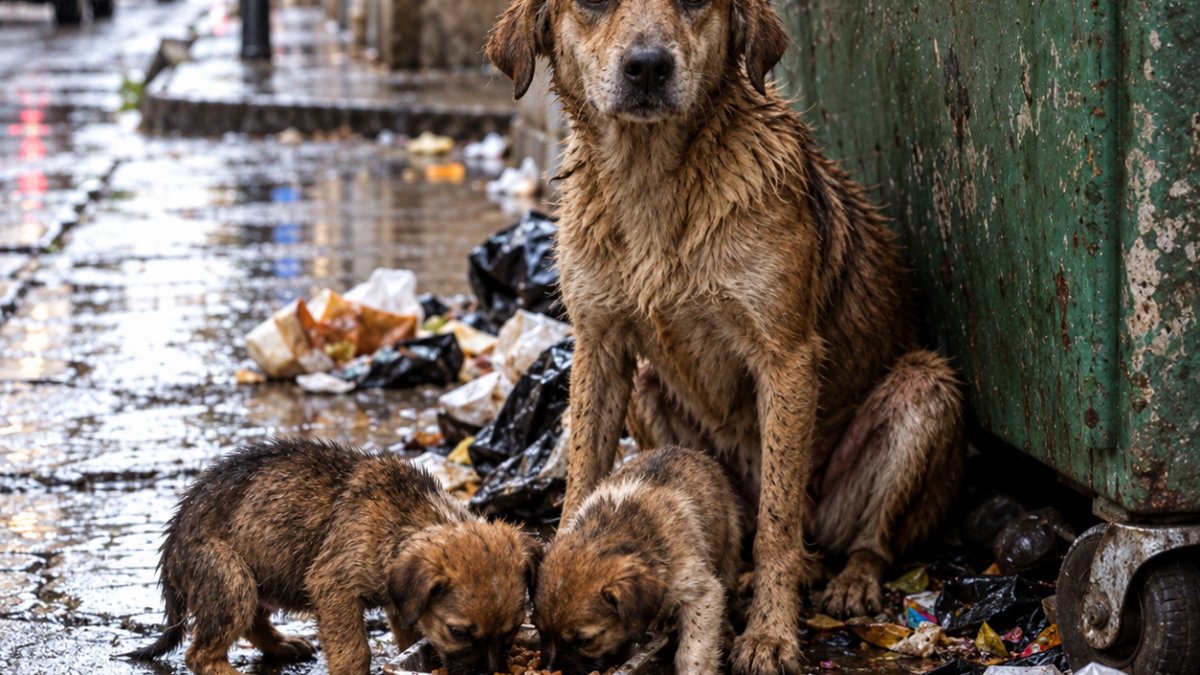
The brown dog had spent days beside an overflowing dumpster in the rain, but when I finally put food in front of her, she wouldn’t take a single bite.
She kept looking over her shoulder toward a dark space between the garbage container and the wall, as if hunger was something she could survive but leaving that spot unattended was not.
Then two tiny muddy faces appeared from the shadows, and I realized the starving dog in front of me had been making a choice nobody on that street had understood.
My name is Rachel Morgan, and I had been volunteering with a local animal rescue for almost nine years when a resident named Carlos called about a dog who had been sitting beside the same dumpster for several days.
“She’s there every morning,” he told me. “Sometimes at night too.”
“Is she injured?”
“I don’t know.”
“Does she let anyone close?”
“Not really.”
“Is she eating from the garbage?”
“That’s the strange part. I don’t think she is.”
That made me pay attention.
It was raining when I reached the narrow street that afternoon.
Water filled cracks in the pavement.
Plastic bottles floated along the curb.
The dumpster stood against an old brick wall behind a row of small repair shops.
And beside it sat the dog.
Brown coat.
White patch on her chest.
Thin.
Soaked.
Her ears were pinned slightly back, and her body looked exhausted in the way only an animal living outside for too long can look.
Carlos stood several yards away.
“That’s her.”
I crouched.
The dog immediately rose.
Not running.
Just ready.
“Easy.”
I placed a container of wet food on the ground and backed away.
Her nose moved.
She smelled it.
For a moment, I thought hunger would bring her straight toward me.
Instead, she looked behind herself.
At the dumpster.
Then back at me.
Then behind her again.
“What is she looking at?” Carlos whispered.
“I don’t know.”
The dog approached the food.
One step.
Two.
Stopped.
Then suddenly turned and disappeared behind the dumpster.
Carlos started forward.
I held up one hand.
“Wait.”
Five seconds passed.
Then I saw movement.
A tiny puppy came out first.
Brown and black.
Mud covering his paws.
His belly was narrow, and his ears looked far too large for his head.
Behind him came another.
Smaller.
Tan.
Both soaked.
Both trembling.
They smelled the food.
And ran.
The mother followed immediately.
I expected her to push them aside.
She didn’t.
She sat behind them.
Watched.
The puppies buried their faces in the container.
Their mother never lowered her head.
Not once.
Carlos said quietly, “She’s letting them eat first.”
My throat tightened.
The dumpster had never been her feeding place.
It was her shelter.
The narrow space behind it was where she had hidden her babies from traffic, rain, strangers, and whatever else she had been surviving.
Every time she went looking for food, she had to come back.
Every time somebody approached, she wasn’t protecting herself.
She was returning to them.
I called our rescue.
Then I put down a second bowl.
The mother stared at it.
She looked toward the puppies.
Looked at me.
I sat on the wet pavement.
Did nothing.
Minutes passed.
The puppies finished their first bowl.
One crawled beneath their mother’s chest.
The other stood beside her leg.
Only then did she approach the second bowl.
She sniffed.
Looked at me again.
And finally ate.
Slowly at first.
Then faster.
Carlos let out a breath behind me.
That tiny decision meant more than food.
For the first time, she was allowing someone else to remain close while she stopped watching everything.
I named her Maggie in my head before I had any right to.
We placed a dry blanket near the wall.
Then another.
No grabbing.
No forcing.
No chasing her into a carrier.
We waited.
Almost an hour later, Maggie stepped toward me with one puppy pressed against each side of her body.
And when I slipped the lead gently around her neck, she froze—but she didn’t pull away.
That should have been the hardest part.
It wasn’t.
Because when we reached the clinic and examined the puppies, Dr. Hannah Lewis looked at me and said quietly:
“Rachel, I don’t think these two are the only ones she had.”
PART 2
For a moment, I thought I had misunderstood her.
“What do you mean?”
Dr. Hannah Lewis was standing beside the examination table with one gloved hand resting gently on Maggie’s abdomen.
Maggie was exhausted.
Her wet coat had been towel-dried, but she still looked like she had been carved out of rain and hunger.
The two puppies were in a warmed enclosure a few feet away.
For the first time since we’d found them, they were asleep.
One on top of the other.
Hannah looked at Maggie again.
“I can’t say anything definitively yet.”
That phrase always meant she had noticed something she didn’t want me turning into a story before we had evidence.
“Then tell me what you can say.”
“She’s been nursing recently.”
“We know that.”
“Yes.”
“But based on her mammary development, I’m wondering whether there were more than two puppies.”
My stomach tightened.
“How many more?”
“I can’t tell.”
“Could she simply be producing more milk than these two need?”
“Absolutely.”
“So this may mean nothing.”
“Yes.”
I looked through the glass at the two puppies.
Then I remembered the narrow dark space behind the dumpster.
Plastic.
Broken wood.
Wet cardboard.
“How old are they?”
“Maybe five to six weeks.”
“Old enough to move around.”
“Yes.”
“Old enough for one to wander.”
“Yes.”
I hated the calmness in Hannah’s voice because it kept my own panic from having anywhere useful to go.
“Can we scan her?”
“We’ll examine her properly first.”
Maggie looked at me.
Her eyes were dark and tired.
But she wasn’t frantic.
That mattered.
If she had puppies missing at that exact moment, would she be this calm?
Maybe.
Maybe not.
Dogs do not read human scripts.
I refused to decide what she must feel.
Hannah continued.
“First priority is making sure she and the puppies are medically stable.”
I nodded.
Maggie was underweight.
Not skeletal.
But too thin for a nursing mother.
Her paw pads were worn.
She had mild skin irritation around her belly from lying on dirty, wet surfaces.
Fleas.
Intestinal parasites were suspected.
No major wounds.
No fever.
No immediate sign of serious illness.
The puppies were also thin, mildly dehydrated, flea-infested, and carrying the swollen little bellies often associated with parasites.
But their temperatures were stable.
They were alert.
They ate.
Those were good signs.
We named them temporarily for paperwork.
The larger brown-and-black male became Milo.
The smaller tan female became Daisy.
Maggie watched every second.
When Emily, our veterinary assistant, lifted Daisy onto the scale, Maggie stood.
No growl.
No bark.
Just stood.
“Easy, mama.”
Emily kept the puppy where Maggie could see her.
The scale beeped.
Daisy was returned.
Maggie sat again.
Milo next.
Same reaction.
Watch.
Confirm.
Relax.
“She’s very focused on them,” Emily whispered.
“She had to be.”
Outside, there had been no kennel walls.
No locked door.
No one assigned to protect them.
Only her.
We gave Maggie food in a separate bowl.
She looked at the puppies before eating.
Again.
That behavior could easily become sentimental if I let it.
Selfless mother starves herself so babies can eat.
Maybe partly.
But nursing dogs also have strong maternal instincts.
Stress can interrupt appetite.
She may have been afraid to eat while strangers were nearby.
The important thing was simpler.
She needed calories.
So did the puppies.
For the next hour, Hannah worked.
Bloodwork.
Fecal testing.
Basic imaging because of her body condition and reproductive history.
Then she called me into the consultation room.
“Good news first.”
“I like good news first.”
“No retained fetus. No obvious uterine emergency. Nothing suggesting she’s currently in a reproductive crisis.”
I breathed.
“And the other puppies?”
She shook her head.
“Imaging can’t tell us how many she delivered weeks ago.”
“So we still don’t know.”
“No.”
“Could there have been only two?”
“Yes.”
“Could there have been more?”
“Yes.”
I rubbed my forehead.
“Wonderful.”
“You love certainty.”
“I love sleeping.”
“You chose rescue poorly.”
Fair.
I called Carlos.
“Can you go back to the dumpster?”
“I’m already here.”
Of course he was.
“Don’t crawl into anything dangerous.”
“I know.”
“Listen carefully.”
“For puppies?”
“Yes.”
“Okay.”
“Look for tracks, bedding, evidence. But don’t tear apart the area until animal control or someone else is there.”
“I understand.”
“I mean it, Carlos.”
“So do I.”
He sent pictures twenty minutes later.
The hidden space was larger than it looked from the street.
Behind the dumpster was a shallow recess between the brick wall and an old sheet-metal barrier.
Someone had dumped broken shelving there.
Cardboard.
Plastic.
A torn moving blanket.
That blanket looked flattened in one corner.
Nest.
Possibly.
Carlos sent a video.
Traffic passing.
Water dripping.
Then silence.
No crying.
No movement.
Animal control joined him.
They moved the dumpster carefully with permission from the property manager.
Searched behind it.
Under pallets.
Inside drainage gaps.
Nothing.
No puppies.
No remains.
That last part mattered.
We checked neighboring lots.
Nothing.
Spoke with shop owners.
One mechanic said he had seen Maggie weeks earlier.
“Pregnant?” I asked over the phone.
“Maybe. Bigger.”
“How long ago?”
“Month? More?”
“Did you see puppies?”
“No.”
A woman at a convenience store remembered Maggie coming at night.
“She took food.”
“How much?”
“If I put scraps out, she’d grab something and leave.”
“Did she eat there?”
“Sometimes.”
“Sometimes?”
“Usually she carried it away.”
That sent a chill through me.
To puppies.
Probably.
“How long had she been doing that?”
“Couple weeks.”
“Did you ever follow her?”
“No.”
Fair.
Nobody expects a stray dog carrying a piece of chicken down an alley to become the center of a rescue investigation.
Another man said he had seen three puppies once.
My heart jumped.
“Three?”
“Maybe.”
“When?”
“Few days ago.”
“What color?”
He hesitated.
“One brown. One yellowish. Another dark.”
Milo was brown.
Daisy tan.
Another dark.
Maybe.
Or he had seen shadows.
Memory becomes unreliable quickly when people are asked to reconstruct things they barely noticed at the time.
Still, we wrote it down.
That evening, Maggie slept with Milo and Daisy pressed against her belly.
We had moved them into a quiet maternity room at the rescue clinic.
Fresh blankets.
Warm floor.
Food available.
Clean water.
Dim light.
I checked through the small window.
Maggie was awake.
Of course.
Her head rested on the bedding, but her eyes tracked every sound.
When I entered, she lifted her head.
“Just me.”
No response.
I sat several feet away.
No reaching.
No touching the puppies.
For twenty minutes, I read emails on my phone.
Eventually Maggie lowered her head.
Milo twitched in his sleep.
Daisy crawled closer to her mother.
Maggie sighed.
A full-body exhale.
Then closed her eyes.
That was the first time I saw her sleep.
Not doze.
Sleep.
I stayed until her breathing deepened.
The dog who had been sitting beside a dumpster through cold rain finally had someone else watching the door.
The next morning, Carlos called before seven.
“I found something.”
My stomach dropped.
“What?”
“A puppy.”
I stood so fast I hit my knee on the desk.
“Alive?”
“Yes.”
“Where?”
“Not at the dumpster.”
“Then where?”
“Storm drain.”
Everything inside me tightened.
“How far?”
“About half a block.”
“Condition?”
“Moving. Crying. I can’t reach him.”
“I’m coming.”
Hannah heard enough of the call to grab a medical bag.
We drove.
Carlos was kneeling beside a curb when we arrived.
A narrow storm drain ran under the street.
Rainwater had slowed overnight, but everything was still wet.
From inside came a sound.
Tiny.
Sharp.
Repeated.
A puppy.
Animal control was already there.
A public-works employee removed the drain cover.
Flashlight.
Fifteen feet in.
Two eyes.
Dark fur.
I thought of the mechanic’s memory.
Another dark puppy.
“Can he get farther away?”
“Pipe narrows.”
“Is water rising?”
“No rain forecast for the next few hours.”
Good.
The public-works employee lowered a flexible camera first.
The puppy was wedged on a small shelf of debris above the remaining waterline.
Alive.
Cold.
One side of his body muddy.
The easiest access point was another opening farther down the street.
For forty minutes, they worked.
Nobody reached blindly.
Nobody sent someone crawling into an unsafe pipe.
They opened the second access.
Used a long humane catch pole with a soft loop only as a last guided tool, but the puppy kept retreating.
Then Carlos had an idea.
“Can we bring Maggie?”
I froze.
Hannah looked at me.
Maybe.
Maternal vocalizations.
Scent.
Could encourage the puppy to move.
But transporting Maggie unnecessarily carried stress.
We discussed it.
Controlled.
Carrier.
No contact with street hazards.
Worth trying.
I drove back.
When I entered the maternity room, Maggie stood immediately.
“Maggie.”
She looked at me.
I leashed her.
She followed.
Not happily.
But more willingly than the first day.
In the car, she paced once.
Then settled.
The moment we reached the storm drain, something changed.
Maggie’s nose went up.
She pulled.
Hard.
First time she had ever pulled on a leash with me.
“Maggie?”
She sniffed the curb.
Moved toward the drain.
The puppy cried.
Maggie’s entire body snapped toward the sound.
There was no ambiguity now.
She whined.
Loud.
The puppy cried again.
Maggie barked once.
Then another whine.
The sound from the pipe changed.
Closer.
The public-works employee watched the camera.
“He’s moving.”
Maggie paced along the opening.
Whined.
The puppy crawled.
Five feet.
Stopped.
Maggie vocalized again.
Another few feet.
Eventually we saw him.
Tiny black body.
Mud-coated.
Eyes wide.
The worker used a towel and gloved hands when the puppy reached the open access.
Lifted him.
Maggie nearly pulled me over.
“Easy!”
We brought the puppy toward her carefully.
She smelled him.
Then began licking his entire face with desperate force.
The puppy squealed.
She licked harder.
“Okay, Mom.”
Hannah laughed through tears.
“That’s definitely hers.”
We named him Finn.
He was colder than the others.
More dehydrated.
One paw had a shallow cut.
Otherwise, astonishingly stable.
“How long could he have been in there?” Carlos asked.
“Impossible to know,” Hannah said.
Maybe he wandered during rain.
Maybe he followed Maggie.
Maybe he became separated days earlier.
We could not prove the timeline.
But he belonged to her.
That much was obvious.
The reunion back at the clinic answered something else.
When Maggie entered the maternity room carrying Finn’s scent, Milo and Daisy woke.
Finn cried.
They rushed toward the carrier.
Maggie paced until we allowed controlled reunion after Hannah finished the exam.
Three puppies.
Possibly her whole litter.
Possibly not.
We still searched for two more days.
No fourth puppy.
No evidence of one.
Eventually, we accepted the only responsible conclusion:
Three were confirmed.
Anything else remained unknown.
Maggie seemed settled with them.
Her constant vigilance decreased after Finn returned.
That observation mattered.
Maybe she had been searching.
Maybe his absence had been why she remained so fixed on the street corner.
Maybe not.
But once Finn was back, Maggie slept longer.
Ate more.
Stopped standing every time a distant puppy sound came from another part of the clinic.
The change was difficult to ignore.
Her recovery began in earnest after that.
And recovery for a nursing mother was different from recovery for a single stray.
She needed calories.
A lot.
High-quality food.
Water constantly.
Parasite treatment safe for her condition and nursing status.
Flea control appropriate to all four.
Monitoring for mastitis.
Monitoring body weight.
Monitoring puppies.
Monitoring stool.
Rescue is glamorous only from very far away.
Up close, it is mostly charts about poop.
Maggie’s fecal test confirmed intestinal parasites.
So did the puppies’.
Treatment started.
No dramatic diagnosis.
Common.
Treatable.
Still important.
The puppies gained weight steadily.
Finn caught up fastest.
Maybe because surviving a storm drain had given him a personal grudge against weakness.
Milo remained the largest.
Daisy the smallest.
Daisy also became the loudest.
Every meal was apparently a constitutional emergency.
If food was thirty seconds late, she screamed.
Maggie would look at us with an expression that seemed to say:
You hear what I’ve been dealing with?
I fell in love with all of them.
Dangerous.
Very dangerous.
At first, Maggie tolerated touch rather than sought it.
I would sit beside her.
Offer food.
Touch shoulder briefly if she allowed.
Stop.
Next day.
Repeat.
One afternoon, I sat inside the room while the puppies wrestled with each other.
Maggie lay beside them.
I was answering messages.
Then something touched my hand.
Her nose.
I stayed still.
Maggie sniffed my fingers.
Then put her chin on my knee.
I almost stopped breathing.
No tail wag.
No dramatic cuddle.
Just weight.
Warmth.
Choice.
I lowered one hand onto her neck.
One stroke.
Paused.
She stayed.
Another.
Maggie closed her eyes.
There are moments in rescue that look like nothing in photographs.
That one was enormous.
She had spent days controlling distance between strangers and her puppies.
Now she was closing the distance herself.
A week later, she wagged when I entered.
Not tiny.
Full tail.
Emily witnessed it.
“She likes you.”
“I bring food.”
“Still counts.”
Fair.
By week three, the puppies were chaos.
They learned toys.
Milo loved rope.
Finn attacked cardboard.
Daisy preferred human shoelaces.
Maggie watched.
Occasionally corrected them.
Mostly looked tired.
Motherhood.
We gave her breaks.
That mattered.
Once the puppies were old enough and medically safe, Maggie could spend short supervised periods outside the maternity room while they stayed secure.
At first, she refused.
I opened the gate.
She looked out.
Looked back.
Stayed.
Next day, same.
Third day, she stepped into the hallway.
Turned around.
Returned.
Fourth day, she walked with me to the yard.
She peed.
Sniffed grass.
Then pulled back toward the door.
Five minutes.
That was enough.
The next week, ten minutes.
Then fifteen.
Eventually she learned something important.
She could leave them somewhere safe.
And they would still be there when she returned.
That changed her.
At the dumpster, leaving meant risk.
Traffic.
People.
Rain.
Unknown dogs.
Maybe losing a puppy to a storm drain.
At the rescue, leaving meant the puppies remained behind a locked door with clean blankets and staff.
Predictability gradually replaced vigilance.
One afternoon Maggie stayed in the yard for twenty-five minutes.
She rolled in grass.
Actually rolled.
Back first.
Four legs in the air.
Wiggled.
I laughed so loudly she stopped and stared at me.
“Sorry.”
She sneezed.
Then did it again.
That was the first time I saw her behave like a dog who belonged only to herself.
Not mother.
Not protector.
Not stray.
Maggie.
That mattered.
Then Marcus from animal control called.
“We may know where she came from.”
I sat down.
“Tell me.”
“Maybe.”
“I hate maybe.”
“I know.”
A delivery driver had seen our found-dog post and recognized Maggie.
He believed she had lived at a small rental property about a mile from the dumpster.
We checked.
The house had a chain-link yard.
Empty now.
Landlord renovating.
Previous tenant gone three weeks.
“Dog listed on lease?”
“No.”
“Any neighbors?”
“Yes.”
Marcus interviewed them.
One woman recognized the photograph immediately.
“That’s Brownie.”
My stomach twisted at the name.
“Brownie?”
“She belonged to the people next door.”
“Family?”
“Couple.”
“Puppies?”
The neighbor nodded.
“She had them right before they moved.”
“How many?”
“Three, I think.”
There.
Three.
Milo.
Daisy.
Finn.
My breath loosened.
“What happened when they moved?”
Neighbor’s expression changed.
“I thought they took them.”
They had not.
The former tenant, Kevin Marsh, was eventually reached by phone.
His story was blunt.
Maggie—Brownie to him—had been his girlfriend’s dog originally.
She became pregnant after getting loose.
Puppies were born in a shed behind the rental house.
Then the couple broke up.
The landlord ended the lease.
Kevin moved into an apartment where pets were prohibited.
His former girlfriend had moved out of state and told him she couldn’t take the dog.
“What did he do?” I asked Marcus.
“He says he left food outside for several days after moving.”
My hand tightened around the phone.
“Then?”
“He thought a neighbor would take them.”
“Did a neighbor agree?”
“No.”
“Did he contact a shelter?”
“No.”
“Animal control?”
“No.”
“Rescue?”
“No.”
“Post them?”
“No.”
“Veterinarian?”
“No.”
“So he left a nursing dog and three puppies at an empty rental.”
“Yes.”
“What happened to them?”
“Landlord says he came to begin cleanup and found the yard gate open. Dog and puppies gone.”
“How long after Kevin left?”
“About five days.”
“And nobody reported them missing.”
“No.”
I closed my eyes.
Maggie had not chosen the dumpster because she preferred street life.
She had been left at a house that stopped being home.
Then something opened the gate.
Or someone.
She moved.
Three puppies following or being moved one at a time.
Somehow they reached the dumpster area a mile away.
At some point Finn ended up in the storm drain.
Maggie kept the others alive.
Again, pieces.
Not everything.
Enough.
Marcus asked:
“You want me to send the interview summary?”
“Yes.”
“I already know your face right now.”
“Then don’t call me.”
“I’m required to.”
“Terrible policy.”
The neglect investigation started.
Kevin’s defense came immediately.
He said Maggie technically belonged to his ex-girlfriend.
His ex-girlfriend said Kevin had agreed to keep her until he found a home.
Messages existed.
That mattered.
She had texted:
Can you keep Brownie and babies until rescue takes them?
Kevin:
Yeah I got it.
Two days later:
Did you call anyone?
Kevin:
Not yet. Busy moving.
Then:
Please don’t leave them there.
Kevin:
They’re fine. I left food.
Final message:
Kevin please answer me.
No reply.
The evidence was not cinematic.
Again.
Texts.
Lease dates.
Photographs.
Neighbor statements.
Maggie’s condition.
Puppies.
An empty property.
A man who kept believing temporary abandonment was not abandonment if food remained behind.
When Marcus told Kevin Finn had been found in a storm drain, there was reportedly a long silence.
Then:
“I didn’t put him there.”
No one said he did.
That was not the point.
When you leave vulnerable animals without an assigned caretaker, you lose control over what happens next.
That is the danger.
Maggie had spent days compensating for a human decision she did not understand.
The puppies did not know the lease ended.
They did not know the apartment prohibited pets.
They did not know a relationship failed.
They only knew the person who had provided shelter stopped coming.
Maggie responded the only way she could.
Move.
Hide.
Find food.
Return.
Watch babies eat.
Repeat.
The investigation took months.
During those months, we focused on the dogs.
That distinction became important.
Kevin’s consequences would not heal Maggie’s paws.
Court would not teach Daisy that bowls refill.
A judge could not give Finn confidence after the storm drain.
Recovery happened elsewhere.
Meals.
Blankets.
Vaccinations.
Deworming.
Play.
Routine.
The puppies reached eight weeks.
Then ten.
Their personalities became unmistakable.
Milo was thoughtful.
He watched before acting.
Finn was fearless in ways that made us nervous.
He climbed everything.
Daisy believed every person was her personal employee.
Maggie, meanwhile, gained weight.
Her ribs softened beneath muscle.
Her coat shone.
She began meeting carefully selected dogs.
Calm ones first.
She was socially appropriate but cautious.
No aggression.
Good communication.
That opened more adoption possibilities.
But we weren’t ready.
The puppies needed independence first.
We gradually weaned them.
Maggie seemed relieved.
One morning Daisy tried to nurse.
Maggie stood up and walked away.
Daisy followed.
Maggie got on a raised bed.
Daisy screamed.
I looked at Maggie.
“You’re done?”
Maggie sighed.
Apparently yes.
Motherhood had an expiration date.
Good.
She deserved a life after puppies.
At twelve weeks, the puppies were ready for adoption.
Applications came quickly.
Puppies are easy to place compared with adult mothers.
That fact always hurts.
Everyone wants babies.
The mother who kept them alive becomes background.
I refused to let that happen emotionally, even though placement would occur individually based on needs.
Milo went first.
A retired couple named George and Elaine.
Fenced yard.
Old Labrador recently lost to age.
Lots of time.
Milo met them and climbed under Elaine’s chair.
Not onto her.
Under.
Then fell asleep.
George smiled.
“I guess he picked shade.”
Milo’s first-night update showed him asleep beneath their kitchen table.
Of course.
Daisy went to a family with a twelve-year-old girl named Sophie and an older small mixed-breed dog named Penny.
Daisy arrived, attempted to steal Penny’s bed, got corrected, and immediately decided Penny was brilliant.
Finn was harder.
Not because nobody wanted him.
Because everyone did.
The storm-drain story had circulated.
People wrote:
“I want the miracle puppy.”
No.
We were not adopting a miracle.
We were adopting a high-energy adolescent dog who climbed fences made of air.
Eventually, Finn went to a young couple who ran trails and already had a confident adult dog.
They understood structure.
Training.
Secure gates.
Most importantly, they barely mentioned the storm drain.
Good.
Adoption days were bittersweet.
Maggie watched each puppy leave.
I worried.
Human worry.
Would she grieve?
Search?
Become distressed?
Milo first.
Maggie sniffed him before departure.
Then he left.
She waited near the door for ten minutes.
Then took a treat.
Daisy left.
Maggie vocalized once.
Walked around.
Settled.
Finn left last.
That was the one I feared most.
Maybe because of the reunion at the drain.
Maybe because I had built a story around it.
Maggie sniffed Finn.
He licked her face.
Then jumped into the adopter’s car because there was chicken.
Maggie watched the vehicle leave.
I stood beside her.
She stayed at the gate.
Five minutes.
Ten.
Then turned toward me.
I opened the door to the rescue.
Maggie walked inside.
No collapse.
No dramatic refusal.
Her puppies were ready.
So was she.
That evening, something remarkable happened.
Maggie chose a toy.
A blue rubber ball.
For months, toys had belonged to the puppies.
She had ignored them.
Now she picked one up.
Carried it to her bed.
Chewed.
Then brought it to me.
I stared.
“You want me to throw this?”
Tail wag.
I tossed it three feet.
She followed.
Picked it up.
Didn’t return.
Fine.
We were learning.
She was no longer feeding anyone before herself.
No longer staying awake because three babies depended on her.
No longer returning to a dumpster.
This part of her life belonged to her.
That was when I started thinking Maggie’s happy ending might require something different from her puppies’.
Quiet.
Predictability.
Someone who appreciated an adult dog.
Someone willing to let trust happen slowly.
Her adoption profile emphasized who she was now.
Gentle.
Moderate energy.
Food motivated.
Good leash manners improving.
House training progressing.
Affectionate once comfortable.
Likely happiest in a calmer home.
We included her history, but not as the selling point.
Applications came.
Fewer than for the puppies.
Of course.
One person asked:
“Can she have another litter?”
Rejected before I finished reading.
One wanted an outdoor dog.
No.
One wanted to adopt her because “mother dogs are more loyal.”
Wrong reason.
Then a woman named Rebecca Hayes applied.
Forty-five.
Widowed.
Works from home doing medical billing.
No children living at home.
Adult daughter nearby.
Fenced yard.
One old cat named Oliver who had lived with dogs before.
Rebecca’s previous dog had died at fourteen.
Her application said:
I’m not looking for a puppy. I’m looking for a dog who wants a quiet life and a person who will be there most of the day.
We called.
Rebecca visited.
Maggie did not run toward her.
Good.
Rebecca sat in a chair.
Did not call.
Even better.
Maggie sniffed from ten feet.
Then five.
Rebecca ignored her.
At twenty minutes, Maggie approached.
Sniffed Rebecca’s shoe.
Rebecca remained still.
Maggie moved away.
Then returned.
Sat beside the chair.
Rebecca whispered:
“Hello.”
Maggie looked up.
That was it.
No hug.
No dramatic connection.
Perfect.
Second visit.
Maggie accepted treats.
Third.
Allowed Rebecca to scratch her chest.
Fourth.
Maggie walked with her.
At the home check, Oliver the cat stared through a glass door with the disappointment of a landlord discovering unauthorized tenants.
Maggie looked.
Then looked away.
Good.
Adoption day came four months after the dumpster rescue.
I packed Maggie’s food.
Records.
Parasite history.
Spay records.
Blanket.
Blue ball.
Rebecca clipped the leash on.
Maggie looked at me.
My throat tightened.
“You ready?”
Tail moved.
I wanted to tell her she was finished protecting everyone.
Finished watching bowls.
Finished sleeping in wet corners.
But dogs do not need speeches.
They need what comes next to be true.
So I simply walked her to Rebecca’s car.
Maggie stepped in.
Turned once.
Lay down.
Rebecca closed the door.
Then she came around and hugged me.
“I’ll take care of her.”
“I know.”
“If she doesn’t eat the first night?”
“Give her time.”
“If she keeps watching the door?”
“Let her.”
“If she misses the puppies?”
“She may. Keep routine stable.”
Rebecca nodded.
“What if she thinks I’m going to leave?”
I looked through the car window.
Maggie watching us.
“You don’t convince her with one promise.”
“How then?”
“Come back tomorrow.”
Rebecca smiled.
“And the next day?”
“Exactly.”
That became Maggie’s real rehabilitation.
Not what happened at the rescue.
What happened afterward.
Day after day.
Rebecca stayed.
The first night, Maggie slept beside the back door.
Second night, same.
Third.
Then one week later, Rebecca sent a photograph.
Maggie asleep halfway between the back door and the couch.
Progress measured in feet.
Two weeks later, beside the couch.
One month later, on it.
Rebecca captioned:
I HAVE LOST MY SEAT.
I replied:
ADOPTION COMPLETE.
Maggie developed a routine.
6:15 a.m. bathroom break.
6:30 breakfast.
7:00 Rebecca’s coffee.
Maggie learned that coffee involved no food and remained offended by the entire concept.
At noon, yard.
At three, walk.
At six, dinner.
At eight, blue ball.
At ten, bed.
Predictability.
That was her luxury.
No decisions about whether puppies had eaten.
No calculation of when it was safe to leave a hiding place.
No wet pavement.
No traffic.
Just routine.
For the first several weeks, Maggie did something at meals.
Rebecca noticed.
She would approach her bowl.
Look around.
Wait.
Then eat.
“Is she looking for the puppies?” Rebecca asked me.
Maybe.
Could be old habit.
Could be environmental checking.
Could simply be caution.
We didn’t turn it into certainty.
But over time, the pauses shortened.
Eventually Rebecca could set the bowl down and Maggie would eat immediately.
The first time that happened, Rebecca texted me:
SHE DIDN’T CHECK. SHE JUST ATE.
I understood why that mattered.
The dog whose entire rescue story began with refusing food while puppies ate had finally learned meals could belong to her.
The court hearing came six months after rescue.
Kevin attended.
His ex-girlfriend provided a statement.
So did the landlord.
Carlos.
The neighbor.
Hannah.
Marcus.
The evidence showed Kevin had agreed to care for Maggie and her newborn puppies temporarily, knew they were at the property, and left without arranging a specific caretaker or surrender.
His attorney emphasized housing instability.
Relationship breakup.
Financial problems.
He had left food.
He believed neighbors would continue helping.
All true or possibly true.
Then the prosecutor displayed a text.
Please don’t leave them there.
Kevin’s response:
They’re fine. I left food.
The prosecutor asked:
“Who was responsible after you left?”
Kevin said:
“I thought the neighbor would check.”
“Which neighbor?”
Silence.
“Did a neighbor agree?”
“No.”
“Did you call a rescue?”
“No.”
“Animal control?”
“No.”
“Shelter?”
“No.”
“So when you say you believed somebody would care for them, you did not know who that somebody was.”
Kevin looked down.
“No.”
That was the entire failure.
Somebody.
Anonymous future rescuer.
Responsibility without a name is often no responsibility at all.
The court imposed consequences based on the actual statutes and evidence.
Fines.
Restitution toward veterinary and rescue expenses.
Mandatory animal-care education.
A period of restrictions related to animal ownership.
No dramatic prison sentence.
No cheering.
Good.
This was not entertainment.
Outside court, Kevin approached me.
I expected excuses.
Instead he asked:
“Are they alive?”
“All four.”
His face changed.
“The puppies?”
“Healthy. Adopted.”
“And Brownie?”
“Maggie.”
He nodded.
“Maggie.”
“Adopted too.”
He exhaled.
“I’m glad.”
I waited.
He looked ashamed.
“I thought leaving food was enough.”
“It wasn’t.”
“I know.”
“Why didn’t you surrender them?”
“I thought they’d judge me.”
That answer again.
Shame.
Pride.
Fear of judgment.
All turning into silence.
“You understand they would rather judge you and have the dogs safe.”
“Yes.”
“You could have made one phone call.”
“I know.”
“You had days.”
“I know.”
I hated how calmly he accepted everything.
Anger likes resistance.
Without it, anger has nowhere theatrical to go.
Kevin rubbed his face.
“My life was falling apart.”
“I believe you.”
He looked surprised.
“That doesn’t make what you did okay.”
“I know.”
“You were overwhelmed.”
“Yes.”
“Maggie was overwhelmed too.”
That landed.
I continued.
“She had three nursing puppies and no idea why the people disappeared.”
Kevin looked away.
“I didn’t think about it like that.”
“That’s the problem.”
He nodded.
“I’m sorry.”
I gave him the same truth I had given other people in other cases.
“I’m not the one you needed to act differently for.”
He swallowed.
“Can I see a picture?”
I hesitated.
Then showed him Maggie in Rebecca’s house.
On the couch.
Blue ball nearby.
Healthy weight.
Coat dry and shining.
Kevin stared.
“She looks good.”
“She is.”
Then I showed him Milo.
Daisy.
Finn.
All safe.
Kevin’s eyes filled when he saw Finn.
“That’s the one from the drain?”
“Yes.”
He looked at the picture for a long time.
“I didn’t know.”
“No.”
“I’m glad somebody found him.”
“Somebody did.”
That word again.
But this time, the somebody had a name.
Carlos.
Animal control.
Public works.
Hannah.
Me.
Maggie.
A chain of people who accepted specific responsibility.
That was the difference.
I walked away from court not feeling victorious.
But I did feel settled.
Maggie didn’t need Kevin destroyed.
She needed him not to repeat the behavior.
She needed her own life to move forward.
Both were possible.
The months afterward were good.
Updates from all three puppies.
Milo discovered snow and hated it.
Daisy discovered a backyard sprinkler and declared war.
Finn became a hiking dog and still attempted to enter every drainage pipe he encountered, apparently having learned absolutely nothing.
His adopters eventually trained a strong “leave it” command.
Thank God.
Maggie met her puppies once at a rescue anniversary event.
I worried about turning it into a reunion spectacle.
So we kept it simple.
Neutral outdoor space.
Leashes.
Distance.
One at a time.
Milo approached first.
Maggie sniffed him.
He sniffed her.
Tail wag.
Then both investigated grass.
Daisy arrived.
More excitement.
Finn nearly knocked over a folding table.
Nothing cinematic.
No mother collapsing with recognition.
They seemed familiar.
Interested.
Comfortable.
Then moved on.
That was healthy.
Their family bond had helped them survive.
Now each had another life.
Maggie spent most of the event beside Rebecca.
That told me everything I needed.
At one point Finn ran toward her too fast.
Maggie corrected him with one bark.
Finn stopped.
Everyone laughed.
Some things never change.
Rebecca leaned down.
“Still their mother.”
Maybe.
Or simply an adult dog with boundaries.
Either way, good for her.
A year after adoption, Maggie’s vet exam showed excellent health.
Healthy weight.
Good bloodwork.
No parasite recurrence.
Strong heart.
Rebecca brought her to see me afterward.
Maggie entered the rescue lobby.
Looked around.
Then walked directly toward me.
Tail wagging.
I crouched.
She pressed her chest against my knees.
“Hey, mama.”
Then I corrected myself.
“Maggie.”
She wasn’t just mother anymore.
That mattered.
She had once been defined entirely by what she protected.
Now she could simply be herself.
Rebecca understood.
“I stopped calling her Mama Maggie.”
“When?”
“Couple months ago.”
“Why?”
“She started doing things that had nothing to do with puppies.”
“Like?”
“Stealing toast.”
“Important identity development.”
“Digging up my herb garden.”
“Self-actualization.”
“Sleeping horizontally across my bed.”
“Recovery.”
Rebecca laughed.
“Exactly.”
Maggie became an ordinary dog.
That may be the best phrase in any rescue story.
Ordinary.
Vet appointments.
Walks.
Rain avoided whenever possible.
Toenail trims she hated.
Blue ball replaced twice.
Barking at delivery trucks.
Squirrels.
Naps.
Nothing heroic.
Nothing tragic.
Years passed.
Maggie turned five.
Then six.
We never knew her exact age, but estimated based on her teeth and condition at intake.
Rebecca celebrated the anniversary of adoption rather than a birthday.
“Gotcha Day” never felt quite right to her because Maggie had not been an object waiting to be claimed.
So she called it Home Day.
Each year, Maggie got chicken.
No cake.
She disliked cake.
Good dog.
At seven, Maggie developed a small benign lump.
Rebecca noticed while brushing her.
Veterinarian.
Needle aspirate.
Benign.
No waiting.
At eight, mild arthritis.
Joint supplements.
Weight management.
At nine, she began walking more slowly.
Rebecca adjusted route.
At ten, Maggie stopped wanting long afternoon walks in summer.
So they went early.
Attention.
Response.
That was the opposite of abandonment.
Kevin’s life surfaced once more.
Marcus had retired by then, but someone from animal control told me Kevin completed all court requirements.
Later, during a housing crisis, he found a stray cat with kittens beneath his apartment stairs.
This time he called the municipal shelter.
Immediately.
The mother and kittens entered foster care.
I heard this secondhand.
I did not contact him.
Did not need to.
That was enough.
Same type of problem.
Different decision.
That was the only revenge worth keeping.
Maggie’s suffering became information.
Information became changed behavior.
The next mother did not have to sit beside a dumpster waiting for anonymous help.
Carlos changed too.
He became one of our most reliable neighborhood eyes.
Not a rescuer exactly.
He had a job.
Family.
Life.
But if he saw an animal repeatedly in one place, he noticed.
He photographed.
Called.
Asked around.
Did not chase.
One morning, years later, he found another dog near that same dumpster.
My heart nearly stopped when he called.
“Not again.”
“No, no. Different situation.”
“What?”
“Collar. Friendly.”
“Then why call me?”
“Phone number on tag is smeared.”
We scanned.
Microchip.
Owner three streets away.
Gate latch broken.
Dog missing four hours.
Home before lunch.
Carlos said:
“That one was easy.”
“Best kind.”
He laughed.
No drama.
No rescue story.
Perfect.
The dumpster itself eventually disappeared.
The repair shops were demolished and replaced with apartments.
When construction started, Carlos sent me a photograph of the empty space.
MAGGIE’S CORNER IS GONE.
I stared at it longer than expected.
No dumpster.
No wall recess.
Fresh concrete.
At first, I felt sad.
Then relieved.
Good.
Let the place disappear.
Maggie did not need a monument to suffering.
Her life had moved elsewhere.
Sunlit living room.
Rebecca’s bed.
A fenced yard.
That was geography worth remembering.
At eleven, Maggie’s muzzle turned noticeably gray.
Rebecca sent me a close-up.
SHE IS BECOMING DISTINGUISHED.
I replied:
SHE IS BECOMING EXPENSIVE.
Senior bloodwork.
Dental care.
Arthritis medication.
Rebecca responded:
WORTH IT.
Always.
At twelve, Maggie began having kidney values that required monitoring.
Early.
Manageable.
Diet adjustments.
More water stations.
Regular testing.
Rebecca took it seriously without panicking.
At thirteen, hearing declined.
She startled if touched while sleeping.
So Rebecca began tapping the floor gently before approaching.
Small adaptation.
Love often looks that boring.
At fourteen, Maggie stopped sleeping in Rebecca’s bedroom every night.
Sometimes she preferred the living room because the orthopedic bed there was firmer.
Rebecca pretended not to be offended.
One weekend, Daisy’s family visited.
Daisy was an older dog now too.
White around muzzle.
Still loud.
Maggie and Daisy sniffed.
Then lay several feet apart in the yard.
No dramatic mother-daughter reunion.
Just two senior dogs sharing sun.
Rebecca took a photograph.
It became one of my favorites.
The puppy who once had to eat while her mother stayed hungry beside a dumpster had grown old enough to lie in a quiet yard while that same mother slept nearby.
Time had done what rescue hoped it would.
Made survival ancient history.
Milo died first.
Cancer at twelve.
His family called us.
He had lived a good life.
No need to make that less painful by pretending otherwise.
Elaine sent Maggie’s family a photograph of Milo as a puppy beneath their kitchen table.
Rebecca placed it near Maggie’s bed for one evening.
I asked why.
“I know Maggie doesn’t understand photographs.”
“Correct.”
“It’s for me.”
That was fair.
Finn died two years later after a sudden illness.
Daisy remained.
Maggie outlived two of her puppies.
That felt wrong emotionally.
But biology owes us no proper order.
When Daisy died at fourteen, Rebecca sat with Maggie that evening.
All three puppies gone.
Maggie around fifteen.
We do not know whether she understood absence across years.
Probably not in the human narrative sense.
But Rebecca understood.
That mattered to her.
The dog who once organized her entire existence around keeping three puppies alive had succeeded.
They had gotten whole lifetimes.
That became the true measure.
Milo did not die at a dumpster.
Finn did not die in a storm drain.
Daisy did not die wet and hungry beside traffic.
They became old dogs.
Loved dogs.
Dogs with medical records thick enough to be annoying.
Dogs with couches.
That was Maggie’s victory.
Not merely getting them through one cold afternoon.
Getting them far enough that other people could take over.
The end of Maggie’s life came slowly.
Kidneys.
Arthritis.
Age.
No single crisis.
Rebecca tracked everything.
Appetite.
Water.
Comfort.
Mobility.
Good days.
Bad days.
Maggie still loved chicken.
Still liked sunlight.
Still carried the third replacement blue ball, though she no longer chased it.
One morning, Rebecca found her lying beside the back door.
That scared her.
Not because Maggie looked ill.
Because it reminded her of the early days after adoption.
Door watching.
“Do you think she’s confused?” Rebecca asked me.
“Maybe.”
“Or wants outside?”
“Take her.”
Rebecca opened the door.
Maggie stepped into the yard.
Walked slowly to the grass.
Lay down in the sun.
That was all.
No symbolic return.
No sign.
She simply wanted sun.
We laughed afterward.
Humans turn old dogs into philosophers when sometimes they just want warm grass.
Maggie deserved that ordinary interpretation too.
Several weeks later, her appetite declined.
Veterinarian same day.
Kidney disease progressing.
Medication adjusted.
Fluids helped temporarily.
Then less.
Her back legs weakened.
She began needing support on steps.
Rebecca installed a ramp.
Maggie refused it the first two days.
Then discovered treats were available at the top.
Suddenly ramps made sense.
At nearly sixteen, she was still teachable when bribery was involved.
The final week was unmistakable.
Maggie ate only a little chicken.
Water.
Small amounts.
Slept more.
Stopped carrying the ball.
Rebecca called me.
“I think she’s tired.”
I heard the sentence.
“Veterinarian?”
“Coming tomorrow.”
“Good.”
“I don’t want to do it too soon.”
“I know.”
“I don’t want to wait too long.”
“I know.”
That is the impossible line every good owner eventually faces.
We talked about comfort.
Things Maggie still enjoyed.
Things she no longer could.
Pain.
Nausea.
Mobility.
Connection.
Sleep.
Rebecca cried.
“She survived so much. I feel like I should give her every possible day.”
“Give her good days.”
“What if tomorrow would have been good?”
“What if tomorrow is the day she needs you not to make her prove she can endure more?”
Silence.
I hated saying it.
It was still true.
Maggie had already spent one part of her life enduring because she had no alternative.
Love should not require that again.
The veterinarian came the next afternoon.
I drove to Rebecca’s house.
Maggie lay in the living room on her orthopedic bed.
Blue ball beside her.
Not clutched.
Just there.
Her muzzle almost completely white.
Body thinner.
Eyes still Maggie.
When I entered, her tail moved.
One slow sweep.
I stopped.
Memory hit.
Not my first moment with her.
That had been fear and food.
But the first true sign of trust had been the day she ate while I sat nearby.
Now another small tail movement.
Full circle if you want to call it that.
I sat on the floor.
“Hey.”
Maggie lifted her head.
Then lowered it.
Rebecca sat beside her.
“I keep thinking about the puppies.”
“So do I.”
“She wouldn’t eat until they did.”
“I remember.”
Rebecca stroked Maggie’s chest.
“All three got old.”
“Yes.”
“That’s because of her.”
“Partly.”
“And because of everyone after.”
“Yes.”
She looked at me.
“Is that what rescue is?”
“What?”
“Keeping someone alive long enough for more people to love them.”
I thought about it.
“That’s a good definition.”
Maggie breathed slowly.
The veterinarian examined her one last time.
Kidneys advanced.
Arthritis painful despite medication.
General weakness.
Quality of life had narrowed significantly.
Rebecca made the decision.
No drama.
No last-minute hospitalization simply because saying goodbye felt unbearable.
That was love too.
Before the sedative, Rebecca brought a small bowl.
Chicken.
Maggie sniffed.
Ate one piece.
Then another.
She stopped.
Rebecca cried.
“That’s enough.”
Those words mattered.
Enough.
Maggie had spent the beginning of her story treating food like a resource that needed to go to somebody else first.
At the end, the food belonged completely to her.
No puppies waiting.
No competition.
No need to ration herself.
She ate what she wanted.
Stopped when she wanted.
Enough.
The veterinarian administered the sedative.
Maggie’s body relaxed.
Rebecca kept a hand beneath her chin.
I touched her shoulder.
For a minute, I saw the dumpster again.
Cold rain.
Two puppies running to food.
Maggie sitting behind them.
Watching.
Then Finn in the storm drain.
Maggie crying at the opening.
Milo beneath a kitchen table.
Daisy screaming for breakfast.
Finn hiking.
Maggie rolling in grass.
Blue ball.
Couch.
Gray muzzle.
All of it.
A life is so much larger than the scene that first makes people care.
I whispered:
“You did your job.”
Then immediately regretted the wording.
Maggie had never been obligated to have a job.
Motherhood had been circumstance.
Survival had been necessity.
So I corrected it.
“You can just rest.”
Better.
Rebecca leaned down.
“You don’t have to watch anybody anymore.”
That destroyed me.
Because watching had defined the first moment we understood her.
She wasn’t eating.
She was watching to make sure they did.
Now nobody needed her to watch.
Milo had been safe.
Daisy had been safe.
Finn had been safe.
All three lived whole lives.
Rebecca was beside her.
The door was locked.
The bowl full.
The room warm.
No rain.
No traffic.
Nothing left for Maggie to manage.
Her breathing deepened.
The veterinarian waited until she was fully asleep.
Then administered the final medication.
Maggie died quietly.
No dumpster.
No pavement.
No cold.
No puppies crying in darkness.
Just her own bed.
Her own person.
Her own home.
Almost sixteen years old by our best estimate.
Afterward, Rebecca stayed on the floor for a long time.
Neither of us spoke.
Eventually she picked up the blue ball.
“This was the third one.”
“I know.”
“She destroyed the first.”
“I remember.”
“Second got lost behind the refrigerator.”
“Also remember.”
She held the ball.
“What do I do with this?”
“Whatever you want.”
“Keep it?”
“Keep it.”
“Is that ridiculous?”
“Yes.”
She smiled through tears.
“Good.”
Rebecca kept the ball.
Maggie’s harness came back to the rescue.
Another older dog used it.
Her unopened kidney food went to a local senior-dog foster.
Her blankets were washed.
One remained with Rebecca.
The rest went forward.
That mattered to me.
Use what can still help.
Months after Maggie died, Carlos came by.
He had heard.
He stood in the same rescue lobby where Maggie had once arrived with three puppies.
“She got old?”
“Very.”
He smiled.
“That’s good.”
“Yes.”
He looked down.
“I still remember that first bowl.”
“So do I.”
“I thought she didn’t want the food.”
“She wanted it.”
“Just not first.”
We stood quietly.
Carlos said:
“I learned something from her.”
“What?”
“If an animal keeps looking behind them, look behind them too.”
Simple.
Practical.
That was Carlos.
He had used that lesson twice since.
Once with a stray cat that kept returning to a drainage culvert.
Kittens.
Once with a dog pacing between a gas station and an abandoned car.
Another dog trapped inside.
Neither became a famous story.
Good.
Attention had become habit.
Kevin surfaced once more too.
Years after completing his court conditions, he sent the rescue a money order.
No return address beyond a post-office box.
Twenty-five dollars.
Note:
For a mother dog and her puppies if another one comes in.
I stared at it.
Hannah asked:
“You sending it back?”
“No.”
“Good.”
We used it.
Not for Maggie.
For another nursing dog surrendered when her owner entered the hospital.
That dog never became homeless.
Never sat beside a dumpster.
A foster home was arranged before she even left the veterinary clinic.
Kevin’s twenty-five dollars bought puppy formula and pads.
Small.
Still useful.
That is how I prefer accountability stories to end.
Not with someone permanently frozen as the worst thing they did.
With the harm named accurately.
Consequences.
Then different choices.
Nothing erases Maggie’s street days.
Nothing should.
But suffering is not honored by insisting nobody who contributed to it can ever become better.
The next decision matters.
Always.
Rebecca eventually adopted again.
Two years after Maggie.
Not immediately.
She needed quiet.
Then our rescue received an eight-year-old female mutt named Rosie.
Owner died.
No family could keep her.
Rosie was overweight, bossy, and deeply offended by vegetables.
Rebecca met her.
Rosie climbed onto the couch.
Stared at Rebecca.
Then fell asleep.
Rebecca called me afterward.
“She’s nothing like Maggie.”
“Good.”
“I thought you’d say that.”
“You don’t need Maggie again.”
“I know.”
She adopted Rosie.
The first picture showed Rosie occupying Maggie’s old couch spot.
Rebecca wrote:
I THOUGHT THIS WOULD HURT.
Then:
IT DOES. BUT IT ALSO DOESN’T.
That made sense.
A home can hold more than one chapter.
Maggie was not replaced.
Space reopened.
Years later, a young volunteer asked me about the photograph we kept in our training binder.
Not the dumpster photo.
A later image.
Maggie lying in Rebecca’s yard.
Gray muzzle.
Sunlight.
Blue ball near one paw.
“Who’s this?”
“Maggie.”
“The dumpster dog?”
I disliked the phrase instantly.
“Yes, but I wouldn’t call her that.”
“Why?”
“Because she lived almost sixteen years.”
The volunteer looked at the photograph again.
“So?”
“So the dumpster was a few days.”
She understood.
Maybe.
I showed her the first image anyway.
Wet dog.
Thin.
Two puppies eating.
Maggie behind them.
Watching.
Then the yard picture.
Healthy.
Old.
Resting.
“This is what we’re trying to do.”
“Before and after?”
“No.”
“What then?”
“Make the ‘before’ small.”
She frowned.
I explained.
We cannot always erase what happened.
We can add enough afterward that the suffering becomes proportionally smaller inside the total life.
A few terrible weeks inside sixteen years.
A storm drain inside Finn’s long hiking life.
Hunger inside Daisy’s years of screaming at breakfast.
Wet pavement inside Milo’s warm home.
The past remains true.
It simply stops being everything.
That was Maggie’s revenge.
Not court.
Not Kevin’s embarrassment.
Not punishment.
Time.
Abundance.
Her puppies getting old.
Her own muzzle turning white.
A bowl she no longer had to share.
A woman who came home every day.
A couch.
A ball.
An orthopedic bed.
Medical care before crisis.
A final afternoon where nobody needed anything from her.
The street had required Maggie to be responsible for everyone.
Her home eventually taught her she was allowed to be cared for too.
That may have been the hardest lesson.
For months after rescue, if another dog whined, Maggie’s head rose.
If a puppy cried in another room, she became alert.
If food appeared while other dogs were nearby, she waited.
Those habits faded.
Slowly.
Then one day Rebecca sent me a photograph of Maggie asleep while Rosie—no, Rosie came later. In Maggie’s lifetime, she had no canine housemate. So the house was quiet.
Maggie asleep alone in a patch of sun.
Food bowl still containing half her breakfast.
That photograph meant more than people realized.
Half a bowl.
Uneaten.
Maggie asleep.
At the dumpster, leaving food untouched meant vigilance.
Later, leaving food unfinished meant confidence.
She knew it would still be there.
She knew no puppy was starving behind her.
She knew nobody would take it.
She knew dinner would come.
That is what security does.
It turns resources into ordinary objects.
Water stops being an emergency.
Food stops being a race.
Shelter stops being a hiding place.
Sleep stops being a risk.
A person leaving the room stops meaning abandonment.
Rebecca once told me that when she first adopted Maggie, she used to announce:
“I’ll be back.”
Every time she left.
Grocery store.
Mailbox.
Trash.
“I know she doesn’t understand English like that,” Rebecca said.
“She understands patterns.”
“I kept saying it anyway.”
“Did it help?”
“Me?”
“Yes.”
Rebecca laughed.
“Probably.”
Years later, she stopped saying it.
Not consciously.
One day she realized she had gone to the grocery store without telling Maggie anything.
Came home.
Maggie was asleep.
No pacing.
No waiting at the door.
Rebecca cried in the kitchen.
That was recovery too.
The promise no longer needed words.
The pattern had become proof.
I leave.
I return.
Breakfast comes.
Dinner comes.
Rain stays outside.
Beds remain dry.
Puppies can leave and still be safe.
You do not have to manage the universe.
Every repetition rewrote something.
Maybe not memory.
Expectation.
That is enough.
On the anniversary of Maggie’s rescue years after her death, I drove through the neighborhood where the old dumpster used to stand.
I didn’t plan to.
I was nearby.
The apartments were complete.
Trees planted along the sidewalk.
A coffee shop occupied the corner.
People walked dogs.
A young mother pushed a stroller.
Nobody there knew what had happened on that patch of pavement.
Good.
Places do not owe us memory.
I parked for a minute.
Looked toward where the dumpster once stood.
I could almost place everything.
Carlos near the curb.
Food container.
Maggie.
Two puppies emerging.
Rain.
Then the image shifted.
Not because I was imagining ghosts.
Because memory has layers.
I saw Milo old beneath a table.
Daisy with gray muzzle.
Finn on a mountain trail.
Maggie in sunlight.
The street could no longer hold the story.
It had become too large.
That was exactly right.
I thought about the first sentence Carlos said when he called.
“She’s always there.”
At the time, that sounded like a description of a stray.
Later I understood.
Maggie was always there because three small lives required her to return.
What mattered most about the ending was that eventually she did not have to be always anywhere.
She could wander from bedroom to kitchen.
Yard to couch.
Sun to shade.
She could leave a room without checking what happened behind her.
She could sleep.
She could age.
She could stop being necessary every second.
That is a kind of freedom people rarely include in rescue stories.
We celebrate devotion.
Mothers sacrificing.
Dogs protecting.
Animals refusing to leave companions.
Beautiful.
But love should not condemn someone to vigilance forever.
The best thing we did for Maggie was not praise her sacrifice.
It was make the sacrifice unnecessary.
Feed the puppies.
Find Finn.
Provide shelter.
Raise them.
Place them well.
Then tell Maggie, through routine rather than words:
We have it from here.
You can eat now.
You can sleep now.
You can play now.
You can be a dog now.
She eventually believed us.
That was why her final day felt so complete.
Not happy.
Never confuse complete with painless.
Rebecca lost a companion of more than a decade.
I lost one of the dogs whose life had shaped how I thought about maternal rescues.
It hurt.
But there was nothing unfinished.
No missing puppy.
No unanswered cry.
No animal left behind a dumpster.
No uncertain home.
Milo had lived and died loved.
Finn had lived and died loved.
Daisy had lived and died loved.
Maggie reached the end after them.
Everyone accounted for.
For a dog who spent her first days with us counting constantly—
one puppy.
two puppies.
look back.
check.
watch.
return—
there was something beautiful in that.
Everyone safe.
Nothing left to count.
When Rebecca told Maggie, “You don’t have to watch anybody anymore,” it was the only ending I could have wanted.
The sedative softened her body.
Her eyes closed.
The room kept existing without her supervision.
The door stayed shut.
The bowl stayed full.
Rebecca stayed beside her.
And for once, Maggie did not need to lift her head to make sure everyone else was okay.
We were.
Because she had already done enough.
More than enough.
So when people remember Maggie as the starving mother who let her puppies eat first, I correct them gently.
She wasn’t starving by choice.
She wasn’t trying to become a symbol of motherhood.
She was surviving a terrible situation with the instincts and options available to her.
The beautiful part came later.
When she no longer had to.
When somebody else filled the bowl.
Somebody else checked the puppies.
Somebody else closed the gate.
Somebody else made sure everyone was dry.
And the dog who had spent every day putting herself last finally learned that being cared for was not another danger she needed to guard against.
That was Maggie’s happy ending.
Not that she saved her puppies.
She did.
Not that we saved her.
We helped.
The real ending was that eventually nobody in her family had to be rescued anymore.
They simply lived.
Long enough to become old.
Long enough for the dumpster to disappear.
Long enough for the worst days to shrink into the beginning of a much larger story.
And when Maggie finally rested for the last time, there was no bowl she needed to watch, no puppy she needed to feed, and no reason in the world for her to look back.


