PART 2: She Was Too Weak to Stand—But She Still Put Her Body Between Me and Her Puppy
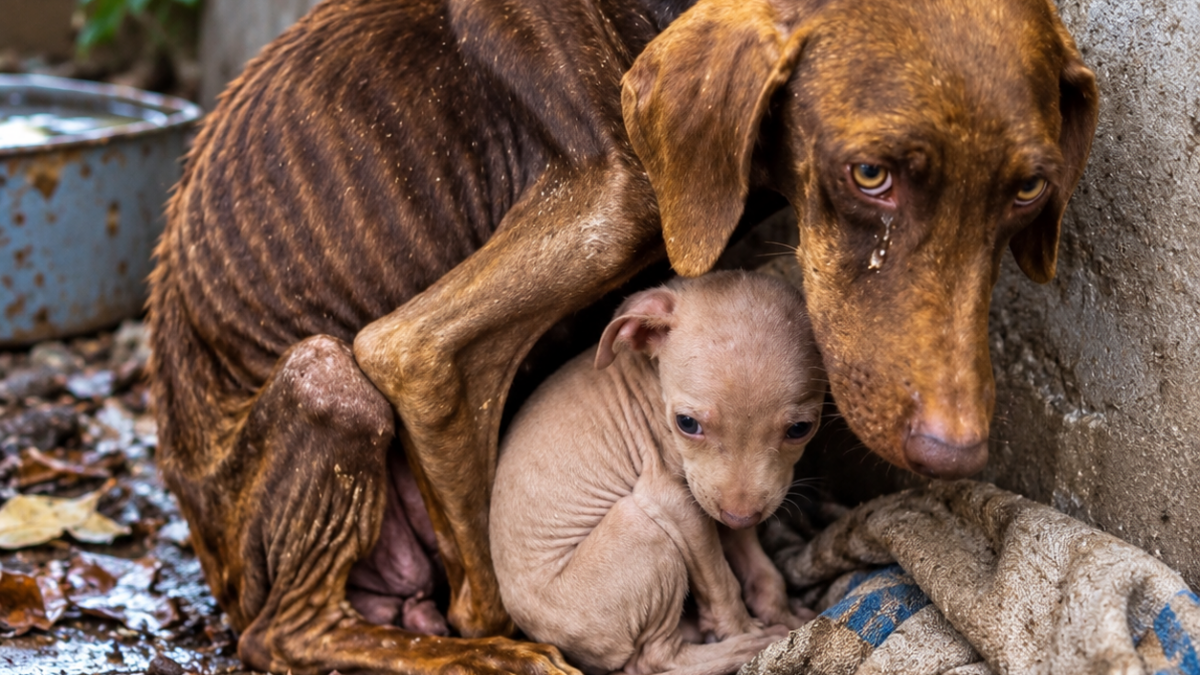
PART 2
She did not walk toward the food.
That was what surprised me.
Instead, she slowly unfolded herself from the corner and pushed the puppy forward with her nose.
Just a few inches.
Then she stopped.
Her eyes stayed on me.
At first I thought I had misunderstood.
Then she nudged him again.
The puppy stumbled forward on unsteady legs.
I looked at her.
“You want me to take him?”
Her ears shifted.
I knew better than to assign human reasoning to every movement an animal made, but I also knew what I was seeing.
She was exhausted.
She was hungry.
She was frightened.
And yet, before she approached the food, she wanted to know what I would do with her baby.
I moved slowly.
I took off my jacket, laid it on the pavement between us, and placed my hands flat against my knees.
“No tricks,” I said. “You both leave together.”
The puppy smelled the jacket.
His little nose twitched.
He took two uncertain steps onto it.
The mother immediately stood.
Her back legs shook so hard I thought she might fall.
“It’s okay.”
She moved toward him.
And that was when I realized just how weak she was.
Her first step was careful.
Her second was worse.
By the third, one leg nearly folded beneath her.
I reached instinctively.
She froze.
So did I.
“Sorry.”
I slowly withdrew my hand.
She remained standing.
The puppy turned toward her.
Then, somehow, she made it to him.
She touched his side with her nose.
Only after confirming he was still there did she look toward the bowl.
“Go ahead,” I whispered.
This time she ate.
Not wildly.
Not desperately.
She took one mouthful, lifted her head, checked the puppy, then took another.
Every few bites, she stopped.
Every time she stopped, she looked at him.
Luis rubbed both hands over his face.
“I’ve never seen anything like that.”
“I have,” I said.
But that was only partly true.
I had seen maternal instinct.
I had never seen it expressed with such quiet determination.
When she finished half the bowl, I took out my phone.
I called our veterinary clinic.
Dr. Maya Patel answered.
“What do you have?”
“Adult female. Very underweight. Nursing or recently nursing. One puppy.”
“Responsive?”
“Yes.”
“Walking?”
“Barely.”
“Any obvious injuries?”
“Nothing I can see from here.”
“Bring them in.”
“I’m still negotiating.”
There was a pause.
“With the dog?”
“With the mother.”
Dr. Patel understood immediately.
“Take your time.”
I ended the call.
The next challenge was transportation.
A frightened dog can become more frightened when a crate appears, especially one that has been surviving by controlling distance.
So I brought the carrier from my van but left it twenty feet away.
The mother noticed it.
Her head came up.
I sat back down.
“You’re right,” I told her. “That thing does look suspicious.”
Luis almost laughed.
The dog didn’t.
For another twenty minutes, I fed her tiny portions.
Little by little, I moved the bowl toward the open carrier.
The puppy followed the smell.
His mother followed the puppy.
Eventually he stepped inside.
She stopped at the entrance.
Her entire body became rigid.
I could see the conflict in her.
The carrier was a trap.
But her puppy was inside.
She looked at me.
Then at him.
Then back at me.
“Both of you,” I promised again.
She stepped inside.
I closed the door.
She turned immediately and wrapped herself around the puppy.
No panic.
No fight.
Just protection.
I carried them to the van.
That was the first time I touched her.
Through the plastic side of the carrier, I felt her body trembling.
“You did it,” I whispered.
I had no idea how much harder the next part would be.
At the clinic, we learned that the mother was younger than she looked.
Dr. Patel estimated she was probably three or four years old.
Her teeth were worn but not old.
Her coat was dull from poor nutrition.
She was dehydrated.
Her muscles had weakened.
But there was no major trauma.
That was the good news.
The harder news was that she had been going without adequate care for long enough that recovery would have to be slow.
“We don’t overwhelm her system,” Dr. Patel explained. “Small meals. Fluids. Rest. Monitoring.”
“And the puppy?”
She smiled for the first time.
“Surprisingly strong.”
I looked toward the examination table.
The puppy was wrapped in a clean towel while a technician listened to his chest.
“How?”
Dr. Patel looked at the mother.
“Because she gave him everything she could.”
The words hit harder than I expected.
The puppy was mildly underweight, but compared with his mother, he was in much better condition.
She had been feeding him.
Cleaning him.
Keeping him warm.
Possibly sharing whatever scraps she found.
While her own body became smaller.
We named her Mara.
I don’t remember exactly who said it first.
One of the technicians suggested it because the name sounded strong without sounding harsh.
The puppy became Finn.
That night, they stayed together in a quiet recovery kennel.
Mara refused to sleep until Finn settled against her stomach.
Then she rested her chin over his back.
I stood outside the kennel for several minutes before leaving.
Dr. Patel came beside me.
“You look bothered.”
“I am.”
“Because of her condition?”
“Because I think she belonged to somebody.”
Dr. Patel looked at Mara.
“What makes you think that?”
“She understands doors. She watched my hands. She knew the food bowl. She let us handle her once she decided we weren’t separating them.”
“That could mean many things.”
“I know.”
But something about it bothered me.
The next morning, we scanned her for a microchip.
There was one.
When the number appeared on the scanner, my stomach dropped.
A microchip meant history.
Sometimes it meant nothing.
People forgot to update phone numbers.
Dogs changed homes.
Records became outdated.
But sometimes a chip gave you the one thing an abandoned animal could not give you herself.
A name.
The registration showed that Mara had once been called Daisy.
She had been registered two years earlier to a man named Eric Nolan.
There was an address.
A phone number.
Both were local.
I called.
The number had been disconnected.
So I drove to the address.
It was a small yellow house about four miles from where we found her.
A woman in her sixties answered the door.
“Yes?”
I introduced myself and showed her my rescue identification.
“I’m trying to locate someone who used to have a dog registered at this address.”
Her expression changed immediately.
“What dog?”
“Female. Tan and white. Medium-sized.”
She stared at me.
“Daisy?”
That was the moment I knew.
“You know her?”
“She was my son’s dog.”
“Eric?”
The woman nodded.
“Is she all right?”
I chose my words carefully.
“She’s safe.”
Her hand covered her mouth.
“Oh, thank God.”
There was no performance in the reaction.
She was genuinely relieved.
“Do you know where Eric is?”
“He moved almost a year ago.”
“Did Daisy go with him?”
“Yes.”
“Do you know his new address?”
Her relief faded.
“What happened?”
“I’m still trying to understand that.”
She looked behind her, then opened the door wider.
“Come in.”
Her name was Carol Nolan.
She made coffee neither of us drank.
On her refrigerator was a photograph of Daisy.
Mara.
Healthy.
Bright-eyed.
Standing beside a younger Eric in a backyard.
She was almost unrecognizable compared with the dog in our clinic.
“What happened to her?” Carol asked.
I showed her a photograph from the rescue.
She sat down.
For several seconds, she said nothing.
Then she began crying.
“I knew something was wrong.”
“What do you mean?”
“Eric stopped letting me visit.”
“When?”
“A few months ago.”
“Why?”
“He said he was busy.”
She wiped her face.
“Then he told me Daisy had gone to live with a friend because his apartment didn’t allow dogs.”
“Did he tell you which friend?”
“No.”
“Did you believe him?”
She looked toward the old photograph.
“I wanted to.”
That sentence stayed with me.
Sometimes people do not ignore warning signs because they do not care.
Sometimes they ignore them because the alternative is accepting something painful about someone they love.
Carol gave me Eric’s current address.
It was the same apartment complex where we had found Mara.
My suspicion became something colder.
“Was Daisy pregnant when you last saw her?”
Carol shook her head.
“No.”
“Do you know if Eric had another dog?”
“No.”
“Did he ever talk about breeding her?”
Her expression tightened.
“Once.”
“When?”
“Maybe six months ago. He said puppies could sell for good money.”
There it was.
Not proof.
But a direction.
I thanked her.
Before I left, she stopped me.
“Can I see her?”
“Yes.”
“Will she remember me?”
“I don’t know.”
Carol pressed both hands together.
“I should have gone over there.”
“You didn’t know.”
“I knew enough to worry.”
There was nothing useful I could say to that.
So I gave her the clinic information.
Then I drove back to the rescue.
By the time I arrived, Officer Leah Grant from county animal services was waiting.
I had called her from the car.
Leah had worked animal welfare cases for eleven years.
She had a calm way of speaking that made people underestimate how carefully she listened.
I told her everything.
The microchip.
The former address.
Carol.
The breeding comment.
The apartment complex.
When I finished, Leah leaned back.
“You said an unused service passage?”
“Yes.”
“Inside the property?”
“Behind Building C. Accessible from the parking area.”
“Any indication they were placed there?”
“I don’t know.”
“Security cameras?”
My head came up.
“I didn’t check.”
Leah already had her phone out.
“Let’s start there.”
The apartment manager was not happy to see us.
His name was Gerald Price.
He wore a tie too short for his shirt and spoke like every question was an accusation against him personally.
“I don’t monitor what every tenant does,” he said.
“We’re not asking you to,” Leah replied. “We’re asking whether your exterior cameras cover the rear passage.”
Gerald crossed his arms.
“Why?”
“Because an animal was found there.”
“Strays come through sometimes.”
“This one had a microchip registered to a tenant.”
His face changed.
“Which tenant?”
“We’re not discussing that yet.”
That bothered him.
Good.
Leah asked to preserve the footage from the previous thirty days.
Gerald initially claimed the system automatically erased video after one week.
Then Luis, the maintenance worker who found Mara, stepped into the office.
“No, it doesn’t.”
Gerald looked at him.
Luis continued.
“The new system stores thirty days.”
Silence.
Leah’s voice remained calm.
“Then we need the footage preserved.”
Gerald’s jaw tightened.
“Do you have a warrant?”
“Not yet.”
The word yet did what Leah intended.
He agreed.
We did not receive the footage immediately.
That required formal steps.
But something else happened before we left.
Luis followed me into the parking lot.
“I need to tell you something.”
“What?”
“I’ve seen that dog before.”
My pulse quickened.
“Where?”
“Third floor. Building C.”
“Which apartment?”
He looked toward the building.
“Three-twelve.”
Eric Nolan’s apartment.
“Are you sure?”
“Yeah.”
“When?”
“A few weeks ago. Door was open while I was checking a water leak. She was inside.”
“With the puppy?”
“I didn’t see a puppy.”
“What did she look like?”
He hesitated.
“Thin.”
“How thin?”
“Not like when you found her. But thin enough that I noticed.”
“Did you report it?”
His face fell.
“No.”
“Why?”
“I thought maybe she was old.”
“She’s about three.”
Luis stared at the ground.
“I should’ve said something.”
I had heard that sentence twice in one day.
First from Carol.
Now from Luis.
It would not be the last time.
Mara improved slowly.
During the first three days, she barely acknowledged me unless I approached Finn.
Then her entire attention snapped into place.
If I entered alone, she watched.
If I carried Finn after an examination, she stood.
If he made a sound, she was instantly alert.
So I developed a routine.
Every time I entered their room, I sat on the floor.
No reaching.
No pressure.
I brought food.
Talked quietly.
Sometimes I read messages on my phone aloud just so she became used to my voice.
“You’re not very impressed with weather reports, are you?”
She blinked.
“Fair. Neither am I.”
Finn was different.
Finn loved everybody.
Within a week, he had discovered shoelaces.
Then towels.
Then the fascinating fact that human fingers moved.
He would tumble across the floor, attack the end of my sleeve, and collapse as though he had just completed an expedition.
Mara watched every second.
At first, she became tense whenever he moved too far from her.
But gradually, something changed.
She began allowing distance.
Three feet.
Five feet.
Across the room.
The first time Finn fell asleep beside me instead of beside her, Mara stared at us for nearly twenty minutes.
Then she lowered her head.
That was trust.
Not complete trust.
But enough.
A week after the rescue, Leah called.
“We got the footage.”
I stepped outside the clinic.
“And?”
“You should come down.”
My stomach tightened.
“Tell me.”
“Come down.”
That was all she would say.
The video answered one question and created five more.
The camera behind Building C showed the service passage.
For most of the month, nothing unusual happened.
Then, nine days before we found Mara, at 11:43 p.m., a man appeared.
Eric Nolan.
We could not see every detail, but the timestamp and building entrance camera confirmed it was him.
He was carrying a plastic storage bin.
Something moved inside.
He placed the bin near the passage.
Then he walked back toward the building.
A few moments later, he returned.
Mara followed him.
Even on the grainy security footage, I recognized her.
She was thin already.
But she still walked after him willingly.
That was the worst part.
She trusted him.
Eric led her into the passage.
Then stepped away.
Mara followed.
He pointed toward the corner.
She hesitated.
Then he walked away.
She followed him again.
This happened twice.
The third time, he moved faster.
He returned to the apartment entrance.
Mara stayed behind for several seconds.
Then she ran toward him.
The door closed before she reached it.
She sat outside.
Waiting.
I could barely watch.
For nearly twenty minutes, Mara remained at that door.
She scratched once.
Then sat.
Then lay down.
Then stood again.
Finally, she returned to the service passage.
The storage bin was still there.
A tiny head appeared above the edge.
Finn.
Eric had carried the puppy out first.
Then led the mother to him.
And left them both.
Leah paused the video.
I stood from my chair.
“You have him.”
“We have evidence of abandonment.”
“He deliberately put them there.”
“Yes.”
“And he knew she would stay because the puppy was there.”
Leah looked at me.
“That appears to be what happened.”
I stared at the frozen image on the monitor.
Mara looking toward the apartment door.
Finn in the bin behind her.
I thought about the way she had protected him in that corner.
The way she had refused food.
The way she had pushed him toward me before moving herself.
A cold anger settled in my chest.
“What happens now?”
“We investigate.”
“That’s it?”
“That’s how it starts.”
“He gets to sleep upstairs while she nearly collapses behind the building?”
Leah didn’t flinch.
“I understand you’re angry.”
“No, you understand procedure.”
“I understand both.”
I looked at her.
She continued.
“If you want consequences that hold, we do this correctly.”
That sentence stopped me.
Because she was right.
Anger wanted speed.
Justice required patience.
So we were patient.
Leah interviewed Eric two days later.
He claimed he had “rehomed” Daisy months earlier.
When shown the footage, he changed his story.
He said he had temporarily put the dogs outside because Finn had made a mess inside the apartment.
Then he claimed he planned to bring them back in.
When asked why they remained outside for nine days, he said he assumed someone had taken them.
When asked why he never reported them missing, he had no answer.
When asked why Mara was so underweight, he blamed her.
“She wouldn’t eat.”
Dr. Patel documented that statement carefully.
Because Mara ate perfectly well once food was consistently available.
Then Eric made his biggest mistake.
He asked Leah whether he could get Finn back.
Not Mara.
Finn.
“Why the puppy?” Leah asked.
“Because I can find a buyer.”
The interview ended shortly afterward.
When Leah told me, I sat in silence.
Then I laughed once.
Not because it was funny.
Because sometimes people reveal themselves so completely that you cannot believe they are making your job easier.
“He said that?”
“On record.”
“What happens now?”
“Now I speak with the prosecutor.”
The legal process moved slower than my emotions wanted.
But Mara did not care about court calendars.
Her world was becoming very different.
She gained weight.
Her coat softened.
Her legs grew steadier.
She started following staff members to the door.
Then one morning, something happened that I had been waiting for without realizing it.
I entered the recovery room carrying breakfast.
Finn came charging toward me.
Mara stood behind him.
Her ears lifted.
Her tail moved.
Once.
Just one small wag.
I froze.
“Was that for me?”
Her tail moved again.
I almost dropped the food.
Dr. Patel happened to be passing the doorway.
“Did you see that?”
“I saw it.”
“She wagged.”
“She did.”
I crouched.
Mara walked toward me.
Not Finn.
Me.
She stopped within arm’s reach.
I held perfectly still.
Then she lowered her head and pressed her forehead against my knee.
That was the first time she chose physical contact with me.
I put one hand gently against the side of her neck.
“You’re okay,” I whispered.
Her eyes closed.
For three seconds.
Maybe four.
Then Finn attacked my shoelace and destroyed the moment.
I laughed so hard I startled both of them.
For the first time since I found her, the room felt normal.
Not like a recovery ward.
Not like a rescue scene.
Just a dog, her puppy, and somebody sitting on the floor laughing.
Three weeks after the rescue, Carol visited.
I prepared her before she entered.
“Mara has changed.”
“Does she know her old name?”
“She responds more to Mara now.”
Carol nodded.
“That’s okay.”
“You need to let her approach you.”
“I understand.”
When Carol walked into the room, Mara was lying beside Finn.
Her head lifted.
Carol stopped near the door.
“Oh, Daisy.”
Mara stared.
Carol covered her mouth.
I watched the dog carefully.
For several seconds there was no reaction.
Then Mara stood.
She took one step.
Stopped.
Took another.
Carol began crying silently.
Mara moved closer.
Then her nose started working.
She smelled Carol’s shoes.
Her pants.
Her hands.
And suddenly her tail began moving.
Not the cautious single wag she had given me.
A real wag.
Carol dropped to her knees.
Mara pressed against her.
Carol wrapped both arms around the dog and buried her face against Mara’s shoulder.
“I’m sorry,” she whispered.
Mara licked her cheek.
That nearly broke me.
Because dogs do not demand explanations first.
Sometimes they simply recognize someone who once made them feel safe.
Carol stayed almost two hours.
Before she left, she asked the question I knew was coming.
“Can I take her?”
I looked toward Mara.
“With Finn?”
“Yes.”
“Are you sure?”
She nodded.
“I should have protected her before.”
“This cannot be about guilt.”
“It isn’t.”
I studied her.
“What is it about?”
Carol looked at Mara and Finn sleeping together on the blanket.
“Finishing what I should have done.”
We began the adoption process.
But then the prosecutor called.
Mara and Finn were evidence.
Technically, they could not be permanently transferred until ownership questions were resolved.
Eric had refused to surrender them voluntarily.
Of course he had.
Not because he wanted Mara.
Because his attorney told him surrender might look like an admission.
So for the first time since her rescue, Mara’s future depended on the person who had abandoned her.
That made me furious.
Eric’s attorney contacted our rescue the following week.
He offered a deal.
Eric would relinquish ownership of Mara.
But he wanted Finn.
I read the email twice.
Then a third time.
The reasoning was dressed in polite legal language.
The puppy was “young and highly adoptable.”
Eric claimed emotional attachment.
He claimed he had invested in veterinary care before the puppy’s birth.
He claimed the mother belonged with the rescue because “she appears comfortable there.”
But the puppy should return to him.
I called Leah.
“You’ve seen this?”
“Yes.”
“He wants Finn.”
“Yes.”
“Absolutely not.”
“I know.”
“Can he actually do that?”
“He can ask.”
“And?”
“The prosecutor will oppose it.”
I walked into Mara’s room.
Finn was asleep across her front legs.
She raised her head.
“No,” I told her. “He’s not taking him.”
She blinked.
I knew she didn’t understand the words.
But I needed to say them anyway.
“No one is putting you back in that corner.”
The preliminary hearing took place six weeks after we found them.
I had never enjoyed courtrooms.
They are too clean for the things discussed inside them.
Everything becomes folders.
Case numbers.
Exhibits.
Dates.
You sit beneath bright lights and explain a moment that once smelled like wet concrete and fear.
Eric sat across the room in a dark jacket.
It was the first time I had seen him in person.
He looked ordinary.
That bothered me more than if he had looked cruel.
People expect cruelty to announce itself.
Most of the time it does not.
Sometimes it wears clean shoes.
Sometimes it checks its phone while waiting for court to begin.
Sometimes it tells a judge that abandoning a mother and her puppy outside for nine days was a “misunderstanding.”
The prosecutor presented the security footage.
Eric’s attorney argued that he had never intended permanent abandonment.
Then Leah testified.
Then Dr. Patel.
Then me.
“Describe the mother dog’s condition when you found her,” the prosecutor said.
I did.
Carefully.
No exaggeration.
No dramatic language.
Just facts.
Underweight.
Weak.
Dehydrated.
Protective of the puppy.
Reluctant to leave the corner.
“Did she show aggression?”
“No.”
“Did she accept food?”
“Eventually.”
“Why eventually?”
“She would not leave the puppy.”
“What happened when you placed the puppy in the carrier?”
“She followed.”
“Would she enter without him?”
“No.”
The prosecutor nodded.
“Based on your observations, was the puppy a major factor in where the mother dog chose to remain?”
“Yes.”
Eric shifted in his chair.
That was important.
Because the video showed him leaving Finn in the service passage before leading Mara there.
He had not simply opened a door and allowed them to wander outside.
He had placed the puppy.
Then brought the mother.
Then left.
His own attorney knew what that looked like.
The judge watched the video twice.
The second time, nobody spoke.
Mara followed Eric to the apartment door.
The door closed.
She waited.
That twenty-minute section played in near silence.
I stared at the table.
I could not watch again.
At the end of the hearing, the judge issued a temporary order.
Mara and Finn would remain in rescue custody.
They would not be returned to Eric.
Permanent ownership would be decided later.
It was not everything.
But it meant they were safe.
Outside the courthouse, Eric walked past me.
He stopped.
“You think you saved some dog and now you’re a hero?”
I said nothing.
He stepped closer.
“She was mine.”
That made me look at him.
“No.”
His expression hardened.
“No?”
“You owned paperwork.”
I kept my voice calm.
“She trusted you.”
He laughed.
“It’s a dog.”
That sentence erased any doubt I had about him.
I stepped aside.
“You’re right about one thing.”
“What?”
“She’s a dog.”
I looked toward the courthouse doors.
“And somehow she understood loyalty better than you did.”
I walked away before he answered.
That could have been the end.
It wasn’t.
Because three days later, Luis called me.
“I found something.”
“What?”
“You need to see it.”
I drove back to the apartment complex.
Renovation crews had begun clearing storage spaces in the basement.
Luis led me to a small locked room near the utility area.
Inside were several folding crates.
Empty food bags.
Old blankets.
Plastic puppy pens.
Nothing illegal by itself.
But there were also handwritten notes taped to the wall.
Dates.
Amounts.
Phone numbers.
Descriptions.
“Brown female.”
“Two males.”
“Deposit paid.”
“Pickup Friday.”
My stomach tightened.
“What is this?”
Luis shook his head.
“I don’t know.”
I photographed nothing.
Touched nothing.
I called Leah.
That was the correct thing to do.
She arrived with another officer.
The room was connected to a storage unit assigned to Eric’s apartment.
The apartment manager suddenly became extremely cooperative.
Very quickly, the case changed.
It was no longer only about Mara and Finn.
Investigators began looking into whether Eric had been breeding and selling dogs without proper care or records.
The handwritten list led to several people.
One had bought a puppy from him eight months earlier.
Another had paid a deposit but never received a dog.
A third said the puppy she bought had required immediate veterinary treatment.
None of that automatically proved criminal conduct.
But patterns matter.
Records matter.
Witnesses matter.
And Eric had left a great many behind.
Carol was devastated.
When I told her the investigation had expanded, she sat quietly in the clinic waiting room.
“I raised him,” she said.
I didn’t know what to say.
“He wasn’t like this as a boy.”
“People change.”
“Did I miss it?”
“That isn’t a question I can answer.”
She nodded.
“I know.”
Then she looked through the glass at Mara.
“She deserved better.”
“Yes.”
“So did all of them.”
That was the moment Carol stopped thinking only about saving Mara.
She offered investigators everything she had.
Old messages.
Photographs.
A conversation in which Eric had asked whether she knew anyone who wanted puppies.
Another message complaining about the cost of dog food.
One message stood out.
He had written:
*Once they’re old enough, I’m done feeding all these mouths.*
Carol stared at it.
“I thought he was joking.”
No one said anything.
The investigation lasted months.
While it continued, Mara became almost unrecognizable.
She gained healthy weight.
Her ribs disappeared beneath a smooth coat.
Her eyes changed.
That is difficult to describe unless you have watched a frightened animal recover.
The eyes do not literally change color.
What changes is how long they stay soft.
At first Mara watched every door.
Then she began sleeping through footsteps in the hallway.
At first she ate quickly and checked Finn between bites.
Then she learned food returned every day.
At first she refused to walk far from him.
Then she allowed him to play in another room.
The world stopped being something she had to manage every second.
Finn, meanwhile, became chaos with paws.
He grew fast.
Too fast, according to everyone except Finn.
He loved tennis balls.
He loved cardboard boxes.
He loved Carol.
He loved stealing towels.
He loved falling asleep in positions that looked physically impossible.
And he loved Mara.
No matter how confident he became, every night he returned to her.
He would circle twice and collapse against her side.
Mara would sigh like an exhausted parent.
Then her paw would move over him.
The same gesture I had seen in that wet corner.
Only now it meant something different.
In the corner, her paw had said:
*I will protect you because no one else will.*
In the clinic, it said:
*You’re safe enough to sleep.*
Four months after the rescue, the ownership hearing finally arrived.
This time, Eric did not look confident.
The expanded investigation had changed his attorney’s strategy.
Instead of demanding Finn back, Eric offered to surrender both dogs if several charges were reduced.
The prosecutor refused to make animal custody a bargaining chip.
I respected that.
The hearing proceeded.
The court reviewed the microchip record.
Veterinary findings.
Security footage.
Witness statements.
Photographs.
Messages.
Then the judge asked Eric directly:
“Do you still seek return of either animal?”
His attorney whispered to him.
Eric stared straight ahead.
“No.”
The judge waited.
“No, Your Honor.”
I felt Carol’s hand grip mine.
The judge signed the transfer.
Mara and Finn were no longer his.
I turned toward Carol.
She was crying.
“So that’s it?” she whispered.
“For them?”
I smiled.
“That’s it.”
The adoption was finalized the following Saturday.
We held it in the rescue’s small community room.
Nothing fancy.
A table.
Some cookies.
A blue folder containing medical records.
Two new collars.
Finn wore his proudly.
Mara tried to remove hers within five minutes.
Carol knelt between them.
I handed her the paperwork.
“You understand you are adopting two professional troublemakers?”
“Absolutely.”
“One steals towels.”
“I know.”
“The other judges you silently.”
“I know.”
“And they come as a pair.”
Carol looked at Mara.
“Wouldn’t have it any other way.”
I signed the final line.
Then I hesitated.
Carol noticed.
“What?”
“Can I ask you something?”
“Of course.”
“Are you sure you want to keep the name Mara?”
She looked toward the dog.
“She was Daisy when she belonged to our old life.”
Mara walked over and rested her chin against Carol’s leg.
Carol smiled.
“Mara is who she became when she survived it.”
So Mara stayed Mara.
Finn stayed Finn.
And together, they went home.
Carol’s house still had the old fenced backyard from Mara’s first photograph.
The first day she brought them home, Mara stepped through the back door and stopped.
I was there.
We had all decided the transition might be easier if someone familiar accompanied them.
Mara looked across the grass.
Her nose lifted.
She remembered.
I am certain of it.
She walked slowly toward an old maple tree.
Sniffed the base.
Circled once.
Then looked toward Carol.
Carol sat on the porch steps.
“Welcome home.”
Mara ran.
Not walked.
Ran.
Straight across the yard.
Finn chased her.
For perhaps thirty seconds, they tore around that backyard like two dogs who had never known fear.
Carol laughed.
I laughed.
Finn crashed into a flowerpot.
Nobody laughed at that part.
Well, I did.
Carol did not.
Mara eventually came to the porch and collapsed beside us.
Her tongue hung out.
Her eyes were bright.
I rubbed behind her ears.
“Long way from the corner.”
She leaned against me.
The legal case against Eric continued.
I tried not to become obsessed with it.
That was harder than it sounds.
Anger can disguise itself as responsibility.
You tell yourself you are checking the case because you care about justice.
Then you realize you have refreshed the court website six times before breakfast.
Leah noticed.
One afternoon she called me.
“You need to stop.”
“Stop what?”
“You know what.”
“I’m following the case.”
“You’re living inside it.”
“He should face consequences.”
“He will or he won’t based on evidence. Your anger won’t change that.”
I didn’t answer.
She continued.
“You rescued Mara.”
“We all did.”
“Fine. We rescued Mara. But if every bad person gets to occupy your mind forever, they keep taking things from you.”
That irritated me because it was correct.
So I stopped checking every day.
I visited Mara instead.
That helped.
Six months after the rescue, Eric accepted a plea agreement related to animal neglect, abandonment, improper breeding activity, and record violations under local ordinances.
There was no dramatic courtroom explosion.
No shouting.
No movie-style confession.
Real consequences usually look less exciting.
Fines.
Restitution.
Probation.
Mandatory compliance.
A court-ordered prohibition on owning or breeding animals for a specified period.
Inspection authority if he later attempted to resume regulated activity.
Some of the money recovered went toward veterinary expenses connected with the animals investigators had identified.
He also lost his lease.
Not because I demanded it.
Not because the rescue pressured the landlord.
Because the apartment property had rules against unauthorized commercial breeding activity, and the evidence uncovered during the case gave management grounds to act.
Gerald, the manager who once complained about preserving security footage, called me personally.
“I wanted you to know he’s moving out.”
“Okay.”
“I thought you’d be happy.”
I considered that.
Months earlier, I would have been.
But I thought about Mara running in Carol’s backyard.
About Finn destroying a gardening glove.
About the way Mara now slept with her stomach exposed to the room, something frightened dogs rarely do when they still expect danger.
“I’m glad the dogs are safe,” I said.
Gerald sounded almost disappointed by the answer.
“That’s all?”
“That’s enough.”
But there was one more thing.
The storage-room investigation had identified two owners who could no longer care for dogs they had purchased from Eric.
Both animals eventually came through our rescue.
One was a young brown dog named Pepper.
The other was a lanky male we called Jasper.
Neither was in the condition Mara had been.
But both needed care.
Carol met them.
She stared at Jasper for a long time.
Then at Mara.
“They look alike.”
Dr. Patel nodded.
“They might be related.”
We had no way to prove it.
But the possibility changed the atmosphere in the room.
Mara approached Jasper carefully.
They smelled each other.
Jasper wagged.
Mara sneezed.
Finn immediately tried to steal Jasper’s toy.
Family reunion or not, Finn remained Finn.
Pepper and Jasper were later adopted into separate homes.
Their adopters stayed in touch with Carol.
Soon we had a strange little group chat filled with photographs of dogs sleeping upside down.
Dogs wearing holiday sweaters.
Dogs sitting beside torn cushions while pretending innocence.
Dogs growing old in safe houses.
That became the real revenge.
Not suffering.
Not humiliation.
Not causing Eric pain.
Replacement.
Everything he had treated as disposable became precious to somebody else.
Everything he failed to value became someone else’s family.
Every dog he had reduced to a number or a possible sale became a name spoken lovingly inside a home.
Mara most of all.
A year after I found her, Carol invited everyone to her house.
She called it Mara’s “corner day.”
I hated the name at first.
“It sounds depressing.”
“That’s because you don’t know what I’m doing.”
“What are you doing?”
“You’ll see.”
When I arrived, I understood.
In the back corner of her yard, beneath the maple tree, Carol had built a small covered shelter.
Not because Mara needed to live outside.
She slept indoors, usually on Carol’s bed despite rules claiming otherwise.
The shelter was symbolic.
Inside was a thick cushion.
A water bowl.
A basket of toys.
On the wooden wall was a small plaque.
I read it twice.
**NO ONE WAITS ALONE HERE.**
I looked at Carol.
“You’re trying to make me cry.”
“Yes.”
“That’s rude.”
“Yes.”
Mara trotted over.
She was healthy now.
Strong.
Her coat shone.
Finn, nearly full-grown, thundered behind her carrying something from the garden.
Carol pointed.
“Is that my glove?”
Finn accelerated.
“Finn!”
He ran around me.
Mara joined him.
Carol chased both dogs.
I stood beneath the tree laughing.
Eventually Finn surrendered the glove.
Mostly because he found a stick.
Everyone settled into lawn chairs.
Luis came.
Dr. Patel came.
Leah stopped by after her shift.
Even Gerald appeared briefly, which surprised everyone.
He brought dog treats.
Mara forgave him immediately.
Humans are more complicated.
As sunset approached, I sat on the porch.
Mara came beside me.
For a while, we watched Finn dig a hole he had absolutely been told not to dig.
I thought about the first time I saw her.
That wet passage.
The stained wall.
Her shaking legs.
That tiny puppy hidden beneath her front leg.
The bowl of food she would not approach.
I remembered believing that the most important thing I could do was convince her I would not hurt her.
I had been wrong.
She did not need promises.
She needed evidence.
Food that came twice.
Hands that remained gentle twice.
Doors that opened twice.
People who returned twice.
Then ten times.
Then a hundred.
Trust is not built in one dramatic moment.
It is built in repetition.
That was what Eric had destroyed.
And that was what everyone else helped rebuild.
Carol stepped onto the porch.
“Do you ever wonder what would’ve happened if Luis hadn’t heard Finn?”
“Yes.”
“Me too.”
We watched Mara.
She was staring toward the yard.
Finn had finally exhausted himself.
He walked over and dropped beside her.
Without looking down, Mara lifted one front leg.
Finn pushed himself beneath it.
He was far too big now.
Half his body stuck out.
Mara didn’t care.
Her leg rested over his shoulders.
Carol laughed softly.
“She still does that.”
“Yeah.”
“Do you think she remembers the corner?”
I considered the question.
“I think dogs remember feelings more than stories.”
“So what does she remember?”
I watched Mara close her eyes.
“Maybe she remembers that she had to keep him safe.”
Carol nodded.
“And now?”
I looked around the yard.
At the fence.
The full water bowl.
The open back door.
The porch light.
The house waiting behind us.
“Now she knows she doesn’t have to do it alone.”
Two years passed.
Then three.
I remained involved with the rescue.
I found other dogs.
Other cats.
Other corners.
You learn after enough rescue work that not every story ends the same way.
Some recover quickly.
Some take years.
Some never completely lose their fear.
Some people disappoint you.
Others restore your faith in what people can be.
Whenever new volunteers became frustrated because a frightened animal would not approach them, I told them about Mara.
Not the entire story.
Just the first day.
I told them how I sat on wet pavement for almost an hour.
How she ignored food.
How she watched every movement.
How the first thing she trusted me with was not herself.
It was Finn.
“Don’t make trust about you,” I would say. “They don’t owe you courage just because your intentions are good.”
That lesson came from Mara.
One winter morning, Carol called me before sunrise.
My first thought was that something had happened.
I answered immediately.
“What’s wrong?”
“Nothing.”
“Carol, it’s six in the morning.”
“I know.”
“Why are you calling?”
“You need to come over before work.”
“Why?”
“Because I have something to show you.”
I drove there half awake.
Snow covered the yard.
Only an inch or two.
Mara loved snow now.
Apparently Finn loved eating it.
When I entered through the kitchen, Carol pointed toward the living room.
“Look.”
Mara was lying beside the couch.
Finn slept near her.
And beside Mara was a tiny dog.
A foster puppy.
Carol had begun fostering for our rescue six months earlier.
This puppy had arrived the night before after being found alone near a roadside.
He was frightened.
Too frightened to sleep.
Carol had placed his crate near Mara.
Sometime during the night, she opened it.
The puppy came out.
Now he was curled against Mara’s chest.
Her front leg rested over him.
The same way it once rested over Finn.
I stood there for a long time.
Carol handed me coffee.
“She heard him crying.”
“What happened?”
“She went to the crate.”
“And?”
“He stopped crying.”
I crouched.
Mara opened one eye.
“Still doing your job?”
Her tail tapped the floor.
The little foster puppy shifted closer.
Something came full circle in that moment.
Years earlier, Mara had hidden her own baby in a cold corner because she believed protection was her responsibility alone.
Now frightened puppies came into a warm house and found her waiting for them.
She became the thing she once needed.
Safety.
Carol fostered seventeen puppies over the next two years.
Mara mothered every one of them.
Some tried to climb on her head.
Some stole her bed.
One particularly bold beagle mix repeatedly sat in her water bowl.
Mara tolerated them all.
Finn was less patient.
He preferred older puppies who could chase him.
Every adoption day followed the same pattern.
The foster family arrived.
The puppy left.
Carol cried.
Mara watched the door.
Then she returned to her bed.
At first I worried the departures might upset her.
But she seemed to understand something simple.
They left because they had homes.
Nobody disappeared into a cold passage.
Nobody was left waiting.
They went through the front door in someone’s arms.
That mattered.
One afternoon, several years after the original case, Leah visited the rescue.
She had news.
Eric had completed his court requirements.
His restriction period had ended.
I felt an old anger return.
“He can own animals again?”
“Legally, eventually, if he complies with local requirements.”
I hated hearing it.
Leah saw that.
“Before you say anything, there’s more.”
“What?”
“He applied for a breeding permit in another county.”
I stared at her.
“You’re joking.”
“No.”
“What happened?”
“The application required disclosure of prior violations.”
“And?”
“He disclosed some. Not all.”
I waited.
“The county reviewed the court record.”
I began to understand.
“They denied him?”
“They denied the permit.”
A slow smile appeared before I could stop it.
Leah raised a finger.
“Don’t enjoy it too much.”
“I’m enjoying exactly the correct amount.”
“He can appeal.”
“Will he?”
“He already did.”
“And?”
“Denied again.”
I leaned back.
For years, I had imagined justice as a dramatic ending.
A judge’s gavel.
A courtroom speech.
A villain losing everything.
But this was quieter.
Years later, when Eric tried to return to the same business, the record followed him.
The video.
The veterinary reports.
The case.
The things he had once believed would disappear because two dogs could not speak.
They had spoken after all.
Through records.
Through witnesses.
Through a mother waiting outside a closed apartment door.
Through a puppy left in a plastic bin.
Through everyone who had decided not to look away.
That evening, I drove to Carol’s house.
Mara was older.
White had begun spreading around her muzzle.
Finn was still ridiculous.
He greeted me carrying two tennis balls and apparently hoping to fit a third into his mouth.
Carol opened the door.
“You look pleased with yourself.”
“I have news.”
I told her.
She listened quietly.
When I finished, she looked toward Mara.
“That’s fitting.”
“I thought you’d be happier.”
“I am.”
She sat beside Mara and stroked her head.
“But I stopped needing anything bad to happen to him a long time ago.”
I thought about that.
“What changed?”
Carol smiled.
“This.”
She gestured around the room.
Photographs covered one wall.
Mara.
Finn.
Foster puppies.
Adoption families.
Holiday pictures.
Luis holding Jasper.
Dr. Patel with Pepper.
Leah kneeling beside Mara at a rescue fundraiser.
A picture of me sitting in the yard with Finn asleep across my feet.
Carol tapped one frame.
It showed Mara beneath the maple tree.
Healthy.
Strong.
Finn beside her.
The wooden shelter visible behind them.
“You wanted revenge,” Carol said.
“I wanted consequences.”
“You wanted both.”
She knew me too well.
“Maybe.”
She looked at the photographs.
“He threw her away because he thought she had no value unless she could give him something.”
Mara lifted her head.
Carol scratched behind her ears.
“So she built a whole world after him.”
That sentence stayed with me.
She built a whole world after him.
That was the ending I had failed to recognize because I had been waiting for something louder.
Eric’s punishment was part of the story.
But it was not the ending.
Mara was the ending.
Mara sleeping inside a warm house.
Mara carrying a little extra weight because Carol could never resist giving her one more treat.
Mara lying beneath the Christmas tree.
Mara supervising foster puppies.
Mara refusing to get out of bed on rainy mornings.
Mara barking at the mail carrier as though national security depended on it.
Mara running through snow.
Mara resting her old head on Carol’s lap.
Mara putting her leg over Finn even after he became twice the puppy she once sheltered.
That was victory.
Years later, when Mara was much older, I visited on a warm September evening.
She no longer ran to meet me.
Her hips had stiffened with age.
She walked carefully from the living room.
But the moment she saw me, her tail moved.
Once.
Then again.
The same small wag she had given me in the clinic years earlier.
I sat on the floor.
“Hey, girl.”
She came to me.
Slowly.
Then pressed her forehead against my knee.
Exactly as she had the first time she chose to trust me.
Finn lay nearby, gray appearing around his face now too.
Carol brought tea.
We sat together while the evening light moved across the floor.
“You know,” I said, “I still remember what she looked like that first day.”
Carol nodded.
“I remember the picture.”
“I sometimes wish I could forget it.”
“Why?”
“Because she doesn’t look like that anymore.”
Carol was quiet.
Then she said, “Maybe that’s why you shouldn’t forget.”
I looked at her.
“So you can see how far she came.”
Mara sighed and lowered herself beside me.
Her head landed on my foot.
I rested my hand against her shoulder.
Carol was right.
The corner mattered.
Not because it defined Mara.
Because it proved what she survived.
That damp little space had once been her entire world.
Two walls behind her.
Danger in front.
A puppy beneath her leg.
No guarantee food would come.
No guarantee anyone kind would arrive.
No guarantee morning would be better.
Yet somehow she kept making the next small decision.
Stay close.
Keep Finn warm.
Watch the open space.
Wait.
Then one afternoon, a stranger placed a bowl on the ground.
And Mara made another decision.
Not to trust completely.
Not yet.
She simply moved one paw forward.
Sometimes that is all survival asks from you.
Not faith in the entire future.
Just one step toward something better.
Mara lived several more peaceful years.
And when her final chapter eventually came, she was not in a concrete passage.
She was home.
Carol was beside her.
Finn was beside her.
I was there too.
The house was quiet.
Sunlight came through the same windows she had once known when she was young.
Her favorite blanket was beneath her.
Carol held one paw.
I rested a hand gently against her shoulder.
Finn lay close enough that their backs touched.
There was no fear.
Only tiredness.
Only love.
Carol leaned down.
“You did your job,” she whispered. “You kept everybody safe.”
Mara looked at Finn.
Then at Carol.
Then, briefly, at me.
Her tail moved once against the blanket.
I had seen that movement before.
Years earlier.
In the clinic.
When she was beginning to understand that people might be kind again.
I lowered my face close to hers.
“You don’t have to watch the door anymore.”
Her eyes softened.
And for the first time since I had known her, Mara seemed completely willing to let everyone else keep watch.
Afterward, Carol buried her ashes beneath the maple tree.
Near the little wooden shelter.
The plaque remained.
**NO ONE WAITS ALONE HERE.**
Finn lay beneath it for most of that afternoon.
Carol sat beside him.
I sat beside Carol.
None of us talked much.
Sometimes grief deserves quiet.
Months later, another foster mother arrived at Carol’s house.
She was frightened.
Thin.
Two puppies followed her.
When Carol sent me a picture, the mother was lying in the living room.
One puppy slept against her stomach.
The other had climbed halfway onto Finn.
Above them, on the wall, hung a photograph of Mara.
I stared at it for a long time.
Then Carol sent one more message.
**The corner is empty now.**
I knew exactly what she meant.
Not the corner of the yard.
Not the old apartment passage.
The corner Mara had spent years carrying inside herself.
That place where she believed safety existed only behind her own body.
It was finally empty.
Because Finn had grown up loved.
Because frightened puppies had slept beside her.
Because the people who failed her did not get the final word.
Because one maintenance worker listened when he heard a small sound.
Because one veterinarian looked beyond the immediate crisis.
Because an officer preserved a video.
Because a grandmother chose to face a painful truth about her own son.
Because strangers became family.
Because records became evidence.
Because evidence became consequences.
And because a mother dog who had every reason to fear the world still found the courage to move one paw forward when kindness finally appeared.
For years, people asked me whether Mara knew I had rescued her.
I always gave them the same answer.
I don’t think that is what happened.
I think I opened a carrier.
I think Dr. Patel gave her medical care.
I think Leah fought for accountability.
I think Carol gave her a home.
But Mara did the hardest part herself.
She chose to try again.
She chose to walk out of that corner.
She chose to eat.
She chose to trust.
She chose to sleep without watching the door.
She chose to let Finn grow up without inheriting her fear.
And eventually, she chose to give frightened puppies the same shelter she had once tried to create with nothing but her own exhausted body.
The first day I met Mara, she had no blanket.
No clean bowl.
No safe room.
No certainty.
She had only a puppy beneath her leg.
Years later, she had an entire house filled with photographs of dogs whose lives had crossed hers.
She had a family.
She had a yard.
She had a warm bed.
She had people who remembered her birthday.
She had puppies who climbed over her.
She had a son who never forgot where home was.
And she had something far more important than revenge.
She had proof that the person who abandoned her had been wrong about her value.
He saw a dog that had stopped being useful.
We saw a mother.
He saw a burden.
Carol saw family.
He left her in a corner.
She became the center of an entire home.
That was the justice I had wanted from the beginning, even before I understood it.
Not watching him lose.
Watching Mara win.
And whenever I think about her now, I do not picture the frightened dog pressed against a wet concrete wall.
I picture the backyard.
The maple tree.
Finn racing across the grass.
Carol laughing from the porch.
And Mara running behind him, strong enough at last to chase the puppy she once barely had the strength to protect.
Then I picture the moment she finally caught him.
Finn dropping into the grass.
Mara standing over him.
Her front leg folding naturally across his shoulders.
The old gesture.
The same promise.
Only everything around it had changed.
This time, there was no cold wall behind her.
No empty bowl.
No closed apartment door.
No reason to be afraid.
There was only home.

