PART 2: She Was Starving Inches From a Full Bowl—But When I Moved It Closer, She Backed Away in Terror
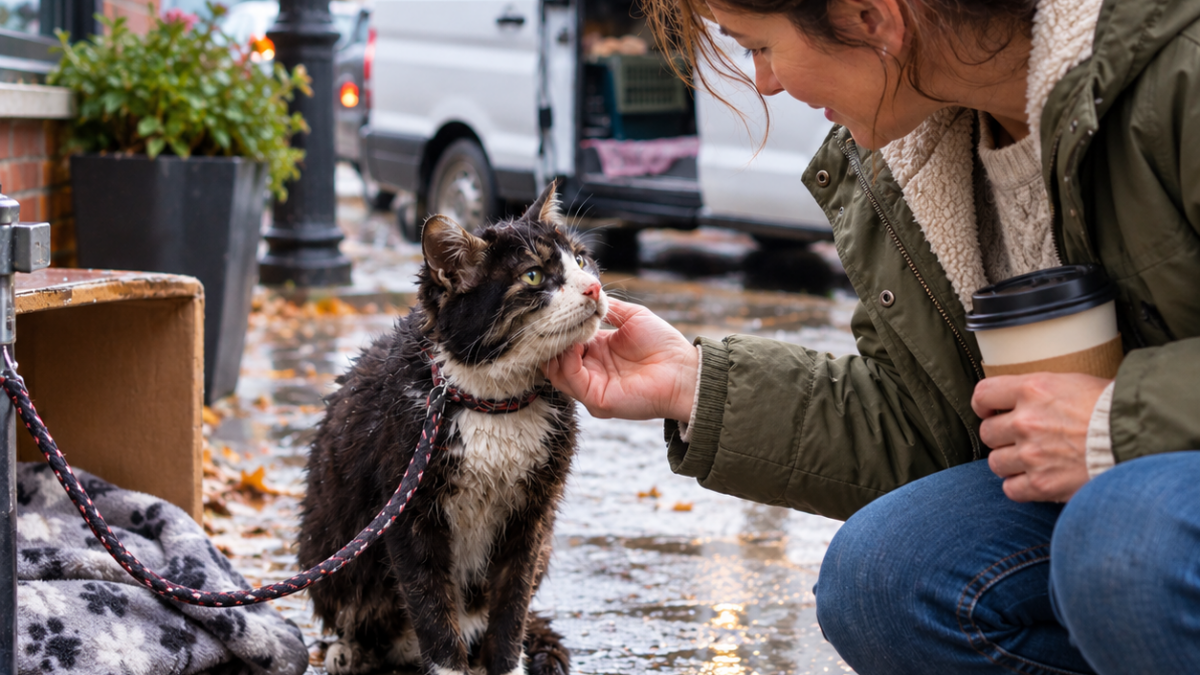
PART 2
I arrived at work almost an hour late.
My supervisor, Dennis, was standing near the service entrance when I came through the door.
He was holding a clipboard.
That was never good.
Dennis was not cruel.
He was not even particularly difficult.
He was simply one of those people who measured the world through schedules.
How many floors had been finished.
How many bathrooms still needed supplies.
How long the evening crew had taken.
How many minutes somebody had clocked in late.
I understood why.
A cleaning company survived on contracts, and contracts survived on reliability.
Still, as I saw him look at the clock above the door, my stomach dropped.
“You all right?” he asked.
“Yes.”
“What happened?”
“I told you. There was a cat.”
“I know what you said.”
He looked at my coat.
There was a small smear of dirt where I had knelt on the sidewalk.
“You waited until someone came?”
“Yes.”
He exhaled.
I expected a lecture.
Instead he said, “Go clock in.”
I blinked.
“That’s it?”
“For now.”
Those two words followed me all morning.
For now.
I changed into my work shoes and pushed my cart into the first-floor offices.
Normally, cleaning helped clear my head.
There was something almost mechanical about it.
Empty trash.
Wipe desks.
Vacuum carpet.
Restock soap.
Move on.
That day, my body worked while my mind remained on the sidewalk.
The blue bowl.
The leash.
The way the cat had backed away from food.
I kept replaying the moment.
Why would a starving animal hesitate?
Why would she look at my hand before every bite?
Around ten, I made the mistake of imagining that someone had taught her to fear food.
I stopped myself.
I had no proof.
Maybe she was simply terrified of people.
Maybe the street noise had overwhelmed her.
Maybe she had been tied there only briefly.
I did not know.
I had to keep reminding myself of that.
Not knowing was hard.
Humans do not like blank spaces.
We fill them with stories.
Sometimes those stories become darker than reality.
Sometimes kinder.
But they are still guesses.
So I focused on the facts.
She was thin.
She was cold.
She had been restrained.
She could not reach her food.
She was now with professionals.
That had to be enough.
At lunch, I checked my phone.
No messages.
I almost called Megan.
Then I worried I would sound ridiculous.
She worked in animal rescue.
She probably had dozens of cases.
To her, maybe this was just another Monday.
To me, the cat had become the only thing I could think about.
At two thirty, I gave up pretending.
I called.
Megan answered after three rings.
“Animal rescue, this is Megan.”
“Hi. It’s Carol. From this morning.”
There was a short pause.
“The parking-meter cat?”
“Yes.”
My throat tightened at the phrase.
Parking-meter cat.
As if that were her identity.
“How is she?”
“We just got an update.”
I leaned against the janitorial cart.
Megan’s voice softened.
“She was very dehydrated. Underweight. The area around her neck is irritated, but the vet thinks it should heal well.”
I closed my eyes.
“She’ll live?”
“Yes.”
Two letters.
One word.
It felt enormous.
“Yes.”
I put my hand over my mouth.
A coworker passing at the end of the hallway glanced toward me.
I turned away.
“Thank you.”
“You’re the one who stopped.”
“I just found her.”
“You stayed.”
I did not know what to say to that.
So I asked the next question.
“Does she belong to someone?”
“No identification.”
“No microchip?”
“None.”
“Has anyone called?”
“Not yet.”
I stared through the office window at a gray Columbus afternoon.
“What happens if nobody does?”
“There is a required holding period. After that, if she’s medically stable, we’ll look at foster placement.”
“Foster.”
“A quiet environment would be ideal.”
Quiet.
The word stayed in my mind.
My apartment was quiet.
Very quiet.
Too quiet, some nights.
I had never described that as a problem.
After my divorce, I had worked hard to make loneliness sound like independence.
I told my daughter I enjoyed having the place to myself.
I told coworkers I liked not answering to anybody.
I told friends there was peace in coming home to silence.
Some of that was true.
The rest had simply become easier to believe through repetition.
My daughter had moved out of state after getting married.
We spoke every Sunday.
Sometimes Wednesday too.
But most evenings, I opened the apartment door to the same things.
One bedroom.
Small kitchen.
Old couch.
Television.
A kitchen table with two chairs.
I used one.
The other mostly held unopened mail.
That night, I came home, placed my keys in the dish near the door, and did what I always did.
Turned on the lamp.
Took off my shoes.
Heated leftovers.
Sat at the table.
But something felt different.
Maybe because I had spent the day imagining a tiny animal waiting somewhere unfamiliar.
I looked at the second chair.
There were two envelopes on it.
Electric bill.
Credit card.
I moved them.
Then I sat staring at the empty seat.
Ridiculous.
A cat would not sit at a kitchen table.
Still, the apartment felt more empty than it had the day before.
At nine, my daughter called.
“Mom?”
“Hi, honey.”
“You sound tired.”
“Long day.”
“What happened?”
I told her.
Everything.
The parking meter.
The leash.
The blue bowl.
When I described the way the cat backed away from food, my daughter went quiet.
“That’s awful.”
“She’s going to be okay.”
“Good.”
“They need a foster once she’s ready.”
Another silence.
Then my daughter said, “Mom.”
I knew that tone.
“No.”
“I didn’t say anything.”
“You were about to.”
“I was about to ask whether you were thinking about it.”
“I work ten-hour shifts.”
“You have a stable home.”
“I barely have enough money for myself.”
“You make room for everything you care about.”
“That sounds like something from a greeting card.”
She laughed.
“Maybe.”
“I’ve never owned a cat.”
“You’ve never owned a dishwasher either, and somehow you’ve survived.”
“That doesn’t even make sense.”
“It wasn’t supposed to.”
I smiled despite myself.
Then she became serious.
“Did you want to leave her this morning?”
“No.”
“Did you want to stop thinking about her all day?”
“Yes.”
“Did it work?”
“No.”
“Well.”
“That proves nothing.”
“Sure, Mom.”
After we hung up, I tried to watch television.
I lasted twenty minutes.
Then I opened my phone and searched:
**What does a foster cat need?**
That was the first step.
I told myself it meant nothing.
An hour later, I was reading about litter boxes.
The next morning, I called Megan.
I did not prepare a speech.
I probably should have.
Instead, when she answered, I said:
“I think I could make room for her.”
Megan did not respond immediately.
I worried the call had dropped.
“Hello?”
“I’m here.”
“Was that stupid?”
“No.”
“Because it sounded stupid once I said it.”
“It didn’t.”
“I’ve never fostered.”
“We can help you.”
“I work long hours.”
“We can talk through that.”
“My apartment is small.”
“For a frightened cat, small and quiet can actually be useful at first.”
I looked around my kitchen.
“What if she hates me?”
Megan laughed softly.
“Then you give her time.”
That sounded manageable.
Time was free.
Mostly.
“Okay.”
“Okay?”
“I want to apply.”
The paperwork came that afternoon.
There was a home questionnaire.
Employment information.
Landlord permission.
Basic care questions.
Emergency contact.
Veterinary plan.
I stared at the expenses section longer than anything else.
Food.
Litter.
Routine care.
Unexpected care.
Money mattered.
I could not pretend it did not.
My life had no magical reserve fund.
I had been late that morning partly because every hour counted.
Taking in an animal would not make those bills disappear.
For a few minutes, I almost closed the application.
Then I remembered the blue bowl.
I remembered the cat taking one piece of food and staring at my hand.
I continued filling out the form.
Two days later, Megan called.
No one had claimed the cat.
They had checked reports.
Nothing matching.
The holding period would continue.
Medical treatment was going well.
“She has a name now,” Megan added.
“Oh?”
“Rosie.”
“Rosie.”
I said it twice.
It fit.
I do not know why.
Some names just settle.
“When can I see her?”
“Saturday.”
Saturday could not come fast enough.
The rescue facility was warmer than I expected.
Clean.
Busy.
Dogs barking somewhere behind closed doors.
Phones ringing.
A volunteer carrying folded blankets.
Megan met me in the lobby.
“You ready?”
“I think so.”
“That means no.”
“Probably.”
She smiled.
We entered a smaller room.
Rosie was inside a large recovery enclosure with soft bedding.
For a second, she looked different.
Cleaner.
Warmer.
Her eyes more alert.
Then she saw me.
She moved backward.
My heart sank.
“She doesn’t remember me.”
Megan leaned against the wall.
“Maybe she does. Maybe she doesn’t.”
“I thought she’d…”
“What?”
“I don’t know.”
“Come running?”
I felt embarrassed.
“Maybe.”
“This isn’t a movie.”
“I know.”
“She survived something frightening. Right now, people mean uncertainty.”
Rosie stared at us.
Megan continued.
“Don’t make trust the price of helping her.”
That sentence stayed with me.
Don’t make trust the price.
Of course.
I had done one decent thing.
That did not mean Rosie owed me affection.
She did not owe me recognition.
She did not owe me gratitude.
She owed me nothing.
I sat on the floor several feet from her enclosure.
Megan opened the door.
Rosie stayed in the back.
I did not reach.
Ten minutes passed.
Then fifteen.
Eventually, Rosie moved forward.
Not toward me.
Toward her food.
She took a bite.
Paused.
Looked at me.
My throat tightened.
Same behavior.
Food.
Person.
Food.
Person.
I looked away.
A few seconds later, I heard chewing.
I smiled.
Megan noticed.
“That’s your first lesson.”
“What?”
“Sometimes helping looks like pretending not to care.”
I laughed quietly.
“I can do that.”
“You sure?”
“No.”
Rosie became medically ready for foster placement the following week.
I spent nearly all of Friday evening preparing.
I bought the cheapest decent litter box I could find.
Two bowls.
A small bed on sale.
A scratching pad.
Food recommended by the rescue.
I moved breakable things.
Tied up electrical cords.
Closed the bedroom closet.
Placed a cardboard box sideways in the living room so she would have somewhere to hide.
Then I looked at the total on the store receipt.
My stomach turned.
I had spent more than planned.
That meant adjusting the week’s groceries.
I stood in the parking lot with the bag of supplies and briefly wondered whether I was being irresponsible.
Then I imagined returning everything.
I could not.
I drove home.
Saturday morning, Megan brought Rosie over.
The cat stayed inside her carrier while we talked.
“Keep things quiet.”
“Okay.”
“Don’t force contact.”
“Okay.”
“Keep food and water predictable.”
“Okay.”
“Watch the irritated area around her collar.”
“I will.”
“And call if you’re worried.”
“I probably will.”
Megan smiled.
“I expected that.”
We placed the carrier near the couch.
Opened it.
Waited.
Rosie did not move.
Megan and I sat twenty feet away.
Nothing.
Eventually, Megan said, “I’m going to go.”
I panicked.
“So soon?”
“She needs to learn the apartment without two humans staring at her.”
“I wasn’t staring.”
“You’ve looked at that carrier every nine seconds.”
“I have not.”
“You have.”
She grabbed her coat.
At the door, she turned.
“You can do this.”
I looked at the carrier.
“I hope so.”
After she left, the apartment became silent.
Rosie remained inside.
I turned on the television at low volume.
Sat on the couch.
Did not look directly toward her.
Thirty minutes.
Forty.
Then I heard movement.
Rosie’s head appeared.
I stayed still.
She stepped out.
One paw.
Then another.
She sniffed the floor.
Walked toward the cardboard box.
Changed her mind.
Moved toward the couch.
Then suddenly disappeared underneath it.
That became her home for three days.
Under my couch.
I knew she came out when I was not around because the food disappeared and the litter box was used.
But whenever I was home, I saw mostly eyes.
I would lie on the floor several feet away.
“Hi, Rosie.”
Two eyes.
“How was your day?”
Two eyes.
“Mine was terrible. Thanks for asking.”
Two eyes.
“You are not a great conversationalist.”
Sometimes she blinked.
I took that as participation.
On the fourth evening, Rosie came out while I was sitting in the living room.
I almost ruined everything by reacting.
My whole body wanted to sit forward.
Instead, I pretended the television was suddenly fascinating.
Rosie walked toward her food.
Slowly.
She ate.
I watched from the corner of my eye.
Then I made a mistake.
I stood to get water.
Rosie panicked.
She shot beneath the couch.
Her back leg clipped the food bowl.
Dry pieces scattered across the floor.
The whole thing took less than two seconds.
I froze.
Then sat down.
“Rosie?”
Nothing.
I stared at the food.
A ridiculous thing happened.
I began crying.
Not because of the mess.
I had cleaned office buildings for more than twenty years.
Spilled cat food was nothing.
I cried because standing up had terrified her.
Standing.
A movement so ordinary I had not even considered it.
What had this cat experienced that made a person rising from a chair feel dangerous?
Maybe nothing specific.
Maybe everything felt dangerous.
Again, I did not know.
And again, I had to stop myself from inventing a past I could never prove.
Still, the fear was real.
I wiped my face.
Then got down on the floor.
Not close to the couch.
Just low.
“I’m sorry.”
No movement.
“I moved too fast.”
Silence.
“I’ll do better.”
There was no reason Rosie could understand the words.
But saying them changed something in me.
Until then, part of me had still been waiting for progress.
I wanted evidence.
I wanted the rescued animal to behave like she knew she had been rescued.
That night, I understood the flaw.
Safety is not something I could announce.
It had to become boring.
Predictable.
Unremarkable.
The same bowl.
Same location.
Same quiet voice.
Same apartment.
Day after day.
No surprises.
No grabbing.
No test.
No deadline.
So I changed.
Every evening, I came home and followed a routine.
Keys in the dish.
Shoes off.
Rosie’s food prepared.
Bowl placed in the same place.
Then I sat across the room.
Sometimes she ate immediately.
Sometimes not.
If she waited until I went to bed, fine.
If she came out while I was there, I did not move suddenly.
I began narrating my evenings in a ridiculous calm voice.
“I’m going to the kitchen.”
Rosie watched.
“I am standing up.”
Her body tensed.
“Still me.”
I took one step.
“Nothing exciting happening.”
Then another.
Eventually, I could walk across the room without her disappearing every time.
Small victory.
The kind nobody applauds.
A week passed.
Then two.
Rosie gained a little weight.
Her fur began looking less dull.
The skin around her neck was healing.
She still did not want me near her.
But she spent more time outside the couch.
One night, I found her sitting in the window.
She saw me.
Her muscles tightened.
I stopped.
“I’m not taking the window.”
She looked outside again.
That felt huge.
I texted Megan.
**She looked away from me.**
Megan responded:
**Congratulations?**
I wrote:
**You don’t understand.**
She replied:
**I do.**
My daughter became obsessed with updates.
Every Sunday:
“How’s Rosie?”
“She ate while I vacuumed.”
“That sounds good?”
“Excellent.”
“Did she let you touch her?”
“No.”
“Did she come closer?”
“Maybe.”
“Mom, you sound like you’re dating.”
“Stop it.”
My daughter laughed.
Then, one Sunday, she asked:
“Are you keeping her?”
“She’s a foster.”
“That wasn’t my question.”
“The rescue hasn’t asked me to decide yet.”
“That wasn’t my question either.”
I changed the subject.
Because I knew.
I just was not ready to admit it.
Money still worried me.
So did the responsibility.
What if she became sick?
What if I could not afford treatment?
What if my work schedule changed?
What if my landlord changed rules?
Adults know how many things can go wrong.
Children decide with their hearts.
Adults build entire court cases against joy.
I was doing that.
Then came the night that changed everything.
I had worked ten hours.
Two employees had called out, so I covered extra floors.
By the time I reached home, my lower back felt like somebody had replaced the muscles with wire.
My feet ached.
My hands smelled faintly of disinfectant even after washing them.
Three bills waited on the kitchen table.
One was red.
Never good.
I heated soup.
Ate half.
Then lowered myself onto the living-room floor because somehow that felt better than getting up onto the couch.
Rosie was under the coffee table.
She watched me.
“Long day,” I said.
She stayed still.
“I bet yours was exhausting.”
Nothing.
“You slept for eleven hours.”
Rosie blinked.
I closed my eyes.
For a minute, I nearly fell asleep sitting there.
Then I heard soft footsteps.
I opened my eyes.
Rosie had moved.
She was beside her bowl.
I expected her to eat.
Instead, she walked past it.
Toward me.
My body went rigid.
Not from fear.
From desperate determination not to ruin the moment.
She came closer.
Three feet.
Two.
One.
She stopped near my hand.
I did not even breathe normally.
Rosie stretched her neck.
Sniffed my fingers.
Then lifted one little white paw.
Placed it on the back of my hand.
That was all.
One paw.
Barely any pressure.
I felt tears come instantly.
“Oh, Rosie.”
She looked up.
I thought I had ruined it by speaking.
Instead, she stepped closer.
Then climbed onto my thigh.
Very slowly.
As if she might change her mind.
I remained frozen.
Rosie circled twice.
Settled against my stomach.
And began to purr.
Tiny.
Uneven at first.
Then steady.
I covered my mouth because the sound that came out of me was halfway between a laugh and a sob.
For years, I had told everybody I enjoyed living alone.
Maybe I had.
Some of the time.
But sitting there with a frightened cat finally deciding my lap was safe, I realized something I had avoided admitting.
There is a difference between choosing solitude and adapting to absence.
I had adapted.
My daughter moved away.
My marriage ended.
Friends became busy with grandchildren, spouses, work and their own problems.
The apartment grew quieter slowly enough that I never noticed the silence becoming part of me.
Then Rosie purred.
And suddenly I heard what had been missing.
I did not move for nearly forty minutes.
My back hurt worse.
My right leg fell asleep.
I did not care.
Eventually, Rosie stood.
I expected her to return under the couch.
Instead, she walked to her bowl.
Ate.
Then sat several feet away.
Watching me.
I texted Megan.
**SHE SAT IN MY LAP.**
Three seconds later:
**I knew it.**
I wrote:
**You absolutely did not.**
**Let me have this.**
The next morning, Rosie avoided me again.
I laughed.
“Of course.”
Trust was not a staircase.
It was weather.
Some days clear.
Some days clouds.
Some days you thought winter was over and woke up to snow.
But something had changed.
She had discovered she could approach me.
Soon, she did it again.
Not every day.
But more often.
She began waiting near the living-room doorway when I came home.
Then near the apartment door.
The first time I opened it and saw her sitting there, I nearly dropped my keys.
“What are you doing?”
Rosie meowed.
It was the strongest sound I had heard from her.
“You missed me?”
Another meow.
I choose to believe that meant yes.
A month after I first found her, Megan called.
“It’s decision time.”
I knew exactly what she meant.
Rosie’s foster period was going well.
She was medically stable.
Her neck had healed.
Weight improving.
She could now be listed for adoption.
My stomach tightened.
“Okay.”
Megan paused.
“Carol.”
“Yes?”
“Do you want us to list her?”
I looked toward the living room.
Rosie was sleeping in a patch of afternoon light.
One white paw stretched forward.
My second kitchen chair was visible behind her.
Still holding mail.
But the apartment did not look empty anymore.
“No.”
Megan laughed.
“No?”
“I want her.”
“Are you sure?”
That was the responsible question.
I appreciated it.
I looked at the unpaid bills.
At my work shoes beside the door.
At the cheap cat toy Rosie ignored because she preferred bottle caps.
I thought about food costs.
Litter.
Veterinary care.
Responsibility.
Then I looked at Rosie.
“Yes.”
This time I did not hesitate.
“I’m sure.”
The adoption paperwork became official two days later.
My daughter sent me a message:
**Congratulations. You’re finally admitting you’re a cat person.**
I replied:
**Blocked.**
She called immediately.
“Mom!”
“You were warned.”
“When do I meet my sister?”
“Your what?”
“Rosie.”
“You’re thirty-one.”
“And?”
“I am not discussing this.”
Rosie officially became mine.
But the most important transformation did not happen on paperwork.
It happened on a Saturday morning.
I woke earlier than usual.
Cold sunlight filled the kitchen.
Rosie followed me from the bedroom.
She had started sleeping near my feet most nights.
Not touching.
Close enough.
I opened her food.
She meowed impatiently.
“Excuse me?”
Another meow.
“You used to be polite.”
She paced around my ankles.
I filled the blue bowl.
Yes.
Blue.
After everything, I had bought her a blue bowl.
Maybe that sounds cruel.
I did not do it to recreate anything frightening.
The opposite.
I wanted blue to become ordinary.
Safe.
Her color.
Not a memory of food she could not reach.
I placed the bowl down.
Rosie walked toward it.
I was halfway to the coffee maker when something made me stop.
She had not frozen.
Had not looked at my hand.
Had not stepped backward.
She lowered her head.
And ate.
Normally.
That was it.
No dramatic music.
No miracle.
No camera.
A cat eating breakfast.
I started crying.
“Look at you.”
Rosie ignored me.
“Just eating.”
Crunch.
“No checking.”
Crunch.
“No running.”
Crunch.
I laughed through tears.
“That’s right, sweetheart.”
She kept eating.
“Nobody’s taking it.”
For weeks, I had wanted Rosie to understand those words.
Now I realized she finally did.
Not because she understood English.
Because repetition had translated for me.
Food appeared.
Food stayed.
Hands passed nearby.
Hands did not take.
A person stood up.
Nothing bad followed.
A door opened.
The person came back.
Again.
Again.
Again.
Trust had been built through boring things.
I loved that.
People often imagine rescue as one dramatic moment.
Cut the leash.
Wrap the blanket.
Drive to the clinic.
Happy ending.
No.
That was the beginning.
Rescue was breakfast.
Every day.
Rescue was paying attention to body language.
Rescue was not pulling Rosie from beneath the couch because I wanted affection.
Rescue was working ten hours and still cleaning the litter box.
Rescue was budgeting for food.
Rescue was scheduling follow-up care.
Rescue was accepting that whatever had happened before me did not have to be fully explained for its effects to be respected.
That was the real work.
And Rosie was doing work too.
Her work was harder.
She had to test the world again.
Was the food safe?
Was the room safe?
Was the hand safe?
Was sleep safe?
Was closeness safe?
Could she close her eyes beside someone without waking up to something frightening?
Every yes cost her courage.
I did not understand that at first.
Eventually, I did.
Our lives settled into a routine.
I woke at five forty-five.
Rosie remained in bed.
I showered.
Rosie remained in bed.
I made coffee.
Still in bed.
At six ten, the moment I opened her food, she appeared like she had been waiting for hours.
“You are unbelievable.”
Meow.
“You were unconscious thirty seconds ago.”
Meow.
I fed her.
Then she followed me while I packed lunch.
Sometimes she jumped onto the second kitchen chair.
That became her chair.
The mail moved elsewhere.
At six thirty, I put on my coat.
Rosie noticed.
Every morning.
At first, she would watch from across the room.
Then she began coming to the door.
I hated that part.
Leaving.
“This is how jobs work.”
Rosie stared.
“I go.”
Blink.
“Then I come back.”
Some mornings, that sentence felt like it was for her.
Other mornings, for me.
I come back.
At work, Dennis noticed I checked my phone on breaks.
“Everything okay?”
“Rosie.”
He frowned.
“The cat?”
“My cat.”
“Ah.”
I smiled.
“You remembered.”
“Hard not to. You lost nearly an hour over her.”
There it was.
The thing I had worried about.
I looked at him.
“I’m sorry about that.”
He surprised me.
“Why?”
“For being late.”
“Did you make up the time?”
“Yes.”
“Then stop apologizing.”
I stared.
He continued.
“My wife saw the shelter post.”
“What shelter post?”
Apparently, the rescue had shared Rosie’s recovery photo after asking permission.
Nothing dramatic.
A black-and-white cat sitting beside a blue bowl.
Her story summarized without graphic detail.
I had approved it and then forgotten.
“My wife cried,” Dennis said.
“Oh.”
“She asked why I never do anything like that.”
I laughed.
“What did you say?”
“That I manage custodial crews. My heroism is mostly supply orders.”
I laughed harder.
Then his expression grew more serious.
“You did the right thing.”
That mattered more than I expected.
For weeks, I had remembered the clock.
Money lost.
Fear of being written up.
The practical cost of staying.
Hearing my supervisor say those words released something.
“Thank you.”
He nodded toward my phone.
“She doing okay?”
“She’s becoming a criminal.”
“What?”
“She knocked a glass off my table yesterday.”
“Sounds serious.”
“I’m considering pressing charges.”
“Keep me updated.”
That was Dennis.
Rosie continued improving.
She gained enough weight that the veterinarian finally said the words I had been waiting for.
“Healthy range.”
I smiled so hard my face hurt.
Her coat became softer.
The rough patch around her neck disappeared beneath new fur.
Sometimes I touched the area gently.
Rosie allowed it.
I never held her collar tightly.
Actually, for a long time, I avoided putting anything around her neck.
The veterinarian recommended identification and we found a safe breakaway collar.
I brought it home.
Placed it on the floor.
Rosie sniffed it.
Walked away.
I left it there for several days.
Treats near it.
Nothing forced.
Eventually, I introduced it gradually.
The first time it fastened around her neck, Rosie froze.
I removed it immediately.
“Nope.”
A week later, we tried again.
Shorter.
Treat.
Remove.
Again.
Eventually, she wore it without fear.
Her tag read:
ROSIE
and my phone number.
I held the tiny tag in my palm before attaching it.
The cat who had once had no identification now had a name connected to someone.
Me.
That felt bigger than a piece of metal.
The first time my daughter visited, Rosie disappeared.
Of course.
My daughter stepped inside carrying a bag.
“Where is she?”
“Under the couch.”
“I flew four hundred miles.”
“She did not approve the itinerary.”
My daughter got onto the floor.
“Hi, Rosie.”
I immediately said, “Don’t reach.”
“I know.”
“I mean it.”
“Mom.”
“She doesn’t like fast movement.”
“I know.”
“You have to let her—”
“Mom.”
I stopped.
My daughter smiled.
“You sound like me when I was sixteen.”
“That is impossible.”
“You told me to slow down constantly.”
“For good reason.”
“And now?”
“Still good reason.”
We sat on the couch.
Rosie stayed hidden for almost an hour.
My daughter never pressured her.
Eventually, Rosie appeared.
My daughter pretended not to see.
I was impressed.
“You’ve been trained.”
“By you.”
Rosie crossed the room.
Sniffed my daughter’s suitcase.
Then sat six feet away.
My daughter whispered:
“I love her.”
“You haven’t touched her.”
“I don’t need to.”
That sentence hit me.
I don’t need to.
There it was again.
Love without demand.
Rosie had changed the rules.
By evening, she accepted a treat from my daughter’s hand.
The next morning, I woke to find my daughter sitting on the living-room floor with Rosie three feet away.
Neither moving.
“What are you doing?”
“Bonding.”
“You’re staring at the wall.”
“Exactly.”
I laughed.
Before my daughter left, Rosie rubbed once against her ankle.
My daughter gasped.
“Mom.”
“I saw.”
“She touched me.”
“I saw.”
“Does she love me?”
“Let’s not get ahead of ourselves.”
“You’re jealous.”
“Completely.”
After she flew home, the apartment was quiet again.
But different.
Rosie sat in the window.
I sat on the couch.
For years, I had measured loneliness by the absence of conversation.
Rosie taught me silence could feel full.
Two beings do not have to speak to share a room.
That was one of the most surprising gifts.
She did not entertain me.
She did not fix my finances.
She did not erase my divorce.
She did not make my knees hurt less.
She simply existed beside me.
And somehow that changed the shape of hard days.
A year earlier, I would come home after ten hours, drop my bag, and hear nothing.
Now the key entered the lock.
Paws ran.
A black-and-white face appeared.
Sometimes Rosie meowed before I had the door fully open.
“I was gone nine hours, not nine years.”
Meow.
“You survived.”
Meow.
“Yes, yes. Terrible neglect.”
She walked toward her bowl.
“Of course.”
Rosie learned quickly that emotional reunions were best followed by dinner.
I respected that.
There were setbacks.
I wish rescue stories talked about them more.
People love the word “healed.”
It sounds finished.
Rosie was not finished.
Neither was I.
One evening, I accidentally dropped a metal pan.
The crash was loud.
Rosie vanished.
I found her beneath the bed trembling.
My heart broke.
I sat on the bedroom floor.
“It’s okay.”
She stayed hidden.
Hours passed.
She did not eat dinner.
The next morning, she remained cautious.
For two days, some of her old behaviors returned.
Watching my hands.
Backing away when I stood suddenly.
I felt devastated.
All that progress.
Gone.
I called Megan.
“I ruined it.”
“No.”
“She’s scared again.”
“Something scared her.”
“Because of me.”
“Because a pan fell.”
“Same difference.”
“No, Carol.”
Megan’s voice became firmer.
“Listen to me. Recovery isn’t an exam she can fail.”
I said nothing.
“She didn’t forget every safe day because one sound frightened her.”
“But she’s acting like before.”
“For now.”
“For now?”
“Give her the routine.”
Same bowl.
Same room.
Same voice.
Again.
By the fourth day, Rosie was eating normally.
By the end of the week, she slept beside me again.
I learned an important lesson.
A return of fear did not erase trust.
Healing could bend without breaking.
That changed how I thought about myself too.
After my divorce, I had spent years believing that needing people again would prove I had not moved on.
So I built independence like a wall.
If I felt lonely, I told myself I was weak.
If I missed my daughter, I reminded myself adults leave home.
If I wanted companionship, I found reasons not to pursue it.
Rosie taught me a different possibility.
You can be strong and still want closeness.
You can be independent and still need comfort.
You can have old fear return without being back at the beginning.
I never expected a cat to teach me emotional vocabulary.
Yet there we were.
Around the six-month mark, Rosie’s rescue story circulated more widely in our neighborhood.
A local volunteer had shared an update.
The before-and-after images attracted attention.
I hated the first photo.
Not because it was graphic.
It wasn’t.
Rosie simply looked tiny beside the parking meter.
The blue bowl sat beyond her reach.
The second photo showed her sitting on my windowsill in sunlight.
Same black-and-white coat.
Different posture.
In the first, her body was compressed.
Prepared.
In the second, loose.
One back leg stretched carelessly.
Eyes half closed.
Safe enough to be unguarded.
People left comments.
Most kind.
Some asked who had tied her.
There was never a confirmed answer.
No reliable information.
That frustrated people.
They wanted accountability.
So did I, sometimes.
There were nights I looked at Rosie and felt anger rise.
Who left you?
Why?
Did they know how cold it was?
Did they put the bowl there?
Why just out of reach?
But questions without answers can become poison.
Megan reminded me.
“We don’t know what happened.”
“I know.”
“Don’t build an imaginary person to hate.”
“I know.”
“Rosie doesn’t need revenge.”
I looked at the cat asleep beside me.
“What does she need?”
“The same thing she needed yesterday.”
Safety.
Food.
Care.
Time.
That became my answer.
If there was justice in Rosie’s story, it would not come from me hunting for somebody to blame.
It would come from the fact that whatever fear had shaped her would not get the final word.
Her answer would be breakfast.
A warm bed.
A name tag.
A window.
A woman coming home every night.
That was enough.
Still, life tested us again.
One winter morning, almost a year after I found Rosie, I woke to the coldest day Columbus had seen that season.
The weather app warned people to limit outdoor exposure.
I stood at the kitchen window watching frost on parked cars.
Then I looked at Rosie.
She was stretched across the radiator cover.
Warm.
Annoyed because breakfast was three minutes late.
I smiled.
“Do you remember?”
She opened one eye.
“That parking meter?”
Nothing.
“I do.”
I filled her bowl.
She ate normally.
I suddenly needed to sit.
The memory of that original morning came back with a physical force.
Cold pavement.
Coffee cup.
Blue bowl.
Leash.
Rosie stretching.
Failing.
Trying again.
For months, I had thought the cruelest image was the leash.
That morning, I realized it had always been the food.
Hope visible but unreachable.
Something you need close enough to smell.
Too far to have.
Maybe that was why Rosie’s peaceful eating still moved me.
Every meal rewrote the old picture.
Bowl within reach.
No restraint.
No watching for a hand.
No condition.
Eat.
That was the revenge.
The quiet kind.
Every full meal defeated the memory of hunger.
Every nap defeated vigilance.
Every impatient breakfast meow defeated silence.
Every time Rosie walked toward a human instead of away, fear lost another inch.
Nobody watching from the outside would call that dramatic.
To me, it was everything.
I began putting away a small amount of money each week for Rosie’s care.
Sometimes five dollars.
Sometimes ten.
On better weeks, twenty.
An envelope in the kitchen cabinet.
**ROSIE**
written across the front.
It became my emergency veterinary fund.
Strangely, saving for her made me more disciplined about my own finances.
I stopped buying coffee before work.
Made it at home.
Planned meals better.
Canceled a subscription I barely used.
Nothing transformed overnight.
I was still an hourly worker.
Still calculating groceries.
But responsibility gave my money a direction.
One evening, Dennis offered me extra supervisory hours.
“You want them?”
“What hours?”
“Saturday rotation.”
My back objected immediately.
My budget said yes.
I took them.
Those extra hours eventually became a more regular lead position.
Nothing glamorous.
A little better pay.
More responsibility.
Less physical work on some shifts.
The first time the larger paycheck arrived, I stared at it.
Then put twenty-five dollars in Rosie’s envelope.
“Congratulations,” I told her.
“You got promoted.”
Rosie licked her paw.
“Your enthusiasm is overwhelming.”
Megan stayed part of our lives.
Every few months, I sent photos.
Rosie on the couch.
Rosie in the window.
Rosie sleeping with her face pressed against my leg.
Megan responded with heart emojis and variations of:
**Look at her.**
One afternoon, she called instead of texting.
“We have a situation.”
My mind immediately went to Rosie.
“What?”
“Nothing bad.”
“Don’t start calls that way.”
“Sorry.”
“What happened?”
“There’s another cat.”
I laughed nervously.
“No.”
“You don’t even know what I’m asking.”
“I know you.”
“We have an older female who needs a quiet foster.”
“Megan.”
“Temporary.”
“Megan.”
“She doesn’t like the shelter.”
“I have Rosie.”
“Exactly. You understand slow introductions.”
I looked at Rosie.
She was asleep.
“You are dangerous.”
“I’ve been told.”
I did not say yes immediately.
That mattered.
Rosie came first.
I had to consider whether another cat would stress her.
We talked with the veterinarian.
Discussed separation.
Scent introductions.
Space.
Eventually, I agreed to foster the older cat for a short period.
Her name was Mabel.
For the first week, Rosie was furious.
Not aggressive.
Offended.
She sat outside the closed spare-area door with the expression of someone discovering their apartment had been subleased without consent.
“It’s temporary.”
Rosie stared.
“You were temporary.”
Her ears moved.
“That was different.”
It took weeks.
Slow scent exchange.
Controlled distance.
No forced contact.
Eventually, Mabel and Rosie learned to coexist.
They never became inseparable.
That was fine.
Mabel later found a permanent home with a retired couple.
The night she left, Rosie walked through the apartment checking every room.
Then jumped onto my bed and took Mabel’s former blanket.
“You’re sentimental.”
Rosie kneaded the blanket.
“Or a thief.”
Probably both.
Fostering Mabel taught me something important.
Rosie had not only changed my home.
She had changed my capacity.
Before Rosie, I thought I barely had enough.
Enough money.
Enough energy.
Enough patience.
Enough emotional room.
After Rosie, I understood that having limits did not mean having nothing to give.
You do not need to be wealthy to matter.
You do need to be responsible.
That distinction became important to me.
I never wanted people hearing our story to think love alone pays veterinary bills.
It does not.
Good intentions need planning.
But ordinary people can still contribute.
Time.
Temporary space.
Transport.
Food donations.
Phone calls.
The small practical acts that keep rescue organizations working.
I began volunteering one Saturday a month.
Mostly laundry and cleaning.
Of course.
Apparently my professional skills were transferable.
Megan joked the rescue had finally found free custodial labor.
“You are exploiting me.”
“Absolutely.”
Rosie stayed home.
When I returned smelling like unfamiliar animals, she inspected me for several minutes.
“Don’t worry.”
She sniffed my shoes.
“You’re still management.”
That became her unofficial title.
Management.
At work, my coworkers began asking about her.
One woman had seen the rescue post.
“That’s your cat?”
“Yes.”
“The parking-meter one?”
“She has a name.”
“Sorry. Rosie.”
I hated that Rosie’s worst morning had become her identifier.
Then I realized stories need an entry point.
People knew her from the parking meter.
I knew her from everything after.
The cat who shouted at breakfast.
The cat who stole my warm spot in bed.
The cat who loved crumpled receipts.
The cat who sat on the bathroom rug while I brushed my teeth.
Trauma may introduce somebody.
It should not become their whole identity.
That was another lesson.
I stopped saying:
“Rosie was the cat tied to the meter.”
Instead:
“Rosie is my cat. I found her tied to a meter.”
Present first.
Past second.
That distinction mattered.
Rosie was not a rescue story living in my apartment.
She was Rosie.
Her life had moved forward.
So had mine.
Two years passed.
My daughter had a baby.
Suddenly, I was a grandmother.
When I visited her, I stayed for a week.
Leaving Rosie was harder than expected.
A trusted pet sitter came twice daily.
Megan checked once.
I still worried constantly.
My daughter laughed.
“You flew across the country and you’ve checked the cat camera twelve times.”
“I’ve checked six.”
“Mom.”
“Eight.”
“Rosie is sleeping.”
“She could wake up.”
My daughter handed me my granddaughter.
“Focus.”
I did.
Holding that baby changed something in me.
Again.
When I returned home, Rosie met me at the door.
She yelled.
Not meowed.
Yelled.
“I know.”
She followed me through the apartment.
“I abandoned you terribly.”
More yelling.
“You had two meals a day, treats, heating, and professional supervision.”
Meow.
“Tragic.”
That night, Rosie slept pressed against my side.
Not at my feet.
Against me.
I lay awake listening to her purr.
I thought about my granddaughter.
My daughter.
Rosie.
Families take strange shapes.
Mine certainly had.
A daughter hundreds of miles away.
A granddaughter I wanted to see more.
A rescued cat who thought six o’clock breakfast was a constitutional right.
A few close friends.
Coworkers.
Megan.
Not the life I imagined at thirty.
Still a life.
A good one.
Then, one January, Rosie became sick.
Not dramatically.
She simply stopped finishing breakfast.
That was how I knew.
Rosie never left food.
Not anymore.
I watched her.
She ate half.
Walked away.
The next morning, same thing.
I called the vet.
They told me to bring her in.
My hands shook during the drive.
Rosie hated the carrier.
I hated seeing her afraid.
At the clinic, bloodwork.
Examination.
Waiting.
I sat in a plastic chair staring at the floor.
The emergency envelope at home flashed through my mind.
Was there enough?
Probably not for something major.
Guilt arrived immediately.
I should have saved more.
Worked more.
Spent less.
Then the vet returned.
A manageable gastrointestinal issue.
Medication.
Special diet for a short period.
Monitoring.
Relief hit so hard I nearly cried.
“She’s going to be okay?”
“That’s what we expect.”
I laughed.
Rosie looked offended by everything.
At home, she refused the new food.
Naturally.
“You survived the street but prescription dinner is where you draw the line?”
Rosie walked away.
Eventually, we found a method.
Within days, she improved.
The crisis was small in hindsight.
But it forced me to face something.
Rosie would not live forever.
Neither would I.
Love creates vulnerability.
I had spent years avoiding that truth.
After my marriage ended, one of the secret benefits of isolation was control.
No attachment.
No loss.
At least that was the theory.
Rosie destroyed it.
She made me care enough to be afraid.
And that was better than not caring.
One night after she recovered, I sat beside her.
“You’re expensive.”
Purr.
“Emotionally exhausting.”
Purr.
“I had a good system before you.”
Rosie opened her eyes.
“Terrible system, apparently.”
She closed them again.
I smiled.
People sometimes say rescued animals know they were saved.
I do not know whether that is true.
Rosie never acted grateful.
Thank God.
I did not want gratitude.
I wanted entitlement.
I wanted her to believe food belonged in the bowl.
Warmth belonged in the apartment.
My bed belonged partly to her.
I wanted safety to become so normal she could complain about it.
And she did.
If dinner was late, Rosie complained.
If I closed the bedroom door, complaint.
If her water bowl was not filled exactly to her preference, complaint.
If I shifted my leg while she slept on it, profound betrayal.
Every complaint made me happy.
A frightened animal monitors survival.
A safe animal develops opinions.
Rosie had many.
Her confidence became my favorite kind of revenge against whatever fear had once shaped her.
The world had once taught her to shrink.
My home taught her to demand breakfast.
I loved that.
Years after the original rescue, the animal organization held an anniversary fundraiser.
They asked whether I would speak.
I said no immediately.
Megan ignored me.
“You’ll be good.”
“No.”
“You have a story people remember.”
“Then you tell it.”
“They want you.”
“Why?”
“Because you’re ordinary.”
I stared.
“Thank you?”
“You know what I mean.”
I did.
People sometimes assume rescue belongs to professionals.
Megan wanted them to hear that a woman with bad knees, overdue bills, and a cleaning job could still make one meaningful choice.
So I agreed.
I stood behind a small podium in a community center.
Maybe seventy people.
No dramatic stage.
Rosie stayed home.
Obviously.
I had written a speech.
Then abandoned it.
Instead, I told them about the blue bowl.
Not the leash first.
The bowl.
Because that remained the image I could never forget.
“Food was inches away,” I said. “When I moved it closer, she backed away from me.”
The room became quiet.
“I thought hunger would be stronger than fear.”
I paused.
“I was wrong.”
Then I told them what came after.
The couch.
The first paw on my hand.
The first lap.
The first peaceful meal.
The pan falling.
The setback.
The recovery.
The emergency envelope.
All the unglamorous things.
Then I said something I had never put into words before.
“I used to think rescue meant removing an animal from danger.”
I looked around the room.
“Now I think that is only the first half.”
“The second half is teaching them they don’t have to keep living as if danger is still coming.”
That was what Rosie and I had done together.
Not perfectly.
But consistently.
After the event, people came to speak with me.
One woman cried.
A man told me about a dog who still hid during storms.
A teenager asked how long it took Rosie to trust me.
“I don’t know.”
He looked confused.
“What do you mean?”
“I stopped measuring.”
That was true.
The moment I stopped waiting for trust was when trust began arriving.
Not because I unlocked some secret.
Because I removed the deadline.
Animals know pressure.
So do people.
The teenager nodded.
“I have a cat who hides.”
“Give him somewhere safe to hide.”
“But shouldn’t I make him come out?”
“No.”
That answer surprised him.
“He’ll come when he can.”
Maybe.
Maybe not.
The point was not performance.
It was safety.
On my way home, I stopped at the grocery store.
I stood in the pet-food aisle comparing prices.
Some things never change.
I chose Rosie’s usual food.
Then passed the bowls.
Blue plastic.
For a second, I froze.
All these years later, blue bowls could still transport me.
I picked one up.
Same shade.
Cheap.
Simple.
I bought it.
At home, I placed it beside Rosie’s old bowl.
She sniffed both.
Then chose the new one.
I laughed.
“Of course.”
The next morning, she ate from it without hesitation.
That was when I understood our story had come full circle.
The color had lost its power.
The bowl was just a bowl.
Food was just food.
My hand was just my hand.
The door opening meant I was home.
Standing up meant I was getting water.
Nothing more.
Ordinary.
Again, ordinary was victory.
As Rosie aged, she became even more affectionate.
She started sleeping beneath the blanket near my knees.
The first time, I nearly panicked because I thought I had lost her.
Then the blanket moved.
“Rosie?”
A head appeared.
“Are you trying to shorten my life?”
She yawned.
I turned off the lamp.
Her purring vibrated through the mattress.
The apartment had changed over the years.
The old couch was eventually replaced.
The kitchen table remained.
So did the two chairs.
One mine.
One Rosie’s.
I stopped apologizing for that arrangement.
My daughter visited and placed her purse on Rosie’s chair once.
Rosie stared at her.
My daughter noticed.
“Am I in trouble?”
“Yes.”
“With you?”
“No.”
She moved the purse immediately.
Smart woman.
Rosie jumped onto the chair.
Order restored.
My granddaughter grew old enough to visit.
I was nervous.
Children move quickly.
Rosie disliked unpredictable movement.
We prepared carefully.
My granddaughter was taught not to chase.
Not to grab.
Let Rosie come.
The first visit, Rosie stayed away.
Fine.
The second, she watched from the hallway.
Third, closer.
Eventually, my granddaughter sat on the floor coloring.
Rosie approached.
Sniffed a crayon.
Then sat beside the paper.
My granddaughter looked at me.
“Can I pet her?”
“Wait.”
Rosie moved closer.
Rubbed against the child’s knee.
“Now?”
“Yes.”
One gentle stroke.
Rosie stayed.
I had to look away for a moment.
The cat who once feared my hand was letting a child touch her.
Again, I did not know Rosie’s past.
I never would.
But I knew her present.
That was enough.
My granddaughter asked:
“Why was Rosie scared?”
I chose my words carefully.
“Something happened before she came here that made it hard for her to trust people.”
“What?”
“I don’t know.”
“Who did it?”
“I don’t know.”
“Were they mean?”
“I don’t know that either.”
Children dislike uncertain answers.
She frowned.
Then asked:
“Is she scared now?”
I looked at Rosie stretched across the carpet.
“Sometimes.”
“Does she know you help her?”
“I think she knows she’s safe here.”
My granddaughter nodded.
Then said:
“That’s enough.”
Children again.
Always simplifying what adults complicate.
Yes.
That was enough.
When Rosie was around nine—our best estimate—she began slowing down.
Not dramatically.
More sleep.
Less jumping.
Longer pauses before climbing onto the couch.
I bought pet steps.
Rosie ignored them.
For weeks.
Then one night I caught her using them when she thought I was not looking.
“I saw that.”
She froze.
“I won’t tell anyone.”
She continued upward.
Dignity preserved.
Her annual checkups became twice yearly.
I could afford them more easily by then.
The promotion at work had helped.
My finances were still modest, but the terror of every bill had softened.
I sometimes thought about the woman I had been at fifty-four.
Coffee in one hand.
Lunch bag in the other.
Calculating an hour of lost wages.
That woman would never have believed where the next decade would lead.
Not wealth.
Not some unbelievable transformation.
Just stability.
Connection.
A little more room to breathe.
Rosie had been part of that journey.
Not the cause of every good thing.
That would be too sentimental.
But responsibility for her had pushed me to build a more intentional life.
Save.
Plan.
Come home.
Care.
Volunteer.
Accept help.
Those practices spread.
One cold Monday morning—almost exactly ten years after I found her—I walked the same street.
I did not work at the same building anymore.
I had gone downtown for an appointment.
Without planning it, I reached the parking meter.
I recognized it instantly.
The city had replaced some meters, but that one was still there.
I stood on the sidewalk.
Cars passed.
People hurried.
Someone carried coffee.
For a moment, I saw myself.
Fifty-four.
Late.
Tired.
Worried about money.
Then I saw Rosie.
Not literally.
Memory.
Small body.
Leash.
Blue bowl.
I touched the cold metal pole.
A woman walking past glanced at me.
I probably looked strange.
I did not care.
I whispered:
“You won.”
The words came without planning.
Rosie had won.
Not against a person.
Not against some imaginary villain.
Against the future that morning seemed to promise.
Cold.
Hunger.
Fear.
Invisibility.
She had outlived that morning by years.
Thousands of breakfasts.
Thousands of nights indoors.
Veterinary care.
A name.
A family.
A child who learned gentleness because of her.
A woman who learned she was not as content with loneliness as she claimed.
That was victory.
That was justice.
That was the kind of revenge worth having.
Nothing from Rosie’s past could reach forward and take those years away.
I walked to my appointment smiling.
When I returned home, Rosie was waiting near the door.
Older.
Rounder.
Much louder than the kitten I found.
She meowed.
“I went somewhere today.”
Meow.
“You don’t care.”
Meow.
“The parking meter.”
Rosie walked toward the kitchen.
“Of course.”
I followed.
I filled her blue bowl.
Placed it down.
Rosie ate.
No hesitation.
Even after ten years, I sometimes watched.
She finished.
Licked one paw.
Then rubbed against my ankle.
I crouched slowly.
Age had made that harder for both of us.
“Good girl.”
Rosie pressed her head into my hand.
That was enough.
As more years passed, her health eventually became complicated.
Age always collects its price.
She developed arthritis.
Then kidney changes that required monitoring.
Medication became part of the routine.
Special food.
More appointments.
More worry.
I used the savings envelope.
Then started another.
Some months were expensive.
But by then there was never a question of whether she was worth it.
Worth is a strange word to apply to love anyway.
You do not calculate the return on family.
You simply do what you can.
Rosie accepted medication with deep personal offense.
I wrapped pills in food.
She learned to detect them.
I changed tactics.
She adapted.
The cat who once feared food had become a food-security expert.
I respected her professionalism.
One evening, after a veterinary visit, I sat at the kitchen table reading the instructions.
Rosie was on her chair.
My daughter called.
“How is she?”
“Old.”
“So are you.”
“Goodbye.”
“Mom.”
I laughed.
“She’s okay. We just have more things to manage.”
“You sound tired.”
“I am.”
“You want me to come?”
The offer touched me.
“No. Not yet.”
“You’ll tell me?”
“Yes.”
I meant it.
That was another change.
The younger version of me would have handled everything alone because asking for help felt like failure.
Rosie had taught me interdependence.
Megan.
My daughter.
Veterinarians.
Coworkers.
Pet sitters.
No one person had built Rosie’s safe life alone.
I had simply become the center of it.
There is dignity in accepting support.
Rosie knew that before I did.
Near the end of one winter, she stopped using her window perch.
That frightened me.
Her favorite place.
Morning sun.
Bird watching.
She stayed mostly on the couch.
I moved a low heated bed near the window.
Rosie inspected it.
Ignored it.
Then eventually slept there every afternoon.
We adapted.
That became our rhythm.
The world narrows gently with age.
Long routes become short.
High places become low.
Running becomes walking.
Then resting.
But safety can remain.
That is what I wanted for her.
Not endless life.
A good one.
As comfortable as possible.
One spring afternoon, I came home and Rosie did not meet me at the door.
My heart stopped.
“Rosie?”
Nothing.
I dropped my bag.
“Rosie?”
I found her sleeping deeply in the heated bed.
She lifted her head, annoyed.
I sat on the floor laughing and crying.
“You can’t do that.”
She blinked.
“You have to file advance notice.”
No response.
I touched her head.
She leaned into my hand.
Trust.
Still there.
That night, I thought again about our first morning.
Back then, touch meant uncertainty.
Now she slept through my key in the door.
That is what a decade of safety had done.
Not erased instinct.
Built confidence.
The body had learned:
This sound belongs here.
This person belongs here.
I am allowed to sleep.
I do not know whether people understand how extraordinary sleep can be for an animal who once lived in fear.
Deep sleep means vulnerability.
Muscles loose.
Eyes closed.
Awareness lowered.
To sleep completely beside someone is trust written in the body.
Rosie had given me that thousands of times.
Every time, I felt honored.
I never stopped.
A few months later, Megan retired from full-time rescue work.
We met for coffee.
She looked older.
So did I.
“Remember the meter?” she asked.
“How could I forget?”
“Rosie barely weighed anything.”
“She weighs plenty now.”
Megan laughed.
“How is she?”
“Bossy.”
“Good.”
“Arthritis.”
“Less good.”
“Still eating.”
“Very good.”
I stirred my coffee.
Then asked something I had wondered for years.
“Did you think I would keep her?”
Megan smiled.
“Yes.”
“Immediately?”
“The morning you called to ask for an update.”
“That fast?”
“You sounded like a woman asking about family.”
I looked down.
“Why didn’t you tell me?”
“You wouldn’t have believed me.”
True.
Megan continued.
“You know what I remember?”
“What?”
“When you visited the shelter the first time. You looked disappointed she didn’t come to you.”
I cringed.
“I was stupid.”
“No. Human.”
“Same thing sometimes.”
She laughed.
“Then you sat down.”
“I remember.”
“You stopped asking her to prove anything.”
That might have been the real beginning.
I paid for our coffee.
Megan protested.
“You rescued her.”
“You rescued her.”
“We both did.”
That was correct.
Neither of us alone.
When I returned home, Rosie was on her chair.
I told her about Megan.
No response.
“Told you she thinks she’s important.”
Rosie yawned.
“Exactly.”
As Rosie became very old, people began asking the question I hated.
“How much longer?”
Nobody meant harm.
They were being practical.
Veterinarians talked about quality of life.
My daughter gently asked about plans.
I understood.
Still, every time I looked at Rosie, I saw the kitten by the meter.
Part of me wanted to bargain.
You fought so hard.
Stay longer.
But love cannot turn into demand.
That lesson had started on the first day.
Rosie owed me nothing.
Not affection.
Not recovery.
Not longevity.
My responsibility was to protect her comfort, not my denial.
So I watched.
Appetite.
Movement.
Pain.
Interest.
Sleep.
Connection.
Good days still outnumbered difficult ones.
Rosie still ate.
Still enjoyed sunlight.
Still complained at breakfast.
Still rubbed against my ankle.
So we continued.
One morning, she did something I had not seen in months.
She walked from the kitchen after breakfast.
Crossed the living room.
Climbed the little steps.
And got into my lap.
I was reading.
I dropped the book.
“Hello.”
Rosie turned twice.
Then curled against my stomach.
Exactly as she had that first night of trust.
Older body.
Slower.
Same position.
The memory came so sharply I almost could not breathe.
My hand.
Her paw.
The first purr.
Now, years later, the purr was quieter.
But there.
I rested my hand lightly on her side.
“You remember?”
Probably not.
I did.
That was enough for both of us.
We stayed like that until my leg hurt.
Some traditions should not be improved.
My daughter called while Rosie was still sleeping.
I whispered.
“She’s in my lap.”
“Why are you whispering?”
“I don’t want to wake her.”
My daughter laughed softly.
“You’ve been doing that for years.”
“I know.”
“Take a picture.”
I did.
It became my favorite.
Not because Rosie looked especially pretty.
She looked old.
Her fur slightly thinner.
Eyes closed.
My hands wrinkled.
It was simply the whole story contained in one image.
She had once feared my hand near a bowl.
Now she slept inside my arms.
No caption could improve that.
Eventually, Rosie’s health declined enough that we had to have harder conversations with the veterinarian.
There is no useful way to make that easy.
I will not turn it into drama.
Rosie’s life deserved more than being reduced to its final difficult days.
What mattered was that decisions were made around comfort, dignity, and love.
My daughter came to stay.
Rosie slept between us on the couch.
My granddaughter drew her pictures.
One showed Rosie beside a huge blue bowl.
I laughed.
“Why is the bowl bigger than she is?”
“So she never runs out.”
Children.
Again.
Always finding the sentence.
So she never runs out.
That drawing went on my refrigerator.
And during those final weeks, every morning, I filled the blue bowl.
Some days Rosie ate less.
But it was there.
Always there.
Within reach.
No leash.
No fear of my hand.
No uncertainty about whether tomorrow’s meal would come.
It was one promise I could keep until the end.
You will not go hungry here.
One evening, my daughter found me sitting on the kitchen floor.
I was holding the blue bowl.
She sat beside me.
“You okay?”
“No.”
“Me neither.”
I looked at her.
“I thought rescue was supposed to feel good.”
“It did.”
“This doesn’t.”
“Because it mattered.”
I hated that answer.
Because it was right.
Grief is not evidence that loving was a mistake.
It is evidence that something became part of you.
Rosie had.
Completely.
When her time finally came, she was not beside a parking meter.
Not cold.
Not alone.
She was in a place she knew.
With voices she knew.
Hands she trusted.
A life behind her filled with more ordinary days than frightening ones.
That mattered to me more than any dramatic final scene.
Afterward, the apartment became quiet.
The real kind.
I had forgotten how loud silence could be.
The first morning, I woke automatically at her breakfast time.
Walked into the kitchen.
Reached for the food.
Stopped.
The blue bowl remained on the floor.
I sat down.
And cried.
I cried harder than I expected.
For the kitten I found.
For the old cat I lost.
For the woman I had been before her.
For the empty chair.
For the full chair.
For every morning in between.
My daughter stayed another day.
Before leaving, she asked:
“What are you going to do with the bowl?”
“I don’t know.”
“Keep it.”
“I can’t look at it.”
“Not now.”
So I washed it.
Dried it.
Put it in a cabinet.
Months passed.
I continued volunteering at the rescue.
At first, people wondered whether it was too painful.
It was.
I went anyway.
Pain and meaning can occupy the same room.
One Saturday, a volunteer brought in a nervous young cat.
She hid inside a box.
Would not approach.
Someone tried coaxing her with food.
She stared.
My chest tightened.
Megan’s old words returned.
Don’t make trust the price.
I sat across the room.
Did nothing.
After a while, the cat ate.
The volunteer whispered:
“How did you know?”
“I had a good teacher.”
That was Rosie’s legacy.
Not that everyone should adopt every animal they see.
Not that one person can solve every problem.
Not that love magically erases fear.
Something simpler.
Give safety time to become believable.
The frightened cat at the rescue eventually found a home.
I did not take her.
That surprised people.
“You don’t want another?”
“Not yet.”
Rosie was not a vacancy.
She was not a position to refill.
When I was ready, I would know.
For nearly a year, I simply lived.
Worked.
Saw my family.
Volunteered.
Came home.
The apartment was quiet again.
But this time, I did not pretend quiet and happiness were the same thing.
I admitted when I was lonely.
Called my daughter.
Had dinner with coworkers.
Accepted invitations I once would have rejected.
Rosie had taught me not to hide need behind independence.
That lesson remained.
Then, one winter afternoon, the rescue called.
Not Megan.
A younger coordinator named Alicia.
“We have an older cat.”
I laughed.
“You people are relentless.”
“I was told you might say that.”
“Who told you?”
“Megan.”
“Of course.”
The cat’s name was Pearl.
Twelve years old.
Owner had moved into care.
Pearl was confused.
Quiet.
Not doing well in the shelter.
I did not say yes immediately.
I visited.
Pearl stayed in the back of her enclosure.
Different cat.
Different story.
No projection.
I sat.
Waited.
After twenty minutes, Pearl came forward and sniffed my hand.
No dramatic moment.
Just curiosity.
I felt something inside me open.
Not replace.
Open.
I fostered Pearl.
Then adopted her.
She was nothing like Rosie.
Pearl loved everybody immediately.
She climbed onto my lap the first evening.
I laughed so hard I cried.
“You have absolutely no standards.”
Pearl purred.
Rosie’s blue bowl remained in the cabinet for another month.
Then one morning, I took it out.
Washed it again.
Filled it.
Placed it on the floor.
Pearl walked over and ate.
I stood nearby.
I expected sadness.
It came.
But something else came too.
Peace.
The bowl had completed another transformation.
First symbol of fear.
Then safety.
Then grief.
Now continuity.
Not replacement.
Continuation.
Rosie’s life had created more room, not less.
That was her final gift.
Years ago, when I first told my daughter I could “make room” for the frightened little cat, I thought I meant square footage.
A corner.
Bed.
Litter box.
Two bowls.
I know better now.
Making room means allowing another life to inconvenience yours.
Change the schedule.
Adjust the budget.
Learn their fears.
Accept responsibility.
Let affection happen without demanding it.
And one day accept that love will eventually ask you to survive loss too.
That is making room.
Rosie had made room in me.
More than I knew.
I still pass the old street occasionally.
The parking meter is gone now.
The city replaced that entire section.
The first time I noticed, I felt strangely disappointed.
Part of me wanted the object preserved.
A monument.
Then I laughed at myself.
Rosie did not need a monument.
She had years.
That was better.
The spot on the sidewalk looked ordinary.
People walked over it without knowing anything had happened there.
That felt right.
Most important moments look ordinary after they pass.
The world keeps no marker.
We carry them.
I carried that Monday morning everywhere.
The cold.
The cry.
The blue bowl.
But over time, another image became stronger.
Rosie eating without fear.
That is the image I choose now.
Not hunger.
Not restraint.
Not uncertainty.
Breakfast.
Head lowered.
Body relaxed.
Me standing in slippers, crying like an idiot because a cat was doing the most ordinary thing in the world.
That was our victory.
People sometimes ask whether I ever learned who tied Rosie there.
No.
I never did.
For years, I thought that absence of an answer meant the story lacked justice.
Now I disagree.
Justice was not knowing who caused the beginning.
Justice was seeing what the beginning failed to become.
Rosie did not stay frightened.
She did not remain hungry.
She did not spend her life waiting beside a bowl she could not reach.
She learned abundance.
Routine.
Trust.
She learned that hands could place food down and leave it.
That footsteps could enter a room without danger.
That doors could close and reopen.
That humans could disappear for work and return every evening.
She learned the couch.
The window.
Her chair.
My daughter’s voice.
My granddaughter’s gentle hand.
She learned to complain.
To demand.
To sleep deeply.
To age.
What better revenge could there be against fear?
Not hurting someone else.
Becoming free of what they left behind.
Rosie did that.
Slowly.
Breakfast by breakfast.
Nap by nap.
Year by year.
And she changed me in the same way.
I stopped pretending I needed nobody.
Stopped treating loneliness like an achievement.
Stopped believing limited money meant I had nothing valuable to give.
Stopped thinking help had to be grand to matter.
I had found Rosie on a morning when I believed my biggest problem was being late for work.
That still makes me laugh.
My whole life was about schedules then.
Clock in.
Clock out.
Payday.
Rent day.
Grocery day.
Sunday call with my daughter.
Everything contained.
Predictable.
Then a faint cry came from beneath city noise.
I stopped.
That one interruption changed the architecture of the next decade.
Not because I became extraordinary.
I did not.
I remained a woman who cleaned offices.
Paid bills.
Had sore knees.
Made cheap coffee.
Worried about money.
But one ordinary woman had enough room to stop for one ordinary little animal.
That was all the story needed.
If I could speak to the version of myself walking down that sidewalk at 6:45 a.m., I would not tell her everything.
I would not tell her about the first lap.
The blue bowl.
The vet appointments.
The sleepless worry.
The laughter.
The eventual grief.
I think knowing all of it might frighten her.
I would tell her only this:
Put down the coffee.
Listen again.
That little sound matters.
You do not have to know the whole future.
You only have to do the next kind thing.
Move the bowl.
Make the call.
Stay.
Everything else will come later.
That is how Rosie entered my life.
Not with certainty.
With one choice.
I stayed.
Then Megan arrived.
Then the clinic.
Then my apartment.
Then the couch.
Then trust.
Then family.
One safe step leading to another.
The blue bowl sits on a shelf now.
I do not use it for Pearl anymore.
Eventually, I decided it belonged somewhere visible.
Not as a sad object.
A reminder.
When my granddaughter visits, she knows the story.
She points to it.
“That’s Rosie’s bowl.”
“Yes.”
“The one she couldn’t reach?”
“At first.”
“But then she could.”
“Yes.”
That is the entire story in six words.
At first she couldn’t.
Then she could.
At first she could not reach the food.
Then it was always within reach.
At first she could not trust my hand.
Then she slept against it.
At first I thought I liked being alone.
Then I learned the difference between solitude and loneliness.
At first I believed I was saving her.
Then I realized rescue had moved in both directions.
Rosie never paid my bills.
Never fixed my knees.
Never changed the size of my apartment.
Never made life easy.
She did something quieter.
She made home feel inhabited.
She gave ordinary evenings a heartbeat.
She made coming through the door matter.
And after she was gone, she left behind a woman more willing to notice, more willing to connect, and less afraid of needing others.
Sometimes I still wake before dawn and think I hear her.
A small sound.
Probably the pipes.
Probably Pearl moving in another room.
But for one second, I am back on that cold sidewalk.
Coffee in one hand.
Lunch in the other.
A faint cry.
Then everything stops.
I see those eyes.
The bowl.
My hand moving forward.
Rosie backing away.
And I remember how little trust existed between us.
Almost none.
Then I think about the final years.
Her sleeping under my blanket.
Yelling at breakfast.
Pressing her head into my palm.
Closing her eyes without checking where my hands were.
That is the distance we traveled.
Not from the parking meter to my apartment.
From fear to safety.
That journey took far longer.
It was also far more important.
Rosie taught me that trust is not built through promises.
I told her a hundred times:
“It’s yours.”
“Nobody’s taking it.”
“You’re safe.”
Words were easy.
She believed routines.
The bowl returning.
The door reopening.
The hand moving slowly.
The person coming home.
Again and again.
Maybe people are not so different.
We say we love.
We say we care.
We say someone can trust us.
Then life asks us to prove it in repetition.
Show up.
Stay.
Come back.
Be predictable when predictability matters.
Rosie taught me that too.
So when people ask me what I remember most, they expect me to say the moment I found her.
I don’t.
I remember breakfast.
That Saturday morning when she walked to the blue bowl and ate without looking at me.
No pause.
No fear.
No question.
Just breakfast.
To anyone else, nothing happened.
To me, an entire past lost its grip.
That was the day I knew she finally understood.
Not the details.
Not what rescue meant.
Something simpler.
This food is mine.
This floor is safe.
This person will not take either away.
That is the kind of ending I wanted for her.
And it is the ending she got.
Not a perfect life.
A real one.
A long sequence of ordinary days where fear gradually stopped making every decision.
Maybe that is what healing actually looks like.
Not forgetting.
Not becoming somebody entirely new.
Simply reaching a point where the past no longer gets to choose what you do next.
Rosie reached that point.
So did I.
That is why I no longer think of the woman beside the parking meter as the one who rescued a cat.
I think of her as a woman who stopped.
That was enough.
The rescue workers did their part.
The veterinarian did theirs.
I did mine.
Rosie did the hardest part.
She tried again.
She ate.
She approached.
She placed one paw on my hand.
She climbed into my lap.
She decided, little by little, that life might contain more than what she had known before.
That courage was hers.
I only made sure the door stayed open.
Today, when Pearl eats from her own bowl and sunlight falls across the same living-room floor, I sometimes look toward Rosie’s shelf.
The old blue bowl catches the light.
And I smile.
Because once, food sat inches away from a starving cat and still felt impossible to reach.
Years later, that same cat lived in a home where she never again had to wonder whether breakfast belonged to her.
She lived long enough for hunger to become impatience.
Fear to become trust.
Silence to become purring.
A temporary foster corner to become home.
And an exhausted woman who thought she had already learned how to live alone discovered that her heart still had room.
I thought I had stopped on that freezing Monday morning because Rosie needed somebody.
That was true.
What I did not understand was that I needed something too.
Not saving.
Not fixing.
Connection.
A reason to stop treating every day as something to simply get through.
Rosie gave me that.
Not all at once.
One small paw at a time.
And if there is any justice in her story, it is not that someone eventually paid for what happened to her.
I never knew who left her there, and I stopped needing to know.
The justice was Rosie herself.
Alive.
Warm.
Loud.
Loved.
Safe enough to be difficult.
Safe enough to be demanding.
Safe enough to sleep.
Safe enough to trust a hand moving beside her bowl.
The world had once placed food inches away and made it unreachable.
For the rest of her life, I made sure the bowl was close.
Rosie spent her first days with me wondering when safety would disappear.
Then she spent years teaching me that safety is not one dramatic rescue.
It is a promise kept quietly, over and over, until one day fear finally stops asking whether you mean it.
That was our happy ending.
Not that I saved Rosie.
Not even that Rosie saved me.
It was that, somewhere between a frozen sidewalk and an old couch in a small Columbus apartment, two lonely lives learned how to trust home again.

