PART 2: She Was Starving Behind a Wall While Her Owner Threatened Anyone Who Fed Her—Then One Neighbor Refused to Look Away
PART 2
The officer asked the owner to stand away from the gate.
For several seconds, nobody moved.
I could hear a television playing inside one of the neighboring houses. Somewhere farther down the street, a lawn mower started and then stopped. Lena stood behind me with her arms folded tightly across her chest, as if she were physically holding herself together.
The owner looked from the officer to our rescue van and then back toward the gate.
“This is ridiculous,” he said. “She’s my dog. I know what she needs.”
The officer didn’t argue with him.
“Open the gate.”
“I said she’s fine.”
“Open the gate.”
Something changed in the man’s expression then. It wasn’t fear exactly. It was calculation. The kind of look people get when they realize the situation is moving beyond the boundaries they thought they controlled.
He pulled the gate open.
The smell reached us first.
Stale waste.
Dirty water.
Hot concrete.
And underneath it, the unmistakable sour odor of a body that had gone too long without proper food, hydration, or basic care.
I stepped into the yard.
Thai lifted her head.
Or tried to.
Her neck moved only a few inches before dropping again.
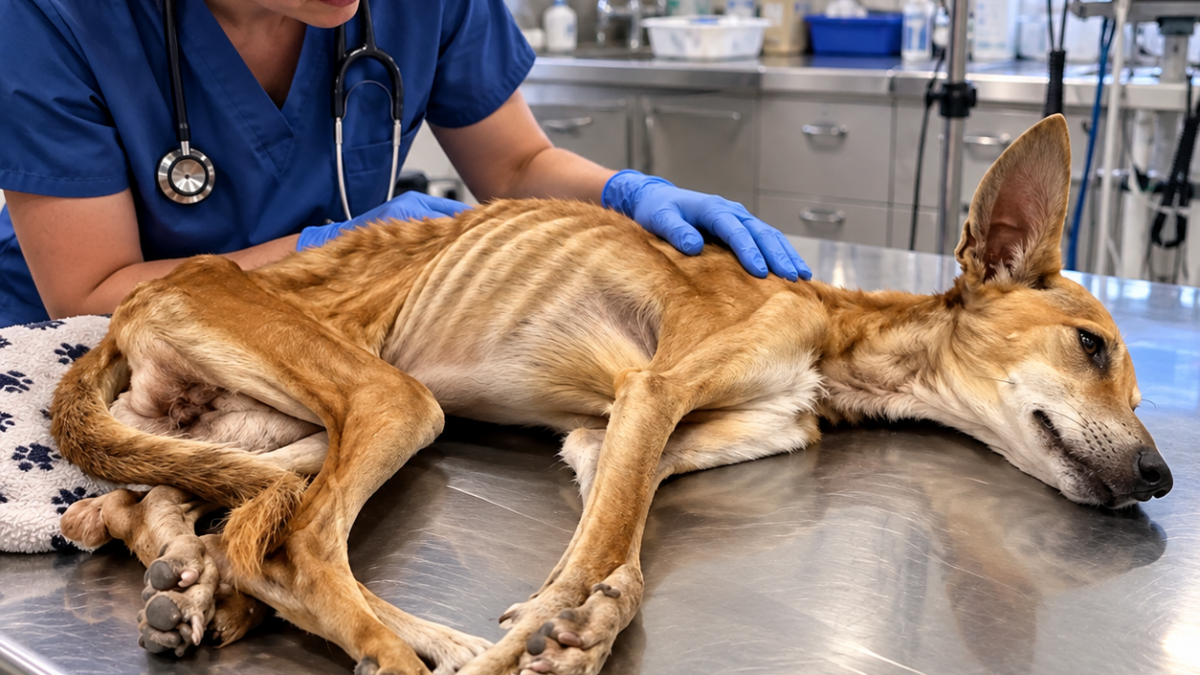
Up close, the condition of her body was worse than the videos had shown. Her hips protruded sharply. Her stomach was drawn inward. Her fur had lost its shine and lay flat against her skin. There were worn patches on her paws from repeatedly scraping and jumping at the wall.
The wall was nearly seven feet tall.
I looked at the marks on it.
Long scratches.
Some low.
Some almost four feet off the ground.
She really had tried.
Again and again.
Every mark represented another attempt made when she still had enough strength to believe there might be something better on the other side.
I crouched several feet from her.
“Thai.”
We hadn’t named her yet, of course.
At that moment she was simply a dog whose original name none of us knew.
But I spoke softly anyway.
“Hey, girl. We’re here.”
Her eyes found mine.
I have rescued frightened dogs that barked.
Dogs that lunged because fear was the only defense they had left.
Dogs that hid beneath cars or pressed themselves into corners.
Thai did none of those things.
She simply looked at me.
There was no energy for fear anymore.
I reached out slowly and placed my hand beneath her chin.
Her skin was hot.
Her mouth was dry.
When I touched her shoulder, I could feel bone beneath almost nothing.
One of our volunteers whispered, “Oh, God.”
The owner heard him.
“She’s always been skinny.”
I turned.
“No.”
The word came out before I could stop myself.
He stared at me.
I stood up.
“A naturally thin dog doesn’t collapse beside a wall because she can’t stand.”
“She eats.”
“Where’s her food?”
He pointed vaguely toward an overturned metal bowl near the house.
“And water?”
He didn’t answer.
The officer walked through the yard photographing everything.
The empty bowls.
The condition of the ground.
The wall.
Thai.
The scratches.
He asked the owner when the dog had last seen a veterinarian.
The answer changed three times.
First it had been a month earlier.
Then “sometime this summer.”
Then the owner claimed he couldn’t remember.
“Do you have veterinary records?”
“No.”
“Receipts?”
“No.”
“Medication?”
“She doesn’t need medication.”
Lena had followed us only as far as the gate.
She stood there crying silently.
When Thai heard her breathing, she turned her head.
The movement was small, but unmistakable.
Lena knelt.
“Oh, sweetheart.”
Thai’s tail moved once against the dirt.
Just once.
That tiny movement nearly broke me.
This dog, who had apparently been threatened away from the only person trying to feed her, still recognized that woman’s voice.
Lena reached toward her but stopped herself.
“Can I?”
I nodded.
She came closer and touched Thai’s forehead.
“I’m sorry,” she whispered. “I’m so sorry I couldn’t get you out.”
Thai closed her eyes beneath Lena’s hand.
The owner scoffed.
“You people are acting like she’s dying.”
The veterinarian later told us Thai might very well have been heading in that direction.
At that moment, though, we had no lab results, no weight comparison and no medical report.
We had only what was directly in front of us.
A severely underweight dog.
Dehydration.
Weakness.
Empty bowls.
No records.
And video footage documenting her decline over several days.
That was finally enough.
The officer told the owner that Thai was being removed for emergency evaluation.
His reaction was immediate.
“You can’t take my property.”
Property.
That was the word he used.
Not her name.
Not “my dog.”
Not “she.”
Property.
He stepped toward me as I slid a blanket beneath Thai.
The officer moved between us.
“Stay where you are.”
“I paid for that dog.”
“She requires medical assessment.”
“You’re stealing her.”
“No,” the officer said calmly. “We’re documenting her condition and removing her under emergency animal-welfare authority. You’ll receive the paperwork.”
The man looked toward Lena.
“This is because of you.”
The officer’s voice hardened.
“Do not threaten your neighbor.”
“I’m talking to her.”
“And I’m talking to you.”
That ended it.
Thai weighed so little that I expected lifting her to be easy.
It wasn’t.
There is something devastating about carrying an animal that should have enough strength to walk beside you.
I slipped one arm beneath her chest and another beneath her hindquarters.
She tensed at first.
Then she simply surrendered her weight.
Her head rested against my shoulder.
I could feel her heartbeat.
Fast.
Weak.
But there.
As I carried her through that gate, Lena followed beside us.
She touched Thai’s ear.
“You made it,” she whispered.
The words stayed with me all the way to the clinic.
You made it.
But we didn’t know that yet.
Getting her out of the yard had solved only one problem.
Now we had to find out whether her body could recover from everything it had endured.
During the drive, one volunteer sat beside Thai in the back of the van.
Every few minutes he checked her gums and breathing.
We didn’t offer a large meal.
People sometimes imagine that the first thing you should do for a starving animal is place a full bowl of food in front of them.
It can be dangerous.
A severely malnourished body has to be stabilized carefully.
At the clinic, the veterinary team moved quickly.
Thai was placed on a padded examination table.
Her temperature was checked.
Blood was drawn.
Fluids were started under medical supervision.
The veterinarian ran his hands gently over her ribs and spine, then listened to her heart.
“How bad?” I asked.
He didn’t answer immediately.
That silence frightened me more than any dramatic sentence could have.
Finally, he said, “She’s very weak.”
“Can she recover?”
“We need to see what the bloodwork tells us. We need to correct the dehydration carefully and start nutrition slowly. The next few days matter.”
I looked at Thai.
Her eyes were half closed.
“Is she in pain?”
“She’s exhausted. Her muscles are wasted. Her stomach and digestive system have been under stress. But right now the biggest concern is how depleted she is.”
He paused.
“She needed intervention.”
I knew what he meant.
Soon.
Not someday.
Not next week.
Now.
I called Lena that evening.
She answered on the first ring.
“How is she?”
“Alive.”
There was a long silence.
Then I heard her crying.
“I should have done more.”
“You did.”
“I waited too long.”
“You reported it.”
“They didn’t do anything.”
“You kept recording. You kept trying. You contacted us.”
“What if I had stopped after the police said there wasn’t enough evidence?”
I looked through the clinic window at Thai.
She was sleeping beneath a light blanket.
“I don’t want to think about that.”
Neither of us did.
The first night was difficult.
Thai barely reacted when the veterinary staff entered her kennel.
She drank only small amounts under supervision. She had no interest in food.
That worried us.
The next morning I came back early.
One of the technicians was sitting on the floor near her.
“How was she?”
“Quiet.”
“Did she eat?”
The technician shook her head.
My stomach dropped.
We tried a small portion of soft food later that morning.
Thai smelled it.
Then turned away.
I sat outside the kennel for nearly an hour.
I talked to her even though I had no idea whether my voice mattered.
I told her about our shelter.
I told her there were dogs there who barked at delivery trucks as if they were defending a fortress.
I told her about the old shepherd who stole blankets from every kennel.
I told her about the volunteers who carried treats in every pocket until their clothes permanently smelled like dog biscuits.
Mostly, I just wanted her to keep hearing a calm human voice.
At one point, she opened her eyes.
“You don’t have to trust us yet,” I told her. “Just stay.”
The second day brought only tiny changes.
Her hydration improved slightly.
She raised her head when a technician entered.
She accepted a few laps of water.
But food still seemed to require more effort than she was willing to give.
That evening, the veterinarian explained that recovery from starvation was rarely dramatic.
People want the movie version.
A bowl placed down.
The dog eats.
Music rises.
Everything becomes better.
Real recovery can be frustratingly slow.
A few bites.
A little water.
A normal temperature.
One better blood value.
A few minutes standing.
Then exhaustion again.
Progress can look almost invisible while you are living through it.
The third morning, I walked into the clinic expecting another difficult day.
Instead, the technician met me near the door.
“She ate.”
I stopped.
“What?”
“She ate.”
“How much?”
“Not much.”
I didn’t care.
“How much?”
The technician smiled.
“About a third of the portion.”
I laughed.
Then, embarrassingly, I cried.
We went to Thai’s kennel.
A small dish sat near her.
Food still remained, but a visible section was gone.
“You did that?”
Thai looked at me.
I crouched.
“You actually ate.”
Her tail tapped the blanket.
Once.
Then again.
That was the first morning I allowed myself to believe we might someday take her somewhere other than a clinic.
We needed a name for her medical record and rescue file.
Someone suggested Thai.
I don’t remember exactly why it stuck.
Maybe because after everything that had happened, giving her a name felt like giving something back.
She had been discussed as property.
A complaint.
Evidence.
A dog in a yard.
Now she was Thai.
And every person who entered that clinic knew her name.
“Thai drank today.”
“Thai stood for thirty seconds.”
“Thai ate half her meal.”
“Thai wagged her tail when I came in.”
The changes were tiny.
To us they were enormous.
Meanwhile, the situation outside the clinic was becoming more complicated.
The owner had begun telling neighbors that Lena had stolen his dog and that our rescue group had manipulated the police.
He claimed Thai had been sick.
Then he claimed she had refused to eat.
Then he claimed Lena had poisoned her.
That last accusation frightened Lena.
She called me late one evening.
“He’s telling people I did something to her.”
“You recorded yourself throwing food over the wall.”
“I know.”
“And we have the veterinary exam.”
“He’s angry.”
“Has he threatened you again?”
There was a pause.
“Not directly.”
That answer told me enough.
I contacted the officer involved in the case.
He asked Lena to save everything.
Messages.
Security footage.
Dates.
Times.
Names of witnesses.
The most important thing, he told her, was not to confront the owner.
Let the evidence speak.
That became our approach too.
We were angry.
Of course we were.
Every time I looked at photographs of Thai’s ribs or the scratches on that wall, anger came naturally.
But rage wasn’t going to protect her permanently.
Documentation might.
So we documented everything.
Her admission weight.
Her hydration status.
Her bloodwork.
Photographs taken on arrival.
Body-condition assessments.
Daily feeding records.
The marks on her paws.
The absence of veterinary documentation provided by the owner.
And Lena’s videos, each automatically stamped with a date.
Those videos became particularly important because they showed a timeline.
Thai didn’t suddenly become thin overnight.
She had deteriorated while trapped in the same yard.
One clip showed her repeatedly trying to climb the wall.
Another showed Lena tossing pieces of food over.
Another captured the owner shouting from his yard.
“Stop feeding my dog.”
Lena’s voice could be heard asking, “Why? She’s hungry.”
His reply was clear.
“Do it again and you’ll have a problem with me.”
That recording changed the tone of the investigation.
This was no longer simply an argument between neighbors about the condition of a dog.
There was evidence that someone had noticed Thai’s hunger, attempted to help and been actively discouraged.
On day five, two investigators visited the clinic.
Thai was stronger than she had been when rescued but still shockingly thin.
One investigator crouched beside her.
“This is the dog?”
“Yes.”
He stared at her for several seconds.
Then he looked at the original photographs.
“She looked worse?”
“Much.”
He exhaled slowly.
We gave them copies of the medical reports.
They interviewed the veterinarian.
They interviewed our volunteers.
They interviewed Lena again.
And then they went back to the house.
The owner apparently expected the situation to disappear once Thai had been removed.
Instead, the opposite happened.
The healthier Thai became, the clearer the evidence of what she had survived became.
On day seven, she stood by herself long enough to walk six careful steps.
I counted every one.
One.
Two.
Three.
She paused.
Four.
Five.
Six.
Then she leaned against my leg.
I sat on the floor beside her.
“You climbed a wall with these legs?”
She looked up at me.
There was more life in her eyes now.
More curiosity.
Her personality was beginning to emerge from underneath the exhaustion.
She liked women immediately.
Men took longer.
Sudden movements made her flinch.
The sound of a metal bowl being dropped made her retreat to the back of the kennel.
But if you sat quietly and let her approach, she would eventually press her nose against your hand.
On the eighth day, she stole a piece of chicken from a technician’s fingers.
The technician came running down the hall to tell me as though Thai had won an Olympic medal.
“She stole it.”
I laughed.
“You’re happy about that?”
“I have never been happier to have food stolen from me.”
By day eleven, Thai’s appetite had improved significantly.
She was still on a carefully controlled nutrition plan, but for the first time she approached the front of her kennel when meals arrived.
That sound—the light scrape of her bowl being placed down—no longer meant disappointment.
It meant food was coming.
Every time.
Not sometimes.
Not if someone remembered.
Every time.
Lena visited on the twelfth day.
Thai heard her voice before she entered the room.
Her head came up.
Lena stepped inside.
“Hello, sweetheart.”
Thai stood.
Her legs trembled.
But she stood.
Then she walked toward her.
Lena dropped to her knees.
Thai pressed her face into the woman’s chest.
I turned away because that moment felt as if it belonged to them.
Lena wrapped both arms carefully around her.
“I told you somebody would come.”
Her voice broke.
“I’m sorry it took so long.”
Thai licked her chin.
Lena laughed through her tears.
For the first time since I had met her, she looked relieved.
Not completely safe.
Not yet.
But relieved.
Then she told me something that changed the case again.
“There are more videos.”
I looked at her.
“What kind of videos?”
“My security camera.”
Her house had a small camera covering the side yard and part of the alley.
She had originally assumed it wouldn’t matter because it couldn’t see directly into Thai’s backyard.
But after speaking with investigators, she reviewed weeks of footage.
She found something.
Several times, the owner appeared carrying bags of dog food from his car.
But he never took those bags into the backyard.
Instead, he carried them to a shed on the opposite side of the property.
At first that seemed meaningless.
Then Lena remembered hearing dogs barking from inside that shed months earlier.
“How many dogs?” I asked.
“I don’t know.”
That information went straight to investigators.
A welfare inspection followed.
By then, no other dogs were found on the property.
But officers discovered old crates, chains, empty food bags and veterinary medication labeled for dogs that were not Thai.
The case widened.
Neighbors were interviewed.
One remembered seeing two dogs at the property the previous year.
Another remembered puppies.
Someone else remembered a van arriving repeatedly.
None of that proved a crime by itself.
But investigators started asking questions the owner clearly did not want answered.
Where had those dogs gone?
Who had owned them?
Were there breeding records?
Sales records?
Veterinary records?
Licenses?
The man who had originally insisted the entire situation was “nobody’s business” suddenly had a growing number of officials interested in his business.
Lena called me after one of those interviews.
“I feel like I started something enormous.”
“You started by trying to feed a starving dog.”
“What if he comes after me?”
“He knows people are watching now.”
She was quiet.
Then she said something I never forgot.
“I was afraid of him before.”
“And now?”
“I’m still afraid. I just don’t think being afraid is a good enough reason to pretend I didn’t hear her anymore.”
That was courage in its most honest form.
Not the absence of fear.
Choosing that something mattered more.
On day fourteen, Thai went outside on a leash.
We chose a quiet fenced courtyard behind the clinic.
The moment the door opened, she froze.
Sunlight covered the pavement.
There was grass beyond it.
No wall.
No shouting.
No chain.
But Thai stood in the doorway as if she had forgotten that she was allowed to choose where her feet went.
I stepped outside first.
“Come on.”
She watched me.
I crouched in the grass.
“You can come out.”
Her front paw crossed the threshold.
Then the other.
She stopped.
A breeze moved through the courtyard.
Thai lifted her nose.
She smelled the air.
There are moments with rescued animals that look insignificant in photographs because the important part is invisible.
That was one of them.
A dog stood in sunlight.
That was all.
But I knew what she had last known outdoors.
A dirt yard.
An empty bowl.
A wall she could not climb.
Now there was grass.
Wind.
Open sky.
And a leash held loosely enough that she could decide which direction to take.
She stepped toward me.
Then past me.
She walked to the grass and lowered her nose.
She sniffed for almost a full minute.
When she finally lifted her head, her tail was moving.
Not one tired tap.
A real wag.
I laughed.
“There you are.”
Thai looked at me as if surprised by her own happiness.
The clinic staff had warned us not to expect a smooth emotional recovery simply because her body was improving.
They were right.
That evening, a metal gate slammed somewhere in the building.
Thai dropped instantly to the floor.
Her entire body shook.
I sat several feet away.
I didn’t touch her.
I didn’t force her to stand.
I just waited.
Ten minutes passed.
Then fifteen.
Eventually, she crawled toward me.
She rested her chin on my shoe.
That became our routine.
We stopped demanding bravery from her.
We simply made the world predictable.
Food arrived.
Water stayed available.
People knocked before entering.
Hands moved slowly.
Doors opened again after closing.
Nobody screamed when she made mistakes.
Nobody punished her for being afraid.
Nobody threatened the person trying to comfort her.
Predictability became medicine.
By day eighteen, Thai had enough energy to become mischievous.
She discovered that one cabinet contained treats.
The first time she smelled them, she sat directly in front of the cabinet and refused to move.
“You’re becoming demanding,” I told her.
The technician laughed.
“That’s a healthy problem.”
It was.
A dog who once lacked the energy to stand was now negotiating for snacks.
She also began watching other dogs through the clinic courtyard fence.
Her ears would rise.
Her body would lean forward.
No aggression.
Just interest.
Our shelter had several stable, friendly dogs we used to help newcomers learn routines.
We started planning her transfer.
But before Thai could leave the clinic, one final medical review was needed.
Day twenty-two.
I arrived early.
Thai was already awake.
She was standing at the kennel door.
The veterinarian came in with her chart.
Her blood values had improved.
She had gained weight.
Her hydration was normal.
Her digestion had stabilized.
She still needed continued monitoring and careful feeding, but hospitalization was no longer necessary.
“She can go.”
I stared at him.
“Today?”
“Today.”
I knelt beside Thai.
“Did you hear that?”
Her tail began moving.
“You’re getting out of here.”
This time she walked out.
Nobody carried her.
That mattered to me.
Twenty-two days earlier, I had lifted her from the dirt because her body couldn’t do what she wanted it to do.
Now Thai walked through the clinic doors herself.
Lena was waiting outside.
She had asked whether she could come.
The moment Thai saw her, the leash tightened.
Not from fear.
From excitement.
Thai moved toward her, and Lena crouched.
“You look beautiful.”
She did.
She was still thin.
Still recovering.
Still carrying things inside her that we could not see.
But she was standing.
She was alert.
She was alive.
At the shelter, we gave Thai a quiet kennel with a bed so thick she spent the first few minutes walking around it as if she didn’t understand what it was.
Then she stepped onto it.
Turned three times.
Collapsed into the middle.
And sighed.
Everyone laughed.
That first evening, I stayed longer than necessary.
Most of the dogs had settled.
A few barked occasionally.
One snored loudly enough to be heard from the hallway.
Thai lay curled on her new bed.
Her bowl was empty because she had finished every bite.
There was fresh water beside her.
I closed the kennel door.
She opened her eyes.
For a second, I worried.
Would the door frighten her?
Instead she looked at the bowl.
Then at me.
Then settled her head back onto the blanket.
She was beginning to understand.
A closed door didn’t always mean abandonment.
Sometimes it simply meant you were safe for the night.
The legal case continued.
The owner had apparently expected the attention to fade once Thai disappeared from public view.
Instead, investigators had assembled a file.
The videos.
The veterinary records.
Photographs.
Witness statements.
The threatening remarks to Lena.
The inconsistencies in his explanations.
Questions about other dogs previously kept on the property.
And perhaps most damaging of all, the timeline.
It is easy for someone accused of neglect to say, “I didn’t realize.”
It becomes harder when video shows the animal deteriorating day after day.
Harder still when a neighbor can prove she repeatedly raised concerns.
Harder again when that same neighbor was told to stop feeding the animal.
The owner was formally cited and later charged under local animal-cruelty and neglect provisions.
When I told Lena, she didn’t celebrate.
She sat at the small table in our shelter office and stared at her hands.
“I thought I would feel happy.”
“What do you feel?”
“Tired.”
I understood.
People imagine justice arriving like lightning.
Sudden.
Bright.
Satisfying.
Usually it arrives as paperwork.
Interviews.
Waiting rooms.
Phone calls.
Statements repeated for the fourth time.
Dates you have to remember.
Videos you wish you had never needed to record.
Fear that evidence won’t be enough.
Fear that someone will retaliate.
Justice can be exhausting long before it becomes satisfying.
The owner contested everything.
He claimed Thai had always been difficult to feed.
The veterinarian disagreed with the idea that her condition could reasonably be explained by simple pickiness.
He claimed she had access to water.
Photographs from the day of removal showed otherwise.
He claimed Lena had exaggerated.
Her videos were time-stamped.
He claimed we had made Thai look worse for fundraising purposes.
That accusation made me furious.
But our lawyer gave us simple advice.
“Don’t argue online. Preserve evidence.”
So we did.
No social media fight.
No public insults.
No threats.
No revenge campaign.
Just records.
And while he talked, Thai kept recovering.
Her body filled out slowly.
Muscle returned to her legs.
Her coat began to shine.
She developed an obsession with tennis balls despite having absolutely no idea how fetch worked.
You could throw a ball.
Thai would chase it.
Pick it up.
Run somewhere completely different.
Then stare at you as if your part of the game had ended.
The first dog she befriended at the shelter was an elderly mixed-breed named Bruno.
Bruno had arthritis and disliked almost everybody.
Thai seemed determined to change his mind.
She followed him around.
Slept near his kennel.
Copied where he sniffed in the yard.
Eventually Bruno stopped walking away from her.
Then one afternoon I found them lying in the same patch of sunlight.
Thai’s head rested across his front legs.
Bruno looked deeply annoyed.
But he didn’t move.
That became her new life.
Morning walks.
Breakfast.
Sunlight.
Friends.
Beds.
Treats.
People who knew when she had eaten because someone actually kept track.
The first time she left food in her bowl voluntarily, I nearly laughed.
Months earlier, food had been something she could not count on.
Now she could stop eating because she was full and trust that another meal would come later.
That is the kind of ordinary miracle people rarely think about.
Then the court date arrived.
Lena asked me to go with her.
“I don’t want to see him alone.”
“You won’t.”
She wore a plain dark jacket and carried a folder containing copies of her statements.
Her hands shook while we waited in the hallway.
“You can still tell the prosecutor you’re uncomfortable testifying,” I said.
She shook her head.
“No.”
“You’re sure?”
“I heard her every night.”
She looked at me.
“If I stay quiet now, what was the point of getting her out?”
When the owner entered the hallway, Lena stiffened.
He saw her.
For a moment, the old intimidation returned to his face.
Then he noticed the officers.
The prosecutor.
The veterinary witness.
Me.
And several members of the rescue organization.
He looked away.
That was the first time Lena saw him and did not lower her eyes.
The hearing itself was less dramatic than television would make it.
No shouting.
No courtroom confession.
No sudden gasp from the gallery.
Evidence was presented carefully.
The veterinarian described Thai’s condition on arrival.
He explained dehydration.
Severe underweight status.
Muscle wasting.
The medical risks involved.
Photographs were entered.
Then Lena’s videos were shown.
I had seen them many times.
Watching them in that room felt different.
Thai jumping against the wall.
Thai sliding down.
Thai trying again.
Then the later recording.
Thai lying still.
The contrast was devastating.
The owner sat motionless.
Then came the audio.
Lena’s voice.
“Why? She’s hungry.”
And his reply.
“Do it again and you’ll have a problem with me.”
The room became completely quiet.
Lena testified next.
She explained when she first noticed Thai losing weight.
How she began placing food near the wall.
How she tried tossing food over.
How the owner confronted her.
How she called authorities.
How she was told that, based on what they had at that time, there was not enough evidence for immediate intervention.
So she kept recording.
She described the night Thai stopped crying.
That part was not in the original statement.
The prosecutor asked her why she remembered it.
“Because I had gotten used to hearing her,” Lena said.
Her voice trembled.
“Every night she would whine or scratch or make some sound. I hated hearing it, but at least it meant she was still trying.”
She swallowed.
“Then one night there was nothing.”
The prosecutor waited.
“What did you think?”
“I thought she had died.”
I looked down.
Lena continued.
“I went outside before sunrise and looked through the gap. She was still alive. She was beside the wall. But she didn’t get up anymore.”
“Is that when you posted in the rescue group?”
“Yes.”
“Why anonymously?”
Lena looked toward the owner.
“Because I was afraid of him.”
Nobody needed the sentence explained.
After her testimony, we stepped into the hallway during a break.
Lena leaned against the wall.
“I thought my legs were going to give out.”
“You did it.”
“I hate that he heard me say I was afraid.”
I looked at her.
“Maybe he needed to.”
The final outcome did not erase what had happened.
Nothing could.
But it mattered.
The court found sufficient evidence of serious neglect and imposed penalties that included fines, reimbursement toward Thai’s documented medical care, and restrictions preventing the owner from keeping animals for a significant period subject to local enforcement and future review.
The threatening behavior toward Lena was also formally documented, and he was warned that any retaliation could create additional legal problems.
The wider investigation into the other dogs did not produce enough evidence for every suspicion raised.
We had to accept that.
Responsible rescue work means telling the truth even when the truth feels incomplete.
We could prove what happened to Thai.
We could prove what Lena recorded.
We could prove Thai’s medical condition.
We could not prove every rumor about every animal that had once been seen near that property.
So we did not pretend we could.
The strongest case was the real one.
And it was enough to ensure Thai would never legally be returned to that backyard.
That was the sentence I had been waiting to hear.
Not the amount of the fine.
Not the restrictions.
Not the angry look on the owner’s face.
Thai would not go back.
When we walked outside the courthouse, Lena stopped on the steps.
For a moment she said nothing.
Then she asked, “Can we go see her?”
We drove straight to the shelter.
Thai was in the yard with Bruno.
When she saw Lena approaching the fence, she ran.
Actually ran.
Her legs stretched beneath her.
Her ears flew backward.
Her tail spun wildly.
Lena dropped her folder.
Thai reached her and nearly knocked her over.
Lena laughed so loudly that several volunteers came outside.
Months of tension left her face all at once.
She wrapped her arms around Thai.
“It’s finished,” she whispered.
Thai licked her cheek.
“You’re never going back.”
I stood a few feet away.
That was the revenge people had wanted when they first heard Thai’s story.
Some had imagined humiliation.
Some wanted the owner frightened.
Some wanted anger returned with anger.
But standing there watching Thai run across grass with a healthy body, I understood something simpler.
The best revenge against someone who treated a living creature as disposable was not cruelty in return.
It was proving that the life he neglected could become full without him.
Thai did not spend her recovery thinking about punishment.
She did not understand court orders.
She did not know about fines.
She knew the morning sun.
She knew Bruno.
She knew exactly which volunteer kept treats in her left pocket.
She knew dinner arrived at the same time every day.
She knew Lena’s voice.
And eventually, she learned something I wasn’t sure she would ever completely believe.
She could walk toward a gate without being afraid of what was waiting behind it.
Several months after the case ended, we received an adoption application for Thai.
A couple named Rachel and Daniel had followed her recovery quietly from the beginning.
They lived outside the city in a modest house with a fenced yard, no children at home and one calm seven-year-old dog named Otis.
Their application was excellent.
But Thai was special to us.
We were cautious.
Rachel visited three times before we even considered a home trial.
The first visit, Thai stayed near me.
Rachel didn’t chase her.
She sat on the grass and talked with the volunteers.
Twenty minutes later, Thai approached.
She smelled Rachel’s shoe.
Rachel ignored her.
Thai moved closer.
By the end of the visit, she was sitting beside her.
The second visit, Daniel came.
Thai was more hesitant around him.
He understood.
He sat sideways instead of facing her directly.
No reaching.
No calling repeatedly.
No forcing contact.
Eventually Thai walked behind him and smelled his jacket.
He smiled but didn’t turn around.
“Hi, Thai.”
Her tail moved.
The third visit, they brought Otis.
Bruno watched the meeting from a distance with the offended expression of an old dog who believed Thai was clearly betraying him.
Otis was gentle.
They walked together.
Sniffed the same fence posts.
Drank from separate bowls.
Then Thai did something that surprised us.
She lay down beside Rachel.
Not touching her.
Just near her.
Thai had made decisions about people before.
We had learned to respect them.
The home trial began two weeks later.
I drove her there myself.
As we approached the property, my chest tightened.
A concrete wall surrounded part of the backyard.
I almost turned the van around.
Rachel noticed my expression.
“We can change that.”
I looked at her.
“The wall?”
“If it bothers her.”
There was no defensiveness.
No explanation.
Just willingness.
We brought Thai into the house first.
She explored slowly.
Kitchen.
Living room.
Hallway.
Guest room.
She discovered a dog bed near the fireplace.
Then she found the back door.
Rachel opened it.
Thai stepped outside.
The yard was large.
Grass covered most of it.
Trees lined the far fence.
The wall was only along one side.
Thai stared at it.
Everything inside me tightened.
She walked toward the wall.
I followed several yards behind.
She stopped exactly where grass met concrete.
For several seconds she didn’t move.
Then she rose slightly onto her hind legs.
My breath caught.
She placed her front paws against the wall.
Rachel looked at me.
Nobody spoke.
Thai smelled the concrete.
Then she dropped back onto all four feet.
She turned away.
And ran toward Otis.
That was it.
No panic.
No desperate jumping.
No scratching.
She had approached a wall and discovered she no longer needed to escape over it.
The gate behind her was already open.
I cried in Rachel’s backyard.
I didn’t hide it.
Daniel pretended not to notice.
Rachel cried too.
The trial lasted three weeks.
Thai slept through the night.
She ate well.
She followed Otis everywhere.
She learned that the sound of Daniel opening the refrigerator was worth investigating.
She stole one slipper and carried it into the yard.
She barked at a delivery driver.
The first time she did, Rachel sent me a video.
Thai stood at the window barking with Otis beside her.
The message beneath it said:
“Apparently she owns the house now.”
I watched that video five times.
After everything we had done to teach Thai that she was safe, she had finally become confident enough to believe something belonged to her.
Not as property.
As home.
The adoption became permanent.
We invited Lena to the signing.
Thai spent most of the afternoon moving between all of us.
Rachel.
Daniel.
Me.
Lena.
As though she were checking that the people responsible for the different chapters of her life were somehow all still there.
Before leaving, Lena knelt beside her.
“You know what you did to my life?” she asked.
Thai tilted her head.
“You ruined my ability to ignore anything.”
We laughed.
But Lena meant it.
After Thai’s rescue, she began volunteering with our group.
At first she only answered messages.
Then she helped transport food.
Eventually she began visiting reported neglect cases with experienced volunteers.
Not alone.
Never recklessly.
But she knew what it felt like to be the person standing on the other side of a wall wondering whether anyone would listen.
She was good at talking to those people.
“I believe you,” she would say.
“Save the videos.”
“Write down the dates.”
“Don’t confront anyone by yourself.”
“We’ll figure out what can legally be done.”
A year after Thai was removed from that backyard, Lena came with me to another property.
Different neighborhood.
Different dog.
Different circumstances.
Nothing as severe.
A family had fallen into financial trouble, and their dog needed veterinary care they genuinely could not afford.
Instead of threats, the owner cried when we offered help.
Lena coordinated the clinic appointment.
On the drive home, she stared through the window for a while.
“Not every case has a bad person.”
“No.”
“That makes it harder sometimes.”
“It does.”
She nodded.
“I used to think rescue was just taking dogs away from cruel people.”
“And now?”
“Sometimes it’s helping people keep the animals they love. Sometimes it’s getting an animal away from someone who shouldn’t have one. Sometimes it’s just being the person who answers the message.”
I smiled.
“You learned quickly.”
She looked at me.
“Thai taught me.”
We continued receiving updates from Rachel.
Thai gained the rest of the weight she needed.
Her ribs disappeared beneath healthy muscle.
Her coat became glossy.
She developed an absurd habit of carrying blankets from one room to another.
Whenever Daniel sat on the couch, Thai brought him a toy but refused to release it.
Otis eventually learned to avoid standing between Thai and the kitchen at meal time.
And the dog who had once collapsed beside a wall became obsessed with running.
Rachel started taking her on early morning walks through nearby fields.
At first Thai stayed close.
Then she began trotting ahead on a long line.
Eventually, in safely enclosed areas, she would sprint until her entire body looked weightless.
Rachel sent us one photograph that I still keep.
Thai is running across a field.
All four paws are off the ground.
Her mouth is open.
Her ears are back.
There is nothing behind her except sunlight.
When people ask which photograph best explains why we do rescue work, I show them that one.
Not the photograph from the backyard.
Not the ribs.
Not the empty bowl.
Not the scratches on the wall.
Those photographs matter because they document what happened.
But they are not Thai.
Suffering was something done to her.
It was never her identity.
The running dog is Thai.
The dog stealing slippers is Thai.
The dog sleeping next to Otis is Thai.
The dog who knows dinner time better than any clock is Thai.
The dog who hears Lena’s voice and still loses her mind with happiness is Thai.
Several months after the adoption, we received unexpected news about the former owner.
He had attempted to obtain another dog through a private online listing.
Because of the existing restrictions connected to Thai’s case, someone who recognized his name reported it.
Authorities intervened before the animal was transferred.
When I heard, I felt the anger return.
Not because I wanted revenge.
Because I realized how quickly the entire cycle could have begun again.
A different dog.
A different backyard.
A different neighbor listening through a wall.
This time the system worked earlier.
The seller was informed.
The transfer did not happen.
The existing order was reviewed.
The owner received additional scrutiny regarding compliance with the restrictions imposed after Thai’s case.
Lena called me that night.
“So he really tried again?”
“Yes.”
“Did he get the dog?”
“No.”
She went silent.
Then she exhaled.
“Good.”
One word.
That was all.
No celebration.
No cruelty.
Just relief.
Thai had not only escaped.
Her case had created a record strong enough to protect another animal she would never meet.
That felt important.
A few weeks later, Rachel brought Thai back to the shelter for our annual open day.
We wondered whether returning might upset her.
It didn’t.
She walked through the gate confidently.
Bruno was still there.
Older.
Slower.
Grayer.
Thai spotted him across the courtyard.
She pulled Rachel halfway across the yard.
Bruno looked up.
Thai reached him and covered his face with enthusiastic kisses.
Bruno endured this indignity for approximately six seconds before walking away.
Thai followed.
Some relationships never change.
Lena arrived later.
The second Thai heard her voice, she turned.
That reaction had never faded.
She ran to her.
Lena crouched and Thai pressed against her chest.
Around us, people were talking and laughing.
Dogs barked.
Volunteers carried bags of food.
Children stood with their parents near adoption booths.
It was a bright ordinary afternoon.
I remembered another ordinary afternoon on another street.
Laundry hanging.
Bicycles by fences.
A quiet backyard hidden behind concrete.
That is what still unsettles me about neglect.
It does not always happen in places that look frightening.
Sometimes suffering lives ten feet from someone’s kitchen window.
Sometimes the most important witness is a woman standing next door who refuses to convince herself that what she hears is none of her business.
Lena and I walked toward a quieter part of the yard while Thai stayed with Rachel.
“Do you still think about that week?” I asked.
“All the time.”
“The threats?”
“Not mostly.”
“What, then?”
She watched Thai.
“The night she stopped making noise.”
I understood immediately.
“I kept thinking silence meant things were getting better,” Lena said. “Then I realized silence can mean something has run out of strength.”
She wiped her eyes.
“That changed the way I listen to everything.”
We stood there for a while.
Thai suddenly grabbed a tennis ball and ran past us.
Rachel called her.
Thai ignored her completely.
I laughed.
“She still doesn’t understand fetch.”
“I think she understands it perfectly,” Lena said. “She just disagrees with the rules.”
Thai circled the yard with the ball in her mouth.
For a dog who had once spent every remaining ounce of energy trying to cross a wall, refusing to surrender a tennis ball felt wonderfully rebellious.
Rachel finally caught up with her.
Thai dropped the ball.
Then immediately stole it again.
Everyone laughed.
I looked at Lena.
“This is what you saved.”
She shook her head.
“We saved her.”
“No.”
I pointed toward Thai.
“You were the first person who decided her life was worth making trouble over.”
Lena looked away.
For a moment neither of us spoke.
Then she said quietly, “I almost didn’t post.”
That surprised me.
“What stopped you?”
“Nothing stopped me. That’s the problem. I almost stopped myself.”
She explained that she had typed the message three times.
The first version sounded too emotional.
She deleted it.
The second included her name.
Fear made her delete that too.
The third sat on her screen for nearly an hour.
She kept thinking about the warning she had received.
Not enough evidence.
She wondered whether strangers would accuse her of exaggerating.
She wondered whether the owner would discover who posted it.
She wondered whether interfering might make things worse.
Then Thai cried once.
A weak sound through the wall.
Lena pressed send.
One click.
That was the distance between Thai’s life as it had been and everything that came afterward.
Not a heroic speech.
Not a dramatic confrontation.
A frightened woman pressing send.
I think about that often because people imagine saving a life requires extraordinary courage.
Sometimes it requires ordinary people refusing one final opportunity to look away.
Thai lived for years after that rescue.
Happy years.
Rachel kept us updated.
There were camping trips.
Snowy mornings.
A ridiculous birthday hat Thai tolerated for exactly four seconds.
A photograph of her asleep upside down on a couch.
A video of her standing in a shallow lake, barking furiously at her own reflection.
She eventually became the confident dog who greeted visitors at the door.
Men no longer frightened her automatically.
Metal bowls no longer sent her running.
She never became completely comfortable with shouting.
Maybe some memories remain inside the body long after the danger is gone.
Rachel understood.
Their house became a quiet place.
If voices rose during a movie, Thai sometimes left the room.
Nobody followed her.
Nobody forced reassurance on her.
She would return when she was ready.
That was another kind of freedom.
The right to leave.
The right to come back.
The right to decide that something frightened you without being punished for it.
As Thai grew older, white appeared around her muzzle.
The first time Rachel sent a close-up of the gray hairs, I stared at it for a long time.
Aging is something rescue workers learn to be grateful for.
Gray hair means time happened.
Birthdays happened.
Winters came and went.
A dog who might not have survived that backyard lived long enough for her face to become old.
There is no photograph of Thai that means more to me than the last one Lena and I received together.
Thai was lying on the porch of Rachel and Daniel’s house.
Her muzzle was silver.
Otis had passed away the year before, and another rescue dog slept nearby.
Thai’s head rested on her paws.
Behind her was the yard.
And beyond the yard stood that concrete wall.
The same kind of wall that once would have filled me with dread.
Rachel’s message said:
“She likes sleeping here because the afternoon sun hits this spot.”
I enlarged the photograph.
Thai was sleeping peacefully only a few feet from a wall.
No scratching.
No jumping.
No escape attempt.
Just sunlight.
That was when I finally understood the full distance she had traveled.
Her story had started with a wall she could not cross.
It ended with a wall that no longer mattered.
Thai never needed revenge.
Life itself gave her something better.
She got mornings when breakfast arrived before she asked.
She got people who knew the difference between fear and disobedience.
She got veterinarians when she was sick.
She got friends.
She got soft beds.
She got fields wide enough to run until she was tired for the right reasons.
She got a woman next door who refused to stop listening.
She got a police officer willing to make the calls that should have been made sooner.
She got volunteers who carried her when she couldn’t walk.
She got a family who never asked her to forget what had happened before allowing her to belong.
And the man who once threatened anyone who tried to feed her eventually discovered that a wall could hide a starving dog only until one person decided to document what was happening on the other side.
After that, the wall protected nothing.
Not excuses.
Not intimidation.
Not lies.
The evidence followed him into a courtroom.
The medical records contradicted him.
The videos contradicted him.
His own recorded words contradicted him.
The neighbor he had frightened sat only a few yards away and told the truth anyway.
And Thai walked away from him forever.
Years later, when people asked Lena whether she regretted becoming involved, she always answered the same way.
She would take out her phone.
Find the photograph of Thai running through the field.
Turn the screen around.
And say, “Look at her.”
No longer starving.
No longer trapped.
No longer scraping bloody determination against a wall too high to climb.
Just running.
That was her answer.
And honestly, it became mine too.
Whenever rescue feels too difficult, whenever a report leads nowhere at first, whenever somebody says an animal is “just property” or a frightened witness tells me they’re not sure whether speaking up will make a difference, I remember Thai beside that wall.
I remember the scratches.
I remember carrying her out.
I remember her first few bites on the third day.
I remember six trembling steps.
I remember the first real wag of her tail.
I remember her walking out of the clinic on day twenty-two without anyone carrying her.
I remember Lena sitting in court with shaking hands and refusing to look down.
I remember Thai seeing that concrete wall in her new backyard, putting her paws against it once, then turning around because there was nothing left to escape from.
Most of all, I remember the silence Lena described.
The night Thai stopped crying.
For years, that part bothered me more than anything else.
Now I understand why.
Thai’s cries had been requests.
Food.
Water.
Help.
Freedom.
The silence came when she was nearly too weak to ask anymore.
But somebody had already heard her.
Somebody kept the videos.
Somebody pressed send.
And because one frightened neighbor refused to let that silence become the end of Thai’s story, the dog who once collapsed beneath an impossible wall eventually grew old sleeping peacefully in the sun.
Not every rescue ends that way.
We know that.
That is exactly why this one matters.
Thai got the ending she should have had from the beginning.
A full bowl.
A safe home.
People who were happy she existed.
And enough years of ordinary happiness that the worst days of her life became only the first pages of a much longer story.
When I think of Thai now, I do not picture the starving dog I carried out of that backyard.
I picture the photograph taken much later.
Four paws off the ground.
Ears flying behind her.
Sunlight across the field.
Nothing holding her back.
And absolutely no wall in front of her.

