PART 2: She Was Blind, Used for Breeding, and Cried Herself to Sleep—Then the Vet Said She Might Not Survive the Night
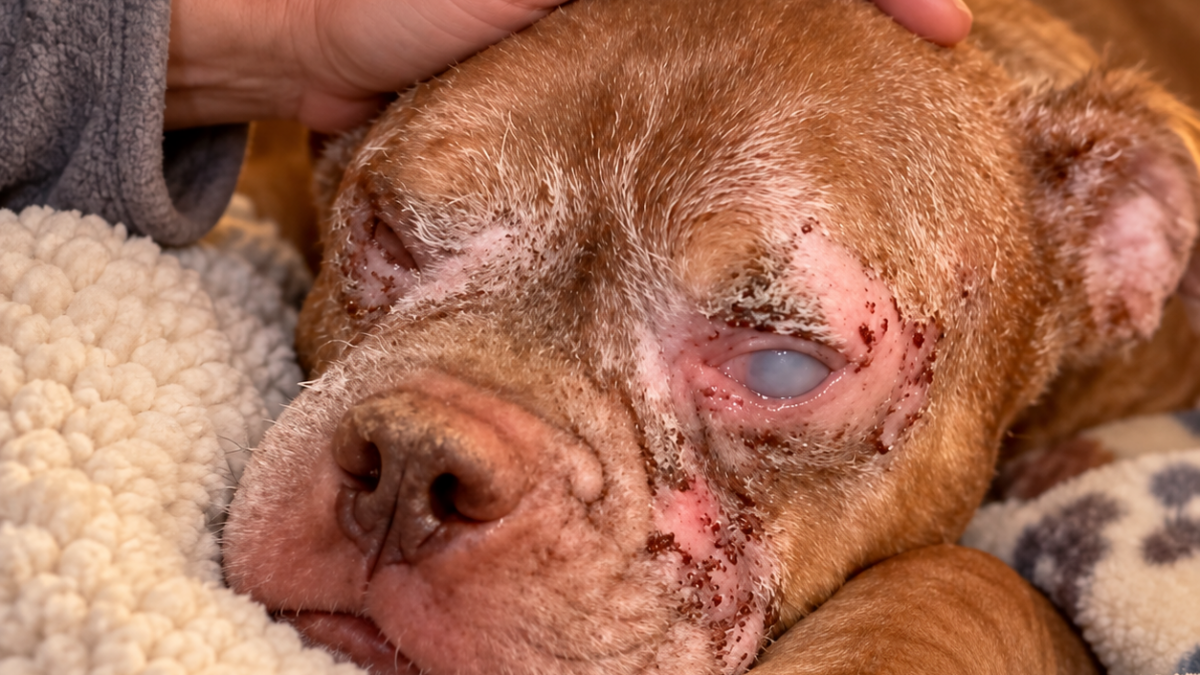
The first thing I heard from Graça was not a bark but a soft, broken cry that came every few seconds as she lay curled against the wall, completely blind and unable to see the person kneeling beside her.
She had spent years producing puppies for other people, and by the time her body finally failed, the same hands that had profited from her had apparently decided there was nothing left worth saving.
I thought bringing her somewhere safe would finally end her suffering, but the next morning a veterinarian looked at her test results, lowered his voice, and told me we might already be too late.
My name is Elena, and I had worked with neglected dogs long enough to know that fear does not always look dramatic. Some dogs bite. Some hide. Some pace until their paws bleed. Graça cried. Quietly. Repeatedly. She would stop only when someone touched her gently or when exhaustion pulled her into sleep. The first night I sat beside her, she kept turning her head toward every sound because she could not see me. Her eyes were cloudy and unresponsive, and when I moved my hand near her face, there was no tracking movement at all. “Hey, sweetheart,” I whispered. Her ears lifted. She cried again. I placed my palm against her shoulder. Almost immediately, she leaned into me.
That was how we slept. Graça pressed against my side on a blanket while I stayed on the floor beside her. Sometime after midnight, I realized the crying had stopped. Not because she had become stronger. Because she had relaxed enough to sleep. It was such a small thing, but after learning even a little about her past, it felt enormous.
Graça had been used for breeding for years. We did not yet know exactly how many litters she had produced, only that her body told a long story. Her abdomen hung loose. Her mammary glands showed the changes of repeated pregnancies and nursing. Her teeth were worn. Her nails were overgrown. She was underweight beneath an old, dull coat. Every part of her seemed tired.
The next morning, I carried her into the hospital because she was too weak to walk far. She weighed almost nothing in my arms. A technician checked her gums and frowned. Another listened to her chest. Dr. Warren came in, examined her carefully, then started ordering tests.
Bloodwork.
Ultrasound.
X-rays.
Blood pressure.
Urinalysis.
One test became another, and every time the treatment-room door opened, I searched the staff’s faces before they spoke.
Finally, Dr. Warren asked me to sit down.
“Her spleen is enlarged,” he said.
I nodded.
“So is her liver.”
Another nod.
“Her kidney values are very concerning. She’s severely anemic, dehydrated, and her pulse is weak.”
“How bad?”
He looked toward the room where Graça was resting beneath warmed blankets.
“Bad.”
“Can you treat it?”
“We can support her. Fluids carefully, medication, nutrition, further diagnostics. But I need you to understand that her body has been under stress for a very long time.”
“Is she dying?”
Dr. Warren did not answer immediately.
That silence told me almost everything.
“Her chances are poor,” he finally said. “Very poor.”
I looked through the glass. Graça was lying on her side, one ear moving whenever somebody walked past. She could not see the room. She could not see me. She could not understand that several people were quietly discussing whether her body had enough strength left to survive the treatment needed to save it.
Then Dr. Warren said the sentence I had been dreading.
“At some point today, we may have to talk about whether continuing treatment is fair to her.”
I stood.
“No.”
“Elena—”
“I understand what you’re saying.”
I walked to the glass and put my fingers against it.
Graça lifted her head toward the sound.
She cried once.
Softly.
And in that moment, I knew I could not promise she would survive—but I could promise that for the first time in her life, nobody was going to decide she was disposable without fighting for her first.
PART 2
Dr. Warren did not argue with me.
That mattered.
He did not tell me I was being unrealistic or emotional. He also did not give me false hope. He simply stood beside me in the hallway and waited until I turned back toward him.
“Fighting for her,” he said carefully, “cannot mean making her suffer because we’re not ready to let go.”
“I know.”
“Do you?”
“Yes.”
I meant it, even though part of me hated the boundary.
“If she deteriorates despite treatment,” he continued, “if we cannot control her discomfort, if her organs continue failing and we reach a point where we are prolonging dying rather than supporting recovery, then we talk again.”
I looked through the glass at Graça.
Her head had lowered.
One front paw twitched beneath the blanket.
“What can we do right now?”
“Right now, we stabilize.”
“Then stabilize.”
That became our agreement.
Not forever.
Not at any cost.
Today.
Give her today.
The first twenty-four hours were brutal.
Graça’s kidneys could not tolerate aggressive fluid therapy the way a healthy dog’s might, so everything had to be measured carefully. Too little support and dehydration would continue damaging her. Too much too quickly and her compromised body might not handle it.
Blood pressure low.
Pulse weak.
Anemia significant.
Liver enzymes abnormal.
Spleen enlarged.
Kidneys struggling.
Her body seemed to have collected years of neglect and presented them all at once.
Every few hours, Dr. Warren adjusted something.
Fluids.
Medication.
Nausea control.
Pain relief.
Nutritional support.
Antibiotics while they ruled out infection.
Further blood testing.
I sat beside Graça whenever staff allowed.
Because she could not see, people announced themselves before touching her.
“Graça, it’s Elena.”
“Graça, I’m touching your shoulder.”
“Graça, we’re turning you.”
At first, I thought it was unnecessary.
Then I saw what happened when someone forgot.
A new technician approached quietly from behind and placed one hand beneath Graça’s abdomen.
Graça screamed.
Not barked.
Not growled.
Screamed.
The technician withdrew immediately.
“I’m sorry.”
Graça shook so hard her teeth clicked.
I knelt beside her.
“Hey. Hey.”
She turned toward my voice.
I placed my hand against her cheek.
“It’s me.”
Her body slowly softened.
The technician’s face had gone pale.
“I didn’t mean to scare her.”
“I know.”
From that moment on, everyone announced themselves.
Blindness itself was not the tragedy.
The tragedy was that nobody knew what Graça had learned to expect from invisible hands.
That difference became important.
She was not afraid because she could not see.
She was afraid because she had lived too long in a world where what came next was rarely hers to choose.
At 2:00 that afternoon, she refused food.
At 4:00, still nothing.
At 6:00, Dr. Warren discussed temporary assisted nutrition if her appetite did not improve.
At 7:15, I sat beside her with a little warmed chicken on my fingers.
“Please.”
Graça turned away.
I did not force it.
Five minutes later, I tried again.
Nothing.
At 8:30, I held a different food beneath her nose.
Her nostrils moved.
That was all.
I almost celebrated.
By midnight, she had taken three licks.
Three.
I texted Miguel, one of our rescue coordinators.
She ate three licks.
His reply came instantly.
That’s not a meal.
I typed:
Today it is.
He sent back a heart.
I hated myself slightly for crying over three licks of food.
Then I decided I didn’t.
When you are worried about losing a dog, tiny things become enormous.
That was what the original story about Graça had said, and now I understood it physically.
Three licks.
A slightly stronger pulse.
One normal urination.
Ten minutes of deep sleep.
A cry that did not come.
All of it mattered.
The following morning, her kidney values were still bad.
But not worse.
Dr. Warren pointed at the chart.
“This is not improvement yet.”
“It’s also not deterioration.”
“No.”
“So I’m taking it.”
“You can take it.”
He was beginning to understand me.
I took every inch.
By day two, Graça had eaten part of a small meal.
By day three, she lifted her head when she heard my footsteps.
By day four, she stood.
Only for several seconds.
The first attempt failed.
Her front legs trembled.
Her rear end slipped.
A technician supported her with a towel sling.
Graça immediately cried.
“Easy,” I whispered.
She turned toward my voice.
Tried again.
This time she remained upright.
Three seconds.
Four.
Then she sat.
I laughed.
“You stood.”
Graça’s ear moved.
“You stood.”
Nobody else in the room reacted the way I did because veterinarians have professional dignity.
I had none.
I kissed the top of her head.
Dr. Warren cleared his throat.
“She still needs to rest.”
“I know.”
“Standing once does not mean we take her hiking.”
“I know.”
“You’re thinking emotionally.”
“I am emotionally thinking about standing.”
He smiled.
“Fair.”
The medical picture slowly became clearer.
The spleen was enlarged but did not appear to contain a ruptured mass.
The liver changes were serious but at least partly compatible with chronic malnutrition, inflammation, and prolonged physiologic stress rather than immediate irreversible collapse.
The kidneys worried everyone most.
Some damage was almost certainly chronic.
How much function could return remained uncertain.
The anemia improved slightly with supportive care.
The weak pulse strengthened.
Not normal.
Stronger.
I began learning to love comparative words.
Better.
Stronger.
Warmer.
Interested.
Responsive.
Not cured.
Not safe.
Just moving away from the edge.
By day five, Graça no longer cried constantly.
That surprised me more than any lab value.
I walked into her kennel room and stopped because something felt wrong.
Silence.
Graça was awake.
Head raised.
Listening.
But silent.
I sat beside her.
“Hey.”
Her tail moved once.
I froze.
“Was that for me?”
Another tiny movement.
I put my hand beneath her chin.
She leaned forward.
No cry.
I cried enough for both of us.
That evening, she slept on her side with her legs stretched instead of tucked tightly beneath her body.
Relaxed.
Really relaxed.
I had seen sleep before.
This was different.
No muscle tension.
No ear constantly tracking the room.
No startled waking when a door clicked.
Just breath.
Slow.
Even.
Calm.
That was when I began seeing Graça beneath the illness.
Not the breeding dog.
Not the blind dog.
Not the organ-failure case.
Graça.
She loved chin scratches.
Hated cold floors.
Preferred chicken over beef.
Did not like being covered completely with blankets but wanted one tucked against her back.
If you stopped rubbing her ears too soon, she leaned toward your hand.
If you spoke before touching her, she tolerated almost anything.
If you approached without warning, she startled.
Reasonable.
She also had a stubborn streak.
The first time she felt strong enough to walk toward the water bowl, a technician tried to redirect her because they wanted her resting.
Graça planted her feet.
“Come on, sweetheart.”
No.
The technician tried again.
Graça leaned backward.
I laughed.
“Good luck.”
“You want to help?”
“No. I want to observe.”
Graça eventually won.
Water first.
Then bed.
That was the moment I knew we were finally dealing with a dog who had opinions again.
Opinions require energy.
I welcomed every one.
About a week after admission, the clinic director asked whether we knew exactly where Graça had come from.
“Not exactly.”
“What do you know?”
“Old breeding property outside Saint Helena. Animal control transferred her after an anonymous report.”
“Licensed?”
“I’m checking.”
The answer came that afternoon.
Yes.
Or, more accurately, the property had been licensed in previous years as a small commercial breeding operation.
The owner was a man named Victor Almeida.
Records listed multiple small companion breeds.
Graça appeared in older paperwork under another identification number.
Not her name.
A number.
F-17.
Female 17.
I stared at the photocopy.
Not Graça.
F-17.
Sex: female.
Color.
Approximate age.
Breeding status.
The word beside her status:
ACTIVE.
I felt sick.
“How many litters?” I asked Officer Marisol Vega, the animal-control investigator assigned to the property.
“We don’t know yet.”
“Can’t records tell you?”
“Some.”
“Some?”
“We’re seeing gaps.”
“What kind of gaps?”
“Missing veterinary documentation. Incomplete litter records. Dogs appearing and disappearing between annual inspections.”
“Disappearing?”
“Transferred, sold, died, retired. Those are the stated categories.”
I looked at Graça asleep beside me.
“What does retired mean?”
“It should mean removed from breeding and rehomed appropriately.”
“And here?”
Marisol’s expression told me she had the same question.
“What triggered the investigation?”
“Anonymous complaint about dogs kept in poor conditions and an older blind female allegedly being moved off-site.”
“Moved where?”
“We found Graça in an outbuilding on an adjacent parcel.”
“Alone?”
“Yes.”
“How long?”
“Unknown.”
“Food?”
“A bowl was present.”
“Water?”
“Yes.”
“Medical care?”
“We found no recent records.”
I laughed without humor.
“So technically she had bowls.”
Marisol looked at me.
“You’ve done this before.”
“Enough.”
Bowls.
Shelter.
Minimal boxes checked.
Animal still suffering.
I hated how familiar the structure was.
“Was she abandoned there?”
“We’re investigating whether the breeder placed her there or whether another person moved her.”
“Do you believe him?”
“I don’t use believe.”
“What do you use?”
“Evidence.”
I respected her immediately.
Hated it too.
Evidence moves slower than anger.
Graça did not care about any of this.
Her world remained smaller.
Food.
Bed.
Voices.
Touch announced before it arrived.
By day nine, she walked ten feet with support.
By day eleven, she made it across the treatment room.
By day twelve, she ate without coaxing.
Her crying decreased from nearly constant to occasional.
Mostly at night.
That was the part I struggled with.
During the day, people moved around her.
Voices.
Footsteps.
Hands.
At night, the hospital quieted.
Graça sometimes woke disoriented.
Blind.
Unfamiliar smells.
No body beside her.
Then the crying started.
One overnight technician began sitting with her during paperwork.
Her name was Olivia.
She told me one morning, “Graça sleeps if my foot touches her bed.”
“Your foot?”
“Just contact.”
Olivia demonstrated.
Graça curled near the edge of the bed.
Olivia sat in a chair, shoe lightly against the blanket.
Graça stopped crying.
I stared.
“She just needs to know someone’s there.”
“Looks like it.”
That sentence hurt more than it should have.
How long had Graça lived wanting nothing more complicated than confirmation that she was not alone?
I began sleeping at the clinic again.
Not every night.
Enough.
I brought a mat.
Dr. Warren disapproved.
The nurses encouraged it.
Graça slept.
So did I, eventually.
Week two brought the first real argument about discharge.
“She’s medically stable enough for foster care,” Dr. Warren said.
I looked at him.
“Stable stable?”
“Veterinary stable.”
“That sounds suspicious.”
“It means she no longer needs twenty-four-hour hospital-level monitoring.”
“Kidneys?”
“Still compromised.”
“Liver?”
“Improving.”
“Spleen?”
“Monitoring.”
“Anemia?”
“Better.”
“Pulse?”
“Much stronger.”
“Blindness?”
“Permanent, based on what we’re seeing.”
I nodded.
That did not frighten me anymore.
“What does she need at home?”
“Predictability. Medication. Kidney-supportive diet. Repeat bloodwork. Low-stress environment. Non-slip surfaces. Orientation time. No furniture rearranging every five minutes.”
“You’ve seen my house?”
“I’ve heard stories.”
I took Graça home.
The first evening was terrifying for her.
New smells.
New echoes.
New distances.
She walked slowly, nose low, one paw reaching cautiously before each step.
I resisted the urge to guide constantly.
Blind dogs need information.
Not helplessness.
I placed textured mats near key areas.
One by the water.
One near the back door.
One before the two-step transition to the kitchen.
I used a gentle verbal cue before obstacles.
“Step.”
“Wall.”
“Bed.”
Within hours, Graça began mapping the room.
Not perfectly.
She bumped into a chair once.
Stopped.
Reoriented.
Continued.
I moved the chair.
Then immediately realized the mistake.
Predictability.
I put it back.
“Sorry.”
Graça found the bed.
Circled.
Lay down.
Ten minutes later, she cried.
I sat beside her.
Silence.
I moved away.
Cry.
Back.
Silence.
We negotiated.
That first night, she slept pressed against my hip.
Exactly like the first night we met.
The difference was that now the crying did not return.
Not once.
At 3:00 a.m., I woke because Graça was snoring.
Snoring.
I laughed into the pillow.
The dog who had cried herself to sleep was now snoring like an exhausted old man.
I loved it.
The next morning, she found the kitchen without help.
Not elegantly.
She bumped one wall.
Turned too early.
Corrected.
Found the food smell.
Then stood beside the bowl impatiently.
“Good morning to you too.”
Tail wag.
Her appetite returned dramatically over the next two weeks.
That created a new problem.
Graça had spent years competing with biological demands we could only imagine—pregnancy, nursing, inadequate nutrition, stress.
Now food appeared on schedule.
Breakfast.
Medication snack.
Dinner.
She did not trust that at first.
She ate too quickly.
Then searched.
Licked the bowl.
Searched the floor.
Checked corners.
The first time I removed her empty bowl, she panicked.
Not dramatically.
Her breathing changed.
She followed the sound.
Cried.
I immediately put the bowl back.
Empty.
She found it.
Sniffed.
Settled.
So for weeks, her bowl stayed down.
Eventually, she stopped checking.
Another small healing I almost missed.
The investigation into Victor’s breeding property expanded.
Marisol called every few days.
At first, records were inconsistent.
Then neighbors began speaking.
One former employee agreed to provide a statement.
Her name was Teresa.
She had worked for Victor for fourteen months.
I met her only once, later.
At the beginning, all I knew was what Marisol told me.
“Teresa says Graça had at least six litters while she worked there.”
“Six in fourteen months?”
“No. Some before her employment. She saw records and remembers pregnancies.”
“How many total?”
“Potentially more.”
My stomach turned.
“How old is Graça?”
“Likely eight or nine.”
Eight or nine.
Not ancient.
Her body looked older because it had been used hard.
“Did Teresa know she was blind?”
“She says vision declined over time.”
“And they kept breeding her?”
“According to Teresa, yes.”
I stood in my kitchen staring at Graça asleep by the heater.
“What happened when she stopped producing?”
“Teresa left before that.”
“What does Victor say?”
“That Graça was retired and transferred to an associate.”
“Name?”
“He provided one.”
“Real?”
“We’re checking.”
“Do you believe—”
I stopped.
Marisol laughed.
“You remembered.”
“Evidence.”
“Evidence.”
I hated evidence.
Then evidence started arriving.
The associate Victor named denied ever taking Graça.
Text messages recovered from Victor’s phone later showed discussion about “moving the blind female” because inspectors were expected.
One message read:
She’s done. Get her out before Friday.
Another:
No point paying vet on one that won’t breed again.
When Marisol read that to me, I sat down.
No point paying vet.
There it was.
Value tied to production.
No puppies.
No value.
The thing I had suspected but could not prove.
Graça walked into the room while I was still on the phone.
She bumped gently against my knee.
I placed my hand on her head.
“She’s right here,” I said.
Marisol was quiet.
“She’s doing well?”
“Better.”
“How much better?”
Graça smelled the treat bag in my pocket and nudged me.
I laughed.
“Demanding.”
“That’s good.”
“Yes.”
Then Marisol said something that stayed with me.
“Let the case prove what happened. Let Graça prove nothing.”
“What does that mean?”
“She doesn’t owe anybody recovery to make the cruelty real.”
I stopped.
She was right.
I had been thinking of Graça’s survival almost as an answer to Victor.
Look what you discarded.
Look what she became.
But Graça did not need to become beautiful, playful, strong, or affectionate to justify saving.
If she remained sick forever, she still mattered.
If she never trusted me, she still mattered.
If her kidneys worsened tomorrow, she still mattered.
Her recovery was hers.
Not evidence.
Not revenge.
That changed the way I talked about her.
I stopped saying:
“She’s proving everyone wrong.”
I started saying:
“She’s having a good day.”
Much better.
The first time Graça played happened by accident.
I dropped a soft rope toy near her bed.
It landed with a little thump.
Graça lifted her head.
Sniffed.
Moved toward the sound.
Her nose touched the rope.
She froze.
Then opened her mouth.
Picked it up.
I did not breathe.
She shook it once.
Weakly.
Then again.
I laughed.
Graça stopped.
“Sorry.”
I moved closer.
She carried the rope two steps.
Dropped it.
Sniffed.
Picked it up again.
Five minutes later, she was tugging.
Not hard.
Enough.
The first toy she may ever have chosen for herself.
I recorded thirty seconds.
Then stopped.
Some moments feel better when you are inside them instead of documenting them.
Her tail moved constantly that afternoon.
I sent one photo to Dr. Warren.
Graça asleep with the rope beneath her chin.
He replied:
Kidneys don’t care about toys, but I do.
Highest praise.
Month two after rescue, her lab values plateaued.
Not normal.
Stable.
Chronic kidney disease likely.
Liver much improved.
Anemia resolved enough to no longer dominate every conversation.
Spleen still enlarged but unchanged and not currently causing symptoms.
Her pulse strong.
Weight increasing.
Coat softer.
Crying rare.
Very rare.
The blindness remained.
By then, none of us considered that the main problem.
Graça navigated my house better than some sighted dogs.
She learned the yard.
Counted steps.
Followed scent.
Used the breeze.
Listened.
One evening, I watched her walk from the patio to her favorite patch of grass, turn left around a planter, avoid the garden bench, and return to the door without touching a single object.
My neighbor saw.
“She can see shadows?”
“No.”
“Nothing?”
“Nothing.”
He stared.
“How does she do that?”
“She’s a dog.”
He laughed.
Fair.
Blindness had become something humans worried about more than Graça did.
The investigation reached the other dogs.
That was the part that made everything larger.
Animal control inspected Victor’s property under warrant authority connected to welfare concerns.
They found twenty-three dogs.
Several pregnant females.
Five dogs with untreated dental disease.
Three with skin infections.
One male with an old leg injury.
Conditions varied.
Not every dog was emaciated.
Not every kennel filthy.
That made the case more complicated.
Neglect does not always look like catastrophe.
Sometimes animals are fed enough to remain commercially useful.
Enough is not the same as well.
Veterinary records showed irregular preventive care.
Breeding logs showed females bred repeatedly with minimal rest.
Graça’s records were incomplete but extensive enough to establish repeated litters over several years.
Then came the most painful piece.
A photograph from two years earlier.
Graça standing in a kennel.
Still sighted then.
Thin but alert.
Four puppies nursing.
Another photograph eight months later.
Graça again.
New litter.
Her eyes already cloudy.
Another year.
Another litter.
Blindness obvious.
Still breeding.
I stopped looking.
Marisol said, “You don’t have to see all of them.”
“I wanted proof.”
“You have it.”
I looked at Graça sleeping beside my desk.
“I don’t anymore.”
The legal case developed slowly.
Licensing violations.
Veterinary neglect.
Improper recordkeeping.
Potential cruelty counts connected to individual dogs, including Graça.
Victor hired an attorney.
He denied intentional mistreatment.
He claimed Graça’s blindness developed suddenly.
Records contradicted that.
He claimed she had been scheduled for veterinary care.
No appointment existed.
He claimed she was transferred responsibly.
Messages contradicted that.
He claimed the outbuilding placement had been temporary.
The associate denial contradicted that.
One by one, the excuses became smaller.
Still, there was no dramatic raid with sirens and cameras.
The dogs were removed under administrative and welfare authority in stages.
Some went to breed-rescue groups.
Some to medical foster.
Several remained temporarily under monitored conditions during proceedings before final surrender agreements were reached.
Real cases are paperwork.
Forms.
Photographs.
Receipts.
Veterinary opinions.
Inspection histories.
Text messages.
Dates.
It is less cinematic than people expect.
More exhausting.
Graça knew none of it.
She was busy discovering peanut butter.
That happened on a Tuesday.
Medication had become difficult.
Graça learned that pills could hide inside food and began separating them expertly.
Cheese failed.
Chicken failed.
Commercial pill treats failed.
Then I tried a tiny amount of xylitol-free peanut butter approved for the medication.
Graça tasted it.
Stopped.
Licked again.
Her entire face changed.
If blind dogs can look shocked, she did.
“You like that?”
She licked the spoon.
Medication disappeared.
Then she spent five minutes searching for more.
From that day forward, Graça became willing to commit fraud for peanut butter.
She would hear the jar.
Appear.
Sit.
Tail moving.
I joked that this was the first commercial transaction in her life where she received the benefit.
Maybe that was unfair.
Maybe she had known kindness before.
I hoped so.
But we had no evidence.
Month three brought her first genuine bark.
I was carrying groceries into the house.
Someone knocked.
Graça lifted her head.
Knock again.
She barked.
Deep.
One single sound.
I dropped a bag.
“Was that you?”
Graça barked again.
I laughed.
The delivery driver looked confused through the door.
“Everything okay?”
“Yes.”
“Your dog sounds big.”
“She is emotionally enormous.”
Graça barked a third time.
That night, I called Miguel.
“She barked.”
“Dogs do that.”
“Not this dog.”
He understood after a second.
“Oh.”
“She barked.”
That mattered because Graça’s first communication had been crying.
Pain.
Fear.
Distress.
Now she had enough security to announce:
Someone is at my door.
My door.
That was identity.
Territory.
Belonging.
The legal hearing happened five months after rescue.
I testified.
I had promised myself I would stay calm.
I failed somewhat.
The prosecutor asked me to describe Graça at intake.
Blind.
Underweight.
Weak pulse.
Organ abnormalities.
Anemia.
Chronic crying.
Physical signs consistent with repeated breeding.
Then Victor’s attorney asked:
“Ms. Moreno, are you a veterinarian?”
“No.”
“Then you cannot testify that breeding caused Graça’s organ problems.”
“No.”
“Yet you have publicly associated her condition with the breeding facility.”
“I have said she came from a breeding facility.”
“You have implied mistreatment.”
“I have described what veterinarians documented and what investigators found.”
“Did you witness my client strike Graça?”
“No.”
“Starve her?”
“No.”
“Deny treatment?”
“I saw the messages.”
The attorney objected.
Sustained.
I breathed.
Evidence.
Not anger.
The veterinarian testified next.
Dr. Warren was devastating because he was boring.
No dramatic language.
No moral outrage.
Just medicine.
Chronic malnutrition indicators.
Dehydration.
Anemia.
Kidney impairment.
Hepatic enlargement.
Splenic enlargement.
Untreated blindness of uncertain cause but long duration.
Poor body condition.
Weak cardiovascular status at intake.
Repeated reproductive history potentially contributing to physiologic depletion, though not solely responsible for every abnormality.
The attorney tried to push him.
“Doctor, can you state that breeding caused her kidney disease?”
“No.”
“Liver enlargement?”
“No.”
“Spleen enlargement?”
“No.”
“So you cannot say my client caused these conditions.”
Dr. Warren looked at him.
“I can say Graça required significant veterinary care well before the day she arrived at my hospital.”
The room went quiet.
The attorney continued.
“How do you know?”
“Because severe anemia, dehydration, chronic kidney impairment, significant underweight condition, and prolonged ophthalmic disease do not typically develop in a matter of hours.”
That was enough.
Teresa testified too.
The former employee.
She looked terrified.
Victor never looked at her.
She described the kennel routine.
Feeding.
Cleaning.
Breeding schedules.
Puppies sold.
Females kept active through multiple cycles.
She admitted not everything was terrible.
That honesty made her stronger.
“Were dogs beaten?”
“Not that I saw.”
“Starved?”
“Not usually.”
“What do you mean by usually?”
“If a female wasn’t eating after giving birth, sometimes it took too long to call a vet.”
“How long?”
“Days.”
“Why?”
“Cost.”
“And Graça?”
Teresa swallowed.
“She started bumping into things.”
“When?”
“Maybe a year before I left.”
“Was she examined by a veterinarian?”
“Not that I know.”
“Was she bred afterward?”
“Yes.”
“How many times?”
“At least once while I was there.”
“Did Mr. Almeida know she could not see properly?”
“Yes.”
“How do you know?”
“I told him.”
“What did he say?”
Teresa began crying.
The prosecutor waited.
“What did he say?”
“He said she didn’t need eyes to have puppies.”
I stopped breathing.
There are sentences you remember forever.
That was one.
She didn’t need eyes to have puppies.
Graça’s entire value reduced to the functioning of her uterus.
Nothing else required.
Not sight.
Not comfort.
Not joy.
Just production.
Victor looked down.
The hearing continued.
Messages.
Records.
Photographs.
Licensing history.
Graça’s incomplete treatment documentation.
The texts about moving “the blind female.”
By the end, the case no longer depended on my anger.
That was a relief.
The evidence stood by itself.
The final resolution came through a combination of plea agreement, administrative action, and civil restrictions.
Victor lost his breeding license.
He was prohibited for years from operating or managing a commercial breeding facility and from owning more than a tightly limited number of personal animals under inspection conditions.
He paid fines and restitution toward veterinary costs associated with several seized dogs.
He pleaded to neglect-related charges tied to failure to provide necessary veterinary care and improper disposal or transfer of animals.
Some counts were reduced.
Some dismissed.
People online were furious.
“Not enough.”
“Should be prison forever.”
“Do to him what he did to the dogs.”
I understood the anger.
I stopped reading.
Graça did not need a revenge fantasy built from more suffering.
The most important consequence was simple:
He could not continue using dogs the same way.
The operation ended.
The remaining dogs were surrendered or placed under approved care arrangements.
Females who had spent years breeding were spayed when medically appropriate.
Males received treatment.
Puppies went through reputable rescue placement.
The machine stopped.
That mattered.
One of the females was named Bella.
Another older dog.
Not blind.
Severe dental disease.
She came through our rescue.
The first time Graça met her, something strange happened.
I had brought Bella into my home temporarily after surgery.
Slow introduction.
Separate areas.
Scent first.
Graça walked toward the baby gate.
Stopped.
Sniffed.
Bella approached from the other side.
Neither barked.
They stood nose-to-nose through the gate.
Graça’s tail moved.
Bella’s did too.
We had no proof they knew each other.
Maybe they had shared the breeding property.
Maybe not.
People wanted the romantic answer.
“They remember!”
I refused to claim it.
What I knew was enough.
Two female dogs from the same operation stood in a quiet house.
Spayed.
Warm.
No puppies expected from either again.
That was powerful without mythology.
Bella stayed two weeks.
Graça tolerated her.
Then liked her.
They slept near each other.
Not touching.
Close.
When Bella left for foster-to-adopt, Graça searched the guest room once.
Then returned to her bed.
Healthy attachment.
No panic.
Graça was changing.
I was too.
I stopped measuring success by whether she became “normal.”
There was no normal to return to.
She had never had the life we wanted her to have.
We were building a first version.
The first time she walked in grass without fear.
First toy.
First bark.
First predictable mealtime.
First night without crying.
First time left alone for ten minutes.
That one was hard.
I needed groceries.
Graça had become attached to me enough that absence mattered.
I set up a camera.
Left music on softly.
Told her:
“I’m coming back.”
She did not understand the sentence.
She understood the door.
The moment it closed, she stood.
Cried.
Walked toward the entry.
I watched from my phone in the car and nearly turned around.
Five minutes.
Graça cried.
Seven.
She lay down by the door.
Ten.
I returned.
When the lock turned, Graça stood.
Tail wagging.
She followed the sound of my feet.
I knelt.
“See?”
Wrong word.
I corrected myself immediately.
“Sorry.”
I touched her cheek.
“I came back.”
That became our routine.
One minute.
Five.
Ten.
Twenty.
Eventually, Graça could sleep while I was gone.
Not because blindness disappeared.
Because predictability arrived.
A year after rescue, Graça looked almost unrecognizable.
Her coat had changed.
Not magically.
Nutrition.
Medical care.
Regular grooming.
Less stress.
Her ribs no longer showed.
Muscle returned.
Her face looked softer.
Blind eyes still cloudy.
Beautiful.
She wore a lightweight halo harness outdoors at first to prevent collisions, though eventually she rarely needed it in familiar places.
She navigated my home confidently.
If I moved a chair, she found it.
Sometimes by bumping gently.
Then memorizing.
She knew the sound of the treat cabinet.
The refrigerator.
My car.
Miguel.
Dr. Warren.
The peanut-butter jar.
Especially the peanut-butter jar.
She also learned the word bed.
I could say it from across the room.
Graça would orient.
Walk toward the rug marker.
Turn.
Find the bed.
Lie down.
People called it inspiring.
Graça considered it basic household management.
The question of adoption came up.
Miguel asked first.
“You listing her?”
I stared.
“What?”
“For adoption.”
I looked at Graça.
She was snoring.
“You want me to give her away?”
“You run a rescue.”
“I know.”
“You foster.”
“I know.”
“You cannot keep every dog.”
“I know.”
“You have kept four.”
“Statistics are irrelevant.”
He laughed.
“Okay.”
I never listed her.
There was no dramatic decision.
No adoption event.
No paperwork moment in my living room.
I simply signed the transfer into my name one afternoon at the rescue office.
Miguel witnessed it.
He looked at the form.
“Congratulations.”
“Shut up.”
“Graça Moreno.”
I smiled.
Yes.
Graça Moreno.
Mine.
Not F-17.
Not breeding female.
Not retired stock.
Not blind dog.
Graça.
The first anniversary of the operation’s closure brought unexpected mail.
A letter.
No return name.
Handwritten.
From Teresa.
The former employee.
She thanked me for taking Graça.
Then wrote something I did not know.
Years earlier, when Graça’s eyesight began failing, Teresa had started spending extra minutes in her kennel after work.
She would sit.
Touch Graça’s shoulder.
Talk.
The breeding manager complained that she was wasting time.
Teresa kept doing it when she could.
She wrote:
I used to hear her cry after lights-out. I’m sorry I didn’t get her out. I was afraid of losing my job and I told myself somebody else would fix it. I think about that all the time.
I read the letter twice.
Then sat beside Graça.
“So it wasn’t all bad.”
Graça slept.
Someone had sat with her before me.
Not enough.
But something.
I wrote Teresa back.
You should have reported sooner. But your fear does not erase the times you gave her comfort. Testifying mattered. Help the next dog earlier.
She did.
Teresa eventually began volunteering with a low-cost spay clinic.
Not a redemption movie.
No transformation required.
Just different choices afterward.
That was enough for me.
Graça aged.
That sounds ordinary.
It was the most extraordinary thing.
At ten, maybe eleven, arthritis appeared.
We managed it.
At twelve, kidney disease remained stable but required stricter diet and more frequent monitoring.
At thirteen, hearing began fading slightly.
Blind and increasingly hard of hearing.
People pitied her.
Graça did not.
She adapted again.
Touch cues.
Floor vibration.
Scent.
A little bell on my ankle outdoors.
Not because she needed constant guidance.
Because information helped.
At fourteen, she moved slower.
The dog who once cried every night now slept deeply.
Sometimes too deeply.
I would touch the bed first so vibration woke her gently.
Then her shoulder.
No startle.
Predictability until the end.
At fifteen, her kidney values worsened.
We adjusted fluids.
Medication.
Diet.
Dr. Warren had long since become part of Graça’s world.
She recognized his voice.
Walked toward him.
He joked:
“She’s the only patient who hears my bill coming.”
I laughed.
Graça searched his pockets.
He always carried treats.
Medical ethics questionable.
Effective.
Her enlarged spleen never became the disaster we feared.
Her liver stabilized for years.
The kidneys were the slow problem.
Expected.
Managed.
Not forever.
Nothing is.
The final winter was quiet.
Graça had stopped playing with rope.
She still loved peanut butter.
Still wanted sun.
Still wanted my body touching hers when she slept.
She still barked once at delivery drivers.
Old habits.
Then came a week when food became difficult.
Nausea.
Medication helped.
Then less.
Fluids gave us a good day.
Then one mediocre.
Then another hard one.
I knew the conversation before Dr. Warren began.
“No.”
“Elena.”
“No.”
“We have to.”
“I know.”
That was the worst part.
I did know.
He sat beside me in the exam room.
Graça lay on a thick blanket.
Her cloudy eyes faced nowhere.
One ear turned toward our voices.
“We can hospitalize,” he said.
“How much time?”
“Impossible to know.”
“Quality?”
“Maybe temporary improvement.”
“Maybe.”
“Yes.”
“Would she hate being here?”
“She tolerates it.”
“That’s not what I asked.”
Dr. Warren was quiet.
Then:
“She rests better at home.”
I looked at Graça.
“What would you do?”
He took a long breath.
“If she were mine, I would choose comfort now rather than wait for a crisis.”
I cried.
Ugly.
Loud.
Graça lifted her head.
Cried once.
Softly.
That sound took me backward years.
The first night.
The hospital.
The breeding records.
F-17.
I placed my hand against her shoulder.
“It’s okay.”
Graça stopped crying.
Of course she did.
Same dog.
Same answer.
Contact.
I took her home.
Not to die that moment.
To have one more day.
A good-enough day.
The next morning, sunlight reached her bed.
I moved it closer to the window.
Graça slept in warmth.
She ate two spoonfuls of chicken.
Then peanut butter from my finger.
Her last great scam.
Miguel came.
Teresa came too, unexpectedly.
She stood in the doorway.
“Can I?”
I nodded.
She approached slowly.
“Graça.”
The old dog’s ear moved.
Teresa announced her touch.
“Shoulder.”
Her hand rested there.
Graça leaned.
Teresa cried.
“I’m sorry.”
Graça did not need the apology.
But Teresa did.
I let it happen.
Dr. Warren came to the house that afternoon.
No clinic lights.
No unfamiliar kennel.
My living room.
Graça’s bed.
Her rug.
Peanut-butter jar still on the table.
I lay beside her.
For years, I had promised myself I would never let my refusal to lose her become another way of using her.
That promise was due.
Dr. Warren explained the medications.
I had heard it before.
Still listened.
Sedation.
Sleep.
Final injection.
No pain.
No fear.
I placed one hand against Graça’s chest.
Miguel sat across the room.
Teresa by the door.
Dr. Warren gave the sedative.
Graça’s body softened.
The tension left.
Her breathing deepened.
I pressed my forehead against hers.
“You don’t have to give anybody anything anymore.”
My voice broke.
“No puppies.”
Breath.
“No work.”
Another.
“No proving.”
I kissed her head.
“No fighting because I’m scared.”
Graça exhaled.
“You can rest.”
I remembered the first time she slept beside me and the crying stopped.
That had felt like a miracle.
This felt like the completion of the same promise.
Safe enough to rest.
Dr. Warren waited.
I nodded.
The final medication entered her vein.
Graça’s heart slowed beneath my hand.
Beat.
Beat.
Pause.
Then nothing.
Dr. Warren listened.
Long enough.
Then looked at me.
“She’s gone.”
I knew.
Still, the words destroyed me.
I buried my face against her neck.
The dog who had spent years producing life for other people had finally reached the end of her own.
Not in a breeding kennel.
Not in an outbuilding.
Not alone.
Home.
Blindness had never been the saddest thing about Graça.
The saddest thing was how long she had been treated as though the parts of her that could produce profit mattered more than the rest.
And the happiest thing?
That she lived long enough to discover the opposite.
Her usefulness meant nothing here.
She did not need to see.
Did not need to breed.
Did not need to guard.
Did not need to entertain.
Did not need to inspire.
Did not need to recover beautifully enough for a story.
She could simply exist.
That had been enough.
After her cremation, I kept her collar.
The peanut-butter jar went into the trash.
Miguel said I should save it.
Absolutely not.
Graça would have wanted it empty anyway.
We framed one photograph at the rescue.
Not the sick one.
Not the breeding records.
Not the blind eyes crying on the first night.
A photograph taken in my yard three years after rescue.
Graça stood in sunlight.
Head lifted toward the breeze.
Mouth slightly open.
Tail relaxed.
You could not tell she was blind unless you knew.
You could not tell she had once been F-17.
That was why I chose it.
Below the photograph we placed a small plaque:
GRAÇA
SHE WAS NEVER WHAT SHE COULD PRODUCE.
That sentence became part of our rescue work.
We started using Graça’s case when training volunteers about breeding survivors.
Not to demonize every breeder indiscriminately.
Responsible breeding and commercial exploitation are not the same thing.
We focused on specifics.
Veterinary care.
Rest between litters.
Retirement planning.
Record transparency.
Body condition.
Behavior.
Individual welfare.
The obligation to treat a female dog as a dog first and breeding animal never above that.
Graça had taught us what happens when the order reverses.
The legal restrictions on Victor eventually expired in part, though his commercial license did not automatically return.
He never reopened the same operation.
I checked once.
Then stopped.
People asked whether that bothered me.
“Don’t you want to know what happened to him?”
Not anymore.
He had already occupied too much of Graça’s story.
His punishment was not the ending.
Her life was.
That became my answer whenever someone asked about revenge.
Yes, I had wanted it.
Early on, I imagined him losing everything.
Feeling helpless.
Being reduced the way Graça had been reduced.
Then I realized something uncomfortable.
I was imagining justice using the same logic that had harmed her.
Make someone suffer enough and the balance is restored.
It isn’t.
Pain does not cancel pain.
What mattered was interruption.
The breeding stopped.
The dogs left.
The records became evidence.
The license disappeared.
The operation could not simply continue unchanged.
And Graça?
She got years he had not planned for her to have.
Years without pregnancy.
Years without litters.
Years without anyone checking whether she was “productive.”
Years where the only numbers we cared about were kidney values, food amounts, weight, and eventually how many good days she still had.
She got to become expensive.
That made me smile sometimes.
Victor’s messages had treated veterinary cost like waste.
Graça accumulated bills for years.
Bloodwork.
Medication.
Special diet.
Imaging.
Dental care.
Arthritis treatment.
Kidney monitoring.
Emergency visits.
She was not cheap.
Worth never had anything to do with it.
That was one of my favorite forms of revenge.
She became economically irrational in the most beautiful way.
We spent money because she was alive.
That was reason enough.
Years after Graça died, a young veterinary assistant visited the rescue and stopped at her photograph.
“What happened to her?”
I told the short version.
Blind breeding dog.
Severely ill.
Poor prognosis.
Recovered.
Lived for years.
The assistant smiled.
“A miracle.”
I shook my head.
“Not exactly.”
She looked surprised.
“She survived when she wasn’t expected to.”
“Yes.”
“That’s a miracle.”
“Maybe emotionally.”
I pointed at the medical binder on the shelf.
“But don’t erase the work.”
Fluids.
Diagnostics.
Nutrition.
Medication.
Monitoring.
Skilled veterinary care.
Foster support.
Long-term kidney management.
Environmental adaptation for blindness.
Follow-ups.
Money.
Time.
Graça’s recovery was not magic.
Calling it only a miracle risks making the human work and medical reality disappear.
It also risks implying that animals who die despite equal effort somehow did not fight hard enough.
Graça had been lucky in ways another dog might not be.
Her body responded.
That mattered.
The assistant nodded.
“So what do you call it?”
I looked at Graça’s photo.
“A chance that worked.”
That felt right.
A chance that worked.
Not guaranteed.
Not deserved more than another animal’s chance.
Worked.
One afternoon, Teresa visited the rescue again.
Years had passed.
She had gray hair now.
She stood in front of Graça’s picture.
“I still hear her sometimes.”
“The crying?”
“Yes.”
I stood beside her.
“I don’t.”
She looked at me.
“At all?”
“I remember it. But that’s not what I hear first anymore.”
“What do you hear?”
I smiled.
“Snoring.”
Teresa laughed.
Then cried.
“That’s better.”
Much better.
Memory changed.
At first, Graça was the blind dog who cried.
Then she became the dog who liked peanut butter.
The dog who mapped my house.
The dog who barked at delivery drivers.
The dog who leaned into a foot touching her bed.
The dog who bullied me out of half the couch despite being unable to see it.
The dog who slept so deeply she snored.
That is what healing eventually did to the story.
It did not remove the beginning.
It shrank it.
The breeding years were long.
Cruel in their reduction.
But they were no longer everything.
Graça had other years.
Enough to create competing memories.
Good ones.
Ordinary ones.
The best kind.
I still think about the first night sometimes.
Graça pressed against me.
Blind.
Weak.
Crying less because a body beside hers meant she was not alone.
I remember wondering how long she had cried before anyone listened.
I still do not know.
Maybe days.
Maybe months.
Maybe years in small ways no one noticed.
But I know when it stopped controlling her.
Not one dramatic day.
Gradually.
A few minutes of calm.
A meal.
A walk.
A bark.
A toy.
Sleep.
Home.
Trust is often boring when it finally arrives.
That is why people miss how extraordinary it is.
A traumatized dog sleeping through the night.
A bowl left unattended because she believes the next meal will come.
A blind dog crossing a room without panic.
A person leaving the house and returning without triggering despair.
No music.
No applause.
Just a nervous system learning:
Nothing bad happened this time.
Again.
Nothing bad happened.
Again.
Again.
Until safety becomes more familiar than fear.
That was Graça’s real transformation.
Not her weight.
Not the coat.
Not the bloodwork.
Those mattered medically.
The deepest change was that she stopped expecting suffering as the next event.
One day, long before she died, I realized Graça had not cried in weeks.
Then months.
I had not noticed the exact last time.
At first, that bothered me.
I wanted a date.
A milestone.
The last night Graça cried.
But healing rarely announces itself.
Sometimes the final occurrence of a symptom passes without ceremony because life has already moved on.
I loved that.
There was no final tear.
There was breakfast.
Then a nap.
Then a walk.
Then dinner.
And at some point, the crying simply stopped being part of the schedule.
Years later, when Graça’s kidneys worsened and discomfort returned, she cried again occasionally.
That was different.
Pain communication.
Not the old endless grief.
We listened.
Adjusted.
Responded.
Her voice finally had an effect.
That might have been the most important change of all.
For years, Graça had cried and the system around her apparently continued.
Pregnancy.
Puppies.
Kennel.
Repeat.
In my house, a cry changed something.
I got up.
Checked her.
Called the vet.
Changed the bed.
Adjusted medication.
Sat beside her.
Her distress produced care.
That taught her the world had changed.
And it taught me something too.
Love is not knowing someone will never hurt.
Love is making their hurt matter when it comes.
Graça’s life had hurt.
We could not erase that.
But for the years she spent with me, pain was never again treated like background noise.
That was enough.
I keep her collar in a drawer.
Not displayed.
Sometimes I find it looking for something else.
The tag still says GRAÇA MORENO.
I run my thumb across the letters.
Then put it back.
I do not need to build a shrine.
Her influence is everywhere anyway.
The textured mats I still recommend for blind fosters.
The way volunteers announce touch.
The questions we ask about retired breeding dogs.
The policies we pushed partner rescues to adopt.
The way I tell new fosters not to mistake crying for manipulation.
The way I always ask:
“What changed when this dog made noise before?”
Did anyone respond?
Did crying work?
Did growling work?
Did retreat work?
Animals learn from consequences.
Graça had learned helplessness.
Then she learned response.
Her voice mattered.
Her boundaries mattered.
Her comfort mattered.
She mattered.
Years after the breeder’s operation closed, one of the dogs removed from that property came back through our network as a senior surrender.
Not because the first adoption failed badly.
The owner died.
The family could not keep her.
Her name was Bella—the same older female Graça had once met through a baby gate.
She was nearly sixteen.
I fostered her.
Of course.
Bella walked slowly into my living room.
Sniffed.
Stopped near the place Graça’s bed had once been.
I felt something in my chest tighten.
Did she remember?
Probably not in the narrative way humans imagine.
Did scent remain?
Maybe.
I did not force meaning onto it.
Bella chose the same sunny patch.
That was enough.
She stayed with me four months.
Then died peacefully after heart failure worsened.
One more dog from that operation leaving life inside a home.
Not a breeding kennel.
Not as inventory.
A dog.
That became the final closure I never knew I needed.
Two females.
Used for litters.
Both old enough to need final care instead.
I thought about Victor exactly once that week.
Then not again.
That is how thoroughly he lost control of the story.
His name faded.
The dogs’ names remained.
Graça.
Bella.
Others.
That was justice too.
People who exploit animals often make themselves central.
Owner.
Breeder.
Producer.
Seller.
But when rescue does its job, the person becomes background.
The animal becomes the subject again.
What does Graça want?
What does Graça need?
Is Graça comfortable?
Is Graça eating?
Does Graça want touch?
Does Graça want space?
Does Graça have a good day today?
Her name at the beginning of those questions changed everything.
Not F-17.
Graça.
That is why the title of her story matters to me.
She was blind.
Yes.
Used for breeding.
Yes.
Cried herself to sleep.
Yes.
But if I could write one final title for her entire life, it would be simpler.
Graça Finally Got to Belong to Herself.
Because that was what had been taken.
Her body used according to someone else’s needs.
Her pregnancies scheduled.
Her value measured by puppies.
Her illness tolerated until she stopped being useful.
When she came home with me, nothing about her body belonged to a business anymore.
If she wanted to sleep, she slept.
If she refused food, we asked why.
If she leaned away from touch, hands stopped.
If she wanted the sunny spot, she got it.
If she wanted peanut butter, we negotiated quantities.
If she barked at a delivery driver, fine.
If she wanted contact at night, I stayed.
Choice.
Small choices.
Over and over.
That was the life she deserved.
That was the life she got.
Not from birth.
Not soon enough.
But long enough.
And when people ask me what I remember most clearly now, I don’t tell them about the enlarged spleen.
Or the liver.
Or the kidneys.
Or the weak pulse.
Or the terrible prognosis.
I tell them about one morning years later.
I woke before sunrise.
Graça was beside me.
Her head on the edge of the mattress.
Snoring.
I got up quietly.
Walked toward the kitchen.
She did not follow.
Did not cry.
Did not panic.
She kept sleeping.
That was the moment.
Maybe the biggest one.
A blind dog who once needed constant proof that someone was there had finally trusted the house enough to sleep while I walked away.
No one took a picture.
No one posted it.
No one applauded.
But I stood in the kitchen and cried.
Because Graça had learned something I had been trying to teach her from the beginning:
You don’t have to watch me.
You don’t have to hear every step.
You don’t have to keep checking.
You can rest.
I’m still here.
And for the years she had left, that was true.
I stayed.
She stayed.
Until one day staying was no longer kind.
Then I helped her leave without making her feel abandoned.
That is the ending I am proud of.
Not that we defeated death.
We didn’t.
Not that justice erased the breeding years.
It didn’t.
Not that Graça’s organs became perfect.
They never did.
The ending was that the dog once valued only for what her body could produce finally spent the rest of that body’s life being cared for simply because it was hers.
And when it finally became too tired to continue, nobody asked for one more litter.
One more day.
One more performance.
One more proof of resilience.
We let her rest.
For the first time, completely.
That is how Graça’s story ends for me.
Not with crying.
With silence.
The good kind.
A quiet room.
A relaxed body.
My hand on her shoulder.
No fear of what came next.
And a dog who had spent most of her life being used finally knowing, at the very end, that she was loved for absolutely nothing she could give back.

