PART 2: She Was About to Give Birth Beside a Pile of Garbage—Then I Saw Her Eyes
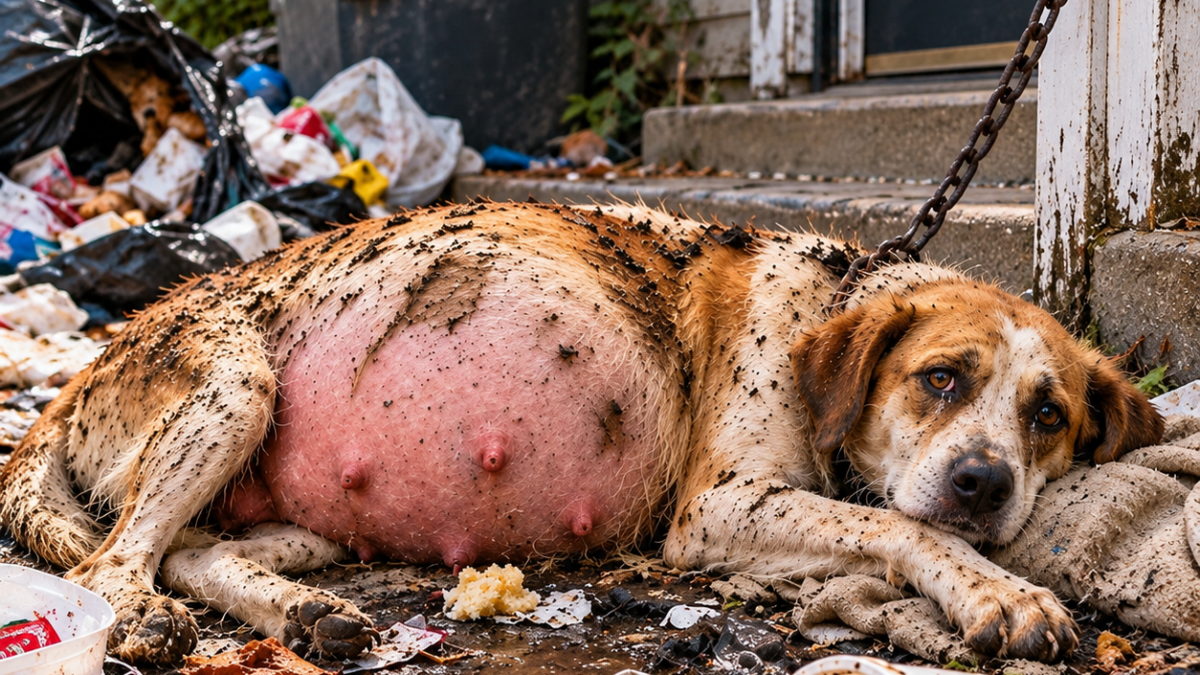
PART 2
I called the local rescue organization before I did anything else.
I’d volunteered with them occasionally over the years, mostly transport and donation work, so I had the coordinator’s number.
She answered on the third ring.
“Rachel?”
“I’ve got a situation.”
“That sentence never leads anywhere good.”
“I found a pregnant dog.”
Silence.
“How pregnant?”
I looked at her.
“Extremely.”
“Define extremely.”
“Her stomach has its own zip code.”
“That pregnant.”
“Yeah.”
“Condition?”
“Thin. Dirty. Exhausted. Drinking like she’s been dehydrated. I don’t see obvious injuries.”
“Friendly?”
“Not exactly.”
“Aggressive?”
“No. Just tired.”
I heard typing.
“Location?”
I gave her the address.
“Don’t try to move her alone if she’s close to labor.”
“How do I know?”
“Panting, nesting, restlessness, discharge, refusing food.”
I looked at the empty paper plate.
“She definitely isn’t refusing food.”
“Good.”
“Can you send someone?”
“Animal control is tied up. I can probably get Jen there in forty-five minutes.”
I looked at the sky.
The first raindrop hit my arm.
“Make it faster if you can.”
I hung up.
The dog watched me.
I sat on the ground several feet away.
“You’ve got forty-five minutes.”
Her eyes closed.
“Apparently so do I.”
Rain began lightly.
I moved my car closer and opened the rear hatch to create some shelter.
Then I found an old blanket in the trunk and placed it under the overhang.
The dog noticed.
She didn’t move.
I didn’t push.
A frightened pregnant animal didn’t need someone dragging her toward unfamiliar objects.
So I sat.
After ten minutes, the rain became heavier.
The dog lifted her head.
Water began darkening her fur.
I pointed toward the blanket.
“That’s yours.”
Nothing.
“It’s dry.”
She stared.
“I’m not asking you to sign anything.”
Still nothing.
Then thunder rolled in the distance.
Her entire body tensed.
She stood.
Slowly.
Walked toward my car.
Stopped.
I turned my face away slightly.
Less pressure.
She sniffed the blanket.
One paw stepped onto it.
Then another.
Finally she lowered herself beneath the open hatch.
I exhaled.
“Smart girl.”
Her eyes closed.
For several minutes, I simply listened to the rain hammer the roof of my car.
I watched her breathing.
Slow.
Heavy.
Every so often, something moved beneath the skin of her belly.
A small ripple.
Then another.
Puppies.
I had seen pregnant dogs before.
Still, something about seeing movement from unborn animals while their mother lay beside garbage moments earlier made the entire situation feel more urgent.
She wasn’t one dog.
Not really.
She was a whole little family waiting to happen.
And nobody knew how much time we had.
A truck pulled up twenty minutes later.
Jen jumped out before the engine fully stopped.
She was one of the rescue’s most experienced field volunteers.
She carried a slip lead, towels, gloves, and the calm expression of somebody who had learned that panic wastes time.
“That her?”
“No, the other extremely pregnant muddy dog.”
Jen looked at me.
“Nice.”
She crouched.
“Hi, mama.”
The dog’s eyes opened.
Jen watched her carefully.
“No visible contractions.”
“Good?”
“For now.”
She looked around.
“She’s been living here?”
“Neighbor says days.”
Jen’s face tightened when she saw the garbage.
“Any owner?”
“None that anyone knows.”
She approached slowly.
The dog didn’t growl.
When Jen extended a hand, the dog sniffed.
Then rested her chin back down.
“She’s done.”
“What do you mean?”
“Not dying.”
Jen touched the dog’s shoulder gently.
“Done fighting everything.”
That was exactly how she looked.
Not surrendered to us.
Just exhausted by the need to make every decision alone.
Jen slipped the lead around her neck.
The dog stood when encouraged.
“Can she walk?”
“Yeah.”
“Then we let her.”
We lined the back of Jen’s SUV with blankets.
Getting the dog inside took several minutes.
She hesitated at the ramp.
I climbed into the back first and sat sideways.
“Come on.”
She looked at me.
Jen waited behind her.
“No pushing,” she said.
“I know.”
The dog sniffed the ramp.
Placed one paw.
Stopped.
Then she looked at the bowl of water we’d placed inside.
That helped.
Step.
Pause.
Step.
Her belly nearly brushed the ramp.
Finally she reached the top.
I moved aside.
She drank.
Then collapsed onto the blankets.
Jen closed the door gently.
“What are we calling her?”
I hadn’t thought about a name.
The neighbor across the road stood beneath her porch watching.
The abandoned house looked darker in the rain.
I thought about the dog lying there.
Carrying an entire future inside her while everyone assumed somebody else would help.
“Hope.”
Jen looked at me.
“Hope?”
“Too much?”
She smiled.
“For rescue work? Never.”
So Hope she became.
We drove directly to the veterinary clinic.
I followed in my car.
Every red light felt offensive.
When we arrived, Hope was taken through a side entrance.
The clinic knew we were coming.
A technician helped her onto a large padded mat rather than an exam table because lifting her unnecessarily could cause stress.
I stood near the wall.
Jen filled out rescue intake paperwork.
The veterinarian, Dr. Alvarez, examined Hope slowly.
Heart.
Lungs.
Gums.
Temperature.
Abdomen.
He looked up.
“She is very close.”
“How close?”
“Could be days.”
“Could it be tonight?”
“Yes.”
Great.
“Puppies okay?”
“We need imaging.”
He ran an ultrasound first.
The room became quiet.
Gel on Hope’s belly.
Machine humming.
Hope lying on her side.
Dr. Alvarez watched the monitor.
Then adjusted the probe.
I held my breath.
“What?”
“Heartbeats.”
“How many?”
“Hard to count accurately this way.”
He moved again.
“I see several.”
“Several?”
He smiled.
“That’s the scientific number for more than a few.”
Jen rolled her eyes.
X-rays provided a clearer answer.
Seven.
At least seven puppies.
I stared at the image.
Seven tiny skeletons curled inside her.
“Oh my God.”
Dr. Alvarez pointed carefully.
“Good skull development. She’s full term or almost full term.”
“Is she healthy enough?”
“That is the question.”
Hope was dehydrated.
Underweight despite her massive abdomen.
Anemic.
Covered in fleas.
One ear had an infection.
Her paw pads were rough and cracked.
But she had no severe internal disease we could immediately identify.
No fever.
No obvious fetal distress.
For a dog found outside in terrible conditions, she had somehow held together.
Dr. Alvarez said, “Her body has prioritized those puppies.”
I looked at Hope.
“What does that mean?”
“It means pregnancy takes what it needs. Calcium. Calories. Protein. If there isn’t enough for mother and puppies, mother gives up her reserves.”
I thought about her ribs.
“So she’s been feeding them even while starving herself.”
“In a biological sense, yes.”
That hit harder than it should have.
Motherhood reduced to anatomy was still motherhood.
Her body had kept giving because it didn’t know how not to.
“What happens now?”
“Hydration. Nutrition, but carefully. Parasite treatment appropriate for pregnancy. Quiet environment.”
“And labor?”
“We let nature work unless she needs intervention.”
“What would intervention mean?”
“Medication in some cases. C-section if there’s obstruction, fetal distress, or maternal exhaustion.”
I looked at Hope’s face.
“She already looks exhausted.”
“She is.”
Dr. Alvarez put the X-ray aside.
“But exhausted doesn’t mean incapable.”
That distinction would matter later.
The rescue had one problem.
No foster placement was immediately available.
Spring had filled every foster home with puppies, kittens, medical cases, and abandoned litters.
The clinic could keep Hope overnight.
Maybe two nights.
But if she went into labor, she needed somewhere quiet and controlled.
Jen was making calls.
“No.”
Pause.
“I understand.”
Another number.
Voicemail.
Another.
“No, seven puppies estimated.”
Pause.
“Yes, seven.”
She hung up.
I knew what was coming before she looked at me.
“No.”
I pointed at myself.
“You’re thinking it.”
“I am not allowed to emotionally manipulate volunteers.”
“You are absolutely thinking it.”
Jen smiled slightly.
“Your spare room?”
“My guest room.”
“Which currently contains?”
“A desk and several boxes.”
“Congratulations. Maternity ward.”
I should’ve said no.
I had no experience assisting with canine birth.
I had work.
I had a house not designed for eight dogs.
Potentially more.
I stared at Hope.
She had fallen asleep on the clinic blanket while strangers discussed her future.
“Fine.”
Jen smiled.
“Fine?”
“Temporary.”
“Of course.”
“Very temporary.”
“Obviously.”
“You’re not convincing.”
“Neither are you.”
That evening, Hope came home with me.
I converted the guest room as quickly as possible.
Desk out.
Boxes out.
Rugs covered.
Whelping box borrowed from the rescue.
Clean towels.
Disposable pads.
Food.
Water.
Thermometer.
Emergency numbers taped to the wall.
My house looked less like a home and more like a veterinary supply closet.
Hope stood in the doorway.
“Welcome.”
She didn’t move.
I stepped away.
“You can take your time.”
She entered.
Sniffed the whelping box.
Ignored it.
Sniffed the water.
Drank.
Walked to the corner.
Lay down on a pile of blankets.
“Excellent. Glad we spent forty minutes setting up the box.”
Hope sighed.
The first night, I slept on the couch outside the room.
Not because Hope needed me.
Because I was terrified she’d begin giving birth and I wouldn’t hear.
Every time she shifted, I sat up.
At 1:15 a.m., she drank water.
At 2:40, she changed positions.
At 3:10, she sighed loudly enough that I turned on the light.
Hope looked at me.
“Sorry.”
I turned it off.
At 5:30, I gave up on sleep.
Hope ate breakfast.
Good sign.
Jen called.
“How’s our girl?”
“Pregnant.”
“Useful update.”
“She slept. Ate. No labor.”
“Temperature?”
“Normal.”
“Behavior?”
“She’s ignoring my expensive whelping setup.”
“Normal.”
Over the next two days, something remarkable happened.
Hope began relaxing.
Not dramatically.
She didn’t suddenly become affectionate.
But the constant tension in her body softened.
At first, she watched every time I entered the room.
Then she stopped lifting her head.
By the second evening, I could sit several feet away without her monitoring every movement.
On the third morning, she approached me.
I was sitting on the floor answering emails.
Hope stood from her blankets.
Walked over.
Sniffed my sleeve.
I stayed still.
Then she pressed her nose against my shoulder.
Once.
I looked at her.
“Hi.”
She stepped back.
Enough.
Trust doesn’t need fireworks.
Sometimes it’s a dog deciding to close three feet of distance.
That afternoon, she finally entered the whelping box voluntarily.
She scratched at the blankets.
Turned.
Scratched again.
Then got out.
I texted Jen.
**She is nesting.**
Jen called instantly.
“Temperature?”
I checked.
Lower than before.
“Okay,” Jen said. “Could be within twenty-four hours.”
My stomach tightened.
“What do I do?”
“Mostly nothing.”
“That seems irresponsible.”
“Watch. Keep her comfortable. Call if active contractions continue without a puppy, if you see abnormal discharge, if she becomes extremely weak, or if anything feels wrong.”
“Anything feels wrong right now.”
“Rachel.”
“I have seven unborn dogs in my guest room.”
“Possibly more.”
“That is not helpful.”
Hope began panting that evening.
Then pacing.
She went into the whelping box.
Out.
Back in.
She refused dinner.
The instructions became real.
I called Dr. Alvarez.
“Sounds like early labor.”
“How long?”
“Could still be hours.”
Of course.
At midnight, Hope’s panting intensified.
She pawed frantically at the blankets.
I sat outside the box.
“You know what you’re doing, right?”
Hope glanced at me.
“Because I absolutely do not.”
At 12:43 a.m., the first contraction I could clearly recognize passed through her body.
I called Jen.
She was already driving over.
By 1:20, contractions were stronger.
Hope lay on her side.
Stood.
Turned.
Lay down.
She looked at me more than she had during the previous three days combined.
I don’t know whether she wanted reassurance or simply needed to track where I was.
I remained nearby.
“You’re okay.”
The words felt inadequate.
Her body tightened.
She panted.
Then strained.
A few minutes later, I saw something.
“Jen.”
“I see it.”
The first puppy arrived at 1:47 a.m.
Tiny.
Wet.
Motionless for one terrifying second.
Hope turned immediately.
Licked.
Licked harder.
The puppy moved.
Then squeaked.
I started crying.
Jen laughed softly.
“First one.”
Hope cleaned the puppy with a focus I’d never seen in her.
No hesitation.
No confusion.
Whatever uncertainty she had shown about people disappeared when motherhood began.
She knew this.
The puppy found her belly.
Latched.
One little life safe.
Six, maybe more, still waiting.
The second came thirty-seven minutes later.
Then the third.
Each one created the same mix of fear and relief.
Hope worked.
Rested.
Cleaned.
Nursed.
Worked again.
By dawn, there were five puppies.
Hope was exhausted.
Too exhausted.
Her contractions had weakened.
She lay with her head flat.
Jen looked at the clock.
“How long?”
“Almost two hours since the last.”
We both knew the X-ray had shown more.
I called the emergency vet.
Dr. Alvarez answered.
I described everything.
“Bring her.”
“Can we move her with puppies?”
“Yes. Keep them warm.”
We loaded Hope and the five newborns into the SUV.
The puppies went into a heated carrier beside her.
Hope tried to follow when we moved them.
“It’s okay.”
She couldn’t understand.
Her eyes stayed locked on the carrier.
We placed it where she could see and smell them.
The drive felt endless.
At the clinic, another X-ray showed two puppies still inside.
One was positioned poorly.
Hope’s contractions were too weak.
Dr. Alvarez looked at us.
“She needs a C-section.”
The words chilled me.
“Risk?”
“There’s always risk, especially with her condition.”
“And if we wait?”
“Greater risk.”
I looked at Hope.
She looked at the carrier.
Not me.
Her puppies.
“Do it.”
The rescue authorized the procedure.
Hope disappeared behind the surgical doors.
I sat in the waiting room with five puppies in an incubator.
Five tiny bodies.
Five tiny noises.
One of the technicians showed me how to stimulate and keep them positioned safely.
I stared at them.
Their mother had survived outside.
Starved.
Carried them.
Delivered five.
Now she was in surgery because her body had reached the edge of what it could do.
For the first time since finding her, I became angry.
Not at a specific person.
That would’ve been easier.
I was angry at every passing car.
Every closed door.
Every moment she had existed in plain sight beside that abandoned house.
The neighbor had said:
I figured somebody had called.
How many times had Hope needed somebody?
How many people had thought the same thing?
Somebody.
Somebody else.
Eventually.
Maybe.
Those words are dangerous when everyone uses them.
Jen sat beside me.
“You’re doing the face.”
“What face?”
“The one where you start blaming the human species.”
“I am currently not impressed with us.”
“Fair.”
“She shouldn’t have been out there.”
“No.”
“She shouldn’t be this thin.”
“No.”
“She shouldn’t be in surgery because nobody—”
Jen interrupted gently.
“We don’t know nobody helped.”
I looked at her.
“We know where we found her.”
“Yes.”
“But we don’t know everything before that.”
That mattered.
Rescue people learn to be careful with stories.
An injured animal doesn’t automatically mean deliberate cruelty.
A stray dog doesn’t automatically mean somebody abandoned her.
Maybe Hope had escaped.
Maybe she’d been born outside.
Maybe someone had fed her occasionally.
Maybe someone had tried to catch her.
We didn’t know.
Anger wants certainty.
Truth sometimes refuses.
So I redirected it.
Not toward punishment.
Toward what we could still do.
The surgery lasted less than an hour.
It felt like four.
Dr. Alvarez finally appeared.
Mask lowered.
“She’s awake.”
I stood.
“And the puppies?”
“Two more. Both alive.”
My knees nearly gave out.
“Seven?”
“Seven.”
“All okay?”
“Right now.”
“And Hope?”
“Tired. Very tired.”
I exhaled.
Jen put a hand on my shoulder.
We reunited Hope with the puppies once she was stable enough.
That moment remains burned into my memory.
She was groggy.
Weak.
An incision across her abdomen.
But when the first puppy was placed near her, Hope lifted her head.
Sniffed.
Then began licking.
Slowly.
The other puppies followed.
Seven tiny bodies pressed toward her.
Hope rested her head.
Her eyes closed.
Still nursing.
“She’s incredible,” I whispered.
Dr. Alvarez nodded.
“She is.”
The next forty-eight hours were intense.
Hope needed pain medication.
Fluids.
Antibiotics.
Nutritional support.
The puppies needed weighing multiple times a day.
Temperature checks.
Monitoring.
Two were smaller than the others.
One had trouble maintaining weight.
The rescue arranged supplemental formula.
I became intimately familiar with the difference between a puppy sleeping peacefully and a puppy becoming dangerously weak.
I learned more about canine stool than any person should.
Sleep became theoretical.
Every two hours:
Check.
Weigh.
Nurse.
Clean.
Repeat.
Hope never complained.
If anything, she seemed calmer now that the puppies were outside her body and visible.
She counted them.
I swear she did.
If one was moved for weighing and took too long to return, she lifted her head.
Watched.
Waited.
When the puppy came back, she sniffed it.
Then relaxed.
“Seven,” I told her.
“Still seven.”
She watched me.
“We’re not losing any.”
That was a promise I had no right to make.
But I made it anyway.
For the first week, the smallest puppy worried us constantly.
A little female with a white stripe down her nose.
We called her Dot.
Dot struggled to gain.
She tired while nursing.
Needed supplemental feeding.
Every few hours, I’d hold her tiny body in my hand and pray she swallowed enough.
Hope watched me.
At first closely.
Then with something that looked suspiciously like trust.
One night, Dot wouldn’t latch at all.
I called Jen.
Then Dr. Alvarez.
We followed instructions.
Warm first.
Never feed a cold puppy.
Monitor.
Small amounts.
I sat on the floor at 3:00 a.m.
Dot wrapped in a towel against my chest.
Hope beside me.
I was exhausted enough to cry over nothing.
Or everything.
“I need her to eat.”
Hope lifted her head.
She sniffed Dot.
Then licked her face.
Dot moved.
I placed her near Hope.
She rooted weakly.
Found a nipple.
Latched.
I held my breath.
She stayed.
Five minutes.
Then seven.
I looked at Hope.
“Good girl.”
Hope looked at me.
For the first time, her tail moved.
Just once.
Against the blanket.
That nearly destroyed me.
Dot gained twelve grams the next day.
Then twenty.
Then more.
Tiny numbers became enormous victories.
By two weeks, all seven puppies were growing.
Eyes began opening.
First narrow slits.
Then dark little eyes looking at nothing clearly.
They started crawling with more purpose.
The whelping box became chaotic.
Hope remained patient.
Mostly.
One large male puppy we called Bear developed the habit of climbing over everyone to reach the best nursing spot.
Hope would sigh.
I related.
“You made him.”
She gave me a look.
“Fair.”
As Hope’s body recovered, her personality emerged.
That surprised me.
Until then, she’d been defined by conditions.
Pregnant.
Exhausted.
Nursing.
Sick.
Recovering.
We hadn’t really met Hope as just a dog.
Then one morning, she stole my slipper.
I found her in the hallway carrying it.
“Excuse me.”
Hope stopped.
Slipper in mouth.
“Is that mine?”
Tail wag.
I stared.
“You are a mother of seven.”
More wagging.
“Show some maturity.”
She walked away.
That was the first time I laughed because of Hope rather than worry about her.
She wasn’t old.
The vet estimated maybe three.
Four at most.
Her exhaustion had aged her appearance.
Nutrition changed everything.
Her coat became smoother.
Ribs disappeared.
Eyes brighter.
She moved easily once pregnancy and surgery recovery were behind her.
One afternoon, about four weeks after giving birth, Hope followed me into the backyard.
The puppies were asleep inside with Jen supervising.
Hope stepped onto the grass.
Stopped.
Looked around.
Then ran.
Actually ran.
A full circle around the yard.
Tail high.
Ears bouncing.
Then another.
I laughed.
“Where did this come from?”
She raced toward me.
Stopped inches away.
Then darted off again.
That image hurt in the best way.
The dog I had found barely willing to stand beside garbage was running simply because she could.
No puppies pulling at her.
No street to survive.
No immediate danger.
For thirty seconds, Hope belonged only to herself.
That mattered.
Mother dogs often disappear inside rescue narratives.
Everything becomes about the puppies.
Save the babies.
Feed the babies.
Find homes for the babies.
Hope reminded me that she was not just a container that had delivered seven adorable animals.
She had a life too.
Needs.
Fear.
Preferences.
Future.
I started setting aside time every day just for her.
Short walks.
Backyard.
Quiet time on the couch.
At first she checked on the puppies constantly.
Then she learned they could survive fifteen minutes without her.
Then thirty.
Freedom returned gradually.
At five weeks, the puppies became tiny disasters.
Bear climbed everything.
Dot became one of the most energetic.
So much for our fragile little baby.
Another female, Penny, screamed dramatically if any sibling touched her while she slept.
A black-and-tan male named Milo discovered shoelaces.
Three others—June, Rusty, and Clover—specialized in collective destruction.
There were seven puppies.
It felt like seventy.
Every morning began with cleaning.
Every afternoon involved cleaning.
Every evening concluded with cleaning things I’d already cleaned twice.
Hope sometimes sat outside the puppy pen watching me work.
“You could help.”
Hope yawned.
“You made these.”
Nothing.
“No accountability.”
She walked to the couch.
Motherhood leave.
At six weeks, adoption applications opened.
That was when another emotional problem appeared.
I’d spent weeks fighting to keep every puppy alive.
Now the goal was to give them away.
Rescue logic is cruel like that.
You save them.
Bond with them.
Learn their personalities.
Wake up at three in the morning for them.
Then find someone else and say:
Please take good care of this piece of my heart.
Applications poured in.
Puppies are easy to market.
Photos of seven round little faces did most of the work.
Hope received far fewer inquiries.
That irritated me.
Again, nobody was being intentionally cruel.
People saw puppies.
New beginning.
Years ahead.
Training from scratch.
Hope was the adult dog.
The mother.
Maybe she had history.
Maybe fear.
Maybe health needs.
People asked about the puppies.
“What breed?”
“How big?”
“Which is calmest?”
“Good with kids?”
Then one person would ask:
“What happens to the mom?”
Finally.
“The mom needs a home too.”
“Oh.”
That “oh” became familiar.
I started worrying.
What if every puppy left and Hope remained?
Would she feel abandoned again?
Was I willing to adopt her?
That question became harder because she was already living like my dog.
She followed me into the kitchen.
Slept near my bedroom door.
Waited for me when I went outside.
When I left the house, Jen said Hope sat near the window.
When I returned, her tail wagged.
Not frantic.
Just sure.
Home had already happened before paperwork.
I knew it.
Everyone knew it.
Except apparently me.
Jen said it first.
“You know you’re keeping her.”
“I am fostering.”
“Sure.”
“I mean it.”
“You bought her a personalized collar.”
“It was on sale.”
“It has her name embroidered.”
“Practical.”
“You ordered matching bowls.”
“Stop.”
Jen smiled.
“Hope has foster-failed you.”
“I hate that phrase.”
“Because it’s accurate.”
I looked at Hope.
She was asleep near my feet.
“She deserves someone better prepared.”
Jen’s smile disappeared.
“What does that mean?”
“Someone with another dog. Bigger yard. More time.”
“Does Hope seem unhappy?”
“No.”
“Does she trust you?”
“Yes.”
“Does she want a bigger yard?”
“I don’t know.”
Jen pointed at Hope.
“Ask her.”
Hope continued sleeping.
“Very useful.”
Jen sat beside me.
“People sometimes sabotage good homes because they’re imagining perfect ones.”
That landed.
I had done that before.
Compared reality to fantasy.
Someone richer.
More experienced.
Home all day.
Ten acres.
The mythical perfect adopter.
Meanwhile Hope had:
Food.
Veterinary care.
A fenced yard.
A couch.
Routine.
Me.
Maybe ordinary was enough.
Maybe ordinary was exactly what she’d never had.
I filled out the adoption paperwork the next morning.
Hope became legally mine.
I expected some emotional transformation.
Nothing happened.
She ate breakfast.
Stole my sock.
Lay in the sun.
Apparently legal status mattered mostly to humans.
The puppies left gradually.
Bear first.
A family with two teenagers adopted him.
He walked out carrying a stuffed dinosaur and absolutely no concern for my feelings.
“Rude.”
His new family sent a photograph that evening.
Bear asleep upside down between the kids.
Okay.
Good.
Penny went to a retired couple.
Milo to a young woman who worked from home.
June and Rusty were adopted separately after trainers determined they would thrive better apart.
Clover went to a family with an older dog who adored her immediately.
Dot was last.
Of course she was.
Not because nobody wanted her.
Because I had become irrationally protective.
Every application seemed flawed.
Apartment?
Too small.
Young children?
Too chaotic.
No children?
Maybe not stimulating enough.
First-time dog owner?
Inexperienced.
Experienced owner?
Why did they have so many previous dogs?
Jen finally said, “Rachel.”
“What?”
“You are the problem.”
“I am screening.”
“You rejected someone because their fence was four feet eight inches instead of five feet.”
“Safety.”
“Dot is ten pounds.”
“She will grow.”
“Into a helicopter?”
I glared.
Jen took the applications away from me.
Dot eventually went to a veterinary technician named Emily who had a secure yard, another friendly dog, and more puppy experience than I did.
Perfect.
I still cried when she left.
Hope stood beside me at the door.
Dot walked to Emily’s car.
Then stopped.
Turned.
Ran back.
Hope sniffed her.
Licked her face once.
Dot bounced away again.
I covered my mouth.
Hope watched the car leave.
She didn’t panic.
Didn’t chase.
Didn’t cry.
She stood there.
Then looked at me.
I knelt.
“They’re okay.”
Hope stepped forward.
Pressed her forehead against my chest.
“All seven.”
I wrapped my arms around her.
“They’re okay.”
That night, the house felt enormous.
No puppy squeaks.
No pen rattling.
No tiny disasters.
Just silence.
I expected Hope to search.
She did.
Once.
Walked into the empty room.
Sniffed.
Looked around.
Then left.
She slept beside my bed.
Not in the doorway.
Beside it.
The next morning, something extraordinary happened.
I woke late.
No puppies.
No feeding schedule.
No emergency.
The sun was already through the curtains.
Hope stood beside the bed.
Tail wagging.
I opened my eyes.
“What?”
She wagged harder.
I got dressed.
Opened the back door.
Hope ran.
Around the yard.
Through the grass.
Back toward me.
Then away again.
Pure joy.
That was the day I realized rescue wasn’t complete when puppies survived.
It was complete when Hope remembered she was allowed to be happy too.
Months passed.
We received updates from every puppy.
Bear grew enormous.
Penny remained dramatic.
Milo destroyed two charging cables and one expensive shoe.
June loved swimming.
Rusty hated rain.
Clover slept with the family’s older dog.
Dot became the fastest.
The tiny puppy we had worried might not survive turned into a small athletic menace who climbed furniture and stole dish towels.
Every photo made me smile.
Hope occasionally sniffed my phone when puppy sounds played from videos.
Did she recognize them?
I don’t know.
Maybe.
Probably not in the sentimental way I wanted.
But her ears would lift.
I’d show her.
“That’s Dot.”
Hope sniffed.
“She’s insane.”
No response.
“Probably genetic.”
Hope walked away.
Her own life became beautifully ordinary.
That was my favorite part.
The story people heard was dramatic.
Pregnant stray.
Garbage.
Rescue.
Emergency C-section.
Seven puppies.
But Hope’s best life happened after the story stopped being dramatic.
Morning walks.
Waiting beside the coffee maker.
Watching squirrels.
Sleeping on the couch.
Stealing one slipper and leaving the other untouched.
Barking exactly once whenever the mail came.
Demanding belly scratches by rolling onto her back in the middle of the hallway.
Ordinary.
That was the victory.
One afternoon, several months after her adoption, we drove past the street where I’d found her.
I hadn’t planned to.
Roadwork forced a detour.
Suddenly the abandoned house appeared.
My body reacted before my brain did.
I slowed.
The garbage was gone.
The yard had been cleared.
A renovation crew was working.
New windows.
Fresh paint along one wall.
It looked almost normal.
Hope was in the back seat.
She had been looking out the opposite window.
Then she turned.
Did she recognize it?
I don’t know.
She sniffed the air through the cracked window.
For a moment, I imagined a dramatic reaction.
Whining.
Fear.
Something.
Nothing.
Hope looked.
Then lay down.
I laughed softly.
“Good.”
The place had no power over her.
Maybe that was the revenge.
Not against the house.
A building doesn’t care.
Not against neighbors.
Not against some imaginary villain.
Against the version of life that told Hope garbage and cold dirt were all she could expect.
That life lost.
Hope got a bed.
Seven puppies got homes.
The forgotten dog became the center of an entire network of families.
Every Gotcha Day, some of the puppy adopters sent photos.
Eventually we created a group chat.
It became chaos.
**Bear ate the birthday cake before we lit the candle.**
**Penny refuses to go outside because the grass is wet.**
**Milo learned how to open the bathroom trash. Please send help.**
**Dot climbed onto the kitchen table.**
I would send a photograph of Hope asleep.
**Your mother accepts no responsibility.**
People loved it.
One year after the rescue, we organized a reunion.
Not all seven could come, but five did.
I worried how Hope would react.
Would she recognize them?
Would the puppies recognize her?
They weren’t puppies anymore.
Large adolescent dogs.
Bear almost knocked me over.
Dot still had the white stripe.
Clover approached Hope first.
They sniffed.
Hope’s tail moved.
Then chaos.
Running.
Sniffing.
Playing.
Was it maternal recognition?
Familiar scent?
Dogs simply being social?
I didn’t care.
For an afternoon, five of the lives Hope had carried inside her ran across a clean green yard.
Hope stood in the middle.
Then joined.
I watched her chase Bear.
Actually chase him.
Bear slowed, probably confused by the older dog suddenly pursuing him.
Everyone laughed.
I almost cried.
Jen stood beside me.
“Remember the first day?”
“Don’t.”
“She couldn’t stand without struggling.”
“I said don’t.”
“And now—”
“I will remove you from this property.”
She laughed.
Hope raced past us.
Jen became quiet.
Then said, “This is why.”
I knew what she meant.
Rescue is exhausting.
Money problems.
Too many animals.
Not enough homes.
Cases that go badly.
People who promise to help and disappear.
Animals you cannot save.
Then sometimes you get this.
A dog who was lying beside garbage.
Now running through grass with her grown puppies.
This is why.
Not because every story ends this way.
They don’t.
Because some do.
And you never know which one you’re driving past.
The second year of Hope’s life with me brought something unexpected.
She became a therapy-dog candidate.
I would never have imagined it.
The frightened pregnant dog who initially watched every movement had grown into one of the calmest animals I’d known.
She liked people.
Especially older people.
She had a strange ability to sit near someone without demanding attention.
My friend worked at a rehabilitation center and suggested an evaluation.
“Hope?”
“Yes.”
“She stole my slipper yesterday.”
“That doesn’t disqualify her.”
“It should.”
We trained.
Basic obedience.
Public environments.
Wheelchairs.
Walkers.
Unfamiliar noises.
Hope passed.
Her first visit was at a senior care facility.
I almost cried before we even entered.
Not because of Hope.
Because I thought about how vulnerable beings sometimes end up depending completely on strangers.
Hope had once been one.
Now she was walking in to comfort others.
An elderly woman named Margaret called her over.
Hope approached.
Margaret placed both hands around Hope’s face.
“What a beautiful mother.”
I froze.
Nobody had told her Hope’s story yet.
Maybe she simply meant something else.
I sat beside them.
“She actually is a mother.”
Margaret smiled.
“I knew it.”
“How?”
“She has that face.”
I laughed.
“What does a mother face look like?”
“Tired.”
Hope sighed.
Margaret laughed so hard she began coughing.
Hope became a regular visitor.
She sat beside wheelchairs.
Rested her head on beds.
Listened to people who repeated the same stories.
Accepted slow hands.
Gentle hands.
Trembling hands.
The dog once waiting for someone to notice her became very good at noticing other people.
That felt like poetic justice.
Again, not revenge.
Something better.
Transformation.
Years passed.
Hope aged.
Her muzzle began graying for real this time.
We had no exact birth date, so I celebrated the day she was found.
I called it Hope Day.
Every year, seven puppy families received a message.
Sometimes all seven replied.
Photographs.
Updates.
Life.
Bear eventually developed arthritis.
Penny became obsessed with blankets.
Milo matured only slightly.
Dot became a hiking dog.
Clover’s older companion passed away, and she stayed beside him through the last night.
Each puppy became an individual.
Their mother’s struggle had created seven completely separate lives.
That realization remained overwhelming.
One rainy evening, I sat beside Hope near the window.
Rain ran down the glass.
She slept on an orthopedic bed.
I thought about the first rain.
Abandoned house.
Garbage.
Mud.
Her curled beneath my open hatch.
I touched her head.
“You picked the right car.”
Hope opened one eye.
“You could’ve chosen somebody wealthier.”
Nothing.
“Bigger yard.”
Tail moved once.
“Better snacks.”
Both eyes opened.
“Okay. Sensitive subject.”
I gave her a treat.
She returned to sleep.
I still occasionally heard people describe stray animals as problems.
“Too many dogs.”
“Someone should do something.”
“Animal control will get it.”
“It’s probably fine.”
Maybe.
Sometimes animals are fine.
Sometimes intervention should be left to trained professionals.
Sometimes approaching an unknown dog can be unsafe.
But Hope taught me one habit I never lost:
Look twice.
You don’t have to rescue every animal yourself.
You can’t.
But look twice.
Notice.
Call.
Ask.
Don’t automatically assume somebody else already did.
Because Hope had spent days beside that house while multiple people saw her.
I didn’t need them to become heroes.
One phone call might have been enough.
The difference between neglect and rescue is sometimes not compassion.
Many people feel compassion.
It’s action.
A bowl.
A number dialed.
A message.
A five-minute delay in your day.
I wasn’t special because I stopped.
I was simply the person who stopped that time.
That matters because it means almost anyone can be that person.
Years after the rescue, one of Hope’s puppies became involved in a story that brought everything full circle.
Dot’s owner Emily called me one evening.
“Are you sitting down?”
“I hate when people begin like that.”
“Dot found a kitten.”
“What?”
“Behind the clinic.”
Apparently Dot had become obsessed with a storm drain during an evening walk.
Wouldn’t leave.
Kept sniffing.
Whining.
Emily finally checked.
A tiny kitten was trapped below.
They called the fire department.
The kitten survived.
I laughed.
“Of course.”
Emily sent a photo.
Dot beside the kitten’s carrier.
White stripe still bright.
I looked at Hope.
“Your daughter is rescuing things now.”
Hope was asleep.
Naturally.
Maybe none of this was destiny.
I don’t believe the universe arranges neat moral chains.
Hope survived because people helped.
Dot survived because Hope did.
A kitten survived because Dot happened to notice it.
Life branches.
That’s enough wonder without making it supernatural.
The point remains:
Saving one life doesn’t always stop at one.
Hope carried seven.
Those seven touched dozens more.
Families.
Veterinary staff.
Neighbors.
Other animals.
Me.
That is how life works.
Not as repayment.
As consequence.
Good consequences can spread too.
Hope’s health remained good for years.
Better than anyone would have guessed from the first photograph.
Eventually, arthritis appeared.
I recognized the irony.
The dog who once carried seven puppies now sometimes needed help climbing stairs.
I built a ramp.
She distrusted it.
“Seriously?”
Hope stood at the bottom.
“You walked into a stranger’s car while pregnant.”
Nothing.
“But this is suspicious?”
I placed treats along the ramp.
She ate the first.
Then second.
Eventually crossed.
By day three, she used it normally.
Adaptation.
Same lesson.
As her body slowed, Hope retired from therapy visits.
Her last visit was emotional.
Margaret was still there.
Much older.
Hope walked slowly into her room.
Margaret smiled.
“My mother dog.”
Hope approached.
Rested her head across Margaret’s knees.
Margaret stroked her white muzzle.
“You’re old now.”
I laughed.
“So are you.”
Margaret pointed at me.
“Rude.”
Hope sighed.
Same sense of timing.
Margaret said something I’ll never forget.
“Old isn’t the sad part.”
I looked at her.
“What is?”
“Being old and having nobody.”
She touched Hope’s ear.
“This one doesn’t have that problem.”
No.
She didn’t.
That sentence stayed with me because it connected everything.
Hope’s suffering had never only been dirt.
Hunger.
Pregnancy.
The abandoned property.
The deepest danger was carrying all of that alone.
Safety didn’t mean nothing bad would ever happen.
It meant bad things didn’t have to happen alone.
Hope had people now.
Vet.
Me.
Jen.
The rescue.
Seven puppy families.
A ridiculous group chat.
More belonging than she probably knew what to do with.
When Hope entered her senior years, I began thinking about endings.
Of course.
Humans can’t help it.
A slower morning.
A skipped breakfast.
I would feel panic.
Then remember Murphy—no, not Murphy, that’s another story in user context, don’t mention. Need remove. We are in story, cannot cross. Let’s fix mentally. We need continue cleanly.
I had spent years learning from Hope that today was not automatically a prediction of tomorrow.
One hard morning was one hard morning.
We adjusted medications.
Shortened walks.
Added rugs.
Made life easier.
Hope still loved the backyard.
She no longer ran circles.
Instead, she’d walk to the sunny corner.
Lower herself.
Watch birds.
Sometimes a squirrel passed.
She’d lift her head.
Consider.
Then decide retirement had benefits.
I respected that.
The rope? There is no rope in Hope story. Don’t introduce. We’ll continue with slipper perhaps.
She still stole slippers occasionally.
Only mine.
Always one.
Never chewed.
Just relocated.
I stopped correcting her.
A guest once asked:
“Why is your slipper in Hope’s bed?”
“Evidence.”
“Of what?”
“Organized crime.”
Hope slept.
Years after I found her, I still had the first photograph Jen took at the clinic.
Hope standing sideways.
Enormous belly.
Ribs visible.
Mud along her legs.
Head low.
I didn’t display it.
But I kept it.
Beside it, I kept a reunion photo.
Hope surrounded by five grown puppies.
Two images.
Same dog.
In the first, her body is carrying them.
In the second, her life is surrounded by them.
That feels right.
People often ask whether Hope remembered living on the street.
I can’t answer.
Maybe she remembered sensations.
Hunger.
Cold.
Certain noises.
Maybe she remembered nothing in a narrative sense.
Dogs don’t need to tell us their past for the past to matter.
Behavior tells some of it.
At first, Hope ate quickly.
Years later, she ate slowly.
At first, she slept lightly.
Later, thunder sometimes failed to wake her.
At first, she watched my hands.
Later, she’d roll onto her back before I even reached her.
The body keeps records.
Safety writes new ones.
That’s the transformation people miss when they focus only on before-and-after photographs.
Yes, weight changes.
Coat changes.
Wounds heal.
But recovery also looks like assumptions.
A dog assuming food will return tomorrow.
Assuming the door opening means somebody familiar.
Assuming sleep is safe.
Assuming a hand approaching means affection.
Hope acquired those assumptions.
Maybe that’s what a home really gives.
Not just shelter.
Predictability.
Years after her rescue, one of the original neighbors contacted the rescue.
The woman who had told me Hope had been there for days.
She had seen an anniversary post online.
Her message was apologetic.
She said she had always felt guilty.
She had thought someone else had called.
She wished she had acted sooner.
Jen forwarded it with permission.
I read it several times.
My first reaction surprised me.
Not anger.
Relief.
Because guilt had been sitting in that woman’s life too.
I wrote back through the rescue.
**Hope is okay. The puppies are okay. You don’t have to carry this forever. Next time, make the call. That’s enough.**
The woman responded:
**I will.**
That mattered more than blame.
If Hope’s story changed one person’s behavior the next time an animal needed help, good.
Punishment wasn’t the point.
Change was.
The world doesn’t improve because everyone who made a mistake suffers equally.
Sometimes it improves because they do something differently next time.
A year later, that same woman reported another stray dog.
Animal control found the dog had a microchip.
He was returned to a family who’d been searching for him for three days.
Jen called me.
“Guess who made the report?”
I knew.
I smiled.
There it was.
Another consequence.
Hope had never met that dog.
Still, her life had touched his.
That’s the kind of ending I prefer.
Not revenge that creates more pain.
A chain in which pain teaches someone to respond faster the next time.
Hope grew very old.
Not impossibly old.
Just enough that we stopped pretending time was abstract.
Her walks became the length of three houses.
Then two.
Some days only the driveway.
Her appetite remained excellent.
That helped.
A dog asking for breakfast is persuasive evidence that life still contains interest.
She enjoyed sun.
People.
Food.
Slippers.
Me.
Good enough.
We tracked quality of life.
Our vet helped.
Pain controlled?
Yes.
Eating?
Yes.
Drinking?
Yes.
Resting comfortably?
Yes.
Interested in family?
Yes.
Good days?
Mostly.
Then, slowly, those answers changed.
Not all at once.
Hope began sleeping more.
Arthritis medication needed adjustment.
Her back legs weakened.
She stopped climbing even the ramp without assistance.
I bought a support harness.
The first time I helped lift her rear end, she looked offended.
“I know.”
She stared.
“This is humiliating.”
More stare.
“I also helped deliver your children, so boundaries left this relationship years ago.”
Hope walked forward.
The harness helped.
One morning, she refused breakfast.
My heart tightened.
An hour later, she ate.
Okay.
One day.
Weeks later, she refused again.
Then dinner.
Vet.
Tests.
Kidney values had changed.
Age.
Nothing dramatic.
No connection to the pregnancy years earlier.
Just a body reaching the later pages.
We changed food.
Medication.
Fluids.
Hope improved for several months.
Spring came.
She returned to her sunny spot.
I sat beside her.
No puppies.
No rescue crisis.
No dramatic future.
Just us.
I placed my hand on her back.
“I almost drove past you.”
Hope breathed slowly.
“That’s terrible, isn’t it?”
No response.
“If traffic had been better, I wouldn’t even have taken that road.”
That thought had disturbed me for years.
How much of life depends on tiny coincidences?
Traffic.
Rain.
A turn.
Five minutes.
Maybe someone else would have stopped.
Maybe not.
We rarely get to know the alternate versions.
I stopped torturing myself with them.
This version existed.
I stopped.
Hope lived.
Seven puppies lived.
That was enough reality.
Her final decline came the following winter.
Not suddenly.
A series of small changes that eventually formed a pattern we couldn’t ignore.
Harder to stand.
Less appetite.
Restless nights.
Pain despite medication.
The vet said we had reached the point where more treatment might extend time without extending comfort.
I hated that sentence.
Not because it was wrong.
Because it was clear.
Hope had spent the beginning of our relationship carrying lives she couldn’t put down.
My responsibility at the end was different.
I had to carry the decision she couldn’t make.
I wanted one more week.
Of course.
One more spring.
One more Hope Day.
One more reunion.
Wanting is easy.
Fairness is harder.
Jen came over the night before.
She sat beside Hope’s bed.
Hope lifted her head.
Tail moved once.
Jen started crying immediately.
“Don’t do that,” I said.
“You’re crying too.”
“I can. It’s my house.”
She laughed through tears.
Hope looked at us as though humans were exhausting.
Jen scratched her ears.
“Remember the rain?”
I did.
Open hatch.
Mud.
Pregnant belly.
Seven heartbeats.
Jen whispered, “You did good, mama.”
Hope closed her eyes.
We spent the evening telling stories she couldn’t understand.
The first slipper.
Bear climbing over everybody.
Dot refusing to gain weight.
The C-section.
Hope’s first run.
Therapy visits.
Margaret.
Reunion.
All the lives tied to hers.
The next morning, six of the seven puppy families sent photographs after hearing the news.
One joined by video.
Dot’s owner brought her in person.
I wasn’t sure whether that was a good idea.
Hope and Dot hadn’t seen each other in nearly a year.
Dot entered quietly.
No puppy chaos anymore.
Mature.
White stripe.
She approached Hope.
Sniffed.
Hope opened her eyes.
Their noses touched.
I don’t know what either dog understood.
I don’t need to.
Dot lay several feet away.
That was enough.
The vet came to the house.
Hope was on her favorite bed by the window.
Sun reached part of it.
Perfect.
I sat on the floor.
Hope’s head rested in my lap.
The vet explained the process.
I already knew.
Still hated hearing it.
Before the first medication, I gave Hope a small piece of chicken.
She ate it.
Of course she did.
I laughed and cried.
“Still you.”
Her tail tapped.
The sedative went in.
Hope relaxed.
Her breathing slowed.
I stroked the same forehead that had once watched me from beside an abandoned house.
“You can rest.”
The words brought everything back.
She had needed rest the first day.
Real rest.
Not exhaustion.
Not collapse.
Rest that comes because nothing is chasing you.
Nothing needs you.
Nobody is going to take the food.
You can close your eyes because someone else is keeping watch.
Hope closed hers.
Dot stayed nearby.
Jen held my shoulder.
I whispered:
“You carried them.”
My voice broke.
“We carried you.”
The final medication went in.
Hope’s last breath was almost impossible to feel.
Then stillness.
For a moment, the entire house seemed wrong.
This dog had once filled a room with seven puppies.
Now there was silence.
I put my forehead against hers.
“Good girl.”
The simplest words.
Always.
Dot approached after a while.
Sniffed Hope.
Then stepped away.
Emily took her outside.
Jen and I remained.
I looked at Hope’s body.
No mud.
No rain.
No garbage.
No hunger.
No cold ground.
A thick bed.
Sunlight.
People.
Home.
That was the ending.
Not the house where I found her.
Not the emergency clinic.
Not the surgery.
This room.
Safe.
When Hope’s ashes came home, I placed them beside the reunion photograph.
Not the rescue photo.
That choice mattered.
I didn’t want the worst day to define her.
Hope was not “the pregnant stray by the garbage.”
That was one chapter.
She was the mother of seven.
Slipper thief.
Therapy dog.
Squirrel observer.
Expert belly-rub negotiator.
Friend to Margaret.
Reason a neighbor made the next phone call.
Reason other dogs found help.
Family.
Weeks later, the rescue held a fundraiser.
They asked permission to use Hope’s story.
I said yes under one condition.
“Don’t make it only sad.”
“What do you mean?” Jen asked.
“Don’t put the worst picture at the center.”
“But before-and-after works.”
“I know.”
I looked at Hope’s reunion photo.
“Use this one.”
Five grown puppies.
Hope in the middle.
Tail up.
Green grass.
“What do you want the caption to say?”
I thought for a long time.
Then:
**Someone finally stopped. Everything after that became possible.**
That’s the version I wanted.
Because Hope’s story wasn’t valuable because it made people cry.
Sadness alone doesn’t help animals.
Action does.
And Hope’s life was about everything action made possible.
Seven puppies grew up.
Seven families gained dogs they adored.
An elderly woman had a therapy companion.
A stray dog later got reported by a neighbor who had learned not to assume.
A lost dog made it home.
Dot found a kitten.
Dozens of people changed slightly because one exhausted dog existed in front of them long enough to become visible.
That is not a miracle.
It’s a chain reaction.
And perhaps that’s more powerful.
Years later, the group chat still exists.
The puppies are seniors now.
Not all of them are still alive.
That’s part of time.
Bear passed first.
Cancer.
His family sent a photograph from his last day.
He was lying between the two teenagers who had adopted him—now adults.
Penny passed two years later.
Rusty after that.
Every loss hurt.
Each time, I looked at Hope’s photograph.
Her children had received entire lives.
That was the point.
Not immortality.
Opportunity.
Hope couldn’t promise them endless time.
She gave them beginnings.
We did the same for her.
Maybe rescue is always that.
Not saving someone from death forever.
You can’t.
It’s saving them from a death that arrives before life has been allowed to become itself.
Hope’s life became itself.
That’s enough.
I still drive past that old neighborhood occasionally.
The abandoned house isn’t abandoned anymore.
A family lives there.
The yard has flowers.
Children’s bicycles.
No garbage pile.
Once I saw a water bowl outside.
Clean.
Full.
I don’t know whether they have a dog or leave it for strays.
I didn’t stop to ask.
I simply smiled.
Maybe places get second chances too.
When people ask what I remember most about Hope, they usually expect the rescue.
Her eyes.
The pregnancy.
The puppies.
The emergency surgery.
Those memories are strong.
But they’re not my favorite.
My favorite is an ordinary summer afternoon years later.
Hope was lying in the backyard.
No crisis.
No puppies.
No therapy vest.
Just grass.
Sun.
Her gray muzzle resting on her paws.
I walked past.
Hope lifted her head.
I said:
“Coming inside?”
She thought about it.
Then decided no.
Put her head back down.
I laughed.
That’s the memory.
A dog who once had no safe place to rest deciding she was perfectly comfortable staying exactly where she was.
Think about that.
At the beginning, rest had been something her body collapsed into because she had no energy.
At the end, rest became choice.
She chose the yard.
The bed.
The couch.
Sunlight.
Company.
Solitude.
Hope got choices.
That may be the most satisfying justice of all.
The world had once reduced her life to survival.
Find water.
Find food.
Carry puppies.
Avoid danger.
Lie wherever the ground allows.
Then one afternoon, someone stopped.
After that, Hope slowly collected options.
This bowl or that one.
Inside or outside.
Couch or bed.
Chicken or dog food.
Therapy visit or nap.
Run or rest.
A small life can become enormous when choices return.
I sometimes think about what I would’ve said if Hope could understand language on that first day.
Maybe:
You’re not going to have to do this alone anymore.
But that would’ve been too much.
She didn’t know me.
Promises from strangers mean nothing until repeated behavior makes them real.
So maybe I would say what I actually said.
“Hey, mama.”
Then water.
Food.
Distance.
Call for help.
One action at a time.
That’s how trust began.
That’s how almost every meaningful thing begins.
Small.
The viral version of Hope’s story would probably focus on the image.
Pregnant dog.
Garbage.
Sad eyes.
And yes, that image matters.
It should disturb us.
But I don’t want her frozen there forever.
If you remember Hope, remember what came after.
Remember seven newborn puppies nursing beside a mother who survived surgery.
Remember Dot gaining twelve grams.
Remember Hope stealing a slipper.
Remember her first full-speed circle around the yard.
Remember grown puppies returning for a reunion.
Remember an elderly woman laughing because Hope sighed at exactly the right moment.
Remember the clean water bowl years later.
Remember the sunlight.
That is her revenge.
The garbage did not get the final image.
The street did not get the final image.
Hunger did not get the final image.
Fear did not get the final image.
The final image is Hope in a home.
Older.
Safe.
Surrounded by evidence that her life mattered.
Seven little lives once moved beneath her skin while she lay alone outside a house.
She carried them because biology gave her no choice.
Then people stepped in and helped her carry what came next.
The puppies.
Recovery.
Trust.
Life.
And eventually, when her old body became too tired to continue, we carried the final part for her too.
That’s what family is.
Not never being afraid.
Not never hurting.
Not never losing.
It’s not carrying everything alone.
Hope taught me that before she ever trusted me enough to rest beside my feet.
I thought I was saving one pregnant stray.
I was wrong.
I was opening a door for eight lives.
And those eight lives opened doors for others.
That is why I still think about the moment I almost drove past.
Not with guilt.
With gratitude.
Because I didn’t.
Because for once, “somebody” became a specific person.
Me.
That day it was me.
Another day it could be someone else.
Maybe you.
Maybe a neighbor.
A delivery driver.
A teenager walking home.
A person who makes one phone call.
You don’t have to know how the story ends.
I didn’t.
You only need to recognize when something in front of you deserves the chance to have an ending different from the one it’s heading toward.
Hope’s ending changed.
So did mine.
Before her, I thought rescue was mostly about removing animals from danger.
After Hope, I understood that rescue is also about returning possibilities.
The possibility of comfort.
Motherhood without fear.
Recovery.
Play.
Trust.
Ordinary mornings.
Old age.
A peaceful goodbye.
Hope got all of them.
Not because the world suddenly became fair.
The world isn’t.
Because enough people made a series of small decisions in her favor.
That is often the closest thing to justice life gives us.
And sometimes it’s enough.
So if I could return to that rainy street one more time and see the younger Hope curled against the wall, I wouldn’t tell her about the C-section.
Or the seven healthy puppies.
Or the reunion.
Or the therapy visits.
Or her future bed beside my window.
She wouldn’t understand.
I’d pour the water.
Put down the food.
Sit far enough away that she didn’t feel trapped.
And wait.
Exactly as I did.
Because the first gift Hope needed wasn’t a promise.
It was proof.
Someone stayed.
Then stayed again.
Then came back tomorrow.
Eventually, Hope stopped watching the door.
Eventually, she slept so deeply that thunder didn’t always wake her.
Eventually, she rolled onto her back and expected hands to be gentle.
Eventually, she grew old.
Do you understand how beautiful that last part is?
The pregnant stray who looked like she might not survive another week grew old.
Gray muzzle.
Stiff legs.
Senior medication.
Slower walks.
She got old enough for age to become her biggest problem.
That is a privilege many stray animals never receive.
Hope received it.
And when she finally left, years after the day I found her, she left from a warm room.
Not dirty ground.
Her stomach wasn’t empty.
Nothing depended on her body anymore.
She didn’t have to search for water.
Didn’t have to protect anyone.
Didn’t have to wonder whether somebody would notice.
We noticed.
We had been noticing for years.
Her head was in my lap.
Sunlight reached her bed.
People she trusted were beside her.
And somewhere across different homes, seven dogs existed because she had fought through a season when almost nobody knew her name.
That was Hope.
Not the suffering.
The continuation after it.
She carried so many little lives when she had no safe place to rest.
In the end, every one of those lives found a place.
And so did she.
The world once walked past Hope.
But it didn’t get to keep her there.
She came home.
She became a mother without having to be afraid.
She became a dog again after motherhood.
She became old.
She became loved.
And when her story finally ended, it ended exactly where every abandoned animal deserves the chance to end someday—
not alone,
not forgotten,
but safe enough to close her eyes and know somebody else was keeping watch.

