PART 2: She Spent 10 Years Locked in a Rusted Cage—When We Opened the Door, What She Did Broke Us
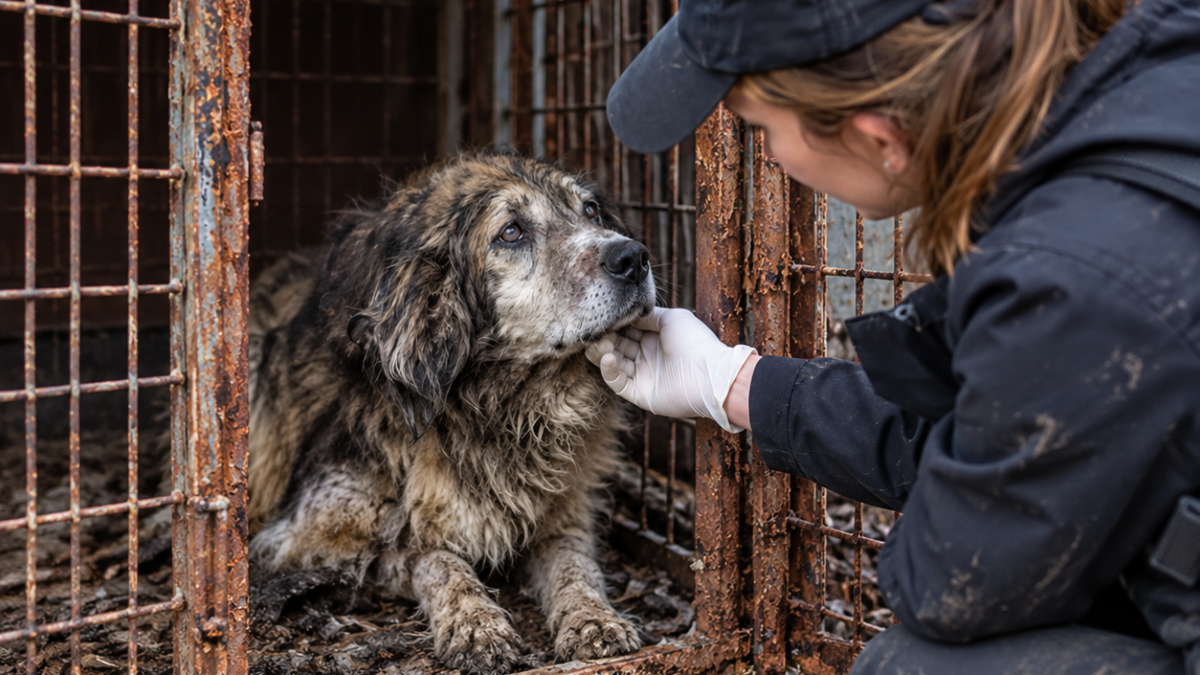
For more than ten years, she watched the world through rusted bars while everyone around her learned to look the other way.
When I finally broke the chain and opened that cage, I thought the hardest part of her rescue was over.
I had no idea the man who left her there would come back—and what he did next would turn one abandoned dog into the center of a fight none of us were prepared for.
My name is Daniel Carter, and by the fall of 2022, I had been working with a small animal rescue organization for almost nine years.
I had seen dogs abandoned beside highways.
I had crawled beneath collapsed porches to reach terrified puppies.
I had carried animals out of houses where their owners had disappeared and simply left them behind.
I thought I understood neglect.
Then Margaret Wilson called.
It was a Thursday morning in early November, cold enough that the windshield of our rescue van was still frosted when I arrived at the office.
Our receptionist transferred the call to me because the woman on the other end sounded frightened.
“My name is Margaret,” she said. “I live outside Mill Creek. There’s a dog on an abandoned property near my house.”
“Is the dog injured?”
“I don’t know.”
“Is she loose?”
“No.”
Her voice cracked.
“She’s in a cage.”
I picked up a pen.
“How long has she been there?”
There was a pause so long that I thought the call had disconnected.
Then Margaret whispered, “Years.”
My pen stopped.
“How many years?”
“I don’t know exactly. We moved here eleven years ago, and she was already there.”
I stared at the wall.
“Eleven?”
“I know how that sounds.”
“Does someone own the property?”
“A man comes sometimes. Or used to. I haven’t seen him in months.”
“Does he feed her?”
“I think so. Sometimes.”
“Does she have shelter?”
Another pause.
“There’s a roof over part of the cage.”
“Water?”
“I don’t know.”
“Why are you calling now?”
Margaret breathed shakily.
“Because I thought she was dead.”
That changed everything.
She told me the dog had once barked whenever someone passed near the property. Over the years, the barking became less frequent.
Then it stopped.
For months, Margaret assumed the dog had died.
The previous evening, she had walked along the edge of her property after retrieving a fallen branch from a fence line.
That was when she saw movement behind the old shed.
Just a small movement.
A head lifting.
Then lowering again.
“I went home,” Margaret said, “but I couldn’t sleep.”
“Can you meet us there?”
“Yes.”
Forty minutes later, I was driving toward Mill Creek with two volunteers, Sarah Mitchell and Luis Ramirez.
The road narrowed as we left town.
Houses disappeared.
Bare trees crowded the shoulders.
When we reached the address, Margaret was waiting beside a mailbox in a green winter coat.
She looked embarrassed when she saw us.
“I should have called sooner.”
We didn’t have time for guilt.
“Show us.”
She led us around the abandoned farmhouse.
The place looked as though people had stopped caring about it years ago.
A section of porch had collapsed.
Several windows were broken.
Weeds had swallowed most of the yard.
Then Sarah stopped walking.
“Oh my God.”
Behind the house stood a homemade metal enclosure.
Six feet long, maybe four feet wide.
Rust covered nearly every surface.
One side of the corrugated roof had caved inward.
The floor was mud.
There was an overturned plastic bowl near the entrance.
And in the farthest corner, curled beneath a sheet of tangled gray-brown fur, was something I initially thought was an old blanket.
Then it moved.
I crouched.
“Hey, sweetheart.”
No response.
I moved closer.
Two dark eyes appeared beneath the dirty fur.
She was alive.
Her body was painfully thin. Her nails were overgrown. Bare patches covered her skin. Around her neck was a dark line of scar tissue.
Sarah turned away and covered her mouth.
Luis whispered something in Spanish under his breath.
I reached two fingers through the bars.
The dog flinched.
But she didn’t growl.
She didn’t bark.
She simply stared at my hand.
Seconds passed.
Then she stretched her nose toward me.
She smelled my fingers.
And very gently, she licked them once.
Sarah started crying.
I looked at the cage door.
A thick chain had been wrapped around it and secured with a rusted padlock.
Luis brought bolt cutters.
The metal wouldn’t move.
He went back to the truck for a battery-powered grinder.
When the chain finally snapped, it dropped into the mud.
I opened the door.
For the first time in perhaps a decade, nothing stood between that dog and the outside world.
She didn’t move.
I knelt several feet away.
“You can come out.”
She pressed herself deeper into the corner.
Five minutes passed.
Then ten.
Finally, one trembling front paw reached toward the doorway.
She placed it on the ground outside the cage.
Then immediately pulled it back.
As if she expected punishment for trying.
I stayed still.
“It’s okay, girl.”
She stared at me.
“You’re allowed.”
The paw came forward again.
Then the other.
Her entire body shook as she crossed the threshold.
She stood outside the cage for three seconds.
Then she looked straight at me.
And what she did next made every one of us go silent.
PART 2
Not quickly.
Not confidently.
Her back legs shook so badly that I thought she might collapse.
But she kept coming.
One step.
Then another.
Until she reached me.
I expected her to stop.
Instead, she lowered her head and pressed the side of her face against my chest.
For several seconds, I couldn’t move.
Sarah was crying behind me.
Luis stared at the ground.
Margaret covered her mouth with both hands.
I slowly placed one arm around the dog’s shoulders.
She stiffened immediately.
I stopped.
“Okay,” I whispered. “I won’t.”
Her body remained rigid.
Then something changed.
The tension slowly left her shoulders.
She leaned into me again.
Harder this time.
Not because she was strong.
She wasn’t.
She barely weighed enough to stay upright.
But because she had made a decision.
After everything people had done to her, she had decided to trust one more person.
I looked back at the cage.
For ten years, perhaps longer, that rusted box had been her entire world.
There was nowhere to walk.
Nowhere to hide.
Nowhere to escape rain when the broken roof leaked.
A rotten piece of plywood rested against one wall.
I wondered whether someone had once intended it as a sleeping platform.
The mud beneath it was nearly black.
I felt anger rise inside me.
Not the loud kind.
Something colder.
Something that made my hands shake.
I had learned over the years that rage is rarely useful in rescue work.
You can be angry later.
In the moment, you document.
You photograph.
You preserve evidence.
You stabilize the animal.
You call the people who can turn suffering into a case.
So that was what we did.
Luis photographed everything.
The cage.
The chain.
The bowls.
The mud.
The broken roof.
The old feces accumulated in one corner.
Sarah filmed the entire area.
Margaret told us what she remembered.
I stayed beside the dog.
“We need to move her,” Sarah said softly.
I nodded.
We had brought a padded stretcher.
When I tried to guide the dog toward it, she lowered herself to the ground.
No growl.
No snap.
Just fear.
“She doesn’t understand,” Sarah said.
I crouched again.
“You’re going somewhere warm.”
The dog watched my face.
“We’re not putting you back.”
Her ears moved slightly.
Luis spread a blanket across the stretcher.
Then he smiled at her.
“You know, abuela, you’re making us work for this.”
Her tail moved.
Barely.
One tiny movement.
All four of us saw it.
Sarah laughed through tears.
“Did you see that?”
“I saw it.”
We lifted her.
She weighed thirty-three pounds.
Later, the veterinarian would tell us she should have weighed somewhere between forty-eight and fifty-five.
Her body felt almost hollow beneath the matted fur.
We placed her inside the van.
She immediately crawled into the corner.
Sarah sat on the floor nearby.
She didn’t touch her.
She simply started talking.
“You’re going to meet Dr. Collins,” Sarah told her. “She’s bossy, but she gives good treats.”
The dog watched.
“And then maybe we’ll find you a bed.”
No reaction.
“A real bed.”
Her ears moved.
Sarah smiled.
“Yeah. That got your attention.”
Twenty minutes into the drive, the dog lowered her head.
By the time we reached the veterinary clinic, she was asleep.
That was the first time I saw her sleeping outside the cage.
And I remember thinking something that made my chest hurt.
She had trusted us enough to close her eyes.
1. The Name She Had Forgotten
Dr. Rebecca Collins had worked with our rescue for six years.
She had a reputation for remaining calm through almost anything.
When we carried the dog into the treatment room, Rebecca stopped talking.
She stared at her for several seconds.
“How old?”
“Neighbor says at least eleven.”
Rebecca touched the dog’s muzzle.
“Could be twelve. Maybe thirteen.”
The examination took nearly two hours.
Every new finding made the room quieter.
Severe malnutrition.
Chronic dehydration.
A skin infection that had spread beneath the mats.
Two broken teeth.
An untreated infection in her right ear.
Arthritis.
Overgrown nails, several curled deeply enough to press into the paw pads.
An old fracture in the left rear leg that had healed badly.
Muscle wasting.
Parasites.
Scars.
And the mark around her neck.
Rebecca shaved the area carefully.
The fur fell away.
What remained was a dark ring of thickened tissue.
Sarah stared.
“What caused that?”
“Pressure trauma,” Rebecca said.
“A chain?”
“Possibly. Or a collar that stayed too tight for too long.”
“How long?”
“Long enough to damage the skin repeatedly.”
I felt sick.
“Would whoever cared for her have noticed?”
Rebecca looked at me.
“Yes.”
One word.
That was all.
Yes.
Someone had seen.
Someone had known.
Someone had left her anyway.
Blood tests showed severe anemia and signs of long-term nutritional deficiency, but her kidneys were still functioning.
Her liver values were elevated but not catastrophic.
Rebecca exhaled.
“She’s in bad shape.”
“Can she recover?”
“She can recover enough to have quality of life.”
I held onto that sentence.
Enough to have quality of life.
Not enough to erase the past.
Not enough to restore ten lost years.
But enough.
The dog was placed on IV fluids.
We gave her a warming blanket.
Her first meal was tiny.
She ate too fast.
Rebecca immediately removed the bowl.
“We need to go slowly.”
The dog looked at the empty space where the bowl had been.
I had seen that look before.
Animals who had known hunger often believed every meal might be the last.
I sat beside the kennel.
“We’ll bring more.”
She stared at me.
“You don’t have to eat everything today.”
If only she understood.
That afternoon, our county humane officer, Frank Delaney, arrived.
Frank was fifty-six and had spent almost twenty years investigating cruelty cases.
Very little surprised him.
This did.
He stood outside the kennel.
“Jesus.”
“That was pretty much our reaction.”
He took photographs.
Then he asked the question we hadn’t answered.
“What’s her name?”
We looked at one another.
“We don’t know.”
Sarah suggested Grace.
Luis suggested Rosie.
I thought about the way she had licked my hand.
About the way she had crossed the cage threshold even though every part of her body had told her not to.
“Hope,” I said.
Sarah smiled.
“Hope.”
Inside the kennel, one ear twitched.
Luis laughed.
“She voted.”
So Hope became her name.
We didn’t know then that she had once had another.
2. The Man Who Said She Was Fine
Frank traced the property records within a day.
The farmhouse belonged to a man named Raymond Pike.
Sixty-two years old.
He lived seventeen miles away in a newer house outside town.
The property had once belonged to his parents.
Then Frank found an old dog license.
Female mixed breed.
Approximate age: two.
Owner: Raymond Pike.
Name: Daisy.
I read the record twice.
Daisy.
Hope had had a name.
She hadn’t simply appeared in that cage.
She had belonged to somebody.
Frank contacted the veterinary clinic listed in the old records.
The veterinarian remembered her.
“She was friendly,” he told us. “Healthy dog. Very social.”
The last visit had been nine years earlier.
After that, nothing.
Frank called Raymond.
The conversation was recorded as part of the investigation.
I heard it later.
Raymond didn’t sound shocked.
He sounded irritated.
“You took my dog?”
Frank said, “She was removed because of her condition.”
“You had no right.”
“She was severely underweight.”
“She’s old.”
“She had untreated wounds.”
“She scratches herself.”
“She had no clean water.”
Raymond sighed.
“She always knocks the bowl over.”
Frank remained calm.
“How often do you visit her?”
“Enough.”
“What does that mean?”
“I bring food.”
“How often?”
“Couple times.”
“A week?”
Silence.
“A month?”
“I don’t keep a calendar.”
Frank asked why she had been living there.
Raymond said she had become difficult after his mother died.
“She tore up furniture.”
“So you placed her in the enclosure?”
“It was temporary.”
“How long ago?”
Another silence.
“I don’t remember.”
“Was it more than ten years?”
Raymond became angry.
“You people exaggerate everything.”
Then he said something I never forgot.
“That dog was fine.”
Fine.
Thirty-three pounds.
Infected skin.
Broken teeth.
Old fracture.
Scarred neck.
Standing in mud beneath a broken roof.
Fine.
When Frank asked whether Raymond intended to reclaim her, his answer came instantly.
“Absolutely.”
That was the moment the rescue stopped being only about saving Hope.
Now we had to protect her.
3. Her First Night
I stayed at the clinic until almost midnight.
Every time I stood, Hope raised her head.
Every time I sat, she lowered it.
At ten thirty, Rebecca walked past and looked at me.
“You going home?”
“Eventually.”
“You said that two hours ago.”
“I know.”
Rebecca leaned against the doorway.
“She doesn’t need you to stay.”
Hope lifted her head again.
Rebecca looked at her.
Then at me.
“Okay. Maybe she does.”
Around eleven, I moved my chair closer.
Hope crawled forward.
She pressed her nose against the kennel door.
I reached through.
She rested her chin on my hand.
I sat like that for almost an hour.
It sounds sentimental now.
At the time, it felt incredibly ordinary.
A dog sleeping.
A hand beneath her head.
But I kept thinking about all the nights she had slept alone.
Storms.
Snow.
Summer heat.
Fireworks.
Thunder.
Every frightening sound with no human coming to reassure her.
I wondered when she had stopped expecting anyone.
At midnight, I finally stood.
Hope woke.
I pointed at the blanket.
“Sleep.”
Obviously, she had no idea what I meant.
I walked toward the exit.
She gave one tiny whine.
It was the first sound I had heard her make.
I stopped.
She stared at me.
“I’m coming back tomorrow.”
Another quiet whine.
I almost stayed.
But I needed sleep.
So I went home.
The next morning, I arrived before eight.
Hope was sitting upright.
When she saw me, her tail moved.
Once.
Then twice.
It was the first time she greeted me.
I pretended my eyes weren’t watering.
4. Grass
On her third day, Rebecca allowed us to take Hope outside.
The clinic had a fenced courtyard behind the building.
It was nothing extraordinary.
Twenty yards of grass.
A maple tree.
Two benches.
A bird feeder.
For Hope, it might as well have been another planet.
We used a soft harness because Rebecca didn’t want anything around her damaged neck.
When I opened the clinic door, Hope froze.
Sunlight fell across her face.
She blinked.
Wind moved through the leaves.
Her nose lifted.
I waited.
Eventually, one paw crossed the threshold.
Then another.
She stepped outside.
The moment her feet touched grass, she stopped.
Her nose dropped.
She smelled one patch.
Then another.
She moved forward slowly.
Sarah stood by the fence.
Luis had his phone out but lowered it.
“I feel weird filming this.”
“Film,” I said.
“One day we’ll want to remember.”
Hope reached the maple tree.
She sniffed the trunk.
Then she turned toward us.
Her tail lifted.
And suddenly she tried to run.
The first attempt lasted maybe three seconds.
Her legs didn’t understand what she was asking them to do.
She stumbled.
I rushed forward.
Hope stood again before I reached her.
Then she tried once more.
Four steps.
Five.
Six.
Her gait was crooked.
Her back legs weak.
But she moved faster than I had ever seen her move.
Sarah laughed.
“Go, Hope!”
Hope made a clumsy circle through the grass.
When she reached me, she leaned against my leg.
Panting.
Her mouth slightly open.
She looked different.
Not healthy.
Not yet.
But alive in a way she hadn’t looked inside the cage.
Rebecca watched from the doorway.
“She’s going to surprise you.”
She was right.
Hope surprised all of us.
5. The Evidence
While Hope recovered, Frank built the case.
Cruelty cases can be harder than people imagine.
Everybody looks at a suffering animal and assumes the truth is obvious.
Courtrooms don’t work that way.
You need dates.
Records.
Ownership.
Medical findings.
Photographs.
Witness statements.
You need to establish who knew what and when.
Margaret became crucial.
After Hope was rescued, she began searching through old photos stored on her family computer.
There was a picture from a Fourth of July barbecue eight years earlier.
In the distant background, Hope’s cage was visible.
Another photograph from a winter storm showed snow piled around the enclosure.
Another showed Raymond’s truck parked near the farmhouse.
Then Margaret remembered her husband’s old trail camera.
Years earlier, they had installed cameras after tools disappeared from a shed.
One camera faced part of the Pike property.
Her son helped recover the online account.
There were hundreds of clips.
Most were useless.
Deer.
Raccoons.
Wind moving branches.
But some showed Raymond.
The first clip Frank showed me was from five years earlier.
Raymond walked toward the cage carrying a plastic grocery bag.
Hope was younger then.
Thinner than she should have been, but not yet skeletal.
She stood when he approached.
Her tail moved.
Raymond opened the cage.
He poured dry food onto a piece of plywood.
Then left.
Hope followed him to the door.
He shut it.
Wrapped the chain.
Walked away.
Hope watched his truck leave.
In another video, snow covered the property.
Raymond kicked ice away from the gate.
Hope jumped against the bars when she saw him.
He tossed food onto the frozen ground.
He never touched her.
Never checked her body.
Never entered the cage.
The visit lasted seventy-nine seconds.
Then came the video I couldn’t watch twice.
Three years before we found her.
Raymond approached.
Hope was already limping.
She pressed herself against the bars.
Her tail wagged.
He opened the door just enough to push a bowl inside.
Then closed it.
Hope tried to follow.
The chain stopped her.
Raymond walked away.
Hope pawed the door.
Once.
Twice.
Again.
Then she sat down and watched his truck disappear.
When the clip ended, Frank turned off the monitor.
Nobody spoke.
Finally, I said, “He knew.”
Frank nodded.
“Yes.”
“He saw her.”
“Yes.”
“He watched her deteriorate.”
“Yes.”
That mattered.
Neglect can sometimes be defended as ignorance.
The videos erased ignorance.
Raymond had seen.
Year after year.
He had simply decided it was acceptable.
6. Eleanor
Hope left the veterinary hospital after eleven days.
She still needed medical care, but she was stable enough for foster placement.
We chose Eleanor Brooks.
Eleanor was sixty-eight, retired from teaching elementary school, and had fostered fourteen senior dogs for us.
She lived alone on eight acres.
Her house was quiet.
Her yard was fenced.
Her patience seemed unlimited.
When we arrived, Eleanor opened the front door and stepped aside.
Hope stopped at the threshold.
I had seen this before.
Doors frightened her.
Openings frightened her.
Anything resembling an entrance into confinement made her uncertain.
Eleanor didn’t call her.
Didn’t pull the leash.
She sat on the floor.
Hope stared.
Five minutes passed.
Then Hope stepped inside.
Her paws slipped on the hardwood.
She panicked and backed out.
Eleanor immediately stood.
“Too slippery.”
Within ten minutes, she had placed old rugs from the doorway to the living room.
Hope tried again.
One rug.
Then the next.
Then another.
By sunset, she had made it to the kitchen.
The refrigerator opened.
Hope’s nose lifted.
Eleanor smiled.
“Well, apparently trauma does not affect your ability to identify cheese.”
That was the beginning.
The first night, Hope refused the dog bed.
She slept against a wall.
The second night, Eleanor moved the bed to the wall.
Hope slept beside it.
Night three, one front paw rested on the cushion.
Night four, half her body.
Night five, Eleanor woke at two in the morning and found Hope completely stretched across the bed.
Her legs extended straight behind her.
No metal touching her back.
No wall limiting her body.
Eleanor took a photograph.
She sent it to me with four words.
Look how much room.
I stared at the picture for a long time.
The phrase broke me.
Not “look how comfortable.”
Not “look how happy.”
Look how much room.
Because that was what Hope had been denied.
Space.
The simplest thing in the world.
7. Learning to Be a Dog
Hope’s recovery didn’t happen in a straight line.
That’s important.
People like rescue stories because they often imagine a simple transformation.
Before: suffering.
After: happiness.
Real recovery is messier.
Hope had nightmares.
She would wake suddenly and scramble backward until she hit a wall.
She panicked when rain hit the metal roof over Eleanor’s back porch.
The sound resembled rain striking her old cage.
She refused to drink from metal bowls.
She became anxious if food disappeared from sight.
She hoarded pieces of kibble beneath blankets.
For months, she slept facing the front door.
Eleanor never punished any of it.
When Hope hid food, Eleanor let her.
When she refused a metal bowl, Eleanor bought ceramic ones.
When rain frightened her, Eleanor sat on the floor until the storm ended.
“She doesn’t need discipline,” Eleanor told me once. “She needs evidence.”
“Evidence?”
“That tomorrow will look like today.”
I understood.
Hope needed repetition.
Meals arrived every morning.
Water remained available.
Doors opened.
Doors did not lock behind her.
Hands touched gently.
Voices stayed calm.
And nobody disappeared for weeks.
Little by little, Hope started behaving like a dog who believed in tomorrow.
She discovered toys.
At first, she didn’t understand them.
Eleanor rolled a tennis ball.
Hope watched it roll away and looked back at her like she had done something stupid.
Then Eleanor bought a stuffed rabbit.
Hope sniffed it.
Carried it to her bed.
And from that day forward, it became hers.
She carried the rabbit between rooms.
Slept with it.
Left it beside her food bowl.
Once, when I visited, I picked it up.
Hope walked over and stared at me.
“You want this?”
She stared harder.
I put it down.
Eleanor laughed.
“You have been warned.”
Hope also discovered the couch.
That discovery changed everything.
The first time she climbed onto it, she froze as if she expected someone to shout.
Eleanor continued reading her book.
Hope lowered herself.
Five minutes later, she was asleep.
Within a month, the couch belonged entirely to her.
Eleanor got one corner.
Sometimes.
8. “I Want My Dog Back”
Three weeks after Hope entered foster care, I received a call from Raymond.
He shouldn’t have had my private number.
I still don’t know how he got it.
“Daniel?”
“Yes?”
“This is Ray Pike.”
My body went cold.
“You need to speak to Frank.”
“I’m speaking to you.”
“I’m ending the call.”
“You stole my dog.”
“We removed an animal under an active cruelty investigation.”
“She belongs to me.”
“Speak to your attorney.”
“She’s property.”
That word.
Property.
Not Daisy.
Not my dog in the emotional sense.
Property.
“You don’t get to decide where she goes.”
“I owned her before you ever knew she existed.”
“That is exactly the problem.”
Silence.
Then his voice changed.
Lower.
“You people are trying to make me look like something I’m not.”
“I don’t control what the evidence looks like.”
“She had food.”
“She nearly starved.”
“She was old.”
“She had infected wounds.”
“She scratched.”
“She had an untreated fracture.”
“She could walk.”
My hand tightened around the phone.
“That’s your defense?”
He ignored the question.
“Give her back.”
“No.”
The word came out before I considered whether I should say it.
Raymond inhaled slowly.
“You better hope nothing happens to that little rescue operation.”
Then he hung up.
I called Frank immediately.
The threat was documented.
Police took a report.
We upgraded security at the rescue.
Then, two nights later, a truck drove slowly past our building at 2:13 a.m.
Once.
Then again.
The plate belonged to Raymond’s brother.
That was when we moved Hope.
Eleanor’s address was removed from all volunteer-accessible records.
Only four people knew where she was.
We told Eleanor what had happened.
She listened calmly.
Then she said, “He’s not getting her.”
“Eleanor—”
“He is not getting her.”
“We’re not asking you to fight him.”
“I’m not fighting him.”
She looked toward Hope, sleeping beside the fireplace.
“I’m keeping the door locked.”
9. The Gate
Raymond found her anyway.
It happened at 6:51 on a January morning.
Eleanor called me less than an hour later.
Her voice was strangely calm.
“Someone came to my gate.”
“Who?”
“I think it was him.”
I was already reaching for my keys.
“Stay inside.”
“I am inside.”
“Where’s Hope?”
“Kitchen.”
“Lock every door.”
“They’re locked.”
I called police while driving.
The sheriff’s deputy arrived first.
Eleanor had a camera facing the driveway.
The footage showed a dark pickup stopping outside the locked gate.
A man got out.
Heavy coat.
Baseball cap.
He walked to the latch.
Tried it.
Looked toward the house.
Then remained there for almost four minutes.
Before leaving, he placed something in the mailbox.
A folded sheet of paper.
The message had been written in block letters.
YOU HAVE SOMETHING THAT BELONGS TO ME.
Frank arrived forty minutes later.
He stared at the note.
“Does Raymond know this address?”
“He shouldn’t.”
Eleanor stood beside me.
Hope remained inside.
Frank looked toward the house.
“He will now be ordered to stay away.”
“He was already supposed to leave us alone,” I said.
“This gives us more leverage.”
I hated that word.
Leverage.
Everything took time.
Paperwork.
Orders.
Hearings.
Meanwhile, the person we were protecting against could get in a truck.
But this time, the system moved quickly.
The truck was registered to Raymond.
He denied being there.
Then claimed he might have driven past.
Then said he was looking for someone else.
The changing story did not help him.
His release conditions were modified.
No contact with rescue staff.
No contact with witnesses.
No contact with foster homes.
No possession of animals during the case.
The judge made it very clear.
One violation could put him in jail pending trial.
Raymond left the courthouse furious.
Hope spent that same afternoon learning how to climb three porch steps.
There was something almost poetic about the contrast.
He was losing control.
She was gaining confidence.
10. The Life Before the Cage
In February, the case changed.
Frank called me.
“Do you have an hour?”
“For what?”
“I found out why she was there.”
I met him at the county office.
On the table lay several documents.
Old advertisements.
Dog licenses.
Veterinary invoices.
Handwritten breeding records.
Raymond had bred dogs.
Not professionally.
Not responsibly.
But repeatedly.
Hope—Daisy then—had been one of his breeding females.
According to the records, she had produced at least four litters.
Perhaps more.
The final litter was documented shortly before she disappeared from veterinary records.
Frank tapped the paper.
“After this, she ends up at the old property.”
I stared at the date.
“She stopped being useful.”
“That’s what it looks like.”
The words landed hard.
Hope hadn’t been placed there because Raymond suddenly had nowhere else for her.
He had used her.
Then discarded her.
Frank had found the records because a man named Calvin Reed contacted him after seeing a newspaper article.
Calvin had once rented storage space in a barn owned by Raymond’s family.
He remembered dogs.
Several.
Females kept in runs.
Puppies sold through classified ads.
Older dogs disappearing.
We drove to the property with a search authorization.
The barn had been unused for years.
Inside, we found rusted chains.
Broken crates.
Old feeding bowls.
Expired medication.
Nothing alive.
Thank God.
But the paperwork remained.
Hope’s original license number appeared beside breeding notes.
Four litters clearly documented.
I sat on an overturned bucket.
“How many puppies?”
Frank did the math.
“Probably between twenty and thirty if the notes are complete.”
Somewhere, maybe, Hope’s puppies had grown into old dogs.
Maybe they had families.
Maybe they slept on beds.
Maybe they rode in cars with their heads out the window.
I wanted to believe that.
Because the alternative was harder.
Frank collected the documents.
“This establishes motive.”
“Motive for what?”
“For why he kept her alive but didn’t care for her.”
I looked around the barn.
“She made him money.”
“Yes.”
“And when she couldn’t—”
“He stored her.”
Stored.
That word was somehow worse than abandoned.
An abandoned dog has been left.
A stored dog has been deliberately placed somewhere to remain.
11. Hope’s First Snow
By February, Hope weighed forty-four pounds.
Her coat was growing back.
The infection had cleared.
Her nails were normal.
Her ears no longer hurt.
She still limped.
Rebecca believed the old fracture and arthritis would always affect her.
Hope didn’t seem interested in the prognosis.
One morning, Eleanor opened the back door after fresh snow.
Hope stopped.
White covered the entire yard.
She sniffed.
Then placed one paw outside.
The paw sank into the snow.
Hope jumped backward.
Eleanor laughed.
Hope looked offended.
She tried again.
One paw.
Two.
Then all four.
She walked five feet.
Stopped.
Pressed her nose into the snow.
Sneezed.
Then something happened.
Hope began bouncing.
Not exactly running.
Her hips couldn’t handle that.
But hopping.
She leaped forward, pushed her nose through the powder, spun around, then hopped again.
Eleanor recorded it.
When the video reached me, I watched it repeatedly.
Hope rolled onto her side.
Kicked her legs.
Sneezed again.
Then stood and shook snow from her coat.
I laughed.
Then cried.
That happened often with Hope.
Joy and grief lived very close together.
Every beautiful thing she discovered reminded us of how long she had gone without it.
12. The Plea Deal
In March, Raymond’s attorney offered a deal.
Raymond would plead guilty to several lesser charges.
He would pay fines and restitution.
He would surrender Hope permanently.
But he would avoid the most serious cruelty count and likely avoid incarceration.
The prosecutor asked for input from the people involved.
We met in a conference room.
Frank.
Rebecca.
Margaret.
Eleanor.
Me.
The prosecutor explained that trials carry risk.
“No case is guaranteed.”
We understood.
“Witness memories get challenged. Evidence gets challenged. Intent gets challenged.”
Eleanor had been silent.
Then she spoke.
“No.”
The prosecutor looked at her.
“I understand why you feel—”
“No.”
Eleanor folded her hands.
“This wasn’t one bad day.”
Nobody interrupted.
“He didn’t forget to feed her one weekend.”
Her voice stayed calm.
“He woke up every morning for years knowing exactly where she was.”
The prosecutor listened.
“He drove there. He saw her body. He saw the cage. He saw the roof. He watched her get older. He watched her become thin. Every time he walked away, he made another choice.”
Eleanor looked at all of us.
“That is not one mistake.”
She paused.
“That is thousands.”
The room remained silent.
The prosecutor eventually declined the agreement.
The case moved toward trial.
13. The Fire
On April 18, someone set fire to the cage.
A neighbor saw flames shortly after midnight.
By the time firefighters arrived, part of the old shed had burned and the enclosure was badly damaged.
Hope was nowhere near the property.
Still, when Frank called me at 6:30 that morning, my stomach dropped.
“Someone burned the scene.”
“Accident?”
“No.”
Investigators found evidence of accelerant.
The cage had already been extensively documented, so Raymond could not erase the case by destroying it.
But the act mattered.
It suggested someone wanted the scene gone.
Margaret had upgraded her cameras after the rescue.
One captured a vehicle.
12:06 a.m.
Dark pickup arrived.
A figure walked toward the abandoned property.
12:19.
Pickup left.
12:23.
Smoke.
The license plate wasn’t readable.
But the truck had a distinctive damaged rear bumper.
So did Raymond’s.
Police obtained a warrant.
Inside his truck, investigators found work gloves.
In his garage, they found a fuel container matching the type seen in surveillance footage.
Then came the notebook.
A small spiral notebook in a desk drawer.
Inside were names.
Margaret Wilson.
Frank Delaney.
Daniel Carter.
Eleanor Brooks.
Beside some names were addresses.
Beside mine, Raymond had written:
HE CAUSED THIS.
I stared at the photograph.
For the first time, I felt something beyond anger.
Fear.
Not for myself.
For Eleanor.
For Hope.
“This is getting insane.”
Frank nodded.
“It is also getting stronger.”
Raymond was arrested on charges related to the attempted destruction of evidence and violation-related conduct.
His attorney argued the case was circumstantial.
Maybe.
But circumstantial evidence is still evidence.
And Raymond had made one mistake after another because he believed the rules shouldn’t apply to him.
That belief had kept Hope in a cage.
Now it was building the case against him.
14. The Bridge
Hope improved through spring and summer.
By June, she had developed opinions.
Strong ones.
She disliked carrots.
Loved roasted chicken.
Hated vacuum cleaners.
Loved riding in Eleanor’s car.
She barked at delivery drivers.
The first time she barked, Eleanor called me.
“She barked!”
“Is something wrong?”
“No! She barked at the UPS man!”
I laughed.
“You called me because your dog barked?”
“You don’t understand.”
I did.
Hope had been silent when we found her.
Not because she couldn’t bark.
Because, somewhere along the way, she had learned barking changed nothing.
Now she believed her voice mattered again.
I visited often.
One afternoon, I took Hope and Eleanor to a county park.
There was a short wooden bridge connecting the parking area to a meadow trail.
Hope stopped at the bridge.
Wooden rails lined both sides.
For her, maybe they looked too much like bars.
She backed away.
“It’s okay,” Eleanor said.
Hope refused.
I sat on the ground.
“We can stay here.”
Twenty minutes passed.
People walked around us.
Hope watched them cross.
Eventually, she approached.
One paw touched the first board.
Then another.
Halfway across, she stopped.
Her body lowered.
I moved beside her.
“Your choice.”
She looked at me.
Then across the bridge.
She stepped forward.
One board.
Then the next.
Then she reached the other side.
Beyond the bridge stretched a field of tall summer grass.
Hope walked into it.
The grass brushed her chest.
Her nose lifted.
The wind moved through her coat.
She kept walking until only her head was visible.
Then she stopped.
Sunlight covered her back.
Eleanor stood beside me.
“She looks like she belongs there.”
“She does.”
For years, Hope had belonged to a cage because a man claimed ownership.
Now she belonged nowhere.
And everywhere.
She belonged to herself.
15. Trial
The trial began in September.
The courtroom was full.
Reporters sat in the back.
Volunteers from several animal organizations filled the benches.
Raymond arrived in a gray suit.
He looked older.
But not sorry.
The prosecutor began simply.
“This case is about choices.”
Then she put a photograph of the cage on the screen.
“This was not one choice.”
Another photograph.
“This was not one day.”
Another.
“This continued for years.”
The prosecution built Hope’s life through evidence.
Old veterinary records showed a healthy young dog.
Breeding records showed her value to Raymond.
Licensing documents showed ownership.
Surveillance footage showed repeated visits.
Medical evidence showed prolonged suffering.
Witnesses established the timeline.
Raymond’s own statements established knowledge.
Rebecca testified.
The defense attorney tried to blame age.
“Is it not true that older dogs lose weight?”
Rebecca answered calmly.
“Some do.”
“Older dogs develop arthritis?”
“Yes.”
“Dental problems?”
“Yes.”
“Skin problems?”
“Yes.”
The attorney looked pleased.
“So these conditions can occur naturally?”
Rebecca didn’t change expression.
“Age can explain arthritis.”
Pause.
“It does not explain chronic starvation.”
The courtroom became very quiet.
The attorney changed direction.
“Can you prove Mr. Pike personally caused every injury?”
“No.”
“Then you cannot prove—”
“I can prove the injuries went untreated.”
The attorney stopped.
Rebecca continued.
“I can prove she had a fracture that healed improperly. I can prove longstanding skin disease. I can prove malnutrition. I can prove chronic pressure damage around her neck. And I can establish that these conditions developed over time.”
The prosecutor later asked, “Would a person regularly caring for this animal have noticed?”
“Yes.”
“How quickly?”
Rebecca looked at the jury.
“Immediately.”
Margaret testified next.
She cried when the old photographs appeared.
The defense pushed her.
“You lived next door for more than ten years?”
“Yes.”
“And you did nothing?”
Margaret swallowed.
“I did too little.”
The attorney paused.
That answer ruined the attack.
Margaret continued.
“I kept telling myself someone else knew. I kept assuming somebody else would do something.”
She looked directly at the jury.
“I was wrong.”
Then came the videos.
Raymond approaching the cage.
Raymond feeding Hope.
Raymond leaving.
Hope watching him go.
The jury saw years pass on a screen.
Younger Hope.
Older Hope.
Thinner Hope.
Limping Hope.
Still waiting at the bars.
I watched several jurors wipe their eyes.
Then Raymond testified.
I was surprised.
Frank was surprised.
Even the prosecutor seemed surprised.
Raymond’s attorney probably believed he needed to explain himself.
Raymond said Daisy had become destructive.
He said she was difficult inside.
He said his wife didn’t want the dog.
He said the old property had been the only option.
The prosecutor stood.
“How long was Daisy supposed to remain there?”
Raymond shrugged.
“I don’t know.”
“A week?”
“No.”
“A month?”
“Longer.”
“A year?”
“I didn’t have a plan.”
She displayed a photograph.
Seven years old.
“Is that your dog?”
“Yes.”
Another.
Five years.
“Your dog?”
“Yes.”
Another.
Three years.
“Yes.”
A video.
“Is that you?”
“Yes.”
“Did you see Daisy limping?”
“She was old.”
“Did you see she was thin?”
“Old dogs get thin.”
“Did you see the damaged roof?”
“I was going to fix it.”
“When?”
“I don’t remember.”
“Did you bring her inside during freezing temperatures?”
“No.”
“During summer heat?”
“No.”
“Did you take her to a veterinarian?”
“No.”
“Did you contact a rescue?”
“No.”
“Did you ask a friend to take her?”
“No.”
“Did you advertise for a new home?”
“No.”
“Did you surrender her to a shelter?”
“No.”
“Why not?”
Raymond looked irritated.
“Because she was mine.”
The prosecutor waited.
Raymond continued.
“I could decide what happened to my own dog.”
You could feel the courtroom change.
The prosecutor walked back toward her table.
“No further questions.”
16. The Verdict
The jury deliberated for six hours.
Eleanor and I waited in the hallway.
Hope was home.
She had spent the morning sleeping on the couch.
While twelve people decided what Raymond had done to her, Hope was probably dreaming about lunch.
I liked that.
She didn’t need to understand justice.
We did.
At 6:17 p.m., the jury returned.
The foreperson stood.
Guilty.
First count.
Guilty.
Second.
Guilty.
Another.
Guilty.
Charges related to the destruction attempt also resulted in findings against him.
Raymond stared straight ahead.
Eleanor took my hand.
I expected to feel triumph.
I didn’t.
I felt relief.
Then sadness.
Because the verdict was correct.
But nothing in that room could return ten years to Hope.
Justice can acknowledge stolen time.
It cannot give it back.
17. Sentencing
Sentencing came several weeks later.
The judge reviewed the evidence carefully.
The duration of neglect.
The medical suffering.
Raymond’s knowledge.
The intimidation.
The fire.
The attempts to interfere with the investigation.
Then the judge addressed him.
“You repeatedly describe this animal as property.”
Raymond said nothing.
“The law may recognize ownership interests in animals, but ownership does not create the right to inflict prolonged suffering.”
Still nothing.
“You had alternatives.”
The judge listed them.
Shelter.
Rescue.
Veterinary care.
Rehoming.
Surrender.
“You chose none.”
Raymond received incarceration followed by supervised probation, financial restitution for documented medical and rescue expenses, and a lengthy prohibition against possessing animals.
Civil claims surrounding the case added further financial consequences.
His breeding activity ended.
His remaining animals had already been removed.
His control was gone.
That mattered more than I expected.
For years, he had controlled everything about Hope.
Where she stood.
When she ate.
Whether she felt sunlight.
Whether she received medical care.
Whether she left the cage.
Now other people controlled his choices.
The court.
Probation.
Restrictions.
Rules.
Before deputies escorted him away, Raymond turned toward me.
For months, I had imagined that moment.
I had imagined saying something clever.
Something devastating.
Maybe:
She survived you.
Maybe:
You lost.
Maybe I would tell him about the couch.
The snow.
The bridge.
Instead, I said nothing.
I realized he didn’t deserve another place in Hope’s life.
Not even as the villain.
He was simply the person who had failed her.
And he had finally been held responsible.
That was enough.
18. Daisy or Hope
After the trial, Eleanor asked me something.
“Do you think we should call her Daisy?”
We were sitting on her porch.
Hope slept near our feet.
I looked down at her.
“Why?”
“That was her name.”
“Once.”
“Maybe she remembers it.”
Eleanor leaned forward.
“Daisy?”
Hope’s eyes opened.
Her head lifted slightly.
Then Eleanor said, “Hope?”
Her tail immediately started moving.
We both laughed.
“Well,” Eleanor said, “apparently she has an opinion.”
Hope remained Hope.
Not because we wanted to erase Daisy.
Daisy mattered.
Daisy was the young dog who had once trusted Raymond.
The mother who had puppies.
The dog who waited at cage bars.
But Hope was the dog who walked out.
19. Adoption Day
Technically, Eleanor had been fostering Hope.
Nobody believed that anymore.
Still, Eleanor insisted on following procedure.
She completed our adoption application.
Under the question:
Why do you want to adopt this dog?
Eleanor wrote:
Because she already owns my couch, my backyard, and half my bed, and I would apparently need her written permission to change that arrangement.
Luis approved the application.
I performed the home inspection.
“Secure fencing?”
Eleanor pointed outside.
“Yes.”
“Food storage?”
She pointed toward the pantry.
“Yes.”
“Sleeping arrangements?”
We walked into the bedroom.
Hope was stretched diagonally across the entire mattress.
I nodded.
“Clearly unacceptable.”
Eleanor laughed.
Hope opened one eye.
On adoption day, we tied a blue bandana loosely around her neck.
Never a tight collar.
Not after what she had endured.
We gathered in Eleanor’s yard.
Sarah came.
Luis came.
Rebecca came.
Frank stopped by after work.
Margaret stood beside the fence.
Eleanor signed the papers.
Then she looked at Hope.
“You’re officially stuck with me.”
Hope walked forward.
Licked her chin.
Everybody laughed.
Eleanor cried.
I looked around at the people gathered there.
Hope had spent most of her life unseen.
Now six people had rearranged their schedules to celebrate her adoption.
That mattered.
Maybe she didn’t understand the ceremony.
But she understood belonging.
20. A Different Kind of Revenge
People who followed the case often talked about revenge.
They wanted Raymond ruined.
They wanted him humiliated.
They wanted pictures of him in handcuffs.
Some messages were darker.
I never agreed with that.
Hope didn’t need violence in her name.
She had already lived through enough cruelty.
The best revenge was simpler.
Raymond had treated animals as disposable.
The case shut down his ability to own them.
He had used dogs to make money.
His money now helped cover veterinary care and rescue expenses.
He had tried to hide Hope.
Her story became public.
He had wanted control.
He lost it.
And Hope?
Hope stopped thinking about him the day she entered Eleanor’s house.
That may have been the greatest victory of all.
21. One Year Later
On the anniversary of Hope’s rescue, Margaret and I returned to the abandoned property.
Hope did not come.
I never wanted her near that place again.
The burned enclosure had been removed.
The old shed was gone.
Only disturbed ground remained.
Weeds had begun growing across it.
Margaret stood quietly.
“I should have called years earlier.”
I had heard her say that many times.
“You called.”
“Too late.”
“You called when you finally stopped assuming someone else would.”
She wiped her eyes.
“I still failed her.”
“Then help the next one sooner.”
She looked at me.
That seemed to reach her.
The current owner of the property had given us permission to plant a tree.
We chose a dogwood.
Nothing dramatic.
No memorial stone.
No plaque.
Just a tree.
We dug the hole where part of the cage had once stood.
Margaret pressed soil around the roots.
“When this grows,” she said, “it’ll shade this whole spot.”
I looked at the open ground.
“That seems appropriate.”
Something living replacing something built to confine.
22. Four More Years
Hope lived four more years.
Four years.
For a dog who had already spent most of her life waiting, those years became enormous.
She went on car rides.
She slept beneath Christmas trees.
She stole food once from Eleanor’s kitchen counter and looked absolutely unapologetic.
She barked at squirrels.
She developed a hatred of one particular blue recycling bin.
No one ever understood why.
Every Tuesday, Eleanor drove to a small coffee shop with outdoor tables.
The owner kept dog biscuits behind the counter.
Hope learned the routine.
By the third visit, she walked directly to the window.
The owner laughed.
“You remember me.”
Hope stared at the biscuit container.
“She remembers your inventory.”
She became gentle with children.
Careful around older people.
Suspicious of men wearing baseball caps for a long time.
That gradually faded.
She never liked metal kennels.
At the veterinary clinic, Rebecca examined her in rooms whenever possible rather than placing her in a cage.
People adapted to Hope.
That was part of loving her.
Not demanding that she become easy.
Meeting her where she was.
Each spring, we returned to the county park.
The first year, she walked the entire meadow trail.
The second year, less.
The third year, Eleanor bought a wagon.
Hope rode when tired.
She sat upright like royalty while we pulled her.
“Look at her,” Eleanor said once. “Ten years in a cage and now she has staff.”
Hope panted happily.
I laughed.
“She earned staff.”
23. Growing Old
Age eventually caught up with her.
Her arthritis worsened.
Her hearing faded.
Her eyes became cloudy.
The kidneys that had survived years of dehydration began slowly declining.
Rebecca adjusted medications.
We changed her food.
Eleanor put rugs everywhere to prevent slipping.
A small ramp replaced the porch steps.
Hope accepted these changes without complaint.
That was another thing she taught me.
Humans often treat assistance as humiliation.
Dogs don’t.
If a ramp helps, use the ramp.
If the wagon gets you to the meadow, ride in the wagon.
If somebody needs to lift you onto the couch, let them.
There is dignity in accepting love.
Hope understood that naturally.
24. Her Last Visit to the Meadow
One May afternoon, when Hope was nearly fifteen—or perhaps older—we took her to the park again.
She rode in the wagon.
At the wooden bridge, she stood.
Eleanor looked at me.
“She wants out.”
We lifted her carefully.
Hope approached the bridge.
Years earlier, she had been afraid.
This time, she stepped onto it without stopping.
Slowly.
Carefully.
One board at a time.
Her old legs shook.
Halfway across, Eleanor whispered, “Look at you.”
Hope kept walking.
She reached the other side.
Then entered the meadow.
Not far.
Maybe thirty feet.
She stopped beneath the sunlight.
Grass moved around her legs.
She lowered herself.
We sat beside her.
For nearly an hour, nobody said much.
There was nothing to fix.
Nothing to investigate.
Nothing to fight.
An old woman.
An old dog.
A rescue worker.
Wind moving through grass.
At one point, Eleanor rested her hand on Hope’s back.
“Was it worth it?” she whispered.
I looked at her.
“What?”
“All the trouble.”
The threats.
The trial.
The money.
The fear.
The years of medical care.
I looked at Hope.
She was sleeping in the sunlight.
“Yes.”
No hesitation.
“Yes.”
25. The Morning Everything Changed
Eight months later, Eleanor called at 5:43 a.m.
One word told me what had happened.
“Daniel.”
Her voice.
That was enough.
“What’s wrong?”
“She can’t get up.”
I was dressed within three minutes.
When I reached Eleanor’s house, Hope was lying on her bed beside the fireplace.
Her breathing was shallow.
Eleanor sat beside her.
Hope lifted her eyes when I entered.
Her tail moved once.
Still Hope.
Still greeting me.
I knelt.
“Hey, old girl.”
She pressed her nose against my hand.
We carried her to the car.
At the clinic, Rebecca examined her.
Bloodwork confirmed what we feared.
Her kidneys had deteriorated dramatically.
Her body was exhausted.
Rebecca sat with us.
“We can hospitalize.”
Eleanor looked at Hope.
“Would it help?”
Rebecca hesitated.
“It may give us time.”
“Good time?”
Rebecca looked down.
“Probably not.”
Eleanor nodded slowly.
“How much pain?”
“Enough.”
That answered everything.
26. Under the Maple Tree
Eleanor asked if Hope could be outside.
Rebecca said yes.
We carried blankets to the same courtyard where Hope had first touched grass after leaving the cage.
The maple tree was larger now.
That detail nearly broke me.
Years had passed.
Hope had lived enough life for a tree to grow noticeably larger.
We placed her beneath it.
The afternoon was mild.
Hope rested her head on Eleanor’s leg.
I sat on the other side.
Rebecca brought the medication.
Eleanor stroked Hope’s face.
“You were such a good girl.”
Hope’s tail moved.
Once.
The same tiny movement we had seen outside the cage years earlier.
I remembered Luis laughing.
Did you see that?
I saw it.
I looked away because I was crying.
Eleanor bent down.
“You never have to be afraid again.”
I wanted to tell her Hope hadn’t been afraid for a long time.
Maybe nervous.
Maybe cautious.
But not truly afraid.
Not after Eleanor.
Rebecca administered the sedative.
Hope relaxed.
Her breathing slowed.
Eleanor continued talking.
“You can go.”
Hope’s eyes closed.
I placed my hand on her shoulder.
Rebecca gave the final medication.
One breath.
Another.
Then stillness.
No cage.
No chain.
No mud.
No rain through a broken roof.
Hope died beneath a tree with sunlight touching her fur and Eleanor’s hand against her face.
Afterward, none of us moved.
Eventually Eleanor whispered, “Do you remember when you opened the cage?”
“Yes.”
“She walked toward you.”
“Yes.”
Eleanor smiled through tears.
“She knew.”
“Knew what?”
“That somebody had finally come for her.”
27. What Happened After
Hope’s ashes came home with Eleanor.
She placed the urn beside a framed photograph from the meadow.
The stuffed rabbit sat beside it.
For several months, Eleanor couldn’t move the dog bed.
Nobody asked her to.
Raymond never apologized.
Not publicly.
Not to us.
Not to Eleanor.
As far as I know, not to anyone.
For a while, that bothered me.
Then I realized something.
Hope’s story never required his redemption.
Some people face consequences and change.
Some face consequences and remain exactly who they were.
Justice still matters.
Raymond eventually completed the custodial portion of his sentence and remained subject to supervision and restrictions afterward.
His breeding operation never returned.
He lost the ability to legally keep animals under the court’s order.
His name became tied permanently to the case.
The money recovered through restitution and related proceedings helped cover Hope’s care and supported other neglected animals.
Eleanor refused reimbursement beyond what she had personally spent.
“Use it for the next Hope,” she said.
And we did.
28. The Photograph on the Wall
There is still a photograph of Hope at our rescue.
Not the cage photograph.
I refused to let that become the image that defined her.
The picture we framed was taken during her third spring with Eleanor.
Hope stands in the meadow.
Her muzzle is white.
Her coat is thick.
Her body looks strong.
Grass surrounds her.
The sky behind her is enormous.
No fence.
No bars.
No chain.
Under the photograph are six words:
SHE WAS MORE THAN WHAT HAPPENED TO HER.
New volunteers sometimes ask about it.
I tell them the story.
Usually not every detail.
But I always tell them about the door.
The rusted chain fell into the mud.
I pulled the cage open.
Hope stayed in the corner.
She didn’t understand freedom because freedom had never been part of her world.
Then one paw moved.
She touched the ground outside.
Pulled back.
Tried again.
Crossed the threshold.
Walked toward me.
Pressed her head against my chest.
For years, I believed that was the moment we rescued Hope.
I understand it differently now.
Opening the cage was the easy part.
Hope did the difficult thing.
She believed us.
She believed the open door.
She believed the hand reaching toward her would not hurt her.
She believed the grass was hers to stand on.
Eventually she believed the couch was hers.
The bed.
The snow.
The meadow.
Eleanor’s kitchen.
Her ridiculous stuffed rabbit.
Four years.
That was what we could give her.
Not the ten that were stolen.
Four.
Four years when rain meant sleeping inside while drops tapped harmlessly against the windows.
Four years when footsteps approaching meant Eleanor coming home.
Four years when food arrived every day.
Four years when nobody locked her away.
Four years when her name was spoken with affection.
Four years when she could choose where to lie down.
Four years when doors opened.
And stayed open.
People sometimes ask me whether Hope ever understood that she had been rescued.
I don’t know.
Dogs don’t tell stories the way we do.
They don’t explain their memories.
They don’t testify about regret.
Maybe Hope never thought about the cage once she left it.
I hope so.
But I know this.
On the morning we found her, Hope looked at an open door and believed it might be a trap.
Years later, unfamiliar doors still made her hesitate.
We never pulled.
We waited.
Sometimes thirty seconds.
Sometimes several minutes.
Eventually, Hope always stepped through.
I do the same thing with frightened dogs now.
I open the kennel.
I kneel.
I stay quiet.
I give them room.
And when they stare at the opening as though freedom itself might hurt them, I say what I said to Hope all those years ago.
“You’re okay.”
Sometimes they move.
Sometimes they don’t.
So I wait.
“No one is going to hurt you.”
A paw crosses.
Then another.
And eventually:
“You can come out now.”
Because rescue is not always the moment somebody breaks a chain.
Sometimes the chain has been gone for a long time, but the fear remains.
Sometimes healing is learning that a full bowl will still be there tomorrow.
That a hand can touch without hurting.
That thunder will pass.
That a couch can belong to you.
That old age can happen beside someone who loves you.
That an open door does not always mean another cage is waiting on the other side.
Raymond spent years trying to reduce Hope to something he owned.
In the end, he lost his animals, his control, his money, his freedom for a time, and the ability to pretend that nobody knew what he had done.
Hope lost ten years.
That will always be the unfair part.
But the final chapter belonged entirely to her.
She crossed the bridge.
She ran through snow.
She learned to bark again.
She slept stretched across a bed so wide that no part of her body touched a wall.
She discovered cheese.
She hated carrots.
She bullied delivery drivers.
She rode through a meadow in a wagon when her legs became too old to carry her.
She died under an open sky.
And the last hands that touched her were gentle.
If there was revenge in that story, maybe it wasn’t the courtroom.
Maybe it wasn’t Raymond being sentenced.
Maybe it wasn’t losing his breeding operation or paying restitution.
Maybe the real revenge was that after everything he had done, he did not get the last word.
Hope did.
And her final answer was not fear.
It was not anger.
It was not the cage.
It was four quiet years in a warm house with an old woman who loved her.
It was sunlight.
It was grass.
It was freedom.
And at last, it was home.

