PART 2: She Saved Five Puppies From the Flood—Then Swam Back for the One Nobody Knew Was There
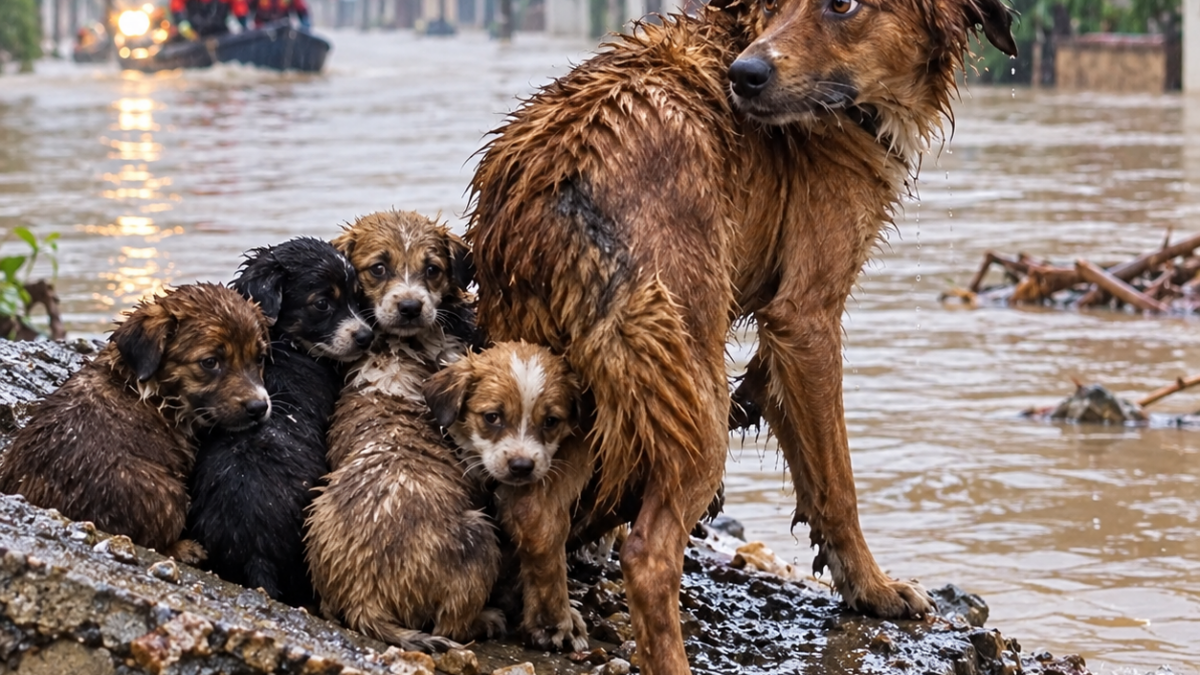
Maya had just carried the fifth shivering puppy onto the only patch of dry concrete when she turned around and stepped straight back into the floodwater.
For one terrible second, I thought exhaustion had finally confused her, because her legs were shaking so badly that she could barely stand and the current had already nearly taken her twice.
Then she stared toward a half-submerged storage building across the drowned street, and the look in her eyes made my stomach drop.
My name is Elodie Martin, and at thirty-nine, I had spent almost ten years helping rescue animals during floods, fires, storms, and evacuations across southern France.
I thought I understood frightened animals.
That morning, a brown dog taught me how little I knew.
The rain had been falling for two days outside Montauban. At first, nobody had treated it as a catastrophe. Ditches overflowed. Fields disappeared beneath shallow sheets of water. A few secondary roads closed.
Then, sometime during the night, everything changed.
A normally quiet creek became a violent brown river.
Garbage cans, fence panels, tree limbs, plastic chairs, and pieces of garden sheds floated between houses. Entire streets vanished. Water pushed through doors and climbed staircases.
Our team received several reports about animals trapped near an abandoned parish hall and an old storage building.
Marc and I arrived in a small aluminum rescue boat shortly after sunrise.
That was when we saw her.
At first, I thought the dog had a rag in her mouth.
Then the bundle moved.
“Marc,” I said. “That’s a puppy.”
He immediately reduced the motor.
The dog was medium-sized, brown, with a white chest and a narrow white mark beneath her chin. Her fur was plastered to her ribs. Every few seconds, a muddy wave rolled over her shoulders.
Still, she kept her mouth above the surface.
She reached a sloping concrete platform beside the parish hall, clawed her way onto it, and gently placed the puppy down.
Only then did we see the others.
Two tiny bodies were already huddled against the wall.
The puppy she had just delivered was number three.
Before we could reach her, the dog turned around.
She went back into the water.
Again.
Then again.
By the time we brought the boat closer, she had made five trips.
Three puppies were brown like their mother.
Two were black with white paws.
None looked older than four weeks.
I had rescued dogs trapped in attics.
Cats stranded on car roofs.
Horses standing chest-deep in flooded fields.
But I had never watched a mother organize the evacuation of her own litter one baby at a time.
Nobody had trained her.
Nobody was calling her.
She didn’t know rescuers were coming.
She only understood one thing.
The place where she had hidden her babies was disappearing beneath the water.
On her fifth trip, her body began to fail.
A floating board struck her side and spun her sideways.
I screamed.
Marc gripped the boat rail.
But the dog never opened her jaws.
She kept that puppy above the surface until she reached the concrete.
Once there, she pushed him toward the others and stood trembling over all five.
“Stay with them, sweetheart,” Marc called. “You did it.”
For several seconds, I thought she would.
She lowered her head.
Touched every puppy with her nose.
One.
Two.
Three.
Four.
Five.
Then her head rose.
She looked behind her.
Across the flooded street.
Toward the old storage building.
My stomach tightened.
“No,” Marc whispered.
The dog stepped toward the edge.
“There’s another one,” I said.
Marc started the engine.
“We’ll get it.”
But before we could move, she jumped.
The current grabbed her instantly.
This time, however, she wasn’t heading toward the same opening she had used on the previous trips.
She angled downstream.
Toward the rear wall.
“Why is she going that way?” Marc shouted.
I didn’t know.
Then I saw something beneath the muddy surface beside the building.
A chain.
It stretched from a submerged doorway toward a broken wooden pallet.
The current pulled it tight.
And something attached to the other end moved.
PART 2
For half a second, neither Marc nor I moved.
The chain rose above the brown water, glistened in the gray morning light, then disappeared again beneath the surface.
I heard something.
Barely.
A sound so thin that the flood nearly swallowed it.
A puppy crying.
“There!” I shouted.
Marc pushed the throttle forward.
The little boat swung toward the rear of the storage building while Maya fought the current ahead of us.
We had started calling her Maya only minutes earlier.
Her collar had no visible name tag, and Marc had said, almost absently, “A mother doing that deserves a name.”
So Maya she became.
Now she was barely swimming.
The difference between her first trip and this one was terrifying.
Earlier, her strokes had been strong and determined.
Now her hind legs sometimes disappeared beneath her. Her head dipped dangerously low. The current pushed her several feet sideways before she corrected herself.
“Maya!” I shouted.
She never looked back.
The old storage building had probably been used by the parish decades earlier. Its plaster walls were cracked, and part of the roof had collapsed long before the storm.
The floodwater had turned the rear yard into a swirling trap of broken fencing, boards, plastic containers, branches, and metal debris.
Maya knew exactly where she was going.
We didn’t.
That frightened me more than anything.
“Slow!” I yelled.
Marc eased off.
A submerged fence line appeared directly in front of us.
The boat scraped over it.
Then I saw the puppy.
He was trapped on a wooden pallet wedged between a railing and the back wall.
A large plastic crate had tipped onto its side.
Inside, a tiny black puppy with a white stripe on his muzzle was struggling to keep his head above the rising water.
And around his neck was a red collar.
Attached to that collar was the chain.
“Oh God,” Marc said.
The puppy’s front leg was caught between two slats.
Every time the current shifted the pallet, the chain tightened around his neck.
Maya reached him first.
She tried to climb onto the pallet.
It rolled.
She slipped beneath the water.
My heart stopped.
Then her head came up again.
She clawed at the plastic crate.
The puppy cried harder.
“Maya, back!” I shouted.
Of course she didn’t listen.
To her, we were strangers arriving too late.
She had already saved five babies herself.
Why would she trust us with the sixth?
Marc brought the boat beside the railing.
I clipped a rescue line to my harness.
“What are you doing?” he demanded.
“Getting him.”
“The current’s too strong.”
“I know.”
“Elodie—”
“If that pallet shifts another foot, the chain will pull him under.”
Marc swore quietly.
Then he secured my line.
“You get thirty seconds before I drag you back whether you like it or not.”
“Fine.”
I stepped over the side.
The water hit me harder than expected.
Even with one hand gripping the railing, my legs immediately slid downstream.
Marc tightened the safety line.
“I’ve got you!”
I pushed toward the pallet.
Maya growled.
Not loudly.
A warning.
Her lips lifted for half a second.
I stopped.
“Okay,” I said softly. “I know. He’s yours.”
Another wave hit the wall.
The crate shifted.
The puppy screamed.
Maya turned toward him.
I moved.
The pallet rolled beneath my hand.
The puppy’s trapped paw slipped free.
For one hopeful second, I thought he might escape.
Then the entire crate twisted.
The chain snapped tight.
The puppy disappeared underwater.
“No!”
I plunged both arms into the crate.
My fingers found wet fur.
Then the collar.
I pulled his head above the surface.
He coughed.
Maya shoved her nose against his face.
“Bolt cutters!” I screamed.
Marc threw the cutters.
They hit the railing and almost bounced away.
I caught one handle.
The other dropped underwater.
I found it with my foot, bent down, and grabbed it.
The current slammed me sideways.
“Elodie!”
“I’m okay!”
I wasn’t.
My left knee struck something metal under the water.
Pain shot up my leg.
I ignored it.
I pushed the jaws of the cutter around the chain.
Squeezed.
Nothing.
The chain was old but thick.
“Again!” Marc shouted.
The puppy began slipping from my grip.
Maya pressed against the crate.
I could feel her trembling against my arm.
I repositioned the cutters.
Squeezed with everything I had.
The link bent.
It didn’t break.
“Come on.”
I opened them again.
My hands were shaking.
Another surge hit.
The puppy coughed.
I squeezed a third time.
There was a sharp metallic crack.
The chain broke.
I ripped the collar free and lifted the puppy against my chest.
For a second, he was completely limp.
“Maya, come!”
Marc leaned over the side and grabbed her beneath the chest.
She resisted only long enough to make sure I still had her baby.
Then she allowed him to pull her into the boat.
I climbed after them.
The moment I put the puppy down, Maya crawled toward him.
She began licking his face.
Hard.
Fast.
Almost frantic.
“Come on, little guy,” I whispered.
Nothing.
Marc turned the boat toward the concrete platform where the five other puppies waited.
I rubbed the tiny dog with a towel.
Water ran from his mouth.
I held him angled downward.
Rubbed again.
Maya whimpered.
Then the puppy coughed.
Once.
Twice.
A thin cry followed.
I had heard louder sounds thousands of times.
None ever felt better.
Maya’s legs folded beneath her.
She collapsed beside him.
“Maya?”
She didn’t stand again.
Her breathing was shallow.
I touched her gums.
Pale.
Too pale.
“Marc, we need to get out now.”
He was already moving.
We reached the concrete platform and loaded the other five puppies into a plastic transport crate lined with blankets.
They squeaked and crawled over one another.
Maya lifted her head when she heard them.
She tried to rise.
Nothing happened.
I moved the crate beside her.
All five puppies pressed against the side closest to their mother.
The sixth lay wrapped against my chest.
Maya looked at him.
Then at the others.
Only after she saw all six did her eyes close.
I placed my hand against her ribs.
Breath.
Pause.
Breath.
Pause.
Too slow.
I had seen animals survive the worst part of a rescue and die minutes later.
Adrenaline can make a body perform impossible things.
Then the debt comes due.
I leaned toward her ear.
“You are not dying now.”
Marc looked back.
“Elodie.”
“No.”
“I didn’t say anything.”
“I know what you were going to say.”
He faced forward again.
The emergency veterinary station had been set up in a municipal gymnasium on higher ground.
When our boat reached the temporary landing area, three volunteers were waiting.
I jumped out.
“We have seven!”
A veterinarian named Dr. Alain Roche ran toward us.
“Condition?”
“Six puppies, hypothermic. One nearly drowned. Mother severely exhausted, possibly shock.”
“Mother first.”
We carried Maya into the gym.
The building smelled like wet clothing, disinfectant, coffee, dog fur, and mud.
Crates lined one wall.
Cats occupied a quieter room.
Volunteers moved constantly between tables.
Maya was placed on a padded examination surface.
Alain checked her heart.
“Temperature?”
A technician read it.
Alain’s expression changed.
“Too low. Warm fluids. Heated blankets. Oxygen.”
I brought the puppies beside her.
The smallest one—the sixth—was still coughing.
“We need to examine him immediately,” Alain said.
I looked at Maya.
“She needs to see where he goes.”
Alain understood.
He placed the puppy in a small clear-sided warming box beside Maya’s table.
Her eyes opened.
Only slightly.
But she tracked him.
“Good girl,” I whispered.
For the next forty minutes, I had no legitimate reason to remain beside her.
There were other rescue calls.
Other animals.
Other people needed help.
But I stood there anyway.
Every few minutes, Maya’s breathing changed.
Every time, my chest tightened.
The technicians worked around me.
Warm fluids.
Oxygen.
Dry towels.
A heating pad under several layers of blanket.
Her coat was soaked all the way to the skin.
When Alain began checking her body for injuries, he found bruising along her ribs.
“The board?” he asked.
“I saw something hit her on her fifth trip.”
“No obvious fracture.”
He moved toward her neck.
That was when his hands stopped.
He parted the wet fur.
Beneath it was a thick, hairless mark circling much of her neck.
Not fresh.
Old.
Some areas had scarred.
Others were still irritated.
Alain looked at me.
“This isn’t from today.”
I stared at it.
“A collar?”
“A collar or chain worn too tightly for a long time.”
I looked across the room at the sixth puppy.
The broken chain still hung from his red collar.
Something shifted inside me.
Until then, I had assumed Maya was a stray.
Maybe she had taken shelter in the abandoned building when she gave birth.
Maybe the puppies had been born there.
Maybe nobody had known.
But stray dogs do not usually come with chained four-week-old puppies.
Alain continued examining her.
Her paws were badly scraped.
Her weight was low.
Her nails had strange wear patterns.
There were calluses on her elbows.
“What are you thinking?” I asked.
He didn’t answer immediately.
“That she didn’t have an easy life before the flood.”
The smallest puppy cried.
Maya’s ear moved.
That tiny movement nearly broke me.
I crouched beside her.
“He’s here.”
Her eyes opened.
I nodded toward the warming box.
“Your baby is here.”
Her tail moved once.
Barely an inch against the blanket.
I laughed through tears.
Behind me, Marc cleared his throat.
I looked at him.
His eyes were red.
“You crying?”
“No.”
“You are.”
“Floodwater.”
“We’re inside.”
“Persistent floodwater.”
I smiled.
Then Alain interrupted.
“Elodie.”
His tone changed everything.
He was examining the small puppy’s leg.
“What?”
“Come see.”
I stepped over.
The puppy’s front paw was swollen to nearly twice its normal size.
A deep indentation circled the leg.
“Something was tied around him?”
“Possibly.”
“Will he lose the leg?”
“I don’t know yet.”
The puppy cried when Alain touched the paw.
I clenched my jaw.
We later named him Milo.
Not because the name had meaning.
Because a volunteer asked what to write on the medical board and somebody had to choose something.
Maya remained Maya.
The five others eventually became River, Poppy, Bean, Nala, and Scout.
But that morning they were simply six cold babies and one mother refusing to die.
By afternoon, Milo’s circulation had improved slightly.
X-rays showed no fracture.
The damage appeared to be compression and soft-tissue injury rather than a broken bone.
Maya remained the greater concern.
She was dehydrated despite nearly drowning.
She was severely underweight for a nursing mother.
Her bloodwork showed anemia.
And the more Alain examined her, the more evidence he found that her suffering had begun long before the rain.
“Look here,” he said.
He showed me old scar tissue near her shoulder.
Then her worn paw pads.
Then thickened skin over her elbows.
“Concrete?”
“Likely.”
“You think she was kenneled?”
“Or tethered.”
“How long?”
“Long enough.”
That phrase stayed with me.
Long enough.
Long enough for a collar to carve marks into her neck.
Long enough for hard ground to change her skin.
Long enough for her body to learn that comfort was temporary.
Late that afternoon, a gendarme entered the veterinary station.
Lieutenant Julien Moreau.
I knew him from previous emergency operations.
He was carrying a clear evidence bag.
Inside was a weathered brown leather collar with a metal tag.
“Found near the storage building,” he said.
I took the bag.
A phone number was stamped into the tag.
No name.
“No microchip?” I asked.
“Not that we’ve found yet.”
“Did you call the number?”
“Yes.”
“And?”
Julien glanced toward Maya.
“It belongs to a man named Laurent Vignal.”
“Owner?”
“He says former owner.”
My skin prickled.
“Meaning?”
“He claims he gave the dog away three months ago.”
“To who?”
“That’s the problem.”
“What’s the name?”
“He won’t give one.”
“Won’t?”
“That’s what I said.”
Julien’s expression was flat.
I had known him long enough to recognize when he was angry.
He rarely showed it.
“Maybe he really gave her away,” Marc said.
Julien nodded.
“Maybe.”
But none of us believed that answer comfortably.
The flood kept us busy for the next forty-eight hours.
Roads remained closed.
Houses were still surrounded.
Our team responded to dozens of calls.
A Labrador trapped on a kitchen counter.
Two cats on a garage roof.
Three goats standing on a concrete loading platform.
A horse trapped behind a fallen tree.
A frightened terrier inside a shed where water had reached the windows.
Every rescue required attention.
Every one deserved it.
Still, I thought about Maya constantly.
Whenever we returned to the gymnasium, I checked her first.
On the second evening, I found her standing.
Her legs shook.
But she was standing.
“Hey,” I whispered.
Her eyes followed me.
Milo slept between her front paws.
The other puppies were nursing.
Alain approached carrying a folder.
“You’re emotionally invested.”
“I’m professionally concerned.”
“You have slept four hours in two days.”
“That’s unrelated.”
“You named all six puppies.”
“The volunteers did.”
“You approved the names.”
I looked at him.
“What’s in the folder?”
His humor disappeared.
“Her results.”
He showed me bloodwork.
Then notes.
Then photographs.
Maya was probably around three years old.
She had given birth before.
More than once.
“Can you tell how many litters?”
“Not precisely.”
“Estimate?”
He hesitated.
“Possibly three.”
I stared at him.
“At three years old?”
“Yes.”
“She would have been bred almost every cycle.”
“That would be consistent.”
The anger came slowly.
Not dramatic.
Cold.
“What else?”
“Poor nutrition. Chronic skin irritation. Old neck injuries. Paw wear consistent with long confinement. Her teeth suggest she chewed metal at some point.”
“Metal?”
“Bars. Chain. Something hard.”
I looked at Maya.
She was licking Scout’s head.
“She swam through a flood six times for those puppies.”
Alain closed the folder.
“Animals will do extraordinary things for offspring.”
“Humans should have done something for her.”
He said nothing.
The following morning, Julien called.
“I need you to see something.”
“Where?”
“Vignal’s property.”
“When?”
“Now, if you can.”
Laurent Vignal lived less than a kilometer from the abandoned storage building.
His house stood on slightly higher ground, and the main structure had escaped serious flooding.
The backyard had not.
Mud covered the lower section.
A fence leaned sideways.
Behind the house stood three concrete kennels.
My stomach tightened before Julien said anything.
Two kennels were empty.
The third had a chain bolted to the rear wall.
Not clipped to a run.
Not attached to a long line.
Bolted directly into concrete.
There was a weathered doghouse in one corner.
A plastic bowl.
No bedding.
The chain was short.
“How far can a dog move?” I asked.
Julien measured it with his eyes.
“Maybe two meters.”
I stepped inside.
A dark stain marked the wall at dog-shoulder height.
Repeated rubbing.
Near the kennel entrance were several small plastic crates.
Cheap ones.
The kind sometimes used for transporting puppies.
“You found records?” I asked.
Julien nodded toward a detached shed.
Inside was a folding table covered with papers.
A notebook lay inside an evidence sleeve.
Julien opened to a marked page.
Dates.
Numbers.
Colors.
Sex.
Deposits.
Sold.
Cash.
No names.
One entry said:
BROWN FEMALE — 7.
Another eight months later:
BROWN FEMALE — 6.
A more recent entry:
BROWN FEMALE — 6. 2 BLACK. 4 BROWN.
I felt physically sick.
“That’s Maya.”
“We think so.”
“She doesn’t even get a name.”
“Apparently not in his records.”
There were prices beside several puppies.
Amounts paid in cash.
Initials.
Phone numbers.
A list of buyers.
My eyes moved down the page.
“She’s inventory.”
Julien didn’t answer.
I turned another page.
Another litter.
Another date.
“How many?”
“We’re still determining.”
“She’s three years old.”
“We know.”
I stepped outside.
The air smelled like wet dirt and diesel fuel.
Across the property, an elderly man stood near his gate.
Julien noticed him.
“That’s René Boucher. He lives next door. He gave us a statement.”
“What did he see?”
“A lot.”
René was seventy-four.
Thin.
Gray hair.
His left arm was wrapped from wrist to elbow.
He spoke quietly.
“I told him to move the dogs.”
“Laurent?” I asked.
“Yes.”
“When?”
“The afternoon before the water got bad.”
“What did he say?”
René looked toward Laurent’s house.
“He said the old parish building had never flooded.”
“Maya was already there?”
“For weeks.”
“Why?”
“People complained about barking.”
My hands curled.
“What barking?”
“The puppies. The mother. Sometimes at night.”
“So he moved them from his property?”
René nodded.
“To the storage building.”
“With permission?”
“I doubt anyone knew.”
I looked toward the drowned street.
“Did you know she had six puppies?”
“I saw her with some. I didn’t know exactly how many.”
“And you warned him?”
“Twice.”
René’s eyes lowered.
“The second time I told him I would help move them.”
“What did he say?”
“He told me to mind my own business.”
A familiar anger spread through me.
“When did he leave?”
“After dark.”
“Did he take the dogs?”
René’s face changed.
“No.”
“How do you know?”
“Because I heard her.”
“Maya?”
“I didn’t know her name. But yes.”
His voice broke slightly.
“I heard her barking after his van left.”
He looked at his bandaged arm.
“I tried to reach the building.”
Julien had already told me René fell.
Now I understood how.
“The road was too deep,” René said. “I got halfway. Water knocked me down. A firefighter pulled me back.”
“You could have died.”
“I know.”
“Then why did you try?”
René looked at me as though the answer should have been obvious.
“Because she was still barking.”
I had to look away.
He continued.
“I called emergency services. More than once. I told them there were dogs there.”
One of those calls had probably become the report that sent us out.
Without René, maybe we would have arrived twenty minutes later.
Maybe thirty.
Maybe not at all.
“Did you see Laurent evacuate?”
“Yes.”
“What was in his van?”
René laughed once.
There was no humor in it.
“Television. Tools. Boxes. His expensive coffee machine, apparently.”
“Animals?”
“No.”
“Are you certain?”
He looked directly at me.
“I watched that man save his television while a dog he owned was barking behind him.”
I walked away before I said something I regretted.
Behind René’s house was a narrow strip of dry grass.
I stood there looking toward the distant parish roof.
People call animals brave when they survive something horrific.
We turn the story into inspiration.
A miracle dog.
A heroic mother.
A symbol of devotion.
But standing in that wet field, I suddenly hated the word heroic.
Maya should never have needed to be heroic.
She had been forced into that role because a human being with a working van, dry clothes, flood warnings, and hours of time had decided televisions mattered more.
She had carried six puppies because someone who should have protected all seven of them simply drove away.
I felt footsteps behind me.
Julien stopped beside me.
“You okay?”
“No.”
He nodded.
“Neither am I.”
“What happens now?”
“We build the case.”
“Against Laurent?”
“If the evidence supports it.”
“Julien.”
He looked at me.
“He left them.”
“I know what it looks like.”
“You know what it is.”
“I need to prove what it is.”
That was the difference between my anger and his job.
I could hate.
He needed evidence.
And Laurent had already begun lying.
When investigators questioned him again, he repeated that Maya no longer belonged to him.
He claimed he had given her to “a friend.”
He could not provide the friend’s full name.
No address.
No phone number.
No message history.
No payment.
No transfer papers.
Then he changed details.
Maybe the friend had only agreed to take Maya later.
Maybe the dog had returned.
Maybe somebody else moved her to the parish building.
Each new explanation contradicted the previous one.
Then investigators found something Laurent had forgotten.
A security camera.
It belonged to a small agricultural equipment business across the road.
The camera did not show Laurent’s entire property.
It didn’t need to.
It showed his driveway.
The flood warning had been issued in the afternoon.
At 6:18 p.m., Laurent’s van returned home empty.
At 7:02 p.m., it left loaded.
At 7:36 p.m., it returned.
At 8:11 p.m., it left again.
The recording was grainy, but furniture was visible through the rear windows.
Boxes.
Tools.
A large television.
No dog.
No puppies.
The final clip also captured sound.
Not clearly.
But enough.
As Laurent’s van backed into the road, a dog barked repeatedly in the distance.
Then the vehicle drove away.
When Julien told me, I sat down.
“So he heard her.”
“We can’t prove what he heard from inside the van.”
“He heard her.”
“Elodie.”
“He knew she was there.”
“That part we can support through the neighbors and his records.”
I hated the careful language.
But I understood why he used it.
Justice built badly can collapse.
Julien intended to build it properly.
Meanwhile, Maya had no idea an investigation existed.
Her world had become much smaller.
A warm room.
Six puppies.
Food arriving regularly.
Hands that did not hurt her.
That alone appeared difficult for her to understand.
During her first week at the veterinary station, she refused to eat if anyone stood nearby.
We had to place the bowl down and walk away.
She swallowed food quickly.
Too quickly.
Then searched for more.
If a metal bowl scraped the floor, she flinched.
If a door slammed, she jumped over her puppies and stood between them and the sound.
If a man entered wearing heavy boots, she lowered her body.
Not aggressively.
Protectively.
Alain noticed it too.
“Trauma doesn’t always look dramatic,” he told me.
“What does it look like?”
“That.”
Maya was asleep.
Or pretending to be.
Her eyes were closed, but her ears moved at every sound.
“She never fully sleeps,” I said.
“Not yet.”
I began visiting after shifts.
At first, I sat three meters away.
No touching.
No calling.
No treats from my hand.
I read reports.
Answered messages.
Drank terrible vending-machine coffee.
Maya watched me.
The first three nights, nothing changed.
On the fourth, she ate while I remained in the room.
On the fifth, she slept for almost ten minutes without opening her eyes.
On the seventh, something cold touched my fingers.
I froze.
Maya’s nose.
She sniffed my hand.
Then stepped away.
I looked toward Alain.
He was pretending not to watch.
“Did you see that?”
“No.”
“You did.”
“I am a veterinarian. I see many noses.”
“She touched me.”
“A historic event.”
I smiled for the rest of the night.
The puppies changed faster.
Once they were warm and properly fed, they became miniature disasters.
River, the largest, believed every towel belonged to him.
Poppy fell asleep in ridiculous positions.
Bean discovered barking and treated it like a personal talent.
Nala tried to climb out of everything.
Scout followed Maya everywhere.
Milo recovered slowly.
For several days, he limped.
His injured paw remained swollen.
But circulation returned.
No surgery.
No amputation.
When Alain gave me that news, I hugged him.
He stiffened.
“We are not that kind of friends.”
“Today we are.”
“Release me.”
Milo grew stronger.
He also developed a strange habit.
Whenever frightened, he crawled under Maya’s chest.
She always lifted herself enough to make room.
One afternoon, I watched him sleep beneath her while the others wrestled nearby.
“You went back for him,” I whispered.
Maya looked at me.
I wondered if she remembered the chain.
Animals remember differently from us.
Maybe not as stories.
Maybe as sensations.
Smells.
Fear.
Relief.
But something in her expression made me believe the flood had not left her.
It certainly had not left me.
At night, I sometimes dreamed about that chain tightening.
In the dream, the cutters never worked.
I would wake with my hands clenched.
Then I would check my phone.
Alain had begun sending me photos when he knew I was worrying.
Maya asleep.
Milo nursing.
All six puppies piled together.
One night, he sent a picture of Maya sitting beside the clinic entrance.
The message said:
YOUR FRIEND HAS BEEN WAITING TWENTY MINUTES.
I arrived late because of a road closure.
When I entered, Maya’s tail moved.
Once.
Then again.
She walked toward me.
I crouched.
She stopped just outside arm’s reach.
“You missed me?”
Her ears lifted.
I extended my hand.
She stepped forward.
For the first time, she allowed me to scratch beneath her chin.
I didn’t cry.
Not until I got back to my car.
By then, the investigation into Laurent had widened.
The notebook provided names and telephone numbers for several people who had purchased puppies.
Julien asked if I wanted updates.
I said yes.
Part of me wished I hadn’t.
One woman remembered arriving at Laurent’s property two years earlier.
“She was tied behind a shed,” the woman told investigators.
“Maya?”
“The brown mother. I didn’t know her name.”
“What condition was she in?”
“Thin.”
“Did you notice injuries?”
“No. I was there for a puppy. I didn’t really look.”
Her honesty hurt.
Not because she was cruel.
Because she was ordinary.
Most harm survives because ordinary people look at the part they came to see.
A cute puppy.
A cheap price.
A quick transaction.
The mother behind the shed becomes background.
Another buyer had saved text messages.
Laurent wrote:
READY THIS WEEKEND.
CASH ONLY.
MOTHER NOT AVAILABLE TO VIEW.
Another message:
LAST TWO. CHEAP IF BOTH TAKEN.
A third person had photographs.
In the background of one picture was Maya.
Tethered.
The date was eighteen months before the flood.
The collar mark around her neck was already visible.
Julien sent me the image only because I asked.
I regretted asking.
Maya was looking directly toward the camera.
The buyer held a fluffy puppy in the foreground.
Everyone’s attention had been on the baby.
Nobody had looked at the mother.
I printed the photograph.
Then I stared at it for ten minutes.
Finally I tore it in half.
Not because it wasn’t evidence.
Investigators already had copies.
I tore it because I couldn’t stand the idea that Maya’s life before us could be reduced to a background detail.
Three weeks after the flood, Maya was medically cleared to leave the veterinary station.
The puppies were almost old enough to begin separation planning.
That should have felt like good news.
Instead, I panicked.
“What happens to Maya?” I asked Alain.
“We find an adopter.”
“You make it sound simple.”
“It isn’t.”
“She doesn’t trust strangers.”
“She trusts you.”
“That’s different.”
“Why?”
I had no answer.
Adoption applications began arriving.
The rescue photograph had spread locally.
Someone had taken a picture after Maya stabilized: she was asleep on a blanket while all six puppies lay against her.
People shared it.
Local newspapers reported the story.
Then larger pages repeated it.
Hundreds of messages arrived.
Most were kind.
Some were not useful.
People wanted the heroic flood mother.
People wanted “one of the famous puppies.”
That worried me.
Animals are not trophies from stories.
We created stricter screening rules.
Fenced property where appropriate.
Veterinary references.
Work schedules.
Household members.
Existing animals.
Long-term plans.
One applicant wanted River because “he would get views online.”
Rejected.
Another wanted Maya for breeding.
I read that application twice because I could not believe anyone would write it openly.
Rejected permanently.
A third wanted two puppies as a surprise birthday gift for children.
Rejected.
Eventually, good families appeared.
River went to a retired couple who had owned dogs for thirty years.
Poppy went to a veterinary nurse.
Bean went to a family whose old Labrador had recently died.
Nala went to a teacher who ran every morning.
Scout created a problem.
René visited almost every day.
At first he claimed he was only “checking on them.”
Then he began bringing toys.
Then treats.
Then a blanket.
One afternoon I found Scout asleep inside René’s jacket.
“You know that’s how adoption happens,” I told him.
“I’m too old for a puppy.”
Scout woke and licked his chin.
“You were saying?”
“I’m seventy-four.”
“You also climbed into floodwater trying to save six dogs.”
“That was stupidity.”
“Then Scout will fit right in.”
René laughed.
Two days later, he submitted an application.
We inspected his house.
Large fenced garden.
Quiet neighborhood.
Retired.
Home most of the day.
Veterinarian nearby.
Perfect.
When we brought Scout home, Maya came with us.
I wanted her to see where her puppy was going.
René had purchased a bed.
Then a second bed.
Then enough toys for ten dogs.
“I may have overprepared,” he admitted.
“Possibly.”
Scout ran into the kitchen.
René sat down heavily.
His eyes filled.
“I should have gotten to them.”
I knew exactly where his mind had gone.
“You tried.”
“Not enough.”
“You nearly drowned.”
“I still left her there.”
“You didn’t leave her. The water stopped you.”
His face tightened.
“I could hear her barking.”
Maya walked toward him.
René lowered his hand.
She sniffed his fingers.
Then, slowly, she rested her chin on his knee.
He broke.
Not loudly.
He simply covered his face with both hands.
Maya remained beside him.
Scout climbed onto his shoe.
I turned away and pretended to examine the garden.
Scout stayed.
There was only Milo.
And Maya.
Applications came for Milo.
Good applications.
Excellent ones, actually.
I rejected them.
At first I had reasons.
One family worked too many hours.
Another lived in an apartment with stairs that could be difficult while his leg strengthened.
Another already had three dogs.
Marc eventually noticed.
He cornered me beside our rescue van.
“You know you’re keeping Milo.”
“I am not.”
“You rejected the couple from Toulouse.”
“They travel.”
“They take their dogs.”
“Frequently.”
“They have a fenced acre and a veterinary reference glowing enough to be poetry.”
“I had concerns.”
“You’re emotionally compromised.”
“I’m responsible.”
“You bought a puppy bed.”
I stared at him.
“How do you know?”
“It’s visible in your car.”
“That proves nothing.”
“It has clouds on it.”
“It was discounted.”
“You do not own a puppy.”
“I might foster.”
“You bought two bags of puppy food.”
“Preparation.”
“You bought a second bed.”
I said nothing.
Marc’s smile disappeared.
“The big one.”
I looked away.
The larger bed was not for Milo.
It was for Maya.
I had bought it three days earlier.
I had hidden it in my spare room because admitting why I bought it felt dangerous.
Milo was easy.
Milo loved everyone.
Maya was different.
If I adopted her, I wasn’t taking home a heroic dog from a beautiful rescue story.
I was taking home fear.
Nightmares, perhaps.
Resource insecurity.
Leash anxiety.
A dog who might never be comfortable with strangers.
A dog who had learned humans could abandon her.
I was also gone for long shifts.
My work was unpredictable.
Sometimes twelve hours.
Sometimes longer.
I lived alone.
Wanting her was not enough.
I needed to be right for her.
So I asked Alain.
“Tell me honestly.”
“Dangerous opening.”
“Would adopting Maya with Milo be irresponsible?”
He leaned against the examination table.
“For whom?”
“For her.”
“No.”
“For Milo?”
“No.”
“For my job?”
“Manageable.”
“For me?”
He smiled.
“That part I cannot diagnose.”
“I’m serious.”
“So am I. You already arranged for your sister to help on long shifts.”
I blinked.
“How do you know that?”
“She called me asking about feeding schedules.”
Traitor.
“She has a fenced yard?”
“Yes.”
“Maya trusts her?”
“More every visit.”
“You have experience.”
“Yes.”
“You are willing to work with a behaviorist.”
“Yes.”
“You understand this dog may never become the dog you imagine.”
I looked at Maya.
She was lying nearby with Milo asleep against her belly.
“I don’t need her to become anything.”
Alain nodded.
“Then maybe that’s your answer.”
I signed the paperwork the next morning.
Milo came home first.
Maya had one final veterinary check.
My house was small.
Two bedrooms.
A fenced garden.
A covered patio.
Nothing extraordinary.
I had spent three nights making it safe.
Cabinet latches.
Baby gate.
Crate with the door permanently open.
Beds in three rooms.
Food station.
Water bowls.
Milo ignored all of it.
He found one of my work boots and fell asleep inside it.
The next day, I brought Maya home.
I opened the car door.
She stayed inside.
I didn’t pull the leash.
I waited.
One minute.
Then two.
She looked at the house.
The garden.
The road.
Me.
Milo heard us.
He began squealing behind the front door.
Maya’s ears lifted.
She jumped down.
We walked to the entrance.
I opened the door.
Milo launched himself across the hallway.
Maya met him.
They touched noses.
He turned.
Ran toward the garden.
Maya followed.
The first time she stepped onto the grass, she stopped.
No chain.
No concrete kennel.
No wall behind her.
I removed the long training leash.
She looked at me.
“Go.”
She didn’t.
Milo ran one circle.
Then another.
Maya watched.
He bounced toward her.
Then away.
Something changed.
She ran.
One full circle around the garden.
Then another.
Faster.
Her legs stretched beneath her.
Her ears flattened in the wind.
Milo chased her, hopelessly behind.
I stood at the doorway with my hand over my mouth.
Maya stopped at the far fence.
For a second, fear hit me.
Maybe she would jump.
Maybe she would panic.
Maybe freedom itself would scare her.
Instead she turned.
She looked at me.
Then she ran again.
That was when I cried.
Marc later claimed I cried too much after Maya arrived.
He was correct.
The first night, she slept beside the front door.
The second night, too.
On the third, she chose the hallway.
The fourth, closer to my bedroom.
For weeks, she positioned herself where she could see every entrance.
She did not like closed doors.
So I kept them open.
She did not like eating while someone stood near her.
So I walked away.
She feared leashes.
So we used a soft harness.
She froze when metal clanged.
So I replaced her bowls.
Small things.
People sometimes imagine healing as a breakthrough.
One beautiful moment.
One dramatic transformation.
It wasn’t.
Healing was Maya sleeping five minutes longer.
Eating without looking over her shoulder.
Walking past a gate without crouching.
Allowing my sister Claire to touch her.
Taking a treat from Marc.
Choosing the couch.
The couch was important.
For two months, she never climbed onto furniture.
Then one rainy afternoon, I walked into the living room and found her lying there.
All four paws up.
Milo asleep across her stomach.
I backed out slowly.
Grabbed my phone.
Took seventeen photographs.
Sent them to Alain.
He replied:
MEDICAL DIAGNOSIS: SPOILED.
He was right.
The criminal case moved more slowly.
Laurent hired a lawyer.
The defense began by challenging ownership.
If Maya had been transferred to someone else, Laurent could argue he was not responsible at the time of the flood.
Julien expected it.
Investigators searched telephone records.
Bank records where legally permitted.
Messages.
Previous advertisements.
No transfer existed.
Then they found a message Laurent had sent less than three weeks before the flood.
A buyer asked:
IS THE MOTHER HEALTHY?
Laurent replied:
YES. SAME BROWN FEMALE AS LAST LITTER.
That alone weakened his claim.
Another buyer contacted him six days before the flood asking whether any puppies remained.
Laurent replied:
SIX. READY IN A FEW WEEKS.
Six.
Not somebody else’s puppies.
His sale.
His litter.
His responsibility.
When Julien called to tell me, I was sitting in my kitchen while Maya slept near my chair.
“He can’t deny it now.”
“He can still deny many things.”
“But that message—”
“Helps.”
I hated “helps.”
I wanted finality.
Julien understood.
“This is how it works, Elodie.”
“I know.”
“No, you know emergencies. They move fast. Legal cases don’t.”
“She nearly died.”
“I know.”
“Milo nearly drowned because he was chained.”
“I know.”
“He saved furniture.”
“I know.”
“Then why does he get months?”
“Because if we rush it, his lawyer may get him nothing.”
That silenced me.
Julien continued.
“I want something that holds.”
So I waited.
Months passed.
Milo grew.
His leg healed completely.
By six months old, he was a long-legged disaster with no understanding of personal space.
He stole socks.
Chewed one chair.
Learned to open a cupboard.
Once ate half a baguette and hid the other half beneath Maya’s bed.
Maya became softer.
Not physically.
Emotionally.
She began greeting me at the door.
Tail wagging.
Sometimes a toy in her mouth.
She loved early walks when the streets were quiet.
She loved lying in sunlight.
She loved my sister Claire.
She tolerated Marc.
“Only tolerates?” he complained.
“She remembers you drove the boat.”
“I saved her.”
“You also called her stubborn.”
“She was stubborn.”
Maya looked at him.
Marc pointed.
“See? Judgment.”
The first major setback happened during a thunderstorm.
Rain struck the windows.
Wind pushed water across the garden.
At 2:13 a.m., I woke because Milo was whining.
Maya was gone from the bedroom.
I found her in the bathroom.
Wedged between the toilet and wall.
Shaking.
“Maya.”
Her eyes were wide.
I didn’t touch her.
I sat on the floor.
The storm intensified.
She pressed harder into the corner.
Milo walked in.
He tried to climb onto her.
I moved him gently away.
For forty minutes, I sat there.
No soothing speeches.
No forcing.
Just presence.
Eventually, Maya crawled out.
She pressed against my side.
Her entire body trembled.
I put one arm around her.
“You’re home.”
Lightning flashed.
She flinched.
“You’re home.”
I repeated it until the storm passed.
The next morning, she refused to go outside.
I called the behaviorist we had been consulting.
“Don’t turn it into a battle,” she told me.
So I didn’t.
We waited.
At noon, Milo stepped into the garden.
Maya watched.
At one, she placed two paws outside.
At three, she walked onto the patio.
By evening, she crossed the grass.
That became our rule.
No forcing.
No dragging.
No proving.
She had spent enough of her life without choices.
My job was to give them back.
The court hearing finally arrived nearly six months after the flood.
I received a summons to testify.
The night before, I couldn’t sleep.
Maya did.
She lay beside my bed.
Milo snored under the chair.
I stared at the ceiling.
I had faced burning barns.
Flooded buildings.
Terrified horses.
Aggressive dogs.
Court scared me differently.
Emergencies ask you to act.
Court asks you to remember.
Precisely.
Without emotion controlling the facts.
The courthouse was smaller than I expected.
Laurent sat with his attorney.
Dark jacket.
White shirt.
Clean.
Ordinary.
That bothered me.
I don’t know why.
Maybe some part of me expected cruelty to announce itself visually.
It doesn’t.
Most people who cause suffering look completely ordinary while doing it.
I testified about the rescue.
The weather.
The platform.
The five puppies.
Maya returning to the water.
The rear building.
The chain.
Milo underwater.
The cut link.
Maya collapsing.
I forced myself not to look at Laurent.
The prosecutor showed photographs.
One of Maya wet and shaking in the boat.
One of Milo’s injured paw.
One of the chain.
One of the kennel.
My throat tightened.
Then the judge asked me a question.
“In your professional experience, what would have happened if the rescue team had arrived twenty minutes later?”
I paused.
There are questions you can answer clinically.
That wasn’t one.
“The platform where the first five puppies were waiting was already being overtaken by water,” I said. “The sixth puppy was chained in an area that was flooding rapidly. Maya was severely hypothermic and physically exhausted.”
“Can you be more direct?”
I looked at the judge.
“Some of them would almost certainly have died.”
“Some?”
I swallowed.
“Possibly all seven.”
Silence.
Laurent looked down.
His attorney argued the flood had been extraordinary.
Unpredictable.
More severe than normal.
The prosecutor agreed with one point.
It had been extraordinary.
Then she displayed the official flood alerts.
Timestamped.
Next came evacuation notices.
Timestamped.
Then the security footage.
Laurent’s van.
Trip one.
Boxes.
Trip two.
Furniture.
Trip three.
Television.
Tools.
Possessions.
The defense argued video quality could not establish whether dogs were inside the vehicle.
The prosecutor did not need to prove they were never in the van.
She only needed to connect the timeline with the witnesses, messages, location of the animals, and Laurent’s own records.
Then René testified.
He wore his best jacket.
Scout was not allowed inside the courtroom, so I had promised to visit him afterward.
René described warning Laurent.
He described offering help.
He described hearing Maya after Laurent left.
The defense attorney asked whether René could be certain of the exact time.
“No,” René said.
“Then your memory may not be reliable.”
“I know what I saw.”
“You were frightened by rising water.”
“I was.”
“You fell.”
“Yes.”
“You were later treated for an injury.”
“Yes.”
“So it is possible your recollection is confused.”
René looked at Laurent.
Then at the attorney.
“I remember the television.”
The attorney paused.
“The television?”
“He carried it to the van himself.”
“Mr. Boucher—”
“I offered to help move the dogs. He said the building would be fine. Then later I watched him load that television.”
The courtroom became very still.
René’s voice hardened.
“I remember because I was standing behind my gate wondering why a television mattered more than a barking dog.”
Laurent shifted in his chair.
The prosecutor later introduced the notebook.
BROWN FEMALE.
Litter counts.
Prices.
Sales.
Then the messages.
SIX. READY IN A FEW WEEKS.
The claim that Maya belonged to someone else became increasingly difficult to maintain.
Laurent changed tactics.
He said he intended to return.
The water rose faster than expected.
He became trapped outside the area.
It sounded plausible.
Until the timeline showed he left before several roads closed.
Until investigators presented another message he sent that night.
A friend had asked:
YOU GET EVERYTHING OUT?
Laurent replied:
MOST IMPORTANT STUFF, YES.
I closed my eyes.
Most important stuff.
Maya had been barking less than a kilometer away.
Six puppies.
Most important stuff.
The legal consequences that followed were not the dramatic movie ending people imagine.
There was no crowd cheering.
No judge shouting.
No handcuffs snapped onto Laurent in the courtroom.
Real consequences are often quieter.
The court found substantial evidence of neglect and abandonment and imposed penalties under the applicable animal-welfare provisions.
Laurent was prohibited from possessing or breeding animals for the legally determined period.
Financial penalties followed.
The breeding activity and related irregularities were investigated separately.
Other animals connected to his sales were checked.
Equipment associated with the operation was seized where authorized.
He lost the ability to turn another neglected mother into a source of litter after litter without scrutiny.
Outside the courthouse, several reporters waited.
One asked me:
“Are you satisfied?”
I hated the question.
Satisfied?
I thought of Maya pressed into the bathroom corner during rain.
Milo’s chain.
The scar around her neck.
René falling into floodwater.
“No,” I said.
The reporter looked surprised.
“Why not?”
“Because justice happened after the suffering.”
I looked toward the courthouse.
“The better outcome would have been someone carrying Maya and those puppies into a van before the water ever reached them.”
That was all I said.
I went home.
Maya met me at the door.
She didn’t know the hearing was over.
She didn’t know Laurent had lost the right to control animals.
She didn’t know people had argued about whether her suffering legally counted.
She only knew I was home.
Her tail hit the wall.
Milo shoved between us.
I sat on the floor.
Both dogs climbed over me.
That was the first moment all day when I felt something close to relief.
The puppies continued growing.
We organized a reunion near the first anniversary of the flood.
All six families agreed.
River arrived first and immediately stole a paper bag of treats.
Poppy rolled onto her back before anyone touched her.
Bean barked at his reflection in a car door.
Nala had become an athletic rocket.
Scout arrived with René.
Milo had been waiting at the gate for twenty minutes.
Then Maya walked outside.
Everything stopped.
I know people romanticize animal behavior.
I know we often interpret it through our own emotions.
So I will not tell you I knew exactly what Maya understood.
I will only tell you what happened.
River stopped eating.
Poppy stood up.
Bean stopped barking.
Nala froze.
Scout pulled gently toward her.
One by one, they approached.
Maya stood still.
River touched noses with her.
Then Poppy.
Bean.
Nala.
Scout.
Milo was already against her side.
Within seconds, six nearly grown dogs surrounded their mother.
Maya’s tail began moving.
René stood beside me.
“You think she remembers?”
Maya licked Scout’s ear.
“Yes,” I said.
Maybe science could have offered a more cautious answer.
That day, I didn’t want one.
We took a photograph.
Maya in the center.
Six healthy young dogs around her.
René beside Scout.
The adopters behind their dogs.
Alain trying to hold Bean still.
Marc making a ridiculous face because he claimed photographs stole his soul.
Me beside Maya.
Milo leaning across my lap.
No floodwater.
No chain.
No concrete kennel.
Just grass.
Sunlight.
Dogs.
People who wanted them.
I framed that photograph.
It still hangs in my hallway.
I thought the story had finally reached its ending.
I was wrong.
Three weeks later, Julien called.
“Remember the old breeding notebook?”
“How could I forget?”
“We traced another dog.”
My stomach tightened.
“One of Maya’s?”
“We believe so.”
“Is the dog okay?”
“Yes.”
I exhaled.
“A female. Almost two years old. Family near Toulouse. They didn’t realize Maya was the mother until we contacted them.”
“What’s her name?”
“Bella.”
The family wanted to meet.
We arranged it in my garden.
When Bella arrived, I knew before anyone explained.
Brown coat.
White chest.
Honey-colored eyes.
Longer legs than Maya.
Same way of tilting her head.
Maya watched from the patio.
Bella’s owner held the leash loosely.
“No pressure,” I said. “We let them decide.”
Bella stepped forward.
Maya approached.
They circled.
Sniffed.
Bella lowered her body.
A playful, almost puppy-like posture.
Maya froze.
Then she moved close.
She began licking Bella’s face.
Bella stood completely still.
Her owner covered her mouth.
“Does she remember her?”
I didn’t know.
I still don’t.
Scent memory?
Familiar genetics?
Behavior?
Something else?
But I know Maya rarely licked unfamiliar adult dogs.
And I know she stayed beside Bella for most of the afternoon.
They slept under the apple tree.
When Bella’s family prepared to leave, Maya walked with them to the gate.
Bella looked back repeatedly.
They visited again.
And again.
Through those records, investigators eventually traced several other dogs from Maya’s earlier litters.
Three were in good homes.
One had been rehomed twice.
His current family loved him deeply.
Not every story connected to Laurent ended badly.
That mattered.
Because his notebook had reduced them to numbers.
Brown.
Black.
Male.
Female.
Cash.
Sold.
But every number had become a dog with a name.
Bella.
Ollie.
Finn.
Ruby.
Each slept in somebody’s house.
Each had bowls with names printed on them.
Each had veterinary records.
Favorite toys.
Beds.
People who knew what frightened them and what food they preferred.
That became, in a strange way, the revenge I needed.
Laurent had treated life like inventory.
The dogs became family anyway.
Time continued.
Maya’s scars faded.
The hair around her neck never grew completely evenly.
If you looked closely, you could still see the pale line where something had once rubbed her skin raw.
For months, I hated that scar.
Then one day I stopped.
Not because what caused it mattered less.
Because it no longer defined what I saw.
I saw the dog who slept across my feet.
The dog who waited beside the door when I worked late.
The dog who had learned where I kept treats.
The dog who loved sitting in the passenger seat.
The dog who stole my pillow.
The dog who once crossed a flooded street six times because counting to five was not enough.
The hardest anniversary came two years after the flood.
A major storm was forecast.
Nothing like the original disaster.
Still, heavy rain.
When the first drops hit the windows, Maya disappeared.
I found her beneath my desk.
Her breathing was fast.
Milo stood nearby.
I sat on the floor.
“Okay.”
Rain intensified.
Maya stared toward the window.
I waited.
Ten minutes.
Twenty.
Then Milo did something simple.
He picked up a tennis ball.
Dropped it in front of Maya.
She ignored him.
He picked it up again.
Dropped it closer.
Nothing.
A third time.
Maya looked at the ball.
Milo bounced.
She stayed.
He ran toward the hallway.
Returned.
Dropped the ball again.
Finally Maya picked it up.
Milo ran.
She followed.
They disappeared around the corner.
A second later I heard paws thunder through the living room.
The storm continued outside.
Inside, Maya chased him.
That night she slept through rain.
Not all of it.
But most.
Years passed.
Maya’s muzzle began turning gray.
Milo grew into a thirty-kilo dog who remained convinced he was small enough for my lap.
Scout aged beside René.
River gained a little too much weight and went on a diet his owners described as “a personal betrayal.”
Poppy became a certified therapy dog.
Nala completed long hiking trails.
Bean never stopped barking at reflections.
Bella visited whenever her family traveled nearby.
Every animal continued becoming more than the worst thing that had happened to them.
René once said something I wrote down.
We were sitting in his garden.
Scout was asleep beneath his chair.
He said, “People talk about giving rescued animals a second chance.”
I nodded.
He continued.
“Maybe we’re the ones getting the second chance.”
“At what?”
“To be better than the person who failed them.”
I looked at Scout.
Then Maya.
I understood.
On another anniversary of the flood, the old storage building was scheduled for demolition.
The structure was unsafe.
Part of the roof had collapsed.
I decided to visit once before it disappeared.
Maya and Milo came with me.
The road looked completely different.
The flood had once covered everything.
Now weeds grew along the ditches.
New fences stood where old ones had been torn away.
Fresh paint covered several homes.
Children rode bicycles nearby.
Ordinary life had reclaimed the place.
I opened the car door.
Milo jumped out.
Maya stayed inside.
Her nose moved.
She stared toward the parish hall.
I waited.
Eventually she stepped down.
We walked slowly.
The concrete platform still existed.
The same one.
I recognized the angle immediately.
That morning came back so sharply that I had to stop.
Five puppies.
Tiny.
Wet.
Pressed together.
Maya counting them.
Turning.
Going back.
I looked at her.
She was sniffing grass.
She reached the platform.
Stopped.
Then walked onto it.
Milo followed.
For a few seconds, they stood in almost the exact place where those five puppies had waited.
I took no photograph.
Some moments do not need to become content.
We continued toward the storage building.
The interior was dry.
A brown line remained across the wall showing how high the floodwater had reached.
Higher than my waist.
Milo wandered around.
Maya stopped near the rear section.
The old metal anchor point remained in the wall.
The place where investigators believed one of the chains had been attached.
She sniffed it.
Her body changed instantly.
Tail lowered.
Muscles tightened.
I didn’t call her.
I didn’t say “It’s okay.”
Sometimes “It’s okay” is a lie.
It had not been okay.
I stood nearby.
Maya backed away.
Looked at me.
Then crossed the space between us.
She pressed her head against my chest.
I knelt.
“We can leave.”
That was the gift I could give her.
Choice.
We walked outside.
Milo chased a butterfly.
Maya followed him.
They ran across the grass.
Behind us stood a building where she had once been trapped by someone else’s decisions.
Ahead was my car.
The door was open.
No chain.
No command.
Maya ran toward it.
Jumped inside.
Chose home.
The building came down the following week.
I thought I would feel satisfaction.
Instead, I felt quiet.
The place was gone.
The memory wasn’t.
Maybe that was fine.
Healing is not forgetting.
It is remembering without being pulled under.
One winter evening, years after the rescue, René arrived at my house carrying a wrapped frame.
“What is this?”
“Anniversary gift.”
“Anniversary of what?”
“Everything.”
Inside was a copy of the reunion photograph.
Maya surrounded by her six puppies.
On the back, René had written:
**She carried them to safety one at a time. The least we could do was spend the rest of their lives proving they were worth saving.**
I read it twice.
Then again.
“You’re trying to make me cry.”
“Yes.”
“It worked.”
“Good.”
I hung the picture by the entrance.
Visitors often ask about it.
I tell them the story.
Not always every detail.
Sometimes just the short version.
There was a flood.
A mother dog carried five puppies to safety.
She went back for the sixth.
We found him chained.
They survived.
But if someone wants to know the whole story, I tell them more.
I tell them Maya wasn’t brave because bravery was easy.
She was brave because her body was already failing.
I tell them motherhood did not make her magical.
It made leaving impossible.
I tell them she had no reason to trust humans.
Yet eventually she did.
I tell them punishment was part of justice, but not the most important part.
The most important part was everything Laurent could no longer control.
He could not decide Maya’s value.
He could not decide whether her puppies mattered.
He could not decide whether she spent the rest of her life chained to concrete.
He could not decide whether she would be loved.
That became my favorite kind of revenge.
Not destruction.
Not humiliation.
Not screaming outside a courthouse.
A full food bowl.
A soft bed.
An unlocked yard.
A veterinary record with a real name.
A dog sleeping so deeply she sometimes snored.
A mother who had once guarded every sound finally resting while somebody else kept watch.
One evening, Maya was asleep on the couch when rain began.
Soft rain.
Nothing dangerous.
Milo walked toward the back door.
He wanted outside.
I opened it.
He ran into the yard.
Maya lifted her head.
Listened.
Years earlier, rain had sent her shaking beneath furniture.
Now she stood.
Walked to the door.
Paused.
I said nothing.
Milo returned carrying a muddy ball.
He dropped it at her feet.
Maya picked it up.
Stepped into the rain.
Then ran.
I watched them chase each other across the grass.
Maya was older.
Slower.
Milo let her catch him anyway.
She shook the ball.
He jumped around her.
Water sprayed from both dogs.
I leaned against the doorway.
There are moments when you recognize an ending only because the beginning was so different.
The first time I saw Maya in water, she was fighting to keep a puppy alive.
Now she was standing in rain because she wanted to.
The first time she looked toward me, I was a stranger in a rescue boat.
Now she glanced toward the house to make sure I was watching.
The first time she came onto dry land, she collapsed.
Now she raced across it.
I thought of that morning.
One.
Two.
Three.
Four.
Five.
Then she had looked back.
Somewhere in the flood was one more.
Six.
I had once believed the most extraordinary moment was that she returned.
I don’t anymore.
The extraordinary part was what happened after.
She learned she did not have to return to danger.
She learned food would come tomorrow.
She learned doors opened.
She learned a leash could mean a walk instead of a chain.
She learned people could leave the house and still come back.
She learned sleep could be safe.
She learned rain could just be rain.
And I learned something too.
Rescue is not the moment you pull an animal from danger.
That is only removal.
Real rescue begins afterward.
It is every meal.
Every vet visit.
Every night sitting on a bathroom floor during a storm.
Every patient walk.
Every choice returned.
Every promise kept so consistently that eventually the animal stops expecting the promise to break.
Maya had saved her puppies in one morning.
It took us years to convince her that she had also been saved.
When she became elderly, she spent more time sleeping.
Her muzzle turned almost completely white.
Stairs became harder.
Milo slowed down to walk beside her.
We placed rugs across slippery floors.
Added a ramp near the patio.
Moved her favorite bed into the warmest room.
Scout was gray too.
René had started using a cane.
Whenever they visited, the four of us looked like a strange retirement club.
One afternoon René sat beside me while Maya and Scout slept in the sun.
“Do you ever think about that day?”
“Every time it rains.”
“Me too.”
“You did enough, René.”
He looked at me.
“I know that now.”
That mattered.
Guilt had chained him almost as tightly as memory had chained Maya.
He had tried.
He had nearly died trying.
He had made the call that helped bring us there.
And Scout had spent years teaching him the same lesson Maya taught me.
Survival creates obligations for the living.
Not guilt.
Obligations.
Feed them.
Protect them.
Do better.
Remember.
Years after Laurent disappeared from our daily lives, I received one final update from Julien.
The prohibition period and enforcement history had prevented Laurent from quietly returning to the same breeding operation without scrutiny.
There had been attempts to acquire animals through others.
They were noticed.
Reported.
Stopped where authorities had grounds to intervene.
“Thought you’d want to know,” Julien said.
“I do.”
“You sound disappointed.”
“I don’t know what I expected.”
“A dramatic ending?”
“Maybe.”
He laughed.
“Real life rarely gives those.”
I looked at Maya asleep beside the window.
“No,” I said. “I think I got one.”
After we hung up, I sat beside her.
She opened one eye.
I scratched beneath her chin.
The same place she had first allowed me to touch years earlier.
“You won,” I whispered.
Of course she had no idea what I meant.
Or maybe she did in the only way that mattered.
She stretched.
Rolled onto her side.
Went back to sleep.
That was the victory.
A dog who had once slept with one ear listening for danger could now close both eyes.
A dog once identified in a notebook only as BROWN FEMALE had a name people knew.
Maya.
A dog once valued for puppies had become valuable simply because she existed.
Nothing she produced.
Nothing she sold for.
Nothing she could do for anyone.
Just her.
That is why, when people ask me whether Laurent got what he deserved, I no longer think first about the courtroom.
I think about our hallway.
The framed photograph.
Maya sleeping beneath it.
Milo carrying another stolen sock.
Bella visiting.
Scout with René.
River on his diet.
Poppy helping nervous patients.
Nala running mountain trails.
Bean still arguing with mirrors.
Six puppies who were never supposed to become anything more than sale entries.
A mother who was never supposed to be anything more than the animal producing them.
They all became somebody.
That was enough.
More than enough.
On Maya’s final visit to the old parish property, years after the storage building had been demolished, wild grass covered the ground where the walls had stood.
The concrete platform still remained.
She walked slowly now.
Milo stayed beside her.
I didn’t know if taking her there was wise.
But when we parked, Maya chose to leave the car.
So we walked.
She stepped onto the concrete.
Stopped.
Milo touched his nose to her shoulder.
Maya looked across the open field.
No brown water.
No debris.
No building.
No chain.
Wind moved through the grass.
For a long time, she simply stood there.
Then she turned toward me.
I called her name.
“Maya.”
Her tail moved.
She stepped off the concrete.
Walked across the grass.
Then, for a few seconds, she began to trot.
Old legs.
Gray face.
Still moving toward me.
I crouched.
She reached me and pressed her head against my chest.
I closed my eyes.
The first time she had crossed that distance, she had been fighting a current.
This time there was nothing between us.
I kissed the top of her head.
“You can stop saving everyone now.”
Milo arrived and shoved between us.
Maya nudged him.
I laughed.
We walked back to the car together.
That became the memory I kept.
Not the chain snapping tight.
Not Maya disappearing beneath muddy water.
Not Laurent’s notebook.
Not the courtroom.
Not even the moment Milo coughed and came back to us.
I remember Maya walking away from that empty field.
Because sometimes revenge is not what happens to the person who hurt you.
Sometimes revenge is what they failed to destroy.
Laurent had left Maya behind believing she was disposable.
She survived.
He had reduced her puppies to numbers.
They got names.
He had kept her on concrete.
She got grass.
He had controlled where she could move.
She got an open gate.
He had used her body until it served him.
She grew old surrounded by people who wanted nothing from her except her company.
He had once decided she was not important enough to put in his van.
Years later, there were people willing to rearrange their entire lives around making sure she never felt abandoned again.
And on quiet evenings, when rain touched the roof and Maya slept beside me without trembling, I understood the simplest truth of all.
That morning in the flood, I thought I was watching a mother dog refuse to leave one puppy behind.
I was.
But I was also watching the beginning of something none of us understood yet.
Maya carried six lives out of that water.
And somehow, without knowing it, she carried her own life out too.
Not all at once.
Not in her mouth.
Not onto the concrete platform.
Her life came back piece by piece afterward.
A warm blanket.
A full bowl.
A gentle hand.
An open door.
A puppy sleeping beside her.
A garden.
A couch.
A name.
A home.
And finally, years later, the ability to hear rain against a window, close her eyes, and know that this time she did not have to save anyone.
Someone was already there to save her.
That was how Maya’s story ended.
Not with the flood.
Not with revenge.
Not with punishment.
With peace.
And after everything she had survived, peace was the one thing she had earned more than anyone I had ever known.


