PART 2: She Had No Eyes—Yet She Led Four Kittens Three Miles Down a Country Road, and What I Found Behind Her Broke My Heart
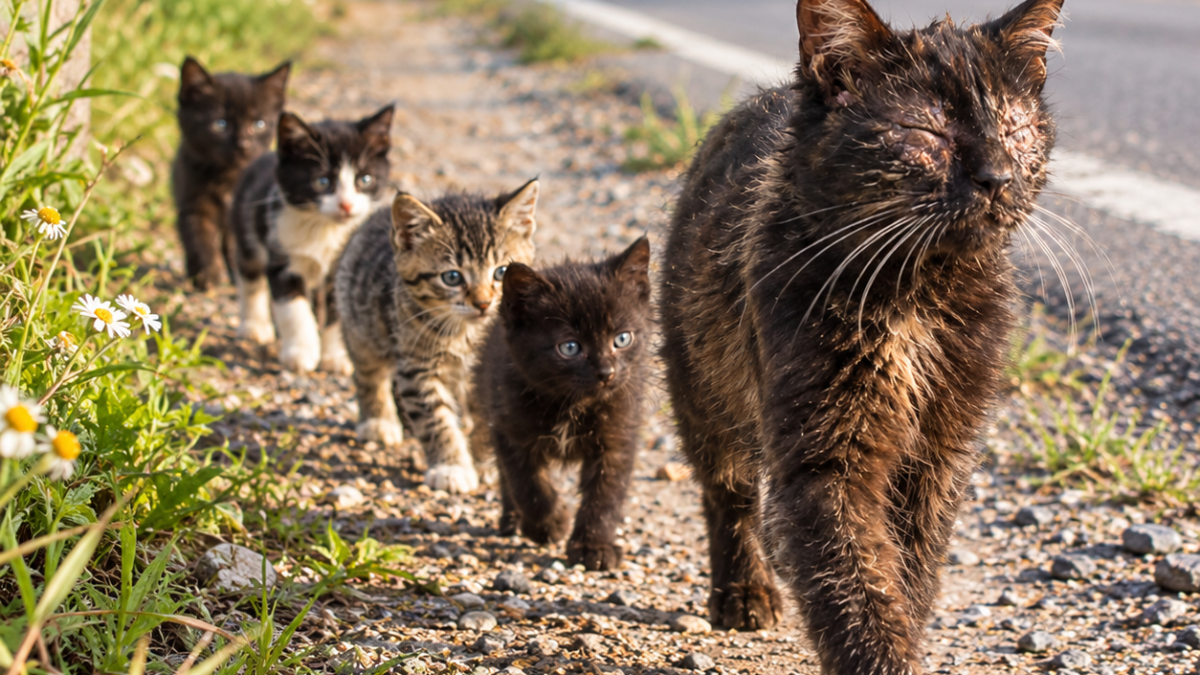
PART 2
She was not moving randomly.
That became obvious.
Every twenty or thirty yards, she stopped.
Her ears worked constantly.
I had never paid so much attention to a cat’s ears before.
Most of us notice eyes.
Expressions.
Tail.
Posture.
With her, the ears were everything.
They turned toward the sound of a distant tractor.
Flattened slightly when a truck approached.
Pointed backward when one of the kittens stepped on loose gravel.
Shifted toward the field when wind moved through dry grass.
Her whiskers worked too.
Longer than average.
The tips brushed weeds at the edge of the shoulder.
When the roadside narrowed, she slowed.
When gravel widened, she moved faster.
The kittens adjusted instantly.
The postal carrier stayed beside me.
“Do you think she knows this road?”
“Maybe.”
“But she can’t see it.”
“She doesn’t need to see it to know it.”
That sounded more confident than I felt.
The mother suddenly stopped.
All four kittens froze.
A pickup truck was approaching behind us.
I waved hard.
The driver saw us and slowed.
But before the truck was anywhere near the cats, the mother moved off the shoulder.
Into the grass.
Her kittens followed.
Then she crouched.
They crouched.
The truck passed.
Wind from it moved her fur.
She waited.
Listened.
Then stepped back onto gravel.
The kittens followed.
I felt something tighten in my throat.
“She’s done this before.”
The postal carrier looked at me.
“You think so?”
“She knows what vehicles sound like.”
“Maybe that’s how she got this far.”
That raised the obvious question.
How far was “this far”?
I kept watching the kittens.
Two black.
One gray tabby.
One black-and-white.
Five weeks old, approximately.
Maybe a little more.
Old enough to walk.
Not old enough to survive alone.
And they were silent.
That bothered me.
Kittens are not silent creatures.
They complain.
Call.
Cry.
Especially when hungry.
But these four made almost nothing.
The only sounds came from their paws.
One slipped on gravel and made a tiny squeak.
The mother immediately stopped.
Her head turned toward the sound.
Not her eyes.
Her entire head.
The kitten hurried forward and touched her hind leg.
Then she moved again.
I whispered, “They’ve learned.”
“What?”
“The kittens.”
“Learned what?”
I pointed.
“They know she can’t find them visually.”
The postal carrier stared.
One kitten drifted perhaps eighteen inches toward the ditch.
The mother stopped.
Made that same quiet chirp.
The kitten returned behind its sibling.
“She trained them.”
I didn’t know if “trained” was scientifically accurate.
But that’s what it looked like.
She had created a system.
Stay behind me.
Stay close.
Stay quiet.
If I stop, you stop.
If I call, come back into place.
Cats don’t organize military marches.
But necessity teaches strange things.
And this mother had four small lives depending on her ability to compensate for something most people would have considered devastating.
She could not see them.
So she had taught them to make vision unnecessary.
Eventually, I knew we had to intervene.
They were too close to traffic.
The mother was thin.
The kittens needed examination.
Whatever destination she believed was ahead might not be safe.
I placed the carrier in the grass well away from the road.
Then crouched.
“Hey, mama.”
Her ears locked onto me.
The kittens gathered behind her.
Every muscle in her body tightened.
I reached into my bag and opened a can of wet food.
The smell carried immediately.
The mother lifted her nose.
Her kittens started moving.
She gave one low warning sound.
They stopped.
“Smart girl.”
I put the food in a shallow bowl.
Then backed away.
She didn’t approach.
Not for almost five minutes.
But hunger eventually competed with fear.
She moved toward the scent.
Slowly.
One paw.
Pause.
Another.
I made no sound.
When her front paw touched the bowl, she recoiled.
Then sniffed.
She ate.
Fast.
Too fast.
The kittens broke formation immediately.
That was the first time I saw them behave like normal kittens.
They rushed the food.
Climbed over one another.
Tiny bodies pressed against their mother.
She didn’t push them away.
She ate around them.
I glanced at the postal carrier.
“She’s starving.”
The carrier looked close to tears.
“You can see her ribs.”
I could.
Under the black fur, every rib moved.
Her hips stood out sharply.
But the kittens didn’t look nearly as bad.
Thin, yes.
Not skeletal.
Their bellies had some roundness.
Their coats were relatively clean.
That told me something important.
She had been giving them what she had.
Milk first.
Calories second.
Her own body last.
Mothers do that until there is almost nothing left.
After they ate, I moved closer.
The mother heard me.
Her head turned.
I reached slowly toward her shoulder.
The instant my fingers touched fur, she flattened herself.
Not aggression.
Fear.
She did not swat.
Didn’t bite.
Didn’t run.
She simply became small.
I whispered, “I’m not going to hurt you.”
Of course she couldn’t understand the sentence.
But tone matters.
Touch matters.
I let my hand rest on her back.
Her breathing slowed.
The kittens crawled underneath her.
One pressed against my wrist.
That made the decision easier.
I slid a towel around the mother.
She stiffened.
Then allowed me to lift her.
She was lighter than I expected.
Far too light.
The kittens cried for the first time.
All four.
Their mother answered immediately.
I placed her in the carrier.
Then transferred each kitten beside her.
The moment the fourth entered, she began sniffing.
One.
Two.
Three.
Four.
She moved her nose from body to body.
Only then did she lie down.
The postal carrier whispered:
“She counted them.”
I looked at her.
“Maybe.”
But that was exactly what it seemed like.
Not with sight.
With scent.
Touch.
Sound.
Four kittens.
All present.
Only then could she rest.
At the clinic, the veterinarian asked the first question everybody asked.
“Both eyes?”
“Both.”
“How recent?”
“Doesn’t look recent.”
He examined her carefully.
The cat tolerated more than I expected.
Her face was a map of old damage.
Smooth scar tissue covered both sockets.
No eyelids functioning normally.
No exposed tissue.
No infection now.
Whatever had destroyed her eyes had already burned through its worst stage and healed.
The veterinarian ran his fingers gently around her face.
“She’s been blind a long time.”
“How long?”
“At least a year.”
“Could be longer?”
“Absolutely.”
He opened her mouth.
Checked teeth.
Ears.
Body condition.
“About four years old.”
“Weight?”
The technician read the scale.
“Five point two.”
The veterinarian frowned.
“She should be around eight.”
I looked at the kittens.
“What about them?”
“We’ll examine all four.”
While the technician began checking the kittens, I asked:
“What happened to her eyes?”
The veterinarian took another look.
“My best guess? Severe untreated infection.”
“What kind?”
“Possibly feline herpesvirus or another upper respiratory infection complicated by corneal ulcers.”
“That can destroy both eyes?”
“If it’s severe enough.”
He explained.
Ulcers.
Ruptures.
Secondary infection.
Scar tissue.
A long process.
Painful.
Terribly painful.
My stomach turned.
“Would she have lost them at the same time?”
“Maybe close together. Maybe one first.”
“Could anybody have saved them?”
“If she’d received treatment early enough? Possibly.”
There was the sentence I hated.
Possibly.
Somewhere in her past, Compass—as she would later be called—had likely been sick enough for someone to notice.
Eyes infected.
Pain.
Discharge.
Maybe swollen shut.
But nobody had treated her.
Maybe nobody owned her.
Maybe nobody found her.
Maybe she spent that entire illness hiding beneath some barn or porch.
We would never know.
“What I can tell you,” the veterinarian said, “is this isn’t recent trauma.”
“So she was already blind when she got pregnant.”
“Yes.”
“Blind when she delivered.”
“Yes.”
“Blind while she raised them.”
He looked toward the kittens.
“Yes.”
That silence after his answer felt heavy.
The kittens were approximately five weeks old.
Which meant for more than a month, a completely blind stray had found food.
Found water.
Produced milk.
Protected a nest.
Groomed four babies.
Kept all four alive.
I looked at her five-pound body.
“How?”
The veterinarian smiled faintly.
“Animals adapt.”
“That’s not enough.”
“No.”
He agreed.
“It isn’t.”
Her paw pads told another part of the story.
They were rough.
Thick.
Calloused.
The veterinarian touched one.
“She travels.”
“How can you tell?”
“Look at these.”
The pads were worn from different surfaces.
Gravel.
Concrete.
Hard ground.
Her whisker tips were also worn.
Not broken from disease.
Worn from contact.
Walls.
Edges.
Grass.
Objects.
She had turned her face into a measuring tool.
Her ears fascinated him most.
He gently examined them.
“No injury.”
“She uses them constantly.”
“I noticed.”
He smiled.
“She’s probably been doing that long enough that those muscles have had a lot more work than most cats.”
Her whole body had reorganized itself around the absence of sight.
Hearing.
Whiskers.
Paws.
Memory.
Air currents.
Scent.
All of it working together.
We call blindness a disability because something is missing.
Watching her, I began thinking about all the things that had grown stronger because of what was missing.
That didn’t make the loss beautiful.
I hate when people romanticize suffering.
She would have been safer with eyes.
Her life would have been easier.
She had endured pain she should never have endured.
But she had adapted anyway.
That mattered.
The kittens were better than we feared.
Thin.
Some fleas.
Common parasites.
Nothing severe.
No injuries.
Normal eyes.
Normal development.
The veterinarian examined the black-and-white kitten last.
“She’s done an incredible job.”
“Especially given her condition.”
“Especially given her weight.”
He looked at the mother again.
“She gave them everything.”
That afternoon, we moved the family into a foster room.
The first challenge was orientation.
Blind cats can adapt beautifully to stable homes.
But change the environment and everything becomes unknown.
Compass didn’t panic.
She mapped.
That is the only word.
I set her down near the wall.
She immediately extended one paw.
Touched the baseboard.
Moved along it.
Whiskers forward.
Ears moving.
She walked the perimeter.
Slowly.
Corner.
Food.
Wall.
Litter box.
Bed.
Door.
Back to starting point.
The kittens followed.
Not perfectly this time.
Inside a safe room, they relaxed.
They played.
Wrestled.
Chased each other.
Compass kept mapping.
When one kitten ran into her side, she stopped and sniffed it.
Then continued.
Within an hour, she could travel from bed to food without touching a wall.
Within three, she could find the litter box directly.
That was when I named her.
I stood in the doorway watching her cross the room in a straight line.
One of the volunteers asked:
“What are we calling her?”
I said:
“Compass.”
She laughed softly.
“Because she can’t see?”
“No.”
I watched Compass locate the water bowl from across the room.
“Because somehow she always knows where she’s going.”
The name stayed.
Over the next several days, we saw the system between Compass and the kittens more clearly.
Outside, the kittens had been disciplined because they had to be.
Inside, they were chaos.
Normal five-week-old chaos.
They climbed blankets.
Attacked tails.
Knocked over shallow dishes.
One black kitten discovered that my shoelace could be killed repeatedly.
But the moment Compass made that little chirp, everything changed.
Heads turned.
They located her.
Usually within seconds.
If she moved rooms, they followed.
If she settled, they gathered nearby.
She groomed each one by scent.
Sometimes she would sniff one kitten from nose to tail before licking it, almost confirming identity.
One afternoon I moved the gray tabby into a carrier for a checkup.
Compass became frantic.
Not wild.
Focused.
She walked the room repeatedly.
Sniffed bedding.
Called.
Her ears turned toward every sound.
I brought the kitten back.
The moment it meowed, Compass ran directly toward the carrier.
Straight line.
No wall.
No hesitation.
She pressed her face against the bars.
The kitten touched noses with her.
I never separated one without letting her know again.
The veterinarian visited a week later.
He watched the family for nearly an hour.
At one point Compass stood and walked toward the food.
The kittens lined behind her naturally.
He stared.
“Do they always do that?”
“Outside, constantly. Here, mostly when she’s moving with purpose.”
“That isn’t typical.”
“I know.”
He watched their spacing.
“They learned this.”
“That’s what I thought.”
He crouched.
Compass’s ears turned toward him.
He said:
“Think about what problem she had to solve.”
I waited.
“Normally a mother can look back.”
He pointed gently.
“She can’t.”
A kitten stepped toward her tail.
“So she needs them somewhere predictable.”
“Behind her.”
“Exactly.”
“Could she actually teach that?”
“Cats teach kittens plenty of behavior. Hunting. Boundaries. Responses to calls.”
He shrugged.
“This may simply be what worked.”
Then he said the sentence I never forgot.
“A blind cat taught her sighted kittens to become her eyes by making sure they were always where she expected them to be.”
I looked at Compass.
She had no idea anyone found her remarkable.
She was busy washing a kitten’s ear.
That became the heart of the story for me.
Not blindness.
Not rescue.
Adaptation.
She did not spend her life waiting for the world to become accessible.
She made a system.
Still, one question obsessed me.
Where had she been going?
The postal carrier had first seen her three miles from any obvious occupied property.
She was heading north.
The nearest residence was about three miles ahead.
But had she actually known it was there?
Or had she simply chosen a direction and kept moving?
I called the postal carrier.
“Do you know the road south of where you found them?”
“Pretty well.”
“Any barns?”
“Not close.”
“Bridges?”
“One farm access bridge.”
That caught my attention.
“How far?”
“Maybe three miles south.”
The next morning, I drove there.
I started from the original sighting point.
Then headed south.
I stopped often.
Looked in ditches.
Tree lines.
Drainage pipes.
Nothing.
About three miles down, I found the bridge.
Small.
Concrete culvert under a farm access road.
Water normally ran beneath it.
But one side had partially collapsed.
Brush concealed the opening.
I parked.
Walked down.
At first, I saw nothing.
Then my flashlight caught compressed grass beneath the damaged concrete.
I crouched.
Crawled farther.
There it was.
A nest.
Flattened grass.
Leaves.
Dark fur.
A few tiny hairs.
The faint smell of cat.
My chest tightened.
“They lived here.”
No one answered.
I was alone.
I touched the nest.
Dry in the center.
Damp around the edge.
One section of the culvert looked unstable.
Broken concrete.
Loose soil.
A line where water had recently reached higher than the nest.
I couldn’t know exactly what forced Compass to leave.
Maybe water.
Maybe the structure shifted.
Maybe a predator found them.
Maybe food disappeared.
Maybe she simply knew the kittens had reached the age when the shelter was no longer safe.
But she had left.
And the distance from that culvert to the place the postal carrier found her was almost exactly three miles.
I sat beneath that bridge for a long time.
Then imagined it.
A completely blind mother.
Four five-week-old kittens.
No carrier.
No human.
No map.
No idea where the next safe place might be.
Only one certainty.
This place is no longer safe.
So move.
How do you lead four babies through three miles of rural road when you cannot see traffic?
Listen.
How do you know where the road ends and grass begins?
Feel.
How do you know the kittens haven’t disappeared?
Teach them not to.
How do you know where you’re going?
Maybe you don’t.
Maybe you just know you cannot stay.
I started crying under that bridge.
Not loudly.
Just enough that I had to wipe my face before crawling back out.
When I returned to the rescue, Compass was asleep.
All four kittens pressed against her.
I sat beside the foster enclosure.
“You knew.”
Her ear moved.
“Didn’t you?”
No response.
“Something happened there.”
She stretched.
One kitten rolled off her side.
“You decided.”
Compass began grooming herself.
I laughed through what was left of my tears.
“Fine. Keep your secrets.”
We kept the culvert information quiet at first.
The property owner repaired the damage.
That mattered.
I didn’t want another animal trapped beneath unstable concrete.
But when people asked whether Compass had really walked three miles, I could finally answer:
At least.
Maybe more.
We knew where she had begun.
We knew where she had been found.
We knew the road between.
And she had crossed it with four kittens.
All alive.
That is when Compass became locally famous.
Not national-news famous.
Nothing dramatic.
But people shared her rescue post.
The photograph showed her sitting upright with all four kittens around her.
You could see the healed sockets.
Some commenters reacted exactly as I expected.
“Heartbreaking.”
“Poor baby.”
“How sad.”
Others asked:
“Why wasn’t she euthanized?”
That question hurt more than I expected.
Not because euthanasia is always wrong.
In rescue, there are cases where suffering cannot be repaired.
But Compass wasn’t suffering because she was blind.
She was eating.
Moving.
Parenting.
Using the litter box.
Playing gently.
Purring.
Navigating.
Her problem had not been blindness.
Her problem had been homelessness.
One commenter wrote:
“What’s the quality of life for a cat with no eyes?”
I almost replied angrily.
Instead, I walked into the foster room.
Compass was lying on a blanket.
One kitten was attacking her tail.
Another had climbed onto her back.
Compass swatted gently in the wrong direction.
Missed completely.
The kitten pounced again.
Compass chirped.
The kitten froze.
Then crawled beneath her chin.
She started purring.
I took a short video.
That became my answer.
Not words.
Life.
A few weeks later, all four kittens were healthy enough for adoption applications.
That created a new fear.
Compass had spent weeks keeping them alive.
Now we were going to separate them.
I hated that part.
Rescue often asks us to do things that feel emotionally wrong but are practically right.
The kittens needed individual homes.
Compass needed stability.
They were growing independent.
Still, when the first kitten left, I cried.
Compass searched after the carrier disappeared.
She walked the room.
Called twice.
My stomach twisted.
Then she found the remaining three.
Sniffed them.
Settled.
The next adoption was similar.
Then two.
Then one.
The final kitten was the black-and-white female.
She stayed an extra week.
Compass groomed her constantly.
Maybe I imagined significance because I knew what was coming.
Humans do that.
We create emotional symbolism around moments animals may experience more simply.
But the final evening, Compass slept with one paw over the kitten.
In the morning, the adopter arrived.
A quiet family.
Older children.
Indoor-only home.
Good veterinary history.
Everything we wanted.
I carried the kitten toward the carrier.
Compass followed the sound.
I knelt.
Let her sniff the kitten.
She licked its forehead.
Once.
Then turned away.
I nearly lost it.
The kitten went home.
Compass returned to the foster room alone.
For the first time since we had met her, there were no little feet following.
She walked to the center of the room.
Stopped.
Ears moving.
Then sat.
The room sounded wrong to me.
Too quiet.
I sat beside her.
“You did it.”
Compass turned her head toward my voice.
“Four.”
I touched her shoulder.
“Every one.”
She leaned slightly into my hand.
“All safe.”
That was when I thought the hardest part was over.
It wasn’t.
Finding homes for healthy kittens is relatively easy.
Finding a home for an adult black cat is harder.
Finding one with no eyes?
Much harder.
People loved Compass’s story.
Love from a distance is cheap.
Adoption asks more.
Applications came for the kittens.
For Compass, almost none.
A couple visited once.
The woman cried when she saw her.
Then whispered to her husband:
“I don’t think I could handle looking at that every day.”
I pretended not to hear.
Another applicant asked:
“Will she ever grow eyes back?”
I thought she’d misunderstood the condition.
She hadn’t.
Someone else wanted to know if Compass could live outside.
Absolutely not.
One man said:
“I’d be scared she’d run into things all night.”
I explained blind cats map stable environments beautifully.
He never called back.
Weeks passed.
Compass improved physically.
Six pounds.
Then six and a half.
Her coat became glossy.
She learned the foster house perfectly.
She could cross from the bedroom to the kitchen without touching a wall.
She knew which cupboard held food from the sound of the hinge.
She learned the refrigerator motor.
The front door.
The washing machine.
My footsteps.
One afternoon I moved a chair six inches.
Compass bumped it with her whiskers.
Stopped.
Mapped the new position.
Walked around it.
Never hit it again.
I thought about the people saying:
“What quality of life?”
Better spatial memory than half the people I knew.
One volunteer joked:
“She makes me feel stupid.”
“Why?”
“I tripped over the same laundry basket twice today.”
Compass crossed the room smoothly.
I laughed.
“Don’t tell her.”
Then came the first real conflict over her future.
Our foster space was limited.
Kitten season was approaching.
New litters would arrive.
An adoption coordinator—not cruel, just practical—asked me:
“What if she stays six months?”
“Then she stays six months.”
“What if it’s a year?”
“Then a year.”
“We can’t keep every hard-to-place animal indefinitely.”
“I know.”
“We have to think about capacity.”
“I know.”
She softened.
“I’m not saying anything bad should happen.”
“I know.”
“But maybe a sanctuary.”
I looked at Compass sleeping in sunlight.
“A sanctuary isn’t a failure.”
“No.”
“But she doesn’t need sanctuary care.”
“Maybe people won’t see that.”
“Then we make them see.”
The coordinator sighed.
“You can’t force someone to adopt a blind cat.”
“No.”
I stared at Compass.
“But I can force them to stop defining her by it.”
That became my mission.
Not marketing pity.
I refused.
No sad music.
No “poor blind mama.”
No posts designed to make people feel guilty.
I wrote about what she could do.
Compass knows the foster house better than I do.
Compass raised four kittens outdoors while blind.
Compass uses sound to know when I open cheese.
Compass will find the warmest patch of sunlight in any room despite having no idea what sunlight looks like.
Compass stole chicken from my plate yesterday and escaped in a straight line.
That one got attention.
People laughed.
Good.
I wanted them to laugh.
Because pity creates distance.
Personality creates connection.
Then, one afternoon, the rescue received a phone call.
The woman on the other end was in her seventies.
Lived in the same county.
Alone.
She had lost most of her vision to macular degeneration three years earlier.
She had heard about Compass from a neighbor.
The adoption coordinator transferred the call to me.
“Are you the one caring for the blind cat?”
“Yes.”
A pause.
“Is she truly completely blind?”
“Completely.”
“And she gets around?”
“Better than you’d expect.”
The woman laughed softly.
“People say that about me too.”
I smiled.
We talked for twenty minutes.
She asked intelligent questions.
Not:
Isn’t it sad?
Not:
Will she bump into everything?
She asked:
“Does she prefer rugs or smooth floors?”
“Both. But texture helps her map.”
“Does she respond to voices?”
“Very much.”
“Does she startle if touched unexpectedly?”
“Yes. I speak before touching her.”
“Good.”
“Do you have other pets?”
“No.”
“Stairs?”
“One level.”
“Furniture changes often?”
“I hate moving furniture.”
That made me laugh.
Then she became quiet.
“I should tell you something.”
“Okay.”
“I can’t see much anymore.”
“I understand.”
“Not completely blind.”
“Okay.”
“But close enough that people sometimes think I shouldn’t live alone.”
Her voice sharpened slightly.
“I disagree.”
“I imagine you do.”
She laughed again.
“Someone told me your cat led four kittens three miles.”
“At least three.”
“Without eyes.”
“Yes.”
Long pause.
Then:
“Bring her to me.”
My throat tightened.
“Would you like to meet her first?”
Another pause.
Then she said the sentence that would stay with me for the rest of my life.
“Bring her to me. I think we’ll understand each other.”
I had to turn away from the others in the office.
“Yes, ma’am.”
“You’re crying, aren’t you?”
“No.”
“You are.”
“Maybe.”
“Don’t make me sound heroic.”
I laughed.
“I won’t.”
“I’m not adopting her because we’re both blind.”
“I know.”
“I’m adopting her because I understand what people sound like when they’ve already decided what you can’t do.”
That silenced me.
“Bring her tomorrow.”
The home visit happened the next afternoon.
I carried Compass inside.
The house was small.
Neat.
One level.
Furniture arranged with wide, clear paths.
Small textured rugs marked transitions between rooms.
There were tactile stickers on the microwave.
A talking clock.
A cane beside the door.
Nothing about the house felt tragic.
It felt organized.
Adapted.
Lived in.
The woman stood in the living room.
“Where is she?”
“In the carrier.”
“Put it on the floor and open it.”
I did.
Compass stayed inside.
The woman sat in a chair.
She didn’t call.
Didn’t reach.
Didn’t coax.
She simply waited.
Five minutes.
Then Compass’s nose appeared.
One paw.
Pause.
Ears turning.
Another paw.
She stepped out.
Mapped the carrier.
Floor.
Rug.
Air.
The woman smiled.
“I can hear her feet.”
Compass moved toward the wall.
Then around the room.
The woman listened.
“She’s fast.”
“That’s her careful speed.”
“You should see her when dinner opens.”
The woman laughed.
Compass approached the chair.
Stopped.
Her ears turned toward the woman’s breathing.
The woman lowered one hand.
Not touching.
Just there.
Compass sniffed.
Then moved away.
“Good,” the woman said.
“Good?”
“She didn’t have to like me immediately.”
I liked that answer.
Compass circled the room again.
This time she came closer.
The woman’s hand remained still.
Compass’s whiskers touched her fingers.
She froze.
Sniffed.
Then rubbed her cheek once against the woman’s knuckles.
The woman went completely still.
I saw tears form.
She couldn’t see Compass clearly enough to watch what was happening.
But she felt it.
“Was that her?”
“Yes.”
“She touched me?”
“Yes.”
The woman smiled.
“Well.”
Her voice shook.
“That’s settled.”
I swallowed.
“Looks like it.”
Compass walked under the chair and sat beside the woman’s feet.
No dramatic cuddle.
No instant magical bond.
Just proximity.
Enough.
The adoption became official that week.
I expected handing Compass over to be easy because the match felt perfect.
It wasn’t.
I had spent weeks watching her recover.
I had followed the road backward.
Crawled beneath the bridge.
Held each kitten.
Taught volunteers how to announce themselves before touching her.
Somewhere along the way, Compass had become mine in the dangerous temporary way foster animals do.
The woman must have heard something in my voice.
“You’re worried.”
“Yes.”
“About me?”
“About both of you.”
“Good.”
I laughed.
“Good?”
“Worry means you’ll answer the phone when I call.”
“I will.”
“You’d better.”
I set Compass’s carrier down.
The woman sat nearby.
“Tell me where everything is.”
We went through the house.
Food.
Water.
Litter.
Bed.
No sudden furniture changes.
Speak before touching.
Keep pathways predictable.
Use textured mats near important locations.
Keep doors either fully open or fully closed so Compass wouldn’t encounter half-open edges unexpectedly.
The woman listened.
Then said:
“You’re describing how I live already.”
Exactly.
Before I left, I knelt beside Compass.
She sniffed my hand.
“Don’t make me regret this.”
She rubbed against my wrist.
The woman said:
“She isn’t going to regret anything.”
“I was talking to you.”
She laughed.
“Get out of my house.”
So I did.
Then cried in my car for ten minutes.
The first update came that evening.
The phone rang.
I answered immediately.
“Everything okay?”
“She’s in the kitchen.”
“Good.”
“She found it herself.”
“Good.”
“She knows when I’m opening tuna.”
“That’s normal.”
“She yelled at me.”
“Also normal.”
The woman paused.
“You made her sound dignified.”
“I lied.”
“Apparently.”
The next morning:
“She slept under my bed.”
“That’s fine.”
“I know.”
Third day:
“She followed me to the bathroom.”
“She’s mapping you now.”
“That sounds threatening.”
“Probably.”
First week:
“She knows my chair.”
“Which one?”
“The one beside the bed.”
“How?”
“She jumps into it every evening.”
I smiled.
Compass had chosen a place.
That mattered.
A month later, I visited.
I knocked.
The woman called:
“Come in. Door’s unlocked.”
I entered.
Compass was nowhere visible.
“Where is she?”
“Hallway.”
I looked.
Sure enough, Compass appeared.
Straight line.
Ears turning.
She heard my voice.
Stopped.
Then walked toward me.
I crouched.
“Hey, Compass.”
She sniffed my fingers.
Then rubbed against my hand.
The woman called from the kitchen:
“Don’t get excited. She does that to the mail carrier too.”
I laughed.
“You two getting along?”
“We haven’t crashed into each other once.”
“You sound proud.”
“I am.”
She came into the room using one hand lightly against the wall.
Compass moved around her feet smoothly.
The woman said:
“People keep telling me this is sad.”
“What is?”
“Two blind creatures living in one house.”
I leaned against the doorway.
“What do you tell them?”
She smiled.
“That I don’t see it.”
I laughed.
“That was terrible.”
“I’ve earned blind jokes.”
“Fair.”
Then she became serious.
“They think we spend all day bumping into furniture.”
Compass crossed the hallway.
Perfectly.
The woman pointed vaguely toward the sound.
“She doesn’t.”
“No.”
“I don’t either.”
“Most of the time.”
“Watch yourself.”
I smiled.
She continued.
“We use the same things.”
“Like what?”
“Sound.”
She tapped her cane lightly.
“Memory.”
She touched the counter.
“Texture.”
Compass’s whiskers brushed the cabinet.
“And routine.”
I watched them.
The woman said:
“She knows exactly where I am in the morning because my slippers sound different from my shoes.”
“Really?”
“She knows when I enter the kitchen.”
“Food.”
“Yes, obviously.”
“She’s using you.”
“So are you.”
Fair.
Then she said something I never forgot.
“This cat spent years learning how to move through a world she couldn’t see.”
Her face softened.
“Now she lives with someone who already understands what that feels like.”
Compass jumped onto her chair.
The woman reached out.
Her hand landed a few inches away.
Compass moved toward it.
Placed her head under her palm.
No hesitation.
I had to look away.
Not because it was tragic.
Because it wasn’t.
That was the part everyone kept getting wrong.
Blindness had shaped both their lives.
It had created limitations.
Challenges.
Fear.
Loss.
But the house wasn’t sad.
There was laughter.
Routine.
Tuna.
Arguments about where Compass should sleep.
A radio playing in the kitchen.
Sunlight neither of them needed to see in order to feel.
People kept wanting the story to be about two damaged creatures finding each other.
That wasn’t it.
They weren’t damaged.
They were adapted.
That distinction mattered.
The closest thing Compass ever got to revenge happened several months later.
The adoption coordinator who had once worried Compass might spend a year in foster care came with me for a visit.
She had never been cruel.
I want to make that clear.
She had been practical.
Capacity matters.
Hard decisions are real.
Still, she had doubted.
When we entered, Compass came down the hallway.
Straight.
Confident.
She stopped beside the woman.
The woman placed a hand on Compass’s back.
“Who’s with you?”
I introduced them.
The coordinator crouched.
Compass approached.
Sniffed.
Moved away.
The woman laughed.
“Rejected.”
“Apparently.”
We sat.
The coordinator listened as the woman described Compass’s routines.
“She knows the garden path.”
I looked up.
“Garden?”
“Fenced.”
“Supervised?”
“Yes, mother.”
The coordinator laughed.
The woman continued.
“I put textured stones along one side. She follows those with her paws.”
“She goes outside?”
“Every morning when weather allows.”
Compass was asleep by then.
Completely relaxed.
The coordinator stared at her.
Then said:
“I was wrong.”
I looked at her.
“About what?”
“I thought her blindness would define every adoption decision.”
The woman smiled.
“It probably did.”
The coordinator looked confused.
“Just not in the way you meant.”
The woman stroked Compass.
“It brought her here.”
That was enough.
No humiliation.
No punishment.
No grand speech.
Just the simple fact that the cat some people quietly feared would become an unplaceable burden was living better than half the animals we knew.
The world had looked at her missing eyes and seen what she lacked.
Compass answered with four surviving kittens and a permanent home.
That was her revenge.
She didn’t need anyone to apologize.
She simply outlived their assumptions.
The postal carrier visited too.
I arranged it.
She had been the first person to stop.
That mattered.
The woman told her:
“If you hadn’t pulled over…”
The carrier shook her head.
“Somebody else would have.”
I disagreed.
“Maybe.”
She looked at me.
“You don’t know.”
“Exactly.”
That’s the frightening part.
The road was rural.
Traffic sparse.
Compass’s black coat blended into winter grass.
The kittens were tiny.
One vehicle moving too fast could have ended everything.
The postal carrier had seen something strange and slowed down.
That’s all.
Sometimes rescue begins with expertise.
Sometimes with equipment.
Sometimes with money.
That day, it began with noticing.
The carrier listened as I described the culvert.
“Three miles south?”
“Almost exactly.”
She covered her mouth.
“So they’d already walked three miles when I saw them?”
“Looks that way.”
She stared at Compass.
“How?”
The elderly woman answered before I could.
“Same way people do most impossible things.”
We both looked at her.
“What’s that?”
She shrugged.
“One step at a time because standing still isn’t an option.”
Nobody spoke for a moment.
Compass started purring.
The carrier laughed softly.
“She doesn’t care about any of this.”
“No.”
I smiled.
“She probably wants dinner.”
That was another lesson Compass taught me.
We humans build stories around survival.
Animals move through it.
We call them heroes.
They look for food.
We say they’re courageous.
They search for shelter.
We say they conquered disability.
They simply learn their environment.
There is something beautiful in refusing to overcomplicate that.
Compass wasn’t walking three miles to inspire anyone.
She was moving her kittens.
The culvert wasn’t safe.
So she left.
That simplicity made it more powerful, not less.
She had no concept of being heroic.
She had four babies.
They needed somewhere to go.
Go.
That’s all.
Months after the adoption, each kitten’s family sent updates.
The first black kitten grew into a large cat who slept in a child’s bed.
The second became obsessed with running water.
The tabby learned to open cabinet doors.
The black-and-white female apparently stole socks.
I laughed at that one.
Maybe bad habits are hereditary.
All four had normal vision.
All four were healthy.
Sometimes I wondered what would happen if Compass saw them again.
Would she know them?
By scent, perhaps.
Voice.
Maybe.
But I never arranged a reunion.
Not because it would be harmful.
Because the human desire for symbolic reunions isn’t always the animal’s need.
Her kittens were safe.
Compass was safe.
That was enough.
Still, I kept one photograph.
The original roadside image the postal carrier had taken from a distance.
Compass in front.
Four kittens behind.
Single file.
People who saw the picture usually asked:
“Did she really walk like that?”
Yes.
“All four?”
Yes.
“Three miles?”
At least.
“Completely blind?”
Completely.
Then they would stare at the image as if one missing detail might make it easier to understand.
There wasn’t one.
The extraordinary part was exactly what it looked like.
A mother who could not see.
Leading children who could.
Eventually, the story reached a local school.
A teacher asked if I would speak to a class about animal rescue.
I agreed reluctantly.
Children ask better questions than adults.
One boy asked:
“How did she know where north was?”
“I don’t know.”
Another:
“Did the kittens know she was blind?”
That was harder.
“Not the way you understand blindness.”
“But they knew she couldn’t see them?”
“Maybe they learned what behaviors helped her.”
A girl in the front raised her hand.
“Was she scared?”
I looked at the photograph.
“Probably.”
“Then why didn’t she stop?”
That question stayed with me.
I could have said instinct.
Maternal drive.
Survival.
Instead:
“Because stopping wouldn’t make her safer.”
The girl nodded like that was obvious.
Children understand certain truths faster.
Another student asked:
“Is she still blind?”
“Yes.”
His face fell.
I knew what he expected.
A miracle surgery.
Eyes restored.
Happy ending.
“No operation can bring her eyes back.”
“That’s sad.”
“Partly.”
I showed a second picture.
Compass asleep in the woman’s chair.
Belly exposed.
One paw hanging off the cushion.
“Does she look sad?”
The class laughed.
“No.”
“That’s important.”
I explained that rescue isn’t always restoring an animal to what it was before.
Sometimes there is no before to return to.
Sometimes success means building a life around what cannot be changed.
Compass would never see.
The goal wasn’t to make blindness disappear.
The goal was to make blindness irrelevant to whether she was safe and loved.
That idea mattered beyond cats.
I didn’t say that.
The children understood anyway.
During the summer, I visited Compass again.
The garden had changed.
The woman had built, with help from a neighbor, a narrow enclosed path from the back door to a small fenced sitting area.
Different textures marked the route.
Smooth pavers.
Then rough stone.
Then grass.
Compass loved it.
I watched her step outside.
Pause.
Nose lifted.
Ears turning.
Birds.
Wind.
Leaves.
She moved along the stone border.
Straight.
Then onto grass.
The woman sat nearby.
“She knows every inch now.”
Compass walked to a sunny patch.
Lay down.
“How does she know where the sun is?” I asked.
The woman laughed.
“You’re supposed to be the expert.”
“Heat.”
“Obviously.”
Compass rolled onto her side.
The woman tilted her face toward the same sun.
For one strange second, the scene felt almost too perfect.
Two beings who couldn’t see the light.
Both knowing exactly where it was.
I said:
“People are going to turn this into some inspirational metaphor.”
The woman groaned.
“Don’t you dare.”
“I won’t.”
“Good.”
She pointed toward Compass.
“She’s a cat.”
“Agreed.”
“And I’m an old woman.”
“Very old.”
“Watch it.”
We laughed.
Then she said:
“People need us to mean something.”
“What?”
“Blind person. Blind cat. They want a lesson.”
I thought about that.
“Maybe there is one.”
“Of course there is.”
She smiled.
“Just don’t make it stupid.”
Fair.
So if there is a lesson, it isn’t:
You can do anything if you try hard enough.
That’s not true.
There are things Compass cannot do.
She cannot see danger from a distance.
She cannot live safely outdoors unsupervised.
She cannot watch birds.
She cannot see the woman who adopted her.
And the woman cannot drive.
Cannot read ordinary print.
Cannot see Compass’s face clearly.
Limitations are real.
Pretending otherwise disrespects the work required to adapt.
The lesson is simpler.
Not seeing the whole road does not mean there is no next step.
Compass didn’t need the entire three miles visible.
She needed the gravel beneath one paw.
Then the next.
Then the next.
Her kittens needed only to stay close.
The woman needed only to learn her house.
Then another route.
Then another.
Adaptation is rarely grand.
It is repetitive.
Practical.
Often boring.
Until someone looks backward and calls the distance impossible.
A year after Compass’s rescue, I drove the same road again.
Not for any official reason.
I just wanted to.
I began at the culvert.
It had been repaired.
Concrete stable.
Water channel cleared.
The old nest was gone.
Grass had grown.
I stood there remembering the flashlight.
The fur.
The damp line.
Then I drove north.
Slowly.
Three miles.
I watched the shoulder.
The ditch.
The places gravel narrowed.
A blind cat had walked all of that.
Maybe she followed the road because the surface was easier.
Maybe sound from distant farms pulled her north.
Maybe wind carried food smells.
Maybe she simply followed the edge.
At the original sighting point, I stopped.
Cars passed occasionally.
Fast.
Too fast.
I imagined four kittens there.
My palms went cold.
Then I continued north toward the closest occupied property.
Maybe Compass had heard dogs.
Machinery.
Voices.
Maybe she was aiming for human sound.
Or maybe not.
We will never know.
Some questions should remain unanswered rather than filled with comforting fiction.
What we know is enough.
She left an unsafe shelter.
She kept four kittens together.
She traveled at least three miles.
She survived.
They survived.
Someone noticed.
That chain is extraordinary without adding anything.
Later that day, I visited her.
The woman was listening to an audiobook.
Compass slept beside her.
“Where were you?” she asked.
“The road.”
“Why?”
“I wanted to see it again.”
“Did it change?”
“No.”
She smiled.
“Then you did.”
That annoyed me because she was right.
I sat.
Compass lifted her head.
The woman asked:
“Still trying to understand how she did it?”
“Yes.”
“Stop.”
“Helpful.”
“I’m serious.”
She reached toward Compass.
Her hand missed by a few inches.
Compass moved into it.
“People always want to know exactly how someone survives something.”
She scratched Compass under the chin.
“Sometimes the answer is just that they kept doing what worked.”
“The road didn’t look like it should have worked.”
“It did.”
“For three miles.”
“Apparently.”
I laughed.
“You make everything sound simple.”
“It usually is.”
“Coming from the woman with tactile labels on every appliance.”
“Exactly.”
She pointed toward her microwave.
“I didn’t defeat blindness. I put a bump sticker on the number two.”
I laughed harder than I expected.
Compass’s ear twitched.
The woman continued.
“People don’t need inspiration. They need methods.”
That might have been the best description of Compass too.
Her kittens weren’t kept alive by magic maternal love alone.
Love needed a method.
Stay behind.
Stay close.
Listen for my call.
Don’t wander.
Follow my pace.
Compass didn’t see the road.
She created a method for crossing it.
There is something much more respectful in that than calling her miraculous.
Miracles make survival sound accidental.
Compass worked.
Every day.
Every feeding.
Every step.
Every kitten.
The following winter, the woman fell in her kitchen.
Not severely.
A bruised hip.
Nothing broken.
But it created the only real scare after Compass’s adoption.
She was alone.
Her phone was on the counter.
Too far away.
Compass reacted to the fall.
The woman later told me the cat began pacing.
Vocalizing.
Not normal behavior.
A neighbor happened to be outside and heard repeated meowing through the screen door.
She checked.
Found the woman.
Called her daughter.
I was careful not to turn Compass into a medical-alert animal.
She wasn’t trained.
Maybe she was distressed by the unusual noise.
Maybe coincidence.
But when I visited afterward, the woman smiled.
“Looks like she led another blind creature to safety.”
“Don’t start.”
“I’m allowed.”
“You’ll become unbearable.”
“Too late.”
Compass sat beside her walker.
The woman said:
“She stayed beside me the whole time.”
“That I believe.”
We added a wearable emergency alert button after that.
Practical methods.
Always methods.
Compass’s life remained ordinary.
And I mean that as the highest compliment.
Veterinary checkups.
Meals.
Sunlight.
Naps.
Occasional hairballs.
She became slightly overweight.
The veterinarian actually told us to reduce calories.
I nearly hugged him.
From 5.2 pounds and skeletal to:
“She’s getting chunky.”
That is rescue success.
The woman protested.
“She’s not fat.”
“Seven point nine.”
“Exactly healthy.”
“Eight is the maximum target.”
“You’re body-shaming my cat.”
The veterinarian looked at me for help.
I stepped away.
“Not getting involved.”
Compass sat on the table, completely indifferent.
The woman whispered:
“Traitor.”
On the drive home, she told me:
“We’re ignoring him.”
“No.”
“Half a tablespoon less food won’t matter.”
“That’s exactly how obesity starts.”
“You sound like him.”
“Because he’s right.”
Compass meowed from the carrier.
The woman pointed.
“She agrees with me.”
“She’s asking to get out.”
“Same thing.”
Their relationship made me happy in ways I didn’t expect.
There was no savior.
That mattered.
The woman didn’t rescue Compass because she was helpless.
Compass didn’t “heal” the woman’s blindness.
Neither completed the other.
They simply fit.
They understood certain routines instinctively.
The woman always spoke before touching.
Never rearranged furniture casually.
Used sound deliberately.
Kept floors clear.
Compass responded.
Two adapted lives overlapping.
No pity required.
The emotional revenge in Compass’s story came quietly.
Every person who had looked at her photograph and asked what kind of life a blind cat could possibly have got their answer.
A full one.
Every person who thought all she represented was tragedy was wrong.
Every person who assumed sight was necessary to guide others had to confront four healthy kittens.
Every person who thought disability automatically meant dependence missed something important.
Compass had been the dependent one in some ways.
She was also the protector.
Guide.
Teacher.
Mother.
Both truths existed at once.
That complexity was her victory.
She did not defeat blindness.
She defeated the idea that blindness was the only interesting thing about her.
Years from now, if someone asks me what I remember first about Compass, I know the answer.
Not her face.
Not the healed sockets.
Not the veterinarian’s explanation.
The line.
Four kittens.
Black.
Black.
Gray.
Black and white.
One behind another.
Following her.
That image reorganized something in me.
We assume leaders see farther.
Know more.
Have a clear view of the destination.
Compass saw nothing.
Not the ditch.
Not the traffic.
Not the kittens.
Not the farm ahead.
Yet she was still the one in front.
Maybe leadership isn’t always seeing farther.
Sometimes it is simply being willing to take the next step first.
And responsibility isn’t always knowing exactly where you’re going.
Sometimes it is refusing to move so fast that those behind you cannot follow.
Compass never left one.
That fact matters more than the distance.
Three miles is impressive.
Four kittens alive is the achievement.
She could have moved faster alone.
She could have abandoned the weakest.
She could have hidden after the first half mile.
Instead:
Stop.
Listen.
Count by sound.
Move.
Wait.
Move.
Wait.
All four.
Again.
Again.
Again.
Until a postal carrier saw them.
One afternoon, years after that first call, I visited Compass and found her asleep in the woman’s lap.
That was unusual.
Compass liked sitting beside people more than on them.
The woman whispered:
“Don’t ruin this.”
“I wasn’t going to.”
“You’re breathing loudly.”
“Sorry.”
I sat.
Compass didn’t move.
Her face had grayed slightly around the muzzle.
The scar tissue where her eyes had once been looked exactly the same.
People sometimes asked whether looking at her face still made me sad.
No.
Not anymore.
At first, yes.
I imagined the infection.
The pain.
The untreated days.
All the things that should have been different.
But eventually her face became simply her face.
Familiar.
Beautiful in the ordinary way a loved animal becomes beautiful.
The woman ran her fingers along Compass’s head.
“Do you remember what you said when you first brought her?”
“What?”
“You told me not to move the furniture.”
“Still true.”
“You sounded terrified.”
“I was.”
“Thought I’d break her?”
“No.”
“Thought she’d break me?”
“Maybe.”
She laughed quietly.
“I think you thought two blind creatures under one roof was an accident waiting to happen.”
“I did not.”
“You did.”
“Fine. A little.”
She smiled.
“We haven’t bumped into each other once.”
“You’ve told me.”
“People with eyes do it constantly.”
“Also told me.”
“It’s worth repeating.”
Compass purred.
I listened.
The woman said:
“She knows I’m getting older.”
“How?”
“She waits for me now.”
That caught me.
“What do you mean?”
“When I walk down the hallway.”
She paused.
“She used to go ahead.”
My throat tightened.
“Now?”
“She walks beside me.”
I looked at Compass.
Maybe coincidence.
Maybe the woman moved slower and Compass adjusted.
Maybe cats understand aging through gait, sound, routine, scent.
Probably.
Whatever the mechanism, the result was simple.
Once, Compass had led four kittens because they needed her pace.
Now she matched an old woman’s pace.
Still moving.
Still adapting.
Still refusing to leave someone behind.
I said:
“Sounds like her.”
The woman stroked Compass.
“Yes.”
Then she added:
“That’s why I don’t worry about where we’re going.”
I looked at her.
She smiled.
“One of us will find the kitchen.”
I laughed until Compass woke up irritated.
There is one part of Compass’s story I rarely tell because people always try to turn it into something sentimental.
After the kittens were adopted, I kept one of their first foster blankets.
It smelled like the family.
I washed everything else.
That one stayed in a sealed bag for months.
When Compass was adopted, I offered it to the woman.
She took it.
Later, she placed it in Compass’s bed.
For the first week, Compass slept on it every night.
Then gradually stopped.
Eventually she chose the woman’s chair instead.
The blanket remained.
Unused.
The woman asked me:
“Should I throw it away?”
I thought about all four kittens.
The roadside.
The culvert.
“Whatever Compass wants.”
She laughed.
“She’s a cat. She doesn’t fill out surveys.”
Fair.
The blanket eventually became just a blanket.
That felt right.
Memories don’t have to remain sacred forever.
Some things are allowed to become ordinary.
Compass never saw the faces of her kittens.
That sentence used to destroy me.
Then I realized I was imposing human grief on something that might not need it.
She knew them.
Sight is not the only form of knowing.
She knew their smell.
Their cries.
Their weight against her body.
Their paws.
The rhythm of their movement behind her.
She knew which one wandered.
Which cried differently.
Which climbed over her.
Which needed grooming.
She didn’t need their faces.
We do.
She didn’t.
Likewise, she never saw the woman who adopted her.
But she knew her.
Slippers in the morning.
Cane tapping the floor.
Voice near the kitchen.
Hand lowering beside the chair.
Breathing at night.
The smell of soap and coffee.
Love does not require an image.
That was perhaps the most obvious thing Compass ever demonstrated.
And the most difficult for sighted people to understand.
We trust what we can see.
Compass had built an entire life from everything else.
Sound.
Touch.
Smell.
Memory.
Routine.
Trust.
That last one took time.
But eventually, it became her strongest sense.
When she crossed the road shoulder with four kittens, she trusted them to stay behind.
When she entered foster care, she trusted the voices that brought food.
When she entered her permanent home, she trusted a woman she could never see.
And when that woman walked slowly down the hallway, she trusted the path would still be where memory said it was.
I used to think Compass’s story was about courage.
Then motherhood.
Then disability.
Now I think it is about trust.
Not blind trust.
People misuse that phrase.
Compass’s trust was anything but blind in the figurative sense.
It was informed by sound.
Experience.
Consistency.
She could not see.
But she paid attention to everything.
That is different.
The postal carrier once asked me:
“Do you think she knew she was saving them?”
I said:
“No.”
Then reconsidered.
“I think she knew she was responsible for them.”
Maybe that is enough.
Heroism is a word humans invented after the fact.
Responsibility happens before anyone is watching.
Compass walked that road before the photograph.
Before the rescue page.
Before adoption applications.
Before anyone called her extraordinary.
She did it because four small bodies followed.
That is the cleanest version of her story.
And it is the one I trust most.
Several years after the rescue, the county resurfaced part of that road.
For a few weeks, construction crews tore up the shoulder.
The exact gravel Compass had followed disappeared.
New drainage.
New markers.
Fresh asphalt.
When I drove by, I felt an unexpected sadness.
Evidence erased.
Then I laughed at myself.
Compass didn’t care about the road.
Why should I?
The story wasn’t stored in gravel.
It was stored in outcomes.
Four adult cats in four homes.
One blind mother in a fifth.
One woman who no longer lived alone.
One postal carrier who now stopped whenever she saw an animal near traffic.
One rescue volunteer—me—who stopped using the word “hopeless” so casually.
Those were the marks Compass left.
Better than footprints.
The woman once asked whether I’d adopt Compass if she died first.
The question came suddenly.
We were drinking coffee.
Compass was asleep.
I nearly choked.
“You’re not allowed to die.”
“I’m seventy-eight.”
“Still.”
“Answer.”
“Yes.”
“Immediately?”
“Immediately.”
“No shelter?”
“Never.”
She nodded.
“Good.”
Then added:
“Don’t feed her too much.”
I stared.
“You fought the vet over half a tablespoon.”
“People change.”
“Apparently.”
She smiled.
“Promise.”
“I promise.”
That conversation frightened me.
But it also showed how completely Compass’s life had changed.
Once, no one knew whether she would survive a road.
Now there was a backup plan for where she would live if her human died.
That is what security looks like.
Not never facing loss.
Knowing there is a next safe place.
I think about the culvert when I think about that.
Compass left because the old shelter became unsafe.
No next home guaranteed.
Just movement.
Now, if anything happened, she would not need to walk three miles.
Someone would come.
I would.
That may be the most satisfying revenge life can give an abandoned animal.
Not punishment for the world that failed them.
A future where they no longer have to solve everything alone.
Compass had done enough.
She had navigated infection.
Blindness.
Pregnancy.
Birth.
Stray life.
A failing shelter.
A country road.
Traffic.
Four kittens.
She deserved a life in which the hardest navigation problem was finding the warm chair.
And that’s what she got.
People often ask what happened to the four kittens.
All adopted.
All sighted.
All healthy.
None apparently inherited the severe eye problem.
Their families occasionally sent pictures.
One perched on a refrigerator.
One asleep upside down.
One staring dramatically out a window.
The black-and-white female, the last to leave Compass, grew especially confident.
Her adopter once wrote:
“She follows me from room to room in a perfectly straight line.”
I smiled at that.
Learned behavior?
Coincidence?
Who knows.
Some things echo.
The woman who adopted Compass kept a printed photograph of the original roadside line even though she could not see it clearly.
Her neighbor described it to her once.
“Compass in front?”
“Yes.”
“All four behind?”
“Yes.”
“Straight?”
“Almost perfectly.”
The woman smiled.
“Sounds like her.”
She kept the photograph on a shelf.
Not for herself, exactly.
For visitors.
When someone asked why she had a picture she couldn’t see, she said:
“Because other people need evidence.”
Evidence of what?
That losing sight does not erase direction.
That dependency can coexist with leadership.
That an animal can be vulnerable and powerful at the same time.
That survival may look slow.
That motherhood may become a system of sound.
That sometimes a creature everyone wants to pity has already done something most of us couldn’t imagine doing.
If I had to choose one moment as the climax of Compass’s story, people assume it would be the road.
It isn’t.
For me, it came months later.
I was visiting.
The woman wanted tea.
She stood from her chair.
Compass stood too.
The woman began down the hallway.
Slow.
Cane lightly touching the floor.
Compass walked beside her.
Not ahead.
Not behind.
Beside.
They reached the kitchen doorway.
The woman turned slightly.
Compass adjusted.
Neither touched the other.
Neither bumped a wall.
Neither needed help.
I stood watching.
The woman called back:
“See?”
I laughed.
“See what?”
“Exactly.”
That was the entire victory.
Nothing dramatic.
No miracle restoration.
No sight.
No triumphant cure.
Just two blind lives moving comfortably through the same house.
The world loves stories where disability disappears at the end.
Surgery works.
Vision returns.
The broken thing is fixed.
Compass’s story refuses that ending.
Her eyes never returned.
The woman’s vision never returned.
And still:
Happy ending.
That matters.
Because sometimes the satisfying ending isn’t becoming who you were before loss.
It is building something worth living inside afterward.
Compass did that twice.
Once for herself.
Once for her kittens.
Maybe three times if we count the woman.
That is enough revenge against every person who thought her missing eyes meant a missing future.
They were wrong.
Completely.
Beautifully wrong.
One evening, the woman called me.
I answered.
“What’s wrong?”
“Why does something have to be wrong?”
“Because you usually text.”
“Fair.”
I could hear Compass purring near the phone.
“She’s on you?”
“Chair beside me.”
“What’s up?”
The woman became quiet.
“I was thinking about the road.”
“Why?”
“I don’t know.”
Long pause.
Then:
“Do you think she was afraid?”
“Yes.”
“Me too.”
Another pause.
“I think people make bravery sound like not being afraid.”
“I know.”
“I hate that.”
“So do I.”
She said:
“Maybe she was terrified every step.”
“Maybe.”
“But she moved.”
“Yes.”
“That’s more useful.”
I smiled.
“Useful?”
“Fear doesn’t disqualify movement.”
That sentence stayed with me.
Compass didn’t need confidence.
She needed the next step.
People wait for fear to disappear before moving.
Animals often cannot afford that luxury.
The culvert is collapsing.
Move.
Traffic is loud.
Move when it passes.
Kittens are behind.
Slow down.
Unknown road ahead.
Keep going.
Fear present the entire time.
Still moving.
Maybe that is courage.
Not the absence of fear.
The refusal to let fear choose the direction.
Compass couldn’t see the destination.
Neither can most of us, if we’re honest.
We just have better illusions.
Years passed, and Compass became less newsworthy.
Good.
That meant she had become a pet.
Not a story.
The best ending for many rescue animals is obscurity.
No emergency updates.
No fundraising.
No medical crisis.
No viral photographs.
Just breakfast.
Nap.
Vet once a year.
Annoying habits.
Normal aging.
Compass deserved to become boring.
She did.
She liked warm laundry.
Hated one brand of wet food.
Could hear a treat bag open from another room.
Preferred the woman’s bed in winter.
Chair in summer.
Occasionally stole bread.
Nobody knew why.
The woman started keeping it inside a cabinet.
“Your heroic mother cat is a criminal.”
“Good.”
“Good?”
“Normal.”
She laughed.
“Fair.”
Compass’s scarred sockets never changed.
But the way people reacted to them did.
Visitors who came regularly stopped seeing blindness first.
They saw Compass.
That transformation matters.
At the beginning:
“Oh, poor thing.”
Later:
“Why is Compass sitting in my chair?”
At the beginning:
“How does she manage?”
Later:
“Compass stole my sandwich.”
Success.
That is how dignity returns.
Not when everyone stops noticing disability.
When disability stops swallowing identity.
I once looked through old intake photographs.
Compass at 5.2 pounds.
Angular.
Exhausted.
Kittens clustered.
Then compared them to a later photo.
Seven-plus pounds.
Coat shining.
Body relaxed.
No kittens.
No road.
Just sleeping.
I sent both to the woman.
She couldn’t see details, so her neighbor described them.
The woman called.
“Which one do you like?”
“The second.”
“Why?”
“She looks safe.”
“Exactly.”
Not prettier.
Not healthier.
Though she was.
Safe.
Safety changes posture.
Animals tell you.
Muscles soften.
Sleep deepens.
Belly exposed.
Ears stop monitoring every sound.
Compass’s ears still moved more than most cats.
Years of habit.
But not urgently.
She could hear a door and choose not to care.
That may have been the greatest luxury she ever learned.
Not every sound required survival.
One evening during a storm, thunder rattled the windows.
Compass woke.
Ears flattened.
The woman spoke:
“It’s just weather.”
Compass walked toward her voice.
Jumped onto the chair.
Settled.
The woman told me later:
“She trusts my explanation.”
I laughed.
“She’s a cat.”
“I know.”
“But yes.”
Maybe she did.
Or trusted the tone.
Or routine.
Same result.
Years earlier, sound had warned Compass of traffic.
Predators.
Danger.
Now sound could also mean:
You’re safe.
I’m here.
Nothing needs to happen.
That is what homes do.
They don’t remove every frightening thing.
They change what comes after fear.
Compass kept walking all those years ago because four kittens depended on her.
Now, when she hears something frightening, she doesn’t have to lead anyone.
She can go toward someone else.
That reversal feels fair.
One day, the postal carrier retired.
We invited her to visit Compass.
She brought a tiny gift.
A reflective orange collar.
I laughed.
“She’s indoor-only.”
“I know.”
“Then why?”
The carrier shrugged.
“I spent years wishing she’d been easier to see beside that road.”
I understood.
We put the collar on Compass briefly.
The woman felt it.
“Bright?”
“Extremely.”
“Good.”
Compass hated it.
Removed it within an hour.
The carrier laughed until she cried.
“Still stubborn.”
“Always.”
She sat beside Compass.
“I almost didn’t stop.”
The room quieted.
“What?”
“I was behind schedule.”
She looked down.
“I saw black shapes. Thought birds at first.”
My chest tightened.
“But you stopped.”
“Yes.”
“I keep thinking about what would’ve happened if I didn’t.”
The woman answered gently:
“Don’t.”
The carrier looked at her.
“Why?”
“Because you did.”
Simple again.
Practical.
We spend so much energy haunting ourselves with roads not taken.
Compass’s story depended on one that was.
The postal carrier stopped.
I answered.
The vet treated.
The foster opened a room.
Four families adopted.
One blind woman said yes.
The chain held.
That is enough.
When I look back now, I think about all the places the chain could have broken.
If Compass hadn’t left the culvert.
If one kitten wandered.
If a vehicle didn’t slow.
If the postal carrier dismissed what she saw.
If the rescue took too long.
If the kittens were weaker.
If adoption failed.
But that kind of thinking can make survival feel impossible after the fact.
Maybe that is why the story affects people.
So many small things had to keep going right after so many things had gone wrong.
Eyes destroyed.
No treatment.
Pregnancy outside.
Underweight.
Shelter failing.
Long road.
Traffic.
And yet:
Four kittens.
One mother.
All alive.
Sometimes life doesn’t repair what was lost.
It builds around it.
Compass’s body built around blindness.
Her family built around her system.
Her home built around sound and texture.
Her relationship with the woman built around mutual understanding.
Nothing returned her sight.
Nothing needed to.
Near the anniversary of her rescue, I asked the woman whether she wanted to commemorate the day.
She hated the idea.
“Why would I celebrate the day she almost got hit by a truck?”
“Fair.”
“Celebrate adoption day.”
“Okay.”
So every April, the woman gave Compass a small portion of tuna.
Not because Compass knew the date.
Because humans do.
I usually visited.
One year I brought four toy mice.
“For the kittens?”
The woman smiled.
“For symmetry.”
Compass attacked one immediately.
“She’s blind, not dignified.”
“I know.”
The woman laughed.
We sat while Compass played.
The woman asked:
“Do you still think about the four kittens behind her?”
“All the time.”
“Me too.”
“You never saw the photo.”
“No.”
She touched her chest.
“But you’ve described it enough.”
I smiled.
“What do you picture?”
The woman considered.
“A straight road.”
“Close.”
“Compass in front.”
“Yes.”
“Four tiny sounds behind her.”
I stopped.
Tiny sounds.
Not kittens visually.
That was how she imagined the scene.
The same way Compass might have known it.
Not four shapes.
Four sounds.
Four scents.
Four footfalls.
Four responsibilities.
My eyes filled.
The woman heard my breathing change.
“You’re crying again.”
“No.”
“Liar.”
“Maybe.”
Compass kept attacking the toy mouse.
The woman smiled.
“Tell me if she wins.”
“She has no idea where it went.”
“Neither do I.”
We laughed.
That moment gave me a new way to remember the road.
I had always pictured the photograph.
Compass.
Line.
Gravel.
Now sometimes I close my eyes.
I hear it.
Paws on stone.
Wind.
Truck in the distance.
Four sets of tiny steps behind one adult.
Pause.
Silence.
Move.
Maybe that is closer to her experience.
And somehow, more powerful.
No view of the horizon.
No visual destination.
Only information arriving second by second.
Enough to continue.
Compass is older now than she was on that road.
Slower.
Still precise.
Her ears continue their constant movement, though age has softened them.
Her whiskers still brush walls.
Her paw pads are no longer as rough because she no longer spends days crossing gravel.
The woman is older too.
Her remaining vision has declined.
They have more help now.
A neighbor.
Family visits.
Home assistance twice a week.
Adaptation continues.
That is another thing sentimental stories often hide.
Happy endings require maintenance.
Medication.
Support.
Transportation.
People.
Nothing stays solved forever.
But Compass is still home.
That is the constant.
The woman once told me:
“If I wake at night and can’t remember exactly where I am, I listen.”
“For what?”
“Her.”
Compass purrs loudly.
“Then I know the bedroom.”
I laughed.
“She’s your navigation system.”
“Exactly.”
“You should rename her GPS.”
“Absolutely not.”
Compass lifted her head at the sound of our laughter.
The woman reached toward her.
Compass met the hand halfway.
Every time I see that, I think about the road.
The kittens stayed where Compass expected them.
Now Compass does the same for the woman.
Not consciously, perhaps.
But there.
Predictable.
Close.
A sound in the dark.
Sometimes we become directions for one another without realizing it.
That might be the final thing Compass taught me.
You don’t always lead from the front.
Sometimes you guide someone by staying where they know they can find you.
That is what the kittens did.
That is what the woman does.
That is what Compass does now.
And maybe that is why the story has such a satisfying ending.
Not because Compass was rewarded for suffering.
I don’t believe suffering earns rewards.
Not because fate sent exactly the right adopter.
Real rescue is messier than fate.
But because after spending years navigating alone, Compass ended up in a home where someone understood that independence and support are not opposites.
She didn’t need pity.
She needed predictable furniture.
Safe doors.
Food.
Veterinary care.
A voice before a hand touched her.
A person who respected what she could already do.
She found that.
The woman didn’t need pity either.
She needed companionship without being treated like she was incapable.
Compass provided that without ever knowing there was a category called disability.
They were good for each other precisely because neither expected the other to become sighted.
That is love at its most practical.
I still keep the original road photograph.
Sometimes I show it to new rescue volunteers.
Especially when they see an injured animal and immediately decide what its future must look like.
I tell them:
“Describe what you see.”
They say:
“Blind cat.”
“Four kittens.”
“Road.”
Then I ask:
“What don’t you see?”
Usually they don’t know.
I tell them:
“Three miles behind her.”
The culvert.
The nest.
The decision to leave.
The nights before.
The system she taught the kittens.
The pain that took her eyes.
The months of surviving afterward.
Photographs flatten stories.
Compass’s life was larger than one strange image.
So is every animal’s.
Labels are useful.
Blind.
Feral.
Senior.
Injured.
Special needs.
But labels become dangerous when we mistake them for complete descriptions.
Compass was blind.
She was also a mother.
Navigator.
Teacher.
Thief of chicken.
Tuna enthusiast.
Chair monopolist.
Companion.
The woman once joked:
“Special needs? She has very ordinary needs. She wants food and my chair.”
Exactly.
We should have known.
The satisfying part is not that Compass became extraordinary.
She always was.
It is that she was finally allowed to become ordinary too.
No road.
No crisis.
No kittens to lead.
No destination to find.
Just home.
I think often about the last line people use when telling her story:
She kept walking.
It sounds inspirational.
It is.
But I would add something.
She didn’t keep walking because she knew safety was ahead.
She couldn’t know.
She didn’t keep walking because she could see the destination.
She couldn’t see anything.
She kept walking because staying had become more dangerous than moving.
And because four kittens followed.
That is different.
Sometimes courage does not come from hope.
Sometimes responsibility is enough.
I don’t know whether Compass expected to find a farm.
A barn.
Food.
People.
Maybe she expected nothing.
She moved anyway.
One careful paw.
Listen.
Next paw.
Four tiny footsteps.
Listen.
Next.
Three miles.
Until someone stopped.
If I could go back to the first moment I saw her, I would still be shocked by her face.
I’m human.
Eyes matter to us.
But I think I would notice the ears sooner.
Constantly moving.
Working.
Gathering.
I would notice the paw touching gravel.
The correction back from grass.
The kittens listening.
I would see not what was gone.
What remained.
That is the difference Compass made in me.
When people first saw her, they saw two empty sockets.
When I think of her now, I see direction.
She never saw the faces of the four kittens she saved.
Never saw the road.
Never saw the culvert behind her.
Never saw the foster home.
Never saw the elderly woman waiting in her living room.
Never saw the garden path.
Never saw sunlight falling across her own black fur.
But sight was never the measure of what she knew.
She knew when her kittens were behind her.
She knew when traffic passed.
She knew when the ground changed.
She knew when a shelter became unsafe.
She knew my voice.
She learned the woman’s footsteps.
She knew where home was.
And in the end, that was enough.
More than enough.
The world had already taken both her eyes.
It didn’t get her kittens.
It didn’t get her future.
It didn’t get the chance to define her as helpless.
That was Compass’s revenge.
Quiet.
Complete.
Four kittens grew up healthy.
The blind mother everyone might have pitied found a home with someone who never pitied her.
And every assumption about what she couldn’t do had to stand aside and watch what she had already done.
Three miles.
Four kittens.
Not one left behind.
I sometimes imagine that old road at dawn.
No cars.
Fields stretching out.
Cold March air.
Compass in front.
Her ears turn.
She listens.
Behind her:
One.
Two.
Three.
Four.
All there.
She takes another step.
They follow.
She cannot see where the road ends.
She doesn’t need to.
For that moment, all she needs is the ground beneath her paws and the sound of the lives behind her.
So she keeps moving.
One step.
Then another.
Then another.
Until finally, after everything the world had taken from her, the road led somewhere safe.
And for the first time in a very long while, Compass no longer had to be the one who knew the way.

