PART 2: She Dragged a 15-Pound Tumor for Years—Then We Learned No One Had Even Given Her a Name
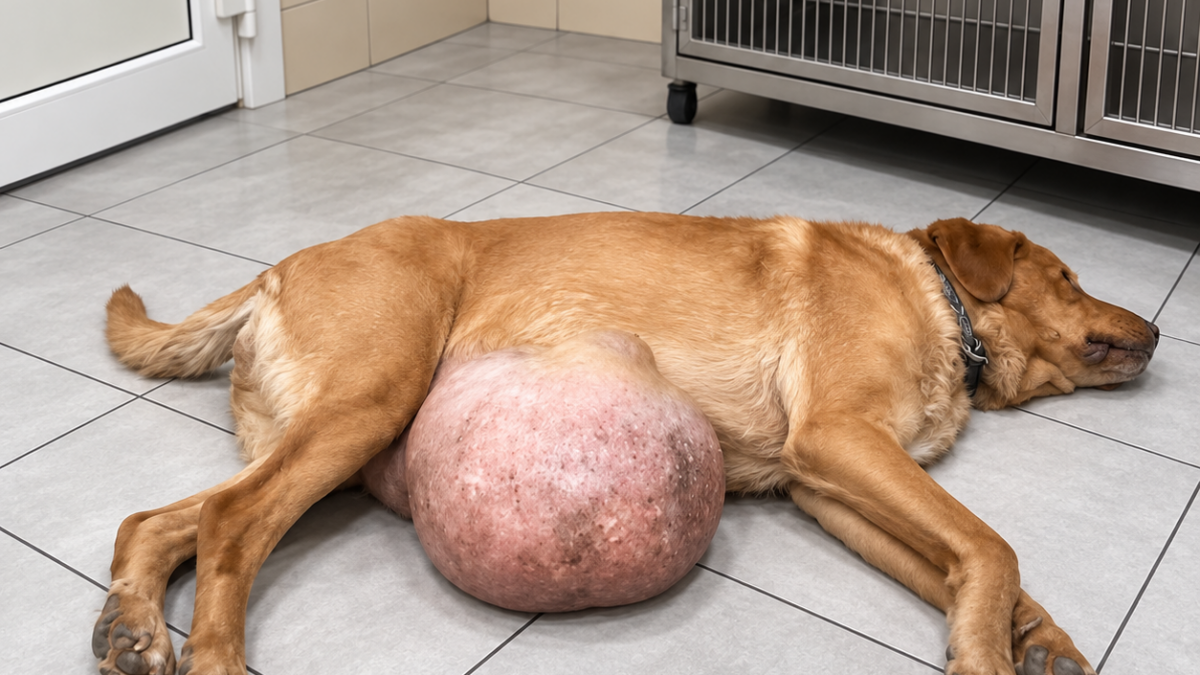
The first time I saw her, she was dragging a tumor so enormous that every step pulled her body sideways, yet she still tried to walk toward me when I called. I had responded to neglect cases before, but I had never seen a dog carrying fifteen pounds of untreated suffering while the people around her had somehow learned to look away. Then her owner answered one simple question about veterinary care, and I realized the tumor was only the beginning of what had been done to her.
My name is Anna, and I had been helping with animal rescue long enough to believe I was difficult to shock.
I was wrong.
The call came from a neglected suburban neighborhood on the edge of town, where small houses sat close together behind patched fences and dogs barking behind gates were so common that most people had stopped paying attention.
A woman had reported an elderly dog with what she described as “a giant lump.”
That description did not prepare me.
When I entered the yard, the dog was standing near a wall with her head lowered.
The mass beneath her body was so large it nearly touched the ground.
For a second, I couldn’t understand what I was looking at.
Then she tried to walk.
Her front legs moved first. Her back end followed unevenly as the enormous tumor swung beneath her, pulling against skin that had been stretched for years.
“Oh, sweetheart.”
She stopped.
Her eyes lifted toward me.
Both were wet with thick discharge. The skin around them was red and irritated, and she squinted against the light as if simply keeping her eyes open hurt.
I crouched.
She took one step toward me.
Then another.
The smell reached me before she did.
Infection.
Her mouth was in terrible condition. When she opened it slightly, I could see teeth buried beneath years of decay and inflammation.
But she still came closer.
No barking.
No growling.
She simply stood in front of me and allowed my hand to rest against the side of her face.
“How long has she had this tumor?” I asked.
The owner shrugged.
“A few years.”
I thought I had misheard.
“Years?”
“It started small.”
“When did a veterinarian last see her?”
Another shrug.
“I don’t remember.”
That answer did something to me.
Not rage at first.
Something colder.
Because a tumor does not become fifteen pounds overnight.
Teeth do not rot that badly in a week.
Eyes do not remain painfully irritated for years without signs.
This dog had been deteriorating in full view of people who saw her every day.
Someone had watched the mass grow from small to large, from large to enormous, and still no help had come.
I looked back at her.
She had lowered herself carefully onto the dirt because standing cost too much effort.
I noticed then how exhausted she was beneath the tumor.
Thin shoulders.
Weak muscles.
A body that had spent years compensating for an impossible burden.
“We’re taking her for veterinary care.”
The owner didn’t argue much.
That almost made it worse.
We used blankets and several pairs of hands to help move her because lifting her normally risked hurting the stretched tissue.
During the ride, I sat beside her.
Every bump in the road made her tense.
“I know,” I whispered. “We’re almost there.”
At the clinic, the staff went silent when we carried her inside.
Dr. Marek knelt beside her before ordering imaging, bloodwork, heart evaluation, and a full examination.
More problems appeared almost immediately.
Her mouth needed extensive dental surgery.
Her eyelids had turned inward enough that her eyelashes rubbed painfully against her eyes.
And her heart was weak.
Then Dr. Marek showed me the tumor.
“It has to come off.”
“When?”
“As soon as possible.”
“Then let’s do it.”
He didn’t answer.
I looked at him.
“What?”
“Anesthesia may kill her.”
The room suddenly felt smaller.
“But leaving this on her—”
“May kill her too.”
I looked through the glass toward the old dog lying beneath a blanket.
For years, nobody had made the decision to help her.
Now we finally had.
And we might already be too late.
I walked back into the treatment room, sat beside her, and placed my hand against her head.
“You’ve carried this long enough,” I whispered.
She closed her tired eyes.
Behind me, Dr. Marek said quietly, “If we operate, we need to be prepared for everything.”
I looked at her massive tumor, her infected mouth, her painful eyes, and the weak heart beating inside a body that had somehow survived years of neglect.
Then I answered him.
“Prepare everything.”
PART 2
That night, I did not go home when I was supposed to.
I told myself I would stay until her bloodwork came back.
Then until the cardiologist reviewed the first heart images.
Then until she ate.
By midnight, I had stopped pretending there was a logical reason for me to still be sitting on the floor beside her recovery kennel.
The dog had no name on any veterinary record because there were no veterinary records.
Her owner had called her different things while we were at the house, none of them sounding like a name she recognized.
“Girl.”
“Dog.”
Sometimes nothing at all.
When I whispered to her through the bars, I needed something else.
“You deserve better than ‘dog,’” I told her.
Her eyes opened slightly.
“I don’t know what to call you yet.”
She placed her chin against the blanket.
The tumor rested awkwardly beside her body.
Even lying down required positioning it first.
That was one of the things I kept noticing.
She didn’t move naturally anymore.
She moved around the mass.
Every time she tried to stand, her front legs pushed first while the rest of her body adjusted to the enormous weight beneath her.
When she turned, she had to turn wide.
When she lay down, she seemed to calculate where the tumor would go before deciding where her own body could fit.
It had become part of the architecture of her existence.
Dr. Marek came into the room carrying a clipboard.
“You should sleep.”
“So should you.”
“I’m working.”
“So am I.”
“You’re sitting.”
“Rescue has a broad job description.”
He lowered himself onto a stool.
“The bloodwork is not as catastrophic as I expected.”
I sat straighter.
“That sounds good.”
“It is good.”
“But.”
“There is always a but with you.”
“There is always a but with medicine.”
He turned the paper toward me.
“She’s anemic. Her protein is low. There are signs of chronic inflammation and infection. Kidney function is acceptable considering her condition.”
“Heart?”
“That remains the major problem for anesthesia.”
“How bad?”
He hesitated.
I hated hesitation from doctors.
“She has cardiac changes that increase surgical risk significantly.”
“Can medication improve it?”
“We may be able to stabilize her somewhat. Not cure it.”
“And how long can we wait?”
“Not long.”
I stared at the old dog.
The tumor looked even larger beneath the fluorescent hospital lights.
“How can something that big still be attached?”
“The body adapts to terrible things when given no other option.”
That sentence made me angry.
“Adapt” sounds positive when people use it.
Resilient.
Strong.
Survivor.
But sometimes adapting means a body simply finding a way to tolerate what should never have been allowed.
“She shouldn’t have had to adapt.”
“No.”
“Do you think she’s been in pain for years?”
“Yes.”
He did not soften it.
I appreciated that.
“Constantly?”
“Probably varying levels. The weight alone would create strain. Then there’s skin tension, possible ulceration, infection, pressure on the surrounding tissues.”
I rubbed my face.
“And her mouth?”
“Painful.”
“Eyes?”
“Also painful.”
“Anything that doesn’t hurt?”
Dr. Marek looked at her for a moment.
“I hope being here doesn’t.”
I stood and went back to the kennel.
She watched me approach.
I opened the door and sat just outside it.
“Food?”
Her nose moved.
That was encouraging.
A technician brought a small portion of soft food because chewing dry kibble would have been difficult with her mouth.
The dog sniffed.
Took one bite.
Then another.
Slowly.
Carefully.
Unlike some starved animals I had helped, she did not attack the bowl.
She seemed too tired.
I held it near her so she would not have to stand.
By the fifth bite, her eyes began closing.
“You’re falling asleep while eating.”
She took another.
Then rested her head beside the dish.
I moved it away.
“Fine. You win.”
Her tail moved.
A tiny movement.
Almost nothing.
But I saw it.
The next morning, the rescue director called me.
“Anna, we need to discuss the legal side.”
“I know.”
“Do you?”
“Yes.”
“Because you sound like you are already emotionally adopting this dog.”
“I’m not adopting anyone.”
“You have been at the hospital sixteen hours.”
“That’s called responsibility.”
“That’s called obsession.”
I ignored that.
“What did animal welfare say?”
“An investigation is being opened.”
“Good.”
“The owner claims she didn’t know the tumor was dangerous.”
I laughed once.
It wasn’t funny.
“A fifteen-pound tumor?”
“We don’t know the exact weight yet.”
“Fine. A tumor the size of a small dog.”
“She says it grew slowly.”
“That is not a defense.”
“I agree.”
“What about the mouth?”
“She says the dog always had bad teeth.”
“And the eyes?”
“No answer.”
“Vet records?”
“None found so far.”
I closed my eyes.
“We need photographs.”
“We have them.”
“I want everything documented before surgery.”
“It will be.”
“Measurements.”
“Yes.”
“Body weight with and without the tumor if possible afterward.”
“Yes.”
“Dental condition.”
“Anna.”
“What?”
“We know how to build a neglect case.”
I exhaled.
“I know.”
“You want revenge.”
The word landed harder than I expected.
I looked through the glass.
The dog was asleep.
“No.”
“Be careful.”
“I want accountability.”
“Good.”
“Those aren’t the same thing.”
“They can become the same thing if you stop thinking clearly.”
I understood what she meant.
Rescue work creates a dangerous kind of anger.
You see an animal who cannot explain why they were hurting.
You meet the person who allowed it.
Your mind wants a simple balance.
They caused pain.
Therefore they should receive pain.
But that is not justice.
Justice is evidence.
Consequences.
Protection.
Prevention.
That became important later.
At the time, all I could think about was getting the dog through surgery.
The cardiologist arrived that afternoon.
Dr. Nowak was calm in the way specialists often are, which can either make you feel safe or furious depending on what they are saying.
He examined the dog’s heart.
Reviewed the ultrasound.
Listened.
Then listened again.
“Well?” I asked.
“She is high risk.”
“How high?”
“High enough that nobody should treat anesthesia casually.”
“That is not a number.”
“I don’t have a meaningful number.”
“Would you operate?”
“If the tumor stays, what is her future?”
Dr. Marek answered.
“Poor.”
“Then yes.”
I looked between them.
“So we operate.”
Dr. Nowak raised a hand.
“We optimize first.”
“For how long?”
“Forty-eight hours if she remains stable.”
“Why not today?”
“Because every improvement in hydration, electrolyte balance, inflammation, and cardiac management gives us a better margin.”
“And if the tumor ruptures or something changes while we wait?”
“Then the equation changes.”
I hated equations that involved living things.
But I agreed.
For two days, the veterinary team prepared her.
Medication for her heart.
Antibiotics.
Pain management.
Nutrition in small portions.
Fluids carefully balanced because too much fluid could burden her heart.
The tumor was cleaned and protected.
Her eyes were treated with lubricating medication to reduce the constant irritation.
The mouth infection could not be fully addressed yet, but antibiotics began working on what they could.
During those two days, she began recognizing us.
Especially food.
Especially me.
The first morning, she barely lifted her head.
The second, when I entered, her tail moved twice.
The third, she tried to stand.
“Don’t impress anyone,” I told her.
She stood anyway.
That was when the name came.
One of our volunteers, Kasia, walked into the room carrying towels.
She looked at the dog.
“You know who she reminds me of?”
“Who?”
“My grandmother Lodzia.”
I laughed.
“Your grandmother had a tumor?”
“No. She was stubborn enough to survive everything people said she couldn’t.”
I looked at the dog.
“Lodzia.”
Her ears moved.
Kasia smiled.
“There.”
“Don’t start.”
“She likes it.”
“You made one sound.”
“She reacted.”
I crouched.
“Lodzia?”
The dog looked at me.
That was enough.
“Fine.”
And just like that, she had a name.
A real one.
The next morning, we weighed the tumor as best we could estimate through imaging and support equipment.
Everyone knew it was enormous.
Nobody was emotionally prepared for the final number after surgery.
But first we had to get there.
Surgery day began before sunrise.
I arrived at 5:40 a.m.
Dr. Marek was already there.
So was Dr. Nowak.
Two anesthesia technicians.
Two surgical nurses.
More people than usually stood around one dog.
That frightened me.
“What’s the plan?”
Dr. Marek pointed toward the board.
“Cardiac monitoring throughout. Blood products available. We remove the mass as efficiently as possible, control bleeding, avoid unnecessary anesthesia time.”
“And if she becomes unstable?”
“We make decisions in real time.”
“What decisions?”
“Anna.”
“What?”
“You know what.”
I did.
Stop the procedure.
Resuscitate.
Or, if everything went catastrophically wrong, let her go.
I looked at Lodzia.
She was lying on a padded gurney.
The sedative had not been given yet.
I knelt.
“Remember when you didn’t have a name?”
She looked at me.
“Now you have one, so you’re obligated to keep using it.”
Her tail moved.
Dr. Marek said, “We need to start.”
I pressed my forehead against hers.
“You carried it long enough.”
Then they took her.
I stood outside the surgical wing.
I had waited through difficult operations before.
This one felt different because everything about Lodzia had already taken too long.
Years too long.
Every minute of surgery felt like another delay she should never have had to endure.
Kasia brought coffee.
I forgot to drink it.
The rescue director called.
I barely answered.
“Any news?”
“No.”
“What time did they start?”
“Seven eleven.”
“What time is it now?”
“Eight fourteen.”
“Anna, that’s an hour.”
“I know.”
“Breathe.”
“I am breathing.”
“You sound like you’re being interrogated.”
At 8:43, a nurse came through the doors.
I stood.
“Is she okay?”
“She’s stable.”
“Why are you here?”
“We need more blood products moved into the room.”
My stomach dropped.
“Why?”
“She’s losing blood. It was anticipated.”
“Anticipated is a horrible word.”
The nurse squeezed my arm and kept moving.
At 9:26, no update.
At 10:02, still nothing.
At 10:37, Dr. Nowak came out.
I stood so fast my knees hurt.
“What happened?”
“She is alive.”
I grabbed the chair.
“Is the tumor gone?”
“Yes.”
“All of it?”
“The main mass has been removed.”
“How is she?”
“Very weak. Her blood pressure has been difficult. We are finishing stabilization.”
“Can I see it?”
“The tumor?”
“Yes.”
He hesitated.
“Why?”
“I need to understand.”
They had placed it in a specimen container for documentation and pathology.
When they showed me, I could barely process the size.
It was no longer attached to Lodzia.
That changed everything.
What had looked almost like part of her body was now simply a mass of tissue that should never have been allowed to become that large.
The scale read just under seven kilograms.
More than fifteen pounds.
I stared.
“That was hanging from her?”
“Yes.”
“For years?”
“Based on the history.”
I looked at my own arms.
Fifteen pounds does not sound impossible until you imagine carrying it from your own skin every minute.
Standing.
Sleeping.
Turning.
Trying to squat.
Trying to walk.
No relief.
No taking it off at night.
No setting it down.
I whispered, “How?”
Dr. Nowak answered quietly.
“She adapted.”
Again that word.
I hated it even more.
When I was finally allowed to see Lodzia, she looked smaller.
That seems obvious.
It still shocked me.
Her body looked almost incomplete without the giant shape beneath it.
A thick bandage covered the surgical site.
She was pale.
Her breathing was slow.
Machines tracked every heartbeat.
I stood beside her.
“Hey.”
No response.
I touched her head.
“Lodzia.”
One eyelid moved.
I started crying.
“Don’t you dare make me dramatic in front of everybody.”
Dr. Marek, behind me, said, “Too late.”
I laughed through tears.
“How did she do?”
“She scared us.”
“How badly?”
“Enough.”
“That’s not an answer.”
“She became unstable twice.”
“What did you do?”
“What we prepared to do.”
“But she woke up.”
“She is waking.”
I touched Lodzia’s ear.
“That counts.”
“Yes.”
“Pathology?”
“Several days.”
“Do you think it’s malignant?”
“I think we wait for pathology.”
He had learned how to avoid feeding my anxiety.
The next forty-eight hours were difficult.
The removal of the tumor solved one enormous problem and exposed how weak Lodzia actually was.
For years, her body had invested energy in surviving.
Now it had to heal.
She slept.
She refused food the first evening.
Accepted water in small amounts.
Her heart rhythm fluctuated.
She needed close monitoring.
When she tried to stand the next day, her body did something strange.
She compensated for weight that was no longer there.
Her balance shifted too far.
One rear leg moved wide.
She nearly fell.
A technician caught her.
Lodzia looked confused.
I knelt.
“It’s gone.”
She looked at me.
“You don’t have to walk around it anymore.”
The second attempt was better.
The third better still.
By the end of the second day, she managed eight careful steps.
No tumor dragging beneath her.
No enormous weight swinging against her legs.
Just a senior dog learning how her own body worked again.
Kasia cried.
“I’m not crying,” she insisted.
“You’re crying.”
“Hospital air.”
“Very emotional air.”
On the third day, Lodzia ate a full meal.
Soft food because of her mouth.
Slowly.
Then looked at the bowl.
I added a little more.
“Don’t tell Marek.”
“I heard that,” Dr. Marek said from the hallway.
“You hear too much.”
“I work here.”
Pathology came back later that week.
The mass was serious, but the removal was considered successful enough that the team felt cautiously hopeful about the immediate future.
I wanted certainty.
Nobody gave it to me.
That was becoming a pattern.
“What does cautiously hopeful mean?” I asked.
“It means we removed the burden threatening her life now.”
“And later?”
“We monitor.”
“What about metastasis?”
“We monitor.”
“Recurrence?”
“We monitor.”
“I hate that word.”
“It is still the correct one.”
Fine.
We monitored.
The legal investigation moved forward at the same time.
Animal welfare officers returned to the owner’s property.
They interviewed neighbors.
One had photographs from years earlier showing Lodzia with a much smaller mass.
Another remembered mentioning it to the owner.
“She said it was just a lump.”
“How long ago?” the officer asked.
“Maybe three years.”
Another neighbor said the tumor became impossible not to notice at least two years before rescue.
“What did people do?”
The neighbor looked embarrassed.
“Nothing.”
That answer appeared again and again.
Nothing.
Someone saw.
Nothing.
Someone asked.
Nothing.
The mass grew.
Nothing.
The eyes became infected.
Nothing.
The mouth rotted.
Nothing.
Lodzia kept walking.
People adjusted to seeing her suffer.
That was almost more frightening than one deliberately cruel act.
Cruelty can be dramatic.
Neglect often becomes wallpaper.
The abnormal becomes normal because it happens slowly enough.
A little bigger.
A little thinner.
A little more smell.
A little less energy.
Until one day a rescuer enters the yard and everyone suddenly sees the emergency that has been there for years.
The owner, Marta, was formally interviewed.
She claimed she loved Lodzia.
I believe she believed that.
That was the uncomfortable part.
She said the tumor began small.
She said money was tight.
She said she thought surgery would be expensive.
She said Lodzia continued eating, so she assumed things were manageable.
She said the dog never cried.
That statement made me furious.
Dogs do not owe us screaming before we acknowledge their pain.
Dr. Marek later testified to exactly that.
“Animals frequently endure chronic pain without vocalizing continuously.”
The investigator asked Marta why she never surrendered Lodzia.
“I didn’t know I could.”
“Did you ask?”
“No.”
“Did you contact a rescue?”
“No.”
“Did you contact a low-cost clinic?”
“No.”
“Did you seek any veterinary assessment?”
“I kept thinking I would.”
“When?”
Silence.
That became the center of the case.
Not poverty.
Poverty is real.
Veterinary care can be expensive.
People do face impossible choices.
But for years, no attempt had been made.
No call.
No surrender.
No assistance request.
No consultation.
Nothing.
The tumor grew to fifteen pounds inside that nothing.
Marta’s attorney later tried to frame the situation as inability rather than neglect.
I understood why.
And I believed inability had probably been part of the beginning.
But inability without action becomes something else when a living creature keeps suffering.
There are places to call.
People to ask.
Shelters.
Rescues.
Clinics.
Neighbors.
Even humane euthanasia, if every treatment option truly becomes impossible, is different from letting an animal carry unchecked suffering for years.
Dr. Marek said it best during the hearing.
“Not being able to afford ideal treatment does not remove the responsibility to seek some form of help.”
That sentence traveled through the room.
I watched Marta lower her head.
Part of me wanted satisfaction.
I didn’t get it.
She looked older than I remembered.
Tired.
Poor.
Ashamed.
Justice is emotionally inconvenient when the person responsible does not look like a monster.
I wanted to hate her.
Instead, I hated what she had allowed.
There is a difference.
Lodzia, meanwhile, had no interest in court.
She had discovered grass.
That sounds ridiculous.
She had obviously seen grass before.
But after weeks in treatment, when she was finally stable enough to walk outside without extensive support, we took her behind the rescue center.
There was a field.
Green.
Open.
Soft.
Lodzia stepped onto it.
Stopped.
Smelled.
Then walked three steps.
Stopped again.
She lowered her head to the grass.
Kasia smiled.
“Finally. A normal dog moment.”
Then Lodzia turned away from the beautiful open field and walked toward the construction area behind the new storage building.
I stared.
“You have an entire field.”
She kept going.
Metal pipes.
Piles of sand.
Workers’ equipment.
Apparently this was more interesting.
“Lodzia.”
Nothing.
“You survived a fifteen-pound tumor for this?”
She sniffed a stack of boards.
That became one of her defining habits.
Everyone expected the rescued senior dog to enjoy picturesque walks through green fields.
Lodzia preferred construction sites.
Gravel.
Wheelbarrows.
Fresh concrete smells.
Stacks of lumber.
If workers were fixing something, Lodzia wanted to supervise.
One carpenter began calling her “the inspector.”
Every morning she walked toward him.
“Good morning, boss.”
Her tail wagged.
“If I do this wrong, tell me.”
She sat.
“I assume that means yes.”
Watching her become funny was one of the most healing things about the entire case.
Suffering had made her look old beyond her years.
Once pain decreased, personality appeared.
She was stubborn.
Curious.
Food motivated.
Suspicious of cucumbers.
Fascinated by power tools.
She loved sunshine but refused to lie in the prettiest patches of grass if there was an ugly patch of gravel nearby.
She liked quiet dogs.
Ignored loud ones.
And she developed an intense attachment to one particular blue blanket in the recovery room.
If someone washed it and replaced it with another, she searched for the original.
“Sentimental?” Kasia asked.
“Or it smells disgusting in a way she appreciates.”
“Anna.”
“What? Dogs are honest.”
The dental surgery came six weeks after the tumor operation.
That frightened me almost as much as the first surgery because her heart remained fragile.
Dr. Nowak reviewed everything again.
“Shorter anesthesia.”
“Still risky.”
“Yes.”
“Necessary?”
“Her mouth is painful and infected.”
I looked at Lodzia chewing soft food carefully.
“Then we do it.”
Several rotten teeth had to be removed.
The infection was treated thoroughly.
When she woke, she looked betrayed.
I sat beside her.
“You have fewer teeth.”
She blinked.
“But they were terrible teeth.”
No reaction.
“You’ll feel better.”
She turned her head away.
Kasia laughed.
“She disagrees.”
Two days later, Lodzia ate better than she had before surgery.
“Apology accepted?” I asked.
She licked the bowl.
The eyelid surgery came later.
Her eyelashes had been rubbing painfully against the eyes because of abnormal eyelid positioning.
Correcting it meant another procedure.
Another anesthesia risk.
Another round of worry.
But by then, Lodzia’s heart had been managed for months, her body condition improved, and the tumor was gone.
She tolerated it.
After recovery, the constant discharge decreased.
The squinting improved.
For the first time, she opened her eyes comfortably in bright light.
I noticed it one afternoon outside.
Sunlight hit her face.
Normally she would narrow both eyes.
This time, she looked directly across the yard.
I crouched.
“Does that feel different?”
Lodzia walked past me toward a cement mixer.
Fine.
Some moments are more meaningful to humans than dogs.
The neglect case concluded months after rescue.
Marta entered a negotiated resolution.
She did not receive the dramatic punishment people online demanded after photographs of Lodzia’s condition became public.
There was no huge prison sentence.
No theatrical confrontation.
There were financial penalties, court supervision, animal ownership restrictions for a defined period, and a permanent surrender of Lodzia.
She was also ordered to comply with animal welfare requirements regarding any animals connected to the property.
Some people were furious.
“That’s it?”
“She should suffer.”
“She should carry fifteen pounds around for years.”
I understood the anger.
I refused to feed it.
Lodzia did not need cruelty committed in her name.
The most important line in the court order was simple.
She would never return to the life where nobody acted.
Permanent surrender.
That was the line I cared about.
After the hearing, Marta approached me outside the courthouse.
I almost walked away.
She stopped several feet from me.
“Is she alive?”
I turned.
“Yes.”
Her face changed.
“Is she… happy?”
The question irritated me.
“You had years to ask whether she was happy.”
She flinched.
I knew immediately the sentence was cruel.
True, but cruel.
Part of me wanted to keep going.
Instead, I stopped.
Marta looked down.
“I know.”
“No,” I said. “I don’t think you do.”
She began crying.
“I thought if I took her to someone, they would tell me she had to die.”
I stared at her.
“So you didn’t ask?”
“I was scared.”
“She carried fifteen pounds because you were scared.”
Marta covered her mouth.
“I know.”
“You kept waiting.”
“Yes.”
“You saw her eyes.”
“Yes.”
“Her mouth.”
“Yes.”
“The tumor.”
“Yes.”
“Why?”
She cried harder.
“I kept thinking I would do it next month.”
There it was.
The great destroyer of neglected animals.
Tomorrow.
Next week.
When money improves.
When work slows down.
When the weather changes.
When the swelling gets worse.
When the dog stops eating.
When the dog cries.
When the emergency becomes undeniable.
Sometimes tomorrow comes too late.
I said, “She almost died because every next month became another next month.”
Marta nodded.
“I’m sorry.”
I wanted to tell her sorry was useless.
Instead I said, “Then don’t ever do it again.”
She looked up.
“I won’t.”
I walked away.
That was our only conversation after the rescue.
Was that forgiveness?
No.
I do not know whether I ever forgave her.
But I stopped wanting revenge in the form I had imagined during those first angry nights.
Because Lodzia had already found something better than vengeance.
Life.
She lived at the rescue center while we searched for the right long-term arrangement.
Then something surprising happened.
Nobody wanted her to leave.
The staff had become attached.
The construction workers had become attached.
Kasia was openly campaigning for her to stay.
“She has a job.”
“What job?”
“Site inspector.”
“She has no qualifications.”
“She has survived more construction than you.”
“That sentence makes no sense.”
“She stays.”
The rescue center director tried to be practical.
“Senior dog. Heart condition. Ongoing monitoring. Future medical costs.”
Kasia crossed her arms.
“So?”
“So we need to decide what is best.”
Lodzia walked into the office, carrying one of the worker’s gloves.
Everyone looked at her.
The director sighed.
“That is not helping.”
Lodzia dropped the glove and lay down.
Kasia smiled.
“She voted.”
Eventually, the rescue center became her permanent home.
Not a kennel home.
A real one inside the staff cottage beside the property, with access to the office, garden, and every construction project she considered her personal responsibility.
I spent three nights a week there during busy periods.
Kasia covered others.
Lodzia was rarely alone.
She gained weight where she needed it.
Muscle returned.
Her coat improved.
Her eyes became bright.
Her mouth stopped smelling of infection.
Her surgical scar slowly faded beneath fur.
Months after the tumor removal, I photographed her standing beside a wheelbarrow.
I put the picture next to the intake photograph.
I could barely look at both.
Same dog.
Different body.
Different eyes.
In the first, Lodzia looked as though she expected discomfort.
In the second, she looked annoyed because someone had moved her wheelbarrow.
That was progress.
One year after rescue, Dr. Marek performed another full examination.
Her heart remained weak.
Stable, but weak.
“How much time?”
I should not have asked.
He looked at me.
“Anna.”
“I know. You can’t predict.”
“Correct.”
“Months?”
“Could be.”
“Years?”
“Could be.”
“That is useless.”
“It is honest.”
Lodzia sat between us.
I rubbed her ears.
“What does she need?”
“Medication. Monitoring. Weight control. Dental checks. And whatever she enjoys.”
I looked at her.
“Construction materials.”
Dr. Marek smiled.
“Medically optional.”
Her second year after rescue was one of the happiest.
She became friends with a rescued shepherd named Bruno.
Bruno was younger and energetic.
Lodzia found him exhausting.
He would run circles around her.
She would stand still until he finished.
Then walk away.
Eventually Bruno learned that lying beside Lodzia earned more acceptance than jumping on her.
They began napping together in the sun.
Not touching at first.
Then paws.
Then shoulders.
One afternoon I found Bruno’s head across Lodzia’s back.
She looked deeply inconvenienced.
“You can move.”
She didn’t.
That was her version of love.
She also developed a strange fascination with delivery vans.
Any time supplies arrived, Lodzia walked to the gate.
Not barking.
Supervising.
The drivers learned her name.
“Morning, Lodzia.”
Tail wag.
“Concrete today.”
She sniffed the tires.
“Approved?”
She looked at the driver.
“Thank you, ma’am.”
People knew her.
That mattered because for years, people had looked at her without really seeing her.
Now electricians knew her.
Carpenters knew her.
Veterinary staff knew her.
Donors knew her.
Volunteers knew which side she preferred being scratched.
Children visiting the rescue knew not to give her too many treats because of her heart.
Her name appeared on medication boxes.
On veterinary charts.
On her bed.
On a little wooden sign Kasia hung outside the staff cottage:
LODZIA’S OFFICE
The director objected.
“She does not have an office.”
Kasia pointed inside.
Lodzia was sleeping across the doorway.
“No one can enter. That’s administrative authority.”
The sign stayed.
The story of her giant tumor spread beyond our region.
Photographs circulated online.
People asked how anyone could let that happen.
Some comments were vicious.
Against Marta.
Against the neighborhood.
Against everyone who had seen Lodzia.
Again, I understood.
But the useful question became something else.
How do we stop the next case earlier?
The rescue began offering a monthly clinic day for people who could not easily afford veterinary consultations.
Not free treatment for everything.
We could not fund that.
But an examination.
Basic guidance.
Referral.
A place to ask before fear became delay.
We called it the Lodzia Clinic.
The first day, thirty-two animals came.
Too many.
We were overwhelmed.
One man brought a dog with a small mammary lump.
He had noticed it two months earlier.
“I was afraid to come.”
I looked at the dog.
The lump was smaller than a grape.
“Why?”
“Money.”
“We’ll start with knowing what it is.”
Tests showed the mass needed removal.
The rescue helped him access a lower-cost surgical program.
It was removed early.
The dog recovered.
The owner returned later with pastries for the staff.
“I almost waited.”
I thought of Lodzia.
“How long?”
“I don’t know. Until she seemed sick.”
“That can be too late.”
“I know now.”
That became Lodzia’s revenge.
Not punishment.
Earlier help.
Her body had carried fifteen pounds because people waited.
Now her name convinced people not to wait.
We printed one sentence on the clinic posters:
SMALL PROBLEMS ARE EASIER TO HELP THAN EMERGENCIES.
Simple.
Obvious.
Apparently necessary.
A woman brought an elderly cat with an infected tooth.
A family brought a dog with chronic itching.
A man who had recently lost work brought his dog because she had begun limping.
Many cases were minor.
That was the point.
We wanted minor.
We wanted boring.
We wanted the story before tragedy.
Lodzia sometimes attended the clinic days.
Mostly she slept beneath the reception desk.
People would ask, “Is that her?”
“Yes.”
“The tumor dog?”
Kasia always corrected them.
“Lodzia.”
That mattered.
She was more than the tumor.
By the third year, people who met her without knowing the story often assumed she had simply always been an elderly rescue center dog.
I loved that.
A volunteer once asked, “Why does everyone act like Lodzia is famous?”
Kasia showed her the old photograph.
The volunteer covered her mouth.
“No.”
“Yes.”
“That was attached to her?”
“Yes.”
“How did she survive?”
I answered from across the room.
“She kept going until somebody stopped waiting.”
Later, I realized the sentence sounded heroic.
It wasn’t meant to.
Lodzia had not chosen suffering.
She had endured because there was no alternative.
I became careful with how we told her story.
I stopped saying she “fought” every second.
Sometimes she didn’t fight.
Sometimes she was exhausted.
Sometimes medicine did the work.
Sometimes surgeons did.
Sometimes rest saved her more than courage.
Animals should not have to perform bravery to deserve rescue.
Lodzia deserved help when she was weak.
Maybe especially then.
Her fourth year after rescue surprised everyone.
Dr. Marek had once warned us her heart could limit her future.
Instead, with medication and monitoring, she continued.
Slower.
Grayer.
Happy.
She stopped walking all the way to the far field.
Not because she disliked it.
Because the construction area was closer.
“Efficient,” Kasia said.
“She has always hated scenic beauty.”
One summer, the rescue built a small rehabilitation room.
For three months, Lodzia supervised construction daily.
Workers started leaving a folded mat near the site.
She would lie there while they worked.
One morning they arrived before us.
When Lodzia came outside, a cardboard sign was taped to her mat.
FOREWOMAN
I laughed.
Kasia photographed it.
The image became more popular than some of our adoption posts.
Lodzia had become an old dog whose greatest public controversy was whether her job title was legitimate.
That felt like an extraordinary ending already.
But life kept giving her more time.
At five years post-rescue, Bruno died.
Cancer.
Fast.
Lodzia searched for him in the yard.
Not dramatically.
She checked his usual sleeping spot.
The water station.
The path behind the cottage.
For a week she seemed quieter.
Then she began sleeping on his old blanket.
We let her.
Grief had entered her safe life.
There was something bittersweet about that.
To lose someone means you lived long enough to love them.
Lodzia had once been so neglected we worried she would die before knowing basic comfort.
Now she had friendships deep enough to miss.
That is painful progress.
A new dog named Tessa arrived months later.
Tessa was terrified of people.
She hid behind a storage shed during her first outdoor sessions.
Lodzia wandered near her.
Not intentionally, I think.
She simply wanted to inspect a pile of bricks.
Tessa watched.
Lodzia sniffed the bricks.
Lay down.
Tessa stayed.
The next day, same thing.
By day four, Tessa lay six feet away.
Kasia whispered, “Lodzia’s mentoring.”
“Lodzia wants bricks.”
“Mentoring through bricks.”
Within two weeks, Tessa followed Lodzia into the cottage.
Everyone celebrated.
Lodzia went straight to her bed and slept.
She had no idea she was inspirational.
That was another reason I loved her.
The legal restrictions on Marta eventually ended.
The rescue was notified because of the original case.
By then, years had passed.
I expected anger to return.
It didn’t.
I felt cautious.
Protective.
But not consumed.
We learned Marta had not acquired another dog.
That mattered to me.
Later, she donated anonymously to the Lodzia Clinic.
We only discovered it because an administrative error showed the name on a receipt.
Kasia asked, “What do we do?”
“Nothing.”
“You’re not angry?”
“I don’t know.”
“Return it?”
“No.”
“Why?”
“Because if she wants to pay for someone else to get help earlier, let her.”
The donation paid for several examinations and one dental procedure.
Was that redemption?
I would never use that word for someone else’s life.
But it was better than nothing.
I never told Lodzia.
She would have preferred a sandwich.
At around what we estimated was fourteen or fifteen years old, Lodzia began slowing significantly.
Her heart medications increased.
Arthritis joined the list.
Kidney values drifted upward.
She slept more.
Construction supervision became seasonal.
On cold mornings, she stayed inside.
The workers noticed.
“Boss coming out?”
“Not today.”
They would look toward the cottage.
“Tell her we’re working.”
“She doesn’t trust you.”
“Fair.”
One worker, Piotr, started bringing her a small blanket during winter because the floor near the office door was cold.
“Not too many treats,” I warned.
“I bring blanket.”
“You always bring treats.”
“No.”
Lodzia stared at his pocket.
He sighed.
“One treat.”
She was a terrible witness.
Her old age changed my relationship with time.
Every checkup felt like something borrowed.
Every stable blood test felt like a gift.
I stopped asking Dr. Marek how long.
I finally understood his answer would never satisfy me.
Instead, I asked:
“Is she comfortable?”
“Yes.”
“Does she still enjoy things?”
“Yes.”
“Then we continue.”
That became our standard.
Comfort.
Interest.
Food.
Movement.
Connection.
Not perfection.
One winter morning, Lodzia refused to go outside.
That wasn’t unusual.
It was snowing.
She hated snow.
But she also refused breakfast.
That was unusual.
I sat beside her.
“Lodzia.”
She opened her eyes.
I brought soft food closer.
She smelled it.
No interest.
Heart patients can have bad days.
Senior dogs can have bad days.
I told myself that.
By noon, she still had not eaten.
Dr. Marek came to the rescue center rather than making us transport her.
He examined her on the blue blanket she had loved for years.
Heart.
Lungs.
Gums.
Abdomen.
Temperature.
He was quiet too long.
“What?”
“Her heart is struggling more.”
“How much more?”
“Enough that we need to decide how aggressively we intervene.”
My chest tightened.
“Hospital?”
“Possible.”
“Would it help?”
“Potentially stabilize.”
“For how long?”
He looked at me.
I almost laughed.
Same question.
Years later.
Still impossible.
“She could respond to treatment.”
“Could.”
“Yes.”
“Would she be scared?”
“Probably.”
I looked at Lodzia.
She hated being moved now.
She liked her cottage.
Her blanket.
Kasia.
Me.
The rescue yard.
Her ridiculous construction site.
“Can we treat here?”
“Some things.”
“Enough?”
“Maybe.”
I hated that word too.
We started medications and supportive care at the cottage.
By evening, Lodzia ate a little chicken.
Kasia and I celebrated quietly.
The next morning, she ate more.
For three weeks, she rallied.
Not fully.
But enough to go outside again.
The workers were repairing a fence.
Lodzia walked toward them.
Piotr saw her.
“Boss!”
Tail wag.
He put down his drill.
“You came to inspect.”
She sniffed the new posts.
Then lay on the gravel.
I stood behind her and cried.
Kasia bumped my shoulder.
“Don’t.”
“I’m not.”
“You are.”
“Cold air.”
“Very emotional cold air.”
We both laughed.
Those three weeks became precious.
I stopped assuming there would be months more.
Every day felt complete on its own.
Then one morning in early spring, Lodzia woke and could not stand.
Her legs tried.
Failed.
She looked at me.
No panic.
Just tired.
I put my hands beneath her carefully.
“Don’t.”
She stopped trying.
“I’ll help.”
We moved her onto the blue blanket.
Dr. Marek came.
He listened to her heart.
Longer than usual.
Then sat beside me.
“She’s tired.”
I hated the gentleness in his voice.
“Can we do more?”
“We can always do more.”
“That’s not what I asked.”
“No.”
I looked at him.
“Would more be for her?”
He shook his head slowly.
“Probably for us.”
Years before, I had demanded surgery despite fear because surgery offered Lodzia a future.
Now intervention offered only a little more struggle.
That difference mattered.
Kasia arrived crying.
“I hate this.”
“So do I.”
Lodzia’s eyes moved toward her.
Kasia knelt.
“You are the worst employee we have ever had.”
Tail movement.
“Never completed paperwork.”
Another tiny movement.
“Stole food.”
Lodzia blinked.
“Harassed construction workers.”
I laughed.
Kasia touched her face.
“You were perfect.”
Piotr and two other workers came to the cottage doorway.
They did not enter.
“Can we say goodbye?”
I nodded.
One at a time, they crouched beside her.
Piotr removed his work glove and placed his hand gently on her shoulder.
“Good work, boss.”
His voice broke.
That destroyed me.
Dr. Marek prepared medication.
I asked everyone to give us a few minutes.
Kasia stayed.
So did I.
Lodzia rested between us.
The blue blanket beneath her.
Sunlight came through the window.
Not dramatic.
Just soft spring light.
I thought about the yard where I first saw her.
The tumor.
The eyes.
The infected mouth.
The owner saying she could not remember the last veterinarian visit.
I had once thought the most important moment in Lodzia’s life was the surgery that removed fifteen pounds from her body.
Now I understood the most important thing was everything afterward.
Years.
Food.
Grass.
Gravel.
Friends.
Dental care.
Eye surgery.
Medication.
Construction sites.
People knowing her name.
The tumor was gone within hours.
Healing took a lifetime.
I placed my hand beside her face.
“You know your name?”
Her eyes moved toward me.
“Lodzia.”
Tail movement.
There it was.
I smiled through tears.
“You didn’t have one when we met.”
Kasia whispered, “She had one.”
“Not one anyone bothered to put on a medical chart.”
I stroked her head.
“Now everybody knows it.”
Dr. Marek gave the sedative.
Lodzia’s breathing softened.
I kept talking.
“You carried fifteen pounds for years.”
My voice cracked.
“You never have to carry anything again.”
Kasia began crying harder.
“Not one thing.”
Lodzia’s head became heavier against the blanket.
I moved closer.
“You don’t have to be strong.”
That mattered to me.
People had called her strong for years.
Survivor.
Fighter.
Miracle dog.
I wanted to free her from that too.
“You can just be tired.”
Her eyes closed.
Dr. Marek waited.
I nodded.
The final medication entered slowly.
Lodzia breathed.
Once.
Again.
Then a smaller breath.
And she was still.
For several minutes, nobody moved.
Outside, someone dropped a metal tool.
The sound echoed from the construction area.
Kasia laughed through tears.
“She’d be furious she missed that.”
I laughed too.
“That work is unsupervised now.”
Lodzia’s final moments were nothing like the life we found.
No tumor.
No untreated infection.
No eyes burning from years of irritation.
No rotten teeth.
No one standing nearby saying they would call a vet eventually.
She was on her own blanket.
In her own place.
Surrounded by people who knew exactly when something changed.
Her suffering was not invisible.
Her final breath was noticed.
That reversal meant everything to me.
The rescue held a memorial a month later.
We did not make it grand.
Lodzia would have hated attention if it interrupted lunch.
The workers built a small wooden bench beside the construction area.
Not in the green field.
Kasia insisted.
“She didn’t even like the field.”
Correct.
The plaque read:
LODZIA
She carried what no dog should have carried. Then she taught us not to wait.
Below it, smaller:
NOTICE EARLY. ASK FOR HELP. ACT.
People came.
Volunteers.
Veterinary staff.
Owners whose animals had received help through the Lodzia Clinic.
One woman brought her dog, the one whose small tumor had been removed before it became dangerous.
The dog was healthy.
Playing.
No giant burden.
The woman hugged me.
“Her story made me come early.”
That was the moment I stopped thinking about Marta entirely.
Because this was the revenge Lodzia deserved.
A tumor removed when it was small.
An infected tooth treated before an animal stopped eating.
A frightened owner calling before embarrassment turned into neglect.
A rescue worker noticing.
A neighbor asking twice.
A clinic door opening sooner.
Years after Lodzia died, her clinic continued.
We expanded it.
One day each month became two.
Then a partnership with local veterinarians.
A transportation volunteer group formed because lack of transport had become a recurring barrier.
A small emergency fund was created.
Not every case could be saved.
Not every owner followed through.
But many did.
One Friday, a man brought a senior dog with a mass on her abdomen.
He had noticed it only three weeks earlier.
The dog received imaging.
Surgery.
The mass was removed.
It weighed less than half a pound.
I held the pathology bag afterward.
So small.
I thought about fifteen pounds.
That difference was Lodzia’s legacy.
Early versus late.
Action versus waiting.
The man asked why I was staring at the specimen.
“Old memory.”
He nodded.
“Is she going to be okay?”
“The vet thinks the outlook is good.”
He started crying.
“I thought I couldn’t afford it.”
“You asked.”
“My daughter made me.”
“Good daughter.”
He laughed through tears.
On my office wall, I kept two photographs of Lodzia.
Not the most shocking intake image.
I stopped displaying that publicly except when educationally necessary.
People did not need to see her at her worst every time they saw her name.
The first photograph showed her a month after surgery, still thin but standing without the tumor.
The second showed her years later beside a pile of lumber, gray-faced, staring directly at a construction worker holding a sandwich.
That was Lodzia.
Not the mass.
Not neglect.
A senior dog with suspicious motives around lunch.
New volunteers asked:
“Was she really the dog with that giant tumor?”
“Yes.”
“She lived for years?”
“Yes.”
“How many?”
More than anyone expected.
Enough.
That is the answer I use now.
Enough years to become more than the rescue.
Enough years to build routines.
Enough years to make friends.
Enough years to lose friends.
Enough years to become old for reasons unrelated to the tumor.
Enough years for the scar to become less interesting than her personality.
Enough years for people who never saw her suffering to know her only as Lodzia.
People sometimes ask whether I wish Marta had received harsher punishment.
Years ago, I would have said yes immediately.
Now I answer differently.
I wish someone had intervened three years earlier.
That is what I wish.
A longer sentence after the suffering does not remove fifteen pounds from the past.
Earlier action might have prevented those pounds from ever existing.
Consequences remain necessary.
Ownership restrictions mattered.
Legal findings mattered.
Accountability mattered.
But punishment is downstream.
Prevention is upstream.
Lodzia changed the direction I looked.
When I hear about a dog with a “small lump,” I do not dismiss it.
When someone says they are embarrassed they waited, I tell them embarrassment is not treatment.
When a neighbor says, “It’s probably not my business,” I tell them there are ways to report concern without confrontation.
When someone cannot afford a procedure, I ask what options they have explored before accepting “none.”
Because I learned from Lodzia that suffering can become enormous one postponed decision at a time.
Tomorrow.
Next week.
Next month.
Fifteen pounds.
The construction bench remains outside the rescue center.
Workers still use it.
Dogs sleep beneath it.
Someone occasionally leaves a treat on the plaque.
Kasia complains.
“Birds take them.”
“It’s symbolic.”
“It’s feeding crows.”
“Lodzia liked supervision. Maybe the crows work for her.”
One spring morning, I sat there during a break.
A young rescue dog named Nala was exploring the yard.
She had arrived with a fractured leg.
Surgery successful.
Recovery nearly complete.
Nala wandered toward the green field.
Then abruptly turned and headed for the construction materials.
I stared.
“No.”
She sniffed a pile of bricks.
Kasia came outside.
“What?”
I pointed.
She laughed.
“Oh, Lodzia has trained the building.”
“That is not scientifically possible.”
“Explain it.”
Nala lay on the gravel.
We both stood there smiling.
Grief becomes strange after enough years.
At first, everything reminds you the one you loved is gone.
Later, things begin reminding you they were here.
Those are different feelings.
The blue blanket disappeared eventually.
Too worn.
The old medication boxes were discarded.
Her bed was used by another senior dog.
Then another.
The office sign saying LODZIA’S OFFICE still exists.
The director tried removing it during renovations.
Three volunteers threatened mutiny.
He put it back.
“Historical artifact,” Kasia said.
“Workplace nonsense,” he answered.
It stayed.
Sometimes visitors ask whose office it is.
We tell them.
A dog.
A forgotten dog.
A dog with no medical records.
A dog with a fifteen-pound tumor.
A dog whose painful eyes opened wider after surgery.
A dog whose mouth finally stopped hurting.
A dog who loved construction sites more than fields.
A dog who became the reason other animals came to the veterinarian earlier.
A dog who was forgotten once and remembered afterward by more people than anyone could have imagined.
That is the part of Lodzia’s story I care about most.
Being remembered cannot undo neglect.
But remembrance can change behavior.
If one person sees a growing mass and remembers Lodzia, maybe they call.
If one neighbor sees an animal declining and remembers that waiting is not kindness, maybe they report.
If one owner with no money remembers there might be help somewhere, maybe they ask.
That is how a rescued animal keeps rescuing others after death.
Not magically.
Practically.
Through changed decisions.
Years after the original case, I received an envelope at the rescue office.
No return address.
Inside was a donation to the Lodzia Clinic.
And a short handwritten note.
I should have asked for help sooner. Please use this so someone else does. — Marta
I sat alone with that note for a long time.
Kasia found me.
“What is it?”
I handed it to her.
She read.
“What do you want to do?”
“Deposit the donation.”
“And the note?”
I looked toward Lodzia’s old office sign.
“Keep it.”
“Why?”
“Because accountability should be allowed to become something useful.”
Kasia nodded.
The money paid for diagnostic testing for three animals that month.
One case was nothing serious.
One required medication.
The third needed surgery.
All received help earlier than they might have otherwise.
That was enough for me.
I never contacted Marta.
She never asked for absolution.
Perhaps that was best.
Some endings do not require every relationship to be repaired.
Sometimes the repair happens somewhere else.
In another dog.
Another clinic room.
Another owner deciding not to wait.
The photograph I keep at home is not of Lodzia after surgery.
It is not the dramatic before-and-after comparison everyone expects.
It is an ordinary picture.
Late afternoon.
Warm sunlight.
Lodzia lying beside a half-built wall.
One ear folded wrong.
Eyes half closed.
A construction worker’s glove beside her paw.
Nothing tragic.
Nothing miraculous.
She looks comfortable.
That is why it matters.
Comfort was once something her body had almost forgotten.
She had carried a mass heavier than some newborn children.
Her mouth hurt.
Her eyes hurt.
Her heart struggled.
Walking hurt.
And the world around her had adjusted to that pain until it became ordinary.
So I treasure the photograph where the ordinary thing is peace.
No emergency.
No heroism.
No surgeon.
No court.
A dog lying in sunshine because she feels like it.
Sometimes people want rescue stories to end with huge gestures.
The villain punished.
The dog transformed.
The crowd cheering.
Real endings are quieter.
A bowl filled every day.
Medication given on time.
A blanket washed.
A checkup scheduled before symptoms become severe.
A dog allowed to become old.
A hand touching her head when she is tired.
A name spoken often enough that she recognizes it.
Lodzia’s life after rescue was made of those small things.
That is what saved her after surgery had saved her body.
Years later, if I close my eyes, I can still see the first yard.
The giant tumor nearly touching the ground.
Her weak body adjusting to its weight.
Her infected eyes.
The owner shrugging when I asked about the last veterinarian.
I remember how furious I was.
But I also remember Lodzia walking toward me anyway.
Painfully.
Slowly.
She did not know I was rescue.
She did not know what surgery was.
She did not know someone would remove fifteen pounds from her body.
She did not know she would eventually lie on gravel supervising carpenters.
She simply came closer.
That was enough.
We carried her out.
Years later, we carried nothing for her except medication, food, and eventually the memory of who she became.
The tumor had once looked like the defining fact of her life.
It wasn’t.
It was only the heaviest thing she had to carry.
The defining fact came later.
She put it down.
She healed.
She received a name.
And she stayed long enough for that name to mean something entirely different.
When people hear “Lodzia” now, they do not think first of a fifteen-pound tumor.
They think of a senior dog asleep beside construction materials.
They think of the clinic.
They think of early intervention.
They think of the old dog who inspected every project.
They think of kindness arriving late but staying.
That is the ending I wanted.
Not revenge that causes another wound.
Revenge against neglect itself.
Neglect says nobody will notice.
We noticed.
Neglect says pain can wait.
We stopped waiting.
Neglect says one animal does not matter enough to disrupt everything.
Lodzia disrupted everything.
Clinic procedures changed.
Neighbors learned to report.
Owners asked sooner.
Funds were created.
Veterinarians donated hours.
Volunteers drove animals to appointments.
Her name remained on a door.
The dog who had once been forgotten became the reason other animals were remembered.
And every time I walk past the construction bench and see her name, I remember the promise I made beside her hospital bed before that first impossible surgery.
“You’ve carried this long enough.”
At the time, I meant the tumor.
I understand now that I meant more.
She had carried neglect.
Pain.
Invisibility.
Years of waiting for someone else to decide her suffering mattered.
We could not erase those years.
But from the day we carried her away, Lodzia never had to carry them alone again.
And when her final day came, there was nothing heavy left attached to her body.
Nothing untreated.
Nothing ignored.
Only an old dog on her favorite blanket, surrounded by people saying her name.
Lodzia.
A name she finally had.
A life she finally owned.
And an ending worth every day we fought to give her.

