PART 2: Our HOA Banned One Old Man From Feeding Stray Cats—Then the Neighborhood Discovered What Those 6:40 A.M. Breakfasts Were Really Holding Together
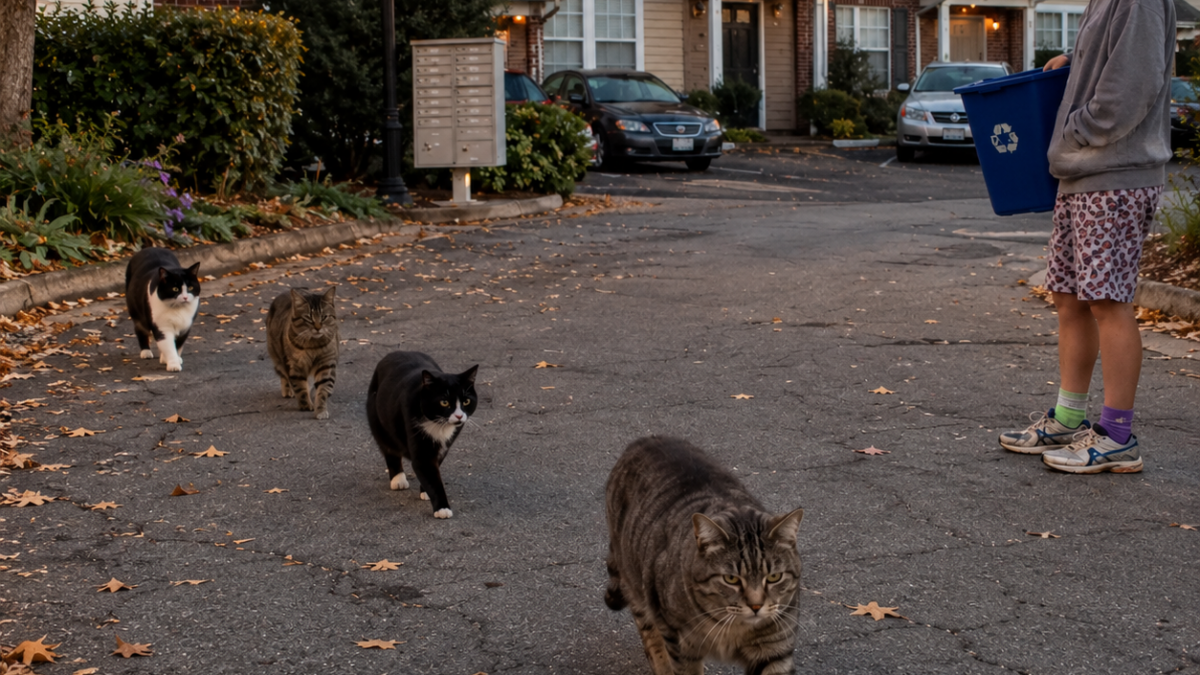
The morning I realized our townhouse community had somehow acquired a leader, a massive gray tabby crossed the courtyard at exactly 6:40 with three other cats following behind him in such perfect order that I stepped out of his way before I even understood why.
For nearly two weeks, I treated his daily patrol like free entertainment—until I discovered where he went every morning, who was waiting for him behind the greenhouse, and why an elderly widower on the corner never missed a single breakfast no matter how cold it was.
Then one afternoon, a single sheet of paper appeared on our community bulletin board, and by the next morning the cats were sitting in front of empty concrete while an old man watched them silently from behind his upstairs curtain.
It had started on a chilly Wednesday.
I was dragging my recycling bin toward the curb in mismatched socks, an oversized hoodie, and the kind of mood that made eye contact feel unreasonable before coffee.
That was when the gray tabby appeared.
He was enormous.
Thick silver stripes.
Broad shoulders.
Scarred ears.
A face that looked permanently disappointed with the standards of everyone around him.
He didn’t hurry.
Behind him walked three cats: a sleek tuxedo, a nervous little tabby, and a fluffy black-and-white cat with half a tail.
None passed him.
None wandered.
They followed.
The gray cat stopped beside the community garden and looked directly at me.
I stopped too.
“Morning.”
He blinked once.
Slowly.
Then turned away.
I stepped aside.
I wish I could say I did it as a joke.
I didn’t.
Something about him suggested I was standing in the middle of an inspection.
That morning I named him Captain Ash.
Our townhouse community sat outside Asheville, North Carolina. It wasn’t glamorous. The sidewalks cracked every winter, one streetlight flickered whenever rain started, and our community mailbox leaned so badly that one day I expected it to simply lie down and give up.
Most of us lived near one another without actually knowing each other.
We waved.
We accepted packages.
We complained about landscaping.
Then we closed our doors.
I worked from home, so Captain Ash became part of my morning routine.
6:40.
Every day.
Sometimes three cats followed him.
Sometimes four.
Once an orange kitten tried to join.
Captain Ash stopped.
Turned.
Stared at him.
The kitten sat down immediately.
I texted a picture to my brother.
He replied:
“That cat definitely owns property.”
I posted another photo online.
“Our neighborhood accidentally elected a feline HOA president.”
People loved him.
“He’s collecting tuna dues.”
“That face says your hedges violate code.”
“I’d rather pay him than my real HOA.”
For the first time in weeks, I laughed hard enough to choke on coffee.
Then I noticed something.
Every patrol ended behind the community greenhouse.
Always.
One evening, curiosity finally won.
I cut behind the greenhouse after checking my mailbox and found Mr. Harold Benson kneeling beside several stainless-steel bowls.
Harold lived alone in the corner townhouse.
Early seventies.
Suspenders.
Polite.
Quiet.
His wife, Martha, had died several years earlier.
Captain Ash sat beside him like a supervisor.
The other cats waited a few feet away.
No fighting.
No crowding.
I smiled.
“So you work for Captain Ash?”
Harold looked up, surprised.
Then he laughed.
It sounded rusty.
“Oh no,” he said. “I work for him.”
I laughed.
“That makes more sense.”
That was how we started talking.
Harold told me he and Martha had begun feeding neighborhood strays nearly fifteen years earlier.
Fresh water.
Measured food.
Clean bowls.
Nothing left out overnight.
“When Martha got sick,” he told me one morning, “the cats still expected breakfast.”
He looked toward Captain Ash.
“After she was gone, they gave me a reason to keep getting dressed.”
I didn’t know what to say.
So I said, “I’m glad they found you.”
Harold nodded.
For several weeks, our mornings became routine.
Then the notice appeared.
NO FEEDING ANIMALS IN COMMON AREAS.
VIOLATIONS MAY RESULT IN FINES.
Harold stood in front of that paper for nearly five minutes.
He didn’t complain.
Didn’t argue.
Didn’t tear it down.
The next morning, Captain Ash arrived at 6:40.
The tuxedo came behind him.
Then the little tabby.
Then the half-tailed cat.
They sat beside the greenhouse.
But there were no bowls.
No breakfast.
Captain Ash stared at the empty concrete.
And when I looked toward Harold’s townhouse, I saw him standing behind the upstairs curtain with one hand pressed against the glass.
That was when I understood the rule hadn’t only taken food away from a few stray cats.
It had taken something much bigger from the man who had been showing up for them every morning for fifteen years.
PART 2
I stood in my kitchen holding a mug I had completely forgotten to drink from.
Outside, Captain Ash remained beside the greenhouse.
The other cats were still there too.
Waiting.
That was what bothered me most.
They did not scatter immediately.
They did not assume breakfast was canceled.
Routine had taught them something different.
Harold always came.
So they waited.
Captain Ash sat nearest the empty patch where the bowls normally appeared.
His tail wrapped tightly around his front paws.
The tuxedo cat kept looking toward Harold’s corner townhouse.
The smaller tabby paced twice, then sat.
The half-tailed cat eventually stretched out beneath the greenhouse fence.
I looked up.
Harold was still behind the curtain.
He could see them.
They couldn’t see him.
I put down the mug and went outside.
The cold hit harder than I expected.
Captain Ash watched me approach.
“Yeah,” I muttered. “I know.”
He gave me that same unimpressed stare.
“I didn’t do it.”
No response.
“I realize that is not a defense.”
He looked past me toward Harold’s house.
I followed his gaze.
The curtain had closed.
That bothered me even more.
I walked over and knocked.
Nothing.
I knocked again.
“Mr. Benson?”
Silence.
Then footsteps.
Slow.
The door opened a few inches.
Harold was already dressed.
Button-down shirt.
Suspenders.
Work pants.
Exactly the way he looked every morning when he went to feed the cats.
Except there was nowhere to go.
“Morning,” I said.
“Morning.”
His voice sounded normal.
Too normal.
I pointed vaguely toward the greenhouse.
“They’re waiting.”
“I know.”
“You’re really going to follow the notice?”
He looked at me.
“They can fine me.”
“How much?”
“I don’t know.”
“So we should find out.”
Harold shook his head.
“I don’t need trouble.”
“Neither do the cats.”
He smiled faintly.
“They’ll find food.”
That sentence irritated me.
Not because it wasn’t partly true.
Street cats are survivors.
They adapt.
They search.
But I had watched Harold measure portions according to which cat needed what.
I had watched him clean every bowl afterward.
I had watched a nervous cat wait until he stepped away before eating.
“Finding food isn’t the same thing.”
Harold lowered his eyes.
“No.”
That was the crack.
I stepped closer.
“Who posted the notice?”
“HOA board, I assume.”
“Did anyone speak to you?”
“No.”
“Anyone complain directly?”
“No.”
“Did they ask how you manage the feeding area?”
“No.”
“Did they ask about vaccinations?”
He looked up.
“You know about those?”
“You told me.”
The local rescue group had trapped, vaccinated, sterilized, and released several of the community cats over the years.
Harold knew which cats had been treated.
Which were new.
Which disappeared.
Which returned.
He had records in a notebook.
Not formal rescue records.
Harold records.
Dates.
Descriptions.
Medication.
Vet visits.
“Heavy gray male, left ear scar.”
That was Captain Ash before I renamed him.
“Black-and-white female, green eyes.”
That was the tuxedo.
“Small striped female, nervous, spayed.”
The little tabby.
“Long-haired male, tail injury healed.”
Half-tail.
Harold knew more about the animals living around our property than our community management knew about most residents.
“We should talk to them.”
Harold shook his head again.
“I’m not fighting with anyone.”
“Neither am I.”
He raised an eyebrow.
That was fair.
I was absolutely preparing to fight with someone.
Not literally.
But emotionally?
Yes.
I went home, opened my laptop, and found the HOA email thread.
Our board wasn’t some faceless corporation.
That almost made it worse.
Five residents.
People I had seen at the mailbox.
People who waved while driving past.
The notice had been issued after “multiple concerns regarding stray animal feeding and sanitation.”
Multiple concerns.
That phrase irritated me immediately.
It could mean five people.
It could mean one person emailing five times.
I wrote a message.
Then deleted it because it sounded angry.
Wrote another.
Deleted that too.
Finally I posted in the neighborhood Facebook group.
I kept it simple.
“I know there are concerns about feeding stray cats near the greenhouse. I’ve recently learned the area has been managed for years by Mr. Benson. Food is served at a fixed time, bowls are removed and cleaned, fresh water is provided, and several of the cats have been vaccinated and sterilized through a local rescue. If there are sanitation issues we should address them, but I think it’s worth understanding the current system before we eliminate it.”
I attached a photograph.
Captain Ash.
Sitting in front of the empty feeding spot.
His expression made the post.
Within ten minutes someone commented:
“He looks like he’s about to sue.”
Another:
“Wait, Harold feeds them?”
Then:
“My kids call the gray one Mayor.”
Then:
“Those cats are fixed. I’ve seen the ear tips.”
Then:
“I thought someone was dumping food overnight. Didn’t know bowls were removed.”
And then the first criticism.
“I’m the person who complained. Cats have been in my flower beds and I’m tired of it.”
The comment came from a resident named Linda Mercer.
I knew Linda.
Everyone did.
Not because she was terrible.
Because she was active.
Very active.
She chaired landscaping meetings.
Organized spring cleanup.
Reported broken streetlights.
Sent emails when garbage cans stayed out too long.
If our neighborhood had elected a human Captain Ash, it might have been Linda.
I replied carefully.
“I understand the frustration. Do you think stopping the controlled feeding will keep the cats away?”
She answered:
“It will stop attracting them.”
Then someone from the rescue organization joined the discussion.
That changed the tone immediately.
The woman introduced herself as Kara.
She explained community-cat management.
Sterilization.
Vaccination.
Controlled feeding.
Monitoring new arrivals.
Removing food after meals.
The risks of simply stopping care without another plan.
She did not attack Linda.
That helped.
She also wrote:
“If the colony is already established, unmanaged hunger can increase roaming and garbage scavenging. A clean feeding schedule can actually make the group easier to monitor.”
People started asking questions.
Real ones.
“Are they all feral?”
“No.”
“Can some be adopted?”
“Possibly.”
“Who pays for vet care?”
“Mostly donations and rescue funds. Harold has covered some himself.”
That last sentence changed everything.
I had not known that.
Apparently neither had anyone else.
Someone tagged Harold.
He never responded.
He didn’t use Facebook much.
By lunchtime, more than sixty comments had appeared.
Some supportive.
Some skeptical.
A few dramatic.
One person suggested relocating all the cats to a farm.
Kara explained why “just move them somewhere” was not a simple or necessarily humane solution.
Another resident offered to pay for food.
Someone volunteered to build a proper station.
Then a retired carpenter named Jim Collins wrote:
“I can build a weatherproof feeding structure that looks better than those bowls sitting out. If sanitation is the real concern, let’s solve sanitation.”
That comment shifted the entire conversation.
A problem had become a project.
By midafternoon, Linda returned.
“I’m not trying to hurt the cats. I didn’t know anyone was managing them. My complaint was about mess and animals digging near my patio.”
That mattered.
Because it would have been easy to turn her into the villain.
The person who ruined an old widower’s mornings.
But once people explained what was happening, she listened.
Not instantly.
Not perfectly.
But enough.
I replied:
“Fair. Maybe we can set up the feeding farther from patios and add deterrents where needed.”
Kara agreed.
Jim added:
“I can build this Saturday.”
Then someone wrote:
“I’ll donate wood.”
Another:
“I can bring food.”
Another:
“I’ve got outdoor bowls.”
Then:
“I’ll do flowers.”
That one made me laugh.
Of course we had somehow turned stray-cat management into landscaping.
I walked to Harold’s house around four.
He answered wearing the same clothes.
“Did you see the Facebook group?”
“No.”
“You should.”
“I don’t like Facebook.”
“That is the healthiest thing you’ve ever said.”
He smiled slightly.
I held out my phone.
“Read.”
He put on his glasses.
Scrolled.
His expression changed.
Not much.
Harold was a man built for small emotions.
But I saw it.
Surprise.
Then confusion.
Then discomfort.
“They don’t have to do all this.”
“I know.”
“Jim shouldn’t spend money.”
“He’s not.”
“Someone should tell him—”
“Harold.”
He stopped.
“Maybe let people help.”
His face changed again.
That landed somewhere deeper.
“I’ve managed fine.”
“I know.”
“Martha and I did it for years.”
“I know.”
“I don’t need anyone feeling sorry for me.”
“That isn’t what this is.”
He looked at the phone.
“Then what is it?”
I thought about the question.
“It’s everybody realizing you were doing something none of us noticed.”
He was quiet.
I continued.
“And now that we noticed, maybe it doesn’t have to be only yours.”
Harold took off his glasses.
Looked toward the greenhouse.
Captain Ash was gone by then.
So were the others.
The empty space remained.
“Martha liked cats more than I did,” he said.
I smiled.
“I don’t believe you.”
“It’s true.”
“She made you feed them?”
“No.”
“She made you clean bowls?”
“No.”
“She made you keep fifteen years of notes?”
He looked at me.
“All right.”
I laughed.
That was the first time since the notice that he sounded like himself.
Saturday arrived colder than expected.
I walked behind the greenhouse at eight carrying coffee and expecting maybe four people.
There were eleven.
Jim had lumber stacked beside the fence.
Kara from the rescue brought information sheets.
Linda arrived carrying two large planters.
A couple from Building C had bags of cat food.
Someone brought screws.
Someone else brought paint.
Harold stood several feet away looking overwhelmed.
Captain Ash sat on a retaining wall.
Watching.
I walked over to Harold.
“You okay?”
“This is ridiculous.”
“You’re crying.”
“I am not.”
“You definitely are.”
“It’s cold.”
“Your eyes only get cold when people are kind?”
He looked at me.
“Go bother someone else.”
I handed him coffee.
The feeding station took most of the morning.
Jim designed it with a raised platform and a small roof.
Enough protection from rain.
Open enough that cats wouldn’t feel trapped.
Easy to clean.
Placed farther from the patios that had caused complaints.
Kara helped us choose the location.
“We want predictable but not too close to resident doors.”
Linda pointed toward the garden edge.
“What about there?”
Kara assessed the distance.
“That could work.”
Linda looked at me.
“I’m not anti-cat.”
“I didn’t say you were.”
“You thought it.”
“I thought you were anti-breakfast.”
She almost smiled.
“Maybe.”
By eleven, the structure stood finished.
Someone painted it a muted green so it matched the greenhouse.
Then a teenager named Emma carried over a wooden sign she had painted the night before.
CAPTAIN ASH’S BREAKFAST CLUB
NEIGHBORHOOD MEMBERS WELCOME
I laughed.
Harold didn’t.
He just stared.
Emma’s smile faded.
“You don’t like it?”
Harold took off his glasses.
“No.”
Her face dropped.
Then Harold wiped one eye.
“I like it too much.”
Emma relaxed.
Everyone became very interested in tools, paint cans, and anything else that allowed us to pretend an elderly man was not crying beside a cat-feeding station.
Captain Ash jumped down from the wall.
He walked toward the structure.
Sniffed one corner.
Walked inside.
Sat.
Jim folded his arms.
“Well?”
Captain Ash looked at him.
Jim nodded.
“Approved.”
Someone laughed.
Harold crouched slowly.
Captain Ash came out.
Rubbed once along Harold’s shin.
Then sat beside him.
Harold rested one hand on the gray cat’s back.
“I didn’t think anyone noticed,” he said.
His voice was so quiet only a few of us heard.
I looked around.
At the people.
The bowls.
The sign.
The flowers Linda had placed along one side.
“We didn’t,” I said.
Harold looked at me.
“Not soon enough.”
Captain Ash leaned harder against his leg.
Then someone opened a bag of food and every emotional moment in the area ended immediately.
Cats appeared from places I did not know existed.
The tuxedo first.
Then half-tail.
Then the nervous little tabby.
The orange kitten from the rejected application returned.
Captain Ash looked at him.
The kitten stopped.
Everyone laughed.
Harold pointed toward an empty bowl.
“Let him eat.”
Captain Ash stared at the kitten.
The kitten moved forward.
“That’s a promotion,” I said.
Harold smiled.
“Probation.”
The feeding program resumed that day.
But it was different now.
Harold was still there every morning.
He insisted.
But he no longer carried everything himself.
We created a rotating schedule.
Fresh water.
Food.
Cleaning.
Supply runs.
Kara coordinated medical monitoring.
New cats were assessed.
Some were social enough for foster homes.
One tuxedo kitten was adopted within three weeks.
An older orange male received dental treatment.
Half-tail turned out to have an old healed injury and absolutely no interest in indoor life.
Captain Ash remained impossible to categorize.
Kara tried to assess him.
He sat on the other side of the trap and looked insulted.
“He’s been neutered already,” she said.
“Obviously.”
She looked at me.
“Why obviously?”
“He’s management.”
“That is not a medical category.”
“It should be.”
Eventually, she gained enough trust to check his ear and verify he had indeed been part of an earlier trap-neuter-return effort.
Harold knew the approximate year.
Of course he did.
“2019,” he said.
“You remember?”
“He disappeared for two days.”
Kara checked records later.
2019.
Correct.
That impressed her.
Harold shrugged.
“You remember when someone doesn’t show up.”
I saw Martha inside that sentence.
So did Kara, I think.
She didn’t ask.
Neither did I.
Winter deepened.
The feeding station became part of the community.
Not everyone loved it.
That would have been unrealistic.
A few residents still complained about cats near cars.
Someone worried about wildlife.
Kara helped us adjust the feeding schedule so food didn’t remain available for long periods.
We added simple humane deterrents near garden beds.
Harold kept meticulous records.
Linda, to everyone’s surprise, became one of the strongest supporters of keeping the area clean.
One morning she caught me forgetting to wipe a bowl completely.
“That has residue.”
I stared at her.
“You reported this whole operation.”
“And now I’m improving it.”
Harold laughed.
“That sounds like Linda.”
She pointed at him.
“You missed one yesterday too.”
“I did not.”
“I have photographic evidence.”
I looked between them.
“This is the most HOA thing I’ve ever witnessed.”
Captain Ash sat nearby washing one paw.
Nobody asked for his opinion.
We assumed he disapproved.
The bigger change happened between people.
At first, the Saturday build had felt like a one-time community event.
Then people kept talking.
Not online.
Outside.
Someone would stop by during breakfast.
“Morning, Harold.”
He would answer.
“How’s Ash?”
“Judgmental.”
“Good.”
Neighbors learned the cats’ names.
Then each other’s.
I learned Linda’s husband had Parkinson’s disease.
That explained why she had become so intense about keeping paths and patios clear.
Tripping hazards mattered in their house.
Suddenly her complaints about cats knocking over garden items sounded different.
Not petty.
Practical.
We moved the station farther from their walkway.
She brought Harold soup the following week.
Harold learned Jim had recently retired and hated having nothing to build.
So Harold started giving him projects.
A windbreak for the feeding station.
A small insulated shelter.
Then another.
I accused him of exploiting free labor.
Jim said, “I’m unionizing.”
Harold replied, “Talk to Captain Ash.”
I nearly fell over laughing.
The rusty laugh I had heard the first evening became easier too.
That changed Harold almost as visibly as anything.
Before the feeding-station dispute, he had been someone people saw but rarely knew.
Afterward, conversations found him.
A woman walking her dog stopped each morning.
A couple from the next row of townhouses brought coffee on Sundays.
Emma, the teenager who painted the sign, started helping twice a week before school.
Harold taught her how to tell which cats had already been sterilized by their tipped ears.
He showed her how to approach frightened animals without staring.
“Don’t chase.”
“I’m not.”
“You’re thinking about chasing.”
“How do you know?”
“You’re seventeen.”
She rolled her eyes.
He smiled.
I watched them from a distance one morning and thought about his sentence.
After Martha was gone, the cats gave me a reason to keep getting dressed.
Maybe now people were giving him another one.
January brought the first heavy snow.
Our roads were terrible.
The HOA sent warnings about ice.
People stocked groceries like Asheville was expecting the apocalypse.
I looked outside at 6:30.
Snow.
Wind.
No Harold.
Good.
At 6:37, his door opened.
“No.”
I pulled on boots and ran across the courtyard.
Harold was wearing a heavy coat and carrying a container.
“What are you doing?”
“Breakfast.”
“You are seventy-something years old.”
“Accurate.”
“There’s ice.”
“Also accurate.”
“You are not walking behind the greenhouse.”
“The cats need—”
“I’ll do it.”
“You don’t know the portions.”
“I have watched you for months.”
“The little striped one gets less dry—”
“I know.”
“The black-and-white one—”
“Harold.”
He stopped.
Snow collected on his cap.
“You don’t have to do every morning yourself anymore.”
He looked toward the greenhouse.
Then back at me.
“I know.”
But his face said something else.
If he stayed inside, who was he?
For fifteen years, weather had not canceled that responsibility.
Martha gone.
Illness.
Cold.
Loneliness.
Cats still expected breakfast.
I softened my voice.
“Come with me.”
“You just said—”
“Come. But I’m carrying everything.”
That was the compromise.
We walked slowly.
I stayed on the icy side.
Harold used my arm once.
Pretended he didn’t.
Captain Ash was already waiting under the shelter.
Snow dusted his back.
“Idiot,” I said.
The cat looked at me.
“I meant both of you.”
Harold laughed.
We fed the cats.
Then Emma’s father appeared carrying coffee.
Then Jim.
Then Linda in a bright red coat.
“What are you all doing out here?” I asked.
Linda held up a bag.
“Salt for the path.”
Jim had a shovel.
Within twenty minutes, half the area was cleared.
Harold stood beneath the roof of the feeding station, coffee in his hands.
I looked at him.
“Still think you work alone?”
He looked at the people.
Then at Captain Ash.
“No.”
That morning became a pattern during bad weather.
Somebody checked on Harold.
Somebody checked the station.
Somebody shoveled.
Someone brought food.
Not because the cats demanded a community.
Because caring for the cats created reasons for people to notice one another.
That distinction mattered.
In February, Harold missed breakfast.
That had never happened.
At 6:45, I looked through my window.
Captain Ash waited.
Emma was there filling water.
No Harold.
I called him.
No answer.
Something in my chest tightened.
I went to his house.
Knocked.
Nothing.
I knocked harder.
“Harold?”
No response.
I tried calling again.
Inside, faintly, I heard his phone.
I called Jim.
Then emergency services.
I hated how quickly my imagination turned cruel.
Fall.
Heart attack.
Stroke.
Alone.
It took only minutes for the paramedics to arrive.
They eventually entered with emergency access.
Harold was upstairs.
Conscious.
He had fallen getting out of bed and couldn’t stand.
Nothing broken.
But he was weak and dehydrated from what turned out to be an infection he had ignored for days.
Of course.
The man monitored every cat for sneezing but apparently considered his own fever irrelevant.
At the hospital, I stood beside his bed.
“You are unbelievable.”
He looked exhausted.
“That’s rude.”
“You had a fever.”
“It wasn’t bad.”
“It was 102.”
“Numbers exaggerate.”
“You couldn’t stand.”
“I fell.”
“You didn’t call anyone.”
“I thought I’d rest.”
“You missed breakfast.”
That made him quiet.
Then:
“Did they eat?”
I stared.
“Yes.”
“All of them?”
“Yes.”
“Captain Ash?”
“Yes.”
He relaxed visibly.
I sat.
“Do you understand how insane that is?”
“What?”
“You’re in a hospital bed and the first thing you ask is whether the cats ate.”
“They’re part of my routine.”
“No. You’re part of theirs.”
He looked at me.
“And now so are we.”
That silenced him.
I continued.
“You built the routine. You don’t have to carry it alone anymore.”
Harold looked toward the window.
“I don’t like needing people.”
There it was.
The actual problem.
“Why?”
He didn’t answer.
“Because Martha got sick?”
His jaw tightened.
I instantly regretted asking.
“Sorry.”
“No.”
He took a slow breath.
“When someone needs you long enough, you get used to being the one who handles things.”
I waited.
“Then she got worse.”
He looked down at his hands.
“I couldn’t fix that.”
I said nothing.
“So after she died, I handled what I could.”
His voice became quieter.
“Food bowls. Water. Vet visits. Little things.”
Captain Ash.
The colony.
Fifteen years of little things.
Things with solutions.
Things that arrived hungry and could leave full.
Things that needed treatment and sometimes got better.
I finally understood why the cats mattered beyond routine.
They gave Harold problems he could solve after living through the one problem he couldn’t.
I leaned back.
“That doesn’t mean you failed her.”
Harold looked at me.
“I didn’t say that.”
“You didn’t have to.”
He looked away.
We sat in silence.
Then he said, “Martha would have liked you.”
I smiled.
“She had questionable judgment?”
“Very.”
That was how Harold survived emotional conversations.
One sincere sentence.
Then retreat.
I let him.
Harold stayed in the hospital three nights.
Captain Ash continued his rounds.
6:40.
The crew followed.
Breakfast happened.
Emma took mornings before school.
I covered one.
Jim another.
Linda handled cleaning.
Harold received photographs from all of us.
On the second day, I sent a picture of Captain Ash staring into the camera.
Harold replied:
HE LOOKS THINNER.
I wrote:
HE ATE TWO SERVINGS.
Harold:
CHECK HIS TEETH.
I replied:
YOU ARE BANNED FROM REMOTE MANAGEMENT.
Ten minutes later:
AND MAKE SURE HALF-TAIL GETS WET FOOD.
I ignored him.
Then did exactly that.
When Harold came home, nearly everyone knew.
Not because we made an announcement.
Because neighborhoods work differently once people actually pay attention.
Linda saw the car.
Told Jim.
Jim told Emma’s father.
By evening, soup, bread, groceries, and one deeply unnecessary pie appeared outside Harold’s door.
He looked at the collection.
“This is excessive.”
“Eat the pie.”
“I don’t like pie.”
“You’re lying.”
“I am.”
Captain Ash arrived at his front step.
That was unusual.
He normally met Harold near the greenhouse.
Harold opened the door.
Captain Ash stood there.
Neither moved.
Then the cat walked inside.
I froze.
Harold froze.
Captain Ash sniffed the rug.
Walked five feet into the entryway.
Looked around.
Then turned and left.
I stared at Harold.
“Did he just conduct a wellness inspection?”
Harold leaned against the door.
“Apparently I passed.”
It became neighborhood legend by evening.
Captain Ash had checked on Harold personally.
Online, my brother wrote:
“Management visited the employee.”
I showed Harold.
He shook his head.
“You people have too much time.”
Maybe.
But laughter had started living in Harold’s house again.
That felt useful.
Spring arrived.
The feeding station got flower boxes.
Linda insisted.
Harold complained flowers served no operational purpose.
Linda ignored him.
Captain Ash slept beside them.
The orange kitten finally graduated from probation and joined the regular breakfast group.
Emma named him Biscuit.
Harold hated the name.
Biscuit did not care.
Kara found him a foster home.
Then an adopter.
Emma cried when he left.
Harold told her, “That’s the point.”
“I know.”
“Then why are you sad?”
“Because I love him.”
Harold nodded.
“Those things can happen together.”
I heard that from a few feet away and pretended not to.
Some sentences belong to the person receiving them.
Captain Ash himself remained outdoors.
Several residents tried to convince Harold to bring him inside.
“He likes it here.”
“He would be safer.”
“Maybe.”
“Cars.”
“I know.”
“Coyotes.”
“I know.”
“Cold.”
“I know.”
Harold did not dismiss the concerns.
Neither did Kara.
They attempted a foster placement.
Captain Ash hated it.
He refused food for nearly a day.
Paced.
Yowled.
Pressed against windows.
The foster home was quiet and experienced.
It wasn’t enough.
After veterinary evaluation and careful discussion, the rescue group determined he might be best managed as a monitored community cat unless circumstances changed.
Some people disagreed.
That was okay.
Animal welfare decisions are rarely simple.
Captain Ash returned.
At 6:40 the next morning, he resumed patrol as though nobody had briefly attempted to alter the political structure of the neighborhood.
I watched him cross the courtyard.
Tuxedo behind.
Half-tail.
A new calico.
Captain Ash paused.
Looked at me.
“You lasted twenty-two hours indoors.”
Slow blink.
“That is not impressive.”
He continued.
Harold stood at the station waiting.
Life resumed.
Then came the HOA annual meeting.
I had forgotten about the original notice until the agenda appeared.
“Community animal management policy.”
Linda saw the line too.
“This could be interesting.”
I looked at her.
“You are enjoying this now.”
“A little.”
The meeting took place in the clubhouse.
More residents attended than usual.
Probably because people had opinions about cats.
Our board president, Marcy, opened the discussion carefully.
“When the original no-feeding notice was issued, the board did not have full information about the existing feeding routine.”
That was bureaucratic language for:
We posted first and asked questions later.
She continued.
“Since then, residents and the rescue organization have implemented a controlled program.”
Kara presented the numbers.
Cats sterilized.
Vaccinated.
Medical cases treated.
Adoptions.
Current colony size.
Feeding schedule.
Cleaning routine.
Wildlife precautions.
I watched people listen.
Data changed the conversation.
The colony was smaller.
Not larger.
Complaints about trash had decreased.
Uncontrolled scavenging had decreased.
The station was cleaner than the area had been before.
Then Linda stood.
That surprised everyone.
She was the original complainant.
“I want to say something.”
Marcy nodded.
Linda looked around.
“I complained because cats were digging near my patio and because I thought food was being left outside.”
She glanced toward Harold.
“I didn’t know what Mr. Benson was doing.”
Harold shifted uncomfortably.
“I still don’t want cats in my planters.”
People laughed.
Linda smiled.
“But I was wrong to assume there wasn’t already a responsible system. The new station solved most of my concerns.”
She sat.
That mattered more than if we had defeated her.
There was no revenge speech.
No humiliation.
Just someone admitting they had incomplete information.
Then Marcy proposed the new rule.
Controlled community-cat feeding permitted only at the designated station in coordination with the rescue group.
No unattended food.
Clean bowls.
Medical monitoring.
Sterilization.
Reasonable mitigation for resident concerns.
The board voted.
Approved.
Harold did not celebrate.
He nodded once.
Captain Ash, obviously, was not present.
I texted my brother:
“Feline regime formally recognized.”
He replied:
“Historic day for democracy.”
I laughed during the meeting and got a dirty look from Marcy.
Afterward, Harold and I walked home.
“You won,” I said.
“I wasn’t trying to win.”
“I know.”
“That’s important.”
“Why?”
“Because I don’t want this turning into me against the HOA.”
He looked at the path.
“Linda wasn’t trying to hurt me.”
“No.”
“She had a complaint.”
“Yes.”
“We fixed it.”
I smiled.
“You are annoyingly reasonable.”
“Martha said the same thing.”
“Did she mean it?”
“No.”
We reached the greenhouse.
Captain Ash appeared from beneath a hedge.
Harold crouched.
“Your permit came through.”
The cat rubbed his arm.
I smiled.
“He was worried.”
“Terrified.”
Summer became easier.
Harold’s health improved.
He started walking farther.
Sometimes I joined him.
Not because he needed assistance.
Because somewhere along the way, he became my friend.
That still surprised me.
Before Captain Ash, I knew him as “the older man in the corner townhouse.”
He probably knew me as “the woman with too many delivery boxes.”
Now I knew Martha’s favorite flowers were irises.
That Harold had worked thirty-eight years repairing industrial equipment.
That he hated cinnamon.
That he pretended not to like television but watched old detective shows every Thursday.
That he had a daughter who lived in Tennessee, not a son like I had somehow assumed.
That they spoke every week.
That he kept Martha’s old gardening gloves in a drawer even though they had holes in the fingers.
He knew things about me too.
That remote work made me lonely.
That I called my brother when I was stressed.
That I hadn’t made many friends after moving there.
That I sometimes stayed inside three days without realizing it.
“You’re becoming a stray,” he told me once.
I looked at him.
“Excuse me?”
“You appear when food is involved.”
“That’s offensive.”
“And accurate.”
Captain Ash sat nearby.
I pointed.
“You’ve been spending too much time with him.”
Harold smiled.
He was right, though.
The cats had given Harold a reason to leave his house.
Then Harold and the cats had given me one.
The neighborhood changed my routine too.
I began working on my laptop outside sometimes.
People stopped.
Talked.
I learned names.
Kids.
Dogs.
Who needed help carrying groceries.
Who traveled often.
Who had spare keys with whom.
Community formed less like construction and more like moss.
Slowly.
In corners.
Then suddenly everywhere.
Autumn brought another scare.
Captain Ash disappeared.
One morning, 6:40 came.
No gray tabby.
The tuxedo arrived.
Half-tail.
Calico.
No Ash.
Harold noticed immediately.
“He’s late.”
I looked at him.
“Maybe hunting.”
“He doesn’t hunt before breakfast.”
“You know his calendar now?”
Harold ignored me.
7:00.
No Captain Ash.
7:30.
Still nothing.
Harold searched after breakfast.
So did Emma.
I worked half a day with my phone beside me.
No update.
That evening, Kara brought a humane trap.
We checked roads.
Sheds.
Under porches.
Behind dumpsters.
No Ash.
Harold became quieter with each hour.
“Cats disappear sometimes,” I said carefully.
“I know.”
That was why the sentence hurt.
Street life remained risky.
No amount of neighborhood affection could remove that.
Cars.
Wildlife.
Illness.
Injury.
People.
Unknowns.
At 10:30 that night, someone posted in the neighborhood group:
“Gray tabby under my deck. Looks hurt.”
I was out the door before finishing the post.
Harold beat me there.
Captain Ash was hiding beneath the deck of a townhouse near the entrance.
He growled when we approached.
Good.
Alive.
Kara arrived.
With food and patience, we got him contained.
At the emergency vet, X-rays showed a fractured pelvis and other soft-tissue injuries consistent with blunt trauma.
Possibly a car.
Nobody saw what happened.
Harold sat in the waiting room holding his cap.
“What do we do?”
The veterinarian explained.
Pain control.
Strict rest.
Monitoring.
Possible surgery depending on stability and fracture pattern.
Recovery would require confinement.
That was the irony.
Captain Ash, who had rejected indoor living, now had no choice.
Harold looked at me.
“He can stay with me.”
The veterinarian asked about his home.
Space.
Other animals.
Ability to keep the cat confined.
Harold answered every question.
“He may hate you,” I said.
Harold looked at me.
“He already works for me.”
“Other way around.”
“Right.”
Captain Ash was discharged into Harold’s care after stabilization with strict instructions.
Harold set up a recovery room.
Captain Ash hated it.
With enormous commitment.
He complained.
Refused affection.
Stared at doors.
Knocked over water once.
Attempted an escape that lasted approximately three seconds before pain changed his mind.
Harold sat with him every morning at 6:40.
That detail destroyed me.
Even though the other cats were outside eating, Harold gave Captain Ash breakfast inside first.
Then Emma or I managed the outdoor station.
Captain Ash would sit near the window, ears turning toward the sounds.
“He thinks we’re replacing him,” I said.
Harold looked offended.
“Nobody could.”
Recovery took weeks.
Then months.
Captain Ash adapted better than expected.
Maybe because Harold was there.
Maybe because pain reduced his interest in patrols.
Maybe because indoor warmth turned out to be tolerable when combined with regular food.
He began sleeping on a chair near Harold’s window.
The first time I saw it, I stopped.
“Is that his chair?”
Harold said, “Temporarily.”
The chair had a blanket.
“What’s the blanket for?”
“Furniture protection.”
“Of course.”
Captain Ash opened one eye.
I smiled.
“Employee benefits improved.”
When the veterinarian finally cleared him for more movement, we faced a decision.
Release him back outdoors?
Transition to supervised access?
Keep him inside permanently if he tolerated it?
Kara wanted to assess carefully.
Captain Ash had now spent enough time inside to form routines.
He used the litter box.
Ate well.
No longer panicked at confinement.
He watched outdoor cats through the window.
But he didn’t throw himself at the door anymore.
Harold pretended not to care.
I knew better.
“What do you want?”
Harold rubbed his chin.
“What’s best for him.”
“That is not what I asked.”
He looked toward Captain Ash.
The cat was asleep in Martha’s old armchair.
That seemed significant.
“I’d like him to stay.”
There.
Simple.
“But if he’s miserable—”
“He doesn’t look miserable.”
“He used to patrol.”
“Managers retire.”
Harold smiled.
Kara designed a gradual trial.
Captain Ash stayed indoors.
Supervised screened porch time.
No free roaming.
His pelvis had healed, but future risk remained.
We watched for stress.
None beyond normal Captain Ash-level dissatisfaction.
He continued eating.
Playing slightly.
Sleeping deeply.
Demanding breakfast.
Eventually, the decision became obvious.
Captain Ash retired from active neighborhood patrol.
The community lost its field supervisor.
Harold gained a roommate.
The first morning after everyone accepted that arrangement, I stood outside at 6:40.
The tuxedo crossed the courtyard.
Half-tail behind.
Calico.
No Captain Ash.
For a moment, the old procession looked wrong.
Then I glanced toward Harold’s window.
Captain Ash sat inside.
Looking out.
Harold stood behind him holding coffee.
I waved.
Harold waved.
Captain Ash did not.
Retirement had not improved his manners.
The younger orange cat who had once been rejected from the patrol was gone to a home by then, so no obvious successor appeared.
The colony became less hierarchical.
At least to human eyes.
The joke changed.
Captain Ash became “Chairman Emeritus.”
My brother wrote:
“Still controls the board remotely.”
Harold printed that one.
Taped it to the refrigerator.
Captain Ash’s indoor life surprised everyone.
He loved radiators.
Despised vacuum cleaners.
Accepted Harold completely.
Tolerated me.
Hated the mail carrier through the window.
Refused most toys except a fabric mouse with no tail.
Slept on Harold’s bed only when he thought nobody was watching.
We caught him.
Frequently.
Harold started smiling more.
Not big smiles.
Harold smiles.
Slight lift.
Longer eyes.
But enough.
One evening I stopped by with groceries.
Harold was in the living room.
Captain Ash lay across his lap.
Actually across it.
The enormous gray tabby who once made kittens stop walking simply by looking at them was asleep with his head against Harold’s stomach.
I stopped at the doorway.
“Oh.”
Harold immediately looked defensive.
“He climbed up.”
“I said nothing.”
“He does this sometimes.”
“I said nothing.”
“He’s heavy.”
“I’m still saying nothing.”
Captain Ash opened one eye.
Harold scratched behind his ear.
I put the groceries on the counter.
Martha’s photograph stood nearby.
She was holding a small calico cat in the picture.
I had seen it before.
That evening, it felt different.
The cats had outlived Martha.
They had kept Harold moving after grief.
Then one of them had moved inside and become family again.
Maybe circles close in strange ways.
A year after the original feeding ban, someone posted the old notice in our Facebook memories.
NO FEEDING ANIMALS IN SHARED SPACES.
A neighbor commented:
“Hard to believe this started Breakfast Club.”
Another:
“Best complaint we ever had.”
Linda replied:
“I expect royalties.”
I laughed.
What had felt like the central conflict at the time had become the catalyst.
That didn’t mean the ban was good.
It meant the response transformed it.
If we had simply attacked the board, maybe everyone would have dug in.
If Linda had refused to listen, maybe the conflict would have become ugly.
If Harold had stopped permanently, maybe the cats would have scattered.
Instead, people talked.
Built.
Adjusted.
Admitted mistakes.
Created something better.
There was no dramatic revenge.
Not really.
The most satisfying reversal was that the notice designed to stop one man from feeding cats ended with the community formally supporting a cleaner, safer, shared program.
The rule did not defeat Harold.
It accidentally revealed him.
That was better than revenge.
The neighborhood finally saw what one quiet person had been carrying.
Then refused to let him carry it alone.
Another winter came.
Captain Ash stayed indoors.
He hated snow through the window rather than experiencing it personally.
Good.
Harold’s health remained stable.
We still checked on him after storms.
Not because he was helpless.
Because he was ours now.
That sounds possessive.
I mean it lovingly.
People belong to communities in the sense that absence becomes noticeable.
That is what had changed most.
Before Captain Ash, someone could disappear for days and neighbors might assume they were busy.
Afterward, we noticed.
Linda didn’t pick up a package?
Someone texted.
Jim’s truck stayed gone overnight unexpectedly?
Someone asked.
I failed to appear outside for nearly a week during a brutal work deadline?
Harold knocked on my door.
I opened wearing the same hoodie I had worn two days earlier.
He looked at me.
“You alive?”
“Barely.”
“Have you eaten?”
“Yes.”
“What?”
I thought.
“That is not a convincing pause.”
He handed me soup.
I stared.
“You’ve become my mother.”
“Eat.”
Captain Ash was waiting inside Harold’s house, probably preparing an invoice.
I ate.
That kind of care became normal.
Nobody called it community building.
Nobody needed to.
The feeding station remained.
The number of cats gradually decreased.
Exactly what a well-managed community-cat program hopes for.
Some were adopted.
Some aged.
Some disappeared.
New cats were trapped, sterilized, evaluated.
Not every outcome was happy.
One older cat developed severe kidney disease.
Kara and the veterinary team eventually made the decision to euthanize when treatment could no longer keep him comfortable.
Harold attended.
He came home very quiet.
I sat with him.
“His name was Jasper,” he said.
I hadn’t known.
“Since when?”
“Before you moved here.”
“How long?”
“Eleven years.”
That stunned me.
“He was one of Martha’s?”
Harold nodded.
Captain Ash jumped onto the couch beside him.
Not his lap.
Beside him.
Harold rested one hand on the gray fur.
“I suppose there aren’t many left from then.”
I didn’t offer false comfort.
That is the cost of showing up for animals year after year.
Eventually, you outlive them.
Or they outlive part of you.
Harold knew that better than anyone.
“I’m sorry,” I said.
He nodded.
Then after a long silence:
“He ate good food.”
I smiled sadly.
“Yes.”
“He had treatment.”
“Yes.”
“He wasn’t alone.”
“No.”
Harold looked at Captain Ash.
“That has to be enough sometimes.”
I thought about Martha.
Maybe he was talking about more than Jasper.
I did not ask.
We sat.
Spring returned again.
Emma graduated high school.
She had been accepted into a college veterinary technician program.
Harold pretended he had nothing to do with it.
Emma disagreed.
At her graduation party, she handed him a card.
He read it.
His eyes immediately filled.
“What did she write?” I asked later.
“Private.”
“Fair.”
He put the card into his shirt pocket.
Captain Ash’s Breakfast Club had accidentally produced a veterinary professional.
That felt absurdly fitting.
Emma left in August.
Before she went, she visited Harold.
Captain Ash allowed her to scratch his head.
Rare honor.
“You better still be here when I come back,” she told him.
Harold said, “Which one of us?”
Emma’s face changed.
“Both.”
Harold smiled.
“We’ll do our best.”
I hated that conversation.
Time had become visible.
Harold was older.
Captain Ash was older.
So was everyone.
Communities change because life changes.
People move.
Animals die.
Children leave.
New residents arrive who don’t know the original story.
That worried me for a while.
What happens when nobody remembers why the feeding station exists?
Then I realized systems matter.
Kara had helped document the program.
The HOA policy existed.
Volunteers had schedules.
Harold’s notebook had been transferred into actual rescue records.
The work no longer depended on memory alone.
That might have been the biggest achievement.
Care became infrastructure.
Harold laughed when I used that phrase.
“Sounds expensive.”
“It means you can retire.”
“I am retired.”
“From cats.”
“No.”
Of course not.
He still visited the station.
Just less often.
Captain Ash watched from home.
Harold called it “executive oversight.”
The neighborhood joke refused to die.
A new family moved into Building B.
Their eight-year-old daughter saw the sign.
“Who’s Captain Ash?”
Her mother didn’t know.
I happened to be nearby.
I pointed toward Harold’s window.
“He’s inside.”
The girl stared.
“The cat owns a house?”
“Basically.”
Her eyes widened.
I decided not to correct it.
Within two days, every child on the block believed Captain Ash owned Harold’s townhouse.
Harold did nothing to stop the rumor.
One afternoon, the girl knocked and asked if she could meet him.
Harold looked at me.
“You started this.”
“Absolutely.”
Captain Ash appeared.
The girl whispered, “He’s huge.”
Harold nodded.
“He used to be bigger.”
“That’s impossible.”
Captain Ash sat.
The girl crouched carefully.
“Can I pet him?”
“If he comes to you.”
She held out one finger.
Captain Ash sniffed.
Then moved away.
The girl smiled anyway.
“He’s busy.”
“Always.”
The next morning she left a hand-drawn sign at the feeding station.
CAPTAIN ASH PROTECTS THE NEIGHBORHOOD.
I showed Harold.
He looked at the drawing.
The cat had a cape.
“Accurate?” I asked.
“No.”
“Needs bigger shoulders?”
Harold laughed.
Later that year, Harold’s daughter, Claire, visited.
I had met her only once.
She lived several hours away and came more often after his hospital stay.
She stood behind the greenhouse with me while Harold cleaned bowls.
“You’re the neighbor,” she said.
“That sounds ominous.”
“The one Dad talks about.”
“He talks about me?”
“More than he admits.”
I smiled.
She watched him.
“I worried about him after Mom died.”
“I can imagine.”
“He wouldn’t move closer to me.”
“Also easy to imagine.”
“He said he had responsibilities.”
I looked toward the cats.
“You thought he meant the house?”
“I thought he was being stubborn.”
“He was.”
She laughed.
Then became serious.
“Thank you.”
“For what?”
“For noticing him.”
That word struck me.
Not helping.
Not saving.
Not fixing.
Noticing.
I looked at Harold.
Captain Ash had first made me notice him.
The giant gray cat marched across a courtyard and accidentally introduced me to a man who had been living fifty yards from me for years.
“I think the cats did that.”
Claire smiled.
“He’d agree.”
There was no dramatic ending waiting for us.
That became important to accept.
The story did not build toward one final confrontation.
The feeding ban had been resolved.
The community had changed.
Captain Ash was safe indoors.
Harold was no longer isolated.
What followed was life.
And life is made mostly of ordinary afternoons.
Harold teaching a child how to refill a water bowl.
Linda arguing about flower placement.
Jim repairing the shelter roof after a storm.
Kara bringing a new cat for assessment.
Me drinking coffee outside instead of alone at my desk.
Captain Ash asleep in Martha’s chair.
One Thanksgiving, Harold came to dinner at my townhouse because Claire was visiting her husband’s family and couldn’t arrive until Friday.
“I don’t need rescuing,” he said when I invited him.
“It’s dinner.”
“I have food.”
“I’m cooking too much.”
“You always cook too much?”
“No. I’m manipulating you.”
“That sounds more honest.”
He came.
Captain Ash stayed home.
Harold returned after dessert and later texted:
ASH IS ANGRY.
I wrote:
HE HAD DINNER.
Harold:
THAT IS NOT THE POINT.
I smiled at my phone.
Years earlier, neither of us would have texted the other for any reason.
Now I knew when his cat was offended.
That was community too.
On the third anniversary of Breakfast Club, Emma came home from college.
She brought a small brass plaque.
Not dramatic.
Just a simple plate.
She screwed it beneath the wooden sign.
ESTABLISHED BY HAROLD & MARTHA BENSON
Harold objected immediately.
“No.”
Emma ignored him.
“It was both of you.”
“Martha is not here to approve that.”
“She’d approve.”
“You never met her.”
“You told me enough.”
Harold became quiet.
The original sign still read:
CAPTAIN ASH’S BREAKFAST CLUB
NEIGHBORHOOD MEMBERS WELCOME
Below it, Martha’s name now existed beside Harold’s.
I watched him touch the brass.
Once.
Quickly.
Then step away.
Captain Ash was no longer making rounds by then.
But that morning, Harold carried a photo of the sign home and set it beside Martha’s picture.
He never told me.
I saw it later.
That was enough.
As Captain Ash aged, his silver coat became lighter around the face.
The scarred ears remained.
His expression remained authoritarian.
He developed arthritis.
Treatment helped.
Harold added steps to the bed.
Captain Ash refused them for a month.
Then used them when nobody was supposed to be watching.
We all pretended not to notice.
His morning schedule remained precise.
6:40.
Not courtyard patrol.
Breakfast inside.
Harold swore Captain Ash woke him at 6:38 every day.
“No alarm?”
“Don’t need one.”
“How does he know?”
“He’s a cat.”
“That explains nothing.”
“It explains enough.”
At 6:40 one morning, I was walking past Harold’s window and saw them.
Harold seated at the table.
Captain Ash on the windowsill.
The outdoor cats moving toward the feeding station.
Harold watched.
Captain Ash watched.
Neither needed to be out there anymore.
Others had taken the shift.
That image felt like the ending before I knew it was one.
The routines they started no longer depended on their bodies.
That is how something survives us.
Not by being remembered emotionally.
By being practiced by someone else.
I stopped outside.
Harold saw me through the glass.
Raised his mug.
I raised mine.
Captain Ash stared.
Still unimpressed.
Of course.
Later that winter, Captain Ash’s health declined.
Slowly at first.
Less appetite.
More sleeping.
Then weight loss.
The veterinarian found kidney disease.
Manageable initially.
We adjusted food.
Medication.
Fluids when needed.
Harold learned everything.
Of course he did.
Charts.
Amounts.
Times.
Captain Ash tolerated treatment only because Harold gave it.
Everyone else received claws or threats.
Harold said, “Professional relationship.”
I said, “Trauma bond.”
He did not laugh.
Months passed.
There were good stretches.
Then harder ones.
I visited often.
Not because Harold asked.
Because I knew.
One evening, Captain Ash refused food completely.
The next morning, he barely lifted his head.
Harold called the veterinarian.
We went together.
Tests.
Examination.
Quiet conversation.
The veterinarian explained that the disease had progressed.
Treatment could perhaps buy a little time.
But Captain Ash was uncomfortable.
Harold listened.
Asked questions.
Then stopped.
He put one hand on the gray cat.
“I promised Martha I wouldn’t let them suffer because I couldn’t let go.”
I looked away.
That sentence was too private and too large.
The veterinarian gave us time.
Harold held Captain Ash.
The cat who once made an entire procession move at his pace now lay quietly against an old man’s chest.
I sat nearby.
For once, I did not make jokes.
Harold spoke softly.
“You’ve been a lot of trouble.”
Captain Ash’s ear moved.
“You’re expensive.”
Another small movement.
“You bullied every kitten in the neighborhood.”
I smiled through tears.
Harold scratched beneath his chin.
“You did good.”
That was the sentence that broke me.
Not goodbye.
Not I love you.
You did good.
Captain Ash died with Harold’s hand on him.
Peacefully.
No fear that I could see.
No stranger.
No cold street.
No traffic.
No patrol.
Just the person who had fed him for years.
Harold cried silently.
I sat beside him.
Eventually, he said, “Martha would have loved that stupid cat.”
“I think she probably did.”
“She never met him.”
“Doesn’t matter.”
He almost smiled.
Captain Ash was cremated.
Harold kept the ashes.
The neighborhood wanted to do something.
Harold refused a large memorial.
Absolutely not.
So we compromised.
Jim carved a small gray cat silhouette into one corner of the feeding-station sign.
Nothing else.
No dates.
No speech.
At 6:40 the morning after it was installed, a tuxedo cat walked past it.
Then another.
Breakfast happened.
That hurt.
And helped.
The routine continued.
Harold stood beside me.
“You okay?” I asked.
“No.”
I nodded.
“Me neither.”
He looked at the cats.
“They still came.”
“Of course.”
He breathed slowly.
“That’s good.”
“Yes.”
Captain Ash had been the reason I noticed the morning patrol.
But the patrol had never really belonged to him alone.
Life moved.
Food bowls filled.
People arrived.
Harold still had a reason to get dressed.
Not the same reason.
But enough.
Over time, the grief softened.
Captain Ash became funny again in stories.
Remember when he rejected Biscuit?
Remember when he inspected Harold after the hospital?
Remember when he lasted less than one day in foster care?
Remember when he stole Martha’s chair?
Harold told those stories.
That was how I knew he was healing.
The last great surprise came several months later.
A skinny gray kitten appeared near the station.
Not related to Captain Ash as far as we knew.
Too young.
Long legs.
Huge ears.
Terrible manners.
He tried to eat from every bowl.
Harold watched.
“No discipline.”
I laughed.
“Captain Ash would have fired him.”
The kitten climbed onto Harold’s shoe.
Harold picked him up.
That alone shocked me.
“You don’t pick up strays immediately.”
“I know.”
The kitten purred.
Harold looked down.
“No.”
I started laughing.
“What?”
“You’re keeping him.”
“I am not.”
The kitten climbed higher onto his chest.
“Definitely.”
“No.”
Kara examined him.
Healthy enough after treatment.
Social.
Adoptable.
Harold fostered him.
Temporarily.
Two weeks.
Then three.
Then six.
His name became Smokey.
Harold claimed Emma named him.
Emma denied responsibility.
By the time adoption applications arrived, Harold had already bought a cat tree.
I stared.
“That seems foster-specific.”
“It was on sale.”
“You bought custom steps.”
“He’s small.”
“You had him microchipped with your number.”
“Temporary contact information.”
I looked at him.
“Harold.”
He sighed.
“All right.”
Smokey stayed.
Not as Captain Ash’s replacement.
That would have been unfair.
He was nothing like Ash.
Clumsy.
Friendly.
No leadership instinct.
Terrified of the vacuum.
Loved everyone.
But that was good.
New love should not be forced into the shape of old love.
Harold understood that.
So did I.
The feeding station remained behind the greenhouse.
Cleaner now.
Better designed.
The flower boxes changed with seasons.
The brass plate still named Harold and Martha.
The little gray-cat silhouette remained in the corner.
New residents asked about it.
We told the story.
Not every detail.
Just enough.
A gray tabby once ran the courtyard.
An old man fed him.
A rule tried to stop the routine.
The neighborhood looked closer.
And discovered that what seemed like feeding stray cats was actually one of the few things connecting a widower to the world outside his door.
Then everyone decided that connection was worth protecting.
Years after the original notice, I found a copy of my first online post.
The one joking that Captain Ash was our feline HOA president.
I read the comments.
“Tuna dues.”
“Grass violation.”
“Property owner.”
I laughed.
Then I looked outside.
Harold was talking with Linda.
Jim was repairing something unnecessary.
Two children filled a water bowl under supervision.
Smokey sat in Harold’s window.
A tuxedo cat waited near the station.
I realized our community really had elected Captain Ash.
Not officially.
Not because he controlled anything.
Because he changed what we paid attention to.
Before him, I knew buildings.
Unit numbers.
Cars.
Complaints.
After him, I knew people.
Harold.
Linda.
Jim.
Emma.
Kara.
Claire.
I knew who needed checking after snow.
Who had extra soup.
Who could repair a shelter.
Who knew animal medicine.
Who complained because her husband needed a safe walkway.
Who pretended he didn’t need company.
The revenge against that original notice was not that we humiliated the board.
We didn’t.
The revenge was that a rule meant to remove something unwanted forced everyone to see how valuable it had become.
The notice said:
Stop feeding them.
The neighborhood answered:
Then let’s understand what we’re feeding, why we’re feeding them, and how to do it better.
The result wasn’t rebellion.
It was responsibility.
Captain Ash would have hated how wholesome that sounds.
One morning, years after I first stepped aside for him in the courtyard, I took my recycling out at 6:40.
Still wearing an oversized hoodie.
Still not fully awake.
The pavement was damp from overnight rain.
A young tuxedo cat crossed in front of me.
Behind her came another.
Not a procession.
Just two cats.
I stopped anyway.
“Morning.”
They ignored me.
I smiled.
Harold appeared near the greenhouse carrying one small container.
He moved more slowly now.
I went over.
“Need help?”
“I have it.”
“You always say that.”
“Because I usually do.”
I took the container anyway.
He allowed it.
That was progress.
We walked together.
The station looked ordinary.
That mattered.
Nothing about it screamed conflict.
No one would guess a neighborhood argument had built it.
No one would guess a gray tabby had inspired the name.
No one would guess a widower once stood behind a curtain because he had been told to stop the routine that got him out of bed.
Ordinary things can carry enormous histories.
Harold filled one bowl.
I filled another.
The tuxedo approached.
We stepped back.
She ate.
Harold looked toward the old Captain Ash sign.
“You know,” he said, “Martha would have thought this whole thing was ridiculous.”
“The sign?”
“All of it.”
“She fed cats for fifteen years.”
“Yes.”
“So she’d love it.”
“She hated attention.”
“So do you.”
“That’s why we got along.”
I smiled.
The morning brightened.
A door opened somewhere.
A car started.
A child laughed.
One of the streetlights finally switched off.
Harold stood beside me.
Not alone.
That was the part I cared about most.
Captain Ash had been gone for years by then.
But the thing he accidentally organized was still alive.
Not the cat colony.
That was smaller now, as it should be.
The community.
People still stopped.
Still checked.
Still noticed.
If Harold missed a morning, somebody called.
If a package sat too long, someone moved it.
If a new stray appeared, Kara got a message.
If snow came, paths were cleared.
If someone was sick, food showed up.
No meeting created that.
No HOA policy could have ordered it into existence.
It started because a gray cat walked across a courtyard like he owned the place.
Because I followed him.
Because an old widower was kneeling behind a greenhouse cleaning bowls.
Because one badly written notice threatened a routine.
And because, for once, instead of everyone retreating behind their own front doors, we stepped outside.
Harold nudged me.
“You’re staring.”
“Thinking.”
“Dangerous.”
I laughed.
The tuxedo finished eating.
Harold collected the bowl.
I washed it at the outdoor tap.
Same routine.
Different hands.
He looked toward me.
“You working today?”
“Yes.”
“Inside all day?”
“Probably.”
“Don’t.”
“Bossy.”
“Take a walk.”
“Yes, Harold.”
“Talk to someone.”
“Yes, Harold.”
“Not customer support.”
I stared.
“You remember that?”
“You complain loudly.”
I laughed.
He started walking home.
Smokey was probably waiting behind the window.
I watched him go.
Years earlier, I might have called him “that elderly man from the corner unit.”
Now he was Harold.
My friend.
The man who taught me that sometimes caring for animals keeps people alive too.
And Captain Ash?
People still occasionally asked about the giant gray tabby from the old pictures.
I would tell them he eventually retired.
Moved into management.
Took over an armchair.
Spent his final years warm, fed, and deeply opinionated.
They usually laughed.
That was how I preferred to end his part.
Not with the clinic.
Not with grief.
With the chair.
The cat who once patrolled cracked sidewalks at 6:40 every morning finally had a home where he could supervise the entire neighborhood from a window.
And the neighborhood he left behind kept running without him.
Not because we forgot him.
Because we learned the lesson.
The smallest routines can carry the heaviest hearts.
Sometimes the person filling a food bowl is also filling the empty hour left behind by someone they loved.
Sometimes the stray waiting for breakfast is giving a lonely person a reason to wake up.
Sometimes a complaint is not the end of a community.
Sometimes it is the first moment the community realizes it exists.
And sometimes leadership looks exactly like a scarred gray tabby crossing a courtyard at 6:40 in the morning, completely convinced everyone else should get out of his way.
I did.
I’m glad I did.
Because if Captain Ash had never made me step aside, I might never have stopped long enough to see Harold at all.
[END OF STORY]

