PART 2: Our Cat Came Home After 367 Days—Then We Read the Note on His Collar and Realized Someone Else Needed Him Too
PART 2
For several seconds, neither of us spoke.
Oliver didn’t understand that anything had changed.
He kept moving between our arms, rubbing his face against Susan’s chin, then mine, purring so hard I could feel the vibration through his body.
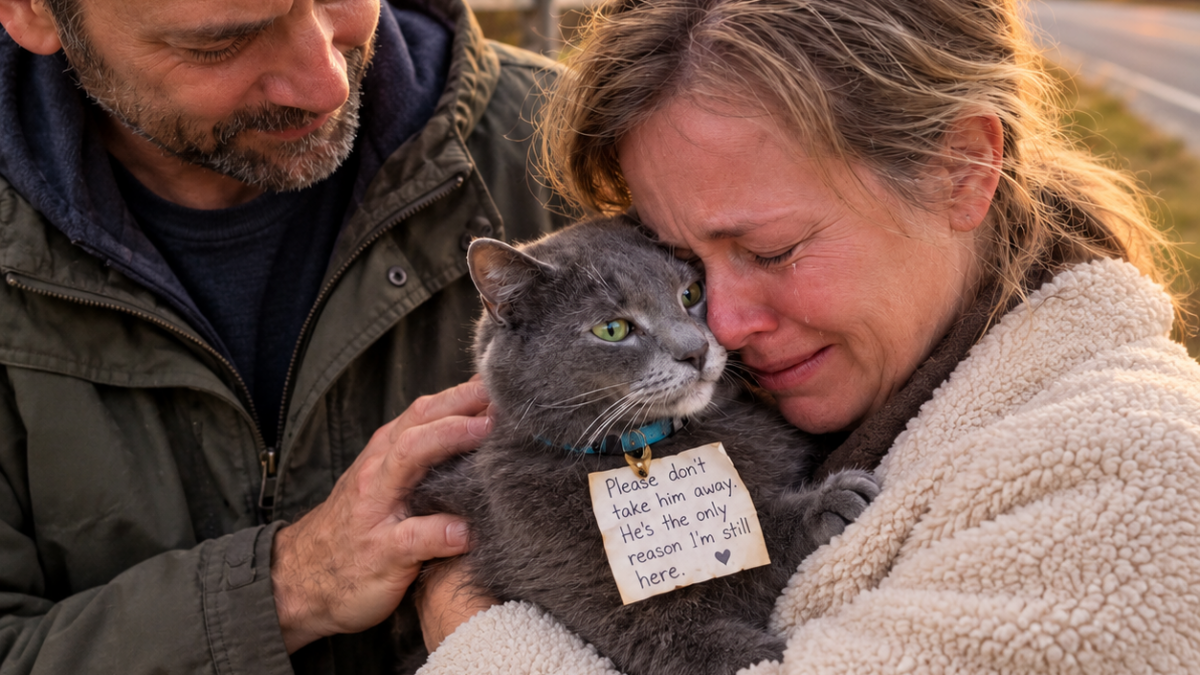
Susan read the note again.
“Please don’t take him away.”
Her voice cracked on the last word.
I looked at the back of the paper.
An address had been written there.
No name.
Just a house number and road.
Maybe two miles from where we’d found him.
Susan stared at it.
“We have to go.”
“Now?”
“Yes.”
“What if whoever wrote this—”
“We have to.”
She looked at Oliver.
“Daniel, somebody loves him.”
That hurt in a way I wasn’t prepared for.
We had spent a year imagining terrible things.
Cars.
Coyotes.
Cold nights.
Hunger.
Injury.
But we had also comforted ourselves with the possibility that someone kind had taken him in.
Now that possibility was real.
And instead of feeling only grateful, part of me felt threatened.
I hated myself for it.
Oliver was ours.
Our daughter’s cat.
Our family.
Susan had cried herself to sleep after he disappeared.
I’d watched her walk through the house calling his name even months later.
We had lost Emily.
Then Oliver.
Now, after 367 days, he was back in my arms.
And somebody had attached a note asking us not to take him.
I put Oliver gently into the basket on the back of Susan’s bicycle.
There was no way we were going to ride quickly with him, so we walked.
The address wasn’t far.
During those twenty minutes, Susan barely spoke.
Finally I said, “What are you thinking?”
She kept her eyes on Oliver.
“I don’t know.”
“Same.”
“What if it’s a child?”
That possibility hadn’t occurred to me.
I felt worse.
“What if it’s someone sick?”
“I don’t know.”
“What if they think he belongs to them?”
“He does belong to us.”
Susan stopped walking.
I immediately regretted the sentence.
She looked at me.
“I know.”
“I didn’t mean—”
“I know whose cat he is.”
She stroked Oliver’s head.
“But whoever wrote that note didn’t write, ‘I found your cat.’”
“No.”
“They wrote, ‘He’s the only reason I’m still here.’”
I looked down at the road.
There was no good response.
We continued.
The address took us onto a quieter road near the edge of town.
Small older houses.
Deep yards.
Large trees.
We found the number on a mailbox leaning slightly toward the ditch.
The house behind it was modest and worn.
Peeling white paint.
A porch that needed work.
Overgrown garden beds.
An old pair of gardening gloves lay beside the front door.
Susan looked at me.
“You ready?”
“No.”
“Me neither.”
Oliver had become strangely alert.
His ears were forward.
Before we reached the porch, he started squirming.
“Easy.”
Susan adjusted her grip.
Oliver looked toward the house.
Then meowed.
The door opened before we knocked.
An elderly woman stood there.
Small.
Gray hair pinned loosely behind her head.
One hand gripping the doorframe.
The moment she saw Oliver, everything changed.
Her eyes widened.
“Angel?”
Oliver twisted so forcefully Susan nearly dropped him.
She lowered him.
He ran.
Straight toward the woman.
No hesitation.
The woman bent slowly.
“Oh.”
Her voice broke.
“Oh, there you are.”
Oliver rubbed himself around her legs, tail high.
She touched his head.
Then his back.
Then crouched as far as her knees allowed and pulled him against her.
I looked at Susan.
She was crying again.
The woman looked up at us.
Her happiness disappeared as quickly as it had appeared.
Fear replaced it.
She looked at Susan.
Then me.
Then Oliver.
“Are you…”
She swallowed.
“Are you his family?”
I nodded.
“Yes.”
The woman closed her eyes.
“I knew it.”
“What?”
“I knew somebody loved him.”
She looked down.
“I was afraid this day would come.”
Her name was Margaret.
She was seventy-four.
She invited us inside.
I remember every detail of that kitchen because the conversation that followed changed the way I thought about grief.
The room was small.
Floral curtains.
An old clock on the wall.
Three mismatched chairs around a wooden table.
A framed photograph of a man sat on the windowsill.
Oliver—Angel to her—jumped onto one of the chairs as if he’d done it a thousand times.
Margaret touched the top of the chair.
“He sits there when I’m making tea.”
Susan smiled weakly.
“He sits on our kitchen chairs too.”
Margaret looked at her.
For the first time, I saw the conflict fully.
Two women looking at the same cat and seeing home.
Margaret made tea.
Her hands trembled slightly.
I wanted to tell her she didn’t need to explain anything.
But she did.
Maybe for us.
Maybe for herself.
“I found him last spring.”
“When?” I asked.
She thought.
“Late March.”
That would have been weeks after Oliver disappeared.
“There was a thunderstorm.”
She pointed toward the back of the house.
“I heard something underneath the porch.”
She had gone outside the next morning.
Oliver was hiding beneath it.
Soaked.
Mud covering his legs.
Terrified.
Hungry.
“He wouldn’t come out.”
“How long did it take?”
“Hours.”
She laughed softly.
“I sat on the steps with tuna.”
Susan smiled through tears.
“That usually works.”
“It did eventually.”
Margaret brought him inside.
She gave him water.
Food.
A blanket.
At first, she intended to keep him only until she found his family.
She asked neighbors.
Called a local veterinarian.
Called a rescue group.
Put a notice on a community board.
But Oliver had traveled farther than any of us had expected.
Our posters had been concentrated near home.
Margaret wasn’t active online.
The shelters we contacted had no record of him because she never surrendered him.
Two search efforts existed only a few miles apart.
Neither crossed the other.
I found that unbelievably frustrating.
One phone call.
One poster.
One coincidence.
Any one of them could have returned Oliver months earlier.
But life rarely arranges grief so neatly.
Margaret continued.
“For the first week, I didn’t name him.”
Susan asked, “Why Angel?”
Margaret looked at Oliver.
“Because he came when I wasn’t doing very well.”
The way she said it silenced us.
I looked at the photograph on the windowsill.
Margaret noticed.
“My husband.”
“How long?”
“Three years.”
“I’m sorry.”
She nodded.
“Fifty-one years.”
Susan reached across the table.
Margaret looked at her hand.
Then took it.
“He was sick at the end,” Margaret said. “Long enough that I thought I was prepared.”
She laughed without humor.
“You never are.”
Susan’s eyes dropped.
“No.”
Margaret noticed something in her voice.
“You lost someone?”
Susan hesitated.
“Our daughter.”
Margaret’s hand tightened.
“Oh.”
“Cancer.”
“How old?”
“Twenty-nine.”
The room changed.
Strangers became something else.
Not friends yet.
But no longer strangers.
People recognize grief in one another.
It has a language.
Margaret whispered, “I’m so sorry.”
Susan looked toward Oliver.
“Emily gave him to me.”
Margaret’s eyes filled.
“Your daughter?”
“Yes.”
“For your birthday.”
Susan nodded.
“She chose him herself.”
Margaret covered her mouth.
I knew what she was thinking.
The cat she had called Angel wasn’t simply someone else’s pet.
He was attached to a dead daughter’s memory.
The fear in her face became something closer to surrender.
“Oh, honey.”
Susan began crying.
Margaret stood slowly and went around the table.
She hugged my wife.
Two women who had met ten minutes earlier held each other in a small kitchen while the cat connecting their grief sat beneath the table licking one paw.
I looked away.
I didn’t want them seeing me cry too.
Eventually we sat again.
Margaret told us what life had been like after her husband died.
The first year, people visited.
Family called.
Neighbors brought casseroles.
Everyone said:
“If you need anything, call.”
Then life moved.
Not cruelly.
Naturally.
People returned to jobs.
Families.
Problems.
Margaret remained in the same house.
The silence became heavier.
Some mornings, she said, she stayed in bed far too long because there was no reason not to.
She stopped cooking real breakfasts.
Stopped tending the garden.
Stopped watching certain television programs because she’d always watched them with her husband.
Then Oliver appeared.
Angel.
The first morning after she brought him inside, he sat outside her bedroom door.
The second, he jumped onto the bed.
A week later, he began waiting by the door when she returned from doctor’s appointments.
“Animals give structure to time,” Margaret said.
I understood immediately.
“Breakfast because he needs breakfast.”
She smiled.
“Get up because he wants the curtains open.”
Susan nodded.
“Go home because somebody’s waiting.”
“Yes.”
Margaret looked down.
“Before him, sometimes I didn’t care if I came home quickly.”
That sentence was the note.
Not exactly.
But close.
I asked carefully, “When you wrote that he was the only reason you’re still here…”
Margaret looked embarrassed.
“I shouldn’t have written it.”
“No.”
Susan reached across the table.
“I’m glad you did.”
Margaret’s eyes filled again.
“I didn’t mean to frighten anyone.”
“You didn’t.”
“I just…”
She struggled for words.
“I knew somebody might recognize him someday.”
She touched Oliver’s back.
“And I wanted them to understand.”
That broke Susan all over again.
Margaret continued.
“The house was so empty after Harold died.”
The photograph.
Harold.
“My children live far away. They call. They’re good children.”
She quickly defended them even though nobody had accused them.
“But a phone call isn’t the same as something breathing in the next room.”
No.
It isn’t.
Margaret said Oliver began sleeping in Harold’s old recliner.
She hadn’t been able to sit in that chair after her husband died.
She had considered giving it away.
Then one afternoon she found Angel asleep there.
For some reason, that made the chair bearable again.
“He brought life back into places I thought belonged only to the dead.”
Susan looked at me.
She understood.
Oliver had done the same thing for us after Emily.
When our daughter died, Susan had stopped sleeping properly.
She’d wake in the night.
Walk downstairs.
Sit in the dark.
Oliver followed.
He never tried to fix anything.
Cats don’t give speeches about grief.
He simply sat beside her.
Sometimes that is enough.
After Emily’s death, people said things that were meant to be comforting.
“She’s in a better place.”
“Everything happens for a reason.”
“You still have so much to be grateful for.”
Susan hated all of them.
Oliver said nothing.
He slept beside her.
That was better.
Now we learned that during the year we’d been grieving Oliver, he had been performing the same quiet service for another woman.
I didn’t know whether to laugh at the absurdity or cry at the beauty.
Probably both.
Then Margaret told us she was moving.
“In about three weeks.”
“Where?”
“A senior apartment.”
The house had become too much.
Roof repairs.
Garden.
Stairs.
Maintenance.
Her children had been encouraging the move.
“Does the new place allow pets?” Susan asked.
Margaret looked away.
“I wasn’t sure when I wrote the note.”
My stomach tightened.
“But now?”
“I called again yesterday.”
“And?”
“They said cats are permitted.”
Susan exhaled.
Margaret looked at Oliver.
“But that doesn’t matter now.”
“Why?”
“Because you found him.”
There it was.
The conflict nobody wanted.
Oliver was ours.
Legally.
Emotionally.
Historically.
Margaret knew.
She lifted him.
He relaxed in her arms.
Then she stood.
Walked toward Susan.
And placed him against my wife’s chest.
“He belongs with you.”
Susan held him.
But instead of looking relieved, she looked devastated.
Margaret forced a smile.
“I had a year I wasn’t supposed to have.”
“Margaret—”
“No.”
She shook her head.
“Your daughter gave him to you.”
Susan’s arms tightened around Oliver.
“I can’t keep that from you.”
I watched Margaret’s hand fall away from Oliver’s back.
It looked like someone letting go of the last piece of a railing over deep water.
That’s when Susan surprised both of us.
“Would you mind if we came back?”
Margaret blinked.
“What?”
“To visit.”
“You don’t have to.”
“I know.”
“With Oliver?”
Susan nodded.
“Maybe Sundays.”
Margaret stared at her.
Susan continued.
“We usually cycle on Sundays anyway.”
I almost laughed because technically that was true, though I doubted we were bringing a cat on bicycles again.
“We could bring him.”
Margaret’s mouth trembled.
“Every Sunday?”
“If you’d like.”
She covered her mouth.
I looked at Oliver.
He was staring at Margaret.
Then he reached one paw toward her.
That finished all three of us.
Margaret touched the paw.
“I would love that.”
We returned home with Oliver that afternoon.
The drive was strange.
Joy and guilt sitting side by side.
Susan held Oliver in the passenger seat.
I glanced over repeatedly.
“Still real?”
She nodded.
“He’s really here.”
Oliver looked around as though he’d never been gone.
When we entered the house, he paused in the foyer.
Sniffed.
Then walked toward the living room.
Susan followed.
He went directly to the old window perch.
Jumped up.
Curled in the same spot.
Susan started crying.
Again.
I stood beside her.
“He remembers.”
“Of course he remembers.”
She touched the back of his head.
“Do you think he remembers Emily?”
There are questions with no answer that should still be treated gently.
“I think he remembers this house.”
Susan nodded.
“And us.”
“Yes.”
She leaned against me.
“That has to be enough.”
That first night, Oliver slept between us.
He had never done that before he disappeared.
Usually he slept beside Susan.
That night he took the center.
One paw on her arm.
Back against me.
As if physically joining two separate pieces.
Neither of us complained.
Around three in the morning, I woke.
Susan was awake too.
“Can’t sleep?”
“No.”
Oliver was purring.
She whispered, “I keep thinking about Margaret.”
“Me too.”
“Do you feel guilty?”
“Yes.”
She turned.
“Me too.”
“We didn’t do anything wrong.”
“I know.”
“And he’s ours.”
“I know.”
“But…”
“I know.”
Marriage after thirty years means sometimes entire conversations are completed by the same two words.
We lay there listening to Oliver purr.
Finally Susan said:
“What if he misses her?”
“He probably will.”
“What if she needs him more than we do?”
I hated the question.
Need isn’t measurable.
Who needed Oliver more?
A mother who lost her daughter?
A widow who lost her husband?
There was no humane scale for that.
I said, “Maybe this doesn’t have to be about who needs him more.”
Susan looked at me.
“What do you mean?”
“I don’t know yet.”
But something had begun forming.
A different answer.
Not ownership.
Connection.
The following Sunday, we drove to Margaret’s.
Oliver recognized the road before we reached the house.
At least that’s how it seemed.
He stood in his carrier.
Looked through the mesh.
Started meowing.
When we opened the car door, he nearly climbed over Susan.
Margaret was already on the porch.
“Angel!”
Oliver ran.
Watching that reunion hurt.
But in a good way.
Susan squeezed my hand.
“Look at him.”
Margaret sat on the porch step despite her knees.
Oliver rubbed against her.
Then rolled onto his side.
She scratched his stomach.
Susan laughed.
“He never lets me do that.”
Margaret looked guilty.
“Oh.”
“I’m kidding.”
Mostly.
We spent three hours there.
Coffee.
Cookies.
Stories.
Margaret told us about Harold.
A mechanic.
Terrible dancer.
Loved tomatoes.
Hated wearing ties.
Kept every screw and nail he’d ever owned because “you never know.”
Susan told her about Emily.
Teacher.
Loved old movies.
Always late.
Could make friends anywhere.
Oliver had been Emily’s idea after Susan complained the house felt empty once our daughter moved out.
Margaret listened.
Not with the uncomfortable patience people sometimes give grieving parents.
She asked questions.
“What was Emily’s favorite movie?”
“What did she teach?”
“Did she choose Oliver because she liked gray cats?”
Susan came alive.
Grief often traps memories behind the final illness.
Cancer.
Hospitals.
Chemo.
Funeral.
Margaret helped pull Emily backward through time.
Before cancer.
Young.
Funny.
Difficult.
Alive.
Susan did the same for Harold.
“What was your first date?”
Margaret laughed.
“A disaster.”
Good.
Tell us.
And she did.
Oliver slept under the table.
That Sunday became another.
And another.
Margaret’s move approached.
We helped pack.
Her children couldn’t come until moving weekend, so Susan and I handled small things.
Books.
Kitchenware.
Photographs.
Harold’s tools.
Margaret had trouble deciding what to keep.
“This house is fifty-one years.”
She stood in the living room surrounded by boxes.
“How do you put fifty-one years into an apartment?”
Susan understood.
“You don’t.”
Margaret looked at her.
“You take what you can.”
Susan touched a box of photographs.
“And keep the rest here.”
She tapped Margaret’s chest.
Margaret smiled sadly.
“That’s very sentimental.”
“I’ve become unbearable.”
“Yes.”
I carried another box.
Oliver followed me from room to room.
The senior apartment turned out to be nicer than Margaret expected.
One bedroom.
Small balcony.
Good light.
Pet-friendly.
That last part mattered enormously.
When we confirmed Oliver could visit—and potentially stay for extended periods—Margaret cried.
Again.
We became a family that cried frequently.
No shame.
The first time Oliver entered the apartment, he explored every corner.
Margaret watched nervously.
“Do you think he hates it?”
“He’s smelled three walls.”
I laughed.
“Give him time.”
He walked into the bedroom.
Then returned.
Jumped onto the couch.
Sat.
Margaret smiled.
“I think that’s approval.”
Susan said:
“He’s not subtle when he disapproves.”
True.
We settled into a routine.
Oliver’s primary home remained with us.
That felt right.
He had been Emily’s gift.
Susan needed him.
I needed him more than I’d ever admitted.
But Sundays belonged to Margaret.
Sometimes more.
If Susan and I traveled, Oliver stayed with Margaret.
If Margaret had a difficult week, we’d bring him by an extra afternoon.
If she had a doctor’s appointment, sometimes we’d meet her afterward.
Oliver became less a possession and more a bridge.
I stopped thinking of him as “our cat who had another owner.”
Margaret wasn’t another owner.
She was family.
That distinction changed everything.
The first real test came several months later.
Margaret fell ill.
Nothing catastrophic.
Pneumonia.
Hospital stay.
But at seventy-four, even ordinary illnesses become frightening.
Susan called me after Margaret didn’t answer her phone.
We went to the apartment.
A neighbor told us she’d been taken to the hospital the night before.
Susan’s face went white.
We visited.
Margaret looked small in the hospital bed.
She tried smiling.
“Don’t look so frightened.”
Susan sat beside her.
“You could’ve called.”
“I was busy being sick.”
“That’s not funny.”
“A little.”
She looked toward the door.
“Where’s Angel?”
“At our house.”
“Good.”
Then:
“Does he know?”
I smiled.
“He knows dinner happened.”
Margaret laughed, then coughed.
Susan took her hand.
“You’re going to be okay.”
Margaret looked at her.
Maybe she heard the fear beneath the promise.
“I know.”
After the visit, Susan said:
“She can’t be alone like this.”
“She has neighbors.”
“You know what I mean.”
I did.
Loneliness is not solved by people existing nearby.
The next morning, we brought Oliver.
Hospital rules obviously didn’t allow him inside.
So Margaret’s doctor approved a short outdoor courtyard visit once she was stable enough.
Susan carried Oliver.
Margaret sat in a wheelchair.
The second Oliver saw her, he struggled free and jumped into her lap.
Margaret buried her face in his fur.
I turned away.
Some moments feel too private even when you’re standing beside them.
After that, Margaret recovered faster.
Not because cats cure pneumonia.
Let’s not turn tenderness into medicine.
Antibiotics did their job.
Doctors did theirs.
But she ate more.
Cooperated.
Walked.
Talked about going home.
Sometimes hope is not treatment.
It is a reason to endure treatment.
That matters.
Margaret returned to her apartment.
Our Sunday routine resumed.
A year passed.
Then two.
Oliver adjusted completely to having two homes.
At our house, he slept beside Susan.
At Margaret’s, he reclaimed the old ritual from her previous house and slept in a recliner she had brought with her.
Harold’s chair.
Of course.
We had debated whether moving it made sense.
It was heavy.
Worn.
One arm sagged.
Margaret almost left it behind.
Susan insisted.
“Bring it.”
“It’s old.”
“So are we.”
Margaret laughed.
We moved it.
Oliver proved Susan right.
First Sunday in the new apartment, he jumped onto that chair.
Circled twice.
Slept.
Margaret stood watching.
“That cat remembers everything.”
Maybe.
Or maybe the chair smelled like years of his second home.
Either explanation was enough.
Our relationship with Margaret deepened outside Oliver.
That’s important.
At first, the cat was the reason.
Later, not always.
Susan and Margaret called each other.
Margaret came to our house for Thanksgiving.
Then Christmas.
We added her name to birthday cards.
She remembered Emily’s death anniversary.
That mattered more than I can explain.
Most people stop mentioning someone who died because they fear causing pain.
Parents don’t stop thinking about them because nobody says the name.
Margaret understood.
On the anniversary, she called.
“I’ve been thinking about Emily.”
Susan cried afterward.
“People don’t say her name anymore.”
“I know.”
“Margaret does.”
That was family.
Similarly, we remembered Harold.
His birthday.
Their anniversary.
We visited his grave once with Margaret.
Oliver didn’t come to that one.
Some things belonged to humans.
Margaret stood at the cemetery.
“I used to come every week.”
“Do you still?”
“Not as much.”
“Does that bother you?”
She thought.
“No.”
Then smiled.
“I suppose Harold knows where I live.”
Susan laughed.
I liked that.
The strangest part was how Oliver transformed our grief without removing it.
Emily remained dead.
That sentence is brutal because the fact is brutal.
Nothing in this story changes it.
No cat replaced our daughter.
Margaret didn’t replace her.
Hope is not substitution.
Grief doesn’t work like an empty chair waiting for another body.
But our life became larger around the hole.
That’s different.
Before Margaret, Susan and I had started defining ourselves by what we’d lost.
Our daughter.
Our cat.
Years.
Plans.
After Oliver returned, the story expanded.
We gained Margaret.
Sunday coffee.
Apple pie.
Harold’s stories.
A second kitchen.
A different version of family.
Loss remained.
But it stopped being the only direction.
That felt like revenge.
Not against a person.
Against grief itself.
Grief had taken Emily.
Then tried to convince us that love only moved backward.
Memory.
Photographs.
What used to be.
Oliver proved otherwise.
Love could still move forward.
It could find an elderly widow in a peeling house.
It could wear a blue collar.
It could leave a note.
It could bring strangers to a kitchen table.
That was the revenge.
Grief expected three lonely people.
Instead, it accidentally created a family.
One Sunday, Margaret asked a question we’d avoided.
“What happens when I can’t take care of him anymore?”
Susan stopped cutting pie.
“Don’t.”
“I’m serious.”
“You’re healthy.”
“I’m seventy-six now.”
“That isn’t old.”
Margaret looked at me.
“Is she always this unreasonable?”
“Yes.”
Susan glared.
Margaret continued.
“If something happens to me, Angel stays with you.”
“Of course.”
“I know.”
She looked down at Oliver.
“I just need to hear it.”
Susan reached across the table.
“He will always have a home.”
Margaret nodded.
“And you’ll come visit me?”
Susan smiled.
“Even without the cat.”
Margaret’s eyes filled.
“That was the right answer.”
We laughed.
That conversation showed me what Oliver had really done.
At first, Margaret feared losing the cat because she believed he was the only thing connecting her to life.
Years later, she knew the relationship survived independently of him.
Oliver had done his job too well.
He wasn’t the only reason anymore.
She had Susan.
Me.
Neighbors.
A fuller routine.
Friends at the apartment building.
Sunday.
He had been the beginning.
Not the entire structure.
I think that’s the healthiest version of rescue.
You don’t become someone’s only lifeline forever.
You help them build more.
Margaret did the same for us.
She didn’t replace Emily.
She helped us return to people.
After Emily died, Susan had withdrawn.
Invitations became exhausting.
Social events felt wrong.
How could the world keep talking about vacations and recipes after our daughter died?
Margaret didn’t demand normal conversation.
She understood silence.
Then gradually there was coffee.
Then stories.
Then laughter.
We realized laughing did not betray Emily.
Living did not betray her.
That sounds obvious.
It isn’t when grief is fresh.
Oliver had taught Margaret to get out of bed.
Margaret helped Susan learn that joy could come back without erasing sorrow.
A cat had connected the whole chain.
At Oliver’s next veterinary appointment, we discovered he’d gained weight.
Not much.
Enough.
The veterinarian asked:
“Any change in diet?”
Susan and I looked at each other.
Margaret.
Definitely Margaret.
She denied it.
“I give him normal portions.”
“Define normal.”
“One little piece of chicken.”
“How often?”
Margaret hesitated.
Susan crossed her arms.
“Margaret.”
“Maybe two.”
“Every visit?”
“He gets hungry.”
“He eats before we bring him.”
“He may become hungry again.”
The veterinarian wanted Oliver to lose half a pound.
Margaret was offended.
“He’s not fat.”
Oliver sat on the exam table looking very fat.
The veterinarian said:
“He’s loved.”
Margaret replied:
“Exactly.”
We compromised.
Less chicken.
Margaret cheated.
Of course.
One winter Sunday, snow began falling while we were at Margaret’s apartment.
We decided to stay longer rather than drive immediately.
Oliver slept in Harold’s chair.
Susan sat beside Margaret.
I made terrible coffee.
Margaret complained.
“Harold made better.”
“He’s not available.”
“Still true.”
Susan laughed.
The room felt warm.
Outside, snow covered the balcony railing.
For a while nobody spoke.
Then Margaret said:
“Do you ever think about why he came to me?”
I knew she meant Oliver.
“Every once in a while.”
“I do.”
Susan looked at her.
Margaret continued.
“I know there’s probably no reason.”
“Probably.”
“Cats wander.”
“Yes.”
“Storm.”
“Yes.”
“He found a porch.”
“Yes.”
She smiled.
“You’re very practical.”
“I try.”
She looked toward Oliver.
“But sometimes I like the other version.”
“What version?”
“That Emily sent him.”
The room went quiet.
Susan’s face crumpled.
Margaret immediately looked worried.
“I’m sorry.”
“No.”
Susan shook her head.
“Don’t apologize.”
Margaret continued carefully.
“I don’t mean literally.”
“I know.”
“I never met her.”
“I know.”
“But sometimes I think maybe if she could’ve chosen somebody to watch him for a year…”
Susan reached for Margaret’s hand.
“You.”
Margaret nodded.
Both women cried.
I pretended to become extremely interested in the coffee pot.
I didn’t know what I believed.
I’m still not sure.
Maybe Oliver ran.
Maybe he followed scents.
Maybe a storm scared him.
Maybe chance carried him three miles.
Then five.
Then to Margaret’s porch.
We don’t need supernatural explanations to recognize meaning.
Something can be accidental and still become sacred.
Oliver didn’t have to be sent.
He simply had to arrive.
That was enough.
The story spread among our friends.
People called it unbelievable.
“What are the chances?”
I don’t know.
But probability isn’t the point after something happens.
The point is what you do with it.
We could have read the note, taken Oliver home, and never returned.
Legally, nobody could have stopped us.
Margaret probably wouldn’t have fought.
She had already surrendered him.
But Susan made a different choice.
Not because she was saintly.
She wasn’t.
She wanted Oliver back desperately.
So did I.
For those first few hours, the idea of sharing him felt wrong.
Then we saw Margaret’s face.
Grief recognized grief.
That changed the question.
Not:
Who owns Oliver?
But:
What arrangement causes the least unnecessary loss?
That answer wasn’t complicated.
Visit.
Stay connected.
Make room.
Most moral decisions aren’t solved by choosing one person and destroying the other.
Sometimes you can widen the circle.
That became the heart of our family.
The circle widened.
At our house, one framed photograph of Emily showed her holding Oliver as a kitten.
At Margaret’s apartment, a picture appeared on the bookshelf.
Susan.
Margaret.
Me.
Oliver in the middle.
Taken one Sunday.
Two families.
Or one.
Depending on how you count.
Oliver aged.
Slowly at first.
Gray cats hide age well.
Then white hairs appeared around his muzzle.
He slept more.
Jumped less.
We added steps beside Susan’s bed.
Margaret placed a small stool near Harold’s recliner.
Watching both women adjust their homes around his aging body made me emotional.
He had once crossed unknown miles.
Now nobody wanted him jumping twenty inches.
That’s what love does over time.
It turns adventure into concern.
One Sunday, Oliver didn’t eat.
Margaret noticed first.
“He’s wrong.”
Susan said:
“He ate breakfast.”
“He won’t take chicken.”
That was serious.
We took him to the veterinarian.
Dental pain.
Treatable.
Nothing catastrophic.
Margaret waited with us.
When the veterinarian returned and said Oliver would be fine after treatment, Margaret’s knees nearly gave out.
I realized then that our arrangement had created another vulnerability.
Now three people could lose him.
But that’s the cost of love.
You cannot expand family without expanding the number of ways your heart can break.
The answer is not to keep the circle small.
Susan understood that better after Emily.
For a while she had wanted exactly that.
Protect.
Withdraw.
Don’t risk.
Then Oliver disappeared.
Loss arrived anyway.
You don’t avoid grief by loving less.
You just get less love before it comes.
Margaret once said something similar.
“I used to wish I’d never loved Harold so much.”
Susan looked shocked.
“Really?”
“Right after he died.”
Margaret stirred her coffee.
“I thought if I hadn’t loved him, it wouldn’t hurt.”
“And now?”
“I’d marry him again tomorrow.”
Susan smiled.
“Even knowing?”
“Especially knowing.”
She looked at Oliver.
“Same with this one.”
That was the real lesson.
Not avoiding attachment.
Choosing it with full knowledge of the ending.
Maybe that’s maturity.
Or madness.
Probably both.
On the third anniversary of Oliver’s return, Susan suggested we ride bicycles along the same route.
I didn’t want to.
Not because it was painful.
Because it felt too symbolic.
Susan insisted.
We rode.
Same road.
Same fence.
No gray cat.
We stopped anyway.
Susan stood where she’d first seen him.
“Right there.”
“I know.”
She touched the old wood.
The fence had weathered further.
One section leaned.
“Do you remember what you said?”
“Oliver?”
“No, before.”
I thought.
“I probably said we should keep going.”
“You did.”
“Smart man.”
“You almost missed him.”
“I stopped.”
“Because I grabbed you.”
“Details.”
She laughed.
We stood quietly.
Then Susan said:
“If we’d found him one month earlier…”
“No Margaret.”
“If we’d found him one month later…”
“Maybe still Margaret.”
“If we’d never found him…”
I didn’t answer.
She looked at me.
“I hate thinking that.”
“Then don’t.”
“Very philosophical.”
“I work hard.”
We got back on the bicycles.
Sometimes you don’t need to extract every lesson from a place.
You can simply pass through again.
That evening, we took Oliver to Margaret.
She had made pie.
Apple.
Susan’s favorite.
Not mine.
I complained.
Margaret said:
“You’re welcome not to eat it.”
I ate two pieces.
Family.
One year, Margaret’s daughter came to visit from another state.
We had heard about her for years.
She had heard about us.
Meeting felt strangely formal.
She hugged Susan immediately.
“Thank you.”
“For what?”
“My mother.”
Susan looked uncomfortable.
“We didn’t—”
“You did.”
Her daughter explained that before Oliver, Margaret had become isolated.
After Oliver, she started answering calls more.
Then after meeting us, she became busier.
Stories.
Plans.
Sunday visits.
“She sounds like herself again.”
Susan’s eyes filled.
Margaret’s daughter turned to me.
“Thank you for not just taking the cat and disappearing.”
I didn’t know what to say.
Finally:
“Your mother would’ve been impossible to disappear from.”
From the kitchen, Margaret shouted:
“I can hear you.”
We laughed.
Her daughter stayed for dinner.
That night, I realized Oliver had created connections beyond the ones we saw.
Margaret’s children worried less because she wasn’t alone.
We heard more stories about Harold.
Emily’s name existed in another household.
A whole network had grown from one missing-cat note.
This is why I don’t think of Oliver’s disappearance only as tragedy anymore.
I still wish we’d known he was safe.
I wish Susan hadn’t spent those 367 nights worrying.
I wish Margaret had found our poster.
But I cannot wish away the year without wishing away what came from it.
That’s complicated.
Life often is.
You can hate what happened and love what grew from it.
Both.
Susan felt the same.
“I’d never choose to lose him,” she said once.
“No.”
“But I wouldn’t choose to lose Margaret either.”
Exactly.
No clean answer.
No need for one.
Oliver had two names for a while.
We called him Oliver.
Margaret called him Angel.
At first I found it strange.
Then I liked it.
To us, Oliver was Emily’s cat.
To Margaret, Angel was the animal who arrived beneath her porch when she needed one more reason to get up.
Same cat.
Different story.
Neither name was wrong.
Eventually Margaret used both.
“Oliver” when talking to us.
“Angel” when talking directly to him.
He responded equally poorly to both unless food was involved.
Cats maintain humility in humans.
One Sunday Margaret said:
“Maybe Angel is his middle name.”
Susan laughed.
“Oliver Angel?”
“Sounds distinguished.”
“He steals butter.”
“Distinguished people can steal butter.”
Fair.
Oliver Angel became a joke.
Then somehow it became real.
When the veterinarian updated his file, Susan jokingly asked whether middle names were allowed.
The technician typed:
OLIVER “ANGEL”
We sent Margaret a photograph.
She framed it.
That little absurdity meant more to her than it should have.
Names are belonging.
Oliver belonged in both stories now.
As the years passed, the note changed meaning too.
Susan had kept it.
Of course.
She flattened the paper and placed it in a small envelope with Oliver’s missing poster.
One said:
MISSING.
The other:
PLEASE DON’T TAKE HIM AWAY.
Two pieces of paper from opposite sides of the same year.
One family begging the world to return him.
Another begging the world not to.
I once found Susan looking at both.
“What are you doing?”
“Nothing.”
She held them.
“Isn’t this strange?”
“Yes.”
“We were praying someone had him.”
“Yeah.”
“And when someone did…”
“We almost became the bad news.”
Susan nodded.
That bothered her.
I sat beside her.
“We didn’t.”
“No.”
“You gave Margaret more than visits.”
“I know.”
“She got us too.”
Susan smiled.
“That was an expensive cat.”
“Emotionally.”
“Very.”
Oliver walked into the room and meowed.
Susan looked at him.
“You have no idea what you’ve done.”
True.
He never knew he was the center of anything.
That’s one of the beautiful things about animals.
They don’t carry the mythology we build around them.
Oliver ate.
Slept.
Wanted doors opened.
Demanded warm laps.
He had no idea he was our last living connection to Emily in one emotional sense.
No idea he had helped Margaret survive widowhood.
No idea his disappearance had united households.
No idea people cried over a note on his collar.
He just lived.
That is sometimes the best gift animals give grief.
They drag us back into the immediate.
Feed me.
Open door.
Pet me.
Clean box.
Now.
Grief wants yesterday.
Animals insist on today.
Susan needed that.
Margaret did too.
So did I.
I had pretended to cope better after Emily’s death.
Fathers sometimes do that.
I focused on Susan.
Paperwork.
Funeral arrangements.
Medical bills.
Thank-you cards.
Practical tasks.
People asked:
“How’s Susan?”
Rarely:
“How are you?”
When they did, I answered:
“I’m holding up.”
I hated that phrase.
Holding what?
Up where?
After Oliver disappeared, I poured my grief about Emily into finding him.
Search.
Drive.
Call.
Poster.
Action.
When the search faded, I had nowhere to put it.
Margaret changed that for me too.
She asked about Emily.
Not only Susan.
Me.
“What was she like with you?”
Nobody had asked that in a long time.
I told her about fishing.
Emily hated fishing.
But every Father’s Day she’d go because she knew I loved it.
She talked constantly, which ruined the fishing.
That was the real reason I loved those trips.
I told Margaret.
She laughed.
Then cried.
Then told me Harold hated dancing but took lessons before their daughter’s wedding because he didn’t want to embarrass her.
Suddenly grief wasn’t something Susan and Margaret shared while I watched.
It belonged at the table for all of us.
That mattered.
Maybe Oliver didn’t save only the women.
Maybe he saved parts of me too.
I don’t say that dramatically.
I was functioning.
Working.
Living.
But functioning isn’t always living.
The Sunday table gave me something.
A place where dead people could be mentioned without everyone becoming uncomfortable.
A place where memory wasn’t considered “dwelling.”
A place where grief could coexist with apple pie.
That’s family too.
Margaret turned eighty.
We threw a small party in the senior building’s common room.
Her children came.
Neighbors.
Susan made cake.
I decorated terribly.
Oliver wore a blue bow tie for approximately forty seconds before removing it.
Margaret laughed harder than anyone.
When she blew out the candles, somebody asked whether she’d made a wish.
She looked toward Oliver.
“No.”
“Why not?”
“I’ve gotten more than enough.”
Susan immediately cried.
Of course.
Margaret rolled her eyes.
“You cry too much.”
“You started it.”
“No.”
“You wrote the note.”
“That was years ago.”
“Still counts.”
I watched them argue like sisters.
That was when I realized the line from Margaret’s note was no longer true.
He’s the only reason I’m still here.
No.
Not anymore.
Oliver may have been the reason during the darkest period.
But now Margaret had a web.
Children.
Neighbors.
Friends.
Susan.
Me.
Routine.
Community.
Oliver opened a door.
People walked through.
That is what real healing looks like.
Not transferring dependency from one thing to another.
Building enough connection that no single thread carries the entire weight.
I once asked Margaret if she’d write the same note today.
She thought.
“No.”
“Why?”
“Because it would be unfair to him.”
That surprised me.
“How?”
“He shouldn’t have to be responsible for whether I stay alive.”
She stroked Oliver’s back.
“He got me through a terrible time.”
Then pointed toward Susan making coffee.
“But then he brought reinforcements.”
I laughed.
“Reinforcements?”
“Very noisy ones.”
Susan looked over.
“What?”
“Nothing.”
Margaret smiled.
There it was.
Growth.
She still loved Oliver enormously.
But love had changed from lifeline to companionship.
That was healthier.
More peaceful.
The note remained important because it captured the truth of one moment.
Not forever.
People change.
Need changes.
Grief changes shape.
The cat helped.
Then humans did the rest.
Oliver himself became increasingly spoiled by both households.
At ours:
One bed.
Two blankets.
Special treats.
At Margaret’s:
Another bed.
Another bowl.
A basket of toys.
One recliner technically owned by Harold but effectively transferred to Oliver.
I said:
“This cat has more property than I do.”
Margaret replied:
“He has two residences.”
Susan added:
“Dual citizenship.”
I said:
“Tax him.”
Nobody supported me.
Even Oliver looked offended.
Our Sunday visits rarely followed a schedule anymore.
Sometimes coffee.
Sometimes lunch.
Sometimes walks.
Sometimes all three of us sat quietly while Oliver slept.
Those quiet visits became my favorite.
No dramatic grief conversation.
No revelation.
Just being together.
That’s when you know a relationship has matured.
You don’t need the reason anymore.
At first:
We are here because of the cat.
Later:
We are here because it is Sunday.
That is stronger.
One year, Emily’s birthday fell on a Sunday.
Susan had been anxious all week.
Birthdays are harder than death anniversaries in strange ways.
They measure the age someone should be.
Emily would have been thirty-seven.
We went to Margaret’s anyway.
Susan brought no pie.
She wasn’t in the mood.
Margaret didn’t force conversation.
She made tea.
Oliver sat between them.
Eventually Margaret asked:
“How old?”
Susan answered.
“Thirty-seven.”
Then silence.
Margaret said:
“Tell me something about her at ten.”
Susan smiled unexpectedly.
“What?”
“Not sick. Not twenty-nine. Ten.”
Susan thought.
Then laughed.
“She cut her own hair.”
I remembered.
“Oh God.”
Margaret smiled.
“Why?”
“She wanted bangs.”
“Did it work?”
“No.”
“Absolutely not.”
We spent the next hour talking about Emily at ten.
Then sixteen.
Then twenty-two.
The cancer never entered the story.
That was one of Margaret’s gifts.
She understood how to remember before tragedy.
Later, Susan told me:
“I didn’t cry once.”
“You laughed.”
“I know.”
She looked shocked by it.
“Does that feel wrong?”
“No.”
Then:
“Maybe a little.”
I kissed her forehead.
“It isn’t.”
Oliver rode home asleep.
Another Sunday.
Another step.
Margaret had her own hard anniversaries.
Harold’s death.
Their wedding date.
Father’s Day.
We did the same.
Stories.
Not only dying.
Living.
Margaret once said:
“Grief steals biographies.”
“What?”
“It reduces people to how they died.”
I had never heard it put that way.
She pointed toward a photo of Harold.
“He was not cancer.”
Then toward the picture of Emily Susan had given her.
“She was not cancer either.”
Correct.
Oliver somehow became the bridge through which both women reclaimed those biographies.
Again, no magic.
Just space.
Time.
Questions.
Listening.
Cats sleeping nearby.
Maybe healing doesn’t require complicated therapy in every moment.
Sometimes it requires someone willing to ask:
What was she like before?
Who was he when he was funny?
What did you love?
Margaret was good at that.
Susan became good at it too.
When Margaret’s health began declining years later, the roles shifted.
She tired faster.
Needed more help.
Her daughter visited more.
So did we.
Oliver was older too.
Sunday visits became quieter.
One afternoon, Margaret sat with Oliver across her lap.
He was asleep.
She looked at Susan.
“I think we found each other at the right time.”
Susan nodded.
“Yeah.”
Margaret smiled.
“I mean all of us.”
“I know.”
She looked toward me.
“You too, Daniel.”
“Unfortunately.”
She laughed.
“You ruin every emotional moment.”
“It’s a gift.”
Susan said:
“He thinks humor makes him mysterious.”
“It does.”
Margaret looked at Oliver.
“Angel knows better.”
I didn’t argue.
The truth was, I used humor because the alternative was often crying.
Everyone had coping strategies.
Mine told bad jokes.
Oliver’s involved sleeping sixteen hours a day.
His seemed healthier.
We eventually had to face the question every pet family faces.
Oliver was getting old.
His kidneys weakened.
Nothing unusual for an aging cat.
The veterinarian recommended diet changes.
Monitoring.
Fluids eventually.
Susan became obsessive.
Margaret became worse.
Every Sunday:
“Did he eat?”
“Yes.”
“How much?”
“Enough.”
“What does enough mean?”
“Margaret.”
“Did he drink?”
“Yes.”
“Use the litter box?”
I looked at her.
“You know, you’ve become surprisingly intrusive.”
“I’m eighty-two. I’m allowed.”
Fair.
Oliver tolerated his care with dignity, meaning he complained constantly.
The first time Susan tried giving subcutaneous fluids, Oliver escaped.
Water everywhere.
I laughed.
She did not.
Margaret said:
“Bring him here. I’ll do it.”
“You cannot even open the saline bag.”
“I’ll supervise.”
“You’ll criticize.”
“Same thing.”
Family.
The kidney disease progressed slowly.
Years, not weeks.
That gave us time.
Time is always the real gift in these stories.
Not endless.
Enough.
Susan once said:
“If he’d never disappeared, maybe we’d have had more days with him.”
Technically, yes.
“But Margaret would’ve had none.”
She nodded.
“I know.”
We stopped counting ownership by days.
That felt petty now.
Who had more?
Us.
Margaret.
Irrelevant.
Oliver had spent his life doing something most humans struggle to do.
Belonging fully in more than one place.
No betrayal required.
Love wasn’t divided.
It multiplied.
That sounds sentimental.
It’s still true.
His affection for Margaret did not reduce his affection for Susan.
His return to us did not erase the year with Margaret.
His life could hold both.
Humans should learn that more often.
One winter, Margaret was hospitalized again.
This time more seriously.
Congestive heart failure.
She was eighty-three.
Doctors stabilized her.
But everyone understood the landscape had changed.
She returned home with more medication.
More support.
Susan increased visits.
Oliver came whenever possible.
One Sunday, Margaret held him and whispered:
“You’ve gotten old.”
Susan said:
“So have you.”
Margaret looked offended.
“I was having a moment.”
“Sorry.”
Oliver shifted.
Margaret continued:
“You came when I thought I was done.”
Her fingers moved through his gray fur.
“And then you left.”
Susan tensed.
Margaret smiled.
“Then came back.”
She looked toward us.
“And brought them.”
My chest tightened.
“Pretty efficient cat,” I said.
Margaret laughed.
“Terrible sense of direction.”
That too.
We never learned exactly how Oliver traveled from our house to Margaret’s.
Five miles from where we found him.
Probably less directly.
Maybe farther.
He may have spent weeks outside before finding her.
No one knows.
I sometimes imagine the journey.
Then stop.
The mystery belongs to him.
The important part is where he arrived.
And what happened next.
Margaret’s health stabilized for almost another year.
Then one morning Susan received a call from Margaret’s daughter.
I knew from Susan’s face.
“Hospital?”
She nodded.
We went.
Margaret was conscious.
Weak.
Still herself.
Oliver couldn’t come inside.
Rules.
This time no courtyard.
Too cold.
We brought a blanket that smelled like him.
Susan placed it beside Margaret.
She touched it.
“Don’t tell him I stole his blanket.”
“He has six.”
“Excessive.”
“You bought three.”
“I reject that accusation.”
Even then.
Jokes.
Defense against fear.
Margaret looked at Susan.
“If I don’t go home…”
“Don’t.”
“Please.”
Susan closed her eyes.
Margaret continued.
“If I don’t, keep the Sunday.”
“What?”
“Don’t stop going somewhere on Sunday.”
Susan’s tears came.
“Margaret.”
“Promise.”
“Where?”
“I don’t care.”
“That’s ridiculous.”
“Coffee.”
She smiled.
“Apple pie.”
Susan laughed through tears.
“And Angel.”
“Yes.”
Margaret touched her hand.
“Keep moving.”
I had to look away.
Margaret recovered enough to leave the hospital.
For a while.
We got three more Sundays.
I remember that clearly.
Three.
First: coffee.
Second: pie.
Third: almost no conversation because she was tired.
Oliver slept on her lap.
At one point Margaret opened her eyes.
Looked at him.
Then at Susan.
“Good.”
One word.
We didn’t know it would be the last Sunday.
Margaret died in her sleep four days later.
Her daughter called.
Susan sat on the kitchen floor.
Oliver came over.
He pressed against her.
The circle had come around.
A cat beside a grieving woman.
Again.
Only now Susan understood something she hadn’t when Emily died.
The grief would not stay this sharp forever.
That knowledge didn’t reduce pain.
It made pain survivable.
Margaret’s funeral was small.
Her children.
Grandchildren.
Neighbors.
Residents from the senior building.
Us.
Someone placed a photograph of Harold beside the flowers.
Another of Margaret.
Then her daughter added the picture of Margaret, Susan, and Oliver.
I cried when I saw it.
Margaret’s daughter spoke.
She talked about Harold.
Her childhood.
Her mother’s gardening.
Then she mentioned “Angel.”
People smiled.
She told the story.
Not every detail.
Enough.
A stray gray cat appeared after her father died.
Brought her mother back into life.
Then returned to his original family.
Instead of losing him, Margaret gained them too.
Her daughter looked toward us.
“My mother thought a cat saved her.”
She paused.
“I think he introduced her to the people who finished the job.”
Susan sobbed.
So did I.
That was probably the closest thing to a perfect summary.
Oliver started it.
People finished it.
After the funeral, Margaret’s daughter handed Susan an envelope.
“Mom wanted you to have this.”
Inside was the original blue collar.
Not the note.
We had that.
Margaret had kept a spare tag she’d bought years earlier.
ANGEL.
On the back:
HOME.
Susan held it for a long time.
Oliver wore that tag beside his regular one for the rest of his life.
OLIVER.
ANGEL.
Two names.
One home?
No.
Two.
Maybe more.
Margaret had asked us to keep Sunday.
We did.
At first, it felt impossible.
Where do you go when the person who defined Sunday is gone?
The first Sunday after her funeral, Susan made apple pie.
Then sat at the table crying.
I said:
“We don’t have to.”
“Yes, we do.”
“Where?”
She looked at Oliver.
Then said:
“The park.”
So we went.
Coffee in a thermos.
Pie in a container.
Oliver stayed home because taking cats to public parks is generally a terrible idea.
We sat on a bench.
It was awkward.
Sad.
But we kept Sunday.
The next week, we visited Margaret’s daughter.
Then friends.
Sometimes just each other.
The ritual evolved.
That is what traditions do when people die.
They either disappear or change shape.
Margaret’s survived.
Oliver got older.
Much older.
Eventually he stopped jumping onto Susan’s bed.
We added steps.
Then a lower bed.
He slept more.
His kidneys worsened.
The veterinarian was honest.
“Time.”
We understood that word.
We had become experts.
Susan asked:
“Months?”
“Could be.”
“Years?”
“Probably not.”
We took him home.
No heroic interventions beyond what gave him comfort.
We’d learned something from grief.
Keeping someone alive at any cost isn’t the same as loving them.
Comfort matters.
Quality.
Presence.
Oliver had spent a life giving presence.
Now we gave it back.
His final months were quiet.
He still ate chicken.
Margaret would have approved.
He slept with Susan.
Sometimes in Harold’s old blanket, which Margaret’s daughter had given us.
The two households collapsed into one collection of objects.
Emily’s photograph.
Margaret’s blanket.
Blue collar.
Angel tag.
Oliver in the middle.
One evening, Susan asked:
“Do you think he knows she’s gone?”
I knew she meant Margaret.
“I don’t know.”
“He doesn’t look for her?”
“Maybe he stopped expecting Sunday.”
Susan stroked him.
“That makes me sad.”
“Me too.”
Then Oliver lifted his head.
Pressed it into her hand.
Present.
Cats always return you to now.
His last day came in spring.
He stopped eating.
Stopped drinking much.
The veterinarian came to our house.
We had decided long before that, if possible, Oliver would not spend his final moments frightened in a clinic.
He lay on Susan’s lap.
I sat beside her.
The blue collar was off.
We didn’t want anything uncomfortable.
But the Angel tag rested nearby.
Susan held Oliver’s face.
“You found your way back.”
Her voice broke.
“You stupid, wonderful boy.”
Oliver looked at her.
Slow blink.
Maybe reflex.
Maybe recognition.
It didn’t matter.
I touched his back.
I thought about the roadside.
367 days.
Running toward us.
The note.
Margaret’s porch.
Every Sunday after.
So much life hidden inside one cat’s disappearance.
The veterinarian gave the sedative.
Oliver relaxed.
Susan whispered Emily’s name.
Then Margaret’s.
“Tell them we love them.”
I almost objected.
Not because I disliked the thought.
Because grief makes people say things they need.
Let them.
I placed my hand over Susan’s.
Oliver took one final breath.
Then another.
Then none.
The house became very still.
For a long time, neither of us moved.
Finally Susan whispered:
“He brought everyone home.”
That sentence broke me.
Not himself.
Everyone.
Emily never came back.
Margaret never came back.
But through Oliver, parts of them entered rooms they had never shared.
Emily’s gift reached Margaret.
Margaret’s love reached us.
Harold’s chair became Oliver’s second bed.
Sunday survived every death.
Families overlapped.
Home became less about a building and more about repeated return.
Oliver had been missing 367 days.
But maybe “missing” was only true from our side.
For Margaret, he had been found.
That is the strange cruelty and beauty of perspective.
Our worst year contained one of her most healing ones.
Her eventual loss became our gain in another form.
Nothing stayed in one category.
Lost.
Found.
Ours.
Hers.
Grief.
Gift.
Life refuses simple labels.
Months after Oliver died, Susan took out the original note.
The paper was yellowing.
The writing still clear.
**Please don’t take him away. He’s the only reason I’m still here.**
She held it beside his Angel tag.
I sat down.
“Remember how scared we were reading that?”
“Yes.”
“What do you think now?”
Susan smiled through tears.
“She was wrong.”
I looked at her.
“About what?”
“He wasn’t the only reason.”
She touched the note.
“He was the first reason.”
Exactly.
Oliver had not become Margaret’s permanent burden.
He became the door.
Through it came routine.
Then us.
Then more life.
That distinction made the note less frightening.
More beautiful.
Not because desperation is romantic.
It isn’t.
Loneliness that deep is dangerous.
But because the sentence stopped being true.
That’s the ending people often miss.
Margaret didn’t remain dependent on a cat to survive.
She rebuilt.
Oliver helped.
Then the circle widened.
The same was true for us.
After Emily, Oliver helped Susan survive.
Then after Oliver disappeared, our marriage had to carry more weight.
After he returned, Margaret joined.
After Margaret died, Sunday remained.
No one creature is supposed to carry another person’s entire reason for living forever.
Love works best when it multiplies support.
Oliver was astonishing because he kept starting multiplication.
One became two.
Two became three.
Three became families.
Maybe that was his real gift.
Not returning.
Connecting.
Years later, Susan and I still keep Sunday.
Sometimes we ride bicycles.
Sometimes coffee.
Sometimes pie.
Sometimes we visit Emily’s grave.
Sometimes Margaret’s.
They’re in different cemeteries.
We complain about the driving.
Both women would appreciate the complaint.
At home, there are two photographs on the shelf.
Emily holding Oliver as a kitten.
Margaret holding him as an old cat.
Between them sits the blue collar.
Oliver.
Angel.
Home.
People who visit ask the story.
We tell it.
They usually focus on the note.
Of course.
It’s a powerful sentence.
But for me, the note is only the beginning.
The important part is what happened afterward.
We could have taken Oliver and left.
Margaret could have surrendered him and closed the door.
Susan could have decided the pain was too complicated.
I could have insisted ownership was ownership.
None of us did.
Instead, someone asked:
“Would you mind if we came back?”
Five words.
That was the real turning point.
Would you mind if we came back?
Maybe families are built from sentences like that.
Can I stay?
Come over Sunday.
Tell me about him.
Tell me about her.
Do you need anything?
We’ll see you next week.
Small offers.
Repeated.
Until strangers become necessary.
I sometimes wonder whether Oliver remembered his year with Margaret after returning permanently to us.
I believe he did.
Not in human narrative.
Not:
I once lived with a widow named Margaret after traveling five miles.
But scent.
Chair.
Voice.
Hands.
Routine.
When we turned onto her road, he became alert.
When he entered her apartment, he knew where to go.
When she called “Angel,” he looked.
Memory existed.
That matters.
His life was not split into competing loyalties.
Both homes remained inside him.
Maybe humans struggle because we think belonging must be exclusive.
Oliver never seemed confused.
He loved Susan.
He loved Margaret.
He slept in our house.
He slept in Harold’s chair.
No betrayal.
Just attachment.
That is a lesson I wish more people understood.
Love doesn’t become smaller because it has another destination.
Susan once told me:
“When we found him, I thought Margaret was going to be the person who took part of Oliver away from me.”
“And?”
“She gave me more of him.”
“What do you mean?”
“She told me who he was when we weren’t there.”
I understood.
Margaret had stories we never would have known.
Oliver hiding under the porch.
Refusing the first bowl of food until she moved away.
Sleeping in Harold’s recliner.
Waiting beside the door after appointments.
Sitting on the bathroom rug while she showered.
Waking her every morning.
That year wasn’t blank anymore.
We had spent 367 days imagining emptiness.
Now those days contained a home.
Meals.
Storms.
A woman speaking to him.
A chair.
A second name.
That knowledge healed something.
When you lose an animal, not knowing is its own pain.
Did he suffer?
Was he scared?
Hungry?
Cold?
For most of that year, at least after Margaret found him, the answer changed.
He was loved.
That is the best answer we could have received.
Even if it complicated reunion.
Especially because it complicated reunion.
I’d rather struggle with two people loving the same cat than know nobody did.
Susan feels the same.
If someone asks whether we regret sharing him with Margaret, the answer is immediate.
No.
If someone asks whether we regret losing 367 days, the answer is also no simple yes.
We regret the fear.
Not the love he found.
Life doesn’t always let you separate them.
Toward the end of her life, Margaret once told Susan:
“You gave him back to me.”
Susan corrected her.
“We shared him.”
Margaret shook her head.
“No.”
Then smiled.
“He shared us.”
That was Margaret.
She always found the cleaner sentence.
He shared us.
Exactly.
Oliver’s revenge against grief was not dramatic.
No cruel villain punished.
No courtroom.
No betrayal exposed.
The enemy in this story was absence.
Emily absent.
Harold absent.
Oliver absent.
Meaning absent.
Then one gray cat kept moving between spaces people thought were empty.
Our house after Emily.
Margaret’s house after Harold.
Our lives after Oliver vanished.
He filled them.
Not permanently.
Not completely.
Nothing does.
But enough.
That is how grief loses.
Not all at once.
It loses inches.
A cat on a chair.
Coffee on Sunday.
Someone saying a dead person’s name.
A new number saved in your phone.
A pie carried into another kitchen.
Laughter in a room that used to feel empty.
Grief never disappears.
It just stops owning all the property.
Oliver helped us take some back.
That is satisfying enough for me.
There is one Sunday I return to more than any other.
Margaret was still healthy.
Oliver somewhere around ten.
Susan had brought apple pie.
We were all on Margaret’s couch after coffee.
Oliver lay in the middle.
Half his body against Susan.
Half against Margaret.
Margaret placed one hand on his back.
Susan’s hand was inches away.
Their fingers touched accidentally.
Neither moved.
Margaret looked at Susan.
“I thought I’d lost my whole family.”
Susan swallowed.
Margaret continued:
“I never imagined a little gray cat would help me find another one.”
Susan started crying.
Margaret did too.
I looked away, because apparently I believed that would stop my own tears.
It didn’t.
Oliver slept.
Unimpressed.
That moment contains the entire story.
Two women who had buried people they loved.
A man trying to understand his own grief.
One cat who had been lost and found twice depending on whose perspective you used.
Nobody got their dead family members back.
That’s why the moment matters.
Healing is not restoration.
It’s construction.
You build after.
With what remains.
With whoever arrives.
Susan lost Emily.
Margaret lost Harold.
We all eventually lost Oliver.
But somewhere between those losses, we built Sunday.
Sunday survived.
That is the part grief didn’t get.
Today, if Margaret could call and ask how her boy was doing, Susan would no longer be able to give the answer she once did.
“He’s doing wonderfully. We’ll see you Sunday.”
Both of them are gone now.
But sometimes Susan still says it.
Usually when we’re driving.
We’ll see you Sunday.
Not literally.
Just habit.
Memory.
Affection.
A sentence that once meant next week and now means something larger.
There will always be another Sunday in our house.
Coffee.
Maybe pie.
Two empty chairs that don’t feel entirely empty.
Photographs.
Stories.
A gray collar.
And the knowledge that 367 days of uncertainty somehow gave us years with a woman we would never otherwise have known.
People hear that and say:
“Everything happens for a reason.”
I don’t.
I still hate that phrase.
Emily didn’t die for a reason that Oliver could fix.
Harold didn’t die so Margaret could meet us.
Oliver didn’t need to disappear so the universe could teach a lesson.
Pain does not require justification.
But humans can create meaning after it.
That’s different.
Oliver wandered.
Margaret opened her door.
We found him.
Susan opened ours wider.
The meaning came from the choices afterward.
That gives me more comfort than destiny.
It means kindness matters.
Not because events were planned.
Because what happens next isn’t always predetermined.
When Susan asked:
“Would you mind if we came back to visit?”
She changed five lives.
Mine.
Hers.
Margaret’s.
Oliver’s.
Probably Margaret’s children too.
One compassionate question.
That’s powerful enough without cosmic planning.
Sometimes I still see gray cats beside roads.
I always look.
Automatic.
Susan does too.
The old search never fully leaves your body.
Once, years after Oliver died, we were driving when Susan said:
“Daniel.”
I knew before she pointed.
Gray cat near a fence.
Healthy.
Collar.
Not ours.
Of course.
I smiled.
“You still check.”
“So do you.”
“Yes.”
We drove on.
But for a second, I was back there.
Bicycle on the ground.
Oliver running.
Susan crying.
Note in my hand.
**Please don’t take him away.**
If I could return to that exact moment knowing everything that followed, I would read the sentence differently.
That day, I thought it meant we were about to hurt someone by taking back what belonged to us.
Now I see a different message.
Please understand that while you were missing him, he mattered here.
Please understand that he was loved.
Please understand that this year wasn’t empty.
Please understand that losing him will hurt.
We understood.
Then we chose not to make love into a competition.
That was the best thing any of us did.
Oliver came home.
Margaret kept Angel.
Not physically every day.
But emotionally.
Both could be true.
That’s the kind of ending people assume is impossible when they think ownership is the only question.
Sometimes the satisfying ending is not:
I got what was mine.
Sometimes it’s:
Nobody had to lose everything.
We got our cat back.
Margaret kept a family.
Susan found someone who could speak Emily’s name without fear.
I found a kitchen table where grief didn’t have to hide.
Oliver got two names, two homes, too much chicken, and more people loving him than any cat reasonably needed.
That’s a good ending.
Better than revenge.
But if you insist on calling something revenge, then this was ours:
Grief took our daughter and expected our house to remain empty.
It didn’t.
Grief took Margaret’s husband and expected her table to stay set for one.
It didn’t.
Oliver disappeared and made us believe another piece of Emily was gone forever.
It wasn’t.
Loss kept trying to make every circle smaller.
Oliver kept making ours bigger.
That was his revenge.
Quiet.
Gray.
Four paws.
A ridiculous sense of direction.
And a note tied around his neck.
For 367 days, we asked the same question every night.
Where is Oliver?
Years later, I finally think I know the answer.
He was exactly where someone needed him.
Then, somehow, he found his way back to us when we needed to learn that too.
I don’t know how many miles he traveled.
I don’t know what he saw.
I don’t know why he left Margaret’s property on the afternoon we happened to cycle past that fence.
Maybe he was wandering.
Maybe he recognized something.
Maybe coincidence.
It no longer matters.
What matters is that when I called:
“Oliver!”
He turned.
He knew.
And he ran.
He ran straight into my arms carrying a message from a stranger that would change the rest of our lives.
We thought the story was:
Our missing cat came home.
It wasn’t.
The real story was:
Our missing cat came home with another lonely person’s heart attached to his collar.
And instead of cutting that connection, we followed it.
I’m grateful every day that Susan said:
“We need to find this person.”
Because finding Margaret became part of finding Oliver.
Maybe even part of finding ourselves after Emily.
The last time I held Oliver, years later, I thought about the first reunion.
He had been heavier then.
Stronger.
Fighting to climb into my arms.
On his final day, he was light.
Old.
Tired.
But when I said his name, his ears moved.
“Oliver.”
Susan whispered:
“Angel.”
Both names.
Both stories.
The veterinarian sat nearby waiting.
I touched the blue collar on the table.
Then Oliver.
“You did enough, buddy.”
Susan kissed his head.
“So much.”
He closed his eyes.
For once, nobody asked him to find his way anywhere.
No road.
No porch.
No house five miles away.
No Sunday drive.
We stayed with him.
That was our job now.
Stay.
He had spent a lifetime teaching us.
When someone is grieving, stay.
When a house feels empty, stay.
When somebody returns, greet them.
When love appears in an unexpected place, don’t ask who deserves it more.
Make room.
When Sunday comes, show up.
And when someone tells you they’re afraid of losing the one thing keeping them going, don’t turn away because their need is complicated.
Sit down.
Have coffee.
Ask their name.
Come back next Sunday.
Maybe that’s all Oliver ever did.
He came.
Then he kept coming back.
And in the end, so did we.
That old note is still in our house.
The paper has become fragile.
Susan keeps it protected now.
Sometimes I look at the handwriting.
**Please don’t take him away. He’s the only reason I’m still here.**
Margaret didn’t know who would read it.
Didn’t know it would be us.
Didn’t know the cat belonged to a grieving mother.
Didn’t know Sunday would become a family tradition.
Didn’t know that years later her own daughter would thank us at her funeral.
She was simply afraid.
So she wrote the truth.
That truth gave us a choice.
And I’m proud of the choice we made.
We didn’t take Oliver away.
Not really.
We brought ourselves back.
Every Sunday.
Until eventually nobody could say where Margaret’s family ended and ours began.
Oliver had already crossed that line.
We just followed him.
These days, when Susan and I talk about those 367 days, we don’t call them the year Oliver was missing anymore.
Not always.
Sometimes Susan says:
“That was Oliver’s year with Margaret.”
I like that better.
Because “missing” tells only our side.
He wasn’t missing from her life.
He was Angel.
He was waiting at her door.
Sleeping in Harold’s chair.
Giving a widow a reason to prepare breakfast.
And when he came running back to us, he didn’t leave that year behind.
He brought it with him.
He brought Margaret.
He brought Sunday.
He brought stories about Harold.
He brought our daughter back into conversation in ways we hadn’t expected.
He brought laughter into rooms that had forgotten it.
We thought we had finally found the cat we’d lost.
Instead, that little gray animal showed us something much larger.
Sometimes what comes back to you does not return alone.
Sometimes it carries another person’s grief.
Another person’s love.
Another person’s hope.
And if you are careful enough not to close your hands too tightly around what you believe is yours, you may discover that getting something back doesn’t require someone else to lose it.
Oliver belonged to us.
Angel belonged to Margaret.
Both were true.
And for the rest of his life, nobody ever asked him to choose.
Neither did we.
That is the ending I’m most proud of.
Not that Oliver came home after 367 days.
Not that we found the woman who cared for him.
Not even that Margaret became family.
It’s that after so much loss, when life finally handed us a situation where somebody was almost guaranteed to get hurt, we refused to let grief make that decision for us.
We made room.
For Oliver.
For Angel.
For Margaret.
For Emily.
For Harold.
For Sunday.
And somehow, that was enough to turn one missing-cat story into the story of how three people who thought their families were shrinking discovered that love could still make one bigger.



