PART 2: Naya Turned Her Back on Every Family Who Tried to Adopt Her—Until One Woman Sat Down and Refused to Look at Her
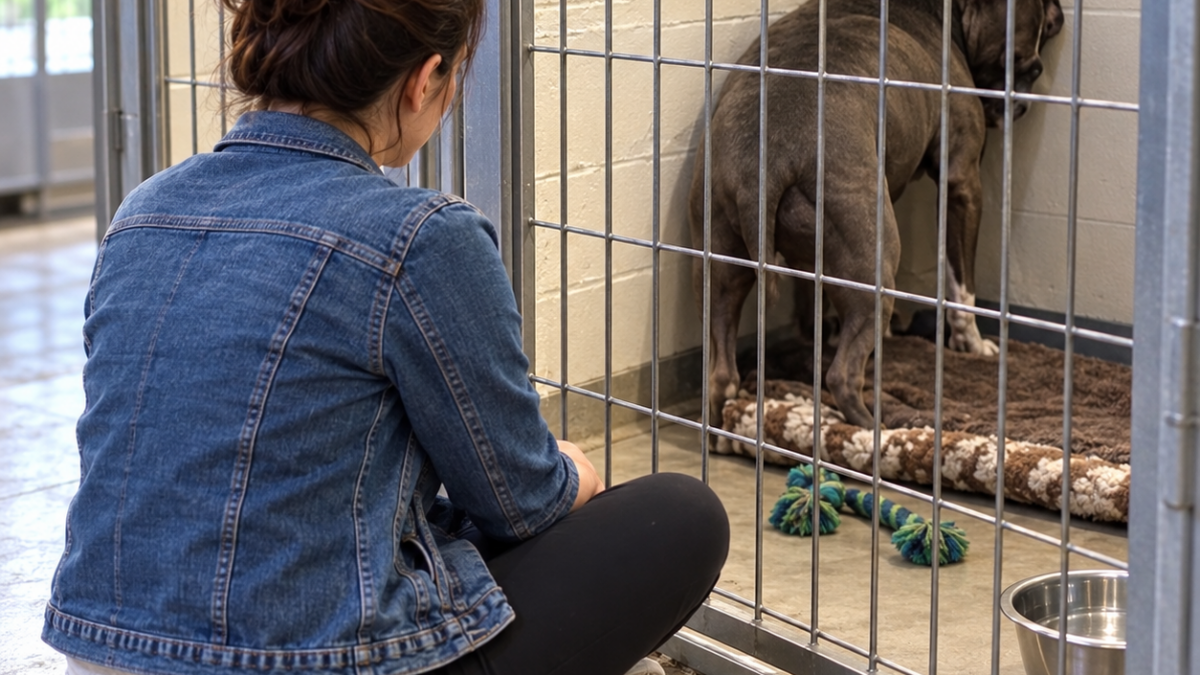
Every family who came to adopt Naya saw the same thing: a beautiful four-year-old dog turning her back on them and pressing herself against the concrete wall as if she could somehow disappear through it.
By the twelfth family, I had stopped wondering whether she disliked strangers and started wondering what had taught her that being chosen was something to fear.
I thought I understood damaged dogs after years of working in shelters, but when I finally opened Naya’s old adoption files that night, three short entries made me realize I had been asking the wrong question all along.
My name is Claire Martin, and I handled behavioral evaluations at a shelter in the countryside east of Lyon. I had worked with dogs that barked, lunged, trembled, snapped, hid beneath beds, refused food, and paced until their paws were raw, but Naya did none of those things when strangers entered her kennel. She simply turned away. That afternoon, the twelfth family stood outside her gate while the father crouched with a treat between his fingers, his wife waited behind him, and their eight-year-old daughter whispered Naya’s name as gently as she could. Naya moved closer to the wall until her forehead was almost touching the concrete. “Come on, sweetheart,” the father said. “We’re not going to hurt you.” Naya didn’t growl. She didn’t bare her teeth. She didn’t even look at him. The little girl eventually glanced up at me and asked, “Does she not like us?” I tightened my grip on the clipboard. “It isn’t you,” I said. “She just needs time.” They gave her four minutes. Then the girl noticed Oslo two kennels down, a big honey-colored dog who wagged so hard his hips swung sideways whenever anyone said his name. Ten minutes later, Oslo was walking across the parking lot wearing a brand-new red collar. Naya heard them leave. She never turned around.
That evening, after the shelter doors were locked and the last visitors were gone, I carried the untouched treat into Naya’s kennel. “They seemed nice,” I told her. Naya glanced over her shoulder. Then she reached for her old green rope toy, carried it across the kennel, and dropped it directly on my shoes. The change was instant. Her front legs dropped, her rear end lifted, and suddenly the dog who had spent the afternoon looking almost lifeless was pulling against the rope while her tail slapped the floor. She spun around me, released it, grabbed it again, and made the ridiculous snorting noise she always made when she was happy. Then a metal door slammed at the far end of the corridor. Naya froze. The rope slipped from her mouth. She looked toward the entrance, walked back to the wall, and sat with her face turned away.
I couldn’t stop thinking about it. At 10:17 that night, sitting alone at my kitchen table, I opened the shelter’s security-camera feed. Naya’s kennel appeared in grainy black and white. What I saw made me lean closer to the screen. Naya was standing beside the divider, tail wagging, trying to get the attention of Marcel, an elderly hound in the next kennel. Then she grabbed her green rope, ran three circles around her bed, rolled onto her back, and slept with all four paws in the air. I checked the night before. Same thing. Then the night before that. Every evening, after unfamiliar voices disappeared, Naya became a different dog. But every morning, when visitors arrived, she returned to the wall.
That was when I understood something important. Naya had not forgotten how to be happy. She was hiding her happiness from anyone who might want to take her home.
I opened her adoption history. Three entries appeared on the screen.
Adopted. Returned after twelve days.
Adopted. Returned after three months.
Adopted. Returned after seventeen days.
I opened the first file. Then the second. Then the third. And before sunrise, I finally understood why Naya would rather stare at concrete than risk believing in another family.
PART 2
The first return had happened almost eighteen months before I began working closely with Naya.
Her adopters were a young couple named Thomas and Julie Bernard. Their application was good. Their references checked out. They lived in a quiet apartment, worked opposite schedules so Naya would rarely be alone for long, and had owned a dog before. The notes from the original adoption counselor described them as patient, warm, and realistic.
Twelve days later, they brought her back.
I opened the return interview.
Reason for return: Dog will not settle. Refuses meals unless completely alone. Hides for hours. Panic when household members prepare to leave.
There was no accusation of aggression.
No complaint that she had destroyed furniture.
No dramatic incident.
Just one sentence from Julie that someone had typed into the file.
“I think she is waiting for us to decide we don’t want her.”
I read it twice.
That family had not harmed Naya.
If anything, the notes suggested they had tried harder than most people would have. They slept on the living-room floor the first two nights because Naya cried when they disappeared upstairs. Thomas began eating breakfast beside her bowl because sometimes she would take a few bites if another living thing was nearby. Julie bought three different beds because Naya refused to lie on any of them and instead slept pressed against the front door.
But on the twelfth day, Julie had suffered a severe asthma attack after Naya panicked during a walk, slipped her harness, and dragged them nearly two blocks before they caught her.
Their doctor told them they needed a calmer environment temporarily.
They returned Naya in tears.
The old counselor’s final note said:
Both adopters cried in parking lot for approximately twenty minutes. Julie repeatedly apologized to dog. Couple requested that Naya’s next family be told she was “good, just scared.”
That one hurt, but it didn’t explain the wall.
I opened the second file.
Naya’s second adoption had lasted ninety-three days.
The adopters were Mathieu Vautrin and his then-girlfriend, Céline Aubry.
They owned a detached house outside the city, had no children, and said they wanted a quiet dog rather than a high-energy puppy. Mathieu described himself as experienced with “stubborn breeds.” During the meet-and-greet, Naya had been hesitant but eventually accepted treats from Céline.
Three months later, Mathieu returned her alone.
The return form contained four words that made my stomach tighten.
Unpredictable behavior. Possible aggression.
I scrolled.
The intake worker had asked for examples.
Mathieu claimed Naya had become possessive of furniture, refused commands, growled when physically moved, and “shut down to manipulate people.”
I actually stopped reading.
Dogs do not press themselves into walls to manipulate people.
I continued.
He said they had hired a private behavior trainer.
No name was listed.
He said the trainer advised “stronger boundaries.”
The intake notes mentioned that Naya arrived wearing a thick nylon collar beneath a second electronic collar.
My fingers froze over the keyboard.
I scrolled farther.
A veterinary technician had examined her immediately after return because she was limping.
There were photographs attached.
I opened the first.
A red abrasion circled part of Naya’s neck beneath the fur.
The second showed two small irritated areas lower down.
The veterinary note did not claim abuse. It said the lesions were consistent with friction or pressure from equipment and recommended leaving collars off until healed.
Another line jumped out at me.
Dog dropped flat to floor when male employee reached toward collar. Urinated when leash was lifted above shoulder level.
I sat back.
The shelter had documented it.
Then somehow, over time, the significance of those notes had disappeared beneath dozens of newer entries.
I opened the emails associated with the adoption.
The first month sounded normal.
Céline wrote:
She sleeps near my side of the bed now. Still nervous with Mathieu but getting better.
Three weeks later:
Trainer says we comfort her too much when she is scared. He wants us to stop letting her hide.
Another:
I’m uncomfortable with some of the exercises. Mathieu says I’m making things worse because I feel sorry for her.
Then nothing for almost five weeks.
The final email came three days before Naya was returned.
It had never received a response.
Can someone please call me? Naya is worse after training sessions. She shakes when Mathieu reaches for her collar and now hides whenever she hears the car in the driveway. I don’t know what to do.
No one had called her.
At least there was no record of it.
I felt sick.
Our shelter was good.
The staff cared.
But good organizations can still fail when they are understaffed, exhausted, and drowning in emergencies.
That email had arrived during a week when twenty-two dogs came in from a hoarding seizure.
It had been marked for follow-up.
Then buried.
Naya had fallen through a crack.
I closed my eyes.
“I’m sorry,” I whispered to a dog who was sleeping several miles away and could not hear me.
Then I opened the third adoption file.
Seventeen days.
A family named the Delmases had taken Naya home as a second dog because their Labrador, Hugo, was grieving the death of another dog.
Their home visit had gone well.
Hugo and Naya had walked together peacefully.
The family expected that Hugo would help Naya become more social.
Instead, Naya became attached to Hugo and avoided everyone else.
They wrote that she followed him room to room, slept beside him, and refused to enter the kitchen unless he went first.
On day ten, Hugo developed a stomach illness and spent two nights at the veterinary hospital.
Naya stopped eating.
She paced the hallway.
She scratched the front door until two nails bled.
The family tried to comfort her.
She retreated.
When Hugo came home, Naya became almost frantic, licking his ears and pressing her body against his.
The Delmas family decided the attachment was unhealthy.
One sentence from the return paperwork stood out.
“We feel she needs a human bond, not another dog to hide behind.”
They were probably right.
But what Naya learned was simpler.
Home number one ended after twelve days.
Home number two ended after ninety-three.
Home number three ended after seventeen.
Different people.
Different reasons.
Same ending.
A car ride.
A shelter door.
Her green rope.
The same kennel.
I checked the timestamps.
All three families had returned her during visiting hours.
That meant every time Naya had been brought back, she had heard strangers walking the corridor looking for dogs to take home.
Maybe the wall wasn’t where she disappeared.
Maybe it was where she protected herself from being noticed.
At 1:42 in the morning, I called our shelter director.
Luc answered on the fourth ring.
“If this is about a dog escaping, tell me first.”
“No dog escaped.”
“Then why are you calling me at almost two?”
“Because I think we failed Naya.”
Silence.
Then his voice changed.
“What happened?”
I told him.
The second adoption.
The collar lesions.
The unanswered email.
The trainer.
The repeated returns.
When I finished, he said, “Come in early.”
“I’m already planning to.”
“Claire.”
“What?”
“Don’t decide what happened before we know.”
“I know.”
“You sound like you already have.”
“I know what happened to Naya emotionally.”
“That’s different from knowing whether somebody deliberately hurt her.”
“I know.”
“Good.”
He paused.
“Bring me everything at seven.”
I slept maybe ninety minutes.
By six-thirty, I was back at the shelter.
Naya was awake.
She stood when she saw me.
Her green rope was in her mouth.
I opened the kennel and sat on the floor.
“You have terrible taste in people,” I told her.
Naya pushed the rope against my knee.
“Although, statistically, I guess that includes me.”
She pulled.
I held on.
For five minutes, she was just a dog playing tug.
Then the front entrance unlocked.
Naya dropped the rope.
The first employee entered.
Her body changed instantly.
She moved toward the wall.
This time I followed.
Not close.
I sat six feet away.
“You don’t have to perform today.”
Her ear turned toward me.
“That’s the new rule.”
Naya kept staring at the wall.
“No families.”
Her head moved slightly.
“I mean it.”
That morning, I changed the sign on her kennel.
Instead of AVAILABLE FOR ADOPTION, I wrote:
BEHAVIORAL HOLD — STAFF ONLY.
Luc approved it.
For two weeks, Naya would not be shown to families.
No meet-and-greets.
No people saying her name through bars.
No pressure to be charming.
No expectation that she prove she deserved a home.
We would watch.
We would learn.
And we would find out what had happened during those ninety-three days in her second adoption.
My first call went to Céline.
The number in the file still worked.
A woman answered cautiously.
“Hello?”
“Céline Aubry?”
“Yes.”
“My name is Claire Martin. I’m calling from the shelter where you adopted Naya.”
Silence.
Then a whisper.
“Is she alive?”
The question hit me harder than I expected.
“Yes.”
“Oh, thank God.”
“You’ve thought about her?”
“Every day.”
I looked through the office window toward the kennel corridor.
“Would you be willing to talk to me?”
Another silence.
“Yes.”
“Not about blaming you.”
“You should blame me.”
“I’m trying to understand.”
Her voice cracked.
“That’s worse.”
We met two days later at a café halfway between the shelter and her apartment.
Céline looked older than her adoption photograph.
Not dramatically.
Just tired.
She wrapped both hands around a cup of coffee she barely touched.
“Mathieu and I separated nine months ago,” she said before I asked.
“Because of Naya?”
“No.”
Then she looked at me.
“But what happened with Naya should have told me who he was sooner.”
I waited.
She swallowed.
“At first, she liked me.”
“I saw the emails.”
“She slept beside my bed.”
“And Mathieu?”
“She avoided him.”
“Why?”
“I don’t know. He’s tall. Loud voice. Maybe something from before.”
“Did he accept that?”
“At first.”
Céline looked down.
“Then he took it personally.”
“How?”
“He’d call her. She wouldn’t come. He’d say she was disrespecting him.”
I felt my jaw tighten.
“What did the trainer tell you?”
Her face changed.
“His name was Laurent Béraud.”
I wrote it down.
“He called himself a behavior specialist. Mathieu found him online.”
“What methods?”
“At first, normal things. Leash walking. Place command. Food rewards.”
“And later?”
“He said Naya’s fear was reinforced because I let her retreat.”
“What did he want you to do?”
“Block the exits. Keep a leash on her in the house. If she tried to hide, bring her back.”
“Physically?”
“Yes.”
“Did he use the electronic collar?”
Céline’s eyes filled.
“He brought it on the third session.”
I stopped writing.
“What did he tell you it was for?”
“He called it communication.”
I had heard that word used to disguise a lot of things.
“Did you see him activate it?”
“Yes.”
“What happened?”
“She dropped.”
Céline covered her mouth.
For several seconds she couldn’t continue.
“When she didn’t come when called, he pressed it. She just… collapsed. Not unconscious. She flattened herself against the floor.”
My hands were cold.
“What did he say?”
“That she was dramatic.”
Exactly the kind of word Mathieu had later used on the return form.
“Did you object?”
“Yes.”
“What happened?”
“Mathieu told me to stop undermining the training.”
“Did Naya ever bite anyone?”
“No.”
“Snap?”
“Once.”
“At who?”
“Mathieu.”
“What was happening?”
“He was pulling her from under the dining table by the collar.”
“Did she make contact?”
“No.”
“So when the return form says ‘possible aggression’…”
Céline shook her head.
“She growled.”
“That’s it?”
“Yes.”
I leaned back.
“Why didn’t you come to the shelter yourself?”
Her eyes dropped.
“I tried.”
“The email.”
“You saw it?”
“Yes.”
“I waited two days.”
My stomach tightened.
“No one called.”
“I know.”
“Mathieu said that proved the shelter didn’t want her either.”
I closed my eyes briefly.
“He told me we were returning her. I said I would take her and leave him.”
“Why didn’t you?”
Céline stared at the table.
“Because I was a coward.”
I didn’t answer.
She continued.
“He controlled the money. The house was his. I had nowhere to go. I told myself the shelter was safer than staying with us.”
Maybe that part was true.
Maybe it was how she had survived the guilt.
Probably both.
“Do you have anything from Laurent?”
“Messages.”
“What kind?”
Céline unlocked her phone.
She had kept everything.
Texts.
Training schedules.
Videos Mathieu had sent her.
One video showed Naya on a long line in the yard.
Laurent stood several feet away.
He called her.
Naya hesitated.
A second later, her body jolted and she flattened to the grass.
The audio captured Laurent saying, “Don’t touch her. She needs to work through it.”
Another video showed Mathieu blocking a doorway while Naya tried to move around him.
A text from Laurent read:
If she retreats, you lose. Make sure she learns avoidance doesn’t work.
My stomach turned.
Dogs like Naya didn’t need to learn that avoidance didn’t work.
Avoidance was the last peaceful option they had before escalation.
Take away retreat often enough and you didn’t create confidence.
You created surrender.
“Can you send these to me?”
Céline hesitated.
“Will Mathieu know?”
“Possibly.”
She became pale.
“I’m not with him anymore, but…”
I understood.
“You don’t have to do this today.”
“No.”
She looked at the video.
Then at me.
“I do.”
She sent everything.
Before we left, I showed her a recent photograph of Naya playing with her green rope.
Céline covered her face.
“She still has that?”
“Yes.”
“I bought it for her.”
That surprised me.
“When?”
“Her first week with us.”
She stared at the picture.
“It was the only toy she liked.”
For the first time, I understood why Naya carried that ragged rope everywhere.
Not every memory from that house had been bad.
That made it more complicated.
Pain usually is.
Céline wiped her eyes.
“Does she hate me?”
“No.”
“You don’t know that.”
“No. I don’t.”
I paused.
“But I don’t think Naya spends much time hating anyone. She spends her energy trying to stay safe.”
Céline nodded.
“What happens now?”
“I don’t know yet.”
“What do you want to happen?”
I thought about it.
“I want nobody to do that to her again.”
That was true.
It was not yet the whole truth.
The other part of me wanted Laurent Béraud to sit in Naya’s kennel while twelve families walked past him.
I wanted Mathieu to call for help and hear nothing for two days.
I wanted them both to understand what helplessness felt like.
Anger likes symmetry.
Justice usually doesn’t get to give it.
Luc watched the videos that afternoon.
He said nothing during the first.
Nothing during the second.
Then he pushed the laptop away.
“We send this to our legal partner.”
“And?”
“And the regional animal-welfare office.”
“And Laurent?”
“Claire.”
“What?”
“You do not contact him.”
“I wasn’t—”
“You were.”
I hated that he knew me so well.
“We also notify the other shelters in our network that there is an open welfare concern regarding his methods. Carefully worded. Facts only.”
“He still trains dogs?”
“I checked.”
Luc turned his monitor toward me.
Laurent had a professional website.
Smiling dogs.
Five-star reviews.
Phrases like balanced leadership, clear communication, confidence through structure.
One photograph showed him crouched beside a terrified shepherd whose ears were pinned flat.
I felt rage rise again.
“He’s still doing it.”
“We have evidence regarding one dog.”
“We have video.”
“Yes.”
“Isn’t that enough?”
“It’s enough to report.”
“Not enough to stop him?”
“I didn’t say that.”
Luc leaned back.
“It means we do this properly.”
I looked toward Naya’s corridor.
“What about her?”
“We do that properly too.”
For the next ten days, Naya stayed off the adoption floor.
Something changed.
Not dramatically.
She still went to the wall when unfamiliar voices entered.
But because nobody approached her kennel, the shutdown lasted less time.
Sometimes she turned her head.
Sometimes she sniffed the air.
Once, when a delivery driver laughed loudly near reception, Naya started toward the wall, stopped halfway, and returned to her bed.
I nearly celebrated.
Then the woman arrived.
Her name was Sophie Laurent.
Forty-seven years old.
Widowed.
Worked as a hospice nurse.
Lived alone in a small house with a fenced garden thirty minutes from the shelter.
No children at home.
No other pets.
Her previous dog, a mixed-breed named Lucien, had died at sixteen.
Her application had been sitting in our system for six weeks because she had written one sentence under What are you looking for in a dog?
I’m not looking for a dog who needs to entertain me.
That sentence was why I called her.
We spoke for almost forty minutes.
I told her Naya’s history without romanticizing it.
Three failed adoptions.
Shutdown around visitors.
Possible trauma associated with coercive training.
Attachment difficulties.
Potential separation distress.
No guarantee she would ever become affectionate with strangers.
Sophie listened.
When I finished, she asked, “Does Naya like anything?”
That was not the question most adopters asked.
They usually asked whether the dog liked children.
Cats.
Other dogs.
Car rides.
Couches.
Sophie asked what Naya liked.
“Her green rope.”
“What else?”
“Quiet.”
“Food?”
“Chicken.”
“Walks?”
“Sometimes, if the environment is calm.”
“Does she like being touched?”
“By people she trusts.”
“How long does that take?”
“I can’t tell you.”
“Good.”
I frowned.
“Good?”
“If you had said three days or two weeks, I would have thought you were selling me something.”
That answer made me smile.
“You understand that meeting her may be underwhelming.”
“I’m a hospice nurse.”
“What does that mean?”
“It means I’ve spent twenty years learning that presence can matter even when nothing dramatic happens.”
I scheduled her visit after closing.
No families.
No children.
No kennel traffic.
At 6:30, Sophie arrived wearing jeans, a gray sweater, and flat shoes.
She carried nothing.
No bag of treats.
No squeaky toy.
No hopeful family members behind her.
I led her into the corridor.
Naya saw us.
She turned toward the wall.
Sophie stopped fifteen feet away.
“That’s her?”
“Yes.”
“Okay.”
She sat down on the floor.
Not directly in front of Naya.
Slightly sideways.
Then she looked at me.
“Can you bring me a chair tomorrow?”
I blinked.
“You’re coming back tomorrow?”
“If that’s allowed.”
“You haven’t met her.”
“I’m looking at her.”
“You haven’t even tried to get her attention.”
Sophie glanced toward Naya for less than a second, then away.
“She noticed me.”
“How do you know?”
“Her left ear has been pointing at me since I sat down.”
I looked.
She was right.
Sophie stayed twenty-eight minutes.
She never said Naya’s name.
Never reached through the gate.
Never offered food.
She asked me about the shelter’s heating system, the drive from Lyon, and whether the old hound next door always snored that loudly.
When she stood to leave, Naya looked over her shoulder.
Sophie pretended not to notice.
The next evening, she returned.
I had put a chair near the kennel.
She ignored it and sat on the floor again.
This time she brought a paperback.
“What are you reading?”
“Something terrible.”
“Why?”
“Because I’m seventy pages in and stubborn.”
She read silently.
Naya faced the wall.
After thirteen minutes, Naya turned around.
Sophie did not look up.
After seventeen minutes, Naya walked to her water bowl.
At twenty-three, she lay on her bed.
At thirty-one, Sophie closed the book.
“Same time tomorrow?”
“Yes.”
The third visit was almost identical.
The fourth was not.
Sophie sat.
Opened her book.
Naya remained at the wall for six minutes.
Then she walked to the middle of the kennel.
She looked at Sophie.
Sophie kept reading.
Naya looked at me.
I shrugged.
“You’re asking the wrong person.”
Naya went to her green rope.
My heart started pounding.
She picked it up.
Carried it halfway across the kennel.
Dropped it.
Sophie turned one page.
Naya stared at her.
Nothing.
Then Naya picked up the rope and carried it closer to the gate.
Sophie continued reading.
I wanted to scream at her.
Do you see this?
Of course she saw it.
That was why she did nothing.
Naya dropped the rope less than a foot from the kennel door.
Then she stepped away.
Sophie finally closed the book.
“Can I leave now?”
I stared at her.
“Why?”
“Because that seems like a good place to stop.”
She was right.
Again.
By the seventh visit, Naya no longer went immediately to the wall.
She went to her bed.
By the ninth, she stood at the gate while Sophie entered the corridor.
Sophie still did not call her.
On the eleventh visit, I opened the kennel door while Naya was at the back.
Sophie sat just outside.
No leash.
No reaching.
Naya could decide.
Ten minutes passed.
Then fifteen.
At nineteen minutes, Naya walked toward the doorway.
One paw crossed the threshold.
Sophie looked at her book.
A second paw.
I barely breathed.
Naya stepped into the corridor.
She stood three feet from Sophie.
Then sniffed her sleeve.
Sophie said nothing.
Naya sniffed her knee.
Then her hand.
Sophie’s hand stayed relaxed on the floor.
Finally Naya touched the back of it with her nose.
Sophie whispered one word.
“Hi.”
Naya retreated immediately.
But not to the wall.
She went back into the kennel and picked up the green rope.
I turned away because I was crying.
Sophie noticed.
“Are you okay?”
“Yes.”
“No, you’re crying.”
“I work with dogs. We cry constantly and pretend it’s allergies.”
She smiled.
Two days later, I let Sophie hold one end of the rope.
Naya held the other.
There was no dramatic music.
No instant transformation.
For the first few seconds, Naya barely pulled.
Sophie did not tug harder.
She simply maintained the lightest pressure.
Naya pulled once.
Sophie let the rope move.
Naya pulled again.
Then her tail began to wag.
I had seen Naya play hundreds of times.
But watching her choose to play with someone who might become her person felt different.
It felt dangerous.
Hope had hurt her before.
I wanted to protect her from it.
That was impossible.
At some point, healing requires risking disappointment again.
The following week, Sophie and Naya took their first walk together.
I held the backup leash.
Sophie held the main one.
Naya walked between us.
When a cyclist passed too quickly, Naya stopped.
Sophie stopped too.
She didn’t say, “Come on.”
Didn’t tighten the leash.
Didn’t bribe.
She simply waited.
After several seconds, Naya looked up at her.
Sophie said, “Take your time.”
Naya moved forward.
I wrote that moment in her behavioral notes.
Not because it looked impressive.
Because Naya had encountered pressure and nobody increased it.
That was new.
The adoption discussion began after three weeks.
Sophie surprised me by saying no.
“Not yet.”
I looked at her across my desk.
“You’ve visited fourteen times.”
“I know.”
“Naya recognizes your car.”
“I know.”
“She waits at the front of the kennel on your visit days.”
“I know.”
“You’ve taken her on six walks.”
“I know.”
“What are you waiting for?”
Sophie folded her hands.
“I want to foster first.”
“Why?”
“Because she’s been adopted three times.”
My chest tightened.
“I don’t want the fourth paperwork event to mean anything to her until I know I can handle the reality.”
“You think you might return her?”
“I think anyone who says returning a dog is impossible is promising something they can’t guarantee.”
I didn’t like the answer.
That was probably why it was good.
Sophie continued.
“I live alone. I work twelve-hour shifts twice a week, although I have arranged a dog walker and my sister can stay with her. But we don’t know how Naya will react in a house. We don’t know what doors, keys, nighttime, visitors, or being alone will do to her.”
“So you want a trial.”
“No.”
She shook her head.
“I want a transition.”
That word changed everything.
We agreed to a foster-to-adopt placement with unusually close support.
I would visit the house.
Sophie would keep a written log.
Naya would have a decompression room with no forced contact.
No guests for the first two weeks.
No training goals beyond safety, eating, sleeping, and toileting.
The green rope went with her.
The day Naya left the shelter, she knew something was happening.
Dogs always know.
The staff moved differently around her.
I packed her food.
Her blanket.
Medication.
A second leash.
Her veterinary records.
The green rope.
Naya watched everything.
Then she went to the wall.
My stomach dropped.
Sophie arrived.
Naya stayed facing the concrete.
I looked at Sophie.
“This is what she does when something feels like adoption.”
“I know.”
“We can delay.”
“No.”
Sophie sat on the kennel floor.
Not touching.
Not looking directly at her.
“We’re not in a hurry.”
For forty minutes, Naya remained at the wall.
Sophie sat.
I sat.
Nobody spoke much.
Then Naya turned her head.
She looked at the bag by the door.
At Sophie.
At me.
Then she walked to her green rope.
She carried it to Sophie.
Dropped it beside her leg.
Sophie picked up one end.
Naya held the other.
They played for less than ten seconds.
Then Naya released it.
Sophie stood.
Naya followed.
She walked out of the shelter between us.
Not dragged.
Not carried.
Not coaxed.
She walked.
At the car, she stopped.
The old pattern lived there too.
Car rides had taken her into homes.
Then back to the shelter.
I opened the rear door.
Sophie stood six feet away.
Naya looked inside.
Then back toward the shelter.
My throat tightened.
“You can hate me for this later,” I whispered.
Naya stepped toward the car.
Stopped.
Sophie said nothing.
Five minutes passed.
Then Naya climbed inside.
I closed the door gently.
Sophie got behind the wheel.
I leaned through the open window.
“If anything happens—”
“I call.”
“Anything.”
“I know.”
“If she doesn’t eat—”
“I call.”
“If she panics—”
“I call.”
“If you feel overwhelmed—”
“I call.”
“If you think you might return her—”
Sophie looked at me.
“I call before I pack her things.”
That sentence almost undid me.
I nodded.
“Okay.”
They left.
I stood in the parking lot long after the car disappeared.
For the first time in months, Naya’s kennel was empty.
I hated it.
That night, I opened the security camera out of habit.
Empty kennel.
Green rope gone.
I closed the screen.
At 11:47, my phone rang.
Sophie.
I answered before the second ring.
“What happened?”
“She won’t come inside.”
I stood.
“Where is she?”
“Garden.”
“Is the gate secure?”
“Yes.”
“Is she trying to escape?”
“No.”
“What is she doing?”
“Sitting outside the back door.”
“Facing the house?”
“No.”
Of course not.
Facing away.
I grabbed my keys.
“I’m coming.”
“You don’t have to.”
“I’m already wearing shoes.”
When I arrived, Sophie was sitting on the kitchen floor with the back door open.
Naya was outside in the dark.
Ten feet away.
Her green rope lay beside her.
“What happened?”
Sophie kept her voice low.
“She came inside when we arrived. Walked through the kitchen. Drank. Ate half her dinner. Then I went upstairs for maybe three minutes.”
“And?”
“When I came down, she was by the door. I opened it because I thought she needed the bathroom. She went outside and won’t come back.”
“Did you call her?”
“Once.”
“Anything else?”
“No.”
“Good.”
I sat beside Sophie.
For another forty minutes, Naya remained outside.
It was chilly but not dangerous.
We left the door open.
Sophie made tea.
We talked quietly.
At 12:38, Naya stood.
She approached the threshold.
Stopped.
Looked at us.
Then stepped inside.
Sophie did not celebrate.
Neither did I.
She walked to her prepared room.
Naya followed.
Inside was a bed, but Naya ignored it.
She curled on the floor beside the doorway.
Sophie placed a blanket nearby.
Naya moved away.
I whispered, “Don’t take it personally.”
“I’m trying not to take anything personally.”
“That might be your greatest qualification.”
At 1:15, I went home.
The next morning, Sophie texted me a picture.
Naya was asleep on the floor.
Her nose rested on the green rope.
Caption:
She stayed.
I stared at those two words for a long time.
The first week was messy.
Naya ate breakfast only if Sophie sat in the adjoining room.
She refused the new bed.
She slept near exits.
Whenever Sophie picked up her keys, Naya froze.
The first time the washing machine entered a spin cycle, she ran into the bathroom and remained there for two hours.
The doorbell was worse.
A package delivery on day six caused Naya to retreat behind the toilet.
Sophie texted:
No emergency. Just documenting. She’s safe. I’m leaving her alone.
I replied:
Perfect.
On day eight, Sophie made her first mistake.
That mattered too.
Healing stories often make good people magically perfect.
They aren’t.
Sophie had come home exhausted after a twelve-hour shift.
Naya was pacing.
The dog walker reported that Naya had barely left the garden.
Sophie prepared food.
Naya wouldn’t eat.
Then Sophie saw mud on the floor and tried to wipe Naya’s paw with a towel.
Naya pulled away.
Sophie tried again.
Naya growled.
Sophie froze.
Naya fled to the hallway.
Ten minutes later, Sophie called me.
“I pushed.”
“Yes.”
“I knew better.”
“Yes.”
“I was tired.”
“I know.”
“She growled.”
“That’s useful information.”
“I scared her.”
“Probably.”
Sophie started crying.
“What if I’m not different from the others?”
There it was.
The real test.
Not whether Sophie would make mistakes.
Whether a mistake would become justification for control or abandonment.
“What did you do after she growled?”
“Stopped.”
“Did you punish her?”
“No.”
“Follow her?”
“No.”
“Corner her?”
“No.”
“Then you listened.”
“I caused it.”
“And then you listened.”
She was quiet.
“What do I do now?”
“Nothing.”
“That’s all?”
“Make tea.”
She laughed weakly.
“You always tell me to make tea.”
“It prevents several crimes.”
“Claire.”
“I’m serious. Let Naya decide when the incident is over.”
Forty minutes later, Sophie sent another photo.
Naya had come into the living room.
She was lying six feet from the couch.
Not touching Sophie.
Not playing.
But she had returned.
Sophie wrote:
She forgave me.
I called immediately.
“Don’t think of it that way.”
“What do you mean?”
“She didn’t forgive you because she isn’t keeping moral score. She learned something.”
“What?”
“That she can tell you no and you will stop.”
Sophie was silent.
Then she whispered, “Oh.”
“That might be more important than never scaring her.”
The next major moment came on day twelve.
Sophie had to work a full shift.
Her sister Amélie arrived at six in the morning.
They had already introduced her twice outdoors.
Naya tolerated her.
That was different from trusting her.
Sophie left.
According to Amélie, Naya stood at the front window for twenty-two minutes.
Then she checked the kitchen.
Then the hallway.
Then the door.
She did not eat breakfast.
At 7:40, she started pacing.
At 8:10, she scratched once at the front door.
Amélie sat at the dining table and ignored her.
At 8:30, Naya lay under the table.
At 10:00, she ate.
At noon, she took her green rope to Amélie.
Not to play.
She simply placed it under Amélie’s chair and lay beside it.
When Sophie returned that evening, Naya heard the car.
She ran toward the door.
Then stopped.
Sophie entered.
Naya stayed ten feet away.
Her whole body trembled.
Sophie put down her bag.
No reaching.
No calling.
Naya took one step.
Then another.
Then suddenly she ran.
Not away.
Toward Sophie.
She pressed her entire body against Sophie’s legs.
Sophie dropped to her knees.
Naya leaned harder.
No jumping.
No frantic barking.
Just pressure.
As if she needed to make sure Sophie was physically real.
Amélie filmed part of it.
When I watched the video, I cried in my office.
Luc walked in.
“Again?”
“Allergies.”
“In February?”
“Severe condition.”
He looked at the screen.
Naya was leaning against Sophie while Sophie stroked her shoulders.
Luc sat beside me.
“That’s big.”
“Yeah.”
“You ready to admit this might work?”
“No.”
He laughed.
“You’re worse than Naya.”
Maybe I was.
I had watched dogs leave before.
I had watched them return.
Hope had become risky for me too.
Then the call came from our legal partner about Laurent Béraud.
The regional office had opened an inquiry.
Not because one video automatically proved every accusation, but because Céline’s evidence was not the first complaint.
There were two others.
A shepherd mix with burns beneath an electronic collar.
A spaniel that developed severe avoidance after a board-and-train stay.
Different owners.
Similar language.
The dog is resisting.
Don’t reward fear.
Make compliance the only option.
The shelter network suspended referrals to him.
Two veterinary clinics did the same.
Luc and I sat in his office reading the notice.
“That’s it?” I asked.
“For now.”
“He still gets to work.”
“For now.”
I hated those words.
Then three days later, Laurent himself walked into our shelter.
I recognized him from the videos.
Broad shoulders.
Expensive outdoor jacket.
Confident smile.
He approached reception with a woman and a teenage boy.
I felt my stomach twist.
The receptionist glanced at me.
Laurent didn’t recognize me.
“Good afternoon,” he said. “We’re here to look at dogs.”
The woman beside him smiled.
“My sister lost her dog recently. Laurent said he’d help us choose one with the right temperament.”
Of course he had.
My hands went cold.
Luc was in a meeting off-site.
I could have walked away.
Called him.
Waited.
Instead, I stepped forward.
“Mr. Béraud?”
He looked at me.
“Yes?”
“My name is Claire Martin. I’m the behavioral coordinator here.”
His expression changed slightly.
He knew the name.
Not from meeting me.
From the complaint.
“I see.”
The woman looked between us.
“Is something wrong?”
I kept my voice professional.
“We’re currently unable to facilitate an adoption involving Mr. Béraud as a trainer or placement consultant.”
Laurent laughed once.
“That’s absurd.”
The teenage boy looked embarrassed.
The woman frowned.
“Why?”
Laurent answered before I could.
“Because some shelters don’t understand balanced training.”
I felt anger rise.
Naya flattening to the grass.
Naya urinating when a leash lifted.
Naya staring at concrete because being noticed had become dangerous.
I could have shouted.
Instead, I said, “There is an active welfare review involving documented training practices. Until that process is resolved, our shelter will not place dogs into arrangements where you are providing training or handling guidance.”
His smile disappeared.
“You’re accusing me of abuse in front of clients.”
“No.”
I met his eyes.
“I stated our placement policy.”
“You have no right to damage my business.”
“We have every right to decide where our dogs go.”
The woman stepped back from him.
“Laurent, what is she talking about?”
He turned on her.
“Nothing. A former client lied because she couldn’t control her dog.”
There it was.
Control.
Always control.
I said, “The adoption staff can speak with you privately if you would still like information about adopting independently.”
The woman looked at Laurent.
Then at me.
“I think we’ll come back another day.”
She took her son’s arm.
Laurent’s face reddened.
“You people create unstable dogs and then blame trainers when we fix them.”
I heard my own heartbeat.
“Please leave.”
He stepped closer.
“Does the name Naya mean anything to you?”
The corridor seemed to go silent.
“Yes.”
He smiled.
“Then you know exactly the kind of dog I’m talking about.”
My anger became something colder.
“Yes,” I said. “I do.”
“She was a mess before I ever met her.”
“Possibly.”
“Fearful. Avoidant. Manipulative.”
“No.”
“You weren’t there.”
“You’re right.”
I kept my voice level.
“But I’ve watched the video.”
His face changed.
Only for a second.
“What video?”
“The one where she collapses after you call her.”
He looked toward reception.
The woman and boy had stopped near the door.
“You have no idea what setting that collar was on.”
“I didn’t mention the setting.”
Silence.
He knew he had said too much.
I continued.
“We also have your written instructions telling the adopters not to allow her to retreat.”
“That is standard pressure-and-release work.”
“For a dog already shutting down?”
“You’re not qualified to lecture me.”
That almost made me laugh.
Instead, I pointed toward the door.
“You need to leave now.”
For a moment, I thought he might refuse.
Then the woman opened the door herself.
“Laurent.”
He looked at her.
She wasn’t smiling anymore.
He left.
The boy followed.
The woman stayed behind for two seconds.
“Is there really an investigation?”
“Yes.”
She looked through the glass at Laurent waiting outside.
“Thank you.”
Then she walked away.
My hands started shaking as soon as the door closed.
The receptionist stared at me.
“Was that smart?”
“No idea.”
Luc called ten minutes later.
“You confronted him?”
“He confronted me.”
“Claire.”
“I stayed professional.”
“Did you?”
“Mostly.”
He sighed.
“Write everything down.”
“I already am.”
The encounter mattered more than I realized.
The woman who had come with Laurent later contacted us.
Her name was Isabelle.
She had been considering a dog partly because Laurent told her fearful dogs needed “firm handling” from the beginning.
After what happened at the shelter, she searched his name more deeply.
She found other complaints.
Then she contacted one of his former clients.
That client contacted another.
Within weeks, additional statements reached the regional investigators.
Again, none of this became dramatic overnight.
There were no police kicking down doors.
No television crews.
No instant punishment.
Real accountability is usually paperwork before it is anything else.
Statements.
Dates.
Videos.
Veterinary records.
Invoices.
Training messages.
People finally saying what they had been too embarrassed to admit before.
Céline gave a formal statement.
So did two other owners.
Laurent denied wrongdoing.
Mathieu denied using the collar improperly.
The process moved slowly.
Meanwhile, Naya was learning how to sleep on Sophie’s couch.
That contrast taught me something.
Revenge makes you stare backward.
Recovery forces you to pay attention to what is happening now.
By the fourth week of foster care, Naya had a routine.
Breakfast at 6:30.
Garden.
Short walk.
Rest while Sophie drank coffee.
Green rope after dinner.
No visitors without advance preparation.
No reaching over her head.
No grabbing collars.
Sophie used a harness instead.
One evening, Sophie sent me a six-second video.
Naya was asleep on her back.
All four paws in the air.
Exactly like the security footage from the shelter.
Only now she was doing it while another human was in the room.
I watched it seven times.
Then I texted:
That is the whole story.
Sophie replied:
Not yet.
She was right.
The hardest test came during week five.
Sophie had a small medical emergency at work.
Nothing life-threatening.
She cut her hand badly while helping move equipment and had to stay at the hospital for stitches.
Amélie went to the house for Naya.
But Sophie did not return at the normal time.
Seven o’clock passed.
Then eight.
Naya began pacing.
At 8:30, she stopped eating.
At nine, she stationed herself by the front door.
Amélie called me.
“She’s going backward.”
“No. She’s scared.”
“What do I do?”
“Stay boring.”
“Boring?”
“Very.”
“Claire, she’s panting.”
“Dim the lights. Sit where she can see you. Don’t block the door.”
I called Sophie.
She was still waiting to be discharged.
“Can you video call?”
“Will that help?”
“Maybe. Maybe not.”
At 9:22, we placed Sophie’s phone on the floor near the hallway.
Her face appeared on the screen.
“Naya?”
The dog froze.
Her ears lifted.
Sophie spoke softly.
“I’m coming home.”
Naya approached the phone.
Sniffed.
Then looked behind it.
My heart cracked.
Of course she did.
A screen could not explain absence.
Sophie kept talking.
Naya lay down beside the phone.
At 10:47, Sophie came home.
Her hand was bandaged.
Amélie opened the door.
Naya stood.
For one terrifying second, she did exactly what she used to do at the shelter.
She turned away.
Sophie stopped.
No one moved.
Then Sophie sat on the floor.
Naya remained facing the hallway wall.
Ten seconds.
Twenty.
Thirty.
Sophie whispered, “I came back.”
Naya’s ears moved.
Another thirty seconds.
Then she turned.
She walked slowly toward Sophie.
Not running this time.
Each step deliberate.
When she reached her, she sniffed the bandaged hand.
Sophie let it rest on her knee.
Naya moved closer.
Then she placed her green rope in Sophie’s lap.
Sophie began to cry.
So did Amélie.
I watched through video because Amélie had forgotten to end the call.
Naya picked up the other end.
Sophie held hers with the uninjured hand.
One gentle tug.
Then another.
That was the night I stopped calling Sophie Naya’s foster in my head.
The paperwork still said foster.
Naya had made a different decision.
The formal adoption was scheduled for the following Saturday.
I dreaded it.
Not because Sophie was wrong.
Because paperwork, bags, cars, signatures, and people feeling emotional were exactly the things that had preceded Naya’s previous losses.
I wanted this time to be different.
So we made it deliberately boring.
No adoption celebration.
No balloons.
No crowd of volunteers.
No photographs at the front desk.
Sophie came alone.
Naya came with her.
That detail mattered.
She entered the shelter through the front door beside Sophie.
Her body tightened.
She smelled the corridor.
Heard dogs barking.
Saw the kennel wing.
Then she stopped.
Sophie stopped too.
Naya looked toward the hall where her old kennel was.
I crouched several feet away.
“Hi, trouble.”
Her tail moved.
Once.
Then twice.
She walked to me.
I touched her shoulder.
No trembling.
“Want to see it?”
Sophie looked at me.
“See what?”
“Her kennel.”
We walked down the corridor.
Naya slowed as we approached.
The kennel was empty that morning.
I had asked for that.
Her old bed remained inside.
Nothing else.
No green rope.
That belonged somewhere else now.
Naya stood in the doorway.
She looked at the wall.
The same wall that had held her attention through twelve families.
She stepped inside.
Sniffed the floor.
Sniffed the bed.
Then walked toward the wall.
My chest tightened.
Sophie remained outside.
Naya stopped inches from the concrete.
For several seconds, nobody moved.
Then she turned around.
Walked back out.
Went directly to Sophie.
And sat on her foot.
I laughed through tears.
“Well, that answers that.”
Sophie bent down.
Naya leaned against her leg.
We signed the paperwork in my office.
Sophie’s hand shook when she reached the final line.
“What?” I asked.
She stared at the form.
“Fourth adoption.”
I understood.
“Technically, yes.”
“I hate that.”
“So do I.”
Naya was lying beneath the desk.
Green rope between her paws.
Sophie looked down.
“What if she knows?”
“She knows what happens next.”
“How?”
“Because you’ve taught her.”
Sophie signed.
I stamped the form.
ADOPTED.
The same word that had appeared three times before.
This time it felt almost frightening.
Sophie looked at me.
“That’s it?”
“That’s it.”
“No speech?”
“I had one.”
“What happened?”
“Naya hates speeches.”
Sophie smiled.
Then she asked something I will never forget.
“What if she never becomes the dog people imagine she should be?”
I looked under the desk.
Naya’s eyes were half closed.
“She already became herself.”
Sophie nodded.
“That’s enough.”
“Yes.”
They went home.
Not to start over.
To continue.
A month later, the shelter received the formal outcome of the welfare review involving Laurent.
His professional registration with one regional partner organization was terminated.
Several shelters and veterinary practices formally stopped referring clients to him.
The evidence was forwarded for administrative review, and he was required to cease using certain equipment and methods within programs connected to those organizations.
There was also a financial penalty related to welfare violations documented in one of the other cases.
It wasn’t prison.
It wasn’t dramatic.
He did not stand in a courtroom and apologize to Naya.
Mathieu was not led away in handcuffs.
The world rarely provides that kind of symmetry.
But the man who had once told frightened dogs they were “manipulating” people lost the credibility that allowed him to keep presenting those methods as compassionate expertise.
His website changed.
Then disappeared.
Céline called me when she found out.
“Is that enough?”
I knew what she meant.
“No.”
She was silent.
Then I added, “But it matters.”
“I wish I had stopped it sooner.”
“So do I.”
She started crying.
I did not tell her she had nothing to feel guilty about.
That would have been dishonest.
She had seen things she knew were wrong and stayed longer than she wished she had.
But guilt is only useful if it changes what you do next.
“Céline?”
“Yes?”
“You helped stop it from happening to another dog.”
“I helped him do it to Naya first.”
“Both things can be true.”
She breathed shakily.
“Does Naya know any of this?”
“No.”
“Good.”
I looked at the photo Sophie had sent that morning.
Naya was stretched across a sofa, head hanging upside down, green rope beside her.
“She has better things to do.”
That should have been the end.
It wasn’t.
Three months after the adoption, Sophie called me at six in the morning.
My heart still reacted badly when her name appeared unexpectedly.
“What happened?”
“She’s gone.”
I was out of bed before my brain caught up.
“What do you mean gone?”
“The garden gate was open.”
My stomach dropped.
“When?”
“I don’t know. I let her out at five-thirty. I made coffee. Five minutes later, she was gone.”
“Was the gate broken?”
“No.”
“Could she have opened it?”
“No.”
“Stay there. I’m coming.”
We notified local animal control.
Shelter staff.
Nearby veterinary clinics.
I drove every road between Sophie’s house and the shelter.
Nothing.
Sophie was barely functioning.
“She thinks I left the gate open.”
“I didn’t say that.”
“I did.”
“We don’t know.”
“I checked it last night.”
“We’ll figure it out later.”
“What if she goes back to the shelter?”
“She might.”
“What if she goes somewhere else?”
“She knows your neighborhood.”
“What if she thinks I sent her away?”
“Sophie.”
“She was finally—”
“Sophie.”
She stopped.
“We find her first.”
The hours crawled.
At nine, a woman reported seeing a gray-blue dog crossing a field.
Wrong dog.
At ten-thirty, someone spotted a dog near a supermarket.
Wrong again.
At noon, rain started.
I hated the weather personally.
At 1:17, Luc called.
“Claire.”
“What?”
“We have her.”
I almost dropped the phone.
“Where?”
There was a pause.
“You’re not going to believe me.”
“Where?”
“Shelter parking lot.”
I froze.
“What?”
“She’s outside the front gate.”
I drove like an idiot.
When I pulled into the shelter, Sophie was five minutes behind me.
Naya was sitting near the entrance.
Wet.
Muddy.
Exhausted.
But unharmed.
Her green rope was not with her.
She must have traveled more than twenty kilometers.
I got out of the car slowly.
“Naya.”
Her head lifted.
She stood.
Then she looked past me.
Toward the road.
I understood immediately.
“Wait.”
Sophie’s car turned into the lot.
Naya saw it.
Her entire body changed.
She ran.
I had never seen Naya run toward a person like that.
Sophie barely opened the door before Naya reached her.
She jumped against Sophie’s legs, slid down, jumped again, whining so loudly I could hear it from across the parking lot.
Sophie dropped to the pavement.
“Naya.”
The dog pressed into her.
Sophie held her.
For almost a minute, nobody tried to move them.
Then Sophie looked at me over Naya’s back.
“Why did she come here?”
I knew.
Because this was the last place Naya had gone every time a home ended.
Her old map of loss still led here.
But she had not come to stay.
She had come to find the place where people disappeared from her life.
And then she waited for Sophie.
That was different.
We later discovered the garden gate had not been left open by Sophie.
A delivery contractor had entered the side access area early that morning and failed to latch the outer gate after checking an address marker.
It was an accident.
No villain.
No betrayal.
Just one mistake and an old fear.
Sophie replaced the latch with a self-closing double-lock system that afternoon.
For several weeks after the escape, Naya regressed.
She followed Sophie from room to room.
Watched the front door.
Refused the garden unless Sophie stood outside.
The first time Sophie left for work, Naya paced for almost an hour.
Healing is not a staircase.
It loops.
It slips.
It revisits old rooms.
Sophie never called it failure.
She simply adjusted.
Shorter absences.
More predictable routines.
Amélie came more often.
Sophie sometimes left the television on.
They resumed from wherever Naya was, not where everyone thought she should be.
Six months after adoption, I visited.
I knocked once.
Sophie texted:
Come in slowly. She’s in the living room.
I opened the door.
Naya lifted her head from the couch.
She did not run.
Did not go to the wall.
Did not even stand.
Her tail thumped once.
I sat on the floor.
“You’re getting lazy.”
Naya stared at me.
“Very disappointing.”
Sophie laughed from the kitchen.
“She’s become unbearable.”
Naya got down from the couch.
Walked over.
Sniffed my hair.
Then fetched the green rope.
She dropped it in front of me.
I grabbed one end.
Naya pulled.
Hard.
I nearly tipped over.
“That’s assault.”
Her tail went wild.
Sophie leaned against the doorway smiling.
“Want coffee?”
“Only if your violent dog allows me to live.”
We sat for nearly two hours.
Naya moved between us.
Sometimes touching Sophie.
Sometimes lying alone.
Sometimes bringing the rope.
At one point, a car door slammed outside.
I watched her.
Naya’s ears moved.
Her head lifted.
Then she looked toward Sophie.
Sophie took a sip of coffee.
Nothing happened.
Naya put her head back down.
That tiny moment meant more to me than any dramatic adoption photograph ever could.
The world made a loud sound.
And Naya did not disappear.
A year after Sophie first sat outside her kennel without looking at her, the shelter organized a small anniversary picnic for staff and foster families.
I didn’t expect Sophie to come.
Crowds still weren’t Naya’s favorite thing.
But they arrived early, before most people.
Naya wore a blue harness.
No decorative bandana.
No silly adoption sign.
Sophie said she’d vetoed all of that on Naya’s behalf.
They stayed near the edge of the grass.
Then Thomas and Julie Bernard arrived.
Naya’s first adopters.
I had contacted them months earlier with Sophie’s permission after they had asked for an update.
Julie saw Naya.
Her hand flew to her mouth.
“Oh my God.”
Thomas stopped beside her.
Naya noticed them.
Her body became still.
I held my breath.
Julie did not approach.
She sat on the grass.
Just like Sophie had.
Thomas sat beside her.
Naya watched.
Five minutes passed.
Then ten.
Finally Naya walked closer.
She sniffed Julie’s hand.
Julie began crying.
“I’m sorry.”
Naya sniffed her sleeve.
Then stepped away.
No reunion.
No cinematic recognition.
Maybe she remembered.
Maybe she didn’t.
It didn’t matter.
Julie looked at Sophie.
“Thank you.”
Sophie shook her head.
“She did the work.”
Thomas asked, “Does she sleep by the door?”
“Not anymore.”
Julie closed her eyes.
That answer meant something to her.
Later that afternoon, Céline arrived.
She had asked permission.
Sophie hesitated for several days before agreeing.
Not for Céline’s sake.
For Naya’s.
We arranged it outside.
No Mathieu.
No surprises.
Céline stood at a distance when she saw Naya.
She looked as if the air had left her body.
Naya looked back.
Then her eyes dropped to something in Céline’s hand.
A new green rope.
Almost identical to the old one.
Céline laughed through tears.
“I know. Stupid.”
She placed it on the grass and stepped away.
Naya approached.
Sniffed it.
Then looked at Céline.
For several seconds, the entire year seemed to hold still.
Naya picked up the new rope.
She carried it toward Sophie.
Not Céline.
Sophie took one end.
Naya pulled.
Céline cried harder.
But she smiled.
“That seems right.”
I stood beside her.
“You okay?”
“No.”
She watched Naya play.
“But I think I’m supposed to not be okay.”
I understood.
Not every painful thing requires relief.
Sometimes remorse is simply the honest shape love takes after you failed someone.
Céline stayed twenty minutes.
Before leaving, she asked Sophie, “Can I touch her?”
Sophie looked at Naya.
Then shook her head gently.
“Not today.”
Céline nodded.
“Okay.”
No resentment.
No insistence.
No demand that Naya make her feel forgiven.
That was growth too.
After everyone left, Sophie and I sat beneath a tree.
Naya slept between us.
“Do you ever think about the first day?” I asked.
“The day I met her?”
“Yeah.”
“All the time.”
“Why didn’t you look at her?”
Sophie smiled.
“You really want to know?”
“Yes.”
“Lucien.”
“Your old dog?”
She nodded.
“He was terrified of people when I adopted him. Not like Naya. Different history. But someone told me something useful.”
“What?”
“Stop making your face the center of his problem.”
I laughed.
“That’s actually good.”
“I realized we ask scared animals to do very human things. Look at me. Come to me. Let me touch you. Show me affection. Prove this relationship is working.”
She looked down at Naya.
“So I thought maybe she’d had enough people asking her to prove something.”
That sentence stayed with me.
Because that had been Naya’s whole life at the shelter.
Visitors came.
They wanted a sign.
A wag.
A lick.
A paw.
A spark.
Something saying:
Choose me.
Naya refused.
And everyone thought she was rejecting them.
She wasn’t.
She had simply learned that showing love could make the loss hurt more.
Sophie was the first potential adopter who did not ask Naya to make her feel chosen.
So eventually Naya chose her.
Two years passed.
Naya became six.
Her face softened.
Not physically.
Her expression.
Photographs from the early shelter days showed eyes that were always measuring distance.
Door.
Wall.
Human.
Exit.
Later photographs showed a dog asleep in impossible positions on Sophie’s sofa.
A dog standing in the garden while rain soaked her.
A dog stealing socks.
A dog carrying two ropes at once.
A dog with preferences.
Opinions.
Bad habits.
That last part mattered to me.
Traumatized dogs often get turned into saints in rescue stories.
Naya was not a saint.
She stole bread.
She hated the vacuum cleaner.
She once chewed the corner of Sophie’s favorite novel.
She barked furiously at a garden statue for three days after Sophie moved it.
She rolled in something dead during a walk and then seemed genuinely offended by the bath that followed.
She became normal enough to be annoying.
I loved that.
Laurent Béraud eventually stopped advertising himself as a behavior specialist.
I heard he moved into a different line of work.
Mathieu disappeared from our world completely.
For a long time, I thought their consequences would be the satisfying part of Naya’s story.
They weren’t.
Watching someone lose the ability to hurt another dog mattered.
Accountability mattered.
Documentation mattered.
Speaking up mattered.
But revenge was too small.
The best answer to what had happened to Naya was not Laurent losing clients.
It was Naya no longer needing to think about him.
He had once controlled whether she could retreat.
Now she lived in a house where every room had somewhere she could choose to lie down.
He had once punished hesitation.
Now Sophie waited.
He had once treated fear as disobedience.
Now fear was information.
He had once taught her that a human hand reaching for her collar might mean pain.
Now that same dog sometimes walked across the room and shoved her head under Sophie’s hand because she wanted affection.
That was the revenge.
He became irrelevant.
The fear he had helped deepen did not get to own the rest of her life.
Three years after the adoption, Sophie sent me a video late one evening.
Naya was in bed.
Not beside the bed.
In it.
Under the blanket.
Only her head visible.
Sophie’s voice came from behind the camera.
“Naya, that is my side.”
Naya did not move.
“Naya.”
Nothing.
“You have your own bed.”
Naya closed her eyes.
The video ended.
I laughed so hard I woke my neighbor.
Then I remembered the first security footage I had watched at 10:17 that night years earlier.
Naya alone in her kennel.
Rolling onto her back only after every stranger had gone.
Back then, happiness was something she did in secret.
Now she stole half a bed and refused to apologize.
There is no behavioral assessment category for that.
There should be.
One winter morning, Sophie called me.
Her voice was strange.
Calm but thin.
“What happened?”
“Naya found a lump.”
My stomach tightened.
“Where?”
“Near her shoulder.”
“Vet?”
“Three o’clock.”
I went with them.
The lump was removed.
Benign.
I nearly kissed the veterinarian.
Sophie laughed at me.
Naya looked deeply unimpressed.
On the drive home, Sophie said, “You know she’s going to get old someday.”
“Don’t.”
“I’m serious.”
“Not interested.”
“You work in rescue.”
“I reject biology.”
Sophie smiled.
Then became quiet.
“I used to think loving another dog after Lucien would be unbearable because I knew how it ended.”
I looked back at Naya.
She was asleep.
“And?”
“I was asking the wrong question.”
“What’s the right one?”
Sophie watched the road.
“What happens before it ends?”
That was Naya’s story too.
Three adoptions had ended.
So she began protecting herself before anything could begin.
The wall became safer than hope.
Then Sophie sat down.
Not asking for an ending.
Not even asking for a beginning.
Just staying in the same room.
Years later, I stood in Sophie’s garden on a warm evening while Naya chased the green rope.
The original one was long gone.
It had finally torn in half after years of use.
Sophie kept a small piece in a drawer.
Not as a sad relic.
As evidence.
Naya now owned five ropes.
Green.
Blue.
Red.
One shaped like a ridiculous carrot.
She preferred the carrot.
“Traitor,” I told her.
Naya ran past me.
Sophie sat on the porch.
“You know what I still think about?”
“What?”
“The little girl.”
“Which one?”
“The twelfth family. The girl who asked if Naya didn’t like them.”
I remembered.
Brown hair.
Eight years old.
Oslo had gone home with them.
I later learned he was still with them.
Happy.
Loved.
Exactly the right dog for that family.
“What about her?”
“I wish I could tell her she didn’t do anything wrong.”
Sophie nodded.
“She probably knows.”
“Maybe.”
Naya dropped the carrot rope at my feet.
I picked it up.
She pulled.
Strong.
Confident.
Eyes bright.
I let go suddenly.
Naya stumbled backward, then bounced toward me again.
I laughed.
“You’re ridiculous.”
Her tail whipped.
The dog who once tried to disappear in plain sight now demanded attention.
Not from everyone.
She never became social in the way shelters advertise.
She did not greet strangers at the door.
She did not love crowded cafés.
She did not become the dog who walked into a room asking every person to pet her.
That wasn’t failure.
Healing did not turn her into another dog.
It gave her back the right to be herself without fear running every decision.
That distinction matters.
One afternoon, a new volunteer at the shelter asked me about Naya because her photograph still hung in my office.
In the picture, she was sitting beside Sophie in the garden.
Not touching.
Just close.
The volunteer read the small caption beneath it.
NAYA — ADOPTED.
“She was here a long time?”
“Yes.”
“Why?”
“She was afraid of being adopted.”
The volunteer laughed, thinking I was joking.
I didn’t.
“How can a dog be afraid of getting a home?”
I looked toward the kennel corridor.
A young shepherd was barking at visitors.
Another dog hid beneath a blanket.
A third wagged at everyone.
“Because sometimes home is where the worst goodbyes happen.”
The volunteer stopped smiling.
I told her Naya’s story.
Not every detail.
Enough.
When I finished, she asked, “So what fixed her?”
I looked at the photograph.
“Nothing.”
She frowned.
“What do you mean?”
“Nobody fixed her.”
“But she got better.”
“Yes.”
“How?”
“People stopped treating her fear like a problem she owed them a solution to.”
That became something we taught new staff.
Not because every fearful dog was Naya.
They weren’t.
But because she changed how we conducted introductions.
We stopped bringing every potential adopter directly to the kennel bars.
We created quiet rooms.
We allowed sideways seating.
We limited eye contact when appropriate.
We told families not to measure success by whether a dog took a treat within five minutes.
We began giving adopters a sentence before every fearful-dog meeting:
Your job is not to make this dog like you today. Your job is to make sure nothing bad happens while you are here.
It changed people.
It changed placements.
Fewer dogs were returned for being “distant” during the first week.
More adopters understood decompression.
More people called for help before problems became crises.
That might be Naya’s biggest legacy.
Not dramatic.
Real.
Four years after her adoption, Sophie and I attended a shelter training session together.
Naya stayed home.
She had no interest in professional development.
Sophie spoke to new foster families about the first month.
Someone asked, “When did you know she loved you?”
Sophie thought for a long time.
“The first time she ran to me when I came home.”
I expected that answer.
Then Sophie shook her head.
“No. That’s not true.”
The room waited.
“I knew when she growled at me.”
Several people looked confused.
Sophie smiled.
“Because she believed I might listen.”
I felt tears come immediately.
Of course.
The towel incident.
The exhausted night.
The first clear boundary Naya had risked giving Sophie.
In Naya’s second home, growling had been treated as defiance.
In Sophie’s home, it became communication.
That difference might have saved everything.
After the session, I said, “You realize you just made twenty people emotional over a growl.”
“Good.”
“You’ve become one of us.”
“That sounds threatening.”
“It is.”
Years earlier, I had wanted revenge for Naya.
I wanted the people who had frightened her to feel ashamed.
Some of them did.
Some probably didn’t.
Eventually I understood that I had been giving those people too much importance.
Naya’s life was not a courtroom argument.
It was not evidence.
It was not a case study in what someone else did wrong.
She was a dog.
A funny, complicated, stubborn, rope-obsessed dog who hated wet grass but would happily roll in mud, who distrusted doorbells and adored roast chicken, who liked women faster than men, who preferred sleeping near Sophie’s knees, and who sometimes still needed the world to give her extra time.
That was enough.
One late summer evening, almost five years after the day Sophie first sat in front of Naya’s kennel, I drove to their house for dinner.
Sophie opened the door.
No Naya.
“Where is she?”
Sophie pointed upstairs.
“She’s sleeping.”
“Without greeting me?”
“She’s old now. You’ve become less important.”
“Rude.”
I went upstairs.
Naya was lying on Sophie’s bed.
Gray had appeared around her muzzle.
She lifted her head when she saw me.
Tail.
One thump.
Then another.
I sat on the floor.
Not beside her.
On the floor.
Old habit.
“Remember me?”
Naya watched.
Then slowly climbed down.
She crossed the room.
Pressed her forehead against my chest.
For several seconds I couldn’t speak.
I wrapped one arm around her shoulders.
“You took your time.”
Her tail moved.
Downstairs, Sophie called, “Don’t make her sentimental.”
“Too late.”
I felt Naya’s weight leaning into me.
Once, she had pressed her forehead against concrete.
Now she pressed it against people she trusted.
The same dog.
Different expectation.
That night, before I left, Naya followed me to the door.
She did not panic when I opened it.
Did not turn away.
Did not move toward the wall.
She watched me put on my coat.
I crouched.
“I’m leaving.”
Her ears moved.
“I know. Terrible.”
She sniffed my hand.
Then turned around and walked back toward Sophie.
No hesitation.
No desperate need to keep everyone.
No fear that one goodbye meant all goodbyes.
I stood in the doorway and watched her disappear into the living room.
Sophie smiled.
“She doesn’t care that you’re leaving.”
“I know.”
“Are you offended?”
I wiped my eyes.
“Best insult I’ve ever received.”
I drove home thinking about the twelfth family.
About Naya’s forehead nearly touching the wall.
About the little girl asking if Naya disliked them.
About the green rope lying untouched while strangers tried to convince her to perform affection.
Back then, I thought Naya needed someone patient enough to make her come forward.
I was wrong.
She needed someone patient enough to stop asking.
Sophie did not save Naya by being magical.
She did not possess some secret dog-whispering ability.
She sat down.
Turned her body sideways.
Opened a bad book.
And allowed a frightened dog to exist without demanding a single thing from her.
Then she came back the next day.
And the next.
And the next.
That was the part Naya had never experienced long enough.
Consistency without pressure.
Presence without possession.
Love without a deadline.
The woman who changed Naya’s life did it first by refusing to look at her.
Then by refusing to leave when progress was slow.
She stayed after the growl.
Stayed after the pacing.
Stayed after the door fear.
Stayed after the escape.
Stayed when Naya needed space.
Stayed when Naya needed closeness.
Stayed until the question Naya had been asking through every adoption finally had an answer.
Are you going to send me back too?
No.
Not today.
Not because you’re scared.
Not because you’re difficult.
Not because healing takes longer than I expected.
Not because you growled.
Not because you hid.
Not because you didn’t become the dog I imagined.
You are allowed to stay while you become the dog you already are.
That is what healed Naya.
Not perfection.
Not training.
Not a miracle.
Someone stayed.
And eventually, the dog who once turned her face toward a concrete wall whenever a family came to choose her began doing something none of us had been sure we would ever see.
She started choosing back.



