PART 2: My Shelter Cat Tried to Buy a Home With an Old Baby Sock—Two Years Later, the Woman Who Abandoned Him Came Back for Him
PART 2
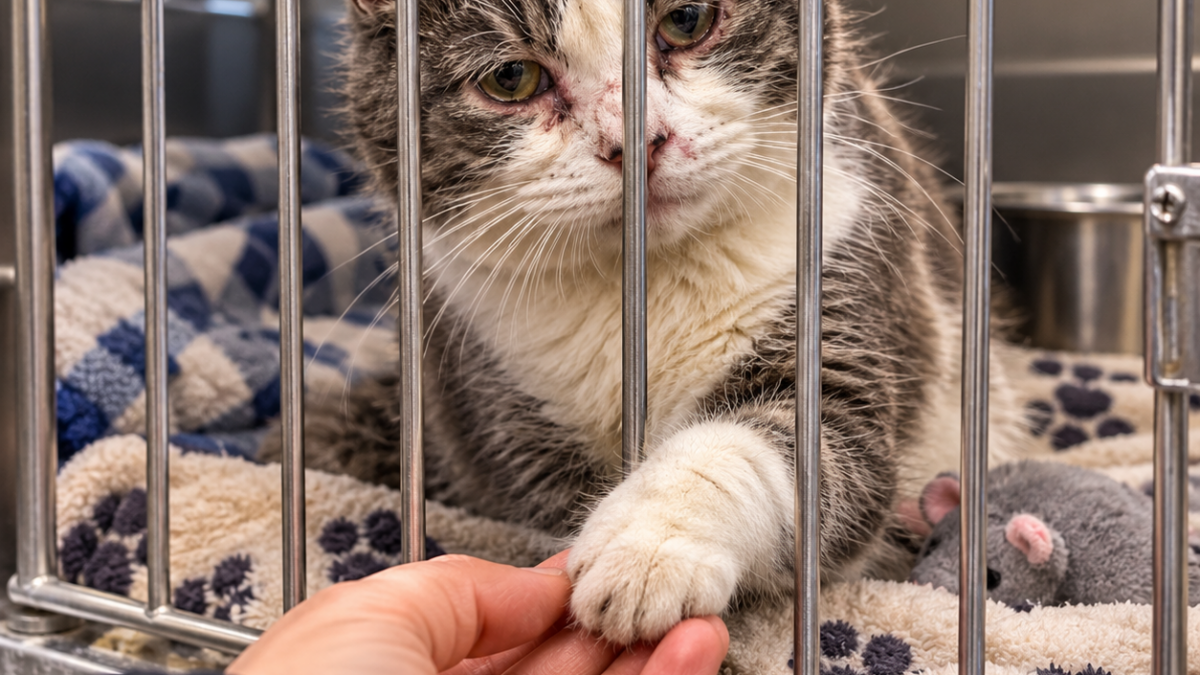
I wish I could say I immediately opened the cage and took him home.
I didn’t.
My first instinct was to escape.
That sounds terrible now.
But it’s true.
I looked toward the kitten room.
Bright.
Noisy.
Simple.
Then back at Cage 23.
Otis.
Eight years old.
Abandoned.
A worn baby sock.
Four months of being passed over.
That was not simple.
I had specifically come to the shelter because I wanted something in my life that didn’t already carry damage.
And standing in front of me was an animal carrying his damage in his mouth.
“I should probably see the kittens,” I said.
Maria nodded.
She didn’t pressure me.
That made it worse.
“Of course.”
I stood.
Otis remained where he was.
He didn’t meow.
Didn’t reach through the bars.
Didn’t do anything dramatic.
He simply kept the sock beneath his paw.
Waiting.
I walked toward the kitten room.
The orange kitten came straight toward the glass.
He pawed at my fingers.
Adorable.
Exactly what I had imagined.
Maria opened the door.
Within seconds, three kittens were climbing on me.
One chewed my shoelace.
Another tried to crawl into my purse.
I laughed.
But I kept thinking about Cage 23.
The ridiculous old sock.
The tired eyes.
Four months.
Finally, Maria asked, “You okay?”
“How long do older cats usually stay?”
She understood immediately which cat I meant.
“It depends.”
“That’s not an answer.”
“No.”
She sat on the small bench beside the kitten enclosure.
“Some get adopted quickly. Some don’t.”
“And Otis?”
Her face softened.
“He’s had people ask about him.”
“What happened?”
“Age.”
I looked down at the kitten in my lap.
“People want this.”
“Usually.”
“A fresh start.”
Maria nodded.
The words hit me harder than they should have.
Fresh start.
People had used that phrase constantly after my divorce.
“This is your fresh start.”
“Now you can begin again.”
“New chapter.”
As if the old chapters disappeared because a judge signed something.
They didn’t.
I still knew exactly where my husband had stood when he told me there was someone else.
I still had a dent in the hallway wall from the bookcase we’d moved in together fifteen years earlier.
My daughter’s childhood height marks were still penciled inside a closet.
The house didn’t become new because he left.
Neither did I.
I wasn’t ruined.
But I wasn’t untouched either.
Maybe that was what made Otis uncomfortable to look at.
He wasn’t a clean slate.
Neither was I.
I put the kitten down.
“Can I spend a few minutes with Otis?”
Maria smiled.
“Absolutely.”
We returned to Cage 23.
Otis was lying down now.
The sock remained against the bars.
“Does he bite?”
“No history of it.”
“Scratch?”
“Only during nail trims.”
“Friendly?”
“Depends what you call friendly.”
“That’s reassuring.”
Maria laughed.
“He doesn’t throw himself at people. He’s cautious.”
She opened the cage.
I knelt.
Otis didn’t come out.
I put my fingers near the opening.
He sniffed them.
Then looked at the sock.
I watched him lower his head.
He picked it up.
Placed it directly in front of my hand.
Something inside me broke open.
Not dramatically.
No music.
No tears running down my face.
Just one quiet realization.
I understood exactly what it was to wonder whether what remained of you was enough to make someone stay.
I touched the sock.
Otis watched.
“You don’t have to pay me.”
His ears shifted.
I looked at Maria.
“I’ll take him.”
She didn’t celebrate.
Didn’t clap.
She only asked, “Are you sure?”
I looked toward the kitten room one last time.
Then at Otis.
“Yes.”
Maria crouched.
“I need you to understand something.”
“Okay.”
“He may hide for days.”
“Fine.”
“He may not be cuddly.”
“Fine.”
“He may have separation issues.”
I looked at the sock.
“That one I figured out.”
“He might never be the cat you pictured.”
I smiled slightly.
“Neither is my life.”
Maria’s eyes softened.
“Then let’s do the paperwork.”
When she opened the cage, Otis didn’t rush out.
He looked at the carrier.
Then back at Maria.
Then at me.
“Come on, buddy,” I whispered.
He turned around.
Picked up the sock.
Then walked into the carrier.
Like a tired businessman taking his briefcase.
Maria laughed through tears.
“I swear that cat knows exactly what he’s doing.”
During the drive home, Otis didn’t make a sound.
His paw rested on the yellow sock.
I kept glancing at him at red lights.
“You know you’re not paying rent with that, right?”
Nothing.
“Utilities are expensive.”
One slow blink.
“Fine. We’ll negotiate later.”
I had prepared the house for a kitten.
Tiny bed.
Bright toys.
Feather wand.
Small scratching post.
Otis ignored everything.
He walked out of the carrier, inspected the living room, then disappeared beneath the dining-room table.
Six hours.
That’s where he stayed.
I didn’t drag him out.
Didn’t lure him.
I put water nearby.
Food.
Litter box.
Then sat on the couch and pretended not to care.
Around ten that night, I looked under the table.
Two eyes stared back.
“You’re safe.”
No response.
“Not that you believe me.”
His sock was between his paws.
I went to bed.
Sometime around three in the morning, I woke on the couch.
The television was still on.
I must have fallen asleep.
Something soft touched my hand.
I opened my eyes.
The yellow sock lay beside my fingers.
Otis stood several feet away.
Watching.
For a moment, I didn’t understand.
Then I remembered Maria’s words.
He’s trying to buy himself a home.
My heart physically hurt.
I picked up the sock.
Otis’s body became tense.
I didn’t take it.
I placed it back in front of him.
“No trade.”
He stared.
“This is yours.”
He didn’t move.
“And the house is still yours too.”
Nothing.
“You understand?”
Of course he didn’t.
Or maybe he did in whatever way cats understand repeated behavior.
I went to bed.
The next morning, the sock appeared beside his food bowl.
That evening, it was near the front door when I returned from work.
The following day, I sat on the couch and called his name.
“Otis?”
He disappeared down the hallway.
Then returned carrying the sock.
Every time he offered it, I repeated the same thing.
“You don’t have to earn your place.”
For weeks, this continued.
Food?
Sock.
Treat?
Sock.
I came home?
Sock.
I sat beside him?
Sock.
One night I cried.
Not because of Otis alone.
Because I understood him.
After my husband left, I had become obsessively useful.
I cooked for my daughter even when she wasn’t coming home.
I volunteered for extra projects at work.
I brought food to neighbors.
I answered every call.
Somewhere deep inside, I had started believing usefulness was the rent you paid for being wanted.
Otis had a sock.
I had competence.
Different currency.
Same fear.
Gradually, he changed.
At first, the sock stopped reaching me.
He left it halfway across the room.
Then near his bed.
Then sometimes he forgot to bring it at all.
The first time I came home and didn’t see it by the door, I stood there smiling like an idiot.
“Otis?”
He emerged from the bedroom.
No sock.
“Well, look at you.”
He glared.
Dinner was apparently late.
Two months after the adoption, I woke one night because something heavy was pressing against my leg.
Otis.
He was sleeping on my bed.
Not at the foot.
Beside me.
The yellow sock was tucked under his chin.
Not offered.
Kept.
I ran one finger over his head.
He didn’t wake.
“That’s right,” I whispered.
“Yours.”
He began to purr.
Two years passed.
Otis became part of the architecture of my life.
He snored.
Loudly.
He occupied the exact center of the bed despite having enough room for three cats.
He hated closed bathroom doors.
He loved rotisserie chicken.
He regarded the vacuum cleaner as a personal enemy.
If dinner was late by more than five minutes, he sat in the kitchen and stared at me with an expression of deep moral disappointment.
He never cared about the expensive toys.
The old sock remained his favorite possession.
I washed it by hand.
Cold water.
Mild soap.
Never in the machine.
The fabric was too fragile.
I kept thinking one day it would fall apart.
It didn’t.
Maybe because I treated it like an artifact.
Then one Tuesday night, two years after the adoption, my phone rang.
Maria.
I smiled when I saw the name.
We still spoke occasionally.
I answered.
“Hey.”
Silence.
My smile disappeared.
“Maria?”
“Hi.”
Her voice sounded wrong.
“What’s happened?”
Another pause.
I sat on the edge of the bed.
Otis was asleep near my feet.
One paw rested over the sock.
“There’s something I need to tell you before you hear it from anyone else.”
My stomach tightened.
“What happened?”
Maria exhaled.
“Someone came into the shelter today asking about Otis.”
I looked at him.
“Who?”
“We didn’t give them your information.”
“Who, Maria?”
“His former owner.”
The room seemed to change around me.
“What?”
“The woman who left him.”
I stood.
Otis opened one eye.
“You’re sure?”
“Yes.”
“How?”
“She knew details from his intake file that weren’t public. His old vet’s name. His approximate age. The house address where he was found.”
I paced toward the window.
“What does she want?”
Maria didn’t answer immediately.
My hand tightened around the phone.
“Maria.”
“She says she wants him back.”
I laughed.
It came out ugly.
“What?”
“She says the abandonment wasn’t what it looked like.”
“He was locked in an empty house.”
“I know.”
“For days.”
“I know.”
“With no food.”
“Not enough.”
I looked at Otis.
He was awake now.
Watching me.
“No.”
Maria spoke gently.
“I haven’t said anything to her about where he is.”
“Good.”
“But there’s more.”
Of course there was.
“What?”
“She has old veterinary records listing her as the owner.”
“Maria, I legally adopted him.”
“Yes.”
“Then what’s the problem?”
“The shelter’s attorney says she probably doesn’t have a claim.”
“Probably?”
“She claims she never surrendered ownership.”
I felt heat rise into my face.
“She abandoned him.”
“Yes.”
“Then she lost ownership.”
“That’s how we see it.”
“How does anyone see it differently?”
Maria sighed.
“She says she had to leave quickly because of an abusive relationship.”
That stopped me.
I sat down again.
For the first time, anger made room for uncertainty.
“What?”
“She says she fled the state.”
I looked at Otis.
His damaged little sock.
His old fear.
“Was the sock from her child?”
“We think so.”
“Think?”
“She confirmed it.”
I closed my eyes.
There it was.
The possibility of a story I hadn’t known.
A woman running.
A child.
Fear.
Leaving too quickly.
My anger didn’t disappear.
But it became complicated.
“What exactly did she say?”
“She said she left Otis temporarily.”
“With whom?”
“Her husband.”
“And?”
“She claims he told her he would care for the cat.”
I stood again.
“So the husband abandoned him.”
“That’s what she’s saying.”
“Do you believe her?”
“I don’t know.”
That answer mattered.
Maria was careful.
Always.
“What does she want now?”
“She says she’s back in the area.”
“And after two years suddenly remembers him?”
“She says she’s been looking.”
“For four years?”
“Two years since you adopted him. Longer since she left.”
I stopped pacing.
“Why now?”
Maria hesitated.
“That’s the part that bothered me.”
“What part?”
“She saw the shelter’s anniversary post last week.”
I remembered it.
The shelter had featured several successful adoptions.
Otis had been included.
A photograph of him on my bed.
The yellow sock beneath his chin.
My stomach sank.
“So she recognized him.”
“Yes.”
“And now she wants him.”
“Yes.”
I stared at the cat who had spent months believing he had to barter his last possession for belonging.
“No.”
Maria spoke gently.
“I expected that.”
“She doesn’t get to disappear, come back years later, see a happy picture and decide he’s hers.”
“I agree emotionally.”
“Legally?”
“We’re checking.”
That sentence began the worst month of my life.
The next morning, I called an attorney.
Not because I believed she would win.
Because “probably” wasn’t enough.
I brought every document.
Adoption contract.
Veterinary bills.
Microchip registration.
Vaccination records.
Photographs.
Receipts.
The attorney was a woman named Denise who listened without interrupting.
When I finished, she tapped the adoption contract.
“This is strong.”
“Strong isn’t absolute.”
“Almost nothing is absolute.”
I hated lawyers for saying things like that.
“Could she take him?”
“Based on what you’ve shown me? Highly unlikely.”
“Why not impossible?”
“Because ownership disputes over animals can be messy, especially if she argues she never voluntarily transferred ownership.”
“She left him in a house.”
“Yes.”
“That should be enough.”
“It may be.”
I leaned forward.
“He’s not property to me.”
Denise nodded.
“I understand.”
“No, you don’t.”
She let that sit.
Then she said, “The law may still treat parts of this like a property dispute. My job is to make sure every fact supports you.”
I looked at the papers.
“What facts do we need?”
“How long he was abandoned. Who found him. Whether the former owner made any attempt to recover him. Whether animal control posted notice. Whether the shelter followed statutory hold procedures.”
“They did.”
“Good.”
“And if all of that checks out?”
“Then she has an extremely weak case.”
I exhaled.
“Extremely weak isn’t zero.”
“No.”
I hated her a little for that too.
Two days later, the former owner sent a letter through an attorney.
Her name was Leah.
I read it at my kitchen table while Otis slept beside me.
She said she had fled an abusive husband.
She said she believed Otis would remain in the house with him temporarily.
She said she had suffered financial and emotional instability.
She said she had only recently found evidence that Otis had been surrendered—or, in her words, “wrongfully taken.”
I read that phrase twice.
Wrongfully taken.
The landlord had found Otis dehydrated, hungry, alone.
The shelter had held him.
No one came.
Four months later, I adopted him.
But suddenly he had been wrongfully taken.
The letter asked that I “voluntarily return” him to avoid litigation.
I laughed so hard I frightened Otis.
He lifted his head.
“What?”
I held up the letter.
“Apparently you’re stolen.”
He blinked.
“News to me too.”
Then he stood.
Walked into the bedroom.
Returned with the sock.
He placed it beside my chair.
My laughter vanished.
Even after two years, distress still triggered the old behavior.
Maybe my tone had changed.
Maybe he sensed tension.
Maybe coincidence.
It didn’t matter.
I picked up the sock and placed it back beside him.
“No.”
His ears moved.
“No trade.”
I crouched.
“And no one is taking you.”
That night, I barely slept.
Not because I thought Leah deserved Otis.
But because part of her story had lodged inside me.
What if she really had fled?
What if she’d been terrified?
What if she had believed the husband would care for Otis?
Was I punishing someone for surviving?
Then another thought followed.
Even if every word was true, why had she waited years?
Why had she never contacted the landlord?
The shelter?
The old veterinarian?
Why had it taken a social-media photograph?
I needed answers.
Denise told me not to contact Leah directly.
I didn’t.
For three days.
Then Leah sent me a message through social media.
I don’t know how she found me.
Probably from the shelter post.
Her message was short.
Please don’t block me. I only want to explain.
I stared at it for almost an hour.
Then forwarded it to Denise.
Her reply came quickly.
DO NOT ENGAGE YET.
So I didn’t.
Leah sent another.
I know you love him. I loved him first.
That sentence made me angrier than the legal letter.
Love him first.
As if chronology outranked presence.
As if being first meant being permanent.
As if Otis hadn’t spent four months paying strangers with a sock because the person who loved him first had disappeared.
I closed the app.
A week later, the shelter found the old intake records.
Everything changed.
The landlord who had found Otis had documented the condition of the house.
No furniture.
No active utilities.
Food bowl empty.
Water bowl dry.
Otis had been locked inside a laundry room.
The landlord estimated the tenants had been gone at least six days.
Six days.
Leah claimed she had left her husband in charge.
Maybe she had.
But the landlord’s statement contained something else.
He had spoken to both tenants before they left.
Both.
According to his written notes, Leah had been present during the move-out inspection three days before the lease officially ended.
I read the copy twice.
“What does that mean?” I asked Denise.
“It means her story has a problem.”
“She says she fled.”
“Maybe she did later. But if the landlord’s notes are accurate, she was at the property shortly before Otis was found.”
My stomach turned.
“Did she know he was there?”
“We don’t know yet.”
“She had to.”
“Don’t jump.”
“How do you forget a seventeen-pound cat?”
“Otis isn’t seventeen pounds.”
“You know what I mean.”
Denise kept her voice calm.
“We need corroboration.”
The landlord was still local.
He agreed to speak with us.
His name was Mr. Alden.
We met in Denise’s office.
He was in his seventies.
Careful.
Precise.
The kind of man who remembered dates because he wrote everything down.
“You remember the cat?”
“Oh, yes.”
“Why?”
“Because he screamed for two days.”
My stomach dropped.
“What?”
Mr. Alden looked at me.
“After I found him.”
I gripped the chair.
“He screamed?”
“At the laundry-room door.”
“Why?”
“I assume he expected them to return.”
I looked away.
Otis.
The sock.
Waiting.
Mr. Alden continued.
“I called the number I had for the tenants.”
“Who answered?”
“The husband once.”
“What did he say?”
“Told me the cat wasn’t his problem.”
I swallowed.
“And Leah?”
“I left messages.”
“Did she return them?”
“No.”
“Are you certain?”
“I keep call logs for tenant disputes.”
Of course he did.
“Did you see her during the move?”
“Yes.”
Denise leaned forward.
“How close to the move-out?”
“Two days before I entered the house.”
“Did you see Otis?”
“I saw the cat in the hallway while they were loading boxes.”
My heart started pounding.
“Was Leah there?”
“Yes.”
I couldn’t breathe normally.
“Did she leave before the husband?”
“Not that day.”
“Did she ask you to care for Otis?”
“No.”
“Tell you he was remaining temporarily?”
“No.”
“Leave food?”
“Not that I saw.”
Denise glanced at me.
I said nothing.
Mr. Alden continued.
“When I came back two days later, the house was empty. I heard the cat scratching.”
“Where?”
“Laundry room.”
“Was the door locked?”
“No. Closed.”
“Could he get out?”
“No.”
“Any food?”
“Empty bowl.”
“Water?”
“Dry.”
I felt sick.
“What about the sock?”
Mr. Alden nodded.
“There were a few children’s things left. One little sock was under the cat.”
I closed my eyes.
“Did you take him to the shelter?”
“Animal control did after I called.”
“Did anyone come back looking?”
“No.”
“Any calls?”
“Not to me.”
Denise thanked him.
After he left, I sat silently.
“So she lied.”
Denise chose her words carefully.
“Her version is inconsistent with documented evidence.”
“That’s lawyer language for lied.”
“Yes.”
I stood.
All the uncertainty I’d been carrying hardened into anger.
“She knew.”
“It appears she knew Otis was at the house.”
“And left him.”
“Yes.”
“Then why come back?”
Denise looked at the shelter’s printout.
“I have a theory.”
I waited.
“Was there anything distinctive in the anniversary post?”
“The sock.”
“Anything else?”
I thought.
Then remembered.
The post had mentioned Otis’s story had drawn significant attention.
Several local pages had shared it.
One post had more than fifty thousand reactions.
Comments everywhere.
People calling him heartbreaking.
Beautiful.
Special.
There had even been a small news story.
My stomach tightened.
“She saw he was getting attention.”
“Possibly.”
The idea disgusted me.
But we needed proof.
We got it by accident.
Maria called three days later.
“You’re going to want to hear this.”
“What happened?”
“Leah came back.”
“To the shelter?”
“Yes.”
“Why?”
“She wanted copies of Otis’s old photographs.”
“Why?”
“She said she needed them for court.”
“Okay.”
“Then she asked whether the shelter had made money from his story.”
I went silent.
“What?”
“She asked about donations.”
A chill moved through me.
“What did you say?”
“That donations go to the shelter generally, not Otis personally.”
“And?”
“She asked whether any companies had contacted us.”
I sat down.
There it was.
Not love.
Value.
Visibility.
She had seen Otis become a story.
And suddenly the cat she left behind mattered.
Maria lowered her voice.
“There’s more.”
“Of course.”
“She asked whether she would be entitled to compensation if someone used his image.”
I closed my eyes.
The anger I felt then was different from ordinary anger.
Cold.
Clean.
Precise.
She wasn’t coming back because she missed him.
She thought there was something to gain.
My attorney loved that detail.
“Do we have witnesses?”
“Three shelter employees.”
“Excellent.”
“Excellent?”
“It goes to motive.”
I didn’t care about motive anymore.
I wanted her gone.
But Leah escalated.
Her attorney filed a civil claim.
Not only asking for Otis.
Also damages.
She alleged the shelter had improperly transferred “valuable personal property.”
Valuable.
That word almost broke something in me.
Otis had spent four months in Cage 23 offering a sock because nobody considered him valuable.
Now that strangers loved his story, suddenly he was property worth fighting over.
I wanted to attend every hearing.
Denise advised me to stay calm.
“The facts are on our side.”
“Then why am I terrified?”
“Because you love the subject of the lawsuit.”
Exactly.
During those weeks, Otis regressed.
He started carrying the sock again.
Every day.
Sometimes twice.
He began waiting by the front door when I left.
One morning I found him hiding beneath the dining-room table—the same place he’d spent his first six hours with me.
I sat on the floor.
“Buddy.”
He didn’t move.
The yellow sock was between his paws.
I wondered whether animals can recognize the emotional texture of a household.
He couldn’t understand legal filings.
But he understood my fear.
My altered routine.
My phone calls.
Visitors.
Stress.
And his answer was the old one.
Offer the sock.
Pay.
Don’t be abandoned.
I crawled halfway beneath the table.
“You listen to me.”
He watched.
“I don’t care who files what.”
His ears moved.
“You are not going anywhere.”
I placed one hand on the floor.
“No one gets to show up after years and decide they own the version of you that survived without them.”
Otis blinked slowly.
I stayed under that table until he came out.
The first court hearing was administrative.
Ugly.
Boring.
Terrifying.
Leah sat across the room.
It was the first time I saw her.
She was around my age.
Maybe slightly younger.
Well dressed.
Tense.
She looked ordinary.
That bothered me.
We expect people who do cruel things to look cruel.
They don’t.
Sometimes they look tired.
Sometimes nervous.
Sometimes like people you’d stand beside at a pharmacy.
She looked at me once.
Then at the carrier beside my chair.
I had not planned to bring Otis.
The court had requested proof of identification because Leah’s attorney challenged the microchip history.
So Otis came.
He hated it.
The sock was inside the carrier.
When Leah saw him, her face changed.
“Otis.”
His ears moved.
That was all.
She stood.
My entire body tightened.
Denise touched my arm.
“Stay seated.”
Leah approached the carrier.
“Otis?”
He backed away.
She crouched.
“It’s me.”
Otis pressed himself against the far wall.
She reached toward the bars.
He hissed.
Loudly.
I had heard Otis hiss maybe three times in two years.
Leah jerked back.
Her attorney looked uncomfortable.
She whispered, “He remembers me.”
I almost said something unforgivable.
Instead, Denise leaned toward me.
“Don’t.”
The judge entered.
We stood.
The hearing lasted forty minutes.
Leah’s attorney argued ownership.
Denise argued lawful abandonment, statutory transfer, adoption, veterinary care, microchip registration, and two years of continuous possession.
Then she introduced the landlord’s records.
Leah’s face changed.
Her attorney leaned over.
Whispered sharply.
The judge read the notes.
Then looked at Leah.
“You were present at the residence shortly before the animal was discovered?”
Leah hesitated.
“Yes, but—”
“Your filing states you fled unexpectedly and believed the animal remained in your husband’s care.”
“I did.”
“When did you flee?”
“After the move.”
“Then why was the animal left in a closed laundry room in a vacated residence?”
Her attorney stood.
“Your Honor—”
The judge raised a hand.
“I asked the claimant.”
Leah swallowed.
“I thought my husband would come back.”
“For the cat?”
“Yes.”
“Did you?”
“No.”
“Did you contact the landlord?”
“I was dealing with—”
“Did you?”
“No.”
“The shelter?”
“No.”
“Animal control?”
“No.”
“Any veterinarian?”
“No.”
“How long before you began searching for the cat?”
Silence.
Her attorney finally said, “My client was under significant emotional distress.”
The judge nodded.
“That may explain actions. It does not erase them.”
I gripped the edge of the chair.
No dramatic ruling happened that day.
The judge requested additional records.
Another hearing.
More waiting.
But walking out, Leah approached me.
Denise stepped between us.
“I only want to talk,” Leah said.
“Through counsel,” Denise replied.
Leah looked past her.
At me.
“You don’t understand.”
I surprised myself.
“Then explain one thing.”
Denise turned.
I ignored her.
Leah swallowed.
“What?”
“Why now?”
Her face changed.
“I told you. I found him.”
“No.”
I shook my head.
“You found a picture.”
She said nothing.
“You had years to find him.”
“I didn’t know where he was.”
“You knew the address.”
“My life was—”
“You knew the landlord.”
Silence.
“You knew the vet.”
Her jaw tightened.
“I was trying to survive.”
“So was Otis.”
That landed.
She looked at the carrier.
I continued.
“He survived six days in an empty house. Four months in a shelter. Two years learning he doesn’t have to pay people to stay.”
Leah’s eyes filled.
I almost felt sorry for her.
Almost.
Then she said, “He’s my cat.”
I looked at the carrier.
Otis had pulled the yellow sock beneath his chin.
“No.”
My voice was calm.
“He was your cat.”
Leah flinched.
“And you left him.”
She stepped forward.
“I loved him.”
I felt something cold settle inside me.
“Then why did he spend four months trying to trade your child’s sock for a home?”
She went completely still.
That was the first time I saw guilt defeat anger on her face.
She turned away.
The second hearing was worse for her.
The shelter produced its statutory hold records.
Notices.
Microchip scan.
Attempts to contact the listed phone number.
No response.
Animal control documentation.
Medical intake.
Dates.
Everything had been done properly.
Then Maria testified.
She described Otis’s behavior.
The sock.
The offering.
Leah cried quietly.
Maria didn’t look at her.
“He arrived withdrawn,” she said. “For the first week he barely ate.”
“Did he show signs of attachment to the sock?” Denise asked.
“Yes.”
“How?”
“He slept on it. Carried it. Became distressed if it was removed for cage cleaning.”
“When did the offering behavior begin?”
“About two weeks later.”
“Describe it.”
Maria swallowed.
“If someone stopped at his cage, he brought the sock forward.”
“Every person?”
“Not every single person. But many.”
“Did shelter staff interpret the behavior?”
Leah’s attorney objected.
The judge allowed limited testimony.
Maria said, “We believed he associated the sock with his previous home. And eventually he appeared to offer it when people gave him attention.”
“Did the claimant contact you during the four months Otis remained available for adoption?”
“No.”
“Ever?”
“No.”
“Until?”
“Two years after his adoption.”
“After seeing a public post?”
“Yes.”
Then came the part that changed everything.
Denise asked about Leah’s questions regarding money.
Maria described the visit.
Donations.
Licensing.
Image rights.
Compensation.
Leah’s attorney objected repeatedly.
The judge allowed most of it.
When Maria finished, Leah looked furious.
Not ashamed.
Furious.
That told me more than tears ever could.
After court, her attorney requested settlement discussions.
Denise called me.
“They’re offering to withdraw the claim if the shelter and you agree not to publicly discuss the dispute.”
I stared at her.
“What?”
“They want confidentiality.”
“Why?”
“You know why.”
Because the case looked terrible.
Because a woman who abandoned an old cat and resurfaced after his story went viral was not a sympathetic headline.
“What do I get?”
“Final written release of any ownership claim.”
“Anything else?”
“We can ask for legal fees.”
“Ask.”
“They may refuse.”
“Then we keep going.”
Denise raised an eyebrow.
“You’re willing?”
I looked toward my living room.
Otis was asleep in sunlight.
Sock beneath one paw.
“Yes.”
For months, I’d been afraid of losing him.
Now that fear was changing into something stronger.
I didn’t want only safety.
I wanted finality.
I wanted a document that said she could never appear again.
Never threaten his home.
Never claim his image.
Never turn his survival into an asset.
We rejected the first offer.
The second included partial legal fees.
Rejected.
The third included full withdrawal, permanent waiver of ownership, legal fees, and a written agreement that Leah would make no future commercial claim connected to Otis.
Denise looked at me.
“This is good.”
“Is it permanent?”
“Yes.”
“Can she come after him again?”
“No.”
“Can she demand access?”
“No.”
“Can she use him for money?”
“Not through an ownership claim.”
I looked at the signature line.
“What happens if I don’t sign?”
“We probably win eventually.”
“Probably.”
She smiled slightly.
“I knew you’d notice.”
I looked at Otis’s photograph attached to the case file.
Then signed.
I expected to feel triumphant.
I didn’t.
Mostly, I felt tired.
The legal dispute ended without a dramatic courtroom verdict.
No judge slammed a gavel and declared me righteous.
No one was arrested.
No one was dragged away.
But something happened two weeks later that gave the story the ending it needed.
Maria called.
Again.
This time she sounded different.
Almost amused.
“You aren’t going to believe what happened.”
“What?”
“Leah came to the shelter.”
My body went rigid.
“Why?”
“Relax.”
“I’m not relaxing.”
“She didn’t ask for Otis.”
I waited.
“Then what?”
“She brought a box.”
“What kind of box?”
“Baby clothes.”
My anger hesitated.
Maria continued.
“Old things from her daughter.”
I sat down.
“Why?”
“She wants to donate them to a family shelter.”
I said nothing.
“And she brought a letter.”
“For me?”
“Yes.”
“I don’t want it.”
“I know.”
“But?”
“But I think you should read it.”
I drove to the shelter that afternoon.
Cage 23 was occupied by a black senior cat named Nelson.
I stood in front of it longer than necessary.
Maria handed me an envelope.
No lawyer.
No official language.
Just my first name.
I opened it.
Leah wrote that she had been angry at me because anger was easier than shame.
She admitted she had known Otis was left in the house.
Her husband had refused to take him.
She had told herself the landlord would find him.
She had been overwhelmed.
Frightened.
Selfish.
All at once.
She wrote that she left without making sure he was safe.
Then she tried not to think about it.
Years later, seeing his picture forced her to confront what she’d done.
At first, she said, she wanted him back because reclaiming him felt like a way to rewrite the past.
Then the attention around his story complicated that desire.
She admitted she had wondered whether his popularity could become financially useful.
There it was.
Ugly.
Direct.
At least honest.
Then she wrote:
I told myself wanting him back proved I loved him.
Court made me understand that love is not proved by what you want returned to you.
It is proved by what you protect when leaving would be easier.
You protected him.
I did not.
I had to stop reading for a moment.
Maria waited silently.
I continued.
Leah wrote about the sock.
It had belonged to her daughter when she was a baby.
Otis used to steal socks from the laundry.
That yellow one became his favorite.
Her daughter would laugh whenever he carried it around the house.
The night before they left, the little girl had apparently put the sock beside Otis.
“For you,” she’d said.
Leah wrote:
When I saw the shelter photograph and realized he still had it, I told myself it meant he remembered us and wanted us back.
Now I understand it may have meant something else.
Maybe he held onto the last object because the people disappeared.
I am sorry he ever had to offer it to anyone.
My eyes blurred.
The final paragraph was short.
Please do not respond. I don’t deserve reassurance from you. I only wanted you to know I will never interfere with his life again.
Tell him I am sorry, even though I know he cannot understand the words.
I folded the letter.
Maria watched me.
“What do you think?”
“I don’t know.”
“Fair.”
I looked toward Cage 23.
“Do you forgive her?”
Maria asked.
I laughed softly.
“That’s not really my job.”
“Maybe.”
I thought about it.
Forgiveness is strange.
People talk about it as though it’s a door.
Open.
Closed.
Done.
For me, it wasn’t.
I could understand Leah’s fear.
I could even believe some of her regret.
That didn’t erase Otis’s suffering.
Her apology didn’t refill an empty water bowl years earlier.
It didn’t stop him from screaming at the laundry-room door.
It didn’t give him back four months in the shelter.
And it didn’t make the lawsuit disappear from my memory.
But revenge had changed shape for me.
At first, I wanted her humiliated.
Then I wanted her defeated.
Then I realized the thing that probably hurt her most had already happened.
Otis had stopped waiting for her.
He had survived.
He had built a life that did not require her return.
There is a particular kind of consequence in discovering that the living thing you abandoned learned to be happy without you.
I didn’t need to add anything.
I went home.
Otis met me at the door.
No sock.
Just Otis.
“Hey.”
He rubbed against my leg.
I sat on the floor.
“I learned where your sock came from.”
He sniffed my purse.
“Apparently you were always a thief.”
His tail lifted.
I laughed.
“That makes much more sense.”
I looked toward the bedroom.
“Want to hear something?”
Otis walked away.
“Of course not.”
I followed.
The sock was on the bed.
Old.
Faded.
Almost translucent.
I picked it up.
For a moment, I imagined a little girl years earlier placing it beside a younger Otis.
“For you.”
Maybe that had been one of the last gentle moments in his old life.
I didn’t hate the sock anymore for what it represented.
I had never hated it exactly.
But I had always seen it as evidence of abandonment.
Now it was also evidence that, once, a child loved him.
Those truths could exist together.
I sat beside Otis.
He looked at the sock in my hand.
Then at me.
I placed it beneath his paw.
“This was never payment.”
He curled his toes over it.
“Just yours.”
That winter, Otis turned ten.
At least we think he did.
We celebrated with chicken.
Maria came over.
So did my daughter, who flew in for the weekend.
My daughter had heard the entire legal saga through frantic phone calls.
The first thing she did when she saw Otis was kneel.
“So you’re the expensive legal problem.”
Otis stared.
“He looks guilty,” she said.
“He always looks guilty.”
She noticed the sock.
“That’s it?”
“That’s it.”
“So much trouble over one ugly little sock.”
I smiled.
“It’s not about the sock.”
She looked at me.
“I know.”
That night, my daughter slept in her old bedroom.
I was lying awake when I heard footsteps in the hall.
Human first.
Then cat.
My daughter appeared at my doorway.
“Mom?”
“What?”
“Your cat is staring at me.”
Otis sat behind her.
“Did you take his spot?”
“Apparently.”
I lifted the blanket.
Otis jumped onto the bed.
My daughter laughed.
“He really does take up half of it.”
“More.”
She sat beside me.
For several minutes, neither of us spoke.
Then she said, “You seem different.”
“Older?”
“No.”
“Thank you.”
“I mean happier.”
I looked at Otis.
He was turning in circles.
Sock in his mouth.
“I think I am.”
“Because of him?”
“Partly.”
She leaned against my shoulder.
“You know I worried about you after Dad left.”
“I know.”
“You kept saying you were fine.”
“I was functional.”
“That’s not the same.”
“No.”
Otis dropped the sock.
My daughter picked it up.
He watched closely.
She placed it back.
“He still needs this?”
“Yes.”
“Does that make you sad?”
I thought.
“Not anymore.”
“Why?”
“Because keeping a memory isn’t the same as being trapped inside it.”
She looked at me.
I smiled.
“Apparently your mother has become philosophical because of a dirty baby sock.”
“That’s concerning.”
We laughed.
Otis glared because we were disturbing him.
The years that followed were quieter.
No lawyers.
No court dates.
No former owners.
Just life.
Ordinary, wonderful life.
Otis developed arthritis.
We added little steps beside the bed.
He refused to use them for three months because accepting help was apparently beneath him.
Then one cold morning I saw him carefully climb each step.
I pretended not to notice.
His fur became softer after years of good nutrition.
The patchiness improved.
His whiskers never did.
They still pointed everywhere.
His permanent frown deepened with age.
People meeting him for the first time often asked, “Is he angry?”
“No.”
“He looks angry.”
“That’s just his face.”
Otis became friendlier too.
Not with everyone.
He loved Maria.
Tolerated my daughter.
Distrusted men wearing hats for reasons we never understood.
He hated delivery drivers.
Loved one particular mail carrier.
Sometimes grief creates strange maps inside the nervous system.
We stopped needing to decode every one.
The sock changed too.
The yellow faded to something closer to cream.
One corner tore.
I stitched it.
Badly.
Otis inspected my repair like a building contractor disappointed with the workmanship.
“You’re welcome.”
He sat on it.
I eventually placed the sock inside a soft cloth pouch when I washed it so it wouldn’t disintegrate.
Every time it was missing, Otis searched the house.
Then I returned it.
Always.
Because he had learned I came back.
And I had learned promises mattered most when the other person—or animal—had reasons not to believe them.
The strangest thing happened on the third anniversary of his adoption.
I came home from work late.
A storm had slowed traffic.
I expected Otis at the door.
He wasn’t.
“Otis?”
Nothing.
I checked the bedroom.
Empty.
Living room.
Nothing.
Panic moved through me embarrassingly fast.
“Otis!”
Then I heard a sound from the closet.
He had somehow pushed open the sliding door and climbed inside.
He was sleeping on an old cardboard box containing things from my marriage.
Photographs.
Letters.
A Christmas ornament with both our names.
Documents I had never bothered sorting.
Otis opened his eyes.
The yellow sock was under his paw.
I stared at him.
Then at the box.
I laughed.
“Really?”
He yawned.
For years, I had avoided that box.
Not because I wanted my husband back.
I didn’t.
But because opening it meant touching a life that no longer existed.
Otis, apparently, had no respect for symbolic boundaries.
I sat on the floor.
Pulled the box toward me.
Opened it.
Old photographs.
My daughter as a child.
Vacations.
Birthdays.
A wedding picture.
I expected pain.
Some came.
But not the kind I feared.
Mostly I felt distance.
That woman in the photographs was me.
But she wasn’t the whole of me.
I picked up one photo.
My ex-husband and I standing beside a lake.
Happy.
At least that day.
I didn’t need to destroy the picture to prove I had moved on.
I didn’t need to pretend nothing good had existed.
I put it back.
Otis watched.
“Look at us.”
He blinked.
“Two emotionally complicated adults with storage issues.”
I closed the box.
But I didn’t push it into the deepest part of the closet.
I put it on a shelf.
Accessible.
Safe.
Like the sock.
Some memories don’t need burial.
They need context.
Years after the lawsuit, I saw Leah once.
Completely by accident.
Grocery store.
Produce section.
I recognized her immediately.
She recognized me too.
For several seconds, neither of us moved.
She looked older.
So did I.
She approached carefully.
“Hi.”
“Hi.”
“How is he?”
I could have walked away.
Part of me wanted to.
Instead I said, “Old.”
She smiled sadly.
“Of course.”
“Arthritis.”
“I’m sorry.”
“Managed.”
She nodded.
“Does he still have the sock?”
“Every night.”
Her eyes filled.
She looked at the apples instead of me.
“My daughter is in college now.”
I hadn’t expected that.
“Really?”
“Yeah.”
“Does she remember him?”
“Very well.”
I didn’t know what to say.
Leah swallowed.
“She was furious with me when she found out what happened.”
There was the consequence.
Not court.
Not money.
Truth.
“I’m sorry,” I said.
And I meant it.
Leah looked surprised.
“I deserved it.”
“Maybe.”
She laughed weakly.
“You haven’t changed much.”
“I’ve gotten ruder.”
“Fair.”
We stood in silence.
Then she asked something I didn’t expect.
“Is he happy?”
I thought about it carefully.
“Yes.”
Her face crumpled slightly.
But she nodded.
“Good.”
I could have told her more.
That he slept beside me.
That he snored.
That he yelled at 5:57 every evening because dinner was at six.
That he still carried the sock during thunderstorms.
That he had learned to trust my daughter.
That he had stopped offering payment years ago.
I didn’t.
Those details belonged to us.
Instead I said, “He’s safe.”
Leah closed her eyes for a second.
“Thank you.”
I almost replied, You should have kept him safe.
The sentence rose in my throat.
Then passed.
I didn’t need it.
She already knew.
We said goodbye.
That was the last time I saw her.
When Otis was around fourteen, his health began to decline.
Slowly.
Kidneys first.
Then weight.
His appetite became inconsistent.
The veterinarian explained chronic kidney disease.
Manageable.
Not curable.
We changed food.
Added fluids.
Medication.
More frequent checkups.
Otis hated all of it.
Especially the prescription diet.
He looked at me the first time I served it as though I had personally violated the Geneva Conventions.
“Eat.”
He sniffed.
Walked away.
“Otis.”
He returned carrying the sock.
I stared.
“Absolutely not.”
He placed it beside the bowl.
“You are not bribing me into giving you chicken.”
He blinked.
“That tactic stopped working years ago.”
It did not stop him from trying.
We compromised.
Veterinary-approved toppers.
Otis won, as usual.
The older he became, the more precious ordinary mornings felt.
His heavy body beside mine.
The little grunt when he jumped down.
His slow walk toward breakfast.
The sock dragged behind him.
I knew where the story was going.
Every person who loves an old animal knows.
We pretend not to.
We celebrate good bloodwork.
Measure food.
Count medication.
Notice good days.
Ignore the calendar.
But the calendar keeps moving.
One November morning, Otis didn’t get out of bed.
I touched his side.
“Hey.”
He opened his eyes.
No movement.
I brought water.
He turned away.
Food.
Nothing.
The sock was beneath his chin.
My hands started shaking.
At the veterinary clinic, they ran bloodwork.
I knew before the veterinarian entered.
You know faces after enough years of bad news.
She sat beside me.
“His kidney values have worsened significantly.”
“Can we treat it?”
“We can hospitalize him. Fluids. Anti-nausea medication. See how he responds.”
“Then do that.”
She nodded.
“But I need you to understand—”
“Do it.”
I wasn’t ready for understanding.
Otis stayed two nights.
He improved slightly.
Came home.
Ate chicken.
Slept beside me.
For three weeks, I convinced myself we’d turned the corner.
Then another crash.
This time, the veterinarian was gentler.
That terrified me.
“He’s tired.”
I looked at Otis.
He was wrapped in a blanket on the exam table.
The yellow sock beside him.
“He’s always tired.”
“You know what I mean.”
I did.
I hated her for making me admit it.
“What happens if I take him home?”
“Maybe days.”
“Weeks?”
“Possibly.”
“Pain?”
“Mostly nausea, weakness, dehydration. We can manage some.”
“Can he have good days?”
“Maybe.”
Maybe.
The cruelest word in medicine.
I sat with him for an hour.
No decision.
Just sitting.
Then Otis lifted his head.
Slowly.
He picked up the sock.
Placed it against my hand.
I broke.
Not because I thought he was consciously making that old offer.
Maybe he was.
Maybe it was simply habit.
But there it was.
The first thing he’d ever offered me.
The thing he’d used when he believed love required payment.
Now, at the end, placed against my fingers again.
I pressed my forehead to his.
“No.”
Tears fell into his fur.
“No trade.”
His breathing was slow.
“You already paid nothing.”
I laughed through crying.
“Remember?”
His eyes closed.
“You never owed me anything.”
That evening, I took him home.
Not because I refused to let go.
Because I wanted one more night in the place he finally believed belonged to him.
Maria came.
My daughter flew in the next morning.
We sat around the bed.
Otis slept.
Sometimes woke.
Sometimes purred.
The yellow sock remained beneath his chin.
My daughter stroked his back.
“He looks peaceful.”
“He is.”
“Are you?”
“No.”
She took my hand.
That afternoon, the veterinarian came to the house.
I had arranged it.
Otis hated the clinic.
I didn’t want his last experience to be fluorescent lights and stainless steel.
He lay on my bed.
His bed.
Our bed.
Sunlight through the curtains.
Sock beneath his paw.
The veterinarian explained every step.
I already knew.
Still, I listened.
My daughter stood beside me.
Maria sat at the foot.
I held Otis.
For a moment, fear hit me.
The old irrational thought:
If I love him enough, I should prevent this.
Then another truth.
Sometimes preventing suffering is the last form of staying.
I whispered into his ear.
“You don’t have to buy anything.”
His eyes were half closed.
“You don’t have to earn anything.”
The veterinarian gave the first injection.
Otis relaxed.
His head became heavy against my arm.
“This was always your home.”
I picked up the yellow sock.
Placed it beneath his chin.
“And this was always yours.”
His breathing slowed.
I kissed his head.
“You were never temporary.”
One last breath.
Then none.
The house became silent.
But it wasn’t the same silence I’d known before him.
That first silence had felt empty.
This one felt full.
Full of evidence.
Hair on the couch.
Scratch marks near the bedroom door.
Medication in the kitchen.
A food bowl.
Steps beside the bed.
Fourteen years of a cat’s life condensed into objects.
Maria cried.
My daughter cried.
I didn’t at first.
I held him.
Then I noticed his paw.
Still touching the sock.
And everything came out.
Afterward, the veterinarian asked if I wanted the sock cremated with him.
I answered immediately.
“No.”
Then felt guilty.
Shouldn’t he have it?
Maria seemed to understand.
“You should keep it.”
I looked at her.
“Are you sure?”
“Otis spent years trying to give it to you.”
I almost smiled.
“He stopped.”
“I know.”
Maria touched my shoulder.
“Maybe now it’s your turn to keep it safe.”
So I did.
Otis was cremated with his favorite blanket.
His ashes came home in a plain wooden box.
No dramatic inscription.
Just:
OTIS
I placed the yellow sock beside it.
For weeks, I couldn’t touch either.
Then one night, I came home from work.
Unlocked the door.
Silence.
No Otis.
No offended stare.
No dinner complaint.
No heavy body on the bed.
I stood in the hallway and felt the old loneliness move toward me.
The one from before.
The one I thought I’d escaped.
For a terrifying second, I believed losing him had returned me to the beginning.
Then I saw the sock.
I picked it up.
The fabric was unbelievably soft from age.
And I realized something.
Before Otis, silence meant nobody was waiting.
After Otis, silence meant someone had been there.
Those are not the same thing.
Grief is not emptiness.
Grief is evidence.
You cannot miss what never mattered.
I sat on the couch holding that ridiculous sock.
And for the first time since he died, I smiled.
“Still causing problems.”
Months later, Maria invited me to the shelter.
“I need help.”
“With what?”
“Just come.”
I walked through the same entrance.
Same reception desk.
Different volunteers.
The adult-cat room had been renovated.
Cage 23 was gone.
In its place were larger enclosures.
Maria led me toward one.
Inside sat a twelve-year-old brown tabby.
Thin.
Grumpy.
Missing several teeth.
“Absolutely not,” I said.
Maria laughed.
“I didn’t say anything.”
“You were about to.”
“His name is Walter.”
“I don’t care.”
“He was surrendered after his owner died.”
“Maria.”
“He’s been here five months.”
I closed my eyes.
“You are a terrible person.”
“I’ve been told.”
Walter looked at me.
No sock.
No offer.
Just suspicion.
I crouched.
He hissed.
“Charming.”
Maria smiled.
“You wanted uncomplicated once too.”
“Look how that turned out.”
Walter came closer.
Sniffed my hand.
Then smacked it without claws.
I laughed.
“He hates me.”
“Promising.”
I didn’t adopt Walter that day.
I waited.
Visited twice.
Then three times.
Because love after loss feels frightening.
You know the ending now.
That’s the price of experience.
With Otis, I had believed adoption meant beginning.
With Walter, I understood it also meant one day saying goodbye.
That almost stopped me.
Then I thought about the yellow sock.
What Otis had taught me wasn’t that loss becomes easy.
It doesn’t.
He taught me that history isn’t a reason to refuse love.
Not his history.
Not mine.
Not Walter’s.
I adopted Walter two weeks later.
He never replaced Otis.
Nothing could.
He shouldn’t have.
Walter slept in different places.
Liked different food.
Hated being picked up.
Loved cardboard boxes.
Never touched Otis’s sock.
The first time he sniffed it, I held my breath.
He walked away.
I laughed.
“Good.”
The sock didn’t need a new owner.
It already had its story.
Years after Otis died, I still keep it in a small glass box beside his ashes.
Sometimes visitors ask what it is.
I tell them.
A baby sock.
A cat carried it into a shelter.
He tried to trade it for a home.
Then he spent the rest of his life learning he never needed to.
People usually cry at that part.
But that’s not the part that matters most to me anymore.
The most important part came later.
When someone from his past returned and tried to claim him, Otis didn’t have to bargain.
I did the fighting.
The shelter did the fighting.
The law did the fighting.
He stayed home.
That mattered.
For once, Otis didn’t have to prove his value.
Other people did.
The woman who left him eventually had to admit that ownership isn’t the same as love.
A signature isn’t the same as staying.
Being first isn’t the same as being permanent.
And wanting something back does not erase abandoning it when it needed you.
I don’t hate Leah.
I did for a while.
But hatred would give her too much space in a story that was never really about her.
Her consequence was enough.
She learned that Otis had stopped offering himself to the past.
He belonged to the life that stayed.
And I learned something too.
I walked into that shelter because I wanted a fresh beginning.
Something clean.
No baggage.
No history.
No painful memories.
I was wrong about what healing looks like.
Healing isn’t finding something untouched.
It is finding something wounded and discovering that the wound no longer controls the ending.
Otis kept the sock.
I kept my memories.
Neither of us had to throw away the past.
We just stopped trying to pay for the future with it.
There are nights when I still think about the first time I saw him.
Cage 23.
Patchy fur.
Crooked whiskers.
That permanent disapproving mouth.
A tiny yellow sock pushed through the bars.
He looked at me as if he had reduced his entire worth to one possession.
This is what I have.
Take it.
Just take me too.
If I could go back to that morning, I’d kneel beside the cage again.
But this time I wouldn’t hesitate.
I would tell him exactly what I eventually spent years teaching him.
You don’t need the sock.
You don’t need to be younger.
You don’t need to be easier.
You don’t need to arrive without scars.
You don’t need to make yourself useful.
You don’t need to prove somebody else was wrong to leave you.
You don’t need to earn the right to stay.
Come home.
That’s all.
Come home.
And maybe, somewhere in the life we built together, Otis finally understood.
Because by the end, when he placed that sock against my hand one last time, I no longer saw an abandoned cat making an offer.
I saw an old friend giving me the thing that had carried him through the worst part of his life.
Not as payment.
Not as a bargain.
As trust.
He had once believed the sock was all he had.
He died knowing he had a home.
A bed.
A woman who fought to keep him.
A daughter who flew three states to say goodbye.
A shelter volunteer who never forgot him.
Years of warm dinners.
Thousands of ordinary nights.
And one place where nobody ever asked him to buy his way inside.
I thought I rescued Otis when I signed those adoption papers.
I didn’t.
We met halfway.
Two creatures who had both been left behind in different ways.
Both pretending we wanted fresh starts when what we really needed was proof that old wounds didn’t make us unworthy of new love.
Otis gave me that proof.
With four paws.
A terrible snore.
An offended face.
And one nearly transparent yellow baby sock.
I still come home to a quieter house now.
But it is never empty.
Not really.
Somewhere inside it is every place Otis slept.
Every doorway he waited in.
Every dinner he demanded.
Every night he pressed his warm body against my leg.
Every time I said, “You don’t have to earn your place here.”
And every time, little by little, he believed me.
The sock sits beside his ashes.
I don’t wash it anymore.
I don’t need to.
It isn’t waiting to be offered.
It isn’t payment.
It isn’t proof of abandonment.
Not now.
Now it means something completely different.
It means he stayed long enough to learn that love wasn’t a transaction.
And I stayed long enough to learn the same thing.

