PART 2: My Neighbor Left His Puppy Outside in a Deadly Winter Storm “To Teach Him a Lesson”—Then the Dog Crawled Back to His Door
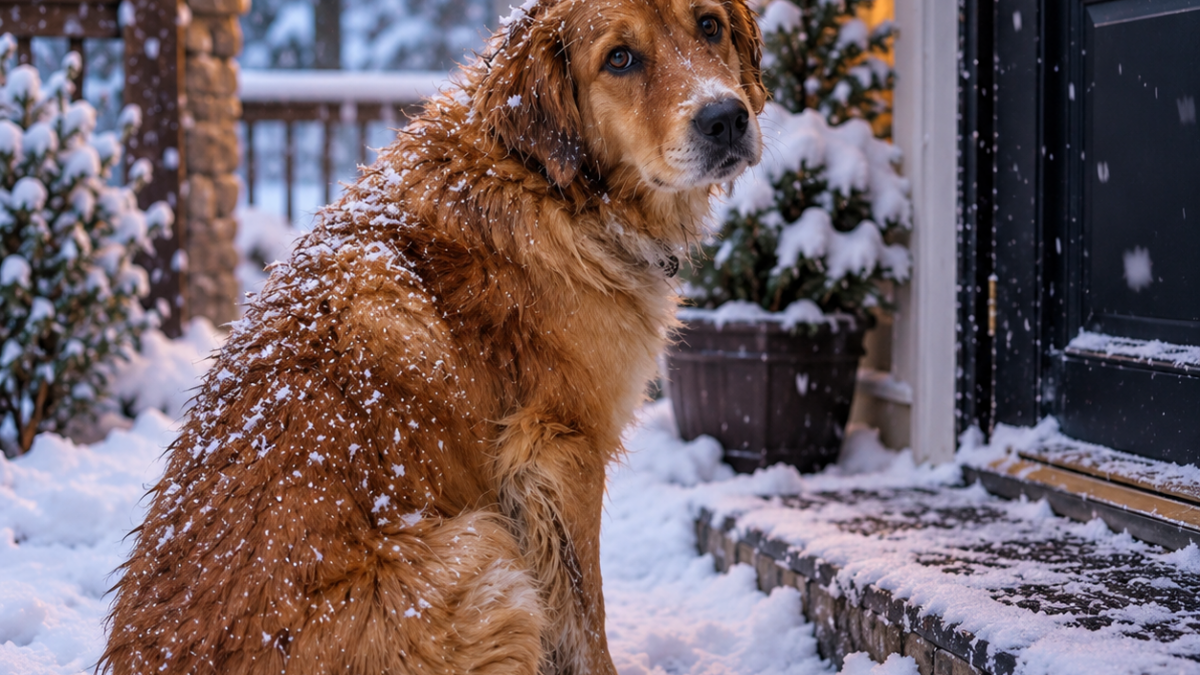
PART 2
For several seconds, neither of us moved.
Snow blew sideways beneath the porch roof and melted against my face.
Eric still had one hand on the door.
The puppy sat between us.
I remember thinking how strange the situation was.
Two adults arguing.
A warm house ten feet away.
And a young dog who didn’t understand that the entire argument was about whether he deserved to go inside it.
Eric gave a short laugh.
“You don’t get to tell me what to do with my dog.”
“I’m telling you he’s dangerously cold.”
“He’s been outside before.”
“Not like this.”
“He needs discipline.”
“Leaving a puppy outside in this weather isn’t discipline.”
His jaw tightened.
“You don’t know anything about dogs.”
That almost made me laugh.
I’d volunteered at our county shelter for five years.
I’d fostered twelve dogs.
I’d completed basic behavior courses through the rescue where I helped on weekends.
I wasn’t a trainer.
I wasn’t a veterinarian.
But I knew enough to recognize a dog whose body was losing the battle against the cold.
“I know he’s shaking,” I said. “I know he can’t keep his feet under him. And I know that’s enough.”
Eric stepped onto the porch.
“Go home, Claire.”
I looked at the puppy.
He was still sitting exactly where Eric had told him to sit.
Not because he was calm.
His entire body trembled.
But he stayed.
Waiting for permission.
“Bring him inside.”
“No.”
“Then I’m calling animal control.”
Eric stared at me.
“You serious?”
“Yes.”
“He chewed two hundred-dollar boots.”
“He’s a puppy.”
“He knows better.”
“No, he doesn’t. That’s why he’s a puppy.”
He pointed toward my house.
“Get off my property.”
That was when the puppy tried to stand again.
His front legs came up.
His rear end didn’t.
He slipped sideways.
I caught him before his shoulder hit the porch.
The moment my hands touched him, I felt how cold his coat was.
That changed the argument.
I no longer cared whether Eric thought I was interfering.
I pulled off my scarf and wrapped it around the dog’s shoulders.
Eric stepped toward me.
“Don’t touch him.”
I looked up.
“Then pick him up and take him inside.”
Nothing.
“Eric.”
He hesitated.
That hesitation told me more than anything he’d said.
If this had really been about teaching a lesson, the lesson had already lasted long enough.
He could have opened the door.
He didn’t.
I pulled out my phone.
“Who are you calling?”
“County dispatch.”
His expression changed.
“Claire.”
I dialed.
“Seriously?”
I turned away from him.
The dispatcher answered.
I explained where I was, described the weather, the dog’s condition, and what his owner had told me.
The woman asked whether the dog was conscious.
“Yes.”
“Responsive?”
“Yes.”
“Can he walk?”
“Not well.”
“Is the owner present?”
“Yes.”
Eric muttered something I won’t repeat.
The dispatcher said an officer was being sent along with an animal control responder who was already on another winter-weather call.
Then she told me:
“If you can keep the dog sheltered from the wind without creating a confrontation, do that.”
Sheltered.
The word almost sounded absurd.
His shelter was ten feet away.
The door was closed.
## TWENTY MINUTES
The next twenty minutes changed the relationship between every person standing on that porch.
Eric stayed near the doorway.
I sat on the top step with the puppy partly against my legs and my coat draped over him.
I didn’t carry him away.
Legally, I didn’t know whether I could.
I wasn’t going to give Eric any opportunity to accuse me of stealing his dog.
So I stayed.
The puppy stopped shaking as violently once he had my coat around him, but that didn’t reassure me.
I knew severe cold could cause shivering to decrease for the wrong reasons.
“What’s his name?” I asked.
Eric didn’t answer.
I looked up.
“If I’m sitting here trying to keep your dog warm, can you at least tell me his name?”
“Rusty.”
Rusty.
It fit.
Red coat.
Amber eyes.
“How old?”
“About eight months.”
Only eight months.
“Where did you get him?”
“Someone from work.”
“When?”
“September.”
Rusty lifted his head when Eric spoke.
His tail tapped once against the porch.
That nearly broke me.
Eric saw it too.
For a second, something softened in his expression.
Then it disappeared.
I tried one more time.
“Just let him inside until they get here.”
“No.”
“Why?”
“Because if I give in every time he acts pathetic, he’ll never learn.”
I stared at him.
“He’s not acting.”
Eric looked away.
## OFFICER MARTINEZ
The patrol vehicle arrived first.
Officer Elena Martinez stepped out.
I’d seen her around town but had never spoken to her.
She climbed the steps.
“What happened?”
Eric immediately said:
“My neighbor is harassing me about my dog.”
I said nothing.
Martinez looked at Rusty.
That was enough to change her posture.
She crouched.
“How long has he been outside?”
Eric answered, “Maybe an hour.”
I looked at him.
He looked away.
An hour.
In that weather.
Officer Martinez touched Rusty’s ear carefully.
“He’s very cold.”
“He has a winter coat,” Eric said.
“Not all coats provide adequate protection at these temperatures, especially if they’re wet.”
Eric crossed his arms.
“He’s fine.”
Rusty tried to stand.
His legs slipped.
Officer Martinez watched.
“No. He’s not.”
A second vehicle pulled up.
Animal Control Officer Marissa Grant came up carrying a blanket, thermometer, and scanning equipment.
She wrapped Rusty immediately.
Then she checked his gums.
His paws.
His responsiveness.
His temperature.
Her face changed.
“We need to warm him gradually.”
Eric stepped forward.
“I’ll take him inside.”
Marissa looked at him.
“No.”
It was the first time anyone had said that word to Eric as simply as he’d been saying it to everyone else.
“What do you mean, no?”
“Given his temperature and mobility, I want him evaluated.”
“He’s my dog.”
“Yes. And right now I’m documenting a welfare concern.”
Eric’s voice rose.
“This is insane.”
Officer Martinez stepped slightly between them.
“Keep your voice down.”
“I’m being treated like a criminal because I put my own dog outside.”
“Nobody said you’re a criminal.”
“Then give him back.”
Marissa looked at Rusty.
Then at the thermometer.
“He’s going to the emergency veterinary clinic.”
That was when Eric made his biggest mistake.
He shrugged.
“Fine. Maybe they’ll teach him not to chew boots too.”
Silence.
Even the wind seemed to disappear for a second.
Officer Martinez looked at him.
Marissa stopped writing.
I felt my stomach turn.
He had just reduced the entire night to a destroyed pair of boots.
And for the first time, I understood this was not simply a frustrated owner making one terrible decision.
Something was wrong with the way he saw this dog.
## THE CLINIC
I had no legal right to ride with Rusty.
I followed in my car.
Eric did not come.
That mattered later.
At the emergency clinic, Rusty was placed under careful warming measures.
The veterinarian, Dr. Sarah Kim, came out after nearly an hour.
“Are you the owner?”
“No.”
I hesitated.
“I’m the neighbor who called.”
“Animal control says you can remain as the reporting witness.”
“How is he?”
“Stable.”
The word nearly made my knees weak.
“His body temperature was dangerously low when he arrived. His paws are irritated, but at this point we don’t believe there’s severe tissue damage.”
I exhaled.
“Will he be okay?”
“Probably.”
Probably was enough.
“What about his back legs?”
“We think weakness was primarily cold-related, but we’re monitoring.”
I sat in the waiting room until almost two in the morning.
I don’t know why.
There was nothing I could do.
But leaving felt wrong.
Around 1:20, Marissa Grant came out with paperwork.
“Eric declined to come.”
“I figured.”
“He says he’ll pick Rusty up tomorrow.”
My stomach tightened.
“You’re giving him back?”
“We haven’t made that decision.”
I looked at her.
“What happens?”
“We document.”
“Then?”
“Then we investigate.”
“What if he says it was one mistake?”
“Then evidence matters.”
That word would define the next several weeks.
Evidence.
## THE MORNING AFTER
I slept for less than three hours.
At seven, someone pounded on my door.
Eric.
I didn’t open it fully.
“What?”
“You happy?”
“No.”
“My dog got taken because of you.”
“Your dog went to a clinic because he couldn’t stand properly.”
“He was fine.”
“Then why didn’t you take him there yourself?”
His face tightened.
“You need to stay out of my business.”
“When your business sits outside crying in dangerous cold, it becomes other people’s business.”
He pointed at me.
“Don’t come near my property again.”
“I wasn’t planning to.”
He walked away.
Then turned.
“If they don’t give Rusty back because of you, we’re going to have a problem.”
I closed the door.
My hands shook afterward.
Not because I thought he would attack me.
Because I realized how personal he had made it.
For Eric, this was no longer about Rusty.
It was about winning.
That frightened me more.
## RUSTY DIDN’T GO HOME
At noon, Marissa called.
“We’re placing a temporary protective hold.”
I sat down.
“For how long?”
“Pending investigation and veterinary recommendations.”
“Where is he?”
“Still hospitalized.”
“Can I see him?”
“Not yet.”
I understood.
Rusty was evidence in an open case.
He wasn’t mine.
I was a witness.
That distinction was important.
“Did Eric agree?”
“No.”
“What did he say?”
“You don’t need that detail.”
Fair.
“When will you know more?”
“Soon.”
I thanked her.
Then I did something that would later become unexpectedly important.
I wrote everything down.
Not from memory weeks later.
That day.
Time I heard the whimper.
What Rusty looked like.
Exact phrases Eric used.
Approximate duration.
Officer arrival.
Clinic.
Everything.
As a shelter volunteer, I’d learned that emotion changes memory.
Documentation protects it.
## THE FIRST PHOTOGRAPH
Two days later, Marissa asked whether I’d taken any photographs before authorities arrived.
I had.
One.
I had forgotten.
When I first saw Rusty beside the steps, before Eric opened the door, I’d taken a photo because I intended to send it to another rescue volunteer and ask what I should do.
The image wasn’t dramatic.
That made it stronger.
Rusty sitting alone.
Snow around him.
Ice along his coat.
The warm windows behind him.
Timestamp visible.
Marissa asked me to forward the original file.
I did.
“Does that help?”
“Yes.”
“How?”
“It establishes condition and time.”
I remembered her word.
Evidence.
## MRS. BELL
Then Mrs. Bell called me.
“I heard about the dog.”
Small towns are efficient.
“What did you hear?”
“That Eric says you stole him.”
I closed my eyes.
“Of course.”
“I told Martha at the pharmacy that’s nonsense.”
“Thank you, I think.”
Mrs. Bell lowered her voice.
“Claire, I’ve seen that dog outside before.”
I sat up.
“When?”
“Several times.”
“How long?”
“Since fall.”
“In bad weather?”
“Rain. Cold.”
“Why didn’t you tell anyone?”
A pause.
“I thought he brought him in.”
That answer would repeat many times.
I thought someone else had handled it.
I thought it wasn’t serious.
I thought he was outside temporarily.
I thought.
I thought.
I thought.
“Mrs. Bell, would you tell animal control?”
“If it helps the puppy.”
“It might.”
She did.
## THE CAMERA
Three houses across the street lived the Parkers.
Their doorbell camera covered part of Eric’s driveway and porch.
Mr. Parker called me that evening.
“Animal control asked about cameras.”
My heart sped up.
“Do you have anything?”
“I haven’t checked.”
He did.
Two days later, Marissa asked me to come to her office.
She wasn’t supposed to show me all the footage, but she explained what investigators had documented.
Rusty had been outside much longer than Eric claimed.
Not one hour.
Nearly four.
The camera first captured him moving near the porch shortly after 5:00 p.m.
At 6:10, Eric briefly opened the door.
Rusty approached.
The door closed again.
At 7:40, Rusty was still outside.
I found him shortly after nine.
Four hours.
In a storm.
Eric had lied before the officer even left his porch.
That changed the case.
## THE COLLAR
Veterinary staff also noticed something.
Rusty’s collar was too tight.
Not severely embedded.
Nothing graphic.
But tight enough to irritate the skin beneath it.
“He grew,” Dr. Kim explained later. “Puppies grow quickly. Collars need checking.”
Simple.
Obvious.
Neglected.
There were also signs he was underweight.
Not starvation.
But thinner than expected for his age and frame.
One mistake became a pattern.
Cold.
Collar.
Weight.
Fearful behavior.
Individually, someone might explain each away.
Together, they said something else.
## THE HOUSE CHECK
Animal control obtained authorization for a welfare inspection of Eric’s property based on the open case and local regulations.
I wasn’t there.
I learned details later through public proceedings.
They found:
An outdoor tether.
An overturned water bowl.
A small plastic dog shelter with no appropriate winter bedding.
Minimal food stored for Rusty.
Inside the house, they found chew damage.
Boots.
Chair legs.
A torn cushion.
Exactly what Eric had complained about.
But they also found something Eric had not considered important.
Rusty had no appropriate chew toys.
No crate.
No puppy-safe confinement area.
No enrichment.
No evidence of formal training.
An eight-month-old dog had been left with access to household objects and then punished for behaving like an eight-month-old dog.
That became central to everything that followed.
## ERIC’S VERSION
Eric hired an attorney.
That surprised me.
Then he started posting online.
That did not.
His version:
A nosy neighbor hated him.
His healthy outdoor-capable dog had spent a short period outside as reasonable discipline.
Authorities overreacted because of one photograph.
I had interfered because I wanted his dog.
The last claim angered me most.
At that point, I hadn’t even touched Rusty since the porch.
I had no idea whether I’d ever see him again.
I didn’t want to “take” his dog.
I wanted his dog not to freeze.
But online stories reward certainty.
Some people believed Eric.
A few comments appeared under local posts.
**Dogs live outside all the time.**
**People are too soft now.**
**It’s his property.**
**A dog with that much fur can handle winter.**
Then Dr. Kim’s veterinary assessment entered the administrative record.
After that, the conversation changed.
This wasn’t about whether some dogs can safely spend time outdoors in winter.
Of course they can.
Breed, acclimation, shelter, moisture, wind, age, duration, health, activity, and temperature all matter.
This was about one specific young dog whose body temperature and physical condition showed he had not been coping safely.
Facts are less dramatic than arguments.
They’re also harder to shout away.
## I SAW RUSTY AGAIN
Two weeks after the rescue, Marissa called.
“Would you be willing to visit?”
My heart jumped.
“Rusty?”
“Yes.”
“Why?”
“Behavioral assessment.”
I didn’t understand until I arrived.
Rusty had been moved from the clinic to a contracted foster facility.
Physically, he was doing well.
Emotionally, less so.
He had become extremely alert around doors.
When someone put on a coat, he became anxious.
If he went outside, he resisted moving away from the door.
Most disturbing of all, once outside, he would sit facing the entrance and wait.
Exactly what I’d seen that night.
The behaviorist wanted to see how he responded to me.
I entered a quiet visitation room.
Rusty was standing beside a volunteer.
He looked healthier already.
Clean coat.
More energy.
No ice.
No trembling.
“Rusty.”
His head snapped toward me.
For half a second, nothing.
Then his tail moved.
Once.
Twice.
He came toward me.
Slowly at first.
Then faster.
He pressed his chest against my knees.
I crouched.
“Hey, baby.”
He pushed his face beneath my arm.
I cried immediately.
The behaviorist, Karen Liu, gave me about ten seconds before asking:
“Did he greet you like that before?”
“No.”
“How much contact did you have?”
“Maybe twenty minutes on the porch.”
Karen wrote something.
Rusty leaned harder into me.
“Apparently it was memorable.”
## THE NAME
I asked Marissa:
“Does he have to stay Rusty?”
She looked confused.
“Why?”
“I don’t know. It feels like his old name belongs to that house.”
“Legally, until custody changes, yes.”
That made sense.
So he remained Rusty.
For now.
## THE HEARING
The county scheduled an administrative animal-welfare hearing to determine whether Rusty should be returned while the broader case proceeded.
Eric attended with his attorney.
I attended because I had been subpoenaed as a witness.
I’d never sat in a room where someone’s ownership of an animal was being formally questioned.
The setting was smaller than a courtroom.
Less dramatic.
Still intimidating.
Eric wouldn’t look at me.
His attorney did.
A lot.
When I testified, he asked:
“You don’t like Mr. Dalton, correct?”
“I barely knew him before this.”
“You disagreed with how he trained his dog.”
“I disagreed with leaving the dog outside in dangerous weather.”
“So yes.”
“If you want to call that training, yes.”
The hearing officer glanced at me.
I realized I sounded argumentative.
I stopped.
The attorney continued.
“You have fostered dogs?”
“Yes.”
“You volunteer with rescue groups?”
“Yes.”
“You believe dogs should live inside?”
“Not categorically.”
That surprised him.
“So you agree outdoor housing can be appropriate.”
“In appropriate conditions.”
“But you personally prefer indoor dogs.”
“Usually.”
He smiled slightly.
“Would you like to adopt Rusty?”
There it was.
The trap.
If I said yes, he could paint me as someone who engineered the entire case to get the dog.
I looked at Rusty’s photograph on the evidence table.
Then answered honestly.
“If he becomes legally available and professionals believe my home is appropriate, I would consider it.”
Eric finally looked at me.
Anger.
The attorney said:
“So you want my client’s dog.”
“No.”
I looked directly at him.
“I want Rusty to be safe. Those are not the same thing.”
## ERIC TESTIFIES
Eric told the hearing officer Rusty had become destructive.
He chewed.
Had accidents.
Jumped on people.
Pulled on leash.
Normal adolescent-dog problems.
He said he’d tried telling Rusty no.
Rusty didn’t listen.
So he escalated consequences.
Outside time.
Isolation.
Less attention.
His attorney called it “structured discipline.”
Then the hearing officer asked:
“What training classes did you attend?”
Eric hesitated.
“None.”
“Trainer?”
“No.”
“Veterinary behavioral consultation?”
“No.”
“Crate training?”
“He didn’t like the crate.”
“How long did you introduce it?”
“I don’t know.”
“Exercise schedule?”
“He’s in the yard.”
“Walks?”
“Sometimes.”
“How often?”
Silence.
The hearing officer looked at the file.
Then asked one question I’ll never forget.
“When the dog approached you on the porch that night and sought contact, why didn’t you bring him inside?”
Eric looked genuinely confused.
“Because then he would’ve won.”
Something in the room changed.
Won.
As if the relationship between a person and an eight-month-old puppy was a competition.
The hearing officer wrote something.
I think that answer ended the argument.
## TEMPORARY CUSTODY
Rusty was not returned.
The protective hold remained.
Eric stormed out.
Outside, he passed me.
“This isn’t over.”
“No,” I said.
“It isn’t.”
I wasn’t threatening him.
I meant the dog still had a long way to go.
But Eric heard what he wanted.
## THE NIGHT SOMEONE OPENED MY GATE
Three nights later, something happened that pushed the situation into a different category.
At 2:13 a.m., my security camera alerted.
Someone was near my backyard gate.
I wasn’t fostering Rusty.
He wasn’t at my house.
Maybe whoever came didn’t know that.
The video showed a hooded figure reaching toward the latch.
My motion light activated.
The person walked away.
I called police.
Officer Martinez responded.
We watched the footage.
“Recognize him?”
“No.”
She paused the frame.
“Could be anyone.”
“Do you think it’s Eric?”
“I’m not going to guess.”
Good answer.
“Does he know Rusty isn’t here?”
“Probably.”
“Then why—”
“Claire.”
She looked at me.
“Document. Don’t speculate.”
Evidence.
Again.
No second incident happened.
We never proved who it was.
I installed a lock anyway.
## RUSTY’S FOSTER HOME
Rusty was placed with a foster named Hannah Brooks.
Hannah had two adult dogs.
A calm Labrador named Ollie and a shepherd mix named June.
Rusty’s first week was difficult.
He ate too fast.
He followed Hannah from room to room.
He panicked briefly when doors closed.
If Hannah told him “no,” he flattened his body.
But Ollie changed everything.
Ollie was twelve years old and had the emotional energy of a retired librarian.
Rusty watched him constantly.
Door opens?
Ollie doesn’t panic.
Vacuum?
Ollie leaves the room with dignity.
Human reaches for collar?
Ollie expects a walk.
Someone drops a shoe?
Ollie doesn’t eat it.
Probably the biggest revelation.
Rusty copied him.
Dogs teach dogs things humans struggle to explain.
## HIS FIRST TOY
Hannah sent me a video.
Rusty stood in the living room staring at a rubber chew toy.
He sniffed it.
Pawed it.
Looked at Hannah.
Then picked it up.
Ollie tried to take it.
Rusty ran.
Tail up.
Hannah laughed behind the camera.
I watched the clip six times.
An eight-month-old dog had been punished for chewing things without ever being given enough appropriate things to chew.
Now he had a toy.
Problem solving doesn’t always require punishment.
Sometimes it requires giving the dog a better answer.
## THE OLD OWNER WANTED HIM BACK
Eric refused a settlement.
He wanted Rusty returned.
His attorney argued that education had changed him and that he would comply with updated care requirements.
For a while, that possibility terrified me.
Could someone learn?
Absolutely.
Should a person lose an animal forever because of one terrible night if they genuinely change?
Not always.
Animal welfare isn’t supposed to be revenge.
It’s supposed to protect the animal.
So evaluators considered Eric’s proposed plan.
Training classes.
Indoor sleeping.
Veterinary follow-up.
No punitive outdoor exposure.
Routine inspections.
Part of me hated even discussing it.
Another part knew fairness mattered.
Then investigators discovered the previous incidents.
## THE FORMER GIRLFRIEND
A woman named Natalie contacted animal control after seeing the local reports.
She had dated Eric the previous year.
She remembered Rusty.
More importantly, she had photographs.
Rusty at about four months old.
Tethered outside during heavy rain.
Rusty hiding beneath patio furniture.
A text conversation in which Natalie had told Eric:
**Bring him inside. He’s soaked.**
Eric had replied:
**He’ll come in when he stops barking.**
Another message:
**He’s a dog, Nat. Stop babying him.**
It wasn’t one winter mistake.
It was a philosophy.
Rusty learned that discomfort was the price of making mistakes before he was even old enough to understand what the mistakes were.
That ended the return plan.
## THE FINAL HEARING
The final proceeding took place in early spring.
Snow still sat in dirty piles beside the courthouse.
Rusty had now been away from Eric for nearly three months.
His physical health was excellent.
His behavioral report showed marked improvement.
Still cautious around abrupt correction.
Still anxious when left outside alone.
But playful.
Affectionate.
Trainable.
Social with appropriate dogs.
The county requested permanent forfeiture of ownership under the applicable welfare provisions.
Eric’s attorney fought it.
He argued Eric had property rights.
The county attorney answered:
“Ownership carries obligations.”
Simple.
The judge reviewed photographs.
Veterinary records.
Camera footage.
Witness statements.
Eric’s own testimony.
Natalie’s messages.
Then the judge looked at Eric.
“You repeatedly describe the animal’s behavior in terms of winning and losing.”
Eric said nothing.
“A young dog chewing household items is not evidence of a power struggle. It is evidence that the dog needs management and training.”
Silence.
The judge continued.
“The court does not find the January incident isolated.”
Rusty would not be returned.
Eric’s ownership rights were terminated.
Additional penalties and restrictions were imposed according to the case.
I expected to feel triumphant.
I didn’t.
I felt tired.
Then Eric turned toward me.
“This is what you wanted.”
I looked at him.
“No.”
He laughed bitterly.
“You get the dog.”
“I don’t know who gets the dog.”
That was true.
“You ruined this.”
I thought about answering.
About reminding him who left Rusty outside.
Who ignored warnings.
Who lied about the time.
Instead, I said:
“Rusty isn’t a thing you lost to me.”
Then I walked away.
## LEGALLY AVAILABLE
Three days later, Marissa called.
“He’s available.”
My heart stopped.
“For adoption?”
“Yes.”
I sat down.
“What happens now?”
“We’ll review applications.”
“Do I get special consideration?”
“No.”
I smiled.
“Good.”
“You sound happy about that.”
“I don’t want anyone claiming I got him because I called.”
“Then apply like everyone else.”
I did.
Every page.
Housing.
Veterinary references.
Work schedule.
Experience.
Existing pets.
Emergency plan.
Training philosophy.
Fenced yard.
Financial capacity.
Everything.
Then I waited.
## I ALMOST DIDN’T GET HIM
There were eleven applications.
One came from a professional trainer.
Another from a retired couple with ten acres.
One from Hannah, his foster.
That one surprised me.
“You applied?”
She laughed.
“You think you’re the only person who loves him?”
Fair.
For several days, I thought Hannah should keep him.
He already trusted her.
Loved Ollie.
Knew the house.
Moving again carried risk.
I called Marissa.
“If Hannah’s home is better, choose her.”
“You sure?”
“No.”
She laughed.
“At least you’re honest.”
The adoption committee evaluated everyone.
Their final concern with my home was simple.
Eric lived three houses away.
That mattered.
Could Rusty encounter him?
Could there be conflict?
Would Rusty be safer elsewhere?
I couldn’t argue.
For the first time, I understood I might have saved Rusty and still not be the right person to keep him.
That hurt.
But love isn’t ownership.
Funny how Rusty had forced everyone in this story to learn that lesson.
## HANNAH’S DECISION
Then Hannah withdrew her application.
I called her.
“Why?”
“Ollie.”
“What about him?”
“He’s older. Rusty’s energy is good for him sometimes, but permanently? I think it would be too much.”
“Are you sure?”
“Yes.”
Then she said:
“And Rusty watches the window on Thursdays.”
“What happens Thursday?”
“You visit.”
I said nothing.
“He knows your car.”
My throat tightened.
“That’s not enough.”
“No.”
She continued.
“But maybe it’s part of the answer.”
## THE HOME CHECK
Marissa came to inspect my house.
I had prepared like the president was visiting.
Baby gates.
Chew toys.
Crate.
Orthopedic bed.
Harness.
Long lead.
Secure backyard lock.
Training schedule printed.
Marissa walked into the living room.
“You realize you’re adopting a dog, not opening a military installation.”
“I’m prepared.”
“You’re terrifying.”
“Is that a pass?”
She laughed.
“Almost.”
The biggest issue remained Eric.
We created a safety plan.
Different walking route.
No unsupervised front yard.
Camera coverage.
Document any contact.
No confrontation.
If Eric approached Rusty, I would leave.
Simple.
Boring.
Safe.
The committee approved me.
## THE DAY HE CAME HOME
Hannah drove Rusty over.
Ollie came too.
I think she knew Rusty needed the transition.
Rusty jumped out of the car.
Saw my porch.
Stopped.
My stomach tightened.
This was not Eric’s porch.
Different house.
Different steps.
But porches and closed doors meant things to him.
I crouched beside the open doorway.
“Take your time.”
Ollie walked inside.
Of course.
Rusty watched.
Ollie turned as if annoyed Rusty was being dramatic.
Rusty took one step.
Then another.
He reached the threshold.
Stopped.
I didn’t pull.
Didn’t call repeatedly.
Didn’t bribe.
I waited.
Rusty lifted one paw.
Stepped inside.
Then another.
The moment all four feet crossed the threshold, I closed the door gently behind him.
Not to keep him prisoner.
To keep winter out.
I knelt.
“Welcome home.”
Rusty came toward me.
Pressed his forehead against my chest.
I cried.
Hannah cried.
Even Marissa, who had come to finalize paperwork, suddenly became very interested in checking her phone.
## I CHANGED HIS NAME
Not immediately.
For two weeks, he remained Rusty.
Then one afternoon, he was lying in a patch of sunlight.
His coat looked copper-gold.
Warm.
Bright.
I said:
“Finn.”
His head lifted.
I hadn’t planned it.
The name just came.
“Finn?”
Tail wag.
“Do you like that?”
Wag.
Rusty had been the puppy waiting outside Eric’s door.
Finn could be the dog who had finally walked through mine.
I completed the microchip update.
**FINN MORGAN.**
For the first time, he had identification permanently connected to a home that wanted him.
## THE FIRST MONTH
Finn was not magically healed by adoption.
That part matters.
The first time I accidentally left my boots beside the couch, I came back to find one lace missing.
I stared at him.
Finn froze.
His body dropped.
The old fear returned instantly.
That hurt.
I sat on the floor.
“It’s a boot.”
He watched.
“I’m not putting you outside.”
Nothing.
“You’re also buying me new laces.”
His ears moved.
I picked up a chew toy.
Offered it.
Finn approached slowly.
He took it.
I put the damaged boot away.
No shouting.
No punishment.
No winter porch.
Later, he fell asleep beside my feet.
The boot survived.
Mostly.
The dog mattered more.
## TRAINING
I enrolled Finn in a positive-reinforcement adolescent-dog class.
The trainer, Maya, already knew his history.
I asked her not to treat him differently.
She didn’t.
First class, Finn was chaos.
Pulled toward another dog.
Ignored me.
Tried to steal treats from a Labrador owner.
Jumped when excited.
Then became nervous when a metal chair scraped the floor.
Maya smiled.
“Congratulations.”
“For what?”
“You have a normal adolescent dog.”
I laughed so hard I nearly cried.
Normal.
What a beautiful word.
## ERIC SAW US
The encounter I’d dreaded happened six weeks later.
Finn and I were walking back from class.
Eric was getting mail.
He saw us.
Finn saw him.
Everything stopped.
Finn’s body lowered.
His tail tucked.
I felt rage rise so quickly it frightened me.
Then I remembered the plan.
No confrontation.
I turned.
“Finn. This way.”
He didn’t move.
Eric said:
“Rusty.”
Finn’s ears shifted.
“Rusty, come.”
My grip tightened on the leash.
Finn took one small step toward him.
My heart broke.
Even after everything, some part of him remembered that voice as home.
Then Eric lifted one hand.
Not threateningly.
Just calling.
Finn froze.
And backed toward me.
One step.
Then another.
Until his body touched my leg.
I didn’t say a word.
Eric’s face changed.
For the first time, I saw something that might have been regret.
Or maybe humiliation.
I don’t know.
He said:
“He remembers me.”
I looked down at Finn.
“Yes.”
Eric swallowed.
“Does he… is he okay?”
It was the first genuine question I’d ever heard him ask about the dog.
“He’s doing well.”
Silence.
“What’s his name?”
I looked at him.
“Finn.”
Eric’s jaw tightened slightly.
Then he nodded.
“Okay.”
He went inside.
Finn watched the door close.
For three seconds.
Then looked up at me.
I held out a treat.
“Home?”
Tail wag.
We walked away.
That was Finn’s revenge.
Not attacking Eric.
Not fearing him forever.
Choosing to walk in another direction.
## THE ONLINE POST
Months later, the county shelter asked permission to share Finn’s update.
I agreed only if the post focused on recovery rather than sensational details.
They posted two photographs.
The first: Finn on the clinic day, wrapped safely in a warming blanket.
The second: Finn hiking beside me in autumn, healthy and bright-eyed.
The caption said:
**Training should build understanding, not fear. Finn’s story reminds us that young dogs need guidance, exercise, management, patience, and safe shelter.**
Thousands of people shared it.
Eric’s name wasn’t included.
It didn’t need to be.
This wasn’t his story anymore.
It was Finn’s.
## THE FIRST WINTER HOME
I dreaded winter.
Not because of Finn’s physical health.
Because I didn’t know what snow would mean to him.
The first real storm arrived in December.
Finn stood at the back door watching flakes fall.
I attached his leash.
“You don’t have to go far.”
We stepped onto the porch.
Finn froze.
I waited.
His nose lifted.
He smelled the air.
Then he walked into the yard.
One step.
Two.
Five.
He sniffed the snow.
Pawed it.
Then something ridiculous happened.
He jumped.
Straight up.
Landed.
Jumped again.
Then ran in a circle.
I laughed.
“Finn!”
He buried his nose in the snow.
Came up covered in white.
Ran again.
I stood on the porch crying.
Snow had once meant punishment.
Now it meant play.
That was healing.
Not avoiding winter forever.
Giving winter a new memory.
## HE STILL HATED CLOSED DOORS
For a long time, Finn became anxious if I left him outside while I stepped inside, even for seconds.
So I stopped doing it unnecessarily.
Then we trained slowly.
Door closes for one second.
Opens.
Treat.
Three seconds.
Five.
Ten.
Finn learned.
Door closed did not mean abandonment.
I always came back.
Eventually, he could relax on the fenced patio while I worked in the kitchen.
He could see me through the glass.
One afternoon, I realized he wasn’t watching.
He was asleep in the sun.
That tiny moment made me happier than any dramatic milestone.
## MRS. BELL
Finn adored Mrs. Bell.
Maybe because she always carried treats.
Maybe because she moved slowly.
Maybe because she had been one of the people who helped his case.
Every Sunday, we walked to her house.
She would open the door and say:
“There is my handsome boy.”
Finn entered like he owned the place.
One day she asked:
“Do you think he remembers that night?”
“I don’t know.”
“I hope not.”
I looked at him sleeping beside her chair.
“I don’t.”
She seemed surprised.
“You don’t?”
“I think remembering is okay.”
“Why?”
“Because now he knows nights can end differently.”
Mrs. Bell smiled.
“That’s better.”
## ERIC’S CONSEQUENCES
People sometimes ask what happened to Eric.
The legal consequences weren’t cinematic.
No dramatic prison sentence.
No huge public downfall.
Real cases often aren’t like that.
He paid fines and costs ordered in the case.
He faced restrictions related to animal ownership for a period established by the court.
He had to complete educational requirements.
The local case became part of the public record.
More importantly, he lost Finn.
That was the consequence he seemed to feel most.
I know because months later, he left a letter in my mailbox.
Not threatening.
Not angry.
An apology.
Mostly.
He wrote:
**I thought being in control meant never letting the dog win. I understand now that I was making everything a fight he didn’t know he was in.**
I read that sentence three times.
Then:
**I’m not asking for him back. I know that’s over. I just wanted you to know I understand why it happened.**
I didn’t answer.
Not because I wanted to punish Eric.
Because the apology wasn’t mine to accept.
Finn couldn’t read it.
Finn didn’t need it.
His life had already moved forward.
## TWO YEARS LATER
Finn became the dog everyone in the neighborhood knew.
Children asked to pet him.
He learned to sit automatically at curbs.
He had one embarrassing habit of stealing gloves.
Never boots.
Gloves.
Progress, I suppose.
He loved hiking.
Car rides.
Peanut butter.
Mrs. Bell.
He hated nail trims and the mail carrier’s truck.
He remained sensitive to angry male voices.
That never disappeared completely.
Healing doesn’t always erase every scar.
Sometimes it simply makes the scar stop controlling daily life.
## THE CHILD AT THE SHELTER
I continued volunteering.
Eventually, Finn came with me as a calm-dog helper during certain adoption events.
One afternoon, a boy around ten entered with his mother.
He was nervous around dogs.
Finn sat several feet away.
The boy asked:
“Will he jump?”
“No.”
“Does he bite?”
“He’s never bitten anyone with me.”
“Was he always nice?”
I thought about the question.
“He was always Finn.”
“What does that mean?”
“It means sometimes a scared dog looks different from a safe dog.”
The boy crouched.
Finn approached slowly.
The boy touched his head.
Finn leaned closer.
His mother smiled.
I thought about the winter porch.
The dog who couldn’t understand why a door stayed closed was now helping someone else feel safe.
## THE OLD BOOTS
Three years after Finn came home, I cleaned my closet.
At the back were the boots from the night I found him.
Mine.
Not Eric’s.
The pair I’d worn through the storm.
Salt stains along the leather.
A scratch from kneeling beside the porch.
I almost threw them away.
Instead, I placed one beside Finn.
He sniffed it.
Then tried to grab the shoelace.
I laughed.
“Absolutely not.”
Finn wagged.
I took a photo.
Maybe the universe has a sense of humor.
## ERIC MOVED
Four years after the incident, a moving truck arrived at Eric’s house.
I watched from my kitchen.
Not because I cared where he went.
Because part of me had remained alert every time Finn and I passed that property.
When the truck left, I felt something release.
A family with two teenagers moved in later.
They adopted a senior Beagle.
The first winter, I saw the dog wearing a ridiculous coat in their yard.
I smiled.
The house had changed stories too.
## FINN GREW OLD
Years have a cruel habit of passing fastest after life becomes good.
Finn turned eight.
Then nine.
The red in his coat faded around the muzzle.
He developed arthritis.
The veterinarian estimated he was probably close to ten by then.
We adjusted.
Shorter walks.
Soft bed.
Medication.
Fewer long hikes.
More time sitting together.
He still loved snow.
Always would.
The first snowfall every year turned him young again.
He rolled.
Dug.
Pushed his nose into drifts.
Then came back inside willingly.
That last part always mattered to me.
I would open the door.
Finn would run toward it.
No hesitation.
No waiting for permission from someone who wanted him to suffer first.
He knew home was warm.
## MRS. BELL’S LAST WINTER
Mrs. Bell became ill when Finn was nine.
Her son moved her to an assisted-living community.
Dogs were allowed to visit.
So Finn visited.
The first time we entered her room, she cried.
“My boy.”
Finn walked to her bed.
Rested his head against her hand.
Her fingers moved slowly through his fur.
She looked at me.
“Remember that night?”
“Every second.”
She smiled.
“You were furious.”
“I was.”
“I was scared of Eric.”
I looked at her.
“You never told me.”
“That’s why I didn’t call sooner when I saw Finn outside before.”
There it was.
Fear.
Another reason people stay silent.
“I wish I’d done something.”
I sat beside her.
“You did.”
“When?”
“You testified.”
“After you started it.”
“Doesn’t matter.”
Finn shifted closer to her.
She whispered:
“We all should’ve noticed sooner.”
Maybe.
But guilt is only useful if it changes what you do next.
Mrs. Bell began telling everyone at the facility that if they saw an animal in trouble, they should call somebody.
She became surprisingly aggressive about it.
I loved that.
## THE LAST SNOW
Finn was almost twelve when we had our last real snowfall together.
His hips were weak.
I worried he’d slip.
I put on his support harness.
Opened the door.
Finn looked outside.
Snow fell softly.
He stepped onto the porch.
I stayed beside him.
He sniffed.
Then moved into the yard.
Slowly.
No running.
No jumping.
He pushed his nose into a little pile of snow.
Came up with white on his muzzle.
I laughed.
“You still have to do that?”
Tail wag.
He walked maybe twenty yards.
Then turned back.
Toward the house.
Toward me.
Toward the open door.
That image stays with me.
An old red dog walking through snow toward warmth.
Years earlier, he had stared at another door praying it would open.
Now he knew this one would.
Every time.
## WHEN HIS BODY GOT TIRED
Finn’s decline was gradual.
Arthritis.
Then kidney disease.
Medication.
Diet changes.
Good days.
Bad days.
I stopped measuring life by distance walked.
I measured it by interest.
Did he eat?
Did he enjoy Mrs. Bell’s visits?
Did he want to sniff the yard?
Did his tail move when I came home?
For months, yes.
Then one morning, he didn’t come to the kitchen.
I found him on his bed.
Awake.
Calm.
Tired.
I sat beside him.
“Breakfast?”
Nothing.
I offered his favorite treat.
He sniffed it.
Turned away.
My heart knew before my brain accepted it.
The veterinarian came to the house later.
She examined him.
We talked quietly.
I asked the question everyone asks even when they know the answer.
“Can we do more?”
“We can always do something.”
That scared me.
“What does that mean?”
“It means the question isn’t whether something can be done. It’s whether it gives Finn something he still wants.”
I looked at him.
He was watching me.
Not scared.
Just tired.
## ERIC’S LETTER
That evening, for reasons I still can’t explain, I took Eric’s old letter from a drawer.
I hadn’t read it in years.
Finn slept beside me.
I read one line aloud:
**I thought being in control meant never letting the dog win.**
I looked at Finn.
“What a stupid game.”
His ear moved.
“You know you won, right?”
Tail tap.
Once.
I laughed through tears.
“Yeah.”
Finn had won without competing.
He won every time he trusted someone.
Every time he walked inside.
Every time snow became fun.
Every time a child touched him without fear.
Every year he lived safely.
That was enough.
## THE FINAL MORNING
I chose a home goodbye.
The veterinarian came in the morning.
Mrs. Bell’s son brought her over in a wheelchair because she insisted.
My sister came.
Hannah, Finn’s old foster, came with a photograph of Ollie, who had died years earlier.
Marissa Grant came after her shift.
Officer Martinez stopped by in uniform.
Finn’s life had collected people.
That struck me.
The dog once sitting alone outside a closed door now had too many people trying to fit into my living room to say goodbye.
Mrs. Bell sat beside his bed.
“Handsome boy.”
Finn’s tail moved.
Marissa crouched.
“You caused a lot of paperwork.”
I laughed.
Officer Martinez added:
“And neighborhood drama.”
Finn didn’t care.
Hannah gave him one small piece of chicken.
He ate it.
Of course.
Then everyone gave us space.
I lay beside him.
Held his face.
Those amber eyes were cloudy now.
But peaceful.
“Do you remember me sitting beside you in the snow?”
He breathed slowly.
“You don’t have to.”
I touched his ear.
“I remember enough for both of us.”
The veterinarian gave us time.
I whispered:
“No more cold porches.”
His eyes stayed on me.
“No more waiting for doors.”
His tail moved once against the blanket.
“You’re home.”
Finn died with his head against my arm.
Warm.
Inside.
Surrounded by people.
## AFTER
The first thing I noticed was the silence.
No nails on the floor.
No collar tags.
No breathing beside my bed.
I left the back door open once out of habit.
Then remembered.
I cried harder over that than I had during the goodbye.
Grief is strange.
The major moments are almost easier because you’re prepared.
It’s the small routines that ambush you.
One empty hook where the leash used to hang.
One unused water bowl.
One snowstorm with nobody waiting at the door.
## THE BENCH
Several months later, the shelter called.
They had received a donation from Mrs. Bell.
She wanted to fund an outdoor covered area for dogs waiting to meet adopters during winter.
Heating panels.
Wind protection.
Raised beds.
Safe flooring.
A proper transition space.
She named it after Finn.
I argued.
She ignored me.
The plaque reads:
**FINN’S DOOR
EVERY DOG DESERVES A SAFE WAY HOME.**
The first time I saw it, I cried.
Naturally.
Marissa stood beside me.
“You’re very predictable.”
“So I’ve been told.”
## THE REAL REVENGE
People who hear Finn’s story sometimes ask whether I was satisfied that Eric lost him.
The answer is complicated.
At the beginning?
Yes.
I was angry enough to want Eric humiliated.
I wanted him to feel every bit of fear and frustration I’d felt on that porch.
But years changed my understanding.
Pain returned isn’t justice.
Protection is.
Accountability is.
Change is.
Finn never needed Eric to suffer.
Finn needed warmth.
Training.
Food.
Safety.
Patience.
A door that opened.
He got all of that.
And that became a much better revenge than anything anger could have designed.
Eric believed a dog had to lose for a person to remain in control.
Finn’s life proved there was never supposed to be a contest.
Eric thought fear created obedience.
Finn learned more through trust than fear ever taught him.
Eric thought a puppy chewing boots deserved isolation.
Finn became a well-mannered adult once someone finally taught him what he was supposed to do instead.
Eric thought walking back inside would mean the dog had “won.”
Years later, every time I opened my door and Finn came running home, I understood how completely wrong that idea had been.
## WHAT I WOULD DO DIFFERENTLY
People have asked whether I regret confronting Eric.
No.
I regret only that nobody intervened earlier.
Including me.
I’d seen Finn in the yard.
Never asked questions.
Mrs. Bell saw him outside.
Thought it was temporary.
The Parkers saw things on camera but didn’t know context.
Natalie had worried but eventually left the relationship and assumed someone else would help.
None of us had the whole picture.
That’s how problems hide.
Each person sees one piece and assumes another person sees the rest.
Sometimes nobody does.
Until a dog sits outside in a snowstorm long enough that silence becomes impossible.
## THE HOUSE THREE DOORS DOWN
The family who bought Eric’s old house still lives there.
Their Beagle died at fifteen.
They later adopted another dog from our county shelter.
A mixed-breed puppy.
One winter evening, I walked past their home alone.
Snow was falling.
The puppy was in the yard wearing a bright coat, chasing a ball.
The teenage boy threw it.
After five minutes, his mother opened the door.
“Come on, Tucker!”
The dog grabbed the ball and ran inside.
The door closed.
Simple.
Ordinary.
Exactly how it should be.
I stood there longer than necessary.
Then walked home.
## YEARS LATER
I’m older now.
I still volunteer.
Every winter, somebody at the shelter tells Finn’s story to a new volunteer.
Usually they get parts wrong.
The temperature.
The exact timeline.
Whether I carried him away myself.
I correct them when accuracy matters.
But there’s one part they always get right.
He stayed by the door.
That’s what people remember.
A dog in the cold.
A warm house inches away.
And still, he believed in the person inside.
That part bothered me for years.
How could Finn still love someone who had failed him?
Eventually, I stopped asking.
Dogs don’t calculate love the way we do.
Finn wasn’t foolish.
He was dependent.
Young.
Hopeful.
He had learned that Eric was home, so he kept asking home to let him back in.
The beautiful part isn’t that he stopped loving.
It’s that he eventually learned love could feel different.
Love could mean somebody noticing you’re cold.
Somebody slowing down training.
Somebody replacing boots instead of punishing you for destroying them.
Somebody coming back.
Somebody opening the door.
## IF I COULD RETURN TO THAT NIGHT
If I could walk back into that storm, I’d find myself on Eric’s porch.
Rusty beside me.
Eric holding the door.
I’d tell myself not to worry about the argument.
Not yet.
I’d say:
Take the photograph.
Call authorities.
Stay calm.
Don’t touch what doesn’t need touching.
Don’t threaten.
Don’t insult him.
Document.
Keep the puppy warm.
Let professionals build the case correctly.
Because anger feels powerful.
Evidence is more powerful.
Then I’d look down at Rusty.
Finn.
And I’d tell him:
You think this is your home.
I know.
You think the person behind that door is the only person who can decide whether you belong somewhere.
He’s not.
Tonight you’re going to a clinic.
You’re going to meet people who speak softly.
Then a foster dog named Ollie is going to teach you that doors aren’t dangerous.
You’re going to chew another boot.
I’m sorry.
You’re going to survive that crime.
You’re going to get a new name.
You’re going to learn to sit at curbs.
You’re going to steal gloves.
You’re going to love an old woman named Mrs. Bell.
You’re going to play in snow.
One day, the man behind this door is going to call your old name.
You’re going to remember him.
But you’re going to choose to stand beside me.
And then we’re going home.
Not his home.
Yours.
You’re going to grow old there.
So keep breathing.
Keep waiting.
Just a little longer.
This isn’t the door that decides your life.
## THE LAST PHOTOGRAPH
My favorite photograph of Finn isn’t from the rescue night.
I almost never share those.
It isn’t from the hearing.
Or adoption day.
Or his first snow.
It’s from his final winter.
Finn stands in my yard.
Gray around the muzzle.
A support harness around his hips.
Snow on his nose.
Behind him, my back door is open.
Warm yellow light spills onto the porch.
Finn is looking over his shoulder at me.
Not at the door.
At me.
He knows where he’s going.
That image contains his whole story.
Once, he sat outside a closed door waiting for permission to be safe.
At the end of his life, the door was already open.
Nobody was testing him.
Nobody was teaching him a lesson.
Nobody needed him to prove anything.
He could go inside whenever he wanted.
And that is the ending I choose to remember.
## THE LESSON ERIC NEVER UNDERSTOOD
The night I met Finn, Eric said:
“He’ll understand how he’s supposed to behave.”
Years later, I still think about those words.
Finn did learn.
He learned not to chew boots.
Mostly.
He learned to walk on a loose leash.
He learned recall.
He learned “leave it.”
He learned to wait before crossing streets.
He learned where his toys were.
He learned that strangers could be safe.
But the biggest lessons weren’t his.
They were ours.
I learned that intervention doesn’t have to begin with certainty.
Sometimes concern is enough to make a phone call.
Mrs. Bell learned that fear of upsetting a neighbor is not more important than speaking up when something feels wrong.
The Parkers learned cameras can matter for more than packages.
Eric, if his letter was sincere, learned that control is not the same as care.
And Finn?
Finn learned something much simpler.
He learned doors can open.
## EPILOGUE
The first heavy snowfall after Finn died, I stood at my back door and watched the yard turn white.
For twelve years, snow had belonged to him.
I expected that storm to feel unbearable.
Instead, I remembered the first winter after his adoption.
His ridiculous jump.
His face disappearing into the snow.
The way he ran back to me.
I laughed.
Actually laughed.
Then cried, of course.
But the laughter came first.
That’s how I knew the memory had finally changed.
When I used to think about Finn in snow, I saw him trembling beside Eric’s steps.
Now I see the old dog with snow on his nose and an open door behind him.
The worst night lost.
Not because it disappeared.
Because better nights outnumbered it.
Thousands of them.
Warm nights.
Safe nights.
Boring nights.
The kind nobody writes stories about.
Those were the ones that saved him.
And if there was ever a final act of revenge in Finn’s story, it was that.
The person who once believed one freezing night could teach a dog who was in charge became little more than a paragraph in Finn’s much larger life.
Finn got the rest of the book.
He got spring mornings.
Summer hikes.
Autumn leaves.
Winter snow.
Training classes.
Chewed gloves.
Car rides.
Mrs. Bell.
Ollie.
Chicken treats.
A warm bed.
An open door.
Years.
So many years that the frightened puppy on the porch eventually became difficult for even me to recognize in the confident old dog walking toward home.
That is what I wanted for him.
Not vengeance.
Not suffering returned for suffering.
Something better.
A life so safe that fear became old information.
A home so certain that he no longer had to stare at doors.
And enough love that, by the time his story ended, the coldest night of his life was no longer the thing that defined him.
Finn had once sat in the snow waiting for somebody to let him in.
In the end, he never had to wait again.

