PART 2: My Grandfather Hadn’t Spoken in Four Years—Then He Knelt Beside an Old Shelter Dog and Finally Broke His Silence
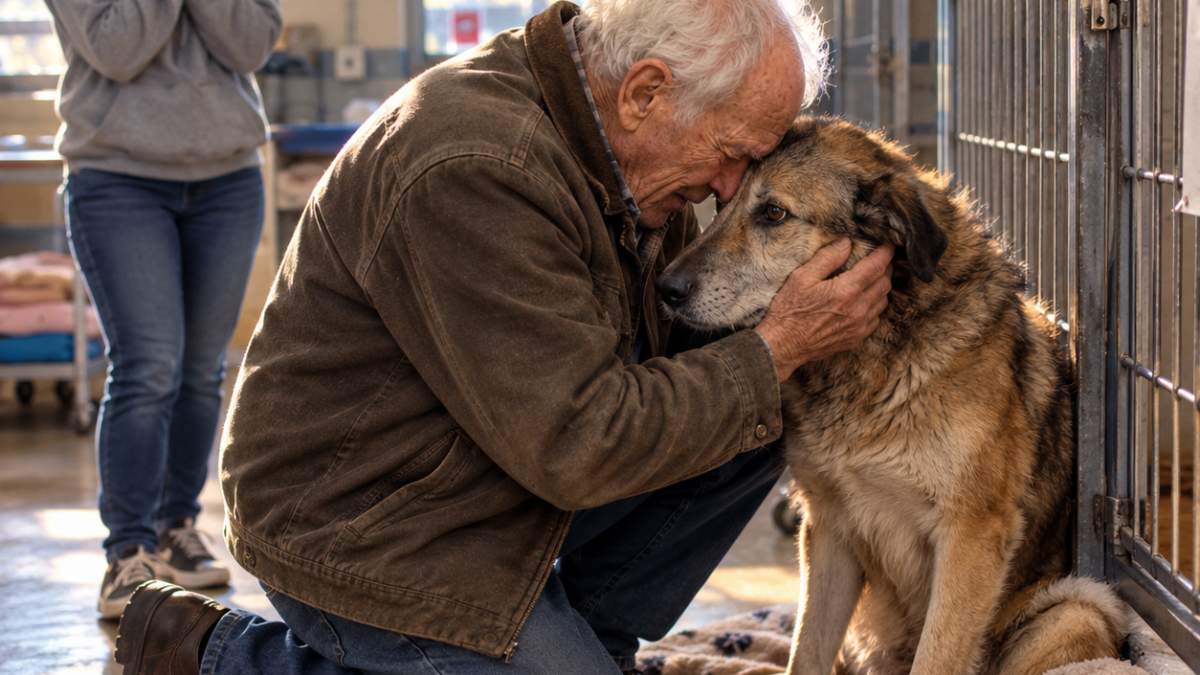
For four years, my seventy-nine-year-old grandfather had not spoken a single word—not because his voice was gone, but because after losing the woman he had loved for more than half a century, he seemed to shut a door inside himself that none of us knew how to open.
Doctors examined him, therapists sat across from him, relatives begged him to answer just once, and through all of it he remained silent, communicating only with a nod, a shake of his head, or the faintest smile when he wanted us to know he was still listening.
Then one rainy afternoon, we took him to a county animal shelter, and when he stopped in front of the very last kennel in the building, the expression on his face made me realize that something was about to happen that no doctor, no therapist, and none of us had been able to make happen in four long years.
My name is Emily Harris. I was twenty-nine then, living in Eugene, Oregon, and if you had asked me who I loved most when I was growing up, I would have answered without hesitation: my grandparents, Walter and Rose.
They had been married fifty-three years.
Grandma Rose talked enough for both of them. Grandpa Walter was quieter, but when he did speak, people listened. He had a dry sense of humor, a stubborn streak, and a habit of calling every complicated problem “something that probably needs coffee before it needs an answer.”
Then Rose died in the fall of 2018.
Cancer took her faster than any of us expected.
The first week afterward, Grandpa still answered questions.
“Yes.”
“No.”
“Thank you.”
By the second week, he stopped.
At first we thought he needed time.
Then weeks became months.
Months became a year.
He still dressed himself. He read the newspaper. He prepared simple meals. His mind remained sharp enough to beat me at checkers and notice when I moved one of his tools from its usual place.
But he would not speak.
We took him to physicians, neurologists, grief counselors, and therapists. Nothing obvious was physically preventing speech. No stroke had taken his language. No injury had damaged his throat.
One doctor finally told my mother, “Walter appears to understand everything. He may simply not be ready to use his voice.”
My mother hated that answer.
I think I did too.
Because it gave us nothing to fix.
Every other Sunday, I drove to Grandpa’s little house on the south side of town. I talked enough for both of us. I told him about work, the neighbor who kept parking too close to my driveway, the terrible dates my friends tried to arrange for me, grocery prices, weather, anything.
He listened.
Sometimes he nodded.
Once I made him laugh silently.
That tiny smile kept me going for months.
Then one Tuesday evening my mother called.
“Emily, I have an idea.”
“That sounds dangerous.”
“I’m serious.”
“So am I.”
She ignored me.
“I think Dad needs a dog.”
I almost laughed.
“Mom, he barely remembers to water the fern.”
“He remembers.”
“The fern is brown.”
“That fern has always been brown.”
Fair.
Then her voice softened.
“I read about companion animals helping older people after loss. I’m not saying a dog is going to magically fix him. I just think maybe he needs something that doesn’t expect conversation.”
That sentence changed my mind.
The next Saturday, Mom drove. Grandpa sat in the passenger seat. I sat behind him.
He did not ask where we were going.
He didn’t speak when the county shelter came into view.
Inside, a volunteer named Debbie greeted us.
“Looking for anybody in particular?”
Mom smiled.
“Maybe an older dog. Calm.”
Debbie led us down the first row.
A terrier bounced against his gate.
Grandpa watched.
Nothing.
A black Lab wagged so hard his entire body moved.
Nothing.
Two puppies climbed over one another.
Grandpa’s face remained still.
I began thinking the whole idea had been a mistake.
Then we reached the last kennel.
The dog inside didn’t stand.
He was a German shepherd, large but painfully thin, with gray covering most of his muzzle. One eye was cloudy. His hips looked stiff even while he was lying down, and his head rested heavily on his front paws.
Debbie lowered her voice.
“That’s Duke. He’s about ten or eleven. He’s been here almost six months.”
“Why so long?” I asked.
“Age. Medical issues. People come in wanting young dogs.”
Grandpa stepped closer.
Duke still didn’t look up.
Debbie continued.
“He used to live with another shepherd. Female. They were together almost their entire lives. She died shortly before he was surrendered.”
Grandpa froze.
I saw his fingers tighten around the handle of his cane.
Duke slowly lifted his head.
Their eyes met.
Something changed in my grandfather’s face.
I had not seen that expression since before Grandma Rose died.
Recognition.
Not happiness.
Something deeper.
He opened the kennel’s outer gate with Debbie’s permission and stepped inside.
Then my seventy-nine-year-old grandfather, a man who had not spoken in four years, lowered himself painfully onto one knee beside an old dog everyone else had walked past.
Duke raised his head.
Grandpa reached toward him.
The dog pressed his nose against Walter’s hand.
My grandfather’s lips moved.
And for the first time in four years, I heard his voice.
PART 2
“You lost your girl too, didn’t you?”
The sentence was quiet.
Rough.
Almost broken from disuse.
But it was unmistakably his voice.
My mother made a sound behind me.
Not quite a gasp.
Not quite a sob.
I stopped breathing.
Debbie covered her mouth.
Grandpa didn’t look at any of us.
He was looking only at Duke.
The old shepherd lifted his head higher and moved his nose along Walter’s palm.
Grandpa swallowed.
“So did I.”
Mom began crying.
I had imagined hearing my grandfather speak again hundreds of times. In some versions, he would answer a doctor. In others, he would surprise us at Christmas. Once, after a particularly bad night, I dreamed he called me by name.
None of those imagined moments looked like this.
No hospital.
No therapist.
No dramatic family gathering.
Just a concrete shelter floor, an old man on one knee, and a tired German shepherd who had also outlived the companion who had shared most of his life.
I whispered, “Grandpa?”
He heard me.
I knew because his shoulders tightened.
But he did not turn.
Duke pushed himself upright.
Slowly.
Painfully.
His rear legs trembled.
Walter noticed immediately.
“Easy.”
One word.
Another word.
I looked at Mom.
She was crying openly now.
Grandpa slid one hand beneath Duke’s jaw.
The shepherd leaned into him.
Then Walter did something even stranger.
He laughed.
It was barely a laugh.
A rough little breath.
But I knew that sound.
Grandma Rose used to make terrible jokes at dinner just to force that exact laugh out of him.
For four years, our family had lived inside silence.
Duke broke it in less than five minutes.
## **1. We Did Not Take Duke Home That Day**
Mom wanted to.
Of course she did.
Emotion had taken over.
“Can we adopt him now?”
Debbie smiled gently.
“There’s paperwork.”
“We’ll fill it out.”
“We also need to talk about his medical needs.”
“We’ll handle them.”
“Mom,” I said.
She looked at me.
“What?”
“We should slow down.”
Her face hardened.
“Emily, your grandfather just spoke.”
“I know.”
“Because of that dog.”
“I know.”
“Then why are you—”
“Because Duke is not medicine.”
That stopped her.
Grandpa looked at me for the first time since speaking.
I continued, more gently.
“He’s a dog. An old one. He needs the right home, not an emotional decision.”
Debbie nodded.
“Emily’s right.”
Mom wiped her face.
“I hate that.”
“I get that a lot.”
Grandpa’s mouth twitched.
Almost another smile.
Debbie took us into a small adoption room and explained Duke’s history.
He had arrived six months earlier with arthritis, an untreated ear infection, dental problems, and significant weight loss. The shelter had stabilized him, but he still needed medication and regular veterinary care.
“He can walk,” Debbie said, “but probably not long distances. Stairs may be difficult.”
Grandpa finally spoke again.
“How many?”
Debbie blinked.
“How many what?”
“Stairs.”
His voice was still rough.
“My house.”
Mom started crying again.
I put my arm around her.
Debbie smiled.
“Three to the front porch?”
Grandpa nodded.
“That can be managed.”
Duke was lying under Walter’s chair.
Already.
As though the decision had been made somewhere none of us had been invited.
## **2. The Story of Duke**
The shelter knew only part of Duke’s history.
His previous owner was a widower named Harold Bennett.
Harold had owned Duke and another German shepherd, Maggie, for nearly ten years.
The dogs had been inseparable.
Maggie died after a sudden illness.
Three months later, Harold had a medical emergency and moved into an assisted-living facility.
His adult son, Richard, surrendered Duke.
That was the official version.
But Debbie added something quietly.
“Duke didn’t do well after Maggie died.”
“What does that mean?” Mom asked.
“He stopped eating normally. He waited by the back door. According to the son, he became ‘difficult.’”
Grandpa stroked Duke’s head.
“Difficult.”
It was the longest word he had spoken.
Debbie nodded.
“Richard said he couldn’t manage him.”
Grandpa looked down.
“So he left him.”
Nobody answered.
Duke sighed and placed his head across Walter’s shoe.
## **3. Grandpa’s First Conversation**
On the drive home, nobody knew what to say.
Grandpa sat in the passenger seat.
Mom kept looking at him.
Finally she asked:
“Dad?”
He stared out the window.
“You okay?”
Long pause.
Then:
“No.”
Mom gripped the steering wheel.
It was such a simple answer.
But after four years, it felt enormous.
She whispered:
“I know.”
Grandpa continued watching the rain.
After several miles, he spoke again.
“Rose would’ve liked him.”
Mom began crying for the third time that day.
“Dad, I cannot drive if you keep doing this.”
Grandpa looked at her.
Then, incredibly, smiled.
## **4. The Family Meeting**
That evening, Mom called everyone.
My uncle David came over.
So did my older cousin Paul.
My other uncle, Raymond, joined by video from Portland.
Raymond had always been the practical one.
Sometimes useful.
Sometimes exhausting.
He had been pushing for Grandpa to sell his house and move into assisted living for almost two years.
“Dad lives alone,” Raymond said. “A dog creates more responsibility.”
Grandpa sat in his chair.
Silent again.
That frightened me.
What if the shelter had been temporary?
What if the voice disappeared?
Raymond continued.
“He already has mobility issues.”
Grandpa’s cane leaned beside him.
“He needs less responsibility, not more.”
Mom said, “He spoke today.”
“I heard.”
“For the first time in four years.”
“I understand that.”
“You don’t sound like you do.”
Raymond sighed.
“Mom—”
“I’m your sister.”
“Sorry. Linda. One sentence does not mean a dog is medically appropriate.”
Then Grandpa spoke.
“No.”
Everyone froze.
Raymond stopped.
Grandpa looked toward the tablet.
“No what, Dad?”
“No home.”
Raymond frowned.
“What?”
“Assisted living.”
His words came slowly.
But clearly.
“I said no.”
Raymond stared at him.
Grandpa continued.
“My house.”
Then after a pause:
“My decision.”
Nobody spoke for several seconds.
Raymond’s face changed.
He had spent years speaking about Grandpa as though silence meant absence.
Now the supposedly absent man was answering.
## **5. The Thing I Had Not Known**
After Raymond disconnected, Grandpa stayed in his chair.
Mom sat beside him.
“Dad, why didn’t you tell us?”
He looked at her.
“Tired.”
“Of speaking?”
He shook his head.
“Of explaining.”
The room went quiet.
“Explaining what?”
He stared at the photograph of Grandma Rose on the mantel.
“How empty.”
That was the first time I understood his silence differently.
We had all treated it like a locked door we needed to break open.
Maybe Grandpa had known we were waiting outside.
Maybe he simply had nothing he believed language could improve.
Duke had not demanded an explanation.
He had just been there.
## **6. Preparing the House**
The shelter approved Grandpa’s application pending a home visit and veterinary plan.
We turned preparing his house into a family operation.
Mom bought non-slip runners for the hardwood.
I ordered a ramp for the porch.
David installed a lower water station.
Grandpa hated the dog bed we selected.
“Too soft.”
“How can a bed be too soft?”
“Dog’ll sink.”
“Grandpa, he is not a submarine.”
He gave me a look.
That look alone told me more of Walter was returning.
We exchanged the bed.
## **7. Adoption Day**
Three days later, Duke came home.
Grandpa wore a clean button-down shirt.
I teased him.
“Are you taking Duke to dinner?”
“Respectable occasion.”
Four words.
Every new sentence felt like hearing a song I remembered but had forgotten I missed.
At the shelter, Debbie brought Duke out wearing a blue bandana.
Grandpa crouched as far as his knees allowed.
“Ready?”
Duke walked to him.
No hesitation.
We signed the papers.
Grandpa wrote:
**Walter Harris**
Under reason for adoption:
**We understand each other.**
Debbie read it and quietly wiped her eyes.
## **8. The First Night**
Duke refused the new bed.
He slept beside Grandpa’s chair.
At ten, Grandpa went to his bedroom.
Duke followed.
At the doorway, he stopped.
Grandpa turned.
“Coming?”
Duke entered.
By midnight, he was lying on the floor beside the bed.
At 2:00 a.m., Mom checked the small indoor camera we had installed with Grandpa’s permission.
Walter was sitting on the edge of his mattress.
Duke’s head rested on his knee.
Grandpa was talking.
We couldn’t hear the words.
Mom called me crying.
Again.
I told her:
“You’re going to run out of tears.”
She replied:
“Shut up.”
## **9. What Grandpa Told Duke**
Weeks later, he told me what he had said that first night.
“I told him about Rose.”
“What about her?”
“Everything.”
Apparently Duke learned more in one night than Grandpa had told any of us in four years.
How Walter met Rose at a high-school football game in 1959.
How she wore a red scarf.
How he pretended to like dancing because she loved it.
How she burned their first Thanksgiving turkey.
How she sang terribly while cleaning.
How she squeezed his hand during her final night.
I asked:
“Why could you tell Duke?”
Grandpa thought.
Then:
“He didn’t tell me how to feel.”
That hurt.
Not because he meant to blame us.
Because he was right.
We had spent four years saying:
You need to get out.
You need to talk.
You need therapy.
You need people.
You need to move on.
Duke asked nothing.
## **10. Duke Had His Own Grief**
Duke still searched for Maggie.
We realized it after his first week.
Every evening around six, he walked to Grandpa’s back door.
Sat.
Waited.
Debbie contacted Harold’s family and confirmed Maggie had often been let into the yard at roughly that hour.
Routine survives loss.
Grandpa understood immediately.
He sat beside Duke.
“She’s not coming.”
Duke watched the door.
Grandpa added:
“Mine either.”
They sat together for nearly an hour.
No one interfered.
## **11. Grandpa Starts Talking to Us**
Speech returned slowly.
Not dramatically.
He did not wake one morning suddenly transformed.
Some days he spoke only ten words.
Other days dozens.
Sometimes he disappeared into silence again.
But now silence was part of conversation, not the end of it.
He asked me about work.
He told Mom her soup needed salt.
He argued with David about baseball.
One Sunday, I arrived and heard him yelling at the television.
“Throw the damn ball!”
I stood in the doorway.
Grandpa looked at me.
“What?”
“Nothing.”
“Team’s terrible.”
I cried in my car afterward.
## **12. Raymond Returns**
Raymond did not like the change.
That sounds unfair.
I think part of him was relieved.
But Grandpa speaking again complicated plans Raymond had been making.
He had spent nearly two years trying to convince the family that selling Grandpa’s property was inevitable.
The house sat on valuable land.
Developers had made inquiries.
Grandpa had always refused to sell before Rose died.
After his silence began, Raymond started handling more financial paperwork.
Not because he was evil.
Because someone needed to.
At least initially.
Then practical help slowly became control.
## **13. The Papers**
One afternoon Grandpa handed me a folder.
“Read.”
Inside were real-estate documents.
A proposed sale agreement.
Authorization forms.
Letters from a developer called North Valley Residential.
I frowned.
“Are you selling?”
“No.”
“Then what is this?”
“Raymond.”
My stomach tightened.
“He signed anything?”
Grandpa shook his head.
“He wants me to.”
The proposed sale price was substantial.
Enough to put Grandpa in a comfortable retirement community and still leave money for inheritance.
That was Raymond’s argument.
Grandpa’s answer was simpler.
“Rose planted those trees.”
He pointed through the window toward two old maples.
“Not selling.”
## **14. Raymond’s Version**
I called Raymond.
He became defensive immediately.
“I’m trying to protect Dad.”
“From what?”
“From becoming eighty-five in a house he can’t maintain.”
“He’s seventy-nine.”
“Exactly.”
“That makes no sense.”
“You know what I mean.”
He said Duke was temporary emotional excitement.
He said Grandpa’s renewed speech did not eliminate mobility issues.
He said the property market might decline.
Then:
“And frankly, Emily, none of you have been handling the practical side.”
That was partly true.
Practical people often become dangerous only when they start assuming practical equals correct.
## **15. Duke Collapses**
Three months after adoption, Duke collapsed in the backyard.
Grandpa shouted for help.
Mom lived five minutes away.
She arrived first.
They rushed Duke to the emergency veterinarian.
I drove there from work.
Grandpa sat in the waiting room.
Pale.
Hands shaking.
For a terrible moment, I feared losing Duke would send him back into silence.
The veterinarian emerged.
“Duke has a cardiac issue.”
Grandpa stood.
“What do we do?”
Medication.
Monitoring.
Shorter walks.
No excessive strain.
The vet was cautiously optimistic.
Duke could still have good time.
Maybe years.
Maybe less.
Older dogs do not sign contracts with us.
## **16. Grandpa’s Fear**
That night, Grandpa said something I had never heard him admit.
“I shouldn’t have taken him.”
“Why?”
“I’ll lose him.”
There it was.
The real wall.
He had not only stopped speaking because Rose was gone.
He had stopped attaching himself to anything that could leave.
I sat beside him.
“Grandpa, loving somebody doesn’t guarantee you won’t lose them.”
He stared at Duke sleeping.
“Bad deal.”
“Terrible deal.”
“Wouldn’t recommend it.”
“No.”
Then I smiled.
“But you keep doing it.”
He looked at me.
Eventually:
“Stupid species.”
“Humans?”
“Yes.”
Duke opened one eye.
“Dogs too.”
## **17. Harold**
The shelter called with unexpected news.
Duke’s former owner, Harold Bennett, wanted to see him.
Harold was eighty-three and living in assisted care.
His son Richard had surrendered Duke without giving Harold a real chance to say goodbye.
That detail changed our view of Duke’s history.
Grandpa was furious.
“You don’t do that.”
Mom said:
“Dad.”
“You don’t.”
He was right.
We arranged a visit.
## **18. Two Old Men and One Dog**
Harold sat in a wheelchair in the facility courtyard.
When Duke saw him, he stopped.
Then his entire body began shaking.
Tail.
Shoulders.
Everything.
Harold whispered:
“Dukey.”
The shepherd walked forward.
Pressed his head into Harold’s lap.
Harold sobbed.
Grandpa stood several feet away.
Watching.
Harold said:
“I thought you were gone.”
Duke licked his hand.
“I’m sorry.”
Grandpa turned away.
I followed.
“You okay?”
“No.”
“What is it?”
He looked toward Harold.
“Everybody losing everybody.”
I put my hand on his arm.
“Yeah.”
He nodded.
“Still worth showing up.”
That sentence told me Duke had changed him.
## **19. The Truth About Richard**
Harold explained that after his medical crisis, he expected Duke to stay temporarily with Richard.
Richard told him Duke was “too difficult.”
Then said he had found the dog a home.
He never told Harold he surrendered Duke to the county shelter.
For six months, Harold believed Duke was living with a family.
When he saw the viral shelter adoption update, a nurse recognized the dog.
That was how he found out.
Grandpa’s anger returned.
“He lied.”
Harold nodded.
“My son thought it was kinder.”
“To who?”
Good question.
## **20. Richard Comes to Grandpa’s House**
Richard appeared two weeks later.
Not angry.
Embarrassed.
He wanted to explain.
Grandpa listened.
Richard said Duke had stopped eating after Maggie died.
Destroyed a door.
Howled at night.
Richard had two young children.
A small house.
He panicked.
“I thought the shelter could handle him better.”
Grandpa replied:
“Then tell your father.”
Richard looked down.
“I couldn’t.”
“Why?”
“Because he’d already lost everything.”
Grandpa’s voice became quiet.
“So you made him lose something and told him he didn’t.”
Richard’s face crumpled.
I had never heard Grandpa speak with such clarity.
No shouting.
No cruelty.
Just truth.
## **21. Forgiveness Without Excuses**
Harold eventually forgave Richard.
Not because surrendering Duke secretly had been right.
Because Richard admitted it was wrong.
That mattered to Grandpa.
He talked about it later.
“Apology needs facts.”
“What does that mean?”
“Can’t say sorry if you’re still explaining why you were right.”
I wrote that down.
## **22. Raymond Pushes Harder**
Meanwhile, Raymond increased pressure about the house.
North Valley Residential raised its offer.
Raymond scheduled a meeting with an estate attorney.
Grandpa refused to attend.
Then Raymond did something that changed our family.
He told the attorney Grandpa’s years of silence raised questions about his decision-making capacity.
I was furious.
“You know his doctors said his mind was intact.”
Raymond answered:
“They said that years ago.”
“He talks now.”
“Sometimes.”
“He knows exactly what’s happening.”
“We need documentation.”
Grandpa was sitting in the next room.
He heard everything.
## **23. Grandpa’s Response**
He walked into the kitchen.
“No.”
Raymond turned.
“Dad—”
“No more talking about me like furniture.”
The room went silent.
Grandpa’s voice shook.
Not from weakness.
Anger.
“I heard you.”
“Dad, I’m trying—”
“Four years.”
Raymond stopped.
“I heard all of you.”
Mom covered her mouth.
Grandpa continued.
“Every meeting. Every whisper. Every time you said sell.”
Raymond’s face went pale.
“You never answered.”
“I didn’t want to.”
“That’s not the same as—”
“I know.”
Grandpa stepped closer.
“You thought silence meant yes.”
That sentence ended the argument.
## **24. The Medical Evaluation**
Grandpa voluntarily underwent a fresh cognitive evaluation.
Not because Raymond deserved proof.
Because Grandpa wanted the legal question dead.
The results were clear.
Walter understood his assets.
His decisions.
Consequences.
Family relationships.
He was capable of making his own financial choices.
The physician asked:
“Why did you stop speaking?”
Grandpa looked toward Duke.
Then answered:
“Grief.”
“Why did you start again?”
Long pause.
“Same reason.”
The doctor smiled.
## **25. Grandpa Changes His Documents**
Walter met with an independent estate attorney.
Not Raymond’s contact.
His own.
He updated financial authorizations.
Removed Raymond’s unilateral access.
Assigned Mom and me as joint backups for limited matters.
He kept ownership of the house.
He also added instructions that no one could surrender Duke without attempting placement with designated family and rescue contacts first.
I laughed when I read that.
“Grandpa, Duke is probably older than all these documents.”
“Still.”
Fair.
## **26. Raymond’s Anger**
Raymond accused us of turning Grandpa against him.
Grandpa heard.
He called Raymond himself.
That alone shocked everyone.
“I did it.”
Raymond said something I couldn’t hear.
Grandpa replied:
“No. Emily didn’t.”
Another pause.
“You did.”
Then:
“You stopped asking what I wanted.”
He ended the call.
That was Grandpa’s revenge, if anyone wanted to call it that.
Not humiliation.
Not cruelty.
Agency.
A man everyone had learned to speak over reclaimed his own voice and used it to say no.
## **27. Duke Gets Better**
The cardiac medication worked.
Not perfectly.
But well enough.
Duke’s energy improved.
His appetite returned.
He gained seven pounds.
His coat became thicker.
Grandpa walked him twice a day.
Slow walks.
One block.
Then two.
People in the neighborhood began recognizing them.
Two old men, as Grandpa called them.
“One with better knees.”
Which one?
“Duke.”
## **28. The Bench**
Grandpa and Duke developed a routine.
Every morning at nine, they walked to a small park three blocks away.
There was a wooden bench near a duck pond.
Grandpa sat.
Duke lay beside him.
Sometimes they stayed twenty minutes.
Sometimes an hour.
I joined them once.
Grandpa barely spoke.
I teased him.
“You got your voice back just to ignore me?”
“Correct.”
Duke sighed.
“See? He agrees.”
## **29. Rose’s Birthday**
Rose’s birthday had been the worst day of every year since she died.
Grandpa usually closed the curtains.
Did not answer the door.
That year, he surprised us.
He asked everyone to come for dinner.
Mom made Rose’s lasagna.
Too much garlic.
Exactly how Rose cooked it.
Grandpa sat at the head of the table.
Duke under his chair.
After dinner, Walter raised a glass.
My heart stopped.
“To Rose.”
Everybody went quiet.
He continued:
“She’d be mad we waited four years to eat properly.”
We laughed and cried at the same time.
## **30. Duke’s Old Collar**
Harold mailed Grandpa Duke’s original collar.
The assisted-living facility had kept it with Harold’s belongings.
A brass tag:
**DUKE BENNETT**
Grandpa placed it in a drawer.
“Not putting it on him?”
“Too heavy.”
“Sentimental.”
“He knows his name.”
That was Grandpa.
## **31. Harold Dies**
Harold died the following spring.
Richard called us.
Grandpa took Duke to the memorial service held in the facility garden.
Duke sat beside Richard.
For a long time, Richard said nothing.
Then:
“He loved you.”
Duke rested his head on Richard’s knee.
Richard cried.
Grandpa watched quietly.
On the drive home he said:
“Dog’s better at forgiveness than us.”
“Maybe.”
“Or forgets faster.”
“Maybe.”
He looked out the window.
“Lucky.”
## **32. Raymond Comes Back**
Raymond stayed away for months.
Then he appeared at Grandpa’s door.
No developer.
No papers.
No arguments.
Just Raymond.
Grandpa let him in.
I happened to be there.
Raymond sat.
Duke watched from beside Walter’s chair.
“I’m sorry.”
Grandpa said nothing.
Raymond swallowed.
“I kept telling myself I was protecting you.”
Still silence.
“I liked being the person with the plan.”
Grandpa looked at him.
Raymond continued.
“And when you didn’t speak, I stopped checking whether my plan was yours.”
Grandpa finally answered.
“Yes.”
Raymond laughed bitterly.
“Dad, you could give me more than one syllable.”
“No.”
I had to look away to hide my smile.
## **33. Reconciliation Is Not Immediate**
Grandpa did not forgive Raymond that afternoon.
Not fully.
He let him come back.
That was different.
Trust returned in pieces.
Raymond started helping with house repairs only when asked.
He stopped discussing property values.
He drove Grandpa to one veterinary appointment when Mom and I were unavailable.
Duke liked him.
Which annoyed Grandpa.
“Traitor.”
Duke wagged.
## **34. Duke’s Second Year**
By the second anniversary of adoption, Duke looked old but stable.
His cloudy eye worsened.
Hearing declined.
He slept more.
Grandpa also slowed.
They matched.
Grandpa once told a neighbor:
“We’re racing to see who needs the ramp first.”
The neighbor laughed.
I didn’t.
A month later, we installed a second handrail for Grandpa.
Duke already had the ramp.
Technically Duke won.
## **35. The Snow Day**
Eugene got a rare heavy snowfall.
Duke stepped outside.
Stopped.
Looked at the white yard.
Then turned toward Grandpa.
“Nope,” Grandpa said.
Duke agreed.
They went inside.
That was the entire adventure.
Not every rescue dog needs a cinematic snow scene.
Some prefer central heating.
## **36. The Local Newspaper**
A shelter volunteer told a local reporter about Grandpa and Duke.
We resisted.
Then Grandpa agreed on one condition.
“No miracle story.”
The reporter asked what he meant.
“Dog didn’t cure me.”
Important.
“What did he do?”
Grandpa looked at Duke.
“Sat there.”
“That’s all?”
“That was enough.”
The eventual article used the headline:
**Two Widowers Find Their Way Forward Together**
Grandpa hated it.
“Too sentimental.”
He clipped it anyway.
## **37. What Duke Actually Changed**
Duke did not erase grief.
Grandpa still missed Rose.
Some nights I found him sitting with her photograph.
He still had quiet days.
Still saw his therapist occasionally.
Still disliked crowds.
What Duke changed was routine.
Breakfast mattered because Duke needed medication.
Morning mattered because Duke needed a walk.
The park mattered.
Dinner mattered.
Vet appointments.
Grooming.
Small obligations.
Grief had made time shapeless.
Duke put edges back around the days.
## **38. The First Full Story Grandpa Told**
One Thanksgiving, Grandpa told us the story of how he proposed to Rose.
All of it.
Twenty minutes.
We had heard fragments growing up but never the whole thing.
He planned a picnic.
It rained.
The car got stuck.
Rose lost one shoe in mud.
Walter dropped the ring beneath the seat.
She finally said:
“If this is your idea of romance, I’m worried.”
Then married him anyway.
Duke slept beneath the table.
At the end, Raymond was crying.
Grandpa pointed.
“Stop.”
Raymond laughed.
“You’re the one telling dead-wife stories.”
“Still.”
## **39. The House**
North Valley Residential eventually withdrew its offer.
The market changed.
The developer moved on.
Raymond once said:
“You know, we probably lost a lot of money.”
Grandpa answered:
“Good.”
“Good?”
“Now you can stop thinking about it.”
That became a family joke.
## **40. The Garden**
Rose had loved roses.
Naturally.
After she died, Grandpa stopped maintaining her flower beds.
Duke changed that indirectly.
He liked lying near the garden.
Grandpa began pulling weeds while Duke rested.
Then pruning.
Then replanting.
The following summer, roses returned.
Not all.
Enough.
Grandpa sat on the porch looking at them.
“She’d complain about that yellow one.”
“Why?”
“Wrong shade.”
“Rose had opinions.”
“Too many.”
He smiled.
## **41. Duke’s Health Declines**
In Duke’s third year with Grandpa, his heart condition worsened.
Medication increased.
His back legs weakened.
Grandpa’s fear returned.
I saw it.
He began watching Duke sleep.
Counting breaths.
Calling the vet over small changes.
One afternoon I said:
“You’re doing it again.”
“What?”
“Trying to prepare so losing him won’t hurt.”
He looked at me.
“Won’t work.”
“No.”
“Still trying.”
“I know.”
## **42. The Veterinary Conversation**
Dr. Patel, Duke’s veterinarian, was direct.
“We can keep him comfortable.”
“How long?” Grandpa asked.
“No honest answer.”
“Months?”
“Maybe.”
“A year?”
“Possible.”
Grandpa nodded.
“What do we watch?”
Quality of life.
Appetite.
Breathing.
Mobility.
Interest.
Pain.
Grandpa listened carefully.
Then asked the hardest question.
“How do I know when I’m keeping him for me?”
Dr. Patel looked at him with extraordinary kindness.
“You keep asking that question. People who keep asking it usually recognize the answer when it comes.”
## **43. Raymond and Duke**
One evening Raymond visited.
Duke struggled to stand.
Raymond immediately crouched.
“Don’t get up, old man.”
Grandpa said from the chair:
“He thinks you mean me.”
Raymond laughed.
Duke’s tail moved.
Their relationship had become ordinary.
That mattered.
Family repair is usually not one grand apology.
It is enough ordinary days without repeating the old harm.
## **44. Grandpa’s Eighty-Second Birthday**
We held a small party.
Duke wore a bow tie.
He hated it.
Grandpa wore one too.
He also hated it.
Mom insisted on photographs.
The picture of both of them glaring at the camera became my favorite.
Grandpa later said:
“Delete that.”
I framed it.
## **45. Duke Stops Walking to the Park**
One morning Duke reached the end of the driveway and stopped.
Grandpa waited.
Duke looked toward the park.
Then back toward home.
Grandpa turned around.
No forcing.
They sat on the porch instead.
From then on, the park became occasional.
Then rare.
Grandpa never complained.
“We had enough walks.”
## **46. A Wagon**
Mom bought a dog wagon.
Grandpa called it ridiculous.
Then used it.
Duke rode to the park.
He sat upright for most of the trip, looking around like a retired general inspecting his territory.
Children waved.
Grandpa pretended not to enjoy the attention.
He absolutely did.
## **47. The Last Visit to the Shelter**
Debbie was still volunteering.
Grandpa wanted to bring Duke back once.
Not for drama.
Just to see her.
They visited after hours.
Duke walked slowly through the hallway.
When they reached his old kennel, he stopped.
Smelled it.
Then continued.
No panic.
No grand symbolism.
He simply walked past.
Grandpa looked at me.
“Good.”
That was all.
## **48. Debbie Asks Grandpa a Question**
Before we left, Debbie asked:
“Walter, do you ever think about the first thing you said here?”
He smiled.
“Yes.”
“Why that sentence?”
He looked down at Duke.
“His face.”
“What about it?”
“Same as mine.”
Debbie’s eyes filled.
Grandpa added:
“Everybody kept asking me to come back.”
Pause.
“He didn’t.”
That was it.
## **49. Rose’s Grave**
For five years after Rose died, Grandpa never visited the cemetery.
Then one autumn morning he asked me to drive him.
Duke came.
We walked slowly.
Grandpa stood in front of Rose’s headstone.
Long silence.
Then:
“Sorry.”
I stayed back.
He talked to her for twenty minutes.
About Duke.
About Raymond.
About the roses.
About me.
About everything.
When he finished, Duke sat beside him.
Grandpa placed one hand on the shepherd’s head.
“Ready?”
They walked away together.
## **50. The Last Winter**
Duke’s last winter was quiet.
No crisis.
Just decline.
He slept longer.
Ate less.
Needed help standing.
Grandpa moved his own recliner closer to Duke’s bed.
Sometimes they slept at the same time.
Two old men.
As promised.
## **51. Christmas**
That Christmas, we all gathered at Grandpa’s house.
Raymond came.
David.
Mom.
Cousins.
Grandchildren.
Duke lay near the fireplace.
Grandpa looked around the room.
Then said:
“Rose would hate this noise.”
Everyone laughed.
Later he stood with difficulty and raised his glass.
“To second chances.”
Raymond looked down.
Grandpa noticed.
“And third ones.”
Raymond looked up.
That was forgiveness.
Finally.
Not forgetting.
Not pretending.
Another chance.
## **52. The Morning Duke Wouldn’t Eat**
In February, Duke refused breakfast.
Then water.
Grandpa called me.
His voice was calm.
Too calm.
“Emily.”
“What happened?”
“Time.”
One word.
I knew.
I drove over.
Duke lay on his bed.
Grandpa sat beside him.
Dr. Patel arrived.
Examined Duke.
Listened to his heart.
His lungs.
Then sat back.
Grandpa asked:
“Can you fix this?”
Dr. Patel shook her head gently.
“No.”
“Can you make him comfortable?”
“Yes.”
Grandpa nodded.
“Home.”
## **53. Everyone Comes**
Mom arrived.
Raymond.
David.
Debbie.
Even Richard and his family sent a message after hearing from the shelter.
We did not crowd Duke.
People said goodbye one or two at a time.
Debbie kissed his head.
“You were worth waiting six months for.”
Raymond stroked his ear.
“Take care, old man.”
Grandpa said:
“Still talking to me?”
Raymond laughed and cried.
## **54. Grandpa and Duke Alone**
Then Grandpa asked us to leave the room.
We did.
For twenty minutes.
I do not know everything he said.
I never asked.
When we returned, Grandpa’s hand rested on Duke’s shoulder.
Duke was asleep.
Grandpa’s eyes were red.
He looked at Dr. Patel.
“Ready.”
## **55. Goodbye**
Dr. Patel gave Duke medication to relax.
His breathing softened.
Grandpa lowered himself onto the floor.
I tried to help.
He waved me away.
He knelt beside Duke just as he had at the shelter three years earlier.
Same man.
Same dog.
Different room.
Different life.
Duke opened his eyes.
Grandpa leaned close.
“You found me.”
His voice broke.
Not:
I found you.
You found me.
Duke’s tail moved once.
Grandpa whispered:
“Go find Maggie.”
Then after a pause:
“And Rose.”
Everyone cried.
Even Dr. Patel.
Duke took one slow breath.
Another.
Then he was gone.
Grandpa remained on the floor with his hand on him.
## **56. I Was Terrified**
I was terrified Grandpa would stop speaking again.
Nobody admitted it.
We all thought it.
The next morning, I went to his house.
He sat in the old chair.
Duke’s bed remained near the fireplace.
Empty.
Grandpa stared at it.
I sat.
Neither of us spoke for ten minutes.
Then Grandpa said:
“Coffee?”
I nearly collapsed.
“Yes.”
He stood.
Slowly.
Walked toward the kitchen.
His voice had not disappeared with Duke.
That was Duke’s final gift.
Not speech.
Proof that grief could return without taking everything.
## **57. The Empty House**
The house felt enormous without Duke.
Grandpa hated evenings most.
For weeks, he still woke at six to prepare medication.
Then remembered.
Routine leaves ghosts too.
But he kept talking.
Sometimes about Duke.
Sometimes not.
He continued therapy.
Continued the garden.
Continued Sunday dinners.
Grief entered the house again.
This time, Grandpa did not lock himself inside it.
## **58. Raymond**
Raymond became the person who visited most often after Duke died.
Funny how families change.
One afternoon I found him repairing the porch ramp.
“Why?”
Grandpa no longer needed Duke’s ramp.
Raymond shrugged.
“Dad likes it for groceries.”
Grandpa shouted from inside:
“He broke the step.”
Raymond shouted back:
“I’m fixing it!”
Grandpa:
“You broke it first!”
Normal.
Wonderful.
Normal.
## **59. The House Is Never Sold**
Grandpa never sold the house.
He did eventually hire help for yard maintenance.
Later, he converted the downstairs office into a bedroom so he did not need to climb stairs.
Practical changes.
His decision.
That distinction mattered.
North Valley Residential built somewhere else.
The maples Rose planted remained.
So did the roses.
## **60. Duke’s Bed**
Grandpa donated Duke’s bed to the shelter.
Debbie placed it in a senior-dog room.
A twelve-year-old Labrador named Molly used it first.
She was adopted two weeks later.
Grandpa said:
“Good.”
Nothing more.
## **61. The Walter and Duke Fund**
Grandpa hated the name.
Mom created a small donation fund at the shelter for senior-dog medical care.
When he discovered the name, he complained:
“Sounds like a law firm.”
We changed the plaque to:
**For Old Dogs Who Still Have Good Days Left**
Grandpa approved.
Mostly.
## **62. Another Old Shepherd**
About a year after Duke died, the shelter called Grandpa.
They had another senior shepherd.
No pressure.
Just letting him know.
Grandpa visited.
He spent twenty minutes with her.
Then came home alone.
“Not ready?” I asked.
He shook his head.
“No.”
That was okay.
Healing does not require replacing what you lost.
## **63. Two Months Later**
He went back.
The shepherd had been adopted.
Grandpa smiled.
“Good.”
He walked through the kennels.
Stopped beside an old mixed-breed dog with one cloudy eye.
I held my breath.
Grandpa looked at me.
“No.”
I laughed.
“I didn’t say anything.”
“You were thinking loudly.”
He did not adopt that dog either.
But he began volunteering once a week.
## **64. Walter at the Shelter**
Imagine that.
The man who had spent four years barely speaking now sat in the shelter reading newspapers aloud to nervous dogs.
Not therapy.
Not a formal program initially.
He simply sat.
Dogs listened.
Eventually the shelter turned it into a volunteer activity.
Grandpa hated the attention.
But continued.
One volunteer asked:
“Why read to them?”
He answered:
“They don’t interrupt.”
Classic Walter.
## **65. His Voice**
By then Grandpa spoke normally most days.
Not constantly.
He had never been a talkative man.
His silence no longer frightened us.
That distinction is difficult to explain.
Before Duke, silence felt like a locked room.
After Duke, silence could simply mean Walter was thinking.
We stopped demanding words.
Maybe that helped too.
## **66. Raymond’s Apology to Me**
Years later, Raymond apologized to me.
“I thought you and Linda were keeping Dad in a fantasy.”
“What fantasy?”
“That he could stay independent forever.”
“He couldn’t.”
“I know.”
“Then why apologize?”
“Because I confused ‘not forever’ with ‘not now.’”
That was exactly it.
Sometimes people destroy today while trying to control tomorrow.
## **67. Grandpa Turns Eighty-Five**
At eighty-five, Grandpa finally chose to leave the house.
His choice.
Not because he could not think.
Because maintaining it had become exhausting.
He moved into a small independent-living apartment with a balcony.
Before leaving, he walked through every room.
Stopped beneath Rose’s photograph.
Then near the place where Duke’s bed had been.
He touched the wall.
“Good house.”
I cried.
He rolled his eyes.
“You all cry too much.”
## **68. The Maples**
The family who bought the house promised not to remove the two maples unless they became unsafe.
Grandpa said:
“They can do what they want.”
But I saw relief.
We dug up one of Rose’s smaller rose bushes and moved it to Mom’s yard.
Grandpa complained that we would kill it.
We didn’t.
## **69. Grandpa’s Apartment**
His apartment allowed pets.
We asked.
He refused.
Then a neighbor’s beagle began visiting.
Technically the dog belonged to Mrs. Jensen across the hallway.
Emotionally, the beagle divided custody between them.
Grandpa gave him treats.
Denied it.
We found the bag.
“Evidence,” I said.
“Circumstantial.”
His legal vocabulary had improved.
## **70. The Photo**
The shelter had taken a photograph on adoption day.
Grandpa kneeling beside Duke.
Duke looking up at him.
That photo stayed beside Rose’s picture in every home Grandpa lived in afterward.
Two great losses.
Two great loves.
Neither erased the other.
## **71. The Sentence Everyone Remembered**
People who knew the story always remembered Grandpa’s first words:
“You lost your girl too, didn’t you?”
But years later, I realized those were not the most important words he spoke.
The most important came after Duke died.
When I sat in that silent house terrified of losing Grandpa again.
“Coffee?”
Ordinary.
That was the miracle.
Not that he spoke once.
That he kept speaking after another loss.
## **72. What Duke Actually Did**
Duke did not cure grief.
He did not perform therapy by instinct.
He did not magically repair my grandfather.
We should be careful with stories like this.
A dog cannot replace medical care.
Cannot replace counseling.
Cannot promise recovery.
What Duke gave Grandpa was connection without demand.
Routine.
Recognition.
A reason to care for something outside himself.
And perhaps most importantly, a companion whose grief did not need explaining.
Sometimes that can open a door.
## **73. What Grandpa Did for Duke**
People often tell the story as though Duke saved Walter.
He did.
But Grandpa saved Duke too.
Duke had spent six months in a shelter being passed over because he was old.
People wanted puppies.
Healthy dogs.
Long futures.
Walter looked at what others saw as limitations and recognized a life still worth choosing.
That matters.
Rescue went both directions.
## **74. The “Revenge” People Expected**
When the family story spread locally, some people wanted Raymond cast as the villain.
He wasn’t.
He made serious mistakes.
He tried to control decisions that were not his.
He spoke about Walter instead of speaking to him.
But he apologized.
Changed.
Returned.
That matters too.
The satisfying ending was not Grandpa cutting him off forever.
It was Raymond learning to ask:
“What do you want, Dad?”
Before:
“Here’s what we’re doing.”
People can change.
If we allow consequences and responsibility to coexist with return.
## **75. Richard**
Richard also changed.
After Harold died, he began volunteering at the same shelter once a month.
Mostly transport.
He said he wanted to do something useful with the mistake he made.
Grandpa once saw him there.
“Still feeling guilty?”
Richard nodded.
Grandpa said:
“Then work.”
That was Walter’s entire philosophy of redemption.
No speeches.
Work.
## **76. Debbie**
Debbie retired from volunteering eventually.
At her farewell gathering, Grandpa attended.
She hugged him.
“You know, you scared me that first day.”
“Why?”
“I thought you were going to fall over kneeling.”
Grandpa nodded.
“Nearly did.”
“You still did it.”
“Dog looked worse.”
Debbie cried.
Naturally.
Grandpa handed her a tissue.
“You people.”
## **77. Grandpa’s Last Years**
Walter lived into his late eighties.
He remained himself.
Stubborn.
Funny.
Sometimes quiet.
Sometimes painfully honest.
He missed Rose every day.
He missed Duke too.
Loss did not disappear.
It became integrated.
A room in the house instead of the whole house.
That is the best way I can describe it.
## **78. His Final Conversation With Me**
A few months before Grandpa died, I visited him in his apartment.
We sat on the balcony.
Mrs. Jensen’s beagle was asleep at his feet.
I asked:
“Do you ever think about those four years?”
He knew exactly what I meant.
“Yes.”
“Why didn’t you talk?”
He looked toward the trees.
“Because every word sounded stupid.”
“What do you mean?”
“People said Rose died.”
He paused.
“I knew.”
“They said I should get out.”
Pause.
“I knew.”
“They said life goes on.”
Longer pause.
“I knew.”
He looked at me.
“Knowing doesn’t make you ready.”
I nodded.
“And Duke?”
Grandpa smiled.
“He didn’t know anything.”
I laughed.
“That helped?”
“Yes.”
## **79. I Asked the Question**
“What did you see in him that day?”
Grandpa didn’t answer immediately.
Then:
“Everybody walked past him.”
“So?”
“Everybody was walking past me too.”
That hurt.
“We weren’t.”
“I know.”
He touched my hand.
“Didn’t mean literally.”
He searched for the words.
“You all saw what was wrong.”
“And Duke?”
“He saw me.”
That was the answer.
## **80. Grandpa’s Death**
Walter died peacefully several months later.
No dramatic final speech.
No miraculous moment.
Mom was with him.
So was I.
His final hours were quiet.
But silence no longer scared me.
He had taught me that silence can mean many things.
Pain.
Choice.
Thought.
Rest.
And sometimes simply no more words needed.
## **81. The Funeral**
At his funeral, we placed two photographs near the flowers.
Rose.
Duke.
Raymond laughed through tears.
“Dad would complain Duke got equal billing.”
Mom said:
“He’d complain Rose got the bigger frame.”
Probably.
## **82. What We Put on the Program**
We did not use a famous quote.
We used Walter’s own words.
Not his first words to Duke.
Another line.
**STILL WORTH SHOWING UP.**
He had said it after Harold reunited with Duke.
That was Grandpa’s life after silence.
Showing up.
## **83. The Shelter Memorial**
The shelter later placed a small bench in the senior-dog courtyard.
The wood plaque reads:
**WALTER & DUKE
FOR THE ONES WHO STILL HAVE GOOD DAYS LEFT**
I visit sometimes.
Old dogs lie in the sun nearby.
Volunteers read.
People meet animals they were not planning to choose.
Sometimes they change their minds.
## **84. The Last Revenge**
If you want revenge in this story, here it is.
Grief tried to reduce my grandfather to silence.
It failed.
Age tried to make Duke invisible.
It failed.
People treated Walter’s silence like consent.
He spoke.
People treated Duke’s age like a reason not to choose him.
Walter chose him.
Raymond tried to plan Walter’s future without him.
Walter reclaimed it.
Richard hid Duke’s surrender because he feared the truth.
The truth came back anyway.
Nobody needed violence.
Nobody needed destruction.
The answer was simpler.
They got their voices back.
Their choices back.
Their dignity back.
## **85. The Thing I Understand Now**
When Grandma died, we wanted Grandpa to return to who he had been.
That was our mistake.
He could not.
The Walter who had Rose was gone in one sense.
Just as Duke would never again be the dog who had Maggie.
Healing was not going backward.
It was becoming someone new without betraying who had been lost.
Walter with Duke was not Walter before Rose died.
He was another version.
Still him.
Different.
Alive.
## **86. The Old Shelter Dog**
Duke never knew what he started.
He did not know Grandpa had been silent four years.
He did not know doctors had tried.
He did not know we were crying behind him.
He did not know Raymond’s plans.
He did not understand wills, property, grief counseling, family arguments, or viral stories.
He saw an old man kneel.
He smelled his hand.
He leaned closer.
Sometimes that is enough.
## **87. Why Grandpa Spoke**
People ask me:
“Why did Duke make him speak?”
I can’t prove an answer.
Maybe Grandpa recognized himself.
Maybe Debbie’s sentence about Maggie broke something open.
Maybe he had been close to speaking for months.
Maybe the timing was coincidence.
Human minds are complicated.
Grief is complicated.
I refuse to turn Duke into a medical explanation.
But I know this.
Grandpa saw Duke.
Duke saw Grandpa.
And Walter chose words.
## **88. The First Sentence**
“You lost your girl too, didn’t you?”
At the time, I thought he was talking to Duke.
Years later, I think he was talking to himself too.
He was finally admitting the thing we all knew.
I lost her.
Not:
She died.
Not:
Rose is gone.
I lost her.
Sometimes healing starts when language becomes personal again.
## **89. The Second Sentence**
“So did I.”
Those three words mattered even more.
Grandpa had spent years avoiding the story.
Duke gave him a listener who could not interrupt.
Could not correct.
Could not tell him to move forward.
Grandpa finally said it.
Then kept going.
## **90. The Final Photograph**
My favorite photograph is not the shelter picture.
It was taken two years later.
Grandpa sits on the park bench.
Duke lies at his feet.
Neither looking at the camera.
Walter holds a paper cup of coffee.
Duke watches ducks.
Sunlight through the trees.
No sadness visible.
No miracle.
Just routine.
That was their victory.
## **91. Ordinary Days**
People underestimate ordinary days.
After dramatic loss, ordinary is not boring.
Ordinary is safety.
Breakfast.
Walk.
Medication.
Newspaper.
Park.
Dinner.
Television.
Bed.
Repeat.
Duke gave Grandpa ordinary days again.
Thousands of small things grief had made meaningless slowly acquired shape.
## **92. My Mother**
Mom eventually admitted she almost did not suggest the shelter.
“Why?”
“I thought it sounded desperate.”
“It was desperate.”
“Yes.”
She smiled.
“Best desperate idea I ever had.”
Probably.
## **93. The Doctors**
One of Grandpa’s former doctors heard the story and wrote him a note.
Not claiming credit.
Not claiming explanation.
Just:
**I’m glad you found something worth talking about.**
Grandpa kept it.
That surprised me.
“Thought you hated doctors.”
“Some.”
“Which ones?”
“The talky ones.”
## **94. The House After Walter**
After Grandpa moved out and eventually died, the family sold the house.
On our terms.
No developers pushing.
No pressure.
A young couple bought it.
They had a toddler.
And a German shepherd puppy.
I laughed when I saw the dog in the listing photo.
Mom cried.
Of course.
## **95. Rose’s Maple Trees**
The maples still stand.
I drive past occasionally.
Not often.
I don’t need the house to stay ours.
That was another thing Grandpa learned before me.
Memory does not require ownership.
## **96. Duke’s Collar**
I inherited Duke’s old collar.
The one Harold sent.
It hangs in my office drawer.
Not displayed.
Sometimes I find it while looking for something else.
The brass tag still reads:
**DUKE BENNETT**
I always smile.
Because Duke had many homes in one life.
Harold’s.
The shelter.
Walter’s.
And maybe, in a strange way, ours.
## **97. If Grandpa Could See the Bench**
He would hate the memorial bench.
“Waste of money.”
He would sit on it anyway.
Probably complain about the angle.
Then read the newspaper while an old dog slept nearby.
That is how I picture him.
## **98. What I Tell People**
When people hear the story and say:
“That dog saved your grandfather.”
I answer:
“Yes.”
But then I add:
“And my grandfather saved him.”
That is the whole point.
Neither was a project.
Neither was medicine.
Neither existed to fix the other.
They were two old beings carrying loss.
They met.
They stayed.
## **99. The Story Is Not About Speaking**
It took me years to understand this.
The miracle was not Grandpa’s voice.
The miracle was connection.
If Walter had remained mostly silent but begun living again, the story would still matter.
Speech was visible.
Easy to notice.
But the real changes were quieter.
He cooked.
Walked.
Gardened.
Set boundaries.
Visited Rose.
Forgave Raymond.
Loved Duke knowing he would lose him.
That was recovery.
## **100. Love After Loss**
Grandpa once told me:
“Second love isn’t replacement.”
He meant Duke.
Maybe himself too.
Loving Duke did not betray Rose.
Missing Duke after his death did not reduce Rose.
Human hearts are not rooms with one chair.
There is space.
Even after we swear there isn’t.
## **101. Why Duke Was Passed Over**
Six months.
People walked past him.
Too old.
Too expensive.
Too many health problems.
I understand those choices.
Adopting a senior animal is not right for everyone.
But Duke’s remaining years became some of the most important years in our family.
Nobody looking at kennel 27 could have predicted that.
Value and time are not the same measurement.
## **102. The Last Lesson**
A young volunteer once asked me what Duke taught our family.
I started to give some long answer.
Then remembered Grandpa.
So I kept it short.
“Don’t confuse quiet with finished.”
That applied to Walter.
Duke.
Old dogs.
Old people.
Grief.
Families.
Lives that look like they have stopped can still contain another chapter.
## **103. The Door at the Shelter**
I sometimes imagine that first afternoon again.
Grandpa walking past cages.
Nothing.
Nothing.
Nothing.
Then Duke.
An old German shepherd lying in the last kennel.
Head down.
Grandpa stopping.
Debbie saying:
“He lost his companion.”
That sentence crossing the space between them.
Walter kneeling.
His hand reaching.
Duke’s nose touching him.
Four years of silence.
Then:
“You lost your girl too, didn’t you?”
If you had told me then what would follow, I would not have believed you.
## **104. What Followed**
A dog came home.
An old man started speaking.
A house stayed his.
A son learned to listen.
Another son learned to apologize.
A widower visited his wife’s grave.
An abandoned senior dog grew old beside someone who understood him.
A shelter created a fund.
A family stopped being afraid of silence.
None of it erased loss.
It simply proved loss did not get the final decision.
## **105. The Ending I Choose**
I could end this story with Duke’s death.
Or Walter’s.
I won’t.
I choose the park bench.
One spring morning.
Grandpa was eighty-one.
Duke lay beside him.
I had brought coffee.
Walter took one sip and frowned.
“Too sweet.”
“You told me two sugars.”
“One.”
“You said two.”
“Didn’t.”
“You absolutely did.”
Duke lifted his head.
I pointed.
“Duke heard you.”
Grandpa looked down at him.
“Whose side are you on?”
Duke put his head back on his paws.
Grandpa smiled.
Then he looked across the pond.
Quiet.
Not broken.
Not absent.
Just quiet.
A few minutes later, without looking at me, he said:
“Beautiful day.”
I followed his gaze.
Sun on the water.
Duke breathing slowly.
Leaves moving overhead.
“Yeah,” I said.
“It is.”
And that is the ending I keep.
Not a man who stopped speaking.
Not a dog nobody wanted.
An old man.
An old shepherd.
A park bench.
And enough life left for one more beautiful day.

