PART 2: My Dad Spent Four Years Yelling at Our Cat for One Terrible Habit—Then That Same Habit Saved His Life
PART 2
Dad remembered Beans staring down at him.
That detail became important to him afterward.
Not because he believed the cat understood the words “heart attack” or “emergency.”
Dad never exaggerated the story that way.
He didn’t claim Beans suddenly became a trained medical animal.
He simply said the cat knew something was wrong.
Maybe it was the way Dad fell.
Maybe the sound.
Maybe his breathing.
Maybe Beans had never seen him lying motionless on the kitchen floor before.
Whatever the reason, Beans stood on that counter looking down at him while Dad struggled to breathe.
Dad tried speaking.
“Beans.”
He said the word came out weaker than he expected.
The pressure in his chest had become crushing.
His left arm felt foreign.
His skin was cold despite the sweat running down his face.
“Beans.”
The cat’s ears moved.
Dad reached again.
Nothing.
The phone remained at the edge of the counter.
He could see it.
Black case.
Screen down.
Three feet away.
“I remember thinking that was such a stupid way to die,” Dad later told me.
We were sitting in his living room when he said it, weeks after surgery.
Beans was sleeping on his chest.
“I could see the damn phone.”
Dad’s voice shook slightly.
“It wasn’t in another room. It wasn’t lost. It was right there.”
He pointed upward as though the counter still hovered above him.
“I could see it and I couldn’t reach it.”
That helplessness bothered him more than the pain.
My father had always been independent.
The kind of man who changed his own oil, fixed leaking pipes before calling plumbers, and believed instruction manuals were mainly suggestions for less competent people.
He hated asking for help.
Now his own body had put him flat against tile and left emergency services three feet out of reach.
He tried pulling himself toward the lower cabinets.
Maybe, he thought, he could use the handles.
He made it only a few inches before the chest pain stopped him.
His vision narrowed.
He could hear Beans moving above him.
Then came the sound my father had spent four years learning to hate.
Scrape.
The soft dragging sound of an object moving toward the edge.
Dad looked up.
Beans had one paw against the phone.
“Beans.”
The cat pushed.
The phone moved half an inch.
Dad stared.
For years, that exact movement had been the beginning of broken glasses, scattered mail, fruit on the floor, and one very angry argument about a wine stain.
Now Dad couldn’t believe what he was seeing.
“Come on.”
Beans looked down.
Dad said he doesn’t remember whether he said the words loudly.
Probably not.
“Come on, buddy.”
Beans pushed again.
The phone reached the edge.
Stopped.
Dad’s heart was pounding wrong inside his chest.
He couldn’t decide whether he wanted to laugh, cry, or scream.
“Push it.”
Beans’s paw moved.
The phone tipped.
For one second it hung against the counter lip.
Then gravity did what Beans had spent his entire life studying.
The phone fell.
It hit the kitchen tile with a crack.
Bounced once.
Slid.
And stopped about eight inches from Dad’s head.
Eight inches.
That distance is burned into our family now.
Three feet had been impossible.
Eight inches saved his life.
Dad rolled partly onto his right side.
His left arm still wouldn’t cooperate.
He stretched.
Fingertips touched the case.
The phone moved away slightly.
He nearly panicked.
“No, no, no.”
He stretched farther.
Caught it.
Pulled it toward him.
The screen had landed facing up.
Dad used facial recognition to unlock it.
That detail still gives me chills.
He didn’t have the strength or coordination to type normally.
But his face was enough.
He pressed the emergency call option.
911 answered.
“911, what’s your emergency?”
Dad could barely speak.
“Heart.”
The dispatcher immediately understood something serious was happening.
“Sir, are you having chest pain?”
“Yes.”
“Are you alone?”
“Yes.”
“Can you unlock the front door?”
Dad looked toward the hallway.
It might have been a hundred miles away.
“No.”
“That’s okay. Don’t try to stand.”
The dispatcher kept him talking.
Address.
Age.
Symptoms.
The usual questions.
Dad answered when he could.
At some point Beans jumped down from the counter.
He came near Dad’s face.
Dad felt whiskers against his cheek.
“Cat,” he muttered.
The dispatcher apparently asked him to repeat himself.
“My cat.”
“Your cat is with you?”
“Yeah.”
Dad reached weakly toward Beans.
The cat stayed.
The dispatcher said help was coming.
Nine minutes.
That’s how long it took.
Nine minutes after the emergency call, paramedics reached the house.
To my father, it felt much longer.
The front door was locked.
They forced entry.
Dad remembered hearing movement.
Voices.
Then boots.
Then people around him.
After that, his memory became fragmented.
An oxygen mask.
Someone cutting open his shirt.
Sticky electrodes.
A blood pressure cuff tightening around his arm.
Questions.
“What’s your name?”
“Can you tell me where you are?”
“Any history of heart disease?”
“Any medications?”
Dad tried answering.
Beans never left.
The lead paramedic later told Mom that when they first entered the kitchen, Beans was sitting directly on Dad’s chest.
Not beside him.
On him.
Dad was conscious but barely responsive.
The cat had planted himself over Dad’s sternum as though physical contact somehow made sense to him.
One paramedic picked Beans up.
Set him several feet away.
They needed access to Dad’s chest.
Beans immediately came back.
The paramedic moved him again.
Beans returned.
A third time.
Same thing.
“He wasn’t attacking us,” the paramedic told my mother later. “He just seemed convinced he needed to be touching your husband.”
They put Dad onto a stretcher.
Beans tried climbing onto it.
One technician blocked him.
Beans went around.
Another blocked him.
Beans jumped onto a chair and tried from the other side.
The lead paramedic finally looked at his partner.
According to the story we were told, he sighed and said:
“The cat’s coming.”
I wish I had been there to see that moment.
The image has become family legend.
Three emergency medical professionals trying to manage a potentially fatal cardiac event while an eleven-pound tuxedo cat refuses to accept that he isn’t part of the response team.
They placed Beans on the stretcher beside Dad’s leg.
The cat settled immediately.
No fighting.
No attempts to escape.
No panic.
Just stillness.
That alone surprised everyone.
Beans hated his regular carrier.
He cried all the way to veterinary appointments.
Yet inside an ambulance, surrounded by strangers, strange smells, movement, equipment, flashing lights he couldn’t understand, he remained beside Dad.
Completely quiet.
The ambulance pulled away.
Mom knew nothing.
She was at work.
Her phone had been on silent during a meeting.
When she finally checked it, she saw missed calls.
Unknown number.
Then another.
Then the hospital.
She stepped into the hallway and called.
The conversation lasted less than two minutes.
Her manager later said Mom turned completely white.
She grabbed her bag.
Didn’t shut down her computer.
Didn’t take her lunch.
Just left.
She called me from the car.
I still remember her voice.
“Your dad had a heart attack.”
There are sentences that divide time.
Before.
After.
That was one.
I was at work too.
I stood beside my desk and suddenly couldn’t remember how to move.
“What?”
“He’s at the hospital.”
“Is he awake?”
“I don’t know.”
“Mom, is he alive?”
“Yes.”
That pause before “yes” nearly destroyed me.
“He’s alive.”
I grabbed my keys.
“I’m coming.”
“No, wait.”
“I’m coming.”
“Drive carefully.”
The fact that my mother had enough presence of mind to tell me not to kill myself driving to the hospital still amazes me.
I don’t remember much of that drive.
Only traffic lights.
My hands gripping the wheel.
The same thought repeating.
Please.
Please.
Please.
Dad reached the emergency room minutes after leaving the house.
The paramedics had already transmitted information.
Cardiac team ready.
Tests.
ECG.
Blood.
Medication.
Everything moved fast.
One coronary artery was critically blocked.
Doctors prepared for intervention.
The cardiologist later told us the timeline mattered enormously.
Heart muscle begins dying when blood supply is interrupted.
Minutes count.
Not metaphorically.
Literally.
The lead paramedic told Mom:
“Another fifteen or twenty minutes without that call and this could have ended differently.”
Twenty minutes.
I have thought about that number more times than I can count.
If Beans had ignored Dad.
If the phone had been six inches farther from the edge.
If Dad had left it in another room.
If the case had caught against something.
If the screen had landed facedown.
If facial recognition hadn’t worked.
If the ambulance had been delayed.
So many ordinary little variables.
But none of those things happened.
Beans pushed.
The phone fell.
Dad called.
Nine minutes later, help arrived.
Within roughly an hour of reaching the hospital, Dad was in a procedure room.
A stent was placed.
Blood flow restored.
My mother arrived while he was being prepared.
She couldn’t see him immediately.
That waiting period nearly broke her.
A nurse found her in the hallway.
“Are you Mrs.—?”
“Yes.”
“Your husband is with cardiology.”
“Is he okay?”
“He’s where he needs to be.”
People in hospitals sometimes avoid making promises.
Understandably.
But frightened families hear uncertainty louder than anything.
Mom sat.
Then remembered something.
“Where’s the cat?”
The nurse blinked.
“The cat?”
“My husband’s cat.”
That sentence probably sounded insane.
Mom explained what the paramedic had told her over the phone.
The nurse smiled.
“Oh.”
Then laughed.
“He’s here.”
Mom stared.
“What?”
“The cat is here.”
Apparently Beans had caused a minor logistical crisis.
Ambulances do not routinely deliver cats to emergency departments.
Nobody had a protocol ready for:
Patient suffering myocardial infarction plus emotionally committed tuxedo cat.
Once Dad disappeared through restricted doors, one nurse took responsibility for Beans.
She carried him to a staff break area away from patients.
Someone found a small box for water.
Someone else apparently gave him a tiny amount of food.
Several nurses came in to look at him.
The story had already spread.
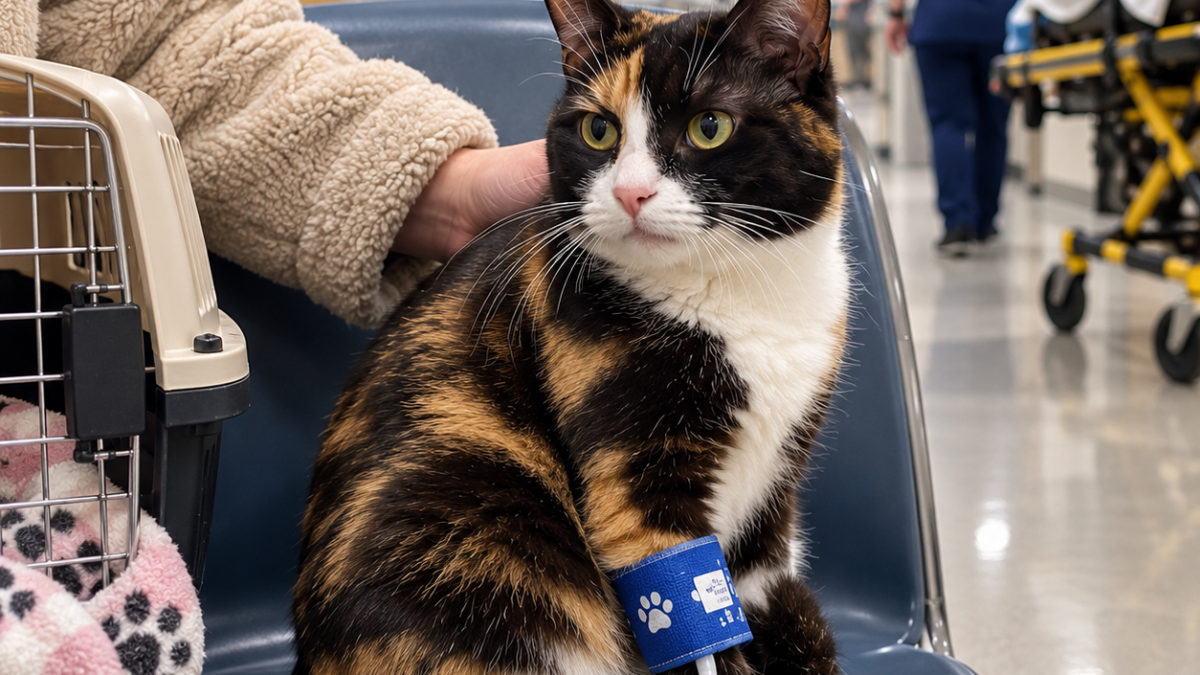
That’s when the blood pressure cuff appeared.
We still don’t know who put it on him.
The paramedic claimed later that it wasn’t him.
One nurse blamed another technician.
Everyone denied responsibility with suspicious amounts of laughter.
It wasn’t tightened.
Just looped loosely around Beans’s front leg.
Far too large.
Hanging like a ridiculous bracelet.
Mom was eventually taken to see him.
She walked into the hallway.
There he sat on a plastic chair.
Black-and-white cat.
Serious expression.
One oversized blood pressure cuff around his leg.
Mom froze.
Beans saw her.
Jumped down.
Went straight toward her.
She knelt.
And according to Mom, that was the moment she finally cried.
Not when the hospital called.
Not while driving.
Not during the explanations.
Seeing Beans broke whatever barrier she’d built.
She picked him up.
“You saved him.”
Beans put one paw on her shoulder.
Mom held him and cried into his fur.
A nurse standing nearby started crying too.
Someone said:
“Take a picture.”
Mom did.
That’s the photograph our family still keeps.
Beans on the chair.
Hospital hallway behind him.
Blood pressure cuff hanging from his leg.
Looking like the least qualified medical professional in the building.
Whenever someone sees the picture without context, they laugh.
Then we tell them.
They usually stop laughing for a second.
Then they look at Beans differently.
I arrived not long after Mom.
She was sitting with Beans in her lap.
I walked toward her.
“How is Dad?”
“In surgery.”
The word surgery made my knees weak.
“Is he stable?”
“They think so.”
“Think?”
Mom grabbed my hand.
“Don’t.”
Beans looked at me.
I touched his head.
“You.”
Mom nodded.
“He knocked the phone down.”
I already knew part of the story by then, but hearing it in the hospital changed something.
I stared at him.
“You actually did something useful?”
Mom laughed through tears.
Beans blinked.
For years, the family joke had been that Beans created problems for entertainment.
Now the joke didn’t work anymore.
Not completely.
We waited.
Hospitals have a special kind of time.
Clocks move.
You don’t.
Eventually the cardiologist came out.
The moment I saw him walking toward us, my stomach tightened.
He pulled off his cap.
“Family?”
“Yes.”
“The procedure went well.”
My mother covered her face.
I felt my knees nearly give out.
“He had a significant blockage. We placed a stent and restored blood flow.”
“Is he going to be okay?”
“We’re optimistic.”
Optimistic.
That word sounded beautiful.
“What happens now?”
“Monitoring. Medication. Cardiac rehab. Lifestyle changes.”
Mom nodded at everything.
I asked:
“How close was it?”
The doctor paused.
“With these events, sooner is always better.”
He didn’t dramatize.
Didn’t give us movie dialogue.
But later, after speaking with the paramedics, the message became clearer.
The call had happened in time.
Barely comfortably.
Maybe not comfortably at all.
Beans was moved from the break room to a quieter staff area while Dad recovered.
Normally, I imagine hospital rules would have ended the cat’s visit much sooner.
But people had heard the story.
Nobody wanted to be the person who threw out the cat who had just helped save the patient.
One nurse joked:
“He’s technically part of the emergency response.”
Another said:
“He hasn’t completed his paperwork.”
Someone else pointed toward the cuff.
“He’s clearly been evaluated.”
Humor is strange during crisis.
It doesn’t erase fear.
It creates a tiny space where you can breathe around it.
Beans gave us that too.
Several hours later, Dad was conscious enough to receive visitors briefly.
Mom went first.
When she came out, she was smiling.
“He asked about Beans.”
Of course he did.
“What did you say?”
“That he’s fine.”
Dad’s first question after heart surgery wasn’t about the house.
Not his phone.
Not his car.
The cat.
The same cat he’d yelled at thousands of times.
“Did you tell him what happened?”
“Not all of it.”
“Why?”
“He’s tired.”
I visited next.
Dad looked smaller in the hospital bed than I’d ever seen him.
Tubes.
Lines.
Monitor.
Hospital gown.
My father had always filled rooms with presence.
Seeing him surrounded by machines did something to me.
He looked toward me.
“Hey.”
“Hey.”
I tried smiling.
Didn’t work.
“You look terrible.”
Dad smiled weakly.
“You too.”
That was enough to make me laugh.
I sat beside him.
For a minute we didn’t say anything.
Then Dad whispered:
“The cat.”
I nodded.
“Mom told me.”
He looked toward the ceiling.
“He pushed it.”
“I know.”
“Right off the counter.”
“I know.”
Dad’s eyes filled.
I had rarely seen my father cry.
He turned his head slightly.
“I couldn’t reach it.”
I took his hand.
“Dad.”
“I thought I was done.”
His fingers tightened around mine.
“Then that stupid cat knocked it down.”
I laughed and cried at the same time.
“He finally knocked down something useful.”
Dad closed his eyes.
“Best thing he ever broke.”
The phone wasn’t even broken.
A cracked screen protector.
That was all.
We still have the protector somewhere.
Mom saved it.
Of course she did.
Dad remained in the hospital until Thursday.
During those two days, Beans stayed with Mom most of the time.
He couldn’t remain in the medical unit continuously, so we took turns caring for him.
But hospital staff found ways to allow short supervised visits.
The first time Beans saw Dad after the procedure became another family story.
Dad was sitting upright.
Beans entered in a carrier.
The nurse opened it.
Beans stepped out.
Stopped.
Looked at Dad.
Then jumped onto the bed.
Right onto his chest.
Every human in the room panicked at once.
Dad laughed.
“Easy.”
Mom grabbed Beans.
The nurse checked everything.
No problem.
The cardiologist later said an eleven-pound cat resting carefully on Dad was fine once he was stable.
Dad looked at Beans.
“You hear that?”
Beans didn’t.
Obviously.
“He’s approved.”
From then on, Dad called Beans his little paramedic.
The counter war ended immediately.
Completely.
I noticed it the first week after Dad came home.
Mom had prepared a strict recovery environment.
Medication schedule taped to the refrigerator.
Low-sodium groceries.
Follow-up appointments.
A blood pressure monitor.
Pill organizer.
Dad hated all of it.
He was grateful to be alive.
He was also a terrible patient.
“Why does everything healthy taste like cardboard?”
“Because you spent sixty-four years seasoning food like you had a personal grudge against arteries.”
“That is medically inaccurate.”
“Eat your oatmeal.”
“No.”
Beans jumped onto the kitchen counter.
I froze.
Old instinct.
I waited for Dad.
GET OFF THE COUNTER.
Instead, Dad looked at him.
Beans sat beside the coffee maker.
Dad pointed.
“You.”
Beans blinked.
“You’ve got diplomatic immunity now.”
Mom laughed.
“What?”
“He stays.”
“On the counter?”
“Wherever he wants.”
I stared.
“Dad, you spent four years—”
“People change.”
Beans pushed a spoon off the counter.
It hit the floor.
Dad looked down.
Then back at the cat.
“That better not go to your head.”
Beans pushed another spoon.
Dad sighed.
“Okay, some restrictions may apply.”
We laughed harder than we had since before the heart attack.
That was Beans’s revenge.
For four years, Dad had tried to defeat his worst habit.
Foil.
Tape.
Spray.
Shouting.
Rules.
Then one Tuesday morning, the exact behavior Dad considered intolerable became the reason emergency services got called.
Beans never understood the irony.
Dad did.
And he never yelled the same way again.
Sometimes Beans still got scolded.
Of course.
Heroism does not make broken dishes less annoying.
But now Dad would say:
“Beans, I know you saved my life, but that does not authorize destruction of household property.”
Or:
“Paramedics don’t knock coffee onto the floor.”
Or:
“You had one good day. Don’t get arrogant.”
Beans remained arrogant.
Recovery was slower than Dad expected.
That surprised him.
He thought the stent fixed everything.
Blocked artery opened.
Go home.
Resume life.
The cardiologist disagreed.
Walking.
Medication.
Diet.
Rest.
Rehab.
Dad had to confront mortality in a way he’d avoided his whole life.
The first week home, he was afraid to be alone.
He didn’t admit it.
We knew.
Mom postponed errands.
I stopped by constantly.
My sister called every night.
But sometimes life required people to leave.
That’s when Beans became important in a different way.
He stayed.
Dad would sit in the recliner.
Beans climbed onto his chest.
Exactly where he’d been when paramedics arrived.
Dad’s hand rested on his back.
Sometimes for hours.
One evening I found them both asleep.
Dad in the chair.
Beans stretched across him.
I stood in the doorway.
Dad opened one eye.
“What?”
“Nothing.”
“You’re staring.”
“It’s weird.”
“What is?”
“You spent years saying you didn’t like cats.”
Dad looked down at the animal sleeping directly over his heart.
“I never said I didn’t like him.”
“Yes, you did.”
“I said he’s irritating.”
“You called him a furry criminal.”
“He is a furry criminal.”
“You threatened to send him to military school.”
“He lacked discipline.”
Beans opened one eye.
Dad scratched his chin.
“Still does.”
There was affection in every word.
Dad started telling the story himself.
Neighbors came over.
Friends.
Former coworkers.
Someone would ask how he was doing.
Dad would point toward Beans.
“Ask my cardiologist.”
If they looked confused, he’d explain.
The story always started:
“This idiot knocked my phone off the counter.”
Beans would sit nearby as though waiting for recognition.
Dad exaggerated some details for comedy but never the important part.
“I couldn’t move.”
His voice would change there.
More serious.
“Phone was up there.”
He pointed.
“And this guy…”
He looked at Beans.
“He knocked it right beside me.”
People smiled.
Sometimes cried.
Then Dad would finish:
“So now I’m alive because I spent four years failing to train a cat.”
That became his favorite line.
But late at night, when the humor faded, I knew the experience had changed him more deeply.
A few weeks after he came home, I found him alone at the kitchen table.
Beans was on the counter.
Dad wasn’t complaining.
He was staring at the floor.
Same spot.
I sat.
“You okay?”
“Yeah.”
“You sure?”
He nodded.
Then pointed toward the tile.
“Right there.”
I knew.
“You don’t have to talk about it.”
He stared.
“I remember every crack in that floor.”
I didn’t say anything.
“The weird thing is, I wasn’t thinking about big stuff.”
“What do you mean?”
“People say when you’re dying your life flashes.”
He shook his head.
“Mine didn’t.”
“What did you think about?”
“The phone.”
He smiled sadly.
“Coffee.”
“Coffee?”
“I remember thinking the machine was still running.”
I swallowed.
“Then I thought about your mom finding me.”
That one hurt.
Dad’s eyes filled.
“I didn’t want her to find me like that.”
I reached across the table.
He continued.
“And I thought I should’ve replaced that stupid smoke detector battery.”
I laughed despite myself.
“Seriously?”
“Brains are weird.”
Then he looked toward Beans.
The cat had stretched out beside the toaster.
“And then I saw him.”
Dad was quiet for a moment.
“I don’t know if he understood.”
“Probably not like we do.”
“No.”
“He knew something was wrong.”
“Maybe.”
Dad nodded.
“He looked at me.”
Then smiled.
“And knocked my phone down.”
I said:
“Maybe Beans thought you finally appreciated his art.”
Dad laughed.
“His life’s work.”
That became another joke.
Beans had been preparing for that moment for four years.
Every cup.
Every pen.
Every banana.
Training.
Mom called him “the longest paramedic internship in history.”
Dad said:
“Four years of field practice.”
The paramedic who made the decision to bring Beans in the ambulance eventually called to check on Dad.
Mom put him on speaker.
Dad thanked him.
Then said:
“Also, apparently you kidnapped my cat.”
The paramedic laughed.
“Your cat kidnapped himself.”
“You could’ve left him.”
“We tried.”
“How hard?”
“Three times.”
Dad looked at Beans.
The cat was grooming himself.
The paramedic continued:
“Honestly, I’ve never seen anything like it.”
“What?”
“He just kept getting back on you.”
Dad looked down.
“He does that.”
“Once we put him on the stretcher, he settled.”
“That’s Beans.”
The paramedic paused.
Then said something that stayed with Dad.
“He seemed to know where he belonged.”
Dad didn’t joke after that.
He simply said:
“Yeah.”
Beans seemed to know where he belonged.
Before the heart attack, Dad would have said that place was not the kitchen counter.
Afterward, definitions changed.
We later learned more about Dad’s cardiac event.
One major artery.
Serious blockage.
The cardiologist showed us diagrams.
Explained plaque rupture.
Blood clot.
Reduced flow.
Heart muscle at risk.
The science was straightforward.
The emotions were not.
Every time the doctor emphasized “early treatment,” my mind returned to Beans’s paw.
One push.
Such a stupid little action.
That is what frightened me most afterward.
How much life can depend on tiny things.
Dad placing the phone on that particular part of the counter.
Beans being there.
The phone falling screen-up.
Dad remaining conscious.
The emergency call connecting.
The ambulance being nearby.
Nine minutes.
We live as though survival is a broad, sturdy road.
Sometimes it’s a narrow bridge made of coincidences.
Dad began carrying his phone differently.
Always in a pocket.
Even inside the house.
Mom bought him a smartwatch with emergency features.
They installed a medical alert system.
“Your backup plan,” I said.
Dad pointed toward Beans.
“That’s the backup.”
“No. Beans is retired.”
Dad looked at the cat.
“Union rules?”
“Exactly.”
Beans yawned.
Dad’s cardiologist thought the story was hilarious once Dad was stable enough for humor.
At a follow-up appointment, he asked:
“How’s the cat?”
Dad smiled.
“Still practicing medicine without a license.”
“Is he staying off your chest?”
“No.”
“Weight?”
“Eleven pounds.”
The doctor considered.
“As long as he’s not putting pressure on your access site and you’re comfortable, he’s fine.”
Dad turned toward Mom triumphantly.
“You heard that.”
She nodded.
“The cat’s approved.”
That quote became permanent.
Whenever Beans climbed onto Dad:
“He’s approved.”
Whenever someone tried moving him:
“Medical clearance.”
Whenever Mom objected to him occupying Dad’s pillow:
“Doctor’s orders.”
“Your doctor never ordered a cat on your pillow.”
“Interpretation.”
Beans benefited enormously from Dad’s selective interpretation.
Treats increased.
Counter enforcement collapsed.
Lap access became unlimited.
Mom finally said:
“You know he’s manipulating you.”
Dad looked offended.
“He saved my life.”
“He knocked down a phone.”
“Heroically.”
“He knocks down everything.”
“Practice.”
“You’re impossible.”
Dad looked at Beans.
“See how she talks to cardiac patients?”
The entire family dynamic changed.
Not drastically.
Dad remained Dad.
Stubborn.
Sarcastic.
Bad at following diets.
Beans remained Beans.
Destructive.
Curious.
Entirely convinced counters belonged to him.
But beneath the jokes, something tender settled between them.
Dad touched Beans more.
Spoke to him more.
Sometimes I’d catch him whispering things when he thought nobody was listening.
“Good boy.”
Or:
“You kept me here.”
Beans usually responded by demanding food.
One afternoon I asked:
“Do you think he knows he saved you?”
Dad thought.
“No.”
“Does that bother you?”
“No.”
He scratched Beans behind the ear.
“Maybe better that way.”
“Why?”
Dad looked at him.
“Then he doesn’t expect anything.”
I smiled.
“He definitely expects dinner.”
“That he does.”
By the second month, Dad could walk farther.
Cardiac rehab helped.
He complained about every session.
“You’d think surviving a heart attack would get you out of exercise.”
“Apparently it gets you more exercise.”
“Scam.”
Beans became part of the rehab routine.
Dad walked around the house.
Beans followed.
Dad walked into the backyard.
Beans watched through the window.
Dad returned.
Beans met him at the door.
The first time Dad walked half a mile outside, Mom came with him.
When they returned, Beans was sitting in the front window.
Dad stopped.
Mom asked:
“What?”
“He’s waiting.”
“Probably for food.”
“Let me have this.”
Dad opened the door.
Beans came running.
He rubbed against Dad’s legs.
Dad bent carefully.
“See?”
Mom smiled.
“Fine. He missed you.”
Dad looked ridiculously pleased.
The man who once swore the cat belonged to my mother had become emotionally dependent on being greeted by him.
I loved watching it.
Because the heart attack had introduced fear into Dad’s relationship with home.
Kitchen floor.
Being alone.
Closed doors.
Long mornings.
Beans slowly replaced some of those associations.
Home was no longer only where Dad almost died.
It was where Beans waited.
Where Beans slept on his chest.
Where the phone now stayed in his pocket.
Where coffee was made again.
That first cup of coffee after Dad returned to the kitchen was emotional.
Dad didn’t tell anyone.
Mom did.
He stood beside the machine.
The same place.
Beans jumped onto the counter.
Dad froze.
Mom watched from the doorway.
“You okay?”
“Yeah.”
The machine began dripping.
Dad stared at the floor.
Then Beans walked toward him.
Dad put one hand on the counter.
For a moment, Mom thought he might panic.
Instead, Beans pushed the sugar container slightly.
Dad snapped out of it.
“Don’t even think about it.”
Beans pushed again.
Dad laughed.
That laugh changed the entire moment.
The kitchen became a kitchen again.
Not an emergency scene.
Not perfectly.
But enough.
Mom told me later:
“I think the stupid cat gave him the room back.”
I understood exactly what she meant.
Trauma can claim ordinary places.
Sometimes ordinary behavior claims them back.
Beans was very good at ordinary behavior.
Mostly bad behavior.
But ordinary.
Months passed.
Dad’s numbers improved.
Blood pressure.
Cholesterol.
Stamina.
He took medication consistently because Mom threatened him with consequences I won’t repeat.
He changed his diet enough to satisfy the cardiologist, though he continued negotiating every restriction.
Beans gained half a pound.
Also because of Dad.
The veterinarian noticed.
“What changed?”
Mom gave Dad a look.
Dad stared at the ceiling.
“Nothing.”
“Treats?”
“No.”
Beans sat on the exam table.
Mom said:
“He’s been giving him turkey.”
Dad protested.
“Lean protein.”
“Not six times a day.”
The veterinarian looked at Beans.
“Your paramedic is getting chunky.”
Dad looked genuinely ashamed.
“Can he still sit on my chest?”
“Not if you keep feeding him like that.”
Dad stopped the extra turkey immediately.
Apparently cardiologist approval had limits.
The blood pressure cuff became another family artifact.
Yes, we kept it.
Not the hospital’s actual equipment—we later learned it was a disposable cuff they didn’t need back.
Mom wrote the date on the inside.
Dad hated sentimental objects.
He kept it anyway.
It sat in a drawer beside discharge papers.
Sometimes when friends asked to see the famous photo, Dad brought out the cuff.
He’d hold it beside Beans’s leg.
“His first medical equipment.”
Beans would try biting it.
“Respect your profession,” Dad would say.
The joke never got old.
At least not to Dad.
A local friend shared the story online.
Then someone else did.
Suddenly strangers were commenting.
People loved Beans.
Of course they did.
Hero cat.
Tuxedo paramedic.
Countertop savior.
Dad pretended to dislike the attention.
He read every comment.
One person wrote:
“Give that cat unlimited counter privileges.”
Dad pointed at the screen.
“See?”
Mom replied:
“No.”
“Public opinion.”
“Health code.”
Another person wrote:
“Beans was training his whole life for that moment.”
Dad loved that one.
“Exactly.”
Mom rolled her eyes.
A few comments suggested the story proved animals sense medical emergencies.
Maybe Beans did.
Maybe not.
We never claimed certainty.
That wasn’t necessary.
We knew what happened.
Dad collapsed.
Phone unreachable.
Beans pushed it.
The phone landed near him.
Emergency services came.
Everything after that was observable fact.
Sometimes people want rescue stories to become supernatural.
The truth can be powerful enough without adding anything.
Beans didn’t need to understand cardiology.
He just needed to be Beans.
That was the beauty.
His worst habit intersected with Dad’s worst moment.
And somehow, that was enough.
About six months after the heart attack, Dad and I had lunch together.
Just us.
He looked healthy.
Not exactly like before.
Maybe better in some ways.
Thinner.
More careful.
More aware.
We were eating when he said:
“You know what bothers me?”
“What?”
“That I almost died angry at Beans.”
I laughed.
“What?”
“That morning.”
“Were you angry?”
“Before it happened.”
“Why?”
“He knocked my keys off the counter.”
I stared.
“Seriously?”
“About ten minutes before.”
I started laughing.
Dad did too.
“I told him, ‘One of these days I’m throwing you outside.’”
“You would never.”
“I know.”
“He knew.”
“Cats know everything.”
Then Dad’s smile faded.
“I remember thinking about that in the hospital.”
“What?”
“That the last thing I’d said to him before he helped me was yelling.”
I reached across the table.
“Dad, he’s a cat.”
“I know.”
“He doesn’t hold grudges.”
“Probably because he causes too much trouble to keep track.”
We laughed.
Then Dad said:
“Still.”
I understood.
Near-death experiences make people inventory strange things.
Words.
Small regrets.
Ordinary moments that suddenly feel final.
“You’ve had six months to apologize.”
Dad nodded.
“I have.”
“You apologized to Beans?”
“Many times.”
I laughed.
“What did he say?”
“Asked for chicken.”
That was Beans.
Forgiveness through poultry.
Dad’s relationship with mortality changed too.
Before, he avoided doctors.
After, he attended appointments.
Complained.
But went.
He started calling me more.
Not dramatically.
Just:
“How’s work?”
“Seen your sister?”
“Want to come for dinner?”
At first I didn’t connect it to the heart attack.
Then I did.
Dad had spent minutes on the kitchen floor believing there would be no more phone calls.
After that, he made more.
One evening he said:
“I used to think there’d always be another Tuesday.”
I didn’t know what to say.
He shrugged.
“Turns out that’s not guaranteed.”
Beans jumped onto the table.
Dad pointed.
“That doesn’t mean you can be up there.”
Beans stepped closer.
Dad sighed.
“Fine.”
Some battles were lost forever.
A year after the heart attack, we marked the date without officially calling it an anniversary.
Mom made dinner.
I came over.
My sister came home.
Dad pretended he didn’t know why everyone was there.
“What’s this?”
“Dinner.”
“You all randomly decided Tuesday?”
“Yes.”
“Suspicious.”
Beans sat on Dad’s chair before he could.
Dad moved him gently.
“Hero status doesn’t include my seat.”
Beans returned immediately.
Dad sat somewhere else.
We gave Beans a tiny bow tie.
Black.
Almost invisible against his fur.
Dad hated it.
Beans hated it more.
The photo is excellent.
At dinner, Mom raised her glass.
Not wine.
Dad’s wine intake had become a negotiation with cardiology.
She said:
“To being here.”
Dad nodded.
My sister added:
“To Beans.”
Dad looked toward the cat.
Beans was under the table.
“To Beans.”
I said:
“And to gravity.”
That made Dad laugh.
“To gravity.”
No long speeches.
We didn’t need them.
The entire evening existed because of one falling phone.
Later, Dad went to the kitchen.
I followed.
He stood where he’d collapsed.
Beans jumped onto the counter.
Dad looked up.
“Same idiot.”
I said:
“Same counter.”
Dad nodded.
“Different Tuesday.”
That line stayed with me.
Same kitchen.
Different Tuesday.
Life doesn’t always replace the place where something terrible happened.
Sometimes it gives you enough ordinary days afterward that the terrible one becomes part of the room rather than the whole room.
Dad had hundreds of mornings there after the heart attack.
Coffee.
Breakfast.
Medication.
Beans.
Eventually the tile stopped being the first thing we thought about.
Mostly.
Sometimes Dad still glanced down.
But then Beans usually did something irritating.
Knocked down mail.
Stole butter.
Sat in the sink.
Life interrupted fear.
I became grateful for those interruptions.
The paramedic visited Dad once at home.
He was in the neighborhood and called ahead.
Dad insisted he come inside.
Beans was on the counter.
Naturally.
The paramedic walked into the kitchen and pointed.
“There he is.”
Dad said:
“Your former partner.”
Beans stared suspiciously.
The paramedic approached.
Beans sniffed his hand.
Then walked away.
“That’s it?”
Dad asked.
“What did you expect?”
“A reunion.”
“He doesn’t remember me.”
“Unprofessional.”
The paramedic laughed.
Then looked at Dad.
“You look good.”
“Better than last time.”
“Much.”
They stood awkwardly for a moment.
Dad wasn’t always good at emotional gratitude.
Finally, he said:
“Thanks.”
The paramedic nodded.
“Just doing the job.”
“No.”
Dad shook his head.
“For taking him.”
The paramedic glanced at Beans.
“He wasn’t giving us much choice.”
“You could’ve left him.”
“Probably.”
“Thanks for not doing that.”
The paramedic looked at Dad.
“Honestly? You looked terrified.”
Dad’s expression changed.
“I was.”
“And that cat wouldn’t leave you.”
He shrugged.
“Sometimes you don’t separate people from whatever is helping them stay calm.”
People.
He said people.
Not patient and cat.
Whatever is helping.
That mattered.
Dad looked at Beans.
“Yeah.”
The paramedic continued:
“Also, he tried climbing into the ambulance before we’d finished loading you.”
Dad laughed.
“That sounds right.”
“He acted like he’d done it before.”
“Born professional.”
Beans knocked a receipt off the counter.
Both men watched it fall.
The paramedic said:
“Still training?”
Dad smiled.
“Every day.”
The years after Dad’s heart attack gave the story more weight, not less.
At first, it was a dramatic rescue.
Then it became a relationship.
Beans aged.
Dad aged.
They slowed together.
At seven, Beans stopped launching onto the highest cabinets.
At eight, Dad started taking longer walks but shorter drives.
At nine, Beans developed a habit of sleeping directly beside Dad’s left arm.
Mom joked that he was monitoring circulation.
Dad said:
“Medical specialization.”
We couldn’t stop.
Every ordinary cat behavior became healthcare humor.
Beans kneaded Dad’s chest?
CPR.
Beans stared at him?
Neurological assessment.
Beans sniffed his medication?
Pharmacy consultation.
Beans sat on the bathroom scale?
Weight management.
The jokes let us hold the memory without constantly fearing it.
That’s what families do.
We turn terror into stories we can tell at dinner.
Not to minimize it.
To survive remembering.
Dad’s cardiac health remained stable.
The stent did its job.
Medication did its job.
Dad did his job, reluctantly.
Beans definitely took credit.
The cardiologist saw Dad annually.
Every visit ended the same.
“How’s Beans?”
Dad would reply:
“Still alive.”
“Still on your chest?”
“Every night.”
“Then I guess he’s continuing follow-up.”
“Can I bill him?”
“No.”
Dad claimed discrimination against feline healthcare workers.
One year, he brought the hospital photo to the cardiologist.
The doctor laughed for almost a full minute.
“That cuff.”
“Nobody admits doing it.”
“I would deny it too.”
Dad pointed at Beans in the picture.
“He looks very professional.”
“He looks furious.”
“Bedside manner needs work.”
Dad loved that photograph.
He kept a copy beside his recliner.
Not the family portrait.
Not a vacation picture.
Beans with a blood pressure cuff.
I once asked why.
Dad shrugged.
“Reminds me.”
“Of what?”
“That I’m lucky.”
He looked toward the kitchen.
“And to keep my phone in my pocket.”
Fair.
Our family changed its emergency habits too.
Mom took a CPR class.
So did I.
Dad installed a lock box for emergency access.
Smartwatch.
Medical information on the fridge.
Neighbors had phone numbers.
We didn’t rely on Beans.
That mattered.
The story was wonderful because Beans happened to help.
It would have been irresponsible to turn coincidence into a safety plan.
Dad joked:
“I’ve upgraded from cat-based emergency services.”
Good.
Still, Beans remained part of every discussion.
The cardiologist once said:
“Keep the phone accessible.”
Dad replied:
“I have a redundant system.”
The doctor raised an eyebrow.
“Beans.”
The doctor laughed.
“I don’t recommend that as standard protocol.”
Neither did we.
The hardest conversation came years later when Beans himself became sick.
He was still relatively young, but cats age faster than we want.
Nothing catastrophic.
A urinary issue first.
Then weight changes.
Dad panicked more than Mom.
“Is he okay?”
The veterinarian said yes.
Treatment.
Diet.
Monitoring.
Dad followed every instruction.
The man who once resisted his own cardiac diet became militant about Beans’s prescription food.
Mom pointed out the hypocrisy.
Dad ignored her.
“He’s a medical professional. He needs proper nutrition.”
Beans hated the new food.
Dad sat beside his bowl.
“You made me eat oatmeal. We’re even.”
Beans walked away.
Dad followed.
I watched this and thought:
There are debts animals never know they’ve created.
Dad treated every veterinary problem as though repayment were required.
Not because Beans expected anything.
Because Dad did.
He felt borrowed time.
Beans was tied to that feeling.
One night, years after the heart attack, Dad told me:
“I know he probably just knocked it off because that’s what he does.”
“Probably.”
“You don’t think he was trying to save me?”
I hesitated.
“I think he knew something was wrong.”
Dad nodded.
“That’s what I think.”
“Whether he understood the phone?”
“Probably not.”
“Does that change anything?”
Dad looked at Beans asleep beside him.
“No.”
Exactly.
Intent doesn’t always determine impact.
Beans may not have understood emergency calls.
He may simply have seen an object at the edge and done what he always did.
But here’s the thing.
A habit is part of who someone is too.
Beans didn’t need to transform into a hero.
He saved Dad by being exactly himself.
That became the part of the story I loved most.
People often imagine salvation requiring extraordinary behavior.
Sometimes it does.
Sometimes it requires the ordinary thing someone has always done.
A cat pushes objects.
A phone falls.
A man lives.
Dad had spent years wanting Beans to become a different cat.
Stay off counters.
Leave objects alone.
Stop pushing.
That Tuesday, if Dad had successfully trained every bit of that behavior out of him, who knows?
Maybe Beans would have sat politely beside the phone.
Maybe nothing would have fallen.
I don’t like thinking too hard about that.
But Dad did.
He once said:
“Imagine if the tape had worked.”
“What tape?”
“The double-sided stuff.”
I remembered.
“Dad.”
“No, seriously.”
“You can’t think like that.”
“Why not?”
“Because then you’ll end up tracing every possible alternate universe.”
Dad smiled.
“That’s what old retired men do.”
“Get a hobby.”
“I have one.”
He pointed toward Beans.
Beans pushed a bottle cap off the table.
Dad watched it fall.
“See?”
His hobby continued.
Eventually Dad stopped trying to keep Beans off the counter entirely.
He cleaned it more.
That’s adaptation.
Mom was less accepting.
She maintained a no-cat-during-food-preparation rule.
Beans violated it.
Regularly.
Mom sprayed the surface.
Dad defended him.
“He has jurisdiction.”
“He has fur.”
“He’s certified.”
“He has no certification.”
“Hospital photo.”
“That is not certification.”
“Looks official.”
Their arguments became part of the house.
I hope they always will be in my memory.
Because the alternative was the Tuesday morning when only Beans was there.
Dad never forgot that.
On the five-year anniversary, he did something unexpected.
He replaced the old kitchen counter.
It needed renovation anyway.
The surface was worn.
Mom chose the material.
During installation, Dad asked the contractor for a small piece of the old countertop.
Mom stared.
“What are you doing?”
“Nothing.”
“Why do you need that?”
Dad shrugged.
“Souvenir.”
She understood.
A section about six inches wide.
Nothing visible marking where the phone had sat.
No scratch.
No inscription.
Just material.
Dad kept it in the garage for months.
Then eventually threw it away.
I asked why.
He said:
“Don’t need it.”
That was healing too.
Memories don’t always require relics.
We kept the picture.
That was enough.
Years later, when people asked Dad about the scar on his wrist from the cardiac procedure, he’d sometimes tell the Beans story.
Not always.
Sometimes a scar can just be a scar.
But whenever Beans was nearby, Dad couldn’t resist.
“You see this cat?”
The visitor would look.
“He saved my life.”
Beans usually ruined the emotional impact by licking himself.
Dad continued anyway.
He liked people knowing.
I think part of him wanted witnesses.
Not to Beans’s heroism.
To his own second chance.
Saying “my cat saved me” was easier than saying:
“I almost died.”
Both meant the same event.
One version ended with gratitude.
The other with fear.
Dad chose gratitude.
Maybe that saved him in another way.
After the heart attack, he became softer.
Not unrecognizable.
Still sarcastic.
Still stubborn.
But he said thank you more.
He hugged longer.
Called people back.
And he tolerated significantly more cat-related property damage.
The ultimate revenge for Beans.
Dad had spent years yelling:
“GET OFF THE COUNTER!”
Afterward, Beans could sit there like a decorated veteran.
Dad would walk into the room.
Pause.
Point.
“You know you’re not supposed to be there.”
Beans blinked.
Dad sighed.
“Fine.”
Victory.
Complete victory.
No villain defeated.
No lawsuit.
No dramatic punishment.
Just one cat proving that the habit everyone hated had value nobody could predict.
The universe has a strange sense of humor.
The wine glass incident Dad once considered Beans’s greatest crime became irrelevant.
The broken mug?
Irrelevant.
The bananas?
Training exercises, according to Dad.
The stack of tax papers Beans scattered?
“Advanced simulation.”
Mom finally said:
“You’re rewriting history.”
Dad replied:
“History is written by survivors.”
He was impossible.
And alive.
That last word made every joke land differently.
Alive.
We got more birthdays.
More Tuesdays.
More Thanksgiving dinners where Dad complained turkey was overcooked.
More Christmas mornings.
More phone calls.
More arguments.
More ordinary irritation.
People underestimate ordinary irritation after almost losing someone.
It’s wonderful.
The first time Dad complained about traffic after surgery, Mom smiled.
“What?”
He asked.
“Nothing.”
“Why are you smiling?”
“Because you’re complaining.”
“So?”
“So you’re back.”
He didn’t understand at first.
Then he did.
Beans was the same.
The first time he knocked a glass over after Dad came home, everyone yelled.
Then everyone laughed.
Back.
Sometimes a family measures recovery through medical numbers.
Sometimes through the return of annoying behavior.
Beans gave us plenty of both.
As he got older, his jumping decreased.
That made Dad unexpectedly sad.
One afternoon Beans stood beside the counter and hesitated.
He tried once.
Missed.
Dad immediately picked him up and placed him on the surface.
Mom saw.
“You put him there?”
Dad looked defensive.
“He wanted up.”
“You spent four years—”
“I know.”
Mom smiled.
Nothing else needed saying.
Beans walked toward the edge.
Pushed down a folded receipt.
Dad watched it fall.
Then smiled.
“Still got it.”
I had to look away for a second.
Because beneath the humor was time.
The cat who had once leaped effortlessly was aging.
The father he saved was aging too.
Neither stayed frozen in the heroic moment.
That’s important.
Stories often end at the rescue.
Real life continues.
Bones stiffen.
Medications increase.
Furniture changes.
People become grandparents.
Cats sleep more.
Dad and Beans grew old together.
That was the reward.
Not fame.
Not the hospital photograph.
Time.
Beans had helped buy Dad time.
Dad spent part of it carrying Beans onto counters he could no longer reach.
I cannot think of a more satisfying repayment.
My favorite memory isn’t the hospital.
I wasn’t even there for the kitchen rescue.
My favorite memory came much later.
Dad was sitting outside on the porch.
Beans was beside him.
The afternoon was warm.
Dad had a mug of coffee.
His phone was in his shirt pocket.
Always.
Beans looked at the mug.
Dad saw him.
“Don’t.”
Beans looked away.
Dad relaxed.
Then Beans slowly lifted one paw and pushed the mug.
Dad caught it before it fell.
“You son of a—”
He stopped.
Beans stared.
Dad started laughing.
Not a polite laugh.
Full-body laughing.
Coffee sloshing.
Tears in his eyes.
He set the mug somewhere safer.
Then pulled Beans into his lap.
“You almost had me.”
Beans settled.
Dad stroked his back.
After a minute, Dad whispered:
“You already got me once.”
I don’t know whether Beans understood anything.
Probably not.
But he stayed.
That’s enough.
Our family still has the hospital photo.
Whenever it appears, people focus first on the ridiculous cuff.
They should.
It’s funny.
An eleven-pound tuxedo cat sitting on a plastic hospital chair with an adult blood pressure cuff hanging around his leg like jewelry.
But when I look at it, I see everything outside the frame.
Dad on the kitchen floor.
The unreachable phone.
Beans’s paw.
The fall.
Eight inches.
911.
Nine minutes.
The ambulance.
A cat refusing to leave.
My mother driving toward a hospital not knowing whether her husband would survive.
Doctors opening a blocked artery.
Dad waking up.
More years.
All inside one stupid photograph.
Mom once said:
“I wish I’d gotten a better picture.”
I told her:
“No.”
The picture is slightly crooked.
Hospital lighting.
Nothing artistic.
Perfect.
Emergency days aren’t composed.
They happen.
The cuff isn’t centered.
Beans isn’t posing.
Life was messy.
Still is.
That’s why it matters.
People sometimes ask whether Beans is officially recognized as a service animal.
No.
He isn’t.
He’s a house cat.
A deeply annoying house cat.
That’s also important.
We don’t need to turn him into something he wasn’t.
He wasn’t trained.
He wasn’t performing a task on command.
He didn’t have special certification.
He was Beans.
On a counter.
Doing the thing Beans always did.
That simplicity makes the story better.
A living creature doesn’t need credentials to matter.
Dad certainly didn’t ask for paperwork when the phone landed beside him.
He just called 911.
And the paramedics came.
Years after the event, I asked Dad what he would say if he could go back to the night before the heart attack and speak to himself.
I expected something profound.
Quit smoking earlier.
Eat better.
Go to the doctor.
Carry your phone.
He thought.
Then said:
“Stop yelling at the cat.”
I laughed.
“That’s it?”
“No.”
He smiled.
“Also take the statin.”
Fair.
“But mainly the cat?”
“Mainly the cat.”
He looked toward Beans.
“Turns out he had a plan.”
“He did not have a plan.”
“You can’t prove that.”
I couldn’t.
Dad wins.
The story became less frightening over the years.
That’s how memory protects us.
Edges soften.
Humor moves in.
But occasionally something brings the fear back sharply.
An ambulance passing.
A chest-pain commercial.
Dad rubbing his sternum absentmindedly.
The kitchen floor in certain morning light.
Then I remember the other part.
Beans.
We don’t get to choose which ordinary moments become important.
A phone on a counter.
A cat with a bad habit.
A Tuesday.
That is what I tell people when they ask what the story means to me.
Not that cats are psychic.
Not that every annoying habit secretly has a purpose.
Life isn’t that tidy.
What it means is that sometimes the thing we desperately want to change turns out to be part of what we love.
Beans was not valuable despite being Beans.
He was valuable as Beans.
Counter obsession included.
Dad’s mistake wasn’t trying to keep the kitchen clean.
Reasonable goal.
The funny mistake was believing the parts of someone that irritate us are separate from the parts that matter.
They’re often tangled together.
The same paw that destroyed a glass of wine moved the phone.
The same stubbornness that made Beans ignore Dad’s rules kept him climbing back onto Dad when paramedics tried moving him.
The same cat who refused to stay where anyone put him became perfectly still the moment he was allowed beside Dad on the stretcher.
Context changes everything.
Afterward, Dad stopped calling Beans a nuisance.
Mostly.
When Beans knocked something over:
“You’re a nuisance.”
Then Dad added:
“A medically necessary nuisance.”
That became the official diagnosis.
Beans the medically necessary nuisance.
I think he would have liked it if he understood English.
Maybe he understood tone.
Dad’s voice changed.
That was enough.
If there is a final piece of revenge in this story, it’s this:
Beans won the counter war.
Completely.
Not because Dad surrendered out of exhaustion.
Because the counter became sacred territory in a strange way.
The place where the habit Dad despised turned into action that saved him.
Dad never admitted this directly.
He didn’t need to.
Whenever Beans sat there afterward, Dad complained.
But he never meant it.
Not really.
The anger was gone.
Only ritual remained.
“Get down.”
Beans stayed.
Dad shook his head.
“Fine.”
Always fine.
One evening, many years after that Tuesday, Dad was sitting at the kitchen table taking his heart medication.
Beans, older now, sat beside the pill organizer.
Dad looked at him.
“You know what these are?”
Beans sniffed.
“These are because apparently you weren’t available for follow-up care.”
Beans pushed the pillbox slightly.
Dad grabbed it.
“Oh, no.”
Beans tried again.
“Absolutely not. Saving me once does not mean you get to kill me later.”
Mom laughed from the living room.
Dad moved the medication safely away.
Beans sat down.
I watched them and thought:
This is the happy ending.
Not dramatic.
A man taking medication years after a heart attack.
A cat trying to knock it over.
A wife laughing.
A child watching.
The ordinary future that almost didn’t happen.
That’s what Beans gave us.
More ordinary.
We are greedy for ordinary now.
More birthdays.
More coffee.
More arguments.
More broken cups.
More cats on forbidden counters.
If you had told Dad before the heart attack that one day he’d be grateful for Beans knocking things down, he would have laughed at you.
If you had told him he’d let Beans ride on his chest during recovery, defend his counter privileges, keep a hospital picture beside his chair, and introduce him to strangers as “the paramedic,” he would have called you ridiculous.
Then Tuesday happened.
Life has a way of making old opinions embarrassing.
Beans never needed an apology.
He got one anyway.
Many, actually.
Dad would scratch his head and say:
“I misjudged you.”
Beans purred.
Then usually asked for food.
No resentment.
No scorekeeping.
Animals are generous that way.
Dad was the one keeping score.
Every extra year.
Every holiday.
Every morning.
Borrowed time.
One cat-sized debt.
Dad could never repay it.
He tried with turkey.
The veterinarian disapproved.
So he repaid it with presence.
Lap.
Warm bed.
Hands under an aging body when jumping got hard.
Counter lifts.
Vet bills.
Patience.
That is how love works after rescue.
Someone helps you survive once.
Then you spend years making sure they know staying mattered.
Dad would never phrase it that way.
He’d say:
“He’s my cat. Of course I take care of him.”
Exactly.
Years after the heart attack, when Dad was telling the story to one of my nephews, the boy asked:
“Grandpa, did Beans know the phone would call the ambulance?”
Dad shook his head.
“I doubt it.”
“Then how did he save you?”
Dad thought.
Then smiled.
“Sometimes you don’t have to know everything to do the right thing.”
The boy accepted that.
So did I.
Maybe that is the cleanest lesson in the whole story.
Beans didn’t need to understand the entire chain.
Phone.
Emergency service.
Paramedics.
Hospital.
Stent.
Recovery.
He only needed to move one object.
Afterward, human beings carried the chain forward.
Dispatcher.
EMS.
Doctors.
Nurses.
Family.
But Beans started it.
One paw.
One push.
Sometimes one small action is enough to hand the next part of the story to someone else.
The hospital staff did the rest.
Dad survived.
And Beans got ambulance privileges.
Fair trade.
I don’t know how many times Dad yelled “GET OFF THE COUNTER” during those first four years.
Thousands might actually be possible.
Morning.
Afternoon.
Dinner.
Every day.
If words left physical marks, our kitchen walls would have been covered with that sentence.
After the heart attack, he still said it occasionally.
But always differently.
Less command.
More affection.
“Get off the counter, Beans.”
Beans stayed.
Dad smiled.
“You know I don’t mean it.”
Maybe Beans knew that too.
Our family did.
That is where the story ends for me.
Not at the hospital.
Not with surgery.
Not even with the ridiculous blood pressure cuff.
It ends years later in that kitchen.
Dad alive.
Coffee brewing.
Medication taken.
Beans on the counter.
Something small sitting too close to the edge.
Dad notices.
Beans notices Dad noticing.
They stare at each other.
Old rivals.
Dad points.
“Don’t.”
Beans slowly raises one paw.
Dad starts laughing before anything even falls.
Because some battles are worth losing.
Because some bad habits become family legends.
Because sometimes the thing that tests our patience for years is the exact thing we thank God for when the worst day finally comes.
And because my father is still here.
Not because Beans became a different cat.
Because, at the moment it mattered most, he was exactly the cat he had always been.
A stubborn little tuxedo menace standing on a forbidden counter, staring at an object near the edge and thinking whatever mysterious thought makes cats push things onto the floor.
One paw.
One phone.
One emergency call.
One life saved.
Dad still calls him his little paramedic.
And if Beans knocks something down now, Dad usually looks at the mess, looks at the cat, shakes his head, and says the same thing:
“Fine. I’ll let that one go.”
After everything Beans gave us, I think he earned it.



