PART 2: My 14-Year-Old Labrador Hadn’t Growled in Years—Then She Saw Something Coming Down the Highway
PART 2
“Molly!”
I screamed her name so hard my throat hurt.
She didn’t stop.
For one terrible second, I saw everything before it happened.
The truck hitting her.
Her yellow body disappearing beneath the tires.
Me standing there afterward knowing I had opened the door.
I ran into the road.
The pickup drifted again.
Its right-side tires crossed the white shoulder line.
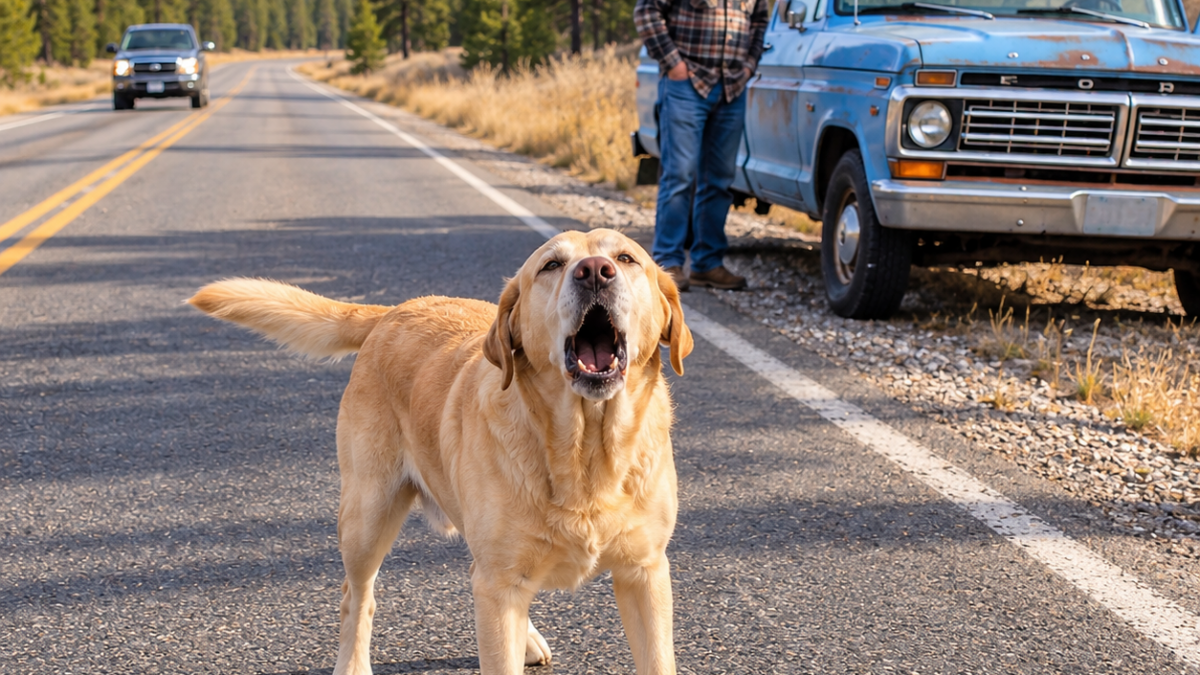
Then Molly planted herself several yards ahead of my Ford and barked with a fury I had never heard from her in fourteen years.
Not the bark she used when a squirrel stole birdseed from the porch.
Not her excited bark when Henry used to pull into my driveway.
This was different.
Sharp.
Repeated.
Desperate.
The pickup kept coming.
Maybe fifty yards away.
Forty.
Thirty.
I finally saw the driver.
His head was tilted downward.
He wasn’t looking at the road.
“MOLLY!”
Her barking intensified.
The driver’s head snapped up.
I saw his face change.
He saw the dog.
Then he saw me.
Then, finally, he saw my disabled truck sitting directly in his path.
He jerked the steering wheel.
The pickup swerved left.
Too hard.
The rear tires fishtailed.
The vehicle crossed the center line, swung sideways, and missed the front of my Ford by what later measured less than three feet.
The sound of tires scraping asphalt tore through the quiet morning.
Then came a crash.
The pickup shot through the opposite shoulder, dropped into a drainage ditch, tore through several wooden fence posts, and stopped nose-first against an embankment.
Dust rose into the air.
For several seconds there was no sound except the ticking of my Ford’s cooling engine.
I stood in the road.
My hands were shaking.
Then I remembered Molly.
She was maybe twenty feet away.
Still standing.
“Molly?”
Her head turned toward me.
And just like that, whatever had carried her into the road seemed to leave her.
Her hindquarters sagged.
The limp came back.
Her head lowered.
She began walking toward me with that slow, uneven gait I knew so well.
One step.
Another.
Another.
I dropped to my knees in the gravel.
“Come here, baby.”
She reached me.
I wrapped both arms around her neck.
Molly pressed her head into my chest.
I cried.
I mean I truly cried.
Not quietly.
Not politely.
I buried my face in the fur behind her ears and sobbed like I hadn’t since the morning Henry died.
“You stupid old girl,” I kept saying.
“You beautiful, stupid old girl.”
Her tail moved weakly against the gravel.
I checked her legs.
Her paws.
Her ribs.
No blood.
No obvious injury.
Somehow, she hadn’t been hit.
Behind us, the crashed pickup’s horn suddenly began blaring continuously.
I looked up.
Reality returned.
There was still a driver inside.
I pulled out my phone and called 911.
“My name is Walter Jensen,” I told the dispatcher. “There’s been a crash on Route 19 about nine miles east of Ashford.”
“Are you injured?”
“No.”
“Is anyone else hurt?”
“I don’t know. The other driver went into the ditch.”
“Stay somewhere safe. Emergency services are on the way.”
I looked at Molly.
Safe.
That word suddenly felt different.
I got her back toward the shoulder.
She couldn’t jump into the Ford anymore, especially after whatever burst of strength she had just spent.
So I lifted her.
She felt heavier than usual because my arms were trembling.
I placed her on the passenger seat.
“Stay.”
She looked at me as if I had personally offended her by suggesting she might do anything else.
I closed the door.
Then I approached the ditch.
The pickup’s driver was moving.
That was the first relief.
He looked to be in his late thirties or early forties. Blood ran from a cut above his eyebrow, but he was conscious.
I stopped several yards away.
“You okay?”
He looked at me through the broken side window.
“What happened?”
“You went off the road.”
He blinked slowly.
Even from where I stood, I could smell alcohol.
It was barely nine in the morning.
“Help me out.”
“Ambulance is coming.”
“I said help me.”
His speech was thick.
I stayed where I was.
“Better not move until they check your neck.”
He tried the door.
It wouldn’t open.
Then he looked past me toward my Ford.
His expression changed.
“That your truck?”
“Yes.”
He stared at it.
Then looked back at the road.
I watched him slowly understand how close he had come.
“You pulled out in front of me.”
I almost laughed because the claim was so absurd.
“My truck hasn’t moved in half an hour.”
“You were in the road.”
“My dog was.”
He frowned.
“What dog?”
That made something cold settle inside me.
He had nearly killed both of us and couldn’t even remember the thing that made him look up.
I pointed toward my Ford.
“My Labrador.”
He leaned back against the seat.
“I never saw a dog.”
“You sure saw something.”
He closed his eyes.
Within minutes I heard sirens.
A sheriff’s deputy arrived first, followed by fire rescue and an ambulance.
The deputy recognized me.
Small towns are like that.
“Walter?”
“Morning, Deputy Cole.”
He looked from me to the crashed truck.
“What happened?”
“My Ford died. I was waiting for a tow. That pickup drifted toward the shoulder.”
“You see why?”
“The driver wasn’t looking up.”
Cole glanced toward the ditch.
“He hit you?”
“Almost.”
“How close?”
I looked at the gap between the tire marks and my truck.
“Close enough.”
Then Molly barked once from inside the Ford.
Deputy Cole turned.
“That Molly?”
“Yeah.”
“She okay?”
I started to answer.
My voice broke unexpectedly.
“She’s the reason I’m standing here.”
He looked at me carefully.
“What do you mean?”
So I told him.
Everything.
How she woke suddenly.
How she growled.
How she scratched at the door.
How she ran into the road.
How her barking made the driver look up.
Cole listened without interrupting.
When I finished, he studied the skid marks.
Then he looked at my driver’s door.
Then back down the road.
“If you’d stayed sitting there…”
“I know.”
He nodded slowly.
“So does your dog, apparently.”
Paramedics removed the other driver from the pickup.
He argued with them.
Then he argued with Deputy Cole.
Then he insisted he hadn’t been drinking.
I heard Cole say, “We’ll sort that out.”
A second deputy searched the truck after obtaining the appropriate authority.
Later, I learned they found several empty miniature liquor bottles inside and another partially full bottle near the driver’s seat.
The driver’s blood alcohol level eventually confirmed what his behavior already suggested.
He had been intoxicated.
Very intoxicated.
Another motorist arrived while police were still documenting the crash.
She told the deputy she had followed the pickup for several miles and had nearly called 911 because it kept crossing the center line.
“I backed way off,” she said. “I thought he was going to kill somebody.”
She looked at my Ford.
“Was somebody sitting in that?”
“I was.”
Her face went pale.
Then Molly raised her head through the passenger window.
The woman looked at her.
“Is that the dog?”
“Yes.”
“I saw her.”
“You did?”
“She was barking in the road. That’s when he swerved.”
Deputy Cole wrote that down.
That witness mattered.
At the time, I didn’t realize how much.
I was too busy staring at Molly.
Adrenaline had carried me through the first twenty minutes.
Now fear started replacing it.
She was breathing hard.
Her back legs trembled even while lying down.
At fourteen, a sprint like that was no small thing.
I asked one of the paramedics, “Can you look at my dog?”
He smiled apologetically.
“I’m afraid my patient license is for the two-legged kind.”
“Right.”
“But if she’s acting different, I’d get her checked.”
I called our veterinarian.
Dr. Sarah Morgan had treated Molly for almost ten years.
When I told the receptionist what happened, she said, “Bring her straight in.”
“My truck is dead.”
Deputy Cole overheard me.
“I’ll get you there.”
“You’re working.”
“I have another unit handling the crash.”
He opened the back door of his SUV.
“Let’s take the hero to the doctor.”
That word made me uncomfortable.
Hero.
At that point I still hadn’t really processed what Molly had done.
I carried her from the Ford.
She licked my chin.
“Don’t start,” I whispered.
Deputy Cole raised an eyebrow.
“Talking to the dog?”
“She understands more than I do.”
“I’m beginning to believe that.”
We reached the clinic fifteen minutes later.
Dr. Morgan met us in the lobby.
“What happened?”
“Molly decided being fourteen was optional for about thirty seconds.”
She looked confused.
I told the story again.
By the end, one of the veterinary technicians had stopped pretending not to listen.
Dr. Morgan examined Molly carefully.
Heart.
Lungs.
Hips.
Paws.
Spine.
Blood pressure.
She ran basic tests to make sure the sudden exertion hadn’t caused a serious problem.
I stood there feeling more frightened than I had during the crash.
Finally, Dr. Morgan straightened.
“She’s exhausted.”
“But?”
“But I don’t see evidence that she was struck. Her heart rhythm is stable. She strained herself, especially through the back end, but she appears okay.”
I exhaled so hard she smiled.
“She may be sore tomorrow.”
“I’ll carry her anywhere she wants.”
“You already do.”
“More than usual.”
Dr. Morgan scratched Molly beneath the chin.
“Quite a morning, huh?”
Molly leaned into her hand.
Then Dr. Morgan looked at me.
“You understand how unusual this is.”
“Her running?”
“That. But mostly the change in behavior you described. Dogs notice motion, engine sounds, vibrations, smells, and patterns before we do sometimes. She may have heard the vehicle drifting onto the rumble strip. She may have seen its movement before you consciously noticed it.”
“You think she knew it was dangerous?”
Dr. Morgan paused.
“I can’t tell you exactly what she understood.”
She looked down at Molly.
“But she clearly perceived something that made her behave very differently from normal.”
I rubbed the white fur around Molly’s ears.
“She got me out of the truck.”
Dr. Morgan smiled gently.
“That part sounds hard to argue with.”
I took Molly home that afternoon.
The Ford arrived later on a flatbed.
The mechanic called the next morning.
“Fuel pump.”
“That’s it?”
“That’s it.”
I stood in my kitchen looking at Molly asleep near the table.
A failed fuel pump.
Something so ordinary had put me on that shoulder.
If it had failed five miles later, I would have been somewhere else.
If it had failed five miles earlier, somewhere else.
If roadside assistance had arrived ten minutes sooner, we would have been gone.
If Molly had stayed asleep…
I stopped that thought.
For the next several days, people called.
Deputy Cole must have told someone at the sheriff’s office.
The woman who witnessed the crash told somebody too.
By Thursday, half of Ashford seemed to know.
A clerk at the grocery store stopped me.
“Walter, is it true your dog saved you from that drunk driver?”
“Molly got me out of the truck.”
“So yes.”
“Apparently.”
The clerk leaned over the counter.
“Give her a steak.”
“She’s fourteen.”
“Fine. A small steak.”
At the hardware store, a man I barely knew shook my hand.
“Hell of a dog.”
At the gas station, a teenager asked whether he could take a picture of Molly.
“She doesn’t sign autographs,” I told him.
He looked uncertain.
I laughed.
“I’m kidding.”
Molly loved the attention.
Of course she did.
This was a dog who had spent fourteen years assuming every human existed primarily to rub her ears.
Then the local newspaper called.
I nearly hung up.
“I’m not interested in being famous.”
The reporter laughed.
“Mr. Jensen, respectfully, nobody is calling because of you.”
I looked at Molly.
“That sounds about right.”
Her name was Claire Bennett.
She came to the house the following afternoon.
She sat on my porch with a notebook while Molly slept at her feet.
Claire asked about the accident first.
Then about Molly.
“How long have you had her?”
“Fourteen years.”
“Always protective?”
“No.”
“Never?”
“Once she barked at a plastic snowman.”
Claire smiled.
“Threatening snowman?”
“Extremely suspicious.”
“What is she usually like around strangers?”
“She’d probably help a burglar carry the television if he scratched her ears first.”
That line ended up in the article.
So did the story of my wife, Anne.
I hadn’t intended to talk about her.
Claire asked why Molly mattered so much to me.
There was no honest answer that left Anne out.
My wife died six years earlier after a long illness.
The last months were difficult.
Molly seemed to understand the house had changed before I did.
When nurses came and went, Molly stayed near Anne’s room.
On bad nights she slept outside the door.
After Anne died, I went through a period where I barely slept.
The bed felt too large.
The kitchen felt too quiet.
Everybody told me grief would ease.
Nobody tells you what to do at 2:17 in the morning when the person you spoke to every day for thirty-four years is suddenly not there.
Molly knew what to do.
She climbed onto Anne’s side of the bed.
She wasn’t technically allowed on the bed.
Anne had spent fourteen years enforcing that rule.
Three nights after the funeral, Molly ignored it.
She climbed up, turned twice, and lay where Anne used to sleep.
I didn’t stop her.
She slept there every night for six months.
Claire stopped writing for a moment when I told her that.
“Then your brother died?”
“Three years later.”
“And Molly stayed with you through that too?”
“She stays through everything.”
Claire looked down.
Molly had opened one eye.
“Seems fair she kept you around a while longer.”
The article ran Sunday.
The headline called her THE OLD LAB WHO WOULDN’T LET HIM DIE.
I hated the headline.
Molly apparently loved it because three people brought her treats that afternoon.
The attention would have faded quickly if the legal case had not become complicated.
The impaired driver’s name was Darren Pike.
He was forty-one and lived two counties away.
According to court records, the incident was not his first alcohol-related driving offense.
That changed how I felt.
Until then, I had been trying not to think about Darren at all.
I told myself he had made a terrible decision.
People make terrible decisions.
He had been injured in the crash but survived.
Nobody else had been physically hurt.
Maybe that could be enough.
Then Deputy Cole came by one afternoon.
He was carrying paperwork.
“Walter, I need to confirm your statement.”
I invited him inside.
Molly shuffled over immediately.
Cole crouched.
“Officer Molly.”
Her tail thumped.
“You’re encouraging her.”
“She outranks me after that stunt.”
We sat at the kitchen table.
Cole reviewed my account carefully.
Then I asked the question.
“This wasn’t his first time, was it?”
Cole hesitated.
“What I can tell you is that prior driving history is part of the case.”
“That means yes.”
“I can’t discuss every detail.”
I looked out the window.
Anger rose slowly.
“If Molly hadn’t moved…”
“I know.”
“He would have hit my door.”
“The reconstruction supports that possibility.”
“Possibility?”
Cole watched me.
“We don’t say certainty when we can’t prove certainty.”
I appreciated that, even if I didn’t like it.
“What can you prove?”
“That his vehicle left its lane. That witnesses observed erratic driving. That physical evidence shows his path continued toward your shoulder before the corrective steering input. That he was impaired.”
“And Molly?”
“We can prove multiple witnesses saw a dog in the road immediately before he corrected.”
I sat back.
Cole slid a statement toward me.
“The prosecutor may ask you to testify later.”
“I will.”
He looked surprised by how quickly I answered.
“Walter—”
“I’ll testify.”
I looked at Molly.
“This doesn’t happen again because everybody decides it turned out okay.”
Cole nodded.
That was the moment my fear became something else.
Not revenge.
I didn’t want Darren hurt.
I didn’t want his family punished.
I wanted a record.
I wanted a judge to look at what happened on that highway and understand that luck had been carrying far too much weight.
The crash had missed me by less than three feet.
Luck had a name that morning.
Molly.
A fourteen-year-old dog should not have needed to be the final barrier between an impaired driver and a dead man.
The case took months.
Meanwhile, ordinary life continued.
That was one of the strangest parts.
One week you nearly die.
The next week you still have to buy coffee filters.
The Ford came home after the fuel pump repair.
When the mechanic handed me the keys, he said, “You realize nobody in town is going to let you sell this thing now.”
“I wasn’t planning to.”
Molly was with me.
I opened the passenger door.
She looked at the seat.
Then at me.
Normally she would put her front paws up and wait for help.
That day she hesitated.
I wondered whether she remembered.
I knelt beside her.
“It’s okay.”
She smelled the running board.
Then the seat.
I slid one arm beneath her belly and another around her chest.
“Ready?”
She relaxed.
I lifted her in.
She turned twice and settled into the same place she had occupied the morning of the crash.
I stood outside for a moment with one hand on the door.
“Still my copilot?”
Molly yawned.
Apparently.
Our first fishing trip afterward happened two weeks later.
Same lake.
Different route.
I admit I considered avoiding Route 19 altogether.
Then I became angry at myself.
The road hadn’t done anything.
So we drove it.
When we passed the spot where the Ford had broken down, my hands tightened on the wheel.
The damaged fence had been replaced.
Skid marks still faintly crossed the asphalt.
Molly slept through it.
I laughed.
“Of course.”
At the lake, she walked slowly to our usual spot.
Henry and I had fished there for decades.
After his death, I kept going because not going felt worse.
I unfolded a chair.
Molly lowered herself beside me.
“You saved me for this?”
Her tail tapped the ground.
The fish weren’t biting.
Henry would have blamed my bait.
I opened a sandwich.
Molly woke instantly.
“You’re medically too old for half the things you demand.”
She stared at me.
I gave her a small piece of turkey.
We sat there until afternoon.
Nothing dramatic happened.
Nobody crashed.
Nobody needed saving.
It was one of the best days of my life.
That summer, Molly became a minor local celebrity.
The town council presented her with a ridiculous certificate.
COMMENDATION FOR EXTRAORDINARY LOYALTY AND COURAGE.
I framed it.
Not because Molly cared.
Because I did.
The sheriff’s office gave her a little honorary badge that attached to her collar.
Deputy Cole insisted on putting it on personally.
“Officer Jensen,” he said.
Molly tried to eat it.
“Disrespecting the badge already.”
“She learned from me.”
The local diner created something called the “Molly Burger,” which was a normal hamburger with an inexplicable fried egg.
I asked the owner what it had to do with Molly.
“Nothing. It sells.”
Fair enough.
Behind all that humor, though, there were nights when I woke sweating.
In dreams, Molly didn’t make it out of the road.
Or she never woke up.
Or the pickup struck the Ford before I opened the door.
Sometimes Anne was sitting beside me instead of Molly.
Sometimes Henry.
Grief and fear are terrible filmmakers.
They use whoever hurts most.
Dr. Morgan told me I was experiencing a normal response to almost being killed.
“Normal doesn’t feel very normal.”
“It rarely does.”
She looked at Molly.
“How’s she doing?”
“Better than me.”
“That may be true.”
Molly’s body had returned to its old rhythm.
Slow mornings.
Careful stairs.
Pain medication for her arthritis.
Short walks.
Long naps.
But sometimes I caught her watching me.
Maybe I imagined meaning in it.
I probably did.
Still, I started talking to her more.
“You know you can retire now.”
Tail thump.
“No more running into highways.”
Blink.
“I mean it.”
Yawn.
“You’re impossible.”
Then, about four months after the crash, I received a letter from the county prosecutor.
A hearing date.
I read it twice.
Darren Pike was contesting parts of the case.
His attorney questioned whether his vehicle had truly been on a collision path with mine before he swerved.
They also suggested the dog entering the roadway had contributed to the crash.
That last part made me furious.
I called Deputy Cole.
“They’re blaming Molly?”
“Walter, defense attorneys challenge causation. That’s their job.”
“She saved him from hitting me.”
“I know what the evidence shows.”
“He could have killed her.”
“I know.”
I walked around my kitchen.
Molly watched me from her bed.
Cole continued.
“The witness behind him saw the lane drifting before Molly entered the roadway. The tire marks support that. Your disabled vehicle was stationary. Don’t get pulled into an argument outside court.”
“I’m not arguing with anybody.”
“Good.”
“I’m thinking very loudly.”
He laughed once.
“Save it for the witness stand.”
I did.
On the morning of the hearing, I put on the same dark suit I had worn to Henry’s funeral.
I hated that suit.
Molly stood in the hallway watching me.
“You’re not coming.”
She tilted her head.
“Court won’t appreciate your commentary.”
Meow would have been strange for a Labrador, but the look she gave me communicated enough.
My daughter, Rebecca, came over to stay with her.
Rebecca lived in Bozeman and had driven in the night before.
She hugged me.
“You okay?”
“I’m sixty-two. I have testified at county zoning meetings. Nothing frightens me.”
“You called me three times last night.”
“That’s unrelated.”
She smiled.
Then her expression softened.
“Dad.”
“I’m okay.”
“You almost weren’t.”
There it was.
The sentence nobody in the family liked saying.
I looked at Molly.
“I know.”
Rebecca took my hand.
“Make them understand that.”
The courthouse was smaller than television courtrooms.
No dramatic wooden galleries.
No reporters packed shoulder to shoulder.
Just benches, fluorescent lights, paperwork, and people whose lives had gone wrong in different ways.
Darren sat with his attorney.
He looked healthier than he had in the ditch.
When our eyes met, he looked away.
I had imagined hating him.
Instead, I felt something stranger.
He looked ordinary.
That bothered me more.
Danger had looked like a monster in my nightmares.
In reality it looked like a man wearing a button-down shirt who might have stood behind me at a grocery store without my noticing.
The prosecutor called the woman who had been driving behind Darren.
Her name was Susan Ellis.
She described his weaving.
“How long had you observed the vehicle?”
“Several miles.”
“Why did you increase your following distance?”
“Because I was afraid he would crash.”
“Did you observe a yellow Labrador enter the roadway?”
“Yes.”
“What happened afterward?”
“The dog barked. The driver looked up and swerved.”
The defense attorney asked, “Isn’t it possible the dog itself caused Mr. Pike to lose control?”
Susan didn’t hesitate.
“He was already losing control.”
I nearly smiled.
Then Deputy Cole testified about the physical evidence.
The tire paths.
The shoulder marks.
The vehicle position.
The alcohol evidence.
He was careful.
Precise.
He did not exaggerate.
That gave his words weight.
Then it was my turn.
I raised my hand.
Swore to tell the truth.
Sat down.
The prosecutor asked me to describe the morning.
I started with the breakdown.
The waiting.
Molly sleeping.
Then the growl.
“Was growling typical behavior for Molly?”
“No.”
“How would you describe her?”
“Friendly to the point of poor judgment.”
A few people smiled.
“What happened when you opened the passenger door?”
“She ran.”
“Was that normal for her at fourteen?”
“No.”
“Why not?”
“She has arthritis. Some mornings I lift her into the truck.”
“What did she do?”
“She stood in the road and barked toward the approaching pickup.”
“What did you observe about the pickup?”
“It was drifting between lanes.”
“When did you first notice that?”
“After Molly was already reacting.”
“And what happened to you?”
“I got out of the truck to go after her.”
The prosecutor paused.
“Where had you been before that?”
“In the driver’s seat.”
He displayed a photograph of the road.
“Where did Mr. Pike’s vehicle pass in relation to your Ford?”
“Right beside it.”
“How close?”
“Investigators told me under three feet at the nearest point.”
The prosecutor let the silence sit.
“If Molly had remained asleep, where would you likely have been?”
The defense attorney stood.
“Objection. Speculation.”
“Sustained.”
The prosecutor nodded.
“Where would you personally have remained if Molly had not exited?”
“That isn’t speculation.”
I looked at the judge.
“I would have been sitting behind the wheel waiting for the tow truck.”
The courtroom became quiet.
The prosecutor finished.
Then Darren’s attorney approached.
“Mr. Jensen, you love your dog.”
“Very much.”
“And you’ve accepted the community’s description of her as a hero.”
“I’ve accepted free cheeseburgers on her behalf.”
A couple of people laughed.
The attorney did not.
“Mr. Jensen, my point is that you are emotionally invested in a particular interpretation of this accident.”
“I watched it happen.”
“You cannot know what your dog was thinking.”
“No.”
“So you cannot state that Molly intentionally saved your life.”
“I can state she behaved unlike she ever had in fourteen years, got me out of the truck, stood in the road barking at your client’s vehicle, and your client looked up in time to miss my door.”
He paused.
“That does not answer my question.”
“It answers the one that matters to me.”
The judge looked over his glasses.
“Mr. Jensen, answer counsel directly.”
“Yes, Your Honor.”
I turned back.
“No, sir. I cannot tell you what Molly was thinking.”
“Thank you.”
“But I know where I was sitting before she moved.”
“Mr. Jensen—”
“And I know where his truck passed.”
The judge raised a hand.
“That will be enough.”
I stopped.
Outside the courtroom afterward, my knees started shaking.
Susan handed me a cup of water.
“You did fine.”
“I talked too much.”
“You’re from Montana. It happens.”
I laughed.
The legal process did not produce the kind of theatrical punishment people enjoy in stories.
There was no screaming confession.
No judge pounding the bench.
What happened was quieter and more satisfying.
The court accepted the evidence of impaired driving.
Darren faced the consequences associated with the offense and his prior history: license restrictions, fines and costs, alcohol-treatment requirements, probationary conditions, and responsibility connected to property damage from the crash.
His attorney’s effort to place meaningful blame on Molly went nowhere.
The evidence showed his dangerous driving existed before she entered the road.
That mattered to me more than I expected.
I didn’t want her remembered officially as the cause of the crash.
She had been the warning.
Afterward, Darren approached me in the courthouse hallway.
His attorney was several feet away.
Deputy Cole stood nearby.
Darren looked uncomfortable.
“Mr. Jensen.”
I stopped.
For months I had imagined this conversation.
In some versions, I told him exactly what I thought.
In others, I said nothing.
Reality gave me neither script.
He rubbed one hand across his jaw.
“I’m sorry.”
I studied him.
“For what?”
His eyes lifted.
“All of it.”
“That’s broad.”
“I know.”
He swallowed.
“I don’t remember most of that morning.”
“That doesn’t make it better.”
“No.”
“You nearly killed me.”
“I know.”
“You nearly killed my dog.”
His face tightened.
“I know.”
I stepped closer.
“Do you?”
He nodded.
For a moment the anger I had carried since learning this was not his first offense came right back.
I wanted to say something that would hurt.
Then I thought of Molly at the lake.
Molly sleeping in sunlight.
Molly stealing turkey from my sandwich.
She had spent none of her time hating this man.
I wasn’t going to give him more of mine than necessary.
“So remember one thing,” I said.
Darren waited.
“You got a chance she almost didn’t give herself.”
He frowned.
“My dog ran into traffic to make you look up.”
I pointed toward the courtroom.
“Whatever the court orders you to do, do it. Because next time there might not be a Molly.”
He looked down.
“There won’t be a next time.”
“I hope you mean that.”
Then I walked away.
That was as close to revenge as I ever wanted.
Not seeing him destroyed.
Seeing him forced to face the fact that an old dog had shown more regard for human life in thirty seconds than he had shown before getting behind the wheel.
The months after court were good to Molly.
Maybe I noticed them more because I understood suddenly that time was not guaranteed.
I stopped saving things.
That sounds strange, but grief teaches you how often people save happiness for later.
The good fishing lure.
The expensive steak.
The scenic route.
The afternoon nap.
The trip you might take next summer.
I had lost Anne.
Lost Henry.
Nearly lost my own life.
Molly was fourteen.
There was no reason to hoard good days.
So I started taking them.
If the weather was good, we went to the lake.
If Molly wanted to sit in the grass for forty minutes smelling things I couldn’t smell, we sat.
If she stared at my hamburger, she got a small bite.
Dr. Morgan lectured me.
“Walter, her cholesterol.”
“She saved my life.”
“That is not a nutritional category.”
“She disagrees.”
Molly wagged.
“Both of you are impossible.”
On one fishing trip, I parked beside the lake and didn’t even take out the rods.
The water was perfectly still.
Molly lay in the truck’s open doorway.
I sat beside her.
Henry’s old tackle box was behind the seat.
I ran my fingers over the scratched lid.
“You remember him?”
Molly lifted her head.
Of course, I knew she didn’t understand the question the way I meant it.
But she had loved Henry.
Whenever he visited, she used to run to his truck.
“Your Uncle Henry would have loved this story.”
Tail thump.
“He would tell everybody you learned bravery from him.”
Another thump.
“He would be lying.”
Molly rested her head on my knee.
I looked across the lake.
“I miss him.”
Her breathing slowed.
“I miss Anne too.”
The older I got, the more I understood why people talk to dogs.
Humans try to fix grief.
Dogs simply sit beside it.
That year Molly turned fifteen.
Rebecca organized a birthday party.
I protested.
“She’s a dog.”
Rebecca stared at me.
“You framed her town-council certificate.”
“That was official business.”
“You have her honorary badge in a shadow box.”
“Law enforcement memorabilia.”
“Dad.”
“Fine.”
Molly had a birthday party.
There were six humans, three dogs, a cake made with peanut butter, and a paper hat Molly hated.
I took one photograph before removing it.
“You look ridiculous.”
She sneezed.
“Exactly.”
Dr. Morgan came too.
She watched Molly walk across the yard.
“She’s doing remarkably well.”
“For fifteen?”
“For any age.”
“Think she’s got another fifteen?”
Dr. Morgan smiled, but not enough.
“Enjoy the birthday, Walter.”
I hated answers like that because I understood them.
That winter was harder.
Molly’s arthritis worsened.
The stairs became impossible.
I built a ramp.
The first design was too steep.
Molly stood at the bottom staring at it.
“What?”
She looked at me.
“I followed instructions.”
She refused to move.
Rebecca came over and looked at the ramp.
“Dad, this is practically a ski jump.”
“It is not.”
She measured it.
“It is.”
I rebuilt it.
Molly approved version two.
We put rugs over slippery sections of the house.
I bought an orthopedic bed that cost more than my first television.
Molly preferred sleeping on an old blanket.
“You are financially disrespectful.”
Tail thump.
Some mornings her back legs failed briefly.
I would slide my hands underneath her.
“I got you.”
That phrase became common.
I got you.
At the highway, she had gotten me.
Now it was my turn.
When she needed help standing, I helped.
When she became confused at night, I turned on lamps.
When thunderstorms made her anxious in a way they never had before, I slept near her bed.
I did not consider any of it repayment.
Love is not accounting.
Still, I was grateful to be the one holding her.
The second anniversary of the crash came in early summer.
I had been thinking about it for weeks.
Molly was sixteen now.
Her face was completely white.
She slept most of each day.
The lake was becoming difficult for her, but I wanted to take her once more.
Dr. Morgan approved a short trip.
“No hiking.”
“I don’t hike.”
“No long walks.”
“I barely walk.”
“Walter.”
“I’ll be careful.”
I drove the Ford slowly.
We passed the crash site.
This time I pulled over farther down where there was a safe turnout.
I shut off the engine.
Molly was awake.
I looked back at the stretch of road.
“You remember that?”
She looked out the window.
Maybe she remembered.
Maybe not.
Memory is another thing we project onto animals because we need them to carry the story with us.
At the lake, I lifted her from the truck.
She weighed less than she had the year before.
I hated noticing that.
I carried her to our spot beneath the oak tree.
The tree had been there since Henry and I were teenagers.
We used to joke that it was the only living thing in Montana older than our father.
I placed a blanket beneath it.
Molly settled beside me.
I brought a fishing rod, but I barely touched it.
We spent three hours there.
At noon, I opened a cheeseburger.
Dr. Morgan would have objected.
I tore off one small piece.
“Don’t tell Sarah.”
Molly accepted it delicately.
“You used to take fingers with food.”
She chewed.
“Old age improved your manners.”
We watched sunlight move across the lake.
I thought about those two years.
Two years.
Hundreds of mornings.
Two birthdays.
Dozens of drives.
Winter snow.
Spring mud.
Fishing trips.
Naps.
Cheeseburgers.
Two years that nearly vanished on a highway in seconds.
I rested my hand on her side.
Her heartbeat was slow beneath my palm.
“Thank you.”
She slept.
A month later, Molly stopped finishing breakfast.
That was the beginning.
I knew it.
Dr. Morgan ran tests.
There wasn’t one dramatic diagnosis.
Age had simply caught up in several directions at once.
Kidneys weaker.
Muscle loss.
Arthritis advanced.
Heart aging.
“How long?” I asked.
Dr. Morgan hated that question.
“Walter—”
“How long?”
“I don’t know.”
“Weeks?”
“Maybe. Maybe longer.”
“Is she hurting?”
“We can manage her discomfort.”
“And when we can’t?”
Dr. Morgan’s eyes softened.
“You’ll know.”
I wanted to tell her that was useless.
Instead, I nodded.
The next weeks were quiet.
Molly still had good mornings.
She still enjoyed the porch.
She still lifted her head when the Ford started.
But we stopped going far.
One evening, Rebecca found me sitting beside Molly’s bed.
“You okay?”
“No.”
She sat next to me.
“I don’t know how to do this again.”
She knew what I meant.
Anne.
Henry.
Loss stacks.
People say you become stronger.
Sometimes you simply become familiar with the hallway.
Rebecca leaned her head against my shoulder.
“You don’t have to do it tonight.”
That helped.
So we lived one day at a time.
Then came a Sunday morning in September.
Molly didn’t get up.
I called her.
Her eyes opened.
Her tail moved once.
I carried her outside.
She lay in the grass.
The air was cool.
She lifted her nose.
For twenty minutes we sat there.
Then I called Dr. Morgan.
“I think it’s time.”
My voice barely worked.
She was quiet.
“Bring her in?”
I looked at Molly.
“No.”
“Okay.”
Dr. Morgan understood.
She came to the house.
Rebecca came too.
Molly lay on her favorite blanket near the living-room window.
I sat on the floor beside her.
Dr. Morgan examined her.
“She’s tired, Walter.”
“I know.”
“You don’t have to rush.”
“I’m not.”
Molly’s breathing had become shallow.
I touched her face.
Sixteen years.
I tried to fit them into my head.
A puppy chewing my shoe.
Anne yelling because Molly stole chicken from the counter.
Henry letting her ride in the truck bed before Anne found out.
Hospital nights.
Funerals.
Fishing.
The highway.
The barking.
The impossible sprint.
The walk back toward me.
I bent close.
“You already saved me once, girl.”
Molly’s eyes rested on my face.
“You don’t have to do anything else.”
My hand shook.
“I got you now.”
Dr. Morgan gave the first medication.
Molly relaxed.
Her head became heavier against my leg.
I buried my fingers in the fur behind her ears.
“That’s my girl.”
Rebecca cried beside me.
I kept talking.
I told Molly about the lake.
About Anne.
About Henry.
I told her that if there was somewhere all the people and animals we lose somehow ended up, she should find them.
“Henry owes you a hamburger.”
My voice broke.
“And tell Anne I let you on the bed.”
Rebecca laughed through tears.
Dr. Morgan waited.
When I nodded, she gave the final medication.
Molly took one slow breath.
Then another.
Then she was still.
The room changed.
Anyone who has lost an animal knows what I mean.
A body can be present and yet the entire room becomes empty.
I pressed my forehead against hers.
I had promised myself I would be calm.
I wasn’t.
I cried into her fur until my chest hurt.
Dr. Morgan sat quietly nearby.
Nobody hurried me.
Eventually, I looked up.
“I want to take her to the lake.”
Rebecca knew immediately.
“The oak?”
I nodded.
Henry and I had always loved that tree.
Molly had spent countless afternoons beneath it.
It felt right.
We arranged everything legally and carefully.
A friend helped me.
I chose a place where the tree overlooked the water.
I placed Molly there with her old blanket and the worn red collar she had used for years.
Not the honorary badge.
I kept that.
Some things are for the living.
For several weeks, the ground beneath the oak looked painfully new.
I avoided the lake.
Then guilt made me go back.
I sat under the tree alone.
I hated it.
No breathing beside me.
No wet nose near the sandwich.
No yellow head resting on my boot.
I almost left.
Then wind moved through the leaves.
I remembered Molly charging toward the highway.
Not weak.
Not old.
For those few seconds, she had been every version of herself at once.
The puppy.
The dog who slept beside Anne.
The companion who stayed after Henry died.
The old girl whose hips hurt.
All of her.
Moving toward danger because something inside her decided I mattered.
I stayed until sunset.
A month later, I ordered a small brass plaque.
The engraver asked what I wanted written.
I had prepared a paragraph.
It was too much.
I crossed it out.
Then I wrote:
TO MOLLY
MY BEST FRIEND
MY GUARDIAN ANGEL
THE DOG WHO SAVED MY LIFE
That was enough.
We mounted it beneath the oak.
Deputy Cole came.
Rebecca came.
Dr. Morgan came.
Claire from the newspaper showed up, though I had not invited media.
She didn’t bring a photographer.
She simply stood with us.
Cole touched the plaque.
“Officer Jensen.”
I smiled.
“She’d still outrank you.”
“Obviously.”
After everyone left, I stayed.
I looked toward the lake.
For the first time since Molly died, the memory of that highway did not end with terror.
It continued.
That was what I had been missing.
The story did not end when the pickup missed me.
It included everything afterward.
The first fishing trip.
The town certificate.
The stupid birthday hat.
The winter ramp.
The cheeseburger under the oak.
Two years.
The crash had nearly taken all of that.
Molly had given it back.
Months after her death, I heard something unexpected about Darren Pike.
He had completed a court-ordered treatment program and remained sober.
Deputy Cole mentioned it when we ran into each other at the hardware store.
“How do you know?”
“Small town,” he said.
“Different county.”
“Small state.”
I put a box of screws into my cart.
“Good.”
Cole studied me.
“That’s it?”
“What do you want me to say?”
“I don’t know.”
I thought about it.
“Then maybe Molly saved two people that morning.”
Cole raised his eyebrows.
“Don’t tell him I said that.”
“Absolutely telling him.”
“Cole.”
He laughed.
A few weeks later, a letter arrived.
No return name I recognized.
Inside was a single handwritten page.
It was from Darren.
Mr. Jensen,
I don’t know whether you want to hear from me. If not, throw this away.
I have been sober eleven months.
I think about that morning often, even though I remember very little of it directly. I have read the reports. I have seen the pictures. I know where your truck was.
I heard that Molly died.
I am sorry.
I know I have no right to say anything about her, but I need you to know that what you told me outside court stayed with me.
You said next time there might not be a Molly.
There will not be a next time.
I cannot undo what I did.
I can only make sure I never do it again.
I am sorry for what I almost took from you.
Darren Pike.
I read it twice.
Then I placed it in a drawer.
For a day I did nothing.
Then I drove to the lake.
I sat beneath the oak and read it aloud.
Yes.
I read a letter to a dead dog.
At sixty-four years old, I no longer cared whether anybody found that strange.
When I finished, I folded it.
“What do you think?”
Leaves moved above me.
“That’s what I thought.”
I did not forgive Darren in some dramatic instant.
Forgiveness is another word people like to make simpler than it is.
I was glad he was sober.
I was glad another family might never receive the phone call mine almost received.
That was enough.
I wrote him back.
My letter was shorter.
Mr. Pike,
Stay sober.
Make the life Molly saved worth saving.
Walter Jensen.
I never heard from him again.
I didn’t need to.
Every year on the anniversary of the crash, I drive the Ford to the lake.
The truck still runs.
Mostly.
The radio still decides for itself whether I deserve music.
The heater still rattles.
Henry’s tackle box still sits behind the seat.
For the first anniversary after Molly died, I almost stayed home.
The passenger seat was too empty.
Then I remembered how stubborn she had been.
So I went.
I stopped at the diner first.
Ordered a cheeseburger.
The waitress asked, “Molly Burger?”
I looked at the menu.
They had never removed it.
“Yeah.”
She wrapped it to go.
At the oak, I sat beside the plaque.
I ate half.
Placed one small piece of hamburger on a napkin beside me out of habit.
Then laughed at myself.
“You’ve got me trained.”
A crow eventually stole it.
Molly would have been furious.
I stayed all afternoon.
Sometimes people recognized the truck and came over.
They asked whether this was Molly’s tree.
I said yes.
A father brought his young son once.
The boy touched the plaque.
“Did she really save you?”
“Yes.”
“How?”
I told him.
His eyes widened.
“She wasn’t scared?”
“I think she probably was.”
“Then how was she brave?”
That question stayed with me.
I looked at the boy.
“Being brave doesn’t mean you aren’t scared.”
He waited.
“It means something matters more than being scared.”
He nodded as if storing that away.
Maybe I was talking about Molly.
Maybe I was talking about all of us.
I’m older now than I was that morning on Route 19.
The Ford has more rust.
The oak is taller.
Molly’s brass plaque has weathered around the edges.
Sometimes I still reach toward the passenger seat when I turn a corner, expecting to steady her.
My hand finds empty vinyl.
That hurts.
But grief changed after a while.
At first, every memory reminded me she was gone.
Now most memories remind me she was here.
Fourteen years before the crash.
Two miraculous years after it.
Sixteen altogether.
People still tell the story as though Molly’s greatest moment lasted thirty seconds.
The growl.
The open door.
The run.
The barking.
The swerving pickup.
I understand why.
It is dramatic.
But I don’t think those thirty seconds were the greatest thing she gave me.
The greatest thing was every ordinary day surrounding them.
The morning she was an eight-week-old puppy chewing my shoelaces.
The afternoon Anne taught her to shake paws.
The night she climbed into my bed because I couldn’t sleep after my wife died.
The months she sat beside me when Henry was gone and I had run out of things to say.
The hundreds of quiet drives in that old blue Ford.
Dogs do not know which days will become important.
That may be why they are so good at living all of them.
Molly did not save her affection for emergencies.
She gave it away every day.
That morning on the highway simply made it impossible for me to overlook what had been there all along.
Trust.
Loyalty.
Attention.
Love without calculation.
Sometimes people ask how Molly knew.
I still don’t know.
Maybe she heard the tires hitting the edge of the road.
Maybe she noticed the truck weaving before I did.
Maybe the engine sounded wrong.
Maybe she saw the movement.
Maybe it was instinct.
I don’t need the mystery solved.
I know what happened.
My old dog woke up.
Something alarmed her.
She tried desperately to get out.
I opened the door.
She ran.
I followed.
And seconds later, a speeding pickup passed through the place where my body had been.
Everything after that is detail.
One year, Dr. Morgan joined me at the tree.
We sat looking across the lake.
“I’ve always wondered something,” I said.
“What?”
“Did she know?”
Dr. Morgan smiled.
“You’ve asked me that before.”
“I’m old. We repeat ourselves.”
“Yes, you do.”
“So?”
She thought for a while.
“I don’t think we can know what she understood in human terms.”
“That’s the veterinarian answer.”
“It’s the honest one.”
I nodded.
Then she added, “But I think dogs spend their whole lives studying us in ways we don’t study them.”
I looked at her.
“They know how we walk when we’re tired. How we smell when we’re afraid. What our routines sound like. Which vehicle belongs in the driveway. Which footsteps belong at the door.”
She touched Molly’s plaque.
“Maybe she didn’t need to understand death, Walter. Maybe she only needed to understand that something was wrong and you were there.”
I looked toward the water.
That answer suited me.
Before leaving, Dr. Morgan asked, “You ever getting another dog?”
“No.”
She smiled.
“You say that every year.”
“And every year I mean it.”
Six months later, Rebecca took me to an animal shelter.
This was supposedly an accident.
It was not.
“I’m just donating blankets,” she claimed.
“You have never donated blankets in your life.”
“I’m starting.”
A black Labrador mix sat quietly in one kennel.
Older.
Gray muzzle.
Eight or nine, maybe.
He didn’t bark.
He just watched me.
“No.”
Rebecca said nothing.
“I know what you’re doing.”
“I’m donating blankets.”
The dog stood.
Walked to the gate.
Pressed his nose through.
I put my hand near it.
He smelled my fingers.
Then licked them.
“This is manipulation.”
Rebecca smiled.
“From whom?”
I did not adopt him that day.
I lasted three days.
His name was Sam.
The first time I brought him home, he stopped beside the Ford.
He looked at the passenger seat.
My chest tightened.
“You’ve got some very large paws to fill.”
Sam wagged.
I lifted him in.
He immediately stole an old glove from the floor.
“Different management style, apparently.”
Sam never replaced Molly.
That is not how love works.
Nothing replaces anything.
The heart simply discovers rooms it had not used yet.
I took Sam to the lake.
The first time, he smelled Molly’s plaque for a long time.
Then he urinated on the opposite side of the tree.
I stared at him.
“Show some respect.”
Sam wagged proudly.
I laughed harder than I had in months.
That laugh felt like another gift from Molly.
Because for a long time after she died, I believed loving another dog might somehow betray her.
Then I realized everything Molly had taught me argued the opposite.
She had spent sixteen years showing me how much better life could be when you let another creature matter.
Why would honoring her mean refusing to do that again?
So Sam came home.
And the old blue Ford gained another passenger.
But one thing never changed.
Every year, on that morning, I drive to the oak.
Sometimes Sam comes.
Sometimes I go alone.
I sit beside a small brass plaque that most people would walk past without noticing.
I think about a fourteen-year-old dog whose hips hurt.
A dog who needed help climbing into a truck.
A dog who had not growled seriously in years.
I remember her body going rigid.
Her paws scratching at the door.
The moment I misunderstood her.
The moment I opened it.
The impossible sight of her running.
I remember the pickup drifting.
I remember her barking.
I remember metal and gravel and dust.
I remember her walking back toward me slowly after the danger passed, her old limp returning as though whatever borrowed strength she had been given had lasted exactly as long as necessary.
And I remember falling to my knees.
People like to say I was lucky.
They are right.
A fuel pump failed in exactly the wrong place.
An impaired driver came over a hill at exactly the wrong moment.
A tow truck had not arrived yet.
I happened to be sitting where the impact path passed.
So yes.
There was terrible luck in that morning.
But there was good luck too.
Fourteen years earlier, I had brought home a yellow puppy.
She grew up beside my family.
She stayed through death and grief and loneliness.
And on one quiet Montana highway, when I could not recognize danger fast enough to save myself, she recognized enough to make me move.
That gave me two more years with her.
Two years I would have lost if she had remained asleep.
Two summers at the lake.
Two winters beside the heater.
Two birthdays.
Hundreds of breakfasts.
Thousands of small touches that nobody would ever put in a newspaper.
The world called Molly a hero because of what she did that morning.
I call her my best friend because of everything she did before and after it.
There is a difference.
Heroes belong to stories.
Best friends belong to your life.
Molly was both.
The last time I visited the tree, the lake was almost perfectly still.
Sam was lying near the Ford.
I sat beneath the branches with my hand resting beside the brass plaque.
For a while, I talked to Henry.
Then Anne.
Then Molly.
People passing nearby probably thought I was some old man talking to himself.
At this age, there are worse reputations.
Before leaving, I cleaned dirt from the plaque.
The words appeared clearly again.
TO MOLLY.
MY BEST FRIEND.
MY GUARDIAN ANGEL.
THE DOG WHO SAVED MY LIFE.
I ran my thumb across her name.
“I’m still here, girl.”
Wind moved across the lake.
Behind me, Sam barked because he had seen a squirrel.
I smiled.
“Yeah. I know.”
I stood slowly and walked toward the truck.
Before getting in, I looked at the passenger seat.
For just a second, I could picture her there.
White muzzle.
Cloudy old eyes.
Head resting against the cracked blue vinyl.
Waiting for me.
Then the picture faded.
It did not leave me sad.
Not the way it once would have.
I started the Ford.
The engine coughed once.
“Don’t you dare.”
It started.
Sam climbed onto the passenger seat.
I drove home.
And somewhere between the lake and that quiet stretch of Route 19, I finally understood what Molly had given me that morning.
It wasn’t merely survival.
She gave me time.
Time to sit beside her for two more years.
Time to learn that gratitude is not something you save for funerals.
Time to forgive some things and hold other people accountable for others.
Time to understand that courage can come from an old body with aching hips.
Time to love another dog after thinking I never could.
Time to keep driving Henry’s truck.
Time to miss Anne without feeling guilty for laughing again.
Time to become older.
Time to keep living.
That is why I still make the drive every year.
Not to remember the crash.
To remember what came after it.
Because the greatest thing Molly ever gave me wasn’t the moment she ran toward danger.
It was every ordinary day her courage allowed us to have afterward.
And if there is somewhere beyond this life where an old yellow Labrador can still hear an old man talking beside a lake, I hope she knows this:
I noticed, Molly.
I finally noticed everything.
And I’m still grateful.

