PART 2: Lucky Spent Years Chained in the Same Dirt Yard—When I Finally Set Her Free, Her Reaction Broke Me
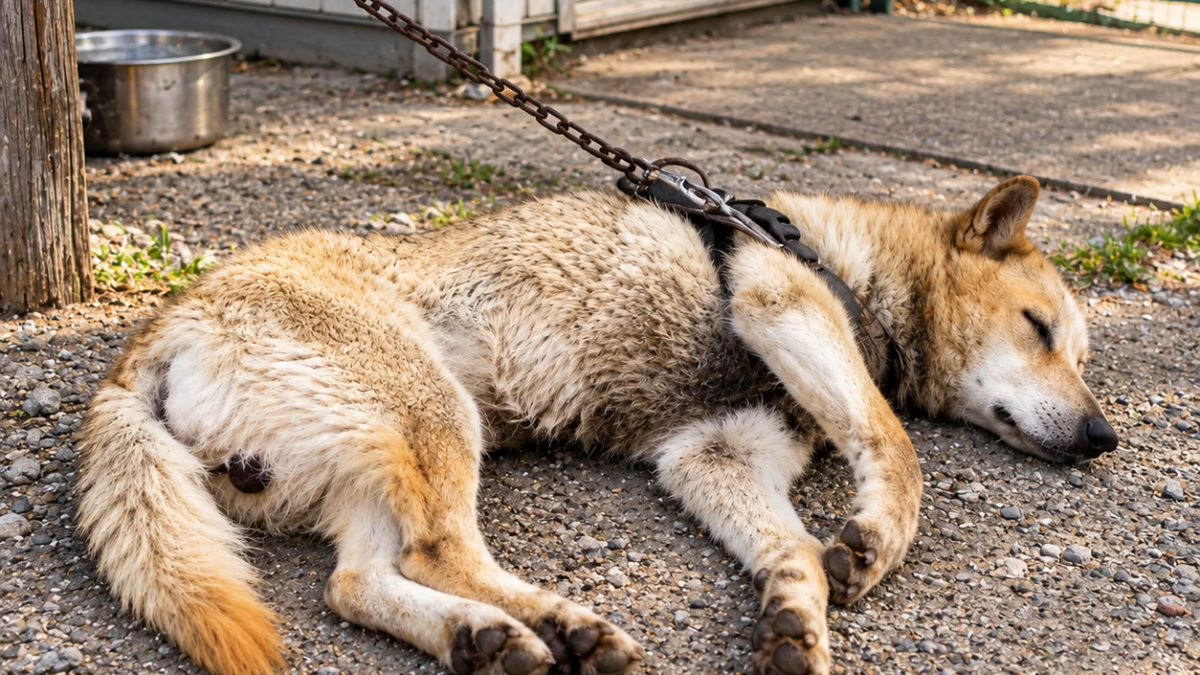
PART 2
I looked at her.
“No.”
The veterinarian turned back toward Lucky and gently moved her damaged front leg.
Lucky didn’t cry out.
That bothered me.
Painful dogs often react.
They pull away.
They tense.
They warn you.
Lucky simply watched the doctor’s hand.
“She has very little useful movement here,” the veterinarian said. “The muscles have wasted significantly. Some of that is from overall malnutrition, but the nerve function in this leg is badly compromised.”
“Could it have happened recently?”
“Not likely.”
“How long?”
“I can’t give you an exact timeline yet. We need imaging and a neurologic assessment. But this isn’t something I would expect from an injury yesterday.”
Lucky shifted her head and rested it against my wrist again.
I looked toward the door.
The neighbor’s sentence kept repeating in my head.
Years, maybe.
I had gone into the yard angry.
Now I was furious.
Not the kind of anger that makes you shout.
The opposite.
The kind that makes everything inside you very still.
“What else?”
The veterinarian inhaled slowly.
“She is underweight enough that I want bloodwork before we do anything aggressive. She’s dehydrated. The wound on the leg is superficial right now, but the position of the limb probably makes her prone to rubbing injuries. Her coat and skin reflect poor nutrition. Her nails are overgrown. I also want to check for parasites and chronic infection.”
“Can she recover?”
The veterinarian looked at Lucky, not me.
“From most of this? Yes.”
“And the leg?”
“She’ll adapt.”
That wasn’t the answer I wanted.
But it was the answer Lucky had.
We took her for X-rays.
The leg showed evidence of an older injury.
There was no fresh fracture to repair.
The larger concern was neurologic.
The signals simply weren’t reaching the lower part of the leg properly.
At some point in Lucky’s past, something had damaged the nerves badly enough that time had turned injury into permanence.
Whether it came from trauma, entanglement, repeated strain against the chain, or something else, we couldn’t prove yet.
But it hadn’t been treated.
That part was obvious.
I stood beside the examination table while the technician shaved a small area for another test.
Lucky’s eyes followed me.
“You don’t have to keep checking,” I whispered.
Her ears moved.
“I’m staying.”
She looked at me another few seconds.
Then closed her eyes.
That simple act nearly broke me.
Trust is usually earned slowly.
Lucky seemed to give hers because she had so little left to protect.
We admitted her overnight.
I hated leaving.
It sounds strange because I had known her for less than three hours.
But once you’ve unclipped a chain from an animal, something changes.
Responsibility becomes personal.
You can no longer pretend that what happens next belongs to somebody else.
I filled out forms.
Signed treatment authorization.
Answered questions.
Then the technician asked, “Does she have anyone?”
I looked through the small glass window.
Lucky was curled beneath a blanket.
“She does now.”
I drove home that night and barely slept.
Every time I closed my eyes, I saw the yard.
The chain.
The patch of bare dirt around the spot where Lucky had been lying.
There had been a circle worn into the ground.
I hadn’t noticed it immediately.
Only later, when we lifted Lucky into the vehicle.
The dirt was compacted in a rough arc around the place where the chain ended.
A map of all the places she had been allowed to go.
Water bowl.
Shade.
A little shelter.
Fence.
Back again.
That circle haunted me.
Human beings can become used to almost anything they see repeatedly.
That is one of our worst qualities.
The first time a neighbor saw Lucky chained outside, maybe it looked temporary.
The tenth time, concerning.
The hundredth time, familiar.
Eventually people stop seeing the extraordinary cruelty of something because it has become part of the landscape.
Lucky had become part of that yard.
People drove past.
Cut grass.
Carried groceries.
Walked their own dogs.
Life moved.
Lucky waited.
The next morning, I was at the clinic before they opened.
The receptionist looked up.
“You’re early.”
“I know.”
“Lucky had a decent night.”
My shoulders dropped immediately.
“How decent?”
“She ate.”
That was the first good news.
“How much?”
“Almost everything we gave her.”
I smiled.
“Can I see her?”
A technician brought me back.
Lucky was awake.
The moment I entered, she lifted her head.
Then something happened that I still remember more clearly than almost anything from those first weeks.
Her tail moved.
Once.
A weak tap against the blanket.
I stopped.
“Did you just do that?”
Another tap.
The technician smiled.
“She knows you.”
I crouched beside the kennel.
Lucky pushed her nose toward my hand.
“You ate breakfast?”
Her tail moved again.
“Good girl.”
The clinic had given her a small meal because her digestive system needed to adjust gradually.
She was hungry enough to have eaten much more.
But after prolonged malnutrition, simply filling a bowl and letting a dog gorge can be dangerous.
We needed calories.
We also needed patience.
Lucky’s entire recovery would become a lesson in patience.
The first few days were about stabilizing her.
Fluids.
Controlled meals.
Pain management.
Skin treatment.
Parasite prevention.
Gentle handling.
Monitoring.
The more we learned about Lucky, the more obvious it became that her neglect had been chronic.
Her body had compensated for weakness so long that she moved in a strange, careful pattern.
She shifted most of her weight away from the damaged front leg.
Her other three limbs had learned to do extra work.
When she stood, her shoulders tilted.
When she walked, her body rotated slightly with each step.
The veterinarian showed me.
“She’s been adapting for a long time.”
I watched Lucky cross the room.
Step.
Shift.
Step.
Shift.
“She doesn’t seem bothered.”
“Dogs are extraordinarily good at normalizing their own limitations.”
“Meaning?”
“If this is the only body she’s known for years, she isn’t comparing herself to the dog she could have been.”
That sentence stayed with me.
Lucky wasn’t mourning the leg.
We were.
She was concerned about food.
Warmth.
People.
Whether someone was coming back.
Her priorities were immediate.
Maybe that was why she healed emotionally in ways I did not expect.
On her fourth day, I brought her home as a medical foster.
The word foster was technically correct.
Emotionally, I was already in trouble.
I prepared a quiet room.
Soft bedding.
Non-slip rugs.
Low bowls.
A crate with the door left open.
A small ramp over the step leading outside.
I placed her bed near the window.
When Lucky entered the house, she froze.
I stood behind her.
“Take your time.”
She stared at the floor.
Then the hallway.
Then the couch.
Then me.
She took one step.
Her nails clicked against the wood.
She stopped.
Another step.
Then another.
Within five minutes, Lucky had crossed the entire living room.
When she reached the rug, she lowered herself onto it and looked around.
I sat several feet away.
“You can sleep.”
She didn’t.
She watched me for almost an hour.
Whenever I stood, her head lifted.
Whenever I walked out of the room, she tried to follow.
The first time I went into the kitchen, I heard her nails scraping.
I turned.
Lucky was struggling to stand.
“No, no. Stay.”
She stood anyway.
Then limped toward me.
I went back.
“I’m coming back.”
She looked at me.
“I promise.”
Of course she didn’t understand the sentence.
Not yet.
She understood patterns.
And her old pattern had apparently taught her that people left.
So I started building a new one.
I would leave the room for ten seconds.
Return.
Thirty seconds.
Return.
One minute.
Return.
Every time, Lucky watched the doorway.
Every time I reappeared, her body softened.
It became a ritual.
Leave.
Come back.
Leave.
Come back.
Again.
Again.
Again.
The first night, she refused to sleep in the bed I had prepared.
Instead she lay beside the back door.
I moved her blanket there.
She stayed.
I suspected why.
The door led outside.
Maybe being near an exit felt familiar.
Maybe enclosed rooms made her nervous.
Maybe she simply wanted to know where I was going.
At two in the morning, I woke and checked on her.
Lucky’s eyes were open.
“You’re supposed to sleep.”
She blinked.
I sat beside her.
After a few minutes, she placed her head across my ankle.
We stayed like that until I fell asleep against the wall.
The next morning, my back hurt.
Lucky looked rested.
“Glad one of us had a good night.”
Her tail tapped.
That became our first joke.
Food was easier than I expected.
Lucky ate eagerly but politely.
She did not inhale meals the way some starving dogs do.
She approached the bowl slowly.
Smelled it.
Then ate.
When she finished, she always looked up.
The expression was difficult to describe.
Not begging.
Not exactly.
More like a question.
Is that all?
Or maybe:
Will there be another?
I started saying the same thing after every meal.
“More later.”
Breakfast.
“More later.”
Lunch.
“More later.”
Dinner.
“More tomorrow.”
Within two weeks, the look began changing.
She finished eating.
Licked the bowl.
Then walked away.
No question.
That was one of the first signs that safety was beginning to reach deeper than her stomach.
But touch was more complicated.
Lucky tolerated being handled at the clinic because she seemed resigned to it.
Affection was different.
If I reached over her head too quickly, she ducked.
If I moved a broom nearby, her body stiffened.
A raised voice on television made her leave the room.
Once I accidentally dropped a metal pan in the kitchen.
It hit the floor with a crash.
Lucky disappeared.
I found her pressed behind the armchair.
Her entire body trembled.
I sat on the floor several feet away.
“I’m sorry.”
Her eyes were wide.
I didn’t reach for her.
I didn’t coax.
I stayed.
Ten minutes.
Then fifteen.
Eventually her head appeared.
“It’s okay.”
She stepped out.
Walked toward me.
Stopped.
I held my hand low.
Lucky sniffed it.
Then leaned her forehead against my palm.
I swallowed hard.
There were scars in Lucky that no X-ray could show.
Those took longer.
Meanwhile, the neglect investigation had begun.
Animal control documented her intake condition.
Photographs.
Weight.
The chain.
The yard.
The worn dirt circle.
Veterinary records.
Statements from neighbors.
A county investigator asked to speak with me.
We met at the clinic.
He was calm in the way experienced investigators often are.
Not cold.
Controlled.
He had learned something I still struggled with.
Anger is useful for motivation.
It is terrible for paperwork.
“I need only what you personally observed,” he told me.
I nodded.
I described Lucky.
Her body condition.
The chain.
Her mobility.
Her reaction when unclipped.
The leg.
The yard.
“What did anyone tell you about the owner?”
I repeated only what had been said directly.
“Neighbors claimed they had seen physical mistreatment.”
“Did you?”
“No.”
“Good.”
I understood what he meant.
Not good that it hadn’t happened.
Good that I wasn’t blurring allegation with evidence.
He wrote everything down.
Then he asked, “Do you still have the chain?”
“Yes.”
“Don’t alter it.”
“I won’t.”
“The collar?”
“Bagged.”
“Photographs?”
“Time-stamped.”
He nodded.
“That’s helpful.”
I leaned back.
“Helpful enough?”
“For what?”
“For consequences.”
He met my eyes.
“That depends on what we can prove.”
I hated those words.
“Look at her.”
“I have.”
“She was left like that.”
“I know.”
“So what more do you need?”
“Evidence tying the condition to a specific person’s actions or failures over a specific period.”
“She didn’t become like that overnight.”
“No.”
“Then—”
He raised one hand slightly.
“I understand.”
I stopped.
He continued.
“But if you want accountability that survives challenge, we build it carefully.”
That became another lesson.
Rescue happens emotionally.
Justice happens methodically.
Lucky deserved both.
So I helped however I could.
The veterinarian documented her nerve damage.
A specialist evaluated the leg.
The conclusion was frustrating but clear.
The injury was old.
Functional recovery was unlikely.
Amputation was discussed because a nonfunctional limb can sometimes become more of a burden than a help.
But Lucky still used the leg partly for balance and placement, and she wasn’t developing severe repeated wounds.
For now, we would monitor.
That decision made me nervous.
“Could she be in pain?”
“We’ll keep watching.”
“Could we be missing something?”
“You ask me that every appointment.”
“Because I need to know.”
The veterinarian smiled faintly.
“You’re not missing Lucky.”
I looked at her.
“What does that mean?”
“It means you’re watching the dog, not just the diagnosis. She’ll tell us if the plan stops working.”
Lucky was stretched on the examination mat.
She looked up at me.
Then rolled slightly onto one hip.
Relaxed.
I understood.
Over the next month, Lucky gained weight.
Slowly.
Her coat began changing.
At first it was subtle.
The dull roughness softened.
The dry flakes decreased.
The fur around her shoulders became fuller.
Her face changed too.
That surprised me.
I had thought her expression came mostly from exhaustion.
Some of it did.
But weight loss had sharpened everything.
As nourishment returned, so did softness.
The hollows above her eyes filled.
Her cheeks looked less sunken.
She began resembling a dog instead of evidence.
The first time she groomed herself, I nearly missed it.
She was lying on a blanket in sunlight.
I walked past.
Then stopped.
Lucky had turned her head and was licking one shoulder.
I watched.
She continued.
Chest.
Front leg.
Side.
Slowly.
Carefully.
Normal.
“Look at you.”
She paused.
Then went back to grooming.
I called the veterinarian later and told her.
She laughed.
“You called me because your dog licked herself?”
“She hasn’t done that before.”
“I know.”
“So that’s good?”
“Very.”
“Why?”
“She has energy to spend on maintenance instead of just survival.”
That sentence made me ridiculously happy.
I started noticing more tiny changes.
Lucky slept deeply.
At first she woke at every sound.
By week three, she sometimes slept through the dishwasher.
By week five, she snored.
The first time I heard it, I walked across the room to make sure she was breathing.
Then realized she was simply asleep.
Deeply.
Peacefully.
Her damaged leg stretched out awkwardly.
Her good legs relaxed.
Her mouth hung slightly open.
I sat beside her.
“You’re snoring.”
Nothing.
“You’re very rude.”
Still nothing.
I smiled.
For years, Lucky had likely slept lightly because vulnerability was dangerous.
Now she could snore.
That was healing.
Then came the first bark.
It happened because a delivery driver approached the porch.
Lucky was sleeping.
I was in the kitchen.
Someone knocked.
Lucky exploded upright.
“Woof!”
I nearly dropped a plate.
Lucky froze.
I froze.
She looked at me.
“Was that you?”
Another bark.
Not angry.
Surprised.
I laughed.
“You have a voice.”
Her tail moved.
The driver knocked again.
Lucky barked twice.
Then looked at me as if waiting for instructions.
“It’s okay.”
She stopped.
I signed for the package.
When I came back inside, Lucky followed me into the kitchen.
“You know you don’t actually work security here.”
Tail wag.
“You’re retired.”
She leaned against my leg.
That was new too.
Leaning.
Lucky had started seeking physical contact.
Not just tolerating it.
If I sat on the couch, she eventually came close.
First beside the rug.
Then beside my feet.
Then against my ankle.
One afternoon, she climbed halfway onto the couch.
Her damaged leg made it awkward.
I held my breath.
She pulled herself up.
Turned in a circle.
Then lay down with her back touching my thigh.
I did not move for nearly an hour.
My leg went numb.
I didn’t care.
When Lucky woke, she looked at me.
I touched the side of her face.
She didn’t flinch.
“Hi.”
Her eyes softened.
Then she leaned into my hand.
That was the day I understood we were no longer simply treating neglect.
We were replacing expectation.
Lucky had expected pain.
Absence.
Hunger.
Being left.
Now she was beginning to expect breakfast.
A warm blanket.
My footsteps.
A hand that scratched instead of struck.
Safety is not only the absence of harm.
It is the presence of reliable goodness.
Lucky was learning that distinction.
Meanwhile, investigators found more witnesses.
One neighbor had cell-phone photographs taken months apart.
Lucky appeared in the background of several.
In the earliest, she was noticeably healthier.
Still chained.
But heavier.
In later images, she was thin.
Then thinner.
One photograph showed the injured leg held awkwardly off the ground.
Another showed the same position weeks later.
No evidence of treatment.
Another neighbor had messages.
She had contacted the owner after noticing Lucky’s condition.
“Your dog looks hurt.”
The response was dismissive.
“She is fine.”
Another message weeks later.
“She needs a vet.”
No reply.
Then one that mattered even more.
“I can take her if you don’t want her.”
The answer:
“No.”
I stared at the screenshot when the investigator showed it to me.
“Someone offered to take her?”
“Yes.”
“And they refused?”
“Yes.”
My jaw tightened.
“Why?”
“We don’t know.”
I looked away.
That was the first time my anger became personal in a new way.
Neglect sometimes grows from poverty.
Sometimes ignorance.
Sometimes overwhelming circumstances.
Those contexts matter because solutions differ.
But someone had offered Lucky an exit.
It had been refused.
That changed something for me.
Not legally by itself.
Emotionally.
A door had opened.
Lucky had still been left behind.
The investigator noticed my expression.
“Stay focused.”
“I am.”
“No, you’re imagining a confrontation.”
He wasn’t wrong.
I looked at him.
“Tell me I’m not allowed to.”
“You can imagine whatever you want.”
“And do?”
“Document.”
I exhaled.
He continued.
“People destroy good cases because they want one satisfying moment.”
I looked back at the message.
“What do you call satisfying?”
“A result that prevents this from happening again.”
That was the first time I began thinking differently about revenge.
I had wanted Lucky’s former owner to feel fear.
Shame.
Loss.
Some version of what Lucky had endured.
But revenge built around suffering would not give Lucky anything.
Prevention might.
Documentation might.
A legal restriction might.
A public record might.
Maybe the most useful consequence was closing the door behind Lucky so no other dog entered the same yard.
That became my goal.
Still, healing came before court.
Lucky reached a healthy weight gradually.
Her energy increased.
We began short walks.
The first one lasted four minutes.
Not because she couldn’t have gone farther emotionally.
Her body wasn’t ready.
I put on her harness.
Lucky stiffened.
The sensation around her chest probably reminded her of restraint.
I stopped.
“It’s not a chain.”
She looked at me.
I loosened it slightly.
Then attached the leash.
Lucky stared at the open front door.
For several seconds, she wouldn’t cross the threshold.
I stepped outside.
“Come on.”
Nothing.
I went back in.
Crouched.
“Your choice.”
She looked outside again.
Then took one careful step.
Her paws touched the porch.
She froze.
Wind moved through the trees.
A car passed.
Somebody’s lawn sprinkler clicked across the street.
Lucky lifted her nose.
She smelled everything.
Then she took another step.
Down the ramp.
Onto the grass.
She stopped.
Grass.
Real grass.
Not the dirt circle from the yard.
I gave her the entire leash.
She walked three feet.
Stopped at a flower bed.
Smelled it.
Walked again.
At the sidewalk, she turned her head toward me.
I smiled.
“Anywhere you want.”
We went left.
Not far.
Lucky moved slowly with her uneven gait.
Every few steps she stopped to smell something.
Mailbox.
Tree.
Hydrant.
Another patch of grass.
When a truck drove past, she startled.
I waited.
She recovered.
We continued.
Four minutes later, I turned back.
Lucky resisted.
Not strongly.
Just enough that I felt it.
“You want more?”
She looked down the sidewalk.
I laughed.
“Tomorrow.”
That became another promise.
Tomorrow.
Lucky learned that word without understanding English.
Walk tomorrow.
Breakfast tomorrow.
I come back tomorrow.
Nothing good had to happen only once anymore.
Within weeks, our four-minute walks became ten.
Then fifteen.
Her damaged leg remained limited, so distance mattered.
We consulted a rehabilitation specialist.
She showed me exercises.
Weight shifts.
Core strengthening.
Controlled movement.
Traction work.
Nothing dramatic.
Just helping Lucky use the body she had as comfortably as possible.
Lucky hated some exercises.
She loved the treats.
That balance kept us going.
“Stand.”
Treat.
“Shift.”
Treat.
“Again.”
Lucky stared at me.
“Don’t look at me like that.”
She looked at the treat bag.
“Yes, I know. I’m the obstacle between you and chicken.”
We worked.
Her shoulders strengthened.
Her hindquarters strengthened.
Her balance improved.
She would never move like an uninjured four-legged dog.
But she began moving like a strong Lucky.
That distinction mattered.
One afternoon, about two months after rescue, we visited a fenced rehabilitation yard.
Lucky had been on leash almost constantly outdoors.
The therapist asked, “Want to try something?”
“What?”
“Take the leash off.”
I looked at Lucky.
“Is that safe?”
“The yard is secure.”
I unclipped it.
Lucky stood still.
The leash fell away.
She looked at me.
Then at the open space.
For several seconds, nothing happened.
I felt my throat tighten.
Her first yard had taught her that outdoor space came with a chain.
This yard had no chain.
Lucky took one step.
Then another.
Then she walked away from me.
Ten feet.
Fifteen.
Twenty.
She stopped.
Turned around.
I expected her to come back.
Instead, she moved faster.
Not quite a run.
A lopsided trot.
Her damaged leg lifted awkwardly.
Her ears rose.
Her tail came up.
She made a wide circle.
Then another.
The therapist whispered, “Don’t call her.”
I didn’t.
Lucky crossed the grass.
Sniffed one corner.
Moved along the fence.
Then turned and trotted toward me.
I crouched.
She reached me and pressed her body against my chest.
I wrapped my arms around her.
“You can go.”
She licked my chin.
“You don’t have to stay next to me.”
She stayed anyway.
I cried.
There was no dramatic music.
No crowd.
No perfect sprint.
Just a damaged dog choosing to move freely through a yard where nothing stopped her.
That was one of the most beautiful things I had ever seen.
The court process began soon after.
The case included allegations of prolonged neglect and failure to provide necessary care.
Specific charges depended on local law, and I learned quickly not to describe outcomes before they existed.
Rumors traveled faster than facts.
People wanted a villain.
Some wanted details we could not verify.
I refused to add them.
What we had was enough.
Lucky had been found underweight.
Chained.
With untreated chronic injury.
Neighbors had documented her decline.
At least one person had urged veterinary care.
Another had offered to take her.
Medical records showed no evidence that she had received treatment during the relevant period.
The chain and collar had been preserved.
Photographs showed the yard.
The veterinarian prepared a formal report.
The specialist prepared another.
I was asked to testify about what I personally saw.
The night before the hearing, I sat at my kitchen table with Lucky sleeping nearby.
I had printed copies of my notes.
The first page said:
Date of rescue.
Approximate time.
Weather.
Condition of yard.
Position of dog.
Chain attached.
Visible body condition.
Leg position.
Reaction on approach.
I read it all.
Then looked at Lucky.
She was asleep beneath the table.
Her coat shone now.
Her body had filled out.
One ear twitched in a dream.
The dog on the paper felt almost like another animal.
That scared me.
Memory changes when recovery succeeds.
You can start softening the past because the present looks good.
I did not want to soften anything.
Not for revenge.
For accuracy.
I pulled up Lucky’s first photograph.
Thin body.
Dull coat.
Chain.
Damaged leg.
Eyes tired beyond description.
I kept the image beside my notes.
Then I slept.
The courtroom was smaller than I expected.
No dramatic wooden galleries.
No television-style shouting.
Just fluorescent lights.
Folders.
People waiting.
Lucky wasn’t there.
I was grateful.
She didn’t need to be.
Her evidence was.
The veterinarian testified first.
She explained body condition.
Chronic malnutrition.
Dehydration.
Muscle loss.
Neurologic damage.
The difference between an acute injury and one that had gone untreated long enough for muscle wasting to develop.
She did not exaggerate.
That gave her testimony power.
When asked whether she could identify the exact cause of the nerve injury, she said no.
When asked whether the leg had required veterinary evaluation long before rescue, she said yes.
When asked whether Lucky’s overall condition was consistent with adequate routine care, she said no.
Simple.
Precise.
Devastating.
Then came the photographs.
I watched them appear.
Lucky in the yard.
Lucky months earlier.
Lucky later.
The progressive weight loss.
The abnormal leg.
The chain.
The worn dirt.
I looked across the room.
The former owner stared forward.
I expected anger.
Defiance.
Something.
Instead, there was almost nothing.
That affected me more than rage would have.
I had imagined this person as enormous in Lucky’s story.
A monster.
But sitting there, they looked ordinary.
That was unsettling.
Harm is easier to understand when the person causing it looks monstrous.
Real life rarely gives us that convenience.
Sometimes cruelty sits in a normal chair wearing normal clothes.
A neighbor testified.
She described seeing Lucky chained repeatedly.
She described the leg.
The weight loss.
The message urging veterinary care.
Then the defense asked the question I had wondered myself.
“If you were so concerned, why didn’t you report it earlier?”
The woman looked down.
“I should have.”
Silence.
“Why didn’t you?”
“I kept thinking it wasn’t my place.”
That sentence moved through the room like something physical.
The defense attorney continued.
“So you aren’t a veterinarian.”
“No.”
“You didn’t know the dog’s diagnosis.”
“No.”
“You didn’t know what treatment she might have been receiving.”
“No.”
“But you assumed neglect.”
The woman lifted her eyes.
“No. I assumed somebody else would do something.”
That was one of the strongest answers of the day.
Because it was not self-protective.
She admitted her failure.
And in doing so, she exposed something larger than one owner.
Lucky had lived inside a circle of collective hesitation.
One person caused the neglect.
Other people saw pieces of it and waited.
Those were not morally identical things.
But the delay had consequences.
When I testified, I kept my answers short.
What did I see?
A thin dog chained in a small yard.
Did she respond aggressively?
No.
Could she walk?
With difficulty.
Was the leg visibly abnormal?
Yes.
Did she appear able to leave the yard?
No.
What happened when I unclipped the chain?
She attempted to stand, then approached me.
Did I observe the owner striking Lucky?
No.
That answer mattered.
The truth mattered more than making the story worse.
It was already bad enough.
Then the prosecutor asked, “What was the first thing the dog did after the chain was removed?”
I paused.
“She tried to come toward me.”
“How far?”
“Only a few steps.”
“Why only a few?”
“She was weak. And the leg made movement difficult.”
“What happened when she reached you?”
I felt my throat tighten.
“She lowered her head against me.”
The room stayed quiet.
No more questions.
The decision did not come that day.
That frustrated everyone.
But legal processes move differently than emotions.
Weeks passed.
Lucky did not care.
She had more important business.
She had discovered sunlight.
Specifically, one rectangle of afternoon sun that crossed the living-room floor around three.
Every day, Lucky moved there.
She would lie down with her damaged leg extended.
Close her eyes.
Warm herself.
If I placed something in the patch, she stared at me until I moved it.
Once I left a laundry basket there.
Lucky stood beside it.
Looked at the basket.
Looked at me.
Back to basket.
Back to me.
“You cannot own sunlight.”
She stared.
Apparently she could.
I moved the basket.
She lay down.
Victory.
She had also become opinionated about blankets.
There was one blue blanket she preferred.
If another foster dog lay on it, Lucky would stand nearby and stare.
Never growl.
Never push.
Just stare until I noticed.
“Lucky, there are five other blankets.”
She looked at me.
Then the dog.
Then me.
“You survived six years of hardship and this is what you’re using your strength for?”
Tail wag.
I usually moved the blanket.
I admit this freely.
Lucky had earned some unreasonable demands.
Her relationship with people continued evolving.
She no longer ducked when I reached over her head.
She began greeting visitors.
Slowly at first.
One person at a time.
She preferred quiet people.
Anyone loud made her cautious.
Children were introduced only in controlled situations because I wanted every interaction predictable.
Lucky did beautifully.
She did not demand attention.
She waited.
If someone sat down, she approached.
If they offered a hand, she smelled it.
Then she might lean.
That lean became her signature.
Lucky did not jump on people.
She pressed herself against them.
Full body.
Quiet.
Warm.
As if saying:
I’m here.
Please stay.
One visitor cried the first time Lucky leaned on her.
“What?”
The woman wiped her face.
“Nothing.”
I smiled.
“I know.”
Lucky had that effect.
Her eyes remained gentle.
That never changed.
But the exhaustion disappeared.
The vacancy disappeared.
Her gaze became curious.
Present.
Sometimes playful.
The first time she played, I almost missed that too.
I was folding laundry.
A soft rope toy lay near her bed.
Lucky nudged it.
Then nudged it again.
I watched from the corner of my eye.
She opened her mouth and picked it up.
Held it.
Dropped it.
Picked it up again.
I slowly sat on the floor.
“Want that?”
Lucky looked at me.
I reached for one end.
She held the other.
Tiny pull.
She resisted.
I pulled again.
Her tail moved.
“Really?”
I tugged.
Lucky tugged back.
We played for maybe thirty seconds.
Then she let go and lay down.
I stared at the rope.
Thirty seconds.
That was all.
But play is expensive when you’ve spent years surviving.
It requires spare energy.
Safety.
Curiosity.
The belief that nothing terrible will happen if you stop watching the world for a moment.
Lucky had found thirty seconds of that belief.
A week later, she played for five minutes.
A month later, she carried toys from room to room.
One morning I woke to find three beside my bed.
“Did you bring these?”
Lucky wagged.
“You’re becoming demanding.”
Her tail moved faster.
Good.
Demanding meant she expected something from life.
I wanted that.
The legal outcome finally came almost four months after rescue.
The investigator called.
“We have a resolution.”
I sat down.
“What?”
The court had found sufficient evidence of neglect-related violations.
There were financial penalties.
Mandatory costs associated with the case.
A prohibition on owning or keeping animals for a defined period under the applicable order.
Lucky’s ownership was permanently transferred.
The exact legal terminology mattered less to me than one sentence.
“They cannot reclaim Lucky.”
I closed my eyes.
“Say that again.”
“They cannot reclaim her.”
My eyes filled.
I looked toward the living room.
Lucky was asleep in her patch of sunlight.
“So she’s safe.”
“Yes.”
“For real.”
“Yes.”
“And the restriction?”
“In place.”
That mattered too.
“What happens if they violate it?”
“Then there are additional consequences.”
I breathed out.
I had imagined revenge so many different ways during those first weeks.
A dramatic arrest.
A confrontation.
Some moment where the person responsible looked at Lucky and understood.
None of that happened.
Instead, there was an order.
Paper.
Signatures.
Restrictions.
A record.
Something enforceable.
And that turned out to be more satisfying than a scene.
Because scenes end.
Restrictions remain.
I hung up and sat beside Lucky.
She opened one eye.
“You’re officially free.”
Tail tap.
“No one can come get you.”
Another tap.
“You don’t know what I’m saying.”
Lucky rolled slightly toward me.
I put my hand on her chest.
“You don’t need to.”
Her heart beat steadily.
That was enough.
Later that week, the neighbor who had testified asked to visit.
I hesitated.
Not because she had harmed Lucky.
Because part of me still resented everyone who had waited.
But she had admitted that.
She had also become important to the case.
So I said yes.
When she arrived, Lucky was in the yard.
No chain.
She walked slowly through the grass.
The woman stopped at the gate.
Her face changed.
“Oh.”
Lucky saw her.
Paused.
The woman crouched.
“Hi, girl.”
Lucky approached cautiously.
Smelled her hand.
Then leaned.
The woman began crying.
“I am so sorry.”
Lucky remained against her.
“I should have called sooner.”
I stood several feet away.
The woman looked at me.
“I kept thinking somebody else would.”
“I know.”
“I don’t know how to forgive myself.”
I thought about that.
Then looked at Lucky.
“She isn’t asking you to punish yourself.”
The woman wiped her face.
“That doesn’t mean I shouldn’t.”
“No. But it means you can do something useful with it.”
“What?”
“Don’t wait next time.”
She nodded.
“I won’t.”
And she didn’t.
Months later, she reported another welfare concern involving a different animal.
That case turned out to be less severe.
The owner was elderly and overwhelmed rather than intentionally neglectful.
Resources were provided.
The dog stayed safely in the home with support.
That taught me something too.
Reporting does not always mean punishment.
Sometimes intervention creates help.
Silence creates nothing.
Lucky’s story changed that neighbor.
Maybe that mattered.
By the fourth month, Lucky had transformed.
Not into a perfectly able-bodied dog.
That wasn’t our goal.
Her front leg still hung differently.
She still tired sooner on long walks.
She needed rugs on slick floors.
We trimmed her nails carefully.
We monitored pressure points.
We kept her weight lean to reduce strain.
But the dog herself?
She had returned.
Or maybe appeared for the first time.
Her coat shone.
Her eyes were bright.
Her weight was healthy.
She barked at squirrels.
She loved chicken.
She hated rain.
She slept on the couch even though I had originally declared the couch off-limits.
That rule lasted eleven days.
Lucky learned how to manipulate me without ever doing anything dramatic.
She would stand beside the couch.
Look at it.
Look at me.
I would say, “No.”
She would lower her head slightly.
“No.”
She would continue looking.
Eventually I bought a ramp.
The veterinarian laughed when I admitted it.
“You know you lost, right?”
“I didn’t lose.”
“You bought furniture for her furniture.”
“She needs access.”
“Sure.”
Lucky lay on the examination table pretending not to listen.
One afternoon, while she rested beside me on that supposedly forbidden couch, I realized something.
I had never decided whether I was keeping her.
Technically, she was still listed as a foster.
People had begun asking when she would be available for adoption.
I gave vague answers.
After her next medical check.
After the court issue.
After her weight stabilized.
After we knew more about the leg.
Every reason had been legitimate.
But those reasons were disappearing.
The rescue coordinator called.
“We need to talk about Lucky.”
I knew immediately.
“She isn’t ready.”
“She has been medically cleared.”
“Mostly.”
“Mostly counts.”
“Her leg needs monitoring.”
“Lots of adopters can monitor a leg.”
“She has emotional trauma.”
“So do half the dogs we place.”
I said nothing.
The coordinator laughed.
“Oh.”
“What?”
“You’re keeping her.”
“I didn’t say that.”
“You didn’t need to.”
I looked across the room.
Lucky was asleep with her head on the blue blanket.
“I foster.”
“Yes.”
“I don’t keep every dog.”
“No.”
“That would be irresponsible.”
“Absolutely.”
Silence.
Then she said, “Do you want me to send you the adoption form?”
I stared at Lucky.
Her ear moved.
“That’s not funny.”
“I’m not joking.”
I took a breath.
“What if she needs more than I can give later?”
“Then you handle it the way you’ve handled everything else.”
“What if the leg gets worse?”
“You call the veterinarian.”
“What if—”
She interrupted.
“Do you want Lucky to leave?”
That ended the argument.
I knew the answer before she asked.
“No.”
“Then fill out the form.”
I did.
The dog who had spent years being told, through neglect, that she belonged nowhere became mine legally a few days later.
I placed the signed adoption paper on the table.
Lucky sniffed it.
Then walked away.
“You could at least pretend this is meaningful.”
She went to her bed.
“Fine.”
I framed a copy anyway.
Not because Lucky cared.
Because I did.
Her name.
My name.
Permanent.
Home.
That night, I sat on the floor with her.
“You’re staying.”
She leaned against me.
“Forever.”
Her eyes closed.
I don’t know whether animals understand permanence.
I know they understand repetition.
Maybe forever is simply enough good days in a row that fear finally stops counting.
Lucky’s days became ordinary.
And that was the miracle.
Morning.
Breakfast.
Walk.
Nap.
Sunlight.
Dinner.
Couch.
Bed.
Again.
Ordinary.
No chain.
No hunger.
No waiting for someone to notice.
On the anniversary of her rescue, I drove back near the neighborhood where we found her.
Not with Lucky.
I didn’t want to bring her there.
I went alone.
The yard looked smaller than I remembered.
The patch of dirt was still visible.
Grass had started growing over parts of the worn circle.
The post where the chain had been attached was gone.
I stood across the street.
For months I had imagined returning.
I thought I would feel triumphant.
Instead I felt quiet.
That yard was no longer Lucky’s world.
That was enough.
A man from a neighboring house recognized me.
“You’re the one who took the dog.”
“Yes.”
“How is she?”
“Good.”
He nodded.
“Real good?”
I smiled.
“Very good.”
He looked toward the old yard.
“Should’ve happened sooner.”
“Yes.”
He didn’t argue.
Neither did I.
Before leaving, he asked, “Do you have a picture?”
I showed him one.
Lucky on my couch.
Healthy.
Blue blanket.
Eyes half closed.
He stared.
“That’s her?”
“Yes.”
“Wow.”
Then he said something I still think about.
“I didn’t know she could look like that.”
Maybe that was the problem.
People get used to seeing an animal diminished until they forget there is another version possible.
Lucky had always had that dog inside her.
The dog who loved sunlight.
The dog who played tug.
The dog who barked at delivery drivers.
The dog who manipulated me into buying a couch ramp.
Neglect had not created her personality.
It had buried it.
Care uncovered it.
A few weeks later, we had another veterinary check.
Lucky’s bloodwork was normal.
Weight stable.
Skin healthy.
Leg unchanged.
The veterinarian watched her walk.
“She’s doing beautifully.”
I smiled.
“She still leans.”
“That is not a medical condition.”
“It might be.”
Lucky approached the veterinarian and pressed against her knee.
The doctor laughed.
“See?”
“She weaponizes affection.”
“Smart dog.”
We talked about long-term care.
Arthritis.
Compensation injuries.
Weight.
Exercise.
Mobility support as she aged.
The conversation did not frighten me the way medical discussions once had.
Because now we were talking about aging.
Future.
Years.
That was a privilege.
On the drive home, Lucky sat in the back seat with her head near the window.
At a red light, I turned around.
“You know what they said?”
She looked at me.
“You’re doing beautifully.”
Tail wag.
“I agree.”
The light changed.
We went home.
Two years passed.
Lucky slowed a little.
Her damaged leg remained the same.
Her good limbs carried more of the load, so we adjusted exercise.
Shorter walks.
More frequent.
Joint support.
Additional rugs.
I built another ramp.
Then another.
At some point my house became a transportation system designed around one dog.
I didn’t care.
Lucky grew more confident with age.
She greeted familiar visitors at the door.
She had favorite neighbors.
Favorite walking routes.
Favorite treats.
She learned exactly which house gave dog biscuits.
If I tried to walk past it, she stopped.
“Lucky.”
She stared toward the porch.
“We are not begging.”
She sat.
“You are embarrassing me.”
The neighbor opened the door.
“Does Lucky want a cookie?”
Lucky wagged furiously.
I sighed.
“She has betrayed me.”
The neighbor laughed.
Lucky received the cookie.
We continued.
She had become a neighborhood dog in the best way.
Known.
Seen.
Cared about.
The opposite of invisible.
Sometimes new people asked about her leg.
I gave the short version.
Old nerve injury.
Permanent.
She adapted.
I didn’t always tell the full story.
Lucky deserved conversations that weren’t always about what happened to her.
But occasionally someone recognized her.
“Is that the chained dog?”
I disliked the phrase.
Not because it was false.
Because Lucky had become so much more.
I usually answered, “She used to be.”
That distinction mattered.
One evening, I received a letter forwarded through the rescue.
It had come from someone connected to the old case.
I almost threw it away.
Then I read it.
The writer said they had known Lucky’s former owner socially.
They had seen Lucky occasionally.
They had noticed she was thin.
They had accepted explanations.
“She is old.”
“She has always been skinny.”
“The leg is from years ago.”
They wrote:
I believed what was easiest because doing something would have required conflict.
That sentence was painfully honest.
They ended by saying Lucky’s case had made them start volunteering with a local animal-welfare group.
I folded the letter.
Placed it in a drawer.
I did not suddenly forgive every person who had failed Lucky.
Forgiveness wasn’t my job.
But I understood something.
Justice and change do not always look alike.
The court had created consequences.
Lucky created change.
Both mattered.
Years after rescue, the worn circle in that yard was gone.
I knew because I drove past once more.
Grass covered everything.
You would never know a chain had defined an entire life there.
That image stayed with me.
Damage can be real and permanent while the visible evidence disappears.
Lucky’s leg would always carry part of her past.
The yard no longer did.
But neither one controlled her future.
The most satisfying moment of Lucky’s story happened on an ordinary Sunday morning.
No investigator.
No veterinarian.
No court.
No rescue team.
Just me making coffee.
The back door was open.
Lucky was outside.
I looked through the window.
She stood in the yard.
No leash.
No chain.
Sunlight across her back.
She smelled the grass.
Then walked toward the far fence.
Stopped.
Turned.
Walked somewhere else.
There was no reason for the route.
That was what made it beautiful.
She wasn’t moving because a chain allowed it.
She wasn’t following me.
She wasn’t being directed by treatment.
She was choosing.
This patch of grass.
That tree.
The shade.
The sun.
Choice.
People underestimate what neglect steals.
It isn’t only food.
Health.
Shelter.
Sometimes the deepest theft is choice.
Where to lie.
When to move.
Who to approach.
Whether to step away.
Lucky had those things now.
She reached the middle of the yard and lowered herself into the grass.
I carried my coffee outside.
Sat beside her.
Her body leaned against my leg.
Of course.
“You know,” I said, “you have an entire yard.”
She leaned harder.
“You could sit anywhere.”
Tail tap.
“But no.”
She rested her head against me.
I looked at her damaged front leg.
Still awkward.
Still hers.
Then at her face.
The tiredness from the first day was gone.
Completely.
There was gray around her muzzle now.
Different tiredness.
Age.
Comfort.
A life being lived.
I touched her head.
“Was it worth waiting?”
The question escaped before I thought about it.
I regretted it immediately.
Lucky should never have had to wait.
Not one day.
Certainly not years.
So I corrected myself.
“No.”
She looked up.
“You should’ve had this from the beginning.”
Her tail moved.
“But you have it now.”
I bent and kissed her forehead.
“And nobody is taking it.”
That was Lucky’s revenge.
Not cruelty returned with cruelty.
Not a person suffering because she had suffered.
Something stronger.
The person responsible lost the legal right to control her.
Lost the ability, under the court order, to simply replace her and repeat the same pattern without consequence.
Lost the story.
Because Lucky’s life stopped belonging to the yard where she had been abandoned.
It became hers.
Every healthy pound.
Every nap in sunlight.
Every ridiculous demand for the blue blanket.
Every walk she chose.
Every visitor she leaned against.
Every bark.
Every toy.
Every meal that came on time.
Every tomorrow.
That was the answer.
For years, somebody had reduced Lucky’s world to a chain.
We couldn’t erase those years.
We couldn’t repair every nerve.
We couldn’t go backward and make neighbors call sooner.
But we could make sure her remaining years became larger than everything that came before.
And they did.
Lucky lived long enough to become completely ordinary.
That may not sound dramatic.
To me, it is the happiest sentence in her story.
She became the dog sleeping in the middle of the hallway so everyone had to step around her.
The dog who refused to walk in heavy rain.
The dog who knew which neighbor carried biscuits.
The dog who took over the couch.
The dog who snored.
The dog who learned that raised hands could mean someone was reaching for a leash instead of preparing to hurt her.
The dog who stopped watching doors constantly because she knew the people she loved came back.
The dog who no longer checked an empty bowl with uncertainty because another meal was guaranteed.
The dog who finally expected kindness.
That last part took the longest.
I noticed it one evening without meaning to.
I was late getting home.
Not terribly late.
Maybe forty minutes.
But I worried.
Old Lucky would have been waiting at the door, tense, watching.
I opened it.
“Lucky?”
Nothing.
My heart jumped.
Then I found her.
She was asleep on the couch.
Deeply asleep.
She hadn’t even heard me enter.
I stood there.
And smiled.
She wasn’t waiting.
For the first time in her life, maybe she didn’t feel that she had to.
She knew I would come back.
I crossed the room and sat beside her.
Lucky woke slowly.
Her eyes opened.
She saw me.
Tail tap.
Then she closed her eyes again.
No panic.
No desperate relief.
Just certainty.
You’re home.
Of course you are.
I rested my hand on her side.
That was when I understood the final wound had closed.
Not the leg.
That one never fully would.
The waiting.
Lucky had spent years waiting for someone to notice.
Then months learning that good things could happen repeatedly.
Eventually, she stopped waiting for disaster too.
She simply lived.
One morning years later, I found the old chain in a storage box.
It had been preserved through the case and eventually released.
Heavy metal.
Rust beginning at some links.
I held it in my hands.
For a while, I considered throwing it away.
Then I decided not to.
I cut one short section from it.
Not for nostalgia.
Not as a trophy.
As evidence.
I mounted those few links in a small frame beside Lucky’s adoption certificate.
Underneath, I placed no dramatic quote.
Just two dates.
The day she was rescued.
The day she became legally mine.
Visitors sometimes asked about it.
I told them.
“That used to define how far she could go.”
Then I pointed toward the backyard.
Usually Lucky was somewhere out there.
Sleeping in the sun.
Sniffing a tree.
Ignoring me.
“Now she decides.”
Years earlier, that chain measured her entire world.
Now it fit inside a frame.
Lucky’s world no longer did.
Her world was the house.
The yard.
The neighborhood.
The clinic where everyone knew her.
The people who loved her.
The couch.
The blue blanket.
The biscuit house.
The sunshine patch.
And every place she chose to go next.
The first day I met Lucky, I thought rescue meant removing a chain.
I was wrong.
Removing the chain took seconds.
Rescue meant teaching her she did not have to live as though it were still attached.
That took months.
Maybe years.
But eventually Lucky understood.
She could walk away from the bowl.
Another meal would come.
She could sleep deeply.
No one would hurt her.
She could let me leave a room.
I would return.
She could approach people.
Some would be gentle.
She could stop watching everything.
Someone else was watching over her now.
And she could close her eyes.
That was the life she should have always had.
It came late.
Far too late.
But once it came, we never allowed it to leave again.
The last image I carry of Lucky from those years is not the chained dog in the dirt.
I remember that dog.
I will never erase her.
But she is not the version I choose first.
I choose a summer evening.
The grass was warm.
Lucky was lying near the center of the yard.
Her damaged leg stretched beside her.
A breeze moved through her coat.
I called her name.
“Lucky.”
She lifted her head.
I held up a treat.
Usually she would come immediately.
That evening, she looked at me.
Looked at the treat.
Then lowered her head back into the grass.
I laughed.
“You don’t even care?”
Her tail tapped once.
I walked the treat to her.
That was when I knew exactly how far she had come.
A starving dog once depended on whatever someone chose to give.
A neglected dog once lived wherever a chain allowed.
A frightened dog once watched every person because anything could happen.
This dog?
This dog could decide she was comfortable enough that I could bring the treat to her.
She had become spoiled.
Safe.
Certain.
Loved.
I handed it over.
“Don’t get used to this.”
Lucky ate it.
We both knew I was lying.
I sat beside her.
She leaned against me.
Of course.
The sun dropped behind the fence.
No chain scraped the dirt.
No empty bowl sat forgotten.
No one was coming to drag her back to that yard.
The legal papers had made sure of that.
The people around her had made sure of the rest.
And Lucky, after years of being forced to wait for life to become kinder, no longer had to wait for anything.
She was already home.

