PART 2: I Went to the Shelter for One Kitten—Then an Old Cat Wrapped His Paw Around a Baby That Wasn’t His
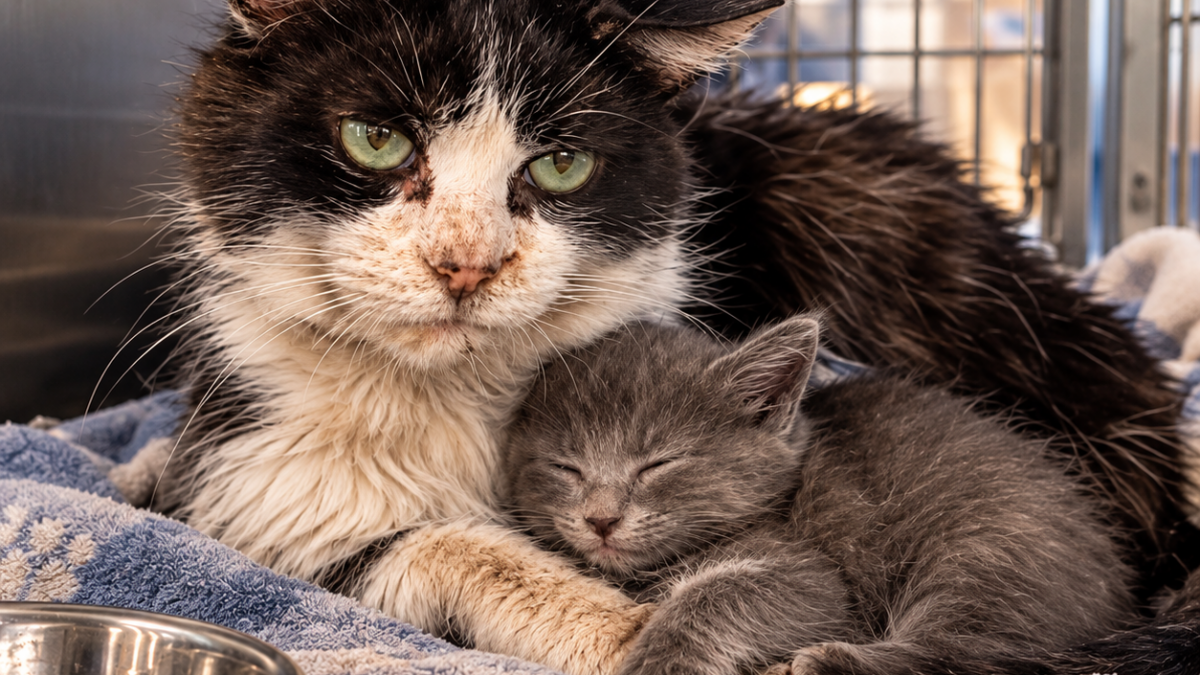
PART 2
I stayed crouched in front of the cage long after Linda stopped talking.
The orange kitten was still waiting for me farther down the hall.
I hadn’t forgotten him.
That somehow made me feel worse.
I had come specifically because I’d seen his photo online.
Bright amber eyes.
Round face.
Tiny white patch under his chin.
I’d already imagined naming him Oliver.
But now there was this old cat.
And this fragile little gray kitten.
And a connection nobody could explain.
“Does the old one have a name?” I asked.
“Not yet.”
“Age?”
“Maybe ten. Maybe twelve.”
“That old?”
“He could be younger and just look worse because of his condition.”
“What condition?”
Linda opened the clipboard hanging beside the cage.
“He’s dehydrated, underweight, has dental disease, an infected wound near his shoulder, and arthritis in both hips.”
I winced.
“Anything else?”
“We’re waiting on bloodwork.”
“And the kitten?”
“Underweight. Mild respiratory infection. Fleas. Probably five or six weeks old.”
I looked at the baby.
“Is he eating?”
“Only if the old cat is beside him.”
I closed my eyes.
Of course.
Because apparently the universe had decided subtlety was unnecessary.
Linda must have recognized the expression on my face.
“You don’t have to decide anything about them.”
“I know.”
“The orange kitten is healthy.”
“I know.”
“He’s exactly what you came for.”
“I know.”
“Then why do you look angry?”
“Because I know.”
She laughed softly.
I stood.
“Can I see the orange one first?”
“Absolutely.”
His name at the shelter was Pumpkin.
I hated the name immediately, which somehow made things easier.
Pumpkin was everything Linda had promised.
Playful.
Confident.
Affectionate.
He climbed into my lap within thirty seconds.
Chewed my shoelace.
Attacked the zipper on my jacket.
Purred so loudly I could hear him over the other cats.
“This is dangerous,” I said.
Linda smiled.
“Told you.”
I held him.
For ten minutes, I remembered exactly why I’d come.
He was easy to love.
That wasn’t an insult.
Some animals meet you with their whole heart already open.
Pumpkin did.
I could picture him in my apartment immediately.
Then from the far end of the hallway came that rough little cry again.
Pumpkin’s ears twitched.
So did mine.
I handed him gently back to Linda.
“I’m terrible at this.”
“At what?”
“Being rational.”
“Most people are.”
I walked back toward the last cage.
The old tom hadn’t changed position.
But when I crouched, his green eyes opened.
The kitten slept against him.
“Can I touch him?”
Linda opened the cage slowly.
“Let him smell you first.”
I held out my fingers.
The old cat watched.
Didn’t retreat.
Didn’t approach.
After several seconds, he leaned forward and sniffed.
Then he did something unexpected.
He rubbed the side of his face against my knuckles.
Once.
Weakly.
That was all.
I felt ridiculous for how emotional it made me.
“Hey,” I whispered.
He blinked.
“What happened to you?”
He couldn’t answer.
But later, I would learn more than I ever wanted to know.
## 1
I didn’t leave with a cat that afternoon.
Not Pumpkin.
Not the kitten.
Not the old tom.
Linda refused to finalize any adoption involving the last two until the veterinarian had completed their assessments.
“You could foster them medically,” she offered.
“Both?”
She gave me a look.
“I think we’ve established that separating them is complicated.”
“What exactly does medical fostering involve?”
She explained.
Medication.
Monitoring appetite.
Follow-up appointments.
Isolation from other animals.
Daily notes.
The possibility that the old cat’s condition could be worse than expected.
“Can he die?”
I asked.
Linda stopped.
“Yes.”
The word landed heavily.
“And the kitten?”
“We think he’ll be okay.”
I looked at the cage.
I should have walked away.
That sounds cruel, but it was also practical.
I had no rescue experience.
I worked full-time.
I lived alone.
I had planned for one healthy kitten.
Instead, I was considering bringing home a sick senior cat and an underweight baby with respiratory symptoms.
“What happens if nobody fosters them?”
“The kitten stays here.”
“And the old cat?”
Linda hesitated.
“Hospital ward if he deteriorates.”
“And if he doesn’t?”
“We keep looking for placement.”
I understood what she wasn’t saying.
Shelters don’t have unlimited space.
Senior cats with medical problems don’t attract lines of adopters.
“Give me the paperwork.”
Linda blinked.
“You’re sure?”
“No.”
That made her smile.
“That’s probably more honest than most people.”
I signed.
My quiet apartment changed that evening.
The kitten rode home in a small carrier.
The old tom rode beside him in a larger one.
Every time the kitten cried, the old cat answered with a low sound.
Not quite a meow.
Almost a murmur.
I kept glancing over at red lights.
“This is temporary,” I told them.
The kitten cried.
“Very temporary.”
The old tom stared at me.
“Don’t look at me like that.”
He continued staring.
“You’re both going back.”
Nothing.
“I mean it.”
The kitten sneezed.
I sighed.
“This is manipulation.”
## 2
I named the kitten Ash because of his gray coat.
The old cat took longer.
I tried several names.
Charlie.
Sam.
Oscar.
He ignored all of them.
Then, while reading through the intake form again, I noticed where he’d been found.
Marlow Street.
“Okay,” I said. “Marlow.”
The old cat opened one eye.
“That’s more response than I’ve gotten from anything else.”
Marlow it was.
The first night was chaotic.
Ash cried if he couldn’t see Marlow.
Marlow refused to use the soft cat bed I’d bought.
He chose the floor beside the radiator instead.
I moved the bed closer.
He walked around it.
I put a blanket on the floor.
He lay partly on it.
Progress.
Ash ate only when Marlow approached the bowl.
So I placed two dishes side by side.
Marlow sniffed his food.
Then looked at Ash.
Ash began eating.
Only then did Marlow take a few bites.
“That’s backwards,” I told him.
“You need the calories more.”
He ignored me.
I started keeping notes because Linda had asked.
**7:15 p.m. — Ash ate half portion. Marlow ate approximately one-quarter.**
**8:00 p.m. — Medication administered. Marlow hates pills.**
**8:20 p.m. — Ash climbed on Marlow’s head. Marlow tolerated it.**
**9:05 p.m. — Ash asleep under Marlow’s front leg.**
**10:30 p.m. — Marlow still awake watching Ash.**
By midnight, I was sitting on the living-room floor wondering what I had done.
Marlow’s breathing sounded rough.
Not dangerously labored.
Just tired.
I reached toward him.
He flinched.
Barely.
Then let me touch his neck.
His fur was coarse beneath my hand.
I could feel every bone.
Ash was sleeping against his belly.
“You don’t know him,” I whispered.
Marlow looked at me.
“Why do you care so much?”
His paw tightened slightly around Ash.
No answer.
But I would eventually come to believe that maybe Marlow didn’t need history to decide someone mattered.
Maybe one frightened baby had cried beside him, and after whatever had happened in his own life, he simply couldn’t ignore it.
## 3
The bloodwork came back two days later.
I was at the shelter clinic when Dr. Hannah Pierce called me into the exam room.
Marlow sat inside his carrier.
Ash pressed against him.
Dr. Pierce was in her forties, calm, direct, and apparently incapable of pretending bad news was good.
“His kidneys aren’t great.”
I swallowed.
“How bad?”
“Early chronic kidney disease. Manageable for now.”
“For now?”
“He’s a senior cat, Rachel.”
That was the first time anyone had said the name I’d given on my foster paperwork aloud.
It made the whole thing feel strangely official.
She continued.
“He also has severe dental disease. Several teeth likely need extraction once he’s stable enough for anesthesia.”
“What about the shoulder?”
“Old puncture wound that became infected.”
“From another animal?”
“Possibly.”
“Was he attacked?”
“We can’t know.”
“What about arthritis?”
“Significant.”
I looked at Marlow through the carrier door.
“And he was outside?”
“At least recently.”
“In October.”
“Yes.”
“Near an abandoned house.”
“Yes.”
The anger arrived quietly.
Not at anyone specific yet.
Just at the idea of him alone.
“How long could he have survived like that?”
Dr. Pierce shook her head.
“Hard to say.”
“What do you think happened?”
“Rachel.”
“I know. You don’t know.”
She softened.
“What I do know is that he was somebody’s cat once.”
“How?”
“His pads aren’t heavily calloused. He’s comfortable with litter boxes. He understands houses. He seeks human touch after initial hesitation.”
She paused.
“And he has a microchip.”
I stared.
“He does?”
“Old one.”
“Registered?”
“We’re checking.”
My heart started beating faster.
“So someone owned him.”
“Yes.”
“Then maybe he’s lost.”
“Maybe.”
For some reason, that possibility felt good.
Maybe someone had been searching.
Maybe there was an old woman crying somewhere, wondering where her cat had gone.
Maybe this story wasn’t abandonment.
Maybe it was just bad luck.
I clung to that possibility for less than twenty-four hours.
Then Linda called.
“We found the chip registration.”
I sat up.
“And?”
“It belonged to a woman named Eleanor Hayes.”
“Belonged?”
“She died eleven months ago.”
The good feeling disappeared.
“What happened to Marlow after that?”
“We don’t know yet.”
“Family?”
“One listed emergency contact.”
“Who?”
“Her nephew. Daniel Hayes.”
“Did you call him?”
“Yes.”
“And?”
Linda was quiet.
“He said he doesn’t know anything about the cat.”
Something about her tone bothered me.
“That’s possible.”
“Yes.”
“But?”
“But when I asked whether Eleanor owned a black-and-white cat, he said, ‘That old thing should’ve been gone years ago.’”
I went cold.
“He said that?”
“Yes.”
“Then he knows Marlow.”
“That’s what I thought.”
## 4
The next week, I learned Marlow’s old name.
Benny.
I hated it at first because he didn’t feel like a Benny to me.
But then Linda found an old veterinary record connected to the microchip.
**BENNY HAYES.**
Neutered male.
Black and white.
First appointment eleven years earlier.
Owner: Eleanor Hayes.
There were records for vaccinations, dental cleanings, routine exams.
He had been cared for.
Loved, apparently.
His last appointment was eighteen months before Eleanor’s death.
The notes said:
**Owner reports Benny sleeps beside her nightly.**
I read that sentence six times.
Then I looked across my living room.
Marlow—Benny—was asleep beside Ash.
Not beside me.
He still didn’t trust me enough for that.
But now I could picture him in another home.
On another bed.
Beside an elderly woman.
Loved.
What had happened after she died?
I called Linda.
“Can we contact the nephew again?”
“Animal control already is.”
“Why animal control?”
“Because the abandoned house where Marlow was found belonged to Eleanor.”
I stood.
“What?”
“The property has been empty since her death.”
“So he was found near his own home?”
“Yes.”
My stomach turned.
“Then somebody took him there.”
“Possibly.”
“Or left him there.”
“Yes.”
“Who inherited the house?”
Another pause.
“Daniel.”
There it was.
Not proof.
But shape.
A story beginning to form.
And I didn’t like it.
## 5
Ash recovered quickly.
Antibiotics cleared his respiratory infection.
His eyes brightened.
His appetite became ridiculous.
Within two weeks, he transformed from a fragile gray bundle into a small criminal.
He climbed everything.
Curtains.
Bookshelves.
My legs.
Marlow.
Especially Marlow.
He attacked Marlow’s tail.
Bit his ears.
Used his back as a launching platform.
Marlow never retaliated.
At most, he placed one huge paw on Ash’s head and held him still for several seconds.
Ash would emerge offended.
Then attack again.
Watching them made me laugh.
It also made separating them feel increasingly impossible.
One afternoon, I placed Ash in the bedroom briefly while giving Marlow medication.
Ash screamed behind the door.
Marlow stood immediately.
He limped toward the hallway.
“It’s okay.”
He ignored me.
Ash cried again.
Marlow began pawing at the bedroom door.
I opened it.
Ash shot out.
Ran directly to him.
Marlow licked his forehead.
I sat down.
“This is a problem.”
They both ignored me.
## 6
The dental surgery happened in early November.
Marlow had six teeth removed.
Six.
Dr. Pierce found evidence of longstanding infection.
After surgery, he looked miserable.
His lower lip drooped slightly from anesthesia.
I took him home with pain medication.
Ash approached the carrier.
Marlow made a weak sound.
Ash immediately curled beside him.
That night, I put both of them in my bedroom because I wanted to monitor Marlow.
At two in the morning, I woke.
Something was touching my arm.
Marlow.
He had climbed onto the bed.
Slowly.
Painfully.
He lay beside me.
Ash slept against his chest.
For several minutes, I didn’t move.
Then Marlow lowered his head onto my wrist.
It was the first time he had chosen to sleep beside me.
I cried quietly into my pillow like an idiot.
## 7
The investigation into Daniel Hayes progressed slowly.
Animal control couldn’t simply accuse someone because a cat was found near a property they owned.
Daniel claimed he had sold or given away Eleanor’s cat months earlier.
“To whom?” Officer Kelly asked.
He couldn’t remember.
“Name?”
No.
“Address?”
No.
“Phone number?”
No.
“Adoption agreement?”
No.
“Text messages?”
No.
He said it had been “some guy online.”
Convenient.
Then a neighbor came forward.
Mrs. Alvarez had lived across from Eleanor for sixteen years.
She remembered Benny.
“He sat in her front window every afternoon.”
She showed Officer Kelly old photographs taken during neighborhood events.
There was Benny.
Healthy.
Heavy.
Sitting on Eleanor’s porch.
Mrs. Alvarez also remembered the weeks after Eleanor died.
Daniel came frequently.
Furniture disappeared.
Boxes.
Appliances.
Then one day, Benny stopped appearing in the window.
“I asked Daniel where the cat was,” she said.
“What did he say?”
“He said, ‘Not my problem.’”
Officer Kelly wrote it down.
“Did you see him remove the cat?”
“No.”
Still not proof.
But more shape.
## 8
Meanwhile, something unexpected happened.
The shelter posted a photograph of Marlow and Ash.
Nothing dramatic.
Just the two of them sleeping together after Marlow’s surgery.
The caption explained that they had arrived separately and bonded instantly.
People loved it.
The post spread locally.
Then beyond locally.
Hundreds of comments.
Thousands of shares.
People called them “grandpa and baby.”
Someone made a drawing.
Someone offered to pay Marlow’s medical bills.
Another person mailed Ash a tiny bow tie.
I found this embarrassing.
Ash loved the bow tie.
Marlow hated it.
Then Daniel Hayes saw the post.
And suddenly, he remembered the cat.
## 9
Linda called me while I was working.
“Daniel wants Benny back.”
I thought I’d misheard.
“What?”
“He says Benny belongs to the estate.”
I stood so quickly my chair rolled backward.
“He told animal control he gave him away.”
“I know.”
“He said he didn’t know where he went.”
“I know.”
“He told you he didn’t know anything about the cat.”
“I know.”
“So why does he want him now?”
Linda’s voice hardened.
“Because the post has sixty thousand shares.”
I sat down.
There it was.
Attention.
Not love.
Value.
Control.
“What did you tell him?”
“That Marlow is under medical foster and protective hold pending the abandonment investigation.”
“Good.”
“He got angry.”
“How angry?”
“He threatened legal action.”
I looked across the room.
Marlow was asleep in a sunbeam.
Ash lay on top of him.
“Let him.”
That was easy to say.
It became harder when Daniel hired an attorney.
## 10
The letter arrived at the shelter first.
Then one came to me.
Demand for return of property.
Property.
Marlow was described as:
**One black-and-white domestic shorthair male belonging to the Estate of Eleanor Hayes.**
No mention of Benny.
No mention of eleven years beside Eleanor.
No mention of his kidneys.
His teeth.
His infected wound.
Just property.
Ash wasn’t included.
Daniel didn’t care about him.
That almost made me laugh.
Almost.
The attorney claimed Daniel had been searching for Benny and only recently learned the shelter had possession.
Animal control had written statements proving otherwise.
The shelter refused.
Daniel filed a civil claim.
The county cruelty investigation remained open.
Everything became more complicated.
I hated him before ever meeting him.
That bothered me.
I didn’t want this to become personal.
But it was difficult not to take personally when a man who had apparently failed a helpless animal suddenly appeared because that animal had become publicly valuable.
## 11
Marlow knew nothing about court.
He had better priorities.
Food.
Ash.
Sunlight.
My bed.
By December, he had gained almost two pounds.
His coat improved.
The greasy, tangled patches were gone.
White fur became white again.
Black fur shone.
His arthritis remained.
Kidney disease remained.
His torn ear remained.
But he no longer looked like a cat waiting to die.
He began meeting me at the kitchen every morning.
Slowly.
With dignity.
Ash arrived at full speed and slammed into cabinets.
Marlow simply sat beside his bowl.
The first time he meowed loudly for breakfast, I laughed.
“Look at you.”
He meowed again.
“Demanding now?”
Again.
“Fine.”
That sound mattered.
At the shelter, his voice had been weak.
Now he expected things.
Breakfast.
Warmth.
Attention.
Safety.
Expectations are a kind of healing.
## 12
The first court hearing took place two weeks before Christmas.
I didn’t need to testify yet.
I went anyway.
Daniel Hayes looked nothing like the villain I had created in my head.
He was forty-something.
Clean haircut.
Expensive winter coat.
Ordinary.
That made him more unsettling.
He avoided looking at me.
His attorney argued that because Eleanor’s estate had not been fully settled, Benny remained estate property.
The shelter’s attorney argued abandonment.
The judge asked:
“Where was the cat for the ten months between Ms. Hayes’s death and his arrival at the shelter?”
Daniel’s attorney answered:
“My client believed he had transferred the animal to another caretaker.”
“Name?”
“We are attempting to locate that individual.”
“Documentation?”
“None currently available.”
The judge looked unimpressed.
Then animal control’s attorney presented the inconsistent statements.
Daniel first denied knowledge.
Then claimed he gave Benny away.
Then demanded him back.
The judge denied immediate return.
Marlow would stay where he was until ownership and abandonment could be determined.
I exhaled so hard Linda squeezed my hand.
“Breathe.”
“I forgot.”
Outside court, Daniel finally approached.
“You Rachel?”
I stopped.
Linda remained beside me.
“Yes.”
“You have Benny.”
“His name is Marlow now.”
His mouth tightened.
“His name is Benny.”
“You haven’t been taking care of him.”
“He was my aunt’s cat.”
“That wasn’t my question.”
Linda touched my arm.
Warning.
Daniel looked annoyed.
“You people are making this into something it isn’t.”
“What is it?”
“A cat.”
I stared at him.
Just a cat.
Behind my anger, something became very clear.
Eleanor had loved Marlow.
Daniel had never understood that kind of relationship.
Maybe he never would.
I walked away.
## 13
Then Mrs. Alvarez found the video.
It had been sitting on an old doorbell-camera account she rarely used.
She had saved clips after Eleanor’s house began attracting teenagers at night.
One clip was dated eleven weeks after Eleanor died.
Daniel’s SUV pulled into the driveway.
He exited.
Opened the back.
Removed a cat carrier.
Set it beside the porch.
He opened the carrier.
Benny came out.
Daniel returned to the vehicle.
Benny followed.
Daniel pushed him away with his foot.
Not a violent kick.
But enough.
Then he got into the SUV.
Benny stood beside the driver’s door.
Daniel drove away.
The cat chased the vehicle halfway down the block.
I watched the clip once.
Then again.
The third time, I couldn’t.
That was Marlow.
Healthy enough to run then.
Confused.
Following the man who had just left him at an empty house.
His own old house.
A place with locked doors and no Eleanor inside.
Officer Kelly called me.
“This changes things.”
“Good.”
My voice shook.
“We also have another clip.”
I closed my eyes.
“What?”
Three days later.
Benny still on the porch.
Rain.
He sat at the front door.
Waiting.
Exactly where Eleanor used to let him inside.
Daniel returned to remove more belongings.
Benny approached him.
Daniel carried boxes around him.
Never opened the door.
Never took him.
Then left.
Again.
I felt sick.
“How long was he there?”
“We don’t know.”
But we knew enough.
## 14
The cruelty case moved forward.
Daniel stopped claiming he’d given Marlow to someone.
Now his attorney argued that leaving him at the property was not abandonment because the cat had access to outdoor shelter.
Except he didn’t.
The doors were locked.
The windows closed.
No consistent food.
No water source except whatever neighbors occasionally left.
And Marlow had eventually disappeared.
For months.
Where had he gone?
We would never know.
Maybe alleys.
Porches.
Garages.
Maybe somebody fed him.
Maybe nobody did.
Eventually he returned to the only place he still considered home.
And that was where a contractor found him.
Near the abandoned house.
Thin.
Infected.
Almost silent.
## 15
Daniel made one more mistake.
He contacted me directly.
A message appeared on social media.
**You have no right to keep my family’s cat.**
I didn’t respond.
Second message:
**You people are exploiting him for donations.**
Screenshot.
Forwarded to the shelter attorney.
Third:
**If my aunt were alive she would hate what you’re doing.**
That one almost worked.
I wanted to answer.
Instead, I opened Marlow’s old veterinary records.
**Owner reports Benny sleeps beside her nightly.**
I imagined Eleanor.
Old woman.
Old cat.
Same bed.
Maybe she would have hated what we were doing.
Or maybe she would have hated the nephew who locked her cat outside after she was gone.
I didn’t reply.
## 16
Ash officially became adoptable before Marlow’s legal case ended.
Linda asked the question carefully.
“Do you want to adopt him?”
I looked at her.
“Is that a joke?”
“No.”
“Yes.”
She smiled.
“I assumed.”
“But only if Marlow stays with me.”
“We can’t finalize Marlow yet.”
“I know.”
“What if the court orders him returned?”
The thought made my stomach hurt.
“Then Ash stays mine.”
“And?”
“And we’ll deal with it.”
Linda looked at me.
“Rachel, you’re allowed to admit you’re attached.”
“I am not attached.”
Ash was asleep inside my sweater.
Linda pointed.
“He is literally wearing you.”
“Coincidence.”
## 17
The next hearing happened in January.
This time, the doorbell footage was shown.
Daniel sat very still.
The judge watched Benny chase the SUV.
No one spoke.
Then the second clip.
Benny sitting in the rain.
Daniel carrying items from the house.
Ignoring him.
The judge paused the video.
“Mr. Hayes.”
Daniel’s attorney stood.
“Your Honor—”
“I am asking Mr. Hayes directly.”
Daniel looked up.
“Why did you leave the cat?”
He swallowed.
“I was overwhelmed dealing with the estate.”
“For three days?”
“I didn’t want him in my house.”
“Did you seek a shelter placement?”
“No.”
“Rescue?”
“No.”
“Veterinarian?”
“No.”
“Did you provide food at the property?”
“Sometimes.”
“Daily?”
“No.”
“Water?”
“There were bowls.”
“Filled by whom?”
No answer.
The judge leaned back.
“And now you seek return of the same animal?”
Daniel’s attorney spoke.
“My client recognizes mistakes were made.”
Mistakes.
I hated that word.
The judge didn’t seem impressed either.
“Why?”
The attorney hesitated.
“Because the cat belonged to his aunt and has sentimental value.”
I nearly laughed.
Sentimental value.
The judge looked toward the county attorney.
“Any evidence of that value before the animal became the subject of public attention?”
Linda’s hand tightened around mine.
No one answered for Daniel.
Because there wasn’t any.
## 18
The court permanently denied Daniel’s ownership claim.
Marlow became property of the shelter through forfeiture.
Daniel was also ordered to reimburse a portion of emergency veterinary expenses.
The separate neglect matter ended in a plea to animal abandonment and failure-to-provide-care violations under local law.
The penalty wasn’t dramatic.
Fine.
Restitution.
Community-service requirements.
A temporary prohibition on owning or possessing animals.
Some people online wanted more.
I understood.
But the part that mattered to me was simple.
He could never take Marlow.
When the judge finished, I looked at Linda.
“Is that it?”
“For ownership?”
“Yes.”
“He’s free?”
She smiled.
“He’s yours if you still want him.”
I laughed.
Then cried.
Then laughed again.
“Still want him?”
Linda shrugged.
“Paperwork requires the question.”
## 19
I signed Marlow’s adoption papers that afternoon.
His shelter name remained Marlow.
Under previous name, I wrote:
**Benny.**
I couldn’t erase Eleanor.
I didn’t want to.
Marlow had been loved once.
That mattered.
His life wasn’t simply before rescue and after rescue.
There had been a woman who cared for him.
A home.
Years of safety.
Then loss.
Then betrayal.
Then survival.
Then Ash.
Then me.
Lives are complicated.
Even cats’ lives.
## 20
When I brought him home officially, nothing changed physically.
Same apartment.
Same blanket.
Same bowls.
Same kitten climbing on his tail.
But I felt different.
I put the adoption certificate on the kitchen counter.
“Congratulations.”
Marlow looked at me.
“You live here.”
He blinked.
Ash attacked his back leg.
Marlow sighed.
“Unfortunately, so does he.”
## 21
The real revenge came months later.
Not in court.
Not when Daniel paid restitution.
Not when he lost the civil case.
The shelter received a donation from Eleanor Hayes’s estate.
That requires explanation.
During the legal proceedings, the executor reviewed Eleanor’s papers more carefully.
Inside a desk drawer, they found a handwritten note attached to her will.
Nothing formally binding about the cat.
Just instructions.
**If anything happens to me, please make sure Benny is cared for. He is old and frightened by change. If family cannot keep him, contact a proper rescue. Do not leave him outside.**
I read those words standing beside Linda.
Neither of us spoke for several seconds.
Then I said:
“He knew?”
“We can’t prove he read it.”
Maybe he hadn’t.
Maybe he had.
It no longer mattered.
The executor was horrified.
A discretionary portion of the estate that had remained unresolved was donated to the shelter’s senior-cat medical program.
Not Daniel’s inheritance.
Other estate funds.
But the symbolism was perfect.
Eleanor had wanted Benny cared for.
Daniel failed.
In the end, money from the home she left behind helped care for cats like him anyway.
The shelter renovated a small room.
Soft beds.
Heated pads.
Low-entry litter boxes.
Quiet lighting.
A space for elderly cats who struggled in the main adoption area.
A plaque was placed beside the door.
**ELEANOR’S ROOM
For the old ones who still deserve to come home.**
Underneath, smaller:
**Inspired by Benny “Marlow” Hayes.**
I cried when I saw it.
Linda pretended not to.
## 22
Marlow visited once.
Not because he cared.
He did not.
He sniffed one bed.
Rejected another.
Ate three treats.
Then demanded to leave.
Ash came too and climbed into an empty supply basket.
Linda took a photograph.
“Very moving.”
“Deeply.”
Marlow looked bored.
That somehow made it better.
The entire legal battle.
The articles.
The donations.
The plaque.
Marlow did not care.
He wanted chicken.
## 23
Ash grew.
Too much.
The tiny fragile kitten became a long-legged gray menace.
By six months, he was almost Marlow’s size.
He still slept pressed against him.
Every night.
Marlow’s arthritis worsened slightly that winter.
Ash adjusted without anyone teaching him.
He stopped launching himself directly onto Marlow’s hips.
Instead, he curled along his side.
When Marlow climbed onto the couch, Ash waited.
When Marlow ate, Ash no longer shoved him aside.
Mostly.
Some relationships mature.
Some only become less rude.
## 24
One evening, I noticed Marlow staring at an empty chair near the window.
He sat there for almost ten minutes.
I wondered whether Eleanor had owned a chair like it.
That was silly.
I knew that.
Cats don’t explain memory.
But sometimes I’d catch him looking toward a door after I left a room.
Waiting.
Watching.
Making sure I returned.
For months, he followed me from room to room.
Not close.
Just within sight.
If I went into the kitchen, he sat in the doorway.
Bathroom, hallway.
Bedroom, rug.
He always knew where I was.
Maybe after being left once, disappearance meant something different.
So I started talking whenever I moved.
“Kitchen.”
Marlow blinked.
“Bathroom.”
Nothing.
“Bedroom.”
Ash followed because he believed every announcement involved food.
It became a ridiculous household ritual.
But after a while, Marlow stopped following every time.
He stayed asleep.
Trusted I would return.
That was one of the greatest signs of healing I ever saw.
## 25
His kidney disease remained stable for almost two years.
Dr. Pierce called him “annoyingly resilient.”
Marlow liked her.
Mostly because she stocked chicken treats.
At thirteen—or whatever age he truly was—he still walked stiffly.
But he walked to the window every morning.
Sunbathed.
Yelled for breakfast.
Allowed Ash to wash his face.
Slept beside me.
Sometimes on my chest.
Which was less charming at 3:00 a.m.
“You weigh too much.”
Marlow purred.
“This is abuse.”
Purr.
“Move.”
Nothing.
I never moved him.
## 26
Daniel disappeared from our lives.
For a while.
Then, almost two years later, I saw his name again.
He had applied to adopt a dog from another rescue.
The temporary ownership restriction had expired.
The organization contacted our shelter because his name appeared in their background review.
Linda called me.
“What did you tell them?”
“The truth.”
“And?”
“They declined the application.”
I was silent.
Not because I wanted Daniel punished forever.
People can change.
But he had apparently omitted his abandonment case entirely.
When asked whether he had ever been cited for animal neglect, he checked:
**No.**
Another lie.
The rescue denied him based on dishonesty in the application.
Actions have long shadows.
I didn’t celebrate.
But I slept well.
## 27
Marlow’s greatest transformation wasn’t physical.
It was attitude.
The cat who barely lifted his head at the shelter became extraordinarily demanding.
He learned that if he tapped my face at 5:30 a.m., I sometimes fed him.
So he began doing it at 5:15.
Then 5:00.
I created a monster.
Ash assisted.
One morning I opened my eyes to both of them sitting on my chest.
“What?”
Two faces.
“It’s dark.”
Silence.
“Normal people are sleeping.”
Ash meowed.
Marlow stared.
“You were supposed to be the grateful rescue cat.”
Marlow touched my mouth with his paw.
I got up.
## 28
People love transformation photographs.
Before.
After.
They make rescue look clean.
Before: suffering.
After: happy.
Marlow’s life taught me the space between those pictures mattered more.
The medication he spit out.
The kidney food he rejected.
The nights Ash cried.
The court hearings.
The vet bills.
The fear.
The patience.
The boring mornings.
The quiet trust.
Healing is mostly ordinary.
That’s why it lasts.
## 29
On the third anniversary of Marlow’s adoption, Linda sent me the original intake photo.
I hadn’t seen it in years.
Old gray towel.
Dirty fur.
Torn ear.
Huge green eyes.
Ash tiny beside him.
Marlow’s paw around his body.
I looked at the photo.
Then across my living room.
Ash was fully grown.
Marlow was sleeping in an orthopedic bed.
His paw rested across Ash’s back.
Same position.
Three years later.
I took a new photograph.
Placed them side by side.
No caption.
None needed.
## 30
Marlow began declining during his fourth year with me.
Slowly.
Kidney values worsened.
He lost weight.
His appetite became inconsistent.
Dr. Pierce adjusted treatment.
Fluids at home.
Medication.
Special diet.
I learned to insert a needle beneath the skin while pretending I wasn’t terrified.
Marlow hated it.
Ash hated it more.
Every time I gave fluids, Ash sat nearby and yelled at me.
“I am helping him.”
Meow.
“Take it up with the veterinarian.”
Meow.
“You’re very dramatic.”
Marlow looked exhausted by both of us.
## 31
Good days still outnumbered bad ones.
That mattered.
He sat in sunlight.
Ate chicken.
Groomed.
Sought affection.
Argued about breakfast.
Stayed interested.
Then one morning, he didn’t come to the kitchen.
I found him on the bed.
Ash beside him.
I knew immediately.
Not that he was dying that day.
But that we were entering the last part.
Dr. Pierce confirmed it.
“Kidneys are progressing.”
“How long?”
“I can’t tell you.”
“Weeks?”
“Maybe.”
“Months?”
“Possible.”
I looked at Marlow.
He was tired.
“Is he suffering?”
“Not significantly right now.”
“Tell me when that changes.”
“I will.”
## 32
Those next months became very small.
And very precious.
I stopped thinking about legal cases.
Daniel.
Shelters.
Viral posts.
None of it mattered.
Marlow mattered.
Sunlight.
Water.
Food.
Comfort.
Ash.
Me.
We spent afternoons by the window.
I worked on my laptop.
Marlow slept beside me.
Ash slept on Marlow.
The hierarchy remained.
## 33
One afternoon, I received an envelope from Mrs. Alvarez.
Inside was a photograph.
Eleanor sitting on her porch.
Years younger.
Benny in her lap.
Healthy.
Black-and-white fur shining.
Eleanor’s hand resting on his back.
On the back, Mrs. Alvarez had written:
**I thought you should know he was very loved before everything went wrong.**
I sat on the floor.
Marlow approached slowly.
I showed him.
“This is you.”
He sniffed the photograph.
Then rubbed his cheek against my hand.
I cried.
Not because he remembered.
Maybe he did.
Maybe he didn’t.
Because now I knew for certain.
His life had contained love before me.
I was not the first person who mattered.
I was simply the person who came after loss.
There was something beautiful about that.
## 34
I framed the picture.
It stayed near Marlow’s bed.
Not as a memorial.
As history.
Eleanor deserved to remain part of his story.
So did Ash.
## 35
Marlow’s final decline came in spring.
He stopped eating enough.
Then stopped grooming.
His eyes looked tired again.
Not like the shelter.
Different.
The shelter had been resignation.
This was age.
I knew the distinction because I had learned him.
Dr. Pierce examined him.
I already knew.
She didn’t need to say much.
“It’s time to think about comfort.”
I nodded.
I had promised him years earlier without realizing it.
No unnecessary suffering.
No abandonment.
No waiting.
## 36
I scheduled an in-home visit.
I wanted him in the place he knew.
His bed.
His window.
His Ash.
The morning came sunny.
Almost offensively beautiful.
Marlow ate three pieces of chicken.
I considered that a personal gift.
Ash stayed close.
When Dr. Pierce arrived, he hissed at her.
She laughed softly.
“Still fighting.”
“Mostly because you smell like veterinary medicine.”
Marlow lay on my lap.
Ash pressed against his side.
I stroked the torn ear.
The same ear I’d first noticed through shelter bars.
“You did good.”
He purred faintly.
I whispered:
“You don’t have to protect anybody anymore.”
Ash lifted his head.
I laughed through tears.
“Okay. Maybe him.”
## 37
Marlow died with my hand on his chest and Ash’s nose pressed against his shoulder.
Quietly.
Warm.
Home.
I had thought losing him would feel like failure.
It didn’t.
It hurt.
Terribly.
But not failure.
He had been old when I met him.
Sick.
Damaged.
We didn’t save him from death.
Nobody can.
We saved him from dying alone.
There is a difference.
## 38
Ash searched for him.
That was the hardest part.
He walked through the apartment calling.
Checked the bed.
Window.
Hallway.
Bathroom.
For several days, he slept where Marlow used to sleep.
I let him.
We grieved badly together.
Then slowly, life continued.
Ash began sleeping beside me.
Not on top of Marlow.
Beside me.
The first night he curled under my arm, I understood.
Marlow had spent years teaching him what safety looked like.
Now Ash trusted me with the job.
## 39
A month later, Linda asked whether I wanted to visit Eleanor’s Room.
I hadn’t been back since Marlow died.
I said yes.
There were three senior cats inside.
One blind.
One diabetic.
One seventeen-year-old tabby surrendered after his owner entered assisted living.
Soft beds.
Warm lights.
Quiet.
On the wall hung a small photograph.
Marlow and Ash.
The original shelter photo.
Beneath it:
**Sometimes the oldest heart in the room still has something left to give.**
I stood there for a long time.
The seventeen-year-old tabby climbed into my lap.
Linda smiled.
“Don’t.”
“What?”
“I know your face.”
“I am absolutely not adopting another senior cat.”
“Sure.”
“I mean it.”
The tabby began purring.
I looked at Linda.
“This is manipulation.”
“Apparently it works on you.”
## 40
I didn’t adopt that cat.
Not that day.
I lasted four days.
His name was Henry.
Ash hated him for approximately six hours.
Then they slept on the same couch.
I blamed Marlow.
## 41
Years later, people still occasionally recognize Ash from the original shelter post.
He’s older now.
Gray becoming silver around the face.
He sleeps beside Henry.
Sometimes with one paw across him.
Exactly like Marlow.
The first time I saw it, I had to sit down.
Behavior travels in ways we don’t understand.
Maybe Ash learned protection from Marlow.
Maybe comfort becomes a language.
One animal teaches another:
Stay close.
Share food.
Make room.
Don’t let someone sleep alone.
## 42
I think about Daniel occasionally.
Not often.
He became less important with time.
That’s another kind of justice.
The person who caused the harm stops being the center of the story.
The lives that continued become larger.
Marlow.
Ash.
Eleanor’s Room.
Henry.
The cats rescued afterward.
Daniel’s cruelty became a footnote.
Marlow’s kindness became the legacy.
## 43
That’s the revenge people sometimes misunderstand.
They want the villain destroyed.
Humiliated.
Ruined.
Sometimes consequences matter.
Daniel paid.
Lost his claim.
Lost the right to take Marlow.
Faced a public record of abandonment.
Had future adoption applications scrutinized because of his own dishonesty.
All of that mattered.
But the most satisfying part wasn’t what Daniel lost.
It was what Marlow gained.
He gained years.
A home.
A kitten.
Beds.
Medical care.
Warmth.
A person who came back every time she left the room.
Daniel abandoned him because he didn’t want responsibility.
In the end, Marlow became the reason an entire shelter room existed to care for senior cats.
That’s bigger than punishment.
## 44
I still keep Eleanor’s photograph.
It’s beside the newer one.
In the first:
Eleanor holding Benny.
In the second:
Me holding Marlow years later.
Between those pictures is everything.
Love.
Death.
Abandonment.
Survival.
A shelter.
A kitten.
A courtroom.
A second home.
Another goodbye.
I don’t own the whole story.
Neither did Eleanor.
Neither did Daniel.
Neither did the shelter.
Marlow did.
## 45
If I could return to that cold October morning, I would still make one mistake.
I would still tell myself:
One kitten.
I would still buy one bed.
One litter box.
One set of bowls.
I would still walk into the shelter expecting orange fur and uncomplicated happiness.
Because if I’d known how painful the next years would sometimes become, maybe I would have been afraid.
And I would hate to think fear could have made me walk past that last cage.
## 46
I went there for Pumpkin.
I should mention him.
He was adopted the next day by a family with two children.
Linda sent me pictures.
He grew into a huge orange cat who apparently stole pancakes.
He got his happy ending too.
I was relieved.
Somewhere in my mind, I’d carried guilt for not choosing him.
But rescue isn’t about proving one life matters more.
It’s about making enough room for more than one ending to be good.
## 47
Marlow’s ending was good.
Not because he lived forever.
Not because every wound healed.
Not because the person who abandoned him received some dramatic punishment.
It was good because the final chapter belonged to love again.
Just as the first chapter with Eleanor had.
There was pain in between.
But pain did not get the last word.
## 48
Sometimes people ask:
“Why did Marlow accept Ash so quickly?”
I don’t know.
Nobody does.
Maybe he had lived with kittens before.
Maybe Eleanor once fostered cats.
Maybe instinct.
Maybe Ash’s cry triggered something.
Or maybe an old abandoned cat understood loneliness perfectly.
Maybe when Ash pressed against him, Marlow recognized a feeling rather than a face.
You too?
Come here.
That’s the explanation I prefer.
Not because I can prove it.
Because it fits the cat I knew.
## 49
The first time I saw them, Marlow had almost nothing.
No home.
No owner coming back.
No clean coat.
No healthy teeth.
No certainty.
Yet he moved away from his own food so Ash could eat.
That’s who he was when life had stripped him down to almost nothing.
Generous.
Protective.
Gentle.
Daniel saw an inconvenient old cat.
Eleanor saw a companion.
Ash saw safety.
I eventually saw family.
Sometimes the difference between those things tells you more about the person looking than the animal being seen.
## 50
The shelter eventually changed the wording on the plaque in Eleanor’s Room.
They added one line.
**No animal is too old to begin again.**
Linda asked whether I approved.
I laughed.
“Marlow would hate all this attention.”
“He’d accept treats.”
“Absolutely.”
We placed a small bowl of donated cat treats beneath the plaque for visitors to give the residents.
That felt more appropriate.
## 51
On the anniversary of Marlow’s death, I don’t do anything dramatic.
I open the window.
Ash sits there.
Henry usually joins him.
I make coffee.
Sometimes I look at the old photographs.
Mostly I don’t.
Memory doesn’t require ceremony every time.
Marlow is in the routines.
The extra orthopedic bed I never removed.
The kidney-food cabinet I eventually repurposed.
The habit of announcing when I leave a room.
I still do that.
“Kitchen.”
Ash looks up.
“Bathroom.”
Nothing.
“Bedroom.”
Henry follows.
Old habits outlive explanations.
## 52
And every once in a while, Ash does something that stops me.
He’ll move aside from a bowl so Henry can eat.
Or groom the top of Henry’s head.
Or rest one paw across his back.
And for half a second, I see that cage again.
Old gray towel.
Thin black-and-white cat.
Tiny gray kitten.
One paw.
A whole promise contained in one gesture.
I didn’t understand it then.
I do now.
Marlow wasn’t simply protecting Ash.
He was demonstrating what survival looks like when it refuses to become selfish.
## 53
That is why Daniel never really won anything.
He emptied Eleanor’s house.
Sold furniture.
Locked doors.
Walked away from a cat he didn’t want.
Maybe he believed that was the end.
It wasn’t.
The old cat survived him.
The video survived him.
The neighbors remembered.
The veterinary records remained.
Eleanor’s note remained.
Marlow’s story grew beyond the abandoned house.
And the room created in his honor continues caring for animals Daniel would probably have considered inconvenient.
The thing he discarded became the thing people remembered.
## 54
I don’t need a more dramatic revenge than that.
I don’t need Daniel miserable.
I don’t need to know where he lives.
I don’t need his life ruined.
I needed him unable to hurt Marlow again.
That happened.
I needed the truth documented.
It was.
I needed his attempt to reclaim Marlow to fail.
It did.
And I needed Marlow to discover that somebody could leave a room and still come back.
He did.
Again and again.
Until he no longer had to check.
## 55
The night before Marlow died, he slept beside me.
Ash was curled against his chest.
Exactly like that first day.
I woke sometime after midnight.
Marlow was awake.
Watching me.
I touched his head.
“I’m here.”
His eyes closed.
That was all.
No grand moment.
No miracle.
Just an old cat believing me.
For years, I’ve thought that may have been the greatest gift he ever gave me.
Trust after betrayal.
Not because betrayal didn’t matter.
Because it didn’t win.
## 56
When I first entered the shelter, I imagined happiness as something energetic.
A kitten running through the room.
Toys.
Chaos.
Purring in my lap.
I got all of that from Ash.
But Marlow taught me another form.
Happiness can also be an old cat asleep without watching the door.
A full bowl he knows will be refilled.
Medication because someone wants him alive.
A bed he doesn’t have to earn.
A kitten pressed against his ribs.
A human who leaves for work and returns at five.
Again.
Again.
Again.
Until returning becomes expected.
## 57
Expectation.
That’s what changed most.
At the shelter, Marlow expected nothing.
By the end, he expected breakfast at five.
Chicken after medication.
The bedroom door open.
Ash beside him.
My hand on his head.
He became demanding because he became secure.
I loved every complaint.
Every impatient meow.
Every paw to my face.
A neglected animal asking for more isn’t ungrateful.
It’s healing.
## 58
Years after that first morning, I finally understood why Linda’s answer had affected me so deeply.
I’d asked:
“What if I take only the kitten?”
I thought I was asking a practical adoption question.
I wasn’t.
I was asking whether love could be separated cleanly once it had formed.
Sometimes it can.
Sometimes animals adapt.
But sometimes two frightened lives find each other at exactly the moment both need someone.
And when that happens, the humane answer isn’t always the simplest one.
## 59
Marlow and Ash weren’t father and son.
They weren’t littermates.
They hadn’t grown up together.
They didn’t share blood.
They shared one night in a shelter cage.
That was enough.
Family isn’t always history.
Sometimes it’s the first creature that stays when everything else disappears.
## 60
I went to the shelter to adopt one kitten.
I left days later with a foster agreement for two animals I hadn’t planned for.
One was sick.
One was tiny.
One had already lost a woman who loved him.
The other had barely begun living.
Together, they changed my apartment.
Then my schedule.
Then my bank account.
Then my understanding of what rescue meant.
Eventually, they changed a shelter room.
A court record.
Other cats’ lives.
And me.
Marlow never knew any of that.
He never knew he became locally famous.
Never understood why strangers paid medical bills.
Never knew Daniel lost his claim.
Never knew Eleanor’s note was found.
Never knew there was a plaque with his picture on it.
He knew simpler things.
Warm.
Full.
Safe.
Ash.
Home.
Maybe those are the only parts that matter to an animal anyway.
## 61
The ending people usually want is punishment.
Here is the ending I prefer.
Daniel walked away from an elderly cat because caring for him was inconvenient.
Years later, that same cat was surrounded by photographs, veterinary files, adoption papers, court records, donors, shelter workers, neighbors, and people who remembered his name.
Daniel treated him like something disposable.
Marlow became unforgettable.
Daniel left him outside a locked house.
Marlow died years later inside a home where every door belonged to him.
Daniel didn’t want the responsibility of an old cat.
Marlow inspired a room dedicated to senior animals requiring exactly that responsibility.
And the tiny kitten Marlow protected when he had almost nothing left?
Ash grew up.
He learned gentleness from him.
Then passed it on.
That was the part Daniel could never take back.
## 62
One cold October morning, I walked into a shelter thinking I knew exactly what I wanted.
A young cat.
Easy.
Healthy.
Mine.
Instead, I met an old tom who had already lost almost everything and still moved aside from his food bowl so a frightened baby could eat.
I asked whether I could take only the kitten.
I thought the hard part would be deciding whether I had room for two cats.
I was wrong.
The hard part was realizing that once I had seen the way Marlow held Ash, I could no longer pretend they were two separate problems.
They were already each other’s answer.
So I changed my plan.
And years later, I’m still grateful I did.
Because the orange kitten I had planned to take found a wonderful home.
Ash found Marlow.
Marlow found me.
And somewhere between an abandoned house, a shelter cage, a courtroom, and a warm bed beside my window, an old cat who had every reason to stop trusting the world proved something I will never forget.
Cruelty can take a home.
Death can take a person.
Neglect can damage a body.
Abandonment can break routines built over a lifetime.
But none of those things automatically erase the part of a living being that still knows how to love.
Marlow had been abandoned.
He was sick.
Hungry.
Tired.
And probably grieving a woman he had spent most of his life beside.
Yet when a tiny gray kitten cried beside him, his first instinct wasn’t to protect his food.
Or his space.
Or himself.
He reached out one paw.
Pulled the baby close.
And made room.
In the end, that’s how I choose to remember him.
Not waiting outside Eleanor’s locked house.
Not thin inside a shelter cage.
Not sick on an examination table.
Not as evidence in Daniel’s case.
I remember him old and warm in my apartment, Ash sleeping against his chest, morning sunlight across his face.
No one was coming to take his home.
No one was locking him outside.
No one was leaving.
He knew where his next meal would come from.
He knew where he would sleep.
And most importantly, he finally knew that when I walked through the front door and said,
“I’m home,”
I meant it.
Every single time.
- **THE END**



