PART 2: I Went to the Shelter for One Dog—Then Two Broken Souls Chose Each Other Before They Chose Me
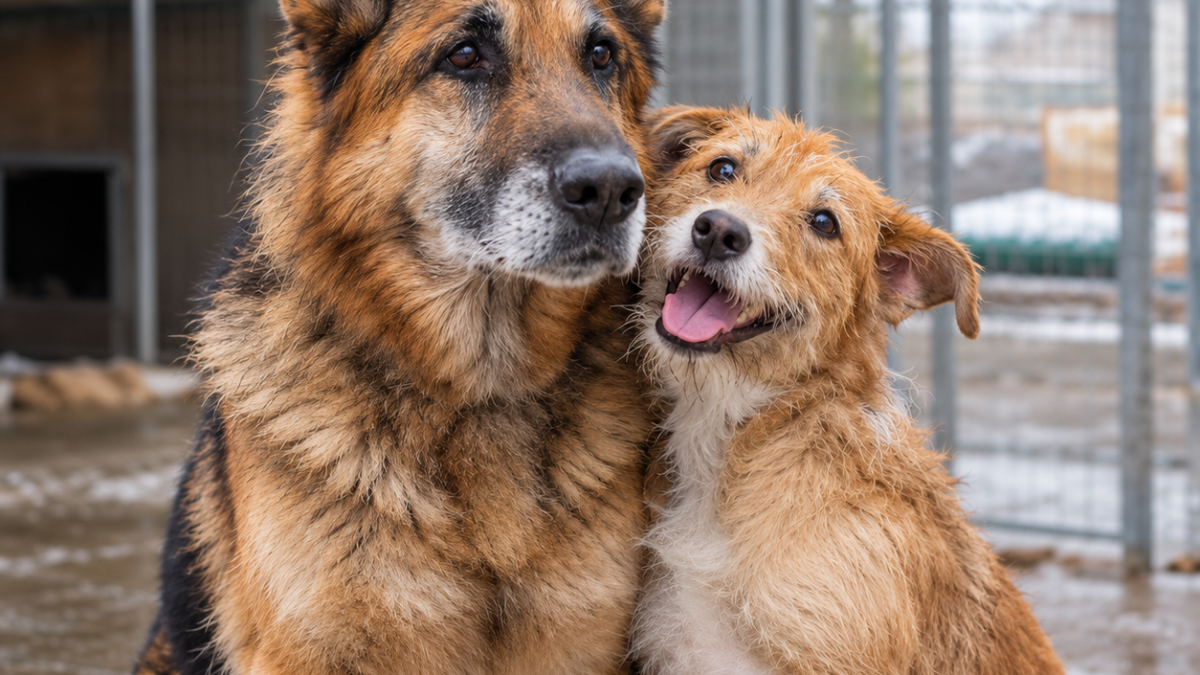
PART 2
The next morning, I woke to the sound of something crashing in the kitchen.
I sat up so fast that I nearly fell out of bed.
“Bonia?”
Another noise.
I ran down the hallway.
Bonia was standing with her front paws on the lower kitchen cabinet, looking remarkably pleased with herself.
A box of cereal lay open on the floor.
Rex sat several feet away.
He looked at me.
Then at Bonia.
Then back at me.
His expression seemed to say, *I would like the record to show that I had nothing to do with this.*
“Seriously?”
Bonia wagged her tail.
I pointed at the cereal.
“How did you even do that?”
She sneezed.
Behind her, Rex slowly stood.
He walked toward his water bowl.
I noticed something then.
His food bowl from the previous night was almost untouched.
My amusement disappeared.
The shelter worker had warned me.
Rex had stopped eating properly.
I knelt.
“Come on, buddy.”
I put fresh food into the bowl.
He sniffed it.
Then turned away.
Bonia appeared instantly.
She tried to stick her face into Rex’s bowl.
“No.”
I pulled her back.
Rex glanced at her.
Bonia sat.
She stared at him.
Rex looked at the food.
Then at Bonia.
Then he took one bite.
I froze.
“Good boy.”
Another bite.
Bonia’s entire body began vibrating.
“Don’t ruin this.”
Rex ate again.
Bonia released a tiny squeak.
He stopped.
She became completely still.
Rex continued eating.
I stood in my kitchen holding Bonia gently by the chest while Rex finished nearly half his meal.
It was more than he’d eaten at the shelter the previous day.
I started noticing patterns after that.
Rex would not always eat when I placed food in front of him.
But if Bonia ate nearby, he often joined her.
Bonia panicked whenever I moved out of sight.
But if Rex remained in the room with her, the panic was less severe.
Rex slept most of the day.
Bonia seemed personally offended by this.
She brought him toys.
A ball.
A rope.
A stuffed rabbit missing one ear.
She dropped each one directly in front of his nose.
Rex ignored them.
Bonia did not understand rejection.
She shoved the ball closer.
Nothing.
She pushed the stuffed rabbit against his face.
Rex turned his head away.
Bonia picked it up and dropped it on his head.
I was certain that would be the end of their friendship.
Rex lifted his head.
Bonia froze.
He stared at her.
Then, slowly, he grabbed the rabbit.
Bonia exploded with joy.
She ran three laps around the coffee table.
Rex remained on the rug with the toy in his mouth.
But his tail was wagging.
Not once this time.
Over and over.
“Well,” I whispered, “look at you.”
The first two weeks were chaos.
Bonia needed far more exercise than I had expected.
Rex needed far more patience.
I worked full time, so I adjusted my schedule.
Long walk before work.
Training session.
Food.
A midday dog walker.
Another long walk when I came home.
Short evening exercises.
Bonia was smart.
Very smart.
Unfortunately, most of her intelligence initially went toward criminal activity.
She learned how to open the bathroom door.
She discovered the laundry basket.
She once carried six socks into the living room and arranged them around Rex while he slept.
She stole a banana from the counter and hid it behind a cushion.
She figured out that if she pushed a chair several inches, she could climb onto it and reach things I’d deliberately placed out of reach.
“You’re supposed to be a dog,” I told her.
She stared at me.
Rex sighed.
I began to understand why people had struggled with her.
But I also began to understand why returning her had probably made everything worse.
Bonia watched doors constantly.
If I put on shoes, she followed me.
If I picked up keys, she panicked.
If I went into the hallway to collect the mail, she cried.
Her fear wasn’t disobedience.
It was anticipation.
She had been left before.
Twice after adoption.
Maybe more times before the shelter ever found her.
Every departure looked permanent to her.
So we worked slowly.
I would pick up my keys and sit back down.
Put on my coat and make coffee.
Open the door, close it, and remain inside.
Step outside for five seconds.
Then ten.
Then thirty.
Rex helped more than any training exercise.
He seemed to understand what Bonia needed.
Whenever she began pacing, Rex often moved into the hallway and lay where she could see him.
He didn’t play with her constantly.
He didn’t tolerate every bit of nonsense.
Sometimes he gave her a look so stern that even I felt guilty.
But he stayed.
That mattered.
And Bonia returned the favor.
Rex had arrived at my apartment emotionally exhausted.
For the first few days, he still chose the space beside the front door.
It broke my heart.
I eventually realized why.
He was waiting.
For what, I didn’t know.
Maybe the people who had surrendered him.
Maybe the next departure.
Maybe someone to open the door and tell him he’d been delivered to the wrong place.
I never forced him away from it.
Instead, every evening, I sat on the floor nearby.
Sometimes I read.
Sometimes I watched television.
Sometimes I said nothing.
Bonia usually ruined the quiet eventually.
She would arrive carrying something forbidden.
A sock.
A tissue.
Once, an entire roll of toilet paper.
Rex gradually started spending less time by the door.
First he moved to the rug.
Then the couch.
Then one evening, about three weeks after the adoption, I woke up and discovered him lying on the floor beside my bed.
Bonia was already there.
I didn’t move.
I barely breathed.
Rex opened one eye.
“Good morning,” I whispered.
His tail tapped the floor.
That sound meant more to me than I expected.
The shelter called for a follow-up a few days later.
“How are things?”
I looked across the room.
Bonia was attempting to pull a blanket off the couch while Rex was lying on it.
“Complicated.”
The shelter worker laughed.
“That sounds like Bonia.”
“But good.”
“And Rex?”
I watched him stand because Bonia had finally succeeded in dragging half the blanket away.
“He’s eating.”
There was a pause.
“Really?”
“Most meals.”
“That’s wonderful.”
“And he’s playing a little.”
“Rex?”
“Very little.”
Bonia suddenly ran past with the blanket.
Rex followed her.
Not quickly.
But he followed.
“Actually, he’s playing right now.”
The woman went quiet.
Then she said, “Would you send us a photo sometime?”
I did more than that.
I sent a video.
Bonia was running through the apartment with a rope toy while Rex held the opposite end.
She pulled.
Rex barely moved.
She growled dramatically.
Rex finally took one step backward.
Bonia slid across the hardwood floor.
The video ended with me laughing.
The shelter posted it a few days later with my permission.
**Sometimes the right home isn’t just about finding the right person. Sometimes it’s about finding the right friend.**
People responded.
Hundreds of them.
Former volunteers remembered Rex.
People who had seen Bonia during her earlier stays couldn’t believe how calm she looked beside him.
One person wrote, *They rescued each other.*
I read that comment three times.
Because it was true.
But improvement isn’t a straight line.
I learned that the hard way.
About six weeks after the adoption, I had an unusually long day at work.
A meeting ran late.
Then another.
My dog walker texted that both dogs were fine after the afternoon visit.
I expected to be home by six.
It was almost eight when I unlocked the apartment.
Before I opened the door, I heard barking.
Bonia.
Not normal barking.
Panicked.
“Bonia?”
I opened the door.
She rushed toward me.
The apartment looked like a storm had passed through it.
A cushion had been torn open.
Paper was everywhere.
The wooden trim beside the door had scratch marks.
My heart sank.
“Bonia…”
She lowered herself.
Her body shook.
I immediately hated the disappointment in my own voice.
Rex walked from the living room.
He seemed tired.
Bonia pressed against him.
I sat down.
The anger disappeared almost as quickly as it had come.
This wasn’t revenge.
This wasn’t spite.
I’d been gone longer than expected.
The routine had changed.
For a dog with severe separation anxiety, that mattered.
“I’m sorry.”
I wasn’t sure whether I was talking to her or myself.
That night, I cleaned the apartment.
Then I sat on the floor with both dogs.
“I guess we’re not done.”
Bonia put her head on my leg.
Rex lay beside her.
So we started again.
Short departures.
Predictable routines.
A camera so I could see what happened when I left.
Enrichment toys.
Professional guidance.
More exercise.
More patience.
And gradually, Bonia improved again.
The first time I watched twenty minutes of camera footage and saw her sleeping instead of pacing, I nearly celebrated at my desk.
Rex was beside her.
Of course he was.
Winter passed.
Then spring.
By April, Rex looked like a different dog.
His coat shone again.
He had gained healthy weight.
His eyes were brighter.
At the dog park, people often assumed he was younger than seven.
He still moved carefully.
He had arthritis in one hip, so I monitored his activity.
But he enjoyed walks.
He loved sitting under trees.
He had also developed an unexpected obsession with tennis balls.
Bonia discovered this one afternoon.
I threw a ball for her.
Rex intercepted it.
Bonia stopped dead.
She stared at him as though he had violated an international agreement.
Rex carried the ball away.
Bonia chased him.
For perhaps thirty seconds, the seven-year-old German Shepherd ran like a young dog.
I laughed until my sides hurt.
That spring, I realized something else had changed.
Me.
I no longer hurried home because I hated being alone.
I hurried home because two faces were waiting behind the door.
I knew which floorboards creaked under Rex’s weight.
I knew which cabinet Bonia would inspect if I forgot to close it.
My mornings had structure.
My evenings had noise.
My weekends had muddy shoes, dog hair and long walks.
The apartment had become a home.
Then the shelter called.
At first, I assumed it was another routine check-in.
It wasn’t.
“There’s something we need to tell you.”
My stomach tightened.
“What happened?”
“Rex’s previous family contacted us.”
I went still.
“What do they want?”
“They asked about him.”
“Why?”
“They saw the update we posted.”
I looked across the room.
Rex was sleeping.
Bonia had somehow positioned herself partly on top of him.
The shelter worker continued carefully.
“They said their living situation has changed.”
I knew what was coming before she said it.
“They want him back?”
“They asked whether that was possible.”
My hand tightened around the phone.
“And?”
“It isn’t.”
I exhaled.
“When they surrendered Rex, they signed ownership over to the shelter. You legally adopted him. He is your dog.”
“Then why are you calling me?”
“Because they asked if we would contact you.”
“For what?”
“They’d like to see him.”
Every protective instinct in me rose at once.
“No.”
The answer came so quickly that even I was surprised.
The woman didn’t argue.
“You don’t have to.”
I looked at Rex.
A month.
He had spent almost a month in that kennel barely eating.
They had surrendered him.
He had stopped expecting anyone to come back.
Now, after seeing photographs of him happy and healthy, they wanted to walk into his life again?
“No,” I repeated.
“I understand.”
For the rest of the day, anger sat beneath my ribs.
I knew there could be circumstances I didn’t understand.
Housing problems were real.
Financial problems were real.
Life changed.
Sometimes people genuinely had no safe option.
I tried to remind myself of that.
But every time I remembered Rex lying beside my front door, waiting, the anger returned.
Two days later, I received an email forwarded through the shelter.
The previous owners had written it.
They explained that they had moved unexpectedly because of a job transfer.
Their rental hadn’t allowed large dogs.
They had believed surrendering Rex to the shelter was better than risking eviction.
Now they had bought a home.
They missed him.
They regretted the decision.
They asked me to reconsider.
I read the email several times.
My first reaction was still no.
My second was more complicated.
They had not demanded him back.
They had not threatened me.
They sounded genuinely sorry.
That made it harder.
That evening, I sat with Rex.
“Do you miss them?”
He looked at me.
Bonia shoved her head under my arm.
“I wasn’t asking you.”
Her tail wagged.
Rex put his chin on my knee.
I made a decision.
Not because his former owners had a right to him.
They didn’t.
But because Rex deserved the chance to respond.
I agreed to one meeting.
At the shelter.
Supervised.
No promises.
When we arrived a week later, Rex seemed confused.
He recognized the building.
His body changed immediately.
His ears went back.
His steps slowed.
Bonia pressed close to him.
“It’s okay.”
We entered a private room.
A man and woman were already there.
The woman covered her mouth when she saw Rex.
“Oh my God.”
Rex stopped.
The man whispered his name.
“Rex.”
For several seconds, nothing happened.
Then Rex walked forward.
The woman knelt.
Tears ran down her face.
“Hi, baby.”
Rex sniffed her.
His tail moved once.
My chest tightened.
He remembered them.
Of course he remembered them.
The woman put her hands around his neck.
“I’m so sorry.”
Rex stood quietly.
Bonia remained beside me.
Then the man crouched.
“Come here, boy.”
Rex looked at him.
He took two steps.
The man stroked his head.
I watched.
Part of me hated it.
Part of me felt guilty for hating it.
These people had once been his family.
Whatever I thought of their decision, Rex had loved them.
After several minutes, the woman looked at me.
“Would you ever consider…”
“No.”
She stopped.
I kept my voice calm.
“I’m sorry. But no.”
Her eyes filled again.
“We had him for six years.”
“I know.”
“We made a terrible mistake.”
“I believe you regret it.”
“Then you understand.”
“I understand that you miss him.”
She looked down.
“But Rex spent weeks barely eating after you surrendered him.”
The room became silent.
I continued.
“He slept beside my front door for almost a month. I think he was waiting.”
The woman covered her face.
I didn’t feel victorious.
I didn’t feel good.
This wasn’t revenge.
It was simply the truth.
“He has a home now,” I said. “And he has Bonia.”
At the sound of her name, Bonia moved forward.
She went directly to Rex.
Rex turned.
Bonia touched her nose to his.
Then Rex did something that settled the question better than any argument could.
He walked away from his former owners.
Crossed the room.
Stopped beside me.
And leaned his body against my leg.
Bonia leaned against his other side.
No one spoke.
The woman cried quietly.
The man stared at the floor.
I put my hand on Rex’s back.
“I’m not taking him away from this.”
The man finally nodded.
“I understand.”
Before we left, the woman asked one thing.
“Can we say goodbye?”
I nodded.
She hugged Rex.
“I’m sorry,” she whispered.
Then she released him.
Outside, I expected to feel triumphant.
Instead, I felt sad.
Rex had not won.
His former owners had not lost.
The real victory was simpler.
He had finally been given a choice.
And for once, nobody was making it for him.
He chose home.
Our home.
Life settled again after that.
For almost three months, everything was beautifully ordinary.
Then, one August night, Bonia woke me at 2:36 in the morning.
At first, I thought she needed to go outside.
“Bonia, go back to sleep.”
She barked.
Once.
Then again.
“Seriously?”
She jumped off the bed.
Ran into the hallway.
Came back.
Barked.
Something in her voice made me sit up.
“What’s wrong?”
She ran toward the living room.
I followed.
Rex was lying beside the couch.
At first, nothing looked wrong.
Then he tried to stand.
He couldn’t.
My heart dropped.
“Rex?”
His breathing was fast.
He looked at me but didn’t rise.
Bonia circled us, whining.
I knelt beside him.
“Hey. Hey, buddy.”
His abdomen looked larger than normal.
I knew enough about large dogs to become afraid immediately.
I called the emergency veterinary hospital.
They told me to come in.
Now.
Ten minutes later, I was driving through empty streets with Rex lying in the back of the car and Bonia pacing beside him.
“Stay with me.”
Bonia licked his face.
Rex barely reacted.
At the hospital, the staff moved fast.
They took him through the doors.
I stood in the waiting room with Bonia pressed against my legs.
A veterinarian came out shortly afterward.
“We’re concerned about gastric dilatation.”
I knew the word.
“Bloat?”
“Yes. We’re taking imaging now.”
I felt sick.
“Is he going to be okay?”
“We need to see what we’re dealing with.”
Bonia pulled toward the treatment area.
I sat down and wrapped my arms around her.
She was shaking.
“It’s okay.”
The words sounded useless.
Twenty minutes later, the veterinarian returned.
Rex’s stomach was severely distended, but we had caught the problem quickly.
They needed to treat him immediately and monitor closely.
The veterinarian looked at me.
“You brought him in early.”
I looked at Bonia.
“No.”
Bonia stared toward the door Rex had disappeared through.
“She did.”
The veterinarian glanced at her.
“Then she may have made a very important difference.”
For hours, Bonia refused to sleep.
She sat facing the treatment doors.
Every time footsteps approached, her ears rose.
Near dawn, the veterinarian finally came back.
Rex was stable.
I covered my mouth.
“Can I see him?”
“For a minute.”
He looked tired.
There were tubes and monitors around him.
I stayed within the staff’s instructions and simply touched his head.
Bonia wasn’t allowed into the treatment area, so she waited outside with a technician.
“Your girlfriend is furious with you,” I whispered.
Rex opened his eyes.
“She woke me up.”
His tail moved weakly.
“Yeah. You’re in trouble.”
Rex remained hospitalized.
Bonia was miserable.
At home, she searched every room.
Then returned to the front door.
For the first time, she took Rex’s old place there.
She waited.
I sat beside her.
“He’ll come back.”
She looked at me.
“I know you don’t trust people when they say that.”
I stroked her ears.
“But he will.”
The next afternoon, the hospital called.
Rex was doing well.
When we finally brought him home, Bonia almost lost her mind.
I kept her on leash so she wouldn’t jump on him.
She cried.
Wiggled.
Whined.
Rex moved slowly.
Bonia lowered herself immediately.
Exactly as she had in the shelter.
She crawled forward.
Touched her nose to his.
Then lay beside him.
I had seen that before.
Two dogs separated by kennel bars.
Two strangers.
Except now they weren’t strangers.
They were family.
Rex recovered gradually.
For several weeks, our walks were short.
Bonia seemed to understand.
She stopped pulling ahead.
She matched his pace.
If Rex stopped, she stopped.
If he slowed, she slowed.
The same dog who had once been described as too energetic, too demanding and too difficult had become unbelievably gentle.
One morning, I met the shelter worker who had processed their adoption.
She stared at them.
“I can’t believe that’s Bonia.”
Bonia sat beside Rex.
Calmly.
“She’s still crazy.”
“I heard that.”
Bonia’s ears lifted.
“But she’s learned.”
The worker smiled.
“And Rex?”
I looked down at him.
“Rex taught her that people can leave and come back.”
“And she taught Rex?”
I didn’t need to think.
“That being left once doesn’t mean you’re going to be left forever.”
A year passed.
Then another.
Bonia no longer panicked when I went to work.
She still followed me when I picked up my keys.
But instead of crying, she went to her bed.
Usually beside Rex.
Rex became slower.
His muzzle became whiter.
His arthritis became more noticeable during cold weather.
We adjusted.
Shorter walks.
Better bedding.
Medication when recommended by his veterinarian.
Bonia adjusted too.
She had once needed constant movement.
Now, if Rex wanted to rest beneath a tree, she rested with him.
My life changed as well.
I moved from the apartment into a small house with a fenced yard.
The first afternoon there, I opened the back door.
Bonia shot outside like a rocket.
Rex walked out more slowly.
He stood on the grass.
Looked around.
Then lifted his face into the breeze.
I watched from the doorway.
“This is yours.”
Bonia immediately began digging beside the fence.
“Not that part.”
She ignored me.
Rex lay beneath a maple tree.
I bought a bench and placed it nearby.
That became our place.
In the evenings, I sat there while Bonia patrolled the yard and Rex slept near my feet.
Sometimes I thought about the woman I had been before I walked into the shelter.
The quiet apartment.
The breakup.
The feeling that everything meaningful had already happened and I had somehow been left behind.
I had gone looking for a dog because I wanted something waiting for me at home.
Instead, I found two animals who had exactly the same fear.
Being left.
Maybe that’s why we fit together.
Then came the day that gave their story the ending I hadn’t known it needed.
The shelter invited us to an adoption anniversary event.
They often brought back families with successful adoption stories to meet prospective adopters.
I almost didn’t go.
Rex was getting older, and crowded events tired him.
But the shelter worker told me something.
“We have a dog here that reminds me of Bonia.”
I laughed.
“Then you have my sympathy.”
“I’m serious.”
The dog had been returned three times.
Separation anxiety.
Destructive behavior.
Too demanding.
Too nervous.
People were beginning to walk past her kennel because her history looked difficult.
I looked at Bonia.
“Okay.”
We went.
The shelter looked exactly as I remembered.
Same hallway.
Same rows of kennels.
Same sound of barking echoing from concrete walls.
Rex slowed when we entered.
Bonia stayed beside him.
Then we reached the kennel.
Inside was a young mixed-breed dog.
She jumped.
Barked.
Spun in circles.
A family standing nearby looked uncertain.
“She’s beautiful,” the woman said.
“But three returns…”
The shelter worker nodded.
“She’s going to need patience.”
The woman’s husband looked doubtful.
“What if she never changes?”
I understood the question.
Then Bonia approached the kennel.
The young dog barked.
Bonia sat.
The dog paused.
Rex came beside her.
The young dog looked from one to the other.
Then sat too.
The shelter worker pointed toward Bonia.
“She was returned twice.”
The family stared.
“Her?”
“Yes.”
“Why?”
“Severe separation anxiety.”
The woman looked at me.
“How did you fix it?”
“I didn’t.”
She seemed surprised.
“We helped her learn she was safe. There is a difference.”
I pointed toward Rex.
“And he helped more than I did.”
The husband looked at Rex.
“He seems old.”
“He is.”
Then I told them the story.
Not every detail.
Just enough.
How Rex stopped eating.
How Bonia couldn’t tolerate being alone.
How they met through kennel bars.
How they began changing each other.
How Bonia alerted me when Rex became critically ill.
How Rex had spent years teaching Bonia that quiet didn’t mean abandonment.
The woman looked inside the kennel again.
The young dog pressed herself against the bars.
“I’m scared we’ll fail her.”
I nodded.
“You might have hard days.”
“That’s not reassuring.”
“It’s not supposed to be.”
Her husband smiled slightly.
I continued.
“But a hard day doesn’t mean you’ve failed.”
The woman crouched.
The dog licked her fingers.
Two hours later, they were filling out adoption paperwork.
I stood across the room with Rex and Bonia.
The shelter worker nudged me.
“Look at that.”
Bonia watched the young dog leave.
Rex sat beside her.
It occurred to me that years earlier, people had probably watched Bonia leave the shelter and wondered whether she would come back again.
She never did.
That was her revenge.
Not against the families who had returned her.
Not against the people who called her too much.
Against the label.
Too difficult.
Too needy.
Too energetic.
Unmanageable.
Every quiet night she spent sleeping beside Rex was an answer.
Every time I left the house and returned to find her calmly waiting was an answer.
Every frightened dog she helped reassure was an answer.
And Rex had his own.
Too old.
Too withdrawn.
Too sad.
Maybe too damaged by abandonment.
Yet he became the center of our family.
The stable one.
The teacher.
The dog who showed Bonia that love didn’t always disappear when the door closed.
Before leaving the event, we passed Rex’s old kennel.
It was empty.
I stopped.
Rex stopped too.
For a moment, I saw him exactly as he had been that November afternoon.
Gray muzzle resting on his paws.
Eyes empty.
Waiting for nothing because expecting nothing hurt less.
I crouched.
“Do you remember?”
Rex sniffed the floor.
Bonia pulled toward the exit.
Rex looked at her.
Then followed.
I smiled.
That was probably the answer.
He remembered.
But he wasn’t staying there.
Neither of them was.
Several months later, I received another message from the shelter.
Rex’s former owners had sent a donation.
No request to see him.
No attempt to change my mind.
Only a short note.
**Please use this for an older dog who needs another chance. We still miss Rex, but seeing what his life became taught us something we wish we’d understood earlier.**
I sat with that message for a long time.
Years earlier, I might have wanted them to suffer.
I might have wanted some dramatic moment where they realized what they had lost.
But life had already done something more meaningful.
They had learned.
And another old dog might benefit from it.
I sent them one photo through the shelter.
Rex beneath the maple tree.
Bonia beside him.
Both looking at the camera.
Nothing else.
No lecture.
No accusation.
Just proof.
Rex was home.
Time moved faster after that.
Bonia’s face matured.
Rex’s body slowed.
Our walks became less about distance and more about being outside together.
One cool October evening, almost five years after I adopted them, we walked the path near our house.
Leaves covered the ground.
Bonia rushed ahead.
Then stopped.
She looked back.
Rex was several yards behind us.
She returned immediately.
No command.
No hesitation.
She walked beside him.
I watched the two of them.
The energetic young dog everyone said needed someone who could keep up with her had chosen to slow down.
Because Rex needed her to.
Near the end of the path, Rex stopped.
I felt a flash of fear.
“Rex?”
He simply sat.
Bonia sat too.
I joined them.
For several minutes, none of us moved.
The sunset turned the sky gold behind the trees.
I put one hand on Rex’s shoulder and the other on Bonia’s back.
“You two completely ruined my life plan.”
Bonia leaned against me.
Rex looked toward the trees.
“I was supposed to get one dog.”
His tail tapped the ground.
“One.”
Another tap.
“And definitely not one of you.”
Bonia sneezed.
I laughed.
The same kind of laugh she’d pulled from me on our first night when she barked at her own reflection.
Only now, I understood how much had happened between those two laughs.
That evening at home, Rex walked to his bed.
Bonia followed.
She circled twice.
Then lay down with her back pressed against his side.
Exactly like the first night.
I stood in the doorway.
The years between those moments disappeared.
I saw the frightened little terrier who couldn’t sleep unless someone stayed.
I saw the defeated shepherd who had stopped caring whether anyone came.
Two dogs from different breeds.
Different ages.
Different histories.
Different problems.
On paper, they shouldn’t have been an obvious match.
Maybe that was why the shelter worker had looked at me as though I were crazy when I asked to adopt them both.
Perhaps I was.
But some of the best decisions of my life had started with no guarantee that they would work.
I had once believed rescue meant taking an animal from a bad situation and giving it something better.
Rex and Bonia taught me that it can be far more complicated.
Sometimes rescue is staying when staying is inconvenient.
Sometimes it’s rebuilding trust after somebody else broke it.
Sometimes it’s cleaning up destroyed cushions without deciding a frightened dog is hopeless.
Sometimes it’s sitting beside an old shepherd until he decides to eat.
Sometimes it’s waking someone at two in the morning because you know your best friend is in trouble.
And sometimes it’s nothing more dramatic than lying beside another living creature so they don’t have to be afraid alone.
Rex did that for Bonia on the first night.
Years later, Bonia did it for him every day.
People often asked me which dog saved the other.
I never knew how to answer.
Bonia brought Rex back to life.
She annoyed him until he played.
Bothered him until he moved.
Waited for him when he became slow.
Alerted me when he needed help.
But Rex gave Bonia something she had never had.
Certainty.
He became the one presence she didn’t have to chase.
He was simply there.
When I left.
When I returned.
When the apartment was quiet.
When she was scared.
He stayed.
And without realizing it, they both did the same thing for me.
The breakup that had once seemed enormous became a distant event.
Not because it hadn’t hurt.
But because it no longer defined what came afterward.
My life hadn’t ended when someone left.
Rex knew that.
Bonia knew that.
Eventually, I learned it too.
One morning, many years after that first November day, I woke before sunrise.
Bonia was standing beside the bed.
She was calmer now.
Older.
Rex was asleep nearby.
His breathing was slow and peaceful.
I got dressed.
We went outside together.
The grass was cold beneath my shoes.
Rex walked carefully toward the maple tree.
Bonia matched every step.
I sat on the bench.
Rex lowered himself beside me.
Bonia lay on his other side.
The sky gradually brightened.
No dramatic music.
No crowd.
No shelter staff.
No one watching except me.
And yet, it felt like the moment everything had been leading toward.
Rex had once been left behind.
Bonia had once been returned again and again.
I had walked into that shelter convinced I was the one offering them a home.
But maybe home was never the apartment.
It wasn’t the house either.
It wasn’t the beds, bowls, toys or fenced yard.
Home was the decision we kept making.
Stay.
Come back.
Try again.
Don’t give up because yesterday was difficult.
Don’t assume a closed door means you’ve been abandoned.
Don’t believe someone’s inability to love you properly proves that you’re impossible to love.
Rex rested his head against my leg.
Bonia placed one paw across his.
I looked at them and remembered the shelter worker’s warning.
“Two completely different dogs.”
She had been right.
They were completely different.
That was exactly why it worked.
Rex taught Bonia how to be still.
Bonia reminded Rex how to move.
Rex gave her security.
She gave him joy.
And together, they filled every quiet corner of my life.
If someone had told me on that cold November afternoon that the old German Shepherd lying hopelessly in the back of his kennel would someday become the reason a terrified little terrier learned she didn’t have to panic whenever a door closed, I wouldn’t have believed them.
If they had told me that same chaotic little dog would one night recognize Rex was in danger before I did and refuse to leave his side, I wouldn’t have believed that either.
And if they had told me the woman who walked into the shelter because she couldn’t stand going home to an empty apartment would eventually sit beneath a tree and realize she had never felt less alone, I probably would have laughed.
But that’s what happened.
I went looking for one dog.
I came home with two.
One had stopped asking people to stay.
The other couldn’t survive emotionally when they left.
Somehow, they became exactly what the other needed.
And the people who once believed Rex was too inconvenient to keep or Bonia was too difficult to handle eventually had to live with one simple truth:
The problem had never been that these dogs were impossible to love.
They had simply not reached the right home yet.
Rex didn’t need somebody who promised never to make mistakes.
He needed somebody who wouldn’t disappear when life became inconvenient.
Bonia didn’t need punishment for being afraid.
She needed patience long enough to discover that a person walking through a door could also walk back through it.
That was their real comeback.
No cruelty.
No revenge that hurt anyone.
Just two discarded dogs becoming so deeply loved that their old labels stopped mattering.
Returned.
Abandoned.
Difficult.
Old.
Anxious.
Unwanted.
Those words belonged to the shelter paperwork.
They didn’t belong to Rex and Bonia anymore.
At home, they had different names.
Family.
Best friends.
Troublemakers.
Protectors.
My reason to get out of bed on hard mornings.
My reason to hurry home at night.
And, sometimes, the reason I had to explain to visitors why six socks were hidden beneath the couch.
Bonia never completely stopped stealing them.
Rex never stopped looking mildly disappointed in her.
I hope she never does.
Because every time she runs through the house carrying something she knows she isn’t supposed to have, Rex lifts his head.
And sometimes—even now—his tail starts to wag.
When that happens, I still remember the first time.
The old dog who wouldn’t move.
The little terrier everyone said was too much.
The blanket.
The kennel bars.
The quiet growl.
Bonia lowering herself to the floor.
Rex looking at her.
Two animals who had never met.
And somehow, before I understood anything, recognizing something familiar in each other.
Maybe loneliness has a language.
Maybe abandoned animals speak it better than we do.
Whatever passed between them that afternoon, it became the beginning of everything that followed.
The first shared night.
The first meal Rex finished because Bonia was beside him.
The first time she slept peacefully while I left the room.
The first game.
The first crisis.
The hospital.
The return home.
The years under the maple tree.
I used to believe the most important moment was when I signed their adoption papers.
It wasn’t.
The most important moment happened seconds before I ever asked whether I could take both dogs.
Bonia stopped jumping.
Rex stopped growling.
They looked at one another.
And for a few quiet seconds, neither one tried to be anything other than exactly what they were.
Tired.
Scared.
Hopeful.
Lonely.
Maybe that’s why they understood each other.
And maybe that’s why, years later, when people ask me whether adopting two dogs at once was a mistake, I always give the same answer.
Yes.
It was completely unreasonable.
Financially irresponsible.
Logistically difficult.
Exhausting.
My furniture has never fully recovered.
My clothes have never been entirely free of dog hair.
I have spent more money at veterinary clinics than I care to calculate.
I have stood outside in freezing rain at five in the morning because somebody suddenly decided that was the only acceptable time to inspect a particular patch of grass.
I have lost countless socks.
And I would make the same mistake again without changing a single thing.
Because that cold November afternoon, I thought I was choosing Rex.
Then I thought I was choosing Bonia too.
It took me years to understand what really happened.
Rex chose Bonia.
Bonia chose Rex.
And somehow, together, they chose me.
That was the day three lonely lives stopped waiting to be rescued.
We simply went home.
We simply went home.
At least, that was what I believed the story would always be about.
Three lonely lives finding one another at exactly the right moment.
For a long time, that was enough.
Life became wonderfully ordinary.
Rex grew older.
Bonia grew calmer.
And I slowly became the kind of person who measured happiness in things I would once have considered insignificant.
The sound of two sets of paws following me into the kitchen.
Rex sighing dramatically when Bonia stole his bed even though there were three other beds in the house.
Bonia waiting beside the window every afternoon because she somehow knew approximately when I would be home.
Sunday mornings beneath the maple tree.
Rainy evenings with both dogs stretched across the living room floor while I read.
None of it was dramatic.
That was exactly why I loved it.
After everything we had been through, ordinary felt like a gift.
But time does something strange when you’re happy.
It moves quietly.
You don’t notice it passing until one day you look at the dog beside you and realize the gray around his muzzle has spread all the way to his eyes.
Rex was nearly twelve when I first noticed that he hesitated before climbing the three steps from the yard to the porch.
He stood at the bottom.
Looked up.
Then back at me.
“Need some help, old man?”
His ears moved.
Bonia had already raced inside.
When she realized Rex wasn’t behind her, she came back.
She walked down the steps.
Then stood beside him.
Rex tried again.
One step.
Pause.
Second step.
Pause.
Then the third.
Bonia stayed beside him the entire time.
I stood at the top pretending I wasn’t worried.
“See? Still got it.”
Rex looked at me with an expression that seemed to say he did not appreciate commentary on his athletic ability.
But that evening, I called his veterinarian.
The examination confirmed what I already suspected.
His arthritis had progressed.
Nothing catastrophic.
Nothing we couldn’t manage.
But the veterinarian gently explained that Rex’s world would need to become smaller and easier.
Fewer stairs.
Shorter walks.
More supportive bedding.
Medication.
Careful weight management.
“No more long hikes?” I asked.
“Probably not.”
I looked down at Rex.
He was lying beneath the examination table while Bonia sat beside him.
He didn’t care about long hikes.
Not really.
He cared about being wherever we were.
That realization helped.
I went home and changed the house.
I bought a ramp for the porch.
Then one for the car.
I placed rugs over the slippery hardwood floor.
I bought an orthopedic bed so ridiculously expensive that I refused to tell anyone what it cost.
Rex slept on it once.
Then Bonia claimed it.
Rex returned to the cheap blanket beside my couch.
“Of course.”
Bonia looked deeply comfortable.
“You understand that bed was not purchased for you.”
Her tail moved.
Rex sighed.
I bought another one.
That was how our new life began.
Not with tragedy.
With adjustments.
We changed our walking route.
Instead of going several miles through the neighborhood, we walked slowly around the small park two blocks from the house.
Rex stopped frequently.
Sometimes to sniff.
Sometimes to rest.
Bonia learned patience.
That surprised me more than almost anything.
The little terrier who had once bounced from one side of the sidewalk to the other now walked beside Rex.
She could have gone faster.
She wanted to go faster.
I saw it every time a squirrel ran across the grass.
Her entire body would tighten.
Her ears would shoot forward.
Then she would look at Rex.
And stay.
One afternoon, a man passing us with a young Labrador smiled.
“Your little dog is really good with him.”
I looked at Bonia.
“She wasn’t always.”
The man laughed.
“She seems very calm.”
I nearly choked.
“That’s because you didn’t know her at two.”
Bonia looked offended.
Rex kept walking.
The truth was that Bonia had changed.
But not because I’d trained the chaos out of her.
She was still Bonia.
She still stole socks.
She still barked at delivery drivers.
She still occasionally ran through the house carrying something completely inappropriate.
But she had learned when energy mattered and when quiet mattered more.
Rex had taught her that.
As his body slowed, she became his shadow.
If Rex went outside, Bonia went outside.
If Rex moved from one room to another, Bonia followed.
When he slept, she often slept touching him.
Sometimes just one paw.
Sometimes her entire body pressed against his side.
I started taking pictures.
Too many pictures.
I knew why.
I didn’t admit it.
But I knew.
There was a small voice in the back of my mind reminding me that dogs don’t stay forever.
I hated that voice.
So I photographed everything.
Rex asleep beneath the maple tree.
Rex with snow on his nose.
Rex wearing a ridiculous birthday bandana.
Rex staring at Bonia after she stole a piece of broccoli from my plate.
Rex and Bonia sitting side by side in the car.
Hundreds of photographs.
Thousands, probably.
As though enough pictures could somehow negotiate with time.
Then came the winter morning when Rex fell.
It wasn’t dramatic.
That somehow made it worse.
I was making coffee.
Bonia was waiting beside her bowl.
Rex stood from his bed and began walking toward the kitchen.
His back legs slipped.
He went down.
“Rex!”
I ran to him.
He tried to stand.
Couldn’t.
For one terrible second, panic erased every rational thought I had.
Then Bonia arrived.
She didn’t bark.
Didn’t jump.
She simply stood beside him.
Rex tried again.
This time, with my hand supporting his chest, he stood.
His legs shook.
“Okay.”
I swallowed.
“Okay, buddy.”
He looked at me.
Bonia touched her nose to his cheek.
I called the veterinarian.
The examination showed no major injury.
His arthritis was worse, and his muscles had weakened.
The veterinarian recommended physical therapy.
Hydrotherapy.
More support.
I nodded through everything.
Then I asked the question I had been avoiding for years.
“How will I know when I’m asking too much of him?”
The veterinarian’s expression softened.
“You watch his good days and bad days.”
I looked at Rex.
“You ask whether he still wants to participate in his life.”
The sentence stayed with me.
Participate in his life.
Not run.
Not climb.
Not be young.
Participate.
Rex still wanted breakfast.
He still wanted to go outside.
He still wanted to sit beneath the maple tree.
He still wanted his evening biscuit.
He still lifted his head when I came home.
And he still tolerated Bonia stealing his bed.
So we kept going.
Hydrotherapy helped.
The first session was ridiculous.
Rex stood in the underwater treadmill looking deeply betrayed.
Bonia watched from behind the glass.
The therapist turned the machine on.
Rex took one slow step.
Then another.
He looked at me.
“I’m sorry.”
Another step.
“You look very handsome.”
He did not believe me.
Bonia began barking.
Rex looked toward her.
She pressed her paws against the glass.
The therapist laughed.
“She’s encouraging him.”
“She’s criticizing his technique.”
Bonia barked again.
Rex kept walking.
After several sessions, his strength improved.
He still moved slowly, but he moved more confidently.
And, as always, Bonia adjusted around him.
One afternoon after therapy, we stopped at the shelter.
I hadn’t planned to.
We were simply nearby.
But when I saw the building, I turned into the parking lot.
Rex recognized it immediately.
He didn’t become afraid the way he had years earlier.
He simply looked.
Bonia started whining excitedly.
The same shelter worker was still there.
When she saw us, she came running.
“Look at you!”
She crouched beside Rex.
He leaned toward her.
“Still handsome.”
His tail moved.
“And you.”
Bonia jumped up.
“Still insane.”
Bonia kissed her face.
“Yes, definitely still insane.”
We laughed.
Then the worker’s eyes moved back to Rex.
“He’s getting old.”
“I know.”
There was no point pretending.
She stroked the white fur around his face.
“I remember when he wouldn’t even get up for visitors.”
“So do I.”
“You changed him.”
I shook my head.
“Bonia did most of the work.”
Bonia was currently attempting to investigate a box behind the front desk.
The worker smiled.
“Maybe.”
Then she looked at me.
“But you took them both.”
Something about those words hit me.
I took them both.
At the time, it had felt impulsive.
Almost irresponsible.
Now it felt impossible to imagine any other version of my life.
Before leaving, we walked past the old kennels.
Rex stopped at the one where I first saw him.
The door was open.
Empty.
He stood there.
I wondered what he remembered.
The blanket.
The noise.
The people walking past.
Waiting.
Maybe dogs don’t remember places in stories the way we do.
Maybe memory is simpler for them.
Smells.
Feelings.
Safety.
Fear.
Rex sniffed the threshold.
Then turned around.
Bonia was several feet ahead.
She looked back.
Rex walked toward her.
I followed.
That night, I thought about all the doors Rex had walked through.
The shelter door.
My apartment door.
The hospital doors.
The door to our house.
And how different his life had been depending on who waited on the other side.
Months passed.
Spring returned.
Rex turned thirteen.
I invited no one to his birthday because I wanted the day to belong entirely to us.
I made him a small dog-safe cake.
Bonia attempted to eat it before I finished putting it down.
“Wait.”
She trembled.
“Bonia.”
Rex looked at her.
She sat.
I placed the cake between them.
“Okay.”
Bonia moved first.
Obviously.
Rex ate more slowly.
I sat on the floor.
“Thirteen.”
The number felt impossible.
Rex looked at me.
“You’re old.”
His tail tapped once.
“I’m allowed to say that. I’m the one paying your medical bills.”
Another tap.
Bonia finished her portion and moved toward Rex’s.
“No.”
I blocked her.
Rex continued eating.
That evening we sat beneath the maple tree.
The sun was warm.
Rex rested his head on my shoe.
Bonia was stretched beside him.
I took another photograph.
Then, for once, I put my phone away.
I didn’t want to look at them through a screen.
I wanted to remember the weight of the moment exactly as it was.
The wind.
The leaves.
Rex’s breathing.
Bonia’s ears moving whenever a bird called.
My hand on Rex’s back.
I don’t know how long we stayed there.
Long enough.
The next real scare came in late summer.
Rex stopped eating breakfast.
That by itself wasn’t unheard of.
But Rex also refused his biscuit.
Rex never refused biscuits.
I knew.
Before the tests.
Before the veterinarian’s careful voice.
Before the ultrasound.
I knew we had crossed into a different part of the story.
There was a mass near his liver.
The veterinarian explained the options.
More testing.
Possible surgery depending on what they found.
Risks.
Benefits.
His age.
His arthritis.
His overall quality of life.
I listened.
Asked questions.
Took notes.
Then I sat in the car afterward with Rex in the back seat and Bonia beside him.
I cried for the first time in years the way I had cried after my breakup.
Not quietly.
Not gracefully.
The kind of crying that empties everything.
Bonia climbed halfway into the front seat.
She licked my face.
“Stop.”
She didn’t.
Rex watched me.
“I’m sorry.”
I turned toward him.
“I don’t know what to do.”
His ears moved.
That was the cruelty of loving animals.
They trust you completely.
Then one day, that trust asks you to make decisions they cannot understand.
I got a second opinion.
Then a third conversation with our regular veterinarian.
The mass appeared slow-growing.
Surgery might help.
But at thirteen, with Rex’s mobility problems, it carried significant risks.
The veterinarian asked me something important.
“What does Rex enjoy?”
I answered immediately.
“Food.”
She smiled.
“Besides food.”
“Being outside. Sitting under the tree. Short walks. Being with Bonia. Being wherever I am.”
“Can he still do those things?”
“Yes.”
“Then whatever decision you make should protect as much of that life as possible.”
We chose comfort-focused care and close monitoring.
It was not surrender.
It took me time to understand that.
For years, I had fought for Rex.
I had fought to get him eating.
Fought through his medical emergency.
Fought to keep him mobile.
But love isn’t always proving how hard you can fight.
Sometimes love is recognizing that your fear of losing someone cannot become the reason they spend their remaining time being treated like a problem to solve.
So we went home.
Again.
That phrase had become the rhythm of our lives.
We went home.
And we lived.
Rex ate chicken when he didn’t want his normal food.
He took shorter walks.
He spent more time beneath the maple tree.
Bonia stayed close.
One day, I found her lying beside Rex with her head across his shoulders.
I sat nearby.
“You know, don’t you?”
She looked at me.
Maybe she did.
Animals notice changes we miss.
Smell.
Movement.
Energy.
Bonia had known when Rex was sick years earlier.
I think she knew now.
She became gentler.
Not sad.
Just attentive.
When Rex struggled to stand, she waited.
When he walked outside, she stayed beside him.
When he rested, she guarded the space around him like a tiny reddish-brown security officer with enormous ears.
Then Rex had a very good month.
So good that I almost convinced myself the diagnosis had been wrong.
He ate.
He wanted walks.
One morning he even chased Bonia several steps across the yard after she stole his tennis ball.
I laughed.
“Get her!”
Bonia ran faster.
Rex stopped after a few yards.
But he stood there with his tail wagging.
I took a picture.
Later, that photograph became one of my favorites.
Not because Rex looked young.
He didn’t.
His body showed every year he’d lived.
But he looked happy.
That mattered more.
Autumn came again.
Almost exactly the season when we had first found one another.
One chilly morning, I woke and realized Rex had not come into the bedroom during the night.
That had become unusual.
I found him in the living room.
Bonia was lying beside him.
Rex lifted his head when I entered.
But he did not stand.
My heart knew before my mind accepted it.
I sat beside him.
“Hey, buddy.”
His tail moved once.
I stroked his face.
He was tired.
Not the temporary tiredness after a walk.
The deep kind.
The kind I had seen once before.
Years earlier.
In a shelter kennel.
Except this time his eyes weren’t empty.
That difference broke me.
I called the veterinarian.
We went in together.
The examination confirmed what I already understood.
Rex’s condition had progressed significantly.
There were medical things we could attempt.
But there was no path back to the life he had been living.
The veterinarian sat beside me.
“I think he’s telling us he’s tired.”
I looked at Rex.
Bonia was pressed against him.
I buried my face in his neck.
For years, I had promised myself that I would not keep him here simply because I couldn’t imagine the house without him.
Promises are easy when they’re theoretical.
This was real.
I wanted another day.
Then another.
Then another.
I wanted every day.
But Rex had already given me years I had never expected.
I whispered into his fur.
“You don’t have to stay because I’m scared.”
Bonia watched me.
The veterinarian gave us time.
A lot of time.
I fed Rex tiny pieces of his favorite chicken.
He ate three.
Refused the fourth.
I laughed through tears.
“Of course you’re finally full.”
I told him things he didn’t need to hear.
That he had been a good dog.
That he had changed Bonia.
That he had changed me.
That nobody was leaving him this time.
We were all there.
I was there.
Bonia was there.
He wasn’t alone.
That mattered.
It mattered more than anything.
When the moment came, Rex was lying on a thick blanket.
His head was in my lap.
Bonia lay against his side.
I kept one hand on his face.
The other rested against Bonia.
I whispered the same words I had said to him thousands of times.
“You’re home.”
And he was.
No kennel.
No strangers walking past.
No waiting beside a door.
No wondering whether anyone would return.
Home.
With us.
Afterward, Bonia didn’t move immediately.
She stayed beside him.
She sniffed his face.
Then lay down again.
The veterinarian allowed her time.
I was grateful for that.
Eventually, Bonia stood.
She looked at me.
Then walked toward the door.
I followed.
For the first time since the day I adopted them, I left that building with only one leash in my hand.
That was the hardest walk across a parking lot I have ever made.
At home, Bonia searched.
Every room.
The yard.
The porch.
Rex’s bed.
She sniffed his blanket.
Then she went to the front door.
And lay down.
Exactly where Rex had slept during his first weeks with us.
I sat beside her.
“Oh, Bonia.”
She placed her head on my leg.
We stayed there for hours.
Grief changed the house.
The silence came back.
But it wasn’t the silence from after my breakup.
That silence had been empty.
This one was full.
Full of memory.
I heard Rex everywhere.
His nails on the floor.
His sigh beside the couch.
His collar.
Sometimes I turned because I thought I’d seen him in the hallway.
Bonia grieved too.
She ate less.
Slept more.
For several weeks, she checked the door whenever we returned from walks, as though Rex might somehow have arrived before us.
So I did for Bonia what Rex had done for her.
I stayed.
When she became anxious, I sat beside her.
When she didn’t want breakfast, I sat by the bowl.
When she woke at night, I let her climb into bed.
We started walking again.
Just the two of us.
At first, Bonia kept looking behind her.
Eventually, she stopped.
Not because she forgot Rex.
Because she learned something Rex had spent his life teaching both of us.
You can lose someone and still keep going.
Months later, the shelter invited me to their annual adoption event.
My first instinct was no.
I couldn’t imagine entering that building without Rex.
Then I looked at Bonia.
She was sleeping on Rex’s old blanket.
“Should we go?”
Her ears lifted.
We went.
Near the back of the shelter was an older German Shepherd.
Nine years old.
Gray muzzle.
Quiet.
He wasn’t Rex.
That was important.
I didn’t want another Rex.
There could never be another Rex.
I stood outside the kennel.
Bonia stood beside me.
The dog looked up.
He didn’t approach.
The shelter worker joined us.
“His owner passed away.”
I swallowed.
“How long has he been here?”
“Three weeks.”
“Does he eat?”
“Not much unless someone sits with him.”
I closed my eyes.
“You’ve got to be kidding.”
The worker smiled sadly.
“I thought you might notice him.”
“I’m not taking another dog.”
“I didn’t say you were.”
“I mean it.”
“I know.”
Bonia moved toward the kennel.
The shepherd lifted his head.
Bonia sat.
Quietly.
The dog stood.
He walked toward the bars.
They sniffed each other.
I felt tears in my eyes.
“No.”
The shelter worker said nothing.
“I know exactly what you’re doing.”
“I’m standing here.”
“Manipulatively.”
She laughed.
I crouched.
The shepherd looked at me.
His name was Max.
I didn’t adopt him that day.
I want that understood.
I went home.
I thought about it.
I told myself a hundred reasons not to do it.
Bonia was older now.
Another senior dog meant medical costs.
Grief had exhausted me.
I was not ready.
Three days later, I returned to the shelter.
Max was in the same place.
Bonia walked toward him.
His tail moved.
Once.
I stared at it.
“Oh, come on.”
The shelter worker started laughing.
“This isn’t funny.”
“It is a little.”
An hour later, I was signing paperwork.
Again.
For an older German Shepherd.
Again.
Bonia sat beside me.
Again.
On the drive home, I looked in the rearview mirror.
Max was lying quietly.
Bonia sat beside him.
I felt guilty.
For a moment, I worried that bringing Max home somehow betrayed Rex.
Then I understood.
Rex had never taught me to close the door after loss.
He had taught me to open it.
When we reached the house, Max stepped into the hallway.
He sniffed.
Bonia ran ahead.
Then came back.
Max hesitated.
On the wall beside the door was a framed photograph of Rex and Bonia beneath the maple tree.
I looked at it.
“You’re not replacing anybody,” I whispered.
Max glanced at me.
“You’re just coming home.”
That first night, Max chose the rug near the front door.
Of course he did.
Bonia watched him.
Then she walked over.
Circled once.
And lay beside him.
Their backs touched.
I stood in the hallway with tears running down my face.
Years earlier, Rex had done exactly the same thing for her.
Now Bonia was doing it for someone else.
That was when I finally understood the full shape of Rex’s legacy.
It wasn’t that he had saved Bonia once.
It was that the safety he gave her had become something she could give away.
Kindness had moved through him.
Into her.
And now into another frightened dog.
I turned off the hallway light.
“Good night.”
Bonia lifted her head.
Max didn’t move.
I walked toward my bedroom.
For the first time in months, the house didn’t feel quite so quiet.
Behind me, I heard paws shifting against the floor.
Then a soft sigh.
I smiled.
Some stories don’t end when someone leaves.
They change hands.
Rex’s story had become Bonia’s.
And Bonia, in her own strange, stubborn way, had decided to keep telling it.
Years earlier, I had walked into a shelter because I couldn’t stand returning to an empty home.
I thought I needed a dog to fill the silence.
Instead, one broken old shepherd and one impossible little terrier taught me something I could never have learned alone.
A home is not protected by keeping loss outside.
You cannot.
Everyone you love will change.
Some will leave.
Some will stay for less time than you wanted.
Some will arrive after you were certain your heart had no room left.
The only thing you can choose is what you do with the love that remains.
Rex gave his to Bonia.
Bonia gave hers to me.
And one night, years later, she lay beside another frightened shepherd and gave a piece of Rex’s love to him.
I stood in the doorway watching them sleep.
The old photograph hung behind me.
Rex looked younger in it.
Bonia too.
The maple tree was green.
I touched the edge of the frame.
“See what you started?”
Bonia’s tail tapped the floor in her sleep.
I laughed softly.
Then I went to bed.
The next morning, I woke to a noise in the kitchen.
Something fell.
I sat up.
“Bonia?”
Another crash.
I ran down the hallway.
Max stood in the kitchen looking confused.
Bonia was on her hind legs attempting to reach a bag of treats on the counter.
I stared at her.
She froze.
Max looked at me.
Then at Bonia.
Then back at me.
For one impossible second, his expression reminded me so much of Rex that I stopped breathing.
Then Bonia grabbed the bag and ran.
“BONIA!”
She raced through the living room.
Max watched her.
And then, slowly, he followed.
His tail began to wag.
I stood in the middle of the kitchen laughing.
Really laughing.
The same kind of laugh Bonia had pulled out of me on the first night she came home.
The house was alive again.
Different.
Never the same.
But alive.
And somehow, I knew Rex would have understood.
After all, this had always been his lesson.
You don’t honor love by refusing to love again.
You honor it by passing it forward.
One frightened animal at a time.
One open door at a time.
One ridiculous stolen bag of treats at a time.
I went after them.
Because apparently, once again, I had two dogs.
And apparently, once again, my life had become beautifully unreasonable.
I wouldn’t have changed a thing.

