PART 2: I Went to the Shelter for a Carrier—Then I Saw a Six-Week-Old Kitten Hiding Behind a Towel
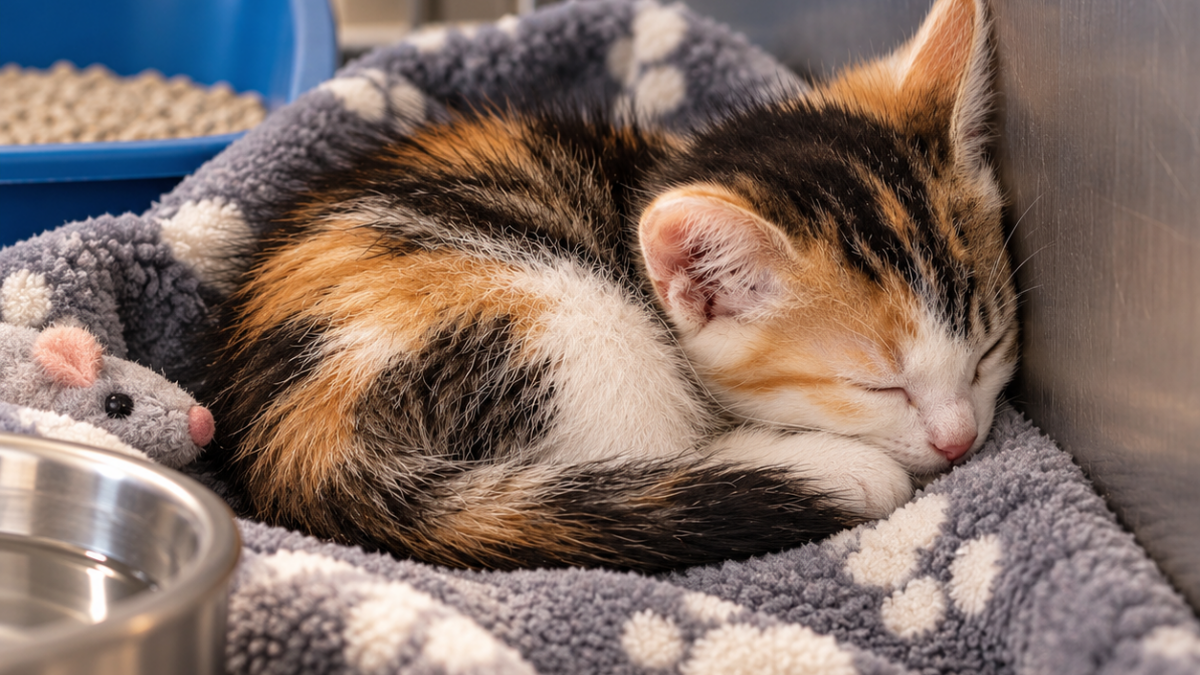
I went to the shelter to pick up a carrier, not a cat—but before I left, I noticed a tiny tail disappearing behind a folded towel.
The six-week-old kitten hiding there would not cry, reach through the bars, or even look at people for long, as if she had already learned that wanting someone could end badly.
I had promised myself one cat was enough, and I still believed that promise when I crouched beside her enclosure for the first time.
My name is Megan, and until the day I met Juniper, I was absolutely certain I understood my limits.
I already had Arthur.
Arthur was twelve years old, gray, opinionated, and completely convinced that my house existed because he needed several different places to nap.
He had been with me for almost a decade.
We understood each other.
Breakfast at six.
Dinner at five-thirty.
The left side of the couch belonged to him.
The warm chair by the window also belonged to him.
Technically, everything belonged to him.
I merely paid for it.
Whenever friends suggested I adopt another cat, I always gave the same answer.
“One cat is enough.”
I meant it.
I worked full-time. Arthur was older. He liked quiet. I liked quiet.
Our life worked.
Then, one Tuesday afternoon, I stopped at the shelter to retrieve a carrier I had loaned to one of the volunteers.
That was all.
I was supposed to be there ten minutes.
I walked past the kitten room while waiting for someone to find the carrier.
Most of the enclosures were impossible to ignore.
Tiny paws reaching through doors.
High little voices demanding attention.
Kittens tumbling over blankets and each other.
Everyone wanted to be seen.
Everyone except the one I almost missed.
A folded towel had been tucked along the back of one enclosure.
Something moved behind it.
Just the tip of a tail.
Calico.
I stepped closer.
“Who’s hiding back there?”
A volunteer named Denise came up beside me.
Her face changed when she saw which enclosure I meant.
“That’s Juniper.”
“Juniper?”
“She came in two nights ago.”
I crouched.
At first, all I could see was the towel.
Then a tiny face appeared.
One orange ear.
A white stripe across her nose.
Eyes far too tired for such a small kitten.
She looked at me for maybe three seconds.
No excitement.
No curiosity.
No tiny hopeful meow.
Just caution.
Then she disappeared again.
“What happened to her?”
Denise lowered her voice.
“A maintenance worker found four kittens beneath the steps of an abandoned house.”
I kept looking toward the towel.
“The mother had apparently been caring for them there, but she stopped coming back.”
My stomach tightened.
“How long?”
“No one knows exactly.”
Denise paused.
“By the time they were found, Juniper was the only one still hanging on.”
I closed my eyes for a second.
Juniper was only about six weeks old.
She had come in extremely cold, dangerously dehydrated, and much too small for her age.
The staff had expected noise.
Searching.
Calling.
Instead, Juniper had gone quiet.
She ate if food was placed directly in front of her.
Then she returned behind the towel and faced the wall.
I wanted to reach inside.
I did not.
Something about the way she hid told me the last thing she needed was another stranger deciding what happened to her body.
So I sat there.
“Okay,” I whispered.
The towel did not move.
“We’re not friends yet.”
Nothing.
“That’s fair.”
A volunteer finally brought me the carrier.
I stood.
Took two steps.
Then turned back.
Juniper remained hidden.
I told myself to leave.
Arthur was waiting at home.
I was not adopting another cat.
I was not even looking for one.
Still, before walking out, I asked Denise one question.
“Can I bring her some kitten food tomorrow?”
Denise smiled.
“Of course.”
I went home with an empty carrier.
Arthur was asleep in his chair.
I set my keys down and looked at him.
“One cat is enough.”
Arthur opened one eye.
“Exactly.”
He went back to sleep.
But that night, every time I closed my eyes, I saw one orange ear disappearing behind a towel.
And by morning, I already knew I was going back.
PART 2
I told myself the second visit was practical.
That was the lie.
I stopped at a pet-supply store on my lunch break and stood in front of the kitten-food shelves much longer than necessary.
There were too many choices.
Chicken.
Turkey.
Salmon.
Soft mousse.
Shredded meat.
High-calorie formulas.
I finally texted Denise.
**What is Juniper eating?**
She answered two minutes later.
**Kitten pâté. Chicken seems easiest for her.**
I bought six cans.
Six.
For a kitten who was not mine.
As I paid, the cashier looked at the stack.
“New kitten?”
“No.”
She glanced at the cans.
I corrected myself.
“Shelter kitten.”
She smiled.
“That’s how it starts.”
I should have returned everything immediately.
Instead, I drove to the shelter.
Juniper was exactly where I had left her.
Behind the towel.
Denise opened the enclosure and placed a small amount of food near the front.
“Want to try?”
“What?”
“Put the plate down.”
I hesitated.
“Will I scare her?”
“Move slowly.”
I slid the plate onto the floor of the enclosure and withdrew my hand.
Nothing.
I sat in the chair beside the enclosure.
Five minutes passed.
Then the towel shifted.
Juniper’s nose appeared.
She looked at me.
Then the food.
Back at me.
I turned my face away slightly.
That seemed to help.
She crept forward.
Her body looked impossibly small.
She reached the plate.
Took one bite.
Stopped.
Looked toward me.
I kept still.
Another bite.
Then another.
By the time she finished, I had barely moved.
Juniper backed away and disappeared behind the towel.
“That went well,” Denise said.
“She left.”
“She ate while you were here.”
“She looked terrified.”
“She ate.”
I understood.
Progress did not always look impressive.
Sometimes progress was a frightened kitten deciding fear and hunger could occupy the same room for a few minutes.
I returned the next day.
And the next.
I began organizing my errands around the shelter without admitting I was doing it.
On the third visit, Juniper stayed visible for almost a full minute.
On the fourth, she did not immediately retreat when I sat down.
On the fifth, she ate while my hand rested several inches outside the enclosure.
The sixth visit changed something.
I arrived later than usual.
The shelter was quieter.
Most of the afternoon visitors had gone home.
Denise saw me walk in and smiled.
“You’re late.”
“I have a job.”
“Tell Juniper.”
“I don’t think Juniper owns a clock.”
Denise laughed.
I entered the kitten room.
Juniper was sitting near the front of the enclosure.
Not behind the towel.
Not even touching it.
I stopped.
“Hi.”
Her ears moved toward my voice.
I crouched.
Juniper stayed.
That felt enormous.
I lowered one hand beside the open enclosure door.
Not toward her.
Just available.
She stared.
Ten seconds.
Twenty.
Then she stepped forward.
One paw.
Stopped.
Another.
Her nose moved toward my fingers.
She sniffed once.
Then pulled back.
I did not follow.
“All right.”
Juniper remained at the front instead of hiding.
When I finally left, I called my sister from the parking lot.
“I think I’m in trouble.”
“What happened?”
“There’s a kitten.”
My sister immediately laughed.
“That was fast.”
“I am not adopting her.”
“Sure.”
“I mean it.”
“What’s her name?”
I hesitated.
“Juniper.”
“Uh-huh.”
“Stop.”
“You’ve visited her how many times?”
“Six.”
“Megan.”
“She’s had a hard start.”
“I’m sure.”
“Arthur doesn’t want another cat.”
“Did Arthur tell you that?”
“Yes.”
“With words?”
“With his entire personality.”
My sister laughed.
“Call me after visit seven.”
“I hate you.”
“I know.”
Visit seven was uneventful.
Which meant it was perfect.
Juniper sat closer.
Ate.
Played briefly with the edge of a cloth toy when she thought nobody was paying attention.
Then came visit eight.
I remember the number because I counted later.
At the time, it was just Saturday morning.
I had nowhere to be.
The shelter was busy, but Juniper’s room felt strangely quiet.
I sat on the floor beside her enclosure.
Denise opened the door.
“You can sit inside the little socialization area with her today if you want.”
“Is she ready?”
“We’ll let her decide.”
That phrase would become almost sacred to me.
We’ll let her decide.
Juniper was carried in her bedding into the enclosed visiting area so she would not have to be held longer than necessary.
I sat on the floor.
Cross-legged.
Hands resting against my knees.
Juniper stayed near the wall.
I did not call her.
Did not pat the floor.
Did not reach.
I looked at a spot beside me instead.
Minutes passed.
Juniper stood.
She took one step.
Then another.
Stopped.
I could hear other kittens crying from the next room.
A door closed somewhere down the hall.
Juniper flinched.
I thought she would retreat.
She did not.
She continued toward me.
Five feet.
Three.
One.
Then she reached my knee.
She sniffed my jeans.
My heart started pounding.
“Hi.”
Juniper lifted one paw onto my leg.
I did not move.
The second paw followed.
Then, with the awkward determination of a very small kitten climbing something much too large, she pulled herself into my lap.
My eyes filled immediately.
She turned once.
Twice.
Then folded herself into the smallest ball imaginable.
Her head pressed against my stomach.
Within minutes, her breathing slowed.
Juniper was asleep.
I looked toward Denise through the glass.
She had one hand over her mouth.
I whispered:
“What do I do?”
Denise mouthed:
**Nothing.**
So I did nothing.
For almost an hour.
My feet fell asleep.
My lower back began aching.
I did not care.
Juniper slept.
That was the part that broke me.
Not that she had climbed onto me.
That she slept.
A kitten who had spent the first days at the shelter pressing her nose against a cold wall had decided my body was safe enough to stop watching the world.
Every once in a while, her paw twitched.
Dreaming.
I looked down at her.
The orange ear.
The white stripe.
Tiny ribs moving beneath calico fur.
I thought about the crawl space beneath that abandoned house.
Her mother leaving and not returning.
Her siblings.
Cold.
Waiting.
I stopped myself.
Juniper did not need me turning her life into a tragedy while she was sleeping.
She was warm now.
Alive.
Safe.
That was the fact that mattered.
After fifty-three minutes, Juniper woke.
I know because Denise checked the clock.
Juniper lifted her head.
Looked at me.
Then stepped out of my lap.
She walked back toward the blanket.
No dramatic affection.
No meowing.
No final glance.
I laughed softly.
“Okay.”
She curled up again.
Apparently our emotional breakthrough had concluded.
On the drive home, I kept remembering the weight of her.
Almost nothing.
Arthur met me near the door.
He smelled my jeans.
His expression changed.
“Oh.”
He smelled again.
“Don’t start.”
Arthur stared at me.
“She is not coming here.”
He continued sniffing.
“I was visiting.”
His tail moved once.
“You are still an only child.”
Arthur walked away.
I followed him into the kitchen.
“One cat is enough.”
Arthur jumped onto his chair.
I opened his food.
He ate.
Everything remained exactly as before.
Except I had started imagining Juniper in the spare room.
That was a problem.
I did not decide immediately.
That matters.
People love to tell rescue stories as if one emotional moment answers every practical question.
It does not.
Love does not make introductions between cats easier.
Love does not pay veterinary bills.
Love does not guarantee that an older resident animal will accept a kitten.
I already had a responsibility to Arthur.
Bringing Juniper home could not mean turning his stable life upside down without planning.
So I talked with the shelter.
The veterinarian.
A behavior volunteer.
We discussed quarantine.
Gradual introductions.
Separate spaces.
Scent swapping.
Feeding on opposite sides of a closed door.
Letting Arthur set the pace too.
Juniper was medically improving.
She had gained some weight.
Her hydration was normal.
Her body was finally beginning to look like that of a kitten instead of an exhausted little creature trying to conserve every ounce of energy.
She still hid sometimes.
But she played now.
The first time I saw her attack a shoelace, I nearly cheered.
“That is an appropriate kitten problem,” I told Denise.
Juniper continued attacking the lace.
The shelter had not formally asked me to adopt her.
I think everyone was waiting for me to stop pretending.
A week after the lap incident, Denise finally said:
“Have you thought about fostering her?”
I gave her a look.
“You planned this.”
“I did not.”
“You knew.”
“I suspected.”
“What if Arthur hates her?”
“Then we manage carefully and reassess.”
“I won’t let him be miserable.”
“You shouldn’t.”
“What if Juniper regresses?”
“Then you give her space.”
“What if I mess this up?”
Denise smiled.
“You probably will mess something up.”
“That’s reassuring.”
“Then you’ll adjust.”
I looked through the glass.
Juniper was asleep inside a little bed.
Not facing the wall anymore.
Her nose rested against the edge.
“I could foster.”
Denise nodded.
“That’s all we’re discussing.”
“Temporary.”
“Of course.”
“I’m serious.”
“So am I.”
Nobody believed either of us.
Preparing my house for Juniper became a military operation.
The spare bedroom became her base camp.
Litter box.
Food.
Water.
Bed.
Small hiding box.
Scratching surface.
Toys.
Nothing too overwhelming.
Arthur was banned from the room at first.
He immediately became obsessed with the closed door.
“What is in there?” his entire body seemed to ask.
“Nothing.”
Arthur sat outside it.
“There is no cat.”
Arthur sniffed beneath the door.
“Fake news.”
He looked at me.
I carried Juniper home the following Friday.
The car ride frightened her.
She stayed low in the carrier.
I spoke quietly.
“You have no idea what’s happening.”
Her eyes stayed wide.
“That’s fair.”
When we arrived, Arthur was behind another closed door so Juniper could enter without being confronted.
I placed the carrier in her room.
Opened it.
Sat several feet away.
Juniper did not come out.
An hour passed.
Still inside.
I eventually left the room.
Thirty minutes later, when I checked quietly, the carrier was empty.
Juniper was beneath the bed.
Of course.
For the first two days, she spent most of her time there.
She ate when I left.
Used the litter box.
Explored at night.
I heard tiny footsteps through the wall.
Arthur heard them too.
At three in the morning, I found him sitting outside the spare-room door.
“What are you doing?”
He looked at me.
“You know you’re supposed to sleep.”
Arthur stared at the door.
“She’s temporary.”
His eyes narrowed.
“Don’t judge me.”
The scent introduction began.
I took a small blanket Juniper had slept on and placed it near Arthur.
He smelled it.
His body stiffened.
Then he walked away.
Not ideal.
Not disastrous.
I moved one of Arthur’s blankets into Juniper’s room.
Juniper sniffed it.
Then slept on it.
That seemed unfair.
Arthur was treating her scent like an invasion.
Juniper treated his like luxury bedding.
Day four, they ate on opposite sides of the closed door.
Arthur refused at first.
He stared at the door.
Then at me.
Then back at his food.
“Your dinner is still dinner.”
Arthur looked insulted.
Juniper began eating immediately on the other side.
The sound of her little mouth working seemed to convince Arthur the enemy had no interest in stealing his bowl.
He finally ate.
Small victory.
Over the following days, the bowls moved gradually closer to the door.
Then came the first visual introduction through a barrier.
Arthur saw Juniper.
Juniper saw Arthur.
I held my breath.
Arthur froze.
His expression was extraordinary.
He did not look angry.
He looked betrayed.
Deeply, personally betrayed.
As though I had brought home a piece of furniture that moved without permission.
Juniper, meanwhile, looked fascinated.
She stepped closer.
Arthur stepped back.
Juniper tilted her head.
Arthur turned around and walked away.
“Arthur.”
He ignored me.
“You are being dramatic.”
His tail flicked.
Juniper watched him leave.
That was the first moment I realized she had chosen him before he had any intention of choosing her.
The next visual session went similarly.
Arthur entered.
Juniper moved toward him.
Arthur left.
Third session:
Juniper tried to follow.
Barrier stopped her.
Arthur looked at me.
“This is not my fault.”
His face disagreed.
Eventually, supervised time in the same room began.
I expected Juniper to be cautious.
She was cautious with humans.
Arthur was different.
The second she was allowed into the living room, she marched toward him on impossibly small legs.
Arthur was sitting beside the couch.
Juniper stopped two feet away.
Arthur looked at her.
Juniper sat.
Arthur stood.
Walked to the window.
Juniper followed.
He sat on the sill.
Juniper sat beneath him.
He looked down.
She looked up.
Arthur turned his head away.
“It’s going great,” I whispered.
My friend Laura, who was visiting, whispered back:
“He hates you.”
“Who?”
“Arthur.”
“He’ll recover.”
“Maybe.”
Juniper shadowed him everywhere.
If Arthur moved into the kitchen, she followed.
If he jumped onto the couch, she settled beneath it.
If he went upstairs, she attempted to climb the stairs after him until I intervened because she was still too small and awkward.
Arthur treated her like background noise.
Juniper did not care.
She had apparently decided he was hers.
I began worrying.
“What if she’s stressing him?”
Laura shrugged.
“He’s eating.”
“Yes.”
“Sleeping?”
“Yes.”
“Using litter normally?”
“Yes.”
“He mostly looks offended.”
“That’s his normal face.”
“Exactly.”
Still, I watched carefully.
Arthur deserved boundaries too.
If he moved away, I did not let Juniper corner him.
If she became too energetic, I redirected her with play.
Separate rest spaces remained.
One cat’s healing could not come at another cat’s expense.
That balance mattered.
Juniper grew stronger by the week.
Her body filled out.
Her eyes became brighter.
Then her voice arrived.
That surprised me most.
The silent shelter kitten became chatty.
Not constantly.
But when she wanted breakfast?
A tiny squeak.
When she lost sight of Arthur?
Squeak.
When I closed the bathroom door?
Squeak.
When a toy disappeared beneath furniture?
Several increasingly outraged squeaks.
I laughed the first time she yelled at me.
“You found your voice.”
Juniper squeaked again.
“Good.”
The little kitten who had once faced a wall now had complaints.
I considered that an excellent sign.
At night, Juniper still slept in her room.
Arthur still slept in mine or on his favorite chair.
I was not rushing overnight access.
Then one morning, about three weeks after Juniper arrived, I walked downstairs earlier than usual.
Something stopped me in the living-room doorway.
Arthur was in his favorite chair.
Asleep.
That alone was normal.
Then I saw the calico shape curled against his stomach.
Juniper.
Her body was tucked so tightly against him that she nearly disappeared into the blanket.
One of Arthur’s front paws rested across her back.
I did not move.
Could not.
Arthur was asleep.
Juniper was asleep.
Together.
The old cat who had spent weeks pretending Juniper did not exist had apparently made a decision sometime during the night.
I covered my mouth.
It was not only cute.
It was what the position meant.
Juniper had spent the earliest days I knew her sleeping with her nose pressed toward a shelter wall.
She had learned to make herself small.
Hide.
Ask for nothing.
Now she was sleeping in the center of Arthur’s favorite chair with an old cat’s paw over her body.
No wall.
No towel.
No empty crawl space.
Someone was beside her.
I took one photograph from a distance.
No flash.
Then I backed away.
Twenty minutes later, Arthur woke.
He looked down.
Juniper remained asleep.
Arthur looked toward me.
I swear his expression said:
Do not discuss this.
“Of course.”
He started grooming her head.
I almost cried again.
“Arthur.”
He stopped.
Looked annoyed.
Then continued.
That was the day everything changed.
Not instantly.
Arthur still became irritated with Juniper.
She still tried to play with his tail when he wanted to sleep.
He still left rooms because she had too much energy.
But the wall between them was gone.
Juniper began sleeping beside him regularly.
Sometimes Arthur put a paw over her.
Sometimes she sprawled across him with no respect for personal space.
He tolerated far more than I expected.
Once, I found Juniper asleep directly on his back.
Arthur looked at me.
“You allowed this.”
He blinked slowly.
“I’m sorry.”
I was not sorry.
The adoption question became unavoidable.
Denise called.
“How’s the foster?”
“Annoying.”
“Juniper?”
“Arthur.”
She laughed.
“Do you want me to send you the adoption paperwork?”
“Why?”
“For Juniper.”
“She’s a foster.”
Silence.
“What?”
“Megan.”
“What?”
“Where is Juniper right now?”
I looked toward the living room.
Asleep against Arthur.
“Busy.”
“Doing?”
“Sleeping.”
“Where?”
I sighed.
“Arthur.”
“And how is Arthur?”
“Asleep too.”
“Want me to send the paperwork?”
I was quiet.
Denise’s voice softened.
“You don’t have to keep her because you’re afraid of another transition.”
That mattered.
I had been thinking exactly that.
Was I keeping Juniper because I wanted her?
Or because I could not tolerate the idea of her being moved again?
Those were not the same thing.
A good adoption decision had to be about the future.
Could I responsibly support two cats?
Could Arthur continue living comfortably?
Was Juniper genuinely thriving?
Would I resent the added cost or commitment later?
I spent several days thinking.
Budget.
Veterinary care.
Time.
Pet insurance options.
Emergency savings.
Arthur’s age and medical needs.
Juniper’s future.
This time, emotion was not enough.
Then one evening, I sat on the couch.
Arthur climbed beside me.
Juniper followed.
She tucked herself against his side.
Arthur started purring.
Then Juniper purred too.
Two different frequencies.
One old.
One young.
I looked at them.
The answer stopped feeling complicated.
The next morning, I signed the papers.
Juniper was mine.
Or more accurately, ours.
When I told my sister, she laughed for almost a full minute.
“I hate you.”
“No, you don’t.”
“I said one cat was enough.”
“You were right.”
“What?”
“One Arthur was enough.”
“That makes no sense.”
“Juniper is a Juniper.”
“You need help.”
Probably.
Juniper’s adoption did not erase her past.
For months, certain things still frightened her.
A door closing suddenly.
A loud thump upstairs.
Unexpected footsteps.
Once, a maintenance worker entered the house while I was holding Arthur behind another door.
Juniper disappeared under the bed for three hours.
I sat nearby.
Did not pull her out.
“Take your time.”
Eventually, one calico face appeared.
Then the rest.
Healing was not a straight line.
That was important.
People saw photographs of Juniper sleeping with Arthur and assumed the story was finished.
Safe kitten.
Happy home.
Done.
Real life continued.
Juniper still had nights when she woke suddenly.
Still occasionally carried food away from her bowl to eat in a more hidden spot.
Still became nervous if I moved too quickly near her while she slept.
We adjusted.
No punishment.
No forcing.
No disappointment.
Safety needed repetition.
Again.
Again.
Again.
Arthur became an unexpected part of that repetition.
He was predictable.
That made him perfect for her.
He ate at the same times.
Slept in the same places.
Walked through the house at the same pace.
He had no interest in grabbing Juniper.
No desire to prove affection.
If she followed, fine.
If she climbed beside him, maybe fine.
If she bit his tail, absolutely not fine.
His boundaries were clear.
Juniper seemed to love that.
There is comfort in knowing the rules.
She learned them.
Arthur taught her things I could not.
How to sit at the window.
Which sunny spot appeared in the afternoon.
The fastest route to the kitchen when the food container opened.
How to ignore the vacuum until it became too close.
Which chair belonged to them.
Where to wait while I prepared breakfast.
Juniper copied everything.
At six months old, she sat like Arthur.
At eight months, she had learned his slow blink.
At one year, she even adopted his habit of waiting at the top of the stairs and judging me when I came home late.
I stared at them one evening.
“This house has become hostile.”
Arthur blinked.
Juniper blinked.
“Exactly.”
The tiny kitten who once tried not to be noticed had become impossible to ignore.
She developed opinions.
Breakfast should happen earlier.
Closed doors were unacceptable.
Arthur was required to participate in grooming whether interested or not.
The red toy mouse belonged in the water bowl for reasons nobody else understood.
If I worked from home, Juniper sat on my keyboard.
If I moved her, she returned.
That behavior made me ridiculously happy.
Confidence can be inconvenient.
That is often how you know it is real.
Juniper stopped moving through life as though she needed permission to exist.
She occupied space.
Stretched across furniture.
Interrupted.
Demanded.
Played.
That became the first form of “revenge” in her story.
Not against a person.
I never knew what happened to her mother.
I did not know why the abandoned house had become their shelter.
There was nobody for me to punish.
No villain I needed to invent.
The revenge was against the future that Juniper’s first weeks seemed to predict.
She had once hidden because being seen felt dangerous.
Now she sat in the middle of the hallway and forced humans to step over her.
She once ate only when food was placed inches from her face.
Now she arrived five minutes before dinner and shouted.
She once slept facing a wall.
Now she slept upside down in the center of my bed.
Fear lost ground.
Every day.
That was enough.
Arthur aged while Juniper grew.
I knew that would be part of our story from the beginning.
He had been twelve when she arrived.
She was six weeks.
They were at opposite ends of life.
Sometimes I watched Juniper attack one of his toys while Arthur slept and felt a shadow of sadness.
Their time together would be shorter than hers with me.
I hated thinking about it.
So I tried not to borrow grief from the future.
That phrase became important.
Do not borrow grief from the future.
Today, Arthur was eating.
Sleeping.
Purring.
Complaining.
Juniper was beside him.
That was today’s truth.
Let tomorrow arrive tomorrow.
Arthur surprised everyone by becoming more active after Juniper settled in.
Not kitten-active.
Arthur still had standards.
But he played more.
One evening I saw him chase Juniper halfway down the hallway.
I stared.
“Who are you?”
He stopped immediately.
Apparently being witnessed ruined it.
Juniper jumped onto him.
Arthur walked away with dignity.
The veterinarian noticed too.
“He’s doing well.”
I smiled.
“Juniper annoys him into exercise.”
“Whatever works.”
At home, I told Arthur the vet approved of his younger roommate.
He turned his back.
“I understand.”
Juniper jumped onto the couch beside him.
He made room.
That tiny adjustment—six inches of space—became one of the things I loved most.
Arthur never became demonstrative by human standards.
He did not carry Juniper around.
Did not “adopt” her in some literal sense.
He simply included her.
Sometimes inclusion is quiet.
Share the chair.
Allow the body beside yours.
Groom the small head.
Move over.
Juniper understood.
Years passed.
The difference in their sizes disappeared.
Juniper became a full-grown calico.
Strong.
Bright.
Beautiful.
The one orange ear remained my favorite feature.
Arthur became grayer around the face.
Slower climbing stairs.
Juniper still followed.
If Arthur moved to the window, Juniper moved to the window.
If Arthur chose the couch, Juniper arrived.
Sometimes I wondered whether she remembered life before him.
Probably not in the narrative way humans remember.
Her earliest experiences may have shaped her nervous system, but the details?
Impossible to know.
That was okay.
Her present had become much larger than her beginning.
I stopped introducing her as “the kitten who lost her mother.”
That was part of her story.
Not her identity.
She was Juniper.
She loved chicken.
Hated the doorbell.
Followed Arthur.
Stole hair ties.
Slept with one paw covering her face.
Yelled from another room if she woke and could not immediately locate us.
That last behavior touched me.
Not because I wanted to romanticize fear.
Because now, when Juniper called, somebody answered.
Every time.
Sometimes me.
Sometimes Arthur would walk toward the sound.
Juniper would see him and relax.
I often thought about the crawl space.
Four tiny kittens waiting for a mother who did not return.
Whatever had happened there, Juniper had experienced absence before she understood anything else.
Now she lived in a house where calling produced footsteps.
That was justice.
Quiet justice.
One winter evening, the power went out.
The house became dark and colder quickly.
I lit battery lanterns.
Arthur settled beneath a blanket.
Juniper became restless.
Every unusual sound made her move from room to room.
I sat on the floor.
“June.”
She stopped.
I almost never called her June, but somehow it came out.
She walked toward my voice.
Then Arthur emerged from beneath his blanket.
Juniper immediately went to him.
He sniffed her face.
She lay beside him.
Power returned three hours later.
Until then, they remained together.
Watching them, I understood something.
I had always thought I was the one who had given Juniper a family.
That was only partially true.
Arthur had chosen her too.
Reluctantly.
Slowly.
Without any sentimental speech.
He had given a kitten another living body that stayed.
That mattered in ways I could never measure.
Maybe more than anything I did.
The shelter anniversary came around.
Denise asked whether I would bring photographs for their adoption board.
I chose three.
Juniper behind the towel.
Juniper asleep in my lap.
Juniper full-grown beside Arthur.
Denise looked at them.
“This one.”
She pointed to the lap photo.
I shook my head.
“No.”
“You don’t like it?”
“I love it.”
“Then why?”
I pointed to the third.
“This is the ending.”
Arthur and Juniper were asleep in the chair.
His paw across her back.
Not because she needed protecting anymore.
Just habit.
Denise smiled.
“Okay.”
They displayed that photograph.
Below it:
**JUNIPER — ADOPTED**
Simple.
No dramatic caption.
I liked that.
There is dignity in not making every rescued animal relive their hardest moment for strangers.
Juniper had survived.
Then she had lived.
The living part deserved attention too.
Several visitors asked about her.
A woman considering a shy kitten said:
“How long before Juniper trusted you?”
I thought.
“I don’t know.”
“You don’t remember?”
“I remember the milestones.”
“The lap?”
“Yes.”
“But?”
“I stopped measuring pretty early.”
She looked confused.
I explained.
“If you count every day until an animal gives you what you want, you turn trust into a deadline.”
The woman looked toward the shy kitten she was considering.
“So what did you do?”
“Showed up.”
“That’s it?”
“Mostly.”
Food.
Quiet.
Predictability.
Space.
Again.
Again.
Again.
The woman eventually adopted that kitten.
Months later she sent the shelter a photo.
The cat was asleep on her couch.
I saved it.
Juniper’s story had traveled outward.
That mattered.
Not because Juniper became famous.
She did not.
Because one small example gave someone patience.
Rescue multiplies through behavior.
You learn.
Then someone watches you.
Then they act differently.
That is enough.
Arthur’s health eventually began changing.
Kidneys.
Arthritis.
Age.
We adjusted.
Low steps.
Water in more places.
Regular veterinary monitoring.
Medication.
Juniper adjusted too.
She stopped trying to initiate as much rough play.
Whether that was deliberate empathy or simple response to his lower energy, I cannot know.
But she stayed near him.
When Arthur began sleeping more, Juniper slept more beside him.
I watched and felt fear growing.
Again:
Do not borrow grief from the future.
But the future was getting closer.
One morning, Arthur struggled to climb into the chair.
I moved to help.
Before I reached him, Juniper jumped onto the seat and turned toward him.
Arthur tried again.
Made it.
Juniper immediately moved aside.
He settled.
She lay beside him.
I sat on the floor and cried.
Not because something terrible had happened.
Because time was visible.
Arthur had once seemed enormous beside six-week-old Juniper.
Now she was larger than he was.
His body had narrowed with age.
Hers was strong.
Roles change slowly.
Then suddenly you notice.
I called my sister that night.
“Arthur’s getting old.”
“He’s been old.”
“You know what I mean.”
“Yes.”
“What happens to Juniper when…”
I could not finish.
My sister was quiet.
“She’ll have you.”
“I know.”
“And you’ll have her.”
I hated the answer because it was true and insufficient.
Some relationships cannot be protected from endings.
The value is not that they last forever.
The value is that they happen.
I knew that intellectually.
Emotionally, I wanted Arthur immortal.
He disagreed.
Arthur remained Arthur.
He still yelled at me if dinner was late.
Still pushed Juniper away if she groomed the same spot too long.
Still occupied the center of the bed.
Still had good days.
We focused there.
One afternoon, I found Juniper grooming Arthur’s face.
He usually tolerated three licks before moving.
This time, he remained.
Juniper cleaned one ear.
Then his forehead.
Arthur closed his eyes.
I took no photo.
Some things I wanted to experience directly.
The quiet sound of her tongue against fur.
Arthur purring.
Sunlight.
Nothing else.
That memory became important later.
Arthur’s final decline came months after that.
Slow.
Managed carefully.
Our veterinarian helped me make decisions based on comfort and quality of life.
I will not turn those days into spectacle.
Arthur deserved better than being remembered only through a difficult ending.
What matters is that he remained surrounded by what he knew.
Home.
My voice.
His chair.
Juniper.
During one of his last quiet evenings, Juniper climbed beside him.
Arthur was under a blanket.
She rested her head against his shoulder.
I sat nearby.
Years collapsed.
The tiny shelter kitten.
The annoyed older cat.
The first shared chair.
Now this.
Arthur had never made any promise to Juniper.
He simply stayed.
Until he could not.
When his time came, the house changed.
Anyone who has lost an animal knows what I mean.
The objects remain.
The schedule remains in your body.
The house does not understand that the routine has ended.
I woke the next morning at Arthur’s breakfast time.
Automatically reached for two bowls.
Stopped.
One bowl.
Juniper sat in the kitchen doorway.
She looked toward the place where Arthur usually waited.
Then at me.
My heart broke.
I crouched.
Juniper walked forward.
Not hesitantly.
She pressed against my legs.
I sat on the floor.
She climbed into my lap.
Full-grown now.
Too large to become the tiny ball she had been years earlier.
Still, she tried.
I wrapped one arm around her loosely.
She purred.
I cried.
The first time she slept in my lap, I had stayed perfectly still because I was afraid movement would remind her people could disappear.
Now Arthur had disappeared in the only unavoidable way.
No amount of stillness could change it.
But Juniper did not retreat behind a towel.
She came closer.
That distinction mattered.
Grief hurt her routine.
But safety remained.
She still ate.
She slept near me.
She searched for Arthur for several days.
Checked his chair.
Waited near the window.
I did not pretend I knew exactly what she understood.
I simply kept the house predictable.
Same meals.
Same voices.
Same rooms.
Same affection on her terms.
Eventually, Arthur’s chair became Juniper’s.
The first time she climbed into it alone, I stopped in the doorway.
She turned twice.
Curled.
Closed her eyes.
I almost expected a gray paw to appear across her back.
None did.
I cried.
Then I smiled.
Arthur had given her the chair years earlier one reluctant inch at a time.
Now she occupied the whole thing.
Life moves like that.
We inherit spaces from those who leave.
Not because we wanted them to leave.
Because eventually, continuing is the only direction available.
Juniper continued.
So did I.
For months, I kept Arthur’s bowl in the cabinet.
His favorite blanket remained folded near the chair.
Juniper sometimes slept on it.
I let her.
Some people rush to remove reminders because the pain is too sharp.
Others need them.
There is no correct schedule for grief.
Juniper taught me not to impose deadlines on trust.
Arthur taught me not to impose them on loss either.
The house slowly found a new rhythm.
Juniper became more attached to me.
She had always loved me.
But Arthur had been her compass.
Without him, she began waiting at the door when I returned.
Sleeping nearer my pillow.
Following me from room to room.
At first, this made me sad.
Then I realized I was doing something unfair.
I was interpreting every new behavior as evidence of what she had lost.
Maybe some were.
But Juniper was also changing because life changes.
She was not permanently a grieving kitten.
She remained curious.
Playful.
Opinionated.
We bought new toys.
She ignored the expensive ones.
Found a cardboard box.
Arthur would have approved.
One afternoon, I watched Juniper chasing a piece of paper through the hallway.
She crashed gently into a laundry basket.
Stopped.
Looked at me.
Then attacked the paper again.
I laughed harder than I had in weeks.
That laughter felt guilty for one second.
Then I let the guilt go.
Joy after loss is not betrayal.
Juniper had survived enough to earn joy.
So had I.
A year after Arthur was gone, the shelter invited me back for another event.
I almost declined.
Walking into that kitten room still carried memories.
But I went.
The layout had changed.
New enclosures.
Different towels.
Different kittens.
One enclosure contained a tiny tabby hiding beneath a blanket.
I stopped.
My chest tightened.
A volunteer said:
“He’s shy.”
I smiled.
“I know the type.”
I sat several feet away.
The kitten did not come out.
That was fine.
I did not need him to.
Denise, still volunteering after all those years, came around the corner.
“Well.”
“What?”
“Full circle.”
“Don’t say that.”
“You were standing right there when you met Juniper.”
“I remember.”
“How is she?”
“Bossy.”
“Perfect.”
We walked to the adoption board.
Juniper and Arthur’s old photo was still in a binder of success stories.
I had forgotten it existed.
I opened the page.
Arthur asleep.
Juniper curled against him.
Paw across her back.
I touched the edge of the photo.
Denise stood beside me.
“You okay?”
“Yeah.”
And I was.
Sad.
Grateful.
Okay.
Human emotions rarely arrive one at a time.
On the drive home, I thought about Juniper’s beginning.
I used to tell the story as though I had rescued her.
Then I started telling it as though Arthur rescued her.
Both versions were too simple.
Juniper’s life changed because many people participated.
The maintenance worker who looked beneath the steps.
Shelter staff who warmed and rehydrated her.
Denise.
Veterinarians.
Me.
Arthur.
Even Juniper herself.
She ate.
She emerged.
She approached.
She climbed.
Trust is collaborative.
Safety must be offered.
But the frightened one still has to decide whether to step toward it.
Juniper did.
One paw.
Then another.
That was her courage.
Years after the shelter, Juniper became the cat visitors noticed first.
She greeted certain people at the door.
Not everyone.
She retained standards.
My sister was eventually approved.
It took five years.
“Five years?” my sister said.
“You rushed her.”
“I visit twice a year.”
“Exactly.”
Juniper rubbed against her ankle.
My sister froze.
“Oh.”
I smiled.
“Congratulations.”
“Can I pet her?”
“Let her decide.”
Juniper moved closer.
My sister scratched behind her ear.
Juniper purred.
My sister looked at me.
“I’ve made it.”
“Don’t get arrogant.”
That was Juniper’s gift.
Affection became something you appreciated rather than expected.
I had learned to stop grabbing good moments.
Let them happen.
That lesson spread beyond animals.
I became a better listener.
More patient with people who needed time.
Less offended when someone set a boundary.
Not perfect.
Better.
Juniper had taught me that care is not proven by how quickly you can make someone comfortable with you.
Sometimes care is accepting that they are uncomfortable and refusing to punish them for it.
That truth sounds obvious.
Living it is harder.
Juniper made me practice.
As she entered middle age, her kitten features softened.
The orange ear remained bright.
The white stripe across her nose became the thing everyone commented on.
She filled out to a healthy weight.
The tiny body that once seemed almost weightless became an impressive presence when she stepped directly onto my stomach at five in the morning.
“Ow.”
Juniper purred.
“You are not six weeks old anymore.”
She kneaded.
“I remember when you weighed nothing.”
More kneading.
“Arthur taught you bad manners.”
She settled.
I smiled.
Arthur remained part of our language.
Not constantly.
But naturally.
When Juniper sat in his old chair:
“Arthur would object.”
When she stole his favorite blanket:
“You waited long enough.”
When she stared at me because dinner was late:
“That face is exactly his.”
Maybe memory is one way family remains structurally present.
The person or animal is gone.
But habits they shaped remain in the architecture of daily life.
Arthur had shaped Juniper.
Juniper had shaped me.
That structure remained.
One Christmas, my sister gave me a framed photograph.
Not the famous chair photo.
A different one.
Juniper as a kitten sitting underneath Arthur at the window.
Arthur looked outward.
Juniper looked up at him.
Below the photograph, my sister had added a tiny engraved line:
**She chose him first.**
I cried.
My sister immediately apologized.
“Too much?”
“No.”
“Good crying?”
“There is no good crying.”
She hugged me.
Juniper attacked the wrapping paper.
The frame hangs near Arthur’s old chair.
That sentence became the simplest version of their relationship.
She chose him first.
Arthur took longer.
That did not make his love less meaningful.
Sometimes being chosen feels like pressure.
Especially when you are old, settled, and convinced your routines are complete.
Arthur taught me that too.
“One cat is enough.”
I had said it.
Maybe Arthur would have said the same if he spoke English.
Then Juniper arrived.
She did not ask permission to matter.
She simply kept showing up beside him until one day there was room.
That is how many families form.
Not through perfect planning.
Through adjustment.
At first, I had worried a second cat would ruin Arthur’s peace.
Instead, Juniper became part of his peace.
Not always.
She annoyed him plenty.
But she also lay beside him as he aged.
Groomed him.
Followed him.
Made him play.
Occupied his final years with another heartbeat nearby.
I can never know whether Arthur’s life was “better” in some measurable sense because of her.
But I know it was fuller.
Mine was too.
Years after Juniper’s adoption, someone asked me:
“If you could go back, would you still say one cat was enough?”
I laughed.
“Yes.”
They looked surprised.
“Really?”
“One cat was enough.”
“Then why Juniper?”
“Because enough isn’t the same as full.”
That answer came without planning.
Enough.
My life with Arthur had been enough.
Good.
Stable.
Loved.
Juniper did not arrive because something was missing.
She arrived and created more room.
That distinction mattered.
We do not always need to be incomplete before a new relationship changes us.
Sometimes life is already good.
Then somebody enters.
And good becomes different.
Not necessarily better in every way.
More complicated.
More expensive.
Louder.
Messier.
Also richer.
Juniper did that.
When she became a senior herself, the symmetry felt almost impossible.
My six-week-old kitten had gray beginning to appear in her calico face.
She moved more slowly after long naps.
She preferred the heated pad in winter.
The veterinarian started using phrases like “for her age.”
I hated those words.
“For her age, her bloodwork looks excellent.”
“For her age, her mobility is good.”
Stop mentioning age.
Juniper did not care.
She still demanded breakfast.
Still occupied Arthur’s chair.
Still slept beside me.
But time had become visible again.
This time, I knew the lesson.
Do not borrow grief from the future.
So I did my best.
More checkups.
Senior food as recommended.
Easy access to favorite places.
Low step near the bed.
Warmth.
Routine.
One rainy evening, Juniper climbed into my lap.
She did this often by then.
Still, something about that night pulled me backward through time.
Same rain-softened light.
Same weight settling against my stomach.
Different body.
Larger.
Older.
She turned twice.
Curled.
Then slept.
I placed my hand lightly along her back.
For one second, I was sitting in the shelter again.
Afraid to move.
Afraid the slightest motion would remind a traumatized kitten that people leave.
I almost laughed.
“Look at you.”
Juniper slept.
“You ruined my whole plan.”
Her ear moved.
“One cat.”
Nothing.
“That was the deal.”
She purred.
“Exactly.”
I stayed there until my leg hurt.
Some traditions deserve discomfort.
The most satisfying revenge in Juniper’s story never involved finding someone to blame.
The abandoned house did not become a place I hated.
Her missing mother was not a villain; we never knew what happened to her.
The world had simply given Juniper an unbearably hard beginning.
Our answer was the rest of her life.
That was enough.
She had learned silence?
She found her voice.
She learned hiding?
She occupied the center of rooms.
She learned that warm bodies disappeared?
Arthur stayed for years.
Then I stayed after him.
She learned to sleep against a wall?
She eventually slept across my chest.
She began life as the kitten nobody noticed when the shelter opened.
Later, she became the first face I looked for every time I entered my own house.
That reversal was better than vengeance.
No cruelty required.
No humiliation.
Just a life proving its beginning did not own its ending.
One morning, I woke before sunrise and found Juniper sitting in Arthur’s chair.
She was looking toward the window.
Outside was still dark.
I sat beside her on the floor.
“Can’t sleep?”
She looked at me.
Then stepped down.
Walked onto my lap.
Heavy now.
Warm.
Real.
I thought about the first time I saw only her tail behind the towel.
I had almost walked past.
That thought still unsettled me.
Not because I believed I was some heroic rescuer.
I was not.
I was a woman waiting for a borrowed carrier.
Juniper’s life had already been protected by shelter workers before I arrived.
But I had almost missed the relationship that would change my house.
How many important things in our lives begin as something we nearly fail to notice?
A person.
A conversation.
A job opening.
A frightened animal behind a towel.
Life rarely announces significance.
Sometimes it wiggles one tiny tail and waits to see whether you look closer.
I looked.
Then I kept coming back.
That was all.
The rest grew from repetition.
By the time Juniper was truly old, everyone who knew me knew her story.
But I became careful about how I told it.
I no longer began:
“She was the only kitten who survived.”
That fact was true.
But I preferred:
“I met Juniper when she was six weeks old.”
Then I told people who she became.
Her beginning mattered.
Her life mattered more.
There is a danger in loving rescue stories so much that we turn animals into permanent symbols of suffering.
Juniper was never obligated to carry tragedy for our emotional benefit.
She had survived it.
Then she moved on.
We should let rescued animals have ordinary identities.
Juniper was terrible at sharing the bed.
Juniper hated one specific brand of wet food.
Juniper loved warm laundry.
Juniper would steal the seat the second you stood.
Juniper learned to open a partially closed bathroom door with one paw.
Juniper once fell into an empty cardboard box and blamed me.
Those details mattered too.
Especially those.
They meant she got a life beyond rescue.
That was the goal.
In her later years, Juniper began sleeping even more.
Sometimes I would find her nose pressed against a pillow.
The first few times, the position reminded me painfully of the shelter wall.
Then I realized the difference.
At the shelter, her body had been tight.
Hidden.
Ready to disappear.
Now she slept stretched out.
Belly loose.
Paws open.
Sometimes snoring.
Same nose against something.
Completely different meaning.
Context transforms everything.
A wall can mean isolation.
A pillow can mean comfort.
Juniper had traveled that distance.
I watched her one afternoon.
Sunlight across her back.
Arthur’s old blanket beneath her.
My hand resting nearby.
She woke.
Saw me.
Closed her eyes again.
No need to check.
No question about whether I would still be there.
I think that was the deepest victory.
Not affection.
Expectation.
Juniper expected me.
She expected food.
Warmth.
Home.
Safety.
When good things become expected, fear has lost a great deal of territory.
For a frightened kitten, entitlement can be healing.
I loved her entitlement.
Within reason.
Breakfast at 4:40 a.m. remained unreasonable.
She disagreed.
One year, on the anniversary of Arthur’s passing, I placed fresh flowers near his photograph.
Yes, I became that person.
Juniper watched from his chair.
I sat beside her.
“Your boyfriend.”
She blinked.
“I know. He denied it too.”
She looked away.
“You were obsessed with him.”
Still nothing.
“He loved you.”
Juniper yawned.
“I have photographic evidence.”
She jumped down and walked to the kitchen.
Arthur would have approved of her refusal to become sentimental.
I followed.
Life continued.
Eventually, Juniper’s senior checkups became more frequent.
We managed arthritis.
Monitored kidney values.
Adjusted food.
She remained comfortable for a long time.
When difficult choices eventually approached, I remembered every lesson she had taught me.
Do not force.
Do not make your need the price of love.
Listen.
Let the vulnerable one have as much choice as possible.
Those lessons applied at the end too.
I worked closely with her veterinarian.
Watched appetite.
Mobility.
Comfort.
Interest.
Sleep.
Connection.
I did not want to keep Juniper because I could not tolerate losing her.
I wanted her life to remain hers.
That was the promise.
Her final chapter, when it eventually arrived, was gentle.
I will not turn it into spectacle.
Juniper’s life was too large to reduce to one hard day.
What matters is that she was home.
No cold wall.
No shelter towel.
No crawl space.
No waiting for a mother who would not return.
She had familiar blankets.
My voice.
My hands.
Arthur’s chair.
A whole lifetime of evidence that she had been chosen.
When her time came, she was not alone.
That is enough for me to say.
After Juniper was gone, I kept waking at her breakfast hour.
Of course.
My body had years of training.
I would open my eyes.
For one second, forget.
Then remember.
The house became painfully still.
Arthur gone.
Juniper gone.
There was no cat.
For the first time in decades.
I stood in the kitchen one morning holding an empty bowl.
And started laughing through tears.
“One cat is enough.”
The sentence had followed me for years.
Now there were none.
The silence felt enormous.
My sister called often.
Denise checked on me.
I continued volunteering occasionally.
But I did not immediately adopt again.
Grief is not a vacancy.
Juniper was not a job opening.
Arthur was not a role another cat could fill.
I needed time.
Months later, I visited the shelter to return something.
Of course.
Apparently carriers and shelters were dangerous combinations for me.
I walked past the kitten room.
Several kittens cried for attention.
One slept upside down.
Another attacked a toy.
In the back enclosure, an older cat sat quietly.
Not hiding.
Just watching.
I stopped.
Then laughed.
“No.”
A volunteer walked over.
“What?”
“Nothing.”
The cat blinked.
I pointed at him.
“Don’t start.”
The volunteer looked confused.
I went home alone that day.
That surprised everyone.
Including me.
But Juniper had taught me not to rush relationships just because a story wanted a neat ending.
A few weeks later, I returned.
The older cat was still there.
This time, I sat down.
Different cat.
Different story.
I did not expect Arthur.
Did not expect Juniper.
I simply allowed something new to be new.
Eventually, another adoption happened.
But that is another story.
The important thing is that my heart did not close after Juniper.
It changed shape again.
That was her final gift.
She had begun life learning that absence could hurt.
Yet knowing her taught me the opposite lesson.
Love is still worthwhile even when it eventually creates absence.
Because before the empty chair, there was the shared chair.
Before the empty bowl, thousands of breakfasts.
Before silence, years of purring.
We cannot avoid the end without also refusing the middle.
I would choose the middle every time.
Arthur.
Juniper.
All of it.
When people ask me what I remember most about Juniper, they expect me to describe the day she climbed into my lap.
That is close.
But not quite.
I remember the first morning she slept with Arthur.
I remember standing in the doorway.
Arthur’s gray body curled into the chair.
Juniper tucked against his stomach.
His paw across her back.
That was the image that told me everything had changed.
The kitten who had once pressed herself against a wall because nobody was there to hold her had finally learned what it felt like to sleep beneath somebody’s weight.
Not trapped.
Protected.
She had family on both sides.
A cat.
A human.
A home.
For years after Arthur was gone, Juniper continued sleeping in that chair.
Sometimes I would look at her and see the outline of where his paw used to rest.
Memory is strange like that.
We see absences shaped by love.
But those absences do not erase what existed.
They prove it did.
That is why I still keep the photograph.
Arthur asleep.
Juniper curled against him.
His paw across her.
If someone asks why that photo matters, I tell them:
“Because she used to sleep facing a wall.”
Usually, that is enough.
They understand.
Juniper never needed some grand act of revenge against the world that had given her such a hard beginning.
Her entire life afterward was the answer.
She lived long enough to become loud.
Picky.
Heavy.
Warm.
Demanding.
Loved.
She lived long enough to grow from a six-week-old kitten into the older cat occupying Arthur’s favorite chair.
She lived long enough to stop hiding food.
Stop hiding herself.
Stop sleeping like somebody might disappear before she woke.
She lived long enough to expect me.
What better ending could I ask for?
If there was a score to settle, Juniper settled it simply by living well.
Fear said hide.
Juniper eventually walked into the open.
Loss said do not attach.
Juniper chose Arthur with embarrassing determination.
Silence said disappear.
Juniper learned to shout for dinner.
The cold wall said you are alone.
Arthur’s paw said otherwise.
Then my hands said it again for years after Arthur was gone.
That was our victory.
No villain required.
No punishment.
Just safety repeated so many times that eventually it became more believable than fear.
Sometimes rescue begins with medicine.
Warmth.
Food.
Shelter.
Those things saved Juniper’s body.
But the rest took time.
A woman returning eight times.
A hand that waited.
A lap.
An annoyed older cat moving six inches over.
A paw across a back.
Thousands of predictable mornings.
That saved something harder to measure.
Expectation.
The belief that good things can remain.
I do not know exactly what animals believe.
I will not pretend Juniper thought about abandonment in human words.
But I knew the difference between her body at six weeks and her body years later.
At six weeks, she folded inward.
As an adult, she stretched.
At six weeks, her eyes monitored everything.
Later, she slept through me moving around the room.
At six weeks, she disappeared behind a towel.
Later, she became annoyed if a closed door prevented her from following me.
You do not need human language to recognize safety.
The body tells you.
Juniper’s body eventually said:
I am home.
That is the story.
Not that I broke my rule about one cat.
Not even that I adopted a frightened kitten.
The story is that a tiny animal who had learned to make herself almost invisible discovered a family willing to see her without demanding anything in return.
And because nobody rushed her, Juniper eventually stopped disappearing.
She came forward.
One paw.
Then another.
First toward my hand.
Then my lap.
Then Arthur.
Then the whole house.
That is how she entered our family.
Not all at once.
In inches.
When I think back to the woman I was before meeting Juniper, I understand why I insisted one cat was enough.
I liked control.
Arthur and I had a system.
Predictable.
Safe.
I thought adding another life meant risking the stability I already had.
Juniper taught me that stability and expansion are not opposites.
Sometimes making room does not destroy what already exists.
It reveals that the structure was stronger than you thought.
Arthur remained Arthur.
I remained me.
But our family grew.
The couch became more crowded.
Bills became larger.
The litter situation became objectively worse.
Sleep became less reliable.
I would still choose it.
Every single time.
Years later, when I sat beside Juniper in Arthur’s chair, I sometimes whispered:
“You know, this was supposed to be temporary.”
She purred.
“Exactly.”
Temporary had become years.
Fear had become trust.
Stranger had become family.
And “one cat is enough” had become the sentence everyone in my family used whenever they wanted to make me laugh.
My sister once had it printed on a mug.
**ONE CAT IS ENOUGH**
Below it were two little silhouettes.
An older gray cat.
A calico kitten.
I still use the mug.
The joke stopped hurting after a while.
Now it makes me smile.
Because technically, the sentence was never wrong.
Arthur had been enough.
Juniper was never required to fill a missing space.
She created her own.
That is what love does when it is healthy.
It does not prove what came before was insufficient.
It adds.
Juniper added noise.
Warmth.
Chaos.
Worry.
Laughter.
And years of two cats sleeping in the same chair.
More than enough.
After all this time, I still think about that first shelter morning.
People walking past.
Kittens crying.
Tiny paws reaching.
Juniper invisible behind a towel.
It would be easy to turn that into a lesson about looking for the quietest one.
Sometimes that is useful.
But I think the lesson is broader.
Not everyone asks for help loudly.
Not every frightened life knows how to reach through the bars.
Sometimes distress looks like silence.
Withdrawal.
A face turned toward a wall.
Those beings matter too.
Maybe especially because they are easy to miss.
Juniper did not perform need.
She simply existed.
Tired.
Small.
Alive.
Someone noticed the tail.
Then stayed long enough to see the kitten.
That is where everything began.
Not adoption.
Attention.
Attention is often the first form of care.
Look.
Notice.
Do not assume silence means no need.
Then ask what the next responsible step is.
For me, the next step was kitten food.
Then another visit.
Then another.
I never walked into the shelter and announced:
I will change this kitten’s life.
Thank goodness.
I would have sounded ridiculous.
I asked:
“Can I bring her food tomorrow?”
Small question.
Manageable.
Sometimes enormous stories begin with small commitments because small commitments are easier to keep.
Tomorrow.
Then tomorrow again.
By visit eight, Juniper was in my lap.
A week later, my home.
Years later, my entire understanding of family had changed.
I did not plan any of it.
Plans are overrated sometimes.
Not useless.
Overrated.
Juniper needed planning once I made the commitment.
Medical care.
Introductions.
Budget.
Responsibility.
But the relationship itself began through attention.
That difference matters.
Compassion can be spontaneous.
Care must become deliberate.
I think that is why our story lasted.
I did not stop at feeling sorry for her.
Feeling is easy.
Showing up is work.
Arthur did not become her family because he looked cute in a photograph.
He became family because day after day, he allowed her to exist beside him.
Eventually, the repeated presence became normal.
That is how homes are built.
Not from one powerful moment.
From repetition.
Same room.
Same food.
Same footsteps.
Same bodies waking up tomorrow.
Juniper had lost that certainty too early.
We rebuilt it.
That was our real work.
And in the end, Juniper gave it back to me too.
After Arthur died, I was the one learning to trust that home could still be home with someone missing.
Juniper stayed.
Her paws in the hallway.
Her voice in the kitchen.
Her weight in the chair.
She reminded me that loss does not require the rest of life to disappear.
Then, years later, after Juniper was gone, everything she had taught me remained.
Patience.
Attention.
The courage to make room.
The willingness to let another relationship be different rather than a replacement.
That is why I say Juniper turned my home into a family.
Not because two cats automatically equal family.
Because loving her forced all of us to become more flexible versions of ourselves.
Arthur moved over.
I broke my rule.
Juniper came out from behind the towel.
Everyone moved.
That is family sometimes.
Not people—or animals—fitting perfectly into empty spaces.
It is existing lives adjusting so nobody has to remain outside.
There is one final photograph I keep beside the chair.
It is not from the shelter.
Not the first shared sleep.
It was taken years later.
Arthur was old.
Juniper full-grown.
They were sitting at the window.
Arthur’s shoulder pressed against Juniper’s.
Juniper was looking outside.
Arthur’s eyes were closed.
No drama.
No visible rescue story.
Two cats.
Home.
That is my favorite because you cannot tell which one needed whom.
Exactly.
That is how it should be.
When people say I rescued Juniper, I usually smile.
There was truth in it.
But incomplete truth.
The shelter rescued her first.
Arthur gave her something I could not.
Juniper gave Arthur companionship in his final years.
And she gave me a life larger than the one I had carefully decided was enough.
Everyone carried something.
Everyone received something.
Nobody came out unchanged.
That is family.
So, yes.
Before Juniper, I meant it when I said:
“One cat is enough.”
I was not lying.
I simply did not know the future.
I did not know a tiny calico tail was waiting behind a folded towel.
I did not know I would visit eight times.
I did not know she would fall asleep in my lap.
I did not know Arthur would spend weeks pretending she did not exist before wrapping one gray paw around her.
I did not know that years later I would look at an empty chair and understand just how much life those two animals had brought into my house.
We rarely know which ordinary day will divide our lives into before and after.
Mine began with a borrowed carrier.
I went into the shelter planning to retrieve it and leave.
Instead, I noticed a movement behind a towel.
That was all.
A tail.
A question.
One more look.
And from that one look came years.
Breakfasts.
Vet appointments.
Cat hair.
Sleepless nights.
Two bodies in one chair.
Arthur aging.
Juniper growing.
Grief.
Joy.
Family.
Everything.
Juniper began her life with a lesson no six-week-old animal should have needed to learn: sometimes the one you are waiting for does not come back.
But that was not the lesson she carried forever.
Because after the shelter, people came back.
I came back.
Day two.
Day three.
Day four.
Again.
Then home.
Arthur stayed.
Then when Arthur could no longer stay, I stayed.
And when Juniper eventually reached the end of her own long life, she left knowing something entirely different from the frightened kitten behind the towel.
She knew what consistency felt like.
She knew a warm body beside her.
A full bowl.
A familiar voice.
A chair that smelled like family.
A home where she never needed to make herself invisible again.
That is the ending I choose to remember.
The world did not owe Juniper a perfect beginning.
She did not get one.
But her beginning did not get to dictate the rest.
She went from sleeping with her nose against a cold wall to sleeping beneath Arthur’s paw.
Then eventually, after he was gone, beneath my hand.
She went from being the kitten nobody noticed to becoming the heartbeat I noticed in every room.
And somewhere between those two versions of Juniper, the promise I had made to myself quietly disappeared.
“One cat is enough.”
Maybe.
But love has never been particularly interested in arithmetic.
Juniper did not ask whether there was room in my plan.
She simply stepped forward.
One paw.
Then another.
And I am grateful every day that when she finally did, I had enough sense to stay still and let her choose me.

