PART 2: I Was Sleeping in a Honda With My 7-Year-Old Son—Then My Uncle Left Me a “Worthless” Mountain House With a Secret Behind the Black Fireplace
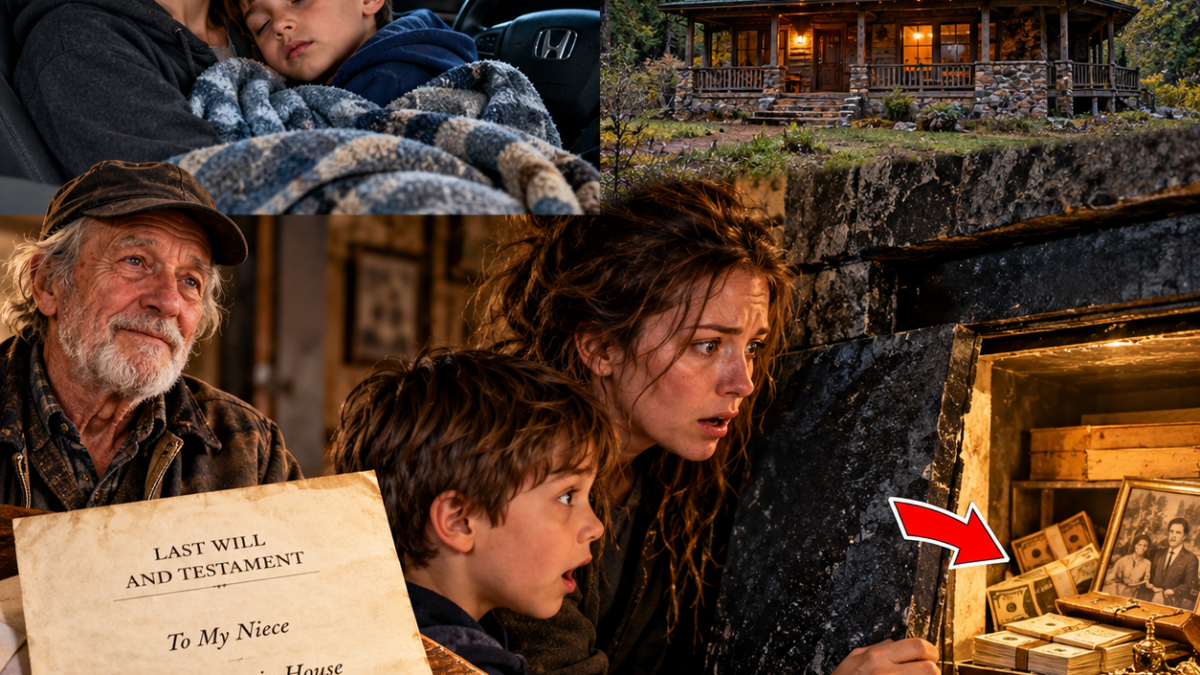
The morning a lawyer told me I had inherited a mountain house, my seven-year-old son and I had eleven dollars, three granola bars, and a Honda Civic we had been sleeping in behind a Seattle grocery store for almost six months.
The photographs showed a place with a sagging porch, peeling boards, broken gutters, and no working electricity, but I asked only two questions—did it have a roof, and did the front door lock—because once you’ve spent half a year waking every time headlights sweep across your windshield, “worthless” starts sounding very different from “safe.”
What I didn’t understand was why my estranged great-uncle Arthur had ordered me to live there for ninety days before selling anything, or why a stranger who knew exactly how desperate I was offered me thirty thousand dollars almost immediately and kept staring at the huge black fireplace instead of the land.
“My great-uncle left me everything?”
The attorney across from me nodded.
“Arthur Hayes had no spouse or children. His will names you as his sole beneficiary.”
I looked at Leo.
He was sitting beside me in a borrowed office chair, eating crackers from the attorney’s receptionist.
Arthur Hayes.
I hadn’t seen him since I was sixteen.
My mother and Arthur had argued years earlier over something neither ever explained properly, and after Mom died, I assumed whatever remained of that family connection died with her.
The attorney slid photographs toward me.
The house sat deep in Washington’s Cascade foothills.
“It’s not in good condition,” she warned.
“Does it have a roof?”
“Mostly.”
“A door that locks?”
“Yes.”
“Then it’s better than where we’re living.”
Her expression changed.
She had already noticed the blankets and grocery bags packed into my Honda outside.
Before I left, she handed me a sealed letter.
Arthur had written my name across the front.
Inside were only a few lines.
**Clara, live in the house for ninety days before allowing anyone to tear it down or talking seriously about selling it.**
**You have spent too much of your life being forced to make decisions while frightened. Don’t make this one that way.**
Then one final warning:
**Do not let anyone persuade you that something is worthless merely because it is ugly.**
Two days later, Leo and I reached the house.
It was worse than the photographs.
Rain had stained two ceilings.
The electrical panel had been disconnected.
The pump didn’t work.
Rusted machinery filled the yard.
But the front door locked.
That first night, Leo slept in an actual bedroom.
Before climbing beneath the blankets, he looked at me.
“We don’t have to leave before morning?”
“No.”
“Even if somebody sees us?”
I swallowed.
“No.”
He smiled.
That alone made the house priceless to me.
In the living room stood the strangest feature in the entire place: a massive fireplace built from what looked like black-painted masonry blocks.
Above it, Arthur had nailed a piece of cardboard to the mantel.
**THE FOUNDATION IS EVERYTHING. LOOK BENEATH APPEARANCES.**
I assumed it was one of his odd sayings.
The following afternoon, a black SUV came up the drive.
The man who stepped out wore polished shoes that immediately sank into the mud.
He introduced himself as Martin Calder.
“I knew Arthur.”
His eyes moved across the house.
Then to Leo.
Then back to me.
“I also know you’ve had a difficult few months.”
My stomach tightened.
“How?”
“Small counties. Probate conversations.”
He removed an envelope from his coat.
“I’ll give you thirty thousand dollars cash for the entire property.”
I stared at him.
“You haven’t even looked around.”
“I don’t need to.”
“Then why is it worth thirty thousand?”
“Land assembly.”
He smiled.
“Convenience.”
I remembered Arthur’s letter.
“I’m not selling.”
Martin’s smile remained, but something behind it disappeared.
“You should reconsider. This house needs more money than you have.”
He knew that too.
Before leaving, he looked through the living-room window.
Not at the mountains.
Not at the acreage.
At the black fireplace.
Three nights later, the temperature dropped and a storm buried the mountain road.
I tried starting a fire.
Smoke exploded into the room.
“Outside, Leo. Now.”
I fought the smoking logs with a shovel and fireplace poker.
My boot slipped on the hearth.
The poker swung sideways and struck one of the black blocks.
Instead of stone cracking, a deep metallic clang filled the room.
I froze.
A thin strip of black paint curled away from the impact.
Beneath it, something reflected the firelight.
Not rock.
Metal.
I scraped away another inch of paint.
And underneath the black surface, someone had stamped two words into a steel plate.
**HAYES VAULT.**
PART 2
I stared at those words while smoke drifted around my face.
Hayes Vault.
My first thought was that Arthur had built some kind of safe into the fireplace.
My second was that Martin Calder had known.
“Mom!”
Leo shouted from the porch.
“I’m okay.”
“You said come outside!”
“You stay there.”
“That doesn’t sound okay!”
He was right.
I opened the windows, shoveled the smoking pieces into an old metal bucket, carried them outside, then waited until the room cleared enough to breathe comfortably.
Leo stood on the porch wrapped in two blankets and glaring at me.
“You look terrible.”
“Thank you.”
“You’ve got black stuff on your face.”
“So do chimney sweeps.”
“What’s a chimney sweep?”
“Someone smarter than me who knows how fireplaces work.”
I brought him inside only after the smoke thinned.
Then we both stood in front of the black fireplace.
I scraped more paint away.
The “blocks” were convincing from a distance, but close up I could finally see seams.
The front of the fireplace wasn’t masonry at all.
It was steel shaped and painted to look like stone.
Leo touched one corner.
“Is there treasure?”
“No.”
“You don’t know.”
“I know real life.”
“Real life is weird. We inherited a house.”
Fair point.
I cleared paint from the center.
A narrow rectangular outline appeared.
A door.
No visible handle.
Only a small brass disk with four numbered wheels that had been painted black.
“A combination,” I whispered.
Leo’s eyes widened.
“Definitely treasure.”
“Definitely something Arthur didn’t want sitting in a normal closet.”
I tried birthdays.
Arthur’s.
Mine.
Mom’s.
Nothing.
I tried ninety because of the letter.
Nothing.
The fireplace still wasn’t drawing properly, so we couldn’t safely use it.
The storm hadn’t improved.
That became a more immediate problem.
We had sleeping bags, blankets, canned food and a small propane heater rated for indoor emergency use, but only two fuel cylinders.
I put Leo in the smallest bedroom, closed the door, and layered blankets over him.
He looked toward the hallway.
“You’re going back to the safe.”
“Maybe.”
“Treasure.”
“Go to sleep.”
“Gold.”
“Leo.”
“Diamonds.”
“Go to sleep.”
He smiled and pulled the blanket over his head.
I returned to the living room carrying Arthur’s letter.
**The foundation is everything. Look beneath appearances.**
I examined the fireplace from floor to mantel.
Nothing.
Then I noticed the cardboard sign had been nailed over another piece of wood.
I pulled one corner loose.
Behind it, Arthur had written directly on the wall.
**Clara was born 4-17. Marianne was born 8-03. Some things should never be forgotten twice.**
Marianne was my mother.
My stomach tightened.
I turned the safe wheels.
4.
1.
7.
8.
No.
Then 8-0-3-4.
Nothing.
I sat on the floor.
Why mention both birthdays?
Then I remembered how old combination locks sometimes used alternating directions rather than four individual wheels.
But this safe had four.
Maybe not dates.
Ages?
Mom had been forty-one when she died.
Arthur had been eighty-three.
41.
83.
I turned the wheels.
4-1-8-3.
A click came from inside the wall.
Leo’s voice floated down the hallway.
“Treasure?”
“You’re supposed to be asleep!”
“Was that a yes?”
I pulled.
The steel panel moved an inch.
Then stopped.
It weighed more than I expected.
I put both hands against the edge and dragged it open.
Behind the false fireplace was a cavity nearly four feet deep.
A metal shelf crossed the middle.
On the top shelf sat wooden boxes.
On the bottom were document cases.
For several seconds, I simply stood there.
Then Leo appeared beside me.
“You are terrible at making people go to bed.”
“You’re terrible at staying there.”
He pointed.
“Treasure.”
“Documents.”
“Worst treasure ever.”
I reached for the nearest wooden box.
It was surprisingly heavy.
Inside were canvas coin rolls.
The first contained silver dollars.
Old ones.
Dozens.
The second box contained more.
The third held smaller paper envelopes with dates written across them.
1898.
1901.
1910.
Some held coins that looked gold.
I closed the lid.
My heart had started beating too quickly.
“Don’t touch anything.”
Leo immediately pulled his hand back.
“Are we rich?”
“I don’t know.”
“You always say that.”
“Because grown-ups mostly don’t know anything until they call somebody.”
“Who are you calling?”
“The lawyer.”
I checked my phone.
No signal.
Of course.
The storm had taken the last bar an hour earlier.
Then I examined the document cases.
The first contained property records.
The second held photographs.
The third had letters.
A fourth was labeled:
**CALDER / SUMMIT CREST**
My hands stopped.
Martin Calder.
I opened it.
The first document was a purchase offer.
Not thirty thousand dollars.
Four hundred eighty thousand.
Dated eighteen months earlier.
Buyer:
**Summit Crest Development LLC.**
Seller:
**Arthur Hayes.**
Arthur had written **REJECTED** across the first page.
Leo leaned against me.
“That’s a lot of zeros.”
“Yes.”
“The shoe man offered us less.”
“A lot less.”
“Why?”
That was the question.
I kept reading.
Summit Crest was assembling land for a luxury mountain development.
Cabins.
A lodge.
Vacation homes.
A private road.
Arthur’s property wasn’t large compared with the hundreds of acres Calder already controlled.
Only eleven acres surrounded the house.
But a survey inside the folder showed something important.
The only existing private road suitable for construction equipment crossed Arthur’s southeastern corner.
A spring on Arthur’s land also fed a small reservoir farther downhill.
A handwritten note from Arthur was clipped to the map.
**They don’t need my house.**
**They need Hayes Cut and the spring corridor.**
Below that:
**Without both, their cheap route becomes their expensive route.**
I kept searching.
There was an engineering estimate.
Alternative road construction:
**$3.1 million–$3.8 million.**
My hand froze on the paper.
Martin Calder had offered me thirty thousand dollars for something his company had once valued at almost half a million because avoiding it could cost them more than three million.
And he knew I had been sleeping in a car.
I felt sick.
Not because he wanted the property.
People buy property.
That wasn’t the part I hated.
He had looked at Leo.
Looked at me.
Looked at our broken house.
And calculated how little desperation might cost him.
Leo read my face.
“He lied?”
“Yes.”
“About the house being bad?”
“No.”
I looked around.
“The house is definitely bad.”
“What did he lie about?”
“What it was worth to him.”
Leo considered that.
“That’s cheating.”
“It’s business if you ask him.”
“Still cheating.”
Maybe seven-year-olds understand certain things faster because they haven’t learned fancy words for them yet.
I found one more letter inside the folder.
It was from Martin to Arthur.
**Arthur,**
**You are letting sentiment interfere with reality. The house is functionally obsolete. The land has no meaningful standalone market value. My offer reflects the premium created by our neighboring ownership.**
**If you wait until after you’re gone, your heir may not have the resources or patience for a title fight.**
I read that last sentence twice.
Your heir.
He knew there would be one.
Maybe not me specifically.
But someone.
Arthur had circled the line.
Beside it he wrote:
**That is exactly what he’s counting on.**
I sat back against the wall.
The storm hammered snow against the windows.
For months, I had lived one unexpected expense away from losing everything.
When Leo got sick, I counted the dollars in my wallet before deciding whether to buy medicine.
I learned which gas stations didn’t bother us if we parked at the far edge overnight.
I learned how to wash my hair in public restroom sinks without looking like I was washing my hair in a public restroom sink.
Martin Calder had looked at that life and seen leverage.
Then another envelope slid from beneath the property documents.
It had my name on it.
**CLARA—READ THIS BEFORE YOU DECIDE WHAT KIND OF MAN I WAS.**
I stared at it.
That was not what I expected.
I opened it.
Arthur’s handwriting was shakier than the note above the mantel.
**Clara,**
**If you’re reading this, then I succeeded at hiding enough to annoy the right person.**
Despite myself, I laughed.
That sounded like the uncle I remembered.
Arthur had always been strange.
He once refused to buy a television because he said any machine designed to sell him soap between stories couldn’t possibly be working for him.
Then the letter changed.
**I know you believe I stopped caring about your mother.**
My chest tightened.
**That isn’t true.**
I almost stopped reading.
Mom’s argument with Arthur had shaped the last fifteen years of our family.
She rarely discussed it.
When I asked, she said:
“Arthur thinks money solves relationships.”
Arthur’s version began differently.
After my father left, Mom borrowed money from him.
A lot.
Arthur offered more.
Mom refused.
Then Arthur made a terrible mistake.
He tried to tie financial help to conditions.
Move closer.
Leave the apartment she couldn’t afford.
Take a job with one of his old business partners.
Let him help manage her bills.
Mom heard control.
Arthur heard responsibility.
They fought.
He told her she was too proud to protect me.
She told him she would rather struggle than owe him her life.
Neither called the other afterward.
For years.
Arthur wrote:
**Your mother was right about one thing. Help that comes with control is not always help. I learned that too late.**
I lowered the page.
The sentence hurt because it sounded so much like my own life.
Every shelter had rules.
Every temporary place came with somebody else’s conditions.
Every offer seemed to include an invisible sentence beginning with “as long as.”
Arthur continued.
He tried writing to Mom.
Most letters came back.
He followed my life from a distance through relatives.
When Mom died, he learned about it weeks later.
Then he tried finding me.
He found the last apartment.
Empty.
A disconnected number.
Eventually, he hired a probate researcher.
Three months before his death, he learned I had been staying in my car with Leo.
I stopped reading.
He knew.
The anger came first.
If he knew, why hadn’t he come?
Why didn’t he send money?
Why let me spend another night in that parking lot?
Then the next paragraph answered me.
**I thought about driving to Seattle.**
**I even packed the truck.**
**Then my doctor told me I shouldn’t make the trip alone, and my pride did what pride has always done in this family—it dressed fear up as a reason to wait.**
**I decided to repair the house first. I did not finish.**
I looked around at the collapsing place.
“You definitely didn’t,” I whispered.
**I arranged the inheritance instead.**
**Maybe that was cowardice. Maybe it was the only useful thing I still knew how to do. You can decide.**
I cried then.
Quietly.
Not beautifully.
Not the kind of tears stories describe as healing.
They were angry tears.
The kind where you don’t know which dead person you want to yell at first.
Mom for never telling me more.
Arthur for waiting.
My father for leaving.
Myself for still caring.
Leo climbed into my lap without asking.
“What happened?”
“Family.”
He nodded seriously.
“That’s usually bad.”
I laughed through tears.
“Sometimes.”
He rested his head against me.
I finished the letter.
Arthur explained the ninety days.
Martin would come.
Arthur was certain of it.
He believed Martin had been monitoring the probate filings.
He believed Summit Crest’s financing depended on securing road access soon.
**Thirty thousand will look like a fortune if you have eleven dollars.**
I stared at that sentence.
Eleven dollars.
Exactly what I had the morning the lawyer called.
How could Arthur have known?
Then I remembered the probate researcher.
Maybe he hadn’t known the exact number.
Maybe he’d just understood poverty.
**Wait ninety days.**
**Repair what you can.**
**Learn what the property is.**
**Learn what you need.**
**Then decide.**
And finally:
**Do not keep the house because I told you to.**
**Keep it only if staying becomes your choice.**
I folded the letter.
For the first time since arriving, I wasn’t thinking about Martin.
I was thinking about Arthur sitting alone in this freezing house, hiding documents behind a fake fireplace because he knew he was running out of time.
The next morning, the storm eased.
The chimney was still unsafe, but our little propane heater lasted.
A county snowplow reached the main road by afternoon.
I walked nearly a mile uphill until my phone found signal.
I called the attorney.
Her name was Rebecca Shaw.
“Clara?”
“I found something.”
“What?”
“A vault.”
Silence.
“You found a what?”
“Behind the fireplace.”
Another pause.
“Arthur never mentioned a vault.”
“He mentioned Martin Calder?”
This silence was different.
“Yes.”
My stomach tightened.
“What did he say?”
“That if Mr. Calder approached you about purchasing the property, I should advise you not to sign anything without independent valuation.”
“You didn’t tell me.”
“You hadn’t told me he’d approached you.”
“He offered thirty thousand.”
Rebecca became very quiet.
“Clara, do not accept it.”
“I know that now.”
“What did you find?”
“Arthur rejected four hundred eighty thousand from Calder.”
Rebecca exhaled slowly.
“All right.”
“There are coins too.”
“What kind?”
“Old.”
“How many?”
“A lot.”
“Do not sell, clean, polish, separate, or carry them around.”
“I wasn’t planning to.”
“And do not tell anyone locally yet.”
“Why?”
“Because anything Arthur owned at death is estate property before distribution. We need to inventory it properly.”
“So it isn’t mine?”
“Eventually, likely yes, because you’re his beneficiary. But we do this correctly.”
I looked back toward the cabin.
“What about the road rights?”
“What road rights?”
“You need to come up here.”
Rebecca arrived the following afternoon with a title examiner named Peter Lang and a numismatic appraiser named Daniel Feld.
Daniel spent four hours cataloging the coins.
Leo followed him everywhere.
“Is that gold?”
“Yes.”
“How much?”
Daniel glanced at me.
“Do you always interrogate professionals?”
“He’s seven.”
“So yes.”
Several coins were ordinary silver dollars.
Some were collectible.
Arthur had apparently bought coins for fifty years.
The gold pieces were mostly American coins from the late nineteenth and early twentieth centuries.
Nothing magical.
No pirate treasure.
No single coin worth a mansion.
But together—
Daniel’s preliminary estimate came to somewhere between one hundred forty thousand and one hundred eighty thousand dollars.
I sat down.
Leo whispered, “Goat money.”
“What?”
“I want a goat.”
“You’ve never mentioned wanting a goat.”
“I didn’t know we had gold.”
Daniel laughed.
I didn’t.
One hundred fifty thousand dollars.
Six months earlier, I had cried because Leo needed new shoes and I couldn’t buy them until Friday.
Now a dead man’s wall contained enough money to change our lives.
Rebecca must have seen panic on my face.
“Don’t spend it in your head.”
“What?”
“Not yet.”
“Why does every good thing come with paperwork?”
“Because bad things without paperwork are worse.”
Peter Lang examined the property documents.
The road question was more complicated.
Arthur’s land contained a strip called Hayes Cut.
Originally a logging road.
A recorded 1948 instrument allowed neighboring owners to use it for “private residential, agricultural, and forestry access.”
No commercial resort traffic.
No construction haul route serving hundreds of lots.
Summit Crest needed a broader easement.
Arthur had refused to grant it.
The spring was separate.
A 1926 water agreement gave Arthur’s parcel priority rights to a source that also fed lower properties.
Summit Crest’s plans proposed enlarging the intake.
That too required consent.
Peter tapped the map.
“This isn’t worth four hundred eighty thousand to an ordinary buyer.”
“I figured.”
“To Calder, it’s worth avoiding millions in alternative infrastructure.”
“So Arthur’s house really is worthless?”
“The house?”
He looked toward a section of ceiling where a bucket caught dripping water.
“Relative to the land problem it creates for Calder?”
“Yes.”
Oddly, I liked hearing that.
The house could be ugly.
That didn’t make me foolish for needing it.
Rebecca said, “You need a real estate attorney.”
“Aren’t you one?”
“Probate.”
“What’s the difference?”
“About four hundred pages of things I refuse to pretend I specialize in.”
She referred me to Thomas Bell.
He was fifty, quiet, and infuriatingly calm.
He read everything.
Then he said, “Do nothing.”
I stared at him.
“I just brought you evidence that a developer is trying to underpay me by hundreds of thousands of dollars.”
“Yes.”
“And your advice is nothing?”
“For today.”
“That sounds expensive.”
“It is.”
Thomas explained that Martin had every right to make a low offer.
Being insulting was not illegal.
Knowing more than the seller did was not automatically illegal either.
But if Martin misrepresented recorded rights, threatened improper action, interfered with my estate, or filed false claims, that was different.
“So we wait for him to do something worse?”
“We let him show us what position he’s actually taking.”
“I don’t like that.”
“Most clients don’t.”
Martin saved us the wait.
He returned three days later.
The snow had mostly melted from the drive.
This time, he brought another man.
“Attorney?” I asked.
“Survey consultant.”
“Mine says nobody enters without permission.”
Martin’s expression tightened.
“You retained counsel?”
“Yes.”
“Who?”
“Thomas Bell.”
That affected him.
I saw it.
“Mr. Bell likes litigation.”
“I like roofs that don’t leak. We all have hobbies.”
Leo, standing behind the screen door, laughed.
Martin glanced at him.
Then back at me.
“I came to improve my offer.”
“Talk to Thomas.”
“Seventy-five thousand.”
A week earlier, I might have stopped breathing.
Now I said nothing.
“One hundred.”
Nothing.
“Clara, be reasonable.”
“You offered Arthur four hundred eighty.”
His face went still.
There it was.
No pretending anymore.
“You found his papers.”
“Yes.”
Martin looked at the fireplace through the front window.
“He always did enjoy theater.”
“He enjoyed copies.”
Martin ignored that.
“The four-eighty offer included concessions and contingencies.”
“Then explain them to Thomas.”
“That offer expired.”
“Good.”
His brow furrowed.
“Good?”
“If it expired, we don’t have to talk about it.”
He stepped closer.
“You have a house that requires six figures of rehabilitation.”
“I have a house with a working lock.”
“You have no stable income.”
My face tightened.
He continued.
“You have a child.”
“Careful.”
“I am being careful.”
“No. You’re reminding me that you know things about my life you shouldn’t be using in a property negotiation.”
Martin’s voice lowered.
“Arthur told me enough about you.”
That surprised me.
“When?”
“Months ago.”
“What did he say?”
“That you were stubborn.”
“Anything else?”
“That he’d made a mess of his family.”
I didn’t expect that.
For a moment, Martin seemed less polished.
Then it disappeared.
“Arthur rejected reasonable solutions because he wanted to punish me.”
“Why?”
“Because he hated Summit Crest.”
“Why?”
Martin glanced toward the mountain.
“He didn’t want development.”
“That all?”
“No.”
He paused.
“Your uncle and my father had history.”
Of course they did.
Every mountain story eventually involved two old men arguing about land.
“What history?”
“Not relevant.”
“Then don’t bring it up.”
Martin handed me a card.
“Call me when Bell tells you what fighting me costs.”
I didn’t take it.
He placed it on the porch rail.
Then said, “One hundred fifty thousand. Forty-eight hours.”
He left.
Thomas laughed when I called.
“What’s funny?”
“He doubled his own concern in ten minutes.”
“He offered one-fifty.”
“I heard.”
“Should I take it?”
“What do you want?”
“A normal lawyer who answers questions.”
“You called the wrong office.”
I sat at Arthur’s kitchen table.
“What would you do?”
“That is not my decision.”
“I hate everyone saying that.”
“I know.”
“I have a seven-year-old who has spent half a year sleeping in a car.”
“I know.”
“One hundred fifty thousand dollars is real.”
“Very.”
“I could rent an apartment.”
“Yes.”
“Buy a reliable car.”
“Yes.”
“Go back to work without wondering if our motel week runs out.”
“Yes.”
“Then why am I stupid if I sell?”
“You aren’t.”
That stopped me.
Thomas continued.
“There is no moral prize for keeping land. If selling gives you and Leo the life you want, sell.”
I looked toward the living room.
The black fireplace.
Arthur’s cardboard sign.
“Then why did Arthur want me to wait?”
“Because he wanted you deciding from knowledge instead of panic.”
That was the answer.
Not keep.
Wait.
I told Martin no.
The following week, a county child-welfare caseworker arrived.
Her name was Dana Brooks.
The moment I saw the county vehicle, my knees almost stopped working.
Leo was inside doing homework.
“Ms. Hayes?”
“Yes.”
“We received a report concerning housing conditions.”
My first thought was Martin.
My second was that proving it wouldn’t matter if Dana decided the house was unsafe.
“You’re taking Leo?”
“No.”
She looked genuinely surprised.
“I haven’t even been inside yet.”
“That’s what people do.”
“What people?”
“People with files.”
Dana closed her folder.
“Can we start again?”
I almost told her no.
Instead I let her in.
She saw the buckets.
The repaired electrical panel.
The new smoke detectors Thomas had insisted I buy.
The propane heater.
The temporary chimney cap.
Our food.
Leo’s bed.
The locked front door.
She asked where we had lived before.
I told her.
Not everything.
Enough.
Then she looked at me for a long time.
“Why didn’t you seek emergency family shelter?”
“We did.”
“What happened?”
“One had no beds. Another could take me but not guarantee Leo and I stayed in the same room. Another was across the county from his school and my job.”
Dana wrote something.
My stomach tightened.
She noticed.
“I’m documenting that you sought resources.”
“Oh.”
“That helps you.”
I didn’t know what to say.
She inspected the house.
“This isn’t ideal.”
“I know.”
“The fireplace cannot be used until inspected.”
“I know.”
“Electrical?”
“Reconnected yesterday.”
“Water?”
“Pump technician comes Friday.”
“Heat?”
“Portable electric heaters once wiring is signed off.”
She looked at Leo.
He was coloring at the table.
“Do you feel safe here?”
He looked at me.
Dana said, “You can answer without checking your mom.”
Leo looked at her.
“We have a door.”
Dana waited.
“It locks,” he added.
Something changed in her face.
She finished the inspection.
Before leaving, she said, “I’ll keep the case open thirty days while you complete the safety repairs.”
“You aren’t taking him?”
“No.”
“Someone said we were homeless.”
“You were.”
“Not now.”
“I can see that.”
I swallowed.
“Can you tell me who reported us?”
“No.”
Of course not.
Then she added, “I can tell you the report was made two days after a property negotiation appears to have occurred, because the caller referenced a purchase refusal.”
My eyes narrowed.
“The caller said that?”
“I’m telling you what I can.”
Martin.
Thomas loved that detail.
Not because child-welfare involvement was funny.
Because the reporter had apparently mentioned my refusal to sell.
“That’s useful,” he said.
“How?”
“Context.”
“Can we sue him?”
“Slow down.”
“He tried using my son.”
“Potentially.”
“Potentially again.”
“Legal language prevents ulcers.”
“It gives me one.”
Thomas sent Summit Crest a formal letter.
All communications through counsel.
No direct property visits.
No contact concerning Leo.
Preserve all communications regarding acquisition of Hayes property.
Martin’s attorneys responded.
For the first time, I saw the position they planned to take.
Summit Crest claimed it already possessed expanded access rights through an agreement Arthur had signed three years earlier.
Thomas read the letter twice.
“Did Arthur mention another agreement?”
“No.”
“Vault?”
“Everything in Calder’s folder is with you.”
“Then we request it.”
Summit Crest produced a document.
**Access Modernization Agreement.**
Arthur’s signature appeared on the last page.
It permitted Summit Crest to “improve, widen and adapt” Hayes Cut for future neighboring development.
My stomach sank.
“What does this mean?”
Thomas remained calm.
“It means we authenticate it.”
“Arthur told me he refused.”
“Arthur could be wrong.”
“He hid all those papers.”
“Dead people can be mistaken too.”
I hated him for saying it.
Then I remembered the letter Arthur wrote me.
**Decide what kind of man I was.**
Maybe the hidden documents were not a perfect truth.
Maybe they were his version.
Thomas hired a document examiner.
The signature looked genuine.
That hurt more.
I went home and opened the vault again.
I read everything.
Every letter.
Every map.
Nothing about signing expanded road access.
Then I found a small notebook beneath the lowest document box.
I had missed it because the cover was the same black as the steel shelf.
Arthur’s daily notes.
Three years earlier.
**May 11—Calder brought revised road agreement. Told him no commercial traffic.**
**May 14—He says he can limit construction hours. Still no.**
**May 22—Signed inspection authorization only. Calder angry.**
Inspection authorization.
I called Thomas.
“What if Arthur signed something that day but not what Calder says?”
“Bring me the notebook.”
I drove to town.
Thomas compared dates.
Summit Crest’s agreement was dated May 22.
Arthur definitely signed something that day.
We requested all drafts and related emails.
Summit Crest objected.
Thomas filed a motion.
The judge ordered limited production.
Three weeks later, Thomas called.
“Sit down.”
“I am.”
“You’re driving.”
“I’m parked.”
“Good.”
Summit Crest’s internal email chain contained an attachment labeled:
**Hayes_Access_0522_FINAL**
Thomas opened the original electronic document.
It was not the agreement Summit Crest had produced.
It was an **inspection authorization**.
Exactly what Arthur’s notebook said.
Same date.
Same signature page formatting.
Different body.
My hands went cold.
“Are you saying they swapped pages?”
“I am saying we have two documents using a visually identical signature page, and their own electronic records show Arthur signed the inspection authorization.”
“That’s fraud.”
“Possibly.”
“Thomas.”
“I know.”
“What does Martin say?”
“Nothing yet.”
“Why?”
“Because I haven’t asked him.”
I almost yelled.
“Why not?”
“Because I want every version before he knows what we found.”
That was the first time I understood why Arthur had hidden copies.
Evidence becomes very useful when the other side doesn’t know which copy survived.
Thomas subpoenaed document metadata and transaction records.
Then something unexpected happened.
A woman named Evelyn Price contacted him.
She had worked as Martin Calder’s executive assistant for six years.
She had left Summit Crest eight months earlier.
She had seen the court filing reported in a local business paper.
Evelyn agreed to speak.
I met her in Thomas’s office.
She looked exhausted before we started.
“Arthur Hayes was not easy,” she said.
“I know.”
“He made Martin furious.”
“Why?”
“Because every time Martin thought he had him cornered, Arthur asked for another copy.”
I almost smiled.
Evelyn continued.
“The May twenty-second document was an inspection agreement.”
“So where did the access agreement come from?”
“I don’t know who created it.”
Thomas asked, “Had you seen it before this litigation?”
“No.”
“Did Mr. Calder ever describe having signed commercial-access rights from Arthur?”
“No. He complained constantly that he didn’t.”
That mattered.
A lot.
Thomas pushed farther.
“Why did Summit Crest continue buying neighboring land without road access?”
“Martin thought Arthur would eventually sell.”
“And after Arthur died?”
Evelyn looked at me.
“He said the heir would.”
My stomach tightened.
“What exactly did he say?”
She hesitated.
“Tell me.”
“He said Arthur had left the property to a niece or great-niece who was broke.”
Thomas asked, “How did he know?”
“Asset search.”
I felt heat rising in my face.
“He knew about the Honda.”
Evelyn looked uncomfortable.
“Yes.”
“He knew Leo was seven.”
“Yes.”
“He knew I had eleven dollars?”
“No. Not that specifically.”
I almost laughed.
At least Arthur hadn’t been psychic.
Evelyn continued.
“Martin said not to lead with the old offer because you’d anchor to Arthur’s number.”
“How much did he say to offer?”
“Twenty-five.”
“He offered thirty.”
She shrugged.
“Maybe he felt generous.”
No one laughed.
Thomas asked the most important question.
“Did Mr. Calder mention an acquisition ceiling?”
Evelyn nodded.
“Sixty thousand if she accepted quickly.”
I stared.
“He was prepared to pay Arthur four hundred eighty.”
“Yes.”
“But only sixty to me.”
“He believed you didn’t know the infrastructure numbers.”
There it was.
Not a feeling.
Not my interpretation.
A plan.
Thomas asked whether she would testify if necessary.
Evelyn looked toward the window.
“I’ll tell the truth.”
That was enough.
Summit Crest’s lawyers changed tone immediately after Thomas disclosed the electronic file.
They stopped insisting the access agreement was unquestionably enforceable.
Instead they called it a “document-management discrepancy.”
Thomas read that phrase aloud in his office.
“What does that mean?”
“It means somebody’s expensive lawyer stayed awake all night finding a phrase that sounds better than what you’re thinking.”
“What am I thinking?”
“You’re a mother. I won’t repeat it.”
I laughed for the first time in days.
Then Summit Crest filed a lawsuit.
They asked the court to declare they possessed access rights anyway based on Arthur’s alleged oral promises, historic use, and investment reliance.
They also sought an emergency order preventing me from blocking survey crews.
Thomas was furious.
Quietly furious.
That was much more frightening than shouting.
“They’re trying to create timing pressure.”
“Why?”
“Financing.”
He showed me a publicly recorded loan agreement.
Summit Crest had borrowed heavily to purchase neighboring acreage.
A major construction loan required confirmed legal access before March 31.
It was January.
“If they don’t get my road?”
“They need the alternate route.”
“Three million.”
“Probably more now.”
“So they’re running out of time.”
“Yes.”
For the first time, Martin was the one making decisions under pressure.
I wish I could say that made me generous.
It didn’t.
It made me want him to feel every hour I had spent in the Honda wondering whether someone would knock on the window and tell us to move.
I wanted revenge.
Thomas noticed.
“Don’t.”
“Don’t what?”
“Start making decisions because it feels good that Calder is scared.”
“He made decisions because I was scared.”
“Yes.”
“So?”
“So if you copy him, he still gets to decide what kind of person you become.”
I hated that sentence.
Arthur could have written it.
Maybe that was why I hated it.
Meanwhile, the coin collection finished probate appraisal.
Final value:
$167,400.
After estate expenses and taxes, most would eventually pass to me.
Rebecca arranged for secure storage.
A bank agreed to lend against a portion of the estate so I could make repairs before probate closed.
For the first time, I had options.
Real ones.
I hired licensed contractors.
We rebuilt the chimney properly.
Repaired the roof.
Installed a heat pump.
Fixed the water system.
Replaced unsafe wiring.
Dana Brooks returned for her thirty-day inspection.
Leo gave her a tour.
“This is my room.”
“I remember.”
“We have heat.”
“I noticed.”
“And water.”
“Excellent.”
“And Mom found gold.”
I closed my eyes.
“Leo.”
Dana turned toward me.
“Gold?”
“Long story.”
Leo continued.
“Behind the fireplace.”
“Very long story,” I said.
Dana smiled.
Then she closed the case.
No fanfare.
No dramatic speech.
Just paperwork.
When she left, Leo stood on the porch.
“So nobody can take me?”
I crouched.
“People can always make decisions we don’t like.”
His face fell.
“But listen.”
He looked at me.
“This house is safe. We have a plan. We have people helping us. I’m not hiding from anybody anymore.”
He thought about that.
“Okay.”
Then he ran inside.
That was the moment I realized homelessness had changed me more than I admitted.
Even after inheriting property, finding gold, hiring lawyers and fixing the roof, some part of me still believed safety depended on staying unnoticed.
Martin had understood that.
That was why his first offer was so insulting.
He thought I would take money just to avoid being seen.
The preliminary hearing occurred in February.
Summit Crest argued that Arthur had repeatedly allowed vehicles along Hayes Cut.
They produced photographs of logging trucks.
A former contractor testified.
Thomas cross-examined him.
“Were these Summit Crest construction vehicles?”
“No.”
“What were they?”
“Forestry trucks.”
“Permitted under the recorded 1948 easement?”
“Yes.”
“So their presence demonstrates forestry access, which the easement expressly allows.”
The witness paused.
“Yes.”
Summit Crest’s lawyer changed subjects.
Then came the questionable access agreement.
Their lawyer tried to avoid relying on it heavily.
The judge noticed.
“So is Summit Crest claiming this document is authentic?”
Silence.
Their attorney answered carefully.
“We are investigating discrepancies in corporate files.”
The judge looked unimpressed.
Thomas presented the May 22 electronic inspection authorization.
Then Arthur’s notebook.
Then Evelyn Price’s declaration.
The judge denied Summit Crest’s request for emergency commercial access.
Not the final case.
But enough.
March was getting closer.
Martin called me personally.
I didn’t answer.
He left a voicemail.
“Clara, this has become absurd. We can settle without spending another hundred thousand dollars on attorneys.”
I sent it to Thomas.
He said, “Don’t respond.”
Martin sent a formal offer.
$250,000.
I almost accepted.
I need to be honest about that.
People love stories where the poor protagonist discovers leverage and instantly becomes fearless.
That’s not how it felt.
Two hundred fifty thousand dollars was still more money than I’d ever expected to have.
Combined with the coins, Leo and I could buy a normal house outright somewhere else.
No mountain legal battle.
No developers.
No collapsing shed.
No Arthur haunting every wall with notes.
I drove to Seattle.
Back to the grocery store where we had slept.
I parked in almost the same place.
Leo was at school.
For fifteen minutes, I sat in the Honda alone.
Cars moved around me.
Shopping carts rattled.
Nobody knew.
Nobody looked.
That parking space had once been the closest thing we had to an address.
I remembered waking at 2:13 in the morning because a security vehicle slowed behind us.
Remembered whispering to Leo not to move.
Remembered calculating whether eleven dollars could buy gas, breakfast, and laundry.
Then I pictured Martin’s email.
Broke heir.
Offer twenty-five.
Ceiling sixty.
He hadn’t created our hardship.
But he had tried to buy advantage from it.
I returned to Thomas’s office.
“I’m not taking two-fifty.”
He looked at me for several seconds.
“Why?”
“Because I don’t want to sell.”
“Good.”
“You aren’t going to argue?”
“I wanted to hear that sentence.”
“What sentence?”
“Not ‘because Calder is awful.’ Not ‘because Arthur told me not to.’”
He leaned back.
“Because you don’t want to sell.”
For the first time, the property decision was mine.
That felt bigger than money.
Then Peter Lang discovered a second problem for Summit Crest.
The spring.
Their environmental application assumed they could draw construction water from the lower reservoir.
But the reservoir’s source agreement traced back to Arthur’s parcel.
Large additional withdrawals required consent from the senior parcel owner.
Me.
Summit Crest had listed the water source in its permits as “secured through existing neighboring rights.”
Thomas stared at the filing.
“Did Arthur consent?”
“No.”
“Any paper in the vault?”
“No.”
Peter shook his head.
“This is going to become uncomfortable.”
The county planning department asked Summit Crest for proof.
They couldn’t produce it.
Martin’s attorneys argued historic use.
The county said historic residential and forestry use did not automatically authorize a major new commercial draw.
The development timeline slipped again.
Martin came to my house one last time.
Not unannounced.
Thomas approved a meeting.
He attended.
So did Martin’s attorney.
We sat at Arthur’s kitchen table.
The same table where Leo and I had eaten canned soup our first night.
Martin looked around at the repairs.
“Looks different.”
“That’s what happens when someone stops calling it worthless.”
His attorney sighed.
Thomas almost smiled.
Martin placed a folder on the table.
“Five hundred thousand.”
Silence.
It was more than Arthur’s old offer.
“For the entire property?” Thomas asked.
“Eleven acres, road rights, spring approvals.”
“No,” I said.
Martin looked at me.
“You haven’t read the terms.”
“I don’t want to sell the house.”
“You could buy ten houses.”
“I don’t want ten.”
His jaw tightened.
“Then grant the easements.”
Thomas said, “Terms?”
Martin’s lawyer took over.
They wanted a widened road.
Construction access.
Permanent resort traffic.
Expanded utility corridor.
Water withdrawal.
Thirty-year maintenance rights.
Thomas finished reading.
“No.”
Martin leaned toward me.
“Do you understand what refusing does?”
“Yes.”
“It may kill the project.”
“Then maybe your project shouldn’t have been financed before you owned the access.”
His face reddened.
“You sound like Bell.”
“I paid him. Might as well learn something.”
Martin pushed back his chair.
“Arthur did this because he hated my father.”
There it was again.
Family history.
I looked at him.
“Tell me.”
Thomas glanced at me.
I nodded.
Martin stood near the window.
“My father, James Calder, and Arthur owned a construction company together in the seventies.”
I hadn’t known.
“They built mountain roads.”
“What happened?”
“1978 flood.”
Martin stared outside.
“A retaining wall failed. Two cabins were damaged. Nobody was seriously hurt, but lawsuits followed.”
“Whose fault?”
“That was the fight.”
Arthur believed James had substituted cheaper material.
James said Arthur approved it.
The partnership collapsed.
Arthur paid much of the settlement personally.
James went bankrupt.
Years later, Martin rebuilt his family’s finances through development.
“He spent the rest of his life saying Arthur destroyed him.”
“And Arthur?”
“Said my father destroyed himself.”
“Who was right?”
Martin laughed without humor.
“Probably both.”
Thomas asked, “What does that have to do with Hayes Cut?”
Martin looked at me.
“When I started assembling Summit Crest, Arthur told me he’d never give a Calder another road through his property.”
“So you thought he’d refuse no matter what.”
“Yes.”
“Then why make the four-eighty offer?”
“Because I wanted the project.”
“And after he died?”
Martin looked down.
“I saw a chance to solve the problem cheaper.”
“At my expense.”
“Yes.”
The honesty surprised me.
Then I asked the question that mattered.
“Did you know the access agreement wasn’t real?”
His attorney immediately said, “Martin, do not answer that.”
Silence.
Martin looked at him.
Then at me.
“I knew Arthur signed an inspection authorization.”
His attorney closed his eyes.
Thomas didn’t move.
“Did you authorize use of the altered document?” Thomas asked.
Martin’s attorney stood.
“This meeting is over.”
Martin remained seated.
“Martin.”
Still seated.
Then Martin said quietly, “I told legal to find anything that supported continued access.”
“That wasn’t my question,” Thomas said.
Martin finally stood.
“Then ask it in court.”
They left.
Thomas waited until the SUV disappeared.
“Do not celebrate.”
“I wasn’t.”
“You have the expression.”
“What expression?”
“The one clients get right before they make my life harder.”
I smiled.
“What happens now?”
“We make him answer it in court.”
The discovery phase became ugly.
Not dangerous.
Not dramatic in the way movies make things dramatic.
Just relentless.
Emails.
Draft agreements.
Depositions.
Invoices.
Metadata.
Board minutes.
The truth appeared in fragments.
Summit Crest’s outside attorney had received the altered access agreement from Martin’s acquisitions team.
The outside attorney assumed it was authentic.
The acquisitions team said the file came from Martin’s personal archive.
Martin claimed an assistant assembled the archive.
The assistant had died the previous year.
Convenient.
But the electronic trail mattered.
An employee had scanned Arthur’s inspection authorization.
Six months later, a new document appeared using the same signature page.
The file creation history traced to a computer assigned to Summit Crest’s acquisitions department.
No one admitted creating it.
Thomas didn’t need a dramatic confession.
He needed enough evidence to make relying on it disastrous.
Then we found the email.
Martin to his acquisitions director:
**If Arthur’s signature page works for the broader access language, use it. I’m done letting an old feud hold up twelve million dollars.**
I read the sentence twice.
Thomas said nothing.
I looked at him.
“That’s it.”
“It’s very bad.”
“That’s lawyer for ‘that’s it.’”
“It’s lawyer for ‘don’t say anything until I stop smiling.’”
I had never seen him smile like that.
The final hearing took place in May.
By then, Summit Crest’s construction lender had frozen additional advances.
Local newspapers were following the access dispute.
I hated that.
One reporter tried asking Leo questions outside school.
I complained.
The newspaper apologized and stopped.
I didn’t want him turned into a symbol.
He was seven.
He liked dinosaurs, pancakes and badly drawn superheroes.
He wasn’t “the homeless boy fighting a developer.”
He was my son.
On the morning of the hearing, I wore a navy dress Rebecca lent me.
Leo stayed with Dana Brooks, who had somehow become someone I trusted enough to call when I needed help.
The courtroom was packed.
Martin sat across from me.
He looked tired.
Thomas presented the recorded road instrument.
Private residential.
Agricultural.
Forestry.
No commercial resort traffic.
Then the May 22 inspection authorization.
Then Summit Crest’s broader access agreement.
The document examiner explained the signature page.
Same scan.
Same minor dust mark near Arthur’s signature.
Same compression artifact.
Digitally reused.
Martin’s attorney argued that Arthur could have separately consented.
Then Evelyn Price testified.
“Did Arthur Hayes ever approve permanent resort access?”
“Not while I worked there.”
“Did Martin Calder know that?”
“Yes.”
“How?”
“He complained about it constantly.”
A few people in the gallery shifted.
Thomas showed her the internal acquisition memo.
**Hayes parcel remains unresolved critical path.**
“What does critical path mean?”
“That the project couldn’t move forward normally without solving it.”
“When was this written?”
“Four months after the document Summit Crest now claims already solved access.”
That landed.
Then Martin testified.
His attorney guided him through the history.
The old family dispute.
Negotiations.
Arthur’s refusal.
The pressure from investors.
Martin admitted making me a low offer.
He called it business judgment.
That was legal.
Ugly, maybe.
But legal.
Then Thomas stood.
“Mr. Calder, you knew Clara Hayes had been living in a vehicle?”
“Yes.”
“You obtained a financial background report?”
“Yes.”
“You knew she had a seven-year-old child?”
“Yes.”
“Your internal note described her as a ‘distressed heir’?”
“Yes.”
“You approved an initial acquisition ceiling of sixty thousand dollars?”
“Yes.”
“Yet eighteen months earlier, Summit Crest offered Arthur Hayes four hundred eighty thousand?”
“Yes.”
“Had the property’s infrastructure importance decreased during those eighteen months?”
“No.”
“Increased?”
Martin hesitated.
“Yes.”
“Because alternative road estimates rose?”
“Yes.”
“How much?”
“Approximately four million.”
The courtroom became quiet.
Thomas let that sit.
Then:
“After Ms. Hayes refused your thirty-thousand-dollar offer, did you make a child-welfare report?”
Martin’s attorney objected.
The judge allowed limited questioning because the report had been referenced in acquisition communications.
Martin answered.
“Yes.”
“Did you tell the agency that Ms. Hayes’s refusal to sell was part of your concern?”
“I don’t remember.”
Thomas displayed an internal message Martin sent twenty minutes after leaving my house.
**She won’t sell. The child situation may create pressure.**
My fingers tightened around each other beneath the table.
Martin stared at the screen.
Thomas asked, “What pressure?”
Martin’s attorney objected again.
The judge overruled.
Martin answered quietly.
“I believed state involvement might make her reconsider the condition of the property.”
“You hoped government scrutiny would influence her sale decision.”
“Yes.”
A woman behind me inhaled sharply.
I didn’t turn around.
Thomas continued.
“Now let’s discuss the access agreement.”
Martin’s attorney tried to intervene.
The judge allowed the question.
Thomas displayed the email.
**If Arthur’s signature page works for the broader access language, use it.**
“Did you write this?”
Martin looked at his lawyer.
“Yes.”
“What did you mean?”
“That we should determine whether the existing signature authorization could support broader access.”
“By attaching Arthur’s signature to different language?”
“I was not directing anyone to fabricate a document.”
“Then why say ‘if the signature page works’ rather than ‘ask Arthur to sign’?”
Silence.
Martin’s attorney objected.
The judge overruled.
Thomas repeated the question.
Martin finally said, “Because Arthur would not sign.”
There it was.
No shouting.
No dramatic confession.
Just six words.
Because Arthur would not sign.
Thomas sat down.
Martin’s own attorney looked as if somebody had removed the floor beneath him.
The judge did not rule immediately.
That felt cruel.
We waited nine days.
Nine.
On the tenth morning, Thomas called.
“You won.”
I sat on Arthur’s repaired porch.
“What does that mean?”
“The claimed commercial-access agreement is invalid.”
I closed my eyes.
“The court found no enforceable expansion beyond the recorded 1948 rights.”
“What about the spring?”
“Summit Crest has no expanded withdrawal rights without your consent.”
“And their lawsuit?”
“Dismissed.”
I started crying.
Thomas continued.
“The court also referred the document issue for appropriate review.”
“What happens to Martin?”
“Not our decision.”
“Legal fees?”
“We were awarded a substantial portion due to litigation conduct.”
I laughed through tears.
“Thomas?”
“Yes?”
“You finally gave me a straight answer.”
“I’ll try not to make it a habit.”
Summit Crest’s lender withdrew from the project the following month.
Not because I asked them to.
Because confirmed commercial access no longer existed and the alternate road pushed project costs beyond their revised budget.
The development did not disappear entirely.
The land was still valuable.
Another company eventually bought portions of it for a smaller project using access from the east.
But Martin’s original Summit Crest plan was finished.
He resigned as managing director before the end of summer.
His company issued the kind of statement companies issue when nobody wants to explain the real story.
Leadership transition.
Strategic realignment.
Ongoing legal review.
I didn’t frame the newspaper article.
For a week, I thought I would.
Then it felt smaller than I expected.
I had imagined revenge as watching Martin lose something.
Instead, the most satisfying moment happened on an ordinary Tuesday.
Leo came home from school.
Dropped his backpack in the hallway.
Walked into the kitchen.
Opened the refrigerator.
“There’s no chocolate milk.”
I stared at him.
“What?”
“You said you’d buy chocolate milk.”
I started laughing.
He looked offended.
“Why are you laughing?”
Because he was complaining about groceries.
Because his biggest problem that afternoon was chocolate milk.
Because he didn’t ask where we were sleeping.
Because he didn’t ask whether somebody had reported us.
Because he didn’t ask whether we needed to move the car before the store manager arrived.
I hugged him.
He pushed me away.
“This does not solve the milk situation.”
“I’ll get it.”
“Today?”
“Today.”
That was victory.
Not Martin’s resignation.
Chocolate milk.
The coin collection eventually passed to me through probate.
I sold part of it.
Not all.
I kept several coins Arthur had labeled with years connected to our family.
One from the year my mother was born.
One from mine.
One from Leo’s.
With the proceeds from the rest, I paid off debts, repaired the house properly, replaced the Honda, and created an emergency savings account larger than any amount I’d ever had.
The first time my bank balance crossed fifty thousand dollars, I stared at it for ten minutes.
Then I closed the app.
Money was useful.
Arthur had been right and wrong about it.
It could fix a roof.
It could not fix fifteen years of silence.
I kept the house.
That surprised almost everybody.
“Why?” Rebecca asked.
“Because I want to.”
Not because Arthur asked.
Not because Martin wanted it.
Not because selling would mean losing.
Because I wanted to.
That was new.
We replaced rotten porch posts.
Painted the siding.
Removed most of the rusted machinery.
Leo insisted we keep one old tractor.
“It doesn’t work.”
“It could.”
“It has a tree growing through it.”
“Trees can move.”
“No.”
We kept the tractor.
The black fireplace stayed too.
I had the chimney rebuilt around the original steel vault.
I stripped the remaining black paint from the safe door.
Underneath was brushed steel.
Arthur had engraved a line near the bottom.
I hadn’t noticed it during the storm because the paint covered it.
**VALUE AND APPEARANCE ARE SELDOM THE SAME THING.**
I left it visible.
Six months after the court ruling, Martin Calder requested a meeting.
Thomas asked whether I wanted to refuse.
I almost did.
Then I said yes.
We met in Thomas’s conference room.
Martin looked different.
No polished performance.
No expensive overcoat.
Just a tired man carrying a file.
“I won’t take long.”
“Good.”
He placed the file on the table.
Inside were old partnership records.
Arthur Hayes.
James Calder.
The road-building company.
Martin had found them while closing Summit Crest’s old office.
One document was a settlement agreement from 1979.
Arthur had paid James Calder thirty-eight thousand dollars after the partnership failed.
Not because Arthur admitted wrongdoing.
Because James had lost nearly everything.
Arthur had also quietly waived a debt James owed him.
Martin stared at the paper.
“My father never told me.”
I read it.
“He told you Arthur ruined him.”
“Yes.”
“Arthur told me your father cut corners.”
“Maybe both believed what helped them sleep.”
That sounded plausible.
Martin took a breath.
“I spent twenty years thinking Hayes land was something my family had been cheated out of.”
“It wasn’t.”
“I know.”
“Did that make it easier to target me?”
His face tightened.
“No.”
I waited.
Then he corrected himself.
“Yes.”
At least he stopped lying quickly.
“I told myself Arthur had manipulated the situation for decades. When he died, I thought buying the property cheaply was balancing something.”
“From me.”
“Yes.”
“Someone who wasn’t there.”
“Yes.”
“Someone living in a car.”
Martin looked down.
“Yes.”
I leaned back.
“That’s not balance.”
“I know.”
He pushed another document toward me.
A letter.
Addressed to Arthur.
Never sent.
Martin had written it after learning about the court referral.
It began with excuses.
Then crossed-out sentences.
Then finally:
**I knew she did not understand the property’s value to Summit Crest, and I used that ignorance. I knew the child-welfare report might frighten her, and I made it anyway. I knew Arthur had not signed the commercial-access language.**
I looked up.
“Why show me this?”
“Because I am tired of discovering how many things I believed because they made my behavior easier to defend.”
I said nothing.
Martin continued.
“I don’t expect forgiveness.”
“Good.”
“I wanted to apologize.”
“Then apologize.”
He swallowed.
“I am sorry.”
No speech.
No request.
Just that.
I let the silence sit.
Finally I said, “I believe you mean it.”
His eyes lifted.
“That isn’t forgiveness.”
“I know.”
“It isn’t friendship.”
“I know.”
“But I heard you.”
He nodded.
Then left.
I never saw him again.
Years later, I learned he moved east and worked for a smaller commercial builder.
I hope he became better.
I don’t need to know.
Arthur’s ninety-day request stayed taped inside my kitchen cabinet.
On the ninetieth morning, I woke before Leo.
I made coffee.
Then walked outside.
Spring had begun pushing green through the mud.
The house still needed work.
One shutter was crooked.
The porch paint wasn’t finished.
The old tractor was still losing an argument with a maple tree.
I sat on the steps.
Ninety days.
Arthur had asked for that much.
Enough time for fear to stop being the only voice in the room.
Leo came outside wearing dinosaur pajamas and carrying a blanket.
“Why are you sitting here?”
“Thinking.”
“About selling?”
I looked at him.
“How did you know?”
“It’s day ninety.”
I laughed.
“You counted?”
“Arthur wrote it on the letter.”
He sat beside me.
“Are we selling?”
“No.”
“Okay.”
That was it.
No celebration.
He leaned against my shoulder.
After a minute he said, “Can we get a dog?”
“No.”
“We have land.”
“No.”
“Goat?”
“Also no.”
He sighed as though homeownership had deeply disappointed him.
Two years later, we got the dog.
No goat.
Not then.
I started working again after Leo settled into his new school.
At first, part-time bookkeeping.
Then property management.
Eventually, after everything I’d learned during the lawsuit, I began helping a legal-aid housing nonprofit organize paperwork for people facing eviction or predatory home-purchase offers.
I wasn’t a lawyer.
I didn’t pretend to be.
I knew something useful anyway.
I knew what it felt like when somebody put a contract in front of you while you were frightened and hungry.
I knew how easy it was to believe the person wearing the better coat must understand your life better than you did.
Sometimes my job was nothing more than saying:
“Don’t sign today.”
Those words saved people more often than you’d think.
Leo grew.
At ten, he finally learned the full story of the vault.
At twelve, he became convinced Arthur had hidden another one.
He spent an entire summer tapping walls.
“Nothing sounds hollow,” he complained.
“Good.”
“He could’ve hidden more gold.”
“He could’ve repaired the bathroom.”
“That too.”
At fourteen, Leo asked the question I had avoided.
“If Arthur knew we were homeless, why didn’t he come get us?”
I had asked myself that hundreds of times.
I could have protected Arthur.
Made him noble.
Explained his health.
Age.
Fear.
The unfinished repairs.
Instead I told Leo the truth.
“He waited.”
“Why?”
“He was scared. Proud. Sick. Probably embarrassed.”
“So he messed up.”
“Yes.”
Leo stared at the fireplace.
“But he gave us the house.”
“Yes.”
“Does that fix it?”
“No.”
He nodded.
“Okay.”
That was one of the most important conversations we ever had.
People don’t need to become perfect after death.
Arthur loved us.
Arthur failed us.
Arthur helped us.
Arthur waited too long.
All of those things fit inside the same man.
When Leo graduated high school, we had the party at the mountain house.
Rebecca came.
Thomas Bell came.
Dana Brooks came with her husband.
Peter Lang came and spent half the evening explaining old easements to a teenager who regretted asking.
Daniel Feld brought Leo a silver dollar from the year he was born.
“Not from Arthur’s collection,” he said.
“Why not?”
“Because your mother would kill me.”
“Correct,” I said.
Late that evening, after everyone left, Leo stood in front of the steel fireplace door.
“You know what I remember?”
“The storm?”
“No.”
“The Honda.”
I leaned against the mantel.
“What about it?”
“You used to wake up every time somebody drove behind us.”
I had forgotten he noticed.
“I thought you were asleep.”
“I pretended.”
My chest tightened.
“Why?”
“Because if I moved, you looked scared.”
I looked away.
He continued.
“I don’t remember being as afraid as you probably think I was.”
“That’s good.”
“I remember you.”
I looked back at him.
He shrugged.
“You made pancakes on that little camp stove.”
“They were terrible.”
“Yeah.”
“You complained every time.”
“Still ate them.”
We both laughed.
Then he touched the engraved words on the vault.
**VALUE AND APPEARANCE ARE SELDOM THE SAME THING.**
“Arthur was talking about the house?”
“I think so.”
“Maybe you too.”
I frowned.
“What?”
Leo looked embarrassed now.
“Nothing.”
“No. Finish.”
He shoved his hands into his pockets.
“Calder saw somebody living in a car and figured that meant you were easy.”
I didn’t speak.
“He looked at how things looked.”
Leo tapped the steel.
“He didn’t look underneath.”
I hated how close that brought me to tears.
“So now you’re philosophical?”
“Graduated yesterday.”
“Apparently high school does miracles.”
He smiled.
Years later, after Leo moved away for college, I finally sold part of the property.
Not the house.
Not Hayes Cut.
A small upper meadow that had never mattered to us.
The buyer was a conservation group preserving wildlife habitat along the ridge.
The first offer was fair.
I still hired an appraiser.
Still called Thomas.
Still read every page.
Some habits are healthy.
The sale funded a small program through the housing nonprofit.
Emergency hotel rooms.
Security deposits.
Car repairs.
Temporary storage.
The little things that can decide whether somebody falls into homelessness or climbs back out.
We called it the Arthur Fund.
I almost chose another name.
Then I decided a complicated person could leave a useful legacy.
On the tenth anniversary of the day the lawyer called me, Leo came home.
He was twenty-two.
Tall.
Bearded badly.
Still incapable of putting a cup directly into the dishwasher.
We stood in the living room.
The house was almost unrecognizable from the original photographs.
Warm cedar siding.
Solid porch.
New windows.
Working lights.
The black fireplace was no longer black.
The exposed steel vault door remained in the center.
Leo had brought someone with him.
His girlfriend, Maya.
He showed her the fireplace.
“This is where Mom found the gold.”
Maya’s eyes widened.
“There was actually gold in the walls?”
“Some.”
Leo nodded toward me.
“She hates when people tell it like that.”
“Why?”
I answered.
“Because the gold wasn’t the secret that mattered.”
Leo rolled his eyes.
“Here we go.”
Maya smiled.
“What was?”
I looked at the fireplace.
The original road instrument was framed beside it now.
Arthur’s letter remained in a glass case.
The court ruling was not displayed.
Neither was Martin’s apology.
Those belonged in a file.
Not on my wall.
“The house looked worthless,” I said. “So did the land if you didn’t know what it controlled.”
Maya nodded.
“But that wasn’t really it either.”
I touched the edge of Arthur’s old letter.
“The important part was that Arthur made me wait long enough to find out what I had before somebody else told me what it was worth.”
Leo said, “That sounded rehearsed.”
“It wasn’t.”
“It definitely was.”
Maya laughed.
Later that evening, rain started.
Not snow.
Just steady mountain rain.
The kind that used to drip through three places in the ceiling.
I went upstairs automatically.
Old reflex.
Then stopped.
No buckets.
No leaks.
Downstairs, Leo and Maya were arguing about dinner.
The dog slept near the hearth.
The repaired fireplace burned cleanly.
I opened the steel vault.
There wasn’t much inside anymore.
Arthur’s coins were in secure storage except for three.
The rest of the vault held family papers.
Mom’s photographs.
Arthur’s letters.
Leo’s childhood drawings.
The grocery receipt from one of our last nights living in the Honda.
Eleven dollars and thirty-two cents.
I kept it because that receipt showed what wealth looked like from the other side.
A loaf of bread.
Peanut butter.
Bananas.
Soup.
I placed the old receipt beside one of Arthur’s gold coins.
The contrast would have made Arthur laugh.
Then I noticed the cardboard sign he had originally nailed above the fireplace.
I had kept that too.
**THE FOUNDATION IS EVERYTHING. LOOK BENEATH APPEARANCES.**
For years, I thought Arthur was giving me directions to the vault.
Maybe he was.
But as I got older, the sentence changed.
The foundation of our house wasn’t the road easement.
It wasn’t the spring.
It wasn’t the coin collection.
It wasn’t even the steel hidden beneath black paint.
The foundation was the first night Leo asked whether we had to leave before morning and I could finally tell him no.
Everything after that grew from the answer.
The court case.
The money.
The repairs.
My work.
Leo’s childhood.
None of it made the six months in the car disappear.
I wouldn’t want it to.
Not because suffering builds character.
People say that when they’re trying to make pain sound useful.
Most suffering is simply suffering.
I kept those memories because they taught me what safety feels like when you haven’t had it.
It feels ordinary.
A refrigerator humming.
Shoes left by the door.
A child annoyed because you forgot chocolate milk.
Mail arriving at the same address month after month.
Rain hitting a roof without a bucket underneath.
Years after Martin Calder told me the house required more money than I had, I received a letter forwarded from Thomas’s old office.
Martin had died.
His daughter had found my address among his papers.
Inside was a single photograph.
Arthur and Martin’s father standing beside a newly built mountain road sometime in the 1970s.
Arthur was younger than I had ever known him.
He was laughing.
On the back, Martin had written:
**We inherited the feud before we inherited the facts.**
Nothing else.
I stood in my kitchen holding that photograph for a long time.
Then I placed it inside the vault.
Not because Martin had become family.
He hadn’t.
Because the sentence belonged with everything else Arthur had hidden.
Truth.
Regret.
Mistakes.
Proof that what people leave behind is rarely as simple as they intended.
The house still stands.
People driving past sometimes slow down because they know part of the story.
Locals call it the Hayes House now.
I don’t.
To me, it’s just home.
The rusted tractor is still in the yard.
Leo eventually won that argument.
The maple tree growing through it is taller than the roof.
Every few years somebody offers to haul it away.
I always refuse.
It is ugly.
Completely useless.
Worth nothing.
And every time I look at it, I remember Arthur’s warning.
So I let it stay.
[END OF STORY]

