PART 2: I Thought the Shelter Cat Was Crying—Then She Reached Through the Bars and Did Something I’ll Never Forget
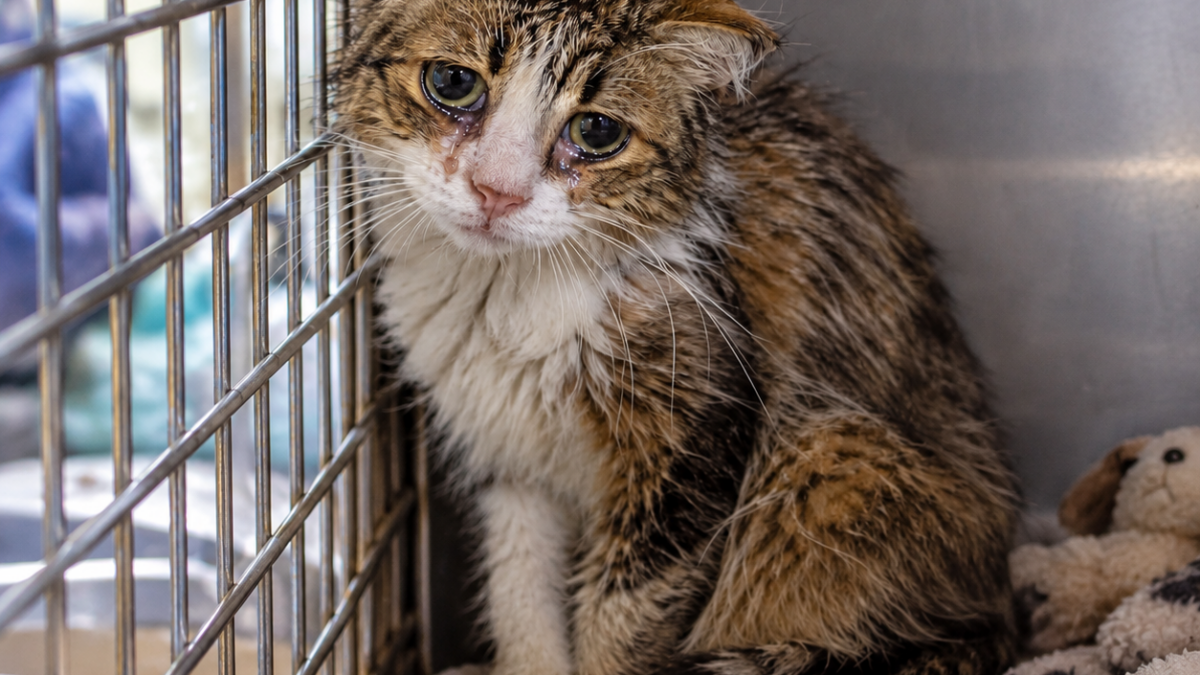
The first time I saw her, there were wet trails running down both sides of her tiny face, and for a few seconds I honestly thought the little gray cat was crying.
Every other cat in the shelter was calling for attention, reaching through the bars, or watching the door, but she sat silently in the darkest corner as if she had already learned that people eventually walked away.
Then I knelt in front of her cage, offered her my hand, and one small gesture changed what I thought was going to be an ordinary shelter visit into a story that would eventually expose a secret someone had worked very hard to keep buried.
My name is Emily Carter, and I had not gone to the county shelter that Saturday morning intending to adopt a cat.
That part matters.
I was only supposed to drop off several bags of food and old blankets collected by the elementary school where I worked. My plan was to unload everything, speak with the shelter manager for a few minutes, and leave before noon.
Instead, I walked into the cat room and stopped halfway down the first row.
She was in kennel 27.
A tiny gray cat with tangled fur, a thin body, and enormous green eyes.
While the other cats moved toward the front of their cages when visitors entered, she did the opposite.
She pressed herself against the back wall.
Her body became so small that she looked as though she were trying to disappear into the stainless-steel corner.
Then I noticed her face.
Two wet tracks ran from the inner corners of her eyes down her cheeks.
I stared.
“Is she crying?”
A shelter employee named Megan had been walking behind me.
She stopped.
“Her eyes have been watering since she came in. The vet thinks part of it is irritation and stress.”
“How long has she been here?”
“Eleven days.”
“What happened to her?”
Megan’s expression changed.
“She was found beside County Road 8.”
“Stray?”
“Not exactly.”
She lowered her voice.
“Someone left her in a cardboard box.”
I looked back at the cat.
The box had apparently been taped loosely across the top and placed near a drainage ditch. A driver noticed it because something inside was moving.
When animal control arrived, they found the gray cat curled beneath a dirty towel.
No food.
No identification tag.
No note.
Nothing explaining why she had been left there.
“She barely made a sound when they opened the box,” Megan said. “That’s what worried everybody.”
I moved closer to kennel 27.
The cat immediately lowered herself.
I crouched instead of standing over her.
“Hi.”
Her eyes followed me.
No hiss.
No growl.
No sound at all.
I slowly held two fingers near the bars.
“You don’t have to come over.”
She remained still.
“That’s okay.”
Several seconds passed.
Then her nose moved.
Barely.
She smelled the air.
I waited.
One tiny paw shifted forward.
Then another.
The little cat crossed half the cage.
Stopped.
Her body trembled.
I didn’t move my hand.
Eventually her nose reached my fingertips.
She smelled me carefully.
Once.
Twice.
Then pulled back.
I expected her to retreat to the corner.
She didn’t.
She stared at my hand.
And then something happened that I still remember with ridiculous clarity.
She lifted one paw.
Slowly pushed it between the bars.
And placed it directly on my finger.
Not scratching.
Not grabbing.
Just touching.
Her paw was so light that I barely felt it.
I looked at Megan.
Megan had gone completely still.
“What?”
“She hasn’t done that with anyone.”
I looked back at the cat.
Her paw remained against my hand.
Her eyes were still wet.
I whispered, “Hey, sweetheart.”
For the first time, she made a sound.
A tiny, broken little meow.
Something inside my chest shifted.
I had known this animal for less than five minutes.
I didn’t know her history.
I didn’t know whether she liked children, dogs, furniture, strangers, or being held.
I didn’t even know whether I was emotionally ready to bring another animal home after losing my old cat the previous year.
But I knew one thing.
I could not walk away from kennel 27 without finding out what had happened to her.
So I asked Megan the question that changed everything.
“Has anyone applied to adopt her?”
Megan looked down at the clipboard in her hand.
Then back at me.
“No.”
“Not one person?”
“Not yet.”
I looked at the little paw still touching my finger.
“All right,” I said quietly. “Then tell me everything you know.”
I thought Megan was going to tell me about an abandoned cat.
Instead, what she showed me would lead us to an old microchip record, a family that insisted the cat had disappeared months earlier, a woman who knew they were lying, and one photograph that finally explained why this tiny animal seemed terrified whenever someone carried a cardboard box into the room.
PART 2
Megan took me into a small office behind the adoption desk.
There was one metal filing cabinet, two mismatched chairs, a coffee maker that looked older than I was, and a bulletin board covered in photographs of animals who had already gone home.
She closed the door.
“You asked for everything we know.”
“Yes.”
“It’s not much.”
She opened a folder.
The intake sheet was clipped to the front.
**Female domestic shorthair. Gray. Approximately four years old.**
Four.
She was not a kitten.
Her size had fooled me.
“Only four?”
“Maybe four or five. She’s underweight.”
Megan turned the page.
There were photographs from the day animal control found her.
I stared at the first one.
A cardboard box sat on the side of a gravel shoulder.
The top had partially collapsed from rain.
Another photograph showed the cat inside.
Curled against one corner.
Head lowered.
Eyes almost closed.
I hated the picture immediately.
Not because it was graphic.
It wasn’t.
Because it looked lonely.
There are certain photographs where you can feel the absence of another living thing.
That was one of them.
“Who found her?”
“A delivery driver named Thomas Reed. He saw the box move while he was turning around.”
“Did he see anyone leave it?”
“No.”
“Cameras?”
“Nothing useful.”
I turned the page.
“Was she checked for a chip?”
Megan paused.
“Yes.”
My eyes lifted.
“She has one?”
“She did.”
“Then why don’t you know who owns her?”
“The chip information is complicated.”
She sat across from me.
“The number goes back to a woman named Margaret Lawson.”
“Have you contacted her?”
“She died almost two years ago.”
That stopped me.
“So the cat belonged to her?”
“Maybe.”
“Maybe?”
“The registration was never updated. The emergency contact was Margaret’s son, Andrew.”
“And?”
“We called.”
Megan’s expression told me the answer before she spoke.
“He said he hadn’t seen the cat in months.”
Something about the wording bothered me.
“Months?”
“He claims she ran away.”
“When?”
“About seven months ago.”
I looked toward the door as though I could somehow see kennel 27 through the wall.
“Then how did she end up in a taped box?”
“That’s what we don’t know.”
## **1. The Name on the Chip**
The chip record listed her name as Sophie.
Sophie.
It fit her better than “kennel 27.”
I returned to the cat room.
She was back in the corner.
I crouched.
“Sophie?”
Her head lifted.
That could have been coincidence.
I tried again.
“Sophie.”
She stood.
Not quickly.
But definitely.
She took two steps toward the front.
Megan, standing behind me, whispered, “Well.”
“You saw that?”
“I saw it.”
“Sophie.”
The cat came closer.
Then sat.
Her green eyes remained fixed on me.
I smiled despite myself.
“So you do have a name.”
Her eyes watered again.
At the time, I still thought of those wet trails as tears.
Later, the veterinarian would explain that Sophie had chronic eye irritation, likely worsened by exposure, stress, and an untreated infection.
Cats do not cry from sadness in the same way humans do.
I learned that.
But knowing the medical explanation never changed the way that first moment felt.
Because whatever caused the moisture, the expression behind those eyes was unmistakable.
Fear.
Exhaustion.
And something that looked dangerously close to resignation.
## **2. I Wasn’t Ready**
Megan assumed I wanted an adoption form.
I didn’t take one.
Not immediately.
My husband, David, deserved to be part of the decision.
We had lost our seventeen-year-old cat, Molly, eleven months earlier.
Molly had been with us before our marriage.
Through two apartments.
Our first house.
My father’s illness.
David changing jobs.
Every ordinary and terrible moment that makes an animal stop feeling like a pet and start feeling like part of the architecture of your life.
When Molly died, I told David I couldn’t do it again.
He had not argued.
So when I arrived home that afternoon and found him repairing a cabinet hinge in the kitchen, I stood there far too long.
He finally looked at me.
“What?”
“There’s a cat.”
He returned to the cabinet.
“No.”
“You didn’t even let me explain.”
“You started with ‘there’s a cat.’ I know this story.”
“I didn’t adopt her.”
He looked up.
“Yet.”
I sat down.
“She was abandoned in a box.”
David closed his eyes.
“Emily.”
“She has these enormous green eyes.”
“Of course she does.”
“And she touched my finger.”
He pointed the screwdriver at me.
“That is emotional manipulation.”
“By the cat?”
“Yes.”
I laughed.
Then became serious.
“Her name is Sophie.”
David studied my face.
“She got to you.”
I looked down.
“Yes.”
He softened.
“Do you want another cat?”
“I don’t know.”
“That’s not what I asked.”
I thought about it.
“I want her not to be alone.”
David placed the screwdriver on the counter.
“That’s different.”
“I know.”
He sat across from me.
“Bring me to meet her tomorrow.”
## **3. Sophie Chose Differently**
David expected Sophie to ignore him.
Instead, when he crouched in front of her kennel Sunday morning, she stared at him for almost thirty seconds.
Then walked forward.
She smelled his fingers.
And sneezed directly on him.
I covered my mouth.
David stared at the cat.
“Well.”
Megan tried not to laugh.
Sophie sniffed him again.
Then rubbed her face against the bars.
David looked at me.
“That feels unfair.”
“What?”
“She’s making a strong argument.”
I knew then.
Not because David said yes.
Because his face had changed.
People who have loved animals recognize that moment.
The instant curiosity becomes responsibility.
He asked Megan, “What medical care does she need?”
That was his version of surrender.
## **4. The Examination**
The shelter veterinarian, Dr. Rebecca Nolan, examined Sophie the following afternoon.
I asked if I could attend.
Sophie weighed six pounds, four ounces.
Rebecca estimated her healthy weight should have been closer to eight or nine.
Her coat had several mats.
She had fleas.
Her paw pads were dry and irritated.
One tooth was chipped.
The eye discharge came from a combination of infection and chronic irritation.
Nothing immediately life-threatening.
That should have comforted me.
Instead, I kept thinking about seven months.
If Andrew Lawson was telling the truth, Sophie had survived somewhere for seven months before being placed inside that box.
Where?
How?
Rebecca checked Sophie’s abdomen.
Sophie suddenly twisted away.
Rebecca stopped.
“Okay.”
“What?”
“She’s sensitive here.”
She examined more gently.
Then found a thin scar beneath the fur.
Old.
Healed.
“Any idea?”
“Could be from surgery. Could be an injury.”
The shelter records contained nothing.
Rebecca scanned the chip again.
Same number.
Same owner.
Margaret Lawson.
I asked, “Could Andrew have inherited her?”
“Legally, pets are usually handled as part of the estate or by whoever assumes care. The chip doesn’t tell us what happened after Margaret died.”
“So we need the family.”
Rebecca looked at me.
“The shelter already contacted him.”
“He says she ran away.”
“Yes.”
“Do you believe him?”
Rebecca removed her gloves.
“My job is to believe evidence.”
I liked that answer.
## **5. The Application**
We submitted the adoption application.
Because Sophie had an ownership history connected to the microchip, the shelter had to complete a hold and documentation process before finalizing anything.
I visited every day.
Sometimes for fifteen minutes.
Sometimes an hour.
Sophie slowly changed.
On Monday, she let me touch her cheek.
Tuesday, beneath her chin.
Wednesday, she stepped into my lap for approximately four seconds before panicking and retreating.
Thursday, she stayed twelve seconds.
Friday, almost a minute.
She never fought.
When frightened, she froze.
That worried Rebecca more.
“People misunderstand animals who freeze,” she told me.
“Why?”
“Because they look compliant.”
She gestured toward Sophie.
“A cat that scratches makes people respect her fear. A cat that becomes still sometimes gets pushed farther because people think she’s accepting it.”
That sentence stayed with me.
Sophie had become very good at disappearing while sitting directly in front of you.
## **6. The Box**
The first serious clue appeared accidentally.
A volunteer entered the cat room carrying flattened cardboard boxes for recycling.
The moment Sophie saw them, she changed.
Her pupils widened.
Her body dropped.
Then she launched herself backward.
She hit the rear of the kennel hard enough that Megan rushed over.
“Sophie!”
The volunteer froze.
“I didn’t do anything.”
“I know.”
I was standing three cages away.
I watched Sophie press herself into the corner.
Shaking.
Not mild nervousness.
Terror.
I looked at the cardboard.
Then at Megan.
“The box.”
She understood immediately.
From that day, cardboard boxes were kept out of Sophie’s sight.
But I couldn’t stop thinking about her reaction.
An animal can be startled by almost anything.
One incident doesn’t prove history.
But it was another piece.
## **7. Andrew Lawson**
I found Andrew’s public business number online.
I debated calling for two days.
Then I did.
He owned a small landscaping company.
When he answered, machinery roared in the background.
“Lawson Landscaping.”
“Mr. Lawson?”
“Speaking.”
“My name is Emily Carter. I’m calling about Sophie.”
Silence.
“The cat?”
“Yes.”
“Why?”
“My husband and I are hoping to adopt her.”
“Okay.”
His indifference surprised me.
“The shelter said she belonged to your mother.”
“Yeah.”
“What happened after your mother died?”
A pause.
“My sister took the cat.”
That was new.
“The shelter said you told them Sophie ran away.”
“She did.”
“From your sister’s house?”
“Yeah.”
“Which sister?”
His tone hardened.
“Why are you asking?”
“Because she was found sealed in a box.”
“She ran off months ago.”
“Do you know how she ended up in the box?”
“No.”
“Did you search for her?”
Another pause.
“Look, lady, I’m working.”
Then he hung up.
I sat at my kitchen table staring at my phone.
David walked in.
“How bad?”
“He changed the story.”
“What did he say?”
“His sister had Sophie.”
“What did the shelter hear?”
“That he hadn’t seen her for months.”
“Those aren’t necessarily contradictory.”
“No.”
But something was wrong.
I could feel it.
## **8. Laura**
Andrew had one sister.
Laura Lawson.
I found her through Margaret’s obituary.
I sent one message.
I expected nothing.
Two hours later, Laura called.
“You’re the woman trying to adopt Sophie?”
“Yes.”
Her breath caught.
“She’s alive?”
I stood from the kitchen chair.
“You didn’t know?”
“No.”
Laura began crying.
Not quietly.
Not politely.
The kind of crying people do when something they have carried too long suddenly breaks open.
“I thought she was dead.”
My grip tightened around the phone.
“Laura, what happened?”
Her answer changed the entire story.
## **9. Margaret**
Margaret Lawson had adopted Sophie as a kitten.
Laura sent photographs.
In every one, Sophie looked healthy.
Bright eyes.
Smooth gray coat.
Sleeping on Margaret’s chest.
Sitting on the back of a couch.
Watching birds through a window.
Margaret adored her.
Then Margaret developed heart problems.
Laura lived three states away.
Andrew lived twenty minutes from their mother.
When Margaret became too sick to remain at home, Andrew started helping.
At least that was what Laura believed.
“Mom made him promise to take care of Sophie.”
“Did he agree?”
“Yes.”
“When Margaret died?”
“He said Sophie was fine.”
Laura’s voice trembled.
“He kept telling me she was living at his house.”
“For how long?”
“Almost a year.”
“Did you see her?”
“No. I kept asking for pictures.”
“And?”
“There was always an excuse.”
Phone broken.
Cat hiding.
Too busy.
Poor reception.
Then one day Andrew said Sophie had escaped through a door.
Laura had been furious.
She posted online.
Called shelters.
Contacted local rescues from several states away.
No one found Sophie.
“I believed him,” she whispered.
I closed my eyes.
“When did he say she disappeared?”
“Seven months ago.”
Same timeline.
“Laura, do you know if your mother left money for Sophie?”
Silence.
Then:
“Yes.”
## **10. The Money**
Margaret’s will contained a small provision.
Ten thousand dollars set aside for Sophie’s care.
Not a fortune.
But enough for food, routine veterinary care, and emergencies.
Andrew had been designated the person responsible for managing it.
Laura knew because she had witnessed discussions about the estate.
“Did he receive the money?”
“Yes.”
“What happened to it?”
“I don’t know.”
She paused.
“I asked once.”
“And?”
“He told me caring for an animal costs more than people think.”
I looked toward the living room where David sat.
He could tell from my expression that something had changed.
“Laura, did your brother ever actually want Sophie?”
“No.”
The answer came immediately.
“He hated cats.”
## **11. The Neighbor**
Laura gave me the name of Margaret’s former next-door neighbor.
Helen Brooks.
Helen was seventy-four.
When I called, she remembered Sophie instantly.
“Little gray thing?”
“Yes.”
“Margaret treated that cat better than she treated herself.”
“Do you know what happened after Margaret passed?”
Helen became quiet.
“Andrew took things from the house.”
“Did he take Sophie?”
“I saw a carrier.”
My pulse changed.
“When?”
“Day after the funeral, maybe two days.”
“Was Sophie inside?”
“I couldn’t see.”
“Anything else?”
Helen thought.
Then said, “I heard her.”
My hand tightened.
“Heard Sophie?”
“Crying in the carrier.”
There it was.
A witness.
Andrew had taken Sophie.
## **12. Home**
Before the investigation went any further, Sophie was cleared for adoption.
The shelter determined there was no valid claim from Andrew after he declined to reclaim her during the required process and maintained she had been lost months earlier.
David and I signed the papers.
I thought adoption day would be joyful.
It was.
But not immediately.
When Megan brought out the plastic carrier, Sophie froze.
We had deliberately avoided cardboard.
Still, she understood confinement.
I knelt beside the carrier.
“You’re coming home.”
Obviously, she did not understand the words.
But I wanted to say them.
She resisted entering.
So we waited.
Megan removed the top.
We placed a familiar blanket inside.
Sophie smelled it.
Stepped forward.
Then backward.
David sat on the floor.
Nobody pushed.
Eventually she climbed inside by herself.
We replaced the top.
She gave one quiet meow.
I placed my fingers against the door.
“We’re going somewhere better.”
## **13. The First Night**
At home, Sophie hid beneath the guest bed.
We had prepared a quiet room.
Food.
Water.
Litter box.
Soft bed.
A small covered hideaway.
She ignored all of it.
Beneath the bed was safer.
David and I sat on the floor outside the room.
“Should we leave her alone?”
“Yes.”
Neither of us moved.
Eventually David said, “We’re very bad at leaving her alone.”
“Yes.”
That night, I woke at 2:14 a.m. because I heard something.
A soft sound.
I walked toward the guest room.
Sophie stood in the hallway.
She saw me.
Stopped.
I stopped too.
For almost a minute, neither of us moved.
Then she walked toward me.
Slowly.
She reached my feet.
Smelled my pajama leg.
Then sat.
I crouched.
She lifted one paw.
Placed it on my knee.
Exactly as she had touched my finger through the shelter bars.
I whispered, “You remember me.”
Maybe she did.
Maybe she simply wanted reassurance.
Either way, I sat on the hallway floor until nearly three.
## **14. Learning the House**
Sophie treated every new room as a negotiation.
Day one: guest room.
Day three: hallway.
Day five: kitchen.
Day seven: living room.
The stairs took two weeks.
Our bedroom took three.
The couch took twenty-six days.
David kept track.
When Sophie finally climbed onto it, he sent me a text from six feet away.
**DO NOT MOVE. HISTORIC EVENT.**
She slept on one cushion for twenty minutes.
We did not turn on the television.
We barely breathed.
Eventually she woke, stretched, and jumped down.
David whispered, “Worth it.”
## **15. The Investigation Begins**
Laura contacted the county humane officer herself.
That mattered.
This was no longer merely my curiosity.
A family member was alleging that Andrew had misrepresented Sophie’s care and possibly misused funds designated for her.
Officer James Porter interviewed Helen.
Then Laura.
Then the shelter.
He obtained Sophie’s medical records.
The eye infection.
Weight loss.
Chipped tooth.
Old scar.
Stress behaviors.
None alone proved Andrew abandoned her.
But the timeline became difficult for him.
Margaret died.
Andrew removed Sophie.
Andrew received responsibility for her care.
No veterinary records.
No photographs.
No proof she ever lived in his house.
Then, seven months before Sophie was found, he claimed she disappeared.
Someone later placed her in a box roughly eight miles from his property.
Eight miles.
Not proof.
But closer than I expected.
## **16. Sophie and Rain**
The first heavy rainstorm after Sophie came home nearly sent her backward.
Thunder started around midnight.
Rain hit the windows.
She ran into the guest room.
I found her beneath the bed.
Her eyes were wide.
I lay on the carpet.
“I’m not pulling you out.”
She watched.
Another thunderclap.
Sophie lowered herself.
I stayed.
Twenty minutes later, she crawled forward.
Not out.
Just closer.
I reached one hand beneath the bed.
She touched it.
The storm lasted two hours.
I remained on the floor.
At some point, Sophie fell asleep with one paw resting on my wrist.
The next morning, my shoulder hurt so badly I could barely raise my arm.
David handed me coffee.
“Worth it?”
I looked toward the hallway.
Sophie was sitting there watching us.
“Yes.”
## **17. The Photograph**
The breakthrough came from Laura.
She had been searching through old cloud backups from Margaret’s phone.
She found a photograph taken six weeks after Margaret’s death.
Andrew was standing inside Margaret’s garage.
Behind him was a wire pet crate.
Inside the crate sat Sophie.
The image was clear.
Date stamped.
Location confirmed.
Andrew had told investigators Sophie lived freely inside his home during that period.
She wasn’t at his home.
She was still at Margaret’s empty property.
In a crate.
Laura stared at the photo during a video call.
“I took this.”
“You?”
“I came home to help with paperwork.”
“Did you notice Sophie?”
“I thought the crate was temporary.”
She covered her mouth.
“God.”
“Laura.”
“I should’ve asked.”
“You were grieving.”
“I should’ve asked.”
There are moments when guilt is useless.
This was one.
“You’re asking now.”
## **18. The Garage**
With consent from the new owner of Margaret’s former home, Porter inspected the garage.
Most of Margaret’s belongings were gone.
But the floor told a story.
Scratches around one corner.
Old adhesive where a protective sheet had once been taped down.
Helen remembered hearing a cat at night after Margaret died.
Weeks.
Possibly months.
Porter asked Andrew again.
This time Andrew said Sophie stayed in the garage “temporarily.”
Different story number three.
“How long?”
He couldn’t remember.
Why?
Because his wife was allergic.
That was new.
His wife later told investigators she had never been medically diagnosed with a cat allergy.
Different story number four.
## **19. The Receipt**
Andrew’s biggest mistake was paperwork.
The estate accounting listed expenses for Sophie.
Food.
Veterinary care.
Boarding.
Medication.
Nearly $8,400 of the $10,000 fund had supposedly been used.
Porter asked for receipts.
Andrew supplied them.
One veterinary receipt immediately looked wrong.
The clinic logo was real.
The invoice number was not.
The clinic had no record of Sophie.
No record of Andrew.
No record matching the date.
The boarding business listed on another receipt had closed two years before the date shown.
Investigators began looking more closely.
Several documents appeared altered.
Now the case was no longer only about Sophie.
Money had entered it.
And paper has a way of remembering what people hope everyone else will forget.
## **20. Andrew Calls Me**
My phone rang on a Tuesday evening.
Unknown number.
“Emily?”
“Yes?”
“This is Andrew Lawson.”
I stood from the couch.
Sophie was sleeping beside David.
“How did you get my number?”
“Laura.”
I doubted that.
“What do you want?”
“My cat.”
I nearly laughed.
“You said she ran away.”
“She did.”
“Then why is she suddenly yours again?”
“Because she belongs to my mother’s estate.”
“Sophie has been legally adopted.”
“That can be challenged.”
“You should talk to the county.”
“I’m talking to you.”
His voice remained controlled.
That bothered me more than shouting would have.
“You’ve gotten involved in something that isn’t your business.”
I looked at Sophie.
She had awakened.
Her eyes were on me.
“She became my business when I signed her adoption papers.”
“You don’t know what happened.”
“Then explain it.”
Silence.
“I cared for that cat.”
“Where?”
“My house.”
“The photograph shows her in your mother’s garage.”
Pause.
“That was temporary.”
“How temporary?”
“You people are twisting everything.”
“You told the shelter you hadn’t seen her for months.”
“She ran away.”
“You told me your sister had her.”
Another silence.
Then Andrew said something I will never forget.
“You should have just left her at the shelter.”
I felt cold.
“Why?”
No answer.
“Andrew?”
The call ended.
## **21. David’s Anger**
David rarely gets angry.
Really angry.
He becomes quiet.
After I told him about the call, he stood at the kitchen sink for a long time.
Finally he said, “Block the number.”
“I already did.”
“Send everything to Porter.”
“I will.”
He turned.
“And we stop talking to him.”
“Yes.”
Sophie walked into the kitchen.
David immediately crouched.
His entire face softened.
“Hey, bug.”
That was his nickname for her.
Sophie walked toward him.
Rubbed against his shin.
Then sat on his foot.
David looked at me.
“He doesn’t get her.”
“No.”
“Ever.”
“No.”
## **22. The First Purr**
Sophie had been home forty-three days when she purred.
I remember because David wrote the date on our refrigerator calendar.
We were sitting on the couch.
Sophie had begun sleeping beside me but still avoided laps.
That evening, she stepped onto my leg.
Stopped.
I didn’t touch her.
She circled once.
Lay down.
Then the sound started.
Low.
Almost impossible to hear.
I looked at David.
He heard it too.
Neither of us spoke.
Sophie’s eyes closed.
The vibration grew stronger.
I began crying.
David whispered, “Don’t ruin this by sobbing on her.”
I laughed silently.
Sophie opened one eye.
Then closed it again.
For the next eighteen minutes, she slept in my lap.
The cat who once sat silently in the back of a shelter cage had decided the safest place in the room was on top of me.
## **23. The Woman at the Gas Station**
The person who found the box, Thomas Reed, remembered something months later.
He had stopped at a gas station before discovering Sophie.
A dark landscaping truck had been ahead of him.
He remembered because the truck’s trailer had a broken left taillight.
When he later found the box, he saw the same truck farther down County Road 8.
He hadn’t thought much of it.
Landscaping trucks were common.
Then he saw a local article about the investigation.
Lawson Landscaping used dark trucks.
One had a damaged trailer light in an old company photo.
Again, not proof.
But Porter added it to the file.
## **24. The Camera**
A rural property owner on County Road 8 had a driveway camera.
Most footage was automatically deleted after ninety days.
Too late.
But several clips had been saved because the owner had been monitoring illegal dumping.
One clip was from the morning Sophie was found.
A dark truck towing a landscaping trailer drove past.
Forty minutes later, it returned without stopping.
The company name wasn’t readable.
But the trailer had a broken left taillight.
Thomas had remembered correctly.
Porter obtained records.
A Lawson Landscaping truck had been assigned to Andrew that morning.
For the first time, the line from Andrew to County Road 8 became more than suspicion.
## **25. Laura Confronts Him**
Laura called me after confronting her brother.
I wish she hadn’t.
Not because I thought she was wrong.
Because Andrew frightened her.
“He kept saying Mom left everything to him.”
“That isn’t true.”
“I know.”
“What else?”
“He said Sophie was just a cat.”
Laura’s voice broke.
“Mom loved her.”
“I know.”
“He said I was destroying the family.”
That sentence made me furious.
Not because it was cruel.
Because it was familiar.
People who fear accountability often describe truth as betrayal.
“Laura.”
“Yes?”
“You are not the person who put Sophie in a box.”
Silence.
“I know.”
“You’re the person helping prove what happened.”
She exhaled.
“I know.”
## **26. The Charge**
Months passed.
Investigations are slower than stories.
That frustrated everyone.
But Porter did not rush.
He wanted records.
Dates.
Phone location data obtained through lawful process.
Estate documents.
Truck assignments.
Receipts.
Witnesses.
Veterinary confirmation.
The final charging decision included allegations related to animal abandonment and neglect, along with separate financial misconduct associated with the estate account.
Andrew pleaded not guilty.
That was expected.
Then he made another claim.
Sophie had become aggressive.
That was why he had confined her.
I looked at Sophie sleeping upside down in our laundry basket when I heard that.
“Aggressive?”
David stared at her.
Sophie’s back foot twitched in a dream.
“She’s currently losing a fight with a towel.”
## **27. Sophie Changes**
By spring, Sophie weighed eight pounds.
Her coat had become soft.
Her eyes were clear.
The wet tracks disappeared almost completely after treatment.
She learned the sound of the treat container.
She learned that opening the refrigerator sometimes meant turkey.
She learned birds were deeply suspicious creatures requiring surveillance.
She discovered David’s home office chair.
He lost ownership immediately.
When he tried to move her, she stared.
He bought another chair.
I wish I were exaggerating.
I am not.
## **28. The Door**
Sophie had one strange habit.
Whenever someone opened the front door, she ran away.
Not toward it.
Away.
Even if the door opened only a few inches.
Rebecca believed it might relate to the period when she was confined or abandoned.
We never forced her to stand near it.
Then one summer evening, I came home carrying groceries.
David opened the door.
Sophie was in the hallway.
She froze.
I froze.
Normally she would run.
This time she didn’t.
She watched me enter.
David closed the door.
Sophie walked forward.
Smelled the grocery bag.
Then rubbed against my ankle.
A tiny thing.
But recovery is made of tiny things.
## **29. The Hearing**
The preliminary hearing drew more people than expected.
Laura sat behind me.
David beside me.
Andrew sat with his attorney.
He did not look at us.
Porter presented the timeline.
Margaret’s death.
Sophie’s transfer to Andrew’s responsibility.
The photograph in the garage.
No legitimate veterinary history.
Questionable financial records.
Andrew’s changing explanations.
The County Road camera.
The truck.
The box.
The defense argued coincidence.
The judge allowed the matter to proceed.
Outside, Andrew’s attorney tried to steer him away from reporters.
Andrew saw Laura.
“Happy now?”
She froze.
He continued.
“You got what you wanted.”
Laura surprised me.
She stepped forward.
“No.”
Her voice shook.
“I wanted Mom to be able to trust you.”
Andrew said nothing.
“That’s what I wanted.”
Then she walked away.
## **30. The Missing Two Thousand Dollars**
Investigators initially focused on the $8,400 Andrew claimed to have spent.
Then they examined the remaining fund balance.
It was nearly empty.
Transfers had been made into a company account.
The description on one transaction read:
**Property maintenance associated with animal care.**
What property maintenance?
The garage.
Andrew had charged Sophie’s care fund for repairing part of Margaret’s garage after Sophie had supposedly damaged it.
Then charged again for cleaning.
Then again for “odor remediation.”
The person who performed the work?
Andrew’s own landscaping company.
He had effectively paid himself using money meant for the cat.
David read the report.
“He made money from locking her in there?”
That was the allegation.
I looked toward Sophie.
For once, I had nothing to say.
## **31. Revenge**
People started using the word revenge after the local story became public.
I didn’t like it.
I didn’t want revenge.
I wanted Sophie safe.
I wanted Laura to know the truth.
I wanted Margaret’s final wishes respected.
And I wanted Andrew prevented from doing the same thing again.
But I understood why people felt angry.
Margaret had trusted her son.
Sophie had trusted the family around her.
Both trusts had been treated as inconveniences.
The satisfying part was not watching Andrew suffer.
It was watching the lies run out of places to hide.
## **32. Trial**
The criminal trial began almost a year after Sophie entered our home.
By then, she barely resembled kennel 27.
The jury never saw her in person.
I was glad.
She had no reason to be dragged into a courtroom.
But they saw photographs.
The box.
The shelter.
The watery eyes.
The thin body.
Then photographs from our home.
Healthy coat.
Clear eyes.
Normal weight.
The defense objected to some.
The judge limited what was shown.
Fair.
This was not supposed to be an emotional contest.
It was about evidence.
Laura testified first.
She described Margaret’s relationship with Sophie.
The promise.
The money.
Andrew’s repeated assurances.
Then Helen testified.
She described hearing Sophie inside the carrier.
The garage.
The crying at night.
Thomas described the box and the truck.
The camera footage followed.
Then Porter walked through the records.
Receipts.
Dates.
Company registrations.
Bank transfers.
Veterinary databases.
One by one.
Slowly.
The truth was boring in the way strong evidence often is.
Not dramatic speeches.
Documents.
Numbers.
Dates that refused to match.
## **33. My Testimony**
I testified about the shelter.
The phone call.
Nothing more.
Andrew’s attorney asked:
“You became emotionally attached to this cat immediately, correct?”
“Yes.”
“So you may have interpreted ordinary behavior through an emotional lens?”
“Absolutely.”
The attorney paused.
I think he expected resistance.
I continued.
“That’s why I’m not asking anyone to rely on my interpretation.”
He looked at me.
“I’m relying on the records.”
He changed direction.
Good choice.
## **34. Rebecca**
Dr. Rebecca Nolan testified about Sophie’s condition.
She was careful.
Professional.
She refused to say more than evidence supported.
“Can you determine exactly how long Sophie was outdoors?”
“No.”
“Can you determine exactly who caused her chipped tooth?”
“No.”
“Can you prove that the moisture beneath her eyes was emotional crying?”
“No. Cats do not produce emotional tears in the same way humans do.”
That mattered to me.
Because I wanted the story told truthfully.
Then the prosecutor asked:
“Can you determine whether Sophie had received adequate routine veterinary care in the months immediately preceding intake?”
Rebecca answered:
“The available medical evidence did not indicate adequate ongoing care.”
“Was she underweight?”
“Yes.”
“Eye infection?”
“Yes.”
“External parasites?”
“Yes.”
“Would those conditions have been visible?”
“Yes.”
## **35. Andrew Takes the Stand**
I did not expect Andrew to testify.
He did.
His attorney must have believed the jury needed another explanation.
Andrew said Sophie was difficult.
She scratched furniture.
She hid.
She urinated outside the litter box.
He kept her in the garage temporarily.
Then she escaped.
The prosecutor stood.
“You told the shelter she disappeared seven months before she was found?”
“Yes.”
“You told Emily Carter that your sister had possession of Sophie?”
Andrew frowned.
“I may have been confused.”
“You told investigators Sophie lived in your house?”
“For a while.”
“You later acknowledged she lived in the garage?”
“Sometimes.”
“You submitted veterinary receipts?”
“Yes.”
“From a clinic that never treated Sophie?”
“I don’t know what their records show.”
“You submitted boarding receipts?”
“Yes.”
“For a business that was closed on the dates shown?”
“I didn’t prepare every document.”
“Who did?”
Andrew hesitated.
“I don’t remember.”
The prosecutor picked up another file.
“Did you authorize payments from Sophie’s care fund to Lawson Landscaping?”
“Yes.”
“You own Lawson Landscaping?”
“Yes.”
“What animal-care services did your landscaping company provide?”
Silence.
The courtroom became still.
“Mr. Lawson?”
“We maintained the property.”
“Which property?”
“My mother’s.”
“The garage where Sophie was confined?”
His attorney objected.
The judge addressed the wording.
The prosecutor rephrased.
“Was Sophie kept in that garage during the period for which your company received payments?”
Andrew’s jaw tightened.
“Yes.”
## **36. The Box**
Then came the hardest question.
“Did you place Sophie in the cardboard box on County Road 8?”
“No.”
“Were you driving the Lawson Landscaping vehicle recorded on that road that morning?”
“Yes.”
“Why?”
“Work.”
“What job?”
“I don’t remember.”
“Your schedule lists no job on County Road 8.”
“I took different routes.”
“Why did your truck pass the location shortly before Sophie was found?”
“Coincidence.”
“Why did you tell Mrs. Carter she should have left Sophie at the shelter?”
“I was angry.”
“Why?”
“Because everybody decided I was guilty before there was a trial.”
The prosecutor nodded.
Then stepped away.
No theatrical ending.
No shouting.
Just:
“No further questions.”
## **37. The Verdict**
The jury deliberated into the afternoon.
I sat with David and Laura.
Laura’s hands shook.
At one point she whispered, “Whatever happens, I’m glad Sophie is safe.”
That was the right perspective.
Then we were called back.
The verdicts were read.
Guilty on several counts connected to the financial misconduct.
Guilty on animal-related charges sustained by the evidence.
Not every allegation resulted in conviction.
That matters too.
Justice is not supposed to give us every outcome we emotionally want.
It is supposed to follow what can be proven.
When court ended, Laura cried.
David hugged her.
I stood quietly.
I did not feel victorious.
I thought about Margaret.
She had tried to make one simple thing happen after her death.
Keep Sophie safe.
It should not have required all of this.
## **38. Sentencing**
At sentencing, the judge focused on trust.
Trust from Margaret.
Trust inherent in the estate responsibility.
Trust associated with caring for a dependent animal.
Andrew received financial penalties, restitution requirements, probationary conditions, and restrictions on possessing or being responsible for animals for a court-defined period, along with additional consequences associated with the financial convictions.
The exact punishment mattered less to me than one order.
He could not reclaim Sophie.
Ever.
He had tried through his attorney earlier in the proceedings.
That question was now finished.
Sophie was ours.
Legally.
Permanently.
Home.
## **39. Laura Comes Over**
Laura visited Sophie for the first time two weeks later.
She was terrified.
“What if she hates me?”
“She doesn’t know enough about family relationships to hold you responsible.”
“I know.”
Still, she was nervous.
Sophie hid when Laura entered.
We sat in the living room.
No chasing.
No calling.
No pressure.
Twenty minutes later, Sophie appeared in the hallway.
Laura covered her mouth.
“Oh.”
Sophie stopped.
Laura didn’t move.
“That’s her.”
“Yes.”
“She looks like Mom’s pictures.”
Sophie approached slowly.
Smelled Laura’s shoe.
Then her hand.
Laura started crying.
“I’m sorry.”
Sophie sniffed again.
Then rubbed her cheek against Laura’s fingers.
Laura broke completely.
She lowered her head.
“Oh, Sophie.”
The cat remained there.
Not forgiving.
Cats do not understand human moral symbolism.
She was simply accepting a gentle hand.
Sometimes that is more powerful than forgiveness.
## **40. Margaret’s Sweater**
Laura brought one item from Margaret’s belongings.
A blue wool sweater.
“She used to wear this constantly.”
We placed it on the couch.
Sophie approached.
Smelled it.
Stopped.
Then smelled it again.
Her body changed.
Not dramatically.
Her shoulders lowered.
She stepped onto the sweater.
Circled twice.
Lay down.
Laura and I stared.
David walked into the room and almost spoke.
I raised one finger.
Don’t.
Sophie pressed her face into the fabric.
Then began to purr.
Laura turned away because she couldn’t stop crying.
I do not know what Sophie remembered.
Smell is powerful for cats.
Maybe Margaret remained in that sweater.
Maybe Sophie simply liked wool.
Both possibilities can exist.
But Laura left the sweater with us.
Sophie slept on it for years.
## **41. The Cat Who Never Cried Again**
After treatment, Sophie’s eyes stopped watering constantly.
There were occasional flare-ups during allergy season.
But the wet trails that had first drawn me to kennel 27 disappeared.
Sometimes visitors saw her photograph from the shelter and asked:
“Was she really crying?”
I always answered carefully.
“Her eyes were medically irritated.”
Then I added:
“But she was definitely hurting in ways a medical test couldn’t measure.”
You don’t have to invent human tears to make an animal’s fear meaningful.
The truth was enough.
## **42. Her Favorite Place**
Sophie eventually chose the window above our living-room radiator as her favorite place.
David installed a padded shelf.
Then a wider shelf because apparently the first one lacked “adequate lounging dimensions.”
His words.
From there Sophie watched birds.
Mail carriers.
Neighbors.
Rain.
Snow.
The world.
But always from inside.
Warm.
Safe.
The first winter, I took a photograph of her sitting there while snow covered the yard.
I sent it to Megan at the shelter.
She replied:
**That’s the same cat?**
Yes.
Same cat.
Different life.
## **43. David**
I had been the one who found Sophie.
But Sophie chose David.
I pretended not to be offended.
Every night around ten, she waited outside his office.
If he worked too late, she entered and stared.
If he ignored her, she jumped onto the desk.
If he continued ignoring her, she sat directly on the keyboard.
He called it harassment.
Sophie considered it management.
When David had the flu one winter, she slept beside him almost continuously.
He looked miserable.
Sophie looked satisfied.
At one point he whispered:
“You know I said no to this cat?”
“Yes.”
“She has absolutely no respect for that.”
“No.”
Sophie placed one paw on his chest.
David smiled.
“Good.”
## **44. What Happened to the Money**
Restitution recovered part of the funds Margaret had intended for Sophie.
Laura had legal authority regarding portions of the estate matter.
She made a decision.
“I don’t want it.”
“What?”
“The recovered money.”
“That belonged to Sophie’s care.”
“She has you.”
Laura smiled.
“I want the rest to help cats whose Margarets aren’t around anymore.”
The funds ultimately supported legitimate animal-care expenses through arrangements approved in the estate process.
Several older cats received veterinary care.
One needed dental treatment.
Another required medication before adoption.
Another had been surrendered after its owner entered assisted living.
Margaret’s attempt to protect one gray cat ended up helping others.
I liked that ending.
## **45. The Shelter Room**
A year after Sophie’s adoption, the shelter renovated the cat wing.
Megan asked whether we wanted to sponsor a kennel.
David chose number 27.
Of course.
A small plate was installed.
It did not use Sophie’s sad photograph.
Instead, we chose one of her sleeping in sunlight.
The plate said:
**For Sophie — and for the quiet ones waiting in the back.**
That was enough.
## **46. The Box Returns**
Two years after adoption, we received a package.
A normal shipping box.
I placed it on the kitchen floor without thinking.
Sophie entered.
Saw it.
Stopped.
For a moment, my heart sank.
Her body stiffened.
I was about to move the box.
Then Sophie walked toward it.
Smelled the corner.
Walked around it.
David and I watched.
She touched it with one paw.
Then another.
And climbed inside.
I almost laughed.
She sat in the center of the empty box.
Looked at us.
Then curled up.
David whispered, “Are we allowed to be emotional about this?”
“Absolutely.”
He took a photograph.
Sophie slept there for twenty minutes.
A cardboard box had once meant abandonment.
Now it was just a box.
That may have been one of the clearest signs of healing I ever saw.
## **47. Time**
Years passed.
Sophie became completely ordinary.
That was perhaps the greatest gift.
Her life stopped being a rescue story every day.
She was simply our cat.
She gained a little too much weight.
Rebecca told us to reduce treats.
David accused her of medical tyranny.
Sophie hated one particular vacuum cleaner.
She learned how to open a closet door.
She once stole half a piece of turkey from David’s sandwich while maintaining direct eye contact.
She knocked a glass off the counter exactly once, then looked at me as though conducting a scientific experiment.
She became ordinary.
Safe enough to be annoying.
Loved enough to have habits.
## **48. Laura and Sophie**
Laura visited whenever she came back to Pennsylvania.
Sophie always took a few minutes to remember her.
Then approached.
Laura believed Sophie recognized something familiar in her scent or voice.
Maybe.
One afternoon Laura sat beneath the living-room window with Sophie beside her.
“She’s older than Mom ever got to see her.”
“Yes.”
Laura stroked Sophie’s head.
“I wish Mom knew.”
I looked at her.
“Maybe the important thing is that you know.”
Laura nodded.
Then Sophie bit her gently because she had apparently reached the petting limit.
Laura laughed.
“That also feels like something Mom would appreciate.”
## **49. Andrew**
I saw Andrew only once after sentencing.
Years later.
At a grocery store.
He was standing near the produce section.
We recognized each other.
Neither spoke.
For a second, old anger returned.
Then I realized I didn’t want anything from him.
No apology.
No explanation.
No humiliation.
Sophie was home.
Margaret’s story was known.
The money had been investigated.
The court had acted.
Andrew no longer controlled the ending.
So I walked past.
That was the last time I saw him.
## **50. Sophie Gets Older**
At twelve or thirteen, Sophie developed early kidney disease.
Nothing unusual for an aging cat.
Rebecca caught it early.
Special diet.
Monitoring.
More water stations.
Medication later.
David installed pet steps to the window shelf.
Sophie refused them for three months.
Then used them exclusively as though the steps had always been her idea.
Her face became softer with age.
A few white hairs appeared around her nose.
She slept more.
Still waited for David outside his office.
Still owned Margaret’s blue sweater.
## **51. The Last Visit to the Shelter**
When Sophie was around fourteen, Megan asked if we could bring her to the shelter after hours.
They were preparing a small anniversary display about successful senior and adult adoptions.
I hesitated.
Shelters had once frightened Sophie.
But the building had changed.
And Megan promised quiet.
We brought her in a soft carrier.
Sophie stepped out cautiously.
She smelled the hallway.
Then the cat room.
Kennel 27 stood empty.
Its door was open.
I expected Sophie to avoid it.
Instead, she approached.
Smelled the threshold.
Then walked away.
That was it.
No dramatic reaction.
No panic.
No symbolic pause.
She simply walked away.
I found that strangely perfect.
Some places stop having power over you long before you realize it.
## **52. The Morning She Wouldn’t Eat**
The last chapter began quietly.
Sophie refused breakfast.
At first, nothing unusual.
Older cats have off days.
Then she refused dinner.
The next morning, she remained on Margaret’s sweater.
Rebecca examined her.
Kidney values had worsened sharply.
We tried fluids.
Medication.
Appetite support.
For several weeks, she improved.
Then declined again.
David began sleeping downstairs because Sophie no longer climbed the steps every night.
He placed a mattress beside the couch.
“This is ridiculous,” I told him.
“Yes.”
“You’re sixty years old.”
“Yes.”
“Your back is going to hate you.”
“Yes.”
He lay down beside Sophie.
“She did not ask for your opinion.”
## **53. The Decision**
Eventually Rebecca told us what we already knew.
“We can keep doing interventions.”
David asked, “Will they give her good days?”
Rebecca looked at him.
“Probably not many.”
That was the answer.
We chose home.
No shelter.
No clinic.
No carrier.
No box.
Home.
Rebecca came on a quiet October afternoon.
Sunlight fell through Sophie’s window.
Margaret’s sweater lay beneath her.
David sat on one side.
I sat on the other.
Sophie was thin again.
Not like the shelter.
Different.
This was old age.
A body reaching the end of its work.
I touched her cheek.
Her eyes were clear.
No tears.
David whispered, “You were a lot of trouble.”
Sophie’s ear moved.
I laughed through tears.
“A lot.”
He stroked her head.
“Worth it.”
## **54. Goodbye**
Rebecca gave Sophie medication to make her sleepy.
Within minutes, Sophie relaxed.
Her head rested against my wrist.
I remembered the first touch.
One paw through metal bars.
Barely touching my finger.
I whispered:
“You don’t have to be scared.”
Her breathing slowed.
David placed his hand beside mine.
The room was quiet.
No cage doors.
No barking dogs.
No shelter intercom.
No traffic beside County Road 8.
Just home.
Rebecca gave the final medication.
One breath.
Another.
Then nothing.
David lowered his head.
I held Sophie until the sunlight moved across the floor.
## **55. Margaret’s Sweater**
We cremated Sophie with a small piece of Margaret’s blue sweater.
Laura kept the rest.
I asked if she was sure.
“Yes.”
“Why?”
She smiled sadly.
“Mom gave Sophie comfort when she was alive.”
She folded the sweater.
“You gave Sophie the rest.”
I couldn’t answer.
## **56. The Photograph**
The photograph I keep is not the shelter picture.
Not the box.
Not kennel 27.
It is Sophie sitting inside an ordinary cardboard shipping box three years after we adopted her.
She looks completely relaxed.
One paw hanging over the edge.
Green eyes half closed.
Behind her, David is laughing.
People who see it think it is just a funny cat picture.
That is why I love it.
It requires no explanation.
Sophie earned the right to have photographs that were just funny.
## **57. What I Learned**
For years, people asked me what made me choose Sophie.
I always corrected them.
“I didn’t choose her that day.”
Not exactly.
I crouched in front of a cage.
Held out my hand.
And waited.
Sophie made the first decision.
She touched me.
That tiny gesture was not a promise.
It was not magic.
She did not know I would adopt her.
I did not know whether I could.
It was simply one frightened animal deciding, for one second, to test whether a human hand might be safe.
Then she tested again.
And again.
That is how trust returned.
Not all at once.
Not because love magically erased what happened.
But through repetition.
Food arrived tomorrow.
Doors reopened.
Hands stayed gentle.
David came home.
I came home.
The water bowl stayed full.
The box remained open.
Nobody left her beside a road again.
## **58. The Ending Andrew Never Controlled**
Andrew had tried to decide what Sophie was worth.
An inconvenience.
An expense.
A problem.
A cat that could disappear and be explained away.
But he did not get to decide.
Margaret decided when she loved Sophie enough to plan for her after death.
Laura decided when she told the truth even though it hurt her family.
Helen decided when she remembered the carrier.
Thomas decided when he stopped on the road because a box moved.
Megan decided when she gave a frightened cat time instead of calling her unfriendly.
Rebecca decided when she treated evidence instead of assumptions.
David decided when he bought a second office chair rather than move Sophie from the first.
And Sophie decided every morning she walked into another room instead of hiding.
That was the revenge, if you insist on calling it revenge.
Not suffering.
Not humiliation.
Not somebody getting hurt.
The lie failed.
The person who treated her as disposable lost the right to control her future.
The money meant for her was traced.
The truth became public record.
And Sophie went home.
## **59. Kennel 27**
I still volunteer at the shelter.
Not every week.
But often.
Whenever I walk past kennel 27, I look inside.
There is always another animal.
A black cat nobody notices.
An older tabby sleeping in the back.
A frightened kitten.
Once there was a huge orange cat who yelled continuously until someone adopted him after three days.
Different stories.
Same metal door.
When visitors say, “That one doesn’t seem friendly,” I think of Sophie.
So I tell them:
“Sit down.”
“What?”
“Just sit.”
Give the animal a minute.
Don’t force your hand through.
Don’t demand affection.
Don’t expect gratitude.
Wait.
Sometimes nothing happens.
That is fine.
Sometimes a nose moves closer.
Sometimes a paw appears.
And every once in a while, an animal who has every reason to distrust people makes one tiny decision.
One paw.
One finger.
One chance.
## **60. The Last Thing I Remember**
People assume the thing I remember most is Sophie dying at home.
It isn’t.
I remember that day.
Of course.
But grief does not own the whole story.
What I remember most clearly is the shelter.
Cold fluorescent lights.
Cats calling from every direction.
A little gray body in the farthest corner.
Wet tracks beneath enormous green eyes.
Me kneeling.
My hand extended.
Sophie walking forward.
Her nose touching my fingers.
Then that paw.
So small.
Pushing between the bars.
Resting on me.
She didn’t know what would happen next.
Neither did I.
Maybe that is why the memory matters.
Neither of us had proof that the other could be trusted.
One of us simply went first.
Years later, after courtrooms and paperwork and investigations were forgotten, after the shelter renovated and the cardboard box became something Sophie willingly slept inside, after Margaret’s sweater had faded and David had surrendered half the furniture to a gray cat he originally said we were absolutely not adopting, one truth remained.
Sophie’s life did not become meaningful because something terrible happened to her.
Her life was meaningful because she lived beyond it.
She became more than the abandoned box.
More than the shelter photograph.
More than the wet tracks beneath her eyes.
She became the cat who stole turkey.
The cat who occupied office chairs.
The cat who slept on a blue sweater.
The cat who watched snow from a warm window.
The cat who eventually looked at an ordinary cardboard box and decided it was safe enough for a nap.
And on the day she left us, she was not the frightened animal sitting silently at the back of kennel 27.
She was ours.
She knew the house.
She knew our voices.
She knew which cupboard held treats.
She knew exactly how long she had to stare at David before he surrendered part of his dinner.
She knew the sound of my key in the front door.
She knew that when night came, somebody stayed.
That was the ending Margaret had tried to give her.
It arrived late.
It took a strange road.
But Sophie finally received it.
A full bowl.
A warm window.
A gentle hand.
A home she never had to earn.
And no one ever put her in a box and left her behind again.

