PART 2: I Thought Someone Abandoned an Old Dog Outside a Grocery Store—Then I Found the Little Red Mitten Beneath Her Paws
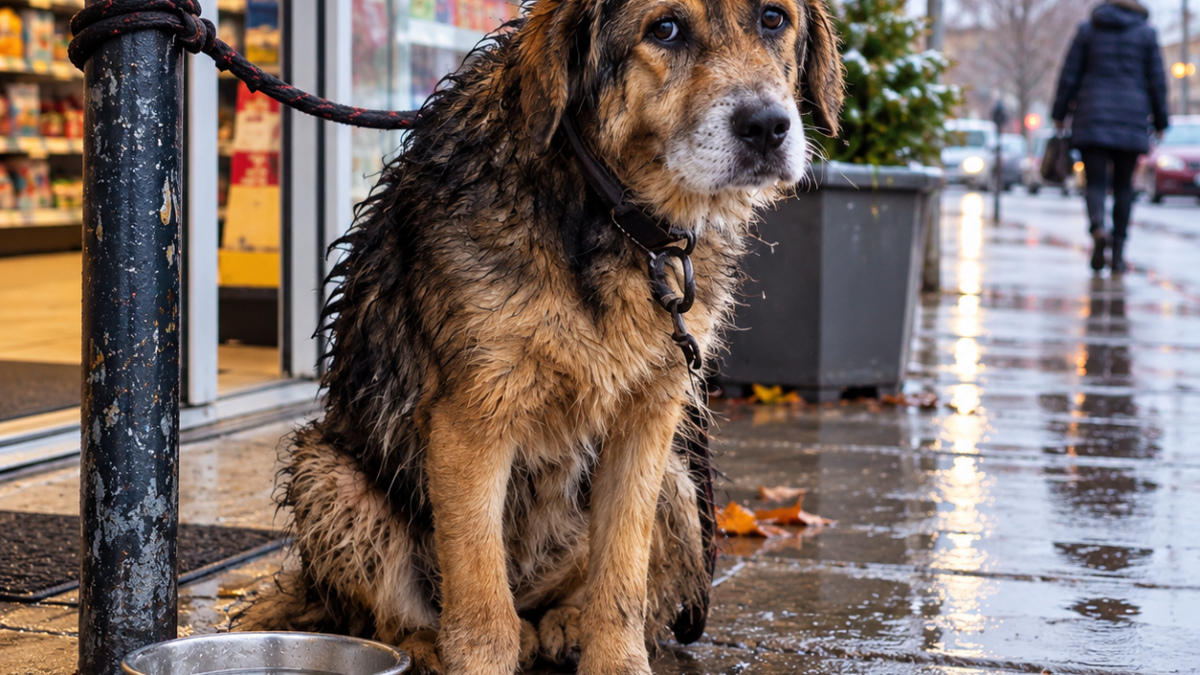
PART 2
I had volunteered with a local rescue group for almost six years by then.
I had learned not to invent stories too quickly.
A scared dog could make ordinary things look mysterious.
An old collar did not automatically mean neglect.
A dog standing beside a road did not always mean abandonment.
People lost animals.
Leashes broke.
Gates opened.
Accidents happened.
But the mitten bothered me.
So did the dog’s reaction to it.
I turned back toward Jenna.
“Do you have security cameras?”
She nodded.
“Inside and outside.”
“Do they cover the parking lot?”
“I think so.”
“Can we look at last night?”
Jenna hesitated.
“I need my manager.”
“Call him.”
Something in my voice must have told her I was not going anywhere.
She picked up the phone.
While we waited, I returned to the dog.
This time I sat on the pavement several feet from her.
I placed the red mitten beside me.
She stared at it.
Then at me.
“Okay,” I whispered. “I know this belongs to somebody you love.”
Her ears lifted slightly.
“I just don’t know who yet.”
I set the piece of sandwich on the ground.
She still would not eat.
But she allowed me to move a little closer.
I noticed then that her collar had a metal tag.
I could not read it from where I sat.
“Can I see that?”
The dog watched my hand.
I stopped.
She looked toward the parking lot again.
A blue SUV turned in.
She stood immediately.
For one second, her entire body changed.
Her ears came up.
Her tail lifted.
She took two steps forward.
Then the SUV parked.
A man and woman got out.
The dog slowly sat again.
That hurt to watch.
Hope had become a reflex.
Every engine might be the right one.
Every opening door might bring the right person back.
A few minutes later, the store manager arrived.
His name was Bill Carter.
He was in his late fifties and looked deeply uncomfortable the moment Jenna explained why I wanted the footage.
“I can’t just hand surveillance video to anyone,” he said.
“I’m not asking you to hand it to me. I’m asking you to look at it.”
“Animal control is already coming.”
“Good. Then we’ll preserve the footage for them.”
Bill stared at me.
“Are you with animal control?”
“No.”
“Police?”
“No.”
“Then—”
“I’m the person sitting outside with a senior dog who spent the entire night in the cold while waiting for somebody who never returned.”
Jenna looked down.
Bill rubbed his forehead.
Then he sighed.
“Fine. I’ll look.”
“May I come?”
He hesitated again.
Then nodded.
The office was barely big enough for three people.
Bill opened the security system on an old monitor.
“Jenna said around seven-thirty?”
“About then,” she answered.
He rewound the video.
7:21 p.m.
Cars moved through the lot.
People pushed carts.
Nothing.
7:28.
A dark gray pickup entered the frame.
Jenna pointed.
“That’s him.”
The truck parked near the front.
A man climbed out.
He appeared to be in his late thirties or early forties.
Baseball cap.
Dark jacket.
Jeans.
Then he opened the rear passenger door.
The dog jumped down.
Even through grainy security footage, I knew it was her.
She looked healthier in the video than she did that morning, although still thin.
The man led her toward the entrance.
Then something moved inside the truck.
I leaned closer to the monitor.
“Wait.”
Bill paused it.
“What?”
“The passenger side.”
He rewound ten seconds.
The truck stopped.
The man got out.
And through the front passenger window, I saw a small face.
A child.
Jenna inhaled sharply.
“Oh my God.”
“Play it.”
The man tied the dog to the post.
Then he entered the store.
The dog immediately looked toward the truck.
Thirty seconds passed.
Then the passenger door opened.
A little girl climbed out.
She wore a red coat.
Her hair was pulled into a messy ponytail.
And on her hands were two red mittens with white snowflakes.
Nobody spoke.
The girl ran toward the dog.
The moment the dog saw her, everything changed.
Her tail moved.
She stood.
The girl dropped to her knees and wrapped both arms around the dog’s neck.
I felt cold despite being inside.
The camera had no sound.
We could only watch.
The girl appeared to be talking to her.
The dog licked her face.
Then the little girl began working at the knot around the metal post.
“She was trying to untie her,” Jenna whispered.
Yes.
She was.
But the knot had been pulled tight.
The child struggled with it.
Then she looked toward the store.
The man came back through the automatic doors.
He saw the girl beside the dog.
His posture changed immediately.
He walked quickly toward them.
The child stood.
They exchanged words we could not hear.
She pointed at the dog.
The man pointed toward the truck.
The girl shook her head.
He reached for her arm.
She pulled back.
I felt my jaw tighten.
He did not strike her.
There was nothing dramatic enough to make the video obvious to a stranger.
But there was something deeply wrong in the way the child planted her feet while the man tried to make her leave.
She reached for the dog one last time.
That was when one mitten came off.
It fell beside the dog.
The man took the girl back toward the truck.
She twisted around to look behind her.
The dog lunged after her.
The short leash stopped her.
She pulled again.
And again.
The girl climbed into the passenger seat.
The truck backed out.
The dog kept pulling toward it until the vehicle disappeared from the camera.
Then she remained standing.
Looking at the road.
For almost three minutes.
Finally, she walked back to the mitten.
She smelled it.
Then lay beside it.
Nobody in the little office spoke.
Bill stopped the video.
Jenna was crying quietly.
I stared at the frozen image of the dog curled around that tiny red mitten.
“Can we see the license plate?”
Bill switched cameras.
The parking-lot angle was better.
The truck passed directly beneath a light as it left.
The plate was partially visible.
Not perfect.
But readable enough.
“I’m calling the police,” I said.
Bill nodded.
This time he did not argue.
—
Animal control arrived first.
Officer Daniel Ruiz was someone I already knew from rescue work.
When he saw me sitting beside the dog, he shook his head.
“Rachel, why am I not surprised?”
“Because apparently I spend my mornings making your job harder.”
“You make my paperwork harder.”
“Same thing.”
His humor disappeared when I handed him the mitten.
“What’s this?”
“Watch the footage.”
Ten minutes later, he came back outside with a very different expression.
“Police are sending someone.”
“Because of the girl?”
“Because we don’t know what we’re looking at yet.”
He crouched several feet from the dog.
“She let you touch her?”
“Not yet.”
“She have identification?”
“There’s a tag, but I can’t read it.”
Daniel took a slip lead from his truck.
The dog immediately became tense.
“Don’t,” I said.
He stopped.
“She’s scared of the leash being touched.”
“Good to know.”
I picked up the mitten.
The dog’s eyes followed it.
“Maybe we try this differently.”
I placed the mitten inside an open transport crate.
The dog stood.
Her body trembled.
She stared at the crate.
Then at me.
I moved away.
“Come on, sweetheart.”
She looked toward the road again.
Nothing.
Then she looked at the mitten.
Slowly, she walked toward the crate.
One step.
Then another.
She stopped at the entrance.
Smelled the mitten.
And went inside.
Daniel closed the door carefully.
“That might be the easiest capture I’ve had all month.”
“It wasn’t us.”
He looked at the mitten.
“No.”
“It was her.”
We took her to Oak Ridge Veterinary Clinic.
Dr. Natalie Harris examined her.
The dog was dehydrated.
Cold.
Underweight.
There was a minor scrape near her eye, likely from pulling against the post or bumping something during the night.
Nothing life-threatening.
But she was older than I had guessed.
“Probably nine or ten,” Dr. Harris said.
“Can you scan her?”
She did.
The microchip reader beeped.
I leaned forward.
“There.”
A number appeared.
Dr. Harris entered it into the registry.
We waited.
Then a name appeared.
**Ruby.**
Registered owner:
**Grace Bennett.**
Address:
214 Willow Creek Road.
Phone number disconnected.
Dr. Harris looked at me.
“Ruby.”
The dog’s ears moved.
I tried it.
“Ruby?”
Her head lifted.
That was enough.
“Hi, Ruby.”
For the first time all morning, her tail moved.
Barely.
But it moved.
I swallowed.
“Okay. Now we know your name.”
Daniel photographed the registry information.
“Let police check the address.”
“I’m coming.”
“No.”
“Daniel.”
“No.”
“You know I’m going anyway.”
He stared at me.
Then sighed.
“Give me twenty minutes.”
—
Willow Creek Road was twelve minutes from the grocery store.
The house at 214 stood at the end of a quiet cul-de-sac.
White siding.
Blue shutters.
A maple tree near the driveway.
Children’s chalk drawings faded by rain along the sidewalk.
Nobody answered the door.
A neighbor stepped outside while Officer Ruiz spoke with one of the patrol officers.
She was an older woman wearing a purple sweater.
“Are you looking for Grace?”
The officer turned.
“Do you know her?”
The woman’s face changed.
“You haven’t heard?”
“Heard what?”
She looked from the officer to me.
“Grace died in February.”
The sentence landed hard.
“When?”
“Eight months ago.”
I thought of the child in the truck.
“Did she have a daughter?”
“Yes. Lily.”
“How old?”
“Nine.”
“Who is she living with?”
The woman hesitated.
“Dean.”
“Dean who?”
“Dean Mercer. Grace’s husband.”
“Lily’s father?”
“No.”
Stepfather.
The man in the video.
I already knew it before she confirmed his description.
Baseball cap.
Dark gray pickup.
Mid-forties.
I pulled out my phone.
“Is this him?”
I showed her a still image from the footage that Bill had allowed police to photograph.
The woman’s expression hardened.
“That’s Dean.”
Officer Ruiz exchanged a look with the patrol officer.
“Do you know where he lives now?”
“He still lives here.”
I looked at the empty house.
“Then where is he?”
The neighbor folded her arms.
“If I knew that, I’d tell you.”
“What do you mean?”
“He hasn’t been here since yesterday afternoon.”
The patrol officer’s tone sharpened slightly.
“Is that unusual?”
“For him? No.”
“For Lily?”
“Yes.”
The woman’s name was Margaret Hale.
Not a neighbor.
Grace’s mother.
Lily’s grandmother.
And she lived three houses away.
That coincidence seemed strange until she explained.
Grace had bought the house near her mother years earlier.
Before Dean.
Before everything became complicated.
Margaret had been part of Lily’s life almost every day.
Until Grace died.
“Dean changed after the funeral,” Margaret told us at her kitchen table.
“How?”
“He started keeping Lily away from me.”
“Why?”
“He said I was confusing her. That she needed to move forward.”
“And Ruby?”
Margaret’s eyes filled immediately.
“Ruby was Grace’s dog before Lily was born. Then she became Lily’s shadow.”
“Was Dean attached to her?”
A humorless laugh escaped Margaret.
“Dean barely tolerated her.”
“Why?”
“Because Ruby belonged to the part of Grace’s life that existed before him.”
That sentence stayed with me.
I showed Margaret the red mitten.
She stopped breathing for a second.
Then reached toward it.
“Where did you get that?”
“It was beside Ruby.”
Margaret pressed a hand to her mouth.
“I bought these.”
“These?”
“A pair. For Lily. Two winters ago.”
Her fingers touched the embroidered snowflakes.
“She still wears them even though they’re getting too small.”
I leaned forward.
“Margaret, Ruby was tied outside Miller’s Market last night.”
Her face went white.
“What?”
“Dean left her there.”
“No.”
“There’s video.”
“And Lily?”
“She was with him.”
Margaret stood so quickly her chair scraped the floor.
“Where is she?”
“We don’t know yet.”
She reached for her phone.
“I knew something was wrong.”
“What happened?”
“Yesterday morning Dean told me he was taking Lily away for a few days.”
“Where?”
“He wouldn’t say.”
The police officer asked, “Does Dean have legal custody?”
Margaret closed her eyes.
“Temporary guardianship.”
“Temporary?”
“Grace left instructions. I’m supposed to become Lily’s guardian if anything happened to her.”
“Then why is Dean caring for her?”
“Because he challenged it.”
There it was.
The story beneath the story.
Grace had been sick before she died.
Not for years.
Only a few months.
Long enough to write a will.
Long enough to specify that if she could no longer raise Lily, her mother Margaret should become guardian.
Dean was Grace’s husband, but he had never formally adopted Lily.
After Grace died, he petitioned for temporary custody, arguing that Lily had lived with him for years and removing her immediately would be disruptive.
The court granted temporary guardianship while the case was reviewed.
Margaret had been fighting it ever since.
“Why?” I asked.
She looked at me.
“Because of the house.”
I did not understand.
Margaret continued.
“The house belonged to Grace before they married. She put it into a trust for Lily.”
“And Dean?”
“He can remain there while he’s Lily’s guardian.”
The room became very quiet.
Daniel leaned forward.
“So if he loses guardianship…”
“He loses the right to live there.”
Margaret nodded.
“And there’s more.”
“What?”
“Grace also left funds for Lily. Education, living expenses, medical care. The guardian receives a monthly allowance for Lily’s needs.”
I felt something cold settle in my stomach.
“How much?”
“Enough.”
Enough to matter.
Enough to fight over.
Enough that suddenly Ruby being abandoned did not feel like an isolated act.
Margaret looked at the mitten in her hands.
“He told Lily last week that Ruby was becoming too expensive.”
I stared at her.
“What did Lily say?”
“She cried. She told him Ruby was the only thing she had left that still smelled like her mother.”
No one spoke.
Margaret’s voice broke.
“And yesterday he took them both.”
—
Police located Dean’s truck three hours later.
A highway camera picked it up thirty miles north.
Then another camera showed it turning toward Lake Haven, a small town near the state line.
There was no Amber Alert.
There was no evidence Lily had been kidnapped.
Dean was her current legal guardian.
But officers were able to contact him.
He claimed everything was fine.
He said he and Lily were taking a short trip.
When asked about Ruby, he said the dog had “run off.”
That lie lasted approximately seven minutes.
Then an officer told him about the grocery-store video.
His story changed.
He said Ruby was aggressive.
She wasn’t.
He said he had tied her outside because he intended to call a rescue.
He hadn’t.
He said Lily understood.
The video suggested otherwise.
He said the mitten meant nothing.
Margaret nearly laughed when police told her that.
“It means nothing?”
She held up the red mitten.
“My granddaughter tried to stay with her dog.”
That afternoon, child welfare authorities requested an immediate welfare check.
Lily was physically safe.
But she was distraught.
She had been crying since the night before.
And according to the officer who later spoke with Margaret, the first question Lily asked was not whether Dean was in trouble.
It was:
“Did somebody find Ruby?”
When Margaret told me that, I had to walk outside.
There are moments in rescue work when anger is easy.
It gives you somewhere to put everything else.
But underneath anger was something heavier.
Lily had spent an entire night believing Ruby was alone.
Ruby had spent the same night believing Lily might return.
Two beings on opposite sides of thirty miles, each waiting for the other.
Because one adult had decided their bond was inconvenient.
—
Ruby stayed at the veterinary clinic for two nights.
She ate once she realized no one was taking the red mitten away.
I am serious.
Dr. Harris placed it beside her blanket.
Ruby sniffed it, circled twice, then lay down.
Only then did she eat.
“Do you think she knows Lily is okay?” I asked.
“No,” Dr. Harris said.
“Then why is she calmer?”
“Because something familiar is still with her.”
I sat beside Ruby’s kennel.
“She waited all night for her.”
Dr. Harris crouched beside me.
“And Lily tried to come back.”
That was the part I could not stop thinking about.
The security footage had captured only forty-three seconds of Lily beside Ruby.
Forty-three seconds.
A child getting out of a truck.
Running toward her dog.
Hugging her.
Trying to untie a knot.
Losing a mitten.
Being led away.
Forty-three seconds became the most important evidence in the entire case.
Not because it showed anything dramatic.
Because it showed intention.
Dean had not accidentally lost Ruby.
Lily had not agreed to leave her.
Ruby had not wandered away.
He tied her there.
He knew the child wanted the dog.
And he drove away anyway.
—
Two days later, an emergency family-court hearing was scheduled.
Margaret’s attorney requested that Dean’s temporary guardianship be suspended until the circumstances were reviewed.
Animal control submitted the grocery-store video.
The veterinarian submitted Ruby’s examination.
Police submitted Dean’s conflicting statements.
I was asked to provide a written account of how I found Ruby.
I expected that to be the end of my involvement.
It wasn’t.
The morning before the hearing, Margaret called me.
“Rachel?”
“Yes?”
“Lily wants to see Ruby.”
I sat up straighter.
“Can she?”
“Child services said a supervised visit is okay.”
“When?”
“This afternoon.”
I looked through the clinic window.
Ruby was sleeping.
The red mitten lay beneath her chin.
“I’ll be there.”
Lily arrived wearing one red mitten.
Only one.
The matching glove.
I knew her instantly from the footage.
She was small for nine.
Brown hair.
Blue jacket.
Tired eyes.
Margaret held her hand as they entered.
Ruby was behind a closed door in the recovery room.
Lily stopped in the hallway.
“Is she mad at me?”
The question nearly broke my heart.
“No,” I said.
She looked at me.
“You don’t know that.”
“You’re right.”
I crouched so we were eye level.
“But I do know Ruby spent an entire night waiting for you.”
Lily’s lower lip trembled.
“Dean said she ran away.”
“She didn’t.”
“He said she didn’t want to come with us.”
“That wasn’t true either.”
Lily looked toward the door.
“I tried to untie her.”
“I know.”
Her eyes widened.
“How?”
“The store had a camera.”
She went quiet.
“I couldn’t get the knot.”
“You tried.”
“I should’ve tried harder.”
“No.”
The word came out more firmly than I intended.
Lily looked startled.
I softened my voice.
“You were a child trying to solve a problem an adult created. You did not fail Ruby.”
She stared at the floor.
Then whispered, “Can I see her?”
I opened the door.
Ruby was lying on her blanket.
Her head lifted.
For half a second, nothing happened.
Then Lily made one sound.
“Ruby.”
The dog exploded to her feet.
Not gracefully.
Her back legs slipped against the floor.
Dr. Harris reached toward her, but Ruby had already found her balance.
Her tail began moving so hard her whole body twisted.
Lily dropped to her knees.
Ruby crossed the room.
The moment she reached the child, she pressed her entire body into her.
Lily wrapped both arms around her neck.
“I’m sorry,” she sobbed. “I’m sorry. I’m sorry.”
Ruby licked her face.
Lily laughed and cried at the same time.
Margaret turned away and covered her mouth.
I looked at Dr. Harris.
She was crying too.
Nobody pretended otherwise.
Lily pulled off her remaining mitten.
Then reached into her pocket.
She had brought the other one.
The muddy red mitten Ruby had guarded through the night had been cleaned and dried.
Lily held both mittens together.
Ruby sniffed them.
Then pushed her nose under Lily’s arm.
As far as Ruby was concerned, the mystery was over.
Her person had come back.
—
The adults were not finished.
Dean arrived at court the next morning with an attorney.
He wore a dark suit.
He looked calm.
Almost bored.
That angered me more than shouting would have.
Margaret sat across the aisle with Lily’s court-appointed advocate.
Lily herself was not required to sit through the entire proceeding.
Thank God.
The grocery-store footage played.
Dean’s attorney argued that his client had made a poor decision under stress.
He said Dean had intended for someone to notice Ruby quickly.
The judge interrupted.
“You left an animal tied outside a business overnight?”
Dean shifted.
“I believed the store would contact someone.”
“Why did you not contact anyone yourself?”
Silence.
His attorney stepped in.
The judge raised one hand.
“I asked Mr. Mercer.”
Dean cleared his throat.
“I made a mistake.”
The judge looked toward the screen.
“And the child?”
“She was upset.”
“She attempted to untie the dog.”
“Yes.”
“Why?”
Dean hesitated.
“Because children become emotional about pets.”
Margaret’s hand tightened around the edge of the bench.
The judge continued.
“You then told her the dog had run away?”
Dean looked at his attorney.
The judge repeated the question.
“Yes.”
That one word changed the room.
It was no longer about a dog.
It was about trust.
About judgment.
About a man willing to manufacture a lie that caused a grieving nine-year-old to believe her last connection to her mother had vanished.
Then Margaret’s attorney introduced something I had not known.
Messages.
Grace’s messages.
Months before her death, she had written to Margaret:
**If anything happens to me, please make sure Lily keeps Ruby. She sleeps better when Ruby is in the room. Ruby has been with her since she was a baby.**
Another message read:
**Dean says keeping Ruby is too much work. I told him she stays. She is part of Lily’s family.**
Dean’s face changed.
Only slightly.
But I saw it.
The judge did too.
The hearing lasted almost three hours.
At the end, Dean’s temporary guardianship was suspended.
Lily would stay with Margaret while the court completed a broader review.
Ruby would remain in rescue custody temporarily because the animal-control case was still pending.
Margaret closed her eyes.
Dean stared straight ahead.
The judge added one more condition.
Dean could not remove property belonging to Lily or Grace from the house while the guardianship dispute continued.
That mattered.
We did not yet understand how much.
—
Three days later, Margaret called me again.
This time her voice was different.
“Rachel, you need to hear this.”
“What happened?”
“Dean went to the house.”
“Is he allowed?”
“Yes, with supervision, to collect personal belongings.”
“And?”
“He tried to take Grace’s documents.”
“What documents?”
“Trust paperwork. Property records. Insurance statements.”
I sat down.
“Why?”
“We don’t know.”
But Margaret’s attorney knew what to do.
The court ordered a full accounting of the money Dean had received for Lily’s care since Grace’s death.
That was when everything began to unravel.
At first, it had nothing to do with Ruby.
Then it had everything to do with her.
Dean had received monthly funds specifically for Lily’s expenses.
Food.
Clothing.
School costs.
Medical needs.
Counseling.
Transportation.
But the numbers did not add up.
Several payments had gone toward personal credit-card balances.
A large payment had been made on his truck.
Another went toward a vacation Lily had not attended.
There were withdrawals with no documentation.
None of that proved he had intended to harm Lily.
But it did suggest the guardianship had become financially useful to him.
Then investigators found an email to a real-estate agent.
Dean had asked whether Grace’s house could be sold once he became Lily’s permanent guardian.
The answer had been no.
The house was held in trust for Lily.
Dean had replied:
**There has to be a way around that.**
Margaret showed me the printed email.
For a few seconds, neither of us spoke.
Finally I said, “So Ruby wasn’t the whole problem.”
“No.”
“What was?”
Margaret looked toward the backyard, where Lily was sitting beside Ruby during another supervised visit.
“Anything tying Lily to Grace.”
That included the house.
Margaret.
And Ruby.
Dean had been trying to build a new life in which he controlled everything around Lily.
The money.
The home.
The relationships.
Ruby did not fit.
Ruby slept beside Lily.
Ruby responded to Grace’s old name when family members said it.
Ruby ran to Margaret whenever she visited.
Ruby was a living reminder that Lily had a family before Dean.
And sometimes, people do not have to say why they resent something.
Their actions say enough.
—
Dean contacted the rescue four days later.
He wanted Ruby returned.
I laughed when our director told me.
Then I realized she was serious.
“He says he owns her.”
“The chip is in Grace’s name.”
“He says he inherited household property as Grace’s husband.”
“Ruby is not a couch.”
“I know.”
“What does Lily say?”
“She wants Ruby.”
“Then there’s your answer.”
Legally, unfortunately, things were not that simple.
Animals are treated as property under many laws.
But ownership records, veterinary history, the trust, Grace’s written wishes, and Dean’s abandonment all mattered.
The county attorney petitioned for Ruby to be surrendered permanently.
Dean fought it.
Not because he loved Ruby.
That became obvious almost immediately.
His attorney sent a letter proposing a settlement.
Dean would surrender Ruby if Margaret agreed not to pursue reimbursement of certain guardianship funds.
I read that sentence four times.
Then called Margaret.
“Please tell me your lawyer said no.”
Margaret laughed for the first time since I met her.
“My lawyer used more professional language.”
“But?”
“No.”
“Good.”
“He underestimated something.”
“What?”
“How angry grandmothers can become when you use a child’s dog as leverage.”
I smiled.
“I’m starting to like you.”
“You’re late.”
—
Ruby improved quickly once Lily was allowed regular visits.
That may sound sentimental.
But even Dr. Harris noticed it.
Her appetite increased.
She slept more deeply.
Her posture changed.
She stopped watching every vehicle in the clinic parking lot.
The first few days, every pickup truck made her stand.
Then one afternoon a dark gray truck passed the window.
Ruby lifted her head.
She watched it.
But she did not get up.
I noticed.
“So did you.”
Dr. Harris glanced at me.
“What?”
“She didn’t move.”
We both looked at Ruby.
Lily was sitting on the floor doing homework beside her.
Ruby’s head rested on the child’s shoe.
Dr. Harris smiled.
“She knows where she belongs.”
Lily looked up.
“What?”
“Nothing,” I said.
She narrowed her eyes.
“You adults always say that when it’s something.”
She was right.
—
The animal-abandonment hearing happened first.
The security video was enough.
Dean claimed again that he expected store employees to help Ruby.
The hearing officer asked why he did not walk twenty feet back inside and request help himself.
He had no convincing answer.
He was ordered to pay veterinary and rescue costs.
He received additional penalties under local animal-welfare rules.
Most importantly, he formally lost any claim to Ruby.
The document transferring custody arrived at our office on a Thursday morning.
I drove it personally to Margaret’s house.
She opened the door.
“Why are you smiling?”
I held up the folder.
“Where’s Lily?”
“In the kitchen.”
“Get her.”
Lily came running.
Ruby followed.
Technically, Ruby was still our rescue’s responsibility until the final adoption papers were signed.
But everyone knew what was about to happen.
I sat at the kitchen table.
Lily climbed into the chair across from me.
“What?”
I slid the paper toward Margaret.
She read it.
Her hand went to her mouth.
Lily looked between us.
“What?”
Margaret turned the paper around.
“She’s yours.”
Lily stared.
“What?”
“Ruby.”
The chair nearly fell backward when Lily stood.
“She can stay?”
“Yes.”
“Forever?”
“Yes.”
Lily dropped to the floor.
Ruby immediately walked over.
Lily grabbed her around the neck.
“You’re staying.”
Ruby wagged.
“You’re staying.”
Another wag.
Lily looked at me.
“You promise?”
I nodded.
“This time I can promise.”
She began crying.
Then she laughed.
Then she buried her face in Ruby’s fur.
Margaret signed the adoption papers that afternoon.
I gave Lily a new red collar.
She looked at it.
Then shook her head.
“Can she keep the old one?”
I understood.
The worn collar had belonged to Ruby’s life with Grace.
“Of course.”
So we cleaned it.
Replaced the damaged buckle.
And kept it.
The new red collar went into a drawer.
Some things do not need replacing just because they are old.
—
The custody case took longer.
Dean fought harder.
The deeper investigators looked, however, the worse his position became.
Teachers testified that Lily’s attendance had become inconsistent after Grace died.
A counselor documented that Lily had repeatedly asked to call Margaret and had been told she was “too busy.”
Margaret produced messages showing she had tried contacting Lily almost every day.
Dean had told Lily the opposite.
He said Margaret did not want to see her.
That discovery hurt Lily in a way I cannot describe.
When Margaret finally told her the truth, Lily sat completely still.
“You called?”
“Every day.”
“He said you stopped.”
“I never stopped.”
“Not even once?”
“Not once.”
Lily stared at her grandmother.
Then she stood and walked out of the room.
Margaret began to follow.
I touched her arm.
“Give her a minute.”
Ruby did not.
Ruby followed immediately.
We found them in the backyard.
Lily was sitting beneath the maple tree.
Ruby pressed against her side.
“I hate him,” Lily whispered.
Margaret crouched.
“You’re allowed to be angry.”
“He lied about Ruby.”
“Yes.”
“He lied about you.”
“Yes.”
“He said Mom wanted me to stay with him.”
Margaret’s face changed.
“That’s more complicated.”
“Did she?”
“Your mother wanted you safe.”
“That’s not what I asked.”
Children can be brutally precise.
Margaret sat beside her.
“No.”
Lily’s eyes filled.
“Mom wanted me with you?”
“If she couldn’t be here, yes.”
Lily looked at Ruby.
“Did he know?”
“Yes.”
“Then why?”
Margaret took a long breath.
“Because sometimes adults make decisions based on what they want instead of what a child needs.”
Lily pulled her knees up.
“That’s stupid.”
“Yes.”
“Really stupid.”
“Extremely.”
I almost smiled.
Lily did not.
Then she asked the question none of us could answer cleanly.
“Did he ever love me?”
Margaret closed her eyes.
I looked away.
Finally Margaret said, “I think people can care about someone and still make selfish choices that hurt them.”
“That doesn’t make sense.”
“No.”
“Then why do adults say everything is complicated?”
“Because sometimes complicated is another way of saying there isn’t an answer that feels good.”
Lily leaned against her.
Ruby shifted so her body touched them both.
For several minutes, nobody spoke.
—
The final guardianship hearing came four months after I found Ruby.
By then, winter had arrived.
Lily wore a new pair of gloves to court.
Blue ones.
She had refused to throw away the red pair.
Those stayed in a small box in her room.
The judge reviewed everything.
Grace’s will.
The trust.
Margaret’s guardianship petition.
Dean’s financial records.
School reports.
Counseling records.
The grocery-store footage.
The false statements about Ruby.
The messages blocking Margaret’s contact.
The attempt to use Ruby as leverage in the financial dispute.
Dean testified.
His attorney asked him whether he loved Lily.
“Yes.”
Whether he had cared for her after Grace became ill.
“Yes.”
Whether he believed staying with him had initially given Lily stability.
“Yes.”
Some of that may even have been true.
That was what made the story more complicated than a simple villain and hero.
Dean had helped during Grace’s illness.
He had driven Lily to school.
He had cooked meals.
He had taken her to appointments.
But somewhere after Grace died, his fear of losing control became more important than Lily’s grief.
And once that happened, every choice became about keeping what he thought he was owed.
The house.
The money.
Authority.
Even the right to decide whether Ruby stayed.
Margaret’s attorney asked one question near the end.
“When Lily begged you not to leave Ruby outside that store, why did you do it anyway?”
Dean paused.
His answer was quiet.
“Because I was tired of that dog controlling everything.”
The courtroom went still.
The attorney frowned.
“Explain.”
“Lily wouldn’t go anywhere without her. Wouldn’t sleep without her. Every time Margaret came around, the dog lost its mind. Every time someone mentioned Grace, Lily grabbed the dog and started crying.”
“So?”
Dean looked frustrated.
“So she needed to move on.”
Margaret’s attorney said nothing for several seconds.
Then:
“You believed separating a grieving child from the dog she had known almost her entire life would help her move on?”
Dean realized too late what he had just admitted.
“I believed it was unhealthy.”
“Did a therapist tell you that?”
“No.”
“A physician?”
“No.”
“A child psychologist?”
“No.”
“Anyone with professional training?”
“No.”
“So this was your judgment?”
“Yes.”
The attorney nodded.
“No further questions.”
The judge issued her ruling that afternoon.
Margaret received permanent guardianship.
Dean lost decision-making authority over Lily.
His access would be determined under a structured, court-supervised plan based on Lily’s well-being and professional recommendations.
The trust remained protected.
He was ordered to repay funds that had been improperly used.
And because his right to live in Grace’s house depended on being Lily’s guardian, he was required to vacate.
That was the moment Margaret finally exhaled.
Not celebrated.
Exhaled.
There is a difference.
For months she had been living as though every phone call might change everything.
Now the uncertainty ended.
When we walked outside the courthouse, snow had begun falling.
Lily waited with a family advocate.
Ruby had not been allowed inside, so I was holding her leash near the steps.
The moment Lily saw us, she ran.
Ruby ran too.
They met halfway.
Lily dropped down.
“What happened?” she asked.
Margaret knelt beside her.
“You’re coming home with me.”
Lily stared.
“For good?”
“For good.”
She looked at Ruby.
“And her?”
“She already lives there.”
That made Lily laugh.
Then Margaret added, “And nobody gets to take either of you away because it’s convenient for them.”
Lily hugged her.
Ruby pushed herself between them.
The three of them nearly fell over.
I looked back toward the courthouse doors.
Dean stood inside behind the glass.
For one second our eyes met.
I expected to feel triumphant.
I had imagined that moment more than once.
I thought I would enjoy seeing him lose everything he had tried so hard to control.
Instead, I felt something calmer.
He had not lost because anyone took revenge on him.
He lost because every lie required another lie.
Every selfish decision left a record.
Every attempt to isolate Lily created a witness.
Every effort to erase Grace’s place in Lily’s life made that place more visible.
And the dog he believed was disposable became the piece of evidence that started the entire chain.
Ruby had not testified.
She had not needed to.
She had simply waited.
—
Dean moved out of Grace’s house two weeks later.
He did not leave gracefully.
There were arguments about furniture.
Tools.
A television.
A dining table he claimed he had purchased.
Lawyers handled most of it.
Margaret refused to fight over ordinary objects.
“Take the television,” she said once. “I have Lily.”
That ended the conversation.
There was one thing Dean tried to take that did matter.
A wooden box from Grace’s bedroom.
Margaret stopped him.
“What is that?”
“Mine.”
“No.”
“You don’t even know what’s in it.”
“Then open it.”
Dean refused.
The supervising officer insisted.
Inside were photographs.
Hundreds.
Grace as a teenager.
Grace holding newborn Lily.
Grace and Ruby on the day she adopted her.
Lily learning to walk while holding Ruby’s fur.
Christmas mornings.
Birthdays.
Camping trips.
School plays.
Life before illness.
Life before courtrooms.
Life before red mittens became evidence.
Margaret looked at Dean.
“These belong to Lily.”
He said nothing.
The box stayed.
That night, Lily and Margaret sat on the living-room floor going through every photograph.
I was there because Margaret had invited me for dinner.
Ruby lay in the middle of the pictures.
Lily held up one photograph.
Grace was sitting on a kitchen floor.
Ruby, young and ridiculous, had her entire head inside a cereal box.
Lily laughed.
“I remember Mom telling this story.”
“What happened?” I asked.
“She left the cabinet open.”
Margaret smiled.
“Ruby ate half the cereal.”
Lily looked at Ruby.
“You were a criminal.”
Ruby slept through the accusation.
Another photograph showed baby Lily asleep against Ruby’s side.
Lily studied it for a long time.
“She really always stayed with me.”
“Yes,” Margaret said.
“Even before I remember?”
“Especially then.”
Lily touched the photograph.
“Dean said she was just a dog.”
Margaret looked at her granddaughter.
“What do you think?”
Lily looked at Ruby.
“No.”
That was all.
No speech.
No dramatic declaration.
Just no.
Some truths do not require more words.
—
Spring arrived.
Ruby turned ten.
At least according to her veterinary records.
Lily insisted on a birthday party.
Ruby wore a paper hat for eleven seconds.
Then ate part of it.
“There,” I said. “Proof she’s recovered.”
Lily laughed.
“She always did that.”
The house felt different.
Not because the furniture changed.
Because fear was gone.
Lily left her backpack in the hallway.
Shoes appeared in places shoes should not be.
Ruby slept wherever she wanted.
Margaret complained about dog hair while buying Ruby increasingly expensive treats.
Normal life returned.
That is one of the least dramatic parts of rescue.
And maybe the most important.
People imagine happy endings as one big moment.
A courtroom ruling.
An adoption.
A reunion.
But the real ending is often ordinary.
It is Tuesday morning.
A child complaining about homework.
A dog waiting beside the breakfast table.
A grandmother searching for her glasses while they are on her head.
A school bus stopping at the corner.
A front door opening again in the afternoon.
Someone always coming back.
Ruby learned that routine quickly.
Every weekday at 3:42 p.m., she stood near the front window.
At 3:47, Lily’s school bus usually appeared.
By 3:48, Ruby was at the door.
Every single day.
Rain.
Snow.
Sun.
Did not matter.
She waited.
The difference was that now, Lily always came home.
—
A year after the grocery-store morning, Jenna called me.
I had not spoken to her in months.
“Rachel?”
“Hey. Everything okay?”
“Yes. I think.”
That is never a reassuring answer.
“What happened?”
“You should come by Miller’s.”
“Why?”
“You’ll see.”
I drove over after work.
The same metal post stood beside the entrance.
For a moment I hated looking at it.
Then I saw what Jenna had done.
A small sign had been attached to the post.
Not a memorial.
Not anything dramatic.
It simply read:
**IF AN ANIMAL IS LEFT HERE UNATTENDED, PLEASE NOTIFY STORE STAFF IMMEDIATELY. WATER AND A SAFE HOLDING AREA ARE AVAILABLE INSIDE.**
Beside the entrance sat a covered water station.
Bill, the manager, had also installed a camera directly facing the area.
Jenna crossed her arms.
“Too much?”
“No.”
“Bill said maybe it was unnecessary.”
Bill came out behind her.
“I said no such thing.”
“You absolutely did.”
“I said the sign was large.”
“It needs to be large.”
I smiled.
“You two haven’t changed.”
Jenna pointed toward the post.
“I couldn’t stop thinking about her.”
“Ruby?”
“She waited there all night.”
“Yes.”
“And everybody assumed somebody else would handle it.”
I looked at the sign again.
“That happens a lot.”
“So now staff are trained.”
“For what?”
“Found animals. Dogs left outside. Kids separated from parents. Elderly customers who seem confused. Basic stuff.”
Bill shrugged.
“We realized we’re open seventeen hours a day. People come through here constantly. We see things.”
I looked at him.
“And now?”
“Now maybe we do something sooner.”
That mattered.
Ruby’s story had changed one small place.
Sometimes that is enough.
—
The red mittens stayed in Lily’s room.
She never wore them again.
But she never threw them away.
Two years later, she showed me the box.
Ruby was twelve then.
Her muzzle almost completely white.
She moved slower.
Still followed Lily from room to room.
Lily opened the box.
Inside were the mittens.
The photograph of Grace and Ruby with the cereal box.
Ruby’s old collar.
And a printed still from the grocery-store security footage.
I frowned.
“Why do you have that?”
“Grandma gave it to me.”
The photograph showed Lily kneeling beside Ruby outside the store.
One mitten already on the ground.
“I hate that picture,” I said.
“I don’t.”
“Why?”
“Because I came back.”
I looked at her.
“You didn’t get to stay.”
“No.”
She touched the photograph.
“But I tried.”
I understood.
For years I had thought the image represented failure.
Lily saw something else.
Proof.
Proof that when someone she loved was in trouble, she had tried.
At nine years old, against an adult decision she could not control, she had opened the truck door.
She had run back.
She had pulled at that knot.
She had left something of herself behind.
And Ruby had held onto it until help came.
“You know something?” I said.
“What?”
“That mitten might be the reason I stayed long enough to figure everything out.”
Lily smiled.
“Then I’m glad I dropped it.”
I laughed.
“Don’t start deliberately losing things because of this.”
“No promises.”
—
Dean appealed parts of the financial ruling.
He lost.
He later tried to argue that some of the money he had spent from Lily’s funds should be considered reimbursement for household expenses.
Some was.
Some was not.
The court made him repay the difference.
He sold the gray pickup.
I only know because Margaret mentioned it once.
I felt strangely satisfied.
Then embarrassed that I felt satisfied.
Margaret did not share my hesitation.
“Good,” she said.
“That truck bothered you too?”
“I hated that truck.”
“It’s an innocent truck.”
“It participated.”
I laughed so hard I nearly spilled my coffee.
That was Margaret’s version of revenge.
Not cruelty.
Not ruining Dean’s life.
Simply refusing to be intimidated by him anymore.
She documented everything.
She followed every court order.
She answered every attorney’s letter.
She protected Lily’s trust.
She maintained boundaries.
Dean had spent months assuming Margaret would eventually become too tired to fight.
He misunderstood her.
More importantly, he misunderstood what she was fighting for.
She did not care about winning against him.
She cared about keeping Lily safe.
That made her much harder to exhaust.
—
Ruby’s health remained surprisingly good until she was almost thirteen.
Then her hips began bothering her.
Lily noticed before anyone else.
“She took longer to stand up.”
Dr. Harris examined her.
“Age,” she said gently.
Medication helped.
A ramp appeared beside the porch steps.
Then another beside Lily’s bed.
Margaret objected to the second one.
“She is not sleeping in your bed.”
Ruby slept in Lily’s bed that night.
Margaret surrendered the argument permanently.
One evening, I visited and found Lily lying on the floor beside Ruby.
She was doing homework.
Ruby’s head rested across her notebook.
“How’s algebra?”
“Ruby doesn’t understand it.”
“Neither do most adults.”
“That’s not comforting.”
Ruby sighed.
Lily scratched her ear.
“Do you think dogs remember bad things forever?”
I sat on the couch.
“Some things.”
“Does she remember the store?”
“Probably.”
Lily looked worried.
“But I don’t think she remembers it the way you do.”
“What do you mean?”
“You remember the story. Before. During. After.”
“And Ruby?”
“She probably remembers feelings. Smells. Places. The sound of your voice.”
Lily was quiet.
“Do you think she thought I abandoned her?”
That question had apparently been waiting for years.
“No.”
“How can you know?”
“I can’t know exactly what Ruby thought.”
I leaned forward.
“But I know what she did when you walked into that clinic.”
Lily smiled faintly.
“She knocked over the water bowl.”
“Yes.”
“And almost knocked me over.”
“Yes.”
“She was happy.”
“She knew you came back.”
Lily looked at Ruby.
“I always came back.”
I nodded.
“That’s what matters.”
—
When Lily turned thirteen, she started volunteering with our rescue.
Margaret blamed me.
“This is your fault.”
“You say that like it’s bad.”
“She came home asking if we can foster kittens.”
“Can you?”
“No.”
A week later, they were fostering kittens.
Ruby was deeply offended.
The first kitten hissed at her.
Ruby looked at Lily as though expecting immediate legal intervention.
Lily laughed.
“Ruby, you’re seventy pounds.”
Ruby moved behind me.
The kitten weighed less than two.
“This is humiliating,” I told her.
She did not care.
Three days later, the kitten was sleeping between Ruby’s front legs.
By the end of the month, Ruby had accidentally become foster mother to four kittens.
Lily took pictures.
One showed all four kittens sleeping on Ruby while she stared at the camera with exhausted patience.
Margaret framed it.
“This is revenge for the cereal.”
Lily disagreed.
“Ruby regrets nothing.”
She was probably right.
—
Dean remained part of Lily’s life in a limited way.
That may not be the ending some people expect.
Real families are rarely clean enough for simple endings.
Supervised visits eventually became structured visits after therapists believed Lily was ready.
Dean apologized.
At first, Lily did not accept it.
Later, she told me something I did not expect.
“I forgive him.”
I stared at her.
“Really?”
She shrugged.
“I didn’t say I trust him.”
That was a distinction many adults never learn.
“Why forgive him?”
“Because I got tired of being angry.”
She scratched Ruby’s neck.
“And Grandma said forgiving somebody doesn’t mean giving them back the same power.”
Margaret had taught her well.
“Does he ask about Ruby?”
“Sometimes.”
“And?”
“I send pictures.”
That surprised me.
“Why?”
“Because I want him to see her.”
I understood.
That was Lily’s revenge.
Not hiding Ruby.
Showing her.
Healthy.
Loved.
Still there.
Every picture quietly contradicted everything Dean had once decided.
Ruby was too much trouble.
Ruby cost too much.
Ruby kept Lily from moving forward.
Ruby was only a dog.
And yet years later, Ruby remained beside Lily through school.
Through grief counseling.
Through court hearings.
Through adolescence.
Through bad math grades.
Through first dances.
Through every ordinary day that rebuilt a life.
Dean had tried to remove Ruby because he thought she represented the past.
He failed to understand that sometimes the safest way forward is to keep one loving piece of the past beside you.
—
Ruby lived long enough to see Lily begin high school.
By then, I had known them for almost five years.
I wish I could say the final chapter surprised us.
It did not.
Old dogs tell you.
Their walks shorten.
Their naps lengthen.
Stairs become negotiations.
Food that once disappeared instantly remains in the bowl a little longer.
One January morning, Margaret called me.
Her voice was calm.
Too calm.
“Rachel, can you come?”
I did not ask why.
I knew.
Ruby was lying in Lily’s bedroom.
Morning sunlight came through the curtains.
Her red-brown coat had faded with age.
Her muzzle was white.
Lily sat beside her.
She was fourteen now.
Almost as tall as I was.
But when she looked at me, I saw the nine-year-old from the clinic hallway.
“Dr. Harris is coming,” Margaret said.
I sat on the floor.
Ruby lifted her head.
Her tail moved once.
“Hey, old girl.”
I touched her gently.
“You really made us work for this story, didn’t you?”
Lily laughed through tears.
Ruby looked toward her.
Lily held something in her hands.
The red mittens.
Both of them.
Still together.
She placed them beside Ruby.
“I thought she should have these.”
Ruby smelled them.
Slowly.
Then rested her chin across them.
Nobody spoke.
Dr. Harris arrived thirty minutes later.
She examined Ruby.
Then looked at Lily.
“You know her better than anybody.”
Lily nodded.
“She’s tired.”
“Yes.”
“I don’t want her to hurt.”
“I know.”
Margaret sat on one side.
I sat near the foot of the bed.
Lily lay beside Ruby.
“You waited for me that night,” she whispered.
Ruby’s eyes moved toward her.
“I’m here now.”
She stroked the gray fur above Ruby’s eyes.
“You don’t have to wait anymore.”
That sentence nearly undid me.
Because Ruby’s entire story had begun with waiting.
Waiting beside a store entrance.
Waiting for a truck to return.
Waiting beside a child’s mitten.
Waiting through cold rain.
Waiting for somebody to notice.
Years later, she was no longer outside.
No leash held her to a metal post.
No strange engines passed while she searched for the right one.
She was in Lily’s room.
On Lily’s blanket.
Surrounded by the people who had promised to stay.
Lily kept one hand against Ruby’s face.
Margaret held her paw.
I rested my hand against her shoulder.
And Ruby, who had once spent an entire night refusing to stop watching a grocery-store door, finally closed her eyes without needing to watch anything.
She was home.
—
We buried Ruby’s ashes beneath the maple tree.
Lily chose the spot.
Margaret placed a small stone there.
No long inscription.
Just:
**RUBY**
**SHE WAITED.**
**WE CAME BACK.**
Below it was a tiny carved mitten.
Red paint filled the carving.
When I saw it, I had to turn away.
Lily noticed.
“You okay?”
“No.”
She smiled sadly.
“Me neither.”
We stood beneath the tree.
After a while, Lily said, “You know what I think?”
“What?”
“I think people tell this story wrong.”
“What story?”
“Hers.”
“How?”
“They say you rescued Ruby.”
I looked at her.
“I helped.”
“Yes.”
She nodded toward the house.
“But if Ruby hadn’t stayed with that mitten, you might have thought she was just abandoned.”
“That’s true.”
“And if she hadn’t waited for me, nobody would’ve looked harder.”
I had never considered it that way.
Lily continued.
“She didn’t know about cameras or court or any of that.”
“No.”
“She just knew I was supposed to come back.”
“Yes.”
“So she stayed.”
I looked at the little stone.
“She did.”
Lily wiped her face.
“Ruby started everything.”
She was right.
One old dog waiting beside one little red mitten had exposed more truth than any angry accusation could have.
Because the facts were simple.
Dean said Ruby ran away.
The camera showed he tied her there.
Dean said Lily did not care.
The camera showed Lily running back.
Dean said Margaret had abandoned Lily.
Phone records showed Margaret called every day.
Dean claimed he wanted only what was best for Lily.
Financial records showed how useful guardianship had become.
He tried to control the story.
Ruby simply waited long enough for the truth to catch up.
That was the justice in it.
Not humiliation.
Not revenge through pain.
Truth.
The kind that grows quietly until there is nowhere left for a lie to hide.
—
Years later, Miller’s Market still has that metal post outside.
The sign Jenna installed is still there too.
So is the water station.
I sometimes stop there after rescue calls.
Bill retired.
Jenna eventually became store manager.
The first thing she did was replace the old security system.
“Higher resolution,” she told me proudly.
“For shoplifters?”
“For everything.”
She still remembers Ruby.
People in town do too.
Not everyone knows the whole story.
Most just know that an old dog was once left outside overnight and that someone noticed.
That version is enough.
Lily knows the rest.
She graduated high school with Ruby’s old collar wrapped around the base of a framed photograph of Grace.
She applied to college.
Her admissions essay was about trust.
Not Ruby specifically.
But I recognized Ruby in almost every paragraph.
Lily wrote that trust is not something people earn by demanding it.
They earn it by returning.
Again.
And again.
And again.
I read that sentence twice when she showed me.
“Where did you learn that?”
She gave me a look.
“Seriously?”
I laughed.
“Fair.”
She attended a university three hours away.
Margaret cried for two days.
Then complained that Lily called too often.
Lily came home almost every weekend that first semester.
On her desk at school, she kept a photograph.
Not the sad security image.
Not the grocery-store post.
Not the red mitten.
It was Ruby in the backyard at eleven years old.
Sunlight on her fur.
Mouth open.
Tail blurred from moving.
Happy.
That was the image Lily chose.
And I think that choice says everything.
The hardest moment in a life does not have to become the image that defines it.
Ruby was once the dog outside the grocery store.
But she was also the dog beneath the maple tree.
The dog covered in foster kittens.
The dog asleep across Lily’s algebra homework.
The dog stealing cereal.
The dog waiting for the school bus.
The dog who slept beside a grieving child until that child no longer woke crying every night.
The dog who lived long enough to teach all of us something about loyalty.
When I first saw her on that October morning, I thought I understood what had happened.
Someone had tied a dog outside a store.
Someone had walked away.
Cruel.
Simple.
End of story.
I was wrong.
The leash was only the beginning.
The empty bowl was only the beginning.
Even the mitten was only the beginning.
The real story was about what happened when one person decided the bonds in a child’s life were inconvenient and tried to cut them away one by one.
A grandmother.
A home.
Memories.
A dog.
He believed that if he controlled enough doors, enough money, enough explanations, eventually Lily would accept the world he built for her.
Instead, one small mistake undid everything.
He left evidence behind.
Not paperwork.
Not fingerprints.
Not some complicated secret.
A dog.
A dog who refused to leave the place where she had last smelled the child she loved.
Ruby stayed beside that red mitten until morning.
She stayed long enough for Jenna to notice.
Long enough for me to stop.
Long enough for someone to check the camera.
Long enough for a lie to become visible.
And once the first lie broke, the others followed.
Dean lost the guardianship he had tried to control.
He lost access to money that never belonged to him.
He lost his claim to Grace’s house.
He lost Ruby.
Most importantly, he lost the ability to tell Lily what had happened and expect her to believe him simply because he was the adult in the room.
That was consequence.
That was justice.
And for Lily, it was freedom.
Years after Ruby was gone, Lily once asked me whether I still had the first photograph I took outside Miller’s Market.
I did.
I had never deleted it.
Ruby was sitting beside the post.
Wet.
Tired.
Red mitten beneath one paw.
Head lifted toward the parking lot.
I almost sent it to her.
Then I stopped.
“You sure you want it?”
“Yes.”
“Why?”
She answered immediately.
“Because I want to remember that waiting wasn’t the end.”
So I sent it.
A few minutes later, she sent me another image.
Ruby in the backyard.
Older.
Healthy.
Lying in sunlight while Lily sat beside her.
Underneath, Lily had written four words.
**This was the end.**
I stared at those words for a long time.
Then I realized she was right.
Not the grocery store.
Not the court.
Not Dean carrying boxes out of Grace’s house.
Not even the judge’s ruling.
Those were only chapters.
The real ending was quieter.
A dog sleeping safely in the sun.
A child growing up knowing the truth.
A grandmother making dinner inside the house her daughter had protected for Lily.
Two red mittens stored together instead of separated on a wet sidewalk.
And a front door that always opened again.
That was Ruby’s victory.
She had once been tied to a post with only a few feet of leash.
For the rest of her life, she belonged nowhere she could not choose to stay.
She had once watched strangers come through a grocery-store door, hoping one face would be Lily’s.
For the rest of her life, she heard Lily come home almost every afternoon.
She had once curled herself around one lost mitten because it carried the scent of the person she loved.
For the rest of her life, she slept beside that person.
And the man who believed abandoning one old dog would make his life easier discovered something he should have understood from the beginning:
You can remove a dog from a house.
You can tell a child a lie.
You can drive away and hope nobody asks questions.
But sometimes loyalty leaves evidence.
Sometimes love refuses to disappear quietly.
And sometimes the one you thought had no voice becomes the reason the truth is finally heard.
Whenever I pass Miller’s Market now, I still glance at the old metal post.
For one instant, I can see Ruby there again.
Wet fur.
Gray muzzle.
Tired eyes.
One little red mitten beneath her paw.
But I no longer remember her as abandoned.
I remember what happened afterward.
A clinic door opened.
Lily walked in.
Ruby heard her voice.
And after one terrible night of waiting, the person she loved finally came back.
This time, she never had to watch the door alone again.

