PART 2: I Swore the Stray Cat at My Door Wasn’t Mine—Then He Started Knocking for Breakfast Every Morning
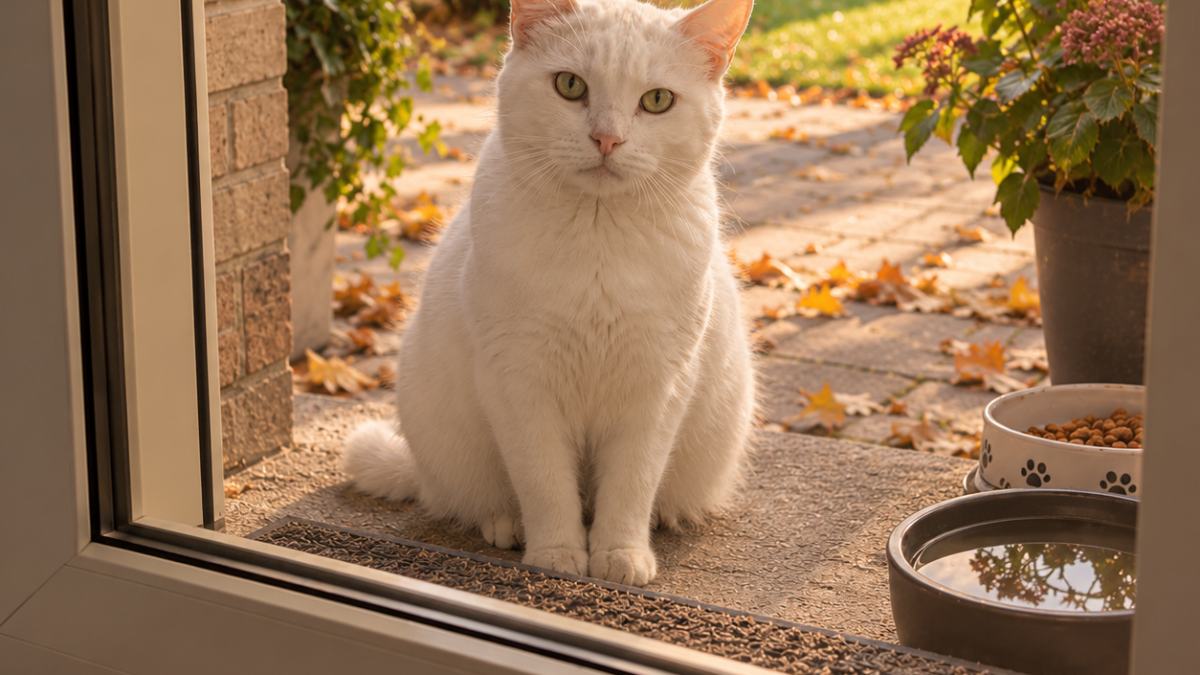
PART 2
The tapping became part of my mornings.
At first, Charlie used it only when breakfast was late.
Then his standards expanded.
Empty water bowl?
Tap.
Curtains still closed after sunrise?
Tap.
Me attempting to sleep an extra thirty minutes on Sunday?
Tap. Tap. Tap.
I began waking before my alarm simply because some part of my brain expected the sound.
That annoyed me.
At least, that was what I told myself.
The truth was stranger.
I liked knowing he would be there.
Before Charlie, my mornings had been predictable in the dullest possible way.
Get up.
Make coffee.
Check the weather.
Read the news.
Start the day.
I had never considered the routine lonely.
It was simply mine.
Then a cat began tapping on the glass, and suddenly there was someone on the other side of the morning.
One Saturday, my sister called while I was preparing Charlie’s breakfast.
“What are you doing?”
“Nothing.”
I opened the can.
Charlie immediately appeared outside.
My sister heard the metal lid.
“That sounded like cat food.”
“It is.”
A pause.
“You got a cat?”
“No.”
“Then why are you opening cat food?”
“For Charlie.”
“Who is Charlie?”
“The cat.”
Another pause.
“The cat you don’t have?”
“Exactly.”
She laughed.
“It isn’t funny.”
“It is extremely funny.”
“He lives outside.”
“So?”
“He isn’t mine.”
“Do you feed him every morning?”
“Yes.”
“Water?”
“Obviously.”
“You named him?”
“That means nothing.”
“Do you worry about him?”
I looked through the glass.
Charlie sat waiting.
“No.”
He tapped.
My sister heard it.
“What was that?”
“Nothing.”
Tap.
“Is the cat knocking?”
“No.”
Tap.
“You have a cat.”
“I have to go.”
I hung up.
Charlie stared at me through the door.
“This is your fault.”
He tapped again.
I put the bowl down.
For all his confidence at breakfast, Charlie still had rules.
Very clear ones.
I could open the door.
I could set the food down.
I could sit on the steps several feet away.
I could speak.
I could look at him briefly.
But I could not touch.
The first few times I tried, he did not hiss.
He did not swipe at me.
He simply stepped backward.
Quietly.
Deliberately.
That somehow felt more powerful than aggression.
It was not a threat.
It was a boundary.
So I stopped reaching.
That was harder than I expected.
There is something almost instinctive in people when an animal begins trusting us.
We want proof.
A touch.
A stroke along the back.
A photograph of the cat on our lap.
Something visible that says:
Look.
He trusts me now.
Charlie did not care about providing evidence.
His trust appeared in smaller ways.
At first, he would not eat if I remained visible.
Then he ate while I stood inside behind the glass.
Later, he ate while the door was open.
Then while I sat on the steps.
The first time that happened, I barely moved.
Charlie approached the bowl.
Stopped.
Looked at me.
I looked away.
He took one bite.
Stopped again.
I kept my eyes on the garden.
Another bite.
Then another.
Five minutes later, the bowl was empty.
He sat down.
I risked looking at him.
“See?”
Charlie cleaned one paw.
“I’m harmless.”
He continued washing.
“You could at least pretend that was a big moment.”
Nothing.
“Very emotional audience.”
He finished grooming and disappeared through the hedge.
I sat there smiling like an idiot.
After that, I began noticing changes in measurements other people would have considered ridiculous.
Charlie sat five feet away instead of seven.
Charlie remained on the porch after eating for four minutes.
Charlie turned his back to me for a few seconds.
Charlie stretched while I was outside.
Charlie drank water without watching my hands.
Each one meant something.
Not ownership.
Not affection exactly.
Safety.
That became the word I cared about.
Safety.
I started reading about outdoor and community cats.
I learned that trust could develop slowly.
That food did not automatically buy affection.
That predictability mattered.
That forcing contact could undo progress.
So I became predictable.
Breakfast at the same place.
Fresh water.
No sudden reaching.
No blocking his escape.
I spoke to him before opening the door.
“Morning, Charlie.”
He would look at me.
“Breakfast.”
His ears would move.
Sometimes I imagined he understood every word and simply considered most of them irrelevant.
One morning in early summer, something happened that changed the way I saw him.
I opened the curtains.
Charlie was on the porch.
But he was not sitting.
He was asleep.
Actually asleep.
Stretched along the warm boards where sunlight reached the corner near the door.
His front paws were folded beneath his chest.
His ginger tail curved loosely beside him.
His head rested against the wood.
For several seconds, I just stood there.
He was not crouched.
Not watching the hedge.
Not positioned for immediate escape.
Asleep.
I reached toward the door handle.
Then stopped.
If I opened it, I might wake him.
So I did something ridiculous.
I stayed inside.
My coffee machine was in the kitchen.
My phone was on the table.
The morning continued around me.
And I stood near the glass door watching a stray cat sleep.
It should not have felt important.
It did.
This was the cat who once would not approach food until I disappeared.
Now he had chosen the space directly outside my home as a place safe enough to surrender awareness.
Sleeping animals are vulnerable.
That was what struck me.
Charlie had spent months controlling distance between us.
Now, without asking permission, he had closed his eyes.
I did not take a photograph.
I thought about it.
Then I worried the movement would wake him.
So I simply watched.
Thirty minutes later, Charlie stretched.
Yawned.
Opened his eyes.
Saw me.
He did not run.
“Morning.”
He blinked.
Then looked toward the empty spot where his bowl usually appeared.
Of course.
A deeply emotional reunion ruined by breakfast expectations.
I put the food outside.
Charlie ate.
Still no touching.
Somehow, that mattered less.
The porch nap had taught me something.
Trust does not always move toward physical contact.
Sometimes trust means somebody feels safe enough to stop monitoring you.
That was enough.
A few weeks later, Charlie took another step.
I was setting his bowl down when he approached before I had backed away.
Normally, I put the food down, stood, and gave him several feet.
That morning, when I straightened, Charlie remained.
Less than a foot away.
I froze.
He froze.
For the first time, I saw his face at that distance.
The small darker freckles near his nose.
The uneven edge of the notched ear.
A faint pale line beneath one eye.
His whiskers.
The exact pattern where orange met white across his cheeks.
My hand moved almost automatically.
Just an inch.
Charlie shifted his weight backward.
I stopped.
There it was.
The old reflex.
Reach.
Prove.
Possess the moment.
Instead, I lowered my hand.
“Morning, Charlie.”
He looked at me.
Then at the bowl.
I stepped inside.
Through the glass, I watched him eat.
I felt strangely proud of myself.
Not because Charlie had come closer.
Because I had finally learned not to turn his progress into a demand.
That became our relationship.
Charlie chose the distance.
I respected it.
Some mornings, he surprised me by sitting close.
Other mornings, he waited near the bushes again.
At first, backward days disappointed me.
Then I realized trust was not a straight road.
Maybe the neighbor’s dog had been outside.
Maybe another cat had passed through.
Maybe a noise had frightened him before arriving.
Maybe he simply felt like keeping distance.
He was allowed.
That idea should have been obvious.
It was not.
People are very good at treating an animal’s affection like a reward for our goodness.
I fed you.
I cared about you.
Therefore you should love me in the way I want.
Charlie refused that equation.
And because he refused it, I learned something useful.
Care is not a transaction.
I began asking different questions.
Not:
Why won’t he let me pet him?
But:
Does he look healthy?
Is he eating?
Does he have water?
Is there somewhere dry to shelter if the weather changes?
I placed a simple weatherproof shelter in a protected part of the porch.
Charlie ignored it for six days.
I took that personally.
“I spent money on that.”
Charlie sat beside it.
“It’s insulated.”
Nothing.
“Excellent reviews.”
He washed his paw.
“You have no respect for consumer research.”
On the seventh morning, I found a few ginger hairs inside.
I celebrated privately.
I did not mention it to him.
He had enough power already.
By autumn, people around me knew about Charlie.
My sister asked for photographs.
A friend called him “your cat.”
I corrected everyone.
“He isn’t my cat.”
“You feed him.”
“That proves nothing.”
“You built him a shelter.”
“It was cold.”
“You bought him a heated water bowl.”
“Necessary.”
“You have a folder on your phone called Charlie.”
I had no defense for that.
Still:
“He isn’t my cat.”
Eventually, it became a joke.
People stopped arguing.
Instead they asked:
“How’s the cat you don’t have?”
That was acceptable.
Then, one Tuesday morning, Charlie did not show up.
At first, I barely noticed.
He was not mechanical.
Sometimes he came later.
I put the food out anyway.
By nine, untouched.
I told myself he had found breakfast somewhere else.
Good.
Independent cat.
At noon, the bowl was still full.
I walked around the garden.
“Charlie?”
Nothing.
I checked beneath the bush where I had first seen him.
Empty.
Behind the shed.
Empty.
Along the hedge.
Nothing.
My stomach felt strange.
I went back inside.
“This is ridiculous.”
Charlie had an entire life beyond my yard.
I knew that.
Maybe he visited several houses.
Maybe somebody else fed him.
Maybe he was sleeping somewhere.
I had no right to expect him.
He was not my cat.
At four, I checked again.
Still nothing.
I replaced the food with fresh food.
Refilled the water.
I stood on the porch longer than necessary.
That evening, I kept glancing toward the glass door.
Every shadow looked orange.
Every faint noise made me turn.
I went to bed annoyed with myself.
At 5:30 the next morning, I woke before my alarm.
No tap.
At six, I opened the curtains.
Empty porch.
“Come on, Charlie.”
Nothing.
That was the morning the joke stopped being funny.
He was not my cat.
But apparently I was his person enough to worry.
I walked farther around the neighborhood than I had ever followed him.
I felt foolish calling his name because I did not even know whether Charlie meant anything to him.
“Charlie!”
A woman watering plants two houses down looked up.
“You lose a cat?”
“No.”
She looked at me.
I realized how stupid that sounded.
“Sort of.”
“What does he look like?”
“Ginger and white. Notched ear.”
“Oh.”
“You’ve seen him?”
“He comes through my yard sometimes.”
“When?”
“Most afternoons.”
“Did you see him yesterday?”
She thought.
“No.”
My worry grew.
I checked beneath parked cars.
Along fences.
Near bushes.
I asked two more neighbors.
Everyone knew him in some way.
“The orange one?”
“He sits by my shed.”
“I’ve seen him near the alley.”
“He sleeps under the blue porch sometimes.”
Charlie had a whole network.
For some reason, that made me feel better and worse.
Better because my yard was not his only resource.
Worse because nobody had seen him.
By evening, I had begun imagining every possible problem.
Injury.
Illness.
Someone taking him.
Getting trapped in a garage.
The mind becomes cruel when information disappears.
I barely slept.
On the third morning, I heard a sound.
Tap.
I sat upright.
Had I imagined it?
Tap.
Tap.
I ran toward the glass door.
There he was.
Charlie.
Sitting outside.
Dirty.
Hungry.
Looking completely unimpressed by my emotional collapse.
I opened the door.
“Where have you been?”
Charlie stepped backward.
My excitement immediately reminded me of the rules.
I stopped.
“Okay.”
My voice shook.
“Okay.”
I got his food.
My hands were actually trembling.
Charlie ate faster than usual.
I crouched several feet away.
He looked tired but not obviously hurt.
His fur had a few bits of dried leaves caught in it.
I wanted desperately to touch him.
To inspect every inch.
To pull him inside.
To say:
You scared me.
But Charlie ate.
I sat.
That was our agreement.
When he finished, he drank water for a long time.
Then instead of leaving, he walked to the sunny corner of the porch.
Turned twice.
Lay down.
I sat on the step.
Maybe six feet away.
“Don’t do that again.”
Charlie closed his eyes.
“You understand?”
Nothing.
“I was worried.”
His tail moved once.
“I looked ridiculous walking around calling a name you probably don’t even recognize.”
He began purring.
Or maybe I imagined it.
I smiled.
“Fine.”
I sat there until he fell asleep.
That disappearance changed me.
Before, I could still pretend our arrangement was casual.
Breakfast in exchange for occasional entertainment.
After those three days, I knew better.
Charlie mattered to me.
That realization created a problem.
Because love naturally creates the urge to control risk.
I wanted him indoors.
I wanted doors between him and cars, dogs, weather, fights and whatever else lived outside.
I began imagining how easy it would be.
Open the door.
Food just inside.
Then farther.
A bed.
A veterinary visit.
Eventually, couch.
Perfect.
Except Charlie had never agreed.
I spoke to a local cat rescue for advice.
The volunteer listened patiently.
“Does he approach?”
“Yes.”
“Allow touch?”
“No.”
“Does he appear healthy?”
“Mostly.”
“Ear tipped or notched?”
I described it.
She explained that he might have been through a trap-neuter-return program at some point, though the notch alone was not enough for me to assume details without confirmation.
The bigger point remained:
Do not rush him.
“Can I just bring him inside?”
“You could frighten him badly if he’s not ready.”
“What if something happens outside?”
“That risk is real.”
“I don’t like that answer.”
“I know.”
“What should I do?”
“Keep building trust. Provide shelter, food, water. If you can safely arrange veterinary evaluation through a rescue or community-cat program, that’s worth exploring.”
“And touching?”
“He’ll tell you.”
I laughed.
“He has been telling me no for months.”
“Then you’re getting excellent communication.”
That conversation calmed me.
Not completely.
But enough.
Charlie did not become mine simply because my anxiety grew.
Love did not cancel his agency.
So we returned to routine.
Breakfast.
Water.
Shelter.
Distance.
The emotional “revenge” in Charlie’s story, if you could call it that, was never against a person.
There was nobody to defeat.
No enemy.
No dramatic confrontation.
It was against the idea that fear always wins.
Every morning Charlie came back was one small answer to whatever had taught him caution.
Every meal eaten while I sat nearby.
Every nap on my porch.
Every moment he chose not to run.
Fear lost another inch.
Winter arrived.
The first truly cold night made me restless.
I checked the porch three times.
Charlie’s shelter was dry.
Bedding arranged.
Water protected from freezing.
He was not there.
“Of course.”
I went inside.
At midnight, I checked again.
There he was.
Curled inside.
Only his face visible.
I nearly laughed.
“You finally admit I bought something useful.”
Charlie stared.
“Don’t worry. I won’t tell anyone.”
I quietly closed the curtain.
The next morning, he tapped for breakfast.
The routine survived winter.
By spring, Charlie looked better than when I first met him.
His coat appeared cleaner.
His weight steadier.
Maybe my meals contributed.
Maybe someone else was also helping.
I hoped so.
There was something comforting in the thought that Charlie had several people quietly looking out for him.
One afternoon, the neighbor who had seen him near her yard stopped me.
“Your cat looks good.”
“Not my cat.”
She smiled.
“Right.”
“He visits.”
“Every day.”
“Usually.”
“And sleeps on your porch.”
“Sometimes.”
“And has a custom shelter.”
“It wasn’t custom.”
“I’m sure that’s the important distinction.”
I laughed.
Then she said:
“I saw him waiting for you yesterday.”
“What?”
“You weren’t home.”
My heart shifted.
“What was he doing?”
“Sitting by the glass door.”
“For how long?”
“Maybe an hour.”
I looked toward the porch.
“He could’ve gone somewhere else.”
“Apparently he didn’t want to.”
That stayed with me all evening.
I had always thought of myself as the one waiting.
Waiting for Charlie to trust.
Waiting for him to get closer.
Waiting to see whether he would arrive each morning.
It had never occurred to me that he might wait too.
The next morning, Charlie arrived.
I put down breakfast.
Instead of immediately going inside, I sat on the step.
Charlie moved toward the bowl.
He was closer than usual.
Maybe eighteen inches.
He ate.
I kept my hands in my lap.
When he finished, he did not leave.
He sat facing me.
We stayed like that.
One minute.
Two.
Five.
“Morning, Charlie.”
He blinked slowly.
I smiled.
There was no need to improve the moment.
That was another thing he had taught me.
Human beings ruin good moments by trying to make them better.
A cat sits close, we reach.
An animal trusts enough to remain, we want it to cuddle.
A relationship reaches one stage, we demand the next.
Charlie had forced me to appreciate incomplete things.
A foot of distance.
A shared porch.
A morning greeting.
Enough.
Months later, my sister visited.
She had heard so much about Charlie that she treated the meeting like an appointment with a celebrity.
“What time does he come?”
“He doesn’t have a timecard.”
“You said seven.”
“Usually.”
At 7:06, no Charlie.
My sister smirked.
“Maybe he heard I was coming.”
“Be quiet.”
7:11.
I looked toward the hedge.
“Do you do this every day?”
“What?”
“Check the yard every fifteen seconds?”
“No.”
7:14.
Charlie appeared.
My sister pointed.
“There!”
“I can see him.”
Charlie stopped when he noticed the unfamiliar person.
He remained near the far end.
My sister whispered:
“He’s beautiful.”
“Don’t approach.”
“I know.”
“Don’t stare.”
“I know.”
“Don’t—”
She looked at me.
“Do you hear yourself?”
“Yes.”
I put breakfast down.
Charlie waited.
My sister stayed inside behind the glass.
Eventually, he approached.
She watched quietly.
Afterward she said:
“I get it.”
“What?”
“Why you care.”
“He’s just a cat.”
She laughed.
“That’s not what you think.”
Maybe not.
Before leaving, my sister took a photograph of me sitting on the porch.
Charlie was visible several feet behind.
When she sent it, I stared at the image.
We were not touching.
Not even close.
But there we were.
Same frame.
Same morning.
That photograph became my favorite.
Not because it proved Charlie was mine.
Because it showed exactly what we were.
Two lives sharing a small piece of space by mutual agreement.
By the second year, Charlie had expanded his supervision duties.
He sometimes appeared in the afternoon.
Occasionally in the evening.
Once, during a rainstorm, he stood beneath the porch roof and watched me through the glass while I ate dinner.
I raised my plate.
“No.”
Charlie stared.
“You already ate.”
He continued staring.
“This is pasta.”
Nothing.
“You don’t even want pasta.”
I eventually checked his bowl anyway.
Full.
“Manipulative.”
He blinked.
I went back to dinner.
There were still setbacks.
A delivery person once came around the side gate unexpectedly.
Charlie disappeared so quickly I barely saw him move.
He did not return until the next morning.
Another time, I accidentally dropped a metal watering can near the porch.
He stayed away for two days.
That hurt.
I had become used to his growing confidence and briefly fooled myself into believing the old fear was gone.
It was not.
Maybe it never would be.
Trust does not always erase instinct.
Safety does not delete history.
Whatever Charlie had experienced before my garden was still part of his nervous system.
I could not rewrite it.
I could only become something different within it.
So after the watering-can incident, I did what Charlie had taught me.
Nothing dramatic.
Food.
Water.
Routine.
No pursuit.
On the third morning:
Tap.
I smiled.
“Welcome back.”
The biggest change happened so quietly I nearly missed it.
One late summer morning, I placed Charlie’s food down.
He approached while I was still crouched.
I did not move.
He ate.
When he finished, he stepped past the bowl.
Toward me.
My heart started beating faster.
Charlie stopped beside my shoe.
I stared ahead.
Not at him.
His whiskers brushed my pant leg.
Barely.
Then his shoulder.
One brief contact.
I did not breathe.
He continued walking.
That was it.
Less than two seconds.
Charlie moved to the porch railing and sat.
I remained frozen.
My entire body wanted to turn.
Reach.
Celebrate.
Instead, I whispered:
“Morning, Charlie.”
He looked at me.
I smiled.
The contact did not repeat for days.
I told nobody at first.
It felt private.
Then my sister called.
“How’s the cat you don’t have?”
“He touched my leg.”
Silence.
Then:
“Oh my God.”
“Calm down.”
“You called me for months about him sleeping six feet away, and I’m supposed to calm down?”
“He just brushed against me.”
“That’s basically a marriage proposal for Charlie.”
“Goodbye.”
But she was right about one thing.
It mattered.
Not because I had finally earned affection.
Because Charlie had chosen it.
There was no hand reaching.
No food held hostage.
No trap.
No pressure.
He decided.
That difference made the moment precious.
After that, small contacts happened occasionally.
A whisker against my shoe.
A shoulder brushing the step near my knee.
Once, his tail crossed my ankle.
Still no petting.
I respected the rule.
And strangely, the more I stopped wanting to “achieve” touching him, the more peaceful our relationship became.
I no longer thought in milestones.
I thought in mornings.
Was Charlie here?
Did he eat?
Did he look comfortable?
Good.
That was enough.
One winter brought a heavy storm.
Wind shook the windows through the night.
Rain hit the glass hard enough to wake me twice.
At 2:00 a.m., I checked the porch.
No Charlie.
I tried not to worry.
He had shelter options.
He knew the neighborhood.
Still, at 3:30, I checked again.
Nothing.
At five, I found him.
Inside the outdoor shelter.
Dry.
Watching me.
Relief flooded through me.
“You know,” I whispered through the glass, “most people sleep at night.”
Charlie tucked his paws beneath himself.
I returned to bed.
That morning, when I opened the door with breakfast, Charlie did not leave the shelter immediately.
I placed the bowl nearby.
Sat.
Waited.
Eventually, he came out.
His fur was slightly messy from sleep.
He ate.
Then sat close to the doorway.
The storm continued.
For the first time, I wondered whether he might step inside.
I left the glass door open several inches.
Not inviting.
Not blocking.
Just open.
Charlie noticed.
He looked at the gap.
Then at me.
Then back toward the garden.
He did not enter.
I felt a small disappointment.
Then caught myself.
“That’s okay.”
Charlie looked at me.
“Your choice.”
I closed the door gently.
Some stories would improve that moment.
They would have Charlie walk inside.
Jump on the couch.
Curl in my lap.
A perfect ending.
But that was not our ending.
At least not then.
And eventually I learned not to confuse a satisfying story with a respectful one.
Charlie was not failing because he stayed outside.
I was not failing because he had not become a house cat.
He had shelter.
Food.
Water.
A predictable safe place.
A human he chose to visit.
His life had improved without becoming the life I might have designed.
That mattered.
My sister struggled with that more than I did.
“You’re telling me you’ve fed this cat for two years and still can’t pet him?”
“I could probably try.”
“But?”
“I don’t want to make him step back.”
She became quiet.
Then said:
“You’ve changed.”
“How?”
“You used to be impatient.”
“I’m still impatient.”
“Not with him.”
That was true.
Charlie had trained me.
Not intentionally.
But effectively.
I used to believe patience meant waiting until someone finally did what I wanted.
Charlie taught me a better version.
Patience is allowing the outcome to remain uncertain.
Maybe he would let me touch him.
Maybe not.
Maybe he would come inside.
Maybe not.
Maybe he would visit for years.
Maybe one day his routine would change.
Love does not get guarantees.
That was uncomfortable.
Also true.
One morning, Charlie arrived much later than usual.
I had already gone outside twice.
When he finally appeared, I said:
“You’re going to kill me.”
He sat.
“Figuratively.”
I caught myself.
“Poor choice of words.”
Charlie tapped the glass.
“Right. Breakfast.”
I served him.
As he ate, I noticed something.
I no longer called him “the stray” in my own mind.
He was Charlie.
No category needed.
He was not mine.
But he was known.
There is a difference.
Being known may be one of the gentlest forms of belonging.
I knew the tilt of his ears when uncertain.
The way his tail curled beside him.
The time he usually arrived.
The food he preferred.
The spot where afternoon sun reached the porch.
I knew when his behavior seemed off.
I knew he disliked sudden footsteps.
I knew he tolerated my voice more than most noises.
And Charlie knew things about me too.
The sound of my door.
My morning schedule.
My steps.
My voice.
Which side of the porch food appeared on.
How many taps were required to make me hurry.
We were not owner and pet.
Not exactly.
But we were no longer strangers.
That felt more honest than forcing another label.
A neighborhood child eventually noticed Charlie.
She was maybe eight.
She stopped outside the fence with her mother.
“Is that your cat?”
I opened my mouth.
“No.”
Charlie was asleep on my porch.
The girl’s mother smiled.
The child frowned.
“Then why is he at your house?”
“He visits.”
“Every day?”
“Almost.”
“Do you feed him?”
“Yes.”
“Does he sleep there?”
“Sometimes.”
“Do you love him?”
Children have no respect for complicated emotional arrangements.
I hesitated.
“Yes.”
The girl looked satisfied.
“So he’s your cat.”
“No.”
She stared at me.
I stared back.
Her mother laughed.
The child said:
“That doesn’t make sense.”
“Welcome to adulthood.”
The mother apologized for the interrogation.
I waved it away.
After they left, I looked at Charlie.
“You are creating legal ambiguity.”
He slept.
Of course.
That afternoon, I thought about the child’s question.
Do you love him?
Yes.
I did.
The word no longer felt dangerous.
But love did not have to equal possession.
That realization became the center of everything Charlie taught me.
Love can be a bowl you refill.
A shelter you maintain.
A door you do not force open.
A hand you keep to yourself because the animal beside you has not invited it.
Love can mean knowing another living thing well enough to understand that your desire for closeness is less important than their sense of safety.
That was not lesser love.
In some ways, it required more discipline.
By now, Charlie’s morning tapping had become famous among my family.
My niece asked for a video.
I finally recorded one.
Charlie outside.
Paw raised.
Tap.
Me saying:
“I’m coming.”
Tap.
“I heard you.”
Tap.
The family group chat exploded.
My sister wrote:
**YOUR CAT IS ORDERING ROOM SERVICE.**
I replied:
**NOT MY CAT.**
My niece:
**You built him a house.**
Me:
**Outdoor shelter.**
My sister:
**You have a favorite brand of his food.**
Me:
**He has dietary preferences.**
My niece:
**You panic if he’s an hour late.**
I stopped replying.
They declared victory.
Charlie, meanwhile, cared only that breakfast had been served.
That was probably his greatest quality.
He was immune to human debates.
Years passed in small seasons.
Spring brought warm porch naps.
Summer meant extra water.
Autumn meant leaves blowing into Charlie’s shelter, which he regarded as my failure.
Winter meant watching weather forecasts more carefully than I had before.
Sometimes he disappeared for a day.
I still worried.
But I had learned not to collapse into panic.
He returned.
Usually hungry.
Always pretending nothing unusual had happened.
Our bond deepened without becoming dramatically different.
Charlie sometimes brushed against my leg.
He occasionally sat within inches of me.
Once, when I held my hand low and completely still, he approached.
Sniffed my fingers.
Stayed.
I did not move.
His nose touched one knuckle.
Then he stepped away.
I smiled.
“Thank you.”
That sounds ridiculous.
I know.
But gratitude felt appropriate.
Trust from a cautious animal is not something you take.
It is something you receive.
One evening, an unexpected cold front arrived.
Charlie appeared just before dark.
I had placed food out earlier.
He ate.
Then remained near the door.
I opened it slightly.
Again, the invitation existed.
Again, no pressure.
Charlie looked inside.
I was seated several feet away.
The room behind me was quiet.
For nearly a minute, he stood at the threshold.
My heart pounded.
One front paw moved forward.
Onto the inside mat.
I did not react.
Another paw.
Charlie stretched his neck.
Sniffed.
Then something outside made a sound.
He turned.
Stepped back onto the porch.
Gone.
I exhaled.
A younger version of me would have felt failure.
This time, I smiled.
He had placed two paws inside.
That was enough.
The next morning, breakfast arrived on time.
No grand transformation.
That too felt right.
Charlie had not become a different animal overnight.
Trust remained something we built in fragments.
I eventually stopped telling the story as:
“There is a stray cat I feed.”
I said:
“Charlie comes by.”
That wording contained the truth.
He came by.
Because he chose to.
People would ask whether I planned to “make him mine.”
I started answering:
“He already knows where home is when he wants it.”
Some understood.
Some did not.
I was fine with that.
Then came the most satisfying moment of all.
Not because it was dramatic.
Because it was so small.
It happened on an ordinary Sunday.
I slept late.
Predictably, Charlie objected.
Tap.
I pulled the blanket over my head.
Tap.
Tap.
“I hear you.”
Silence.
For ten seconds.
Tap. Tap. Tap.
“Fine.”
I got up.
Hair a mess.
Barefoot.
I walked into the kitchen.
Charlie was waiting.
I prepared breakfast.
Opened the door.
Placed the bowl down.
Normally, I stepped back.
That morning, I remained crouched.
Charlie approached.
He began eating.
I sat completely still.
When he finished, he looked at me.
Then something changed in his posture.
He stepped closer.
I kept my hand resting against my knee.
Charlie sniffed.
Then slowly, very slowly, he pressed the side of his face against one finger.
My eyes filled immediately.
I did not move.
He rubbed once.
Only once.
Then stepped away.
That was the first time Charlie touched my hand voluntarily.
Not a brush against my shoe.
Not accidental contact.
Choice.
I whispered:
“Morning, Charlie.”
He looked at me.
Then walked toward his sunny spot.
I sat there with tears on my face.
The entire moment lasted perhaps three seconds.
No one recorded it.
There was no dramatic music.
Nothing “viral” about it.
But after years of respecting his no, Charlie had given me one tiny yes.
And because I had waited, the yes meant everything.
I did not try to pet him again that day.
That was important.
He had offered contact.
I refused to turn it into a new requirement.
A week passed before it happened again.
Then again.
Eventually, I could scratch lightly along the side of his cheek.
One finger.
Two seconds.
Charlie controlled the duration.
If he stepped away, I stopped.
Always.
Our rules had changed.
But Charlie still made them.
The first time my sister saw me touch him, she almost shouted.
I put a finger to my lips.
She whispered:
“You finally did it.”
“No.”
“What?”
“He did.”
That distinction mattered.
I had not “won.”
Charlie had decided.
There was no conquest in trust.
That became the happiest ending I could imagine.
Not because Charlie finally allowed petting.
Because the years before it had taught me I did not need petting to value him.
The touch was a gift, not proof.
By then, Charlie had a routine more sophisticated than some people I knew.
Morning breakfast.
Midday porch nap if weather allowed.
Occasional neighborhood patrol.
Return near dusk.
He still disappeared sometimes.
I never discovered his entire world.
I stopped needing to.
Mystery was part of Charlie.
Maybe other people had names for him.
Maybe somewhere two streets away another person insisted:
“I don’t have a cat.”
I liked imagining a network of humans unknowingly employed by one ginger-and-white supervisor.
My sister said:
“He probably owns six houses.”
“That sounds right.”
“You’re not special.”
I looked at Charlie sleeping on my porch.
“I know.”
But I felt special anyway.
One summer afternoon, I sat outside reading.
Charlie slept nearby.
We had reached the point where I could move gently without waking him.
A bee drifted near the flowers.
Cars moved in the distance.
Leaves shifted.
Nothing happened.
That is the scene I remember most.
Not the first meal.
Not the tapping.
Not even the first touch.
Nothing happened.
That was the victory.
A once-cautious outdoor cat slept deeply beside a human.
The human read.
The afternoon passed.
No one needed anything.
Safety had become boring.
Beautifully boring.
I thought about how our relationship had started.
Charlie beneath the bush.
Me putting food down.
Him waiting for me to disappear.
How far we had traveled without either of us ever changing the fundamental agreement.
I would not demand.
He would decide.
That simple rule had carried us all the way here.
As Charlie got older, I began thinking more seriously about his future.
His face filled out.
Then later, gradually, thinned again with age.
The ginger around his muzzle became lighter.
He moved a little more slowly on cold mornings.
That frightened me.
I contacted the rescue again.
This time, with Charlie’s increased trust, we were able to discuss safe veterinary options.
With patience and careful planning, he received a health evaluation without turning the experience into unnecessary panic.
Nothing magical.
Basic care.
Age-related monitoring.
Parasite prevention as recommended.
The practical pieces that affection alone cannot provide.
I paid the bill.
My sister laughed when I told her.
“Still not your cat?”
“Correct.”
“You paid veterinary expenses.”
“Community responsibility.”
“You put him as ‘Charlie’ on the paperwork.”
“Because that’s his name.”
“According to you.”
“Yes.”
“And your phone number?”
“Emergency contact.”
She paused.
Then:
“You are exhausting.”
I took that as victory.
Charlie recovered from the stress of the visit quickly.
Two days later:
Tap.
Breakfast had returned as the highest priority.
Eventually, I noticed something else.
He began staying on the porch later at night.
The outdoor shelter still worked.
But sometimes Charlie sat at the glass watching the house.
I would leave the door cracked while sitting far away.
He began stepping inside briefly.
First two paws.
Then four.
Three seconds.
Ten seconds.
Once, almost a minute.
Never farther than the mat.
I never shut the door behind him.
That was sacred.
He needed to know exit remained his.
Slowly, the threshold stopped being a wall.
It became a choice.
One evening in winter, Charlie stepped inside.
All four paws.
He walked three feet into the room.
Stopped.
Looked at me.
I did not move.
He sniffed the edge of the rug.
Then walked back outside.
I laughed softly.
“You’re inspecting.”
The next day, he repeated it.
Then disappeared for twenty-four hours just to remind me that this story remained his.
I accepted that.
Eventually, Charlie began spending short periods indoors during very cold weather.
Not trapped.
Not forced.
Door access managed safely.
He sat near the entrance.
Sometimes on the mat.
Once beneath the table.
The couch remained too ambitious.
I stopped caring.
He had expanded his world by his own choice.
That was enough.
The funniest part was that I still told people I did not have a cat.
By then, nobody listened.
My sister came over one morning.
Charlie was inside on the mat.
She pointed.
“Explain.”
“He’s visiting.”
“In your living room.”
“Yes.”
“With a bowl in your kitchen.”
“Temporary.”
“And a bed?”
“He hasn’t used it.”
“That’s your defense?”
“Strong defense.”
Charlie stood.
Walked toward the door.
Tapped the glass from the inside.
My sister laughed so hard she had to sit down.
Apparently the restaurant now had an exit service.
Charlie went outside.
My sister wiped tears from her eyes.
“You lost this argument years ago.”
I looked at Charlie through the glass.
He sat on the porch washing his paw.
Maybe she was right.
But I realized I no longer cared about the label.
Was Charlie my cat?
Was I Charlie’s person?
Was my porch simply one trusted point in a larger territory?
All of those could be true at once.
Love did not require legal language.
It required care.
The final lesson Charlie gave me came one morning after a long stretch of cold weather.
I woke early.
No tapping.
That still made my heart jump, even after all those years.
I opened the curtains.
Charlie was there.
Not at the glass.
In his usual sunny place.
Sleeping.
I made coffee.
I sat near the window.
He slept for almost an hour.
When he woke, he stretched slowly.
Looked at me.
Then walked to the glass.
Tap.
I smiled.
“Of course.”
I brought breakfast.
Charlie ate.
Then instead of leaving, he rubbed his cheek once against my hand.
I scratched gently behind the ear—the good ear, as I called it.
Charlie closed his eyes.
Only for a second.
Then stepped away.
That was all.
I remember thinking:
This is enough.
Not *finally enough*.
Not enough because I had given up wanting more.
Truly enough.
A meal.
A porch.
A touch chosen freely.
A relationship neither of us had planned.
Charlie never needed to become a perfect house cat for our story to have a happy ending.
He never needed to curl in my lap.
He never needed to surrender every instinct that had kept him alive before me.
He only needed somewhere he could come without fear.
I could give him that.
And he gave me something too.
Patience.
Attention.
The discipline to love without grabbing.
The humility to understand that kindness does not entitle us to closeness.
Sometimes people still ask:
“So is Charlie officially yours?”
I look through the glass.
Usually, he’s asleep on the porch.
Or sitting beneath the bush.
Or staring at the door because breakfast is late.
I answer the same way.
“No.”
Then they laugh.
I let them.
Because technically, I still understand what I mean.
Charlie is not a possession.
He is not something I won by feeding him long enough.
He is a living creature who decided, one breakfast at a time, that my yard could be part of his world.
That decision means more to me than ownership ever could.
Yes, I buy his food.
Yes, I refill his water.
Yes, I watch the clock when he is late.
Yes, I know where he likes to sleep.
Yes, I built him a shelter.
Yes, I keep veterinary information on file.
Yes, there is a blanket inside my house that nobody uses except him.
Yes, I talk to him every morning.
And yes, if I sleep too late, a ginger paw appears against the glass.
Tap.
Tap.
Tap.
I still pretend this arrangement is casual.
Charlie still pretends breakfast is his only motivation.
We both know better.
The real revenge in our story was quiet.
Whatever had once taught Charlie not to rely on people did not get the final word.
The cat who once waited until I disappeared before touching his food learned that I could sit beside him while he ate.
The cat who once stayed beneath a distant bush learned to sleep inches from my door.
The cat who stepped backward from every reaching hand eventually chose to press his own face against mine.
Fear did not vanish in one beautiful scene.
Trust simply became larger than fear.
Little by little.
Morning by morning.
That is the ending I wanted without knowing I wanted it.
Not possession.
Not transformation.
Trust.
People like dramatic rescues because they have clear moments.
Before.
After.
Danger.
Safety.
Charlie gave me no single moment like that.
His rescue—if I can even call it that—was a thousand ordinary mornings.
A bowl placed down.
A door closed softly.
A hand that did not reach.
Water changed.
Shelter checked.
A person waiting.
A cat returning.
Again.
Again.
Again.
Until one day the distance between us was small enough that neither of us noticed it disappearing.
That is why, when someone tells me love should be obvious, I think about Charlie.
Love can be obvious.
It can also be quiet.
Love can look like a cat asleep on your bed.
It can also look like a cat asleep outside your door because that is the place he chose.
Love can be holding.
It can also be restraint.
Sometimes the most loving thing you can do with your hands is nothing.
Leave them still.
Let the frightened animal decide.
Charlie decided slowly.
And every choice felt like a gift.
Sometimes love is fresh water on a hot afternoon.
Sometimes it is replacing bedding before a winter storm.
Sometimes it is checking the yard five times because your regular visitor is late.
Sometimes it is walking the neighborhood calling a name the cat may not even recognize.
Sometimes it is spending money on a shelter he ignores for six days.
Sometimes it is sitting perfectly still for twenty minutes because a cautious animal has fallen asleep nearby.
And sometimes love sounds like this:
Tap.
Tap.
Tap.
Breakfast is four minutes late.
I open my eyes.
I smile before I even get out of bed.
“I’m coming, Charlie.”
Tap.
“I heard you.”
Another tap.
By the time I reach the kitchen, his face is waiting behind the glass.
Older now.
Still ginger and white.
Still slightly notched at one ear.
Still watching me with the same serious expression he had beneath the bush all those years ago.
Except now I know the difference.
Back then, he watched because he did not trust me.
Now he watches because I’m taking too long with breakfast.
That may be the greatest compliment I have ever received.
I open the door.
Set down the bowl.
Charlie approaches.
I sit.
He eats.
When he finishes, he pauses beside me.
Sometimes he accepts a scratch behind the ear.
Sometimes he does not.
Either answer is fine.
Then he walks to the warm patch on the porch and settles down.
I pick up my coffee.
The morning begins.
No miracle.
No dramatic ending.
Just safety where there used to be caution.
Trust where there used to be distance.
And two creatures who never signed any agreement somehow keeping the same promise every day.
I will leave breakfast.
You can leave whenever you want.
I will not chase you.
You can return whenever you choose.
And tomorrow morning, if the restaurant is late opening, you are apparently authorized to file a complaint directly against the glass.
So no.
I still tell people I don’t have a cat.
Charlie is simply a ginger-and-white visitor who has been coming to my house for years.
I buy his food.
I know his schedule.
He sleeps on my porch.
He occasionally walks inside.
I worry when he’s gone.
I pay attention to his health.
I know exactly where he likes to sit when the afternoon sun moves across the boards.
He has trained me to wake up on time.
My family asks about him before they ask about me.
And apparently a small section of my house now exists entirely for his convenience.
Completely different.
At least, that’s the story I’m sticking with.
Charlie has never bothered to correct me.
He simply taps on the glass, waits for his breakfast, and lets me believe whatever I need to believe.
And perhaps that is his final act of generosity.
Because whether I call him mine or not, one thing is no longer uncertain.
He knows he has somewhere safe to come back to.
And every morning he returns, he reminds me that sometimes the most beautiful kind of love is not the kind that holds on tightly.
Sometimes it is the kind that leaves the door open and lets the other heart choose its own way home.

