PART 2: I Pulled Over for a Shivering Kitten on My Delivery Route—Days Later, He Became the Tiny Co-Pilot Everyone Was Talking About
PART 2
For the next several miles, I kept glancing toward the passenger seat.
The kitten barely moved.
Every so often, his head lifted when the truck slowed or when a package shifted in the back.
Then he would settle deeper into the sweatshirt.
I had no plan.
That was the truth.
I had rescued something.
I had not solved anything.
There was still a full delivery route ahead of me, and after that I had to figure out whether the kitten belonged to somebody, whether he needed medical care, what he could eat, and where he could stay.
I lived alone in a small rented house where the most demanding living thing I had ever kept alive was a cactus on my kitchen windowsill.
Even that cactus looked questionable.
A kitten was different.
Very different.
At my next stop, I parked in front of a hardware store and stared at him.
“Okay.”
He blinked.
“I need thirty seconds.”
Another blink.
“You stay here.”
I stepped out with the package.
Halfway to the entrance, I turned around.
Through the windshield, I could see one tiny head.
Watching me.
I delivered the box.
The customer signed.
Then I practically jogged back.
The kitten was exactly where I had left him.
“This is ridiculous,” I said as I climbed inside.
He gave a tiny sound.
I froze.
It was the first noise I had heard from him.
Not exactly a meow.
More like a squeak with ambition.
“You hungry?”
Another tiny sound.
“Right.”
I picked up my phone.
The nearest place where I could safely stop was a small gas station with a convenience store.
I drove there, parked, and walked inside.
The clerk knew me because I delivered packages there three or four times a week.
She looked at what I was carrying.
A bottle of water.
A shallow disposable container.
And absolutely no idea what kittens ate.
“You look confused,” she said.
“I found a kitten.”
She raised an eyebrow.
“Where?”
“Roadside.”
“Where is it?”
“In the truck.”
Her expression changed instantly.
“You left a kitten in your truck?”
“The engine’s running. Heat’s on.”
“Oh.”
She leaned over the counter to look through the front windows.
“I can’t see it.”
“Because he’s the size of a sandwich.”
She laughed.
Then she became useful in a way I desperately needed.
“You need kitten food. Not regular milk.”
“I wasn’t going to give him milk.”
I absolutely had been thinking about milk.
She knew it.
Her face told me she knew it.
“There is a grocery store two blocks down.”
“I have a route.”
“And you have a kitten.”
I sighed.
“You sound like my conscience.”
“Your conscience sounds smart.”
I bought the water and continued.
Two blocks later, I pulled into the grocery store.
Ten minutes after that, I had kitten food, a small towel, and a cardboard box that one of the employees gave me after hearing the story.
I placed the box in the passenger-side footwell and lined it with the towel.
The kitten showed no interest in my carefully designed accommodations.
He crawled out almost immediately and returned to the sweatshirt on the seat.
“Fine.”
He looked at me.
“Interior design critic.”
I opened the food.
The smell filled the cab.
His response was immediate.
He stood.
Or attempted to.
His back legs looked a little uncertain, probably from cold and exhaustion.
He moved toward the food so quickly that I had to slow him down.
“Easy.”
He ate with such concentration that something tightened in my chest.
I had no idea how long he had been out there.
I did not want to imagine it.
So I focused on what I could change.
He had food now.
He had warmth.
He had someone watching.
One step at a time.
I sent a message to my dispatcher.
**Found kitten on route. Had to stop. Still completing deliveries. May be delayed.**
Three dots appeared.
Then disappeared.
Then appeared again.
Finally:
**A kitten?**
I typed:
**Yes. Very small. Alone near county road.**
Another pause.
**Are you serious?**
I took a picture.
The kitten was sitting beside the open container of food, looking approximately one hundred percent guilty of destroying my schedule.
I sent it.
The reply came quickly.
**Okay, that’s definitely a kitten.**
I laughed.
Then another message appeared.
**Finish safely. We’ll figure it out when you get back.**
That was more understanding than I expected.
The rest of the route changed.
Not logistically.
Emotionally.
I had driven those roads for almost four years.
I knew which houses had barking dogs.
Which porches had loose boards.
Which customers would talk for twenty minutes if I gave them the chance.
Which roads flooded after heavy rain.
Which neighborhoods had children waiting for packages near Christmas.
Usually, I moved through all of it on autopilot.
That day, I noticed everything.
Maybe because every time I got back into the truck, someone was waiting.
At first, the kitten remained curled on the passenger seat.
Then, after several stops, he started sitting up whenever I returned.
Later, he took a few cautious steps toward the center console.
At a farmhouse delivery, I climbed back inside and found him sitting exactly where my coffee cup had been earlier.
“You’re getting confident.”
Tiny squeak.
“Don’t get comfortable.”
He got comfortable.
By the last hour of my route, he was sleeping against the passenger-side door with his head resting on the folded sweatshirt.
I had begun talking to him.
I did not notice until I caught myself explaining why one particular driveway was terrible.
“See this?”
The kitten slept.
“This guy orders fifty-pound bags of supplies and has a driveway shaped like a roller coaster.”
No response.
“And he never answers the door.”
The kitten remained asleep.
“You’re a great listener.”
When I returned to the distribution center, word had already spread.
Apparently my dispatcher had shown someone the photo.
The moment I parked, three coworkers appeared near my truck.
One of them, Marcus, looked through the window.
“No way.”
“Back up,” I said.
“Is that the highway kitten?”
“He has a title already?”
“Everybody’s talking about him.”
My coworker Jen approached from behind Marcus.
“You actually picked him up?”
“What was I supposed to do?”
Marcus shrugged.
“I don’t know. Call somebody?”
“I was somebody.”
Jen looked at me.
For a second, none of us said anything.
Then she smiled.
“Okay. That’s annoyingly good.”
When I opened the passenger door, the kitten woke.
He saw three unfamiliar faces.
Immediately, he moved backward.
“Give him space.”
They did.
That mattered to me.
I had known him only a few hours, but suddenly I felt responsible for everything that frightened him.
Our shift manager, Tom, walked over.
Tom was not an unkind man.
But he was a schedule man.
Numbers man.
Efficiency man.
He looked inside.
Then at me.
“This is why you were forty-three minutes behind?”
“Partly.”
“Partly?”
“I stopped for supplies.”
Tom stared at me.
“For the cat.”
“For the kitten.”
“I can see that.”
Marcus tried to hide a smile.
Tom saw him.
“Everybody back to work.”
Marcus disappeared instantly.
Tom looked at me again.
“What are you going to do with it?”
“First, check for a microchip and get him looked at.”
“You have a vet?”
“No.”
“You own a cat?”
“No.”
“Any pets?”
“No.”
He exhaled slowly.
“This sounds well planned.”
“It wasn’t exactly scheduled.”
His mouth almost moved into a smile.
Almost.
“Just make sure tomorrow’s route doesn’t turn into a petting zoo.”
That was the first hint of conflict.
Not a disaster.
Not a dramatic threat.
Just reality.
My job came with rules.
The kitten had come with none.
I placed him back in the cardboard box for the drive to a veterinary clinic Jen recommended.
He climbed out before I left the parking lot.
So much for that.
The clinic was fifteen minutes away.
I walked inside carrying the kitten against my chest.
A woman behind the desk looked up.
“Appointment?”
“No.”
“Emergency?”
“I don’t think so.”
I explained.
She looked down at the kitten.
“Okay. Sit.”
Twenty minutes later, a veterinary technician scanned him.
No chip.
The veterinarian estimated he was only several weeks old.
A little underweight.
Cold and tired.
But otherwise, thankfully, there was nothing immediately alarming.
“You found him alone?”
“Beside the road.”
“No mother nearby?”
“Not that I saw.”
She nodded.
“You did the right thing bringing him in.”
The sentence hit harder than it should have.
Maybe because until then I had been improvising.
Stopping traffic.
Buying food.
Texting dispatchers.
Breaking routine.
I had not known whether any of it was right.
Now someone qualified had said it.
I looked at the kitten.
He was standing on the examination table, sniffing a stethoscope.
“What happens now?”
“If you’re keeping him, we can give you a care plan and schedule follow-ups.”
I laughed nervously.
“I haven’t decided that.”
She looked at how the kitten had moved toward my hand.
Then she looked at me.
“Of course.”
There was something in her tone.
I pointed at her.
“Don’t do that.”
“Do what?”
“That face.”
“What face?”
“The face everyone keeps making.”
She smiled.
“I have no idea what you’re talking about.”
I left the clinic with instructions, supplies, and a temporary name written on a form.
Under **Patient Name**, the receptionist had asked me what to put.
I had stared at the blank line.
“Roadside?”
She frowned.
“No.”
“Package?”
“Absolutely not.”
“Diesel?”
“For a kitten?”
I looked through the window toward the delivery truck.
Then the answer came.
“Miles.”
She smiled.
“Miles?”
“Yeah.”
So that was it.
By the time we left, the kitten had a name.
Miles.
I drove home feeling strangely nervous.
The house looked different when I entered with him.
Suddenly, every exposed cord looked dangerous.
Every gap beneath furniture looked suspicious.
Every fragile object seemed positioned specifically to be knocked over by a cat I had owned for approximately fifteen minutes.
I set Miles down in the bathroom first because it was the safest contained area I could manage quickly.
Food.
Water.
Soft towel.
Small litter box.
A cardboard hideout.
I sat on the floor.
He immediately walked behind the toilet.
“Great.”
I waited.
Ten minutes.
Fifteen.
Eventually, one tiny face appeared.
I did not reach for him.
He came forward.
Slowly.
One step.
Then another.
When he reached my shoe, he sniffed it.
Then climbed directly onto my leg.
I stayed completely still.
Miles circled once.
Twice.
Then curled against my thigh.
I looked down at him.
“This is temporary.”
His eyes closed.
“I mean it.”
He began purring.
I had never realized something so small could make that much sound.
“You are very manipulative.”
Purr.
“I have work tomorrow.”
Purr.
“You can’t come.”
Purr.
I looked at the ceiling.
“This is a problem.”
That night, I slept badly because every hour I got up to check on him.
Every time, Miles was fine.
At two in the morning, he was eating.
At three thirty, sleeping.
At five, somehow climbing into a laundry basket I had not realized was accessible.
At six, he was awake and ready for the day.
I was not.
My phone alarm went off.
Miles attacked the sound.
“Outstanding.”
I showered, dressed, fed him, and stared at the clock.
Then came the problem I had delayed thinking about.
I could not leave a kitten that young alone for an entire delivery shift without making proper arrangements.
I called Jen.
She answered sounding half asleep.
“If this is about the cat—”
“It is.”
“It is six fifteen.”
“I know.”
“I hate you.”
“I need help.”
Silence.
Then:
“Bring him.”
“What?”
“My sister works from home. I’ll drop him there.”
Relief hit me so quickly I nearly sat down.
“Seriously?”
“Yes.”
“I owe you.”
“You owe me coffee for a month.”
“Done.”
“And I get visitation rights.”
“We’re not married.”
“To the kitten.”
“Oh.”
“Idiot.”
That arrangement lasted three days.
Every morning, I dropped Miles at Jen’s sister’s house.
Every evening, I picked him up.
Every evening, he seemed more excited when he saw me.
That could have been my imagination.
I told myself it was.
On the fourth day, Jen leaned against my truck after work.
“You know what your problem is?”
“I have several.”
“You miss him.”
“No.”
“You talk about him all day.”
“No, I don’t.”
“You showed Marcus seven photos at lunch.”
“He asked.”
“He asked for one.”
I opened the driver’s door.
“Good night, Jen.”
“You should just keep him.”
I paused.
The truth was, I already knew.
I had known the second night when I caught myself researching kitten-safe toys at midnight.
I had known when I rearranged my living room.
I had known when I drove twenty minutes out of my way to buy the food the veterinarian recommended.
I had known when Miles fell asleep on my chest while I watched television and I was afraid to move for nearly an hour.
I looked at Jen.
“I think I am.”
She smiled.
“Obviously.”
Keeping Miles solved one question.
It created another.
What happened during work?
Jen’s sister could not watch him forever.
I asked the veterinarian.
She gave me guidelines.
I made changes at home.
For a while, Miles stayed there safely during shorter days with somebody checking on him.
But he hated it.
I knew people would say I was projecting human emotion onto a kitten.
Maybe I was.
Still, on days when I returned late, Miles waited at the window.
He would hear my truck, race toward the door, and immediately climb my pant leg the second I entered.
Then something unexpected happened.
Our company had a community event scheduled on a Saturday.
Employees could bring family members.
There were trucks on display.
Food tables.
A small fundraiser for local organizations.
Jen convinced me to bring Miles in a secure carrier.
“He’s basically staff,” she said.
“No.”
“He’s more popular than you.”
“That is statistically possible.”
Miles had grown stronger by then.
His coat was healthier.
His energy had multiplied by about ten thousand.
The trembling roadside kitten was disappearing into an increasingly confident little animal who believed every shoelace in America existed for his entertainment.
At the event, everybody wanted to see him.
Marcus took one look and said, “He needs a uniform.”
“No.”
“Tiny vest.”
“No.”
“Tiny delivery hat.”
I stopped.
Jen saw my expression.
“Don’t encourage him.”
Marcus pointed.
“You’re imagining it.”
“I am not.”
“You are.”
“I hate both of you.”
A week later, Marcus appeared at work holding something behind his back.
“What did you do?”
“Nothing.”
“Marcus.”
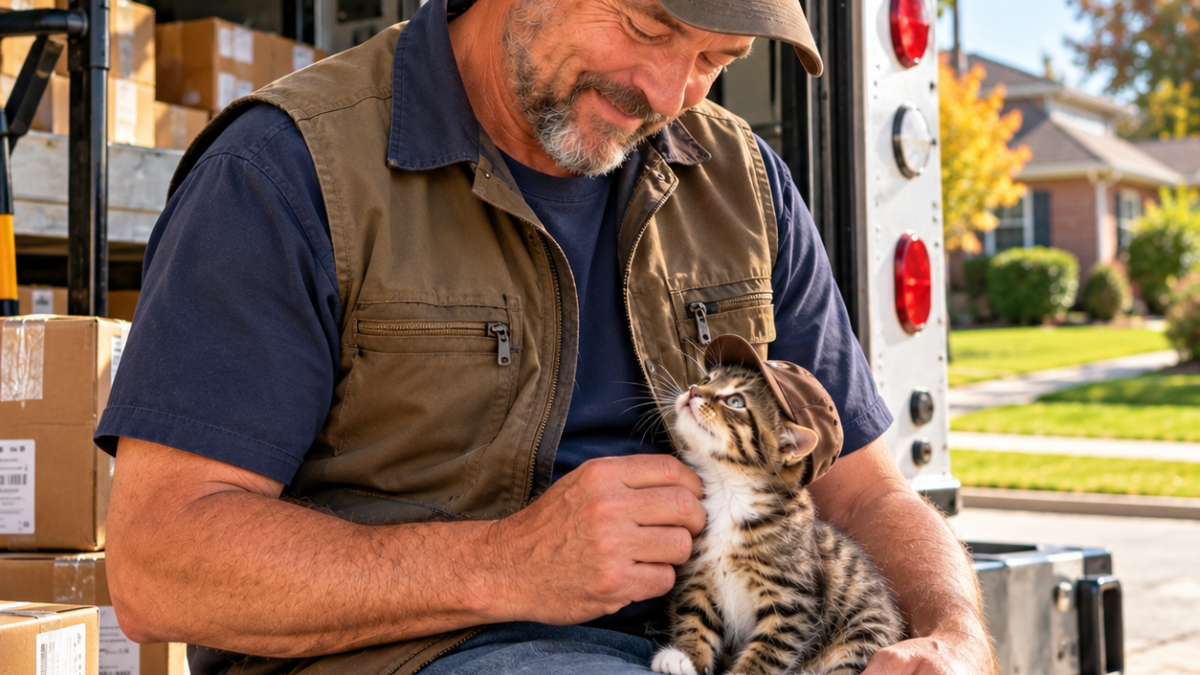
He revealed the smallest hat I had ever seen.
Not an official company uniform.
Just a tiny novelty delivery-style cap that looked ridiculous.
I stared at it.
“No.”
Ten minutes later, we took a photo.
Miles tolerated the hat for approximately six seconds.
Long enough.
He sat beside a small package while Marcus took the picture.
The result was absurd.
Tiny kitten.
Tiny hat.
Serious expression.
I laughed harder than I had in months.
“What do we call him?” Marcus asked.
“We don’t call him anything.”
“Assistant regional delivery manager.”
“Too long.”
“Chief mouse inspector.”
“No.”
“Package protection specialist.”
Jen walked by.
“Smallest employee of the month.”
Miles knocked the hat off.
Marcus pointed.
“Union dispute.”
That picture became the beginning of everything.
Someone shared it with a few coworkers.
Then a short video appeared.
Miles sitting on my lap inside the parked truck.
Miles walking across the passenger seat.
Miles batting at a scanner lanyard.
Miles wearing the little hat for another few seconds.
It spread through our local workplace chat.
Then somebody posted a clip publicly after asking me.
I almost said no.
I had never wanted attention.
I was a delivery driver.
I liked being anonymous.
Drive.
Deliver.
Go home.
Simple.
But the video seemed harmless.
So I agreed.
The caption was simple.
**Driver found this little guy alone beside his route. Now Miles thinks he works here.**
I expected maybe fifty people to watch.
The next morning, Marcus ran toward me in the parking lot.
Actually ran.
“Have you seen it?”
“Seen what?”
“The video.”
“What about it?”
“Twenty thousand.”
I stared at him.
“Twenty thousand what?”
“Views.”
“That doesn’t sound real.”
“Look.”
He shoved the phone toward me.
Twenty-three thousand.
Comments.
Hundreds.
People asking about Miles.
People sharing pictures of their own rescued animals.
People saying the tiny hat had made their day.
One woman wrote that she had lost her elderly cat months earlier and had not smiled at an animal video since.
Another person said their father had been a delivery driver for thirty years and would have done exactly what I did.
Another wrote:
**The world keeps telling us to hurry. He stopped anyway.**
I read that comment several times.
Because that was the whole story.
I had been hurrying.
That morning, more than anything, I had been hurrying.
Miles had forced me to stop.
The video kept growing.
Fifty thousand.
A hundred thousand.
More.
People from places I had never visited knew my kitten’s name.
I felt embarrassed by the attention.
Miles felt none.
He remained focused on important matters.
Food.
Sleeping.
Shoelaces.
Cardboard.
Destroying a roll of paper towels.
But not everyone thought the whole thing was charming.
Tom called me into his office on Monday.
He had his serious face.
I sat.
He turned his monitor toward me.
The video was paused on Miles wearing the tiny hat.
“That your cat?”
“You know it is.”
“You know why we’re talking?”
“Because he’s more famous than management?”
Tom did not smile.
Bad start.
He leaned back.
“The public story makes it sound like you’re driving around every day with a cat in the truck.”
“I don’t.”
“People think you do.”
“He’s been in the truck at the center. At the weekend event. And obviously the day I found him.”
Tom nodded.
“I need that distinction clear.”
“Okay.”
“The trucks have safety policies.”
“I know.”
“And schedules.”
“I know.”
“And I don’t need ten employees deciding tomorrow that their dogs, birds, snakes, and emotional-support goats are joining the route.”
I tried very hard not to laugh at emotional-support goats.
Tom noticed.
“I’m serious.”
“I know.”
He paused.
Then his tone softened slightly.
“Look, what you did was decent.”
I had not expected that.
“You stopped because there was an animal in trouble. Nobody’s punishing you for that.”
“Okay.”
“But now this is public.”
I understood.
The rescue had been simple when it belonged only to me and Miles.
Now it belonged partly to an audience.
Stories changed once thousands of people started interpreting them.
“I’ll make sure people know he isn’t riding loose around during regular deliveries.”
“Good.”
I stood.
Tom stopped me.
“One more thing.”
I turned.
He looked almost annoyed by what he was about to say.
“My wife watched the video.”
“Oh, no.”
“She wants the hat.”
“For what?”
“Our cat.”
I stared at him.
Then I smiled.
He pointed toward the door.
“Get out.”
That should have been the end of the tension.
It was not.
Because once the video spread, strangers started showing up at the distribution center hoping to see Miles.
Only a few.
But enough.
People left toys.
Small bags of kitten food.
Someone delivered an envelope addressed to:
**MILES, DELIVERY DEPARTMENT**
Inside was a handwritten note.
No money.
No request.
Just a note.
**Thank you for reminding us that slowing down for something small can still be important.**
I put it on my refrigerator.
Then came criticism.
It always does.
A few people claimed I had staged the rescue for attention.
Someone wrote that no real delivery driver would risk being late over a stray animal.
Another said:
**It’s just a cat. People act ridiculous over animals.**
I wish I could say I ignored those comments.
I did not.
One evening, I sat on my couch reading them.
Miles was asleep beside me.
The positive comments outnumbered the negative ones by hundreds to one.
Yet the negative ones stayed in my head.
Funny how that works.
I kept thinking about “just a cat.”
I looked at Miles.
He had one paw stretched across the cushion.
His stomach rose and fell slowly.
He trusted the room.
Trusted the house.
Trusted me.
On the roadside that first morning, he had been shaking.
Now he was sleeping deeply enough that I could hear tiny purring sounds between breaths.
“Apparently you’re just a cat.”
One ear moved.
I placed the phone face down.
“No more internet for us.”
The next morning, Marcus cornered me.
“You okay?”
“Fine.”
“You’re lying.”
“I read comments.”
“Ah.”
He nodded knowingly.
“Never read comments.”
“You read every comment.”
“Yes, but I’m emotionally sophisticated.”
“You spent twenty minutes arguing with a stranger about whether pineapple belongs on pizza.”
“That was different. Civilization was at stake.”
I laughed.
That helped.
Then he said something more serious.
“You know what they’re missing?”
“What?”
“They think the story is the video.”
He pointed toward me.
“It isn’t.”
I waited.
“The story happened before anybody recorded anything.”
That shut me up.
Because he was right.
The important moment had happened on an empty county road.
No camera.
No audience.
No tiny hat.
No likes.
No praise.
Just a cold kitten.
A truck.
A schedule.
And a choice.
Everything after that was noise.
Some good.
Some bad.
But noise.
That realization let me enjoy what happened next.
Our company asked whether I would be willing to participate in a local animal-shelter supply drive inspired by Miles’ story.
I hesitated.
“I don’t want this turning into advertising.”
The community coordinator understood.
“Then don’t make it about the company.”
“What do you mean?”
“Make it about the shelter.”
That I could accept.
We set up donation boxes at several locations.
Food.
Blankets.
Cleaning supplies.
Kitten formula.
Toys.
No dramatic campaign.
No huge promises.
Just practical items local shelters had requested.
The response surprised everybody.
People brought bags.
Boxes.
Cases of food.
One elderly man arrived with a small blanket.
He handed it to me personally.
“My wife made these for our cats,” he said. “She passed away last year.”
I did not know what to say.
He touched the blanket.
“There’s no reason it should sit in a closet.”
I swallowed.
“No, sir.”
He looked at Miles’ photo printed on the donation sign.
“That’s your boy?”
“Yeah.”
“Lucky cat.”
I thought about the roadside.
“I’m pretty lucky too.”
He smiled.
“That usually is how it works.”
More stories followed.
A woman told me she had gone back and adopted the shy adult cat she had been thinking about for months.
A teenager said his family had started putting a safe winter shelter outside for community cats in their neighborhood.
A warehouse worker said he had begun carrying an animal-safe emergency kit in his vehicle.
None of those people had done those things because I was extraordinary.
That was precisely why the story seemed to affect them.
I was not extraordinary.
I was a tired guy driving a truck.
That made the choice feel available.
You did not have to be a rescuer.
You did not need special equipment.
You did not need thousands of dollars.
Sometimes, you just had to refuse to keep moving.
Months passed.
Miles grew.
The tiny hat stopped fitting.
Marcus tried to buy a larger one.
I banned him from feline wardrobe decisions.
He ignored me.
Miles developed strong opinions.
He hated closed bathroom doors.
He loved cardboard boxes more than any toy I purchased.
He slept on my chest whenever I tried to watch television.
He believed five in the morning was a reasonable breakfast hour.
He became fascinated by the sound of my truck arriving home.
Every afternoon, if he heard the engine, he appeared at the front window.
By the time I unlocked the door, he was waiting.
Then came the routine.
I would set down my keys.
Miles would circle my boots.
I would say, “Long day.”
He would yell at me.
I would say, “You have no idea.”
He would yell again.
And somehow the house no longer felt quiet.
Before Miles, I had never thought I was lonely.
That word seemed too dramatic.
I had coworkers.
Friends.
Family I spoke with.
I was fine.
But there is a difference between being fine alone and realizing you have been living in a silence you stopped noticing.
Miles changed the sound of my life.
Running paws at midnight.
A food bowl sliding across the kitchen floor.
Purring beside my head.
The crash of something falling in another room followed by absolute suspicious silence.
He gave my mornings shape.
My evenings warmth.
And my bad days somewhere to end.
The emotional high point came almost a year after I found him.
It was cold again.
Not as cold as that first morning, but enough to remind me.
I was driving near the same county road.
Same fields.
Same ditch.
Same long gray stretch.
I slowed.
Without thinking.
The shoulder looked ordinary.
Empty.
I remembered the exact spot.
The tiny shape.
The argument in my head.
Keep driving.
You’re late.
Someone else will handle it.
I pulled into a safe turnout farther down the road.
Not because anything was there.
I just sat.
My phone had a picture of Miles as the lock screen.
He was sitting in a cardboard box that was obviously three sizes too small for him.
I looked at it.
Then at the road.
For the first time, I allowed myself to think about what could have happened if I had not stopped.
I had avoided that thought for months.
Not because I believed I was a hero.
I didn’t.
But because the difference between the two possible outcomes felt frighteningly small.
A foot moving from accelerator to brake.
A hand turning a steering wheel.
A few lost minutes.
That was all.
I imagined returning home that original night.
House quiet.
Shoes by the door.
Television on.
No kitten.
No Miles.
No hat.
No ridiculous videos.
No blanket from the elderly man.
No shelter drive.
No thousands of strangers sharing rescue stories.
Just another workday I would have forgotten.
My phone rang.
Marcus.
I answered.
“What?”
“Are you coming?”
“Coming where?”
“Center. You were supposed to meet us ten minutes ago.”
I checked the clock.
For the second time in my life, that stretch of road had made me late.
I laughed.
“I’m on my way.”
“You okay?”
“Yeah.”
I looked out at the shoulder.
“Just remembering something.”
At the center, a surprise waited.
I should have known.
Marcus could not keep secrets.
Jen could.
Marcus absolutely could not.
The break room had been decorated with photos of Miles from the previous year.
Tiny roadside kitten.
First vet visit.
First ridiculous hat.
Sleeping in my truck during the original rescue.
Sitting beside donation boxes.
Full-grown, glaring at the camera.
“What is this?”
Jen smiled.
“One-year gotcha day.”
“I hate that phrase.”
“No, you don’t.”
“I do.”
Marcus walked forward carrying a box.
“No.”
“You don’t even know what it is.”
“If you bought another hat—”
He opened the box.
Another hat.
Larger.
I stared at him.
“You have a problem.”
He looked proud.
“We all contributed.”
“You spent company time crowdfunding a cat hat?”
“Community building.”
Tom entered behind him.
“I was told this would take five minutes.”
Marcus handed him the hat.
“You want to put it on Miles?”
“No.”
“You know you do.”
Tom looked at me.
“My career has gone in directions I did not anticipate.”
Miles was not actually there.
The hat had to come home.
Which was probably safer for everyone.
Then Tom handed me an envelope.
“This came from corporate.”
My stomach dropped.
Nothing good ever begins with those words.
“What did I do?”
“For once, nothing.”
Inside was a letter.
The company had decided to formalize guidance for drivers who encountered animals in immediate roadside danger.
Not permission to adopt animals mid-route.
Not encouragement to interfere unsafely.
Practical guidance.
Pull over only when safe.
Contact appropriate local services when necessary.
Avoid creating traffic risks.
Notify dispatch if an unexpected situation causes delays.
Use reasonable judgment.
I read it twice.
Then looked at Tom.
“This is because of Miles?”
“Partly.”
For some reason, that affected me more than the viral videos.
A year earlier, I had been worried I might be disciplined simply because I stopped.
Now somebody had turned the experience into clearer instructions so the next driver would not have to wonder whether compassion and responsibility were automatically in conflict.
Marcus leaned against the table.
“Your cat changed policy.”
“Don’t say that.”
“Assistant regional manager.”
“Stop.”
Jen looked at the letter.
“You realize this is the closest you’re ever getting to revenge on anyone who said you should’ve kept driving.”
She was joking.
Mostly.
But the word stayed with me.
Revenge.
I had never wanted revenge.
There was nobody to punish.
No villain standing beside that road.
But there had been something I wanted to defeat.
The idea that stopping was foolish.
The idea that kindness made you weak.
The idea that caring about one tiny life was embarrassing because there were larger problems in the world.
The idea that schedules were always more important than suffering.
If there was any revenge in our story, it was this:
Miles lived well.
He grew strong.
He became loved.
And every person who said the stop had been pointless had to watch that “pointless” choice become something much larger than a delayed delivery route.
That was enough.
More than enough.
But the most satisfying part came from someone I had not expected.
Months earlier, one coworker named Dale had been one of the loudest skeptics.
He was not cruel.
Just practical to the point of bluntness.
When Miles’ story first spread, Dale had said, “I wouldn’t have stopped. I’d have called animal control and kept moving.”
I had disliked that answer.
We never argued about it.
There was no point.
Then, one rainy Tuesday, Dale arrived late.
Very late.
Tom was waiting near the entrance.
Everyone noticed.
Dale climbed from his truck carrying a cardboard box.
I looked inside.
Two tiny eyes looked back.
I stared at him.
Dale looked miserable.
“Don’t say it.”
Marcus appeared beside me.
“Oh, I’m absolutely saying it.”
Dale pointed.
“Not one word.”
Inside the box was a small young cat he had found beneath a loading dock at one of his stops.
Wet.
Hungry.
Afraid.
Dale had called the property manager.
Nobody knew where it belonged.
He contacted a nearby rescue.
Then waited until someone could safely help.
It had cost him almost half an hour.
Tom folded his arms.
“Schedule?”
Dale looked at him.
“Yeah.”
“And?”
Dale glanced down at the box.
“I figured the packages could wait.”
Nobody spoke.
Then Marcus made the mistake.
He clapped slowly.
Dale nearly threw a glove at him.
I laughed so hard I had to lean against the truck.
Dale looked at me.
“This is your fault.”
“My fault?”
“You and that cat.”
“I didn’t make you stop.”
“No.”
He looked at the animal again.
“You just made it impossible to pretend I wouldn’t know what to do.”
That sentence meant more to me than a million views.
Because kindness can work like that.
Not as a lecture.
Not as a command.
As permission.
One person stops.
Somebody sees it.
Later, when their moment comes, stopping feels possible.
The little cat Dale found eventually went to a foster home and then a permanent family.
Marcus suggested a tiny hat.
Dale threatened to quit.
We respected his boundaries.
Mostly.
Years passed.
Miles stopped being a tiny kitten.
He became a solid adult cat with a strong personality and almost no respect for my personal space.
People online still occasionally recognized him from old videos.
Every few months, someone would message asking:
“Is the delivery kitten okay?”
My answer was always yes.
More than okay.
He owned my house.
He had a bed he rarely used because mine was apparently superior.
He had toys in every room.
He had regular veterinary care.
He had a window perch overlooking the driveway.
And he had developed a strange habit of sitting by the front door at the approximate time I normally arrived home.
One afternoon, a neighbor told me something that made me laugh.
“He knows your truck.”
“I know.”
“No, I mean really knows it.”
She pointed toward her house.
“I heard a delivery truck come down the street yesterday. He didn’t move.”
“Okay.”
“Then yours turned the corner fifteen minutes later, and he ran to the window.”
I looked through my front window.
Miles was asleep on the couch.
“That’s ridiculous.”
“He knows.”
I believed her.
Because every evening, there he was.
Waiting.
The little creature I had once found with nobody beside him had somehow become the one making sure I never came home to an empty room.
There is a photograph from those later years that I love more than the famous one with the tiny hat.
Nobody else cared much about it.
It never went viral.
I took it on an ordinary evening.
My boots were near the door.
My work jacket was hanging over a chair.
A package scanner charger was on the kitchen counter.
Miles was asleep beside my work bag.
No costume.
No truck.
No dramatic background.
Just home.
That picture tells the real ending.
People often thought the rescue story ended when I picked him up.
It did not.
That was only the first page.
Rescue was taking him to the clinic.
Learning what food he needed.
Waking up to check on him.
Finding care during work.
Changing my house.
Scheduling veterinary visits.
Cleaning things I did not want to clean.
Buying scratching posts he ignored in favor of furniture.
Making a commitment long after the emotional roadside moment had passed.
That is the part viral stories sometimes leave out.
Compassion is not only the dramatic decision.
It is what happens on Tuesday morning six months later when you are tired and still fill the food bowl.
It is making the appointment.
Paying attention.
Keeping something safe when nobody is watching.
The famous moment lasted minutes.
The responsibility lasted years.
And I would choose it again.
Every time.
One evening, I found the original tiny hat in a drawer.
I had forgotten about it.
I carried it into the living room.
Miles was stretched across the couch.
I held it up.
“Remember this?”
He looked at me.
I placed it beside his head.
Not on him.
I had learned enough.
The hat looked unbelievably small.
“Were you really that tiny?”
He yawned.
I sat beside him.
For several minutes, I looked through old pictures on my phone.
The first one.
Miles on the sweatshirt inside the truck.
His fur messy.
Eyes tired.
Body small enough to fit in my hand.
Then the next.
Veterinary table.
Bathroom floor.
Jen’s sister holding him.
Tiny hat.
Donation drive.
Growing.
Sleeping.
Playing.
Waiting at the window.
A whole life stored in rectangles of light.
I stopped at the original roadside photo.
For years, I had remembered that morning as the day I saved Miles.
Sitting there beside him, I finally understood why that description had always felt incomplete.
He had changed my life too.
Not in a dramatic movie way.
I did not become famous.
I did not quit my job.
I did not suddenly discover some grand new destiny.
I still delivered packages.
Still complained about traffic.
Still lost socks.
Still hated waking up early.
But Miles changed something quieter.
He made me less willing to move through the world without noticing it.
I started keeping an eye on the shoulder of the road.
I noticed animals.
People.
Cars with hazard lights.
Older neighbors struggling with groceries.
Small things I might once have categorized as somebody else’s problem.
I did not stop for everything.
Nobody can.
But I stopped telling myself that because I could not help everyone, helping one did not matter.
That excuse disappeared.
Miles took it with him the day I picked him up.
A few years after the rescue, I was invited to speak briefly at a small local shelter event.
I almost refused.
Public speaking terrified me more than angry dogs behind fences.
But Jen said I should do it.
Marcus said he would attend solely to heckle me.
That guaranteed I would not invite him.
I eventually agreed.
I stood in front of maybe sixty people.
Not thousands.
No cameras from national television.
Just volunteers, adopters, local families, and a few shelter employees.
Someone introduced me as “the delivery driver who rescued the kitten.”
I walked to the microphone.
For a few seconds, I had no idea what to say.
Then I remembered the road.
“I think people sometimes misunderstand what happened.”
The room became quiet.
“I wasn’t looking for an animal to rescue.”
“I wasn’t prepared.”
“I wasn’t especially brave.”
“I was late for work.”
A few people laughed.
“I saw something small beside the road.”
I paused.
“And I almost kept going.”
That part mattered.
I did not want to turn myself into a better person than I had been.
“The reason I stopped wasn’t because I knew the perfect thing to do.”
“I stopped because I knew continuing to drive felt wrong.”
I looked around the room.
“After that, I figured out the next step.”
That was the lesson.
You do not always need to know the entire solution before doing the first decent thing.
Sometimes you make something safe.
Then ask for help.
Sometimes you call a rescue.
Sometimes you contact professionals.
Sometimes you move out of the way and let someone better equipped handle it.
Kindness does not require pretending expertise.
It requires paying attention.
After the event, a little girl approached with her mother.
She could not have been older than eight.
She held a drawing.
A truck.
A gray kitten.
An enormous red hat.
Apparently Miles had been promoted again.
“This is for him,” she said.
“For Miles?”
She nodded.
I took the paper.
“Thank you.”
She looked serious.
“Did he know you were coming back?”
“What?”
“When you got out of the truck.”
I thought about that first morning.
“No.”
“Was he scared?”
“Probably.”
She looked down.
“Then he didn’t know you were helping.”
“No.”
“But you helped anyway.”
Her mother smiled apologetically.
“She asks a lot of questions.”
“It’s okay.”
The girl looked at me.
“I think that’s nice.”
I still have the drawing.
It is framed.
Not because it is artistically accurate.
The truck has six wheels on one side.
Miles is approximately the size of a horse.
But because a child had understood something adults often complicate.
You do not need recognition from the one you help.
You do not need certainty.
You do not need applause.
You do the decent thing because it is decent.
That was the best part of Miles’ story.
Not the views.
Not the tiny hat.
Not the attention.
A small act had remained small enough that anybody could imagine doing it.
There were no helicopters.
No dramatic equipment.
No professional rescue crew arriving through a storm.
Just a man.
A roadside.
A frightened kitten.
And brakes.
Years later, I ran into Tom after he had transferred to another position.
We sat in a coffee shop.
He asked about work.
Then about Miles.
“Still alive and running the house?”
“Unfortunately.”
Tom smiled.
“You know, I thought you were going to become a problem that day.”
“The rescue day?”
“Yeah.”
“Why?”
“You were late, emotional, carrying a kitten, and had no plan.”
“Accurate.”
“I thought, great, now every route is going to involve an adventure.”
I laughed.
“Sorry to disappoint you.”
“You didn’t.”
He stirred his coffee.
“Remember when I talked to you about the video?”
“Yeah.”
“I was worried about the wrong thing.”
I looked at him.
“What do you mean?”
“I was worried that people would think you were unprofessional.”
“And?”
He shrugged.
“Turns out most people understood the difference between being careless and stopping for a legitimate reason.”
That was another victory.
Not dramatic.
But real.
Tom had started with schedule numbers.
Now he was talking about judgment.
Human judgment.
The ability to look at a situation no policy could predict perfectly and make a reasonable compassionate decision.
“That cat was a pain,” Tom said.
“You met him twice.”
“Exactly.”
I smiled.
“He liked you.”
“He tried to climb my leg.”
“Affection.”
“That’s what you called it?”
“Absolutely.”
Tom shook his head.
Then he pulled out his phone.
His lock screen was a cat.
I stared.
“No.”
“Don’t.”
“You got one?”
“My wife did.”
“What happened to ‘no petting zoo’?”
“This is my private life.”
I laughed.
“What is his name?”
Tom hesitated.
“Barcode.”
I nearly fell out of the chair.
“You named your cat Barcode?”
“My wife named him.”
“Sure.”
“He’s black and white.”
“That’s terrible.”
“He answers to it.”
“He doesn’t understand words.”
“You don’t know that.”
I stared at him.
Then we both started laughing.
That was the kind of revenge I could appreciate.
Not somebody suffering.
Just life slowly proving that caring was never as ridiculous as people liked to pretend.
The years continued.
And eventually, Miles became the one slowing down.
The first white hairs appeared around his face.
He jumped onto the counter less often.
Then stopped.
His veterinary checkups became more detailed.
I bought small steps so he could reach his favorite window perch without jumping as high.
He hated the steps for three weeks.
Then used them constantly.
He still waited for my truck.
Still complained when dinner was late.
Still believed my chest was his preferred sleeping location.
One cold morning, many years after the rescue, I woke before my alarm.
Miles was beside me.
He did not get up immediately.
Age had made mornings slower.
I touched the blanket near him.
“Morning, copilot.”
His eyes opened.
He purred.
That word had stayed.
Copilot.
Even though he had spent very little of his actual life riding in the truck.
It was never really about driving.
It was about companionship.
I carried him carefully toward the kitchen.
He could still walk.
He simply enjoyed being carried now.
Funny.
The kitten who once had no choice but to accept my hands had grown into a cat who spent years choosing when touch was allowed.
Now, in old age, he leaned against me.
Trust changes shape.
So does love.
I placed his breakfast down.
While he ate, I looked through the kitchen window.
A delivery vehicle passed outside.
For a second, I saw myself years earlier.
Younger.
Tired.
Watching the clock.
Thinking the day was ordinary.
I wanted to reach backward through time and tell that man something.
Not “You’re about to become famous.”
He didn’t.
Not “This kitten will make you a hero.”
He wasn’t.
I wanted to say:
Pay attention.
The thing you think is ruining your schedule might become one of the best things that ever interrupts your life.
Miles finished eating.
He turned.
Then walked toward me.
Slowly.
I crouched.
He pressed his head against my hand.
No tiny hat.
No cameras.
No thousands of people watching.
Just us.
Exactly how the story should end.
For years, strangers had called Miles lucky.
They were not wrong.
He was lucky somebody saw him.
Lucky traffic had not reached him first.
Lucky he was still strong enough to recover.
Lucky a clinic was nearby.
Luck was part of it.
But I never liked the idea that the entire story belonged to luck.
Because luck did not turn the truck around.
A choice did.
And choices are more hopeful.
Luck is something that happens to us.
Choices are something ordinary people can make.
That is why I still tell the story when people ask.
Not because everybody should pull over recklessly every time they see an animal.
Safety matters.
Professional help matters.
Knowing your limits matters.
But indifference should never become our automatic setting just because we are busy.
The world gives us endless reasons to keep moving.
Schedules.
Deadlines.
Phones.
Bills.
Traffic.
Responsibilities.
Sometimes those reasons are completely legitimate.
But occasionally, something small appears at the edge of all that hurry.
A frightened animal.
A person who needs a hand.
A moment when slowing down costs us very little and means everything to somebody else.
Those moments do not announce themselves.
No music plays.
No camera begins recording.
Nobody tells you, “This is the decision you’ll remember for the rest of your life.”
The road looks ordinary.
The clock keeps moving.
And you choose.
I chose to stop.
Miles chose absolutely nothing that morning.
He was simply there.
Cold.
Alone.
Waiting without knowing he was waiting.
But later, once he was safe, he made plenty of choices.
He chose the sweatshirt instead of the cardboard box.
He chose my lap.
My house.
My bed.
My work bag.
My side of the couch.
My five-in-the-morning wake-up time.
He chose to run to the window when he heard my truck.
And eventually, I stopped thinking of him as the kitten I had rescued.
He was simply Miles.
My cat.
My family.
My smallest coworker who had technically never completed a single delivery.
His performance reviews were terrible.
Attendance inconsistent.
He slept on company-related materials.
He refused all training.
And yet somehow he became the employee everyone remembered.
The tiny hat eventually ended up framed with one of the photographs.
Under it, I placed the note someone had mailed to the distribution center years before.
**The world keeps telling us to hurry. He stopped anyway.**
I still think that stranger understood the story better than I did.
Because my life did not change when a video went viral.
It did not change when people recognized Miles.
It did not change when a company policy was updated or when shelter donations arrived.
My life changed beside a county road before any of that existed.
I looked in the mirror.
Saw something small.
And decided it mattered.
That was all.
And somehow, that was enough.
If there was one final thing Miles taught me, it was that helping one life is never “only” helping one life.
You do not know where kindness travels afterward.
Maybe nowhere.
Maybe the act remains private forever.
That does not make it smaller.
But sometimes somebody sees it.
A coworker.
A child.
A stranger online.
A skeptical delivery driver named Dale.
And the next time they reach their own moment, maybe they stop too.
Not because they were ordered.
Because somebody once showed them it could be done.
Miles’ story began with one rescued kitten.
But it left behind something more useful than a viral video.
Permission to care.
Permission to slow down.
Permission to take small compassion seriously.
And maybe that is why people remembered him.
Not because he wore a funny little hat.
Not even because he rode beside a delivery driver.
They remembered because everybody has driven past something in life.
A person.
A problem.
A moment.
Something that quietly asked:
Will you notice me?
Most days, we cannot fix everything we notice.
Nobody can.
That is not failure.
But on that morning, there was one thing I could do.
I could stop.
So I did.
And years later, when an older gray-and-white cat curled beside me at night and purred as if he had always belonged there, I never once wished I had saved those forty-three minutes.
Not once.
The packages were delivered.
The schedule recovered.
The day ended.
Nobody remembers whether I was late.
But I remember the kitten.
And the kitten came home with me.
Sometimes, that is how a life changes.
Not through a grand plan.
Not through some dramatic promise to save the world.
Just one ordinary person deciding that one small life in front of him is worth stopping for.
That morning, I thought I was rescuing a kitten from the side of a road.
Years later, I understood the better ending.
I gave Miles a safe place to belong.
And without ever trying, he gave me one too.

