PART 2: I Pulled a Bear Cub From a Flooded River—Then His Mother Stepped Out of the Trees and Walked Straight Toward Me
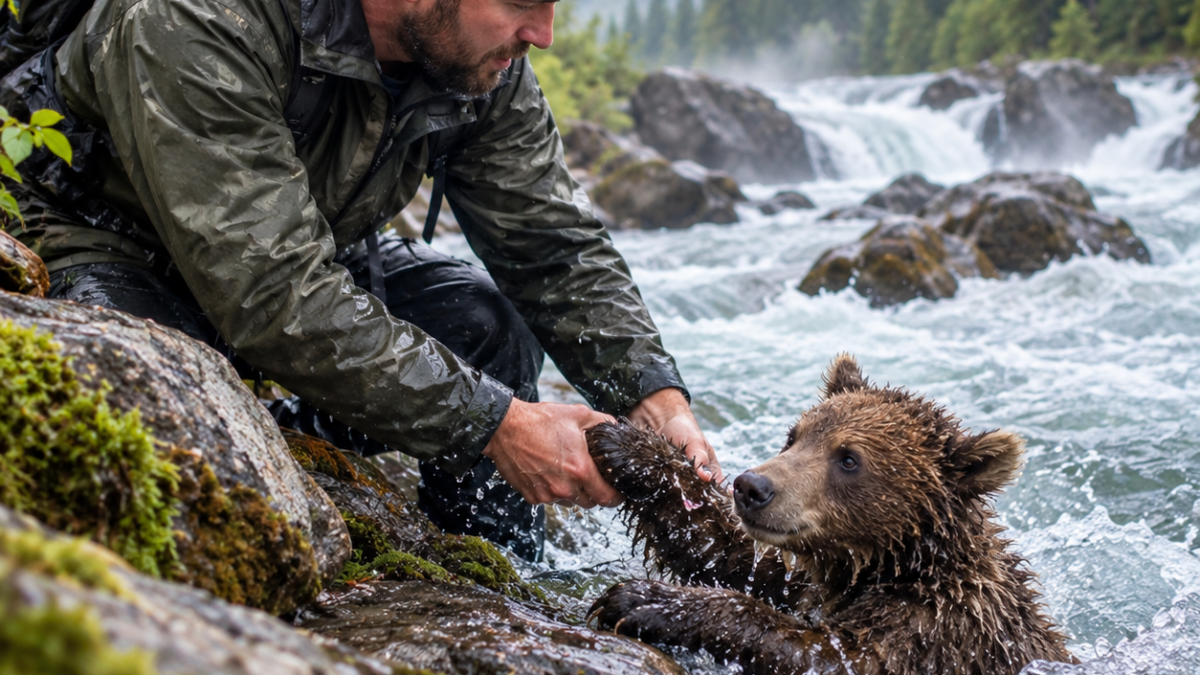
PART 2
I did not run.
People later asked me why.
The truthful answer is that fear can make you surprisingly obedient to things you’ve heard your entire life.
Don’t run from a bear.
Don’t scream.
Don’t make sudden movements.
Don’t place yourself between mother and cub.
I had already failed the last rule.
I wasn’t going to fail the first three if I could help it.
So I stayed low.
The cub lay several feet in front of me.
The mother came closer.
Twenty yards.
Then fifteen.
Her nose moved continuously.
She was smelling him.
Smelling the river.
Smelling me.
I could hear her breathing.
Deep.
Heavy.
Not the dramatic growl people imagine from movies.
Something quieter.
More frightening because it was real.
I spoke softly.
“Okay.”
My voice trembled.
“Your baby is right there.”
The bear kept moving.
I put both hands where she could see them.
Then slowly moved backward.
One knee barely worked.
Pain shot up my leg.
I didn’t care.
I wanted space.
She wanted her cub.
That was the only thing in that clearing that mattered.
“He’s yours.”
I moved another step.
The cub lifted his head.
His mother immediately shifted toward him.
I stopped.
She walked the remaining distance.
For one second, I thought she might strike the cub because he smelled like me.
I had heard all kinds of myths growing up.
Touch a wild baby and the mother rejects it.
Human scent ruins everything.
Most of those stories are oversimplified or false, but in that moment my mind pulled up every frightening possibility it could find.
The mother lowered her nose to the cub’s back.
Sniffed.
Moved to his head.
The cub made a tiny sound.
She nudged him.
He rolled partly onto his chest.
Then collapsed.
She nudged him again.
I moved farther away.
Slowly.
She looked at me.
That look became the part of the story everyone wanted to interpret.
Some people later said she thanked me.
Others said she recognized what I had done.
Wildlife experts told me something more reasonable: she was evaluating whether I remained dangerous.
They’re probably right.
But I remember those eyes.
Not soft.
Not grateful.
Not human.
Focused.
Intelligent.
Taking everything in.
She held that look for several seconds.
Then turned away from me.
That choice felt enormous.
She returned to her cub.
The little bear tried to stand.
Front paws first.
Then his rear legs.
He swayed.
His mother stayed beside him.
Didn’t rush.
Didn’t push hard.
Waited.
He took two steps.
Stopped.
She waited again.
Three more.
Then another stop.
Together, they moved toward the trees.
The cub stumbled once.
His mother turned.
Waited.
He followed.
At the edge of the timber, he looked back.
Maybe at the river.
Maybe at me.
Then disappeared behind her.
I remained kneeling for at least a minute.
Maybe longer.
I didn’t trust my legs.
Didn’t trust the clearing.
Didn’t trust that the mother wasn’t circling back.
Eventually, I stood.
Every part of me shook.
Cold.
Adrenaline.
Shock.
I limped toward my truck.
Only when I got inside and shut the door did I realize I was laughing.
Then crying.
Then laughing again.
THE PHONE CALL
I drove nearly five miles before my phone found enough signal.
My first call was to the regional wildlife office.
The woman who answered transferred me to an officer named Rachel Torres.
“Wildlife enforcement,” she said. “Torres.”
“I need to report an injured bear cub.”
“Where?”
I gave the location.
“Is the cub still there?”
“No.”
“Did it leave?”
“With the mother.”
Pause.
“Start from the beginning.”
So I did.
The river.
The cub.
Going into the water.
The mother.
Rachel let me finish.
Then there was silence.
“Mr. Miller?”
“Yes?”
“I’m going to say something you’re probably not going to enjoy.”
“I probably deserve it.”
“You should never approach a bear cub unless there is absolutely no safe alternative.”
“I know.”
“Especially in flood conditions.”
“I know.”
“Especially if you don’t know where the mother is.”
“I know.”
“And entering fast water alone was extremely dangerous.”
“Yes.”
Another pause.
“Are you injured?”
“My knee.”
“Head?”
“No.”
“Did you lose consciousness?”
“No.”
“Any numbness?”
“No.”
“Then you’re going to get checked.”
“Probably.”
“No. You’re going to get checked.”
She sounded like my wife already.
Then Rachel asked:
“Did you see anything unusual near where the cub entered the water?”
That caught me.
“What do you mean?”
“Fencing. Rope. Wire. Vehicles. Camps. Anything out of place.”
I thought.
The bank.
Branches.
Mud.
Then I remembered.
“There was wire.”
Her tone sharpened.
“What kind?”
“Couldn’t tell. It was upstream near a fallen tree. I thought maybe old fencing.”
“How far?”
“Maybe seventy yards.”
“Which side?”
I explained.
“Anything attached to it?”
“I didn’t look closely.”
“Any other people?”
“No.”
“Tracks?”
“Everything’s mud.”
“Vehicles?”
“I saw a green pickup on that service road earlier this week.”
“When?”
“Tuesday and yesterday.”
“Plate?”
“No.”
“Description?”
“Older dark green pickup. Metal toolbox. White decal in the back window.”
“Shape?”
“Looked like antlers or maybe a deer head.”
Rachel went quiet.
“Do not go back there.”
“I wasn’t planning to.”
“I mean it.”
“I just got stared down by a mother bear. You won’t have to ask twice.”
That earned a small laugh.
Then she said:
“We’ll send a team at first light.”
HOME
My wife, Laura, opened the front door before I reached it.
She looked at my clothes.
Mud.
Water.
One torn pant leg.
Blood from my knee.
Her face changed.
“What happened?”
“I slipped.”
“In what?”
“A river.”
She stared.
“Why were you in a river?”
There are moments when you realize the order in which you tell a story matters.
This was one of them.
“There was a bear cub.”
Her mouth opened.
I continued quickly.
“It was drowning.”
“Andy.”
“I got it out.”
“Andy.”
“The mother came.”
She closed her eyes.
“Andy.”
“I’m fine.”
That was the wrong thing to say.
“You are soaking wet, bleeding, limping, and you just told me you were between a mother bear and her cub.”
“Technically, yes.”
She pointed toward the truck.
“Hospital.”
“It’s just my knee.”
“Truck.”
“Laura—”
“Truck.”
I went.
X-rays showed no fracture.
Deep bruising.
Strain.
Small cut.
Lucky.
Again.
When we got home after midnight, Laura sat at the kitchen table.
“So.”
“So?”
“Would you like to explain how you decided entering floodwater was a reasonable life choice?”
I rubbed my face.
“It wasn’t reasonable.”
“Good start.”
“I didn’t have time.”
“You had time to call someone?”
“No signal.”
“Drive until you had signal?”
“The cub would have been gone.”
She looked at me for a long time.
“I understand why you did it.”
That surprised me.
“You’re still angry.”
“Those two things are not mutually exclusive.”
Fair.
Then she asked:
“Was the mother really that close?”
“Closer than this house is wide.”
Laura went pale.
We didn’t talk about it anymore that night.
THE VIDEO
The next morning, my phone had twenty-three missed messages.
Then forty.
Then more.
At first I thought someone in wildlife enforcement had shared the report.
Wrong.
A hiker had been on a ridge on the opposite side of the river.
He had seen part of the rescue from a distance.
And filmed it.
The video wasn’t clear.
You could barely make out me entering the water.
Then dragging something toward shore.
Then later, the mother bear moving into the clearing.
Someone posted it online with the caption:
MAN SAVES BEAR CUB FROM FLOOD—MOTHER RETURNS
By breakfast, thousands of people had watched it.
By lunch, tens of thousands.
The comments were everything you’d expect.
“Hero.”
“Idiot.”
“Bravest thing I’ve ever seen.”
“Never approach a bear cub.”
“Mother bear thanked him.”
“Mother bear almost ate him.”
“Fake.”
“Staged.”
“Nature is amazing.”
“Humans need to stop interfering.”
I turned the phone off.
Then Rachel called.
“Your video is causing trouble.”
“I didn’t post it.”
“I know.”
“What trouble?”
“People recognized the location.”
My stomach sank.
“How?”
“Mountain ridge. Road sign in one frame. Internet detectives.”
“Great.”
“We already had two vehicles near the access gate this morning.”
“Looking for the bears?”
“Probably.”
I felt sick.
The cub had survived the river.
Now curiosity might drive strangers into the area.
“What can I do?”
“Nothing.”
“Rachel—”
“Nothing means nothing.”
“I can tell people not to go.”
“That may make more people interested.”
She was right.
“Let us manage it.”
I agreed.
For half a day.
Then Rachel called again.
“We found the wire.”
Something in her voice made me sit down.
“And?”
“It’s not old fencing.”
“What is it?”
“Improvised snare equipment.”
My stomach tightened.
“For bears?”
“Probably not intentionally designed for bears.”
“But dangerous to them?”
“Absolutely.”
“Did the cub get caught?”
“We don’t know.”
“Was there fur?”
Pause.
“Yes.”
I stood.
“From the cub?”
“Lab will determine species. Maybe more if we’re lucky.”
“What else?”
“Disturbed mud. Broken restraint. Tracks.”
“The mother?”
“Could be.”
“So the cub may have been trapped.”
“May have.”
“And that’s why he ended up in the river.”
“Andy.”
“What?”
“Don’t turn possibility into fact.”
I hated that sentence because I knew she was right.
Investigations are built from evidence, not anger.
Still, everything inside me said the same thing:
The storm might not have started the rescue.
Someone might have.
THE SITE
Wildlife officers temporarily closed part of the access route.
That created a different kind of problem.
Local residents complained.
Hikers complained.
Some people blamed the bear rescue.
One online comment read:
One guy plays hero and now the whole area gets shut down.
Another:
People need to stop treating animals like children.
Then someone posted my name.
Soon my workplace number circulated.
People called.
Some thanked me.
Some criticized me.
One person asked if I knew where the mother bear slept.
I hung up.
Laura watched me switch off the phone.
“Humans were a mistake.”
I laughed despite myself.
“You’re not wrong.”
THE FIRST TRAIL CAMERA
Two days later, Rachel sent me a message.
No explanation.
Just a photograph.
The mother bear crossing between two trees.
Behind her, the cub.
Walking.
Alive.
I stared at the image.
His fur looked dry.
He was close to his mother.
No obvious limp.
I called Rachel.
“He’s okay.”
“Appears to be.”
“You couldn’t just write that?”
“Wanted you to see.”
I swallowed.
“Thank you.”
“Don’t post it.”
“I won’t.”
“Don’t send it.”
“I won’t.”
“Don’t tell your reporter friends.”
“I don’t have reporter friends.”
“You will soon.”
Unfortunately, she was right.
THE REPORTER
Her name was Jenna Cole.
She worked for a regional newspaper.
She called four times before I answered.
“I’ll speak if you agree to conditions.”
“Name them.”
“No exact location.”
“Agreed.”
“No encouragement for people to approach bears.”
“Agreed.”
“No ‘hero befriends bear family’ nonsense.”
She laughed.
“Agreed.”
“And the story needs to say wildlife officials think what I did was dangerous.”
Silence.
“You’re serious?”
“Very.”
“That may ruin my headline.”
“Good.”
Jenna turned out to be excellent.
She asked about the mother.
“What did she do?”
“Came to the cub.”
“Did she look at you?”
“Yes.”
“How?”
“What does that mean?”
“Did it feel threatening?”
“Everything about standing ten yards from a bear feels threatening.”
“Did she charge?”
“No.”
“Growl?”
“No.”
“Did you feel she understood you helped?”
I thought carefully.
“I have no idea what she understood.”
“But?”
“But she chose her cub over me.”
Jenna smiled.
“That’s a good line.”
“It’s the truth.”
Her article focused as much on wildlife safety as the rescue.
Rachel approved.
Mostly.
Then the lab result returned.
Bear fur.
Black bear.
Could not determine whether mother or cub from the sample available.
But one of them had contacted the illegal equipment.
That moved the case from possible problem to confirmed wildlife violation.
THE GREEN TRUCK
About two weeks later, I stopped for gas after work.
A dark green pickup sat near the convenience store.
Older model.
Silver toolbox.
White deer-head decal in the rear window.
My heart sped up.
I didn’t approach.
I didn’t stare.
I took a photograph from inside my truck.
Plate visible.
Sent it to Rachel.
My phone rang immediately.
“Where are you?”
“Gas station on Highway 12.”
“Leave.”
“Already pulling out.”
“Did the driver see you?”
“I don’t think so.”
“Description?”
“I didn’t see him clearly.”
“Good.”
“Good?”
“Means you didn’t get curious.”
“I can learn.”
“Slowly.”
The truck was registered to Travis Cole.
Thirty-eight.
Lived in a rural property about thirty miles away.
Prior citations for trespassing.
Improper trapping equipment.
Hunting-related violations.
Nothing catastrophic.
But enough.
“What happens now?” I asked Rachel.
“We investigate.”
“That sounds like nothing.”
“It means I can’t tell you.”
“Right.”
“Go home.”
MORE DEVICES
Wildlife officers found a second illegal snare system farther uphill.
Then a third.
The devices appeared designed for smaller wildlife but were poorly placed, unmarked, and prohibited in that area.
One was close enough to a known wildlife corridor that officers became concerned additional animals may have encountered it.
Trail cameras were installed.
Patrols increased.
The road closure extended.
Public anger increased with it.
One afternoon, a man confronted me outside the hardware store.
“You’re Miller?”
“Depends who’s asking.”
“The bear guy.”
I regretted answering immediately.
“Apparently.”
He shook his head.
“Because of all this, they’ve blocked half the access.”
“Wildlife department did that.”
“Because of you.”
“Because someone put illegal traps there.”
“So you say.”
“So officers say.”
He crossed his arms.
“Animals have been taking care of themselves forever.”
“Agreed.”
That surprised him.
“Then leave them alone.”
“I’d love to.”
He frowned.
“That’s the whole point.”
He didn’t understand.
Some people don’t want to.
THE CUB’S CONDITION
Wildlife staff continued monitoring.
The cub stayed close to his mother.
He gained strength.
A month after the river incident, trail cameras captured him climbing a fallen tree.
I watched the clip in Rachel’s office.
“He looks normal.”
“Seems to be.”
“Any injury from the wire?”
“Nothing obvious.”
“Could there be hidden damage?”
“Always possible.”
I hated “possible.”
Rachel noticed.
“You know what wildlife work teaches you?”
“That you enjoy uncertainty?”
“That you’re not entitled to certainty.”
I looked at her.
She smiled.
“Animals don’t send follow-up emails.”
Fair.
THE NIGHT TRUCK
Three weeks later, at 1:07 a.m., Laura shook me awake.
“Andy.”
I sat up.
“What?”
“Camera.”
We had installed two exterior cameras after the story went public.
On the screen, a dark pickup moved slowly past our house.
Green.
Could have been Travis.
Could have been another truck.
It disappeared.
Two nights later, it happened again.
Same time range.
This time the license plate was partly visible.
Enough.
I called the sheriff.
A deputy took the report.
“Any contact?”
“No.”
“Threats?”
“No.”
“Someone approach your property?”
“No.”
“Could be coincidence.”
“Could be.”
The deputy looked at me.
“Do you believe that?”
“I don’t know what I believe.”
Good answer.
We documented it.
Nothing more.
Then Rachel called in the morning.
“Stop posting your schedule online.”
“I don’t post my schedule.”
“Your workplace does.”
We fixed that.
The story had stopped feeling like an interesting rescue.
Now it felt invasive.
THE SEARCH WARRANT
I did not know wildlife officers had been building a larger case until months later.
Trail cameras caught Travis entering restricted land.
More than once.
One image showed him carrying equipment.
Another showed him checking something near a tree.
That, combined with prior violations and physical evidence, supported a warrant.
Investigators searched his vehicle, property, and phone.
What they found changed the case.
Photographs of the riverbank.
Snare setups.
Animal tracks.
Maps.
Dates.
And one photograph of a bear cub moving near the area less than twenty-four hours before I found him in the river.
When Rachel showed me the image after it entered public record, I felt sick.
“That’s him.”
“Maybe.”
“It’s him.”
“Likely.”
The cub stood near brush.
Healthy.
Upright.
Not drowning.
Not injured.
The next photo showed another angle of the area.
One illegal device clearly visible.
“What happened after this?”
“We don’t know.”
“Did Travis see the bear?”
“He took the picture.”
“So yes.”
“Yes.”
“And left the device?”
“Evidence indicates he did.”
My anger hardened.
This wasn’t a man who accidentally placed something without knowing bears used the area.
He knew.
THE TEXTS
Investigators recovered messages between Travis and a friend.
One:
Saw the little bear again. Mama can’t be far.
The friend replied:
Then get your stuff out of there.
Travis:
They’re messing up the whole line.
Another:
Need to scare them off somehow.
No message said:
I will hurt them.
No direct confession.
Still, the mindset was clear.
Wild animals existed in his mind as interference.
Obstacles.
Problems.
Rachel watched my face.
“Don’t.”
“Don’t what?”
“Build facts we don’t have.”
“He’s talking about scaring them.”
“Yes.”
“And the cub ends up in a river.”
“Yes.”
“After contacting illegal equipment.”
“Likely.”
“How much more do you need?”
“For what you’re implying? More.”
I turned away.
“That’s ridiculous.”
“No. That’s law.”
I knew she was right.
Still hated it.
THE MOTHER
Through all of this, the mother bear kept appearing on cameras.
Once alone.
Once with the cub.
Once crossing at night.
Every time I saw her, I returned to the clearing.
That look.
The cub between us.
Her decision to approach him instead of me.
I began to realize how easy it would have been to turn her into a villain if she had reacted differently.
If she had charged, headlines would have said:
MAN ATTACKED AFTER SAVING BEAR CUB.
People would have blamed her.
But from her perspective?
A human stood beside her weakened baby.
She had no context.
No explanation.
And still, somehow, the encounter ended with everyone alive.
The more I thought about it, the more extraordinary restraint seemed.
Not mine.
Hers.
THE BEARS DISAPPEAR
Near the end of summer, the cameras stopped capturing them.
One week.
Two.
Three.
I called Rachel.
“Nothing?”
“Nothing.”
“Is that normal?”
“Yes.”
“Could something have happened?”
“Anything could happen.”
“Rachel.”
She sighed.
“They move. Food changes. Cubs get older. Home ranges shift.”
“So you think they’re fine.”
“I think we have no evidence they aren’t.”
That did not comfort me.
“You need to let wild animals disappear, Andy.”
“What?”
“You’re trying to turn monitoring into ownership.”
That stung.
“I just want to know he’s alive.”
“I know.”
“What’s wrong with that?”
“Nothing. Until you think knowing is something nature owes you.”
I sat quietly.
Then nodded.
She was right again.
Annoyingly.
COURT
The criminal and wildlife proceedings began that fall.
Travis faced charges related to prohibited trapping methods, trespassing, illegal placement of equipment, and repeated wildlife violations.
The state could not prove that he intentionally forced the cub into the river.
That point mattered.
Online, people simplified everything.
“Bear trapper tried to kill cub.”
Not proven.
“Poacher nearly drowns baby bear.”
Not proven.
The real case was less dramatic and more credible.
He knowingly operated illegal equipment.
He knew bears were present.
He continued anyway.
Some of that equipment had contacted a bear.
He repeatedly entered restricted areas.
That was enough.
I testified.
Travis’s attorney was polite but aggressive.
“Mr. Miller, you did not witness my client at the river on the day you rescued the cub.”
“No.”
“You did not see the cub caught in any device.”
“No.”
“You do not know how it entered the water.”
“No.”
“So you cannot tell this court that my client’s actions caused the cub’s distress.”
“No.”
The attorney paused.
Maybe he expected me to fight.
I didn’t.
Facts were facts.
Then he asked:
“Yet you’ve participated in media coverage connecting the two.”
“I participated in one interview before I knew his name.”
“Did you discuss illegal traps?”
“Only after wildlife officers confirmed they existed.”
“Did you say they caused the rescue?”
“No.”
The prosecutor stood later.
“Mr. Miller, why did you report the wire?”
“Because Officer Torres asked if I noticed anything unusual.”
“At the time, did you know it was illegal?”
“No.”
“Did you know who placed it?”
“No.”
“Did you have any reason to accuse the defendant?”
“No.”
“Then why mention it?”
“Because it was there.”
The prosecutor nodded.
That became important.
I wasn’t a person trying to build a case.
I had simply remembered a detail.
Sometimes that’s how investigations begin.
TRAVIS TESTIFIES
Travis chose to testify.
I did not expect that.
He said he had trapped legally for years in other areas.
Said he misunderstood boundary restrictions.
Said some devices were old.
Said others belonged to people he knew.
Said photographs on his phone were for documenting wildlife interference.
Then the prosecutor read his text:
Need to scare them off somehow.
“What did you mean?”
“Noise. Human presence.”
“Why?”
“They were disrupting the line.”
“What line?”
“My sets.”
“Illegal sets?”
His attorney objected.
Sustained.
The prosecutor adjusted.
“Sets placed in the area under investigation.”
“Yes.”
“You knew a mother bear and cub were using the corridor.”
“Yes.”
“Yet you left equipment.”
“I didn’t think they’d touch it.”
That sentence sat heavily.
I didn’t think.
How much harm in the world begins there?
THE JUDGE
At sentencing, the judge spoke longer than I expected.
He didn’t romanticize the bears.
Didn’t call them innocent babies.
Didn’t use emotional language.
He said wildlife regulations exist partly because individual people cannot decide that shared public land belongs to their personal activity.
He said knowledge matters.
Repeated conduct matters.
Prior warnings matter.
He said:
“Wild animals moving through lawful habitat are not interfering with you. You are operating within their habitat.”
That line ended up in several newspapers.
Travis lost trapping privileges for years.
Paid fines.
Paid restitution.
Received probation.
Was restricted from particular public lands.
His equipment was confiscated.
Some online commenters said punishment was too light.
Others said too harsh.
I felt something unexpected.
Relief.
Not triumph.
No joy in another person’s losses.
Just relief that the case had reached an end.
“AREN’T YOU ANGRY?”
Jenna interviewed me again afterward.
“Are you satisfied?”
“With what?”
“The sentence.”
“I think the judge handled it.”
“That sounds diplomatic.”
“It’s honest.”
“You’re not angry?”
I laughed.
“Of course I’m angry.”
“Then don’t you want more?”
“More what?”
“Punishment.”
I thought about it.
“No.”
“Why not?”
“Because punishment isn’t the goal.”
“What is?”
“Remove the danger.”
“That’s it?”
“Isn’t that enough?”
She looked at me.
I continued.
“If the traps are gone, the area is monitored, and he isn’t allowed to do it again, what does me wanting him miserable add?”
She stopped writing for a second.
“That’s less exciting than revenge.”
“Reality usually is.”
THE FIRST SPRING
The following spring, Rachel called.
“I have something.”
“What?”
“Come by.”
I drove to the wildlife office.
She pulled up a trail-camera photograph.
Female bear.
Yearling beside her.
Same ear notch on the mother.
Similar markings.
Likely them.
The cub was huge compared with the soaked animal I’d carried from the river.
Long legs.
Thick coat.
Standing on a log.
I couldn’t speak for a moment.
“You’re sure?”
“No.”
“Rachel.”
“Highly confident.”
“That’s as close as I get?”
“Yes.”
I smiled.
“Fine.”
The next image showed the yearling climbing a tree.
Another showed mother and young bear crossing the old service road.
No traps.
No people.
No crisis.
Just bears.
“That’s the ending,” I said.
Rachel shook her head.
“No.”
“What?”
“That’s one day.”
I laughed.
“Let me have this.”
She smiled.
“Fine.”
REVENGE
That was when I finally understood what revenge looked like in this story.
Not Travis losing money.
Not social media attacking him.
Not his name in court records.
The better revenge was quieter.
The snares disappeared.
The road closed to unauthorized vehicles.
The mother returned.
The cub grew.
The forest continued without asking anyone’s permission.
Travis had treated wildlife as obstacles in his path.
The outcome removed him from theirs.
That was enough.
THE SCHOOL
A local elementary school invited Rachel and me to speak about wildlife safety.
She almost refused.
Then I said:
“You can spend forty-five minutes telling children I was stupid.”
She accepted immediately.
The auditorium held about two hundred students.
The teacher introduced me as “the man who saved a bear cub.”
Rachel leaned toward the microphone.
“And who should not be copied.”
The kids laughed.
I put my hand over my heart.
“Thank you, Officer Torres.”
We showed maps.
Not exact location.
Pictures of rivers.
Examples of safe distances around wildlife.
Rachel asked:
“If you see a bear cub alone, what do you do?”
A hundred hands went up.
One boy shouted:
“Jump in the river!”
Everyone laughed.
Rachel pointed at me.
“This is why we can’t invite him places.”
Then she explained.
Leave space.
Back away.
Contact wildlife officials.
Never assume a cub has been abandoned.
Never approach for a photograph.
Never feed wildlife.
One girl asked:
“Then why did Mr. Miller go in?”
Rachel looked at me.
My turn.
“Because sometimes adults make a bad safety decision for a good reason.”
Rachel nodded.
“That’s actually accurate.”
The girl frowned.
“Was it worth it?”
That question stayed with me.
I answered carefully.
“The cub lived.”
She smiled.
“But that doesn’t mean what I did was safe.”
She looked disappointed.
Children prefer clear heroes.
Life rarely provides them.
EMMA
My daughter Emma was twelve during the rescue.
At nineteen, she chose wildlife biology.
At twenty-three, veterinary medicine.
At twenty-nine, she worked with regional wildlife rehabilitation programs.
I like to tell people I inspired her.
She hates that.
“You almost became a cautionary statistic.”
“Still inspiration.”
“No.”
One Christmas, she gave me a framed trail-camera photograph.
The mother and yearling.
Underneath, a small engraved plate:
YOU WERE THERE FOR ONE DAY.
THEY HAD A LIFE AFTER.
That hit me harder than anything else.
Because that’s what I had slowly learned.
The rescue felt huge to me because I experienced every second.
To the bears, it was one terrible afternoon.
Then life continued.
They needed that.
Not fame.
Not names.
Not humans following them.
Ordinary wild days.
TRAVIS’S LETTER
Two years after court, an envelope appeared in my mailbox.
No return address.
Inside was a handwritten letter.
Travis.
At first, he blamed everyone.
Wildlife department.
Media.
Court.
Me.
He wrote that the case cost him money.
Friends.
Work.
He believed people treated him like a monster.
I nearly stopped reading.
Then the tone changed.
He wrote:
I saw the picture of that cub a year later. It was almost full grown.
Next:
I never thought about the little one and the mother as anything except bears moving through where I had equipment.
I paused.
Read it again.
Then:
I understand why that sounds bad now.
He didn’t ask forgiveness.
Didn’t make excuses.
Didn’t claim transformation.
He wrote only:
I haven’t set another trap since.
I folded the letter.
Laura asked:
“Going to answer?”
“No.”
“Why?”
“Nothing to say.”
“Do you believe him?”
“I hope he’s telling the truth.”
“Enough?”
I thought.
“Yeah.”
If the case had changed behavior, that mattered.
THE MOTHER’S “THANK YOU”
The Internet never stopped asking about the mother.
Years later, old clips resurfaced with new captions.
MOTHER BEAR THANKS HERO WHO SAVED HER CUB
Didn’t happen.
BEAR HUGS MAN AFTER RESCUE
Definitely didn’t happen.
BEAR FOLLOWS MAN HOME
Absolutely not.
One video even added fake sound effects.
I hated that one most.
I eventually posted a short statement:
The mother did not hug me.
She did not follow me.
She did not become tame.
She approached her cub, assessed me, allowed me to retreat, and led her baby into the forest.
That was enough.
People want animals to behave like humans because it makes stories easier to understand.
But the real moment was powerful precisely because she remained wild.
She didn’t owe me gratitude.
I didn’t save her cub in exchange for affection.
I helped because he was drowning.
Then I left.
That’s the relationship humans should usually have with wildlife.
Help when genuinely necessary.
Then get out of the way.
THE RIVER FIVE YEARS LATER
I returned to the site five years later.
Late summer.
Low water.
The river looked almost peaceful.
That surprised me.
Memory had frozen it at flood stage.
Violent.
Brown.
Loud.
But now sunlight touched shallow pools.
Small fish moved between rocks.
The bank had shifted.
Trees had fallen.
New grass covered areas of exposed mud.
I couldn’t find the exact place where I’d pulled the cub out.
At first, that bothered me.
Then I realized the river had no obligation to preserve my moment.
I found a root that looked familiar.
Maybe the one I’d grabbed.
Maybe not.
My knee still ached before storms.
Laura called it my “bear weather report.”
I stood there alone.
Then a branch cracked.
My entire body froze.
For one stupid second, I expected her.
The mother.
Instead, a deer stepped out.
Looked at me.
Walked away.
I laughed.
“Good.”
THE MALE BEAR
Seven years after the rescue, Rachel—already nearing retirement—sent me another photograph.
A large male bear moving along a ridge several miles from the original site.
No certainty.
But some markings resembled the cub.
Ear shape.
Color pattern.
Age plausible.
Her email read:
Could be him. Don’t turn this into religion.
I called.
“You’re impossible.”
“You’re sentimental.”
“Do you think it’s him?”
“Maybe.”
“More than fifty percent?”
“I’m not assigning percentages to your emotions.”
“Rachel.”
She laughed.
“Could be.”
I looked at the bear.
Powerful.
Massive.
Nothing about him resembled the little soaked body at my knees.
Except maybe the eyes.
That was enough for me.
I did not post the photograph.
I did not name him.
I did not ask for more.
He had become what he was supposed to become.
Unknown.
Wild.
Independent.
RACHEL RETIRES
Rachel retired twelve years after the rescue.
At her dinner, somebody asked about the strangest case of her career.
She pointed at me.
“That idiot.”
The room laughed.
I raised my glass.
“You’re welcome.”
She told the story differently.
Not the river.
Not the bear.
The wire.
“Andy remembered one piece of wire he barely noticed.”
She looked around the room.
“That’s what changed the case.”
I had forgotten how small that detail was.
A piece of wire.
Could have meant nothing.
Could have ignored it.
Instead, it led officers upstream.
Then to other devices.
Then cameras.
Then the truck.
Then Travis.
Rachel said:
“The dramatic thing gets attention. The small observation often does the work.”
That line stayed with me.
WHAT I LEARNED FROM THE MOTHER
The mother bear taught me something I didn’t understand until years later.
When the cub tried to stand, she waited.
She didn’t drag him.
Didn’t rush.
Didn’t force.
He stood.
Fell.
Tried again.
She remained beside him.
Then walked only as fast as he could follow.
For years, that image returned whenever Emma struggled with something.
College.
Work.
A breakup.
Career decisions.
I wanted to fix everything.
Laura would say:
“Bear.”
That became our code.
Wait.
Stay close.
Let the smaller one stand.
I hated that my wife used a life-threatening wildlife encounter as parenting advice.
She was usually right.
THE SECOND FLOOD
Almost fifteen years later, another major flood hit the region.
Different river section.
No bear rescue.
Thankfully.
But water damaged trails and washed out fencing.
I volunteered with the recreation district even though I’d retired from full-time work.
One young employee saw me checking debris.
“You’re the bear guy.”
I sighed.
“Apparently forever.”
He pointed toward high water.
“Would you do it again?”
The question people always asked.
This time, I gave the most honest answer I’d found.
“I hope I’d make a safer decision.”
“That’s not yes or no.”
“No.”
He smiled.
“So yes.”
Maybe.
WHY THE STORY STAYED WITH PEOPLE
I’ve thought a lot about why strangers still send me messages about the rescue.
It wasn’t because of me.
People forget my name.
Some call me Andrew.
Andy.
Adam.
One article even called me Anthony.
It doesn’t matter.
They remember two things.
A cub in water.
A mother walking toward him.
That’s the heart of it.
A small animal nearly lost.
A parent arriving.
A moment when fear and trust existed together.
People see themselves there.
Parents.
Children.
Anyone who’s ever thought someone they loved might not come back.
The bear story gives that fear a clean ending.
The mother finds the cub.
The cub stands.
They leave together.
Real life doesn’t always give us that.
Maybe that’s why people hold onto it.
LAURA’S VERSION
Laura tells the story differently too.
According to her:
“My husband saw a drowning bear, forgot every safety rule he had ever learned, went into floodwater, almost ruined his knee, met an angry mother bear, accidentally helped expose an illegal trapping operation, got harassed online, and then spent twenty years insisting he wasn’t a hero.”
I object to “angry mother bear.”
“You don’t know she was angry.”
Laura responds:
“Andy, she was a bear and you were touching her child.”
Fair.
THE LAST PHOTO
The photograph I keep isn’t of the rescue.
It’s not the viral video.
Not me.
Not the river.
Not the mother in the clearing.
It’s a trail-camera still from the following spring.
Mother on the left.
Yearling on the right.
Both walking away from the camera.
Their backs toward us.
People sometimes ask why I chose that one.
Because that’s the point.
They’re leaving.
Returning to a world that doesn’t need me.
The cub survived long enough to become a bear whose life no longer had anything to do with mine.
That’s success.
THE REAL REVENGE
If you still want the revenge part, here it is.
Travis believed those animals were interfering with his activity.
Years later, his equipment was gone.
His privileges were gone.
His access was limited.
But the bears were still moving through the forest.
He treated them like obstacles.
The system ultimately removed him from their path.
The cub he considered part of a problem may have grown into a full-size male roaming miles of mountain country.
The mother continued her life.
Other bears used the corridor.
Trees grew.
Floodwater receded.
The forest did not remember Travis.
That may be the most complete revenge nature offers.
Not anger.
Continuation.
WHAT IF I HADN’T HEARD HIM?
Sometimes late at night, I still ask myself:
What if I had gotten into my truck thirty seconds earlier?
What if the wind had covered the cub’s cries?
What if I had decided it was a bird?
What if I had driven away?
Maybe he would have found a rock.
Maybe his mother would have reached him.
Maybe not.
Those questions have no answers.
They’re useless if you let them become guilt.
So I replace them with a different question.
What did happen?
I heard him.
I stopped.
I helped.
He survived.
The rest is enough.
THE END OF THE CASE
Officially, the case ended years ago.
The records were archived.
The access restrictions changed.
Officers moved to different positions.
Travis disappeared from public attention.
The viral clip still circulates.
Sometimes with my name attached.
Sometimes not.
The bears became uncertainty.
That’s how wildlife stories should end.
Not with permanent human observation.
With uncertainty.
Somewhere.
Maybe alive.
Maybe long gone.
Part of the landscape again.
THE LAST TIME I SAW RACHEL
Several years after her retirement, Rachel and I met for coffee.
She looked older.
So did I.
She asked:
“Still checking bear photos?”
“No.”
“Good.”
“I lied.”
“I know.”
We laughed.
Then she became serious.
“You know what I always respected?”
“What?”
“You never touched the story after they left.”
I wasn’t sure what she meant.
“You didn’t chase the bears. Didn’t try to find them. Didn’t turn them into your thing.”
“I wanted to.”
“I know.”
“Why is that respectable?”
“Because wanting isn’t the same as doing.”
That may be one of the best compliments I’ve received.
IF I COULD SPEAK TO THE CUB
If I could go back to that riverbank and speak in a language the cub could understand, I wouldn’t tell him:
You’re safe.
He wasn’t.
Not yet.
I wouldn’t say:
Everything is okay.
It wasn’t.
I would say:
Breathe.
That’s all.
One breath.
Then another.
Your mother is coming.
You don’t need to understand me.
You don’t need to trust me.
Just breathe.
Soon you’re going to stand.
It will hurt.
You’ll wobble.
Your mother will wait.
Then you will follow her into the trees.
After that, you don’t owe me anything.
No memory.
No gratitude.
No story.
Go become what you’re supposed to become.
A bear.
IF I COULD SPEAK TO MYSELF
I would say something different.
Andy:
You’re about to make a dangerous choice.
Don’t romanticize it later.
You are not invincible.
You are not trained for this.
The river can kill you.
The mother can kill you.
Respect both.
But if you’re going anyway, keep your head.
Find something to hold.
Don’t lose the cub when you fall.
Get him above the waterline.
Then back away.
When the mother comes, do not turn the moment into a battle.
It isn’t.
You don’t need to win.
You need to leave.
And afterward, when an officer asks whether you noticed anything unusual, remember the wire.
Because the thing that matters most might not be the thing everybody films.
THE FINAL LESSON
The rescue taught me something I couldn’t have understood before.
We like stories with one hero.
One villain.
One clean ending.
Reality gives you systems.
Weather.
Animals.
Bad choices.
Good choices.
Luck.
Law.
People doing their jobs.
People making mistakes.
One person notices something.
Another follows it.
Someone collects evidence.
Someone testifies.
Someone changes a rule.
A road closes.
A trap disappears.
A cub grows.
No one person owns the outcome.
That’s less dramatic.
It’s also more true.
YEARS AFTER
I’m an old man now by the standards I used when the rescue happened.
My knee is worse.
Laura still laughs every time rain makes me limp.
Emma has children.
They know the bear story.
Of course.
My grandson once asked:
“Grandpa, were you scared?”
“Yes.”
“Really scared?”
“Very.”
“But you still went.”
“Yes.”
He thought about it.
Then asked:
“Does that mean you’re brave?”
I almost gave him the adult answer.
Bravery is action despite fear.
Then I remembered how adults had turned the story into something too simple.
So I said:
“It means I was scared and made a choice.”
“Was it the right choice?”
I looked at him.
“That day, it worked.”
He frowned.
Children hate nuance.
Good.
He’ll understand later.
THE RIVER NOW
The river is still there.
That’s another thing I love.
It doesn’t know my name.
Doesn’t know the cub.
Doesn’t know the video.
Doesn’t know Travis.
Every spring, snowmelt fills it.
Every summer, levels drop.
Stones move.
Trees fall.
Banks shift.
The exact place where everything happened probably doesn’t exist anymore.
But somewhere in that stretch of water, one afternoon is fixed in my memory.
A dark head.
A small paw.
My hand catching fur.
Cold water.
Mud.
A first breath.
A breaking branch.
A mother.
Then forest.
That’s enough.
THE ENDING I CHOOSE
People often end the story at the dramatic point.
The mother steps forward.
She looks at me.
The cub breathes.
Beautiful.
But that’s not where I end it.
I end it months later.
No humans nearby.
A camera triggered by movement.
The mother crosses a trail.
The young bear follows.
Healthy.
Ordinary.
Free.
Nobody needs saving.
Nobody is filming from a ridge.
Nobody is breaking laws.
Nobody is shouting.
That’s the ending.
Not drama.
Normal life returned.
EPILOGUE
Every time the old video appears online, someone sends it to me.
Sometimes the caption says:
Bear Mom Thanks Man Who Saved Her Baby.
I smile.
Not because it’s true.
Because I know something better.
She didn’t thank me.
She didn’t need to.
She came for her cub.
That was all.
And when she reached him, she gave him what I couldn’t.
Belonging.
I could pull him from water.
She could take him home.
I was only a bridge between one dangerous moment and the rest of his life.
That’s a role I’m proud of.
Small enough to be honest.
Important enough to matter.
If there was a miracle that afternoon, it wasn’t that a man entered a river.
It wasn’t that a bear chose not to attack.
It wasn’t even that the cub breathed again.
The miracle was everything that happened after.
The investigation.
The traps removed.
The corridor protected.
The mother still alive.
The cub growing.
Maybe becoming a huge male bear years later.
Maybe fathering cubs of his own.
Maybe simply living a life nobody photographed.
That’s the part I love most.
He disappeared from my story because he no longer needed me.
And that is exactly what a successful rescue should look like.
The river didn’t get the final word.
The trap didn’t get the final word.
The man who placed it there didn’t get the final word.
Fear didn’t get it either.
Life did.
And if somewhere in those mountains a large bear once pauses beside a flooded river without knowing why the sound feels familiar, that is more than enough for me.

