PART 2: I Lost Five Years to a Crime I Didn’t Commit—When I Finally Found My Dog 400 Miles Away, He Remembered Me Before Anyone Else Did
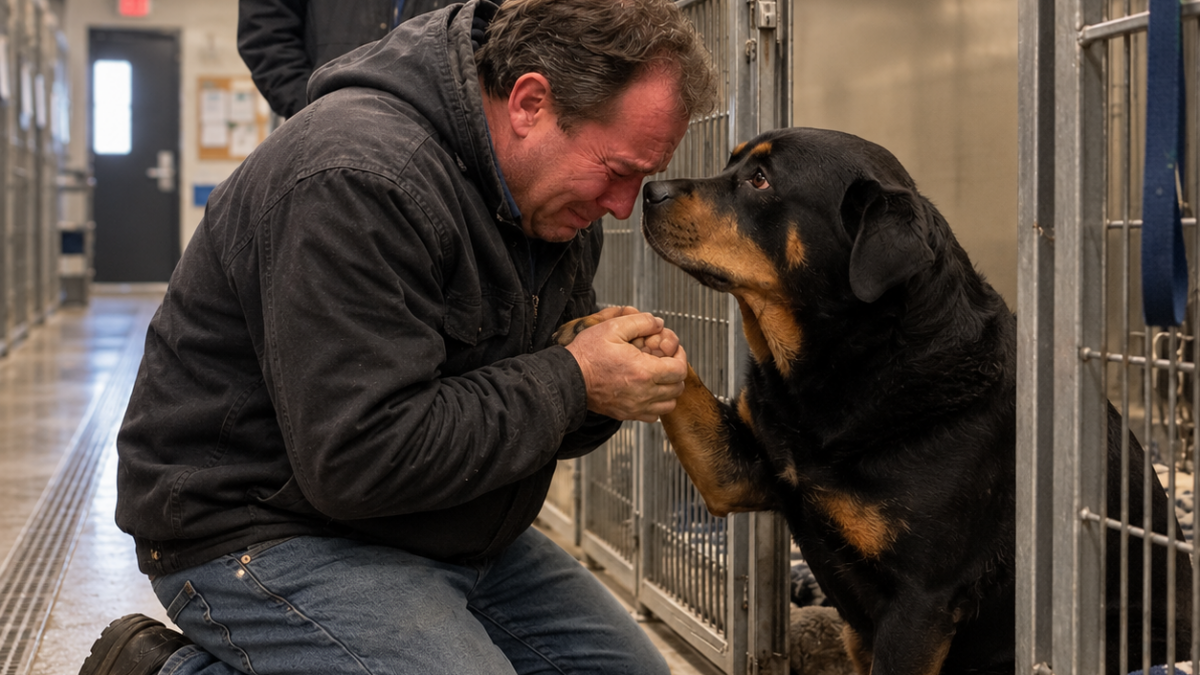
For five years, three months, and eleven days, I carried one image in my head more clearly than the walls around me: my ninety-two-pound Rottweiler standing behind the courthouse glass, barking as officers led me toward a van for a crime I had spent every breath insisting I did not commit.
I survived those years by telling myself that if I ever walked free again, I would find Buck no matter who had adopted him, how far he had been taken, or whether age had turned the dog I remembered into someone who no longer knew my voice.
Then, the morning after my conviction was finally overturned, a shelter worker told me Buck was alive nearly four hundred miles away—but what she said next made me realize that getting my freedom back had only been the first battle.
My name is David Harris, and in May 2018, my life ended without actually ending.
The trial lasted four days.
That still amazes me.
Four days to erase a job, a home, a reputation, and everything I thought the rest of my life would look like.
I had been accused of taking part in a robbery at a warehouse where I occasionally did contract maintenance. I said from the beginning that I wasn’t there that night. The state had a witness who claimed otherwise, grainy security footage that showed a man roughly my height, and a timeline my public defender tried to challenge but never fully broke.
There was no clear image of my face.
No reliable physical evidence tying me to the scene.
But there was enough doubt pointed in one direction and not enough money on my side to fight it properly.
When the verdict was read, I did not look at the judge.
I looked toward the back of the courtroom.
Buck was sitting beside my sister Jenny.
He had been mine since he was eleven weeks old.
Black-and-tan coat. Broad chest. Ridiculous square head. Ninety-two pounds of muscle wrapped around the emotional sensitivity of a child who believed thunder was personally offensive.
My attorney had arranged for Jenny to bring him because I had asked for one thing before I was taken away.
I wanted to see him.
The officers moved me through a side door.
Buck stood.
“Stay,” Jenny whispered.
He didn’t.
He pulled free and ran toward the glass partition.
“Buck!”
His paws hit the glass.
I put my hand against the other side.
For one second, we were separated by less than an inch.
He licked the glass.
I laughed.
Then I cried.
“Good boy.”
The officer beside me lowered his eyes.
Buck barked when they pulled me away.
I heard him all the way down the corridor.
Then through another door.
Then, faintly, from inside the transport van.
That was the last sound from my old life.
Two weeks later, during my first permitted phone call with Jenny, she told me Buck had gone to a county shelter because her apartment prohibited large dogs.
“I tried,” she said, crying. “David, I swear I tried.”
“I know.”
“They already have adoption applications.”
That should have comforted me.
Instead, it felt like another door closing.
For the next five years, three months, and eleven days, I counted time.
I worked in the prison library.
Read everything I could get my hands on.
Learned basic law because nobody else was going to understand my case as desperately as I did.
And I wrote about Buck.
Not letters.
I had nowhere to send them.
Memories.
The time he stole an entire rotisserie chicken and hid under the table with absolutely no plan for what came next.
The time he jumped into a neighborhood pond after a little girl slipped near the edge, grabbed the back of her jacket, and helped pull her toward shallow water before the adults reached her.
The way he slept with his back against my bedroom door.
The ridiculous noise he made when I scratched beneath his collar.
Then an innocence clinic took my case.
Evidence surfaced that my original defense had never received.
A timestamped delivery record.
Phone-location data.
A witness investigators had interviewed but never disclosed properly.
And finally, enhanced footage showing a vehicle connected to another suspect who had already been under investigation for similar thefts.
My conviction was vacated.
Not pardoned.
Not forgiven.
Vacated.
The state eventually dismissed the case.
Five years, three months, eleven days after the courthouse doors closed behind me, I walked outside.
The sun hurt my eyes.
Jenny hugged me so hard I couldn’t breathe.
The next morning, at 6:02, I was standing outside the shelter where Buck had first been sent.
The woman at reception typed his name.
Her expression changed.
“Mr. Harris…”
“What?”
“Buck was adopted in June 2018.”
My stomach dropped.
Then she kept reading.
“He was returned.”
I gripped the counter.
“Where is he?”
“Adopted again.”
“And?”
She looked at me.
“Returned again.”
I stopped breathing.
“Where is he now?”
She scrolled farther.
“The last transfer was to a rescue in Northern California.”
“How far?”
“Almost four hundred miles.”
I took out my phone.
She handed me a list.
I started calling.
At the ninth number, a woman answered.
“Yes,” she said slowly. “We have a Rottweiler named Buck. About ninety pounds. Older now. He’s been here almost two years.”
My legs went weak.
“Please.”
My voice broke.
“Please don’t let anyone take him.”
The woman was silent.
Then:
“Who are you?”
I closed my eyes.
“I’m the man he’s been waiting for.”
PART 2
The woman on the other end of the phone did not answer immediately.
I could hear shelter noise behind her.
Metal doors.
Dogs barking.
Someone rolling a cart.
Then she said:
“Sir, I need you to slow down.”
“My name is David Harris.”
“All right, Mr. Harris.”
“Buck was my dog.”
“He has had multiple registered owners.”
“I know.”
Another pause.
“You said he’s been there two years?”
“Yes.”
“Why?”
Her voice changed.
Not cold.
Careful.
“He has behavioral notes.”
My chest tightened.
“What notes?”
“Guarding. Withdrawal. Difficulty bonding after returns. He doesn’t like being handled by unfamiliar men.”
That did not sound like the dog I remembered.
Then again, five years can change anyone.
“What happened to him?”
“I can’t give you every detail over the phone.”
“I’m coming.”
“Sir—”
“I’m four hundred miles away. I’ll be there today.”
“You need proof.”
“I have it.”
“Vaccination records?”
“Old ones.”
“Photos?”
“Hundreds.”
“Microchip information?”
“Yes.”
“Registration?”
“Yes.”
Then I gave her the one thing no database had.
“His favorite word is ‘truck.’ Not ‘ride.’ Truck. If you say truck, he runs to the door. He hates cucumbers. Sleeps on his left side. Has a small white scar inside his right rear leg from catching himself on a chain-link fence when he was two. And if you scratch the base of his neck three times, he leans backward until he almost falls over.”
Silence.
Finally:
“What time can you get here?”
## **1. Four Hundred Miles**
I had been free for less than twenty-four hours.
I owned almost nothing.
Jenny had bought me jeans, a sweatshirt, and a cheap phone.
My driver’s license had expired years earlier.
So she drove.
We left at 7:10 in the morning.
I barely spoke.
Jenny tried.
“You need to eat.”
“No.”
“Coffee?”
“No.”
“You’re going to make yourself sick.”
“I’ll eat later.”
She eventually stopped.
Highway stretched north.
Cities turned into farmland.
Farmland into hills.
Every mile felt too slow.
I kept imagining Buck.
Old.
Gray around the muzzle.
Maybe deaf.
Maybe sick.
Maybe angry.
And underneath every thought was the question I refused to say aloud.
What if he doesn’t remember me?
Jenny finally said it for me.
“You know dogs remember people.”
“Some do.”
“Buck will.”
“You don’t know.”
“No.”
She kept her eyes on the road.
“But I know he loved you.”
“That was five years ago.”
“So?”
“So five years is half his life.”
Jenny’s hands tightened on the steering wheel.
“David.”
“What?”
“He doesn’t have to remember you for what happened between you to have been real.”
I looked out the window.
That was kind.
It was also exactly what I did not want to hear.
## **2. The Shelter**
We arrived after two in the afternoon.
The rescue was smaller than I expected.
Not a county facility.
A private senior-dog organization outside Redding with fenced runs, shade trees, and low concrete buildings.
A woman in a navy sweatshirt came out to meet us.
“I’m Karen Blake.”
“David.”
She looked at Jenny.
“My sister.”
Karen nodded.
“I spoke with you this morning.”
“Yes.”
“I reviewed what you emailed.”
I had sent everything from the car.
Photographs.
Old veterinary records.
Microchip certificate.
Licensing paperwork.
One picture showed me asleep on a couch with Buck lying across my legs like a ninety-pound blanket.
Karen studied me.
“Before you see him, I need to explain some things.”
My stomach dropped.
“Is he sick?”
“Not exactly.”
“Then what?”
She led us toward an office.
“Buck came here after his second return.”
“Why was he returned twice?”
“First family said he was depressed and destructive.”
That word again.
Destructive.
“What did he destroy?”
“A door.”
“Why?”
“They left him alone twelve hours a day.”
Karen raised an eyebrow.
“You already sound like someone who knows him.”
I ignored that.
“Second family?”
“They had another male dog. Conflict developed.”
“Was Buck aggressive?”
“Not in the way people use that word casually.”
“What does that mean?”
“He gave warnings. They ignored them. There was an altercation. No serious injury, but they surrendered him.”
I rubbed my face.
“What happened after?”
“He went through two rescues. Then us.”
“And nobody adopted him?”
“People applied.”
“But?”
“He stopped engaging.”
“What does that mean?”
Karen looked through the window toward the kennel wing.
“He gave up trying.”
That sentence hit harder than the verdict.
## **3. I Asked to See Him**
Karen did not take me straight inside.
“Buck is almost eleven now.”
“I know.”
“He has arthritis.”
I nodded.
“Some hearing loss.”
I nodded again.
“He’s on medication.”
“Fine.”
“He can be cautious with strangers.”
“I’m not a stranger.”
Karen held my gaze.
“To you, no.”
That stopped me.
“To him?”
“That’s what we’re about to find out.”
She was right.
I hated her for being right.
We walked down a covered corridor.
My palms were sweating.
Kennel doors lined both sides.
Dogs barked.
One jumped against the gate.
Another ignored us.
At the end, Karen stopped.
“Wait here.”
She disappeared around a partition.
I heard a latch.
Then her voice.
“Come on, Buck.”
My knees nearly gave out.
Not because I saw him.
Because I heard his name spoken aloud by someone else.
There was movement.
Slow steps.
Then he appeared.
## **4. Buck**
He was gray.
That was the first thing.
Gray around his muzzle.
Above his eyes.
Along his jaw.
His once-black coat had faded in places.
He moved stiffly.
His right hip dipped when he walked.
He was still huge.
Still square-headed.
Still Buck.
I forgot how to breathe.
Karen held the leash loosely.
Buck looked at Jenny first.
No reaction.
Then at me.
He stopped.
Completely.
Karen looked down.
“Buck?”
His ears lifted.
One step.
Then another.
I couldn’t move.
“Hey, buddy.”
His whole body changed.
Not gradually.
Instantly.
His tail rose.
His mouth opened.
A sound came out of him that I had never heard before.
Half whine.
Half howl.
Then he pulled.
Karen dropped the leash.
Buck ran.
Not gracefully.
His old legs slipped on the concrete.
But he ran.
Straight into me.
Ninety pounds hit my chest.
I fell backward.
Jenny screamed.
Karen yelled something.
I didn’t care.
Buck climbed on top of me.
Licking my face.
Whining.
Pawing my chest.
I couldn’t see because I was crying.
“Buck.”
He shoved his head beneath my chin.
“Buck, I’m here.”
His tail struck the floor so hard it sounded like someone knocking.
“I’m sorry.”
He licked my mouth.
“God, that’s disgusting.”
Jenny started laughing and crying at the same time.
Buck turned toward her.
He recognized her too.
Tail.
Whine.
Then back to me.
He would not leave.
Five years.
Three months.
Eleven days.
And he knew me in less than one second.
## **5. The Thing Karen Said**
We sat on the floor for almost twenty minutes.
I had no dignity left.
Buck had covered my face in drool.
My jeans were full of dog hair.
I had never been happier.
Karen crouched nearby.
“I’ve worked here sixteen years.”
I looked up.
“What?”
“I have never seen him do this.”
I scratched Buck’s neck.
Once.
Twice.
Three times.
He leaned backward.
Too far.
Almost fell.
Karen covered her mouth.
Jenny whispered:
“Oh my God.”
There it was.
The habit.
Still there.
Buried under years.
Not gone.
I steadied him.
“Same idiot.”
Buck sneezed directly into my face.
Jenny said:
“He remembers your manners too.”
## **6. Then Karen Told Me I Couldn’t Take Him**
The happiness lasted twenty-seven minutes.
Then Karen said:
“David, there’s a legal problem.”
I stared.
“What legal problem?”
“Buck’s ownership history.”
“I’m his owner.”
“You were.”
“I never surrendered him.”
“The county did after you were incarcerated.”
“I didn’t consent.”
“I understand.”
“Then what is the problem?”
“His last formal owner signed him over to a rescue. That rescue transferred him here.”
“Fine. You own him?”
“Our organization has custody.”
“Then transfer him back.”
Karen looked uncomfortable.
“I want to.”
“What does that mean?”
“It means our legal counsel needs to review this.”
I stood.
Buck stood too.
My anger rose instantly.
“No.”
“David—”
“I spent five years proving the state took my life based on evidence they should have turned over. I am not spending another five months proving my dog belonged to me.”
“I’m not your enemy.”
Buck stiffened at my voice.
I saw it.
Stopped.
Karen lowered hers.
“I’m not trying to keep him from you.”
“Then don’t.”
“I need forty-eight hours.”
“No.”
“David.”
“I’m not leaving him.”
Silence.
Then Jenny touched my shoulder.
“David.”
I looked at Buck.
He watched me.
His tail had stopped.
I realized I was doing it.
Bringing chaos into his world.
Again.
I sat back down.
“Can I stay nearby?”
Karen nodded.
“Come tomorrow morning.”
“Can I see him again before I leave?”
“Yes.”
“Can I leave my shirt?”
She smiled.
“Yes.”
That night, I slept at a roadside motel wearing an undershirt because Buck had my sweatshirt.
Worth it.
## **7. I Learned What Happened to Him**
Karen gave me copies of Buck’s non-confidential shelter history where permitted.
I read everything.
First adoption:
June 2018.
Family with two teenagers.
They loved him initially.
Then Buck developed separation distress.
He scratched at doors.
Refused food when left alone.
Waited near windows.
After three months, they returned him.
Reason:
**Not adjusting to household routine.**
Second adoption:
January 2019.
Couple with another Rottweiler.
Buck bonded strongly with the woman but clashed with the resident male.
After one fight over a doorway, they surrendered him.
Then Buck bounced.
County shelter.
Private rescue.
Foster home.
Transfer.
Another rescue.
Finally Karen’s organization.
By the time he arrived there, he was seven.
He had stopped rushing to gates when visitors came.
Stopped showing toys.
Stopped barking for attention.
He ate.
Walked.
Slept.
That was it.
Karen’s staff described him as “polite, distant, resigned.”
I hated that word.
Resigned.
Buck had spent his first five years believing every day ended with me coming home.
Then one day I disappeared.
From his perspective, I had done exactly what every later family did.
Left.
## **8. I Blamed Myself**
Jenny found me sitting on the motel floor with the paperwork.
“You need sleep.”
“I did this.”
“No.”
“He waited for me.”
“You were incarcerated.”
“He didn’t know that.”
“That doesn’t make it your choice.”
“Choice doesn’t matter to a dog.”
She sat beside me.
“David.”
I kept reading.
“Three homes.”
“You didn’t cause that.”
“He was mine.”
“And you were taken away.”
I laughed bitterly.
“That should be on a greeting card.”
Jenny grabbed the papers.
“Stop.”
“Give those back.”
“No.”
“Jenny.”
“You spent five years blaming yourself for not proving something you didn’t do. You are not starting another version with Buck.”
I stared at her.
“You think innocence magically gives me back what he lost?”
“No.”
Her voice softened.
“I think you have tomorrow.”
That shut me up.
## **9. The Call at 7:12 a.m.**
Karen called before I reached the shelter.
“David?”
“Yes.”
“Legal reviewed everything.”
My hands tightened around the phone.
“And?”
“We can release Buck to you.”
I closed my eyes.
Jenny started screaming before I even said anything because she saw my face.
Karen continued:
“There are conditions.”
“What?”
“Standard senior adoption agreement. Veterinary follow-up. No breeding.”
I laughed.
“Karen.”
“I had to say it.”
“Fine.”
“Also…”
My heart dropped again.
“What?”
“There’s someone else who may challenge ownership.”
“What?”
“Buck’s second adopter.”
I went cold.
“Why?”
“He saw the local social-media post.”
“What post?”
“One of our volunteers shared yesterday’s reunion photo before I realized it.”
I stood.
“Take it down.”
“Already did.”
“Who is he?”
“Michael Grant.”
“Why does he want Buck?”
“He says Buck belonged to him legally and the surrender was made under pressure.”
I laughed.
Not because it was funny.
Because it was absurd.
Five years of silence.
Now everyone wanted him.
## **10. Michael**
Michael called the rescue.
Then an attorney.
He argued that he had surrendered Buck during an emotional period and wanted him back once he learned Buck’s original owner had been exonerated.
That logic made no sense to me.
Then Karen explained.
Publicity.
The reunion photo had begun spreading.
Local news wanted the story.
Suddenly Buck had value.
Not money necessarily.
Attention.
Sympathy.
A story people wanted to stand next to.
I knew that kind of hunger.
Courtrooms have versions of it too.
People like being near narratives that make them look important.
I told Karen:
“I don’t care about the media. I want my dog.”
“I know.”
“Does Michael have a case?”
“Probably weak.”
“Probably?”
“David, law likes documents.”
“So do I.”
I pulled out five years of mine.
## **11. The Microchip**
Buck’s original microchip registration had never been fully transferred.
That mattered.
The county shelter updated secondary records after adoption but did not complete the chip transfer correctly.
My name remained in the original registration history.
David Harris.
Address.
Phone number.
Emergency contact: Jenny Harris.
That error became the most useful administrative mistake of my life.
Karen’s attorney said:
“It helps establish prior ownership.”
Prior.
I hated the word.
I said:
“He was never voluntarily surrendered by me.”
That became the central issue.
My incarceration removed my physical ability to care for Buck.
It did not mean I chose to give him away.
But the county had followed its standard procedure when no approved caretaker could take him.
No conspiracy.
No villain.
Just a system.
Systems can hurt people without intending to.
I had learned that thoroughly.
## **12. Buck Chooses While Lawyers Argue**
Michael arrived at the rescue with his attorney.
I did not know he was coming.
Karen tried to keep us separate.
Buck solved that.
Michael entered the visitation yard.
Buck saw him.
Tail moved slightly.
Recognition.
He approached.
Michael crouched.
“Hey, big guy.”
Buck smelled him.
Allowed one pat.
Then turned.
Saw me behind the fence.
And ran to me.
No drama.
No aggression.
He simply chose where he wanted to stand.
Against my legs.
Michael’s face changed.
Not anger at first.
Sadness.
I understood that.
He had cared about Buck too.
For however long.
Then he said:
“He was my dog for eight months.”
“Three,” Karen corrected.
Michael looked embarrassed.
I said nothing.
He continued:
“I tried.”
“I believe you.”
That surprised him.
“You do?”
“Yes.”
“Then you understand why—”
“No.”
I shook my head.
“I understand you loved him. I do not understand why loving him means taking him away again.”
Silence.
Buck leaned against me.
Michael’s attorney asked everyone to stop talking.
Smartest person there.
## **13. Michael Drops the Claim**
Two days later, Michael withdrew.
No court battle.
No spectacle.
He sent me a note through Karen.
**He looked at you the way he never looked at me. Take care of him.**
I kept it.
Not because I needed permission.
Because the sentence contained more grace than I expected.
## **14. Going Home**
I had no home.
That was our next problem.
Freedom sounds simple until you realize the world moved while you were gone.
My old apartment belonged to somebody else.
My tools had been sold.
My truck was gone.
My credit was wrecked.
I had $1,840 in release assistance and whatever Jenny could spare.
But I had Buck.
So we went to Jenny’s apartment.
The landlord had changed policies.
Large dogs allowed with deposit.
Funny.
Five years earlier, that rule had separated us.
Now it didn’t.
Jenny paid the deposit before I could argue.
“Pay me back when you’re rich.”
“I was wrongfully convicted, not secretly a tech founder.”
“Details.”
## **15. Buck Enters the Apartment**
He stopped at the doorway.
I stepped inside.
“Truck.”
His ears lifted.
Jenny laughed.
“Wrong word.”
“I know.”
I crouched.
“Come on, Buck.”
He entered.
Smelled everything.
Kitchen.
Sofa.
Bedroom.
Then found my duffel bag.
The only bag I owned.
He lay beside it.
That broke me.
Because I realized Buck was doing what he had always done.
Guarding my stuff.
As if five years had been an unusually long workday.
## **16. The First Night**
Buck refused the dog bed.
Of course.
He slept against the bedroom door.
Exactly where he used to.
At 2:13 a.m., I woke.
For one disoriented second, I thought I was still in my bunk.
Then I heard Buck breathing.
I sat up.
He lifted his head.
“Hey.”
Tail thump.
I got onto the floor.
He placed his head on my lap.
I whispered:
“I didn’t leave you.”
That sentence had been sitting inside me for five years.
Buck did not need it.
I did.
“I didn’t leave you.”
He sighed.
Closed his eyes.
We stayed there until morning.
## **17. Freedom Was Harder Than I Expected**
People assume release is happiness.
It is.
But freedom is also noise.
Choices.
Crowds.
Doors you can open yourself.
People walking behind you.
Sleep without institutional lights.
My first grocery store nearly broke me.
Too many cereal boxes.
I stood in the aisle for ten minutes.
Buck was not allowed inside.
So I left.
Jenny said:
“You need groceries.”
“I’ll try tomorrow.”
Buck helped.
He needed walks.
Food.
Medication.
Routine.
I knew routine.
Routine had kept me sane.
Now it kept me outside.
## **18. The Civil Case**
My attorneys filed claims related to my wrongful conviction.
The evidence that overturned my case showed serious failures.
A witness statement had not been properly disclosed.
Investigators had received a delivery receipt supporting my alibi but failed to preserve it in the material my defense saw.
Another suspect had been identified early.
His connection was not adequately pursued.
I wanted revenge.
For about a month, I wanted it badly.
Not violence.
I wanted everyone who had dismissed me to lose something.
Career.
Reputation.
Sleep.
Anything.
My innocence attorney, Maya Chen, listened.
Then said:
“Do you want justice or do you want them hurting?”
“At the moment?”
“Yes.”
“Hurt.”
She nodded.
“Good.”
I stared.
“Good?”
“At least you’re honest.”
Then:
“Don’t build your next life around that.”
I hated her.
She was right too.
Too many correct women in my life.
## **19. Detective Reynolds**
The lead detective from my original case was Thomas Reynolds.
He had retired.
My civil attorneys deposed him.
I insisted on attending.
He looked older.
Smaller.
That surprised me.
For five years, he had occupied enormous space in my head.
Then I saw a sixty-six-year-old man adjusting his glasses.
Maya asked:
“When did you first learn there was a second suspect?”
Reynolds answered.
“During the initial investigation.”
“When did you document it?”
“I don’t recall.”
“Did defense counsel receive the full interview?”
“I believed discovery handled that.”
“Did you follow up on the vehicle?”
“Not adequately.”
That word.
Adequately.
Five years of my life disappeared inside an adverb.
## **20. I Confronted Him After**
I should not have.
My lawyer told me not to.
But in the hallway, Reynolds passed me.
I said:
“Do you remember me?”
He stopped.
“Yes.”
“Did you ever think I might be telling the truth?”
His face tightened.
“That’s not appropriate to discuss.”
“I’m not asking legally.”
He looked at me.
Long pause.
“Yes.”
My stomach turned.
“When?”
“Before trial.”
I laughed.
A dry sound.
“Then why didn’t you stop it?”
“I wasn’t the prosecutor.”
“That’s not what I asked.”
He looked away.
“We had evidence going both directions.”
“I lost five years.”
“I know.”
“No.”
I stepped closer, then stopped myself.
“You know the number. You don’t know the years.”
He had no answer.
I walked away.
That felt better than shouting.
## **21. The Actual Culprit**
Months after my release, the other suspect pleaded guilty to several related warehouse thefts.
Including the one that had been used to convict me.
His name was Eric Vaughn.
He had been investigated for similar crimes at multiple sites.
The state eventually acknowledged publicly that evidence connected him to the incident.
I did not attend his hearing.
People expected me to.
I stayed home with Buck.
Jenny asked:
“You sure?”
“Yes.”
“Why?”
“Because I already know who did it.”
“What if he apologizes?”
“He can mail it.”
Buck was asleep with his paws twitching.
That mattered more.
## **22. Buck’s Health**
Five lost years meant Buck was old.
Nothing could change that.
His arthritis worsened.
Dr. Sarah Kim became our veterinarian.
She looked through his file.
“Eleven.”
“Approximately.”
“Big dogs don’t always give you unlimited time.”
“I know.”
“You’re going to hate me for saying that.”
“I already hate everyone who says correct things.”
She smiled.
Medication.
Weight management.
Gentle exercise.
Joint support.
We started.
Buck still acted young when food appeared.
That helped.
## **23. The Pond Story Comes Back**
Remember the little girl Buck helped at the pond?
Her name was Natalie Brooks.
She had been six then.
Thirteen when I was released.
Her mother saw our reunion story online and contacted me.
**Is this the same Buck from Willow Park?**
I answered yes.
A week later, they visited.
Natalie walked in carrying an old photograph.
Tiny girl.
Wet clothes.
Buck beside her.
Her mother had taken it after the incident.
Natalie knelt.
“Do you remember me?”
Buck smelled her.
No obvious reaction.
Then she scratched behind his ear.
Tail.
Maybe memory.
Maybe good scratching.
Didn’t matter.
She gave me the photograph.
On the back:
**He was there when we needed him.**
I framed it.
## **24. The Reunion Story Goes Viral**
I did not want publicity.
Then somebody shared the shelter reunion video.
Buck running.
Me falling.
The internet did what it does.
Millions of views across reposts.
Headlines:
**Wrongfully Convicted Man Reunites With Dog After Five Years**
**Rottweiler Recognizes Owner Instantly**
People donated money.
I hated it.
Then Jenny showed me my bank balance.
“I hate it less.”
We used enough to secure a small rental house with a fenced yard.
The rest went into Buck’s medical care and a legal-aid fund Maya’s clinic recommended.
That mattered to me.
## **25. The House**
Our rental was small.
Two bedrooms.
Bad paint.
Old cabinets.
Perfect yard.
Buck walked through the door.
Smelled every room.
Then discovered the back door.
I opened it.
He stepped onto grass.
Stood in sunlight.
Then looked back at me.
“Go.”
He ran.
Or attempted to.
His back legs disagreed.
He made half a circle and returned.
I laughed.
“You’re old.”
Buck barked.
First full bark I had heard since 2018.
I cried.
Again.
Apparently freedom turned me into a professional crier.
## **26. The Neighbor**
My next-door neighbor was a retired teacher named George.
He distrusted Rottweilers.
I could tell.
First week:
“That dog friendly?”
“Yes.”
“Sure?”
“No. He’s planning your taxes.”
George did not laugh.
Buck eventually won him over.
Within a month, George was slipping treats through the fence.
I confronted him.
“He’s on a diet.”
“One treat.”
“He has arthritis.”
“Treats don’t cause arthritis.”
“They cause weight.”
George looked at Buck.
“You want another?”
Traitor.
## **27. My Old Job**
My former employer offered me a position.
Not charity.
They said so repeatedly.
I had worked maintenance before my conviction.
I returned.
First day, I stood outside the building for ten minutes.
My supervisor, Mike, came out.
“You coming in?”
“Thinking.”
“Dangerous hobby.”
I laughed.
Then worked eight hours.
When I got home, Buck met me at the door.
Exactly like before.
Five years disappeared for one second.
Then returned.
But differently.
Less sharp.
## **28. The Compensation Hearing**
My state provided a process for compensation following wrongful conviction.
Forms.
Evidence.
Hearings.
Nothing automatic.
We documented lost wages.
Legal costs.
Years incarcerated.
Medical effects.
Reentry expenses.
A government attorney questioned parts of my claim.
I knew he was doing his job.
Still hated every question.
“What income would you reasonably have earned?”
I almost said:
How do you price five Christmases?
Five birthdays?
My father’s funeral?
Buck’s aging?
Instead, Maya touched my arm.
I answered numbers.
Courts understand numbers better than grief.
## **29. My Father**
My father died during my third year inside.
Heart attack.
I attended no funeral.
No goodbye.
That loss was harder than I ever admitted.
Buck had loved him.
When I got back, Jenny gave me Dad’s old baseball cap.
I placed it on the table.
Buck smelled it.
Stopped.
Smelled again.
Then lay beside it.
Maybe he remembered.
I sat next to him.
For the first time since release, I cried about my father instead of myself.
Buck stayed.
He had always been good at that.
## **30. The Settlement**
The civil case eventually settled.
No dramatic trial.
No prosecutor collapsing under cross-examination.
The county and other parties agreed to financial terms without every defendant admitting personal wrongdoing.
People online complained.
They wanted public destruction.
I didn’t.
The settlement gave me enough to buy a modest home.
Fund retirement.
Support Jenny.
And contribute to the innocence clinic.
More importantly, reforms were announced around evidence tracking and disclosure review.
Not perfect.
But real.
Maya asked:
“Happy?”
“No.”
“Good.”
I stared.
“Again?”
“Money doesn’t return years. If you expected happiness, you’d be disappointed.”
“What does it give?”
“Options.”
That was true.
Freedom plus options.
Good combination.
## **31. The Courthouse Steps**
One year after release, I returned to the courthouse.
Voluntarily.
That felt strange.
A local journalist wanted to photograph me there.
I almost refused.
Then I brought Buck.
The last time he had been there, I was taken away.
Now we climbed the same steps together.
Slowly.
Buck’s hips were worse.
I stopped at the glass door.
He smelled it.
My chest tightened.
I placed my hand against the glass.
Same place, roughly.
Buck looked at me.
No barking.
No panic.
I whispered:
“We’re leaving together this time.”
Then we turned around.
That photograph went everywhere.
I never looked at the old courthouse image again.
I had a better one.
## **32. Detective Reynolds Writes**
Three months later, a letter arrived.
Thomas Reynolds.
I nearly threw it away.
Then read it.
He wrote that he had spent years telling himself the investigation met standards.
That after my exoneration, he reviewed the case.
Saw how assumptions narrowed the inquiry.
How each ambiguous fact had been interpreted against me.
How contrary evidence was treated as inconvenience.
He wrote:
**I cannot return what was taken. I am sorry I contributed to taking it.**
No excuses.
I read it twice.
Jenny asked:
“Forgive him?”
“No.”
“You going to answer?”
“No.”
I kept the letter.
Forgiveness and acknowledgment are not the same.
Sometimes acknowledgment is enough.
## **33. Eric Vaughn’s Apology**
The actual culprit wrote too.
His lawyer forwarded it.
I did not open it for months.
When I did, it was shorter.
He said he had known another man was convicted.
He stayed silent because speaking would expose his own crimes.
That one hurt differently.
Reynolds made mistakes inside a flawed investigation.
Eric knew.
He let me sit there.
Five years.
I wanted to hate him.
I did, for a while.
Then Buck got sick.
Hatred became surprisingly time-consuming.
## **34. Buck’s First Major Decline**
At twelve, Buck began struggling to rise.
Sarah adjusted medication.
Hydrotherapy.
Ramps.
Rugs.
He hated the water treadmill.
The same dog who once jumped into a pond to help a child looked personally betrayed by six inches of controlled water.
I laughed.
“You were brave when there was a kid.”
Buck glared.
“No kid here, huh?”
He huffed.
## **35. Jenny Moves Away**
Jenny got engaged.
Then moved two hours south.
I pretended not to care.
“You survived five years without me.”
“Barely.”
“You have Buck.”
“Buck doesn’t cook.”
“Neither do I.”
Fair.
She visited every other weekend.
Buck still recognized her car.
Would stand at the window.
Tail.
Some memories survived everything.
## **36. My First Real Relationship After**
Her name was Elena.
We met through the legal-aid fundraiser.
She was a nurse.
Smart.
Direct.
Had no interest in “saving” me.
Important.
On our third date, she met Buck.
He stared at her.
She stared back.
“Does he judge everyone?”
“Yes.”
“Good.”
She sat on the floor.
Buck smelled her.
Then walked away.
Elena looked offended.
“Did I fail?”
“He usually leans on people he likes.”
Five minutes later, Buck backed into her knees.
She nearly fell.
“Am I being attacked?”
“He likes you.”
Strange language, dogs.
## **37. Elena Moves In**
Two years after my release, Elena moved in.
Buck approved faster than I expected.
She handled medication better than I did.
Not because I forgot.
Because nurses love schedules with terrifying intensity.
Buck received pills at exactly 7:00.
Not 7:01.
I called her dictator.
She called me noncompliant.
Buck got chicken.
He sided with her.
## **38. The Case Becomes Training Material**
Maya’s innocence clinic asked permission to use my case in training for law students.
I agreed.
Not because I enjoyed reliving it.
Because the failure was instructive.
Confirmation bias.
Incomplete disclosure.
Underfunded defense.
Witness assumptions.
People imagine wrongful convictions require cartoon villains.
Often they require ordinary people making ordinary errors in the same direction.
That is more frightening.
And more fixable.
## **39. Revenge Changes Shape**
For years, I imagined revenge as somebody else losing what I lost.
Then I realized that would not restore anything.
The most satisfying thing I ever did was fund a small fellowship at the innocence clinic.
The first fellow reopened three cases.
One man’s sentence was reduced.
Another case was dismissed after new evidence.
Maya called me.
“Still want revenge?”
“Yes.”
She laughed.
“What does it look like now?”
“Paperwork.”
“Beautiful.”
## **40. Buck Meets a Puppy**
George’s granddaughter brought a Rottweiler puppy.
Buck hated him.
Not violently.
Philosophically.
The puppy bounced.
Buck walked away.
Puppy followed.
Buck lay down.
Puppy climbed on him.
Buck looked at me.
I swear his expression said:
Why?
Eventually he tolerated the little monster.
Then taught him the fence line.
Somehow old dogs always become teachers without applying.
## **41. The Second Adoption Family Visits**
Karen contacted me.
Michael—the second adopter—wanted to visit Buck once.
I said yes.
Not immediately.
Eventually.
He came alone.
Buck recognized him.
Tail.
Smell.
A lean.
Michael cried.
“I’m glad he got back to you.”
I said:
“Thank you for taking care of him when you could.”
He looked ashamed.
“We gave up.”
“You had another dog.”
“I should’ve handled it better.”
“Maybe.”
I had learned not every regret needs punishment.
Michael scratched Buck’s neck.
“Still hates cucumbers?”
I stared.
“You knew that?”
“He stole one once, spit it out, then barked at it.”
I laughed.
There were years of Buck’s life I didn’t own.
Michael had some.
So did others.
That no longer threatened me.
Love is not made smaller because someone else cared too.
## **42. The First Family**
The first adoptive family sent a photo.
Buck beside one of their sons.
The boy—now grown—wrote:
**We were young and didn’t understand separation anxiety. I’m sorry we returned him.**
I saved the photo.
Not the apology.
The photo.
Buck looked happy in it.
That mattered.
His five years were not uninterrupted suffering.
I needed to stop imagining that because guilt wanted a cleaner story.
He had good days without me.
I was glad.
Eventually.
## **43. Karen’s Truth**
Karen told me something years later.
“When you called, I almost didn’t tell you Buck was here.”
“What?”
“I thought you might be another person with a dramatic claim.”
“Fair.”
“Then you described the scar.”
I smiled.
“And the neck thing?”
“That too.”
She paused.
“But the reason I believed you was your voice when I said he was old.”
“What about it?”
“You didn’t ask whether he was still impressive.”
“What?”
“You asked if he was hurting.”
I looked at Buck.
“Of course.”
Karen nodded.
“That’s why I figured you were probably his person.”
## **44. Buck Turns Thirteen**
We had a birthday party.
Approximate birthday.
Dog-safe cake.
Jenny.
Elena.
George.
Karen drove down.
Natalie—the girl from the pond—came with her mother.
Buck wore a ridiculous bandana.
He endured it.
We took pictures.
I looked around.
Five years earlier, I had assumed my life was over.
Now my backyard held people from every chapter.
Some painful.
Some good.
Buck lay in the middle.
As if he had arranged it.
## **45. The News Interview**
A documentary team asked:
“What did Buck teach you about loyalty?”
I hated the question.
Too easy.
I answered anyway.
“Loyalty isn’t waiting forever.”
The producer looked confused.
“What is it?”
“Coming back when you can.”
That made the final cut.
I still think it’s true.
## **46. Buck’s Hearing Fades**
At thirteen and a half, Buck stopped hearing the front door.
Then my voice from another room.
Then even the treat bag unless close.
I learned hand signals.
He already knew some.
Sit.
Stay.
Come.
We added more.
Touch chest = me.
Point bed = go lie down.
Both hands up = good.
Buck did not care about language.
He adapted.
Again.
## **47. His Eyes**
Cataracts developed.
Not complete blindness.
Cloudiness.
Night became harder.
We added lights along the hallway.
Elena taped textured strips near steps.
Our house slowly became a senior-dog accessibility project.
Worth every dollar.
## **48. My Compensation Check**
The state compensation arrived eventually.
Large enough that I stared at the number without feeling anything.
Jenny said:
“You can breathe.”
I said:
“It’s just money.”
“Yes.”
Then:
“Money buys breathing room.”
I used some to pay off the house.
Some for retirement.
Some for legal-aid work.
And $25,000 to Karen’s senior-dog rescue.
She called me furious.
“That is too much.”
“No.”
“David.”
“Use it.”
“For what?”
“Dogs nobody wants.”
Silence.
Then:
“Buck says thanks.”
“Buck says feed them chicken.”
## **49. The Buck Fund**
Karen named a medical assistance fund after him.
I complained.
She ignored me.
The Buck Fund covered senior-dog medication for adopters who could handle love but not unexpected veterinary costs.
That felt right.
Buck had been returned partly because people were overwhelmed.
Sometimes keeping a dog home requires money.
Better to solve the real problem.
## **50. The Prosecutor**
The prosecutor from my original trial, Alan Price, contacted Maya.
Wanted to meet.
I said no.
Then yes.
Curiosity.
We met in a conference room.
He looked uncomfortable.
“I believed the case.”
“I know.”
“I thought the witness was credible.”
“I know.”
“I didn’t know about the missing material.”
“You should have.”
He nodded.
“Yes.”
That surprised me.
No defense.
He continued:
“Your case changed our disclosure process.”
I looked at him.
“You want me to thank you?”
“No.”
Good answer.
“I wanted you to know.”
I stood.
“Then I know.”
That was enough.
## **51. The Revenge Meeting**
People later called that meeting closure.
It wasn’t.
Closure is a fake word sometimes.
The past does not close.
It changes size.
That was what happened.
Price became smaller.
Reynolds smaller.
Eric smaller.
Buck’s life grew.
My work grew.
Elena.
Jenny.
Home.
New years.
The people who had once occupied every thought gradually became footnotes.
That was better than revenge.
## **52. Buck’s Fourteenth Year**
Fourteen is old for a Rottweiler.
Very old.
Sarah told me to prepare.
I wanted to fire her.
Instead, I listened.
Kidney values beginning to shift.
Arthritis severe.
Heart still decent.
Appetite good.
Interest good.
Quality good.
We continued.
Short walks.
More naps.
Less pride.
More help.
Buck hated the support harness until he realized it let him reach the yard.
Then accepted it.
## **53. The Courthouse Anniversary**
On the fifth anniversary of my release, I considered visiting the courthouse again.
Didn’t.
I took Buck to the lake.
Not the pond from the old rescue story.
A quiet lake outside town.
We sat on a dock.
Buck didn’t swim.
Too old.
He watched ducks.
I drank coffee.
Nobody knew us.
Perfect.
## **54. Jenny Asks the Question**
“What would you do if you could go back to 2018?”
“Not get convicted.”
“Helpful.”
I laughed.
Then thought.
“I’d tell Buck I was coming back.”
“He wouldn’t understand.”
“I know.”
“Then why?”
“Because I needed to believe it.”
She nodded.
## **55. Buck’s Last Big Scare**
One morning, Buck couldn’t stand.
I panicked.
Elena stayed calm.
Vet.
X-rays.
No catastrophic injury.
Arthritis flare.
Medication adjustment.
Rest.
Buck recovered enough to walk again.
That scare changed me.
I stopped assuming time.
I had learned that lesson in prison.
Somehow forgot it in freedom.
## **56. We Took More Ordinary Photos**
Not staged.
Buck sleeping.
Buck eating.
Buck with Elena.
Buck staring at George.
Buck wearing rain boots he despised.
Buck leaning against my leg.
I did not want my last photographs to be medical.
That had happened with my father.
Not again.
## **57. Eric Vaughn’s Second Letter**
Years after his plea, Eric sent another letter.
He was nearing release.
He wrote:
**I know I cannot ask for forgiveness. I want you to know I have spoken in two reentry programs about what silence cost someone else.**
I read it.
Then surprised myself.
I replied.
One sentence:
**Tell the truth sooner next time.**
Jenny said:
“That’s it?”
“That’s enough.”
## **58. Buck Stops Sleeping at the Door**
For years after reunion, Buck slept near my bedroom door.
Then, around fourteen, he changed.
He started sleeping beside my side of the bed.
Not guarding the exit.
Closer to me.
Maybe mobility.
Maybe hearing.
Maybe nothing symbolic.
I made it symbolic anyway.
He no longer needed to watch the door.
I was there.
## **59. My Wedding**
Elena and I married in the backyard.
Small.
Buck wore a bow tie.
Hated it.
Jenny officiated.
George cried more than anyone.
Buck slept through half the ceremony.
When Elena and I kissed, he barked once.
Everyone laughed.
Best wedding sound possible.
## **60. Buck and Elena**
After we married, Buck sometimes chose Elena over me.
She had better treats.
I accepted betrayal.
Mostly.
One evening I called:
“Buck.”
Nothing.
Elena:
“Chicken.”
He stood instantly.
I said:
“Fourteen years of loyalty destroyed by poultry.”
Elena answered:
“Know your competition.”
## **61. The First Time He Didn’t Recognize Jenny’s Car**
That hurt.
Jenny arrived.
Buck stayed asleep.
She entered.
Knelt.
Touched his shoulder.
His nose worked.
Then tail.
She smiled through tears.
“Still in there.”
Yes.
Memory changes routes.
Smell remains powerful.
## **62. Dr. Sarah’s Warning**
Kidney disease progressed.
Not suddenly.
Numbers.
Then appetite.
Then weight.
We adjusted everything.
Sarah said:
“David, you have to think about comfort.”
“I am.”
“You are thinking about time.”
I hated her again.
“What’s the difference?”
“Comfort is his. Time is yours.”
That sentence stayed.
## **63. I Had Already Lost Him Once**
That made the final decision harder.
Everyone told me:
“You gave him years.”
I knew.
But my brain kept saying:
You lost five.
You only got him back.
You are owed more.
Life does not negotiate that way.
Buck was not compensation.
He was a living animal.
He did not owe me enough years to balance the ledger.
## **64. The Last Good Month**
Buck still ate chicken.
Walked to the fence.
Barked occasionally.
Lay in sun.
Leaned against Elena.
Slept.
Good.
Then bad days increased.
Not disaster.
Decline.
He would look at food and turn away.
Stand halfway and stop.
Breathe harder after short walks.
I started writing a quality-of-life calendar.
Green day.
Yellow.
Green.
Yellow.
Red.
Then two greens.
Hope.
Then three yellows.
The pattern told the truth before I wanted it.
## **65. Natalie Visits**
Natalie was eighteen now.
College student.
She came one last time.
Sat beside Buck.
Showed him the old pond photograph.
“You were huge.”
Buck slept.
She touched his paw.
“My mom still tells everybody you saved me.”
I smiled.
“He’d prefer chicken.”
She gave him a tiny approved piece.
His eyes opened.
Still Buck.
## **66. Karen Comes**
Karen drove four hours.
She said she happened to have business nearby.
Liar.
She sat with Buck.
“I remember the day you knocked David down.”
Buck’s tail moved weakly.
“Best adoption meeting ever.”
I looked at her.
“You almost didn’t let me take him.”
“Legal.”
“Still holding it.”
“Get over it.”
Good people are allowed to annoy you.
## **67. The Last Night**
Buck refused dinner.
Then water.
He could not get comfortable.
Elena and I stayed on the floor.
Around midnight, Buck tried to stand.
I helped him.
He took three steps.
Stopped near the front door.
My heart broke.
For years he had waited near doors.
Courthouse.
Shelters.
Adoption homes.
Mine.
I opened it.
Cold night air came in.
Buck smelled outside.
Then turned.
Walked back toward me.
Not out.
Back.
I lowered myself.
He pressed his head against my chest.
I knew.
## **68. The Call**
Sarah came the next morning.
At home.
I did not want Buck inside another clinic if we could avoid it.
Jenny drove down.
George came over.
Karen joined by video for a minute, then said goodbye privately.
Elena cooked chicken even though Buck wouldn’t eat it.
Habit.
Love often looks like preparing things nobody can use.
## **69. One Last Trip Outside**
We carried Buck into the backyard on a blanket.
Sunlight.
Mild breeze.
His favorite patch near the fence.
I sat beside him.
Jenny on one side.
Elena on the other.
George stood back.
Buck’s eyes were cloudy.
Hearing nearly gone.
But when I touched his neck three times, he tried to lean.
I laughed and cried.
“Still.”
## **70. What I Told Him**
I had rehearsed words.
Terrible idea.
When the moment came, most vanished.
I said:
“You found me.”
Then corrected myself.
“No.”
I touched his face.
“I found you.”
But even that felt wrong.
We had both been searching.
So I said:
“We made it back.”
That was right.
## **71. Goodbye**
Sarah gave Buck medication to relax.
His breathing eased.
His head rested on my thigh.
Elena stroked his shoulder.
Jenny held one paw.
I put my hand where his heartbeat had always felt strongest.
I remembered courthouse glass.
His paws.
His barking.
The van door closing.
Then the shelter yard five years later.
Buck running.
Me falling.
His face against mine.
I whispered:
“I didn’t leave you.”
The sentence again.
This time I added:
“And I’m not leaving now.”
Sarah gave the final medication.
Buck took one slow breath.
Then another.
Then no more.
I stayed with my hand on him.
Free.
Home.
Together.
## **72. I Thought That Would Break Me**
It did.
Just not the way prison had.
Prison removed choice.
Grief did not.
I could choose what happened next.
I could close every curtain.
Stop answering calls.
Sit in the house.
I understood that temptation.
Instead, I walked.
Not far.
Around the block.
Without Buck.
Awful.
Then again the next day.
## **73. His Collar**
I kept Buck’s collar.
Heavy black leather.
Old tag.
It sits beside Dad’s baseball cap.
Two things from two lives I lost while time kept moving.
I do not look at them every day.
That matters.
Memory should not require constant pain to prove love.
## **74. The Buck Fund Grows**
After Buck died, donations poured into Karen’s rescue again.
I asked people to stop sending me anything.
Send it there.
The Buck Fund grew.
Senior dogs received medication.
Dental work.
Mobility aids.
Temporary foster support.
One Rottweiler named Moose avoided surrender because the fund covered emergency treatment.
Karen sent me a photo.
“You did that.”
“No.”
“Buck did.”
Better.
## **75. The Courthouse One Last Time**
I returned once more.
Alone.
No media.
No lawyer.
I stood near the glass door.
Placed my hand against it.
The last time I had seen Buck there, I believed I might never touch him again.
I had been wrong.
That mattered.
Five years were stolen.
But the story did not end at the worst moment.
I lowered my hand.
Walked away.
No photograph.
No speech.
Just leaving under my own power.
## **76. Reynolds Dies**
Years later, I learned Detective Reynolds died.
His obituary described a long career.
Family.
Grandchildren.
Service.
For a second, anger returned.
Then left.
He had apologized.
Not enough to erase anything.
Enough that I did not need to carry him.
I sent no flowers.
Also no bitter message.
Nothing.
That was freedom too.
## **77. Alan Price Retires**
The prosecutor later became part of a statewide evidence-review committee.
Some people called it hypocrisy.
I called it useful.
If the man who helped convict me could reduce the chance someone else experienced the same thing, good.
Redemption is not supposed to make the harmed person feel comfortable.
It is supposed to produce different behavior.
## **78. Corey? No. Eric.**
Eric Vaughn completed his sentence.
He worked in a warehouse after release.
That detail felt almost absurd.
Maya told me he continued speaking in accountability programs.
I never met him.
I didn’t need to.
Our lives had intersected enough.
## **79. Jenny’s Children**
Jenny had two kids.
They knew Buck only as stories and photos.
Her oldest once asked:
“Was Buck famous?”
“No.”
“But he was on TV.”
“Still no.”
“Did he save you?”
I thought.
“Yes.”
“How?”
“By being there when I got back.”
The child accepted that.
Kids understand simple truths better than adults.
## **80. Elena and I Adopt Again**
Three years after Buck died, Karen called.
“No.”
“You don’t know why I’m calling.”
“Yes, I do.”
“Senior Rottweiler.”
“No.”
“Eleven.”
“No.”
“Owner died.”
I hung up.
Elena looked at me.
“Who?”
“Karen.”
“And?”
“No.”
Two weeks later, a gray-muzzled Rottweiler named Walter was sleeping in my living room.
I have no defense.
## **81. Walter Is Not Buck**
Important.
Walter was not Buck.
He did not sleep at the door.
Didn’t hate cucumbers.
Loved them.
No dignity.
He snored.
He preferred Elena.
Rude.
That was good.
I did not need Buck replaced.
I needed another dog allowed to be himself.
## **82. The Biggest Mistake People Make About Reunion Stories**
People think reunion is the ending.
It isn’t.
Finding Buck was not the end.
It was the beginning of work.
Trust.
Medical care.
Reentry.
Legal fights.
Money.
Old age.
Loss.
Love afterward.
The viral moment lasted thirty seconds.
The important part lasted years.
## **83. Did Buck Wait for Me?**
People ask.
I don’t know.
At the first family, he waited near doors.
At later shelters, he withdrew.
Was he waiting specifically for me?
Maybe.
Maybe not.
I don’t need to claim something I cannot prove.
What I know is that he remembered me.
Instantly.
That is enough.
## **84. What Five Years Means to a Dog**
People say five years is a lifetime to a dog.
It can be.
Buck aged.
Changed homes.
Learned other routines.
Loved other people.
Suffered some losses.
Had some good days.
Yet when he saw me, some pathway opened immediately.
Voice.
Scent.
Body.
Memory.
Whatever dogs use to store love.
It survived.
## **85. What Five Years Means to a Man**
Long enough to lose people.
Long enough to become somebody else.
Long enough to forget certain sounds.
Long enough to become frightened by freedom.
Not long enough to erase who you were.
That surprised me.
## **86. The Revenge I Wanted**
At the beginning, I wanted the people who failed me publicly shamed.
I wanted careers gone.
I wanted them to feel trapped.
Then I got Buck back.
And slowly I understood that spending freedom rehearsing captivity is another kind of sentence.
I did not forgive everything.
I simply stopped organizing my days around anger.
## **87. The Revenge I Got**
My conviction disappeared.
My record was cleared.
Evidence reforms were adopted.
The county paid compensation.
The innocence clinic used the money I gave them to help others.
The actual culprit admitted responsibility.
The detective admitted failure.
The prosecutor changed procedure.
And I got years with Buck that everyone assumed were impossible.
That was enough revenge for me.
## **88. The Most Satisfying Part**
Not the settlement.
Not Eric’s plea.
Not Reynolds’s letter.
Not media apologies.
Buck recognizing me.
One second.
That was the moment.
The system had spent five years saying the man I claimed to be did not matter.
Buck looked at me once and knew exactly who I was.
No cross-examination.
No appeal.
No paperwork.
He knew.
## **89. Jenny’s Version**
Jenny says the best moment was when Buck sneezed in my face during the reunion.
Why?
“Because you looked offended.”
“I had just been emotionally destroyed.”
“Exactly. Then you were grossed out like normal.”
She might be right.
Normalcy heals too.
## **90. Maya’s Version**
Maya says the best part was the fellowship.
Of course.
Lawyer.
Paperwork.
She still sends me updates.
Cases reviewed.
People helped.
Sometimes I read every detail.
Sometimes not.
I learned I do not need to carry every injustice personally.
## **91. Karen’s Version**
Karen says the best part was Buck running.
“He hadn’t run for anyone in years.”
That still hurts.
And heals.
## **92. Elena’s Version**
Elena says the best part was watching Buck sleep.
“You knew he trusted the house.”
I ask:
“How?”
“He snored like a chainsaw.”
Valid.
## **93. My Version**
The best moment came years after the reunion.
Ordinary Tuesday.
I came home from work.
Buck was old.
Couldn’t hear the key.
I entered.
He was asleep near the couch.
I walked closer.
His nose moved.
Eyes opened.
Tail.
No surprise.
No panic.
Just recognition.
Every day.
That was what I wanted most.
Not a dramatic reunion once.
A thousand small reunions.
## **94. The Story People Tell**
They say:
A wrongfully convicted man got out after five years and found his dog four hundred miles away.
True.
But incomplete.
The real story is that a man and a dog both went through systems that moved them from place to place without understanding what either had lost.
Then, somehow, they ended up in the same yard again.
And built the rest from there.
## **95. Buck Was Not Frozen in Time**
I had to learn this.
The Buck I found was not the Buck I lost.
He had arthritis.
Fear.
New habits.
History I did not share.
I could not demand the five-year-old dog return.
Love required meeting the eleven-year-old one.
Humans deserve the same courtesy.
## **96. I Was Not the Same Either**
Buck probably knew.
I was thinner.
Older.
Gray beginning near my temples.
More anxious.
Less trusting.
I startled at doors.
Slept badly.
Hated crowds.
Maybe Buck recognized the person beneath all that.
Or maybe dogs simply accept updates better than humans.
## **97. The Last Thing I Learned**
Exoneration proves something about the past.
It does not automatically build the future.
That part is manual.
Breakfast.
Work.
Therapy.
Walks.
Legal appointments.
Dog medication.
Friends.
Love.
Sleep.
Repeat.
Freedom is maintenance.
So is trust.
So is home.
## **98. The Photo I Keep**
Not the courtroom.
Not the shelter reunion.
Not Buck old and sick.
The photograph Elena took one summer afternoon.
I am sitting on the back steps.
Buck leaning against my leg.
Both of us looking somewhere outside the frame.
No context.
No tragedy.
No headline.
Just us.
That is my favorite.
## **99. If I Could Speak to the Man in 2018**
The one with his hand against courthouse glass.
I would tell him:
You are not forgotten.
Buck survives.
Jenny keeps fighting.
A lawyer you have not met yet finds the evidence.
You walk out.
Buck is old when you find him.
He runs anyway.
You fall.
He covers you in slobber.
You get years.
Not enough.
Enough.
Keep going.
## **100. The Courthouse Sound**
I used to remember Buck barking as the van pulled away.
For years, that was the final sound.
Now another sound replaced it.
His nails scraping across the shelter yard as he ran toward me.
That is the sound I choose.
## **101. The Meaning of Recognition**
People say:
“He recognized you.”
Yes.
But what did that give me?
More than joy.
Proof that I still existed somewhere outside the case file.
To the state, I had been a defendant.
An inmate number.
An appellant.
An exoneree.
To Buck, I was David.
Always had been.
## **102. The System Got My Name Wrong**
That is the simplest way to put wrongful conviction.
A system looked at evidence and gave me the wrong identity.
Buck looked at me after five years and got it right immediately.
That contrast is why the reunion mattered so much.
Not because dogs are magical.
Because recognition is powerful when you have spent years being misidentified.
## **103. Buck’s Last Day Was Not the End**
After he died, people told me:
“At least you found each other.”
I hated “at least.”
Then eventually understood.
Not consolation.
Fact.
We found each other.
That changed both endings.
## **104. Why I Still Visit Karen’s Rescue**
Once a year, Elena and I drive north.
The rescue expanded.
Buck Fund plaque near the office.
I hate the plaque.
Karen refuses to remove it.
I sit with senior dogs.
Not all.
One or two.
Sometimes people ask whether I am the Buck guy.
I say:
“Yeah.”
Then change the subject.
The dogs do not care.
That is why I like them.
## **105. One Old Dog**
Last year, an old Rottweiler sat alone at the back of a kennel.
Gray.
Arthritic.
No adoption applications.
I sat beside him.
He ignored me.
Good.
I scratched near his neck.
Nothing.
Not Buck.
Good.
Every dog deserves a story not borrowed from somebody else.
## **106. What Justice Finally Means to Me**
Not equal pain.
Not public humiliation.
Not destroying whoever hurt you.
Justice is correction.
Truth entered into the record.
Freedom restored.
Compensation where possible.
Systems changed.
Responsibility acknowledged.
And the harmed person given enough space to build something after.
Anything beyond that belongs to anger.
Anger has its place.
It should not own the house.
## **107. The Sentence I Carried**
For years:
I didn’t do it.
That was my sentence.
I said it to lawyers.
Guards.
Appeal forms.
Anyone who listened.
After release, another sentence replaced it.
I’m here.
To Jenny.
To Elena.
To Buck.
To myself.
I’m here.
## **108. Buck’s Answer**
Buck never needed words.
When I said:
“I’m here.”
His answer was always the same.
Lean.
Tail.
Stay.
## **109. The Final Time I Dreamed About the Courthouse**
For years, I dreamed the guards took me through the door and Buck barked behind the glass.
Then one night after he died, the dream changed.
Same courthouse.
Same glass.
Same Buck.
But this time the door opened.
No guards.
Buck walked through.
I woke crying.
Not because I believe dreams predict anything.
Because my mind had finally rewritten the exit.
## **110. The Ending I Choose**
I could end this story with the wrongful conviction.
Or the exoneration.
Or Buck’s death.
I won’t.
I choose the first morning in our own house.
Sunlight coming through cheap blinds.
Boxes still unpacked.
Buck asleep against the bedroom door.
I woke before him.
For years, somebody else had decided when lights came on.
When doors opened.
When I ate.
When I worked.
That morning, nobody told me to get up.
I stayed.
Watched Buck sleep.
Eventually his nose moved.
His eyes opened.
He saw me.
Tail hit the floor.
Once.
Twice.
I reached down.
“Morning, buddy.”
Buck stood slowly.
Walked over.
Pressed his head into my hand.
No courtroom.
No shelter.
No lawyers.
No cameras.
No one asking who belonged to whom.
Just a man who had come home and the dog who remembered him.
Five years, three months, and eleven days had been taken from me.
Buck had spent those same years moving through homes that never became his.
Neither of us got those years back.
That is the part no settlement, apology, or headline can change.
But we got something else.
A morning.
Then another.
Then hundreds more.
Walks.
Medication.
Bad television.
Chicken.
A fenced yard.
A wedding.
Gray hair.
Old joints.
Quiet afternoons.
Enough ordinary life that the courthouse eventually became one chapter instead of the whole story.
And when people ask me whether Buck really remembered me after all those years, I tell them the truth.
He did not pause.
He did not need to smell me twice.
He did not circle me cautiously.
He looked at me once.
Then ran.
The world had spent five years deciding who I was.
Buck needed less than a second.
And somehow, after everything, that was the verdict that mattered most.

