PART 2: I Let the HOA President Steal My Boat—She Had No Idea I’d Been Waiting for Her
I spent twenty-two years in uniform learning that the most dangerous person in a conflict is rarely the loudest one, so when the president of the neighborhood HOA began trespassing on the lakeside property my late uncle had left me, photographing my gates, demanding access to my dock, and quietly testing how far she could push me, I decided not to yell, threaten, or chase her away—I decided to watch.
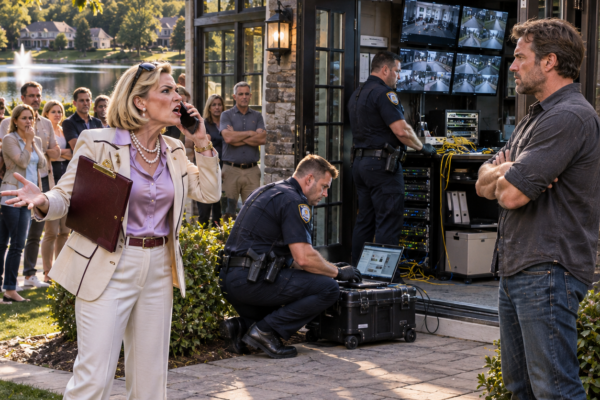
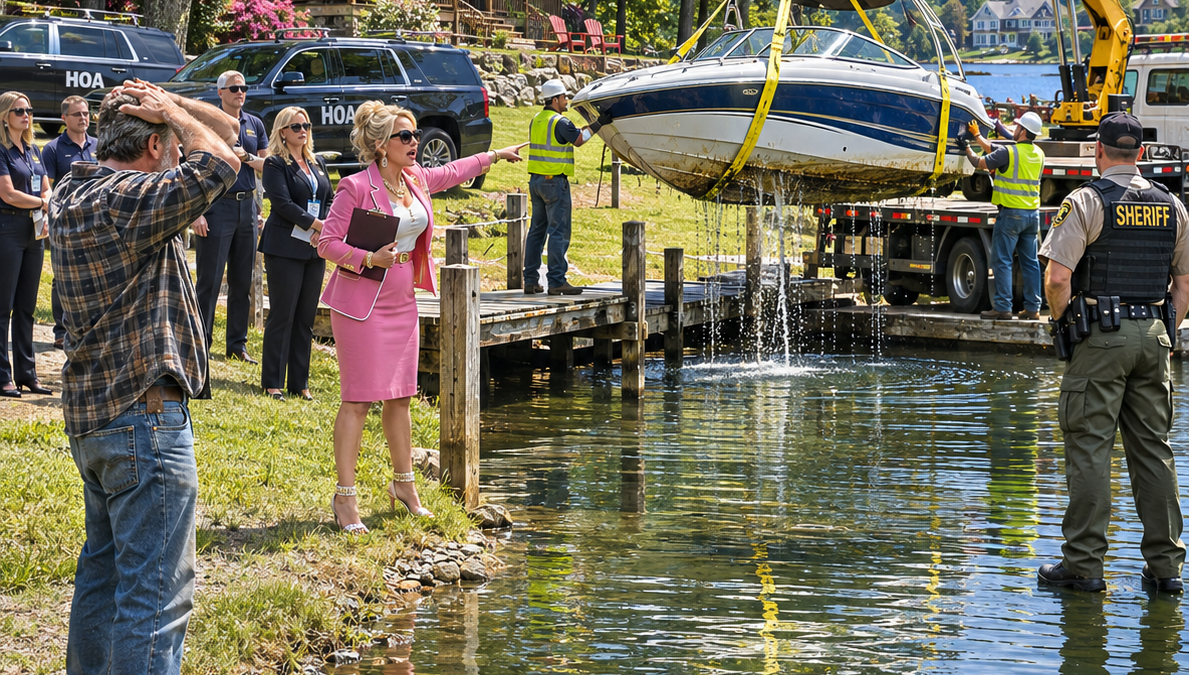
For three peaceful days after moving into that old cabin, I believed I had finally found the silence I had spent half my life dreaming about, but then Skyler Campbell arrived in rhinestone sandals with a laminated HOA badge, a color-coded clipboard, and the absolute certainty that my land, my shoreline, my dock, and eventually even my boat should somehow belong to everyone simply because she said the word “community” often enough.
By the time the lake became quiet again, the sheriff would know my dock by heart, lawyers would be arguing over camera footage, neighbors who had feared Skyler for years would finally begin speaking up, and the woman who ruled Lake View Serenity like her own private kingdom would learn that some boundaries remain invisible only until the wrong person decides to cross them.
My name is Benjamin Reed.
I was fifty-seven when I moved into the cabin my uncle left me after he died.
It sat on a wooded stretch of lakefront outside Lake View Serenity, a manicured development full of expensive houses, matching mailboxes, freshly edged lawns, and enough committees to supervise the migration of birds.
My parcel was different.
My uncle had owned it long before most of those houses existed. The deed was clean. No HOA membership. No covenant. No shared-access agreement.
Just a weathered cabin, several acres of pines, a narrow gravel drive, a private dock, and a view across the water that made my chest loosen every time I saw it.
After two decades of deployments, orders, aircraft engines, radios, alarms, arguments, and sleeping lightly because somebody always needed something, that silence felt sacred.
The first morning, I drank coffee at the end of the dock and watched fog slide across the lake.
The second morning, I repaired a shutter.
On the third, I started replacing warped boards on the dock.
That was when I heard sandals scraping across my gravel.
Scritch.
Scritch.
Scritch.
I kept working.
The footsteps stopped behind me.
“Good morning!”
The voice was bright enough to be cheerful and sharp enough to be a warning.
I set down my hammer and turned.
She was somewhere in her early fifties, perfectly arranged from blonde bob to jeweled sandals. Oversized sunglasses covered half her face. A pastel blouse was tucked neatly into white pants.
Then there was the clipboard.
Thick.
Color-coded tabs.
Pen attached by a curly cord.
A laminated badge clipped near the top read:
**SKYLER CAMPBELL — PRESIDENT**
“President of what?” I asked.
Her smile twitched.
“Lake View Serenity Homeowners Association.”
I looked behind her, then around my property.
“Did the United States annex my cabin overnight?”
She laughed.
Not because she thought it was funny.
Because people like Skyler laugh when they want you to understand that your resistance is cute.
“You must be Benjamin Reed.”
“Benjamin is fine.”
“We’re so excited to welcome you into our community.”
“I’m not in your community.”
The smile shortened.
“Oh. The cabin.”
She glanced toward my dock.
Then toward the new sign I had bolted beside the path.
**PRIVATE PROPERTY — NO TRESPASSING.**
“Yes,” I said. “The cabin.”
“Well, technically your lot isn’t under HOA jurisdiction.”
Technically.
I already disliked the word.
“But historically,” she continued, “this shoreline has functioned as a community access point.”
“Historically, it belonged to my uncle.”
“People have held barbecues here.”
“They’re done.”
“Small gatherings.”
“Done.”
“Sunset socials.”
“Also done.”
She stared at me.
I pointed toward a trash bag beside the boathouse.
“I collected twelve beer cans, broken plastic plates, cigarette butts, and half a burned hot dog from under my deck yesterday. If that’s your community spirit, it needs supervision.”
Her pen clicked.
“We have a culture of shared stewardship.”
“I have a culture of picking up my own garbage.”
That was when Skyler stopped pretending this was an introduction.
She flipped a tab.
“We also coordinate watercraft schedules to prevent congestion. Tuesdays and Thursdays would be available for your personal use. Saturdays are generally reserved for community—”
“No.”
Her head lifted.
“I’m sorry?”
“You’re not scheduling my dock.”
She looked at me as though I had just spoken in animal noises.
“Benjamin, cooperation prevents misunderstandings.”
“So do property lines.”
She took a slow breath.
Then she said something I would remember for a long time.
“We prefer to consider this parcel an honorary community zone.”
I actually laughed.
“An honorary zone?”
“It recognizes the historical relationship between this property and Lake View Serenity.”
“Does my deed recognize it?”
Her jaw tightened.
“That isn’t really the point.”
“It’s exactly the point.”
I stood.
At six-foot-two, weathered from years outside and still carrying the posture the military had beaten into me, I didn’t need to step toward her.
I simply stopped kneeling.
The change was enough.
“Skyler,” I said calmly, “I checked the deed before I moved here. I checked the county plat. Then I checked again because I spent too many years learning that paperwork causes more wars than bullets.”
Her pen stopped clicking.
“This property is private.”
She lowered the clipboard.
“We’ll see about that.”
And there it was.
The first honest sentence she had spoken all morning.
PART 2
I watched Skyler walk back toward the road, her sandals scraping across the gravel with a rhythm that somehow sounded angry.
Before she reached the trees, I called after her.
“Skyler.”
She turned.
“What?”
“Does that clipboard have a section for trespassing?”
She smiled.
All teeth.
“Does your paperwork have a section for community goodwill?”
“Right between private property and call the sheriff.”
Her expression hardened.
Then she walked away.
A black SUV that had been idling beyond the tree line pulled out almost immediately.
That interested me more than Skyler’s threat.
She hadn’t come alone.
Someone had been watching.
I stood there with the hammer in my hand, listening until the SUV disappeared.
Then I returned to the dock.
My uncle had repaired those boards himself for thirty years.
He had taught me to fish there when I was a teenager.
Back then, I had been impatient. I wanted to cast farther, move faster, catch something immediately.
He would sit with his old thermos beside him and say, “Ben, the lake doesn’t owe you excitement.”
I hadn’t understood what he meant until much later.
After deployments.
After funerals.
After learning how precious an uneventful morning could become.
Now I was kneeling on his dock, replacing boards that had carried his boots for decades while a stranger told me those same boards belonged to everyone.
The anger came slowly.
That worried me.
Fast anger burns out.
Slow anger plans.
I finished repairing the dock.
At noon, I found an HOA brochure wedged beneath a rock beside my mailbox.
**WELCOME TO LAKE VIEW SERENITY**
Below it:
**COMMUNITY GUIDELINES YOU’LL LOVE**
I read three paragraphs.
Then I dropped it into the burn barrel.
That afternoon, I started a notebook.
On the cover I wrote:
**CAMPBELL LOG — VOLUME ONE**
I had spent too much of my career around people who later claimed they never said what everyone had heard them say.
Documentation solves that problem.
I wrote the date.
The time.
Her name.
What she demanded.
What I said.
I also downloaded the footage from the little security camera my uncle had installed near the dock and backed it up.
Skyler’s entire visit was there.
Including the sentence about my property not technically belonging to the HOA.
Especially that sentence.
At five-thirty that evening, I installed two gates.
One blocked the gravel road.
The other crossed the narrow lakeside path running through the birches.
They weren’t fortress gates.
They weren’t threatening.
They were simple steel barriers attached to concrete posts.
Physical punctuation.
At the lakeside gate, I hung a brass bell.
If someone wanted to speak to me, they could ring it.
If they ignored it, the cameras would do the talking.
For the rest of the evening, nothing happened.
I sat at the edge of the dock while the sunset turned the water copper.
Ghost floated beside me.
That was the name I had given my boat.
She was unlike anything else on the lake.
Low-profile.
Matte black.
Electric.
Quiet enough that at slow speed the loudest sound was water moving along the hull.
I had spent years tinkering with her.
Some men restore muscle cars after retirement.
Some build furniture.
I built Ghost.
Engineering kept my hands occupied when memories didn’t want to leave me alone.
The boat had navigation assistance, GPS tracking, remote diagnostics, and several safety systems I had added simply because I enjoyed solving problems.
I looked at her that evening and ran a hand along the railing.
“Don’t worry,” I said.
“No community weddings.”
The bell rang.
Once.
Clear and sharp.
I stood.
Nobody was at the gate.
But gravel shifted somewhere beyond the trees.
I smiled without humor.
Skyler was testing the boundary already.
### **1. THE WOMAN WHO COULDN’T HEAR NO**
For two days, Skyler disappeared.
On the third morning, the bell chimed twice.
When I walked outside, she was waiting beyond the gate wearing running clothes.
She wasn’t sweating enough to have run from anywhere farther than her SUV.
“Benjamin!”
“Skyler.”
She placed both hands on her hips as if catching her breath.
“Beautiful morning.”
“It was.”
Her smile tightened.
“I wanted to invite you to a community brainstorming session.”
“I’ve already had my idea.”
“Oh?”
“Stay off my property.”
She laughed again.
“You really are determined to isolate yourself.”
“I moved to a cabin in the woods, Skyler. That wasn’t an accident.”
She stepped closer to the gate.
“I noticed you’ve installed barriers.”
“Most people call them gates.”
“We’re concerned about the message.”
“The message is printed on the sign.”
She looked at it.
**PRIVATE PROPERTY. RING BELL. WAIT FOR OWNER.**
Her eyes returned to me.
“People have used this path for years.”
“My uncle tolerated things I don’t.”
“So you’re changing the character of the neighborhood.”
“No. I’m changing access to my land.”
She stared at me for a long second.
Then she pulled out her phone and photographed the gate.
I raised mine.
I photographed her photographing it.
That irritated her.
“Really?”
“Documentation.”
“For what?”
“Whatever comes next.”
Her expression changed for half a second.
There it was again.
That calculation.
Skyler wasn’t used to being denied.
But more importantly, she wasn’t used to people preparing for the consequences of denying her.
“I hope we can avoid hostility,” she said.
“So do I.”
“Then open the gate.”
“No.”
Her lips compressed.
“Benjamin, the HOA can make things complicated.”
“Not for property outside the HOA.”
“We have influence.”
“So does gravity. I still don’t jump off roofs.”
Her eyes narrowed.
“You think this is funny.”
“I think it’s unnecessary.”
She walked back toward the road.
Then stopped.
“You’ll eventually understand how things work here.”
“I already do.”
She turned.
“What does that mean?”
“It means you’re hoping persistence will turn no into yes.”
The sunglasses hid her eyes.
But I saw the muscles tighten around her mouth.
“We’ll see.”
There was that phrase again.
By sunset, I had another entry in the notebook.
The following afternoon, a white SUV arrived.
Two women stepped out wearing matching polo shirts embroidered with:
**LAKE VIEW SERENITY VOLUNTEER COMMITTEE**
One held a clipboard.
The other held two Chihuahuas.
I opened the gate but didn’t invite them through.
“Mr. Reed?”
“That’s me.”
“We’re here on behalf of President Campbell.”
“I’m shocked.”
The taller woman ignored that.
“I’m Debbie Miller, shoreline beautification chair.”
The other smiled.
“Carol Simmons. Hospitality committee.”
One Chihuahua barked continuously at my boot.
“What can I do for you?”
Debbie consulted her clipboard.
“We’re coordinating Saturday’s cleanup and kayak event. We’ll need access to your dock from eight until approximately three.”
“No.”
Her eyes rose.
“The community voted.”
“I didn’t.”
“Participation is expected.”
“I’m not a member.”
Carol tried the softer approach.
“It would really help morale.”
“Then hold it somewhere you own.”
Debbie frowned.
“Sir, this shoreline has always been—”
I pointed toward the private-property sign.
“I’m going to save us all time. If the sentence you’re about to say contains the words historically, traditionally, community, honorary, stewardship, or cooperation, the answer is still no.”
The Chihuahuas stopped barking.
Even they seemed impressed.
Debbie closed her clipboard.
“You’re being unnecessarily confrontational.”
“You came to my gate to tell me what you’re doing on my dock Saturday.”
“We were informing you.”
“Now you’re informed too.”
They left.
Five minutes later, my phone buzzed.
Unknown number.
**It would greatly benefit community morale if you reconsidered. —SC**
I took a picture of the locked gate.
I sent it back.
**Morale remains secure. —BR**
That should have ended it.
Instead, the campaign began.
Flyers appeared throughout the neighborhood.
**HELP PRESERVE OUR SHARED LAKE ACCESS**
The photograph under the headline showed my dock.
My actual dock.
Apparently they had pulled an old picture from the HOA social page.
Underneath:
**SERENITY COVE DOCK — TRADITIONALLY OPEN TO ALL**
I walked down there with the flyer in my hand.
For the first time, the situation stopped being merely annoying.
They were manufacturing a story.
If enough people believed my land had always been public, eventually somebody would act as though it were.
So I made my position equally public.
I installed another sign.
**PRIVATE PROPERTY.**
**NO PUBLIC LAKE ACCESS.**
**TRESPASSERS WILL BE REPORTED.**
Then beneath that, in smaller letters:
**YES, THIS INCLUDES COMMITTEES.**
Skyler arrived the next afternoon with Debbie, Carol, and a man in pressed jeans.
They stood outside my gate like a suburban tribunal.
“We need to discuss optics,” Skyler said.
“Optics?”
“Your signs.”
“They’re legible.”
“They’re hostile.”
“They’re accurate.”
The man crossed his arms.
“This is creating negative energy.”
I looked at him.
“Who are you?”
“Logan Pierce. Water Use Subcommittee.”
“How many committees do you have?”
He looked genuinely confused by the question.
Skyler raised her clipboard.
“Benjamin, this doesn’t need to become a conflict.”
“It isn’t one.”
“You’re threatening to call law enforcement on neighbors.”
“If neighbors trespass.”
“You’re alienating the community.”
“I’m not in your community.”
“Geographically, you are.”
“Legally, I’m not.”
She snapped the clipboard shut.
“We’re offering one final compromise.”
“No.”
“You haven’t heard it.”
“I’m saving you the effort.”
Her face reddened.
“We would schedule limited community access windows. Two Saturdays a month. In exchange, the HOA would provide cleanup services.”
I laughed.
“You want permission to trespass in exchange for cleaning up after yourselves?”
“Don’t twist my words.”
“I’m straightening them.”
Debbie began writing.
Skyler stepped nearer to the gate.
“People expect continuity.”
I looked at her.
“If I walked into your backyard Saturday morning, opened your gate, invited forty people, set up grills beside your pool, and told you your lawn was an honorary zone, what would you call it?”
“That isn’t comparable.”
“Why?”
“My house is private property.”
“So is mine.”
The silence that followed felt almost physical.
Skyler looked past me toward Ghost.
The boat rocked gently against the dock.
Her gaze lingered there.
Then she looked back at me.
“You should think carefully about making enemies here.”
That was the first moment I stopped viewing her as an irritation.
Because that wasn’t a request.
It wasn’t even an HOA warning.
It was a threat.
I leaned against the gate.
“Skyler, I’ve had actual enemies.”
Her smile faded.
“Don’t become nostalgic.”
For once, she had nothing to say.
She turned and left.
That night, I sat inside the boathouse with Ghost beside me.
The lake outside was black except for scattered lights from houses across the water.
I wasn’t afraid.
I was tired.
There is a difference.
I’d spent twenty-two years in places where boundaries mattered because crossing the wrong one could get someone killed.
Now I had come home believing boundaries would finally be simple.
A deed.
A gate.
A sign.
A polite no.
Yet here I was fighting over the meaning of the word mine.
I thought about my uncle.
He had been patient with people.
Sometimes too patient.
I remembered neighbors walking across the property when I was young.
Families picnicking near the shore.
Teenagers fishing from the dock.
My uncle had often allowed it.
That was the part Skyler had twisted.
Permission had become tradition.
Tradition had become entitlement.
Entitlement was now being rewritten as ownership.
I opened my notebook.
Then I wrote:
**She is not trying to convince me anymore.**
**She is looking for a way around me.**
I closed the book.
That was when the plan truly began.
### **2. GHOST**
Ghost wasn’t designed as a trap.
That matters.
She was designed because I hated noise.
After years around diesel engines, helicopters, generators, and machinery that vibrated through your teeth, I wanted a boat that moved without announcing itself to half the county.
So I built one.
The hull had started as a used electric launch.
I stripped it down.
Reworked it.
Added redundant navigation safeguards.
Geofencing.
Remote monitoring.
Automatic return.
An emergency shutdown.
Then, years earlier, after a friend had his boat stolen from a marina, I added an unauthorized-user safety mode.
If the boat detected an unapproved startup, manual controls could be temporarily locked while Ghost followed a slow, predetermined route inside a safe section of open water.
Nothing violent.
Nothing fast.
Nothing designed to injure.
The whole point was preventing somebody unfamiliar with the craft from crashing it.
The route happened to trace a large figure eight.
Which made it extremely annoying.
I had never needed the feature.
Now I tested it.
Ghost slid away from the dock.
Six knots.
Wide turn.
Cross the center.
Wide turn again.
Back.
I watched from shore.
Smooth.
Predictable.
The emergency return switch remained clearly visible at the console.
If anyone truly panicked, one press would send the boat home.
I reset the system.
Then I checked the camera covering the dock.
Everything recorded.
Everything timestamped.
I did not intend to invite Skyler onto my property.
But I had learned something about her.
Tell someone like Skyler no, and she’ll argue.
Lock a gate, and she’ll inspect the hinges.
Install a camera, and she’ll search for the blind spot.
Own something she believes she deserves, and eventually she’ll convince herself that taking it is not theft.
It’s enforcement.
All I had to do was stop preventing her from revealing that.
Two days later, she returned.
This time she was alone.
And this time she noticed Ghost immediately.
“That’s a beautiful boat.”
“Thanks.”
“New?”
“Project.”
“You built it?”
“Most of it.”
She walked closer to the railing.
Not past the gate.
Not yet.
“We used to have a community pontoon.”
“I heard.”
“We held sunset cruises.”
“Sounds nice.”
“Weddings too.”
“Of course you did.”
She smiled.
“Maybe you could revive that tradition.”
“No.”
“Benjamin.”
“No passengers.”
“You haven’t even thought about it.”
“I thought quickly.”
She laughed.
“You know, people would really warm up to you if you stopped acting like everybody was trying to steal something.”
That sentence almost made me smile.
“Interesting choice of words.”
“What?”
“Nothing.”
She watched Ghost.
“What does something like that cost?”
“More time than money.”
“Is it difficult to operate?”
“For some people.”
Her head tilted.
“What does that mean?”
“It means people should operate boats they own.”
The friendliness vanished.
“You enjoy this, don’t you?”
“What?”
“Making everything difficult.”
I wiped grease from my hands.
“Skyler, my life was simple before you arrived.”
“You moved next to an established community.”
“I moved onto private land.”
“Same lake.”
“Different deed.”
“You really think a piece of paper gives you the right to shut everyone out?”
I looked at her.
“Yes.”
She stared at me.
I continued.
“That’s what property ownership is.”
Her face went cold.
“You think you’re special because you wore a uniform?”
I hadn’t mentioned my service.
Not to her.
That meant somebody had been researching me.
I let the silence hang.
“No,” I said finally. “I think I’m tired because I wore one.”
Something changed in her expression.
For one second I thought she might understand.
Then she looked back toward Ghost.
“You won’t always be here to guard everything.”
There it was.
I felt every instinct I had spent a career sharpening become very quiet.
“What did you say?”
She smiled.
“I said you can’t spend your life guarding a dock.”
Then she walked away.
I didn’t follow.
I didn’t shout.
I went inside.
Downloaded the camera recording.
Added another entry to my log.
And called Deputy Mark Howard.
He was a county deputy I’d met twice since arriving.
Mid-fifties.
Patient.
The kind of officer who listened before speaking.
I explained the repeated access demands, the flyers, the photographing, and Skyler’s latest comment.
“Has she crossed the gate since you posted it?” he asked.
“Not that I can prove.”
“Then keep documenting.”
“I intend to.”
“If she enters, call us.”
“I will.”
He paused.
“Ben?”
“Yeah?”
“Don’t get creative.”
I looked out the window toward Ghost.
“Define creative.”
Howard sighed.
“That answer is exactly why I’m saying it.”
I laughed.
“I won’t hurt anybody.”
“I know.”
His voice became more serious.
“Make sure that stays true.”
After the call, I sat on the porch for a long time.
His words mattered.
I wasn’t looking for a fight.
That was the strange part.
Twenty years earlier, maybe I would have confronted Skyler directly.
Age changes the way anger works.
You stop caring about winning the moment.
You care about ending the problem.
And the only way to end Skyler Campbell’s campaign was to make it impossible for her to pretend she was the victim.
She needed to cross the boundary herself.
Clearly.
On camera.
With no ambiguity.
Then came the flyer.
Friday morning.
Wedged beneath my gate latch.
**COMMUNITY SUNSET CRUISE**
**REVIVING A LAKE VIEW TRADITION**
**SUNDAY — SERENITY COVE DOCK**
I stared at it.
Serenity Cove Dock was what the HOA called my dock.
There was even a photograph of a pontoon on the flyer.
No boat had been arranged.
No permission had been requested.
But they were advertising a cruise from my property.
That was when I understood.
The boat wasn’t merely tempting Skyler.
She needed one.
And Ghost was sitting right there.
### **3. I STOPPED LOCKING THE DOOR**
Sunday morning arrived warm and bright.
I drank coffee.
Checked the weather.
Checked the cameras.
Checked Ghost.
Then I did something I had not done in weeks.
I left the lakeside gate unlocked.
Not wide open.
Just unlatched.
I also parked my truck away from the cabin where anyone watching from the road would assume I had left.
Then I drove into town.
I stopped at a gas station on a ridge where I could see a thin strip of the lake between trees.
Bought coffee.
Sat in the truck.
Waited.
Ten minutes.
Nothing.
Fifteen.
Nothing.
At eighteen minutes, my phone vibrated.
**EAST PATH MOTION DETECTED.**
I looked at the screen.
A figure appeared between the birches.
Gray hoodie.
Jeans.
Baseball cap.
For three seconds I didn’t recognize her.
Then she looked directly toward the camera.
Skyler.
No clipboard.
No pastel blouse.
No HOA badge.
That told me everything.
People behaving officially want witnesses.
People who know they’re doing something wrong dress to avoid being recognized.
She paused at the gate.
Looked around.
Saw it wasn’t latched.
Then entered.
My pulse barely changed.
I had felt that strange calm before.
Not excitement.
Not fear.
Focus.
She walked toward the dock.
Stopped beside the boathouse.
Looked through the window.
Then stepped onto Ghost.
The camera caught everything.
Her first hand on the railing.
Her shoe on the deck.
Her face turning toward the cabin to make sure nobody was coming.
Then another alert appeared.
**UNAUTHORIZED CONSOLE ACCESS.**
Skyler sat behind the controls.
She pressed something.
Nothing happened.
She tried again.
Then another alert.
**UNAUTHORIZED START ATTEMPT.**
I whispered to myself.
“Walk away.”
She didn’t.
She tried a second time.
A third.
Ghost’s system woke.
The display illuminated.
Skyler looked delighted.
She glanced toward shore.
Then she released the mooring line.
That detail mattered.
The boat didn’t carry her away by accident.
She untied it.
She stepped back behind the controls.
The motor hummed.
Ghost moved from the dock.
Skyler smiled.
For about four seconds.
Then the wheel stopped responding.
Her smile vanished.
She pulled at the controls.
Ghost continued straight.
The display flashed:
**UNAUTHORIZED USER**
**SAFETY NAVIGATION ACTIVE**
Then she began the first turn.
Skyler stared at the screen.
She stabbed at buttons.
The boat curved gently left.
Completed the loop.
Crossed its own wake.
Turned right.
From the truck, I took a sip of coffee.
Then my phone rang.
I expected the system.
Instead, it was Deputy Howard.
“Morning, Ben.”
“Morning.”
“You sound suspiciously relaxed.”
“Funny you called.”
“What happened?”
“Remember when you told me not to get creative?”
Silence.
“Ben.”
“She took the boat.”
“What?”
“Skyler entered the posted property, boarded Ghost, untied her, started her, and left the dock.”
“You have video?”
“Every second.”
“Where are you?”
“Not there.”
Another silence.
“Is she in danger?”
“No. Six knots. Open water. Stabilized route. Emergency return is available.”
Howard exhaled.
“What is she doing now?”
I looked at the feed.
Skyler was standing behind the console yelling at it.
“Learning geometry.”
Howard made a sound that might have been a cough.
“Send me coordinates.”
I did.
“We’re heading there. Do not interfere.”
“I won’t.”
“Ben?”
“Yeah?”
“I meant it when I told you not to get creative.”
“You should see the figure eight.”
He hung up.
I drove back slowly.
By the time I reached the cabin, two sheriff’s cruisers were parked outside the road gate.
Howard stood near the dock beside a younger deputy.
Both men were looking across the lake.
Ghost was completing another loop.
Skyler was visible at the console.
Even from shore, we could hear her shouting.
Howard looked at me.
“How long?”
“Thirty-two minutes.”
“She okay?”
“Physically?”
“Yes.”
“Probably.”
He glanced toward the boat.
“Emotionally?”
“That’s between her and her HOA.”
The younger deputy turned away.
His shoulders shook.
Howard gave him a look.
“Professionalism.”
“Yes, sir.”
“Try harder.”
“Yes, sir.”
A rescue boat had already been contacted, but before it arrived, Ghost’s system reached the return threshold.
She turned toward home.
Skyler apparently thought she had finally regained control.
I could see her straightening proudly behind the wheel.
Then Ghost aligned herself perfectly with the dock without any input from her.
The younger deputy whispered:
“Oh, that’s beautiful.”
Howard heard him.
So did I.
Neither of us corrected him.
Ghost slowed.
Three knots.
Two.
One.
The hull touched the dock bumper with a soft rubber thump.
Skyler lunged for shore.
Her legs disagreed with the decision.
She stumbled.
One sneaker went into the water.
Howard caught her elbow before she fell.
“Easy.”
She ripped her arm away.
“He trapped me!”
Howard looked at Ghost.
Then at her.
“Ms. Campbell, were you invited onto this property?”
“I was conducting official HOA business.”
“That’s not what I asked.”
“The boat was obstructing community access.”
Howard stared at her.
The younger deputy stared at her.
I stared at her.
Even the lake seemed to pause.
Howard spoke again.
“Did Mr. Reed give you permission to operate his boat?”
“I believed it was available for community use.”
“You believed the privately owned boat behind a private-property sign on land outside your HOA was community equipment?”
Skyler looked toward me.
Her face was pale beneath the anger.
“He left the gate unlocked.”
I nodded.
“I also leave windows unlocked sometimes. That doesn’t make my furniture public.”
“You set me up!”
“No,” I said.
I kept my voice calm.
“I stopped stopping you.”
Her mouth opened.
Nothing came out.
A medic checked her.
Pulse elevated.
Mild nausea.
No injuries.
No dehydration.
No physical harm.
Just nearly an hour of humiliation and the uncomfortable realization that the camera above the dock had recorded all of it.
Howard pulled me aside.
“You want to press charges?”
I looked toward Skyler.
She was sitting on the dock now, wrapped in a blanket she absolutely did not need, pointing furiously at Ghost while trying to explain something to the younger deputy.
“Not today.”
Howard raised an eyebrow.
“You sure?”
“Yes.”
“Why?”
“Because if I press now, she’ll tell everyone I ambushed her.”
“You did leave the gate open.”
“I didn’t drag her through it.”
He glanced at the camera.
“You’ve got everything?”
“Multiple angles.”
He almost smiled.
“Then you’re right about one thing.”
“What?”
“She did the hard part herself.”
Skyler heard me laugh.
She stood.
“You think this is funny?”
“No.”
I looked directly at her.
“I think it’s finished.”
Her face changed.
That frightened me more than the shouting.
Because Skyler didn’t look defeated.
She looked humiliated.
Humiliation can teach reasonable people.
In unreasonable people, it creates revenge.
She stepped closer.
“You have no idea what you just did.”
“I know exactly what you did.”
“You engineered this!”
“I engineered a boat. You stole it.”
“I borrowed it.”
“From someone who repeatedly told you no.”
She pointed at me.
“I will sue you for everything you have.”
Howard stepped between us.
“Ms. Campbell.”
“No! This man endangered me. He stalked me with cameras. He created a trap.”
“On his property,” Howard said.
“He knew I would take it!”
I couldn’t help myself.
“That’s not the defense you think it is.”
The younger deputy turned away again.
Skyler’s eyes filled with fury.
“I’ll destroy you.”
There it was.
In front of two deputies.
On another camera.
Howard’s patience ended.
“Ma’am, that’s enough.”
Skyler looked at him.
“Are you threatening me?”
“No. I’m telling you the conversation is over.”
She stared at the three of us.
Then she gathered what remained of her dignity and walked toward the road.
One wet sneaker squeaked with every step.
Squeak.
Scrape.
Squeak.
Scrape.
The sound followed her through the trees.
When she disappeared, Howard looked at me.
“I have a feeling this isn’t over.”
“So do I.”
He turned toward Ghost.
“What do you call that mode?”
“Loop mode.”
He shook his head.
“Of course you do.”
### **4. THE STORY SKYLER TOLD**
By sunrise the next morning, Skyler had rewritten history.
According to the Lake View Serenity Facebook page, I had lured the HOA president onto a dangerous vessel and deliberately trapped her in open water.
The headline read:
**SHOCKING ABUSE OF TECHNOLOGY BY RECLUSIVE CABIN OWNER**
There was a blurry photograph of Skyler after Ghost returned.
Her hair was tangled.
Her sneaker was wet.
She looked exhausted.
The caption said:
**THIS IS WHAT HAPPENS WHEN NEIGHBORS WEAPONIZE PRIVATE PROPERTY AGAINST COMMUNITY LEADERSHIP.**
I read it twice.
Then I laughed.
Not because it was funny.
Because Skyler had just handed me something valuable.
Defamation in writing.
I took screenshots.
Downloaded the page.
Recorded the timestamp.
Saved comments.
Most supported her.
Some called me unstable.
One called me “a dangerous ex-military recluse.”
Another wrote:
**People like that shouldn’t live near families.**
Then I saw one comment from Cheryl Bennett.
I knew Cheryl only slightly.
She was an HOA board member who had once waved when she passed my property.
Her comment said:
**Wouldn’t the simplest way to avoid being trapped on someone else’s boat be not stealing someone else’s boat?**
Sixty-eight people liked it.
An hour later, the comment disappeared.
That told me something.
Skyler’s control over the neighborhood wasn’t based on popularity.
It was based on fear.
That evening, an email arrived.
**MITCHELL GREEN & ASSOCIATES**
**NOTICE OF PENDING CIVIL ACTION**
I forwarded it to Donna Carter.
Donna had served as a JAG attorney before entering private practice.
We had met years earlier through mutual friends.
She was one of the few people I trusted to tell me when I was being clever and when I was being stupid.
She called eleven minutes later.
“Please tell me you have video.”
“Four cameras.”
“Audio?”
“Yes.”
“Signs visible?”
“Yes.”
“Gate?”
“Posted.”
“Did you physically place her on the boat?”
“No.”
“Encourage her to board?”
“No.”
“Communicate with her while she was out there?”
“No.”
“Did the boat exceed safe speed?”
“No.”
“Could she return it in an emergency?”
“Yes.”
There was silence.
Then Donna started laughing.
Not polite laughter.
Full laughter.
“Donna.”
“I’m sorry.”
“You don’t sound sorry.”
“I’m really not.”
“Should I be worried?”
“You should always be worried when litigation starts. But she’s got a problem.”
“What?”
“She has to explain why she was on the boat.”
I looked out toward Ghost.
“That was my thought.”
“No, Benjamin. Do not start sounding pleased with yourself.”
“I’m drinking coffee.”
“I can hear you smiling.”
“I didn’t know smiles had audio.”
“Yours does.”
Three days later, Donna and I walked into mediation.
Skyler sat opposite us.
Perfect hair.
Gray blazer.
Sunglasses indoors.
Mitchell Green sat beside her wearing enough cologne to establish jurisdiction over the room.
The mediator introduced herself.
Then Mitchell began.
“My client suffered severe emotional distress as a direct result of Mr. Reed’s deliberate use of a motorized vessel as a confinement mechanism.”
Donna lifted one finger.
“Before we get philosophical, are you alleging my client forced Ms. Campbell onto the vessel?”
Mitchell hesitated.
“We’re alleging entrapment.”
“That’s not what I asked.”
Skyler interrupted.
“He knew I would use it.”
Donna looked at her.
“Why?”
“Because the HOA had announced a community cruise.”
“Did Mr. Reed agree to that cruise?”
“No, but—”
“Did he agree to provide the boat?”
“No.”
“Did he authorize you to enter his property?”
Skyler stiffened.
“I was acting on behalf of the community.”
Donna turned to the mediator.
“We’re going to have a productive afternoon.”
She opened the first folder.
County plat.
My deed.
HOA boundary map.
The cabin parcel sat clearly outside Lake View Serenity.
Then the HOA bylaws.
Donna pushed them across the table.
“Section Four. Jurisdiction applies only to lots enrolled in Lake View Serenity.”
Mitchell read.
Skyler looked away.
Donna placed another document down.
“Sheriff’s incident report.”
Another.
“Photographs of posted no-trespassing signs.”
Another.
“Text messages from Ms. Campbell requesting weekend access and Mr. Reed repeatedly refusing.”
Then she slid a small drive onto the table.
“And security footage.”
Mitchell looked at Skyler.
Skyler looked at Mitchell.
He already knew.
Donna opened her laptop.
The first video began.
Skyler stood on my dock during our original conversation.
Her voice filled the conference room.
“Technically, you’re not part of the HOA, but we’ve always treated this shoreline as an honorary zone.”
Donna stopped the video.
“Would anyone like more context?”
Nobody answered.
She played the second clip.
Skyler at the gate.
“You won’t always be here to guard everything.”
Then the third.
Skyler entering Sunday morning.
Looking left.
Looking right.
Walking past the sign.
Boarding Ghost.
Unfastening the mooring line.
Attempting the ignition.
The mediator leaned closer.
Mitchell’s face had gone blank.
Donna paused the frame as Skyler’s hand held the rope.
“This is important.”
Skyler snapped.
“He left the gate open!”
Donna didn’t even look at her.
“Amazing how often people confess while trying to defend themselves.”
Mitchell raised a hand.
“My client isn’t confessing to anything.”
Donna turned toward him.
“Then perhaps you’d like to explain what she thought she was doing.”
Skyler answered for him.
“I was ensuring that his boat wasn’t a hazard.”
“With the engine running?” I asked.
“With the rope removed?” Donna added.
Skyler stared at me.
“You wanted me to take it.”
I leaned forward.
“Skyler, if I put a pie on my windowsill, you still can’t enter my kitchen and steal it.”
The mediator covered a smile.
Mitchell tried another angle.
“The boat itself created a dangerous condition by locking controls.”
Donna opened another folder.
“Safety documentation.”
She passed it over.
“Limited speed. Controlled route. Automatic stability assistance. Emergency dock-return control clearly labeled beside the console.”
Skyler’s head snapped up.
“What emergency control?”
Donna stared at her.
“The large red button.”
Silence.
I remembered watching Skyler spend forty minutes jabbing at everything except that button.
Mitchell whispered:
“You didn’t see it?”
Skyler ignored him.
Donna continued.
“The vessel automatically returned when the battery threshold was reached. Ms. Campbell was examined immediately afterward. No injury.”
The mediator turned to Mitchell.
“What remedy is your client seeking?”
Mitchell straightened.
“Compensatory damages for emotional distress, harassment, reputational damage, and negligent endangerment.”
Donna smiled.
“Excellent.”
Mitchell looked suspicious.
“Why is that excellent?”
“Because if this proceeds, we’ll counterclaim.”
The smile disappeared.
“Trespass. Unauthorized use of a vessel. Harassment. And defamation.”
She placed the Facebook screenshot on the table.
Skyler went still.
“That post doesn’t identify him.”
“It calls him the reclusive cabin owner beside a photograph taken on his property.”
Donna tapped another page.
“And the original upload metadata identifies the device.”
Skyler’s voice dropped.
“You hacked me.”
“No.”
Donna leaned back.
“You posted publicly.”
The mediator rubbed her forehead.
For the first time all afternoon, Skyler looked uncertain.
Mitchell requested a break.
Donna and I walked into the hallway.
I leaned against the wall.
“How bad?”
“For her?”
“Yes.”
Donna smiled.
“Bad enough that her lawyer is probably explaining the difference between humiliation and damages.”
“Do you think she’ll drop it?”
Donna’s expression became serious.
“No.”
“Why?”
“Because this stopped being about winning the moment she got off that boat.”
I knew what she meant.
“Pride.”
“Exactly.”
She studied me.
“And don’t underestimate injured pride.”
We returned ten minutes later.
Mitchell announced that they were not withdrawing.
Donna closed her folder.
“Then we’ll see you in court.”
Skyler smiled at me.
But this time, the smile looked fragile.
“You should have just shared the lake.”
I looked at her.
“You should have just respected the word no.”
### **5. THE NEIGHBORS STARTED TALKING**
The lawsuit changed something in Lake View Serenity.
Until then, Skyler had controlled the narrative.
She was president.
She chaired meetings.
She wrote notices.
She moderated the community page.
She decided what counted as cooperative and what counted as hostile.
But lawsuits create documents.
Documents create questions.
And questions are dangerous to people whose authority depends on nobody asking them.
Cheryl Bennett came to my gate one morning.
She rang the bell.
That alone made me like her.
I walked down.
“Morning.”
“Mr. Reed.”
“Benjamin.”
She smiled.
“Cheryl.”
I unlocked the gate.
She didn’t move through it.
“May I come in?”
“See? That’s how it works.”
She laughed nervously.
“I owe you an apology.”
“For what?”
“For not speaking sooner.”
We walked toward the dock.
Cheryl was in her sixties with silver-streaked hair and the careful manner of someone used to measuring every sentence.
She looked across the lake.
“Skyler has been doing this for years.”
“Taking boats?”
“No.”
She smiled faintly.
“Not specifically.”
Then she told me.
A disabled resident had once lost a parking space because Skyler wanted it temporarily assigned to a yoga instructor during HOA events.
Another homeowner had returned from vacation to find his lawn mower missing.
Skyler had declared it available for community landscaping.
The HOA reimbursed him only after he threatened police involvement.
A widowed resident had been fined repeatedly for leaving trash cans visible from the road even though severe arthritis made dragging them behind the house difficult.
A family had been pressured into allowing HOA events on their empty side lot because Skyler called it “underutilized community-adjacent space.”
The stories weren’t dramatic individually.
That was what made them disturbing.
Small invasions.
Constant pressure.
Tiny humiliations.
Enough to teach everyone that life was easier if they surrendered early.
“Why didn’t the board remove her?” I asked.
Cheryl looked embarrassed.
“Because she made herself indispensable.”
“To whom?”
“To herself.”
I smiled despite myself.
Cheryl continued.
“She controlled the meeting agendas. The social page. Contractor relationships. Complaints. Most people just wanted quiet lives.”
“So they gave her authority because fighting her was exhausting.”
“Yes.”
I understood that too well.
“Why are you telling me?”
She looked toward Ghost.
“Because you embarrassed her.”
“That seems like a strange reason to trust me.”
“No.”
Cheryl shook her head.
“You showed us she isn’t untouchable.”
Her voice cracked slightly on the last word.
That changed the conversation.
Skyler wasn’t just annoying.
She had trained an entire neighborhood to avoid conflict with her.
I had seen that dynamic before in much uglier places.
The bully doesn’t need everyone to agree.
The bully only needs everyone to believe resisting costs more than surrendering.
“What are you planning?” I asked.
Cheryl looked back toward the house.
“Nothing.”
It was exactly the kind of answer people give when they’re planning something.
“Cheryl.”
She smiled.
“Keep your cameras running.”
Then she left.
That evening, an anonymous packet appeared in HOA mailboxes.
I didn’t create it.
I never learned who did.
But somebody had been collecting records.
Receipts.
Meeting minutes.
Screenshots.
Expense reports.
Emails.
Three years of Skyler Campbell using HOA procedure as personal leverage.
There was even a receipt for expensive custom clipboard organizers charged as “administrative storage solutions.”
That one became legendary.
By morning, residents were furious.
By afternoon, they were organizing.
By evening, someone had filed a formal petition demanding a recall vote.
Skyler blamed me.
Naturally.
She came to my gate after sunset.
For once, she didn’t have a clipboard.
She gripped the bars.
“What did you send them?”
“Nothing.”
“You expect me to believe that?”
“I don’t care what you believe.”
“You’re destroying this community.”
“No.”
I walked closer.
“I think the community is reading its own records.”
“You poisoned them against me.”
“I barely know them.”
“You turned them into a mob.”
“That’s an interesting word from someone who tried to schedule strangers onto my land.”
Her fingers tightened around the gate.
“I built this neighborhood.”
“You chaired it.”
“Same thing.”
“No, Skyler.”
I shook my head.
“That’s the whole problem.”
She stared at me.
The moonlight made her look older.
For the first time, I could see exhaustion behind the anger.
“You don’t understand what leadership requires.”
“I understand leadership very well.”
“Then you should understand sacrifice.”
“Whose?”
She hesitated.
That was the question she had never asked herself.
“Everybody’s,” she said.
“No. Yours.”
She blinked.
“Leadership means you sacrifice your convenience for everyone else’s rights.”
I pointed toward my property.
“You’ve been asking everyone else to sacrifice their rights for your convenience.”
Her eyes watered.
I didn’t enjoy seeing it.
That surprised me.
For all the anger, part of me wanted Skyler simply to understand.
To admit that she had crossed a line.
To apologize.
Maybe because if she did, I could stop seeing her as an enemy.
She didn’t.
Instead, she whispered:
“I hope that stupid boat was worth what I’m going to do to you.”
Then she walked away.
I stood at the gate long after she disappeared.
Inside me, something hardened.
Not hatred.
Resolve.
She had been offered every exit.
Every warning.
Every chance.
Now the court could finish what she refused to.
### **6. THE COURTROOM**
The hearing took place three weeks later.
Small county courtroom.
Wooden benches.
Old fluorescent lights.
A seal behind the judge.
Skyler arrived early.
Gray blazer.
Pearls.
Sunglasses.
New attorney.
Mitchell Green had apparently decided one round was enough.
Her replacement was Patricia Horn, a sharp woman with a controlled voice who looked much less amused by Skyler’s version of events than Mitchell had.
Donna and I entered five minutes before the judge.
“She’s going to testify?” I whispered.
Donna nodded.
“That’s good?”
“For us?”
She smiled.
“Very.”
Judge Halbrook entered.
Gray-haired.
Severe eyebrows.
The patient expression of a man who had spent thirty years listening to adults explain why obvious decisions were somehow somebody else’s fault.
Patricia began.
She described emotional distress.
Harassment.
Entrapment.
Surveillance.
A “technologically weaponized vessel.”
That phrase almost got me.
Donna nudged my shoe under the table.
Don’t laugh.
Then Skyler testified.
She told the court she had entered my property in her official capacity as HOA president.
She claimed she believed Ghost was available for community use.
She said my unlocked gate constituted implied permission.
Then she described being carried helplessly into the lake.
Terrified.
Trapped.
Dizzy.
Afraid she might drown.
Judge Halbrook looked up.
“Was the boat taking on water?”
“No.”
“Was there severe weather?”
“No.”
“Did it travel at high speed?”
“No.”
“Did Mr. Reed pursue you?”
“No.”
“Did he threaten you?”
“Not directly.”
The judge raised an eyebrow.
“What does indirectly mean?”
“He built the boat.”
Donna lowered her head.
I knew she was hiding a smile.
Skyler continued.
“He knew I would try to use it.”
Judge Halbrook stopped writing.
“Why would he know that?”
The courtroom went silent.
Patricia’s head turned toward her client.
Skyler realized too late what she had said.
“Because we had disagreements over community access.”
“So after those disagreements, you entered his land without invitation and operated his boat.”
“I was verifying—”
“Yes or no.”
“Yes.”
“Thank you.”
Donna’s turn came.
She did not make a speech.
She simply played the evidence.
First video.
Skyler at my dock weeks earlier.
“Technically, you’re not part of the HOA.”
Second.
My response denying access.
Third.
The posted gates.
Fourth.
Skyler entering.
Judge Halbrook watched without expression.
Then came the footage of Ghost.
Skyler’s voice rang through the courtroom speakers.
“What is this?”
Then the boat display:
**UNAUTHORIZED USER. SAFETY NAVIGATION ACTIVE.**
Skyler shouted.
“Turn around!”
The boat continued.
A few people on the benches smiled.
Then came the line that nearly broke the room.
Skyler screamed at the console:
“I’m the HOA president!”
Somebody laughed.
The judge lifted his gavel.
“Order.”
But even his mouth had tightened at the corners.
Donna stopped the recording.
“Ms. Campbell.”
Skyler glared at her.
“Were you aware of the emergency return button?”
“No.”
“Was it concealed?”
“I don’t know.”
Donna enlarged the image from the console camera.
There it was.
Red.
Clearly labeled.
**EMERGENCY RETURN**
The judge leaned forward.
Skyler’s attorney closed her eyes briefly.
Donna continued.
“Did Mr. Reed disable that button?”
“No.”
“Did he remove your life jacket?”
“I wasn’t wearing one.”
“Was one available?”
“Yes.”
“Did he prevent you from sitting down?”
“No.”
“Prevent you from calling emergency services?”
“My phone had poor reception.”
“Did he cause that?”
“No.”
“Did he speak to you at all while you were on the boat?”
“No.”
Donna turned toward the judge.
“No further questions.”
Patricia attempted to recover.
She argued intent.
She insisted I had anticipated the trespass.
That I had created circumstances designed to humiliate Skyler.
Donna stood.
“Your Honor, anticipating unlawful behavior does not authorize the unlawful behavior.”
Patricia countered.
“He deliberately left his gate unsecured.”
Donna looked toward the judge.
“If I forget to lock my car, does that create a public transportation program?”
The judge didn’t smile.
But he did say:
“Point taken.”
Then came our counterclaim.
Trespass.
Unauthorized operation.
Harassment.
Defamation.
Donna showed the Facebook post.
The comments.
The screenshots.
The allegation that I was violent.
The characterization of my cameras as threatening despite every camera being installed on my property.
Then Cheryl’s deleted comment.
Then proof that moderators connected to Skyler’s account had removed dissenting posts while leaving accusations against me visible.
Judge Halbrook removed his glasses.
“Ms. Campbell, did you authorize the post describing Mr. Reed as dangerous?”
Skyler looked toward Patricia.
Her attorney couldn’t save her from a direct question.
“I was emotional.”
The judge leaned back.
“That wasn’t my question.”
“Yes.”
“Did you remove comments defending him?”
“I moderated misinformation.”
“Was the statement that you entered his property without permission misinformation?”
Silence.
“Ms. Campbell?”
“No.”
“Was the statement that you operated his boat without permission misinformation?”
“No.”
“Then what exactly were you moderating?”
Skyler’s shoulders fell.
For the first time since I met her, she had no answer.
Judge Halbrook looked at the documents again.
Then at me.
“Mr. Reed.”
“Yes, Your Honor.”
“Your boat’s unauthorized-use system.”
“Yes.”
“I strongly recommend that future disputes be handled through law enforcement before they develop into… nautical demonstrations.”
A few people laughed.
I nodded.
“Understood.”
Then he looked toward Skyler.
“However, an unlocked gate is not permission to trespass. An unattended boat is not an invitation to take it. A history of informal access does not override ownership. And an HOA president does not acquire authority over property specifically excluded from the HOA.”
Skyler stared straight ahead.
The judge continued.
“The plaintiff’s claims are dismissed with prejudice.”
Skyler inhaled sharply.
“Regarding the counterclaims, I find sufficient evidence of trespass and unauthorized operation, and the parties will comply with the settlement terms concerning damages and legal fees.”
Then his expression hardened.
“Ms. Campbell, you will also remove the defamatory statements identified by counsel and publish a written retraction.”
Skyler stood suddenly.
“Your Honor—”
Patricia grabbed her sleeve.
“Sit down.”
Skyler did.
Slowly.
The gavel struck.
The sound was not loud.
But it felt like a door closing.
### **7. THE FALL OF PRESIDENT CAMPBELL**
The board meeting was held that evening.
I wasn’t there.
I didn’t need to be.
Cheryl called me at nine-seventeen.
“It’s done.”
I sat on my porch overlooking the lake.
“What is?”
“You know what.”
I looked toward the lights across the water.
“Vote?”
“Unanimous.”
I said nothing.
“Skyler Campbell is no longer president of Lake View Serenity.”
A strange feeling moved through me.
I expected satisfaction.
Maybe triumph.
Instead I felt tired.
“Is she okay?”
Cheryl laughed once.
“After everything, you’re asking that?”
“I’m asking.”
“She screamed for twenty minutes. Accused the board of betrayal. Threatened lawsuits.”
“Sounds familiar.”
“Then she left.”
I stared at Ghost.
“Who’s president now?”
There was a pause.
“Me.”
I smiled.
“Congratulations.”
“Don’t congratulate me.”
“Condolences?”
“Much better.”
She became serious.
“Benjamin?”
“Yeah.”
“Thank you.”
“For what?”
“For saying no.”
I leaned back.
“That’s a low bar.”
“You’d be surprised.”
The next morning, the HOA page changed.
Cheryl posted:
**Effective immediately, Lake View Serenity HOA recognizes and will respect all private property boundaries, including independent parcels adjacent to the lake. No member, officer, committee, volunteer, or guest may enter or use private land or equipment without express permission from the owner.**
Then, apparently unable to resist, she added:
**Also, please do not steal boats.**
The post received more than a hundred reactions.
Most were laughing.
I printed it.
Pinned it above my Campbell Log.
Two days later, Skyler’s house went on the market.
I saw the sign from across the lake.
**FOR SALE**
For nearly a week, her beige SUV remained in the driveway.
Then one Saturday morning, I heard tires on the road.
I was repairing a fishing reel on the porch.
The SUV passed slowly.
Boxes filled the back.
A small plant pressed against one window.
And in the passenger seat, wedged between two bags, was the famous clipboard.
Skyler was driving.
She didn’t look toward the cabin.
I stood anyway.
Not to gloat.
Not to wave.
Just to watch.
For months, I had felt her presence even when she wasn’t there.
Her SUV beyond the trees.
Her perfume near the gate.
Her handwriting on flyers.
Her name in emails.
Her voice in my head telling me that private ownership was somehow antisocial.
Now I watched the vehicle disappear around the curve.
And nothing replaced it.
No second SUV.
No committee.
No sandals.
No clipboard.
Just wind through pine needles.
I stayed standing for several minutes.
Then I heard something behind me.
A rustle.
I turned.
A raccoon was halfway into my trash can.
He froze.
I froze.
He stared at me with both paws gripping the rim.
“You serious?”
He continued staring.
“After everything I’ve been through, you’re trespassing too?”
The raccoon slowly disappeared into the garbage.
I started laughing.
Harder than I had laughed in months.
### **8. THE LETTER**
Three days after Skyler moved, I received a handwritten envelope.
Inside was a letter from Cheryl.
**Dear Benjamin,**
**The board cannot officially endorse what happened with your boat, and our attorney has specifically asked us not to describe it as funny.**
I laughed before reading the next line.
**Unofficially, several residents would like you to know it remains the funniest thing that has happened here in years.**
Then the letter became serious.
**More importantly, you reminded us of something we should never have forgotten: community does not mean ownership of one another. Rules are supposed to protect neighbors, not give one neighbor power over everyone else.**
**We have amended the HOA charter, strengthened conflict-of-interest rules, and added explicit protections for adjacent private parcels.**
**Thank you for standing your ground when the rest of us had become too tired to stand ours.**
**Enjoy your lake.**
**Cheryl Bennett**
I read the letter twice.
Then I pinned it to the refrigerator.
Beside it was an old photograph.
My uncle and me at the dock.
I was seventeen.
Skinny.
Sunburned.
Holding a fish I had been ridiculously proud of.
He was standing behind me, smiling.
For months, I had treated the conflict with Skyler like a campaign.
Observe.
Document.
Protect.
Respond.
Win.
But looking at that photograph, I suddenly remembered why any of it mattered.
Not because I wanted to defeat an HOA president.
Because my uncle had left me the closest thing I had ever known to peace.
When he died, I had lost more than a relative.
He was the person who had always represented home.
During deployments, I used to think about that dock.
The smell of wet wood.
The cold water around my ankles.
His old thermos.
The way he never rushed.
After my final year in uniform, I had promised myself that if I ever got the chance, I would learn how to live that slowly.
Then he left me the cabin.
It felt like one last lesson.
And three days after arriving, someone had come down the gravel path and tried to tell me that even this wasn’t mine to protect.
I hadn’t realized until that moment how deeply it had hurt.
Not the paperwork.
Not the threats.
The disrespect.
Skyler had treated the place like empty real estate.
To me, every board held a memory.
I walked down to the dock.
Ghost floated beside it.
The late afternoon sun spread across the water in long gold bands.
I sat at the edge.
For the first time since moving in, I wasn’t listening for tires.
Wasn’t checking a phone.
Wasn’t watching the gate.
I just listened to the lake.
A loon called somewhere beyond the reeds.
The sound echoed.
My uncle used to imitate them badly enough to make me embarrassed.
I laughed quietly.
“Guess we kept it,” I said.
The water touched the dock.
Soft.
Regular.
Almost like an answer.
### **9. DENNIS**
The raccoon returned the next night.
Then the next.
By the end of the week, he had figured out how to remove the lid from my trash can.
I reinforced it.
He defeated that.
I added a latch.
He learned the latch.
I stood on the porch one evening watching him work.
“You would’ve made an excellent HOA president.”
He looked up.
“No offense.”
Eventually I named him Dennis.
Dennis had several qualities Skyler lacked.
He trespassed honestly.
He never called it shared stewardship.
He never sent notices.
He never organized committees.
He just stole garbage and left.
I respected the transparency.
Autumn arrived.
The trees around the lake turned gold and red.
The air became sharp in the mornings.
Ghost and I spent more time on the water.
Sometimes I fished.
Sometimes I didn’t.
The neighborhood changed too.
People began waving.
A few came to the gate.
They rang the bell.
Waited.
Asked permission.
An elderly man named Robert asked whether he could fish from the shore one afternoon because his knees made getting into his small boat difficult.
I said yes.
That surprised him.
“I thought you didn’t let anybody use the property.”
“I don’t let people tell me they’re using it.”
There was a difference.
He understood immediately.
A family asked whether their grandchildren could watch the Fourth of July fireworks from my dock the following summer.
They asked six months ahead.
I said probably.
Cheryl nearly dropped her coffee when she heard.
“Look at you,” she said.
“Community spirit.”
“Don’t push it.”
The strange thing was, once people stopped demanding access, I became more willing to offer it.
That was the lesson Skyler had never understood.
Generosity requires choice.
When you remove the choice, generosity becomes surrender.
My uncle had shared the shoreline because he wanted to.
Skyler had mistaken kindness for a permanent easement.
Now the neighborhood understood the difference.
One cold evening, Deputy Howard stopped by.
He wasn’t working.
He carried two beers.
I opened the gate.
We sat on the porch.
Dennis rustled somewhere near the trash.
Howard listened.
“What is that?”
“Security.”
“That sounds like a raccoon.”
“His name is Dennis.”
“You named your raccoon?”
“He has seniority now.”
Howard handed me a beer.
We sat quietly for a moment.
Then he nodded toward Ghost.
“You know other deputies ask me about that boat.”
“I was afraid of that.”
“They call it the Carousel.”
“I hate that.”
“They also call it Karen’s Cruise.”
“I hate that less.”
Howard smiled.
“You doing okay?”
I looked at him.
“Why wouldn’t I be?”
“Because sometimes when the fight ends, that’s when people realize how tired they are.”
That sentence stayed with me.
I looked toward the lake.
“I sleep better.”
“Good.”
“Still check the cameras.”
“That’ll fade.”
“Maybe.”
Howard took a drink.
“You ever regret it?”
“The boat?”
“Any of it.”
I thought carefully.
“I regret that it became necessary.”
“That’s not the same question.”
“No.”
I smiled.
“I don’t regret letting her make her own decision.”
He nodded.
“Fair.”
Then he raised his bottle.
“To boundaries.”
I lifted mine.
“To people who read signs.”
Dennis knocked over the trash can.
Howard looked toward the sound.
“Your tenant doesn’t.”
“He’s independent.”
### **10. WINTER**
The first snow covered the lake in December.
Ghost came out of the water and into the boathouse.
I drained systems.
Checked batteries.
Covered the hull.
Then the lake froze.
The world became almost unbelievably quiet.
No motors.
No insects.
No waves.
Just wind and the occasional crack of ice moving in the cold.
At night, I sat beside the wood stove reading old books and occasionally flipping through the Campbell Log.
The notebook had become absurdly thick.
Dates.
Times.
Photographs.
Printed emails.
Copies of flyers.
The lawsuit.
Cheryl’s letter.
I considered throwing it into the fire.
Then I decided not to.
Not because I wanted to remember Skyler.
Because I wanted to remember the lesson.
Peace does not protect itself.
That sounds obvious.
It wasn’t obvious to me.
When I left the service, I believed peace was the absence of conflict.
A place you reached.
A finish line.
The cabin taught me something else.
Peace is a boundary.
Sometimes physical.
Sometimes emotional.
Sometimes legal.
If nobody respects it, it disappears.
But defending it doesn’t always mean fighting harder.
Sometimes it means staying calm longer.
Keeping records.
Refusing to be provoked.
Giving people enough room to reveal who they really are.
Skyler spent weeks trying to make me angry.
If I had shouted at her first day, she would have won.
If I had threatened her, she would have used it.
If I had physically blocked her from Ghost, she would have told everyone I assaulted the HOA president.
Instead, I said no.
Again.
And again.
Then I let her decide whether she respected it.
She didn’t.
That became her problem.
Not mine.
One January afternoon, a postcard arrived.
No return address.
The front showed a desert resort.
For one strange second, I thought it might be from Skyler.
It wasn’t.
Cheryl had gone on vacation.
On the back she wrote:
**No HOA meetings for seven days. I finally understand you.**
I put it on the fridge.
By March, the snow began melting.
Dennis returned.
I hadn’t realized how much I missed that criminal.
### **11. THE FIRST MORNING BACK**
Spring reached the lake slowly.
Ice broke along the shoreline.
Birds returned.
The dock groaned and shifted.
I replaced two boards.
Then I uncovered Ghost.
Dust had settled across the black hull.
I ran my hand along it.
“Miss me?”
The boat, being more emotionally stable than most people I had dealt with that year, said nothing.
I launched her the following week.
Just before dawn.
No audience.
No deputies.
No HOA president.
No cameras needed except the ones that always ran.
I started the motor.
Ghost slipped away from shore.
The lake was covered in mist.
For several minutes, I drove toward the center.
Then I stopped.
Cut the motor.
Let the boat drift.
Silence settled around me.
True silence.
Not empty.
Full.
Birds in the distance.
Water against the hull.
Wind touching the surface.
I closed my eyes.
Twenty-two years.
That number felt heavier some mornings than others.
Twenty-two years of waking to schedules.
Twenty-two years of knowing somebody could knock on a door and change the day.
Twenty-two years of carrying responsibility.
Then I came home and discovered I didn’t know how to stop standing guard.
Maybe that was why Skyler had affected me so much.
I didn’t want another mission.
I didn’t want another enemy.
I didn’t want to prove anything.
I wanted coffee.
A dock.
A fishing line.
Quiet.
And somehow I had needed one final ridiculous war to understand that I was allowed to have those things.
I looked at the empty passenger seat beside me.
In my memory, my uncle was there.
Older.
Sunburned.
Holding that battered thermos.
“Lake doesn’t owe you excitement, Ben.”
I smiled.
“No, sir.”
For once, nothing happened.
And that was perfect.
### **12. WHAT HAPPENED TO SKYLER**
I didn’t hear Skyler’s name for months.
Then Cheryl stopped by one afternoon.
She had paperwork for a boundary survey the HOA had commissioned.
Every independent parcel around the development was now clearly marked in the association records.
“No more honorary zones?” I asked.
She smiled.
“We retired the term.”
“Tragic.”
Before leaving, she hesitated.
“You heard about Skyler?”
“No.”
“She moved in with her sister.”
I waited.
“Two counties away.”
“Good for her.”
“Condo association.”
I stared at Cheryl.
“No.”
“Yes.”
“She’s not president?”
“Not yet.”
We both laughed.
Then Cheryl became more serious.
“She wrote to the board.”
I raised an eyebrow.
“Threat?”
“Actually no.”
“What did she say?”
Cheryl looked uncomfortable.
“She apologized.”
I didn’t respond.
“Not to you,” she added.
“Of course not.”
“To the board. Said she had allowed the position to become too personal.”
I looked toward the lake.
“That’s something.”
“Do you want a copy?”
“No.”
Cheryl seemed surprised.
“Why?”
“Because I don’t need it.”
And I meant that.
For months, I had imagined what I would say if Skyler ever returned.
What I would do if she admitted she was wrong.
Whether I would forgive her.
Standing there, I realized none of it mattered anymore.
I didn’t need Skyler to become a better person for my story to end.
I didn’t need an apology.
I didn’t need her humiliation to last forever.
She had lost the position she abused.
She had paid legal costs.
She had publicly retracted what she said.
She had left.
The property was peaceful.
That was enough.
Maybe that was the difference between revenge and justice.
Revenge keeps asking for more.
Justice knows when the debt is paid.
### **13. ONE YEAR LATER**
A year after Skyler first walked down my gravel path, I found myself in almost the same place.
Same dock.
Same coffee.
Same pry bar.
Another warped board under my knee.
The sun had barely cleared the ridge.
I heard gravel shift behind me.
Scritch.
Scritch.
For half a second, every muscle in my back tightened.
Then a voice called:
“Benjamin?”
I looked around.
Cheryl stood at the path.
No clipboard.
Two paper cups of coffee.
“Gate was open,” she said quickly. “But I rang the bell.”
“I heard.”
She lifted one cup.
“Peace offering.”
“For what?”
“The HOA summer picnic is Saturday.”
I stared at her.
She raised both hands.
“Marina pavilion.”
“Good answer.”
“Not your dock.”
“Better.”
“And everyone has been specifically instructed not to walk through your property.”
I took the coffee.
“Now I’m almost disappointed.”
“You could come.”
“Careful.”
“I’m only asking.”
That was the difference.
Asking.
I thought about it.
“Maybe.”
Cheryl looked shocked.
“Don’t make a big deal.”
“I won’t.”
“You’re already making a face.”
“What face?”
“HOA face.”
She laughed.
Then she walked back toward the gate.
I watched her go.
At the edge of the property, she stopped.
“Benjamin?”
“Yeah?”
“I’m glad you stayed.”
I looked across the water.
“So am I.”
She left.
I finished the board.
That evening, I sat at the end of the dock with a beer.
Ghost rested beside me.
Dennis was somewhere under the boathouse doing whatever crimes raccoons do after sunset.
The sky burned orange above the far ridge.
I thought about the first three days after I arrived.
How naive I had been.
I believed peace meant nobody would bother me.
Now I knew better.
Peace wasn’t the guarantee that nobody would cross your boundaries.
Peace was knowing what you would do when they did.
Not rage.
Not panic.
Not surrender.
Just clarity.
Skyler believed community gave her the right to control people.
I learned that real community begins exactly where control ends.
My uncle had known that.
He let people fish because he wanted to.
He shared because sharing made him happy.
But the dock remained his.
His kindness never made it public.
And when the property became mine, I had the right to decide again.
That was what Skyler couldn’t accept.
She thought if enough people wanted something, wanting turned into ownership.
It doesn’t.
Not a dock.
Not a boat.
Not a piece of land.
Not another person’s peace.
I lifted my bottle toward the horizon.
“To you, Uncle.”
The lake turned darker.
A loon called.
Ghost shifted softly against the bumper.
Then Dennis emerged from the boathouse carrying something silver in his mouth.
I squinted.
“My fishing pliers?”
He stopped.
“Dennis.”
He ran.
I stood.
“You little thief.”
I chased him halfway toward the trees before stopping.
The absurdity hit me.
A year ago, another trespasser had taken something from me and started a neighborhood war.
Now I was standing barefoot beside the lake yelling at a raccoon who had stolen twelve-dollar pliers.
I laughed until my ribs hurt.
Dennis disappeared into the woods.
I let him keep them.
Some battles aren’t worth winning.
I walked back toward the dock.
Ghost waited.
The cabin lights glowed behind me.
Across the lake, porch lights came on one by one.
No one was marching toward my gate.
No notices waited by the mailbox.
No committee had scheduled my weekend.
No one believed my land belonged to them.
For the first time in years, my biggest problem really was a raccoon.
And that felt like victory.
I sat down.
The last sunlight disappeared.
Somewhere far across the water, people laughed around a backyard fire.
Their sound carried faintly to me.
Once, I might have viewed it as intrusion.
Now it sounded different.
Because they were there.
And I was here.
Separate.
Neighboring.
Respectful.
Exactly the way community was supposed to work.
I looked at Ghost.
The little navigation screen glowed softly in the darkness.
For no reason other than nostalgia, I tapped through the menu until I found the setting that had made her famous.
**LOOP MODE**
I smiled.
Then I switched it off.
Not because the system didn’t work.
Because I no longer needed it.
The lake had finally learned its lesson.
Maybe I had too.
I’d spent most of my adult life believing strength meant being prepared for the next fight.
Sometimes it does.
But sitting there, listening to water brush the dock my uncle had built, I realized another kind of strength was knowing when the fight was finished.
Skyler Campbell had wanted control.
She lost it.
I wanted peace.
I finally had it.
There was nothing left to prove.
So I put away the phone.
Turned off the dock light.
And stayed there in the darkness, listening.
No engines.
No shouting.
No sandals scraping over gravel.
No clipboard clicking.
Just frogs in the reeds.
A breeze through the pines.
The soft creak of Ghost against the dock.
It was the sound I had crossed half a lifetime to find.
Nothing going wrong.
Nothing demanding my attention.
Nothing asking me to fight.
Peace.
Real peace.
And this time, nobody was going to mistake it for weakness.
Because the truth Skyler never understood was simple.
A boundary isn’t an act of hostility.
“No” isn’t an attack.
Private property isn’t selfishness.
And respecting someone else’s peace doesn’t make a community weaker.
It is what makes a community possible.
I raised the last sip of beer toward the dark lake.
Then I whispered the only words that seemed appropriate.
“Mission complete.”
And for once, there was no next mission waiting.
Only home.
Only silence.
And that was more than enough.