PART 2: HOA Karen Offered Me $1 for My Lamborghini—Then Called 911 When I Said No
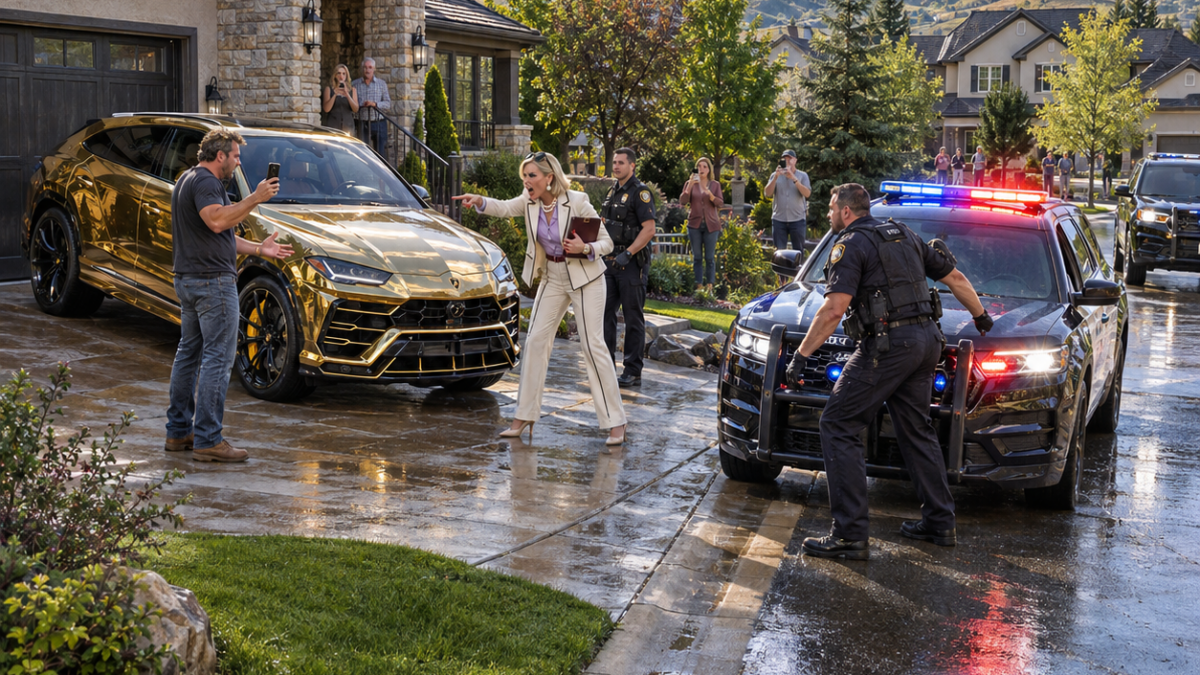
The first police cruiser came around the corner so fast that its tires barked against the pavement, and as the red-and-blue lights washed over my driveway, I stood beside the Lamborghini I had spent fifteen years working toward while the president of my HOA pointed at me and screamed for the officers to arrest me.
Thirty minutes earlier, Valerie Monroe had been smiling in a pink blazer, holding out a single crisp dollar bill and insisting that selling her son my nearly three-hundred-thousand-dollar Urus for one dollar would be a “good deed,” but the moment I told her no and ordered her off my property, her smile vanished and something far uglier stepped out in its place.
I thought I was dealing with an entitled neighbor throwing a tantrum over a car, but when I saw the confidence in Valerie’s face as she lied to a 911 dispatcher with me recording every word, I realized the Lamborghini was only the excuse—and what she really could not tolerate was a homeowner who refused to obey her.
My name is Ethan Cole.
And before that Saturday morning, my biggest problem was deciding whether I wanted to spend the day working or washing my car.
I chose the car.
It was one of those rare Colorado mornings when everything felt clean.
Rain had rolled through during the night, leaving the pavement dark and the air cool. The foothills beyond Lakeside Meadows were sharp against a blue sky, and sunlight was just beginning to creep across the roofs of the houses on Maple Crest Drive.
My Lamborghini Urus sat in the driveway.
Metallic gold.
Mirror finish.
Not subtle.
I had never intended it to be.
For fifteen years, I had built a cybersecurity company from a rented office, two used laptops, and a credit card I probably should not have been approved for.
I worked weekends.
Missed vacations.
Lost clients.
Won them back.
Slept on an office couch during our first major breach-response contract because I couldn’t afford to lose the account or hire another analyst.
There were years when every dollar went back into payroll.
Years when I watched friends buy houses, boats, motorcycles, and take vacations while I was trying to convince companies that six people in a cramped office could protect networks better than firms ten times our size.
Eventually, we could.
And eventually, I stopped worrying about whether payroll would clear.
The Urus came later.
To everyone else, it was an expensive SUV.
To me, it was proof that the years when I nearly quit hadn’t won.
So yes, I took care of it.
That morning, music was playing quietly through the open garage.
I had a microfiber towel in one hand and ceramic detail spray in the other.
I was working around the front wheel when a voice drifted up the driveway.
“Good morning, Mr. Cole.”
My shoulders dropped before I even turned around.
I knew that voice.
Valerie Monroe.
President of the Lakeside Meadows Homeowners Association.
Valerie was in her mid-fifties and dressed for every neighborhood interaction as though a local news crew might appear without warning.
That morning, she wore a bright pink blazer over white pants, enormous sunglasses pushed onto her hair, and the ever-present clipboard tucked beneath one arm.
Beside her stood her nineteen-year-old son, Brandon.
Brandon looked like he would have preferred to be anywhere else.
He was staring at his phone.
“Morning, Valerie,” I said.
Her eyes moved over the Lamborghini.
Not casually.
Possessively.
“Beautiful day.”
“It is.”
She smiled.
“Brandon has been talking about your car for weeks.”
Brandon finally looked up.
“It’s the V8 one, right?”
“Twin-turbo V8.”
His face brightened.
“See, Mom?”
Valerie nodded as though this confirmed something important.
“Yes, honey.”
Then she looked at me.
“His birthday is next month.”
“Happy birthday in advance.”
Her smile widened.
“I promised him something special.”
I waited.
She reached into her handbag.
“So let’s talk numbers.”
I actually laughed.
“What numbers?”
“The car.”
I looked at the Lamborghini.
Then back at her.
“It’s not for sale.”
She produced a checkbook.
“Everything is for sale.”
“Not everything.”
“Twenty thousand.”
I thought I had misheard her.
“For what?”
“The Lamborghini.”
I stared at her.
“Valerie, this car cost close to three hundred thousand dollars before the customization.”
She waved one hand.
“Yes, new.”
“It is six months old.”
“Exactly. Used.”
Brandon’s face changed.
Even he knew where this was going.
Valerie continued.
“I could do twenty-five.”
“No.”
“Thirty.”
“No.”
“Cash.”
“No.”
She lowered the checkbook.
Her expression tightened.
“Mr. Cole, you’re being emotional.”
“About my own car?”
“You’re overvaluing it because you’re attached.”
“I don’t need to value it. I’m not selling it.”
She stepped onto my driveway.
I set down the towel.
“Valerie.”
“Yes?”
“Please stay off the property.”
Her smile became thinner.
“Don’t be dramatic.”
Then she reached into her purse again.
This time, she pulled out a single dollar bill.
Crisp.
Perfectly flat.
She held it between two fingers.
“One dollar.”
For several seconds, I honestly didn’t know what to say.
“Excuse me?”
“Symbolic sale.”
She smiled as though she had solved an international dispute.
“You sell the car to Brandon for one dollar. Think of it as doing something generous for a young man in your community.”
I looked at Brandon.
He looked mortified.
I looked back at Valerie.
“No.”
“Ethan—”
“No.”
Her eyes hardened.
“You haven’t even considered it.”
“I have now.”
I pointed toward the sidewalk.
“Please leave.”
And that was the exact moment her face changed.
PART 2
Valerie stared at me for a long second.
The fake warmth disappeared.
The neighborhood president remained.
But the polite neighbor vanished.
She folded the dollar bill and slid it back into her purse.
“That’s disappointing.”
“I’m sure Brandon will survive.”
Brandon muttered, “Mom, let’s go.”
She ignored him.
Instead, she looked slowly over the Urus.
The gold paint.
Black wheels.
Carbon trim.
Then she opened her clipboard.
“All right.”
I knew that tone.
I’d heard versions of it from managers, vendors, bureaucrats, and clients who were accustomed to getting what they wanted by pretending the rules were on their side.
“All right what?”
“If you’re determined to be uncooperative, we’ll have to discuss the vehicle itself.”
I almost smiled.
“The vehicle itself?”
“It may violate community standards.”
“Which standards?”
“Aesthetic harmony.”
I laughed.
She didn’t.
Valerie ran one manicured finger down a page.
“Excessive reflective finish.”
“That’s not a rule.”
“Potentially disruptive coloration.”
“Also not a rule.”
“Noise.”
“I haven’t started the engine today.”
“Your exhaust is aggressive.”
“My exhaust has a personality. That’s not an HOA violation.”
Her jaw tightened.
“We can amend guidelines.”
I looked at her.
“Because I wouldn’t give your son my Lamborghini?”
“That isn’t what this is about.”
“Then why wasn’t my car a problem five minutes ago?”
Brandon whispered:
“Mom.”
She snapped:
“Quiet.”
That did it.
I pulled out my phone.
Opened the camera.
Pressed record.
Valerie immediately noticed.
“Oh, we’re doing that?”
“We are now.”
I kept my voice calm.
“Valerie Monroe, I’m asking you to leave my private property.”
Her cheeks flushed.
“You don’t get to intimidate me.”
“I’m standing beside my car.”
“You’re being hostile.”
“I’m recording you.”
“You think cameras make you powerful?”
“No.”
I held up the phone.
“They make conversations accurate.”
She looked at the lens.
Then at me.
Her mouth twisted.
“You people with money always think you can do whatever you want.”
I nearly laughed at the irony.
“I’m asking you to leave my driveway.”
She stepped closer to the Urus.
I moved sideways.
Not toward her.
Toward the car.
“Valerie.”
She reached out.
Grabbed the driver’s door handle.
The car was locked.
The sharp mechanical click sounded much louder than it should have.
Something in me went cold.
“Take your hand off my car.”
She jerked the handle again.
“Don’t tell me what to do.”
“Step away.”
“You think you’re above this neighborhood.”
“I think I own my car.”
“You flaunt it in everyone’s face.”
“By parking it at my house?”
“You deliberately create resentment.”
I almost couldn’t believe what I was hearing.
Brandon moved closer.
“Mom, stop.”
She turned on him.
“I said stay out of it.”
Then she pulled out her phone.
I thought she was going to record me.
Instead, she dialed.
I saw the numbers.
9.
1.
1.
My stomach tightened.
“Valerie.”
She raised one finger toward me.
Then the dispatcher answered.
“911, what’s your emergency?”
Valerie’s entire voice transformed.
The anger vanished.
Suddenly she sounded frightened.
Fragile.
Breathless.
“Yes, hello. Please send someone. I’m at 214 Maple Crest Drive.”
I stared at her.
She continued.
“There’s a man threatening me.”
I almost lowered my phone from sheer disbelief.
The dispatcher said something.
Valerie looked directly into my eyes.
“Yes. He’s becoming aggressive.”
“Valerie, you’re being recorded.”
She ignored me.
“He won’t let me leave.”
My mouth fell open.
She was standing at the end of my driveway with the street completely clear behind her.
Brandon whispered:
“Mom, what are you doing?”
She turned away from him.
“I don’t know if he has a weapon.”
I felt a flash of genuine fear.
Not fear of Valerie.
Fear of what she was doing.
False reports can become real emergencies very quickly.
One bad assumption.
One nervous officer.
One sudden movement.
I lowered my free hand.
Kept it visible.
Did not approach her.
“Valerie, I’m staying right here.”
She covered the phone briefly.
Then whispered to me:
“You should’ve taken the dollar.”
That sentence changed everything.
Not because it was threatening.
Because it proved motive.
And my camera caught it.
### **1. THE SIRENS**
Five minutes later, I heard them.
At first faint.
Then louder.
Two police cruisers came down Maple Crest with lights flashing.
By then neighbors were outside.
Curtains had moved.
Garage doors had opened.
People who had spent years avoiding HOA disputes suddenly had front-row seats to one.
I stood near the Urus.
Phone recording.
Hands visible.
Valerie moved toward the street before the cruisers fully stopped.
Four officers got out.
One immediately looked at me.
“Sir, keep your hands where we can see them.”
I raised them slightly.
“My phone is recording.”
“Set it on the hood slowly.”
I did.
Valerie pointed.
“That’s him!”
Her voice shook perfectly.
“He threatened me.”
An officer moved between us.
“Ma’am, step over here.”
“He wouldn’t let me leave.”
“That’s not true.”
The officer nearest me raised a hand.
“Sir, don’t engage.”
“Understood.”
Another officer asked:
“Any weapons?”
“Not on me.”
“Are there weapons in the house?”
“Yes. Secured.”
He nodded.
“Okay. Stay here.”
I could feel every neighbor watching.
That was the humiliating part.
I knew I had done nothing wrong.
But the arrival of police changes appearances instantly.
People don’t see context.
They see four officers.
A man being separated.
A distressed woman.
And they make assumptions.
Valerie knew that.
That’s why she called.
Then a voice came from across the street.
“Officer!”
Dr. Lucas Park was jogging toward us.
Lucas lived opposite me.
Cardiologist.
Quiet guy.
Usually wore running clothes even when he wasn’t running.
He held his phone up.
“I recorded it.”
Valerie turned.
“You stay out of this!”
Lucas stopped.
“I’ve been out of it for ten years, Valerie. That’s probably why you’ve gotten away with so much.”
One officer walked over.
“You witnessed the incident?”
“From the beginning.”
“The whole thing?”
“Most of it.”
He glanced toward me.
“He never threatened her.”
Valerie exploded.
“You don’t know what happened!”
Lucas looked at her.
“I know you offered him money for the car, touched the car after he told you to leave, and called 911 when he wouldn’t sell.”
The lead officer looked toward me.
“Do you have video too?”
“Yes.”
“May I see it?”
“Absolutely.”
I picked up the phone carefully.
Unlocked it.
Played the footage.
Valerie offering twenty thousand.
Twenty-five.
Thirty.
Then the dollar.
Then the threat about HOA rules.
Then her hand on the Lamborghini.
Then the 911 call.
Then the sentence:
**You should’ve taken the dollar.**
Sergeant Whitaker—his name was on his badge—stared at the screen for a moment after it ended.
Then he exhaled.
Slowly.
He looked toward Valerie.
“Ma’am.”
She folded her arms.
“What?”
“From what I’m seeing, Mr. Cole did not threaten you.”
“He intimidated me.”
“How?”
“His posture.”
I looked at Lucas.
Lucas looked away because he was about to laugh.
Whitaker continued.
“You entered his driveway after being asked to leave.”
“This is an HOA neighborhood.”
“That doesn’t make his driveway public.”
“He refused to cooperate.”
“That isn’t a crime.”
“He was aggressive.”
“Your own phone call claims he prevented you from leaving. The video shows the street behind you completely open.”
Valerie’s face reddened.
“Are you taking his side?”
Whitaker’s expression barely changed.
“I’m looking at evidence.”
“Do you know who I am?”
Lucas actually coughed.
Whitaker looked tired.
“Yes, ma’am.”
“I am president of Lakeside Meadows.”
Whitaker paused.
“Okay.”
The single word destroyed her entire performance.
She stared at him.
“Okay?”
“Being HOA president doesn’t change state law.”
Something snapped.
Maybe it was humiliation.
Maybe the realization that the uniform in front of her outranked the title printed on her clipboard.
Maybe she simply could not tolerate being told no twice in the same morning.
She turned toward my landscaping.
There was a decorative river rock beside the flower bed.
About the size of a grapefruit.
She grabbed it.
I saw where her eyes went.
The Urus.
“If I can’t—”
Officer Ruiz moved instantly.
“Ma’am! Drop it!”
Valerie lifted her arm.
Ruiz tackled her before she could swing.
The rock hit the concrete.
Brandon shouted:
“Mom!”
Whitaker and another officer secured her hands.
Valerie screamed.
Not words at first.
Just rage.
Then:
“Get off me!”
“Stop resisting.”
“This is assault!”
“Ma’am, stop moving.”
“You’re arresting the wrong person!”
The cuffs clicked.
The entire street became silent.
Whitaker stood.
“Valerie Monroe, you are being detained for filing a false report, trespassing, and attempted property damage.”
“You can’t!”
“Stand up.”
“I know the mayor!”
Lucas whispered beside me:
“Of course she does.”
I nearly laughed.
Didn’t.
Brandon stood near the curb with his face in his hands.
As officers moved Valerie toward the cruiser, she twisted around.
“This is your fault!”
I didn’t answer.
She screamed again.
“You humiliated me!”
That finally pulled a response from me.
“No, Valerie.”
She looked at me.
“You did this yourself.”
The cruiser door shut.
### **2. AFTER THE LIGHTS LEFT**
The street remained crowded after police left.
Nobody knew where to look.
One neighbor slowly dragged his trash bin inside as if he had come outside only for that.
Another pretended to inspect flowers.
Lucas walked over.
“You okay?”
I looked at the Urus.
The rock had landed perhaps six feet from the front bumper.
“Ask me tomorrow.”
He held up his phone.
“I’ve got backup footage.”
“Save three copies.”
He grinned.
“Cybersecurity guy.”
“Occupational disease.”
Brandon was still standing near the sidewalk.
I walked toward him.
He stiffened.
“I’m not mad at you.”
His eyes stayed lowered.
“She does this.”
“What?”
“When she doesn’t get what she wants.”
He swallowed.
“Not like this.”
That told me more than he intended.
“Do you have a ride?”
“Yeah.”
He shoved his hands into his pockets.
“I’m sorry.”
I nodded.
“Go home.”
He left.
For the rest of Saturday, my phone buzzed constantly.
The HOA group chat.
Texts.
Neighbors.
Rumors.
Someone posted:
**I heard Ethan threatened Valerie with a gun.**
Five minutes later:
**Police arrested Valerie, not Ethan.**
Someone else:
**This is why we need to stop judging before facts come out.**
Then:
**Does anybody know what happened to the Lamborghini?**
I turned the phone off.
That evening, I sat alone in my living room.
For the first time since buying the car, I considered putting it in the garage permanently.
That thought made me angry.
Not because I needed people to see it.
Because fear was already changing my behavior.
Valerie had been arrested, but part of what she wanted had worked.
She made me wonder whether enjoying something I earned was somehow inviting trouble.
The doorbell rang around eight.
Sergeant Whitaker stood outside.
“Evening.”
“Sergeant.”
“Can I come in?”
“Sure.”
He declined coffee.
“Mrs. Monroe made bail.”
I wasn’t surprised.
“She’ll be facing charges.”
“What kind?”
“False reporting. Trespass. Attempted criminal mischief depending on how the DA frames the rock incident.”
I nodded.
“You have good evidence.”
“Lucas too.”
“That helps.”
Whitaker paused.
“I’m going to give you the same advice I give anyone when a neighborhood dispute turns criminal.”
“Document.”
He smiled slightly.
“You already know.”
“Anything else?”
“Don’t engage.”
“That may be difficult.”
“Why?”
“She’s HOA president.”
His expression changed.
“Ah.”
“Exactly.”
He rubbed his forehead.
“You’re about to receive more paperwork than a divorce attorney.”
“I can handle paperwork.”
“Good.”
He stood.
“Keep cameras on.”
I walked him to the door.
Before leaving he glanced toward the garage.
“That the car?”
“The famous one.”
He looked at it.
Then at me.
“One dollar?”
“One dollar.”
He shook his head.
“Fifteen years doing this job.”
“What?”
“I thought I’d heard everything.”
### **3. VALERIE’S FIRST COUNTERATTACK**
Monday morning, an envelope was taped to my front door.
Official HOA seal.
Lakeside Meadows Board of Directors.
I already knew.
Inside:
**NOTICE OF VIOLATION**
The letter accused my Lamborghini Urus of violating “community aesthetic and harmony standards.”
The listed offenses:
**Excessive reflective finish.**
**Non-neutral exterior coloration.**
**Noise disturbance.**
And my favorite:
**Public nuisance resulting from emergency police presence.**
I read that one twice.
Then laughed.
They were fining me because Valerie called the police.
At the bottom:
**President Valerie Monroe**
The notice was dated Friday.
The day before the incident.
I stopped laughing.
That was significant.
She had prepared retaliation before calling 911.
I photographed it.
Scanned it.
Checked the document metadata when possible.
Then drove to the county records office and obtained the current HOA filings and governing documents.
That evening, my dining table became a war room.
CC&Rs.
Board rules.
Vehicle restrictions.
Noise provisions.
Architectural standards.
I went line by line.
No color restrictions on personal vehicles.
No reflective-finish restriction.
Noise provisions applied to parties and powered lawn equipment during quiet hours.
Nothing about factory legal vehicles.
Nothing remotely supporting her notice.
I drafted an appeal.
Certified mail to the board.
Copy to the management company.
Copy to the association’s attorney.
Copy to my lawyer.
My attorney was Rachel Donovan.
She had helped my company with a property dispute years earlier.
Direct.
Unimpressed by drama.
She read the violation.
“This is retaliation.”
“Obviously.”
“Obvious isn’t enough. Evidence is.”
I showed her the date.
She smiled.
“Better.”
Then she looked at me.
“What do you want?”
“I want her to stop.”
“That isn’t a legal remedy.”
“I know.”
“Damages?”
“Not unless necessary.”
“Removal?”
I thought about it.
“I don’t know yet.”
Rachel leaned back.
“Then don’t rush. People who abuse authority tend to produce evidence faster when they feel challenged.”
That afternoon, I created a private neighborhood group.
**LAKESIDE TRANSPARENCY**
I uploaded my own video.
No dramatic editing.
No music.
Just what happened.
Caption:
**If you’ve ever received a rule or fine from this HOA that you believe was fabricated or retaliatory, send it to me.**
Within six hours, sixty-seven comments.
Twenty-two private messages.
People sent photographs.
Violation notices.
Emails.
Stories.
A retired couple fined because their garbage bins were visible twelve minutes too early.
A young mother threatened over children’s chalk drawings.
A veteran fined for a small flag bracket that had supposedly required architectural approval.
A widow charged repeated late fees on a landscaping fine she claimed had never been properly issued.
The Lamborghini was suddenly the least interesting part of the story.
Valerie had been doing this for years.
She wasn’t maintaining standards.
She was training people.
If you challenged her, life became difficult.
If you complied, she left you alone.
Control through inconvenience.
And almost everyone had learned the lesson.
### **4. GREG MONROE**
Two days later, my phone rang.
Unknown number.
“Ethan Cole?”
“Yes.”
“This is Greg Monroe.”
Valerie’s husband.
I hit record.
“What can I do for you?”
“We need to resolve this.”
“Your wife has a lawyer.”
“I’m talking neighbor to neighbor.”
“Okay.”
“Take down the video.”
“No.”
He exhaled.
“Ethan.”
“The video is accurate.”
“You’re humiliating my family.”
“Your wife called 911 and falsely reported that I trapped her.”
“She’s under tremendous stress.”
“She tried to hit my car with a rock.”
“You provoked her.”
I almost laughed.
“With the word no?”
“You know exactly what you’re doing.”
“What am I doing?”
“Turning people against her.”
“No.”
I looked at the folder of messages on my desk.
“I think people were already against her. They were just quiet.”
His tone cooled.
“If you don’t remove those posts, the HOA can make your life miserable.”
“Is that a threat?”
“It’s reality.”
“Good.”
“What?”
“I’ve been recording since hello.”
Silence.
Then:
“You son of a—”
I hung up.
Saved the recording.
Sent it to Rachel.
Her response arrived thirty seconds later.
**Thank you, Greg.**
### **5. THE MEETING**
The story escaped the neighborhood.
Someone reposted the video.
Then another person uploaded it to a large HOA forum.
Views climbed.
Ten thousand.
Fifty thousand.
Half a million.
Local reporters contacted me.
I declined interviews.
Valerie’s mugshot spread anyway.
The pink blazer.
Hair disheveled.
Expression furious.
Lakeside Meadows scheduled an emergency HOA meeting Friday night.
I attended.
Forty homeowners filled the community center.
Valerie’s chair was empty.
Greg sat at the front.
Treasurer.
Of course.
He saw me walk in.
His expression tightened.
“Mr. Cole.”
“Mr. Monroe.”
“We weren’t expecting you.”
“Public meeting.”
He glanced toward the board.
“We’re here to discuss the unfortunate incident and restore community stability.”
I sat in the front row.
“Which incident?”
He ignored me.
A neighbor called:
“The fake police report.”
Another:
“The fake car fine.”
Someone else:
“The years of fake fines.”
Murmurs spread.
Greg slammed a folder onto the table.
“Enough.”
The room quieted.
“This association will not become a mob.”
I stood.
“No.”
Every face turned.
“But it also won’t remain a private kingdom.”
Greg narrowed his eyes.
“You’re out of order.”
“I’m not on the board.”
“Then sit down.”
I held up the bylaws.
“Section 4.7.”
People shifted.
Greg’s face changed.
I continued.
“A special recall vote may be called with signatures from twenty-five percent of members.”
Silence.
Then whispers.
Greg said:
“You have no idea what you’re doing.”
“I read the bylaws.”
“You’re destabilizing the association.”
“No.”
I looked around the room.
“I’m asking whether homeowners still trust someone who called 911 on a resident because he wouldn’t sell her his car.”
A woman in the second row raised her hand.
“I’ll sign.”
Another:
“Me too.”
Lucas stood.
“Put my name first.”
By the time I walked out, twelve people had asked for copies.
Within a week, eighty homeowners signed.
More than double the requirement.
The recall meeting never happened.
Valerie resigned through her attorney.
Her statement cited:
**Emotional distress and concerns for personal safety.**
Not the false report.
Not trespassing.
Not the rock.
Personal safety.
I expected to feel victorious.
Instead, I sat in my car and felt the tension leave my body.
That was better.
### **6. BRANDON**
Brandon stopped by three days later.
No Valerie.
No Greg.
Just him.
He stood at the edge of the driveway.
“Can I talk to you?”
“Sure.”
He looked at the Urus.
“I really am sorry.”
“You’ve said that.”
“I mean for all of it.”
He rubbed the back of his neck.
“I never asked her to buy it.”
“I figured.”
“I said it was cool.”
I nodded.
“She turned that into a mission.”
“Yeah.”
He looked embarrassed.
“She does that.”
I leaned against the garage.
“Are you okay?”
He shrugged.
“People online are destroying her.”
“That’s not something I control.”
“I know.”
He looked at me.
“I don’t think she understood how crazy it sounded.”
“One dollar?”
“She thought you’d say yes.”
“Why?”
“Because she thinks people want her approval.”
That sentence explained almost everything.
Valerie didn’t believe the dollar was fair.
She believed her status filled the difference.
That her approval was worth hundreds of thousands.
That people should feel honored to surrender something to her.
Brandon shoved his hands into his pockets.
“I don’t want to be like that.”
“Then don’t.”
“Easy for you to say.”
“No.”
I shook my head.
“It’s simple to say. Hard to do.”
He looked up.
“How?”
“Learn to hear no without turning it into an insult.”
He nodded.
Before leaving, he smiled at the Lamborghini.
“Still not selling?”
“Not even for two dollars.”
He laughed.
It was the first moment of the entire mess that felt human.
### **7. THE APOLOGY**
Valerie’s attorney sent a cease-and-desist letter demanding that I remove all recordings and stop making “defamatory representations.”
Rachel responded.
Her letter was longer than two words.
But the meaning was:
**Truth is a defense.**
Two weeks later, they wanted settlement talks.
Valerie would cover my legal expenses related to the HOA violation appeal.
The false violation would be withdrawn.
She would refrain from contacting me.
And she would make a public apology.
I added one condition.
“Recorded.”
Rachel looked at me.
“You want it recorded?”
“HOA newsletter too.”
“Why?”
“Because she accused me publicly.”
Rachel nodded.
“Fair.”
The apology took place at the next community meeting.
Valerie stood behind the podium.
No pink blazer.
Gray sweater.
No clipboard.
Her voice shook.
“To my neighbors and Mr. Cole, I allowed my pride and my position to affect my judgment.”
She paused.
“I made false accusations.”
The room was completely silent.
“I acted irresponsibly toward Mr. Cole and created a situation that should never have happened.”
She looked toward me.
“For that, I apologize.”
Applause followed.
Not enthusiastic.
Not cruel.
It sounded like release.
Closure.
At least I thought it was closure.
### **8. PRESIDENT COLE**
After Valerie resigned, Lakeside Meadows needed a new president.
Someone nominated me.
I laughed.
Then discovered nobody else was laughing.
Lucas cornered me one evening.
“You should do it.”
“No.”
“Why?”
“I run a cybersecurity company.”
“So?”
“I already have a job.”
“You exposed the problem.”
“That doesn’t qualify me to govern shrubs.”
He smiled.
“Maybe that’s exactly why.”
Residents sent messages.
Stories.
Requests.
Not asking me to become another strongman.
Asking me to make sure there wasn’t another Valerie.
Eventually I agreed to run.
My campaign speech lasted less than three minutes.
“I don’t want power over your homes.”
People looked up.
“I want an association where homeowners don’t fear their own board.”
Silence.
“No surprise fines. No invented rules. No retaliation. Every board decision visible. Every major expense reviewable. Every resident allowed to challenge us without becoming an enemy.”
I looked around the community center.
“And if I’m ever the problem, remove me.”
That last part got the applause.
I won with eighty-six percent.
My first proposal established a resident transparency committee.
My second digitized board records.
My third created a documented appeals process.
For the first time in years, meetings became boring.
Which I considered success.
Then Greg filed a complaint about my Lamborghini.
**Excessive reflection causing driver distraction.**
I laughed for a full minute.
Then put it on the public agenda.
At the meeting:
“Greg, please explain.”
He stood.
“Several residents have reported glare.”
“Names?”
“They prefer anonymity.”
“Dates?”
He provided three.
I pulled up the neighborhood gate logs.
“Interesting.”
His face changed.
“What’s interesting?”
“You were out of the neighborhood during daylight hours on all three dates.”
Laughter.
Greg reddened.
“I received reports.”
“From whom?”
“Residents.”
“Names?”
“I said anonymous.”
I projected my security footage.
His SUV passed my house at 8:47 p.m. on one of the dates.
Dark outside.
Headlights on.
“So unless my Lamborghini has learned to store sunlight and release it at night, this complaint isn’t credible.”
Even Mark Ellison, our vice president, laughed.
I dismissed the violation.
Then I said:
“Greg, this is the last informal warning. False complaints used to retaliate against residents will be treated as harassment.”
He stormed out.
The room remained quiet for a moment.
Then an elderly homeowner began clapping.
Others joined.
I didn’t enjoy embarrassing Greg.
But I needed people to see something.
Rules now required evidence.
Even if the complaint targeted me.
Especially if it targeted me.
### **9. THE LAWSUIT**
For several months, things improved.
Community garden.
Open Q&A meetings.
Fewer fines.
More warnings.
Clear appeal procedures.
Residents volunteered again.
Kids left bicycles on lawns without receiving violation letters.
Then a thick envelope appeared at my door.
**MONROE & ASSOCIATES**
Valerie was suing me.
Defamation.
Intentional emotional distress.
Loss of reputation.
$150,000.
Greg joined the complaint.
I called Rachel.
She read it.
“SLAPP.”
“Meaning?”
“Strategic lawsuit against public participation.”
“They’re suing me for posting factual video?”
“They’re suing you because they want the cost of defending yourself to become punishment.”
I looked through the complaint.
“This is insane.”
“Insane can still be expensive.”
“So?”
“We move to dismiss.”
Rachel tapped the complaint.
“And because you’ve saved everything since day one, we bury them in their own record.”
Court came two weeks later.
Valerie sat at the plaintiff’s table.
Gray blazer.
Hair shorter.
Greg beside her.
Their attorney, Stanford Pierce, described a “campaign of public humiliation.”
When Rachel stood, her voice stayed calm.
“Your Honor, the plaintiff was arrested after making a false 911 report about my client.”
Pierce objected.
Rachel continued.
“She trespassed.”
Another objection.
“Attempted to damage his vehicle.”
“Counsel—”
“All documented.”
The judge raised a hand.
“Do you have evidence?”
Rachel looked at me.
I handed over a labeled drive.
The courtroom screen lit.
There was Valerie.
Pink blazer.
One-dollar bill.
The offer.
The threats.
The door handle.
The 911 call.
**He won’t let me leave.**
Then the wide camera angle.
Open street behind her.
Then:
**You should’ve taken the dollar.**
Finally the rock.
Officer Ruiz tackling her.
When the lights came back on, the room was silent.
The judge looked toward Valerie’s attorney.
“Context?”
Pierce swallowed.
“The video does not capture the emotional environment.”
The judge looked back at the screen.
“It appears to capture quite a lot.”
The motion was granted.
The lawsuit dismissed.
With prejudice.
Valerie was ordered to pay my legal fees under the applicable ruling.
Outside, reporters waited.
I gave one sentence.
“I didn’t win today.”
Microphones moved closer.
“The truth did.”
Then I left.
I didn’t want another viral moment.
I already had enough.
### **10. THE AUDIT**
Six months into my term, state auditors notified Lakeside Meadows that they wanted a financial and ethical review.
Public exposure had attracted attention.
I wasn’t worried about the current board.
I was worried about what we inherited.
Two auditors arrived Monday.
Mr. Blake.
Ms. Wynn.
Efficient people.
Minimal humor.
They reviewed five years.
Contracts.
Invoices.
Vendor records.
Bank statements.
Fine revenue.
Landscaping.
Three days later, Blake called me into the office.
“Mr. Cole, do you know Greencrest Maintenance LLC?”
“Previous lawn contractor.”
“Did you ever meet them?”
“No. We replaced them.”
He turned his tablet around.
“Greencrest doesn’t appear to operate.”
“What do you mean?”
“No employees we can verify.”
He showed me an address.
PO box.
Then:
**Registered contact: G. Monroe**
I stared at it.
“Greg.”
Wynn tapped a stack of invoices.
“Your association paid roughly forty thousand dollars to the entity last year.”
“For what?”
“Landscaping.”
I looked out the office window.
The landscaping had been notoriously bad.
“How much total?”
Blake hesitated.
“Preliminary misappropriation across multiple related payments may exceed eighty-seven thousand dollars over three years.”
My stomach tightened.
Valerie’s petty abuse of authority was one thing.
This was theft.
“Were these payments approved by her?”
“Many.”
“Greg?”
“Signatory involvement appears likely.”
I sat back.
The Lamborghini incident suddenly looked smaller.
Maybe it had never been the real story.
Maybe Valerie’s obsession with authority existed partly because authority protected money.
I called Rachel.
She wasn’t surprised.
“People willing to invent rules are sometimes willing to invent invoices.”
The auditors referred the case.
Subpoenas followed.
Local news returned.
This time the headline had nothing to do with a Lamborghini.
**FORMER HOA PRESIDENT AND HUSBAND UNDER INVESTIGATION OVER ASSOCIATION FUNDS**
Greg came to the HOA office.
He looked smaller.
Tired.
“Ethan.”
“What?”
“We need to talk.”
“About Greencrest?”
He winced.
“Valerie handled most of it.”
“You’re listed on the company.”
“She asked me to create it.”
“You signed checks.”
“I trusted my wife.”
“Residents trusted both of you.”
He lowered his voice.
“She used some of the money for legal costs.”
I stared at him.
“HOA money?”
“She planned to replace it.”
“When?”
He didn’t answer.
“Greg.”
“She wasn’t thinking clearly.”
“That excuse is getting old.”
“If this goes criminal, she’s finished.”
I leaned forward.
“I don’t control the investigation.”
“You could tell the auditors it was a misunderstanding.”
“No.”
“Ethan.”
“No.”
He looked at me with something almost like hatred.
“You enjoy this.”
That made me stand.
“No.”
My voice stayed low.
“I enjoyed washing my car on Saturday mornings.”
He flinched.
“Everything after that has been cleaning up what you and your wife did.”
He left.
The final audit confirmed approximately $87,000 in misused funds and falsified vendor activity.
Valerie and Greg faced financial penalties, restitution requirements, probation, and court supervision.
It wasn’t cinematic.
No one got dragged out screaming.
But every dollar had to be repaid.
Every false contract was documented.
Every resident could finally see where the money had gone.
That mattered more.
### **11. THE DRONE**
By early summer, I believed we had survived the worst.
I was wrong.
Saturday morning.
Same driveway.
Same Urus.
Same towel.
Then:
Buzzing.
A drone hovered above my garage.
Maybe fifteen feet up.
Too low.
I looked up.
“Whose drone?”
It descended slightly.
Camera pointed toward me.
I pulled out my phone.
“If you’re recording private areas, identify yourself.”
The drone followed me toward the side of the house.
Then shot away.
The next morning, I woke to hundreds of notifications.
A video had been posted online.
Title:
**HOA PRESIDENT FLAUNTS $300K LAMBORGHINI WHILE FINING HOMEOWNERS**
Aerial footage of me cleaning the car.
Fake screenshots of fines.
Claims that I bought the Urus with HOA money.
Four hundred thousand views.
Then more.
Comments:
**Same corruption, new president.**
**This guy became the Karen.**
**Where did the money come from?**
For the first time in the entire fight, something hit me personally.
Not anger.
Doubt.
I had spent months rebuilding trust.
One edited video could destroy it in a day.
Lucas came over.
“You okay?”
“No.”
“Good. Means you’re normal.”
I showed him the video.
“I know those screenshots are fake.”
“So do I.”
“People online don’t.”
“Then show them.”
Three days later, an anonymous tip sent to the HOA account included a purchase record for the drone.
Buyer:
**Gregory Monroe.**
Rachel reviewed it.
“We can pursue him.”
“I don’t want another lawsuit.”
“I know.”
“What else?”
She leaned back.
“Sunlight.”
So I recorded a video.
No music.
No editing.
I sat in the garage.
The Urus behind me.
“My name is Ethan Cole.”
I explained the original 911 call.
The recall.
The lawsuit.
The audit.
The reforms.
Then I opened the HOA financial portal on screen.
Every current expenditure.
Every budget line.
Accessible.
“My Lamborghini was purchased with income from a cybersecurity company I built years before I joined this HOA.”
I showed company records where appropriate.
“I have never taken a dollar of association money.”
Then I said something I hadn’t planned.
“I didn’t buy this car to show people I’m rich.”
I looked back at it.
“I bought it because fifteen years ago I was sleeping in an office wondering whether my company would survive.”
I faced the camera again.
“To me, it isn’t proof that I’m better than anybody.”
Pause.
“It’s proof I didn’t quit.”
I finished:
“Integrity is the only luxury worth protecting.”
Uploaded.
A million views in a day.
This time, people looked deeper.
Journalists checked the records.
Residents posted screenshots of the open budget portal.
Police traced the drone back to Greg.
Raw footage was recovered.
The edited claims collapsed.
Greg was cited and penalized for the harassment and privacy-related conduct.
The smear died.
But something else changed.
I no longer felt the need to defend the Lamborghini.
I had spent months letting other people’s reaction to it determine how I saw it.
Valerie wanted it.
Greg hated it.
The internet judged it.
None of that mattered.
It was mine.
Earned honestly.
End of argument.
### **12. REFORM**
Lakeside Meadows became known for something strange.
A functional HOA.
Other communities asked for copies of our transparency policies.
We created a homeowner bill of rights.
No retaliatory fines.
Written evidence for violations.
Accessible financial records.
Independent appeal review.
Recorded board votes.
Open vendor bidding.
Limits on discretionary enforcement.
People joked that we had overcorrected.
Maybe.
But boring systems protect people from exciting personalities.
That was the point.
I was invited to speak at a statewide association conference.
I almost declined.
Lucas said:
“You caused all this. You have to go.”
“I did not cause Valerie.”
“You refused the dollar.”
“That’s not causation.”
“Tell the conference.”
So I did.
Two hundred board members.
Managers.
Homeowners.
Lawyers.
I stood at a podium feeling more nervous than I had in court.
“I used to think bad HOA outcomes came from bad rules.”
People listened.
“I was wrong.”
I clicked to a slide showing the Lakeside Meadows reforms.
“Rules matter.”
“But the bigger problem is what happens when people stop questioning authority simply because it has a title.”
I thought of Valerie.
Pink blazer.
Clipboard.
Dollar bill.
“An HOA can protect a neighborhood.”
“Or it can become a tool for the person most willing to abuse procedure.”
I looked around.
“The difference is accountability.”
Applause came slowly.
Then grew.
I didn’t enjoy being an advocate.
I still preferred cybersecurity.
And cars.
But I understood why I was there.
If our disaster helped another community avoid theirs, then something useful came from it.
### **13. THE CHALLENGE FROM INSIDE**
The strangest conflict came the following winter.
Mark Ellison.
My vice president.
The man who had helped rebuild the board.
He decided to run against me.
At first, I took it personally.
His announcement spoke about:
**Fresh leadership.**
**Less media attention.**
**Avoiding personality-centered governance.**
Everyone knew what he meant.
Me.
The car.
The viral stories.
I went to his house.
“You could have told me.”
He nodded.
“I should have.”
“Why are you running?”
He sighed.
“Because you’re good at this.”
“That makes sense.”
“Too good.”
I stared at him.
He continued.
“Ethan, people associate Lakeside Meadows with you. That’s dangerous too.”
“I’m not Valerie.”
“I know.”
“Then?”
“Good systems should survive without one person.”
That stopped me.
Because he was right.
The entire point of reform was eliminating dependence on a powerful individual.
Even if that individual was me.
“So this isn’t personal?”
“No.”
I studied him.
“If you beat me, you keep the transparency rules?”
“Yes.”
“Open finances?”
“Yes.”
“Appeals?”
“Yes.”
“No invented Lamborghini glare regulations?”
He smiled.
“Especially that.”
I held out my hand.
“Fair election.”
He shook it.
“Fair election.”
The campaign became tense anyway.
Anonymous accounts accused me of using the HOA for publicity.
Others accused Mark of trying to restore the old guard.
I refused to participate in the mud.
At the candidate forum, Mark spoke first.
“Ethan saved this association from a terrible period.”
He looked toward me.
“But our goal should be normalcy. Lakeside Meadows should not depend on one hero.”
That word embarrassed me.
Then it was my turn.
I walked to the microphone.
“Mark is right about one thing.”
The room quieted.
“This community should not depend on me.”
He looked surprised.
“It should depend on rules strong enough to protect you from whoever sits in this chair.”
I looked across the room.
“When I first became president, I promised you that if I became the problem, you should remove me.”
I paused.
“That promise still stands.”
“But don’t vote against me because you’re tired of headlines.”
“Don’t vote for me because you’re grateful.”
“Vote based on whether the system is working.”
I looked toward Mark.
“And if you believe Mark can protect it better, vote for him.”
The applause was louder than I expected.
I won.
Narrower than before.
Which actually made me feel better.
Because residents weren’t worshipping me.
They were deciding.
Afterward, I walked to Mark.
“No hard feelings.”
He shook my hand.
“You meant what you said?”
“Yes.”
“Then we keep working.”
We did.
That election became one of the things I was proudest of.
Not because I won.
Because losing would have been okay.
That meant Lakeside Meadows was finally healthier than the person running it.
### **14. VALERIE’S FINAL SHADOW**
Months passed.
Valerie and Greg moved out of Lakeside Meadows.
Restitution payments continued.
Brandon stayed in touch occasionally.
He went back to school.
Once he sent me a photo of a used Subaru he bought with money from a summer job.
Caption:
**Cost more than $1.**
I laughed for five minutes.
Valerie never contacted me directly again.
Through Greg, I heard she had entered therapy.
I hoped it helped.
Not because I had forgiven everything.
Because punishment without change doesn’t protect anyone.
People sometimes asked whether I hated her.
I didn’t.
I hated what she did.
That’s different.
Hatred requires attention.
I was tired of giving her mine.
### **15. ONE YEAR AFTER THE DOLLAR**
On the anniversary of the incident, Lakeside Meadows held a neighborhood barbecue.
Nobody officially called it an anniversary.
But someone brought a cake shaped like an HOA logo.
On top sat a tiny gold toy Lamborghini.
Lucas pointed at it.
“This is your legacy.”
“Terrifying.”
Kids ran through sprinklers.
Music played.
People grilled burgers.
Officer Ruiz stopped by.
She looked at the cake.
“You people are weird.”
“You tackled the HOA president.”
“Professional duty.”
“Legendary professional duty.”
She laughed.
Then pointed toward the Urus parked nearby.
“You ever consider selling that thing after all this?”
“No.”
“Not even for the right price?”
I looked at her.
She grinned.
“One dollar?”
“Get off my property.”
She laughed so hard she nearly spilled her lemonade.
Later, as sunset spread orange across the street, Lucas stood beside me.
“You know what’s funny?”
“What?”
“This whole thing started because she wanted the car.”
“No.”
He looked at me.
“What?”
“It started because she couldn’t hear no.”
He thought about that.
Then nodded.
“Yeah.”
That was the truth.
The dollar wasn’t important.
The Lamborghini wasn’t even important.
Valerie believed authority meant entitlement.
If she wanted access, approval, money, property, compliance—people were supposed to give.
And when somebody refused, she interpreted the refusal as rebellion.
That is how small authority becomes dangerous.
Not with one giant abuse.
With a thousand tiny moments where nobody says:
No.
### **16. THE REGIONAL COUNCIL**
Our reforms began circulating outside Lakeside Meadows.
That drew criticism.
A regional HOA council invited me to a “review discussion.”
The chair, Diane Holt, sat across from me in a downtown conference room.
“Mr. Cole, your association has become unusually influential.”
“That’s a polite way to say infamous.”
A few people smiled.
Diane didn’t.
“We’re concerned about your Community Rights framework being distributed to other associations.”
“Why?”
“Every community has different needs.”
“Then they don’t have to adopt it.”
“You’re undermining board authority.”
I looked around the table.
“Our policy says boards must document fines, disclose finances, and allow appeals.”
“Yes.”
“Which one is the threat?”
Silence.
A man cleared his throat.
“Too much homeowner control can make management impossible.”
“Homeowners are the association.”
Diane leaned forward.
“You’ve become disruptive.”
“Transparency tends to feel disruptive to systems that aren’t used to it.”
Her smile disappeared.
“We’re asking you to stop publicly promoting these reforms.”
“In exchange for what?”
“We could recognize Lakeside Meadows for community excellence.”
I stared at her.
“You want me to stop sharing transparency rules in exchange for a plaque?”
She stiffened.
“That’s an oversimplification.”
“No.”
I smiled.
“That’s clarity.”
Three days later, our association received notice of a surprise compliance inspection.
Lucas read it in my kitchen.
Then looked at me.
“They’re retaliating.”
“Maybe.”
“What do we do?”
“Nothing.”
“Nothing?”
“We already keep clean records.”
The inspectors arrived.
Reviewed everything.
Budgets.
Contracts.
Voting records.
Garden modifications.
One inspector finally announced:
“You paid fifty dollars above the regional average for mulch.”
I stared.
“Fifty dollars?”
“Yes.”
“Over what period?”
“Annual total.”
Lucas looked at the ceiling.
I said:
“Invoice me personally and we can end the revolution.”
The inspector did not laugh.
The final report found no major violations.
That should have ended the matter.
Instead, Diane filed a petition supported by several regional board leaders to remove me from their council network.
The reason:
**Disruptive advocacy.**
That phrase spread online.
Homeowners loved it.
Within days, residents from other communities began requesting our transparency charter.
Local news covered the dispute.
The council tried to contain it.
Instead, they amplified it.
I ended up standing at an emergency summit in Denver.
Board members.
Attorneys.
Homeowners.
Cameras.
I had no prepared speech.
So I said what I believed.
“HOAs were created to protect shared interests.”
I looked at Diane.
“They were not created to destroy peace of mind.”
Silence.
“They are supposed to manage common property.”
“Not individual lives.”
Some homeowners clapped.
I continued.
“If accountability threatens your authority, then the problem is not accountability.”
More applause.
I finished:
“I’m not against HOAs.”
Pause.
“I’m against tyranny with landscaping bylaws.”
The room erupted.
I regretted the line immediately.
Lucas loved it.
It became a headline.
Of course it did.
### **17. WHAT THE CAR MEANT**
One night after all of that, I took the Urus into the mountains.
No cameras.
No neighbors.
No meetings.
Just a road climbing toward the foothills.
I had forgotten how the car felt when none of the story was attached to it.
The engine pulled smoothly.
The gold hood caught the last light.
I drove until the city became a glow behind me.
Then I stopped at an overlook.
For fifteen years, I had thought success would feel like arrival.
Build company.
Make money.
Buy house.
Buy car.
Relax.
But every time I reached something, another problem appeared.
Maybe that was adulthood.
Maybe peace wasn’t something life gave permanently.
Maybe you built it.
Protected it.
Rebuilt it.
I walked around the Urus.
My hand rested on the hood.
Valerie had reduced it to a symbol of arrogance.
Greg had turned it into evidence of corruption.
The internet had turned it into a meme.
I had let all of them redefine it.
But standing there alone, I remembered the night I first ordered it.
I had been sitting in my office.
One employee remained.
Our largest client had just renewed for another three years.
Fifteen years earlier, I’d been terrified the business would collapse.
That night, I finally believed it wouldn’t.
I opened the configurator.
Metallic gold.
Clicked.
Ordered.
Not because I needed strangers to notice.
Because younger me would have understood what it meant.
I had survived.
That was all.
I smiled.
“Still not worth a dollar.”
### **18. BRANDON’S LETTER**
Around Christmas, I received a handwritten card.
From Brandon.
He wrote:
**Mr. Cole,**
**I wanted to thank you for the way you handled everything. At first I blamed you because our family fell apart after that day. Later I realized the problems were already there. You just said no when the rest of us had stopped saying it.**
I stopped reading.
That line hurt.
I continued.
**My mom used to tell me leadership meant people listened to you. I think she had it backward. I’m starting to think leadership means you still listen when people don’t.**
**I’m studying business now. I don’t know what I’ll do yet, but I know I don’t want to become somebody who thinks money or a title means people owe him things.**
**Also, I bought my own car. It’s not a Lamborghini. But I paid more than one dollar.**
**—Brandon**
I put the letter in my desk.
Not because it proved I won.
Because it proved something better survived.
### **19. THE FINAL MEETING**
Two years after Valerie’s 911 call, I announced that I would not seek another term as HOA president.
Lucas thought I was joking.
“You can’t quit.”
“Watch me.”
“Why?”
“Because Mark was right.”
He stared.
“When?”
“Don’t tell him I said that.”
“About what?”
“The system has to survive without me.”
At the meeting, residents objected.
Some asked me to reconsider.
I didn’t.
I stood at the same podium where Valerie once delivered her apology.
“When I took this seat, I promised it wouldn’t become mine.”
I looked around.
“It belongs to whoever you elect.”
“We built transparent records.”
“Independent appeals.”
“Open finances.”
“Clear limits.”
“If all of that only works while I’m president, then we failed.”
The room grew quiet.
“I’m not leaving the neighborhood.”
A woman called:
“What about the Lamborghini?”
I smiled.
“That stays.”
Laughter.
Mark won the election.
I voted for him.
His first act as president was to remove the reserved parking space labeled:
**HOA PRESIDENT**
He replaced it with:
**VISITOR**
I congratulated him.
He said:
“Trying not to become you.”
“Good.”
“Or Valerie.”
“Better.”
### **20. BACK WHERE IT STARTED**
The following Saturday morning, I washed the Urus.
Same driveway.
Same sunlight.
Same microfiber towels.
But everything else had changed.
No fear when footsteps approached.
No anxiety when a neighbor slowed down.
No wondering whether another violation notice would appear.
Lucas walked by with his dog.
“Morning, civilian.”
“Feels good.”
“You miss being president?”
“Not once.”
“It’s been four days.”
“Longest peaceful four days of my life.”
He looked at the car.
“You ever think about how ridiculous the original offer was?”
“Every time I see a dollar bill.”
He laughed.
Then a mother and her little boy walked past.
The boy pointed.
“Mom! Lamborghini!”
She smiled.
“Ask before you touch.”
The boy looked at me.
“Can I see it?”
“Sure.”
He stayed several feet away.
“Is it fast?”
“Pretty fast.”
“How much does it cost?”
His mother looked embarrassed.
“Jake.”
I laughed.
“A lot more than a dollar.”
Lucas nearly choked.
The kid didn’t understand.
That was fine.
Some jokes deserve to stay with the people who survived them.
### **21. WHAT REVENGE REALLY WAS**
If you had asked me the day Valerie was arrested what revenge looked like, I might have given you a different answer.
Maybe her losing the presidency.
Maybe the apology.
Maybe the dismissed lawsuit.
Maybe the audit.
Maybe repayment.
Maybe watching her authority collapse in public.
But none of those became my favorite part.
My favorite part came years later.
Lakeside Meadows held another summer barbecue.
Mark was president.
I was nobody.
Exactly what I wanted.
A family had moved into Valerie’s old house.
Nice people.
Two kids.
A dog that barked at delivery trucks.
No one cared who used to live there.
The community garden was full.
Budgets were public.
Board meetings lasted under an hour.
People complained about normal things.
Pool hours.
Parking.
Sprinklers.
The kind of boring neighborhood problems I once thought I wanted.
Lucas stood beside me holding lemonade.
“You look happy.”
“I am.”
“Why?”
I looked around.
“Nobody needs me.”
He laughed.
“That sounds depressing.”
“No.”
I smiled.
“It’s perfect.”
That was revenge.
Not Valerie suffering.
Not me becoming powerful.
The system no longer required either of us.
Her fear was gone.
My fight was unnecessary.
People could disagree without becoming enemies.
No one had to be brave just to question a fine.
The neighborhood had become boring.
Beautifully boring.
### **22. ONE LAST DOLLAR**
Near sunset, Brandon arrived.
I hadn’t seen him in almost a year.
He was older.
More confident.
He walked over.
“Mr. Cole.”
“Ethan.”
“Right.”
He smiled.
“I brought something.”
He handed me a small frame.
Inside was a one-dollar bill.
Below it, a tiny engraved plate:
**THE MOST EXPENSIVE OFFER NEVER ACCEPTED**
I laughed.
“You made this?”
“My girlfriend did.”
“Smart woman.”
“She thinks our family story is insane.”
“She is also correct.”
We stood beside the Urus.
Brandon looked at it.
“You know what’s weird?”
“What?”
“I don’t even want one anymore.”
“That is weird.”
“I want a 911.”
I stared at him.
He laughed.
“Porsche.”
“Important clarification.”
For a second, neither of us said anything.
Then he became serious.
“My mom’s doing better.”
“I’m glad.”
“She still doesn’t like you.”
“I’ll survive.”
“She admits she was wrong.”
That surprised me.
“About what?”
“The car.”
“Only the car?”
He laughed.
“Starting small.”
I nodded.
“Good place to start.”
### **23. THE LAST LESSON**
I hung the framed dollar in my garage.
Not as a trophy.
Not to mock Valerie.
As a reminder.
Every time I see it, I remember how quickly something ridiculous became dangerous.
A woman wanted something.
I said no.
She believed my refusal challenged her identity.
So she reached for authority.
HOA rules.
Police.
Public opinion.
Lawsuits.
Complaints.
Smears.
Every tool meant to protect people became, for a moment, a weapon against someone who refused to comply.
That is why transparency matters.
That is why evidence matters.
That is why institutions need limits.
And that is why the word no matters.
A healthy person hears no and adjusts.
An entitled person hears no and negotiates.
A controlling person hears no and punishes.
Valerie punished.
Until the evidence became louder than her title.
### **24. THE END**
The Lamborghini still sits in my garage.
Metallic gold.
Twin-turbo V8.
Still excessive.
Still reflective.
Still completely legal.
Every now and then someone asks whether I would ever sell it.
Maybe someday.
Cars are machines.
Eventually another one will interest me.
Maybe I’ll wake up and decide I want something quieter.
Maybe electric.
Maybe I’ll become one of those people who suddenly claims he always preferred vintage Porsches.
Who knows?
But there is one price I will never accept.
One dollar.
Not because the car is priceless.
Because the story attached to that dollar is.
I spent fifteen years building something from nothing.
Valerie looked at the result and decided she deserved it because she wanted it.
When I refused, she tried to turn authority into ownership.
What she didn’t understand was that authority without accountability is only intimidation with paperwork.
Lakeside Meadows learned that.
So did I.
The Urus used to represent success.
Then it represented conflict.
Then resilience.
Now?
It mostly represents a Saturday morning.
Sunlight on gold paint.
Music playing from the garage.
A towel in my hand.
No sirens.
No clipboards.
No one yelling.
Just peace.
The kind of peace I once assumed happened naturally.
Now I know better.
Peace survives because people defend the rules that protect it.
Because homeowners ask questions.
Because boards show their records.
Because officers watch the evidence before believing the loudest voice.
Because neighbors like Lucas keep their cameras running.
Because people like Brandon learn that love does not mean supporting someone when they’re wrong.
And because sometimes one ordinary word is enough to expose an entire system.
No.
No, I will not sell you my car.
No, you cannot invent a rule because I refused.
No, you cannot lie to police without consequences.
No, you cannot weaponize an HOA because somebody hurt your pride.
No, you cannot spend other people’s money and call it leadership.
No, you cannot rewrite the truth because your version sounds better online.
And no, power does not become legitimate simply because nobody challenged it yesterday.
That was the lesson Valerie never understood until it cost her almost everything.
I learned a different lesson.
Winning isn’t making the person who hurt you suffer.
Winning is reaching a point where their behavior no longer controls yours.
I no longer check the window when a car slows near my house.
I don’t tense when an HOA email arrives.
I don’t think twice before parking the Urus in my own driveway.
I don’t wonder whether somebody thinks it is too flashy.
I don’t care.
Because I know the difference now.
Confidence doesn’t mean believing nobody can challenge you.
That’s arrogance.
Confidence is knowing you can be challenged and still stand on the truth.
One summer evening, long after the last court filing and the last viral video had faded, I stood in my driveway watching the sunset reflect across the Lamborghini’s hood.
Gold turned orange.
Orange turned red.
Then deep blue.
The neighborhood around me was alive.
Kids riding bikes.
A lawn mower somewhere down the block.
Someone grilling.
A dog barking.
Ordinary sounds.
The sounds of a place where nobody was afraid of the person holding the clipboard anymore.
Lucas passed with his dog.
He raised a hand.
“Still got it?”
“Still got it.”
“Still not selling?”
I smiled.
“Depends.”
He stopped.
“How much?”
I looked at the framed dollar visible through my garage window.
Then back at him.
“Two dollars.”
For a second, he stared.
Then he started laughing.
I laughed too.
And maybe that was the best ending possible.
Because two years earlier, one dollar had brought police cruisers screaming down this street.
It had triggered arrests.
Lawsuits.
Recall votes.
Audits.
Scandals.
Reforms.
It had exposed people who believed authority existed for themselves.
Now it was only a joke between neighbors.
The dollar had finally lost its power.
Valerie had too.
And the Lamborghini?
The Lamborghini was exactly what it had always been.
A car.
A beautiful, ridiculous, impossibly expensive car that belonged to the man who bought it.
Nothing more.
Nothing less.
I closed the garage door.
Walked inside.
And left the neighborhood to enjoy the kind of silence nobody needed permission to have.
That was worth far more than three hundred thousand dollars.
And infinitely more than one.