PART 2: HOA Karen Kept Sending an SUV Through My Hedge — The Last Time, Their Car Never Drove Away
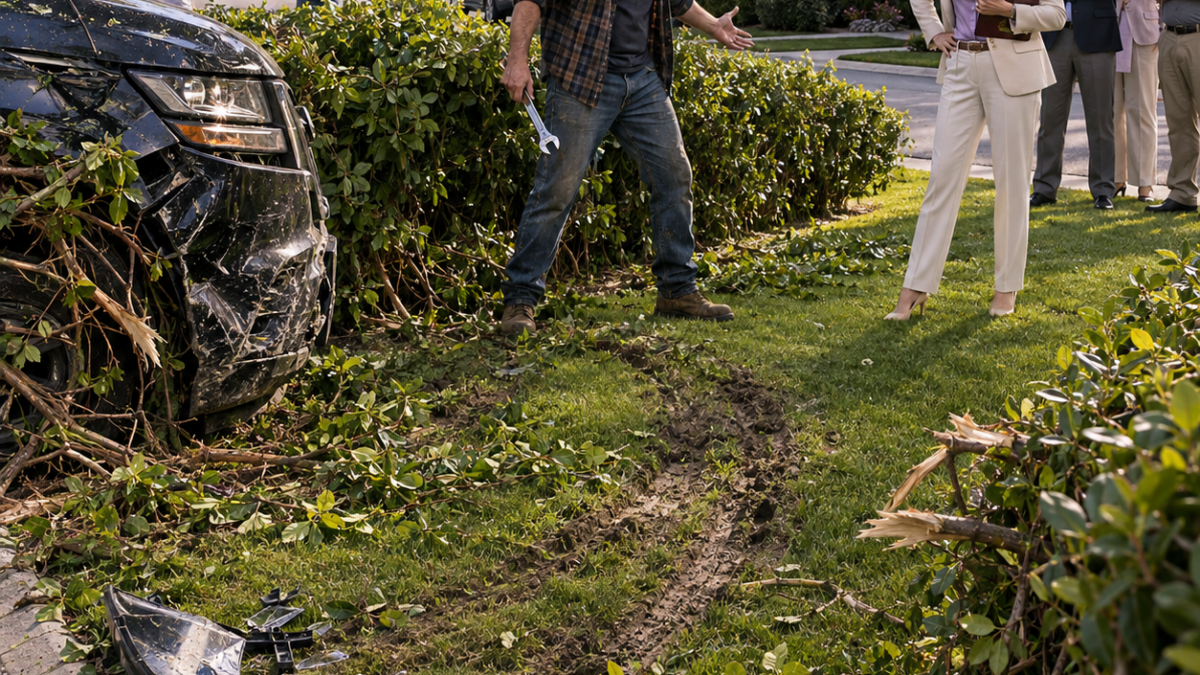
The fourth time a black SUV deliberately jumped the curb and tore straight through the hedge I had spent fifteen years growing around my home, I stood in my driveway holding a wrench and watched branches, dirt, and another piece of shattered headlight explode across the lawn while the driver backed out and disappeared before I could reach the street.
By then I had already endured months of HOA violation notices, smiling threats from President Karen Douglas, whispered warnings from neighbors who suddenly forgot how to see anything, and enough “accidental” damage to know that nobody was losing control of a vehicle—they were trying to make me lose control of my property.
What Karen didn’t understand was that destroying the hedge finally forced me to start asking the one question she desperately needed me never to ask: why did anyone care so much about ten feet of shrubs?
My name is Josh McKenzie, and before all this started, the most controversial thing about me was probably how seriously I took my landscaping.
The hedge ran along the front corner of my property in Hawthorn Ridge, a quiet suburban neighborhood where every mailbox looked related and every lawn seemed to have signed the same contract.
I planted those shrubs fifteen years earlier.
Back then they barely reached my knees.
My late father helped me dig the first holes.
He was seventy-one at the time, stubborn enough to refuse a chair and proud enough to criticize every hole I dug.
“Too shallow.”
I dug deeper.
“Now you’re burying it in China.”
I stared at him.
“You want the shovel?”
“No. I want you to learn.”
That was my father.
He could turn planting bushes into a character test.
He died six years later.
The hedge stayed.
Every spring I trimmed it.
Every winter I checked for frost damage.
I knew which section grew faster because it caught more afternoon sun and which corner had once been crushed by a delivery truck before growing back thicker.
To everybody else, it was landscaping.
To me, it was one of the last things my father and I had built together.
Karen Douglas didn’t care about any of that.
Karen had been HOA president for three years and behaved like Hawthorn Ridge was a small sovereign nation that had accidentally forgotten to give her a crown.
She carried a clipboard everywhere.
She measured lawns.
She photographed trash cans.
She once sent a neighbor a written warning because his Halloween decorations created what she called an “aggressive visual atmosphere.”
Nobody knew what that meant.
The pumpkin had a smile.
Karen first complained about my hedge in June.
She stood on the sidewalk in white tennis shoes and a pink athletic jacket, staring at it as if the leaves had personally insulted her.
“Josh, have you considered removing this?”
“No.”
“It blocks the visual flow of the street.”
“I didn’t realize the street was flowing.”
She ignored that.
“We’re moving toward cleaner sightlines.”
“Who’s we?”
“The community.”
I looked around.
Nobody else was there.
“Seems like the community went to work.”
Her smile tightened.
“This hedge is outdated.”
“My father planted it with me.”
For half a second, I thought that might end the conversation.
Instead she said, “Sentiment can’t override standards.”
That told me everything I needed to know about Karen.
Two weeks later, I found the first tire tracks.
A corner of the hedge had been flattened.
I assumed somebody lost control turning around.
I repaired it.
Six days later, another section was crushed.
Then came the first HOA notice.
**HEDGE APPEARANCE INCONSISTENT WITH COMMUNITY STANDARDS.**
I actually laughed.
My hedge had just been hit by a vehicle, and Karen was citing me because it looked damaged.
I called her.
“Someone drove through my landscaping.”
“Yes,” she said, with suspicious calm. “I’ve seen it.”
“And you’re fining me?”
“Damage doesn’t excuse noncompliance.”
“Karen, somebody ran over it.”
“Which perhaps demonstrates that the hedge is poorly positioned.”
That sentence stayed with me.
The third incident happened at night.
This time I found black paint on a broken branch.
A week later came the fourth.
I had been working on my truck when I stepped inside for a different wrench.
Two minutes.
That was all.
When I came back, headlights were already turning toward me.
The SUV accelerated.
Not drifted.
Not slipped.
Accelerated.
It crossed the curb and buried its front end in the hedge.
Then reversed violently.
For a moment the vehicle stopped beneath a streetlight.
I couldn’t see the driver’s face.
But I saw the shape of him.
A man.
Broad shoulders.
Then he disappeared.
I looked down at the mangled shrubs my father and I had planted fifteen years earlier.
Something inside me finally changed.
This wasn’t about gardening anymore.
And I was finished pretending it was an accident.
PART 2
I stayed outside long after the SUV disappeared.
My wrench was still in my right hand.
I hadn’t even noticed how tightly I was holding it until my fingers started aching.
The hedge looked worse than it ever had.
One entire section had been pushed almost flat against the soil. Branches were snapped at the base. Fresh tire tracks cut through the flower bed.
Near the curb, something glittered.
I bent down.
A piece of plastic.
Headlight housing.
Larger than the fragment I’d found after the first incident.
Black trim.
A stamped manufacturer code.
I turned it over in my hand.
“Got you.”
Not completely.
But it was something.
I didn’t sleep much that night.
Every time I closed my eyes, I saw the SUV accelerate.
That was the detail that bothered me.
Someone didn’t simply hate my hedge.
Someone was willing to damage an expensive vehicle repeatedly to get rid of it.
That made no sense.
Not yet.
The next morning I called my friend Dave Patterson.
Dave owned an auto shop four miles outside Hawthorn Ridge and knew vehicles the way some people know their children.
I put the plastic fragment on his counter.
He turned it over.
“Where’d you get this?”
“Front yard.”
“That isn’t usually where headlights reproduce.”
“Funny.”
He cleaned the stamped number.
Typed something into his computer.
Then whistled.
“Luxury SUV.”
“What kind?”
He turned the screen.
The model matched the black vehicle I’d seen.
Heavy.
Expensive.
Reinforced front bumper package.
“This isn’t somebody’s old pickup,” Dave said. “Whoever keeps hitting your bushes has money to burn.”
“My hedge.”
“What?”
“Not bushes.”
He stared at me.
“You brought a broken headlight to my shop in a freezer bag and corrected my shrub terminology.”
“My father planted it.”
His expression softened.
“Okay.”
He handed the piece back.
“Your hedge.”
“Can you tell if this came from a specific car?”
“Serial numbers won’t identify one vehicle. But if somebody brings one in with matching damage…”
He stopped.
“What?”
Dave leaned over the counter.
“This is funny.”
“I haven’t heard the funny part.”
“Somebody called yesterday asking whether I could repair front bumper and headlight damage on the same model.”
My pulse changed.
“Who?”
“They haven’t brought it in.”
“Name?”
Dave hesitated.
I didn’t pressure him.
Then he said, “Richard Douglas.”
Karen’s husband.
There it was.
The answer I’d expected and still somehow hadn’t wanted.
Richard wasn’t exactly intimidating.
He was a big guy, maybe fifty-eight, with the kind of confidence that came from loudly explaining things he had never personally done.
At neighborhood cookouts, he talked about military strategy despite never serving.
He talked about construction despite hiring people to assemble his deck.
He talked about cars despite calling roadside assistance to change a tire.
But Richard owned a black SUV.
I had seen it.
Everybody had.
I drove home slowly.
Karen was outside when I turned onto our street.
She stood beside the community mailbox cluster talking to another homeowner.
When she saw my truck, she stopped talking.
Just for a second.
That was enough.
I parked.
Got out.
She continued toward me.
“Josh.”
“Karen.”
“I noticed the hedge was damaged again.”
“Did you?”
“Terrible.”
“Really terrible.”
She folded her arms.
“This does reinforce the HOA’s position that it may be creating a traffic hazard.”
I almost admired the nerve.
“Karen, vehicles don’t normally accelerate across lawns because a hedge exists.”
She smiled.
“Accidents happen.”
“Four?”
Her smile stayed.
“Unfortunately.”
“Your husband drive much at night?”
The smile disappeared.
Only briefly.
Then returned.
“Excuse me?”
“Nothing.”
I walked inside.
That afternoon, another violation appeared.
**UNSAFE LANDSCAPING CONDITION.**
I stared at the paper.
Then laughed.
It wasn’t funny.
But sometimes laughing is what keeps anger from becoming action.
I had been treating the hedge as something I needed to defend emotionally.
That was over.
I needed evidence.
So I installed cameras.
Not hidden spy equipment.
Ordinary home security cameras.
Driveway.
Front walk.
Property line.
One pointed directly toward the damaged hedge and street.
I added motion lights.
Then I called the city.
I wanted to know exactly what I could legally install along my property line.
That conversation changed the direction of everything.
A permit clerk named Denise listened patiently while I explained that vehicles had repeatedly crossed my lawn.
“You want fencing?”
“Maybe reinforced landscaping.”
“Decorative barrier?”
“Something that prevents cars from crossing onto the property.”
“Bollards?”
“Maybe.”
She explained setback requirements.
Visibility requirements.
Height.
Permit rules.
Nothing exciting.
Exactly what I needed.
I contacted a licensed landscape contractor.
His name was Miguel Santos.
He came out the next morning.
I showed him the tire tracks.
He frowned.
“Somebody doing this intentionally?”
“Looks like it.”
“You call police?”
“I’ve made reports.”
He studied the damaged section.
“We can install decorative stone planters behind the hedge line. Reinforced. Anchored properly. Visible from the road. They’re meant for vehicle deterrence around commercial landscaping.”
“Legal?”
“With permit and setback, yes.”
“Could a car drive through them?”
“Not comfortably.”
That was good enough for me.
I did not want anybody injured.
I did not want hidden spikes.
I did not want a booby trap.
I wanted something on my property that made the next driver discover the ancient principle that shrubs were not an invitation to cross a property line.
We submitted the permit.
It was approved.
Miguel’s crew installed three low reinforced stone landscape barriers several feet behind the legal boundary.
They were plainly visible if you were driving normally on the road.
Then we replanted damaged shrubs around them.
From the street, it looked like landscaping.
Because that’s what it was.
Karen appeared before the crew finished.
“What is this?”
Miguel looked at me.
I looked at her.
“My yard.”
“These structures weren’t approved by the HOA.”
“They were approved by the city.”
“You need architectural review.”
“I checked the covenants.”
Her eyes narrowed.
“Then you know exterior modifications require authorization.”
“Not these.”
“They alter the streetscape.”
“So does Richard’s SUV.”
Miguel coughed into his fist to hide a laugh.
Karen stared at him.
Then at me.
“You’re becoming very difficult.”
“I’ve been told.”
She moved closer.
“What exactly are these for?”
“Protecting the landscaping.”
“From what?”
I looked straight at her.
“Cars.”
For one second, neither of us spoke.
Then Karen smiled.
It was the kind of smile people use when they’re angry enough to make promises they shouldn’t.
“You really think you’re clever.”
“No.”
I nodded toward the barriers.
“I think concrete is.”
She turned and walked away.
That night, nothing happened.
The second night, nothing.
The third night, rain.
The fourth, silence.
By the fifth, I started wondering whether Karen had finally realized the game was over.
At 2:17 in the morning, I woke to a sound so violent it shook the front windows.
**CRASH.**
Then metal grinding against stone.
Then a horn.
Continuous.
I was out of bed before I was fully awake.
I grabbed my phone.
Put on shoes.
Looked through the front window.
The black SUV sat halfway across my lawn.
Its front bumper had collapsed against one of the reinforced landscaping barriers.
The hood was buckled.
A front wheel sat at an angle no engineer had intended.
Steam rose from somewhere beneath the engine.
The horn finally stopped.
The driver’s door opened.
Richard Douglas climbed out.
He stood beside the vehicle, stunned.
Then he looked toward my house.
I stepped onto the porch.
Neither of us spoke.
I folded my arms.
Finally I said, “You okay?”
That was the first question.
Not because I liked him.
Because a destroyed car is funny only until somebody is seriously injured.
Richard flexed one wrist.
“I think so.”
“Need an ambulance?”
“No.”
“Good.”
Then I looked at the SUV.
“Looks like you hit my landscaping.”
His face changed.
“What the hell did you put there?”
“Landscaping barriers.”
“You booby-trapped the hedge!”
“No.”
I pointed toward the street.
“There are reflective markers on both ends. Permit number is filed with the city. They’re visible from the road.”
“You knew somebody would hit them.”
“I knew somebody kept driving onto my property.”
“You did this on purpose.”
“Yes.”
His eyes widened.
I continued.
“I intentionally installed legal barriers to stop people driving through my yard.”
“You destroyed my car.”
“No.”
I looked at the tire tracks.
“You drove your car off the street.”
He opened his mouth.
Closed it.
Then came the moment that made the entire miserable month worthwhile.
Richard realized the cameras were pointed at him.
His eyes traveled from one camera to another.
“You’ve been recording?”
“Every entrance onto my property.”
His face went pale.
Ten minutes later, Karen arrived.
Pink robe.
Slippers.
Hair uncombed.
She saw the SUV.
Stopped.
Saw Richard.
Then saw me.
Her expression passed through disbelief, anger, fear, and calculation in about three seconds.
“What happened?”
I almost felt sorry for her.
Almost.
“Richard drove into the hedge.”
Richard snapped, “There’s concrete in there!”
“Behind it,” I corrected.
Karen stared.
“You trapped him.”
“No.”
“You deliberately damaged our vehicle.”
“I was sleeping.”
“This is sabotage.”
I pointed toward the street.
“Why was Richard driving across my lawn at two seventeen in the morning?”
Silence.
Karen looked at Richard.
Richard looked at Karen.
I watched the truth move between them without a word.
Then Karen said, “He lost control.”
“Again?”
Nobody answered.
I held up my phone.
“The entire thing is recorded.”
Karen’s face hardened.
“You don’t have permission to record us.”
“My cameras record my property.”
Richard turned away.
That was when I knew.
Not suspected.
Knew.
They had been responsible every time.
A tow truck arrived.
The driver stepped out and stared at the SUV.
“What’d you hit?”
Richard answered before I could.
“A hidden barrier.”
The driver looked toward the structure.
Reflective markers.
Stone.
Lights.
Then back at Richard.
“That’s not hidden.”
I had to turn away.
Karen heard me laugh.
“Enjoy this while you can.”
I looked at her.
“Karen, I’m not enjoying your husband nearly getting hurt.”
That surprised her.
“What?”
“I mean it.”
I pointed toward Richard.
“This was stupid. Somebody could’ve been injured.”
She said nothing.
“This stops tonight.”
Her eyes hardened again.
“You don’t control Hawthorn Ridge.”
“And you don’t control my property.”
The tow truck dragged the SUV away.
I went inside.
Made coffee.
Watched the camera footage twice.
The video was unmistakable.
Richard’s SUV approached slowly.
Paused.
Then accelerated directly toward the same part of my hedge.
Nobody could honestly call that an accident.
The next morning, I took the footage to the police.
The officer watched it.
Then looked at me.
“Previous reports?”
I handed him copies.
“Four incidents.”
“You have footage of the others?”
“Only this one clearly.”
He watched Richard accelerate again.
“Why would your neighbor do this?”
“That is what I’d like to know.”
So did I.
Because once the satisfaction faded, the question returned.
Why?
Karen hated the hedge.
Fine.
She was petty.
Fine.
But repeatedly damaging a luxury SUV to knock down shrubs was irrational even by Karen standards.
There had to be more.
Dave called that afternoon.
“You sitting down?”
“No.”
“Sit.”
I did.
“Richard brought the SUV in.”
“I assumed.”
“It isn’t repairable without spending stupid money.”
“I didn’t ask.”
“No, but you’re enjoying hearing it.”
“A little.”
Dave lowered his voice.
“Karen came with him.”
“And?”
“She spent most of the time on the phone outside.”
I waited.
“She kept saying a name.”
“What name?”
“Langford.”
Something about it felt familiar.
“Paul Langford?”
“Maybe.”
I sat straighter.
Paul Langford.
Developer.
Big commercial projects.
Luxury condo developments.
Shopping centers.
He had been trying to buy property on the west side of town for years.
“What was she saying?”
Dave hesitated.
“I wasn’t trying to listen.”
“You listened.”
“Obviously.”
I smiled.
“Go ahead.”
“She said something like, ‘He won’t move, the lot isn’t cleared, and we’re running out of time.’ Then something about permits.”
My stomach tightened.
“The lot?”
“That’s what I heard.”
“What else?”
“‘If McKenzie doesn’t sell, the access plan doesn’t work.’”
Everything inside me went quiet.
“Say that again.”
He did.
I thanked him.
Then I drove home.
For the first time, I looked at Hawthorn Ridge not as a resident.
As a map.
My property sat at the end of the eastern curve.
Behind it was a wooded strip.
Beyond that, an undeveloped parcel.
If somebody wanted to connect the main road to the undeveloped property…
My lot mattered.
Especially the corner where the hedge stood.
The hedge sat near the most logical access corridor.
I pulled county planning maps online.
There it was.
A proposed development area behind Hawthorn Ridge.
No final approvals.
No public construction.
But preliminary filings existed.
One applicant.
**Langford Development Group.**
My heart started pounding.
Six months earlier, Langford had submitted a concept plan for upscale townhomes.
One possible access route passed directly along the edge of my property.
The route looked impossible with my current lot configuration.
Unless I sold.
Or surrendered part of it.
Suddenly Karen’s behavior looked different.
The violation notices.
The pressure to remove the hedge.
The constant claim that it interfered with “street visibility.”
The vehicle attacks.
They weren’t trying to improve my landscaping.
They were trying to make my property unpleasant enough that selling started to sound like relief.
I printed every page.
Then I walked to Karen’s house.
I stopped myself halfway there.
Anger was pushing me.
Anger makes people careless.
So I turned around.
Went home.
Made a folder.
I called it:
**LANGFORD.**
The next morning, I waited near the mailboxes.
Karen appeared at nine.
She saw me.
Her pace slowed.
“Morning.”
“Karen.”
I held up one piece of paper.
Her face changed before she read it.
That told me enough.
“Why does Paul Langford’s preliminary development plan depend on access beside my property?”
She blinked.
“I don’t know what you’re talking about.”
“You know exactly what I’m talking about.”
“Josh, if this is another accusation—”
“Richard drove through my hedge at two in the morning.”
“He lost control.”
“His vehicle approached at twelve miles an hour, stopped, then accelerated directly onto my lawn.”
Her lips pressed together.
“I have video.”
“I know.”
“And now I have this.”
I held up the development plan.
She looked toward the street.
Nobody nearby.
Then back at me.
“Where did you get that?”
“Public planning records.”
For the first time since I’d known Karen, she looked genuinely scared.
Not angry.
Scared.
“Josh.”
“Why does Langford want my property?”
“It’s complicated.”
“No.”
I stepped closer.
“It stopped being complicated when your husband drove onto my lawn.”
Her shoulders dropped.
“Langford wants several houses.”
“How many?”
“I don’t know exactly.”
“Mine?”
“Yes.”
There it was.
The truth.
“And you’ve been helping him.”
She looked down.
“He promised the HOA major improvements.”
“That’s not what I asked.”
Silence.
“What did he promise you?”
Her jaw tightened.
“Nothing.”
“Karen.”
“Nothing directly.”
“That is a lawyer’s answer from someone who isn’t a lawyer.”
She looked at me.
“He said if the project went through, there might be a consulting role.”
“How much?”
“I don’t know.”
“You do.”
She closed her eyes.
“Seventy-five thousand.”
I actually laughed once.
Not because it was funny.
Because fifteen years of memories with my father had apparently been worth seventy-five thousand dollars to Karen Douglas.
“So you wanted me pressured into selling.”
“He told me you’d eventually agree.”
“By destroying my property?”
“I never told Richard to hit the hedge.”
“But you knew.”
She didn’t answer.
“Karen.”
“Yes.”
The word barely came out.
I felt anger rise.
Then something else.
Disappointment.
“You knew your husband was driving into my yard.”
“He said it would make the hedge look unsafe. Then the HOA could require removal.”
“And then what?”
“Langford said once the visual obstruction was gone, he could reopen the access discussion with the planning board.”
I stared at her.
“This wasn’t even about getting me to sell at first.”
“No.”
“You were trying to create a record that the corner of my property was a safety problem.”
Her eyes filled with shame.
“Yes.”
I stepped back.
The whole thing was worse than I’d imagined.
Not because of the damaged plants.
Because this had been planned.
Paperwork first.
Physical damage second.
Then use the damage as proof.
“You filed violations against me for damage you knew your husband caused.”
Karen said nothing.
“That’s fraud.”
“I know.”
“You used HOA authority to help a private developer.”
“I know.”
“You let your husband repeatedly trespass.”
“I know.”
I felt my voice tighten.
“My father planted that hedge.”
Karen looked at me.
“I didn’t know that.”
“I told you.”
Her eyes dropped.
That hurt more.
Not that she didn’t know.
That she hadn’t listened.
She whispered, “I’m sorry.”
I shook my head.
“No. You’re scared.”
She looked up.
“There’s a difference.”
Then her expression changed.
“Josh, you don’t understand Paul.”
“I’m beginning to.”
“He isn’t going to accept this falling apart.”
“That’s his problem.”
“No.”
She moved closer.
“Listen to me. Richard and I were useful. That’s all. Langford has attorneys, contractors, political contacts.”
“Good for him.”
“Stop joking.”
“I’m not.”
“He will come after you.”
“He already has.”
Karen swallowed.
“He’s coming tonight.”
That made me pause.
“What?”
“He knows you found the planning documents.”
“How?”
“I called him.”
I stared at her.
“Of course you did.”
“I panicked.”
“Karen.”
“I know.”
“What time?”
“He didn’t say.”
I took a breath.
“Go home.”
“Josh—”
“Go home.”
“You need to be careful.”
“So do you.”
She walked away.
At 9:47 that night, Paul Langford came up my driveway.
No black SUV.
No entourage.
Just one man in an expensive dark suit.
Early sixties.
Silver hair.
Perfect posture.
The kind of person who probably never carried his own suitcase.
I sat on the porch.
Security camera blinking above me.
He stopped at the bottom step.
“Mr. McKenzie?”
“Depends.”
His mouth almost smiled.
“Paul Langford.”
“I figured.”
He held out a hand.
I didn’t take it.
His arm remained there for a moment.
Then dropped.
“I understand there’s been some friction.”
“Your definition of friction includes cars.”
“I don’t know anything about that.”
“That’s convenient.”
He looked toward my hedge.
The repaired shrubs.
The stone barriers.
His eyes lingered.
“I came to discuss your property.”
“Not for sale.”
“You haven’t heard the offer.”
“Doesn’t matter.”
“Everything has a number.”
“Not everything.”
He studied me.
Then reached into his jacket.
Pulled out a folded document.
“Three times current market value.”
I didn’t take it.
“Generous.”
“It is.”
“Still no.”
“You haven’t looked.”
“I can read the number from here.”
His expression barely changed.
“Mr. McKenzie, the development will benefit the entire district.”
“Then build it somewhere else.”
“The access route makes your parcel uniquely important.”
“There it is.”
“What?”
“The honest sentence.”
His eyes narrowed.
I stood.
“You don’t care about my hedge.”
“No.”
“You care about the land.”
“Yes.”
“And Karen’s HOA pressure?”
“I don’t control Mrs. Douglas.”
“Of course not.”
“And her husband?”
“Never met him.”
That was a lie.
I could tell from the speed.
Not proof.
Instinct.
Langford offered the paper again.
“Take the offer.”
“No.”
“Think about your future.”
“I am.”
“Development is coming whether you want it or not.”
“Not through my yard.”
His voice changed.
Softer.
“People who refuse reasonable solutions sometimes discover that circumstances become inconvenient.”
There it was.
Not a direct threat.
Something meant to live just outside one.
I looked at the camera.
Then back at him.
“Want to say that again?”
He followed my gaze.
His expression hardened.
“I said sleep on the offer.”
“I sleep fine.”
“You may not forever.”
He turned.
Walked away.
I didn’t stop him.
I backed up the recording immediately.
Sent a copy to an attorney.
Then another to a cloud drive.
The next forty-eight hours became ugly.
First came a city notice alleging my landscaping barriers violated sightline regulations.
I called the permitting office.
They checked.
Permit valid.
Inspection complete.
Notice withdrawn.
Then two new HOA violations.
Lawn edging.
Debris.
Both nonsense.
Then my truck tire was slashed.
Clean cut along the sidewall.
I photographed it.
Called police.
Added it to the report.
Then someone entered my garage.
Nothing valuable was taken.
Tools dumped.
Cabinets opened.
Papers scattered.
In the center of the floor sat a brick.
Around it was tied a note.
**LAST CHANCE.**
That did something to me.
Until then, I had been angry.
Now I felt violated.
There’s a difference between somebody damaging the edge of your property and somebody entering the place where you keep your father’s tools.
His old hand plane was on the floor.
One wooden handle cracked.
I picked it up.
Sat on the garage step.
And for the first time since this began, the humor disappeared completely.
My father had used that tool before I was born.
He taught me how to plane a board with it when I was twelve.
“Don’t fight the grain,” he’d told me.
“Read it first.”
I held the broken handle.
Paul Langford had wanted my land.
Karen had wanted money and influence.
Richard wanted to please his wife.
Whatever person had entered my garage had wanted fear.
Instead, they made me patient.
That turned out to be worse for them.
I called my attorney first.
Then police.
Then my friend Joel Carter.
Joel worked in cybersecurity compliance.
Not hacking.
Not secret databases.
Public information.
Corporate filings.
Permits.
Data that people leave lying around because they assume nobody will connect it.
“I need help researching a developer.”
“How legal?”
“Painfully.”
“Good.”
“Public records only.”
“Less fun.”
“Joel.”
“Fine.”
We started with Langford Development Group.
Then subsidiaries.
LLCs.
Political donations.
Zoning applications.
Civil suits.
Contractors.
One company led to another.
Then another.
A pattern appeared.
Langford would identify neighborhoods near development zones.
He’d cultivate relationships with HOA officers.
Offer improvement grants.
Consulting fees.
Future management positions.
Then the HOA would begin documenting “infrastructure deficiencies” near the properties he needed.
Access complaints.
Drainage complaints.
Safety complaints.
Appearance violations.
Pressure.
The goal wasn’t always to force a sale directly.
Sometimes it was to create enough administrative misery that a homeowner accepted an inflated buyout just to escape.
Hawthorn Ridge wasn’t the first.
Joel found two older developments with remarkably similar histories.
In one, three residents had sold after months of HOA violations.
Six months later, their homes were demolished for a new access road.
In another, a property owner had fought a driveway easement for a year before settling.
The HOA president from that neighborhood later appeared on a consulting payroll connected to a Langford subsidiary.
I leaned back from my computer.
“Oh, you have got to be kidding me.”
Joel called.
“You seeing it?”
“Yeah.”
“This isn’t proof of a criminal conspiracy.”
“I know.”
“But it’s ugly.”
“Very.”
Then came the document that changed everything.
Preliminary development plans for Hawthorn Ridge had been submitted six months before Karen’s first hedge complaint.
Attached was an internal project summary accidentally included in an older planning packet.
Most of it was ordinary.
Traffic studies.
Utility routes.
Parcel numbers.
Then one line:
**Primary access dependent on acquisition or easement across McKenzie parcel. Community liaison pursuing compliance leverage.**
Community liaison.
I read the words several times.
Joel said, “Josh?”
“I’m here.”
“That sounds like—”
“Karen.”
“Maybe.”
“No.”
I stared at the timeline.
“This started before she ever mentioned my hedge.”
The realization made me feel strangely cold.
Karen hadn’t looked at my hedge one morning and decided she hated it.
She had been looking for leverage.
The hedge was simply convenient.
I called my attorney.
Her name was Laura Bennett.
She listened.
Then said, “Do not confront Langford again.”
“Wasn’t planning to.”
“You were.”
“I was considering it.”
“Don’t.”
“What now?”
“We package the evidence.”
“For police?”
“For everybody appropriate.”
She contacted a reporter she’d worked with before on land-use corruption.
I contacted the planning board with formal objections.
Joel assembled the public documents.
I supplied video of Richard’s vehicle entering my property.
Copies of HOA notices.
Karen’s recorded conversation admitting Langford wanted the land.
Langford’s doorstep visit.
The threat note.
Police reports.
Nothing anonymous.
Nothing exaggerated.
No dramatic accusations we couldn’t support.
Just evidence.
A journalist named Maya Reynolds called the next morning.
“Mr. McKenzie, I’ve reviewed what you sent.”
“And?”
“I need independent verification.”
“Good.”
She sounded surprised.
“You want verification?”
“I want the truth.”
“Most people who contact reporters want a headline.”
“I want Langford away from my house.”
She spent two days verifying.
She found more than we had.
Former homeowners.
A contractor who had refused to falsify a drainage report.
A former Langford employee who said “community liaison” meant somebody inside an HOA willing to create pressure.
Then Maya found financial transfers.
Not proof of bribery by themselves.
But enough to make investigators interested.
A consulting company owned by Karen’s sister had received payments from a Langford-linked LLC.
Three payments.
Twenty-five thousand each.
Seventy-five thousand total.
Exactly the number Karen had admitted.
Maya called me.
“Josh.”
“Yeah?”
“Your HOA president wasn’t promised seventy-five thousand.”
“What?”
“She already received it.”
I sat completely still.
“When?”
“First payment eight months ago.”
Before the hedge notices.
Before everything.
Karen had lied even while confessing.
She hadn’t been waiting for a future consulting job.
She had already been paid.
The story published Friday morning.
The headline wasn’t about my hedge.
It was much worse for them.
**DEVELOPER’S LAND DEALS TIED TO HOA PRESSURE CAMPAIGNS, RECORDS SHOW**
By eight, local television trucks were outside Hawthorn Ridge.
By nine, the city announced a review of Langford’s pending permits.
At ten thirty, a state investigator called me.
By eleven, Karen was at my door.
Not walking.
Running.
She looked nothing like the Karen who carried a clipboard through the neighborhood.
Hair disheveled.
Blazer crooked.
No makeup.
She pounded twice.
I opened the door but left the storm chain in place.
“You.”
“Morning.”
“What did you do?”
“I sent records to people who know how to read.”
“Langford is furious.”
“That sounds difficult.”
“The project is collapsing.”
“Good.”
“You have no idea what you’ve done!”
“Actually, I have folders.”
“Stop joking!”
Her voice cracked.
I stopped.
“What do you want, Karen?”
“You need to tell them this was a misunderstanding.”
“It wasn’t.”
“Tell the reporter you exaggerated.”
“I didn’t.”
“Tell the city the hedge incidents were accidents.”
“They weren’t.”
“Josh.”
“No.”
She gripped the door frame.
“He’s blaming me.”
“That may be because you took his money.”
Her face went white.
“How—”
“Your sister’s consulting company.”
She looked physically sick.
“You knew?”
“I know now.”
“I can explain.”
“You told me he promised you seventy-five thousand.”
“He did.”
“You neglected to mention he already paid it.”
She looked down.
“Karen.”
“I was going to give it back.”
“When?”
No answer.
“Before or after I sold my house?”
Her eyes filled.
“I made a mistake.”
“No.”
My voice came out quieter than I expected.
“You made dozens of decisions.”
She looked at me.
“You signed notices.”
“You lied.”
“You watched your husband destroy my property.”
“You filed violations using the damage he created.”
“You took money.”
“You told me you were afraid of Langford only after the story started collapsing.”
Tears came down her face.
“I was afraid.”
“I believe that.”
That surprised her.
“But you were also benefiting.”
She covered her face.
For a moment, Karen wasn’t the HOA president.
Just a woman standing on my porch after finally seeing the cost of her choices.
I didn’t enjoy it.
That surprised me too.
“Josh.”
“What?”
“There was a black SUV outside your house last night.”
“I know.”
Her head snapped up.
“You saw it?”
“My cameras did.”
“Langford?”
“Don’t know.”
“You should leave.”
“No.”
“Please.”
“This is my home.”
“You don’t understand him.”
I almost laughed.
“Karen, everybody keeps saying that.”
“Because it’s true.”
“No.”
I shook my head.
“I understand him perfectly.”
“He thinks everybody has a price.”
She stared.
“And people like you taught him he was right.”
That hit.
She stepped back.
“I am sorry.”
I didn’t answer.
She left.
The next morning, the state executed search warrants connected to Langford Development.
By afternoon, the story was everywhere locally.
Bribery investigation.
Zoning manipulation.
Harassment.
Fraud.
The city froze three pending projects.
Investors began distancing themselves.
Langford released a statement describing the allegations as “fabricated claims from disgruntled property owners.”
Then investigators obtained internal emails.
That finished him.
One message from Langford to a project manager referenced my parcel:
**Douglas believes continued HOA enforcement will soften owner. Vehicle issue may accelerate removal of landscaping obstruction.**
Vehicle issue.
He knew.
Another said:
**Need McKenzie out before final access review. Increase pressure without creating police attention.**
I read that sentence twice.
Increase pressure without creating police attention.
Somebody had failed badly.
Richard’s SUV totaled itself against my landscaping.
The state attorney general opened a formal fraud and bribery case.
The developer’s office was searched.
Paul Langford was arrested several days later on charges related to fraud, bribery, conspiracy, and harassment allegations arising from the broader investigation.
I found out at 3:14 in the afternoon.
My phone buzzed.
Maya sent one line.
**They got him.**
Below it was the news alert.
I stared at the screen.
I thought I’d feel triumphant.
Instead, I looked outside at the hedge.
Half the shrubs were dead.
One had been uprooted so many times it never recovered.
The stone barrier Richard hit had a long scrape across it.
I thought about my father.
All the stupid jokes I’d made.
All the nights watching the street.
The garage break-in.
The broken hand plane.
The fear I’d refused to call fear.
I put the phone down.
Then I cried.
Not dramatically.
Just quietly at my kitchen table.
Because sometimes you don’t realize how tired you’ve been until the thing you’re fighting finally stops.
The HOA collapsed almost immediately.
Three board members resigned.
A fourth claimed he had known nothing about the Langford arrangement.
The association’s attorney recommended suspension of enforcement actions while finances were audited.
Every fine issued to me over the hedge was voided.
So were dozens of questionable fines against other residents.
Mrs. Morales knocked on my door that evening.
She carried banana bread.
“I should’ve told you.”
“Told me what?”
“I saw Richard once.”
My expression changed.
“When?”
“Second time your hedge got hit.”
“Why didn’t you say anything?”
She looked ashamed.
“Karen threatened to fine us over our deck.”
I leaned against the doorway.
“Mrs. Morales.”
“I know.”
“Somebody could’ve gotten hurt.”
“I know.”
She started crying.
I took the banana bread.
Not because I wanted it.
Because she needed me to.
“You were afraid.”
“Yes.”
“I understand.”
She looked surprised.
“But next time?”
She nodded.
“No more silence.”
Old Miss Henderson came over the following morning.
“I told you they came at odd hours.”
“You could’ve mentioned Richard.”
She leaned on her cane.
“I am eighty-three years old, Joshua. My days of fighting moving vehicles are over.”
“Fair.”
She examined the hedge.
“You going to replace it?”
“Yes.”
“Same kind?”
“Of course.”
She smiled.
“Your father would approve.”
That stopped me.
“How do you remember my father?”
“He flirted with me while you two planted it.”
I stared at her.
“My mother was alive.”
“I didn’t say I flirted back.”
I laughed so hard my stomach hurt.
That was the first good laugh I’d had in weeks.
Karen disappeared for several days.
Rumor said she was staying with her sister.
Richard hired an attorney.
State investigators interviewed both.
Then, one Tuesday morning at 8:12, Karen appeared.
No clipboard.
No pink blazer.
Jeans.
Gray cardigan.
She stopped at the edge of my yard.
Didn’t step onto it.
That detail mattered.
“Josh?”
I walked outside.
“What do you need?”
“I came to apologize.”
I waited.
She took a breath.
“What I did was wrong.”
No excuses yet.
Good start.
“I let Langford convince me that the development was good for Hawthorn Ridge.”
She looked down.
“Then he offered money.”
“You took it.”
“Yes.”
“The first time?”
She nodded.
“I told myself it was consulting.”
“What were you consulting on?”
“Community relations.”
I almost smiled.
She did too.
Barely.
“I know.”
Her eyes filled again.
“I knew what it really was.”
I said nothing.
“He wanted your property.”
“Yes.”
“I told him you wouldn’t sell.”
“And?”
“He said everybody sells eventually.”
Of course he did.
“He wanted the hedge documented as a safety obstruction. Then he wanted the board to pressure you into removing it. Richard said he could make it look like vehicles naturally had trouble with that corner.”
I stared at her.
“That was the plan?”
“At first.”
“And after the first crash?”
“I should have stopped it.”
“But you didn’t.”
“No.”
“The second?”
She looked away.
“The third?”
“Josh.”
“The fourth?”
Her voice broke.
“I know.”
I let silence sit between us.
Finally she said, “I kept thinking if I stopped, Langford would expose the payments and I’d lose everything.”
“So you decided I should lose my home instead.”
She flinched.
“Yes.”
I hadn’t expected her to admit it that plainly.
For some reason, honesty made anger harder to hold.
Not impossible.
Harder.
She continued.
“Richard and I are separating.”
I said nothing.
“He blames me.”
“Do you blame him?”
She almost laughed.
“We’re both guilty.”
That was more honest than anything I’d ever heard from Karen.
“The HOA is being dissolved.”
I stared.
“What?”
“The board voted this morning to begin dissolution and transition common maintenance functions to a smaller voluntary association while the legal structure is reviewed.”
“You’re serious.”
“Yes.”
“No more hedge regulations?”
“No.”
“No pumpkin emotional-aura violations?”
Her face turned red.
“I should never have written that.”
“You absolutely shouldn’t.”
For the first time, Karen laughed.
Small.
Sad.
Real.
Then she looked at the damaged hedge.
“Your father really planted that with you?”
“Yes.”
“I remember you telling me now.”
“Apparently you didn’t remember when it mattered.”
“No.”
She swallowed.
“I’m sorry.”
I believed her.
That didn’t mean everything disappeared.
Forgiveness isn’t a magic eraser.
“You hurt me, Karen.”
“I know.”
“You made my home feel unsafe.”
“I know.”
“You let somebody use your authority to try to take something that wasn’t theirs.”
“Yes.”
“And your apology doesn’t undo that.”
“I know.”
I looked at her.
“But it’s better than another violation notice.”
She smiled through tears.
“I’ll take that.”
She walked away.
Slowly.
No power stride.
No clipboard.
Just Karen.
I watched until she reached her house.
Then I turned toward the hedge.
For fifteen years, those shrubs had marked the edge of my home.
For two months, they had become a battlefield.
I was tired of looking at a battlefield.
So I rebuilt.
Miguel came back.
We removed the dead sections.
Saved what we could.
Added new shrubs of the same species.
I insisted.
He asked why I didn’t install something easier.
“Because that’s not the point.”
“What is?”
“My father planted these.”
Miguel nodded.
That was enough.
I repaired Dad’s hand plane too.
The handle couldn’t be restored perfectly.
A woodworker made a replacement using walnut from an old board in my garage.
When he handed it back, I ran my thumb over the new handle.
Different.
But familiar.
That became a theme.
Hawthorn Ridge didn’t return to what it had been.
Maybe it became something better.
Without the old HOA structure, neighbors had to talk to one another.
Actual conversations.
Not violation letters.
If someone left trash cans out, another neighbor usually rolled them back.
If a lawn got too high because someone was sick, three people showed up with mowers.
When Mrs. Henderson’s porch step cracked, Richard—before moving out—quietly paid a contractor to fix it.
I never knew whether guilt motivated him.
Didn’t matter.
He did something useful.
The city ultimately approved a different access route for the development parcel, but only after Langford’s project was sold to another company and redesigned under stricter oversight.
My property remained untouched.
The hedge remained.
Six months later, Paul Langford pleaded guilty to several financial charges tied to the broader investigation.
Other counts remained contested.
The evidence exposed similar arrangements in other neighborhoods.
Karen cooperated with prosecutors.
The payments were recovered through restitution and forfeiture.
She received consequences too.
No dramatic escape.
No magical absolution because she apologized.
She admitted her role.
Paid restitution.
Lost the position she had loved more than she understood.
Richard faced the trespass and property-damage consequences connected to the vehicle incidents and his cooperation became part of the larger case.
The SUV?
Total loss.
Dave sent me a photograph before it went to salvage.
I stared at it for a long time.
Front end crushed.
Wheel bent.
Headlight missing.
The same headlight whose broken plastic had started my investigation.
I almost printed the picture.
Then didn’t.
I didn’t need a trophy.
The hedge was enough.
By the following spring, green growth covered the damaged areas.
New leaves filled spaces that had once looked dead.
One Saturday morning, I stood outside trimming the top when Mrs. Henderson called from across the road.
“Josh!”
“What?”
“You’re two inches high!”
I froze.
She stared.
Then grinned.
I pointed the trimmer at her.
“Don’t start.”
She laughed all the way back into her house.
Later that afternoon, I found an envelope taped to my mailbox.
For half a second, my stomach tightened.
Funny how the body remembers.
I opened it.
Handwritten card.
Karen.
**Josh,**
**I moved out today.**
**I don’t expect forgiveness, but I wanted to leave one thing behind that wasn’t a threat, a fine, or an excuse.**
**You were right to stand your ground.**
**I kept telling myself I was protecting Hawthorn Ridge when I was really protecting my position, my money, and my pride.**
**Langford used that weakness because I gave it to him.**
**You didn’t ruin my life. I did enough of that myself.**
**I’m starting over.**
**Thank you for refusing to let me take your home just because I was too afraid to protect my own integrity.**
**And for what it’s worth, your hedge looks good.**
**Karen**
I read the last line twice.
Then laughed.
I put the card in my kitchen drawer.
Not with the violation notices.
Those went into a storage box.
The card stayed with things I actually wanted to remember.
That evening I sat on the porch with coffee.
The sun dropped behind the houses.
The hedge caught the light.
Green.
Full.
Imperfect.
Exactly the way living things are supposed to be.
I thought about my father.
He’d probably have loved the whole story.
Not the corruption.
Not the threats.
He would’ve loved the absurdity of somebody repeatedly trying to destroy the hedge he planted only for that hedge to outlast their entire scheme.
I could almost hear him.
“Too shallow.”
I smiled.
“Yeah, Dad.”
Then another memory came back.
The day we’d finished planting.
I had complained that it looked small.
Dad leaned on the shovel.
“Give it time.”
“That fixes everything?”
“No.”
He looked at the line of tiny shrubs.
“But roots do their work where nobody sees them.”
At twenty-eight, I thought he was talking about plants.
At fifty-something, I understood.
The whole fight had been about what people could see.
Karen saw a hedge.
Langford saw an obstruction.
Richard saw something he could flatten.
I saw my father’s work.
But beneath all of that were roots.
Memory.
Ownership.
Truth.
Community.
Things harder to remove than anybody expected.
I had spent weeks thinking revenge would feel like seeing Richard’s SUV destroyed.
For a few minutes at two seventeen in the morning, it did.
I won’t pretend otherwise.
Watching the same vehicle that had repeatedly torn through my property finally stop against something it couldn’t bully aside was satisfying.
But that feeling didn’t last.
The real satisfaction came later.
It came when the fraudulent notices were voided.
When the city looked at the permits instead of Karen’s claims.
When neighbors stopped being afraid to speak.
When investigators followed the money.
When Langford discovered homeowners weren’t simply inconvenient dots on a development map.
When Karen finally admitted what she had done without blaming me.
And most of all, it came when I replanted.
Destroying is fast.
A vehicle can destroy fifteen years of growth in three seconds.
A lie can damage a reputation in one email.
One corrupt board can turn neighbors against each other in a month.
Building takes longer.
Planting.
Documenting.
Talking.
Trusting.
Waiting.
That isn’t as dramatic.
But it lasts.
A year after the SUV crash, Hawthorn Ridge held its first neighborhood cookout without an HOA committee.
Nobody submitted an application.
Nobody approved the tablecloth colors.
Nobody inspected the grill placement.
People simply showed up.
Dave brought ribs.
Miguel brought his family.
Joel arrived wearing a shirt that said:
**ASK ME ABOUT PUBLIC RECORDS.**
I told him to change.
He refused.
Mrs. Morales brought banana bread.
Mrs. Henderson brought nothing and criticized everybody else’s cooking.
At some point, somebody set up lawn chairs beside my driveway.
A little boy kicked a soccer ball directly into the hedge.
Everybody froze.
The ball bounced harmlessly back.
The boy looked terrified.
I stared at him.
Then at the hedge.
Then I said, “You’re good.”
The adults laughed.
The boy ran away.
Dave handed me a beer.
“You realize you’re famous now.”
“For shrubs?”
“For destroying a developer.”
“I didn’t destroy him.”
“His arrest report disagrees.”
“He destroyed himself.”
Dave nodded toward the hedge.
“And the SUV?”
“Same principle.”
We laughed.
Then he got serious.
“You ever think about selling?”
I looked at him.
“After all this?”
“Land’s worth more now.”
I stared across the yard.
Sunlight moved through the leaves.
My father’s old hedge.
New sections mixed with old.
“Not for sale.”
Dave smiled.
“Thought so.”
As the evening cooled, neighbors drifted home.
I stayed outside.
Lights came on behind windows.
Somewhere down the street, a dog barked.
A sprinkler clicked.
No black SUVs.
No violation notices.
No clipboard.
Just ordinary life.
That was the part I’d fought for without realizing it.
Not control.
Ordinary life.
I went inside and opened the drawer where I’d kept everything.
Karen’s first violation notice.
**HEDGE HEIGHT NONCOMPLIANT.**
The second.
**VISUAL DISHARMONY.**
The police reports.
Photographs.
The piece of headlight casing.
I had kept that too.
I held it.
A broken piece of plastic that once felt like victory.
Now it just looked like garbage.
I walked outside.
Dropped it into the trash.
Closed the lid.
Then stopped.
Laughing.
After everything, Karen would have been proud that the trash can was stored properly.
The thought made me laugh harder.
Maybe that was closure.
Not forgetting.
Not pretending nothing happened.
Being able to remember without feeling like the fight was still happening.
Two years later, the hedge reached almost exactly the height it had before the first collision.
I measured it once.
Not because of HOA regulations.
Because Dad used to measure everything.
Forty-nine inches.
He would’ve told me fifty.
I would’ve said forty-nine.
We would’ve argued.
I miss those arguments.
One morning, I found Mrs. Henderson standing beside the hedge.
She touched a branch.
“Your father would like this.”
“You said that before.”
“Old people repeat themselves.”
“You’re admitting it?”
“I said old people. Not me.”
She started walking away.
Then stopped.
“Josh?”
“Yeah?”
“You know why Karen hated this thing?”
“The development.”
“No.”
I frowned.
She tapped her cane.
“That was why she wanted it gone.”
“Difference?”
“Big difference.”
She looked at the hedge.
“She hated it because it was one thing she couldn’t order around.”
Then she walked home.
I stood there.
Thinking.
Maybe she was right.
People like Karen often aren’t angry at objects.
They’re angry at boundaries.
A hedge says:
Here is where one person’s property ends and another begins.
A fence says it.
A deed says it.
The word no says it.
Langford believed boundaries could be bought.
Karen believed authority could erase them.
Richard believed a two-ton SUV could drive through them.
They were all wrong.
Not because my hedge was stronger.
It wasn’t.
They destroyed it repeatedly.
They were wrong because boundaries don’t disappear when someone violates them.
Sometimes violation makes people defend them more fiercely.
I watered the shrubs.
Went inside.
Made coffee.
And went on with my day.
Years from now, somebody may buy my house.
Maybe they won’t care about the hedge.
Maybe they’ll remove it.
If they own the property legally and choose to, that’s their right.
Strangely, that thought doesn’t bother me.
Because this was never truly about keeping plants forever.
It was about choice.
Mine.
The right to decide what happened to my home without somebody manufacturing violations, buying influence, or using fear to force my hand.
That was what Langford never understood.
Money can buy land.
It cannot automatically buy consent.
Karen learned it too late.
But she learned it.
And Richard learned it at approximately two seventeen in the morning when his SUV discovered that my property line had finally stopped being theoretical.
I still smile about that part.
I’m only human.
But the best part came much later.
One summer afternoon, a young couple stopped while I was trimming the hedge.
They had moved into Karen’s old house.
Their names were Ben and Alicia.
Nice people.
Two children.
No clipboard.
Ben pointed toward the shrubs.
“Is that the famous hedge?”
I groaned.
“Please don’t call it that.”
Alicia laughed.
“We heard the story.”
“Which version?”
“The one where you filled it with explosives.”
I nearly dropped the trimmer.
“What?”
Ben laughed.
“I told her that wasn’t true.”
“For the record, absolutely not.”
“We figured.”
Their daughter, maybe eight, peeked through the hedge.
“Did a bad guy really drive through here?”
I crouched.
“A few people made bad decisions.”
“Why?”
“Because they wanted something that wasn’t theirs.”
She considered that.
Then asked, “Did you win?”
Children love simple questions.
Adults ruin them with complicated answers.
I looked at the hedge.
At Karen’s old house.
At the quiet street.
“Yes.”
She smiled.
Then I added, “But not because their car broke.”
She frowned.
“Then why?”
“Because they didn’t get to make everybody else afraid.”
She nodded as if that made perfect sense.
Then ran home.
Ben smiled.
“That’s a pretty good answer.”
“Took me two years.”
They left.
I finished trimming.
When I was done, I stood at the curb and looked back.
The hedge was green.
Straight enough.
Not perfectly uniform.
A little taller on the sunny end.
Exactly the way it had always grown.
I decided not to fix that.
Dad had planted that section.
He always said nature hated rulers.
Karen would’ve disagreed.
That was fine.
The sun moved lower.
Leaves shifted in the breeze.
For fifteen years, I thought the hedge mattered because my father planted it.
Then I thought it mattered because Karen wanted it gone.
Then because Langford needed my land.
Eventually I understood the bigger truth.
The hedge mattered because I chose for it to matter.
That’s what home is.
Not market value.
Not neighborhood standards.
Not development potential.
It’s the collection of ordinary things you decide are worth protecting.
An old tool.
A porch.
A tree.
A stupid line of shrubs your father helped plant.
Karen and Langford looked at my home and saw leverage.
I looked at it and saw a life.
That was why they lost.
They thought they were fighting a homeowner over landscaping.
They were fighting memory.
And memory has deep roots.
That evening, I sat on the porch until dark.
No stakeout.
No cameras open on my phone.
No waiting for engines.
The security system was still there.
I wasn’t foolish.
But I no longer watched it every five minutes.
A vehicle drove slowly down the street.
For a split second, my shoulders tightened.
Then I recognized Mrs. Morales.
She waved.
I waved back.
The car passed.
Didn’t jump the curb.
Didn’t touch the hedge.
Imagine that.
I laughed quietly.
Some victories are dramatic.
Police lights.
Arrests.
Court filings.
Destroyed SUVs.
Others are almost invisible.
A quiet street.
A good night’s sleep.
A shrub growing where somebody tried to erase it.
I preferred the second kind.
Before going inside, I walked to the oldest surviving section of hedge.
One of the original plants.
Scarred near the base from the first collision.
It had grown around the damage.
The trunk wasn’t straight anymore.
New wood curved over the old wound.
I ran my hand across it.
Dad would’ve liked that.
Not perfect.
Still alive.
I turned off the porch light.
And for the first time in years, I didn’t see the hedge as something I had to defend.
I simply saw it as mine.
That was enough.
Because Karen had tried fines.
Richard had tried an SUV.
Langford had tried money, pressure, threats, and corruption.
They had all believed the same thing:
Eventually, Josh McKenzie would move.
Instead, the developer went to court.
The HOA disappeared.
Karen moved.
Richard lost the SUV.
And the hedge stayed.
Not because I was tougher than all of them.
Not because revenge solved everything.
Because I kept the evidence.
I followed the rules more carefully than the people abusing them.
I refused to let anger make my decisions.
And when they finally exposed themselves, I didn’t have to destroy them.
I simply stopped protecting them from the consequences of what they had already done.
People sometimes ask what happened to the reinforced landscaping barrier.
It’s still there.
Legal.
Permitted.
Covered now by healthy green growth.
Most visitors don’t notice it.
They shouldn’t.
It isn’t a weapon.
It isn’t a trap.
It’s simply a boundary.
And that’s probably the best symbol for the whole story.
A boundary doesn’t chase anyone.
It doesn’t threaten anyone.
It doesn’t punish anyone.
It just stays where it’s supposed to be.
If somebody respects it, nothing happens.
If somebody repeatedly decides they’re entitled to drive through it—
eventually, they discover it was real all along.
And every time I look at that hedge now, I don’t remember the sound of Richard’s SUV breaking apart.
I remember my father handing me a shovel fifteen years earlier.
“Too shallow,” he said.
I complained.
He laughed.
Then he showed me how deep roots needed to go.
Turns out he wasn’t only teaching me how to plant a hedge.
He was teaching me how to stay.