PART 2: I Heard a Clicking Sound Behind a Rusted Storage Door—What We Found Inside Had Been Fighting to Stay Alive for 47 Days
PART 2
The second I stepped outside with the cat in my arms, Ron rushed toward the office.
“I’ll get a bowl.”
“Wait.”
I don’t know why I said it.
Maybe something I had heard years earlier.
Maybe basic instinct.
The cat looked beyond thirsty.
His lips were dry.
His tongue barely moved.
But there was something frightening about the idea of letting him drink as much as he wanted after being deprived for that long.
“Call a vet,” I said.
Ron stared at me.
“Now.”
He called the nearest clinic.
I put the cat on the passenger seat of my pickup, still wrapped in my shirt.
The veterinary receptionist asked questions through Ron’s phone.
“How responsive is he?”
“Hardly.”
“Can he stand?”
“No.”
“Is he breathing?”
“Yes.”
“Do not force water into his mouth.”
That confirmed my fear.
“Bring him immediately.”
I drove.
The clinic was less than fifteen minutes away.
It felt like an hour.
Every red light made me furious.
I kept looking at the passenger seat.
The cat’s chest rose.
Stopped.
Rose again.
“Don’t you do it.”
His eyes didn’t open.
“Not after all this.”
I had no idea what “all this” meant yet.
At that moment, I only knew someone had survived in a locked unit long enough for me to hear him.
“Stay with me.”
The clicking stopped during the drive.
That scared me more.
At the clinic, two technicians met me at the door with a small stretcher.
One took a single look at the cat and said:
“Treatment room. Now.”
The veterinarian came in moments later.
Her name was Dr. Harris.
She had been practicing for more than twenty years.
I watched her expression change as she examined him.
“How long was he in there?”
“The eviction notice was forty-seven days old.”
She looked at me.
“Forty-seven?”
“That’s what it says.”
“Was there food?”
“None that I saw.”
“Water?”
“No bowl with water.”
She touched his gums.
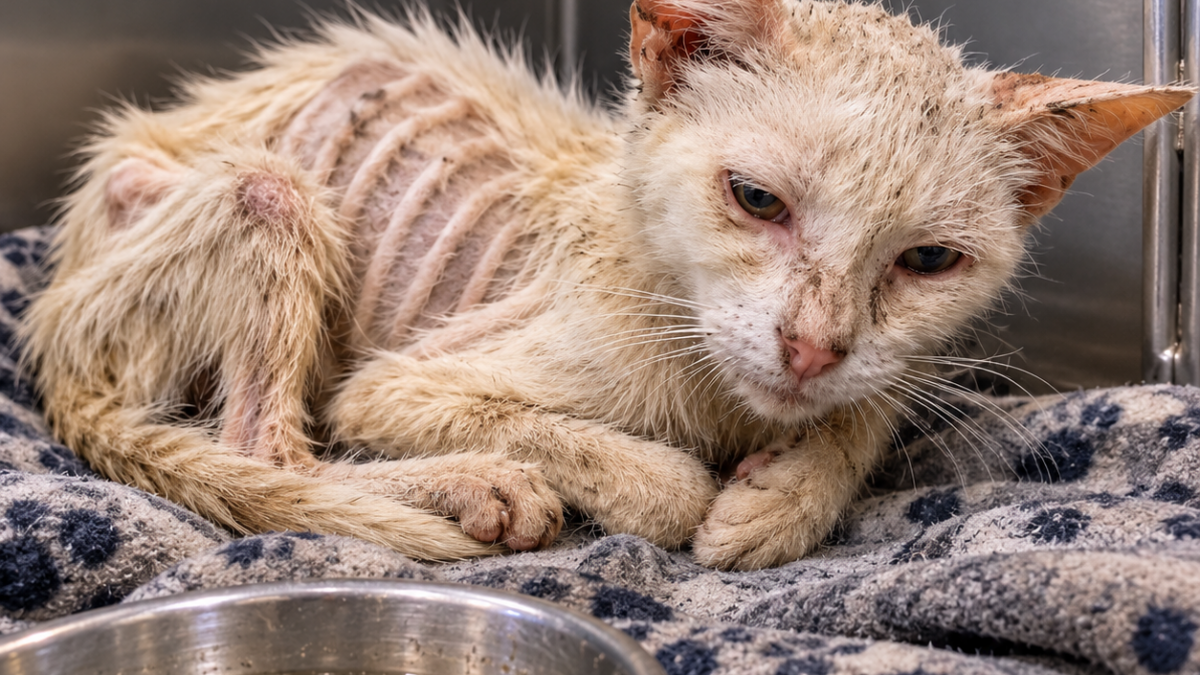
Almost white.
Lifted his lip.
Checked his eyes.
Then gently pinched the skin over his shoulders.
It stayed raised.
One second.
Two.
Three.
Four.
Five.
Then slowly fell.
Dr. Harris’s face became serious.
“He’s critically dehydrated.”
“Can you save him?”
“We’re going to try.”
I hated that answer.
Not yes.
We’re going to try.
She continued.
“He’s profoundly emaciated. If he’s really been without normal food access that long, we have to be careful feeding him.”
“Why?”
“Refeeding syndrome.”
I had never heard the term.
She explained that after severe starvation, suddenly giving too many calories could trigger dangerous shifts in electrolytes.
His body had spent weeks consuming itself.
Muscle first.
Fat.
Anything it could use.
Even his organs had likely slowed.
“We can’t just give him a full bowl of food.”
“He looks starving.”
“He is.”
“Then feed him.”
“Slowly.”
She wasn’t rude.
Just firm.
“Too much too fast could kill him.”
That sentence made the whole thing feel impossible.
Starvation could kill him.
Food could kill him.
Dehydration could kill him.
Too much fluid too quickly could create problems.
Every basic thing a body needs had suddenly become dangerous.
They weighed him.
Four point three pounds.
I actually asked them to check the scale.
“That can’t be right.”
Dr. Harris looked at his frame.
“It is.”
“What should he weigh?”
“Ten. Maybe twelve.”
I stared.
More than half his body weight gone.
A full-grown male cat reduced to four pounds.
They inserted an IV catheter.
He didn’t resist.
That bothered everyone.
A healthy frightened cat would struggle.
Hiss.
Scratch.
Something.
This one barely moved.
His body had given up everything except the functions absolutely necessary to remain alive.
I stood near the wall while they worked.
Someone asked:
“What’s his name?”
I looked at them.
“No idea.”
“Owner?”
“No idea.”
“Who authorizes treatment?”
That question stopped me.
Ron was standing in the hallway behind us.
Technically the cat had been found in a delinquent storage unit.
Animal control would probably become involved.
The facility might have legal responsibility.
The former renter might still technically own him.
But while we figured all that out, the animal was dying.
I said:
“I do.”
Dr. Harris looked at me.
“You understand there may be significant cost?”
“Yes.”
I didn’t actually know what I was agreeing to.
I didn’t care.
“Treat him.”
They kept him.
I should have left.
I had a route.
A schedule.
Freight waiting.
Dispatch calling.
Instead I sat in the waiting room.
After an hour, my phone buzzed.
My dispatcher.
WHERE ARE YOU?
I called.
“Emergency.”
“What kind?”
“Cat.”
Silence.
“What?”
“I found a cat locked in a storage unit.”
Another silence.
“You’re late because of a cat?”
“Yeah.”
“How late?”
“I don’t know.”
He sighed.
“Is it alive?”
“Barely.”
A pause.
Then:
“Send me the clinic location.”
“Why?”
“So I can reroute the load.”
I didn’t expect that.
“Thanks.”
“Don’t make me regret liking animals.”
I hung up.
Dr. Harris came out about two hours later.
“He’s stable for the moment.”
“For the moment?”
“His kidneys are in trouble.”
“How bad?”
“Acute kidney injury. Severe dehydration can reduce blood flow long enough to cause significant damage.”
“Permanent?”
“Too early to know.”
“What else?”
“Liver values are abnormal. Electrolytes are off. He’s severely anemic.”
I looked through the small window into the treatment area.
“How did he survive?”
She shook her head.
“I don’t know.”
That answer stayed with me.
A veterinarian who had seen almost everything did not know how this cat was alive.
Then she asked:
“Are you sure there was no water source?”
“None.”
“Toilet?”
“No plumbing.”
“Leaking roof?”
“Dry.”
“Open container?”
“I didn’t see one.”
“Could he have eaten rodents?”
“Maybe.”
“That could explain some calories. Not hydration.”
She looked thoughtful.
“Something gave him water.”
The next morning, Ron called me.
I was parked at a truck stop west of town waiting for a new dispatch.
“I found something.”
“What?”
“You need to come back.”
“Is this about the cat?”
“Yeah.”
“What did you find?”
“Just come.”
I drove back.
The storage door was open.
Sunlight cut across the concrete floor.
Without the emergency of the day before, I noticed details I hadn’t seen.
An empty cardboard case.
Trash.
Old clothes.
A broken fan.
Scratch marks around the inside of the door.
That made my stomach turn.
He had tried to get out.
Ron walked toward the far wall.
“This side faces north.”
“So?”
“Look.”
He crouched.
At the bottom of the metal wall was a darker line.
Barely visible.
“Touch it.”
I did.
Cooler.
Not cold.
But noticeably cooler than the wall facing the sun.
Then I saw the marks.
Hundreds of tiny vertical scratches.
Close together.
Four or five inches above the concrete.
Not claw marks.
Too fine.
Too shallow.
“What is that?”
Ron shook his head.
“That’s what I wanted you to see.”
I knelt.
A thin film of moisture had collected along one seam.
Not much.
Barely enough to wet my fingertip.
Condensation.
The nights in Kansas could cool sharply after brutal daytime heat.
Metal that had baked all afternoon would lose temperature.
The north wall stayed shaded longer.
Humidity inside the closed unit must have condensed along the lower section.
Just a tiny amount.
A few tablespoons at most.
Maybe less.
I stared at the scratches.
Then understood.
“No.”
Ron looked at me.
“What?”
“He was licking it.”
The words came out quietly.
Ron crouched beside me.
I pointed.
“The marks.”
He stared.
One section was almost polished from repeated contact.
Four inches above the floor.
Exactly where a cat lying on his side could reach.
My chest tightened.
The last weeks.
He hadn’t been standing.
Not at four pounds.
Not with muscle wasting that severe.
So he must have crawled.
Night after night.
Dragged himself toward that wall.
Waited for moisture.
Licked until nothing remained.
Then waited another day.
I called Dr. Harris.
She came to the facility that afternoon.
The second she saw the wall, she became quiet.
“Could this have kept him alive?”
“Possibly.”
“Forty-seven days?”
She shook her head.
“It shouldn’t have.”
“But?”
“But we’re looking at a cat who’s alive.”
She crouched.
“Animals can do extraordinary things under starvation conditions.”
She explained the body can slow metabolism dramatically.
Activity decreases.
Heart rate may slow.
Temperature can fluctuate.
Energy use falls.
Not true hibernation.
Not exactly.
But a conservation state.
“What about water?”
“That was the bigger problem.”
She touched the wall.
“If he got even a small amount every night…”
“Enough?”
“Not enough.”
“Then how?”
She looked at the scratches.
“Enough not to die yesterday.”
That sentence hit me harder than anything.
Enough not to die yesterday.
Not enough to live normally.
Not enough to feel good.
Not enough to stop suffering.
Just enough to see another night.
Then another.
Then another.
Forty-seven of them.
I asked Ron:
“Who rented this unit?”
His expression changed.
“Can’t give you that.”
“Why?”
“Privacy.”
“There was a cat locked inside.”
“I know.”
“So somebody did this.”
“We don’t know that.”
I looked at him.
“How else did he get behind a padlocked door?”
Ron didn’t answer.
Animal control became involved that same day.
Then the sheriff’s office.
The facility had rental records.
The unit belonged to a woman named Jenna Pike.
She had stopped paying rent in July.
Notices had been mailed.
Calls made.
No response.
The facility posted an eviction notice August 1.
Under normal procedure, they would wait through the required period before clearing the space.
No employee had entered during those forty-seven days.
That part would become important later.
Because everyone started asking the same question.
How did nobody hear him?
The answer was horrifyingly simple.
Storage units are loud during the day.
Metal expanding.
Trucks.
Doors slamming.
Wind.
And by the time the cat became desperate enough to make noise, he probably no longer had the strength to produce much of one.
That clicking sound was not a cry.
It was the end of a cry.
The former renter was located three days later.
I learned that from an animal-control officer named Kelly.
“She says she didn’t leave the cat intentionally.”
“Then what happened?”
“Claims he must have hidden in the unit while they were moving things.”
“Forty-seven days ago?”
“Yes.”
“She locked it.”
“Yes.”
“Then never noticed her cat missing?”
Kelly didn’t answer.
I already knew what her silence meant.
“What’s his name?”
“According to her?”
“Yeah.”
“Snow.”
I hated it.
Not the name.
The fact that he had one.
A name meant history.
A house.
Food bowls.
Someone once saying, Snow, get down.
Snow, dinner.
Snow, come here.
He hadn’t been born in that unit.
He had belonged to somebody.
“How long did she own him?”
“About three years.”
“And she didn’t notice?”
“She says she thought he ran away.”
“After she locked the storage unit?”
“That’s her statement.”
“Did she look for him?”
“No lost-pet reports.”
“Call shelters?”
“Not that we’ve found.”
“Post online?”
“No.”
“Come back to the storage unit?”
“No.”
I stared at the wall.
Kelly said:
“We’re investigating.”
That wasn’t enough for me.
Maybe it should have been.
But I’d held four pounds of that cat in my arms.
I had seen his mouth open without sound.
“Investigate fast.”
Kelly looked at me.
“We will.”
His third day at the clinic was worse.
Dr. Harris called.
“He’s vomiting.”
“From food?”
“Maybe.”
“Is that bad?”
“Everything is bad right now.”
I drove there immediately.
He was in a heated kennel.
IV fluids.
Monitoring lines.
Small bowl of special recovery food.
Untouched.
His eyes opened when I approached.
“Hey, Snow.”
He didn’t react.
The name felt wrong coming from me.
Maybe because I knew what it belonged to.
A previous life.
A life that had ended behind a padlock.
I sat on the floor.
“You’re not going back there.”
His eyes closed.
“I promise.”
That was the first promise I made him.
I had no authority to make it.
Animal control could have decided otherwise.
The previous owner might have tried to reclaim him.
The shelter might have taken custody.
But I meant it.
“You are never going back into that box.”
Dr. Harris joined me.
“He needs to start eating.”
“What happens if he doesn’t?”
“We may need a feeding tube.”
“Do it.”
“We’ll give him a little more time.”
“How much?”
“Twelve hours.”
I hated time by then.
Forty-seven days.
Twelve hours.
Every number felt like a threat.
That evening, I brought a small piece of cooked chicken.
The veterinarian barely allowed it.
“Very small.”
“How small?”
“Thumbnail.”
I broke off a piece.
Snow smelled it.
Nothing.
I put it near his nose.
His mouth opened.
For one second, I saw the clicking again.
I almost couldn’t handle it.
Then his tongue moved.
One lick.
Another.
He took the chicken.
Chewed slowly.
Swallowed.
I looked through the glass toward Dr. Harris.
She smiled.
He ate another piece.
Then stopped.
That was all.
Two tiny pieces of chicken.
I called my dispatcher.
“He ate.”
“Who?”
“The cat.”
“You’re still doing this?”
“Yeah.”
A pause.
Then:
“Good.”
That night he kept the food down.
The next day he ate a little more.
The day after that, he stood.
Not fully.
His front legs pushed.
His rear legs trembled.
He lifted his chest two inches.
Then collapsed.
I nearly cheered.
Dr. Harris laughed.
“I’ve never seen someone so excited about a cat failing to stand.”
“He tried.”
“That’s what matters.”
That became our standard.
He tried.
He tried to eat.
Tried to drink.
Tried to groom.
Tried to stand.
Tried to live.
One inch at a time.
One ounce at a time.
By the end of the first week, he could remain standing for five seconds.
By the second week, he walked across his kennel.
Six steps.
Rest.
Four steps.
Rest.
His kidneys improved.
But not enough.
Dr. Harris showed me the bloodwork.
“He has permanent damage.”
“What does that mean?”
“Special diet. Monitoring. Possibly subcutaneous fluids.”
“For how long?”
“The rest of his life.”
I nodded.
“Fine.”
She looked at me.
“You’re saying that as if you’re going to be the one doing it.”
I looked at the cat.
“I might.”
“Have you ever given a cat fluids?”
“No.”
“Are you home regularly?”
“I’m a truck driver.”
“That’s not ideal.”
I knew.
My job kept me away.
Sometimes three days.
Sometimes a week.
Sometimes longer.
I couldn’t adopt a medically fragile cat and pretend love solved logistics.
That night I sat in my truck for almost an hour trying to figure it out.
Quit driving?
Impossible.
Change routes?
Maybe.
Ask my sister?
She hated cats.
Neighbor?
Too much.
Then my company called.
My dispatcher said:
“You still want local routes?”
“What?”
“You asked about them last year.”
“I did.”
“One opened.”
The timing was almost ridiculous.
“Pay cut?”
“Some.”
“Overnights?”
“Usually home.”
“Take it.”
“You didn’t even ask the amount.”
“Take it.”
He laughed.
“This cat is wrecking your career.”
“No.”
I looked through the clinic window from the parking lot.
“Maybe fixing it.”
Animal control formally seized Snow from his former owner during the investigation.
That mattered.
Because two weeks after the rescue, Jenna appeared at the clinic.
I was there.
She walked into the lobby and asked:
“Where is my cat?”
I knew immediately who she was.
Twenty-something.
Blonde hair.
Sunglasses on top of her head.
Not crying.
Not frantic.
Angry.
The receptionist said:
“You’ll need to speak with animal control.”
“I own him.”
“He’s currently under a hold.”
“This is ridiculous.”
I stood.
I should have stayed out of it.
I didn’t.
“You left him in a storage unit.”
She turned.
“Excuse me?”
“Forty-seven days.”
Her face hardened.
“It was an accident.”
“Forty-seven days is a long accident.”
“You don’t know what happened.”
“Then explain.”
The receptionist said:
“Sir—”
But Jenna was already facing me.
“He got into the unit while I was moving.”
“And you locked it.”
“I didn’t know he was inside.”
“Then where did you think he went?”
“He runs outside.”
“Did you look?”
“Of course.”
“Where?”
She opened her mouth.
Closed it.
“Did you call shelters?”
No answer.
“Post him missing?”
Her jaw tightened.
“This is none of your business.”
I almost laughed.
“I carried him out.”
That stopped her.
“What?”
“I found him.”
Her expression shifted.
For the first time, something like discomfort appeared.
“You?”
“Yeah.”
I stepped closer.
“He weighed four pounds.”
The lobby became quiet.
“His kidneys are damaged permanently.”
She looked away.
“He must’ve had health problems already.”
That sentence almost made me lose control.
Dr. Harris appeared from the hallway.
“That’s enough.”
Jenna turned toward her.
“I want my cat.”
Dr. Harris’s expression was cold.
“That’s an animal-control matter.”
“Can I see him?”
“No.”
“Why not?”
“Because stress could destabilize him.”
“He’s mine.”
Dr. Harris didn’t flinch.
“Then you should cooperate with the investigation.”
Jenna left furious.
I stood there shaking.
Not from fear.
From the need to do something.
Anything.
But there was nothing.
No dramatic confrontation.
No movie-style punishment.
Just paperwork.
Statements.
Photos.
Veterinary records.
The wall.
Then Kelly from animal control called.
“We found something.”
“What?”
“Text messages.”
“From Jenna?”
“Yes.”
Her former roommate had turned them over.
The messages were dated the day Jenna emptied the storage unit partially.
One said:
I CAN’T FIND SNOW ANYWHERE. HE’S PROBABLY HIDING IN THAT DAMN UNIT.
Another, sent hours later:
I’M NOT DRIVING BACK THERE TONIGHT. HE’LL COME OUT WHEN THEY OPEN IT.
My grip tightened around the phone.
“They never opened it.”
“I know.”
“She knew he might be inside.”
“Yes.”
“Did she go back the next day?”
“No.”
“Call the facility?”
“No.”
“Why?”
Kelly was quiet.
“That’s what makes this case different.”
The next message came two days later.
Her roommate had asked:
DID YOU FIND THE CAT?
Jenna answered:
NO. PROBABLY RAN OFF. WHATEVER.
Whatever.
One word.
Forty-seven days.
Whatever.
I drove to the clinic after work.
Snow was sleeping.
His ribs still showed.
His coat still had that yellow cast.
But he was alive.
I sat beside the kennel.
“You’re not whatever.”
His ear twitched.
“Just so we’re clear.”
He opened his eyes.
“You’re a gigantic pain in my ass.”
One slow blink.
“Much better.”
The prosecutor eventually filed an animal-cruelty charge based on reckless abandonment and failure to seek help despite knowledge that Snow may have been locked inside.
I won’t pretend the legal process was exciting.
Most of it was not.
Continuances.
Paperwork.
Statements.
Lawyers.
But there was one day I will remember forever.
The photographs from the storage unit were introduced.
Especially the wall.
The prosecutor enlarged one image.
Those tiny vertical marks.
Hundreds of them.
I was called to testify.
“Where were these marks located?”
“Bottom of the north wall.”
“Why did they stand out to you?”
“Because moisture formed there.”
“And what did you believe caused the marks?”
I swallowed.
“His tongue.”
The courtroom became silent.
The prosecutor asked:
“Why?”
“Because that’s where he was getting water.”
“How much?”
“Almost nothing.”
“Can you describe the pattern?”
I looked toward the enlarged image.
“They’re about four inches from the floor.”
“Why is that significant?”
My throat tightened.
“Because by the end, he couldn’t stand.”
I heard someone behind me inhale sharply.
“So?”
“He was lying down.”
I stared at the image.
“He kept going back to the wall while lying on his side.”
The prosecutor didn’t ask another question for a moment.
That silence mattered.
The defense attorney tried to argue nobody could prove every scratch came from Snow.
Technically true.
He suggested insects.
Debris.
Normal wear.
Then Dr. Harris testified.
She described the dehydration.
Weight loss.
Kidney injury.
Muscle wasting.
The fact that Snow had almost no saliva.
She described how even a tiny source of condensation could have prolonged survival.
Then she said:
“In my opinion, without access to that moisture, he would have died long before he was discovered.”
Jenna looked down.
I watched her.
Part of me wanted her to look at the photograph.
Look at the wall.
Look at what “whatever” looked like.
The case ended with a plea.
No dramatic jury verdict.
No years in prison.
People online complained the punishment wasn’t enough.
Maybe they were right.
Jenna received probation, mandatory community service, a fine, and a prohibition on owning animals during the probationary period.
She was also ordered to reimburse part of the veterinary costs.
I felt angry at first.
Forty-seven days for probation?
Then Kelly told me:
“Justice isn’t always proportional in the way we want.”
I hated that sentence.
But she was right.
The real consequence came somewhere else.
The storage facility changed its procedures.
Any unit scheduled for eviction had to be inspected for animals before a lockout period could continue.
Employees were trained to listen at doors.
Emergency contact information became mandatory.
After a local reporter wrote about Snow, three other storage facilities in the county adopted similar policies.
Ron installed cameras.
Ventilation checks became part of abandoned-unit inspections.
One cat.
One wall.
One set of scratches.
Enough to change rules.
Snow remained at the clinic for almost three weeks.
Then he moved into a foster home.
Mine.
At least temporarily.
That’s what I told myself.
The first night, he hid behind my couch.
He was nine pounds away from healthy.
Not literally.
By then he’d gained some.
But he still looked hollow.
His legs were thin.
His belly tucked sharply.
His coat was improving.
White again in patches.
Yellow in others.
I set up fluids.
Dr. Harris had trained me.
Needle under the skin.
Bag overhead.
Slow drip.
Snow hated it.
The first time I tried alone, he escaped halfway through.
Fluid went everywhere.
I cursed.
He hid beneath the kitchen table.
“You’re supposed to be dying.”
He stared at me.
“You don’t get to be this difficult.”
That was the first moment I felt hope.
Difficult meant strength.
I changed his name about a week later.
Not because Snow was a bad name.
Because I wanted something that belonged to the life after the door opened.
I kept thinking about that rusted latch.
The thing separating him from everything.
Light.
Air.
Water.
People.
“Latch.”
He looked at me.
“That’s your name.”
Nothing.
“Congratulations.”
He turned away.
“Great enthusiasm.”
The name stuck.
Latch.
A reminder of what trapped him.
And what finally opened.
My work schedule changed.
Local routes.
Less money.
More nights at home.
I told people I did it for quality of life.
That was partly true.
The other truth was waiting on my couch.
Latch began following me around the house.
Not close.
Never underfoot.
Always five or six feet behind.
If I went to the kitchen, he appeared in the doorway.
Bathroom, hallway.
Garage, door.
At night, he slept beneath the kitchen table.
Never on the bed.
Never on furniture.
For the first month, he avoided closed doors entirely.
If I shut one, even briefly, he panicked.
The first time I accidentally closed the bathroom door while he was inside, he threw himself against it.
I opened it immediately.
Latch shot past me.
He hid for six hours.
That taught me.
No closed doors.
Not around him.
At least not then.
He also had a strange habit.
Every night around two or three in the morning, he went to the kitchen wall.
He licked the baseboard.
Not because there was water.
Nothing was there.
Just paint.
The first time I saw it, my stomach dropped.
I put a water bowl beside him.
He ignored it.
Licked the wall.
Then drank from the bowl.
Dr. Harris said:
“Behavioral memory.”
“Will it stop?”
“Maybe.”
“When?”
“No idea.”
Trauma does not follow calendars.
Humans know that.
Animals prove it.
Latch had unlimited water.
Three bowls.
One fountain.
Still, some part of his brain remembered a world where water came from walls.
So every night, he checked.
For months.
I hated that sound.
Not loud.
Just tongue against paint.
Soft.
Repetitive.
Every time, I saw the storage wall.
I never punished him.
Never moved him.
I just kept water nearby.
Eventually, the licking decreased.
Every night became every few nights.
Then once a week.
Then almost never.
The first full month without it, I noticed.
I didn’t celebrate.
Some progress is too private for celebration.
His body recovered faster than his habits.
By December, he weighed nine pounds.
Dr. Harris called that remarkable.
His kidney values stabilized.
Not normal.
Never normal again.
But manageable.
His coat became white.
Bright white in the sunlight.
Except along his sides, where it remained thin.
He looked permanently narrower than other cats.
The famine had changed his body.
But his eyes changed most.
When I found him, they had been sunken.
Half-dead.
By winter, they were green.
Sharp.
Annoyed.
Curious.
Alive.
One night he jumped onto the couch beside me.
I froze.
Latch sat at the far end.
I pretended not to notice.
Football played on television.
Ten minutes passed.
He lay down.
Twenty.
His paw stretched toward me.
Not touching.
Close.
I smiled.
“Don’t worry.”
One ear moved.
“I’m not telling anybody.”
The next morning I called Dr. Harris.
“He got on the couch.”
She laughed.
“That’s your update?”
“You don’t understand.”
“I understand.”
“No. This is important.”
“Congratulations on furniture.”
I hung up on her.
Six months after the rescue, a local radio station asked me to talk about Latch.
I didn’t want to.
I’m a truck driver.
I talk to dispatchers.
Warehouse workers.
Gas-station clerks.
Not microphones.
But they wanted people to understand the storage-unit policy changes.
So I went.
The host asked:
“What image stays with you most?”
I expected myself to say his body.
Four pounds.
Sunken eyes.
The clicking mouth.
Instead I said:
“The wall.”
The host became quiet.
“Why?”
I thought about it.
“Because that’s where the whole story is.”
“What do you mean?”
“He couldn’t get out.”
I looked toward the studio window.
“Couldn’t find food. Couldn’t make anybody hear him.”
My hands tightened.
“But every night, that wall got a little wet.”
“Condensation.”
“Yeah.”
“And he found it.”
“Yeah.”
“For forty-seven days?”
“Apparently.”
The host asked:
“What do the marks look like?”
I had returned once.
I hadn’t told many people.
After the case ended, Ron let me into the unit.
It was empty by then.
Everything hauled away.
Just metal.
Concrete.
Light coming under the door.
I stood facing the north wall.
The marks were still there.
Hundreds.
Parallel.
Tiny.
A section about the size of a dinner plate.
I told the host:
“It looks like someone tried to write something.”
“Write what?”
“I don’t know.”
That answer stayed with me.
After the interview, callers flooded the station.
People donated to the veterinary clinic.
Enough to cover much of Latch’s treatment.
Others donated to animal rescue.
A teacher emailed asking permission to tell his story to her class.
Someone mailed a stainless-steel water fountain with a note:
MAY HE NEVER HAVE TO LOOK FOR WATER AGAIN.
I cried over that one.
Didn’t tell anyone.
Latch hated the fountain.
Of course.
He preferred a ceramic bowl.
I used the fountain anyway because I was stubborn.
He ignored it for three months.
Then one morning I caught him drinking from it.
“You ungrateful bastard.”
He looked at me.
“About time.”
Life became normal.
That was the miracle.
Not survival.
Normal.
People imagine rescue as one dramatic moment.
Door opens.
Animal saved.
Music.
Ending.
Real rescue is medication at 6:00 a.m.
Kidney food.
Vet appointments.
Cleaning vomit.
Watching weight.
Checking litter boxes.
Calling the clinic because the cat drank less than usual.
Adjusting your work schedule.
Learning to put a needle under skin while the patient judges your competence.
Normal isn’t glamorous.
It is better.
Latch became difficult in all the best ways.
He stole chicken.
Knocked pens off the table.
Hated my boots being left near his food.
Sat directly in front of the television during weather reports.
Once he climbed into my open duffel bag the morning I was leaving for an overnight route.
I looked at him.
“No.”
He sat deeper.
“You’re not coming.”
Nothing.
“Laws exist.”
He blinked.
I lifted him out.
He went back in.
That happened four times.
Eventually I left the bag in the truck permanently.
Latch had won.
He never liked carriers.
That didn’t surprise anyone.
Vet visits required planning.
I left the carrier open for days.
Blanket inside.
Treats.
No sudden door closure.
Dr. Harris once asked:
“Think he’ll ever forget?”
“No.”
She nodded.
“Probably not.”
That used to make me sad.
Then I changed my mind.
Healing doesn’t require forgetting.
Latch didn’t need to forget the storage unit.
He needed the storage unit to stop controlling every door.
Eventually it did.
One year after the rescue, I closed my bedroom door accidentally.
Latch was inside.
I realized thirty seconds later.
My heart jumped.
I opened it.
Latch was sitting on the bed.
Calm.
He looked at me like I was stupid.
I laughed so hard I had to sit down.
“You didn’t panic.”
He yawned.
“Look at you.”
That night he slept on the bed for the first time.
At the foot.
Far away.
But there.
The former storage unit remained empty for almost a year.
Nobody wanted to rent it after the news story.
I understood.
Eventually the facility renovated that row.
New insulation.
Better seals.
Lighting.
Cameras.
Ron called me before they replaced the wall panel.
“You want it?”
“What?”
“The section with the scratches.”
I thought he was joking.
“You’re cutting it out?”
“Renovation.”
I drove over.
The panel was about three feet wide.
The scratch section near the bottom.
Ron leaned it against the building.
“Take it.”
“What am I supposed to do with a wall?”
“You’re the guy who keeps talking about it on the radio.”
“Once.”
“Still.”
I stared at the marks.
I didn’t want them in my house.
Too heavy.
Too ugly.
Too much.
Then I thought of the clinic.
Dr. Harris.
All the animals brought in after neglect.
People who needed to understand what deprivation actually looked like.
I called her.
“You want part of a storage-unit wall?”
Silence.
“What?”
I explained.
She wanted it.
They mounted the section in a staff area at the clinic.
Not the public lobby.
That felt important.
It wasn’t entertainment.
Not a display.
A reminder.
A small plaque beneath it read:
LATCH
FOUND SEPTEMBER 2022
SURVIVED 47 DAYS
THESE MARKS SHOW WHERE HE FOUND CONDENSATION.
No dramatic quote.
No accusation.
Just facts.
That was enough.
New technicians asked about it.
New veterinarians asked.
Dr. Harris told the story.
“Never assume an animal has given up simply because it has stopped fighting.”
I heard her say that once.
I liked it.
Because Latch hadn’t looked like a fighter when I found him.
No claws.
No struggle.
No dramatic last effort.
He lay on cardboard.
Opened his mouth.
Click.
Click.
But the wall proved he had been fighting the entire time.
Quietly.
One lick at a time.
Two years after the rescue, I received a letter.
No return address.
Inside was a handwritten note.
Jenna.
I nearly threw it away.
Then read it.
She said probation had ended.
She had completed community service at a municipal cleanup program because she wasn’t allowed around animals.
She said she had gone through counseling.
People always mention counseling in apology letters as if it guarantees transformation.
I was skeptical.
Then she wrote:
I know you hate me.
I didn’t.
Not anymore.
That surprised me.
Hate requires energy.
I had better uses for mine.
She continued.
She said she had been overwhelmed during the move.
Money problems.
A bad relationship.
Housing instability.
All possibly true.
None enough.
She admitted that when she realized Snow might be inside the unit, she chose not to go back because she was exhausted and angry.
She told herself somebody at the facility would open it.
Then days passed.
She became afraid to call.
Then ashamed.
Then she convinced herself he’d escaped.
That part I understood in the ugliest human way.
People can build explanations around what they cannot bear to admit.
Her last paragraph said:
I saw the photograph of the wall during court.
I think about those marks more than anything else.
I don’t expect forgiveness.
I only hope he has water now.
I looked toward the kitchen.
Three bowls.
One fountain.
Latch sleeping on a chair.
I folded the letter.
Didn’t answer.
Some apologies do not require a response.
But that night, I filled every water bowl fresh.
Ridiculous.
I knew.
Still did it.
Latch followed me.
“Apparently someone hopes you have water.”
He watched.
“I’ve got you covered.”
He drank.
I realized then that revenge had never mattered as much as I thought it would.
When the investigation began, I wanted Jenna punished.
I wanted her to feel forty-seven days somehow.
Impossible.
No legal sentence could reproduce darkness.
Heat.
Thirst.
Fear.
And I wouldn’t have wanted it to, if I was being truthful.
Pain does not repair pain.
The real justice was simpler.
She had to look at the wall.
She had to know he survived despite her.
The facility changed.
Other facilities changed.
Latch got a home.
And every day he drank clean water without earning it.
That was enough.
More than enough.
His kidney disease remained manageable for years.
Some days were harder.
Fluid days especially.
He learned the routine.
I hung the bag.
Warm towel.
Treat afterward.
He complained.
Always.
One afternoon I missed the vein—technically not a vein, but I messed up the placement—and fluid sprayed onto my shirt.
Latch bolted.
I sat on the floor dripping saline.
“You survived a metal oven for forty-seven days and this is where you draw the line?”
He stared from the hallway.
“Fair.”
I started laughing.
That’s what changed most.
At first his story felt like tragedy.
Then it became life.
Life includes stupid moments.
Annoyance.
Laundry.
Bills.
Cats vomiting on rugs.
You cannot remain inside the rescue forever.
Eventually the rescued creature needs to become a pet.
Latch did.
He stopped being the storage-unit cat in my mind.
He became the cat who stole turkey.
The cat who hated thunderstorms.
The cat who slept on the right side of the bed.
The cat who sat beside my boots every morning.
The cat who knew the sound of my truck.
When I pulled into the driveway, he waited at the window.
Every time.
That window became important to me.
The first time I noticed, I had been gone one night.
Local delivery.
Returned around six.
Latch was sitting behind the glass.
He saw me.
Jumped down.
By the time I opened the door, he was there.
I froze.
For forty-seven days, doors had meant confinement.
Now a door meant someone came back through it.
I knelt.
“Hey.”
He rubbed against my leg.
That might have been the moment I officially stopped telling people I was fostering him.
Dr. Harris asked at the next appointment:
“Still temporary?”
“No.”
She smiled.
“Thought so.”
I signed the adoption paperwork that afternoon.
Under NAME, I wrote:
LATCH.
Under OWNER:
my name.
I stared at that word.
Owner.
Never liked it much.
Caretaker felt better.
But forms like simple words.
Life doesn’t.
The day the adoption became official, I bought him a ridiculous expensive bed.
Orthopedic.
Heated.
Washable cover.
Latch slept in the cardboard box it came in.
Of course.
I sent Dr. Harris a picture.
She replied:
HE’S A CAT.
I told her I wanted a refund for veterinary incompetence.
Years passed.
Latch slowed.
Kidney disease does that.
So does age.
He was about four when I found him.
At least that’s what the old records suggested.
By eight, he had become gentler.
Less startled.
He allowed strangers sometimes.
Not many.
Ron visited once.
Latch sniffed his boots.
Ron got emotional.
“That’s him.”
“Yeah.”
“He looks…”
“Fat?”
“Normal.”
I understood what he meant.
Normal had become beautiful.
Ron sat on the couch.
“I still feel guilty.”
“For what?”
“We should have checked.”
“You followed procedure.”
“Procedure almost killed him.”
“No.”
I sat across from him.
“Someone left him.”
“We still didn’t find him.”
“You find every mouse in every unit?”
“No.”
“Every hidden animal?”
“No.”
He looked down.
“That’s why we changed things.”
“Exactly.”
He nodded.
The facility had since found two other animals during pre-eviction inspections.
One rabbit.
One elderly dog.
Both alive.
That fact mattered.
A rule created because Latch almost died had already prevented two repetitions.
Sometimes one survivor saves animals it never meets.
Latch obviously had no idea.
His concerns were food.
Sunlight.
My chair.
Water.
Always water.
He developed a strange pleasure in watching sinks.
If I turned on the bathroom faucet, he appeared.
He didn’t drink.
Just watched.
Water moving freely seemed to fascinate him.
I once left the faucet trickling for ten minutes while he stared.
“Expensive hobby.”
No reaction.
“You’re paying this bill.”
Nothing.
I never told him to stop.
How could I?
Let him watch.
Let him know.
Water existed in abundance now.
It came from bowls.
Fountains.
Faucets.
Rain against windows.
No darkness required.
No wall.
No waiting for night.
When Latch was around nine, his kidney values began worsening.
Slowly.
Dr. Harris adjusted medication.
More fluids.
New diet.
“We’re not at the end,” she said.
“I didn’t ask.”
“You were thinking it.”
I hated how well she knew me.
“What are we at?”
“A different stage.”
“How long?”
“No idea.”
“Months?”
“Could be years.”
“Years?”
“Could be.”
Kidney disease is cruel because uncertainty becomes routine.
Good week.
Bad week.
Weight up.
Weight down.
Appetite.
No appetite.
You learn numbers.
Creatinine.
BUN.
Phosphorus.
Things I had never cared about suddenly determined whether I slept.
Latch didn’t care.
He cared whether I opened chicken.
That helped.
One winter morning, he refused breakfast.
I panicked.
Called the clinic.
Drove thirty miles.
Bloodwork slightly worse.
Antinausea injection.
Fluids.
Came home.
Latch ate my sandwich.
I stared at him.
“You’re joking.”
He chewed turkey.
“You couldn’t eat prescription food.”
More turkey.
“But my lunch?”
He licked his paw.
I laughed until my eyes watered.
Rescue is strange.
You spend years terrified of losing them.
Then they steal your sandwich and save you from terror for another afternoon.
Around the anniversary of his rescue every year, the radio station sometimes mentioned him.
THE STORAGE-UNIT CAT.
I didn’t love that label.
But it raised donations.
So I cooperated.
One interviewer asked:
“Do you think Latch knew he was dying?”
I answered:
“I don’t know.”
“Do you think he consciously chose to survive?”
Another question people like.
Choice.
Willpower.
Heroism.
“I think he was thirsty.”
The interviewer looked surprised.
“That’s all?”
“No.”
I explained.
“We make survival poetic afterward.”
He listened.
“But when you’re inside it, survival probably isn’t poetry.”
I thought about the wall.
“It’s a body doing the next thing.”
Find moisture.
Breathe.
Stay still during heat.
Move at night.
Lick the wall.
Repeat.
“Isn’t that heroic?”
“Maybe.”
I shrugged.
“But I think calling it heroic can make us forget how awful it was.”
The host nodded.
I continued.
“He shouldn’t have needed to be heroic.”
That became the line people quoted.
I hadn’t planned it.
But I meant it.
Latch’s survival was extraordinary.
The conditions were not admirable.
We should not romanticize suffering because someone survives it.
The lesson was not:
Look how much pain an animal can tolerate.
The lesson was:
Don’t make them prove it.
The year Latch turned ten, I took him back to the storage facility.
Not inside the old unit.
I would never do that.
Ron had created a shaded outdoor area near the office.
I brought Latch in a secure carrier because the local newspaper was doing a follow-up on the policy changes.
I wasn’t sure whether it was a good idea.
Dr. Harris said:
“Watch him. Leave if he reacts.”
The moment we turned onto the gravel drive, Latch became alert.
Could he recognize the place after years?
Smell?
Sound?
Probably impossible to know.
His body lowered slightly.
I talked the whole time.
“We’re not stopping long.”
His ears moved.
“No doors.”
Ron approached.
“Should we take him out?”
“No.”
Absolutely not.
The reporter asked for a picture.
Latch stayed in the carrier with the door locked.
Sunlight.
Air.
Me beside him.
The old unit was visible fifty yards away.
New door.
New latch.
I watched his eyes.
Nothing dramatic happened.
He didn’t scream.
Didn’t hide.
Didn’t somehow recognize his prison and conquer it like a movie.
He sat.
Then yawned.
I almost cried.
Because sometimes indifference is victory.
That place no longer mattered enough to frighten him.
Or maybe he simply didn’t remember.
Either way, we left after ten minutes.
I never brought him back again.
He had nothing else to prove there.
Later that year, Ron called.
“We’re painting over the old wall section in the clinic display?”
“What?”
“No.”
He laughed.
“Different thing. Facility office.”
“Oh.”
They had hung a photograph of the original scratch marks.
Employees saw it every day.
Underneath:
CHECK BEFORE YOU LOCK.
That made me happy.
Simple.
Practical.
No inspirational speech.
Check before you lock.
The best memorials sometimes tell people what to do next.
Latch grew old.
Slowly.
Then suddenly.
That’s how animals age.
For years they seem unchanged.
Then one morning you notice hesitation before a jump.
More sleep.
Bones easier to feel.
A little gray where white already existed.
Hard to see on him.
He stopped jumping onto the kitchen counter.
I pretended to appreciate it.
Actually, I hated it.
I bought steps.
He ignored them.
Then eventually used them.
Our lives became smaller.
My routes became shorter too.
Not only for him.
For me.
I’d spent decades living between highways.
Truck stops.
Schedules.
Loading docks.
Latch made home feel less like the place I stored clothes between jobs.
I began gardening.
Terribly.
Bought a grill.
Made friends with neighbors.
Normal things.
He sat in the window while I did them.
One night, after fluids, Latch lay beside me on the couch.
Not the far end anymore.
Against my thigh.
I ran my hand down his back.
His sides still never completely filled out.
Under the coat, you could feel the history.
I said:
“You know, you cost me a better-paying route.”
He purred.
“Vet bills.”
Purr.
“Furniture.”
Nothing.
“Half my turkey sandwiches.”
Louder purr.
“Terrible investment.”
He slept.
I looked at him and thought about the first day.
Four point three pounds.
A body so empty it seemed impossible it could contain enough life to continue.
Now warm.
Heavy.
Home.
That’s when I finally understood something about those scratch marks.
For years I saw desperation.
Then I started seeing direction.
Night after night, Latch went to the same place because experience had taught him one thing:
Sometimes there is water there.
Not always.
Not much.
But sometimes.
So he returned.
Survival depends on that kind of memory.
Remember the place where something helped.
Go back.
That principle followed him afterward too.
Kitchen bowl.
Couch.
Window.
My bed.
Me.
Places where something good had happened.
He returned.
Maybe trust is exactly that.
Repeating a choice because the last time it didn’t hurt you.
Latch was around eleven when Dr. Harris retired.
Her last week, I brought him in.
She laughed when she saw the appointment.
“You couldn’t let me leave quietly.”
“No.”
She examined him.
“Kidneys are old.”
“So is he.”
“So are you.”
“Watch it.”
Latch sat on the table.
He had gone from a cat too weak to lift his head to one irritated by every thermometer.
Dr. Harris touched his head.
“He looks good.”
“Lie to me.”
“I’m not.”
“How long?”
She looked at me.
Still that question.
Always.
“I told you years ago. I don’t know.”
“You’re retiring. Give me a number.”
She smiled sadly.
“No.”
I hated her consistency.
Before we left, she took me to the staff area.
The wall section remained.
The scratches.
Faded slightly.
Still visible.
“You’re keeping that?”
“The new owner wants it.”
“Good.”
She stood beside me.
“Do you know how many people I’ve told this story to?”
“No.”
“Every intern.”
I looked at her.
“Why?”
“Because when they see an emaciated animal, sometimes they assume the body is already done.”
She pointed toward the wall.
“I tell them the body may know things we don’t.”
I nodded.
Then she added:
“And because it reminds them neglect can look quiet.”
That was better.
Neglect can look quiet.
No barking.
No screaming.
No blood.
Sometimes just a locked door.
Dust.
A notice.
A faint click almost nobody hears.
I hugged her.
I don’t hug people much.
She looked shocked.
“Don’t tell anyone.”
“Never.”
Latch died two years later.
Not dramatically.
Not because of the storage unit directly.
Though his kidneys had carried damage from those forty-seven days for the rest of his life.
Eventually, they could not compensate anymore.
He stopped eating.
Then drinking.
The irony was unbearable.
A cat who survived by finding drops of moisture eventually reached a point when water could no longer save him.
The new veterinarian was kind.
She gave me options.
Hospitalization.
More aggressive fluids.
Maybe a few days.
Maybe weeks.
I asked the question I had learned mattered most.
“Will he feel better?”
She hesitated.
“Possibly temporarily.”
Not enough.
I took him home.
One last night.
No storage unit.
No clinic.
No metal.
Home.
I put fresh water beside the bed.
Three bowls.
Ridiculous.
Habit.
Latch slept next to me.
Around two in the morning, I woke.
He wasn’t there.
Panic.
Then I heard something.
Soft.
From the kitchen.
I walked in.
Latch was beside the wall.
For the first time in years, his tongue touched the baseboard.
Once.
Twice.
Then he stopped.
My heart broke.
I carried him to the water bowl.
He didn’t drink.
I sat on the floor.
“You don’t have to do that anymore.”
His head rested against my leg.
I touched his back.
“No more walls.”
He closed his eyes.
“Remember?”
I started crying.
“You made it.”
That was the sentence.
Not stay.
Not fight.
Not one more day.
You made it.
He had.
Whatever came next couldn’t take that away.
The veterinarian came to the house the following afternoon.
Latch was on his favorite blanket near the window.
Sunlight across his white fur.
I sat beside him.
The vet explained.
I nodded.
My hand stayed against his chest.
Before the sedative, I placed a bowl of water near him.
Not because he needed it.
Because I did.
I wanted the last room he ever knew to contain more water than he could possibly drink.
Stupid.
Maybe.
But grief is allowed symbolism.
I whispered:
“Forty-seven days.”
His breathing slowed.
“You stubborn bastard.”
One ear moved.
I laughed through tears.
“You had no business surviving.”
His eyes closed.
“But I’m glad you did.”
The sedative took effect.
He relaxed.
The tension left his body.
For years, some small part of him always seemed prepared to wake.
Not then.
I touched his head.
“No locks.”
His chest rose slowly.
“No heat.”
Another breath.
“No waiting.”
I leaned closer.
“You’re home.”
The veterinarian gave the final medication.
Latch died with my hand on him.
Window open.
Air moving.
Water beside him.
Door unlocked.
Afterward, the house was unbearable.
I had experienced silence before.
Truck cabs at night.
Empty houses.
Rest stops at 3:00 a.m.
But this was different.
Every routine had a missing piece.
No fluids.
No kidney food.
No white head in the window.
No body beside my boots.
For several days, I couldn’t move the water bowls.
Eventually I put two away.
Kept one.
Don’t know why.
Maybe for me.
Maybe because an empty water bowl felt like betrayal.
His ashes came home in a small wooden box.
I placed it near the window.
Beside it, a photograph.
Not the rescue photograph.
Not four pounds.
Not the storage unit.
A later picture.
Latch asleep on my couch.
Fat enough to look ordinary.
I wanted him remembered that way.
Not as suffering.
As safe.
A month after he died, I went to the clinic.
The wall section was still there.
I stood in front of it.
Hundreds of scratches.
I had seen them countless times.
But something had changed.
For years they meant:
He almost died here.
Now they meant:
He left.
He got out.
He came home.
Dr. Harris had once said survival was extraordinary.
I finally understood the full meaning.
Survival wasn’t only those forty-seven days.
Survival was everything afterward.
Years of meals.
Windows.
Annoyance.
Vet bills.
Stolen sandwiches.
Couch naps.
Kidney diets.
Water fountains.
Doors opening.
That was the part the wall couldn’t show.
The wall only recorded the effort required to reach morning.
It did not record what morning eventually became.
I asked the clinic if I could add one line beneath the plaque.
They agreed.
So underneath the original text, we added:
HE LIVED THE REST OF HIS LIFE IN A HOME WHERE WATER WAS ALWAYS FULL AND NO DOOR WAS EVER LOCKED AGAINST HIM.
I stood there a long time.
That felt like the ending.
But stories like Latch’s keep moving.
The storage facility still uses animal checks before clearing abandoned units.
Other facilities copied the policy.
The clinic still shows new staff the wall.
People still occasionally recognize me from the radio interview.
“You’re the guy with the storage cat.”
“Yeah.”
“What was his name?”
“Latch.”
“Is he still alive?”
That question used to hurt.
Now I say:
“No. But he had a good long run.”
Because he did.
People sometimes focus on the forty-seven days.
Understandably.
Forty-seven days sounds impossible.
And maybe parts of the timeline will always be difficult to explain perfectly.
Biology has limits.
Memory has limits.
Records have limits.
What I know is what I saw.
The notice.
The lock.
The heat.
The four-pound body.
The clicking mouth.
The moisture.
The scratches.
The recovery.
The life afterward.
That is enough.
And if you ask me what I remember most, I still won’t say the day I found him.
I won’t say the courtroom.
Not the radio.
Not even the day he died.
I remember standing inside that empty unit months after the rescue.
No boxes.
No cat.
No sound.
Just light.
I crouched beside the north wall.
Ran my fingers over those scratches.
Hundreds.
Almost parallel.
Tiny marks in paint.
They looked meaningless until you knew.
Then they looked like a record.
Night one.
Reach.
Night two.
Reach.
Night three.
Reach.
Maybe he didn’t understand days.
Maybe he didn’t know rescue existed.
Maybe by the end he had stopped expecting anything beyond the next patch of moisture.
Still, he reached.
That matters.
We like to imagine survival as a dramatic decision.
I will live.
I will fight.
I refuse to die.
Maybe sometimes it is.
But I don’t think Latch made speeches to himself in the dark.
He was thirsty.
The wall had moisture.
So he licked it.
Then did it again.
And again.
The next night.
And the next.
Until one afternoon a truck driver heard a clicking sound.
That’s all.
That’s everything.
Years later, whenever I hear people say an animal has “given up,” I think of Latch.
Sometimes the body looks finished before the will is visible.
Sometimes the fight is too quiet for us to recognize.
Sometimes survival leaves marks four inches above a concrete floor where no one thought to look.
And sometimes the difference between dying alone and getting years of ordinary life afterward is one person stopping beside a door and asking:
What was that sound?
I nearly kept walking.
That part still scares me.
Another ten seconds.
Maybe a truck starting.
Maybe wind against metal.
Maybe I decide it’s mice.
Then what?
I don’t like thinking about it.
So I turn the question around.
What if we all stopped more often?
Listened longer?
Checked the door?
Looked behind what everyone else assumed was empty?
Not because every locked unit contains a miracle.
Most don’t.
But sometimes something is still alive on the other side.
Latch taught me that.
Not through heroism.
Not through some dramatic display of courage.
Through persistence.
A mouth against metal.
A few drops at night.
One more breath.
One more hour.
One more morning.
Until the lock finally opened.
When people ask what kind of cat he became, I tell them the truth.
Annoying.
Demanding.
Expensive.
Stubborn.
Afraid of closed doors.
Obsessed with running water.
Terrible with prescription diets.
Excellent at stealing turkey.
He was not a symbol while he lived with me.
He was a cat.
That was the gift.
He got to stop being a tragedy.
He got to become ordinary.
And after forty-seven days in darkness, ordinary was more than enough.
Sometimes I still drive past Wichita.
The highway cuts through flat land.
Grain elevators in the distance.
Sunset wide enough to make the whole sky look open.
When I pass the exit near the storage facility, I think about him.
Not the wall.
Not anymore.
I picture Latch at my front window.
White coat.
Green eyes.
Waiting for the sound of my truck.
I pull into the driveway.
He jumps down.
I open the door.
And this time, the door opens from the outside.
Every single time.
That’s the memory I keep.
Not a cat trapped in a metal box.
A cat learning that doors can open.
That water can stay full.
That people can come back.
That survival can eventually become something other than surviving.
Forty-seven days almost killed him.
But they did not get the final word.
The final word belonged to the years after.
To warm rooms.
To unlocked doors.
To clean water.
To a home.
And to a stubborn white cat named Latch who spent the worst forty-seven nights of his life reaching toward a cold metal wall for drops small enough that most of us would never have noticed them.
He noticed.
He kept going.
And eventually, someone came.

