PART 2: I Found Phoenix Searching for Food in a Garbage Dump—His Back Legs Could Barely Hold Him Up
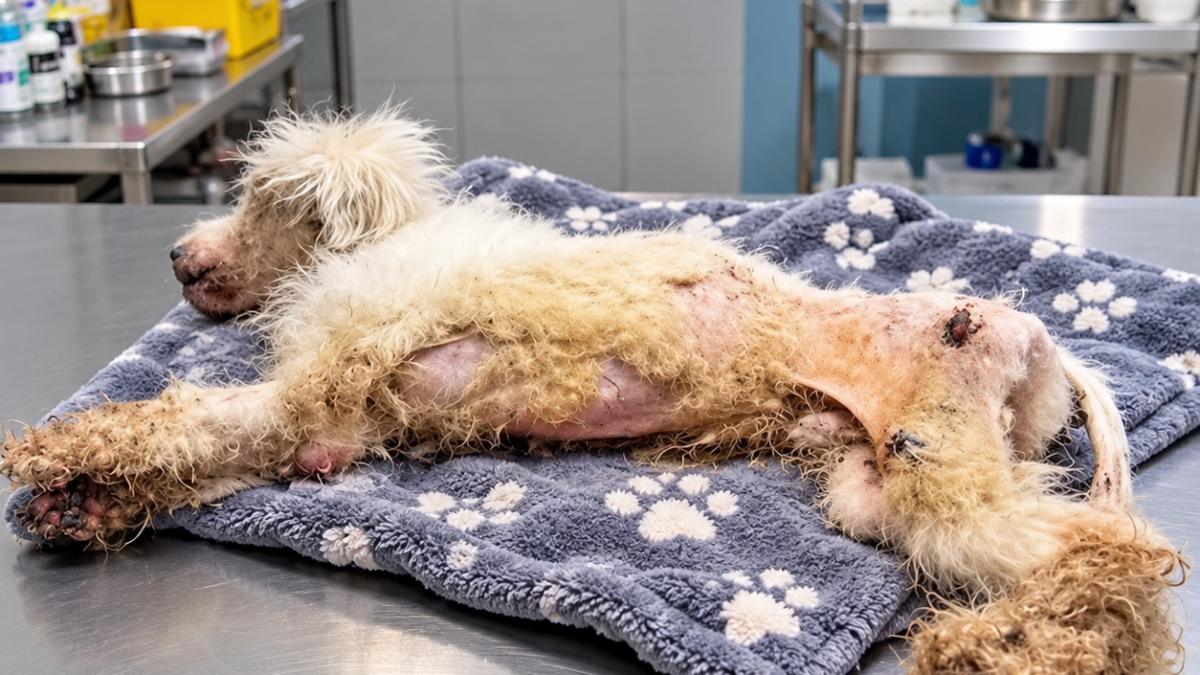
I found him standing between torn garbage bags, too weak to walk normally but still searching for one more scrap of food because hunger had given him no other choice.
At first glance, I thought I was looking at an elderly dog whose body had simply reached the end of a very hard life, but the veterinarian later told me he was only about six years old.
What happened after I lifted him out of that place began with one question none of us could answer that day: had we found him in time?
The call came just after sunrise.
A sanitation worker had spotted a dog moving between piles of discarded household trash on the edge of an illegal dumping area outside town. He had seen strays there before, but this one was different.
“He keeps falling,” the man told me over the phone. “Then he gets back up and keeps looking for food.”
Twenty-five minutes later, I was standing at the entrance to the site.
The smell reached me before I saw him.
Plastic bags had been torn open by weather and animals. Old cardboard sagged beneath the previous night’s rain. Broken furniture, food containers, and household debris formed uneven piles along the dirt road.
Then something moved near a stack of black garbage bags.
A dog lifted his head.
For a second, neither of us moved.
He was medium-sized, dark-coated beneath the dirt, with large areas where his skin looked painfully irritated and exposed. Ticks clung around his ears, neck, and legs. His hips stood out sharply beneath his body.
But what frightened me most was the way he stood.
His front legs were doing almost all the work.
His back end trembled continuously.
He tried to take one step toward a torn food container.
One back leg folded.
He caught himself.
Then he tried again.
“Hey, buddy.”
His head turned toward me.
He didn’t bark.
He didn’t run.
I’m not sure he could have.
I crouched several yards away and opened a container of soft food.
His nose lifted immediately.
Hunger was still stronger than fear.
“That’s for you.”
I placed it on the ground and backed away.
He stared at me.
Then at the food.
He tried walking toward it.
Watching those few steps was harder than I expected.
Every movement required concentration. His back paws dragged slightly over the dirt. His hips shifted awkwardly as he fought to keep himself upright.
Still, he kept coming.
Not toward me.
Toward the meal.
When he finally reached it, he lowered his head and began eating.
Slowly at first.
Then faster.
I wanted to let him finish everything, but experience told me that feeding a severely underweight animal too much at once could create other problems.
So after a small amount, I moved the container away.
He looked up at me.
For the first time, I saw his eyes clearly.
They were tired.
Not defeated.
Just deeply, terribly tired.
“I know,” I whispered. “There’s more coming. Just not all at once.”
The sanitation worker stood behind me.
“How old do you think he is?”
“Ten? Maybe older.”
The dog’s gray, exhausted expression made that seem obvious.
I would later learn how wrong I was.
I placed a bowl of water near him.
He drank for a long time.
Then he tried to sit.
His back legs slipped sideways, and his body lowered unevenly onto the dirt.
That was when I stopped waiting.
I moved closer.
He watched my hands but made no attempt to escape.
“Can I help you?”
I slid a towel beneath his chest and another under his back end.
He was lighter than he looked.
Far too light.
When I lifted him, his head rested against my shoulder almost immediately.
No struggle.
No protest.
His body simply relaxed as if he had been waiting for someone else to carry the weight for a while.
I took him to the rescue van.
Before closing the door, I looked back at the garbage pile.
Five minutes earlier, he had been searching through it for breakfast.
Now he was lying on a clean blanket.
I did not know whether he would stand again normally.
I did not know what the tests would show.
I did not even know whether his body had enough strength left to respond to treatment.
But on the drive to the veterinary hospital, I decided he needed a name that meant something stronger than the place where I had found him.
By the time we reached the clinic, I had one.
Phoenix.
Because if there was even the smallest chance he could rise from what had nearly consumed him, I wanted his name to remind us not to give up before he did.
PART 2
Dr. Laura Bennett met us at the side entrance.
She had worked with our rescue long enough that she could usually tell how serious a case was by looking at my face.
This time she didn’t bother asking.
“Treatment room two,” she said.
I carried Phoenix inside.
A technician named Ashley spread a thick blanket over the examination table, and I lowered him onto it carefully.
The moment his back feet touched the surface, they slid outward.
Ashley caught him.
“I’ve got you.”
Phoenix looked at her.
No growl.
No panic.
He simply stood there trembling.
Dr. Bennett placed a stethoscope against his chest.
“How long at the dump?”
“No idea.”
“Eating?”
“Whatever he could find.”
“Drinking?”
“He drank when I gave him water.”
She examined his gums.
Her expression changed.
“Very pale.”
“Anemia?”
“Almost certainly.”
She ran one hand gently along his spine and hips.
Phoenix’s body felt like angles beneath the remaining coat.
“Age?”
“I guessed ten.”
She opened his mouth and examined his teeth.
Then looked at me.
“Try six.”
I thought I had misheard her.
“Six?”
“Approximately.”
I stared at him.
He looked older because hardship had aged every visible part of him.
The grayish cast around his face.
The tired eyes.
The stiffness.
The way his body seemed to carry years that did not belong there.
“He’s six?”
“Maybe six and a half. But he is not an old dog.”
That somehow made the scene worse.
This wasn’t age catching up with him.
Something had happened to a dog who should still have had years of strength ahead of him.
Blood was drawn.
Skin samples were taken.
Ticks were removed one by one.
There were so many that Ashley finally stopped counting.
Phoenix barely reacted.
He lay on his side while we worked.
At one point, she touched the inside of his ear.
His tail moved once.
Ashley froze.
“Did he just wag?”
“I think so.”
She touched him again.
Another small movement.
“Hi, handsome.”
The tail stopped.
He was too tired.
But that single movement was enough to change the atmosphere in the room.
Phoenix was still there.
Not only physically.
Some part of him was still responding to kindness.
—
The blood results came back quickly.
The anemia was severe.
His calcium level was dangerously low.
His protein levels were poor.
There were signs his body had been surviving without adequate nutrition for far too long.
Dr. Bennett placed the results on the counter.
“This explains the weakness.”
“All of it?”
“Not necessarily.”
“What else?”
“Muscle loss. Possibly nerve involvement. Long-term nutritional deficiency. Maybe pain. We’ll need imaging if he’s stable enough.”
“Can we fix the calcium?”
“Yes.”
“The anemia?”
“We can support him and monitor. Depending on how he responds, we may need more aggressive intervention.”
I looked toward Phoenix.
Ashley had placed a folded towel beneath his head.
His eyes were closed.
“Is he going to make it?”
Dr. Bennett didn’t answer immediately.
I hated when veterinarians did that.
Not because they were cruel.
Because silence usually meant the truthful answer was complicated.
“He has a chance.”
“That wasn’t what I asked.”
“I know.”
She turned toward me.
“He is very depleted. We need to see what happens when we give his body what it has been missing.”
“Food?”
“Food. Fluids. Calcium. Medication. Rest.”
“And time.”
“Yes.”
“How much?”
“No one can tell you that today.”
I rubbed my forehead.
Phoenix opened his eyes.
I walked back to him.
“Apparently you’re six.”
One ear shifted.
“You’ve been falsely advertising yourself as a senior citizen.”
Ashley smiled.
Phoenix did not.
“You’re going to have to explain that.”
His eyes closed again.
—
Feeding became the first challenge.
Phoenix wanted food.
That was good.
But we could not simply place a huge bowl in front of him and let him eat until he stopped.
His system needed controlled portions.
Small meals.
Frequent meals.
Four times a day became the plan once he was stable enough.
The first afternoon, Ashley brought him a small plate of veterinary recovery food.
Phoenix smelled it.
His head lifted.
He tried to stand.
His back legs failed almost immediately.
“Easy,” I said.
I supported his hips.
He looked at the bowl.
“You don’t need to stand.”
We moved the food close enough that he could eat lying down.
That bothered me.
Not because there was anything wrong with helping him.
Because eating from the ground while lying on his side felt like another reminder of how much strength had been taken from him.
Phoenix didn’t care.
Food was food.
He ate.
Every bite disappeared.
When the plate was empty, he licked it.
Then the towel.
Then looked at Ashley.
She laughed.
“That is all you get right now.”
Phoenix stared.
“He disagrees.”
“He can file a complaint.”
His tail moved once.
That was the second wag.
—
That evening we bathed him.
We waited until he had rested.
Warm water.
Gentle cleanser.
No strong spray.
His skin was raw in places, so every movement had to be careful.
Dirty water ran beneath him.
Tiny dark shapes loosened from the coat as the last ticks were removed.
I kept one hand under his chest because standing in the tub was impossible.
Halfway through, his legs began shaking harder.
“Enough,” Dr. Bennett said.
“We haven’t finished.”
“We finish tomorrow.”
“He needs to be clean.”
“He also needs energy to recover.”
She was right.
We wrapped him in towels.
Ashley sat on the floor with Phoenix between her legs while we dried him.
He leaned against her.
Not affectionately.
He simply did not have the strength to hold himself upright.
Ashley looked at me.
“He feels like nothing.”
I knew what she meant.
Not emotionally.
Physically.
There should have been muscle beneath that coat.
Weight.
Power.
Instead, his body felt fragile.
“Six years old,” she whispered.
“Yeah.”
“What happened to him?”
I looked down.
“I don’t know.”
That question would haunt us for months.
—
The rescue named him Phoenix officially that night.
We posted no dramatic appeal.
No graphic pictures.
Only a simple update explaining that a severely underweight adult dog had been found searching for food at a dumping site and was receiving veterinary care.
Within hours, people began sending blankets.
Food.
Small donations toward treatment.
One person delivered a blue orthopedic bed.
Another brought washable pads.
Someone mailed supplements.
I remember looking at the growing pile of supplies and thinking how strange rescue work can be.
One day an animal is invisible.
The next, strangers know his name.
Phoenix knew none of that.
His world had become a quiet kennel, four small meals, medication, and people who kept appearing.
He began learning our routines.
Ashley in the morning.
Me before lunch.
Dr. Bennett after rounds.
A volunteer named Carlos in the afternoon.
Phoenix never showed excitement the way a healthy dog might.
Not yet.
But his eyes followed us.
That was progress.
—
On day three, we tried helping him stand for thirty seconds.
It lasted twelve.
I supported his chest.
Carlos supported his hips.
“Ready?”
Phoenix was not.
But we lifted gently.
His front feet found the floor.
His back feet touched down.
His knees trembled.
“Good,” Carlos said.
Phoenix looked toward the food bowl across the room.
Of course.
We had placed it there intentionally.
Motivation.
He shifted forward.
One back leg slipped.
Carlos corrected it.
“Easy.”
Another step.
Phoenix moved.
His entire body shook.
But he moved.
Two feet.
Three.
Then his back end lowered.
We let him rest.
I sat beside him.
“That was terrible.”
Carlos looked offended.
“That was excellent.”
“Three feet.”
“Yesterday he couldn’t do three inches.”
Phoenix looked between us.
Carlos pointed at me.
“She has unreasonable expectations.”
I scratched Phoenix’s neck.
His tail tapped the blanket.
—
The physical therapist arrived on day five.
Her name was Jenna Morris.
She specialized in rehabilitation for animals recovering from injury, surgery, and severe weakness.
She watched Phoenix attempt to walk.
Then she knelt beside him and moved each rear leg through a gentle range of motion.
“He has some neurological response,” she said.
“That’s good?”
“Very.”
“So he’ll walk normally?”
“I didn’t say that.”
I had begun to hate every version of that answer.
“What did you say?”
“I said the pathways are responding. That gives us something to work with.”
She showed me exercises.
Passive flexion.
Careful extension.
Weight shifting.
Supported standing.
Short sessions.
Never to exhaustion.
“The temptation will be to push,” she said.
“I would never.”
She looked at me.
“You absolutely would.”
Carlos laughed from the doorway.
“Thank you.”
I ignored him.
Jenna continued.
“His body has been compensating for weakness for a long time. We rebuild slowly.”
“How slowly?”
“Slow enough that he does not learn to hate us.”
Phoenix stared at her.
“Too late,” I said.
Jenna smiled.
—
The therapy ball came a week later.
It was large, soft, and bright.
Phoenix hated it immediately.
We positioned his chest over the ball so his back feet could make light contact with the floor.
The ball supported most of his weight.
Jenna held his hips.
I stood in front of him with food.
“Look.”
Phoenix looked at the treat.
“See? Worth it.”
He stretched his neck.
The ball shifted slightly.
Phoenix’s eyes widened.
“Nope,” I said. “Stay.”
He tried to back away.
His feet scrambled.
We stopped.
Jenna lowered him.
“That was enough.”
“Five seconds.”
“Five seconds without panic.”
“Four and a half.”
She pointed at me.
“You are exactly why rehab professionals have blood pressure problems.”
—
There were good days.
Then there were days when Phoenix seemed exhausted by everything.
Those days were the hardest.
Because progress creates expectations.
The first week, any small movement feels miraculous.
By the third, you start wanting more.
One morning, Phoenix refused breakfast.
My stomach dropped.
He always ate.
Always.
I called Dr. Bennett.
She examined him immediately.
Temperature normal.
No vomiting.
No obvious pain.
Blood work showed his anemia was improving slightly, but his calcium still needed careful management.
“He may simply feel bad today.”
“That’s not an acceptable diagnosis.”
“It happens.”
“He ate yesterday.”
“He can have an off morning.”
I sat beside his kennel.
Phoenix turned his head away from food.
Every fear from the first day came back at once.
What if his body had reached its limit?
What if we had mistaken temporary improvement for recovery?
What if—
Dr. Bennett touched my shoulder.
“Stop.”
“What?”
“I can see your thoughts.”
“No, you can’t.”
“Yes, I can.”
She pointed at Phoenix.
“He is allowed to have a bad day without you writing his obituary.”
The words stung.
Because she was right.
We gave Phoenix space.
Two hours later, he ate half a meal.
By evening, all of it.
The next morning, he barked at Carlos because breakfast was late.
Carlos came running into the office.
“Your patient is abusive.”
I stood.
“He barked?”
“In my face.”
I nearly hugged him.
“Do not encourage this.”
Phoenix barked again.
I laughed.
That was the first time his voice filled the room.
—
His personality arrived before his strength did.
We discovered this because another foster dog named Toby came too close to his bed.
Toby was friendly.
Too friendly.
He walked straight over and tried to smell Phoenix’s food bowl.
Phoenix lifted his head.
Toby ignored the warning.
Phoenix gave one small, quick nip in the air.
Not a fight.
Not an attack.
Just enough to communicate:
Back up.
Toby backed up.
I looked at Phoenix.
“Well.”
Carlos laughed.
“He has boundaries.”
Phoenix stared at Toby until the other dog walked away.
That tiny display made me ridiculously happy.
A completely shut-down animal often tolerates everything because he has stopped believing his choices matter.
Phoenix was telling us he had preferences.
Food was his.
Space was his.
He could say no.
That was health too.
—
Then came the morning none of us expected.
I arrived just after seven.
Ashley met me in the hallway.
Her eyes were huge.
“What?”
“Come here.”
“What happened?”
“Just come.”
She led me to Phoenix’s room.
He was on his bed.
Nothing unusual.
“What?”
“Wait.”
Ashley placed his breakfast about three feet away.
Phoenix lifted his head.
Then he pushed himself forward.
His front legs straightened.
He shifted his weight.
And instead of rolling awkwardly to one side, he gathered his back legs beneath him.
He sat.
By himself.
Completely unsupported.
I stopped breathing.
Ashley whispered, “There.”
Phoenix looked at us.
Then at the bowl.
As though sitting independently was merely a logistical step toward breakfast.
“You’re sitting.”
His ears moved.
“You are sitting.”
I crouched.
“Do you understand what you just did?”
Phoenix did not care.
He wanted food.
Ashley began crying.
I laughed at her.
Then realized I was crying too.
“Do not tell anyone.”
“You’re crying harder than I am.”
“Clinic allergies.”
“There are no seasonal allergens inside.”
“Medical mystery.”
Phoenix barked.
We gave him breakfast.
—
That moment changed everything.
Not medically.
His problems were still real.
But emotionally, it shifted the entire team.
Until then, we had been working on faith.
Food.
Medicine.
Supplements.
Therapy.
We hoped his body would respond.
Now we had proof.
He could reclaim movement.
One function at a time.
Sit.
Then stand longer.
Then step.
Then walk.
Not quickly.
Not perfectly.
But the path existed.
Jenna increased his therapy slightly.
We used the ball.
Supported walking.
Weight shifts.
Gentle resistance.
Short sessions on textured mats.
His rear paws sometimes placed incorrectly, so we worked on awareness.
“Come on, Phoenix.”
Step.
“Good.”
Step.
“Again.”
He grew tired.
Rest.
Then food.
Everything came back to food.
Phoenix would probably have completed a tax return for chicken.
—
By month two, his coat had changed.
The irritated skin was healing.
Dark fur began filling bare areas.
His weight increased.
His face changed too.
That was the part photographs captured best.
The first images showed a dog whose eyes seemed permanently half closed.
Now they were open.
Alert.
Interested.
He began watching birds through the clinic window.
He barked at the delivery truck.
He learned the sound of the refrigerator opening.
One afternoon, he discovered a stuffed toy shaped like a hamburger.
He carried it everywhere for three days.
Then destroyed it.
Carlos brought another.
Phoenix destroyed that one too.
“Ungrateful,” Carlos said.
Phoenix wagged.
“Do you see this?”
“I do.”
“He has no respect for gifts.”
Phoenix pulled stuffing from the toy.
“He looks remorseful.”
“He absolutely does not.”
—
Then something happened that frightened us.
Phoenix tried to stand too quickly one morning and fell hard onto his side.
The sound brought everyone running.
I reached him first.
“Don’t move.”
He tried to get up.
“Stay.”
Dr. Bennett examined him immediately.
No fracture.
No serious injury.
But he had strained one hip.
Three days of reduced activity.
Phoenix hated it.
So did I.
Progress had been moving forward.
Now we were resting.
The first day, he stared at the therapy room door every time someone passed.
The second, he barked when Jenna walked by without him.
The third, he tried to follow.
“You’re injured because you forgot you are still rebuilding,” I told him.
He wagged.
“That was not a compliment.”
Jenna smiled.
“Actually, this is a good problem.”
“How?”
“He wants to move.”
I looked at Phoenix.
Two months earlier, standing had been work.
Now enforced rest was punishment.
She was right.
Again.
I hated how frequently this happened.
—
When he returned to therapy, we added water.
Hydrotherapy had been discussed from the beginning, but we waited until his skin was sufficiently healed and his overall health was stable.
The first session happened in a shallow rehabilitation pool.
Phoenix stood at the edge.
He stared at the water.
I stood beside him.
“You know what this is?”
No reaction.
“It’s like a bath, except everyone expects exercise.”
He looked at me.
“Terrible marketing, I know.”
Jenna fitted him with a support harness.
We entered slowly.
Water reached his chest.
Phoenix froze.
Then something remarkable happened.
His legs moved.
Not perfectly.
But naturally.
The water supported him.
His back feet began stepping without carrying his full body weight.
One.
Two.
Three.
I felt my throat tighten.
Jenna guided him.
“Good.”
Phoenix paddled slightly.
His body became lighter in the water.
For the first time since I had known him, movement looked almost effortless.
He wasn’t dragging his back end.
He wasn’t shaking under his own weight.
He was moving.
“Look at you.”
Phoenix turned his head toward my voice.
Then paddled harder.
Water splashed my shirt.
Jenna laughed.
“He’s swimming.”
“I can see that.”
“You’re crying again.”
“Water.”
“We’re in a pool.”
“Exactly.”
—
Swimming became one of his favorite parts of rehabilitation.
At first, sessions were brief.
Then longer.
His confidence grew.
The water gave him something gravity had taken away.
Freedom.
I watched him cross the small pool one afternoon and remembered the dump.
The dirt.
The garbage.
The way his back legs had folded beneath him after three steps.
Now those same legs pushed rhythmically through water.
No one watching that first swim could fully understand why it mattered unless they had seen where he started.
For us, it was more than exercise.
It was evidence.
His body had not given up.
—
Around the same time, Phoenix moved from the clinic into foster care.
His foster mother was a woman named Maya Reynolds.
She had volunteered with our rescue for years.
Calm house.
No stairs at the main entrance.
Large fenced yard.
Experience with rehabilitation.
Perfect.
Except Phoenix disagreed for the first two hours.
He stood near the front door and stared at it.
Maya sat on the floor ten feet away.
“He thinks you abandoned him.”
“I know.”
“That’s dramatic.”
“He’s allowed.”
Phoenix refused the new bed.
Refused the living room.
Refused Maya’s carefully prepared chicken.
Then I stood.
“I should go.”
Maya looked worried.
“He’ll be okay.”
“What if he won’t eat?”
“He will.”
“What if he waits at the door?”
“He probably will.”
“That’s awful.”
“It is temporary.”
Phoenix watched me put on my jacket.
I crouched.
“You live here for now.”
His head tilted.
“This is Maya.”
Maya waved.
“She has excellent food.”
Phoenix looked unimpressed.
“She also has no Carlos.”
Maya laughed.
Phoenix did not.
I left.
Maya texted me forty minutes later.
**He moved three feet from the door.**
An hour later:
**He ate.**
Two hours later:
**He is sleeping on my foot. I am not allowed to move.**
I replied:
**Correct. You live there now.**
—
Foster care changed Phoenix in ways the clinic could not.
Clinics heal bodies.
Homes teach life.
Maya had routines.
Morning sunlight through the kitchen.
Coffee.
Four meals for Phoenix, carefully measured.
Medication.
Short walks.
Therapy.
Nap.
Car rides.
More therapy.
More food.
Evening outside.
Bedtime.
He learned the sound of her keys.
He learned which cabinet contained treats.
He learned that when she went into the bathroom, she usually came back.
He learned that the vacuum cleaner was suspicious but survivable.
He learned that the couch was technically off-limits until Maya realized enforcing that rule required more energy than she possessed.
Within three weeks, Phoenix had a favorite spot.
Middle cushion.
Naturally.
—
Maya took him almost everywhere she safely could.
Short drives.
Quiet parks.
Pet-friendly outdoor cafés during uncrowded hours.
A friend’s backyard.
The rehabilitation pool.
At first, Phoenix became nervous whenever the car stopped.
He seemed to assume every destination might mean another move.
Then he learned Maya always returned to the car with him.
That mattered.
One afternoon she sent me a photograph.
Phoenix sat in the passenger seat wearing a seat-belt harness.
His face was turned toward the window.
Ears relaxed.
Mouth slightly open.
He looked normal.
I stared at that picture for a long time.
Normal is one of the most underrated miracles in rescue.
—
Month three brought another milestone.
Phoenix stood from his bed without using the wall for support.
Maya witnessed it.
She called me immediately.
“He stood.”
“He stands every day.”
“No. He stood.”
I understood.
“No help?”
“None.”
“Video?”
“I was carrying laundry!”
“Unacceptable.”
“He did not schedule the milestone.”
“Make him repeat it.”
“That is not how dogs work.”
“Offer chicken.”
Silence.
Then:
“That might actually work.”
It did.
Phoenix stood again.
Maya recorded it.
I watched the clip at least twenty times.
Front legs straight.
Back legs pushing.
Hips rising.
Pause.
Balance.
Then one step.
It took less than five seconds.
But those five seconds contained months of work.
—
Not every change was physical.
Phoenix learned to sleep on his back.
The first time Maya sent the photo, I thought something was wrong.
He was upside down across the bed.
All four legs partially raised.
Belly exposed.
Head twisted sideways.
I called her.
“Is he okay?”
She laughed.
“He’s sleeping.”
“That is an alarming position.”
“He does it now.”
Dogs expose vulnerable parts of themselves when they feel safe enough.
I knew that academically.
Seeing Phoenix do it affected me differently.
At the dump, every movement had been about survival.
Find food.
Stay upright.
Rest only because the body demands it.
Now he slept like nothing in the room required his attention.
Maya worried about his next meal.
He didn’t have to.
That might have been the most important transformation of all.
—
Four meals a day.
Medication.
Calcium supplements.
Therapy.
Swimming.
Routine.
Repeat.
Recovery sounds inspiring when condensed into thirty seconds.
In reality, it is repetitive.
Maya prepared bowl after bowl.
Marked medications on a calendar.
Cleaned muddy paws.
Drove to appointments.
Supported Phoenix on bad mornings.
Celebrated small changes no one else would notice.
One extra minute standing.
One smoother step.
One day without slipping.
A little more muscle over the hips.
Less trembling after exercise.
Half a pound gained.
Then another.
Then another.
That is how Phoenix changed.
Not through one miracle.
Through hundreds of ordinary decisions made on his behalf.
—
There was a moment in month four when I became impatient.
Phoenix’s walking had improved, but I wanted more.
His back legs still moved awkwardly when tired.
He still needed support on uneven ground.
I watched him during therapy.
“He should be further along.”
Jenna stopped.
“According to whom?”
“According to four months of treatment.”
She looked at me.
“Do you remember what his calcium level was?”
“Yes.”
“His muscle mass?”
“Yes.”
“His anemia?”
“Yes.”
“Then stop comparing him to a healthy dog.”
“I’m comparing him to himself.”
“No. You’re comparing him to the version you want him to become.”
That shut me up.
Jenna continued.
“Phoenix doesn’t know your timeline.”
I looked at him.
He was standing with his front paws on the therapy ball.
Tail wagging because Maya held chicken.
“He’s doing the work.”
“I know.”
“Then respect it.”
I did.
That lesson mattered later.
Recovery belongs to the patient.
Not to the people watching.
—
Phoenix gained confidence around other dogs too.
The little warning nip for personal space became less frequent.
He learned to walk away instead.
Toby visited Maya’s house once.
The same dog who had tried to inspect Phoenix’s bowl at the clinic.
Toby approached the food area.
Phoenix looked at him.
Toby stopped.
They stared.
Then Toby walked away.
Phoenix returned to eating.
Maya laughed.
“Diplomacy.”
Growth.
—
By month five, Phoenix could walk around Maya’s yard without a sling for short periods.
I visited one afternoon.
He was near the fence.
Maya opened the back door.
“Phoenix!”
His head turned.
Then he walked toward us.
Not perfectly.
Not fast.
But independently.
Halfway across the yard, he increased speed.
A strange little trot.
His back legs bounced slightly.
His ears lifted.
Maya clapped once.
Phoenix came straight to her.
Then past her.
To me.
I crouched.
He pushed his head into my chest.
“You remember the dump?”
Maya looked at me.
“Don’t.”
“What?”
“You’re going to make me cry.”
“I asked the dog.”
“You’re looking at me.”
Phoenix wagged hard enough to lose balance.
Maya caught him.
We both laughed.
—
A week later, we received another call from the same dumping area.
Another animal had been seen there.
I went.
Phoenix did not.
I would never take him back unless there were a meaningful reason, and there wasn’t.
But walking into that place again affected me.
Same smell.
Same broken furniture.
Same torn bags.
Different weather.
Different dog.
This one was younger and healthy enough to run.
We brought him out too.
Before leaving, I stood where I had first seen Phoenix.
I could picture him.
Head low.
Back legs trembling.
Searching.
For months, I had imagined that place as the beginning of his story.
Standing there again, I realized it wasn’t.
His story began long before I found him.
I simply entered it at the moment someone finally helped.
And the dump?
The dump was only one chapter.
Not his identity.
Not his ending.
I took a photograph of the empty spot.
Then deleted it.
Phoenix did not need it.
—
Six months after rescue, we weighed him.
Maya stood beside the scale.
Dr. Bennett checked the number.
Then checked again.
“Twelve pounds.”
“What?” Maya asked.
“He has gained twelve pounds since intake.”
Maya covered her mouth.
I looked at Phoenix.
Twelve pounds on a dog his size had changed everything.
His shoulders had muscle.
His ribs no longer defined his silhouette.
His coat covered healed skin.
His eyes were bright.
His back legs were still weaker than the front, but they carried him.
He stood on the scale himself.
That mattered more than the number.
“You weigh twelve pounds more,” I told him.
Phoenix stepped off.
Maya gave him a treat.
“He does not care.”
“He should.”
“He cares about chicken.”
“Fair.”
Dr. Bennett pulled up his first intake photograph on the computer.
Then we looked at Phoenix.
The difference was almost uncomfortable.
“How was that six months ago?” Maya whispered.
I didn’t answer.
Because I had the same question.
—
We celebrated with a swim.
Phoenix entered the water willingly now.
No freezing at the edge.
No suspicious stare.
He knew the routine.
Harness.
Ramp.
Water.
Then movement.
Jenna guided him into the deeper section.
Phoenix began swimming.
Strong strokes.
Steady.
I stood beside Maya.
“Remember when he couldn’t hold himself up?”
She nodded.
Neither of us looked away.
Phoenix crossed the pool.
Turned.
Came back.
His back legs moved continuously beneath the water.
The same legs that had barely supported him among the garbage now carried him forward.
That image became the one I used whenever someone asked me whether rescue was worth the hard cases.
I didn’t answer with statistics.
I thought of Phoenix swimming.
—
Then came the conversation none of us had been having.
Adoption.
Technically, Maya was his foster mother.
Technically.
The word had become ridiculous.
Phoenix slept in her bedroom.
Went on trips with her.
Knew her schedule.
Waited at the window when she left.
Had his own shelf of supplements.
His own therapy equipment.
His own collection of destroyed toys.
One evening, I sat at Maya’s kitchen table.
Phoenix was asleep under it.
“We should discuss adoption.”
Maya became still.
“Okay.”
“We have an application.”
Her face changed.
It was almost funny.
Almost.
“From who?”
“A couple with rehabilitation experience.”
“Oh.”
“Large yard.”
“Good.”
“Someone home most days.”
“Good.”
“Excellent veterinary references.”
“Great.”
Phoenix sighed beneath the table.
Maya stared into her coffee.
I waited.
Finally she said, “Do they have stairs?”
“Some.”
“He hates stairs.”
“They can use ramps.”
“He likes sleeping on the couch.”
“They allow dogs on furniture.”
“He needs swimming.”
“They live near a canine therapy center.”
Everything I said made her more miserable.
“Maya.”
“What?”
“Do you want me to reject them?”
She looked at me.
“Can you?”
“Yes.”
“For what reason?”
“The dog is unavailable.”
Her eyes filled.
“Why would he be unavailable?”
I smiled.
“Because his foster mother is wasting my time.”
She started crying.
“That was mean.”
“Sign the adoption papers.”
“You planned this.”
“Obviously.”
Phoenix woke.
Looked up.
Maya dropped to the floor.
“You’re staying.”
Phoenix licked her face.
I looked away.
Not because I was emotional.
Clinic allergies.
Apparently they followed me to houses now.
—
The adoption became official quietly.
No event.
No balloons.
Just paperwork.
A signature.
A new tag.
Phoenix Reynolds.
Maya stared at the tag.
“Do dogs have last names?”
“Only when they owe medical debt.”
“Then he has several.”
Phoenix wagged.
—
His life became wonderfully ordinary.
Morning walks.
Therapy twice a week, then once.
Swimming for fitness rather than emergency rehabilitation.
Car rides.
Parks.
Naps.
Food.
Lots of food.
He remained deeply serious about meal schedules.
At 6:00 a.m., breakfast.
At 10:30, second meal.
At 3:00, third.
Evening meal at seven.
If Maya was five minutes late, Phoenix found her.
He would stand in the doorway.
Stare.
Wait.
Sometimes bark once.
“I created a monster,” Maya told me.
“No. Malnutrition created excellent timekeeping.”
—
A year after rescue, Phoenix returned to the veterinary hospital for routine blood work.
Not emergency.
Routine.
That word felt luxurious.
His anemia had resolved.
Calcium stable.
Weight healthy.
Dr. Bennett listened to his heart.
“Do you remember me?”
Phoenix smelled her pocket.
“She remembers your treats,” I said.
“He.”
“What?”
“Phoenix is a male.”
I stared at her.
“I know that.”
“You said she.”
“I was talking about—”
“You absolutely were not.”
Maya laughed.
Phoenix stole a treat.
Dr. Bennett shook her head.
“Recovery has made you careless.”
“Recovery has made him distracting.”
—
We took new photographs.
Phoenix standing.
Phoenix walking.
Phoenix swimming.
Phoenix sleeping upside down.
Phoenix riding with Maya.
I placed one beside the intake image.
People online called it a miracle.
I understood why.
But the word bothered me slightly.
Miracle makes recovery sound effortless.
Phoenix’s transformation had not been effortless.
It had taken treatment.
Money.
Four meals a day.
Supplements.
Physical therapy.
Pools.
Appointments.
Patience.
A foster home.
A veterinarian.
Technicians.
Volunteers.
And Phoenix himself.
Miracle was too easy.
Work was more accurate.
Love was part of it.
Work made love useful.
—
Months later, I was invited to speak at a small community event about animal rescue.
I brought Phoenix.
Maya came too.
He walked into the room under his own power.
People who knew his story recognized him immediately.
A woman approached.
“That’s Phoenix?”
“Yes.”
“He’s smaller than I expected.”
Phoenix stared at her treat bag.
“He’s also more manipulative.”
She laughed.
During the presentation, I showed his first photograph.
A murmur moved through the room.
Then Phoenix stood from his mat and walked toward Maya because she had opened a snack.
Everyone laughed.
That contrast said more than I could.
One picture showed what had happened to him.
The living dog showed what happened next.
—
Afterward, a man approached me.
“I saw that dog before you got him.”
I stopped.
“Where?”
“At the dumping area.”
“When?”
“Maybe a week earlier.”
My stomach tightened.
“You saw him?”
“Yes.”
“Why didn’t you call anyone?”
His face changed.
“I thought he belonged to somebody nearby.”
I said nothing.
“I left food.”
That mattered.
“Did he eat?”
“Immediately.”
“Did you see him walk?”
“Yes.”
“He was already weak?”
“Very.”
I felt anger rise.
A week.
Phoenix may have been there at least a week before the call.
The man looked ashamed.
“I should have done more.”
I could have agreed.
Part of me wanted to.
Instead I asked, “Why are you telling me?”
“Because I saw him walk in today.”
I looked toward Phoenix.
Maya was kneeling beside him.
The man continued.
“I didn’t think he’d make it.”
There it was.
The sentence.
The assumption Phoenix had spent his entire recovery contradicting.
I looked at the man.
“He did.”
He nodded.
Then quietly:
“I’m glad.”
So was I.
—
That conversation gave me the closest thing Phoenix’s story ever had to revenge.
Not against that man.
Not against an unknown former owner.
Not against the people who had failed to notice sooner.
Against the prediction.
Against the image of him as finished.
Phoenix had looked older than ten.
He was six.
His back legs could barely hold him.
Now he walked into rooms.
He had searched through garbage for food.
Now he complained when dinner was late.
He had slept wherever exhaustion dropped him.
Now he occupied the center of Maya’s bed.
He had moved only because hunger forced him.
Now he swam because he enjoyed it.
That was revenge enough.
Every ordinary day became evidence against the idea that he had been beyond saving.
—
His second year with Maya was better than the first.
Not more dramatic.
Better.
His rehabilitation became maintenance.
He remained slightly unusual in his gait.
When tired, his back legs sometimes wobbled.
Maya kept rugs on slippery floors.
A ramp remained beside the porch.
He took supplements.
They were precautions, not signs of crisis.
Phoenix learned to hike short, flat trails.
He loved creeks.
He hated rain.
This made no sense.
Standing in creek water voluntarily?
Excellent.
Raindrops?
Personal betrayal.
Maya once tried to walk him during a drizzle.
Phoenix turned around and headed back to the car.
“He nearly died in a dump,” she told him. “And weather is where you draw the line?”
Phoenix climbed into the back seat.
The matter was settled.
—
One summer we took him to a dog-friendly lake.
Not therapy.
Just water.
Maya was nervous.
“He’s only swum in controlled pools.”
“He knows how.”
“What if he gets tired?”
“He has a life vest.”
“What if—”
“Maya.”
“What?”
“You sound like me.”
She stared.
“That is horrifying.”
Phoenix walked into the shallow water.
Then farther.
The vest lifted him.
He paddled.
Maya walked beside him.
When the water became deeper, Phoenix swam.
Not for treatment.
Not because Jenna told him to.
Because he wanted to reach Maya.
She backed up.
“Come on!”
Phoenix followed.
He reached her.
Turned.
Swam back toward shore.
Then out again.
I stood waist-deep nearby.
Something about seeing him choose to swim made me emotional in a way therapy never had.
Rehabilitation had been necessary.
This was freedom.
The same motion.
Different meaning.
—
On shore, Phoenix rolled in the dirt immediately.
Maya looked horrified.
“I just bathed him yesterday.”
I laughed.
“He is reclaiming his heritage.”
“That is not funny.”
Phoenix rolled harder.
—
He gained a reputation in our rescue organization.
New volunteers heard about him.
“Phoenix was the dump dog, right?”
I corrected them every time.
“Phoenix was found at a dump.”
It sounded like a small distinction.
It wasn’t.
The dump was a place.
Not an identity.
Language matters.
Animals become the labels we repeat.
Abused dog.
Broken dog.
Dump dog.
Senior dog.
Difficult dog.
Sometimes those labels help explain history.
Sometimes they become cages of their own.
Phoenix had spent enough time inside limitations.
So I described him differently.
Phoenix likes chicken.
Phoenix loves swimming.
Phoenix dislikes rain.
Phoenix steals Maya’s pillow.
Phoenix requires a ramp after long walks.
Phoenix snores.
Phoenix has strong opinions about breakfast.
Those were facts too.
Better ones.
—
Three years after rescue, Dr. Bennett reviewed his original file with a group of veterinary students.
She asked if Phoenix could attend.
We brought him.
The students looked at the first blood work.
The calcium.
The anemia.
His intake weight.
Photographs.
Then they examined the dog standing in front of them.
One student asked, “What was the most important intervention?”
Dr. Bennett answered medically.
“Stabilization, controlled nutrition, parasite treatment, correction of deficiencies, and structured rehabilitation.”
Then she looked at me.
I added, “Consistency.”
The student wrote it down.
I almost laughed.
Not because consistency is a drug.
Because it was true.
Phoenix needed the right medical care.
He also needed it tomorrow.
And the next day.
And the day after that.
Care only transforms when it continues.
—
Later, Dr. Bennett and I sat outside the hospital.
Phoenix slept beside Maya’s feet.
“You know,” I said, “I thought he was going to die that first day.”
“So did I.”
I stared at her.
“You never said that.”
“You were barely functioning.”
“You said he had a chance.”
“He did.”
“But you thought—”
“I thought his body was very close to a point where recovery might not be possible.”
I looked down at Phoenix.
He snored.
“That would have been useful information.”
“No, it would have made you useless.”
“You have a terrible bedside manner.”
“Yet you keep coming back.”
Phoenix opened one eye.
Then closed it.
Dr. Bennett smiled.
“He made the decision for us.”
“What?”
“To keep trying.”
“How?”
“He ate.”
Simple.
But true.
That first meal mattered.
Phoenix had been exhausted.
Weak.
Covered in evidence of prolonged hardship.
But food appeared.
He ate.
Water appeared.
He drank.
Hands helped him.
He allowed it.
His body responded.
Recovery began with ordinary biology.
The heart still beating.
The stomach still hungry.
The nervous system still trying.
Life insisting on itself.
—
Phoenix aged normally after that.
That was another gift.
Normal aging.
Not premature decline caused by starvation.
Not a body wearing ten years at six.
Actual time.
Gray appearing gradually around his muzzle.
Longer naps.
Shorter hikes.
He eventually looked like the age I had guessed the day I found him.
But now he had earned those years.
Maya once said, “He finally looks ten.”
I replied, “Four years late.”
Phoenix barked because dinner was late by approximately ninety seconds.
“Spiritually, he is twenty-five.”
—
One evening, Maya sent me a photograph.
Phoenix lay on his back in the living room.
All four paws in the air.
A blanket partly beneath him.
The message read:
**Still sleeping like no one has ever worried about food.**
I read that twice.
Then I corrected her.
**He sleeps like he knows someone else is worrying about it now.**
That was the difference.
Safety is not believing nothing will ever go wrong.
Safety is knowing you won’t face it alone.
Phoenix had learned that.
—
The final piece of his story arrived unexpectedly.
The sanitation worker who first called us—Mr. Harris—contacted me years later.
He had retired.
He asked whether Phoenix was still alive.
“Yes.”
“Doing okay?”
“Very.”
He became quiet.
Then said, “I think about him.”
“Why?”
“I almost drove past.”
My chest tightened.
“What stopped you?”
“He fell.”
I remembered.
“He fell trying to reach food.”
“Yeah.”
Mr. Harris cleared his throat.
“I watched him get back up.”
That detail had not been in the original call.
“You saw him stand again?”
“Three times.”
“Why didn’t you tell me?”
“Didn’t think it mattered.”
“It mattered.”
He was quiet.
Then:
“Every time he fell, he got up.”
I looked toward Phoenix, sleeping beside Maya across my living room during one of their visits.
“That sounds like him.”
Mr. Harris laughed softly.
“I guess his name fit.”
Yes.
It did.
—
Years passed.
Phoenix never became a perfectly athletic dog.
That was never necessary.
His gait always carried a small reminder of where he had come from.
When he was excited, the back legs sometimes moved faster than coordination allowed.
When tired, Maya supported him.
When swimming, he looked almost young again.
He did not need perfection.
He had a life.
That was enough.
More than enough.
—
On the anniversary of his rescue one year, Maya suggested something.
“Let’s go to the dump.”
“No.”
“Not with Phoenix.”
I relaxed slightly.
“Why?”
“I want to see it.”
“You don’t.”
“I do.”
So we drove there.
Phoenix stayed home with Maya’s sister.
The dumping area had changed.
Most of the garbage had been cleared after repeated complaints.
A fence had been installed.
Signs warned against illegal dumping.
The dirt road remained.
We stood where I remembered finding him.
Maya looked around.
“This?”
“This.”
“He was here?”
“Yes.”
She stared at the ground.
For a long time.
Then she said, “I thought I’d be angry.”
“Aren’t you?”
“Yes.”
“But?”
“It feels small.”
I understood.
The place had occupied so much space in Phoenix’s story.
Standing there without him, it looked insignificant.
Dirty ground.
Trash.
A road.
Nothing magical.
Nothing powerful.
“He outgrew it,” Maya said.
Exactly.
That was the revenge.
The place meant almost nothing now.
Phoenix had a bigger world.
—
When we returned to Maya’s house, Phoenix was waiting at the door.
He barked.
Maya knelt.
“We visited your old neighborhood.”
Phoenix smelled her coat.
Then walked toward the kitchen.
“He does not care,” I said.
“Good.”
She followed him.
“So what does he care about?”
I looked at the clock.
6:58 p.m.
“Dinner in two minutes.”
Phoenix barked.
“Correction. Dinner now.”
—
Eventually, Phoenix became a senior dog for real.
His face softened with age.
His sleeping increased.
But the old pattern never returned.
He never became the frail, hollow version we found at six.
His senior years were supported.
Veterinary checks.
Pain management when needed.
Supplements.
Soft beds.
Controlled exercise.
Swimming continued for as long as he enjoyed it.
Maya adjusted everything around him.
When he could no longer climb into the car comfortably, she added a ramp.
When the couch became too high, she placed steps beside it.
When hardwood floors became difficult, rugs appeared.
Phoenix’s world changed as his body changed.
That was what care looked like.
Not discarding him when his needs increased.
Changing the environment so he could remain part of it.
I thought often about that contrast.
At the dump, weakness had made survival harder.
With Maya, weakness made people help more.
That was perhaps the deepest form of justice Phoenix ever received.
His needs no longer reduced his value.
They increased our responsibility.
—
One autumn morning, many years after his rescue, I visited Maya.
Phoenix was lying near the back door.
He lifted his head when I entered.
His tail moved.
Slowly now.
“Hey, old man.”
Maya smiled.
“You can say old now.”
“I’ve been waiting years.”
I sat beside him.
His coat was gray around the muzzle.
His hips thinner from age, not hunger.
The distinction mattered.
I scratched beneath his chin.
He leaned into my hand.
“You looked older than this the day I met you.”
Maya sat beside us.
“He really did.”
Phoenix sighed.
Outside, rain tapped against the glass.
He had no interest in going out.
Still hated rain.
Some things survive everything.
—
We talked about the first day.
The dump.
The towels.
The clinic.
The first meal.
The therapy ball.
Maya laughed.
“He hated that ball.”
“He hated Jenna.”
“He loved Jenna.”
“Only because she had treats.”
“He loved everyone with treats.”
Phoenix opened one eye.
“See?”
Maya smiled.
Then grew quiet.
“Do you think he remembers any of it?”
“The dump?”
“Yes.”
I looked at him.
“Maybe pieces.”
“Do you think dogs remember suffering?”
“I think they remember patterns.”
“Like what?”
“Whether food returns.”
She nodded.
“Whether hands are safe.”
Another nod.
“Whether someone comes back.”
Maya rested her hand on Phoenix’s shoulder.
“He knows that one.”
Yes.
He did.
—
Phoenix lived long enough that the six-year-old dog we found became a genuinely old dog surrounded by people who knew exactly what he needed.
That ending meant more to me than any dramatic rescue.
He got time.
Years.
Ordinary years.
Meals.
Sunlight.
Swimming.
Car rides.
Friends.
Annoying veterinary appointments.
Destroyed toys.
Soft beds.
A person who called herself his foster mother for far too long before finally admitting she had been his family almost from the beginning.
He got the years hardship had tried to steal.
That was victory.
—
When his final season eventually came, there was no garbage around him.
No desperate search for scraps.
No body shaking because there was nowhere safe to rest.
He was at home.
Maya beside him.
Me on the floor.
Dr. Bennett there too.
His favorite blanket beneath him.
The old blue orthopedic bed nearby—the same style someone had donated during his first week.
Phoenix was tired.
Age had finally done what neglect once seemed about to do years too early.
But this time was different.
His blood values were not collapsing from hunger.
His body was simply old.
Properly old.
Loved enough to reach old age.
Maya held his paw.
“You know what I keep thinking?”
“What?”
“That he wasn’t supposed to look old at six.”
I swallowed.
“No.”
“He had to survive long enough to earn this face.”
I looked at Phoenix.
White muzzle.
Soft eyes.
Relaxed body.
She was right.
There was dignity in that aging.
—
Maya leaned close.
“You don’t have to get up anymore.”
Phoenix’s eyes shifted toward her.
For years, getting up had defined him.
Mr. Harris watching him fall and stand again.
Me watching him stagger toward food.
Carlos supporting his hips.
Jenna guiding his steps.
The morning he sat.
The first unsupported stand.
The pool.
The yard.
The hikes.
Again and again, Phoenix had risen.
Now Maya whispered something different.
“You can rest.”
His tail moved once against the blanket.
Dr. Bennett looked at us.
We nodded.
There was sadness.
Of course.
But there was also something that felt almost like completion.
Phoenix had not been rescued so he could live forever.
He had been rescued so he could live.
And he had.
Fully.
—
Afterward, Maya kept his collar.
His favorite toy was too damaged to save.
She kept it anyway.
The therapy ball?
That went to another rescue dog.
When I saw it in the rehabilitation room months later, I stopped.
A young dog recovering from surgery had his chest supported across it.
Jenna noticed me.
“Same ball.”
“I know.”
“Want me to retire it?”
“No.”
I watched the new dog work.
“Keep using it.”
Phoenix would have approved.
Especially if treats were involved.
—
Maya scattered part of his ashes near the lake where he had swum for fun.
Not the therapy pool.
The lake.
The place where water had stopped being medicine and became joy.
She kept the rest beneath a tree in her yard.
No large memorial.
Only a small stone.
**PHOENIX**
Below it:
**HE ROSE.**
I stood there for a long time.
Two words.
Enough.
—
People still ask me what happened to the dog we found in the garbage.
I correct them.
“The dog we found at the garbage site.”
Small difference.
Important difference.
Then I tell them.
He ate.
He rested.
He received medication.
The ticks came off.
His skin healed.
His blood recovered.
Calcium returned to safer levels.
He ate four meals a day.
He worked with a therapist.
He hated the therapy ball.
He learned to sit.
Then stand.
Then walk.
He gained twelve pounds in six months.
He swam.
He rode in cars.
He went places with his foster mother.
Then his foster mother became simply his mother.
He slept upside down.
He destroyed toys.
He demanded food on schedule.
He hated rain.
He grew old.
That is what happened.
—
If there was revenge in Phoenix’s story, it was never aimed at a person.
We never knew enough about his life before the dump to build some dramatic enemy.
And eventually, I was grateful for that.
Because Phoenix did not need a villain to defeat.
He defeated the conclusion everyone might have drawn when they first saw him.
Too weak.
Too far gone.
Too much work.
Too damaged.
Too late.
Every year he lived afterward answered those assumptions.
No.
Not too late.
His skin healed.
His body filled out.
His blood improved.
His back legs strengthened.
The dog who could barely stand learned to swim.
The dog who searched through trash began judging dinner if it arrived two minutes late.
The dog who looked ten at six lived long enough to truly become old.
That was the revenge.
Not hurting anyone.
Outliving the version of himself hardship tried to create.
—
I still have the photograph from his first morning.
Phoenix near the garbage bags.
Head lowered.
Body thin.
Back legs uncertain.
I used to hate the picture.
Now I see something I missed.
His head was not completely down.
He was looking forward.
Toward the food I had placed there.
Toward me.
Toward the next small thing that might keep him alive.
Phoenix never knew what six months would look like.
He did not know about the therapy pool.
Maya.
The lake.
The couch.
The twelve pounds.
The years.
He only knew there was food three feet away.
So he tried to reach it.
One unstable step.
Then another.
His leg folded.
He corrected himself.
He kept going.
Maybe recovery is often like that.
You do not need to understand the whole future.
You only need enough reason to make the next movement.
Phoenix did.
Again.
And again.
Until the steps that once carried him between garbage bags eventually carried him through a completely different life.
That is the Phoenix I remember.
Not the dog who could barely stand.
The one who kept rising.

