PART 2: I Found Gracie Hiding Outside the Home That Had Already Replaced Her—She Was Too Afraid to Let Me Touch Her
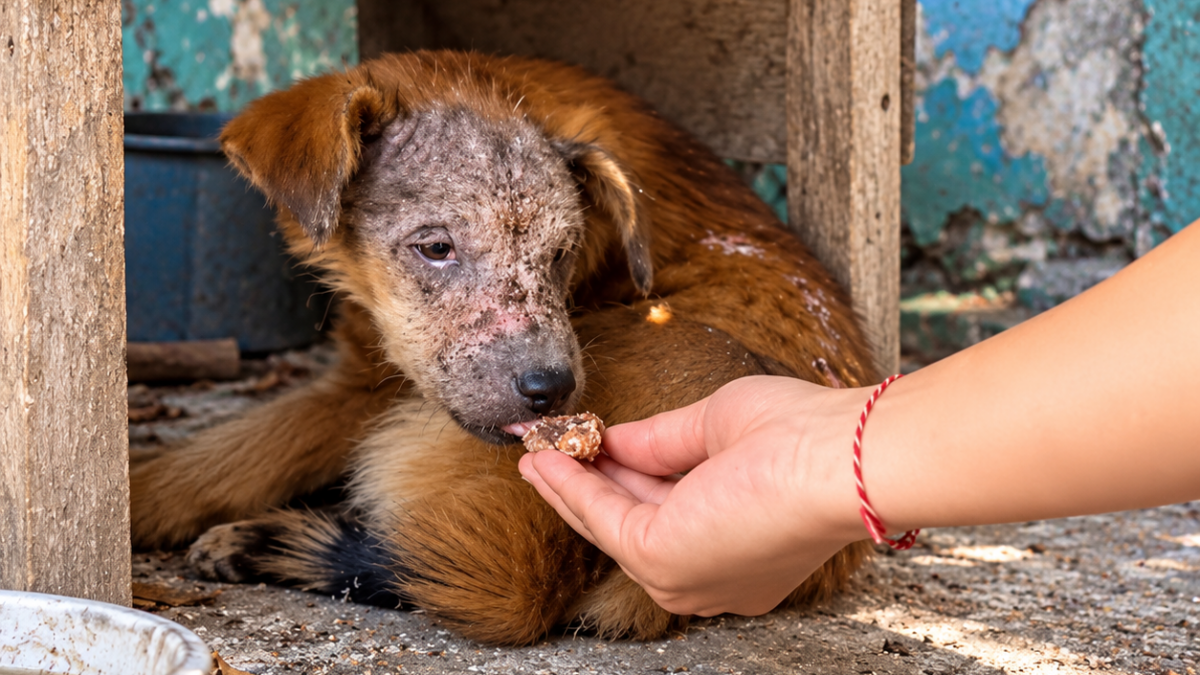
PART 2
Gracie slept almost the entire drive to the veterinary hospital.
That frightened me more than if she had cried.
Most puppies do not willingly sleep beside a stranger in a moving vehicle unless exhaustion has overwhelmed almost everything else.
I kept glancing toward her.
I had wrapped the blanket around her body, leaving only her head visible.
Her breathing was shallow but steady.
“Stay with me,” I whispered.
One eye opened a fraction.
Then closed again.
The clinic was only seventeen minutes away.
It felt like an hour.
Dr. Emily Carter met us at the side entrance because I had called ahead.
“What have we got?”
“Young female. Severe skin problem. Very weak. She’s been outside at least two days.”
“Known owner?”
“Yes.”
Dr. Carter looked at me.
“That sounded complicated.”
“It is.”
“We’ll handle the dog first.”
That was why I trusted her.
No speeches.
No assumptions.
Patient first.
Questions later.
A technician brought a clean towel.
I transferred Gracie carefully.
The moment unfamiliar hands touched her, she stiffened.
“It’s okay,” I said.
She looked at me.
That surprised me.
We had known each other less than twenty minutes, yet she had already decided that among all the strange people in that room, my face was at least familiar.
“I’m staying.”
Dr. Carter listened to her heart.
Checked her temperature.
Looked at her gums.
Examined her skin.
The longer she looked, the quieter she became.
Finally I asked, “How bad?”
“She’s dehydrated.”
“I expected that.”
“Underweight.”
I nodded.
“The skin is what concerns me most.”
She gently lifted one of Gracie’s front legs.
Inflammation extended across large areas of her body.
Her remaining coat had become thin and uneven.
Her eyes were irritated as well.
“Could this be mange?”
“Possibly part of it. Could be secondary infection. Could be several things happening together.”
“Can you treat it?”
“Yes.”
The answer came immediately.
That helped.
“Then let’s treat it.”
“We need tests first.”
“Do everything you need.”
Dr. Carter looked at me.
“Rescue covering it?”
“We’ll find a way.”
That was the unofficial motto of almost every small rescue organization I knew.
We’ll find a way.
It usually meant:
We do not currently have the money.
We do not currently have the foster space.
We do not currently know exactly how.
But the animal is here.
So we will figure it out.
Gracie was placed on fluids.
Blood was drawn.
Skin samples were collected.
Her eyes were cleaned carefully.
She flinched each time someone touched her.
Not aggressively.
She simply seemed unfamiliar with gentle handling.
The technician, Maria, spoke softly the entire time.
“You’re doing good, sweetheart.”
Gracie stared at her as if the words were a foreign language.
Maybe they were.
Not literally.
Emotionally.
Some animals understand tone before they understand safety.
They hear kindness.
They simply do not know whether to believe it.
I stayed until the first test results came back.
Malnutrition.
Dehydration.
An advanced skin infection.
Parasites.
Nothing about her condition had appeared overnight.
That mattered.
Dr. Carter removed her gloves.
“This has been developing for a while.”
“How long?”
“I can’t give you an exact number. But this isn’t something that began two days ago.”
I thought about the man standing outside the house.
*I tried treating her.*
Maybe he had.
But whatever effort had been made clearly had not been enough.
“Is she going to make it?”
Dr. Carter looked through the glass toward Gracie.
“I think so.”
“You think?”
“She’s young. That helps. But we need to get nutrition into her carefully, treat the infection, manage the skin, monitor hydration, and see how she responds.”
“Anything special?”
“That depends on the culture results.”
She paused.
“There is one medication I may want if this organism is what I suspect.”
“You have it?”
“Not currently.”
“Can you get it?”
“Yes.”
“How fast?”
“Probably several days.”
“From where?”
“Overseas supplier.”
I rubbed both hands over my face.
“Of course.”
Dr. Carter almost smiled.
“Nothing can ever be simple with you.”
“I was going to say the same thing about rescue dogs.”
Behind the glass, Gracie lifted her head.
Then dropped it again.
“What happens tonight?”
“She stays here.”
“Will someone be with her?”
“Staff checks all night.”
I nodded.
Then hesitated.
“Can I leave the blanket?”
“Yes.”
I carried it into the kennel.
Gracie watched me.
I folded it beside her.
She smelled it.
Then placed her chin on the edge.
Something about that tiny movement hurt more than I expected.
“Tomorrow,” I whispered.
She blinked.
“I’ll come back tomorrow.”
And I meant it.
—
I did not go home.
Not immediately.
I drove back to the neighborhood.
The house looked ordinary.
That bothered me.
People imagine neglect happening in frightening places.
Abandoned buildings.
Dark alleys.
Properties covered in trash.
Sometimes it does.
But sometimes it happens behind an ordinary front door.
A lawn.
A mailbox.
A child’s bicycle near a fence.
A new puppy bouncing behind a clean screen door.
I parked across the street.
The neighbor who had contacted us came outside.
Her name was Denise.
“You got her?”
“Yes.”
“How is she?”
“Alive.”
Denise looked relieved.
“Will she be okay?”
“I hope so.”
She stared toward the house.
“He told you she was his?”
“Yes.”
“He told you about the cage?”
I turned toward her.
“What cage?”
Denise froze.
“You didn’t know?”
“No.”
She sighed.
“I probably should have called sooner.”
That sentence appears in rescue stories more often than anyone wants to admit.
“What did you see?”
“Not much at first.”
“Tell me.”
“She used to be kept around back.”
“In a yard?”
“A cage.”
“What kind?”
“Wire.”
“How big?”
Denise spread her hands.
“Maybe this wide.”
It was not wide.
“How long was she in it?”
“I don’t know. A lot.”
“All day?”
“I work. I wasn’t watching constantly.”
“That’s fine. Just tell me what you know.”
“She was usually there when I left in the morning.”
“And when you came home?”
“Usually.”
My anger rose slowly.
“Was it covered?”
“Partly.”
“Food?”
“Sometimes.”
“Water?”
“I saw a bowl.”
“That isn’t what I asked.”
Denise looked down.
“I don’t know.”
I took a breath.
Getting angry at a witness does nothing useful.
“Did you ever see him treating her skin?”
“Once. He sprayed something on her.”
“When?”
“Maybe a month ago.”
“Did a vet come?”
“Not that I saw.”
“Did he take her anywhere?”
“I don’t know.”
Then she added quietly, “When the other puppy arrived, Gracie stopped being in the cage.”
“What do you mean?”
“She was outside the property.”
“Immediately?”
“Pretty much.”
“And she stayed nearby?”
“Yes.”
“Why didn’t she leave?”
Denise looked toward the house.
“Where would she go?”
Exactly.
Dogs do not understand replacement.
They do not understand that another puppy being carried through the door means they no longer belong.
They understand home as smell.
Routine.
Sound.
The place where food once appeared.
The doorway where someone used to stand.
So Gracie stayed.
She hid near the property because even after everything, it was still the only place in the world she recognized.
I called Animal Welfare Officer Marcus Reed.
We had worked together before.
“I need to make a report.”
“What happened?”
I told him.
He became quiet.
“Any photos?”
“Yes.”
“Vet records?”
“Tomorrow.”
“Witness?”
“Yes.”
“Known owner?”
“Yes.”
“Send me everything.”
“I want the new puppy checked.”
“That’s going to depend on what we establish.”
“Marcus.”
“I heard you.”
“There is a healthy new puppy inside the same house while Gracie was hiding outside with untreated medical problems.”
“I heard you.”
“Then check.”
“We will follow procedure.”
I hated that sentence.
Rescuers often do.
Procedure feels slow when an animal is suffering.
But Marcus had taught me something years earlier.
If you want consequences that survive a hearing, you document.
You do not storm in.
You do not threaten.
You do not create an argument someone can use to distract from the facts.
You document.
Photographs.
Veterinary reports.
Witness statements.
Dates.
Times.
Then you let the evidence become louder than anger.
So that was what we did.
—
The next morning, I arrived at the hospital before visiting hours officially began.
Maria met me in the hallway.
“She ate.”
I stopped.
“How much?”
“Not a lot. But she ate.”
I smiled.
“That’s a good start.”
“She also tried to hide behind the water bowl when I changed her bedding.”
My smile disappeared.
“Still scared.”
“Very.”
We entered quietly.
Gracie was awake.
Her eyes opened slightly wider than the day before.
I sat on the floor outside the kennel.
“Hey.”
Her nose moved.
Then something happened.
Her tail shifted.
Not a wag.
Barely movement.
But movement.
“You remember me?”
Maria smiled.
“She does.”
I opened the kennel but did not reach inside.
For ten minutes, I simply sat there.
Finally Gracie pushed herself up.
She walked toward me.
Slowly.
One step.
Then another.
She stopped at the threshold.
I placed my hand on the floor.
Not toward her.
Just there.
She smelled my fingers.
Then backed away.
“That’s okay.”
It was enough.
Trust is easy to misread when you want it badly.
You start calling every small movement progress because you need hope.
But with Gracie, I learned to respect the smallest victories.
She smelled my hand.
That was victory.
She did not panic when I opened the kennel.
Victory.
She ate.
Victory.
She slept.
Victory.
Recovery was not going to be one dramatic transformation.
It would be hundreds of tiny moments in which the world failed to hurt her.
Enough of those moments, repeated, might eventually teach her something new.
Dr. Carter entered carrying a clipboard.
“We got the culture.”
“And?”
“Mixed bacterial infection. Significant.”
“Medication?”
“The imported one would be ideal.”
“How long?”
“Three to five days.”
“Can she wait?”
“We’ll start with what we have and adjust when it arrives.”
“Any permanent damage?”
“Too early to know.”
She examined Gracie’s eyes.
The puppy endured it better this time.
“Her eyelids are inflamed because the surrounding skin is so irritated. Once we control that, she should be much more comfortable.”
“Can she see?”
“Yes.”
That was a relief.
“What about bathing?”
“Soon.”
Gracie looked at me.
I looked at her.
“You’re not going to like that part.”
Her ears lowered.
Maria laughed.
“I think she understood you.”
—
The first medicated bath was terrible.
Not because we did anything harsh.
Because Gracie had no idea why three humans were touching her at once.
The moment her paws felt water, panic took over.
She scrambled.
I held her gently against my chest.
“You’re okay.”
She trembled.
“I know.”
Maria moved slowly.
No spraying water into her face.
No sudden movements.
Everything deliberate.
Dr. Carter had explained that the medication needed time against the skin.
Gracie did not care about medical explanations.
She wanted out.
At one point she pressed her face beneath my arm.
Not biting.
Not resisting anymore.
Hiding.
I felt her heart racing.
“You can hide there.”
She stayed beneath my arm until the bath was finished.
Then we wrapped her in warm towels.
Maria brought a dryer set to low.
Gracie hated that too.
So we stopped.
We towel-dried her instead.
It took longer.
That did not matter.
When we finished, I sat on the floor with her wrapped against me.
For the first time, she did not try to leave.
Her eyes closed.
“You know what?” Maria whispered.
“What?”
“I think this is the first time she’s realized being held doesn’t always mean something bad is coming.”
I looked down.
Gracie’s head rested against my chest.
“I hope so.”
—
The investigation moved quietly.
Marcus visited the former owner.
He photographed the property.
He inspected the cage Denise described.
It was still there.
Empty.
He asked about treatment.
The owner said he had purchased medication from a farm supply store.
No veterinary prescription.
No examination.
No diagnosis.
He showed an old bottle.
Marcus documented it.
Then he asked why Gracie had been outside the property.
The answer changed twice.
First:
“She escaped.”
Then:
“I let her out because she kept making the cage dirty.”
Then:
“She didn’t want to stay.”
Dogs cannot explain when humans rewrite their stories.
Evidence has to do it for them.
Denise provided photographs from her phone.
She had taken them because she had been considering reporting the situation earlier.
One image showed Gracie inside the cage several weeks before I found her.
Her skin was already visibly irritated.
Another showed the new puppy arriving.
A third, taken the next morning, showed Gracie hiding near the wall outside.
Dates.
Times.
Sequence.
Facts.
Marcus called me.
“The owner signed surrender papers.”
I stopped walking.
“For Gracie?”
“Yes.”
“Permanent?”
“Yes.”
“So he cannot ask for her back?”
“Not legally as owner.”
I exhaled.
“What about the other puppy?”
“Examined.”
“And?”
“Currently healthy.”
“Currently?”
“He’s been instructed on care requirements and follow-up. The case is open.”
I wanted more.
I wanted immediate consequences.
I wanted someone to look at Gracie’s medical photographs and feel the same fury I felt.
Marcus heard it in my silence.
“Rachel.”
“What?”
“Do not go over there.”
“I wasn’t planning to.”
“You were thinking about it.”
“Thinking isn’t illegal.”
“Do not go.”
“Fine.”
“Your job is Gracie.”
I looked through the clinic window.
She was sleeping beneath a clean blanket.
“You’re right.”
“I know.”
“I hate when you say that.”
“I also know.”
—
The imported medication arrived on day four.
By then Gracie had started eating full meals.
Still slowly.
Still cautiously.
But she ate.
Her treatment schedule became complicated enough that Maria taped a chart beside her kennel.
Morning medication.
Topical treatment.
Eye care.
Small meal.
Rest.
Midday check.
Another meal.
Skin rinse on scheduled days.
Evening medication.
More rest.
There was something almost beautiful about the routine.
For perhaps the first time in Gracie’s short life, every hour of her day was organized around helping her feel better.
Not containing her.
Not keeping her out of the way.
Helping her.
She did not understand the chart.
She understood what came with it.
Food returned.
Water stayed clean.
Blankets were replaced.
Hands touched gently.
Voices remained soft.
No one became angry when she was afraid.
That last part mattered more than I realized.
Fear often creates inconvenience.
A frightened dog backs away.
Refuses a leash.
Freezes at doorways.
Struggles during treatment.
People who expect obedience may interpret fear as stubbornness.
Gracie had probably learned that showing fear did not make people more patient.
So when she froze, she waited for frustration.
Instead, we waited too.
The first time I realized she understood this was during her second bath.
She resisted at first.
Then stopped.
Not because she shut down.
Because she looked at me.
I held my hand near her face.
“You know this part.”
She smelled my fingers.
Maria slowly wet the cloth.
Gracie stayed.
“You’re okay.”
Her body remained tense.
But she stayed.
When the bath ended, she walked into the towel on her own.
I nearly cried.
Maria did not hide hers.
“She chose you.”
“No.”
I shook my head.
“She chose not to run.”
“That’s the same thing today.”
Maybe it was.
—
A week passed.
Then another.
Gracie’s skin began to change.
The angry redness softened.
The swelling around her eyes decreased.
She could open them more comfortably.
Her posture changed too.
At first, she moved like a dog expecting the floor itself to betray her.
Head low.
Body folded inward.
Always ready to retreat.
Then one morning I entered carrying breakfast.
She stood.
Her tail moved.
Once.
Then again.
I froze.
“Maria.”
Maria looked through the doorway.
“What?”
“Watch.”
I stepped sideways.
Gracie’s tail followed me.
Maria smiled.
“That counts.”
“It absolutely counts.”
I crouched.
“Are you happy to see me?”
Gracie walked forward.
Stopped.
Then touched her nose to my knee.
I held still.
She smelled my jeans.
Then my hand.
Then, for the first time, she allowed me to scratch beneath her chin.
One second.
Two.
Three.
She stepped away.
I did not follow.
“That’s enough,” I whispered.
The next day she let me do it again.
Then longer.
By the end of that week, she had discovered something else.
Toys.
It began with a small yellow ball.
I rolled it across the room.
Gracie stared.
The ball stopped.
She stared at me.
I rolled it again.
Nothing.
Maria picked it up.
“She may not know what it is.”
That possibility had never occurred to me.
Most puppies understand play through experience.
Chasing siblings.
Pulling cloth.
Stealing shoes.
Running after movement.
If Gracie had spent most of her life confined, maybe nobody had ever taught her that some objects existed for no reason except fun.
I found a soft stuffed rabbit.
I squeezed it gently.
It squeaked.
Gracie jumped.
“Bad idea.”
I hid it behind my back.
She stared at me.
Then tilted her head.
I squeezed it again, quieter.
Her ears lifted.
I placed it on the floor.
She approached.
Smelled it.
Touched it with her nose.
The rabbit squeaked.
She jumped backward.
Then came forward again.
That was the beginning.
Within three days, the rabbit had one ear missing.
I had never been happier to see a destroyed toy.
—
The first bed arrived from my friend Sarah.
It was soft.
Round.
Light brown.
Nothing special.
Except to Gracie.
We placed it inside her recovery room.
She approached slowly.
Smelled the edge.
Put one paw in.
Then removed it.
I sat nearby.
“It’s yours.”
She looked at me.
“You can use it.”
One paw.
Then two.
She climbed in.
Turned around.
Then sat.
Her expression changed.
I cannot explain it more scientifically than that.
Dogs do not smile exactly the way humans do.
But their bodies soften.
Their eyes change.
Their mouths loosen.
Gracie sank into the cushion.
Then she rolled onto one side.
Her legs stretched.
Her head dropped against the raised edge.
Five minutes later, she was asleep.
Not curled tightly.
Stretched out.
Taking space.
That was what got me.
For most of her life, space had been something denied to her.
The cage had taught her to make herself small.
Fear had taught her to hide.
Now this ridiculous inexpensive dog bed was telling her something different.
You can take up room.
You belong here.
Sarah visited that afternoon.
“Does she like it?”
Gracie was upside down with one paw hanging over the edge.
“No.”
Sarah laughed.
“I can see that.”
“Completely hates it.”
Gracie opened one eye.
Sarah crouched.
“She’s beautiful.”
I looked at the patches where new fur was beginning to grow.
“She will be.”
Sarah shook her head.
“No. She already is.”
I remembered that.
—
The report to authorities eventually became a formal case.
I avoided asking for details every day.
Mostly because Marcus threatened to stop answering my calls.
But one afternoon he came to the clinic.
He stood outside Gracie’s room.
She barked once.
It startled all of us.
“That’s new,” he said.
“She found her voice.”
“Apparently.”
“What happened?”
“Someone rolled a cart past the door.”
Marcus looked at her.
“Protecting the building already?”
“Maybe.”
He handed me a copy of the finalized surrender confirmation.
Then he said, “The owner has been cited under local animal-care provisions.”
I looked up.
“For Gracie?”
“For conditions documented on the property and failure to obtain adequate care.”
“What happens?”
“Financial penalty. Compliance requirements. Follow-up inspection.”
“And the other puppy?”
“Still being monitored.”
I nodded.
“Is that all?”
Marcus gave me the look he used when I was about to become unreasonable.
“What do you want?”
“I want him to understand what he did.”
“That’s not something a citation can guarantee.”
“He replaced her.”
“I know.”
“He watched her hide outside.”
“I know.”
“He called her difficult because she was scared.”
“I know.”
Marcus lowered his voice.
“But you’re making his understanding too important.”
I frowned.
“What does that mean?”
“If he wakes up tomorrow and suddenly understands everything, does that change Gracie’s life?”
“No.”
“If he never understands, does that stop her from recovering?”
“No.”
“Then stop making him the center of the story.”
I looked through the glass.
Gracie had the yellow ball between her paws.
Marcus was right.
Again.
I hated that.
The best revenge was not convincing the wrong person that Gracie mattered.
It was building a life in which his opinion no longer mattered at all.
—
The first walk happened almost a month after I found her.
By then, Gracie’s coat was growing back.
Not evenly.
She still looked a little patchy.
But her eyes were bright.
Her weight was improving.
She trusted me enough to accept a harness.
The front door of the clinic frightened her.
She stopped at the threshold.
Outside stretched a world she had barely experienced freely.
Cars.
Birds.
Wind.
Grass.
People.
Open space.
I stepped outside.
She stayed inside.
“Come on.”
Nothing.
I sat on the concrete.
Maria watched from behind us.
“She doesn’t have to go today.”
“I know.”
Gracie smelled the air.
Her nose worked constantly.
A leaf moved across the sidewalk.
She watched it.
Then something extraordinary happened.
She stepped forward.
One paw outside.
Then another.
She stopped.
The sun touched her face.
She squinted.
Then she walked all the way out.
I did not cheer.
I wanted to.
But loud celebration would have scared her.
So I whispered, “Good girl.”
We walked fifteen feet.
Then she froze at grass.
Grass.
Something most dogs take for granted.
She smelled it.
Stepped on it.
Jumped slightly when the blades touched her paws.
I laughed.
“Yeah. That’s grass.”
She looked offended.
Then tried again.
Ten minutes later, she was walking through it.
Fifteen minutes later, she discovered a leaf.
Twenty minutes later, she discovered that leaves could be chased.
Maria recorded part of it.
When I watched the video later, I noticed something I had missed in the moment.
Gracie’s tail was up.
Not tucked.
Not low.
Up.
She looked like a puppy.
For the first time, she looked her age.
—
Applications began arriving once the rescue posted that Gracie would eventually be available for adoption.
We were careful.
Very careful.
A dog like Gracie did not only need a nice person.
She needed patience.
Consistency.
A quiet introduction.
Someone who would not interpret fear as rejection.
Someone who understood that progress could move backward on difficult days.
Then I received an application from a woman named Hannah Brooks.
Forty-two.
Worked from home.
No small children.
Fenced yard.
One elderly cat.
Previous experience with shy rescue dogs.
Her application looked almost too perfect.
That made me suspicious.
Rescue work does that to you.
You stop trusting perfect paperwork.
So I called.
“Why Gracie?”
Hannah paused.
“Because of the picture of her in the bed.”
“Not the before pictures?”
“No.”
“Why not?”
“I saw them.”
“And?”
“They made me sad.”
“The bed picture?”
“She looked surprised.”
I smiled despite myself.
“Surprised?”
“Like she had just discovered comfort existed.”
That was exactly what I had seen.
Hannah continued.
“I don’t want to rescue her because she’s sad.”
“What do you want?”
“To give her enough time that she doesn’t have to be sad anymore.”
That answer got her a visit.
—
Hannah came to the clinic three days later.
I gave her instructions.
“Sit down.”
“Okay.”
“Don’t reach for her.”
“Okay.”
“Don’t call her repeatedly.”
“Okay.”
“Don’t stare.”
“Got it.”
“And if she ignores you—”
“I let her.”
I looked at her.
“You really have done this before.”
“A border collie named Penny.”
“What happened?”
“She spent the first two weeks living behind my couch.”
“How long did you have her?”
“Eleven years.”
I relaxed slightly.
Gracie entered the room.
She saw Hannah.
Stopped.
Hannah did nothing.
Gracie looked at me.
I sat on the floor.
“It’s okay.”
Hannah turned slightly sideways.
Less threatening.
Gracie smelled the air.
Five minutes passed.
Then ten.
Hannah never reached.
Finally Gracie walked behind her.
Smelled her back.
Then moved away.
Hannah smiled but did not turn.
“Hi, Gracie.”
The puppy froze.
Then continued walking.
Twenty minutes later, Hannah placed one treat on the floor.
Not from her hand.
Gracie ate it.
Then another.
At the end of the visit, Hannah stood slowly.
Gracie followed her toward the door.
I noticed.
So did Hannah.
Neither of us said anything until she was gone.
Maria appeared.
“Well?”
“I hate how good that went.”
She laughed.
“You like her.”
“I don’t like adopters.”
“That seems problematic in rescue.”
“I tolerate them when necessary.”
—
Hannah visited four more times.
Each time Gracie approached faster.
On the fourth visit, she placed her chin on Hannah’s knee.
Hannah looked at me with tears in her eyes.
I raised one finger.
“Do not ruin this by getting emotional.”
She whispered, “You’re emotional.”
“I am a professional.”
“You’re crying.”
“Clinic air is dry.”
Gracie climbed halfway onto Hannah’s lap.
That ended the argument.
We scheduled a home visit.
Hannah’s house was small.
One story.
Quiet street.
Backyard with grass, trees, and a low wooden fence.
She had already purchased a bed.
Then another bed.
And a third.
I stared.
“How many dogs are you adopting?”
“One.”
“You have three beds.”
“One for the bedroom. One for the office. One for the living room.”
I pointed toward a fourth cushion near the kitchen.
“What is that?”
“That came with the living-room bed.”
“You have four beds.”
Hannah looked embarrassed.
“I may have overprepared.”
I smiled.
“No. For Gracie, I think overprepared is fine.”
—
Before the adoption could proceed, one final problem appeared.
The former owner contacted animal control.
He had seen updated photographs of Gracie.
Her skin had healed dramatically.
Her coat was returning.
She looked happy.
Healthy.
Like a different dog.
He asked whether he could get her back.
Marcus called me before I heard it from anyone else.
“No.”
That was my entire response.
“I know.”
“No.”
“Rachel.”
“He surrendered her.”
“Yes.”
“Permanently.”
“Yes.”
“Then why are we talking?”
“Because I knew you would hear about it.”
“What did he say?”
Marcus hesitated.
“What?”
“He said she looks better now.”
I laughed once.
There was no humor in it.
“Better now?”
“Yes.”
“So now she’s worth having?”
“I didn’t say that.”
“He did without saying it.”
Marcus stayed quiet.
I walked outside.
I needed air.
Gracie was inside with Maria, playing with the stuffed rabbit’s replacement.
“What happens?” I asked.
“Nothing.”
“Nothing?”
“He surrendered ownership.”
“So he cannot reclaim her?”
“No.”
I closed my eyes.
There are moments when justice is not dramatic.
No courtroom.
No confrontation.
No shouting.
Just a document.
A signature.
A line someone signed when they believed an animal no longer had value.
That same signature now prevented him from taking her back after other people had spent weeks rebuilding what had been neglected.
“He asked if he could visit,” Marcus added.
My eyes opened.
“What did you say?”
“That it was not appropriate.”
“Good.”
“He got angry.”
“I’m comfortable with that.”
Marcus sighed.
“Rachel.”
“What?”
“Don’t celebrate somebody being angry.”
“I’m not.”
I looked through the clinic window.
Gracie ran past carrying the rabbit.
“I’m celebrating that for once, his decision only hurts him.”
That was different.
At least to me.
—
The adoption happened on a Saturday.
Hannah brought a red bandana.
Gracie tried to eat it.
We decided that was a sign of confidence.
I signed the rescue paperwork.
Hannah signed.
Then she stopped.
“What?”
“I’m nervous.”
“Good.”
She looked surprised.
“Good?”
“People who aren’t nervous about taking responsibility for a living animal worry me.”
“I don’t want to mess this up.”
“You will.”
Her face fell.
I laughed.
“Everyone does.”
“That is not reassuring.”
“You’ll make mistakes. You’ll misunderstand her. She’ll have bad days. You’ll have bad days. The goal isn’t perfection.”
“What’s the goal?”
“Return.”
She frowned.
“What?”
“When you leave, come back.”
“When she’s scared, stay patient.”
“When she has a setback, try again.”
“When she hides, give her time.”
“When she trusts you, don’t make her regret it.”
Hannah looked at Gracie.
The puppy was asleep in her new bed.
“Return,” she repeated.
“Every day.”
Then Hannah signed.
Gracie had a home.
—
The first night was harder than either of us expected.
Hannah called me at 11:42 p.m.
“She won’t come out of the bathroom.”
“Is she eating?”
“Yes.”
“Drinking?”
“Yes.”
“Breathing normally?”
“Yes.”
“Then let her stay in the bathroom.”
“But I bought four beds.”
I laughed.
“I told you.”
“This is not funny.”
“It’s a little funny.”
“I put one outside the bathroom door.”
“Good.”
“She’s sleeping on the bath mat.”
“Of course she is.”
Hannah sighed.
“What if she hates it here?”
“She has been there six hours.”
“I know.”
“Remember Penny behind the couch?”
Silence.
Then:
“That was unfair.”
“It was accurate.”
“Fine.”
“Go to bed.”
“What if she needs me?”
“She’ll find you.”
“Are you sure?”
“No.”
“Rachel.”
“Hannah, she doesn’t need you to solve everything tonight. She needs the house to stay quiet long enough for her to discover nothing bad happens there.”
Another pause.
“Okay.”
“Call me tomorrow.”
She did.
At 7:10 a.m.
“She’s in the living-room bed.”
“See?”
“And she stole one of my socks.”
“Excellent.”
“That’s excellent?”
“Very.”
“Why?”
“Because frightened dogs do not usually steal laundry for entertainment.”
There was silence.
Then Hannah laughed.
“She’s currently chewing the heel.”
“Congratulations.”
—
A week later, I visited.
Gracie met me at the door.
Actually met me.
She ran from the living room.
Tail moving.
Eyes bright.
Then she stopped three feet away as though suddenly remembering she had once been a cautious dog.
“Don’t pretend you’re cool now.”
She rushed forward.
I crouched.
She climbed against me.
Hannah leaned on the wall.
“I feel betrayed.”
“You should.”
“She never greets me like that.”
“She lives with you.”
“That should count for more.”
“Absence makes the tail wag harder.”
Gracie eventually returned to Hannah.
Then something happened that made me know the adoption would work.
She walked into the bedroom.
We followed.
She jumped onto her bed.
Not the human bed.
Her own.
Circled twice.
Then looked at us with complete confidence.
This room was hers now.
This bed was hers.
This person was hers.
She understood ownership in the only way that mattered.
Not legal possession.
Belonging.
—
Her first real neighborhood walk with Hannah lasted eight minutes.
The second lasted twelve.
The third almost twenty.
By the end of the month, Gracie had favorite routes.
She liked the quiet street behind the elementary school.
She disliked motorcycles.
She loved watching squirrels.
She was deeply suspicious of garbage cans.
She had discovered that grass after rain was excellent for rolling.
Hannah sent videos constantly.
Gracie chasing leaves.
Gracie asleep upside down.
Gracie barking at her own reflection in a patio door.
Gracie carrying one shoe from room to room without damaging it.
Then came the duck.
Hannah’s neighbor kept several ducks behind a low wire enclosure.
One afternoon, Gracie noticed a brown duck named Edith walking loose in the neighbor’s yard.
Gracie approached the fence.
Tail high.
Curious.
Edith approached from the other side.
They stared at each other.
Gracie made the mistake of barking.
Once.
Edith charged.
The duck came straight toward the fence, wings out, making a level of noise Gracie apparently considered completely unreasonable.
Gracie ran.
Not gracefully.
She sprinted across Hannah’s yard and hid behind a patio chair.
Hannah recorded the whole thing.
When she sent it to me, I watched it six times.
The puppy who had once hidden from people was now being chased across a sunny backyard by an offended duck.
That was recovery.
Not simply looking healthier.
Having enough confidence to make foolish decisions.
—
Months passed.
Gracie’s coat returned almost completely.
The reddish-brown color deepened.
Her eyes opened fully.
She gained muscle.
People who had seen her first photographs sometimes struggled to recognize her.
I did not.
I recognized her in the way she watched hands.
In the way unexpected movements still made her pause.
In the way she sometimes slept curled tightly even though she had space.
Recovery does not erase history.
It gives history competition.
New memories begin appearing beside the old ones.
A bath that once meant panic becomes a warm towel and a treat.
A hand that once meant restraint becomes a scratch beneath the chin.
A closed door no longer means confinement.
It means Hannah went to get the mail and will be back in thirty seconds.
That was how Gracie healed.
Not by forgetting.
By experiencing enough good things that fear was no longer the only evidence she had about the world.
—
The legal case involving her former owner continued for several months.
I stayed out of most of it.
Marcus encouraged that.
Strongly.
But eventually he told me the final outcome.
The citation stood.
The former owner paid the required penalties.
He was ordered to comply with follow-up welfare requirements.
Authorities continued monitoring the other dog.
There were restrictions concerning future animal care under the local process.
No dramatic prison scene.
No public humiliation.
No shouting crowd.
Real accountability is often boring on paper.
But one thing mattered enormously.
Gracie could never be treated as his property again.
He had signed her away when she was sick.
He could not change his mind after she healed.
That felt fair.
More than fair.
It felt exact.
He had looked at a suffering puppy and decided she was no longer worth the effort.
Other people had looked at the same puppy and decided effort was exactly what she deserved.
The difference between those two choices became Gracie’s entire future.
—
One afternoon nearly six months after the rescue, Hannah and I returned to the neighborhood where I had found her.
Not with Gracie.
I was not going to bring her there.
There was no reason.
We were meeting Denise because she had collected a few old photographs for our rescue records.
The cage was gone.
The weeds had been cut.
The wall remained.
I stood near the place where Gracie had hidden.
Hannah folded her arms.
“She was here?”
“Right there.”
“That tiny space?”
“Yes.”
“She stayed for two days?”
“At least.”
Hannah looked toward the house.
“Why?”
I knew what she meant.
Why stay?
Why not run?
Why wait near the place that had failed you?
“Because dogs don’t understand rejection the way we do.”
She looked at me.
“They understand belonging.”
I pointed toward the house.
“To her, this was still the center of the map.”
Hannah became quiet.
Then she said, “Her center moved.”
I smiled.
“Yes.”
“To my house.”
“Yes.”
“To my bathroom mat.”
“Unfortunately.”
She laughed.
“Four beds.”
“And the bath mat.”
We stood there for another minute.
I felt anger trying to return.
Old anger.
But it did not fit anymore.
Gracie was not there.
That place no longer controlled the story.
We left.
—
Gracie’s one-year rescue anniversary arrived in spring.
Hannah invited me over.
Sarah came.
Maria came.
Dr. Carter stopped by after work.
Even Marcus appeared.
“I was told there would be food,” he said.
“There is.”
“For humans?”
“Mostly.”
“Good.”
Gracie wore a new bandana.
This one survived.
For almost an hour.
Hannah had placed her first little clinic bed in the living room.
Not because Gracie still used it.
She had outgrown it.
The bed looked tiny now.
I touched the edge.
“I remember when she fit in this.”
Hannah smiled.
“She still tries.”
“Of course.”
On the wall hung two photographs.
The first was from the day I found her.
Gracie beside the wall.
Thin.
Eyes barely open.
Afraid.
The second had been taken the previous week.
Gracie running across the yard.
Mouth open.
Ears flying backward.
Healthy coat shining in sunlight.
A duck visible in the distance.
I laughed.
“You included Edith?”
“She’s part of the journey.”
“Gracie would disagree.”
Marcus stood beside me.
“Same dog?”
“Yes.”
He studied both photographs.
“Hard to believe.”
I looked toward Gracie.
She was trying to convince Sarah that one piece of chicken was obviously insufficient.
“Not really.”
“What do you mean?”
“She was always in there.”
Marcus glanced at me.
“You’re getting sentimental.”
“Leave.”
“I just got here.”
—
Later that afternoon, Hannah handed me an envelope.
“What’s this?”
“Open it.”
Inside was a printed photograph.
Gracie asleep in Hannah’s bed.
Not her dog bed.
The human bed.
Head on a pillow.
Blanket partially over her.
I looked at Hannah.
“You said she wasn’t allowed on the bed.”
“I was wrong.”
“Clearly.”
On the back, Hannah had written:
**She doesn’t hide anymore.**
I stared at those words.
That was not completely true.
Gracie still hid during thunderstorms.
Sometimes she retreated behind the couch when unfamiliar men entered the house.
The vacuum cleaner remained her mortal enemy.
But I understood what Hannah meant.
Gracie no longer hid from life.
There was a difference.
—
A few weeks later, something unexpected happened.
The former owner saw Hannah and Gracie at a local pet-supply store.
I was not there.
Hannah called me afterward.
“He recognized her.”
My stomach tightened.
“What happened?”
“He said her name.”
“Gracie?”
“No. Whatever he used to call her.”
“What did she do?”
“Nothing.”
I paused.
“Nothing?”
“She looked at him.”
“And?”
“Then she came behind my legs.”
Old instinct.
Safety behind the person she trusted.
“What did he say?”
“He asked if she was the same dog.”
“You answered?”
“Yes.”
“What did you say?”
“I said, ‘She is.’”
I could hear tension in Hannah’s voice.
“Then?”
“He said she looked good.”
I closed my eyes.
Of course.
“Did he try to touch her?”
“Yes.”
My eyes opened.
“What happened?”
“I stepped between them.”
“Good.”
“He got annoyed.”
“Better.”
“Rachel.”
“What?”
“I’m not finished.”
I stayed quiet.
“He said, ‘She remembers me.’”
My jaw tightened.
“And you?”
“I said, ‘Maybe.’”
“That’s all?”
“No.”
Hannah took a breath.
“I told him remembering someone isn’t the same as wanting to go back.”
I smiled.
“That was good.”
“He asked whether I knew how much money he’d spent trying to help her.”
“What did you say?”
“I said I knew how much the rescue spent.”
“Hannah.”
“I stayed calm.”
“I’m proud of you.”
“He said people had made him look like a monster.”
“And?”
“I told him I wasn’t interested in what people thought of him.”
I waited.
“I was interested in what Gracie needed.”
“That was the right answer.”
“He looked at her again.”
“What did she do?”
“She leaned against me.”
Silence.
Then Hannah said something I never forgot.
“He wanted her to recognize him.”
I looked toward the window.
“And?”
“She chose me instead.”
There it was.
The revenge the story actually deserved.
Not pain.
Not humiliation.
Not destroying someone.
Choice.
Gracie had once had no choice.
No choice about the cage.
No choice about treatment.
No choice about being left outside.
No choice about the new puppy.
No choice about which hands reached for her.
Now she had a choice.
And when the past stood in front of her, she stepped behind the person who had given her a home.
That was enough.
—
When Hannah returned from the store, Gracie apparently slept for three hours.
No pacing.
No whining.
No waiting near the door.
That mattered too.
Seeing the past had not pulled her backward.
It had only reminded us how far she had come.
I visited the next day.
Hannah apologized.
“For what?”
“I should have left immediately.”
“You handled it.”
“What if it scared her?”
“Maybe it did.”
“That’s what I’m afraid of.”
I watched Gracie rolling on the lawn.
“Hannah.”
“What?”
“Being scared is not the same as being damaged forever.”
She looked at me.
“That is basically her whole story, isn’t it?”
“Yes.”
Gracie ran toward us.
Then past us.
Straight toward the fence.
Edith the duck appeared.
“Gracie,” Hannah warned.
Gracie barked.
Edith charged.
Gracie ran back behind Hannah.
I laughed until my stomach hurt.
“Trauma response,” Hannah said dryly.
“Completely.”
—
Time passed.
Gracie became the dog nobody expected from that first photograph.
Affectionate.
Playful.
A little dramatic.
She loved blankets.
Hated rain.
Adored car rides once she realized they did not always end at a clinic.
She collected socks.
Never chewed them.
Just collected them.
Hannah eventually bought a basket and filled it with old socks so Gracie could steal them legally.
Gracie ignored the basket and continued stealing Hannah’s good ones.
Some instincts cannot be redirected.
She also developed a strange habit of checking every new bed in the house.
Guest mattress?
Gracie tested it.
Laundry pile?
Bed.
Fresh towels?
Bed.
Hannah’s yoga mat?
Obviously a bed.
I used to think this was funny.
Then Hannah said, “Maybe soft places still surprise her.”
That made me stop laughing.
Not because it was sad.
Because it was beautiful.
A dog who had spent too much time on hard surfaces had decided comfort should be tested wherever it appeared.
I supported the policy.
—
Two years after her rescue, our organization held a small fundraiser.
Hannah brought Gracie.
I was nervous.
Crowds could still overwhelm her.
But she surprised us.
She walked through the room slowly.
Accepted treats.
Allowed two children to pet her after she approached them first.
Then she found the table displaying before-and-after rescue photographs.
Her own picture was there.
Gracie stopped.
Not because she recognized herself.
Probably not.
She smelled the display.
Then lay down beneath it.
People kept passing.
Some read her story.
Then looked down at the healthy dog sleeping at their feet.
A woman whispered, “That’s her?”
I nodded.
She crouched several feet away.
Gracie lifted her head.
The woman started crying.
I smiled gently.
“She’s okay.”
“I know.”
The woman wiped her face.
“That’s why I’m crying.”
I understood.
Sometimes recovery hurts to witness because it shows you what should have existed all along.
—
Dr. Carter eventually told me something I had forgotten.
“The first day,” she said, “I wasn’t sure we’d save all of her skin.”
“What do you mean?”
“The infection was extensive.”
“You never told me that.”
“You were already panicking.”
“I was not.”
“You asked me if she was going to die four times.”
“That seems medically responsible.”
“You also asked if we could import medication overnight from another continent.”
“Again, responsible.”
She laughed.
Then looked at Gracie asleep beneath Hannah’s chair.
“She did better than I expected.”
“Because of the medicine?”
“That helped.”
“What else?”
“Nutrition. Hygiene. Time.”
She paused.
“And low stress.”
I looked at her.
“You mean love?”
“I’m a veterinarian. I said low stress.”
“Coward.”
She smiled.
“Fine. Stable attachment helps.”
“Still avoiding the word.”
“Love is difficult to bill.”
That became one of my favorite things she ever said.
—
The former owner never approached Gracie again.
As far as I know.
I stopped asking.
That was another milestone.
For months, I had wanted updates about him.
Did he pay the fine?
Was he following the requirements?
Did he understand what he had done?
Did he regret surrendering Gracie?
Eventually those questions felt smaller.
Gracie had become too big a story to keep centering the person who failed her.
I think rescuers sometimes make this mistake.
We become so angry at whoever caused suffering that we accidentally give them the most important role.
But Gracie’s life was not a story about one man.
It was a story about everyone who came after.
Denise noticing.
Me stopping.
Maria holding a towel.
Dr. Carter ordering medication.
Sarah buying a bed.
Marcus documenting evidence.
Hannah sitting on a clinic floor without demanding trust.
All those small choices became larger than the choice that had hurt her.
That was the ending I eventually learned to prefer.
—
Three years after rescue, Gracie developed a habit that made Hannah laugh every morning.
At exactly 8:15, while Hannah worked at her desk, Gracie brought her a toy.
Not before.
Not after.
8:15.
If Hannah ignored her, Gracie placed the toy on the keyboard.
If that failed, she rested her chin on Hannah’s arm.
If *that* failed, she barked once.
“Union-mandated break,” Hannah called it.
I visited one morning to witness it.
8:14.
Nothing.
8:15.
Gracie appeared carrying a stuffed duck.
I laughed.
“Is that supposed to be Edith?”
Hannah nodded.
“I may have encouraged the rivalry.”
Gracie dropped the duck on the keyboard.
“Professional,” I said.
“She has boundaries.”
“She used to be terrified of people touching her.”
“I know.”
Now she was demanding human attention on a schedule.
Transformation does not always arrive as a dramatic moment.
Sometimes it looks like a dog interrupting spreadsheets because she has decided affection is overdue.
—
Gracie’s fourth rescue anniversary was quieter.
No party.
Just Hannah.
Me.
Sarah.
And Gracie.
We took her to a lake trail early in the morning.
The first mile was easy.
Gracie walked ahead.
Stopped to smell everything.
Looked back constantly to make sure we were following.
At one point the trail opened into a wide meadow.
Hannah unclipped Gracie’s leash inside a secure fenced exercise area nearby.
Gracie stood still.
The open space seemed to surprise her.
Then she ran.
Full speed.
Across the grass.
Turned.
Ran back.
Then away again.
Her ears flew.
Her tail streamed behind her.
Sarah raised her phone.
“Look at her.”
I was.
I remembered the cage.
Not from seeing it firsthand.
From Denise’s photograph.
Wire walls.
Small space.
A puppy forced to fold herself into whatever room remained.
Now Gracie ran until she was tired.
Then ran again.
Hannah stood beside me.
“You okay?”
“No.”
“Good no or bad no?”
“Good.”
Gracie raced toward us.
At the last second, she changed direction.
We both laughed.
“She’s showing off,” Hannah said.
“She earned it.”
—
On the drive home, Gracie fell asleep in the back seat.
Exactly as she had slept the day I rescued her.
But everything about it was different.
That first car ride, she slept because she had nothing left.
This time, she slept because she had spent the morning running.
The first time, she was wrapped in a blanket because her body struggled to stay warm.
This time, sunlight fell across her healthy coat.
The first time, she did not know where the car was taking her.
This time, she knew.
Home.
Hannah looked at her through the mirror.
“What are you thinking?”
“That the same thing can mean completely different things.”
“What?”
“Sleeping in a car.”
Hannah understood.
She reached back at the next red light and touched Gracie’s paw.
Gracie did not wake.
—
Years later, I still keep one photograph from the day I found her.
Not because I enjoy looking at it.
I don’t.
But because memory can soften reality.
You start remembering the ending so clearly that the beginning becomes abstract.
“Gracie had skin problems.”
“Gracie was scared.”
“Gracie was underweight.”
Those sentences become clinical.
The photograph prevents that.
She was real.
Her fear was real.
The wall was real.
The other puppy behind the screen door was real.
The moment she tried to move away from my hand was real.
So was everything after.
The blanket.
The car.
The fluids.
The medicine flown in from abroad.
The baths.
The first touch beneath her chin.
The yellow ball.
The destroyed rabbit.
The bed.
The first walk.
Hannah.
Edith.
The socks.
The lake.
The life.
All real.
That matters.
Because rescue stories sometimes become fairy tales once they are told enough times.
People skip from “before” to “after.”
They forget the middle.
The middle is where healing happens.
Slowly.
Expensively.
Inconveniently.
With setbacks.
With fear.
With medication at 6:00 a.m.
With bedding that needs changing again.
With dogs refusing doors.
With adopters calling at midnight because the dog prefers the bathroom floor to four expensive beds.
The middle is not glamorous.
It is where love proves itself.
—
One winter evening, Hannah called.
“Emergency.”
My stomach dropped.
“What?”
“Gracie stole an entire loaf of bread.”
I closed my eyes.
“Hannah.”
“It was on the counter.”
“That does not sound like an emergency.”
“She ate half.”
“Still not.”
“She looks proud.”
“That is concerning.”
“I thought you’d want to know.”
“You nearly gave me a heart attack.”
“Sorry.”
“Send me a picture.”
She did.
Gracie sat beside an empty bread bag.
Expression peaceful.
No remorse.
I saved it.
Later, I placed it beside her first rescue photograph.
The contrast was absurd.
In one image, she barely had enough energy to stand.
In the other, she had committed a carbohydrate crime and felt excellent about it.
That might be my favorite before-and-after set.
Not because the second picture was beautiful.
Because it was normal.
Gracie had earned normal.
—
As she grew older, her coat changed slightly.
A little white appeared around her muzzle.
Hannah noticed first.
“She’s getting gray.”
“You are too.”
“That was unnecessary.”
“Accurate.”
Gracie still loved walks.
Still loved beds.
Still feared thunderstorms.
Still treated ducks with appropriate caution.
She remained suspicious of men wearing baseball caps for several years.
Then even that faded.
Not completely.
But enough.
One afternoon a delivery driver crouched near the porch.
Gracie approached.
Smelled his hand.
Accepted a treat.
Walked away.
Hannah texted me immediately.
**BASEBALL CAP. SHE TOOK THE TREAT.**
I understood why it mattered.
Some milestones are invisible to everyone except the people who know the history.
—
The anniversary of her adoption eventually became more important to Hannah than the anniversary of her rescue.
“I think this should be her real birthday,” she said.
“Why?”
“Because it’s when she started living here.”
“Reasonable.”
So every year, Hannah baked a small dog-safe cake.
Gracie ate too fast.
Then stared at everyone else’s plates.
One year, Marcus came.
He stood in the backyard watching her.
“You know,” he said, “I barely recognize her.”
“She remembers you.”
“I don’t think she does.”
“Maybe not.”
We watched her run toward Hannah.
Marcus crossed his arms.
“You were difficult during that case.”
“I was passionate.”
“You called me nine times in one day.”
“Passionate.”
“You threatened to sit outside the department office.”
“I don’t remember that.”
“I have the voicemail.”
“Delete it.”
“No.”
We laughed.
Then he grew serious.
“You were right about one thing.”
“What?”
“She needed out.”
I looked at Gracie.
“You made it happen.”
“No.”
He shook his head.
“We documented it. The owner signed. The clinic treated her. You transported her. Hannah adopted her.”
He pointed toward the dog.
“A lot of people made it happen.”
That was true.
Rescue stories are rarely about one rescuer.
They are networks of people deciding not to pass responsibility to the next person.
Someone notices.
Someone calls.
Someone drives.
Someone treats.
Someone fosters.
Someone documents.
Someone adopts.
Each person holds the story for a little while.
Then passes it forward.
Eventually, if everything goes right, the animal stops needing rescue.
That is the goal.
To become unnecessary.
—
Gracie eventually reached an age when running across the yard became trotting.
Then walking.
The vet called it normal aging.
Hannah called it unacceptable.
“You cannot age,” she told Gracie.
Gracie sneezed.
“I agree,” Hannah said.
I smiled.
“Strong medical argument.”
Gracie still climbed into her favorite living-room bed.
The first one had been replaced many times.
But Hannah always bought the same shape.
Round.
Raised edge.
Soft center.
One evening I watched Gracie circle twice and lie down.
For a second, I saw the puppy at the clinic doing the same thing for the first time.
The body was older now.
The movement slower.
But she still sank into comfort as if she appreciated it consciously.
Maybe she did.
Maybe not.
It didn’t matter.
Hannah sat beside her.
“You know she changed me too.”
“How?”
“I used to think helping meant doing something.”
“It usually does.”
“No.”
She shook her head.
“I mean doing something immediately.”
I understood.
“Gracie taught me waiting can be doing something.”
Yes.
Sitting quietly.
Not reaching.
Not forcing.
Allowing a frightened dog to decide when the distance closes.
Those are actions too.
—
Years after I carried her away from that wall, Denise contacted me.
She had moved.
Before leaving, she found an old picture on her phone.
Gracie in the cage.
She asked whether I wanted it.
I nearly said no.
Then I changed my mind.
She sent it.
I stared for a long time.
Not at Gracie.
At the size of the cage.
It was smaller than I remembered from Denise’s description.
Hannah happened to call later.
I told her about the photo.
“Send it.”
“Are you sure?”
“Yes.”
I sent it.
She did not answer for several minutes.
Then:
**I hate it.**
I replied:
**Me too.**
Another minute.
Then she sent a current photograph.
Gracie stretched diagonally across Hannah’s queen-size bed.
Hannah had apparently been left six inches of mattress.
Caption:
**She has corrected the space issue.**
I laughed.
That was justice again.
Not punishment.
Correction.
A dog once forced into too little space now occupied far too much.
Perfect.
—
The final time I returned to the street where I found her, the old house had been sold.
Different family.
Different car.
Flowers near the porch.
No cage.
I parked for only a minute.
The wall still stood behind the property.
The narrow strip where Gracie hid was gone, replaced by gravel and small shrubs.
There was no marker.
No sign.
No reason anyone passing would know what had happened there.
That felt right.
Gracie did not need a monument to the worst place she had lived.
Her monument was elsewhere.
A hundred miles of neighborhood walks.
Destroyed toys.
Dog beds.
Vet records showing steady weight gain.
Photos.
A duck rivalry.
A woman who arranged her workday around 8:15 play breaks.
A lifetime of small evidence proving that what happened beside that wall was not the end.
I drove away.
I never went back.
—
When people ask me which part of Gracie’s story made me angriest, they expect me to say the cage.
Or the untreated skin.
Or finding another puppy inside.
Those things angered me.
But the hardest moment was actually something quieter.
It was when I first reached for her.
She ran.
Not because I had hurt her.
Because someone had taught her that a hand moving toward her was reason enough to escape.
That was the damage I wanted most to undo.
Years later, when I visited Hannah, Gracie would come to me and push her head directly beneath my hand.
Demanding contact.
If I stopped petting, she nudged me again.
The same animal.
The same human hand.
A completely different expectation.
That was healing.
—
The last photograph in the album Hannah eventually made for Gracie shows her sitting in the backyard at sunset.
Her coat is full.
Her eyes are open.
A soft bed is visible through the patio door.
Hannah is kneeling beside her.
In the background, safely behind a fence, is Edith’s successor, another duck with equally poor diplomatic skills.
Gracie is looking toward the camera.
Relaxed.
No cage.
No wall.
No need to hide.
Hannah titled the photograph:
**Exactly Where She Chose to Be.**
I could not have written a better ending.
Because choice was what Gracie had been denied from the beginning.
She had not chosen the cage.
She had not chosen illness.
She had not chosen to be left outside.
She had not chosen to be replaced.
But eventually she chose almost everything.
She chose to smell my hand.
She chose to step from her kennel.
She chose the toy.
She chose the bed.
She chose the grass.
She chose Hannah.
She chose where to sleep.
Where to walk.
Which socks to steal.
Which ducks to annoy.
And when the person from her old life appeared again, she chose where safety was.
Not behind him.
Behind Hannah.
Then, with time, not behind anyone at all.
Beside her.
That was the ending.
Not revenge in the way angry people imagine it.
Something better.
The person who once decided Gracie was too sick, too inconvenient, too difficult to keep eventually lost every right to decide what happened to her.
The authorities had the documents.
The rescue had the surrender.
Hannah had the adoption papers.
But Gracie had something more important than all of them.
A life that no longer required permission from the person who had given up on her.
The last time I saw her after that particular anniversary, she was lying in the center of Hannah’s living room.
Sunlight warmed one side of her body.
Her old stuffed rabbit—replacement number five—rested beneath one paw.
I sat beside her.
She opened her eyes.
Her tail moved.
I scratched beneath her chin.
The same place she had once allowed me to touch for only three seconds.
She leaned harder into my hand.
I smiled.
“Remember when you wouldn’t let me do this?”
Gracie sighed.
Hannah came from the kitchen.
“She says you’re exaggerating.”
“I have witnesses.”
“She wants legal representation.”
“Marcus?”
“Probably.”
Gracie rolled onto her side.
I rubbed her chest.
No fear.
No hesitation.
Nothing left to prove.
I thought about the first morning.
The weeds.
The concrete wall.
The other puppy behind the door.
The exhausted little body I wrapped in a blanket.
At the time, I believed I was carrying Gracie away from the worst thing that had happened to her.
Years later, I understood it differently.
I was not only carrying her away from something.
I was carrying her toward everything she had never been given.
A clean bed.
Medical care.
Space.
Play.
Grass.
Patience.
Choice.
A person who returned every day.
A home where being sick did not make her disposable.
A family that did not need her to be easy in order to love her.
And perhaps that is why the ending still stays with me.
The puppy hiding beside that house had looked like she had almost nothing left.
But that was never true.
She still had one thing.
The ability to keep going long enough for the right people to find her.
And once they did, Gracie did not simply survive what had happened.
She became louder than it.
She became the dog racing across a yard.
The dog asleep in four different beds.
The dog stealing bread.
The dog challenging ducks and immediately regretting it.
The dog interrupting work because playtime had arrived.
The dog choosing the person beside her instead of the past standing in front of her.
The dog who had once been treated as replaceable and spent the rest of her life proving she had never been replaceable at all.
That is the Gracie I remember.
Not the puppy hiding beside a wall.
The one running home.

