PART 2: I FOUND AN OLD DOG HIDING BENEATH AN ABANDONED HUNTING BLIND—THEN HE TOUCHED MY HAND AND EVERYTHING CHANGED
PART 2
The old dog did not fight us when we loaded him into the rescue vehicle.
That almost worried me more than if he had.
Most frightened dogs give you something.
A pull against the leash.
A stiff body.
A warning growl.
A desperate attempt to back away.
He gave us nothing.
He lay inside the blanket as if whatever happened next no longer belonged to him.
I climbed into the back beside him.
My teammate Rachel closed the door.
“You good?”
“Yeah.”
“Call if he changes.”
I nodded.
The engine started.
The dog’s head lifted immediately.
His entire body tightened.
“Easy.”
He looked toward the rear doors.
“Just a car.”
His breathing became faster.
I put my hand on the floor near him.
Not on him.
Near.
“You’re okay.”
He stared.
The vehicle bumped over the muddy access road.
The dog flinched at every jolt.
Then slowly, almost cautiously, he moved his front paw until it touched the edge of my sleeve.
I did not move.
Another mile.
His paw remained there.
By the time we reached the paved road, his head had lowered onto the blanket again.
I looked down.
“Good boy.”
One ear moved.
We did not have a name for him yet.
The clinic staff needed something for the chart, so the receptionist wrote:
MALE DOG — RED/GRAY — FOUND WOODS.
I hated it.
He had already been alone long enough.
He deserved a name.
But I did not want to choose one quickly just because humans dislike blank spaces.
The veterinarian, Dr. Lewis, examined him immediately.
Body temperature low but stable.
Severely underweight.
Dehydrated.
Pressure sores beginning over the hips.
Several ticks.
Matted coat.
A healing wound along one shoulder.
Arthritis.
Older teeth.
Toenails overgrown.
And exhaustion.
Real exhaustion.
The kind that affects every movement.
Dr. Lewis ran his hands gently along the dog’s back.
“He’s older than he first looks.”
“How old?”
“Hard to say. Maybe ten. Maybe twelve.”
I looked at the dog.
His eyes were open but distant.
“Any chip?”
“We’ll scan.”
We all waited.
Nothing.
They checked twice.
No microchip.
I felt strangely disappointed.
A chip could have given us a name.
A person.
A direction.
Instead, we had an elderly dog who had appeared in the Pennsylvania woods with no identification and no way to tell us how he got there.
Dr. Lewis checked his blood.
“Is he starving?”
“Malnourished, definitely.”
“For how long?”
“Long enough that we need to be careful.”
That answer sounded familiar from other rescue cases.
You see a hungry animal and want to fill a bowl.
But a depleted body can’t always handle that.
Small meals.
Measured.
Repeated.
Water monitored.
Bloodwork.
Rest.
Everything gradual.
Dr. Lewis looked at me.
“He needs time.”
“How much?”
He almost smiled.
“That’s not how time works.”
I hated veterinarians sometimes.
Mostly when they were right.
The dog stayed at the clinic that night.
I told myself I was going home.
Instead, I sat in the parking lot for fifteen minutes.
Then went back inside.
The receptionist looked up.
“Forget something?”
“No.”
She smiled.
“Of course.”
I went to the kennel area.
The old dog was asleep.
Deep sleep.
Soft blanket.
Heater nearby.
Water bowl.
One small meal already gone.
His body had stretched out.
That caught me.
Under the hunting blind, he had been curled into the smallest shape he could manage.
Here, his back legs extended behind him.
Front paws forward.
Like he was discovering space.
I stood there until Dr. Lewis appeared.
“Hannah.”
“I’m leaving.”
“You’ve said that twice.”
“I mean it this time.”
He looked at the dog.
“He’ll be here in the morning.”
I knew what he meant.
You don’t have to keep watch.
I wasn’t convinced.
But I left.
At 2:14 in the morning, my phone rang.
I nearly threw it across the room trying to answer.
Clinic.
My heart dropped.
“What happened?”
A technician’s voice.
“Nothing bad.”
I sat up.
“Then why are you calling me at two in the morning?”
“You said to call if he woke up and ate.”
I had forgotten that.
“He ate?”
“All of it.”
I closed my eyes.
“Okay.”
“And he stood up.”
“How long?”
“About twenty seconds. Then lay back down.”
“That’s good?”
“Yes.”
“Anything else?”
The technician paused.
“He wagged his tail.”
I smiled in the dark.
“For who?”
“I’d like to say me.”
“But?”
“He heard someone come through the hallway.”
That hurt a little.
Maybe he was still expecting someone else.
Maybe footsteps had meant something before the forest.
“Thanks for calling.”
“You asked.”
“I know.”
I did not sleep much afterward.
The next morning, he looked different.
Not healthier.
One night cannot rebuild a body.
But alert.
He raised his head when I entered.
“Hey.”
His eyes followed me.
I crouched.
“You remember?”
His nose moved.
I placed my hand near the kennel door.
He came forward.
Slowly.
Touched my fingers.
Then leaned his forehead into them.
“There you are.”
A volunteer behind me said, “You need to name him.”
“I know.”
“What about Rusty?”
“No.”
“Copper?”
“No.”
“Red?”
“That’s not a name. That’s a color.”
She rolled her eyes.
“Very demanding for someone who has nothing.”
The dog watched us.
I looked at him.
“Walter?”
Nothing.
“Sam?”
Nothing.
“Henry?”
One ear moved.
The volunteer laughed.
“Oh.”
I tried again.
“Henry?”
Both ears lifted.
Coincidence.
Probably.
Still.
“Henry.”
His tail moved.
Once.
That was enough for me.
Henry.
The clinic changed the chart.
MALE DOG became HENRY.
It felt ridiculous how much better that made me feel.
Names do not heal wounds.
But they change the way people speak.
“Did the dog eat?” becomes “Did Henry eat?”
“Move the animal” becomes “Move Henry.”
He becomes someone in the room.
That matters.
The rescue posted found-dog notices.
Local groups.
Shelters.
Veterinary offices.
Police dispatch.
Neighborhood pages.
Photos.
FOUND SENIOR MALE DOG.
Reddish-gray mixed breed.
Found near wooded area in rural Pennsylvania.
No chip.
Proof of ownership required.
We waited.
A dozen people messaged.
Most were trying to help.
One said Henry looked like a dog that had disappeared six months earlier two counties away.
Not him.
Another sent a photograph of a younger dog with a similar face.
Different markings.
A third insisted Henry belonged to an uncle.
When asked for veterinary records or photographs, the story collapsed.
That happened more than people realize.
Sometimes people want to help so badly they connect things that aren’t connected.
We needed facts.
Nothing matched.
Meanwhile, Henry slept.
A lot.
Eat.
Sleep.
Short potty break.
Sleep.
Water.
Sleep.
His body seemed to treat safety like permission to shut down.
Dr. Lewis explained it.
“He’s not lazy.”
“I know.”
“His system has been running on stress.”
“So now?”
“Now it’s paying the bill.”
That made sense.
The first three days, Henry barely walked farther than the clinic yard.
He moved slowly.
Each step considered.
His back legs stiff from arthritis and weakness.
His shoulder wound hurt if he turned too sharply.
Still, every day he went slightly farther.
On day four, he sniffed a bush.
Not survival.
Curiosity.
I celebrated.
“Huge.”
Rachel stared at me.
“He smelled a bush.”
“Yes.”
“A historic achievement.”
“You weren’t there under the blind.”
She softened.
“Fair.”
On day five, Henry barked.
One deep, rusty sound when a delivery truck arrived.
Everyone in the clinic stopped.
Henry looked surprised by his own voice.
Then barked again.
Dr. Lewis came out.
“What’s wrong?”
“Nothing.”
“He barked.”
Dr. Lewis stared.
“That’s why you called me?”
“Yes.”
He walked away shaking his head.
Recovery makes adults stupid.
You celebrate bark.
Poop.
Weight.
Normal temperature.
A dog choosing to sleep on one side instead of the other.
Everything becomes evidence that the future exists.
Henry gained less than a pound the first week.
I wanted more.
Dr. Lewis did not.
“Slow.”
“He’s still too thin.”
“He didn’t become this thin in seven days.”
“I know.”
“Then stop fighting biology.”
I did not like him.
Again, because he was right.
The matted coat was addressed gradually.
We did not shave him completely at first because of the cold and his fragile skin.
Warm room.
Careful clipping.
Bath later.
The first time warm water touched him, Henry froze.
Not literally.
His body went rigid.
The groomer stopped.
No forcing.
We changed plan.
Wet cloth.
Section by section.
Different day for full bath.
Trust before cleanliness.
That became the rule.
When Henry finally received a gentle full bath, the water coming off him was almost black.
Mud.
Forest dirt.
Old skin debris.
Bits of leaves.
He stood quietly.
Halfway through, he leaned into the groomer’s hand.
She looked at me.
“He’s sweet.”
“He is.”
“Too sweet.”
“What does that mean?”
“You know.”
I did.
People in rescue say things like that.
Too forgiving.
Too willing to trust after humans may have failed them.
But we didn’t know if humans had failed Henry.
That was important.
Maybe he had been loved and lost.
Maybe he wandered after a door was left open.
Maybe an owner had died.
Maybe someone abandoned him.
Maybe he had lived outside.
Maybe he had no owner at all.
The forest could not testify.
So we refused to invent a villain.
His condition told us he had been alone and undernourished for a significant period.
It did not tell us why.
The uncertainty frustrated people.
Social media wanted certainty.
WHO DID THIS?
Sometimes we didn’t know.
That did not make Henry’s suffering less real.
It only meant we could not turn guesses into facts.
Two weeks after rescue, the found-dog hold expired without a verified owner.
Henry legally transferred into the rescue’s care.
That changed the next question.
Not where did he come from?
Where does he go now?
The rescue director asked whether I would foster.
I laughed.
“No.”
“Hannah.”
“I work.”
“You volunteer.”
“Different.”
“You visit him every day.”
“Coincidence.”
“You named him.”
“Administrative necessity.”
“You bought him a bed.”
“The clinic one was inadequate.”
She stared.
I stared.
Henry was asleep across my shoe.
She pointed down.
“Your argument is weak.”
I looked at him.
“Temporary.”
“Of course.”
Never trust that word in rescue.
Henry came home with me on a Thursday.
My house was small.
Single-story.
Good for his joints.
I put rugs over the slippery floor.
Two beds.
One near the couch.
One in my bedroom.
Food station.
Water.
Gate at the stairs to the basement.
The rescue director inspected everything.
“You prepared.”
“I’m not an idiot.”
“I didn’t say you were.”
“You implied.”
“I implied you’re adopting him.”
“I am fostering.”
Henry entered the house.
Stopped.
His nose moved constantly.
Living room.
Kitchen.
Hallway.
He looked at every doorway.
Then returned to the front door.
Sat.
My heart tightened.
“You don’t have to leave.”
He looked at me.
I took off his leash.
Henry remained by the door.
Twenty minutes.
Thirty.
I sat on the floor.
Did not coax.
Did not drag him toward the bed.
Eventually, he stood.
Walked to the living room.
Sniffed the bed.
Ignored it.
Lay on the rug beside it.
Naturally.
I spent money on orthopedic foam.
Henry chose the floor.
Fine.
The first night was hard.
Around midnight, I woke to nails moving across the floor.
Henry was pacing.
Front door.
Kitchen.
Hallway.
Bedroom.
Back.
Again.
He stopped whenever I moved.
“Henry.”
He looked.
I patted the rug.
Nothing.
“Come here.”
He took one step.
Stopped.
I lay on the floor.
Ridiculous.
But I did.
Henry watched.
After five minutes, he approached.
He lowered himself beside me.
Not touching.
Ten minutes later, his front paw moved against my arm.
Then his head.
He slept.
I did not.
The floor hurt.
Worth it.
Morning came.
Henry was still there.
When I stood, he woke instantly.
Panic for half a second.
Then he saw me.
Tail.
Tiny.
That morning, I learned something.
Doors bothered him.
Not open doors.
Closing doors.
If I entered the bathroom and closed it, Henry stood outside.
If I went to the basement and latched the gate, he waited.
If I stepped onto the porch without him, he stared through the glass.
He did not bark.
That was worse.
He simply waited.
I began practicing.
Short absences.
Thirty seconds.
Return.
One minute.
Return.
Walk to mailbox.
Return.
No dramatic reunion.
Calm.
Predictable.
Henry learned.
Slowly.
A closed door became temporary.
Footsteps leaving could return.
That became one of the most important parts of his recovery.
The source story had said he learned that footsteps could mean someone was coming to help.
I watched that become real.
At first, footsteps made his body stiffen.
He tracked every movement.
By month two, footsteps in my hallway meant he barely opened one eye.
Safety is sometimes boredom.
That is beautiful.
Henry’s appetite improved.
His body filled out.
You could no longer see every rib.
His coat began growing softer.
The reddish color became richer.
Gray around the muzzle remained.
I loved it.
He looked distinguished.
Rachel called him Professor Henry.
He had no academic qualifications.
But he sat with judgment.
Especially when meals were late.
At six weeks, he played for the first time.
Not much.
A rope toy lay near his bed.
I moved it while cleaning.
Henry’s head came up.
I stopped.
He walked over.
Sniffed.
Picked it up.
Dropped it.
Looked at me.
I picked it up.
Moved it.
Henry grabbed the other end.
Very gently.
I froze.
He pulled.
I laughed.
“You want this?”
Henry tugged.
Not strong.
But playful.
We played twenty seconds.
Then he got tired and lay down.
I cried in the kitchen where nobody could see.
Except Henry.
He followed.
Of course.
At two months, we returned to the veterinary clinic for full bloodwork.
Anemia improved.
Weight up.
Hydration normal.
Shoulder healed.
Arthritis manageable.
Dr. Lewis listened to his heart.
“Not bad.”
“Not bad?”
“For a senior dog who lived in wet woods.”
“How senior?”
“We’re still guessing.”
“Helpful.”
“Ten to twelve.”
I rubbed Henry’s head.
“How long does he have?”
Dr. Lewis lowered the stethoscope.
“That’s not a useful question.”
“It is to me.”
“No.”
He looked at Henry.
“A useful question is whether today is good.”
I hated that answer.
I would remember it for years.
Today was good.
That should have been enough.
It wasn’t at first.
I wanted guarantees.
How many years?
Will arthritis worsen?
Will kidney values stay normal?
Will he trust fully?
Will he relapse?
Will he remember the woods?
There were no guarantees.
So Henry taught me to work with days.
Good walk.
Good appetite.
Good nap.
Sunlight.
Quiet.
Today.
One thing still bothered him strongly.
Rain.
The first heavy rain after he came home changed everything.
It started around midnight.
Henry stood.
Went to the window.
Rain hit the roof harder.
His breathing changed.
He moved toward the hallway.
Then the kitchen.
Then under the table.
I turned on a lamp.
“Henry.”
He did not move.
Lightning.
Thunder.
Henry pressed farther beneath the table.
I sat on the floor.
Not reaching.
Same as the woods.
Rainwater dripping from the hunting blind.
Me sitting outside.
Waiting.
Now table instead of blind.
House instead of forest.
But fear does not care about address.
We waited.
After an hour, Henry crawled forward.
His nose touched my hand.
Exactly like the first morning.
I almost laughed.
“You still make me earn it.”
He rested his chin there.
Rain continued.
Henry slept against my arm.
By the third storm, he stayed on his bed.
By the tenth, he lifted his head, listened, then went back to sleep.
Not every time.
Some nights were harder.
But fear lost ground.
That became the pattern.
Not erased.
Reduced.
Around that time, we finally got our first credible lead about Henry’s past.
A woman named Denise contacted the rescue.
She lived about fifteen miles from where Henry was found.
Her father, Harold, had owned a reddish-gray mixed-breed dog named Jasper.
The dog disappeared after Harold was taken to a rehabilitation facility following a fall.
Denise thought a relative had rehomed him.
Months later, she learned nobody could clearly explain where the dog went.
She sent photographs.
I stared.
Same face?
Maybe.
Same gray muzzle.
Similar ears.
But rescues learn caution.
Similar is not same.
We compared markings.
Henry had a small dark patch behind his left shoulder.
Photograph.
There.
Same.
A white line along one rear toe.
There.
Same.
My stomach tightened.
Dr. Lewis reviewed old veterinary records Denise provided.
Weight.
Age.
Dental notes.
Arthritis.
All consistent.
Henry may have been Jasper.
We arranged a meeting.
I felt sick.
If this was his family, he might leave.
That was the job.
Return lost animals when appropriate and safe.
But I loved him.
I had already stopped pretending otherwise.
Denise came to the rescue center instead of my house.
She carried an old red leash.
When Henry entered, he stopped.
Denise covered her mouth.
“Jasper.”
His ears lifted.
He looked at her.
Then walked closer.
Slowly.
Sniffed.
Tail moved.
Denise knelt.
“Oh my God.”
Henry leaned against her.
She cried.
I looked away.
It was him.
The rescue director asked carefully, “Can you tell us what happened after your father was hospitalized?”
Denise wiped her face.
“My brother said he found Jasper a home.”
“With who?”
“He never told me.”
“Why?”
“He said the dog was too much for Dad to manage when he came home.”
“Did your father agree?”
“No.”
That word changed the room.
“Dad kept asking about him.”
Denise started crying again.
“We told him Jasper was safe.”
I looked at Henry.
“Was he?”
“We thought.”
Her brother had apparently given the dog to someone he knew casually.
No paperwork.
No vet transfer.
No chip update.
That person later claimed Henry/Jasper ran away.
When?
Months before our rescue.
Did they search?
They said yes.
No formal lost report had been filed.
Again, facts became thin.
Could we prove deliberate abandonment?
No.
Could we prove the dog had been neglected before entering the woods?
Not clearly.
Could we say someone failed him through careless rehoming?
Absolutely.
But careless is not always criminal.
The rescue documented what we knew.
No fictional courtroom.
No invented punishment.
Reality was messy.
Denise asked to visit her father.
Harold was eighty-three.
Now living in assisted care.
Could Henry go?
Facility management agreed to an outdoor meeting.
The day came.
Henry rode in my car.
I kept one hand on the steering wheel, one near him.
“You’re going to see somebody.”
Henry watched the window.
At the facility, Harold sat on a bench under a covered patio.
Thin man.
White hair.
Blanket over his knees.
Denise stood beside him.
I brought Henry around the corner.
Harold looked up.
His face changed before Henry reacted.
“Jasper?”
Henry froze.
One second.
Two.
Then he pulled.
Harder than I had ever felt him pull.
I released extra leash.
Henry ran.
Not fast.
Old joints.
But ran.
Straight to Harold.
The old man leaned forward.
Henry pushed his whole head into his lap.
Harold cried.
No restraint.
No embarrassment.
“My boy.”
Henry’s tail moved faster than I had ever seen.
“My boy.”
I stood twenty feet away and cried too.
Denise held her father’s shoulder.
For nearly an hour, Henry stayed beside him.
Harold touched the gray muzzle.
Ears.
Shoulder.
Paws.
Like inventory.
Like proving the dog was real.
“Where were you?”
Henry rested his head on Harold’s knee.
That meeting answered one question.
Henry had been loved.
The woods had not been his whole life.
Before rain and hunger, there had been a home.
A person.
A name.
Jasper.
I asked Harold, “What do you call him?”
He looked at me.
“Jasper.”
I smiled.
The rescue paperwork now had a dilemma.
Henry.
Jasper.
Who was he?
Harold laughed when I explained.
“He can have two names.”
That settled it.
Henry Jasper.
Ridiculous.
Perfect.
Then came the harder question.
Would Harold want him back?
He did.
Of course.
But he could not keep a dog in his assisted living apartment under the current care arrangement.
He also knew it.
That was the heartbreak.
“I can’t walk him.”
“We can arrange visits.”
“He should be home.”
Denise looked at me.
I looked at Henry.
Harold said, “Where is he now?”
“With me.”
“You good to him?”
My throat closed.
“I think so.”
Harold studied my face.
Then Henry.
“Does he sleep inside?”
“Yes.”
“On a bed?”
“Several.”
“Eat good?”
“Yes.”
“Walk?”
“Every day.”
“Does he still hate rain?”
I laughed.
“Yes.”
Harold smiled.
“That’s him.”
He rubbed Henry’s head.
Then said the thing I did not expect.
“Keep him.”
Denise started to speak.
“Dad—”
“No.”
Harold shook his head.
“He already lost one home because people decided for him.”
He looked at me.
“If he knows your house, keep him there.”
I crouched.
“Are you sure?”
“No.”
Honest.
Then:
“But I’m sure he shouldn’t lose another place because I miss him.”
That sentence broke everyone.
We arranged visits.
Every two weeks at first.
Henry knew the route eventually.
When my car turned toward the facility, he stood.
Tail.
Harold waited outside.
Sometimes with treats he was not supposed to overuse.
“Dad.”
“One.”
“You gave him four.”
“Prove it.”
Henry became his accomplice.
Those visits gave Harold something too.
He participated in Henry’s new life without needing to possess all of it.
That mattered.
The relative who had carelessly passed Henry along eventually apologized.
Not dramatically.
No public confrontation.
He admitted he had made a bad decision because he believed an easier solution was better.
He had not followed up.
Had not verified the new home.
Had not checked when the dog disappeared.
People wanted me to be furious.
I was.
But anger did not fix anything.
What mattered was that Harold knew the truth.
Henry was safe.
The rescue updated our policies about informal rehoming cases and senior-owner contingency planning.
That may sound boring.
It saves animals.
If an elderly owner is hospitalized, who has legal authority?
Where does the animal go?
Is the placement documented?
Does the receiving person understand medical needs?
Who verifies?
Henry’s case turned questions into procedure.
That was a better form of revenge against what happened than screaming at one person.
We made it harder for another old dog to vanish between good intentions.
Harold lived another year and a half.
Henry visited.
Sometimes Harold slept through half the visit.
Henry lay beside the wheelchair.
That was enough.
The last time, Harold was very weak.
Denise called.
“If you can bring him…”
We went.
Henry entered the room.
Allowed this time.
He approached the bed.
Harold’s eyes opened.
“Jasper.”
Almost whisper.
Henry put his chin on the mattress.
Harold’s fingers moved over his head.
No speeches.
Five minutes.
Then sleep.
Harold died two days later.
Denise called me.
“I don’t know how to tell him.”
“You don’t.”
We met outside the facility one final time.
Henry sniffed the bench.
Door.
Grass.
Looked toward the entrance.
Waited.
We sat.
Eventually he lay down.
Then we left.
He looked back once.
That was all.
For a few weeks afterward, Henry became quieter.
Was it grief?
Maybe.
Dogs notice absence.
But I refused to narrate every nap as mourning.
We kept routine.
Food.
Walks.
Rain management.
Visits from friends.
Life.
Henry emerged.
By then, the question of adoption was almost insulting.
The rescue director brought papers.
“You ready to stop saying foster?”
“I stopped months ago.”
“You never told me.”
“You knew.”
She handed me the form.
I signed.
Name:
Henry “Jasper.”
I laughed.
The first official act of his permanent life was paperwork with quotation marks.
He did not care.
He was asleep.
Adoption changed nothing day to day.
That is how you know the home existed before the signature.
Still, I bought him a new tag.
HENRY JASPER.
My phone number.
Back side:
FOUND ME IN THE WOODS.
My friend Rachel said it was dramatic.
“Too much?”
“Yes.”
I changed it.
The new tag said:
HOME.
One word.
Better.
The hunting blind remained in the woods.
I avoided that area for almost a year.
Then one autumn afternoon, I decided to return.
Not with Henry.
At first.
I went alone.
The structure looked worse.
One side had collapsed further.
Leaves everywhere.
I stood where I first sat.
Looked underneath.
Empty.
Good.
I felt something unexpected.
Anger.
At wood?
At rain?
At people?
At uncertainty?
Maybe at the fact that Henry had survived there while roads and houses existed only miles away.
Then I noticed something.
A shallow depression beneath the blind.
Where he had curled.
Still visible.
I imagined him listening.
Cars.
Deer.
Footsteps.
Hope.
Stop it, I told myself.
Do not turn suffering into poetry.
It had been cold.
Hungry.
Painful.
Nothing noble.
I left.
Two weeks later, I returned with Henry.
Maybe that was selfish.
I debated it.
But the weather was dry.
Warm.
He was healthy enough.
We parked at the trailhead.
Henry sniffed.
Walked slowly.
As we approached the blind, his body changed.
Head up.
Nose working.
He stopped twenty yards away.
I stopped too.
His choice.
He looked at the structure.
No pulling.
No panic.
We stood.
Five minutes.
Then Henry turned.
Walked toward a patch of sunlight between trees.
Lay down.
I laughed.
“You don’t care.”
Maybe he did.
Maybe he didn’t.
He rested in the sun.
That was better than any symbolic confrontation.
The old blind could keep its memories.
Henry chose sunlight.
We stayed thirty minutes.
Then went home.
Over the next several years, Henry aged beautifully.
Not without problems.
Arthritis worsened.
We added medication.
Then physical therapy.
Rugs everywhere.
Raised food bowl.
Shorter walks.
He developed kidney changes at one point.
Managed with diet.
Nothing dramatic.
Just senior care.
The kind Harold would have understood.
Henry loved windows.
Especially sunny ones.
He would lie beside the glass and watch rain.
That detail got me every time.
Rain no longer automatically meant forest.
Now rain happened outside.
He was inside.
That difference is a whole life.
Sometimes thunder still sent him to the hallway.
Fine.
I sat there too.
He never became fearless.
He became safe enough to be afraid without being alone.
That is better.
At thirteen or fourteen, he lost most of his hearing.
I learned to tap the floor.
Wave before touching.
Avoid startling him.
He became slower but more demanding.
Breakfast at 7:00.
If 7:05, stare.
At 7:10, one bark.
“Old man.”
Stare.
“You survived the forest. You can survive five minutes.”
Bark.
Fine.
Food.
He trained me completely.
At fifteen or maybe older—we never knew exactly—Henry stopped climbing onto the couch.
I built a small ramp.
He ignored it.
Naturally.
I added carpet.
Treats.
He learned.
Then used it only when convenient.
When he wanted drama, he stood beside the couch and stared until I lifted him.
“You can do this.”
Stare.
“The ramp is right there.”
Stare.
I lifted.
He sighed like royalty.
Rescue creates monsters.
Wonderful monsters.
One winter, snow covered the yard.
Henry stood at the door.
Looked.
Turned around.
No.
I cleared a path.
He went out.
Peed.
Returned.
Efficient.
I laughed.
“You really hate weather.”
Harold had known.
That connection still comforted me.
I kept one photograph of Harold with Henry on my shelf.
Not because I wanted Henry’s new life defined by old loss.
Because the old life was good.
That matters.
We often tell rescue stories as if everything before rescue was darkness.
Not always.
Sometimes love existed.
Then people failed in the handoff.
Then accidents compounded it.
Henry had years with Harold.
Those years deserved respect.
His story was not:
Nobody ever loved him until me.
It was:
Someone loved him.
Then he got lost between people.
Then someone found him again.
That is different.
More honest.
When Henry’s body began declining seriously, I recognized the signs before I wanted to.
Longer naps.
Less appetite.
Difficulty standing even with rugs.
Arthritis medication less effective.
Kidney values worsening.
Dr. Lewis was still practicing.
More gray in his hair now.
He examined Henry.
“Today still good?”
I remembered the question from years earlier.
“Mostly.”
“Mostly is important.”
“When does mostly stop being enough?”
He sighed.
“You know the answer.”
“I want yours.”
“When discomfort becomes his main experience instead of part of it.”
I looked at Henry.
He was asleep on the exam-room blanket.
“Not yet.”
“No.”
Not yet.
We got months.
Good months.
Sun.
Food.
Very short walks.
Visits from Denise.
She brought Harold’s old red leash one day.
“For you.”
I held it.
“I don’t know if I want this.”
“Then throw it away.”
I kept it.
Not used.
Memory.
One afternoon, Denise sat beside Henry.
“You know, Dad worried until the end.”
“About him?”
“Yes.”
“What did you tell him?”
“That Henry had two beds.”
I laughed.
“He had three.”
“I should have said three.”
Henry snored.
Denise smiled.
“He would’ve liked that.”
Then she looked at me.
“Thank you for not making Dad feel like he lost him twice.”
I did not know what to say.
We had all been trying.
That was enough.
Henry’s final week came quietly.
He stopped wanting breakfast.
That was serious.
This dog considered breakfast a constitutional right.
I offered chicken.
A little.
He ate half.
Next morning, less.
His breathing remained okay.
But standing hurt.
He looked tired.
That tiredness.
The same eyes under the hunting blind.
Except now there was one huge difference.
He was not alone.
Dr. Lewis came to my house.
I wanted home.
No clinic if we could avoid it.
Henry lay beside the sunny window.
Rain outside.
Of course.
Soft rain.
He watched.
No fear.
Just water moving down glass.
I sat beside him.
Dr. Lewis examined gently.
Then looked at me.
I knew.
“Today?”
He nodded.
My chest tightened.
“Are you sure?”
“No one is ever sure in the way you want.”
I hated that answer one last time.
Then Henry lifted his head.
Looked at me.
Tried to stand.
Couldn’t.
I supported him.
He leaned into my legs.
That decided it.
Love sometimes asks us to stop making an animal prove he can keep going.
I laid him back down.
The sun broke briefly through clouds.
Light came across the floor.
Henry’s eyes followed it.
He rested his head inside the bright patch.
I laughed through tears.
“You always choose the sun.”
Maybe that was my own meaning.
Fine.
We get some.
Dr. Lewis prepared everything.
I placed my hand in front of Henry’s nose.
He sniffed.
Then moved forward.
Chin into palm.
First touch.
Last touch.
Same gesture.
I cried.
No restraint.
No shame.
“Hey, old man.”
His eyes stayed on me.
“You remember those woods?”
I immediately regretted asking.
Of course I did not want him remembering.
I changed.
“Forget the woods.”
His breathing slowed.
“Remember breakfast.”
Tail.
Tiny.
“Remember the couch.”
Another breath.
“Remember Harold.”
Ear movement.
“Remember home.”
His eyes closed.
The medication relaxed him.
Then, quietly, Henry was gone.
Rain continued outside.
Dr. Lewis left us alone.
I stayed on the floor.
My hand under Henry’s chin long after there was no need.
The house became too silent.
No breakfast complaints.
No nails.
No sigh.
Just rain.
I looked toward the window.
The forest had once been his whole world.
Now, at the end, his world had been a warm room, sunlight, familiar hands, and a person who knew his name.
Two names.
Henry.
Jasper.
Both true.
A week later, I went back to the hunting blind.
Alone.
A storm earlier that spring had finally collapsed most of it.
One wall remained.
Roof half down.
The space beneath where Henry once hid was open to the sky.
I stood there.
No dramatic closure.
No sign.
No flowers.
I did something simple.
I picked up the old food container I had used the first morning.
I had kept it in the rescue vehicle for years.
Ridiculous.
I placed it on the ground.
Empty.
Then picked it back up.
I could not litter.
Henry would have judged me.
I laughed.
That helped.
The rescue later worked with the property owner to remove the dangerous remains of the hunting blind.
Not because of Henry.
It was collapsing and unsafe.
Still, I was glad.
Months later, I walked through that area.
Nothing.
Leaves.
Trees.
Open ground.
No dark space underneath.
The forest had erased the shape.
That felt right.
People ask me whether Henry ever got revenge.
They mean the usual thing.
Was someone punished?
Did the person who mishandled his rehoming face consequences?
Was there a confrontation?
The truth is less cinematic.
There was no proven intentional abandonment.
No villain we could honestly put in handcuffs.
There was carelessness.
Bad communication.
A senior man hospitalized.
A dog passed from one person to another without proper follow-up.
Then Henry disappeared.
Neglect may have happened somewhere in that chain.
We could not prove exactly where.
Inventing certainty would have made the story stronger and the truth weaker.
I will not do that to him.
But there was still something that felt like revenge.
Not against a person.
Against being forgotten.
Henry had spent days, maybe longer, beneath wet wood listening to footsteps disappear.
Then, for the rest of his life, footsteps meant something different.
Mine in the hallway.
Rachel’s at the rescue.
Dr. Lewis entering the exam room.
Denise coming through the door.
Harold’s wheelchair rolling toward the patio.
People returning.
Again.
Again.
Again.
The forest taught him footsteps disappear.
Home taught him footsteps come back.
That was the reversal.
That was the ending I wanted.
The woods had made him curl into the smallest shape possible.
Home gave him three beds and a couch.
The woods made him conserve every ounce of energy.
Home gave him enough to complain about breakfast.
The woods taught him rain meant cold.
Home taught him rain could happen behind glass.
The woods gave him an abandoned hunting blind.
Home gave him a sunny window.
The woods made him anonymous.
Home gave him two names and too many people who loved both.
Maybe that is revenge.
Not hurting what hurt you.
Building a life so large that the worst place becomes small in comparison.
Henry lived years after the woods.
Years.
That matters.
The forest gets one chapter.
Not the whole story.
When I look at his photographs now, I keep very few from the rescue.
One.
The first one.
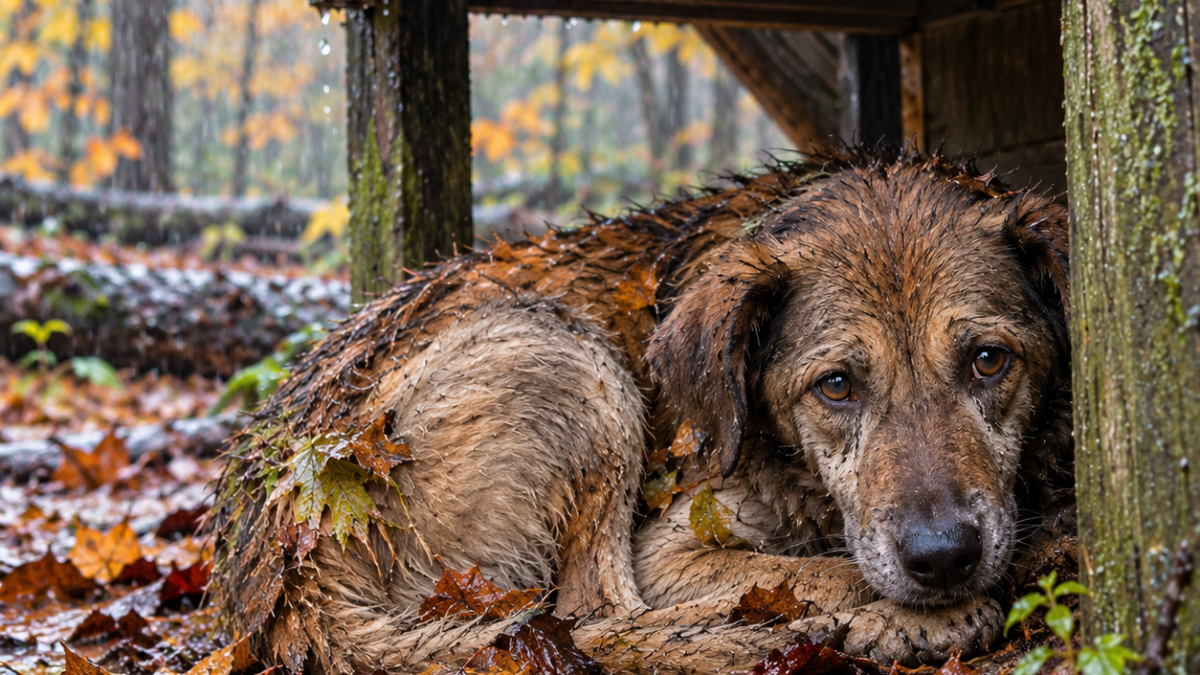
Henry beneath the blind.
Eyes tired.
Wet leaves.
I keep it not because I like seeing suffering.
Because beside it is another photograph.
Henry years later.
Lying beside the sunny window.
Head on a clean blanket.
Gray face.
Eyes half closed.
Safe.
Two pictures.
Same dog.
Between them: everything.
Food.
Medicine.
Trust.
Harold.
Denise.
Adoption.
Storms.
Breakfast arguments.
Couch ramps.
Old age.
Life.
That is the distance rescue can create.
Not from woods to house.
From waiting to belonging.
I still volunteer.
Older now.
Slower.
Still crawling under things when I probably shouldn’t.
Every time someone reports a frightened dog hiding somewhere, I remember Henry.
I tell new volunteers:
“Do not make your need to rescue faster than the animal’s need to trust.”
Sit.
Food.
Distance.
Wait.
Let the nose come first.
That tiny touch can be everything.
One young volunteer once asked, “What if they never come?”
“Then we adjust.”
“How long did Henry take?”
“Minutes.”
“Then why does it sound like hours when you tell it?”
I thought about that.
“Because some minutes divide your life into before and after.”
That was true.
Before Henry, I thought rescue began when we picked up an animal.
After Henry, I understood rescue sometimes begins much earlier.
The moment you stop walking.
The moment you notice.
The moment you sit in wet leaves instead of deciding someone else will handle it.
The moment you accept that fear has a pace different from yours.
I did not save Henry by doing something heroic.
I saw two eyes.
Stopped.
Sat.
Placed food.
Waited.
He did the brave part.
He crawled out.
People call rescue animals lucky.
Sometimes they are.
But I think about how much courage it takes for an animal who has no reason to trust a stranger to try again anyway.
Henry tried once.
Nose to fingers.
Chin to palm.
That opened the door.
Years later, on his final day, he gave me the same gesture.
Maybe I am assigning too much meaning.
Humans do that.
I don’t care.
That gesture became our language.
The first time:
I’m not sure about you.
The last:
I know you.
That is enough.
Somewhere deep in the Pennsylvania woods, there used to be an old hunting blind where a forgotten dog hid from rain.
It is gone now.
Henry is gone too.
But sometimes when the woods are wet after a storm and mist hangs low between the trees, I remember the exact place.
The wet ground.
My knees soaked through my jeans.
His eyes beneath the boards.
“It’s okay,” I whispered.
I did not know whether it was.
Neither did he.
All we had was the next small choice.
Food.
Wait.
Hand.
Touch.
Then another.
Blanket.
Car.
Clinic.
Bed.
Home.
Years.
A whole life was built that way.
One small safe thing after another.
And that is why, when people ask me what I remember most about finding Henry, it is not the hunting blind.
It is not how thin he was.
Not the rain.
Not even carrying him from the woods.
It is the moment after he finished eating when I moved my hand toward him.
He flinched.
So I stopped.
I waited.
Then Henry leaned forward on his own.
His nose touched one finger.
And the old dog who had spent too long listening to footsteps disappear decided, just once, to see what would happen if he trusted the person who stayed.
I stayed.
And from that day forward, so did he.
The house did not feel empty immediately after Henry died.
That was the strange part.
For the first few hours, everything still behaved as though he were there.
His water bowl sat beside the kitchen cabinet with a few drops clinging to the rim. The orthopedic bed beneath the living-room window still carried the shallow impression of his body. One of his blankets was folded over the arm of the couch, and the little ramp I had built for him remained exactly where I had left it.
Nothing had changed.
And yet everything had.
That evening, I opened the refrigerator and automatically reached for the container where I kept Henry’s medication wrapped in tiny pieces of chicken.
My hand stopped halfway.
For several seconds, I simply stood there holding the refrigerator door open.
Then I closed it.
The house became very quiet.
At seven the next morning, I woke before my alarm.
For years, Henry had been my alarm.
Sometimes he stood beside the bed and stared until I opened my eyes.
Sometimes he gave one rusty bark.
Sometimes, when he was older and his hearing was fading, he simply pushed his nose against my arm.
Seven o’clock meant breakfast.
That morning, seven o’clock meant nothing.
I lay there listening.
No nails against the floor.
No impatient breathing.
No body shifting beside the bed.
I finally got up and walked into the kitchen.
Henry’s bowl was still there.
I knew I should put it away.
I couldn’t.
So I made coffee instead.
Then I sat at the kitchen table and stared at the empty spot near my feet where he usually waited for me to accidentally drop something.
Nothing fell.
No one was there to notice anyway.
That was when I understood something grief had never taught me before.
You do not only miss the animal.
You miss the version of yourself that existed because the animal needed you.
For years, I had structured my mornings around Henry.
Food.
Medication.
A slow walk.
Checking the weather.
Making sure the rain wasn’t too heavy.
Making sure the floor wasn’t slippery.
Helping him onto the couch when he pretended to forget the ramp existed.
Those things had sometimes felt inconvenient.
Now I would have given anything to be inconvenienced again.
Rachel came over that afternoon.
She entered without knocking, which she only did when she thought I might pretend I was fine.
She looked around.
“You haven’t moved anything.”
“No.”
“You don’t have to.”
“I know.”
She sat beside me.
For a while, neither of us spoke.
Then she looked toward Henry’s bed.
“Do you remember the first one you bought him?”
I laughed softly.
“The expensive orthopedic one?”
“He slept beside it.”
“For three weeks.”
“You were furious.”
“I wasn’t furious.”
“You called him an ungrateful old criminal.”
“That was affectionate.”
Rachel smiled.
The smile helped.
We started talking.
Not about the end.
About everything before it.
Henry refusing to go outside when snow touched the porch.
Henry barking at breakfast five minutes early.
Henry pretending not to hear commands but somehow hearing a cheese wrapper from two rooms away.
Henry seeing Harold at the assisted-living facility and pulling harder than I had ever seen him pull.
Henry discovering the sunny window.
Henry sleeping through thunderstorms after years of hiding from rain.
The stories came faster.
And something changed while we told them.
Henry stopped being the body I had just held while his breathing slowed.
He became alive again in memory.
Annoying.
Hungry.
Stubborn.
Warm.
The next morning, I put away the medication.
The bowls stayed.
Another day passed.
I washed the blanket.
That felt wrong.
I almost took it back out of the washing machine.
It smelled like Henry.
Once it was clean, that smell would be gone.
My hand rested on the lid.
Then I remembered something Dr. Lewis once told a family at the clinic.
“Keeping something unchanged is not the same as keeping someone.”
So I let the machine run.
The blanket came out clean.
It was still Henry’s blanket.
Just without the smell.
I cried while folding it.
A week later, Denise visited.
She brought the old red leash Harold had once used.
I had forgotten she still had it.
“I found it in a box.”
She placed it on the table.
The leather was worn smooth near the handle.
Henry—Jasper, back then—had probably pulled against it thousands of times before age slowed him.
I ran my thumb over the cracked leather.
Denise said, “Dad used to wrap it twice around his wrist because Jasper chased squirrels.”
“That sounds like him.”
“He once dragged Dad halfway across the yard.”
I smiled.
“I wish I had seen him young.”
Denise looked at the photograph of Henry beside the sunny window.
“You got something better.”
“What?”
“You got him when he knew how to appreciate a bed.”
I laughed.
“That’s true.”
She became quiet.
“Do you ever think about the woods?”
“Too much.”
“I think about Dad asking where Jasper was.”
My chest tightened.
Denise continued.
“He trusted us.”
“You didn’t know.”
“I know.”
She looked down.
“But somebody made a careless decision. Then another person made another one. Nobody checked. And somehow an old dog ended up alone under rotten wood.”
There was no answer that made that acceptable.
So I didn’t give one.
Instead, I said, “He got back to Harold.”
Denise nodded.
“That’s what I hold onto.”
So did I.
Not every story gives you a chance to repair something.
We had gotten one.
Harold saw Henry again.
Touched him.
Called him Jasper.
Knew he was safe.
Henry got to hear the voice of someone who had loved him before the forest.
That mattered.
A month after Henry died, I returned to the woods.
The old hunting blind had already collapsed further.
The roof leaned almost completely to one side now.
A storm had broken part of the frame.
I stood several yards away.
For a moment, I could see everything exactly as it had been that first morning.
Wet leaves.
Mist.
Dark boards.
Two exhausted eyes.
I walked closer and sat where I had sat years earlier.
The ground was dry this time.
Sun filtered between branches.
Birds moved overhead.
Nothing dramatic.
I looked beneath the blind.
Empty.
Good.
That emptiness once would have frightened me.
Now it felt right.
Henry did not belong there anymore.
He never had.
I stayed almost an hour.
At some point, footsteps sounded farther down the trail.
My body reacted before my mind did.
I remembered Henry beneath the wood, listening to footsteps that always disappeared.
A hiker eventually passed.
He nodded.
I nodded back.
His footsteps faded.
And I realized that I no longer heard that sound as abandonment.
Because Henry’s story had continued.
People had come back.
I had come back.
Rachel.
Denise.
Harold.
Dr. Lewis.
Volunteers.
Footsteps had changed meaning for him.
That was one of the quietest victories of his life.
When I returned to the rescue, I found a new dog hiding beneath a plastic chair in one of the intake rooms.
A small brown female.
Maybe two years old.
Terrified.
A volunteer stood several feet away trying to lure her with food.
“She won’t come out.”
I looked at the dog.
Her eyes reminded me of Henry.
Not because she looked like him.
Because of the waiting.
“Stop calling her.”
The volunteer looked confused.
“What?”
“Sit down.”
We sat.
The dog remained beneath the chair.
Five minutes.
Ten.
The volunteer shifted impatiently.
“How long?”
“As long as she needs.”
“Did Henry take this long?”
“No.”
“So—”
“Henry was Henry.”
I looked at her.
“She is not Henry.”
That lesson mattered.
Rescue stories can become formulas if you are not careful.
Sit.
Food.
Trust.
Happy ending.
But every animal has its own clock.
Henry had taught me patience, not procedure.
Eventually the little dog crawled forward.
One paw.
Then another.
She sniffed the food.
Ate.
When the volunteer moved her hand too quickly, the dog retreated.
The volunteer sighed.
“We lost progress.”
“No.”
“What?”
“She told you something.”
“What?”
“Too fast.”
We waited again.
That dog eventually found a home.
Months later, her adopter sent a picture of her sleeping upside down on a couch.
I laughed when I saw it.
Another animal had discovered the luxury of taking up too much space.
Henry would have approved.
The rescue used his story in volunteer training, but I insisted on one thing.
I did not want the first photograph to be the image from beneath the hunting blind.
Everyone else thought it was powerful.
It was.
Too powerful.
It risked turning Henry into suffering before people knew anything else about him.
So I chose another photograph.
Henry old, gray, lying beside the window while rain ran down the glass.
His eyes half closed.
One paw stretched forward.
Safe enough to sleep while the weather did whatever it wanted outside.
That was the photograph new volunteers saw first.
Then I told them where he came from.
The order mattered.
He was not “the abandoned dog.”
He was Henry.
He had preferences.
History.
People.
Breakfast opinions.
A hatred of wet grass.
A talent for ignoring expensive beds.
A habit of leaning into anyone he trusted.
Suffering had happened to him.
Suffering was not his identity.
Several months later, the property owner finally removed what remained of the hunting blind.
It had become unsafe.
I went back after the work was completed.
No structure.
No roof.
No dark little space underneath.
Only forest floor.
Leaves had already begun covering the disturbed ground.
I stood there trying to locate the exact spot where I first saw Henry.
I couldn’t.
That surprised me.
I thought I would know.
I had replayed the image hundreds of times.
But without the blind, the place became anonymous.
Tree.
Rock.
Leaves.
Nothing.
At first, that upset me.
Then I understood.
Places should not always have to remember pain.
The earth did not owe Henry a scar.
He had left.
He had lived.
The forest could become ordinary again.
I walked back to my car lighter than I expected.
That winter, the first heavy snow came early.
For years, bad weather made me think of Henry immediately.
Rain meant the hunting blind.
Snow meant worrying about older joints and clearing paths.
That morning, I opened the door and looked at the yard.
Everything white.
I could almost hear him refusing.
No.
Not happening.
I laughed.
“You would hate this.”
The house answered with silence.
But for the first time, the silence did not crush me.
I made coffee.
Sat beside the window.
Watched snow fall.
Henry had taught me something about memory that I had not understood while he was alive.
You cannot choose whether you remember.
You can choose which image becomes the doorway.
For a long time, my doorway into Henry’s story was the hunting blind.
Two tired eyes.
Wet fur.
Fear.
Eventually, another image replaced it.
Henry in sunlight.
Then another.
Henry with Harold.
Another.
Henry barking at breakfast.
Another.
Henry walking away from the hunting blind years later and choosing a patch of warm ground instead.
That one became my favorite.
He had looked at the place where he once hid.
Then turned away.
No dramatic confrontation.
No trembling.
No need to reclaim anything.
He found the sun.
Lay down.
That was enough.
People often want trauma stories to end with conquest.
The abused dog fearlessly approaches men.
The storm survivor runs joyfully into rain.
The dog found in the forest returns and proves he is no longer afraid.
But Henry never owed us that.
He did not owe the woods courage.
He did not owe rain indifference.
He did not owe strangers trust.
He got to choose.
That was freedom.
And choice became the thing I respected most about his second life.
If he wanted the bed, bed.
If he wanted floor, floor.
If thunder sent him into the hallway, we sat there.
If he did not want snow, we cleared pavement.
If he wanted Harold, we drove.
If he wanted sunlight, we stopped walking and stayed.
Those things sound small.
They are not.
A frightened animal often loses control first.
Rescue should not become another way of taking it.
That was Henry’s lesson to me.
One year after he died, Denise asked whether I wanted to go with her to Harold’s grave.
I almost said no.
I’m not much for anniversaries.
But I went.
She brought no flowers.
Instead, she carried a copy of the photograph of Harold and Henry together at the care facility.
She placed it temporarily against the stone while we sat nearby.
“I used to think Dad died believing he had failed Jasper.”
I looked at her.
“Did he?”
“No.”
She smiled.
“Not after the visits.”
We stayed for a while.
Then Denise picked up the photograph.
She did not leave it outside to weather.
Harold did not need proof on a gravestone.
We carried the memory with us.
Before leaving, Denise said, “They found each other twice.”
I understood.
Harold found Jasper first.
Years later, Jasper found Harold again.
Not perfectly.
Not permanently.
Enough.
Sometimes enough is the miracle.
Time kept moving.
I continued volunteering.
New dogs came.
Old ones left.
Some stories ended beautifully.
Some did not.
That is another truth rescue stories often hide.
We do not save everyone.
Sometimes the dog found too late does not recover.
Sometimes medical damage is greater than hope.
Sometimes fear stays difficult for years.
Sometimes adoption fails and we begin again.
Henry did not make me believe kindness always wins.
He made me believe kindness matters even when you do not control the ending.
That is more durable.
The first morning under the hunting blind, I did not know whether Henry would survive.
I sat anyway.
I placed food anyway.
I waited anyway.
The value of that choice did not depend on knowing what would happen next.
I think about that often now.
People wait for certainty before helping.
Is the dog really abandoned?
Is the neighbor definitely neglecting it?
Will the animal trust me?
Will my help matter?
What if someone else is already coming?
Sometimes caution is appropriate.
But sometimes uncertainty becomes an excuse to walk past.
Henry taught me to notice the difference.
One rainy morning years after his death, a driver called the rescue about a dog seen near a drainage ditch.
No clear description.
Maybe injured.
Maybe not.
The weather was terrible.
Part of me wanted to send someone else.
I was tired.
Then I remembered two eyes beneath dark wood.
I went.
That dog turned out to have an owner searching three streets away.
Healthy.
Scared.
Home within two hours.
Not every call becomes a tragedy.
That was good too.
Because helping does not need a dramatic ending to be worth doing.
I drove home soaked.
Hung my coat near the door.
For one second, I expected Henry to be standing there.
Old habits survive long after the body is gone.
Instead of feeling pain, I smiled.
“You got me again.”
There is no final moment when grief ends.
No morning where you wake and stop missing them.
What changes is the weight.
At first, every memory presses downward.
Later, some begin lifting.
Henry became lighter in my mind.
Not less important.
Lighter.
I could remember without immediately seeing loss.
I could laugh.
Tell stories.
Show photographs.
Use what he taught me.
That is how I know memory had become love again instead of only grief.
Years after I first found him, a young volunteer asked why I kept doing rescue work.
I started to give the normal answer.
Because animals need help.
True.
But incomplete.
So I told her about Henry.
Not the entire story.
Just the beginning.
Old hunting blind.
Wet woods.
Dog underneath.
Food.
Hand.
Touch.
She asked, “What made you stop?”
“I saw him move.”
“What if you hadn’t?”
I thought about that.
“I don’t know.”
That question still bothers me.
How many animals do we miss because they do not move at the right moment?
How many people?
How much suffering stays quiet enough to become invisible?
I cannot answer that.
What I can do is pay attention.
Henry made me better at that.
One afternoon, while cleaning a storage cabinet at the rescue, I found his original intake card.
MALE DOG — RED/GRAY — FOUND WOODS.
I stared at it.
That was all he had been when he arrived.
No name.
No history.
No certainty.
I turned the card over.
Later notes had been added.
HENRY.
FOSTER.
ADOPTED.
SENIOR.
ARTHRITIS MANAGEMENT.
I smiled.
A life reduced to administrative words.
Impossible.
No form could hold him.
I kept a copy.
On mine, underneath the final line, I wrote one more word.
HOME.
Then I put it with his photograph and the old leash.
Not a shrine.
A file.
That suited him better.
Henry’s story had begun for me beneath rotting boards.
But if I had to choose the real ending, it would not be his death either.
It would be an ordinary afternoon several years before.
I came home late.
Rain had been falling all day.
Years earlier, weather like that would have sent Henry hiding.
That afternoon, I opened the door.
He was asleep beside the window.
Rain running down the glass inches from his face.
He heard me eventually.
Lifted his head.
Tail moved.
Then, instead of getting up, he put his head back down.
He knew I was home.
No need to follow.
No need to check the door.
No need to stay alert.
That was trust in its final form.
Not excitement.
Not clinging.
Rest.
The dog I first met had been exhausted because he believed he had to survive every minute by himself.
The dog beside that window slept because he knew someone else was there.
That is the image I carry now.
Not the hunting blind.
The window.
Rain outside.
Warmth inside.
Henry asleep.
When people ask whether rescue changed his life, the answer is obvious.
But Henry changed mine in a way I did not understand until much later.
He taught me that the opposite of abandonment is not adoption.
It is consistency.
Coming back.
Doing what you said.
Filling the bowl again tomorrow.
Opening the door.
Sitting through the storm.
Taking the slow walk.
Driving to the appointment.
Lifting the old body when the legs stop cooperating.
Staying when care becomes repetitive and inconvenient.
That is what tells a frightened animal:
You are no longer temporary.
For Henry, the proof took years.
We gave him those years.
And he gave us his trust.
I once thought the most moving moment of his story was that first touch beneath the hunting blind.
His nose against my fingers.
I was wrong.
The most moving moment was every ordinary touch after.
Thousands of them.
His head against my knee.
His body leaning into my legs.
His chin in my palm.
Every one saying the same thing without words.
Still here.
Still here.
Still here.
Until one day he wasn’t.
And even then, somehow, the lesson remained.
So when I think about the Pennsylvania woods now, I do not imagine Henry waiting there forever.
I refuse to freeze him beneath that structure.
He crawled out.
That matters.
He came toward the food.
Toward my hand.
Toward the vehicle.
Toward the clinic.
Toward Harold again.
Toward home.
His story moved.
So I let the memory move too.
The old hunting blind is gone.
The wet leaves dried.
The mist lifted.
The forest grew over the place where he once curled himself into the smallest shape possible.
Henry is gone too.
But he did not disappear there.
He left those woods years before death came for him.
He left hungry and frightened.
He died old, loved, stubborn, well-fed, and safe enough to complain when breakfast was late.
That is the difference an ordinary act of kindness can make when it is followed by another.
And another.
And another.
I did not rescue Henry in one dramatic moment.
None of us did.
We rescued him every time we came back.
And eventually, he stopped waiting to see whether we would.
He simply knew.
That was home.

