PART 2: I Found a Tiny Puppy Crawling Through the Rain—Then the Vet Saw His Twisted Front Leg and Went Quiet
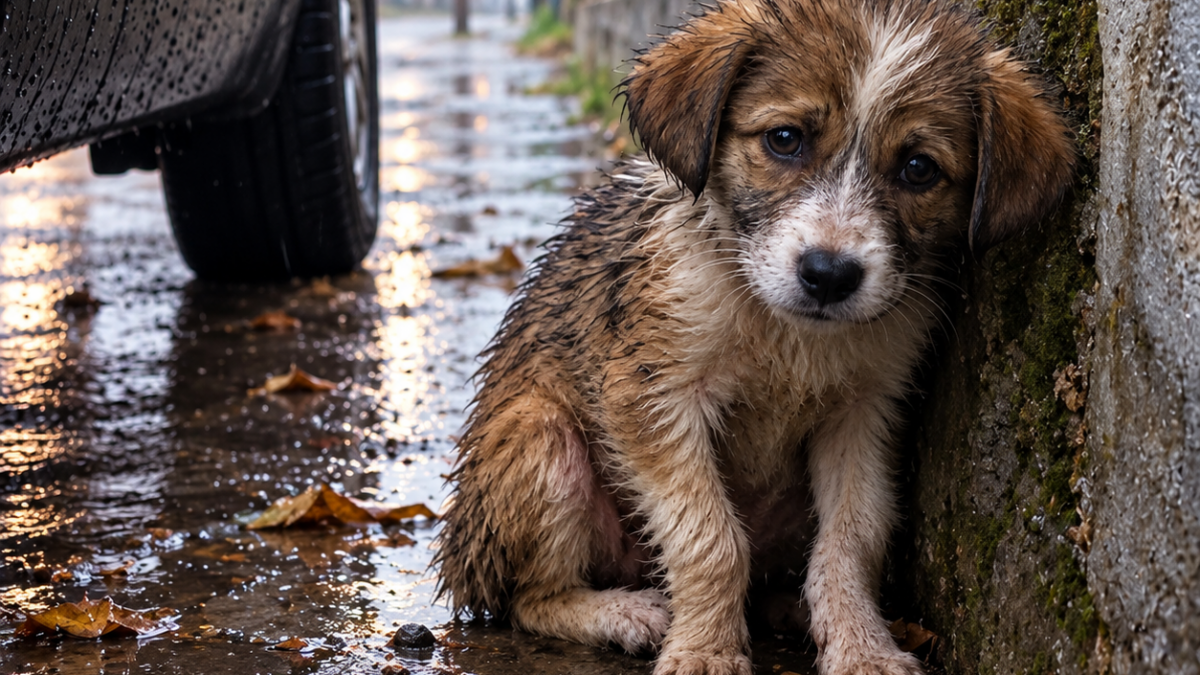
PART 2
I stared at her.
“What does that mean?”
The veterinarian, Dr. Harris, ran two fingers gently along the puppy’s shoulder, then down the abnormal leg.
He lay on a folded towel on the examination table, wrapped in another blanket because his temperature had been low when we arrived.
His eyes were open now.
Not bright.
But alert enough to follow our voices.
Dr. Harris looked at the leg again.
“I don’t think somebody broke this yesterday or last week.”
“So he was born like that?”
“Possibly.”
“Possibly?”
“There are several things that can cause limb deformities in puppies. Congenital abnormalities, developmental problems, an injury very early in life that healed incorrectly. We need X-rays before I can tell you more.”
I looked at the puppy.
He had placed his chin across the edge of the towel.
“So he’s been trying to walk like this for a while.”
“Yes.”
“How old is he?”
“Maybe ten to twelve weeks. Possibly a little younger.”
A baby.
That was the part I couldn’t stop thinking.
He wasn’t an adult dog who had gradually adapted after years of experience.
He had barely entered the world and already had to figure out how to move through it differently.
Dr. Harris continued the exam.
He was underweight.
Not dangerously emaciated, but thin enough to concern her.
His belly suggested intestinal parasites.
His ears were dirty.
His coat had fleas.
There was mild irritation between his toes from spending time wet.
No collar.
No microchip.
No obvious sign of recent trauma.
When she touched his abdomen, he tensed.
“Hungry?” I asked.
“Probably.”
“We can feed him?”
“A little. Slowly.”
A technician brought soft puppy food.
The moment the bowl touched the table, the puppy lifted his head.
His nose moved.
Then something changed.
That frightened, exhausted little animal suddenly became extremely interested in being alive.
He pushed himself forward.
The twisted leg slipped.
He didn’t care.
He reached the bowl.
Started eating.
Fast.
Too fast.
Dr. Harris pulled it back gently.
“Slow down.”
The puppy stared at her as though she had committed a crime.
I laughed for the first time since finding him.
“Well, at least something works.”
She smiled.
“Appetite is a good sign.”
He received a smaller portion.
This time we made him pause.
Bite.
Wait.
Another.
He hated our management style.
That also seemed promising.
When the X-rays were ready, Dr. Harris asked me to come look.
I am not medically trained.
Bones on an X-ray usually look like a collection of white shapes I pretend to understand.
Even I could see the problem.
The bones in the left front limb did not line up like those in the right.
The lower section was shortened and rotated.
The joint sat at an abnormal angle.
Dr. Harris pointed.
“See this?”
I nodded.
“What is it?”
“The radius and ulna haven’t developed normally.”
“Can you fix it?”
She did not answer immediately.
That pause scared me.
“Can you?”
“There may be options.”
That was veterinarian language.
Not yes.
Not no.
“What kind?”
“First, he needs to get healthy. Parasites treated, nutrition improved, vaccinations started. Then I want an orthopedic specialist to evaluate him.”
“Surgery?”
“Possibly.”
“Amputation?”
The word came out before I was ready for it.
Dr. Harris looked at me.
“Also possible. But we’re nowhere near that decision today.”
I looked at the puppy.
He was chewing the edge of the blanket now.
Apparently nobody had informed him that we were discussing his entire future.
“Does it hurt?”
“That’s an important question.”
She manipulated the limb again.
The puppy pulled back slightly.
“But he’s not screaming.”
“No.”
“Does that mean it doesn’t hurt?”
“Not necessarily. Dogs compensate. Puppies especially can adapt quickly. The bigger question is whether the limb can become functional or whether it will create chronic pain, skin injuries, shoulder problems, or spinal compensation as he grows.”
I heard only one word.
Pain.
I touched his head.
He immediately stopped chewing the blanket and looked at me.
“What happens now?”
Dr. Harris asked:
“Are you planning to keep him overnight?”
I almost laughed.
“I found him forty minutes ago.”
“That wasn’t my question.”
I looked down.
The puppy put his nose against my wrist.
“Well.”
Dr. Harris waited.
“I guess he’s coming home with me tonight.”
She smiled.
“I thought so.”
I called local animal control first.
Reported the found puppy.
Sent photographs.
Location.
Description.
We had to give any legitimate owner a chance to identify him.
Part of me hoped someone was searching.
Another part couldn’t understand how a puppy who could barely walk had ended up alone beside a wet wall.
Maybe he escaped.
Maybe someone lost him.
Maybe there was a mother dog nearby.
Maybe siblings.
There were possibilities that did not require cruelty.
I reminded myself not to invent a villain just because anger is easier than uncertainty.
Dr. Harris treated the fleas, started parasite medication, gave me feeding instructions and scheduled follow-up care.
Before I left, one technician asked:
“What are we calling him?”
“I don’t know.”
The puppy looked up.
“Tiny?”
The technician laughed.
“He won’t stay tiny.”
“Rain?”
“No.”
“Bentley?”
I looked at her.
“Because he’s bent?”
She winced.
“When you say it like that…”
“No.”
I lifted the puppy carefully.
He settled against my chest.
The technician watched.
“He looks like a Milo.”
“Milo?”
The puppy’s ears moved.
Coincidence.
Still.
“Milo.”
I tried it again.
He turned his face toward me.
“That’s unfair.”
Dr. Harris smiled.
“Milo it is.”
So Milo came home.
I lived alone in a small ground-floor apartment with exactly zero dog supplies.
By the time we arrived, I had one bag from the clinic containing medication, food and a temporary collar.
That was all.
I put towels on the kitchen floor.
Made a bed from two folded blankets.
Used a shallow ceramic dish for water.
Then set Milo down.
He stood.
Or tried.
His good front leg took his weight.
The twisted leg folded.
His back end pushed forward too quickly.
He tipped.
I caught him before his shoulder hit the tile.
“Okay.”
I picked him up.
“New rule.”
Milo licked my thumb.
“No floor adventures until I solve the floor.”
I drove back out.
Twenty minutes later, my apartment contained rubber-backed rugs, puppy pads, two food bowls, a small harness, toys, and a bed that cost far more than anything a creature who had spent the morning beside a curb could possibly appreciate.
Milo ignored the bed.
He slept on my sweater.
Of course.
The first night, I barely slept.
Every time he moved, I sat up.
At 12:40, he drank water.
At 1:17, he whimpered in his sleep.
At 2:05, he tried to walk toward the puppy pad, fell, got up, tried again.
I helped.
At 3:30, he woke hungry.
At 4:15, he discovered that chewing my shoelace was possible from a lying position.
By six, I understood something.
Milo was not fragile in the way I had imagined.
His body had a limitation.
His personality did not.
Once he was warm and fed, stubbornness appeared immediately.
He wanted to move.
Everywhere.
The leg made movement difficult.
So Milo developed methods.
He leaned heavily onto the good paw.
Used his chest for balance.
Sometimes hopped.
Sometimes slid.
He fell constantly.
But every fall lasted about one second.
Down.
Up.
Continue.
I found that both inspiring and terrifying.
“Milo.”
He was trying to follow me into the bathroom.
Fall.
Up.
“Milo.”
Another step.
“You do not have to follow me literally everywhere.”
He kept coming.
I eventually carried him.
He fell asleep while I brushed my teeth.
The next day, I searched the area where I found him.
No mother dog.
No puppies.
I knocked on doors.
Showed photographs.
One older woman had seen a small puppy two streets over several days earlier.
“Was he alone?”
“I only saw one.”
“Anyone with him?”
“No.”
A mechanic recognized the coloring but couldn’t place him.
A teenager said she thought she had heard puppies at night near an empty property.
I checked.
Nothing.
Animal control found no matching lost-dog report.
I posted carefully online.
FOUND PUPPY.
General area.
No detailed description of the deformed leg beyond what was visible in one photograph.
Anyone claiming him would need to provide information.
No one did.
For seventy-two hours, my phone made my heart jump every time it rang.
Nothing.
By the fifth day, Milo had decided my apartment belonged to him.
He discovered toys.
His first favorite was a small stuffed fox.
I rolled it across the rug.
Milo chased.
“Slow.”
Ridiculous instruction.
He launched himself forward.
Two awkward steps.
Fall.
He grabbed the fox from the floor.
Victory.
Then he tried to shake it and rolled onto his side.
I laughed so hard I had to sit down.
Milo stared at me.
I apologized.
“You’re very dignified.”
He attacked the fox harder.
That evening, I noticed the first thing that frightened me after the initial rescue.
The skin near the twisted paw was red.
Milo dragged part of that leg when he moved.
The outer surface rubbed against rugs and floor.
Even with soft surfaces, friction was creating irritation.
I photographed it and sent it to Dr. Harris.
She called.
“Bring him tomorrow.”
At the clinic, she examined it.
“This is exactly one of the concerns.”
“So what do we do?”
“Protective wrap for now. But this reinforces why we need the specialist.”
The orthopedic appointment was moved earlier.
Three days later, Milo and I drove almost two hours to a veterinary referral hospital.
By then, I had known him less than two weeks.
It felt longer.
Not because time moved slowly.
Because my entire schedule had rearranged itself around him.
Meals.
Medication.
Cleaning.
Carrying him down one small step outside.
Watching skin.
Watching appetite.
Watching every fall.
He had inserted himself into every hour.
The orthopedic surgeon was a woman named Dr. Patel.
She reviewed the X-rays.
Examined Milo walking.
Watched him attempt to chase a treat across a padded floor.
Milo fell once.
Got up.
Continued.
Dr. Patel smiled.
“Determined.”
“That’s one word.”
She sat with me afterward.
“This deformity is significant.”
I looked at Milo chewing a rubber toy.
“Can surgery fix it?”
“We need to define fix.”
I hated medical conversations that began like that.
She continued.
“There are corrective orthopedic procedures for angular limb deformities, particularly in growing dogs. But Milo’s case is complicated because the limb is not just angled. There’s developmental shortening and rotation.”
“So?”
“We could attempt reconstruction. Multiple surgeries may be required.”
“How many?”
“Possibly more than one. There are risks. Infection, failure to align, repeat procedures as he grows, long rehabilitation.”
I swallowed.
“Would he have a normal leg afterward?”
“Maybe improved. I would not promise normal.”
“And amputation?”
“More predictable.”
My chest tightened.
I had known it was possible.
Hearing it made it real.
“You think we should remove it.”
“I think we should evaluate what gives Milo the best long-term function with the least chronic pain.”
“That sounds like yes.”
“It means I’m not emotionally attached to preserving a limb if the limb is not helping the dog.”
I looked at Milo.
The little twisted paw was wrapped.
He used it occasionally for balance.
“That’s his leg.”
“Yes.”
“I know that sounds stupid.”
“It doesn’t.”
I pressed both hands together.
“If we amputate, he’ll have three.”
“Yes.”
“He already has trouble balancing.”
“He has trouble balancing because one front limb cannot bear normal weight or align properly.”
That stopped me.
Dr. Patel continued.
“Three-legged dogs often function extraordinarily well, especially young dogs.”
“Front leg is harder, right?”
“Front-limb amputation requires more adaptation because dogs bear more weight through the front. But young, otherwise healthy dogs can do very well.”
I looked down.
“What would you do if he were yours?”
She paused.
“I would give his nutrition and general health a few more weeks to improve, monitor the skin, and use that time to review whether any reconstructive option offers a meaningful advantage.”
“Then?”
“If not, I would choose the procedure most likely to give him a comfortable, durable life.”
Amputation.
She didn’t say it.
She didn’t have to.
I cried in the car.
Milo slept beside me in his carrier.
I hated myself for crying.
He was alive.
Fed.
Warm.
Playing.
Why was I acting as if something terrible had already happened?
Because I had become attached to an idea.
Four legs.
Normal.
Fixed.
Rescue stories condition us to crave restoration.
Broken animal enters.
Medicine returns animal to expected form.
Before.
After.
But Milo might never look like the dog I had unconsciously pictured.
His best life might require losing the leg we had spent two weeks trying to protect.
That was difficult for me.
It did not seem difficult for Milo.
When we got home, he stole a sock.
I chased him.
He tried to run.
Fell.
Got up.
Continued.
“Milo!”
He had no time for my existential crisis.
Over the next three weeks, he improved in every other way.
Weight up.
Coat softer.
Parasites cleared.
Vaccinations started.
Energy became ridiculous.
His confidence around hands changed too.
That mattered almost as much as his body.
The puppy who had flattened himself against a wall when I reached toward him now shoved his head under my palm if I stopped petting too soon.
The first time he did it, I froze.
I was sitting on the floor.
Milo lay beside me.
I scratched behind his ear.
Stopped.
His head lifted.
Then pushed directly under my hand.
I laughed.
“Demanding now?”
Again.
Nose under fingers.
“Excuse me. I remember when you thought I was terrifying.”
Tail wag.
“Zero gratitude.”
I kept petting.
Some changes happen quietly.
No dramatic trust moment.
Just one day you realize the animal no longer flinches.
The second orthopedic review brought the decision.
Dr. Patel had consulted another surgeon.
They believed reconstruction was technically possible but would involve substantial intervention with uncertain long-term benefit.
Milo’s abnormal leg was beginning to create compensatory movement at his shoulder.
The skin remained vulnerable despite protection.
We could try to preserve it.
Or we could choose predictability.
I asked every question twice.
Maybe three times.
Then:
“If we amputate, are we giving up too early?”
Dr. Patel shook her head.
“You are not treating an X-ray. You’re treating Milo.”
I stayed quiet.
“He does not know how many limbs dogs are supposed to have.”
That sentence changed everything.
Milo did not have an identity crisis about his leg.
I did.
He knew only:
Can I move?
Does it hurt?
Can I chase the fox?
Can I reach the food?
Can I follow you into the bathroom despite explicit instructions?
Function.
Comfort.
Life.
Not symmetry.
I scheduled surgery.
The night before, I barely slept again.
Milo slept perfectly.
At midnight, I sat beside his bed.
He rolled onto his back.
I looked at the tiny twisted leg.
Soon gone.
I touched the fur above it.
“I’m sorry.”
Milo yawned.
“I know this is supposed to help.”
He stretched.
“I wish you could sign the consent form yourself.”
He bit my sleeve.
“Strong opinion.”
The next morning, I handed him to a technician.
That was harder than finding him in the rain.
Because this time I was choosing to let someone hurt him in order to help him.
There is a particular guilt attached to medical decisions for animals.
They cannot understand temporary pain.
They cannot understand future benefit.
They only know one moment becomes frightening.
I cried in the parking lot.
Again.
Then waited.
The surgery went well.
No complications.
When Dr. Patel called, I had to ask her to repeat that.
“Well?”
“Very well.”
“Blood loss?”
“Minimal.”
“Anesthesia?”
“Smooth.”
“Pain?”
“Controlled.”
“Can I see him?”
“Later today.”
When I entered the recovery area, Milo was groggy.
Very groggy.
His left front leg was gone.
Bandage.
Shaved shoulder.
Sleepy eyes.
I stopped walking.
My brain knew.
My heart had not prepared.
Dr. Patel stood beside me.
“He looks different.”
“Yes.”
I hated that my voice shook.
“He’s still Milo.”
I nodded.
Milo smelled me.
His eyes opened more.
Tail.
One weak wag.
Then another.
I sat.
“Hi.”
His nose found my hand.
He licked once.
That was it.
No accusation.
No confusion I could interpret.
Just:
You.
Here.
Good.
I stayed until he slept.
The first two days after surgery were rough.
Pain medication helped, but movement frightened him.
He stood once.
Without the abnormal limb, his body tipped forward.
He panicked.
Sat immediately.
My heart broke.
Dr. Patel’s technician said:
“This is normal.”
“He looks terrified.”
“He has to relearn his balance.”
“What if he can’t?”
She smiled.
“He will.”
“How do you know?”
“Because he’s a puppy.”
That sounded too simple.
It was also mostly true.
Day two:
Stand.
Three seconds.
Sit.
Day three:
One hop forward.
Fall.
Up.
Two hops.
Day four:
Across the room.
Ugly.
Determined.
Day five:
He tried to chase the fox.
I yelled:
“No!”
Milo ignored me.
Of course.
One week after surgery, he crossed my living room faster on three legs than he had ever crossed it on four.
I stood with my mouth open.
He reached the food bowl.
Turned.
Looked at me.
As if to say:
Problem?
I laughed.
Then cried.
Then laughed again.
“Okay.”
Tail wag.
“I was wrong.”
Milo attacked the stuffed fox.
His revenge against every expectation had begun.
Not against a person.
Against limitation.
Against pity.
Against the assumption that a dog who looked different had to live a smaller life.
I stopped calling him fragile.
That mattered.
At first, I carried him everywhere.
Too much.
Dr. Patel corrected me.
“He needs safe opportunity to use his body.”
“I’m protecting him.”
“You’re preventing practice.”
That stung.
But she was right.
So I changed.
Ramps where necessary.
Non-slip flooring.
Controlled exercise.
Physical rehabilitation.
But also independence.
Let Milo solve problems.
Let him fall safely.
Let him get up.
The first time he climbed one small step by himself, I nearly intervened.
Stopped.
Milo shifted his weight.
Back legs pushed.
Front paw lifted.
Up.
He stood.
Looked at me.
I cheered.
He ran into the room.
No appreciation.
Perfect.
At his rehabilitation sessions, he became a favorite.
Partly because he worked hard.
Mostly because he was a thief.
One therapist, Jenna, carried treats in a waist pouch.
Milo discovered this immediately.
During exercises, he would perform exactly enough repetitions to earn reward.
Then attempt to bypass the system by putting his nose directly inside the pouch.
“Milo.”
Tail.
“That is fraud.”
He tried again.
“You are not a patient. You are organized crime.”
He adored her.
Strength developed.
Shoulder.
Remaining front limb.
Core.
Back legs.
Balance improved.
His gait became fluid.
Not the same as a four-legged dog.
His own.
Hop-step-run.
Within two months, strangers who saw him sprint sometimes did not notice the missing leg until he stopped.
I noticed.
Of course.
But no longer with sadness.
It became simply part of his shape.
The harder question was ownership.
No one had claimed him.
The legal stray hold expired.
The rescue that helped cover part of his surgery asked whether I planned to foster him formally until adoption.
I laughed.
The coordinator waited.
“What?”
“Adoption?”
“Yes.”
I looked at Milo.
He was asleep on my couch.
On his back.
One remaining front paw bent toward his chest.
Stuffed fox under his head.
“You think I’m giving him to someone?”
The coordinator smiled.
“I needed you to say it.”
“You knew.”
“I suspected.”
“You approved surgery knowing I was emotionally compromised.”
“Very.”
“So what paperwork?”
She emailed it.
I filled it out the same night.
Adopter:
Me.
Dog:
Milo.
Permanent.
I stared at the form before signing.
The day I found him, I had planned to walk home, make dinner, and answer emails.
Instead, a sound beneath a parked car had altered my household permanently.
I signed.
“You’re officially stuck.”
Milo snored.
Moving.
Months passed.
His coat changed from dirty brown-gray fuzz into something beautiful.
Golden tan with darker ears.
White patch on his chest.
One front paw.
Two ridiculous back feet that seemed too large for him.
He grew.
And grew.
Not huge.
Medium-sized.
Athletic.
The puppy Dr. Harris said would not stay tiny.
She was correct.
At his six-month check, she walked into the exam room.
Milo immediately tried to climb into her lap.
She laughed.
“This is the dog who was afraid of your hand?”
“Apparently I destroyed his sense of boundaries.”
She watched him walk.
Then run.
“He looks wonderful.”
I felt absurdly proud.
“He’s fast.”
“I see.”
“He goes up stairs.”
“Carefully?”
“Define carefully.”
She gave me a look.
“Fine. We use a ramp most of the time.”
The surgical site healed beautifully.
No chronic skin trauma.
No painful twisted paw.
His remaining joints looked good.
We maintained weight carefully because three-legged dogs benefit from staying lean.
Milo objected to portion control on ethical grounds.
He filed daily appeals at the kitchen.
Denied.
Then one afternoon I received a message through the original neighborhood post.
A woman named Sofia.
I think I know where the puppy came from.
My stomach tightened.
Months had passed.
I had almost stopped expecting answers.
I replied carefully.
Can you tell me why?
She sent a photograph.
A litter of six puppies.
Maybe six weeks old.
One stood strangely near the back.
Front leg visibly different.
Milo.
I knew instantly.
Same face.
Same dark ears.
Same white chest patch.
Same limb.
My hands began shaking.
I called.
Sofia answered.
She lived four streets from where I found him.
The litter belonged to a neighbor’s dog.
Accidental breeding.
Six puppies.
Five had been given away.
One had the leg deformity.
“What happened to him?”
“I don’t know exactly.”
“Who owned the mother?”
She gave me a name.
I will call him Daniel.
Not because he became the villain of the story.
Because facts matter.
Sofia said Daniel had struggled to find anyone willing to take the disabled puppy.
One family backed out after seeing the leg.
Another said veterinary bills would be too high.
Then one day the puppy disappeared.
Daniel told neighbors someone had taken him.
“Do you believe that?”
“I did.”
“Until?”
“Until I saw your old post.”
I went cold.
“Did you see someone leave him?”
“No.”
Important.
No.
“Did Daniel?”
“I don’t know.”
“Then we don’t know he abandoned Milo.”
“No.”
Again important.
I wanted answers.
I did not want false certainty.
Animal welfare contacted Daniel.
So did I eventually, through the rescue, after the appropriate conversations.
He agreed to speak.
We met in a café.
He looked uncomfortable.
Early forties.
Work clothes.
Tired face.
He did not look like a monster.
Real life rarely gives you the visual cues anger wants.
I showed him Milo’s current photograph.
Three legs.
Bright eyes.
Standing in a field.
Daniel stared.
“That’s him.”
“Yes.”
“He lost the leg.”
“Yes.”
His face tightened.
“Because of the deformity?”
“Yes.”
He kept looking.
“Is he okay?”
“He’s excellent.”
Daniel nodded.
Then looked down.
I asked the question.
“How did he end up on that street?”
Silence.
Long enough that I knew the answer mattered.
Finally:
“I left him.”
There it was.
Not dramatic.
Not denied.
“I put him near the wall.”
My hands tightened around my cup.
“Why?”
“I couldn’t afford what they said he needed.”
“Which veterinarian saw him?”
“No vet.”
I stared.
“So who said he needed expensive care?”
“People online.”
I exhaled slowly.
“You abandoned a puppy because strangers online told you his medical care would cost too much?”
His face reddened.
“When you say it like that—”
“How else should I say it?”
He looked away.
I was angry.
Deeply.
But I wanted the full truth.
“Why didn’t you call a rescue?”
“I thought they’d judge me.”
I almost laughed.
“You chose leaving a puppy in the rain over being judged on the phone.”
“Yes.”
No defense.
That stopped me.
He continued.
“I know how that sounds.”
“It sounds terrible.”
“It was.”
I said nothing.
“I drove him two streets over.”
“You drove?”
“Yes.”
“So he couldn’t follow you home.”
He nodded.
That hurt worse.
Milo had not wandered.
He had been placed there.
Deliberately far enough away not to return.
Daniel rubbed his hands together.
“My girlfriend wanted him gone.”
I waited.
“The other puppies were easy. People took them.”
“And Milo wasn’t.”
“No.”
“What did you think would happen?”
“I thought somebody would see him.”
“Someone did.”
“I know.”
“In cold rain.”
“I know.”
“He couldn’t walk properly.”
“I know.”
“You didn’t even leave him at a clinic.”
“No.”
“Shelter?”
“No.”
“Rescue?”
“No.”
Each answer made the table feel colder.
Then Daniel said:
“I was ashamed.”
I had heard that word in rescue before.
Shame.
People avoid asking for help because they fear judgment.
Then make choices far worse than the judgment ever would have been.
I sat back.
“Do you want him back?”
Daniel’s head snapped up.
“No.”
I was surprised.
He shook his head.
“No. He’s yours.”
“Legally, yes.”
“I mean…”
He looked at the photograph.
“He should stay where he is.”
That did not forgive anything.
It did make the conversation simpler.
Animal welfare documented the admission.
Because Milo had been intentionally abandoned, there were consequences under local animal welfare procedures.
I provided the original veterinary records.
Weather conditions.
Location.
Photographs.
Daniel cooperated.
He did not fight what happened.
The case resulted in penalties and restrictions appropriate to the evidence.
No dramatic courtroom.
No shouting.
No revenge speech.
Just an official recognition that leaving a mobility-impaired puppy outside was not an acceptable solution to being overwhelmed.
I thought I would feel triumphant.
I didn’t.
I went home.
Milo met me at the door.
Three-legged sprint.
Tail violently wagging.
Stuffed fox in his mouth.
He crashed into my knees.
“Ow.”
More wagging.
I sat on the floor.
He climbed against me.
That was when I understood what revenge actually looked like for him.
Not Daniel being embarrassed.
Not a fine.
Not restrictions.
Those were accountability.
Necessary.
But Milo’s revenge was different.
The person who left him had assumed disability made him too difficult.
Milo became the easiest joy in my day.
They assumed his medical problem meant he was not worth the trouble.
He became the dog veterinary students asked to meet during rehabilitation demonstrations.
They assumed nobody would want him.
People stopped me in parks to ask whether he was adoptable.
“No.”
Very much no.
They assumed he had less future.
Milo apparently took that personally.
He ran.
Hiked.
Played.
Learned scent games.
Learned to open the lower cabinet where treats were stored.
Unfortunately.
He learned “sit.”
“Stay.”
“Touch.”
“Wait.”
“Leave it.”
Then selectively forgot “leave it.”
He became obsessed with tennis balls.
Three legs did not reduce his retrieving enthusiasm.
Only his braking accuracy.
The first time I threw a ball in a large fenced field, Milo sprinted after it.
Fast.
Really fast.
He caught up.
Grabbed it.
Turned.
Then momentum exceeded engineering.
He rolled once.
Stood.
Came back.
I almost had a heart attack.
Milo wanted another throw.
“That was horrifying.”
Ball dropped at my feet.
“No.”
Stare.
“Milo.”
Tail.
I threw it again.
We developed safer games.
Eventually.
He became a regular at a local dog park.
At first other owners stared.
That used to bother me.
Then I learned most were simply curious.
“How did he lose the leg?”
“Developmental deformity.”
“Accident?”
“No.”
“Does it slow him?”
Milo would usually answer by chasing someone’s Labrador across the field.
Conversation over.
One day a little boy stared for a long time.
His mother looked embarrassed.
“Don’t stare.”
I said, “It’s okay.”
The boy asked:
“Why does your dog only have three legs?”
“One of his legs didn’t grow properly, and it hurt him, so doctors removed it.”
The boy considered.
“Does he know?”
I smiled.
“Probably.”
“Is he sad?”
Milo was digging furiously at a patch of dirt.
“No.”
The boy nodded.
Then:
“He’s faster than our dog.”
His mother laughed.
That interaction stayed with me.
Children often do not pity until adults teach them how.
The boy saw a difference.
Asked.
Accepted.
Moved on to speed rankings.
I wished more people handled disability that way.
Milo also changed how I understood rescue.
At first, I saw the twisted leg before I saw him.
That’s natural.
The unusual thing grabs attention.
But months later, if someone asked me to describe Milo, the leg was not first.
Stubborn.
Affectionate.
Food thief.
Tennis-ball addict.
Terrible at boundaries.
Excellent sleeper.
Hates the vacuum cleaner.
Loves elderly people.
Three-legged somewhere after that.
Disability was real.
It affected management.
Weight.
Joint health.
Exercise.
Long-term monitoring.
But it was not his personality.
That distinction mattered.
The first anniversary of finding him arrived with rain.
Almost exactly like the day we met.
I realized it at breakfast.
Gray sky.
Cold drizzle.
Milo stood at the back door.
I opened it.
He stepped out.
Immediately reconsidered.
Turned around.
Came inside.
I laughed.
“You survived on a street in this and now rain is unacceptable?”
He shook water from one paw.
“One paw got wet.”
He went to bed.
I found my old jacket in the closet.
The one I wrapped around him.
I had never thrown it away.
There was a small tear near the zipper from one of his first nights when his baby teeth caught it.
I laid it beside him.
Milo smelled it.
Then slept on it.
Did he remember?
Probably not in the story-like way I did.
Maybe scent.
Maybe familiarity.
It didn’t matter.
I remembered for both of us.
The following spring, Dr. Patel invited Milo to participate in a rehabilitation open house at the referral clinic.
Not as spectacle.
As an example of functional adaptation after amputation.
I hesitated.
“Will he enjoy it?”
“There will be treats.”
“He’ll enjoy it.”
Milo entered the clinic like he owned shares in it.
Jenna, his old therapist, saw him.
“Milo!”
He nearly pulled me down.
She crouched.
He launched his entire front half against her.
“You remember me.”
Of course he did.
She had carried treats.
Some bonds are powerful.
Veterinary students watched him navigate.
Turn.
Sit.
Stand.
Use ramps.
Balance.
They discussed body condition and joint preservation.
One student asked:
“Would reconstruction have been possible?”
Dr. Patel explained the original deformity and tradeoffs.
Then pointed at Milo, who was attempting to steal a treat bag.
“Remember that successful treatment means optimizing the patient’s life, not preserving anatomy for our emotional comfort.”
I knew that sentence was partly for me.
I smiled.
She noticed.
Afterward, we sat outside.
I told her:
“I hated you a little when you recommended amputation.”
“I know.”
“You knew?”
“You asked the same question nine different ways.”
“Fair.”
She watched Milo.
“Most people need time.”
“I thought losing a leg was failure.”
“And now?”
I looked at him.
He was rolling on grass.
“Now I think keeping a painful useless leg just so I could say he had four might have been the failure.”
Dr. Patel nodded.
That was one of Milo’s lessons.
Love is not preserving what we imagined someone should be.
Sometimes love is choosing what allows them to live comfortably as they are.
Two years passed.
Milo matured.
His body filled out.
Muscles developed around his shoulders and back.
He became remarkably coordinated.
We took walks.
Then longer walks.
Eventually easy trails.
His stamina surprised people.
I monitored him carefully.
Rest breaks.
No excessive jumping.
Good body weight.
Joint checks.
But I stopped wrapping him in fear.
That was important.
Animals can inherit our anxiety.
If every step gets a gasp, they learn the world is dangerous.
Milo’s world needed sensible boundaries.
Not constant alarm.
So we lived.
We went to a lake.
Milo discovered water.
He hated rain.
Loved swimming.
Explain that.
The first time he entered, he stepped carefully.
Then buoyancy changed everything.
Three legs became irrelevant.
He paddled.
Turned.
Came back.
His face looked shocked.
Then delighted.
He went again.
I cried.
Naturally.
A man nearby asked if I was okay.
“My dog is swimming.”
He looked at Milo.
“Dogs do that.”
“Yes.”
He moved away from the emotional stranger.
Fair.
Swimming became part of Milo’s exercise routine.
Low impact.
Excellent conditioning.
He adored it.
At home, he remained shameless.
One evening, I returned from work and found the kitchen cabinet open.
Treat bag on floor.
Empty.
Milo asleep nearby.
I stared.
“Milo.”
One eye opened.
“Do you know anything about this?”
Tail.
“Interesting.”
The cabinet had a child lock the next day.
Milo spent an hour investigating.
Defeated.
For now.
Then came another twist I had not expected.
Sofia—the woman who helped identify Milo’s original litter—contacted me again.
One of Milo’s sisters needed a new home.
Her family was relocating overseas and could not take her due to complex travel restrictions and timing.
Would I help network her through rescue?
Her name was Daisy.
I agreed.
When Daisy arrived for a meeting, Milo froze.
She did too.
Not dramatic movie recognition.
No instant crying dogs.
Just intense interest.
Sniffing.
Circling.
Then play.
Immediate.
Rough.
Joyful.
Daisy had four normal legs.
Milo had three.
Within minutes, he was outrunning her in turns because he had spent years perfecting his own mechanics.
Sofia laughed.
“The one nobody wanted.”
I looked at her.
She realized the words landed wrong.
“I mean—”
“I know what you mean.”
Milo tackled Daisy.
Daisy rolled.
Returned.
They played for forty minutes.
We found Daisy a wonderful home with a family two towns away.
Her adopter stayed in touch.
Milo saw her several times a year.
Did they know they were siblings?
We couldn’t prove what dogs conceptualize.
But they liked each other.
That was enough.
I told Daniel, through the welfare liaison, that Daisy was safe too.
I didn’t have to.
I chose to.
His reply was one sentence:
“I’m glad they both got better than I gave them.”
I read it several times.
No request for forgiveness.
No justification.
Maybe accountability had become remorse.
I hoped so.
Not for Milo.
Milo did not need Daniel’s growth.
For the next puppy Daniel might encounter someday.
Years later, I learned he had volunteered with a low-cost spay-and-neuter outreach group.
I did not investigate why.
I did not need a redemption story.
People should improve because it is right, not because the person they harmed is obligated to witness it.
Still, I was glad.
Milo reached four.
Then five.
Healthy.
Strong.
We monitored his remaining front limb carefully.
That was the long-term concern.
Three-legged dogs compensate.
Extra load matters.
I became religious about weight.
Milo considered this persecution.
At each checkup:
“Perfect body condition,” Dr. Harris said.
I smiled.
Milo stared at the treat jar.
“Do not undermine me.”
Dr. Harris gave him one.
“Traitor.”
At six, mild shoulder stiffness appeared after long hikes.
We adjusted.
Shorter distances.
More swimming.
Joint support.
Nothing dramatic.
Another lesson.
Adaptation continues.
A good outcome does not mean you stop paying attention.
Milo never knew he was supposed to be inspirational.
Thank God.
He was a dog.
He woke me at 5:45 because breakfast apparently had constitutional protection.
He barked at delivery drivers.
Slept through thunderstorms.
Tried to befriend cats who clearly disagreed.
Stole blankets.
Hated nail grinding.
Loved old women.
If someone cried, he sat against them.
That behavior began with me.
I noticed it after my mother died.
I was thirty-seven when I found Milo.
My mother died five years later after a short illness.
For several days after the funeral, I sat around my apartment without doing much.
Milo did not fix grief.
Dogs do not fix grief.
But he kept routines alive.
Food.
Walk.
Water.
Outside.
Come back.
One evening, I was sitting on the kitchen floor for no good reason.
Milo approached.
He could have gone to his bed.
Instead he came directly to me.
Turned.
Pressed his side against my legs.
Then lowered his head on my shoe.
The same thing he had done the first day.
I started crying.
“Milo.”
He stayed.
That was all.
Years earlier, he had crawled across wet pavement and put his head on my shoe because he needed somebody.
Now he did it because I did.
Mutual rescue is a phrase people use too easily.
I don’t think Milo saved my life.
That would be unfairly dramatic.
He did something quieter.
He kept showing up inside it.
Sometimes that is enough.
At seven, Milo became a certified therapy visitor through a local community program—not because three-legged dogs are automatically inspirational, but because his temperament had become remarkably steady.
We trained.
Handling.
Crowds.
Mobility equipment.
Sudden sounds.
He passed.
His first visits were at a senior living center.
He loved it.
Why?
Snack density.
Also attention.
One resident, Mr. Ellis, had lost part of his leg years earlier and used a wheelchair.
He saw Milo.
“Finally,” he said. “A dog with some common sense about unnecessary limbs.”
I laughed.
Milo immediately liked him.
Mr. Ellis became his favorite person at the center.
Every visit, Milo went straight to him.
One afternoon, a new resident stared at Milo’s missing leg.
Mr. Ellis said:
“Don’t feel sorry for him. He’ll use that sympathy to steal your crackers.”
Accurate.
Milo stole a cracker ten minutes later.
The therapy program never used Milo as a mascot without nuance.
I insisted.
No “look how brave despite disability” posters.
No pity.
He was a dog who liked people and happened to navigate on three legs.
That was enough.
But sometimes someone would see him and feel understood.
A teenager using crutches.
A man recovering from surgery.
An older woman frightened of losing mobility.
Not because Milo taught human lessons deliberately.
Because seeing a living body adapt can open emotional doors.
That was okay as long as Milo remained a dog rather than a symbol.
At eight, his stuffed fox finally died.
Technically it had died years earlier.
It consisted of fabric, two surviving seams and no recognizable face.
I tried to throw it away.
Milo watched.
I stopped.
“You cannot be serious.”
Tail.
“It contains no stuffing.”
Stare.
“It smells terrible.”
Stare.
I put it back.
He slept with it.
Some things are sacred.
At nine, we moved from the small apartment into a little house with a fenced yard.
Milo spent the first day mapping every inch.
Fence.
Tree.
Porch.
Back door.
Then he discovered a sunny patch near the kitchen window.
His spot.
Moving worried me.
Would stairs be a problem?
The house had only two shallow porch steps.
I installed a ramp anyway.
Milo used the steps.
Of course.
I pointed.
“I built that.”
He ignored me.
Eventually, as he aged, he used the ramp.
I considered it delayed gratitude.
At ten, gray appeared around his muzzle.
The puppy I had found in the rain became an older dog.
That hit me unexpectedly.
I had always remembered him as small.
Even while looking directly at the adult dog.
Now age forced me to update the picture.
Senior bloodwork.
Joint checks.
Dental cleaning.
Slight arthritis.
Nothing alarming.
But time had arrived.
I did the math.
Then stopped.
Rescue people are dangerous with math.
How many years since.
How many years left.
Animals do not need us calculating their endings while they are eating breakfast.
Milo needed breakfast.
So I fed him.
At eleven, his remaining front shoulder developed moderate arthritis.
That was the consequence we had always monitored.
Dr. Patel, older too, reviewed new images.
“He’s done very well.”
My stomach tightened.
Past tense language scared me.
“He’s still doing well.”
“Yes.”
“Then say that.”
She smiled.
“He is doing well.”
“Thank you.”
We adjusted medication.
Swimming became gentler.
Walks shorter.
Weight remained lean.
Milo still stole socks.
Good.
At twelve, he stopped wanting long car rides.
We stopped taking them.
He still loved the senior center but tired afterward.
We retired from therapy visits.
Mr. Ellis had died the year before.
Milo had stood beside his empty wheelchair during our final visit there.
I don’t know what he understood.
I know he smelled the chair.
Then sat.
We went home.
Life removes relationships one at a time if you are lucky enough to live long.
Milo knew that too.
One rainy afternoon, almost twelve years after I found him, I opened the front door.
Milo stood inside.
Old.
Gray.
Three legs slightly stiff.
He looked at the rain.
Then me.
Refused to go out.
I laughed.
“You started in worse than this.”
He turned around.
“No historical appreciation.”
I put on his waterproof coat.
We went anyway.
Slowly.
The smell of rain on pavement brought the first day back so vividly I had to stop.
Milo looked at me.
“What?”
I crouched.
He pushed his forehead against mine.
“You have no idea.”
Tail.
“You changed everything.”
Another wag.
We continued.
The final chapter began at thirteen.
Appetite less reliable.
More sleep.
A new heart murmur.
Kidney values shifting.
Nothing catastrophic individually.
Together, age.
We managed.
Medication.
Diet.
Comfort.
Ramps.
Rugs.
Short outings.
Milo still had good days.
Lots.
Then fewer.
The day he stopped chasing the tennis ball frightened me more than any blood result.
I rolled it.
He watched.
No movement.
“Milo?”
He looked at me.
Tail wag.
But no chase.
I put the ball away.
Not tragedy.
Information.
His body was changing.
The stuffed fox remained important.
He slept with it.
At fourteen, Milo was older than Dr. Harris had expected a medium-sized dog with his orthopedic history to reach comfortably.
She said:
“He’s remarkable.”
I corrected her.
“He’s annoying.”
Milo licked her hand.
“He can be both.”
Fair.
Then came one morning when he could not rise.
His back legs worked.
The remaining front limb shook violently.
He tried.
Failed.
Tried again.
I helped with the support harness.
He stood.
His face looked tired.
That was new.
Not old.
Tired.
We went to the clinic.
X-rays.
Severe progression in the remaining shoulder.
Kidney disease worse.
Heart stable enough.
Pain could be managed more aggressively.
We did.
For a month, improvement.
He walked.
Ate.
Went outside.
One final swim on a warm afternoon.
I supported him entering.
In water, his body became light.
He paddled slowly.
The missing leg disappeared from the equation again.
I cried.
A familiar tradition.
Milo swam toward me.
Put his head against my arm.
We stayed in shallow water together.
I knew it would probably be the last time.
That knowledge did not ruin it.
It sharpened it.
Two weeks later, appetite faded.
Chicken worked.
Then not.
Cheese.
Then not.
Sleep grew restless.
Medication adjusted.
One good day.
Two difficult.
Then one morning, Milo crawled toward me.
Not because he could not stand entirely.
Because getting up hurt.
He pulled himself across the rug a few feet.
Just like the first day.
My chest broke open.
“Milo.”
He reached my shoes.
Put his head on them.
Exactly.
The same.
Fourteen years disappeared.
Rainy street.
Tiny body.
Twisted leg.
Big eyes.
Crawling.
Head on shoe.
“You remember this trick?”
Tail.
Barely.
I sat on the floor.
He rested against me.
I knew.
Not because of symbolism.
Because his quality-of-life markers had shifted.
Pain.
Mobility.
Appetite.
Rest.
Interest.
The veterinarian agreed.
We could escalate further.
Hospitalize.
Change medications.
Maybe gain a little.
I asked:
“Good time?”
She said:
“Maybe some.”
“Comfortable?”
She hesitated.
That was enough.
I chose home.
The final day was warm.
No rain.
I was grateful.
Milo lay in the sunny patch by the kitchen window.
The stuffed fox beside him.
I opened all the curtains.
Friends visited quietly.
Dr. Harris came.
Jenna, his old rehabilitation therapist, came for ten minutes.
She sat beside him.
“You’re still organized crime.”
Milo’s tail moved.
She cried.
Dr. Patel sent a message:
Tell him three legs were plenty.
I read it aloud.
Milo slept.
In the afternoon, the veterinarian arrived.
I had arranged everything on the floor because Milo had always preferred being near my shoes anyway.
I sat beside him.
His head on my foot.
Where the story began.
The vet gave us time.
I stroked the white patch on his chest.
“You scared me.”
Tail.
“The first day.”
Nothing.
“I thought you were broken.”
My throat tightened.
“You weren’t.”
That word mattered.
Not broken.
His body needed help.
Surgery.
Adaptation.
Care.
But Milo himself had never been broken.
I had simply lacked better language when I met him.
“You were just you.”
His eyes opened.
Brown.
Cloudier with age.
Still Milo.
“You crawled over and picked me.”
One slow breath.
“Terrible judgment.”
Tail.
I laughed through tears.
“You spent fourteen years proving everybody wrong.”
That included me.
Especially me.
I had wondered whether he could walk normally.
Milo redefined normal.
I wondered whether he could run.
He ran.
Swim.
He swam.
Climb.
He climbed.
Be adopted.
He was.
Be useful.
Wrong question.
He did not need usefulness.
Still, he comforted people.
He comforted me.
I touched his face.
“You don’t have to crawl anymore.”
The veterinarian gave the sedative.
Milo relaxed.
His head became heavier against my shoe.
I whispered:
“You made it home.”
His tail moved one final time.
Then the second medication.
I kept my hand on his chest.
Breathing slowed.
Softened.
Stopped.
Milo died with his head resting exactly where he had first placed it fourteen years earlier.
On me.
The house afterward was unbearable.
The ramp.
Food bowl.
Three-legged rhythm missing from the hallway.
No early breakfast demands.
No stuffed fox moving mysteriously between rooms.
I kept the fox.
Obviously.
I also kept my old jacket.
The one from the rainy day.
Years had faded it.
Milo had slept on it often enough that it became more his than mine.
For weeks, I could not move either.
Grief rearranges ordinary objects into land mines.
Then, slowly, time changed texture.
I volunteered more with the orthopedic rescue fund that had helped pay for Milo’s surgery.
Eventually, with Dr. Patel and other volunteers, we created a small assistance program for people who found animals with congenital limb differences.
Not because every deformity needs amputation.
Exactly the opposite.
The program existed to help people get proper veterinary evaluation before making assumptions.
Some puppies needed surgery.
Some physical therapy.
Some prosthetic support.
Some amputation.
Some nothing beyond monitoring.
The rule was simple:
Treat the animal, not the appearance.
Dr. Patel’s sentence.
Milo’s lesson.
We called the fund Milo’s Steps.
I objected to the name at first.
Too sentimental.
Then I accepted.
The first puppy we helped had two shortened back legs.
She used a mobility cart later.
Thrived.
The second had a mild angular deformity corrected surgically.
The third needed amputation.
His foster cried.
I sat with her.
“I thought keeping the leg meant saving him.”
I knew that sentence.
I told her:
“You’re saving his comfort, not the idea of what he should look like.”
She chose surgery after specialist consultation.
Months later, video arrived.
Dog running.
Different mechanics.
Full life.
I cried.
Tradition.
Milo’s story continued without turning him into a saint.
He was never a saint.
He was a food criminal.
A sock thief.
A blanket hog.
A dog who once knocked an entire bowl of soup off my coffee table while attempting to catch a fly.
I insisted every memorial description include at least one crime.
Otherwise we would reduce him to inspiration.
He deserved personality.
Years later, the street where I found him changed.
The old fence came down.
The wall repainted.
The curb repaired.
I walked there once.
Not often.
I found the approximate spot.
Nothing marked it.
Good.
Milo’s life deserved more space than one wet patch of pavement.
I stood there anyway.
Remembered the sound.
That tiny whimper I almost ignored.
If a car had passed loudly.
If I had been wearing headphones.
If I had chosen another street.
I stopped.
That line of thinking goes nowhere healthy.
Rescue contains chance.
So does every life.
What mattered was that I heard him.
Then Milo did the harder part.
He came toward me.
People often describe rescuers as the active person and animals as passive recipients.
That wasn’t our story.
I reached once.
Milo recoiled.
So I stopped.
Then he decided.
Crawled.
Placed his head on my shoe.
Consent, in the simple animal sense.
Enough trust for the next step.
I wrapped him.
He let me.
Everything followed.
That is why the first moment mattered.
Not because I saved him from rain.
Because he had enough courage left to try one more person.
The hand frightened him.
The voice didn’t.
So I used the voice.
He chose to close the distance.
That was Milo from beginning to end.
Adapt.
Find another way.
One leg doesn’t work?
Crawl.
Then three legs?
Run differently.
Cabinet locked?
Investigate.
Body old?
Find the sunny patch.
Pain too much?
Put your head on the person you trust.
He never needed motivational language.
He just lived.
That became his revenge against the person who abandoned him too.
Daniel expected somebody might “take care of it.”
He had no idea what “it” would become.
Fourteen years.
Thousands of breakfasts.
Hundreds of swims.
Therapy visits.
A house.
A yard.
An orthopedic program helping other dogs.
Not because suffering magically creates good things.
I hate that idea.
Milo should never have been abandoned.
There was no hidden necessity.
No “everything happens for a reason.”
Bad choices are still bad even when people later build good things.
The good does not justify the harm.
It answers it.
That distinction matters.
Daniel’s abandonment did not give Milo meaning.
Milo already had worth.
The rest of us simply finally behaved accordingly.
That was the justice.
A puppy someone considered too difficult became a dog surrounded by people willing to learn.
A limb people saw as a problem led us to better questions about pain and function.
A dog who looked incomplete to strangers lived a completely full life.
There is the ending.
Not perfection.
Fullness.
If I close my eyes, I can still feel the tiny weight of his head on my wet shoe.
Then I can feel the much heavier old head fourteen years later.
Same gesture.
Different dog.
Different me.
On the first day, it meant:
Please.
On the last, maybe:
Here.
Or maybe nothing that articulate.
Maybe shoes were simply comfortable.
Dogs do not need our poetry.
We do.
But the facts remain.
He crawled toward me as a puppy.
He stayed beside me for fourteen years.
He left with the same trust he had slowly chosen in the rain.
And that is why, when people ask me about the unusual puppy I found beside the road, I don’t begin with the missing leg.
I begin with his decision.
A frightened little dog saw a stranger sitting several feet away.
The stranger stopped reaching.
Waited.
Talked.
And eventually that puppy decided to try.
One painful movement.
Then another.
Until his head reached my shoes.
Everything else came afterward.
The veterinarian.
The X-rays.
The surgery.
Three legs.
Recovery.
Adoption.
Swimming.
The stuffed fox.
The locked treat cabinet.
Gray fur.
Fourteen years.
All of it existed because one tiny puppy still had enough hope to cross a few feet of wet pavement.
And because, for once, somebody stayed still long enough to let him.

