PART 2: I Found a Tiny Puppy Beside My Trash Cans—Months Later, the Giant Dog He Became Made an Entire Neighborhood Go Silent
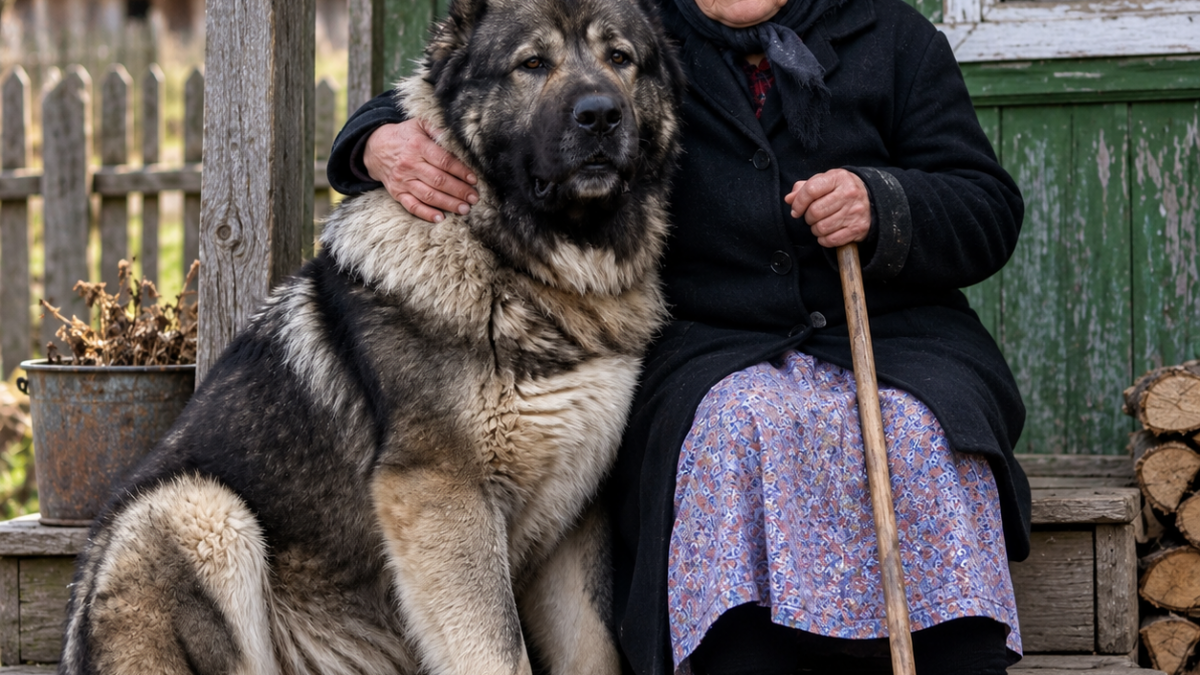
PART 2
The first thing I remember is the sound of wood cracking.
Not the door opening.
Not Grom growling.
Wood.
The old frame around my back door had been repaired twice during the forty-one years I’d lived in that house, and when whoever was outside drove something hard against it, the frame split near the lock with a sound like a rifle shot.
I should have run.
Instead, I stood frozen halfway between the kitchen and the hallway.
There are moments when people imagine they will be brave.
You tell yourself that if someone ever breaks into your home, you’ll call 911, grab something, lock yourself in a room.
Reality is different.
My mind went blank.
My hands went cold.
The only thing moving was Grom.
He stepped fully between me and the door.
His tail wasn’t wagging.
His ears weren’t flattened in panic.
He didn’t charge.
He simply planted himself.
The door slammed again.
The crack widened.
I finally moved.
My phone was on the side table.
I reached it and dialed 911.
The dispatcher answered.
I whispered:
“Someone is breaking into my house.”
“Ma’am, what’s your address?”
I gave it.
Another impact.
The latch tore partially free.
“Are you alone?”
“No.”
“Who is with you?”
“My dog.”
“What kind?”
I looked at Grom.
At that moment, “dog” seemed insufficient.
“A very big one.”
The dispatcher said:
“Do not confront the intruders. Move to a secure room if you can.”
I started backing toward the hallway.
“Grom.”
He didn’t move.
The door burst inward.
A man stepped into my kitchen.
Black hoodie.
Gloves.
Something metallic in his right hand.
Maybe a pry bar.
Behind him stood another man.
Both stopped.
Not because they saw me.
Because they saw Grom.
The first man’s expression changed so quickly I almost would have laughed under different circumstances.
“What the hell is that?”
Grom barked.
Once.
I had heard him bark plenty of times.
But never like that.
The entire kitchen seemed to shake.
The man with the pry bar stepped backward.
The second man swore.
I said:
“Leave.”
My voice sounded small.
Grom’s did not.
The first man raised the pry bar.
That was his mistake.
Grom lunged forward.
Not at his throat.
Not like some movie attack dog.
He closed the distance so fast that the man stumbled backward through the broken doorway before Grom ever touched him.
The second man ran.
The first tried to turn.
His boot caught the threshold.
He fell hard onto the wet patio.
Grom stopped at the doorway.
That detail mattered later.
He could have followed.
He didn’t.
He stood inside the house, blocking the entrance, barking while both men ran toward the alley.
The dispatcher was shouting through my phone.
“Ma’am? Ma’am?”
I realized I had stopped answering.
“They ran.”
“Are you hurt?”
“No.”
“Stay inside. Officers are two minutes away.”
Grom remained at the broken door until I touched his back.
His entire body was trembling.
People later described him as fearless.
He wasn’t.
He had been scared.
He had simply stayed.
“Come here.”
He turned instantly.
The giant terrifying dog everyone had warned me about walked away from the door and pressed his head against my chest.
I wrapped both arms around his neck.
“My good boy.”
That was when my knees gave out.
I sat on the kitchen floor.
Grom sat with me.
## 1
Police arrived within minutes.
Three cars.
Lights everywhere.
Neighbors emerging onto porches despite the rain.
Officer Daniel Ruiz came through the front door while another officer checked the alley.
He stopped when he saw Grom.
“That’s your dog?”
“Yes.”
“How much does he weigh?”
“I don’t know exactly.”
Grom was still growing.
The last veterinary weight had been 126 pounds.
Officer Ruiz stared.
“Did he bite anyone?”
“No.”
“Attack?”
“No.”
“He chased them?”
“He didn’t leave the house.”
Ruiz looked impressed.
“That helps.”
At the time, I didn’t understand why.
Later I would.
Security camera footage from my neighbor’s garage showed two men entering my alley.
My own small doorbell camera caught their vehicle passing the front of the house.
A dark pickup.
Partial plate.
Susan’s camera captured something better.
One man had removed his hood while running.
Clear face.
Police recognized him.
His name was Travis Cole.
Twenty-nine.
Prior burglary arrests.
The second man took longer to identify.
What bothered investigators was not who they were.
It was what they’d said.
**She’s alone.**
That suggested more than random burglary.
They knew something about me.
## 2
The next morning, half the neighborhood came by.
Some brought food.
Some brought questions.
Some came mostly to stare at Grom.
Mrs. Whitaker from three houses down stood at the gate.
“That thing saved you.”
“His name is Grom.”
“That Grom saved you.”
Better.
Susan arrived carrying coffee.
“I withdraw every bad thing I said.”
“You called him a bear.”
“He remains a bear.”
Grom leaned against her leg.
Susan nearly fell over.
“You see?”
“You’re weak.”
“Evelyn.”
I laughed for the first time since the break-in.
But the fear remained.
Someone had targeted my house.
Specifically.
Police confirmed it two days later.
Travis Cole was arrested after trying to sell stolen electronics from another burglary.
During questioning, he denied being at my property.
Then officers showed him the video.
His story changed.
He said someone had told him my house was easy.
Someone knew I lived alone.
Someone knew I kept cash at home.
That last part was false.
I barely kept twenty dollars in a kitchen drawer.
But someone believed otherwise.
Who?
Travis initially wouldn’t say.
Then prosecutors offered consideration for cooperation.
A name emerged.
Leonard Voss.
I knew him.
Everyone on our block did.
## 3
Leonard wasn’t a criminal in the obvious sense.
He wore expensive shoes.
Drove a silver SUV.
Owned Voss Development Group.
For almost two years, he’d been buying properties around our neighborhood because the city had approved a large mixed-use redevelopment nearby.
My house sat on a corner lot.
One of the largest remaining parcels.
Leonard had made three offers.
I had rejected all of them.
The first was reasonable.
The second higher.
The third came with a warning disguised as friendly advice.
“Property values could change quickly, Mrs. Harper.”
I remember smiling.
“So could my mind.”
He smiled back.
It never reached his eyes.
I wasn’t protecting some mansion.
My home was old.
Roof replaced twice.
Foundation repaired once.
Kitchen from 1989.
But Frank and I had bought that house when our daughter was three.
We planted the apple tree.
Built the porch.
Buried two dogs beneath the maple.
I had no interest in selling so someone could tear it down.
After my third refusal, strange things started happening.
Someone reported my fence to code enforcement.
Someone complained Grom was dangerous despite no incidents.
A city inspector received an anonymous complaint about my shed.
None serious.
All annoying.
I thought Leonard was trying to pressure me.
I had no proof.
Then Travis told police something.
Leonard hadn’t directly hired him to burglarize me.
That would have been too simple.
Instead, according to Travis, a man associated with Voss had mentioned “an old widow sitting on a property worth a fortune” and joked that she kept cash and jewelry.
The information traveled.
Maybe Leonard never said:
Break into her house.
But someone in his circle had painted a target.
That made me angry.
Then things got worse.
## 4
A week after the burglary, I received a letter.
Certified mail.
From Voss Development.
New offer.
Twenty percent higher.
At the bottom:
**Given recent safety concerns in the neighborhood, we believe relocation may be in your best interest.**
I read the sentence twice.
Then called my daughter.
“Mom, sell.”
“No.”
“Someone broke into your house.”
“Yes.”
“You live alone.”
“I have Grom.”
“You cannot use a giant dog as a retirement plan.”
“Why not? He’s cheaper than assisted living.”
She did not laugh.
“Mom.”
I softened.
“I’ll put in better cameras.”
“That isn’t the point.”
“I know.”
“Then what is?”
The answer surprised me.
“I don’t want fear making decisions for me.”
Silence.
My daughter understood eventually.
Not happily.
But she understood.
I tore up the Voss offer.
Not the certified envelope.
That went into a folder.
Good thing.
## 5
Grom changed after the break-in too.
Not aggressive.
More alert.
At night, he checked doors before settling.
If a vehicle slowed in front of the house, he watched.
I worried.
Dr. Allison Park, our veterinarian, recommended a professional behavior evaluation.
Not because Grom had done anything wrong.
Because large guardian breeds can become overly protective after a threatening event.
We met a trainer named Mark Ellison.
He had worked with livestock guardians and giant breeds for twenty years.
The first thing he did was ignore Grom.
Smart man.
Grom approached.
Sniffed.
Mark waited.
Eventually Grom leaned against him.
Mark almost lost his balance.
He laughed.
“Okay. He’s enormous.”
“I know.”
“Temperament?”
“Soft with me.”
“I can see that.”
We spent an hour testing basic responses.
Strangers approaching.
Door knocking.
Leash pressure.
Food handling.
Startle response.
Grom was cautious.
Stable.
Protective.
But controllable.
Mark said:
“He’s not looking for conflict.”
“That’s good?”
“Very.”
“Could he have hurt those men?”
Mark looked at Grom.
“Easily.”
My stomach tightened.
“But he didn’t.”
“No.”
“Why?”
“Because he wanted them gone, not dead.”
That sentence stayed with me.
People assume power and violence are the same thing.
They aren’t.
Grom had enormous power.
What made him safe was restraint.
## 6
Then Mark noticed something else.
“You ever test his DNA?”
“No.”
“Microchip?”
“When I found him, none.”
“Where exactly did you find him?”
“Behind my trash cans.”
“How old?”
“Maybe seven weeks.”
Mark studied Grom’s build.
“Somebody didn’t accidentally lose this dog.”
“What do you mean?”
“These guardian mixes are obvious even young. Somebody bred him.”
I shrugged.
“Maybe an unwanted litter.”
“Maybe.”
He didn’t sound convinced.
Two weeks later, curiosity got the better of me.
We ran a DNA panel.
The results came back:
Caucasian Shepherd.
Anatolian Shepherd.
Great Pyrenees.
Small percentage German Shepherd.
No wonder he was huge.
But the report included something unexpected.
A relative match.
A close one.
Another dog with nearly identical genetics registered through the same service.
Owner:
**Red Mountain Guardian Kennels.**
Located forty miles away.
I searched the name.
My stomach tightened.
Photographs showed enormous guardian dogs.
Several looked like Grom.
Same dark facial mask.
Same thick mane.
Same unusual white patch beneath the throat.
I called.
A woman answered.
“Red Mountain.”
“My name is Evelyn Harper. I think I may have one of your dogs.”
Silence.
“What dog?”
I described Grom.
Age.
Where found.
DNA result.
The woman became guarded.
“We don’t have missing dogs.”
“Did you have a litter around last October?”
“No.”
Too quick.
“Are you sure?”
“Yes.”
Click.
She hung up.
Interesting.
## 7
I told Officer Ruiz.
He wasn’t investigating lost puppies.
But he’d heard of Red Mountain.
“Why?”
“Animal-control complaints.”
My heart sank.
“What kind?”
“Overbreeding. Noise. One neglect complaint. Nothing sustained.”
I contacted the county shelter near them.
A technician remembered something.
A litter had been born the previous year.
Large guardian mix.
One puppy described as “undersized” and “not suitable.”
The breeder claimed it died.
No body record.
No veterinary report.
Approximate date matched Grom.
I stared at the email.
The tiny puppy behind my trash cans.
“Why would someone drive forty miles to dump him behind my house?”
That question had no answer.
Not yet.
## 8
The Voss pressure escalated.
A city inspector appeared regarding Grom.
Anonymous complaint:
Dangerous animal.
I showed vaccination records.
Training evaluation.
No bite history.
Inspector met Grom.
Grom sat beside me.
The inspector scratched his chin.
“Dangerous?”
He looked at the complaint.
Then at the dog.
“Somebody doesn’t like you.”
“I’ve noticed.”
Complaint dismissed.
Then another.
My porch allegedly violated setback rules.
It didn’t.
Then my old detached garage.
Again, compliant under grandfathered code.
Leonard never signed any complaint.
Everything anonymous.
But every few weeks, another inconvenience arrived.
He wanted me tired.
I started keeping records.
Dates.
Letters.
Inspector names.
Offers.
Photographs.
My daughter helped organize everything digitally.
Mark installed cameras around the yard.
Susan added one facing the alley.
The neighborhood became a surveillance network.
Leonard had underestimated retirees with Wi-Fi.
## 9
Then one evening, Grom found something at the back fence.
He wouldn’t leave.
Sniffing.
Low growl.
I turned on the porch light.
A plastic bag lay just inside the fence.
I didn’t touch it.
Called police.
Inside were pieces of raw meat.
Officer Ruiz arrived.
“Could be trash.”
“Thrown over a six-foot fence?”
He nodded.
“Fair point.”
Animal control took it.
Lab testing later found a heavy concentration of sedative medication.
Not enough information to identify who prepared it.
But enough to make my blood cold.
Someone had tried to drug Grom.
That changed everything.
The burglary frightened me.
This enraged me.
My dog had never done anything to Leonard.
Never bitten anyone.
Never left my property.
If someone couldn’t get through him, apparently removing him became useful.
Ruiz asked:
“Who knows your dog stays in the backyard evenings?”
“Everyone.”
“Any cameras catch the throw?”
Unfortunately, no.
The angle missed that part of the fence.
But Susan’s camera caught a dark SUV entering the alley fifteen minutes before Grom found the bag.
Silver trim.
Temporary plate.
Vehicle disappeared behind garages.
Came out two minutes later.
We couldn’t see the driver.
Voss Development used several company SUVs.
Including dark ones.
Still not proof.
But the pattern was getting uglier.
## 10
I received another offer the following morning.
This one forty percent above the first.
I called Leonard.
First time I had initiated contact.
He sounded pleased.
“Mrs. Harper.”
“You sent another offer.”
“I did.”
“No.”
Pause.
“You haven’t even considered—”
“No.”
“Your neighborhood is changing.”
“So am I. My knees are worse.”
He laughed politely.
“I am trying to help you.”
“Stop.”
Silence.
“Stop contacting me.”
His voice cooled.
“That’s your final answer?”
“Yes.”
“I hope you don’t regret it.”
There are sentences people should never say when police are already interested in patterns.
My phone was recording.
One-party recording was legal in my state.
Ruiz listened later.
“Not a threat.”
“I know.”
“But useful context.”
Exactly.
## 11
Then Grom disappeared.
For eleven minutes.
It happened on a Sunday morning.
I opened the back door.
He went into the yard.
I poured coffee.
When I checked again, gate open.
Grom gone.
My whole body went cold.
I called.
“Grom!”
Nothing.
The gate latch had been lifted from outside.
Camera footage showed a man in a cap approach from the alley.
He slipped something through the fence.
Grom came over.
The man opened the gate.
Then walked away quickly.
Grom followed several steps.
Not happily.
Curiously.
Then the man moved out of frame.
I ran outside screaming.
Neighbors joined.
Susan drove one direction.
Mark another.
Police notified.
Eleven minutes later, Grom came running back down the street.
Alone.
Panting.
A blue rope attached to his collar.
I grabbed him.
“What happened?”
Grom pressed against me.
No injury.
No sedation.
The rope had a broken clasp.
Someone had tried to take him.
And Grom had gotten away.
This time, the camera caught more.
The man’s face.
Not Leonard.
His property manager.
Derek Shaw.
Voss Development employee.
## 12
Police arrested Derek that afternoon.
He claimed he had been trying to “secure a loose dangerous dog.”
Video destroyed that story.
The dog had been inside a closed yard.
Derek had opened the gate.
Why?
He initially refused to answer.
Then officers found messages on his phone.
From Leonard.
Not:
Kidnap the dog.
Again, Leonard was careful.
Messages like:
**Need that animal issue solved before appraisal.**
**She won’t sell while she feels safe there.**
Then:
**Derek, handle the dog situation. I don’t care how.**
That was much worse.
Derek had interpreted “handle” literally.
He admitted throwing the sedative meat.
He admitted opening the gate.
He denied involvement in the original burglary.
But investigators found something else.
A message to Travis Cole weeks earlier.
**Old woman corner property. Alone most nights. Might be easy money.**
There it was.
The chain.
Leonard to Derek.
Derek to Travis.
Maybe Leonard hadn’t ordered a burglary.
But his campaign to pressure me had created the opportunity.
And the attempt to remove Grom?
That one pointed much closer to him.
## 13
Leonard was questioned.
His attorney arrived.
Everything became careful.
He claimed “handle the dog situation” meant legal complaints.
He claimed he had no knowledge of sedative meat.
No knowledge Derek would open my gate.
No intention anyone be harmed.
Possible.
Maybe true.
Maybe partly.
Proving criminal intent is harder than knowing someone is rotten.
Derek took a plea.
Trespass.
Attempted theft of an animal.
Animal endangerment.
Harassment-related charges.
His cooperation exposed internal communications.
Leonard faced a civil lawsuit from me and regulatory scrutiny over the campaign of complaints.
The city opened an ethics review because one code complaint appeared to have been submitted using false information.
Voss Development’s proposed project slowed.
Investors noticed.
Banks notice lawsuits.
So do newspapers.
For months, Leonard had tried to make me feel small.
Now he had to explain himself publicly.
## 14
The most satisfying confrontation came without planning.
A public zoning meeting.
Voss needed approval for a variance affecting the redevelopment.
I attended.
Not with Grom.
He stayed home.
I walked into that room with my cane, my daughter beside me, and a folder thick enough to stop a door.
Leonard sat at the front in a suit.
When he saw me, his expression tightened.
The board allowed public comment.
I waited.
Then stood.
“My name is Evelyn Harper.”
Everyone knew by then.
Local news had covered the attempted theft of Grom.
I continued.
“I am not here to discuss whether Mr. Voss is guilty of crimes. That’s for courts.”
Leonard’s attorney watched carefully.
“I am here to discuss a pattern.”
I presented dates.
Offers.
Anonymous complaints.
Inspection records.
The letter referencing “recent safety concerns” immediately after the burglary.
The call recording.
Internal messages discovered through litigation.
Derek’s actions.
No exaggeration.
No screaming.
Facts.
Then I said:
“A developer has the right to make me an offer. He does not have the right to make remaining in my own home so frightening and exhausting that surrender starts to feel easier than saying no.”
Nobody moved.
I looked directly at Leonard.
“You thought because I was old, alone, and walked with a cane, I would eventually get tired.”
I smiled.
“You forgot old women have time to keep receipts.”
Someone in the back laughed.
Even one board member smiled.
The variance was tabled.
Later denied pending additional review.
That didn’t destroy Voss Development.
But the project he wanted?
It changed completely.
My property was removed from the plan.
So were two neighbors who had also refused to sell.
The company eventually redesigned around us.
Imagine that.
A multimillion-dollar development curved around one old house because one old woman said no.
## 15
People called that revenge.
I called it a property line.
My house remained.
The apple tree remained.
My garden remained.
And Grom remained.
Leonard eventually settled the civil case.
The agreement included compensation, attorney fees, and a strict no-contact provision.
I used part of the money to replace my fence.
Steel posts.
Better gate.
Lighting.
Cameras.
Susan called it Fort Grom.
I hated the name.
It stuck.
Another portion went somewhere more satisfying.
A local senior-pet assistance program.
They helped elderly people keep animals through veterinary grants, fencing, food delivery, and temporary foster care during hospital stays.
Because something had become clear during all of this:
People kept telling me that at my age, keeping Grom was irresponsible.
Maybe one day caring for him would become difficult.
That didn’t mean the answer was separating us before necessary.
Sometimes people just need help.
So the settlement helped other old people keep their dogs.
Leonard never intended that.
Good.
## 16
Then the Red Mountain mystery returned.
Animal control contacted me.
A former employee had come forward after seeing Grom on local television.
His name was Aaron.
He recognized him.
Not as Grom.
As Puppy Seven.
That’s what the breeder called him.
Not a name.
A number.
Aaron had worked one season at Red Mountain.
The litter contained nine guardian pups.
Eight were sold or reserved.
One developed slowly.
Too gentle.
Didn’t react strongly to threat-testing.
The breeder considered him unsuitable as a protection dog.
That puppy had a white patch under the throat.
One folded ear.
Huge paws.
Grom.
“What happened to him?” I asked.
Aaron looked ashamed.
“The owner told me he’d been euthanized.”
“Was he?”
“No.”
“How do you know?”
“I saw her put him in a crate.”
“Who?”
“Caroline Bishop. The owner.”
“And?”
“She drove away.”
“Where?”
“I don’t know.”
“When she came back, crate empty.”
My stomach turned.
Grom had not gotten lost.
He had been discarded.
Why behind my house?
Aaron couldn’t know.
Then police found the answer through old kennel delivery records.
Red Mountain delivered dog food to a client three streets away.
Caroline knew the neighborhood.
She had probably chosen an alley and left the puppy where someone might eventually notice.
Not murder.
Not the worst possible act.
But abandonment.
Grom had been judged useless because he was too soft.
I laughed when Aaron told me.
“Too soft?”
“Yes.”
I looked at the enormous dog lying with his head on my slipper.
The dog who had faced two intruders and stopped at the threshold.
The dog who had allowed police, veterinarians, children, neighbors, and strangers to touch him without aggression.
The dog who slowed his stride for my cane.
“Good.”
Aaron looked confused.
“Good?”
“Soft was exactly what I needed.”
## 17
Red Mountain was later cited for record violations and an unreported disposal of a puppy.
No dramatic prison.
No satisfying handcuffs.
The breeder lost a licensing renewal for a period and had to meet stricter inspection requirements.
People online wanted more.
I didn’t.
Grom was alive.
Safe.
Loved.
And the characteristic that made him commercially disappointing had become the reason he could live beside an old woman without frightening me.
That’s enough irony for one life.
## 18
By the time Grom turned three, he weighed 168 pounds.
The veterinarian told me he needed to lose six.
I told her she could explain it to him.
She did.
Grom disagreed.
We reduced treats.
He survived the injustice.
He became a neighborhood institution.
Children asked before petting.
He sat.
They touched his shoulders.
Some couldn’t reach over his back.
Delivery drivers who once refused the gate began carrying treats.
The mailman learned his name.
Susan bought him a Christmas sweater that fit approximately one-third of him.
We took a photograph anyway.
Grom looked humiliated.
Perfect.
## 19
The story of the burglary grew in neighborhood mythology.
According to one version, Grom had thrown a burglar through a window.
False.
Another said he chased three armed men two blocks.
Also false.
One child insisted Grom was part wolf.
Definitely false.
The truth was better.
He had stood between me and danger.
Barked.
Moved forward when threatened.
Stopped when the threat left.
That’s all.
Control made the story extraordinary.
Not violence.
## 20
Years passed.
The Voss development opened.
Stores.
Apartments.
A small plaza.
My house remained on the corner behind a new row of landscaped trees.
People driving past probably wondered why one old home stood between modern buildings.
I knew.
So did Leonard.
He sold his interest in the project eventually.
Moved into other developments.
We never spoke again.
Good.
Sometimes the best ending with a bully is distance.
## 21
My daughter visited more.
That was one consequence I hadn’t expected.
The break-in scared her enough that she started coming every month instead of twice a year.
At first she hated Grom.
Too large.
Too much fur.
Too much responsibility.
Then one afternoon she fell asleep on the couch.
I found Grom lying on the floor beside her.
She woke.
Looked down.
“He didn’t move?”
“No.”
“He’s been there two hours?”
“Yes.”
She touched his head.
“Okay.”
“What?”
“I get it.”
Finally.
## 22
When my first great-grandchild was born, everyone worried about Grom.
Including me.
Power deserves respect.
We introduced them carefully.
Distance.
Leash.
Calm.
Grom sniffed the baby’s blanket.
Then the baby.
Then walked away.
My granddaughter laughed.
“That’s it?”
“What did you expect?”
“A Disney moment.”
“Real dogs have boundaries.”
Years later, that little boy learned to walk holding onto furniture.
Grom often lay nearby.
Never allowed climbing.
Never treated as a toy.
But when the boy fell once, he landed against Grom’s side.
Grom didn’t move.
Just looked offended.
The boy laughed.
I thought about Puppy Seven.
Too soft.
Thank God.
## 23
At six, Grom began developing arthritis.
Large dogs age differently.
Too fast.
The first time I saw him hesitate at the porch steps, fear went through me.
“No.”
He looked at me.
“No, you’re not old.”
He was.
So was I.
We adapted together.
Ramp for him.
Rail for me.
Joint medication for him.
Blood-pressure medication for me.
Shorter walks.
Longer naps.
Susan said:
“You two are becoming the same person.”
Grom sneezed.
“That was rude.”
## 24
The most beautiful thing about growing old with Grom was that neither of us needed the other to pretend.
On good days, we walked farther.
On bad days, we sat in the garden.
Sometimes my hands hurt too much to brush his thick coat.
My granddaughter did it.
Sometimes Grom’s hips hurt too much for the stairs.
He slept downstairs.
Neither was failure.
We were just adjusting.
## 25
When I turned eighty, the senior-pet program asked us to attend a small fundraiser.
I refused speeches.
Then somehow ended up giving one anyway.
People expected me to talk about the break-in.
I didn’t.
I said:
“Everyone told me the problem with Grom was that one day I might become too old to care for him.”
I looked at him lying beside the podium.
“They were right about one thing. I did get older.”
People laughed.
“So did he.”
I continued.
“The answer wasn’t getting rid of each other. The answer was asking for help when we needed it.”
That’s what the program did.
A volunteer helped with heavy bags of food.
My daughter handled certain vet appointments.
A neighbor walked Grom when my knee surgery kept me home.
Community.
Not independence at all costs.
That’s another myth old people are taught.
## 26
Grom was eight when the first serious health problem came.
A mass near his spleen.
Ultrasound.
Tests.
Surgery.
I sat in the veterinary waiting room remembering the tiny puppy beside the trash cans.
Mark, the trainer, came.
So did Susan.
My daughter drove down.
Dr. Park emerged after three hours.
“It’s out.”
“Cancer?”
“We’ll know after pathology.”
A week later:
Benign.
I cried so hard the receptionist brought tissues.
Grom recovered.
Slowly.
He hated the cone.
Everyone hates the cone.
For two weeks, the dog once described as terrifying walked around my house crashing an enormous plastic satellite dish into furniture.
Fearsome.
## 27
At ten, his muzzle became gray.
At eleven, hearing declined.
At twelve, he stopped caring when strangers came through the gate.
He’d lift his head.
Evaluate.
Go back to sleep.
I joked:
“Terrible guard dog.”
Susan replied:
“He’s retired.”
Fair.
By then, I had a security system.
Steel fence.
Neighbors.
Cameras.
Grom had earned retirement.
## 28
One evening, years after the burglary, I heard something at the back door.
A metallic sound.
For one second, my entire body remembered.
The crack of wood.
A whisper:
She’s alone.
I froze.
Grom was asleep beside the couch.
Old.
Gray.
He lifted his head.
I grabbed my phone.
Then someone knocked.
“Mrs. Harper?”
My neighbor’s teenage son.
He had accidentally kicked a soccer ball over the fence.
I laughed so hard I frightened him.
Grom put his head back down.
Fear can survive long after danger ends.
That doesn’t mean danger still owns you.
## 29
The original broken doorframe remained in my garage for years.
I had saved it without knowing why.
One day my daughter found it.
“Why do you still have this?”
I looked at the split wood.
“I don’t know.”
She waited.
Then:
“Want me to throw it away?”
I thought.
“Yes.”
She did.
I felt nothing.
That was good.
## 30
Grom’s final decline began at thirteen.
His back legs weakened.
Heart disease.
Arthritis.
A neurological problem that made one paw drag.
Dr. Park was honest.
“We can manage comfort.”
“For how long?”
“I don’t know.”
I hated that answer.
But old age doesn’t offer contracts.
So we managed.
Rugs across floors.
Harness for support.
Medication.
Ramp.
More time outside.
Less walking.
Grom still followed me.
Just slower.
Sometimes I waited for him.
Years earlier, he had slowed his pace for my cane.
Now I slowed mine for his legs.
Fair exchange.
## 31
One autumn morning, I sat beside him beneath the apple tree.
The leaves were turning.
Grom’s head rested on my shoe.
I looked at the old trash cans near the garage.
Different cans now.
Same corner.
“You know I found you over there?”
His ear moved.
“You looked awful.”
Nothing.
“You were the size of a rabbit.”
Still nothing.
“I should’ve known those paws were a warning.”
His tail tapped once.
I smiled.
## 32
People had spent years telling me Grom saved my life.
Maybe.
That night could have ended badly.
I don’t minimize it.
But the more important saving went both directions.
I gave him a home after someone discarded him for being unsuitable.
He gave me companionship after Frank died.
He gave me confidence when people tried to frighten me out of my own house.
He gave me a reason to walk.
To laugh.
To argue with veterinarians about his weight.
To accept help without feeling diminished.
“Saving” is rarely one dramatic act.
It’s often years of ordinary presence.
## 33
At fourteen, Grom stopped eating breakfast.
That was unusual.
He loved breakfast with religious commitment.
I called Dr. Park.
Bloodwork.
Kidneys.
Heart.
Age.
Everything declining at once.
We adjusted medication.
He rallied.
Two months.
Good ones.
Then one morning, he couldn’t stand without help.
I used the support harness.
He tried.
Collapsed.
Looked at me.
I knew.
I hated knowing.
## 34
Dr. Park came to the house.
My daughter sat beside me.
Susan too.
Mark came briefly, knelt beside Grom, pressed his forehead against the dog’s enormous head, then left because he couldn’t stay.
Grom lay in the living room.
Same room where I had been reading the night of the break-in.
I noticed that.
Of course I did.
But the room meant something different now.
Family photos.
Grandchildren.
Sunlight.
His old bed.
My chair.
Life had crowded out fear.
## 35
I sat on the floor despite my knees.
My daughter protested.
“Mom.”
“Leave me.”
She helped me down anyway.
Grom placed his head in my lap.
Even old, it was heavy.
I touched the white patch beneath his throat.
“Puppy Seven.”
My daughter looked confused.
“What?”
“Long story.”
Grom breathed slowly.
“You know everybody thought you were dangerous?”
One ear moved.
“They were ridiculous.”
Susan laughed through tears.
“Some of us corrected ourselves.”
“Eventually.”
## 36
I thought about Travis.
Derek.
Leonard.
Red Mountain.
All those people who had looked at Grom and seen either a problem, an obstacle, a tool, or a failed product.
None of them were in the room.
That mattered.
The people who loved him were.
That’s how power changes hands.
## 37
Dr. Park gave the sedative.
Grom relaxed.
His eyes stayed on me.
I whispered:
“You don’t have to guard the door anymore.”
My voice broke.
“The house is safe.”
My daughter started crying.
“So am I.”
That was the sentence I needed him to hear.
Maybe for myself.
“You did your job.”
But even that felt wrong.
He wasn’t a tool.
So I corrected myself.
“No.”
I stroked his forehead.
“You were never a job.”
Grom’s breathing softened.
“You were my boy.”
## 38
The final medication went in.
Grom exhaled.
One long breath.
Then another.
Then stillness.
Fourteen years after I found a trembling puppy behind trash cans, the largest dog most people in my neighborhood had ever seen died with his head in the lap of the old woman everyone once warned he might hurt.
The irony wasn’t lost on me.
## 39
We buried some of his ashes beside Frank.
The rest stayed in the house.
His collar hung near the back door for months.
Eventually I moved it.
Not because I wanted to forget.
Because the door was just a door again.
No guard needed.
## 40
The neighborhood held a small gathering.
I didn’t ask for it.
Susan organized everything.
Children brought photographs.
Delivery driver brought biscuits out of habit, then cried when he realized.
Someone printed a picture of Grom wearing the ridiculous Christmas sweater.
That became the favorite.
Not the security footage.
Not the giant dog at the doorway.
The sweater.
Good.
## 41
Leonard Voss’s old development company had changed hands by then.
One of the new managers sent a condolence card.
I almost threw it away.
Then laughed.
Life has strange timing.
## 42
The senior-pet assistance program created a grant in Grom’s name.
Not for guard dogs.
For elderly owners with large dogs who needed help with fencing, ramps, transport, or temporary care.
I approved of that.
The first recipient was an eighty-one-year-old man with a 110-pound Newfoundland.
Perfect.
## 43
Years later, people still asked:
“Was Grom really that big?”
I show photographs.
They say:
“No way.”
“Yes way.”
“Were you ever scared of him?”
“No.”
Never.
Respectful?
Absolutely.
A dog that powerful deserved responsible handling.
But afraid?
No.
The only time Grom ever frightened me was when he got old.
Because love makes endings frightening.
## 44
When people tell the story, they focus on the night he stopped two intruders.
I understand.
That’s dramatic.
But if you want the truth, the most extraordinary thing Grom ever did happened every day.
He controlled himself.
He adjusted to me.
He stayed gentle while becoming powerful.
He learned that my cane meant slow.
That children meant careful.
That doors were boundaries.
That fear did not require violence.
That was harder than chasing a burglar.
## 45
The breeder had rejected him because he wasn’t aggressive enough.
Think about that.
The characteristic that made someone throw him away was exactly what made him extraordinary.
He had strength without needing to prove it.
That’s rare in dogs.
Rarer in people.
## 46
The burglars had looked at my house and seen an elderly widow.
Leonard had looked at my property and seen acreage.
Derek had looked at Grom and seen an obstacle.
The breeder had looked at a puppy and seen defective merchandise.
Every one of them made the same mistake.
They reduced something living to one useful label.
Old woman.
Property.
Obstacle.
Failed guard dog.
They were all wrong.
## 47
I was not helpless because I was old.
My house was not just land.
Grom was not just protection.
And softness was not weakness.
That last one became the lesson I carried longest.
## 48
A few years after Grom died, another puppy appeared in my life.
Not behind trash cans.
At Greenfield Rescue.
Small.
Brown.
One eye.
Maybe twenty pounds fully grown.
My daughter said:
“No.”
I said:
“I haven’t asked.”
“You’re thinking.”
“I am capable of thoughts.”
“You are eighty-eight.”
“Observant.”
She sighed.
We compromised.
I didn’t adopt him.
I fostered him for six weeks.
He went to a young family.
Then I fostered another.
Old age changed what I could manage.
Not what I could contribute.
## 49
I eventually moved out of the house.
That surprises people.
After everything, yes.
At ninety-one, stairs became difficult.
My daughter found a small one-level home closer to her.
I chose to move.
That’s the important part.
No developer pressured me.
No burglary.
No fear.
My decision.
We sold the old house to a young couple with two children.
Before signing, I made them promise one thing.
“Keep the apple tree if you can.”
They did.
## 50
The morning I left, I stood by the back gate.
New fence.
Strong lock.
Cameras still mounted.
The corner behind the trash cans was empty.
I could almost see him.
Tiny.
Dirty.
Folded ear.
Those ridiculous paws.
I touched the gate.
“Come on, Grom.”
Habit.
No dog came.
Still, I smiled.
## 51
The new owners later sent a photograph.
Their little boy sitting beneath the apple tree.
Beside him, a dog.
Not giant.
Golden Retriever.
I laughed.
The house had another guardian.
A friendlier-sized one.
## 52
People sometimes ask if I regret refusing Leonard’s money earlier.
No.
I eventually sold for less than his final offer.
Didn’t matter.
The point was never maximizing money.
The point was choosing.
He tried to turn fear into leverage.
He failed.
I left when I wanted.
That’s the revenge.
## 53
And Grom?
People wanted some spectacular ending where he became famous.
Police dog.
Hero award.
Television appearances.
None of that happened.
He received a plaque from the neighborhood association.
He tried to eat the ribbon.
That was enough.
His real reward was boring.
Fourteen years.
Food.
Warmth.
Veterinary care.
A yard.
Children.
A woman who loved him.
The right to grow old.
## 54
That’s more valuable than fame.
## 55
If I could return to the morning I found him, I wouldn’t tell myself about the burglars.
Or Leonard.
Or court hearings.
Or cameras.
I would say:
“Pick him up.”
That’s all.
“Pick him up.”
Because every good thing begins there.
A small decision before you understand its consequences.
## 56
I didn’t know he would become huge.
Didn’t know people would fear him.
Didn’t know he would stand between me and men forcing my door.
Didn’t know he would become evidence in a harassment case.
Didn’t know a breeder once considered him unsuitable.
Didn’t know I’d eventually need ramps for both of us.
I just knew a puppy was cold.
Sometimes that’s enough.
## 57
The dramatic part of Grom’s story lasted minutes.
The break-in.
The bark.
Men running.
Police lights.
The real story lasted fourteen years.
That’s the version I prefer.
## 58
Fourteen years of him waiting beside the bathroom door.
Fourteen years of hair on furniture.
Giant water bowls.
Food bills that made my daughter question my judgment.
Vet visits.
Muddy paw prints the size of saucers.
Children asking to pet “the bear.”
Slow walks.
Old joints.
Morning sunlight.
## 59
One night of courage made him a neighborhood legend.
Years of gentleness made him mine.
There’s a difference.
## 60
I have a photograph beside my bed now.
Not Grom standing at the broken doorway.
The police took a picture that night.
I’ve seen it.
He looks enormous.
Terrifying.
I don’t keep that one.
My photograph shows Grom at twelve years old.
Gray face.
Lying beside my garden chair.
His head resting on my cane.
Eyes closed.
If you didn’t know the story, you’d see an old woman and an old dog taking a nap.
That’s exactly what I want.
## 61
Because danger was never the heart of his life.
Safety was.
He had been discarded.
Then safe.
I had been threatened.
Then safe.
We gave that to each other.
## 62
And if Leonard ever thinks about the old widow whose house ruined the neat line on his development map, I hope he remembers one thing.
He thought making me afraid would make me leave.
Instead, it made an entire neighborhood watch more closely.
It exposed Derek.
It exposed the burglary connection.
It strengthened my case.
It brought cameras, witnesses, lawyers, inspectors, and public scrutiny.
Every attempt to isolate me did the opposite.
It surrounded me with people.
That’s a satisfying kind of consequence.
## 63
He wanted one old woman to feel alone.
By the end, I had half the street checking my gate.
Susan watching the alley.
Mark training Grom.
My daughter organizing records.
Officer Ruiz calling with updates.
Neighbors attending zoning meetings.
He created the community he didn’t want me to have.
## 64
And the dog he wanted removed?
Grom became the reason people stopped seeing my house as easy.
There is poetry in that.
I won’t pretend otherwise.
## 65
But Grom never cared about revenge.
Dogs are better at that.
He cared whether breakfast arrived.
Whether I was in the room.
Whether squirrels were violating property boundaries.
Whether Susan had treats.
Whether we were walking.
His world was honest.
## 66
Maybe that’s why living with him changed me.
I spent less time worrying about what people thought.
More time asking:
Is the door locked?
Is the dog fed?
Are the tomatoes watered?
Is today good?
Practical questions.
Useful questions.
## 67
The final lesson came from his death.
Power ends.
Size ends.
Bodies fail.
The giant dog who once filled a doorway eventually needed help standing.
That isn’t humiliation.
It’s life.
He had protected me when he was strong.
I supported him when he wasn’t.
That’s what loyalty actually means.
Not endless strength.
Staying after strength leaves.
## 68
When I held him that final day, he wasn’t Grom the neighborhood legend.
Not the giant.
Not the protector.
Not the “bear.”
He was the little puppy behind the trash cans again.
At least to me.
Same eyes.
Same trust.
Same quiet way of asking:
Are you the one?
Fourteen years earlier, I’d answered by carrying him inside.
At the end, I answered by staying while he left.
Full circle.
No spectacle needed.
## 69
So when people tell me:
“That dog saved you.”
I say:
“Yes.”
Then I add:
“But not only that night.”
He saved me from becoming smaller after Frank died.
From allowing fear to decide where I lived.
From believing old age meant my useful years were over.
From mistaking independence for isolation.
And I hope, in return, I saved him from spending his life being judged by what he wasn’t aggressive enough to become.
## 70
We were both underestimated.
Maybe that’s why we understood each other.
## 71
The old neighbors are mostly gone now.
Susan moved closer to her children.
Officer Ruiz retired.
Mark still trains dogs.
My daughter has gray hair and pretends not to notice.
Time is rude that way.
But whenever someone from the old neighborhood visits, eventually Grom comes up.
Always.
“Remember the night?”
“Yes.”
“Remember how big he was?”
“Yes.”
“Remember Voss?”
Unfortunately.
Then someone laughs.
Stories soften.
Fear becomes history.
## 72
One Christmas, my great-grandson gave me a framed drawing.
Crayon.
A tiny old woman.
A ridiculously large black-and-tan dog.
The dog is three times larger than the house.
He wrote underneath:
**GREAT-GRANDMA AND GROM**
Proportionally inaccurate.
Emotionally perfect.
It’s on my wall.
## 73
That’s probably how Grom survives now.
Not through hero stories.
Through family memory.
The giant dog who walked slowly beside Grandma.
The dog who guarded the door.
The dog who hated sweaters.
The dog whose tail knocked cups off tables.
The dog who once stole an entire roast and somehow convinced everyone it was an accident.
It was not.
## 74
That’s legacy.
Messy.
Ordinary.
Loved.
## 75
The person who abandoned him expected him to disappear.
The men who broke into my house expected me to be helpless.
The developer expected fear to make me surrender.
Every prediction failed.
Not because life magically rewards good people.
It doesn’t.
They failed because other choices interrupted them.
I picked up the puppy.
Grom stood at the door.
Police investigated.
Derek talked.
Neighbors recorded.
Lawyers filed.
The board listened.
I said no.
Again.
Again.
Again.
That’s how outcomes change.
## 76
There was no single miracle.
Just persistence.
## 77
If you want the most dramatic moment, picture this:
An old kitchen.
Broken door.
Rain outside.
A man holding a pry bar.
A seventy-four-year-old woman with a phone in one trembling hand.
And between them, a dog so large the intruder took one look and forgot whatever plan he’d rehearsed.
That’s the story people click.
I understand.
## 78
But if you want the ending that matters, picture something else.
Years later.
Same house.
Quiet afternoon.
An eighty-something-year-old woman sitting beneath an apple tree.
A gray-faced giant dog sleeping beside her.
Neither guarding anything.
Neither fighting anyone.
Just safe.
## 79
That’s what we fought for.
Not victory.
Peace.
## 80
And yes, the people who tried to frighten me faced consequences.
The burglars were prosecuted.
Derek lost his job and pleaded to charges related to trespass, theft, and animal endangerment.
Voss paid through civil settlement, legal costs, lost approvals, and public scrutiny.
The breeder who discarded Grom faced licensing consequences.
Those things mattered.
Accountability matters.
## 81
But punishment wasn’t the conclusion.
Grom was.
## 82
A puppy somebody threw away.
A giant dog everybody feared.
A gentle animal one breeder didn’t consider useful.
A protector who knew when to stop.
An old dog who eventually needed protecting himself.
My friend.
## 83
That’s why the title people gave him later never quite fit.
They called him:
**The Giant Dog Who Saved the Widow.**
I appreciated it.
But if I could rename the story, I’d say:
**The Puppy Nobody Wanted Grew Big Enough to Protect the One Person Who Never Asked Him to Be Anything But Gentle.**
That’s closer.
## 84
Because I never needed a weapon.
I needed Grom.
There is a difference.
## 85
He didn’t make me brave.
He reminded me fear didn’t always deserve obedience.
That is different too.
## 86
The last night I spent in the old house before moving, I slept badly.
No Grom beside the bedroom door.
Hadn’t been for years.
Still, at three in the morning, I woke and thought I heard his nails on the hallway floor.
Click.
Click.
Click.
I listened.
Nothing.
The house settling.
I smiled in the dark.
“Go back to sleep.”
Old habit.
Maybe addressed to him.
Maybe myself.
## 87
Morning came.
I made tea.
Walked through every room.
Touched the kitchen doorway where the old frame had once broken.
No scar now.
Repaired years earlier.
I looked toward the back gate.
Locked.
Sunlight.
Quiet.
No fear.
## 88
Then I left.
By choice.
That’s important.
## 89
My daughter drove.
I looked back once.
The apple tree moved in the wind.
For a moment, I imagined a huge black-and-tan shape standing beneath it.
Tail low.
Watching.
Waiting for me to catch up.
## 90
I didn’t cry then.
Later.
Much later.
## 91
People sometimes think satisfying endings require getting everything back.
They don’t.
Frank didn’t come back.
Grom didn’t live forever.
I eventually left the house.
Time took plenty.
A satisfying ending means the important choices were still ours when they mattered.
## 92
I chose Grom.
Grom chose to stay between me and danger.
I chose not to sell from fear.
I chose when to leave.
I chose to stay beside Grom when his body was finished.
Enough choice remained.
That’s dignity.
## 93
And if there was one final revenge against everyone who underestimated us, it was this:
We lived well anyway.
## 94
Leonard couldn’t take the house while I wanted it.
The burglars couldn’t take my safety permanently.
The breeder couldn’t decide Grom’s worth.
Age couldn’t erase what we’d done.
Fear couldn’t become the narrator.
## 95
Grom and I got fourteen years.
Fourteen years is longer than a broken door.
Longer than a zoning fight.
Longer than one man’s ambition.
Longer than the morning beside the trash cans.
## 96
That’s how you defeat a terrible moment.
You live past it.
## 97
I still have Grom’s first photograph.
Taken the morning after I found him.
He’s wrapped in a blue towel.
One ear up.
One down.
Paws absurdly large.
Looking directly into the camera.
Every time I see it, I laugh.
I had no idea.
None.
## 98
Maybe that’s why I treasure it.
We almost never know what a small act is becoming.
You feed a puppy.
Open a door.
Say no to an offer.
Install a camera.
Make a phone call.
Stay one more day.
Years later, somebody calls it a story.
At the time, it’s simply Tuesday.
## 99
My Tuesday became Grom.
And Grom became much larger than I expected.
Physically.
Certainly.
But in every other way too.
## 100
So yes, the little puppy I found beside the garbage eventually became so enormous that strangers stepped backward when they saw him.
And yes, one night his size helped stop two men from entering my home.
But that was never the most shocking thing about him.
The most shocking thing was that inside that enormous body remained the same quiet puppy who had looked up at me from beside the trash cans and trusted me before I had earned it.
He never became cruel.
Never became the dangerous animal people predicted.
Never needed to prove how strong he was.
And when everyone else tried to decide what an old woman and an unwanted dog were worth, we answered in the only way that mattered.
We stayed.
We lived.
We chose for ourselves.
And for fourteen years, the dog somebody once discarded like garbage slept beside my door as though guarding the most valuable place in the world.
To him, maybe he was.
Because I was inside.
And to me, the enormous dog everyone feared was never a monster.
Never a weapon.
Never a legend.
He was simply Grom.
The tiny puppy I bent down to pick up one cold morning.
The best decision I almost didn’t know I was making.
**THE END**


