PART 2: I Found a Pit Bull Puppy Tangled in Barbed Wire—Months Later, I Learned Why Someone Had Left Him There
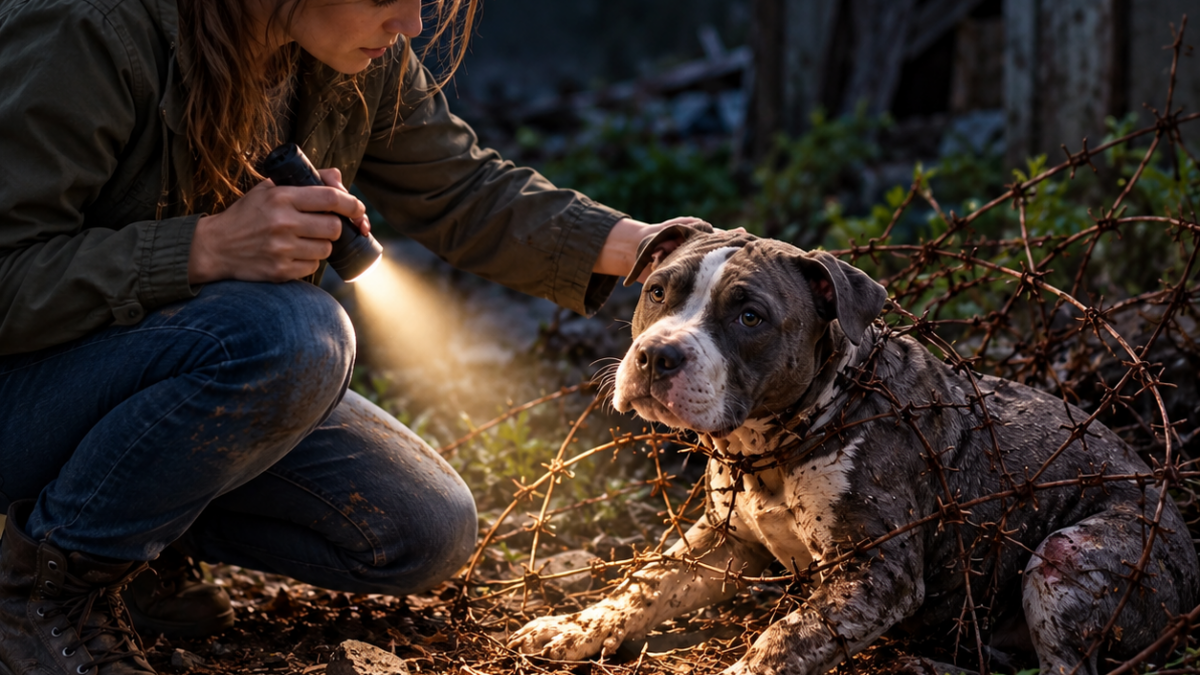
PART 2
Roy backed into my legs so quickly that I nearly lost my balance.
That alone frightened me.
By then, I knew almost every version of Roy.
I knew the sleepy Roy who made little snorting noises when he dreamed.
I knew the excited Roy who spun in a ridiculous circle when I picked up his leash.
I knew the patient Roy who sat beside the elevator while our elderly neighbor, Mrs. Alvarez, shuffled inside with her grocery cart.
I knew the curious Roy who could spend five minutes investigating a single leaf.
I even knew frightened Roy.
But this was different.
His entire body became low and tight.
His tail disappeared beneath him.
He wasn’t looking for something to chase.
He was looking for somewhere to escape.
“Roy?”
The man across the street shut the door of an old dark pickup.
He stood beside it without moving.
Maybe he was waiting for someone.
Maybe he lived nearby.
Maybe Roy was reacting to the truck, not the man.
Those were the explanations I tried to give myself.
Then the man whistled.
Two short notes.
Roy shook so hard that the leash trembled in my hand.
I felt every hair on my arms rise.
The man smiled.
Not warmly.
Not like someone who had simply recognized a dog.
He crossed the street.
I stepped backward.
Roy moved with me.
“Evening,” the man said.
He looked somewhere in his late forties, maybe early fifties. Work boots. Faded jacket. Baseball cap pulled low. Nothing remarkable about him except the way his eyes stayed on Roy.
“Hi,” I said.
“Nice dog.”
“Thanks.”
“How long have you had him?”
The question came too quickly.
I tightened my grip on the leash.
“A while.”
He leaned slightly to get a better look at Roy.
Roy pressed harder against my knees.
The man noticed.
His smile changed.
“He’s nervous.”
“He doesn’t like strangers.”
That wasn’t true.
Roy loved strangers now.
He had spent months learning that most hands offered treats or scratches instead of something to fear.
The man whistled again.
Roy tried to retreat.
I stepped between them.
“Don’t do that.”
The man’s expression flattened.
“Do what?”
“Whistle at him.”
For several seconds, neither of us said anything.
Traffic moved behind us.
Someone laughed on a balcony above the street.
Ordinary sounds.
I remember them because everything about that moment felt strangely separated from ordinary life.
Then the man shrugged.
“Didn’t mean anything by it.”
He returned to the truck.
Before climbing in, he looked at me again.
“Take care of that dog.”
The engine started.
I stood there until his taillights disappeared.
Only then did I realize my hands were shaking.
I crouched beside Roy.
“Who was that?”
He licked his lips nervously.
I touched his shoulder.
“It’s okay. He’s gone.”
But Roy kept staring down the street long after the truck had vanished.
That night, he slept pressed against my bedroom door instead of beside my bed.
I didn’t sleep much at all.
## THE DOG I HAD NEVER PLANNED TO KEEP
Before Roy, I had built my life around predictability.
I was thirty-two, single, and living in a second-floor apartment that was exactly seven minutes from my job if every traffic light cooperated.
I paid my bills on the first of the month.
I bought groceries every Sunday.
I called my mother on Wednesday evenings.
Exciting?
Not particularly.
But after growing up in a house where money disappeared without warning and arguments could start over something as small as a missing set of keys, predictability felt like peace.
A dog had never fit into that plan.
Especially not Roy.
During our first week together, he destroyed one couch cushion, refused to walk through doorways unless I went first, and panicked when the garbage truck passed outside.
The first time I left for work, my downstairs neighbor called twenty minutes later.
“Is everything all right up there?”
“Why?”
“Your dog sounds heartbroken.”
I drove home during lunch.
Roy had dragged the blanket from his crate to the front door.
He was lying on it, waiting.
That was when I realized the problem wasn’t obedience.
It was trust.
He wasn’t being difficult.
He was terrified I might disappear.
So we started slowly.
Five minutes outside the apartment.
Then ten.
Then twenty.
I stopped making a dramatic production out of leaving or returning.
A trainer named Melissa taught me to reward calm behavior, establish routines, and give Roy choices whenever possible.
“He needs to learn that the world is predictable now,” she explained.
That sentence stayed with me.
Maybe because I understood it.
So we built predictability together.
Breakfast at seven.
Morning walk at seven-thirty.
A stuffed toy before I left for work.
Training after dinner.
Lights out around eleven.
Eventually, Roy stopped waiting at the door.
He started sleeping on the couch.
Then, despite all the expensive dog beds I bought, he decided my feet were better.
My mother hated the idea at first.
“You brought home what?”
“A puppy.”
“What kind?”
I hesitated.
“Pit bull mix.”
Silence.
Then:
“Absolutely not.”
“Mom—”
“Those dogs are dangerous.”
“This one is scared of cardboard boxes.”
“He’s a puppy now.”
“He’s a dog, Mom.”
We argued.
For the first time in years, I refused to make a decision simply because it made someone else more comfortable.
Two months later, my mother visited.
Roy sat behind the baby gate while she entered.
His tail moved slowly.
I gave her treats and showed her how to toss them without approaching him.
By the end of the afternoon, she was sitting on my couch with Roy’s chin resting on her knee.
She pretended not to notice.
I definitely noticed.
“So dangerous,” I whispered.
“Don’t start,” she said.
But she smiled.
Roy changed people that way.
Not with some dramatic transformation.
Just through patience.
He gave them time to discover who he actually was.
Which was why the encounter with the man near the truck disturbed me so much.
Roy’s reaction wasn’t based on reputation or imagination.
He knew something I didn’t.
And for the first time since I had found him, I began thinking seriously about the night behind the warehouse.
I had never reported anything beyond finding an injured stray.
At the time, there hadn’t seemed to be anything to report.
I had no suspect.
No license plate.
No witness.
No idea whether Roy had wandered there or been abandoned nearby.
But now I had a man.
Or at least a face.
And a truck.
The next morning, I called the veterinary clinic.
Dr. Patel answered between appointments.
“Do you still have Roy’s original photographs?”
“Yes. Why?”
I told her what happened.
She went quiet.
“Could be coincidence.”
“I know.”
“But you don’t think it was.”
“No.”
“Neither does Roy, apparently.”
She sent me copies of the original medical photographs and notes.
For the first time in months, I studied them closely.
The marks around Roy’s neck were the part that bothered me most.
Not because they were dramatic.
They weren’t.
But because they were specific.
Repeated pressure in the same area.
Old marks beneath newer ones.
Someone had kept this puppy restrained for a long time before I found him.
I printed everything.
I didn’t know what I planned to do.
I only knew I wanted a record.
Two nights later, the truck appeared again.
This time, it was parked outside my apartment building.
## THE SECOND VISIT
I saw it from my kitchen window.
Same dark pickup.
Same dent above the rear wheel.
Same faded sticker in the lower corner of the back window.
I turned off the kitchen light and stepped away from the glass.
My heart began hammering.
Roy was asleep on the rug.
I didn’t wake him.
Instead, I photographed the truck through a gap in the curtains.
The license plate was partly visible.
I zoomed in.
Then I called the non-emergency police number.
I felt ridiculous while I explained the situation.
A dispatcher listened patiently.
“So the individual hasn’t threatened you?”
“No.”
“Has he attempted to enter the building?”
“No.”
“Has he contacted you again?”
“Not yet.”
There was a pause.
I knew how it sounded.
A parked truck.
A nervous dog.
A bad feeling.
Not exactly a crime.
The dispatcher suggested documenting anything unusual and calling immediately if I felt unsafe.
I thanked her.
When I looked outside again, the truck was gone.
The next morning, someone had slipped a folded piece of paper under my apartment door.
Three words were written on it.
**Nice dog. Careful.**
I read it twice.
Then a third time.
My stomach went cold.
I called the police again.
This time, an officer came.
His name was Officer Brennan.
He was younger than I expected, with tired eyes and a calm voice.
He photographed the note and asked me to describe the man.
“Did you see him leave this?”
“No.”
“Any cameras in the hallway?”
The building manager checked.
The camera above the entrance had stopped recording four days earlier.
Of course it had.
Officer Brennan looked through the veterinary records.
When he reached the photographs from the night I found Roy, he frowned.
“You found him near the old Mercer warehouse?”
“Yes.”
“You sure?”
“Absolutely.”
He looked at me.
“That property has had complaints.”
“What kind?”
“Mostly trespassing. Noise. Vehicles coming and going after dark.”
“Is someone using it?”
“Technically it’s owned by a holding company. Building’s supposed to be empty.”
“Supposed to be?”
He didn’t answer directly.
Instead, he gave me his card.
“If that truck comes back, call.”
“What do you think is happening?”
“I think we need more than a note and a nervous dog before I tell you anything.”
It wasn’t the answer I wanted.
But it was fair.
So I waited.
Three days passed.
Then five.
No truck.
No man.
Roy returned to normal.
I started telling myself I had overreacted.
Then, on Saturday morning, I drove to a pet supply store across town.
When I came out twenty minutes later, there was an envelope beneath my windshield wiper.
Inside was a photograph.
Roy.
It had been taken through the fence at our neighborhood dog park.
On the back, someone had written:
**He wasn’t yours to take.**
That ended the possibility of coincidence.
I drove straight to the police station.
Officer Brennan was there.
He took the photograph without speaking.
Then he asked one question.
“Where is the dog right now?”
“At home.”
“Alone?”
My chest tightened.
I called Mrs. Alvarez.
She lived across the hall and had a spare key because she sometimes watched Roy when I worked late.
“Can you go into my apartment?”
“Of course. Why?”
“Please just go now.”
I heard her door open through the phone.
Then mine.
A few seconds later:
“He’s here. He’s fine.”
I nearly cried from relief.
Officer Brennan stood.
“I’m sending a unit with you.”
That afternoon, two things changed.
First, my apartment building finally repaired the cameras.
Second, Officer Brennan began treating the situation not as a strange encounter but as targeted harassment.
He ran the partial plate.
The truck was registered to a man named Wade Mercer.
The name made me stare at him.
“Mercer?”
“Same family name as the warehouse.”
“Does he own it?”
“His father’s company did. Property was transferred after the father died.”
“So Wade has access?”
“Probably.”
“Then he knows where I found Roy.”
Officer Brennan folded his arms.
“That appears likely.”
“Can you arrest him?”
“For what we have right now? Not yet.”
My frustration must have shown.
He continued before I could speak.
“I know that’s not what you want to hear. But a strong case beats a rushed one.”
I looked at Roy beside my chair.
He had his nose resting across my shoe.
“What am I supposed to do meanwhile?”
“Don’t confront him. Don’t go near the warehouse. Save everything. Photograph everything. Change your routines for a while.”
It felt unfair.
I had done nothing wrong.
Roy had done nothing wrong.
Yet we were the ones changing routes, checking locks, watching mirrors.
That anger became useful.
Fear makes you want to disappear.
Anger makes you want answers.
I started looking for them.
## WHAT THE WAREHOUSE HAD BEEN HIDING
I didn’t return to the warehouse.
I kept that promise.
Instead, I searched public records.
The property belonged to Mercer Industrial Holdings, a small company controlled by Wade Mercer and his older brother, Dean.
Taxes were delinquent.
Several code violations had been issued.
The city had ordered sections of the property secured after complaints about broken fencing.
Then I found something more interesting.
An animal control incident report from almost two years earlier.
It wasn’t detailed.
Anonymous complaint.
Multiple dogs heard on property.
Officer responded.
No animals located.
Another complaint six months later.
Vehicles arriving late at night.
Again, nothing confirmed.
I printed both.
On Monday, I called county animal control.
A woman named Lena Ortiz returned my call.
She had worked the first complaint.
When I told her about Roy, her voice changed.
“You found him outside Mercer?”
“Behind the western fence.”
“When?”
I gave her the date.
She was quiet for several seconds.
“What color is he?”
“Dark brown. White patch on his chest.”
“Any small pale mark above his left eye?”
My hands froze over the phone.
“Yes.”
Another silence.
“Lena?”
“I may have seen that dog before.”
I stood up.
“Where?”
“Not clearly. During the second complaint, I saw a puppy through a gap in one of the interior gates before someone moved him. We didn’t have a warrant to enter the building.”
My mouth went dry.
“Was it Roy?”
“I can’t say that.”
“But you think it might have been.”
“I think you should send me current photos and the veterinary records.”
I did.
An hour later, she called again.
“I’ve forwarded this to an investigator.”
“What does that mean?”
“It means don’t go looking for trouble yourself.”
“Everyone keeps telling me that.”
“Because people who believe they are about to lose something can become unpredictable.”
That sentence stayed with me.
I looked across the room at Roy.
He was asleep in a square of sunlight.
Four months earlier, someone had treated him like property.
Now someone was behaving as if I had stolen that property.
I wanted to understand why.
The answer came from an unexpected person.
Melissa, Roy’s trainer, called after I missed a class.
I told her part of what was happening.
She became quiet.
“Did you say Mercer warehouse?”
“Yes.”
“I know that name.”
“How?”
“A former client mentioned a guy who trained dogs out near those industrial buildings.”
“For what?”
She hesitated.
“Not the kind of training I do.”
I understood.
My stomach turned.
I didn’t need graphic details.
I didn’t want them.
All I needed to know was that someone might have been using frightened young dogs for activities that had nothing to do with responsible ownership.
“Do you know his name?”
“No. But another trainer might.”
Within a day, Officer Brennan had that information.
I didn’t.
He intentionally kept details from me.
At first, that frustrated me.
Then I realized he was protecting both the investigation and me.
“Your job,” he told me, “is to keep Roy safe.”
“My job?”
“Yes.”
“And yours?”
He almost smiled.
“To make sure the person bothering you eventually regrets creating evidence.”
That was the first hopeful thing anyone had said.
## ROY’S TEST
For the next several weeks, nothing happened.
No notes.
No photographs.
No truck.
The silence should have comforted me.
It didn’t.
I began checking beneath my car every morning.
I changed the route I took to work.
I bought an inexpensive door camera.
Mrs. Alvarez insisted on walking to the parking lot with me whenever I left after dark, even though she was seventy-four and barely five feet tall.
“What exactly are you going to do if he’s there?” I asked.
She lifted her cane.
“This has multiple uses.”
I laughed for the first time in days.
Roy adored her.
Every morning, he sat outside her door until she came into the hallway.
She called him “my bodyguard,” although Roy was more interested in the small treats she kept in her sweater pocket than security.
The people in my building changed too.
The same neighbors who had once stepped away from Roy began watching out for us.
Mr. Jenkins from downstairs wrote down the plate number of every unfamiliar truck he saw.
A college student on the third floor adjusted the entrance camera so it covered more of the sidewalk.
My landlord installed a brighter light near the back door.
Fear had isolated me at first.
Then, unexpectedly, it built a community around us.
Roy seemed unaware of any of it.
He just continued being Roy.
Then one night, around eleven, he woke me.
Not barking.
Just standing beside the bed.
I opened my eyes.
“What?”
His ears were forward.
He looked toward the front of the apartment.
I listened.
Nothing.
Roy walked to the bedroom door.
Then I heard it.
A faint scrape near the front door.
Every muscle in my body locked.
Roy moved ahead of me.
I whispered his name.
He stopped.
Another scrape.
Then the doorknob moved slightly.
I grabbed my phone and called 911.
Roy stood between me and the living room.
He did not rush the door.
He did not bark wildly.
He simply stood there.
Solid.
Watching.
Whoever was outside must have heard something because footsteps suddenly moved down the hallway.
By the time police arrived, the person was gone.
But my new door camera had recorded him.
Wade Mercer.
Baseball cap.
Work jacket.
Face clearly visible when he looked toward the lens.
Officer Brennan watched the clip twice.
“What was he doing?” I asked.
“Can’t say yet.”
“He touched my door.”
“Yes.”
“Is that enough?”
“It’s more.”
Police interviewed Wade the next morning.
He claimed he had been visiting someone in the building.
He couldn’t remember who.
He claimed he had only touched my door because he thought he had the wrong apartment.
He claimed the notes weren’t his.
The photograph wasn’t his.
The parked truck was a coincidence.
But he had made a mistake.
One of the building cameras had also captured him placing something near my door.
Police recovered it before I returned.
Another envelope.
Inside was a photocopy of an old photograph.
Three puppies behind a metal gate.
One of them had a white patch on its chest.
Roy.
The image had a handwritten inventory number beneath it.
Officer Brennan didn’t show me the rest immediately.
The photograph became evidence.
And suddenly, this was no longer only about harassment.
It connected Wade directly to Roy.
The investigation widened.
## THE NIGHT EVERYTHING CAME BACK
The search warrant was served ten days later.
I didn’t know it was happening.
Officer Brennan called me at work around three in the afternoon.
“Don’t go home yet.”
My stomach dropped.
“Why?”
“You’re safe. Roy is safe?”
“He’s with Melissa today.”
“Good. Stay where you are until I call again.”
“What happened?”
“We’re executing a warrant at Mercer.”
I sat down.
For months, I had imagined that sentence.
Now that it had arrived, I couldn’t breathe normally.
“What did you find?”
“Nothing I can discuss yet.”
“Brennan—”
“Stay at work.”
The call ended.
At 6:40, he called again.
“You can go home.”
“That’s it?”
“For tonight.”
“Wade?”
“In custody on an unrelated violation discovered during the search. Other charges are being reviewed.”
“Animals?”
He paused.
“Several were located.”
“Alive?”
“Yes.”
My eyes filled instantly.
“How many?”
“I can’t discuss numbers.”
“Was Roy there before?”
“We found records.”
That answer nearly knocked the air out of me.
Records.
Not a guess.
Not Roy’s fear.
Not an old complaint.
Proof.
I drove to Melissa’s house.
Roy came running when she opened the door.
For one second, seeing him so healthy and joyful compared with the puppy I had carried into the emergency clinic overwhelmed me.
I dropped to my knees.
Roy crashed into my chest.
I wrapped both arms around him.
“It’s over,” I whispered.
But I was wrong.
It wasn’t over.
Not even close.
Wade was released two days later while prosecutors reviewed the larger case.
A protective order prevented him from contacting me.
He couldn’t come near my home or workplace.
He couldn’t approach Roy.
For forty-eight hours, nothing happened.
Then somebody threw a brick through the front window of the print shop where I worked.
Nobody was hurt.
The brick landed after closing.
A note had been attached with tape.
My manager called police before he called me.
The message contained no name.
But it contained a phrase I recognized.
**He wasn’t yours.**
This time, Wade had created a much larger problem for himself.
The street outside the print shop had multiple cameras.
One recorded a vehicle stopping nearby.
Another captured a passenger exiting.
It wasn’t Wade.
It was his brother Dean.
Police found him that night.
What happened next cracked the entire case open.
Dean did not want to carry Wade’s problems.
Within twenty-four hours, he had an attorney.
Within forty-eight, investigators had boxes of business records, old phones, storage keys, financial documents, photographs, and names.
Dean claimed Wade had been operating independently from parts of the warehouse for years.
Whether Dean truly knew nothing was another question.
But he knew enough to bargain.
And what investigators learned explained Roy.
Roy hadn’t been thrown behind the warehouse because he was useless.
He had escaped.
A storm had damaged an exterior enclosure the night before I found him.
Roy had squeezed through an opening.
He became tangled while trying to get beyond the rear fence.
Nobody had found him before I did.
Wade had apparently assumed the puppy had wandered away or died somewhere beyond the industrial property.
Months later, when he saw me walking Roy, he recognized him.
That was why Roy knew the whistle.
That was why Wade stared at him.
That was why he wanted the dog back.
Roy wasn’t just a missing animal.
He was evidence.
## WHY WADE WAS AFRAID OF ONE DOG
The explanation came slowly.
Some details were kept from me because the criminal investigation remained active.
What I learned was enough.
Wade had been presenting himself publicly as a private dog trainer.
Some clients were legitimate.
Others weren’t.
He acquired dogs through informal sales, online advertisements, and people looking to surrender animals quickly.
Records showed animals coming and going from the warehouse far more often than anyone realized.
Roy had been one of them.
The case involved neglect, illegal confinement, fraudulent paperwork, and other offenses investigators were still sorting through.
I deliberately avoided asking for every detail.
I didn’t need nightmares to prove I cared.
The evidence spoke loudly enough.
Several dogs recovered from the property were placed under veterinary supervision.
One was an older female with a graying muzzle.
Another was a young mixed-breed dog who hid whenever someone opened a door.
A rescue organization agreed to help once the court cleared the animals for placement.
Lena called me one afternoon.
“You changed this.”
“No. Roy did.”
“You stopped.”
“Anyone would have.”
“No,” she said quietly. “They wouldn’t.”
I looked at Roy sleeping beside my desk.
“I almost didn’t.”
“But you did.”
The district attorney eventually filed charges against Wade.
I won’t pretend the legal process moved quickly.
It didn’t.
There were hearings.
Delays.
Motions.
More interviews.
Months when nothing seemed to happen.
Wade’s attorney argued that Roy had been stolen from private property.
That claim lasted less than a day.
I had found Roy outside the secured portion of the property, tangled in damaged fencing, without identification, in obvious need of care.
I had taken him directly to a licensed veterinary clinic.
The clinic had documented everything.
I had also followed the required found-animal procedures afterward.
Nobody had claimed him during the legal holding period.
Wade had never reported him missing.
And then there were the records investigators found.
Those records did not make Wade look like a concerned owner.
They made him look like someone who wanted evidence to disappear.
Still, hearing his lawyer describe me in court as “a woman who inserted herself into a situation she did not understand” made my hands shake.
Officer Brennan sat behind me.
“Ignore it,” he whispered.
“Easy for you to say.”
“That’s literally their job.”
“To annoy me?”
“Sometimes it seems that way.”
I almost laughed.
Then Wade walked into the courtroom.
It was the first time I had seen him since the night by the truck.
Roy wasn’t there.
The judge had ruled that bringing him would serve no purpose.
I was grateful.
The moment Wade looked at me, I remembered Roy backing against my legs.
I remembered that whistle.
For one second, I felt afraid again.
Then Wade looked away.
And something changed.
For months, I had thought of him as the man who had frightened Roy.
The man watching my apartment.
The man connected to the warehouse.
But in that courtroom, he looked smaller.
Not physically.
Just in the way fear changes when you finally see the system standing between you and the person who caused it.
He couldn’t leave a note under my door here.
He couldn’t follow me.
He couldn’t whistle at Roy.
He had to answer questions.
That mattered.
## THE OFFER
Three weeks before trial, Wade’s attorney requested a meeting through the prosecutor.
There was a possible plea agreement.
I wasn’t required to attend, but the district attorney asked whether I wanted to provide a victim statement beforehand.
I did.
I rewrote it seven times.
The first version was angry.
The second sounded like a legal document.
The third talked too much about me.
Eventually, I realized my statement wasn’t really about me.
It was about the puppy behind the warehouse.
So I wrote:
“I don’t know what Roy understood that night when I found him. I know only that he had stopped trying to escape. He was four months old, and he had already learned to become still when he was afraid.
“Today he runs toward people he trusts. He sleeps upside down on my couch. He waits outside my elderly neighbor’s door every morning because she gives him treats. Children in our building ask whether they can pet him.
“The greatest damage done to him was not a mark anyone could photograph. It was teaching him that people were something to fear.
“The greatest victory is that he learned otherwise.
“I am not asking for revenge. I am asking for accountability strong enough that no animal depending on this person will ever need to learn the same lesson.”
When I finished reading it to the prosecutor, she sat quietly.
“That’s what you want submitted?”
“Yes.”
No dramatic threats.
No demand for maximum punishment.
Just the truth.
Ironically, that truth became the most satisfying answer I could have given.
Because Wade had spent months trying to frighten me into silence.
Now my words were part of the permanent record.
The plea agreement required him to accept responsibility for multiple offenses, surrender any claim to the animals recovered from the property, pay restitution related to veterinary care and property damage, and accept a long-term prohibition on possessing or working with animals.
There were additional penalties connected to the harassment and the warehouse operation.
Dean faced consequences too, though lesser ones because of his cooperation.
The warehouse was condemned after inspectors found serious code violations.
Mercer Industrial Holdings eventually lost the property.
The building that had terrified me every time I drove past it was fenced off and scheduled for demolition.
When I heard that, I expected to feel triumphant.
Instead, I felt tired.
Really tired.
Like my body had waited months for permission to stop being alert.
That night, I sat on the kitchen floor beside Roy.
He placed one paw on my leg.
“It’s finished,” I told him.
He yawned.
That was Roy.
Entire criminal investigations could change around him, and he still considered bedtime the most important event of the evening.
## BUT THERE WAS ONE THING LEFT
Several months after Wade’s case was resolved, Lena called.
“I have a question.”
“That sounds dangerous.”
She laughed.
“Do you remember the older female dog recovered from Mercer?”
“Yes.”
“She’s ready for adoption.”
I looked across the room.
Roy was chewing a toy.
“Okay.”
“We think she may be connected to Roy.”
My heart stopped.
“Connected how?”
“We ran the records we had. Nothing is certain, but her age, intake date, and veterinary information make it possible she’s his mother.”
I sat down.
“Where is she?”
“Foster home.”
“Can I meet her?”
“That’s why I’m calling.”
Her name was Daisy.
She was about five years old.
Smaller than Roy.
Dark coat.
White feet.
One ear folded at the tip.
When I arrived at the rescue facility, I reminded myself not to create some movie scene in my head.
Dogs don’t experience family reunions the way humans do.
Roy might ignore her.
They might dislike each other.
There might be no recognition at all.
Melissa came with me.
We introduced them outside in a large fenced area.
Daisy entered first.
She walked slowly, sniffing the grass.
Then Roy came through the second gate.
He stopped.
Daisy stopped.
For several seconds, both dogs simply looked at each other.
Roy’s tail moved once.
Daisy approached in a curve.
They sniffed.
Roy stepped backward.
Then forward.
Daisy touched her nose beneath his chin.
And Roy did something I had not seen him do since puppyhood.
He lowered himself to the ground.
Not in fear.
Something softer.
Daisy stood over him for a moment.
Then she lay down beside him.
I covered my mouth.
Melissa touched my shoulder.
“Don’t overinterpret it,” she whispered.
“I’m going to overinterpret everything.”
“I know.”
I cried anyway.
Not because I knew Daisy was his mother.
I didn’t.
Maybe we would never know with certainty.
I cried because both dogs had once existed inside that warehouse world, and now they were lying in sunlight.
Free.
Safe.
Nobody shouting.
Nobody pulling them away.
Nothing around their necks except collars with identification tags.
Daisy was adopted three weeks later by a retired couple named Susan and Mark.
They lived fifteen minutes away.
Roy and Daisy continued meeting occasionally.
Whether they were truly family didn’t matter much after a while.
They became family anyway.
## THE ARTICLE
I thought our story would end there.
Then a local reporter called.
She had been covering Wade’s case through public court records and wanted to write about the investigation.
I initially said no.
I didn’t want my face online.
I didn’t want strangers debating Roy.
I especially didn’t want sensational headlines about a pit bull.
The reporter, Hannah Lee, surprised me.
“I don’t want to write a dangerous-dog story,” she said. “I want to write about why people ignored complaints around that warehouse for so long.”
That interested me.
We met at a coffee shop.
I brought Roy.
He slept beneath the table while we talked.
Hannah asked careful questions.
Not only about the night I found him.
She asked about the old animal control complaints.
The property violations.
The neighbors who had heard dogs but assumed someone else would report it.
She asked about breed stereotypes.
About why Roy’s veterinary documentation mattered.
About how harassment cases build from small pieces of evidence.
The article ran on a Sunday.
The headline wasn’t dramatic.
It was better:
**One Lost Puppy Exposed Years of Silence at an Abandoned Warehouse**
The story spread locally.
Then regionally.
People emailed the rescue.
Donations increased.
Several former clients of Wade contacted investigators with additional information.
More important, people began calling animal control about situations they might once have ignored.
Lena told me reports went up for two months after the article.
“Most are nothing,” she said.
“Isn’t that annoying?”
“No. Nothing is a good outcome.”
That changed the way I thought about speaking up.
You don’t report something because you are certain.
You report it because the people trained to evaluate it cannot evaluate what they never hear about.
The city eventually demolished the warehouse.
I drove past on the morning the last wall came down.
Roy was in the passenger seat.
I parked across the road.
For five minutes, I watched machinery move through the place where I had found him.
The weeds were gone.
The broken fence was gone.
The shadowy corner where he had lain tangled in wire no longer existed.
Roy looked through the windshield.
Did he recognize it?
I don’t know.
He didn’t react.
After a moment, he turned toward me and nudged my arm.
“You’re right,” I said.
There was nothing for us there anymore.
I drove away.
## THREE YEARS LATER
People like to ask whether Roy saved my life.
I understand why.
It makes a better story.
Woman rescues dog.
Dog eventually rescues woman.
Perfect circle.
But life rarely arranges itself that neatly.
Roy never had to attack anyone for me.
He never became the dramatic hero people expect in movies.
He did something much more important.
He changed the direction of my life.
Before Roy, I believed safety meant avoiding difficult things.
Keep your head down.
Take the familiar route.
Don’t become involved in problems that aren’t yours.
After Roy, I understood that sometimes safety means creating a life in which fear doesn’t make every decision.
I eventually left the print shop.
Not because of the brick.
My manager repaired the window, installed better cameras, and refused to let the incident drive either of us away.
I left because Hannah’s article connected me with a local rescue organization looking for a communications coordinator.
I knew nothing about nonprofit work.
I told them that during the interview.
They hired me anyway.
Part of my job became telling stories about animals looking for homes.
I made one rule immediately.
No fear-based descriptions.
No dramatic labels.
No reducing a dog to whatever terrible thing had happened before rescue.
We told people what the animals liked.
What they were learning.
What homes might fit them.
Who they were becoming.
Roy came to the office twice a week.
He became unofficial quality control.
If a new dog was comfortable around other animals, Roy sometimes helped during carefully managed introductions.
He was calm.
Predictable.
Patient.
The same puppy who once panicked when I left the room could now lie quietly while frightened dogs learned that being near another dog did not always mean competition.
My mother became one of our volunteers.
Yes.
The same woman who once said, “Absolutely not,” when I told her I had brought home a pit bull mix.
She specialized in laundry and pretending she did not have favorites.
She had many favorites.
Mrs. Alvarez remained Roy’s favorite person besides me.
When she eventually moved into a smaller senior community, the facility allowed visiting dogs.
Roy visited twice a month.
The first time we walked into her new apartment, she cried harder than I did.
“My bodyguard,” she whispered.
Roy climbed halfway into her lap despite weighing nearly sixty pounds.
Some things never changed.
## THE LETTER
Four years after I found Roy, I received an envelope from the state correctional system.
Wade Mercer had written to me.
I nearly threw it away unopened.
I stood beside the trash can for a full minute.
Then I called the prosecutor who had handled the case.
She was no longer assigned to it, but she remembered me.
“You’re under no obligation to read anything,” she said.
“Is he allowed to contact me?”
“The restrictions have specific terms. Let me verify.”
She checked.
The letter had been screened and legally forwarded through an approved process connected to restitution documentation.
No threat.
No attempt to locate me.
Just a letter.
“What would you do?” I asked.
“I wouldn’t make that decision for you.”
I hated that answer.
But it was the right one.
I waited two days.
Then I opened it.
The letter was short.
Wade did not suddenly become a different man on paper.
There was no dramatic confession.
No beautiful apology.
He wrote that he had spent a long time blaming everyone else.
Dean.
Police.
Animal control.
Me.
Even Roy.
Then he wrote one sentence I read several times:
**I kept telling myself you took something from me, but the truth is I had already thrown away any right to call that dog mine.**
That was the closest thing to accountability I ever expected from him.
He said he didn’t expect forgiveness.
Good.
Because forgiveness wasn’t something I owed him.
He said he hoped Roy was alive.
I looked across the room.
Roy was upside down on the couch.
One leg was sticking into the air.
Alive was an understatement.
I didn’t answer the letter.
I put it into the folder with the old veterinary records.
Not because I wanted to preserve Wade’s words.
Because someday, when Roy was gone, I knew I might need proof of how far we had traveled.
## THE LAST WALK PAST MERCER STREET
Roy turned nine the year the city finished redeveloping the old industrial district.
The warehouse property became part of a public greenway.
Trees were planted.
Sidewalks replaced cracked asphalt.
A small veterinary outreach clinic opened two blocks away.
There was even a fenced dog exercise area.
I avoided the neighborhood for years.
Not consciously.
I simply never had a reason to return.
Then, one October afternoon, Roy and I were driving home from Daisy’s annual birthday gathering—Susan celebrated the date she adopted Daisy because nobody knew her actual birthday—when I found myself turning toward Mercer Street.
Roy’s muzzle had begun turning gray.
He still had energy, but age was softening him.
I parked near the new greenway.
“Want to walk?”
Roy looked at me as if the question were ridiculous.
Of course he wanted to walk.
We followed the path.
Children rode bicycles.
A man drank coffee on a bench.
Two women pushed strollers.
Nothing about the place looked haunted anymore.
Near the far end stood a small sign explaining the industrial history of the district.
The warehouse was mentioned by name.
No reference to Wade.
No reference to the case.
Good.
He did not deserve a monument, even a negative one.
Roy stopped near a patch of tall ornamental grass.
I realized we were close to where the rear fence had once stood.
Where I had found him.
I could almost reconstruct the old scene.
Broken windows.
Rust.
Weeds.
Darkness.
My younger self kneeling on the ground with manicure scissors.
Roy looked up at me.
I knelt carefully, my knees less forgiving than they had been nine years earlier.
“You know,” I said, “I really wasn’t planning on keeping you.”
His tail moved.
“You ruined everything.”
Another tail wag.
“My quiet apartment.”
Wag.
“My clean couch.”
Wag.
“My predictable life.”
Roy leaned forward and licked my chin.
I laughed.
A woman walking past smiled.
“Beautiful dog.”
“Thank you.”
“How old?”
“Nine.”
“He looks happy.”
I looked at Roy.
“Yeah,” I said.
“He is.”
And suddenly, that was enough.
## WHEN HIS STEPS BECAME SLOWER
Roy reached eleven before age began making serious demands.
First, he stopped jumping onto my bed.
Then stairs became slower.
He still insisted on walking, but our long evening routes shortened.
The dog who once pulled me toward every interesting smell began pausing halfway around the block.
Our veterinarian diagnosed arthritis.
Medication helped.
Swimming helped.
A ramp appeared beside my couch.
My apartment slowly transformed again, this time around an elderly dog instead of a frightened puppy.
I hated every change.
Not because caring for him was difficult.
Because each accommodation admitted something I didn’t want to say aloud.
Time was moving.
One evening, my mother found me sitting beside Roy’s bed.
“You gave him a good life,” she said.
“Don’t.”
“I’m not saying anything is happening tonight.”
“Then don’t talk like that.”
She sat beside me.
Roy slept between us.
“You know what you told me years ago?” she asked.
“What?”
“That he wasn’t dangerous. He was scared.”
I smiled faintly.
“You didn’t believe me.”
“I was wrong.”
That was rare enough from my mother that I turned to look at her.
She rubbed Roy’s ear.
“I was afraid of something I didn’t understand.”
Roy opened one eye.
She smiled.
“He taught me better.”
He taught a lot of us better.
## DAISY
Daisy went first.
She was estimated to be almost fourteen.
Susan called me one morning.
I knew from her voice.
Roy and I drove over.
Daisy was lying on a blanket beneath a window.
She lifted her head when Roy entered.
He walked slowly toward her.
They touched noses.
Then Roy lay beside her.
Just like the first day.
Nobody spoke for several minutes.
Susan cried quietly.
Mark stood with one hand over his mouth.
I sat on the floor.
There are moments when words only make grief smaller.
We didn’t need them.
Daisy died peacefully later that afternoon with Susan and Mark beside her.
Whether she was truly Roy’s mother remained unanswered.
By then, none of us cared.
Family is not always something a record can prove.
Sometimes it is simply who stays beside you when standing becomes difficult.
After Daisy was gone, Roy searched Susan’s house once.
Kitchen.
Hallway.
Bedroom door.
Then he returned to the blanket where they had rested.
He sniffed it.
Sat.
And looked at me.
“I know,” I whispered.
He came home unusually quiet.
For several nights, he slept beside my bed again.
Exactly where he had slept as a puppy.
## THE FINAL WINTER
Roy was almost thirteen when the winter cold began bothering him more than usual.
He moved slowly.
His hearing had faded.
His eyes were cloudy.
But he still knew the important sounds.
The refrigerator opening.
A treat bag.
Mrs. Alvarez’s voice on speakerphone.
My keys in the door.
Most of all, he knew me.
People sometimes talk about old dogs as if they become less themselves.
Roy became more himself.
Everything unnecessary fell away.
He didn’t chase squirrels.
Didn’t care which dog barked across the street.
Didn’t investigate every noise.
He wanted sunlight.
Soft blankets.
Food.
And people he loved.
Especially me.
The last week came quietly.
He stopped finishing breakfast.
Then he refused dinner.
The veterinarian examined him.
The news wasn’t good.
I won’t turn those final days into something dramatic.
Roy had already lived through enough drama for one lifetime.
We kept him comfortable.
My mother came.
Melissa came.
Lena came.
Officer Brennan—now Detective Brennan—came wearing civilian clothes and sat on my floor.
Roy hadn’t seen him in nearly a year.
His tail still moved when Brennan said his name.
“Hey, buddy.”
Brennan scratched beneath his chin.
“You caused a lot of paperwork.”
I laughed through tears.
Roy sighed.
Mrs. Alvarez couldn’t travel anymore.
I called her on video.
When she said, “My bodyguard,” Roy lifted his head.
That broke me.
On his final morning, sunlight filled the living room.
I spread his favorite blanket near the window.
He rested his head in my lap.
For thirteen years, I had wondered whether I really rescued Roy that first night.
The truth was more complicated.
I removed the wire.
I took him to a veterinarian.
I gave him a home.
But Roy had done things for me no veterinarian could measure.
He taught me that fear could be unlearned.
That trust wasn’t weakness.
That being gentle and being strong were not opposites.
That sometimes the creature everyone warned you about was the safest heart in the room.
I ran my fingers across the faint mark beneath his collar.
The old scar was almost impossible to see now.
“You made it,” I whispered.
His eyes opened.
“You hear me?”
His tail tapped the blanket once.
“You made it all the way home.”
He died with my hand against his chest.
Safe.
Warm.
Loved.
Exactly the opposite of how I had found him.
## AFTER ROY
For weeks, I kept expecting to hear his nails on the floor.
I woke up at seven automatically.
Reached for the leash.
Opened the apartment door carefully because some part of my brain still expected him to be standing behind it.
Grief lives inside habits.
That surprised me.
The big moments were painful.
But the small ones were worse.
One empty food bowl.
One leash hanging by the door.
One spot of sunlight with nobody sleeping in it.
I took three weeks away from the rescue.
When I returned, everyone knew not to ask whether I was “ready for another dog.”
Roy wasn’t a broken appliance.
There was no replacement.
I went back because the work still mattered.
Several months later, Lena brought me a cardboard box from the old case files.
The retention period had ended for certain copies, and she thought I might want them.
Inside were photographs, reports, and the original image recovered from Wade’s apartment.
Three puppies behind a gate.
Roy among them.
I stared at the photograph for a long time.
Then I noticed something I’d never seen.
Roy wasn’t looking at the camera.
He was looking toward the edge of the frame.
There was another dog’s nose barely visible near him.
I smiled.
Even then, he had been looking toward someone.
Not away.
Toward.
That was Roy.
## THE BUILDING THAT REPLACED THE WAREHOUSE
One year after Roy died, our rescue organization launched a veterinary assistance program for families struggling to afford basic treatment.
We needed a name.
People suggested donors.
Founders.
Local landmarks.
I said no to all of them.
Then our director asked, “What would you call it?”
I looked at the proposal in front of me.
“The Roy Fund.”
Nobody objected.
The fund covered vaccinations, emergency exams, short-term medication, and temporary boarding for families in crisis.
Nothing glamorous.
Just the kind of help that prevents a difficult week from becoming permanent abandonment.
During the first year, 186 animals received assistance.
I knew the number because I read every report.
One hundred eighty-six.
Dogs.
Cats.
One rabbit.
A very angry parrot.
Roy would have been terrified of the parrot.
We eventually opened a small outreach office near the old Mercer property.
Not on purpose.
The location simply happened to be affordable and accessible.
On opening day, I stood outside looking toward the greenway.
For a moment, I pictured the warehouse.
Then I pictured Roy running across my apartment with a stolen sock.
The second memory won.
It always did.
## THE REAL REVENGE
People who heard the story sometimes asked whether I felt satisfied by what happened to Wade.
Did I enjoy seeing his warehouse taken?
Did I feel triumphant when he was sentenced?
Did his letter make me feel like I had won?
For a long time, I didn’t know how to answer.
Then I understood.
Wade’s punishment wasn’t the part that satisfied me.
Roy was.
Every year Roy lived safely was an answer.
Every stranger he trusted was an answer.
Every child who learned to ask before petting him was an answer.
Every frightened rescue dog he helped calm was an answer.
Daisy sleeping in Susan’s sunny living room was an answer.
The animals removed from that warehouse and placed into homes were an answer.
The reports people made because they had read our story were an answer.
The old warehouse becoming a greenway was an answer.
The Roy Fund helping families keep their animals was an answer.
Wade had tried to make Roy small.
Afraid.
Disposable.
Instead, that frightened puppy left a mark on an entire community.
That was the only revenge I ever needed.
Not destruction.
Not cruelty returned with cruelty.
A life so full that everything someone had tried to do to him became smaller than everything he became afterward.
## TEN YEARS AFTER THAT NIGHT
Every October, I still walk the greenway.
Usually alone now.
The city planted maples along the path, and by midmonth the leaves turn red and gold.
Near the place where I found Roy, there is a bench funded by our rescue.
There is no long explanation.
No story about Wade.
No description of suffering.
Just a small metal plaque.
It reads:
**FOR ROY
FOUND HERE.
LOVED EVERYWHERE.**
The first time I saw it, I cried.
Now I usually smile.
One evening, I sat there while a young woman approached with a muscular brown dog.
The dog had a white stripe down his chest.
For half a second, my heart did something strange.
Not because he looked exactly like Roy.
He didn’t.
But enough.
The woman stopped several feet away.
“Can he say hello?”
I held out my hand.
“Sure.”
The dog approached gently.
He sniffed my fingers.
Then leaned against my knee.
I laughed.
“What’s his name?”
“Cooper.”
“He’s beautiful.”
“Thanks. He’s a rescue.”
She sat at the other end of the bench.
We talked.
Cooper had been abandoned as a puppy.
She had been nervous about adopting him because of his breed.
Then she met him.
Now he slept in her bed.
I looked at the plaque.
She followed my eyes.
“Did you know Roy?”
“Yeah.”
“Was he your dog?”
I nodded.
“I found him here a long time ago.”
She looked around.
“Here?”
“Before all this.”
“What happened?”
I could have told her everything.
The warehouse.
The wire.
Wade.
The notes.
The court case.
Thirteen years of life.
Instead, I looked at Cooper leaning happily against her leg.
“He was scared,” I said. “Then he wasn’t.”
She smiled.
“Sounds like Cooper.”
“Maybe.”
She stood after a few minutes.
“Come on, buddy.”
Cooper looked back once before following her down the path.
I watched them disappear around the curve.
And I thought about the night I found Roy.
If I could speak to the woman I was then—the tired woman taking a shortcut home, holding a useless little pair of scissors in trembling hands—I wouldn’t tell her about the police.
I wouldn’t tell her about Wade.
Or courtrooms.
Or news articles.
Or the day the warehouse disappeared.
I wouldn’t warn her how much it would eventually hurt to lose Roy.
I would tell her only one thing.
Keep cutting the wire.
That’s all.
Don’t think about thirteen years from now.
Don’t think about whether you know enough about dogs.
Don’t worry about the stories people have told you about what kind of animal he is.
Just free one more inch.
Then another.
Then another.
Because sometimes the biggest changes in your life begin with something ridiculously small.
A sound in the dark.
A frightened pair of eyes.
A decision to stop when it would be easier to keep walking.
That night, I thought Roy collapsed into my arms because he had nothing left.
Years later, I understood it differently.
Maybe that was the first time he trusted me.
And trust, once given, became the foundation of everything that followed.
The dog nobody had protected became the animal who taught an entire group of people what protection was supposed to look like.
The puppy someone treated as property became family.
The frightened dog people crossed hallways to avoid became Mrs. Alvarez’s “bodyguard,” my mother’s favorite volunteer companion, Daisy’s old friend, a calming presence for rescue dogs, and the name on a fund created to keep animals with the people who loved them.
And me?
I stopped taking shortcuts because I was in a hurry.
I started taking them because sometimes you find something important on roads you never intended to travel.
I still have the manicure scissors.
They’re useless now.
Bent.
Rust beginning near the hinge.
One blade never closes properly because of the wire.
They sit inside a small wooden box with Roy’s collar, his first identification tag, a photograph of Daisy, Officer Brennan’s old business card, and the original veterinary receipt from that Thursday night.
Sometimes I open the box.
Not often.
I don’t need objects to remember him.
But when I do, I always pick up those scissors.
They remind me that I had no special equipment.
No rescue experience.
No plan.
I was scared.
My hands were shaking.
I was bleeding from a scratch on my palm.
And I almost convinced myself someone else would know what to do better than I did.
But there was no one else standing in those weeds.
There was just me.
And Roy.
So I stayed.
For years, people called that the night I saved him.
They were only half right.
I freed Roy from the wire.
But Roy spent the next thirteen years freeing me from things I hadn’t realized were wrapped around my own life.
Fear of conflict.
Fear of being judged.
Fear of getting involved.
Fear of loving something I knew I could eventually lose.
He taught me that avoiding pain isn’t the same thing as living safely.
Sometimes love comes with risk.
Sometimes doing the right thing makes your life harder before it makes anything better.
Sometimes the happy ending isn’t that nothing terrible ever happened.
It’s that what happened never got the final word.
Wade Mercer didn’t get the final word.
The warehouse didn’t get the final word.
The scars didn’t get the final word.
Even death didn’t get the final word.
Roy did.
He said it every morning he woke up excited for breakfast.
Every time he rested his head on my feet.
Every time he trusted another hand.
Every time he walked calmly past someone who once might have frightened him.
Every time he chose joy after being taught fear.
And if I had to reduce his entire life to one message, it would be this:
What happens to you matters.
But it does not have to become all that you are.
Roy was proof.
A puppy trapped in wire became a beloved old dog sleeping in sunlight.
A frightened animal became a symbol of trust.
A terrible place became a park.
A threatening note became evidence.
An attempt to silence me became a case that helped save others.
And one man’s belief that he could frighten us into disappearing ended with his warehouse gone, his operation exposed, the animals removed from his control, and Roy’s name attached not to what had been done to him—but to the help now being given to animals all across our community.
That was justice.
That was revenge without becoming cruel.
And that was the ending Roy deserved.
Whenever I visit the bench now, I run my fingers across the little metal plaque before leaving.
**FOUND HERE.
LOVED EVERYWHERE.**
Then I walk home.
Not because I’ve forgotten him.
Because after everything Roy taught me, I know love was never meant to keep us standing forever beside the place where the pain began.
It was meant to lead us forward.

