PART 2: I Found a Mother Cat With 47 Porcupine Quills in Her Body—Then I Saw the Four Kittens Behind Her
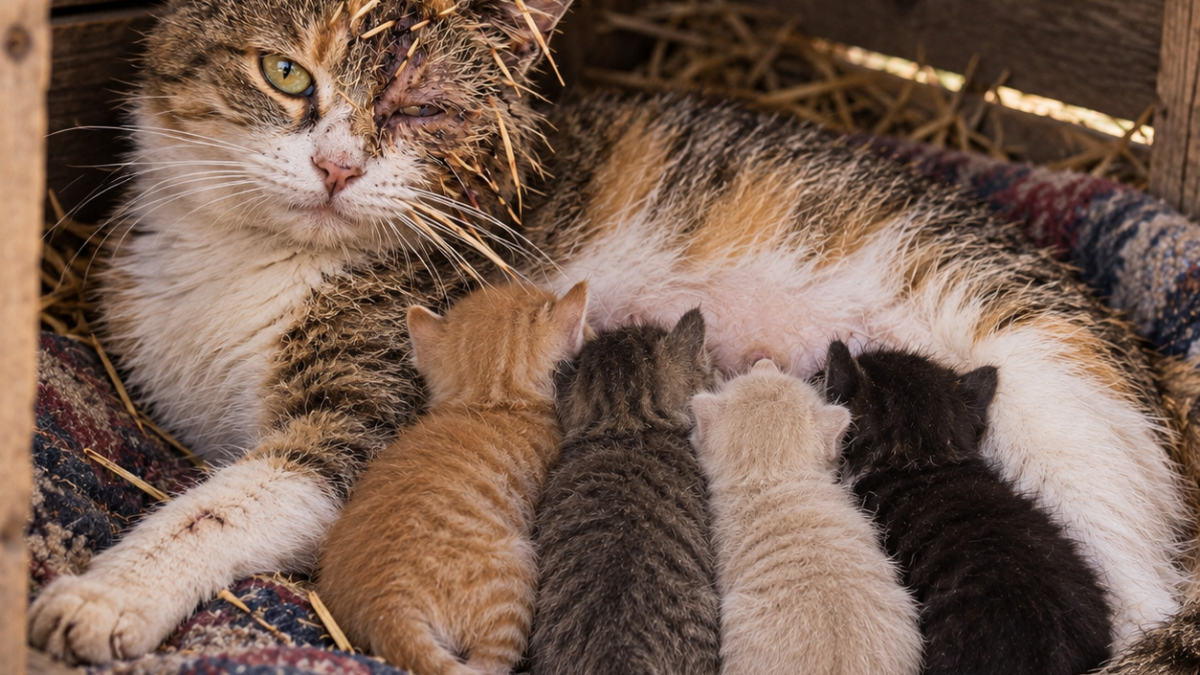
PART 2
I slid a folded towel across the dirt.
She watched.
No movement.
I reached toward the first kitten.
That finally got a reaction.
Her head came up.
Barely.
But her body tensed.
“Easy.”
I stopped.
“You want them with you.”
Her breathing was fast.
The kitten squirmed against her.
I changed the plan.
Instead of removing the babies first, I pushed a shallow plastic crate close enough that I could transfer all five as one group.
I placed another towel inside.
Then I moved the kittens one by one, but never far.
The first squeaked.
The mother’s head turned immediately.
She tried to rise.
Couldn’t.
“Right here.”
I put the kitten into the crate perhaps twelve inches from her nose.
Second.
Third.
Fourth.
Each time, the mother tracked the sound.
When the fourth kitten was inside, they began calling.
That was enough.
The mother tried to stand.
Her left front paw touched the ground.
A quill through the pad shifted.
She collapsed.
I cursed.
“Don’t.”
She tried again.
There was no sensible way to explain to a cat that courage had become counterproductive.
I moved the crate closer.
Then slipped a towel beneath her body, keeping my hands away from the quills as much as I could.
She weighed almost nothing.
Seven pounds at most.
Probably less.
I lifted.
Her entire body trembled.
One quill brushed my glove.
She jerked.
I felt sick.
“Sorry.”
I lowered her beside the kittens.
The instant her body touched the towel, all four crawled toward her.
One tucked beneath her chin.
Another went immediately to nurse.
I stared.
The mother relaxed.
That was her priority.
Not her face.
Not the paw with a spike through it.
Four kittens accounted for.
Only then did she lower her head.
I carried the crate to the truck.
The drive to the veterinary clinic normally took an hour and a half.
That morning it felt like crossing the province.
I placed the crate on the passenger-side floor where I could see it.
Every few minutes I looked down.
The mother lay still.
The kittens moved constantly.
At one point one of the blue-gray kittens crawled onto her shoulder and stepped directly beside a cluster of quills.
The mother flinched.
Still didn’t push the kitten away.
“Girl.”
I shook my head.
“What are you doing?”
She looked toward me.
“You have to stop taking everything.”
Of course she didn’t understand.
But I kept talking anyway.
Maybe for her.
Mostly for me.
About twenty minutes into the drive, one kitten began squeaking.
The others followed.
The mother shifted her body.
Her chest moved against several quills.
I saw the pain travel through her.
She adjusted anyway.
Moved her belly closer.
The kittens settled.
I gripped the steering wheel harder.
I had spent decades watching animals in the woods.
I respected them.
Didn’t romanticize them.
Nature isn’t a children’s book.
Mothers abandon weak offspring.
Predators kill.
Animals make practical decisions humans sometimes find cruel because survival is practical.
But this little cat had apparently made a decision so completely opposite to self-preservation that I couldn’t make sense of it.
She should have left.
Not abandoned the kittens forever.
Just moved away from the porcupine.
Escaped.
Found somewhere to pull quills.
Found food.
Water.
Anything.
Instead, she’d stayed.
Two days, we later estimated.
Forty-seven quills.
Still nursing.
The clinic appeared eventually.
I pulled in too fast.
A technician came outside because I had called ahead from the road.
“What happened?”
“Porcupine.”
“How many?”
“I don’t know.”
Then she saw the crate.
“Oh my God.”
She called through the door:
“Dr. Lawson!”
A veterinarian came quickly.
Middle-aged woman.
Practical expression.
That expression disappeared when she saw the cat.
“How long has she been like this?”
“No idea. Maybe more than a day.”
“Are these her kittens?”
“Yeah.”
“Any quills on them?”
“None.”
Dr. Lawson looked again.
“None?”
“Not one.”
She stared at the mother.
Then:
“Get her inside.”
They moved the crate to an exam room.
The kittens were transferred to a heated box beside the table.
The moment they were separated, the mother tried to turn toward them.
Dr. Lawson stopped her gently.
“She can hear them.”
The kittens squeaked.
The cat relaxed slightly.
I stood against the wall feeling useless.
The veterinary team began counting.
Not removing.
Counting.
Because they needed to understand the pattern before sedation.
Face.
Chest.
Legs.
Ear.
Paw.
The technician marked numbers on a sheet.
Ten.
Twenty.
Thirty.
I stopped listening.
Then she said:
“Forty-seven.”
I looked up.
“Forty-seven?”
Dr. Lawson nodded.
“Forty-seven visible quills.”
I stared at the cat.
“How is she still feeding them?”
The veterinarian glanced toward the kittens.
“Maternal behavior can be extremely strong.”
“That doesn’t answer it.”
“No.”
She touched the mother’s jaw as gently as possible.
“Nothing really does.”
The cat weighed six pounds, eleven ounces.
I had guessed close.
Dr. Lawson estimated her healthy weight nearer seven and a half or eight.
“She isn’t catastrophically underweight.”
“That’s good?”
“It means she was probably finding enough food before this happened.”
“Then maybe she lived here.”
“Likely.”
She examined the kittens.
About four weeks.
Healthy overall.
Mild parasites.
No injuries.
No quills.
Not one.
The veterinarian kept returning to that.
“You’re sure there weren’t any under the shed?”
“I checked.”
“None pulled out?”
“No.”
She looked at the mother.
“This cat put herself between them and the porcupine.”
It wasn’t a question.
“That was my thought.”
Dr. Lawson nodded slowly.
“Most likely.”
She was careful about certainty.
Good veterinarians are.
Nobody had witnessed the attack.
We couldn’t know every movement.
But the injury distribution told a story.
Face.
Chest.
Front legs.
All forward-facing surfaces.
Nothing significant along her back or hindquarters.
Defensive confrontation.
Head-on.
The porcupine had likely been near the nest.
The mother charged.
Porcupine turned.
Tail presented.
Quills.
The cat kept going.
Maybe once.
Maybe repeatedly.
We would never know.
But enough times for forty-seven quills.
The kittens, behind her, untouched.
Dr. Lawson said:
“She took the front of it.”
“What?”
“The distribution.”
She pointed.
“Everything is here.”
Face.
Chest.
Forelimbs.
“If she’d stumbled onto a porcupine casually and then retreated, I’d expect fewer. If she tried to go around it, maybe flank exposure.”
She paused.
“This looks like she went straight in.”
My stomach tightened.
“That thing could’ve outweighed her four times.”
“More.”
“And she went at it?”
“The kittens were trapped under a shed.”
That was the answer.
I looked toward the heated box.
Four tiny bodies piled together.
Too young to run effectively.
Too young to defend themselves.
If a twenty-five-pound porcupine wandered between the nest and the opening, the mother had a choice.
Retreat.
Or confront.
She confronted.
“Can you get them out?”
“The quills?”
“Yes.”
“We’re going to sedate her.”
“Risk?”
“There’s always some. But trying to do this awake would be cruel and dangerous.”
I nodded.
“Do it.”
The technician looked at me.
“Are you the owner?”
That question surprised me.
“No.”
“Who is?”
“No idea.”
“Do you know where she came from?”
“Under my equipment shed.”
“Feral?”
“Probably.”
They needed treatment authorization.
Animal rescue protocols.
Payment questions.
All the practical machinery beneath compassion.
I said:
“I’ll cover it.”
Dr. Lawson looked at me.
“This could be expensive.”
“Cover it.”
“You don’t need to decide—”
“I decided.”
Maybe that was the first moment the cats became mine.
I didn’t know it yet.
The kittens were fed supplemental formula while the mother was prepared.
Sedation took effect gradually.
Even then, her body fought.
Not aggressively.
Just tension.
Her jaw remained tight.
Front legs stiff.
When she finally relaxed, Dr. Lawson began.
One quill at a time.
Forceps.
Straight pull aligned with entry angle.
No twisting.
The first came from her cheek.
Long.
Cream-colored.
Dark tip.
Blood followed.
Second.
Third.
The technician laid them on gauze.
I had to stop looking.
Then I couldn’t stop.
Each quill looked too large for that body.
Four inches.
Some shorter where they had broken.
Seven passed through the ear cartilage.
Front to back.
Dr. Lawson clipped the protruding ends and removed them carefully.
The ear bled.
Three quills had passed completely through the left front paw pad.
One end visible on top.
Another underneath.
I muttered:
“Jesus Christ.”
Dr. Lawson heard.
“Those are bad.”
“Will she lose the paw?”
“I don’t think so.”
“Don’t think?”
“There’s swelling. Tissue damage. But circulation looks intact.”
Small victories.
They continued.
Eleven quills were buried so deeply that the ends were almost flush with the skin.
Small incisions had to be made.
Chest.
Upper leg.
Near shoulder.
The one beside the eye worried everyone.
The left eye was swollen almost shut.
One quill had entered soft tissue above the socket.
Another through the cheek below.
Neither had penetrated the globe.
At least not visibly.
Dr. Lawson exhaled when she confirmed it.
“She may keep the eye.”
That was the first time I realized losing it had been a real possibility.
“How close?”
“Too close.”
The entire extraction took over two hours.
Forty-seven.
We counted again afterward.
Forty-seven removed.
The cat remained asleep while wounds were flushed.
Antibiotics.
Pain medication.
Fluids.
The eye cleaned.
Paw treated.
Ear examined.
I walked outside for air.
The forest around the clinic parking lot looked ordinary.
Cars.
Gravel.
Clouds.
I leaned against my truck.
For some reason, anger arrived.
Not at a person.
There was no cruel owner in this story.
No criminal.
The porcupine had only defended itself.
It didn’t know about kittens.
It hadn’t hunted anyone.
Nature had created a collision.
One animal protecting itself.
Another protecting babies.
Nobody evil.
That almost made it harder.
There was nowhere to put the anger.
So I put it into a promise.
She’s not going back under that shed.
I didn’t say it aloud yet.
But I knew.
When I returned inside, the kittens were sleeping in a pile.
Two gray.
Silver.
Charcoal.
I touched one with a finger.
Tiny.
Warm.
The kitten grabbed my glove with both paws.
I laughed for the first time all day.
“You caused all this trouble.”
The kitten yawned.
No apology.
Dr. Lawson entered.
“She’s waking.”
I went to the recovery room.
The mother’s eye opened slowly.
The left remained swollen.
But her face was clear.
No quills.
I almost didn’t recognize her.
Small scars and punctures covered her cheek.
Her ear looked battered.
Chest shaved in places.
Both front legs bandaged.
She lifted her head.
First thing she did?
Turned toward the sound of the kittens.
Dr. Lawson looked at me.
“You can bring them closer.”
We placed the heated box beside her.
The kittens squeaked.
The mother’s body relaxed visibly.
Hours after surgery, forty-seven wounds, one eye half closed, paw bandaged, she still counted the world by those four voices.
I whispered:
“They’re here.”
Her good eye looked toward me.
“All four.”
I don’t know why I needed her to know.
Maybe because she had paid so much to keep that number intact.
Four.
Still four.
The clinic kept them overnight.
I stayed at a cheap motel nearby.
Never do that for animals, I told myself.
Then laughed.
Apparently I did now.
The next morning, Dr. Lawson called at six-thirty.
I answered immediately.
“What’s wrong?”
“Nothing.”
I sat up.
“You call people at six-thirty to say nothing?”
“She ate.”
That was worth the call.
“And?”
“And she’s nursing.”
I closed my eyes.
“Good.”
“Her eye infection is significant.”
My relief dropped.
“But?”
“We’ve started antibiotics. We think the eye itself is okay.”
“The paw?”
“Painful. No major tendon damage.”
“Chest?”
“Sore.”
“She’ll recover?”
“Likely.”
“How long?”
“Weeks.”
“Fine.”
I drove over.
The mother was awake.
Kittens nursing.
Same image as under the shed.
Except now no quills.
Clean bedding.
Warm room.
Pain medication.
Safety.
I stood watching.
Dr. Lawson said:
“She needs a name.”
I looked at her.
“No.”
“Medical chart.”
“Cat.”
“We already have four ‘Cat’ patients.”
I stared at the small mother.
Then at a sealed container holding some of the removed quills.
“Quill.”
The technician smiled.
“That’s obvious.”
“Good.”
Dr. Lawson wrote:
QUILL.
The kittens remained unnamed for another week.
I wasn’t planning to keep them.
That is what I told everyone.
Quill?
Maybe.
The kittens?
Absolutely not.
I had a job.
A remote property.
Long days.
No history with cats.
Five cats was absurd.
Ray, one of the other logging contractors, heard about them.
“You’ve got cats now?”
“No.”
“You paid for surgery.”
“Yes.”
“You named the mother.”
“For the medical chart.”
“You’re staying at a motel to visit.”
“Temporary.”
He laughed.
“You have five cats.”
“I have zero cats.”
“Four kittens and a mother.”
“Mathematically, still zero until they come home.”
That argument lasted about ten days.
Quill remained at the clinic for observation.
Her eye swelling began to improve.
The infected tissue around it drained.
Antibiotics worked.
She kept vision.
That was huge.
The left ear healed slowly.
Three tiny holes in the cartilage would never close completely.
The front paw worried us most.
She avoided putting full weight on it.
The three through-and-through punctures had left deep channels.
One became mildly infected.
More cleaning.
Medication.
Bandage changes.
Through all of it, Quill tolerated handling in a way I didn’t expect from a stray.
Not because she enjoyed it.
Her body went rigid when strangers touched her.
But she didn’t bite.
Didn’t scratch.
If a kitten cried, however, her head snapped around.
Instantly.
Mother first.
Patient second.
I began visiting every evening.
Sometimes I brought work paperwork.
Sat in the corner while the family slept.
Quill watched me.
At first from the far side of the enclosure.
Then closer.
One evening, I placed my hand flat on the floor.
Didn’t reach.
She sniffed from a foot away.
Left.
The next day she came closer.
Third day, her nose touched one knuckle.
Then she returned to the kittens.
Progress.
By week three, the eye infection was almost gone.
Swelling reduced.
She could open it fully.
Dr. Lawson smiled.
“She keeps it.”
I felt more relief than I expected.
“Definitely?”
“Barring complications.”
The tiny scars around the eye would remain.
“Will she see normally?”
“Looks like it.”
“Good.”
The front paw improved too.
Bandage removed.
She still limped.
But weight bearing.
The kittens grew.
Fast.
Tiny helpless bodies became moving disasters.
They escaped everything.
Climbed curtains.
Attacked medical tubing.
One silver kitten discovered the veterinary scale and repeatedly slept inside it.
The charcoal kitten was the bold one.
Blue-gray number one climbed my boot during visits.
Blue-gray number two preferred Quill.
I started calling them names accidentally.
Not official names.
Just descriptions.
Silver.
Coal.
Blue.
Other Blue.
Ray visited once.
“You named them.”
“I described them.”
“Silver is a name.”
“It’s a color.”
“What about Coal?”
“Color.”
“Blue?”
“Color.”
“Other Blue?”
He stared.
“That one needs work.”
I told him to leave.
He brought toys the next day.
By week four, Quill could walk without obvious pain most of the time.
Her face healed.
Fur began returning over the shaved areas.
Tiny round scars dotted the left cheek.
Chest too.
Her left ear remained perforated.
Three pin-sized openings through cartilage.
No medical problem.
Just history.
I asked Dr. Lawson:
“Will they close?”
“Probably not completely.”
I touched one gently later.
Quill flicked the ear.
“Fine.”
The holes didn’t matter.
Visible proof didn’t bother her.
That’s something humans care about more than animals.
Scars.
Appearance.
Damage.
Quill cared whether breakfast happened.
Whether kittens were nearby.
Whether hands moved too fast.
Whether sleeping places were warm.
I started learning her priorities.
The clinic wanted to move the family into foster care.
That created a problem.
They needed space.
I said:
“I have space.”
The technician smiled.
Ray laughed for an entire day.
“They’re coming to your house.”
“Temporarily.”
“All five.”
“Temporarily.”
“How temporary?”
“Until adoption.”
“Sure.”
I converted a spare room.
Not much conversion.
Blankets.
Litter boxes.
Food.
Low bed.
A wooden crate I had planned to use for tools.
I lined it with fleece because Quill liked enclosed spaces.
The first night at my place, she refused the expensive cat bed the clinic gave me and chose the wooden crate.
Of course.
She curled inside.
All four kittens piled onto her.
I stood in the doorway.
Five cats.
In my house.
Ray appeared behind me.
“Zero cats?”
“Shut up.”
He looked inside.
Quill’s good eye tracked us.
Kittens sleeping.
Ray lowered his voice.
“She took forty-seven?”
“Yeah.”
“For them.”
“Most likely.”
He stared.
“That little thing?”
“Six pounds.”
“Porcupine twenty?”
“Could’ve been thirty.”
Ray shook his head.
“I don’t understand animals.”
“Neither do I.”
Quill closed her eyes.
Maybe understanding wasn’t required.
Over the next two weeks, my house changed.
Cat food appeared.
Litter everywhere.
Tiny scratches on furniture.
One kitten climbed my pant leg while I was on the phone with a supplier.
I yelled.
Then apologized to the supplier, who thought I was yelling at him.
The charcoal kitten fell asleep inside one of my work boots.
Silver stole a glove.
Blue climbed onto the kitchen counter.
Other Blue learned how to open one cabinet.
Quill mostly watched.
Quiet.
Always quiet.
That detail stayed with me.
I never heard her meow during those first weeks.
Maybe once.
A tiny sound toward the kittens.
Otherwise nothing.
The veterinarian said some cats are simply quiet.
Maybe trauma.
Maybe personality.
I thought about the shed.
Two days.
Forty-seven quills.
Had she cried there?
The logger in me hated unanswered questions.
The cat owner—apparently that’s what I was becoming—learned to live with them.
At night, I sometimes checked the room.
Quill always slept in the crate.
The kittens piled across her.
Even as they grew too large.
One on her neck.
One across her side.
One against her belly.
One between her front paws.
She never pushed them away.
Eventually I worried.
“They need independence.”
Ray laughed.
“You sound like a father.”
“I mean biologically.”
“Sure.”
The kittens were weaned gradually.
Food bowls.
Play.
Exploration.
Quill began eating more.
Weight increased.
Seven pounds.
Then a bit over seven.
Her coat filled out.
Soft blue-gray.
She was beautiful.
Not dramatic.
Not exotic.
Small face.
Greenish eyes.
Three little holes in one ear.
Scars.
The kind of cat you’d walk past in a shelter if you didn’t know the story.
I liked that.
She didn’t need to look heroic.
Heroism is often ugly while happening.
Blood.
Dirt.
Pain.
Afterward, it can look like a small cat asleep in fleece.
That was enough.
The adoption applications began.
Not for Quill at first.
The kittens.
Healthy.
Cute.
Easy.
People wanted them.
I read the first application.
Nice family.
Indoor home.
Veterinary references.
Everything correct.
I felt sick.
Ray noticed.
“You’re supposed to give them away.”
“I know.”
“That’s what foster means.”
“I know.”
“Then why are you looking like somebody stole your truck?”
“I’m reading.”
He took the paper.
“Good home.”
“Yes.”
“Problem?”
“No.”
“Then?”
I looked toward the spare room.
Silver and Coal were wrestling.
Blue on the windowsill.
Other Blue chewing cardboard.
Quill asleep in the crate.
I didn’t answer.
Ray smiled.
“No.”
“What?”
“You’re keeping them.”
“That would be stupid.”
“Yes.”
“Five cats.”
“Yes.”
“I work twelve-hour days.”
“You’ve already changed your schedule.”
“That was temporary.”
“You installed a camera.”
“For safety.”
“Three cameras.”
“Different angles.”
He laughed.
I hated him.
The truth was already obvious.
I had become attached to the entire family as a unit.
Not only because Quill had protected them.
Because they still functioned like a family.
At night, every kitten returned to the crate.
Even as they grew.
Quill groomed them.
They slept against her.
She relaxed most when all four were present.
The story under the shed hadn’t ended.
The arrangement continued.
Separate them?
Maybe they would adapt perfectly.
Most cats do.
But did I have to?
That was the question.
I could afford five.
Had space.
The property was isolated but safe indoors.
Veterinary care available.
Work schedule manageable.
The only reason not to keep them was because five sounded ridiculous.
That’s not a strong reason.
I called the rescue coordinator.
“I need to withdraw the kittens.”
“Why?”
“They’re not available.”
Pause.
“You found another adopter?”
“Yes.”
“Who?”
“Me.”
She laughed.
“All four?”
“And Quill.”
Longer pause.
“You’ve never owned cats.”
“I know.”
“Now you own five.”
“Apparently.”
“Are you sure?”
I looked through the doorway.
Quill’s head was resting across two grown-too-fast kittens.
“Yes.”
“Completely?”
“No.”
She laughed.
“Good enough.”
That night, I told Quill.
“You’re all staying.”
She cleaned one paw.
“No gratitude?”
Nothing.
“I just saved you from the adoption system.”
She stared.
“Fine.”
Maybe she already knew.
Her bed remained the wooden crate.
The fleece got replaced several times.
I sanded the wood smooth.
Built a low platform beneath it.
Ray said:
“You’ve built furniture for a cat.”
“I built a box.”
“With rounded edges.”
“Safety.”
“With her name burned into the side.”
I looked at him.
“Get out.”
QUILL.
The name looked right.
The kittens eventually received better names.
Silver remained Silver.
Coal remained Coal.
The two blue-gray siblings became Cedar and Ash.
Forestry theme.
Ray accused me of trying too hard.
Maybe.
They answered to none of them.
Cats remain committed to equality.
All four reached adulthood healthy.
No quill injuries.
No developmental problems.
No lasting evidence of the attack they escaped.
That’s the part I kept returning to.
Nothing.
Not one scar.
Their mother carried all of it.
Tiny circular marks beneath fur.
Ear holes.
A faint stiffness in the paw on cold mornings.
The kittens?
Clean slate.
If Quill’s objective under that shed had been to make the danger stop before it reached them, she succeeded completely.
That was her revenge.
Not against the porcupine.
The porcupine had done nothing wrong.
Against the odds.
Against pain.
Against the possibility that one of those kittens would take the hit she had already chosen to take.
Forty-seven quills entered one body.
Zero entered four others.
That’s the mathematics of that night.
I don’t romanticize it.
I wish she’d never had to do it.
I wish the porcupine had wandered another direction.
I wish I had noticed the cats sooner.
Maybe one day earlier.
Maybe before the encounter.
But you can’t rewrite wilderness.
You deal with what remains.
What remained was a mother and four living kittens.
So I built around that.
Winter came early.
Northern British Columbia does not negotiate.
Snow covered the property.
Temperatures dropped.
The cats became indoor royalty.
Quill hated the first snowfall she saw through the window.
Or maybe she didn’t care.
Hard to tell.
Coal tried attacking flakes against the glass.
Silver slept beside the heater.
Cedar and Ash discovered that my bed was warmer than theirs.
Quill remained loyal to the crate.
All four grown kittens still squeezed in.
It looked physically impossible.
Tails.
Legs.
Heads.
One night I walked in and found Quill almost entirely buried.
Only her face visible.
I laughed.
“You fought a porcupine for this?”
One green eye opened.
Apparently yes.
The paw scars gave trouble occasionally.
When temperatures dropped sharply, Quill limped.
The vet thought scar tissue or sensitivity.
Nothing serious.
I added rugs over rough flooring.
Bought softer litter.
Ray noticed.
“More accommodations.”
“She needs them.”
“You’ve gone from zero cats to feline accessibility contractor.”
“Don’t start.”
He started.
But then he built a second wooden bed himself.
Lined it with fleece.
Claimed it was because the crate was overcrowded.
The cats ignored his bed for three weeks.
He was deeply offended.
Eventually Silver slept in it.
Ray took twelve photographs.
“Look.”
“I see.”
“She likes it.”
“Congratulations.”
“Maybe I need a cat.”
“There it is.”
He adopted one from the same rescue six months later.
Quill’s influence expanded.
The logger who mocked me became a cat owner.
His cat destroyed a couch.
Justice.
Spring returned.
The shed where I found Quill remained standing.
I avoided looking under it for months.
Not consciously.
At least I told myself that.
Then one afternoon I was repairing equipment and caught the same smell.
My stomach dropped.
I grabbed the flashlight.
Crawled down.
Nothing.
Just damp leaves.
I sat back.
Heart pounding.
The past had trained me too.
Interesting.
Animals aren’t the only ones who build associations.
I cleaned under the shed.
Sealed dangerous gaps.
Added wire barriers so no animals could nest there again.
Not because the shed had been evil.
Because I’d learned.
We also changed how food waste and salt-contaminated materials were stored around the site so porcupines were less likely to investigate.
No poison.
No killing.
Just reduce attraction.
That’s important.
I never blamed the porcupine.
Some people who heard Quill’s story said things like:
“I would’ve shot it.”
No.
Wrong lesson.
A porcupine protects itself with quills.
A mother cat protects kittens.
Two survival systems collided.
The human responsibility afterward is to reduce the chances of another collision.
Not punish wildlife for being wildlife.
That became part of the story I told.
Quill wasn’t victorious because something else died.
Nothing had to.
She survived.
Kittens survived.
Porcupine left.
That’s enough.
A local newspaper eventually heard about Quill.
I didn’t want publicity.
The veterinarian thought the case could help educate people about porcupine injuries.
So I agreed to one interview.
The reporter asked:
“Did you see the attack?”
“No.”
“Then how can you know she protected the kittens?”
“We don’t know every detail.”
Good answer.
I repeated what Dr. Lawson had said.
Injury distribution.
All frontal.
Kittens uninjured.
Likely nest confrontation.
The reporter tried:
“So she heroically threw herself—”
I interrupted.
“Don’t make it a movie.”
He looked surprised.
“What do you mean?”
“She probably didn’t think about heroism.”
I pointed toward Quill asleep nearby.
“She had babies. Danger came close. She reacted.”
“Isn’t that heroic?”
“Maybe.”
I shrugged.
“But she shouldn’t have had to suffer forty-seven quills for people to think she mattered.”
The reporter wrote that down.
I hoped he’d use that part.
He did.
The story spread locally.
People mailed toys.
Food.
A company offered cat beds.
I declined most.
The cats had enough.
One child sent a drawing.
Quill was enormous in it.
Bigger than a bear.
Four kittens behind her.
Porcupine running away.
I kept that.
Not scientifically accurate.
Emotionally accurate.
Children understand scale differently.
The cat felt huge because what she did felt huge.
In reality, Quill remained petite.
Seven pounds.
Maybe seven and a half in winter.
Easy to lift.
She tolerated me lifting her now.
That took months.
Hands coming around her chest initially made her tense.
Maybe memories of pain.
Maybe ordinary stray caution.
I learned to support from below.
Let her see me.
No sudden grabbing.
Eventually she trusted.
One evening I picked her up.
She settled against my chest.
Her left ear with three holes rested near my chin.
I could feel a small ridge beneath the fur where one facial scar remained.
I thought about the clinic table.
Forty-seven quills.
Then the warm body in my arms.
That’s recovery.
Not erasing evidence.
Changing what surrounds it.
Quill still had scars.
But scars were no longer sitting in dirt under a shed.
They were resting against a man who knew where they came from.
That’s enough.
The kittens reached one year.
Adult-sized.
Still babies around Quill.
Coal, the largest, outweighed her.
Didn’t matter.
He still tried crawling into the crate beside her.
She groomed his head.
Cedar brought toys to her.
Ash slept across her back.
Silver remained the most independent but returned every night.
People asked:
“Do cats recognize grown offspring?”
I don’t pretend expertise.
They had never been separated.
Whatever biological relationship meant to them, social bonds remained.
That was visible.
Quill didn’t become less protective completely.
If a strange dog barked outside, she gathered near the younger cats.
If loud equipment started, she’d position herself where she could see all four.
I noticed patterns.
Maybe coincidence.
Maybe motherhood engraved into routine.
Again, animals don’t owe us clean explanations.
One afternoon a porcupine appeared near the edge of the property.
First one I’d seen close since the incident.
Quill was inside.
I saw the porcupine from the porch.
Slow.
Round.
Completely uninterested in us.
I froze.
Old anger.
Then remembered.
The animal lumbered toward a tree.
Chewed bark.
Moved on.
Quill watched from the window.
Her body went rigid.
That caught my attention.
Did she recognize the shape?
Smell?
Movement?
Possibly.
Her tail lowered.
She backed away.
I didn’t force her closer.
Didn’t try to create some inspirational reunion with the species that injured her.
I closed the curtain.
That’s all.
You don’t need to confront every fear to heal.
Sometimes a curtain is fine.
Quill returned to the crate.
Coal followed.
Ten minutes later, asleep.
Good.
The porcupine left.
Everyone lived.
That was better than revenge.
Years passed.
Quill became the smallest adult in a house filled with cats she had once carried in her body.
I became the man who bought cat litter in industrial quantities.
Life is strange.
Work continued.
Timber contracts.
Winters.
Maintenance.
Paperwork.
The cats gave the house rhythm.
Breakfast.
Morning inspection.
Work.
Return.
Dinner.
Night pile.
Quill became increasingly affectionate but only on her terms.
She liked sitting beside me.
Rarely on my lap.
One paw touching my thigh.
That was enough.
When I reached toward her too quickly, she sometimes ducked.
I stopped taking it personally.
Trust isn’t a straight line.
Neither is recovery.
One night, a storm knocked power out.
Wind.
Branches.
House dark.
Backup generator took several minutes.
I found all five cats in the living room.
Quill in front.
Four adults clustered behind.
I laughed.
Same formation.
Years later.
Different danger.
No quills.
No shed.
Just darkness.
I sat on the floor.
“Everybody here?”
Five shapes.
Yes.
The generator started.
Lights returned.
Coal immediately went to food.
Crisis over.
That image stayed with me.
Quill still positioned herself first.
Maybe that’s simply who she was.
A small body willing to stand between uncertainty and the creatures behind her.
People think strength looks large.
It often doesn’t.
Sometimes strength weighs seven pounds and has three holes in one ear.
Dr. Lawson remained Quill’s veterinarian.
Every annual checkup, she counted old scars like landmarks.
“Eye looks good.”
“Paw?”
“Fine.”
“Ear?”
“Still decorative.”
Quill hated the thermometer.
Good.
Normal cat grievances.
At one appointment, a young veterinary student shadowed Dr. Lawson.
She had heard the story.
“Is this the porcupine cat?”
I hated the phrase.
Before I could answer, Dr. Lawson said:
“Her name is Quill.”
Good vet.
Names before injuries.
The student apologized.
She examined carefully.
Then asked:
“How did she survive forty-seven quills untreated for two days?”
Dr. Lawson said:
“Same way animals survive many things.”
The student waited.
“Until they don’t.”
That answer was uncomfortable.
True.
Quill wasn’t invincible.
She was lucky.
Found in time.
No quill migrated into a vital structure.
No catastrophic infection.
Eye spared.
Paw circulation maintained.
Those details mattered.
We should never turn survival stories into proof that suffering is tolerable.
If I had found her a day later, outcome could have been different.
Porcupine quills can migrate.
Abscess.
Infection.
Internal damage.
She needed veterinary treatment.
Heroism did not replace medicine.
That’s important.
Quill saved the kittens.
The veterinarian saved Quill from consequences she couldn’t overcome alone.
Then I gave them a home.
Three different forms of help.
No one part enough by itself.
One winter, Quill developed an abscess near an old chest scar.
Years after the initial injury.
We panicked.
Dr. Lawson examined.
Probably unrelated infection.
Simple treatment.
But I sat in the waiting room reliving everything.
When Dr. Lawson came out:
“She’s fine.”
I exhaled.
“You need to stop doing that.”
“Doing what?”
“Almost killing me.”
“She has a minor abscess.”
“You know what I mean.”
Dr. Lawson smiled.
“You got attached.”
“Apparently.”
Quill came home.
Antibiotics.
No drama.
The kittens—adult cats—followed her around for two days.
One illness.
Four shadows.
The family system remained.
At night they still piled together, though the crate had been replaced with a larger wooden bed I built from scratch.
I kept the original crate in the corner.
Nobody used it anymore.
Couldn’t throw it away.
Maybe sentimental.
Fine.
There’s worse.
The left ear scars remained visible.
Visitors sometimes asked.
“What happened?”
I used to tell the entire story.
Eventually:
“Porcupine.”
Enough.
Quill didn’t need her trauma introduced before her personality.
That’s something rescue stories often get wrong.
We freeze animals at their worst moment.
Starved dog.
Burned cat.
Abandoned kitten.
Porcupine mother.
But survivors keep living.
Quill became more than the shed.
More than forty-seven quills.
She liked chicken too much.
Hated closed bedroom doors.
Slept facing heaters.
Despised rain.
Liked paper bags.
Once stole half a sandwich.
Attacked shoelaces well into adulthood.
Those details deserve equal weight.
Maybe more.
Because the point of rescue is not preserving tragedy.
It’s making tragedy no longer central.
One morning, I found Quill on top of the equipment shed.
The same shed.
I froze.
No idea how she’d gotten out.
A door had been left open.
My fault.
She sat on the roof.
Sunlight.
Perfectly calm.
I approached slowly.
“Quill.”
She looked.
My heart hammered.
Underneath was the place.
The dirt.
The nest.
The entire beginning.
She jumped down onto a lower stack of lumber.
Then to the ground.
Walked toward me.
No panic.
No drama.
I picked her up.
She allowed it.
I carried her inside.
Later I crawled under the shed.
Nothing there.
Just dirt.
I expected to feel something profound.
Mostly I felt irritated at myself for leaving the door open.
Maybe that’s healing too.
The past becomes a place you maintain, not a shrine.
I fixed the latch.
Quill never went out unsupervised again.
As she aged, the old paw sometimes stiffened more.
Cold mornings.
I built ramps to favorite windows.
Ray said:
“You know she can jump.”
“Yes.”
“Then?”
“Choice.”
He nodded.
He’d learned.
His own cat was twelve by then.
We became two middle-aged men discussing joint supplements for cats.
If my younger self could see me, he’d be merciless.
Good.
People change.
Animals do that to us.
One of the kittens—Coal—eventually developed a habit that mirrored Quill.
Whenever something startled the group, Coal moved toward her.
Not away.
He was bigger.
Yet still sought the mother.
I found that touching.
Not because he was weak.
Because history creates default directions.
Under stress, he went to the body that had once stood between him and danger.
He didn’t know why.
Probably no memory of the porcupine.
But his nervous system knew Quill meant safety.
That’s legacy in animal form.
Cedar became the bold explorer.
Ash the quiet one.
Silver the most independent.
Four personalities Quill protected before any of them had personalities we could see.
That’s what gets me.
When she charged whatever came under that shed, she wasn’t protecting the adult cats they’d become.
She couldn’t know.
She was protecting four tiny helpless bodies.
Potential.
Future.
She paid in blood for lives she would never conceptualize as “future.”
Yet there they were years later.
Coal stealing my chair.
Silver sleeping in sun.
Cedar opening cabinets.
Ash watching snow.
Every ordinary behavior existed because she prevented one night from ending differently.
That is the satisfying ending.
Not revenge.
Continuation.
When Quill turned—by our estimate—seven, I built a larger wooden bed.
Fleece lining.
Low entrance for the old paw.
I burned five names into the side.
QUILL
SILVER
COAL
CEDAR
ASH
Ray saw it.
“You made a family plaque.”
“It’s a box.”
“It’s a family plaque.”
“Leave.”
He took pictures.
The cats ignored it for two days.
Then all five moved in.
Of course.
I found them there one evening.
Quill center.
Four adult bodies around her.
Barely fit.
I sat on the floor.
Looked at her left ear.
Three holes.
Tiny.
The rest of the scars hidden beneath fur.
I remembered the first flashlight beam.
Face full of quills.
Eye swollen.
Four kittens nursing.
I thought:
You did it.
Not alone.
But the part no one else could do, she did.
She stood there.
Every quill had gone into her.
None into them.
I whispered:
“You did it.”
Quill opened one eye.
Then closed it.
Good enough.
Sometimes people ask whether I wish I could know exactly what happened under the shed.
No.
I used to.
Now I don’t.
I don’t need to imagine every lunge.
Every quill.
Every sound.
The injury pattern gives enough.
The kittens give enough.
Quill’s body gives enough.
We don’t need to turn suffering into spectacle to honor it.
What matters is outcome.
All five alive.
That is the record.
Years after the original rescue, the logger who had spent three decades considering cats mostly useless indoor animals owned five.
That became the running joke.
I accepted it.
Quill changed my definition of toughness too.
Logging culture has plenty of macho nonsense.
Big trucks.
Cold weather.
Heavy equipment.
Men bragging about injuries.
Then you meet a seven-pound mother with forty-seven barbed quills in her face who still nurses babies for two days.
Perspective.
I’ve never called another coworker tough without thinking:
Compared to Quill?
Probably not.
Ray says the same.
One guy complained about a splinter in his hand.
Ray said:
“Quill had eighteen—”
“Wrong cat,” I interrupted.
He mixed up another rescue story he’d heard.
We laughed.
But the point remained.
Animal stories invaded the work site.
Good.
Made us softer in useful ways.
Workers started checking under machinery before moving it.
Looking for nests.
Closing food waste.
Watching wildlife patterns.
One rescue changes habits.
That’s how impact spreads.
Not inspirational posters.
Procedure.
Attention.
We never had another cat-porcupine encounter under the sheds.
That’s the best tribute.
Prevention.
I want that stated clearly.
The ideal outcome is not another heroic mother.
It’s no mother needing to be heroic.
Quill had already done enough.
Toward the end of one summer, I found a porcupine near a stack of timber.
Instead of chasing it aggressively, we gave it space.
Secured salt sources.
It moved on.
No confrontation.
I thought:
There.
Better ending.
No blood.
No hero.
Just distance.
Nature works best when we stop creating unnecessary collisions.
Quill slept through the entire event inside.
Perfect.
As she entered senior years, her face softened.
Blue-gray fur gained silver.
The scars became harder to see.
Ear holes remained.
One eye maybe slightly more watery in winter.
Paw stiff.
Still healthy overall.
The kittens aged too.
Five older cats.
The house got quieter.
Less climbing.
More sleeping.
The wooden bed remained crowded.
I replaced fleece constantly.
Worth it.
One evening, a friend asked:
“Which one is your favorite?”
I stared at him.
“Don’t.”
“Come on.”
“No.”
“Quill?”
I looked toward her.
She was asleep.
“She’s the reason the others are here.”
“That sounds like favorite.”
“No.”
It probably did.
Maybe she was.
But love isn’t a ranking system I needed.
They were family.
Quill had created the group.
I maintained it.
That’s enough.
The story came back into public attention on the tenth anniversary of a local animal-rescue organization.
They asked if I’d speak.
I refused.
Then Dr. Lawson asked.
I agreed because apparently veterinarians control me.
I stood in front of a small room.
No dramatic speech prepared.
I told them the truth.
“I smelled something bad.”
People laughed.
“Thought an animal died.”
Then described flashlight.
Mother.
Quills.
Kittens.
I avoided exaggeration.
At the end, someone asked:
“What did Quill teach you?”
I hate questions like that.
Animals don’t exist to teach human lessons.
But eventually I answered.
“She taught me that protection has a cost.”
Then paused.
“And that the goal should be making sure nobody has to pay that cost twice.”
That felt right.
Another person asked:
“Would she do it again?”
I said:
“I hope she never gets the chance.”
Also right.
We like asking whether survivors would repeat their sacrifice.
Better question:
Can we build a world where they don’t need to?
Quill’s kittens were safe.
House safe.
Wildlife managed responsibly.
No second battle.
That’s victory.
After the event, a mother approached with her daughter.
The girl had drawn Quill.
Tiny cat.
Huge porcupine.
Four kittens.
She handed me the picture.
“She’s brave.”
I looked at it.
“Yes.”
Then added:
“She also likes chicken.”
The girl laughed.
Good.
Let heroes be ordinary too.
I brought the drawing home.
Put it above the wooden bed.
Quill did not care.
Coal tried eating the corner.
Art criticism.
One cold morning, Quill couldn’t get into the bed easily.
Her old paw stiff.
I watched.
She tried once.
Stopped.
Before I moved, Coal stood.
He stepped out.
Quill entered.
Then he followed.
Maybe coincidence.
Maybe social adjustment.
Still got me.
The kitten once protected now making space for the mother.
Life loops.
No need to romanticize too much.
But some moments deserve noticing.
That was one.
I sat nearby.
Quill settled.
Coal pressed against her.
I thought about forty-seven quills.
Then one adult cat stepping aside.
Repayment comes in forms animals never name.
Quill eventually became deaf in one ear with age.
Not completely.
Maybe unrelated to the old cartilage damage.
Dr. Lawson couldn’t say.
She adapted.
Of course.
Cats do.
More visual cues.
Touch.
Nothing major.
Her world narrowed gently.
She slept more.
Still ate.
Still groomed the others when they allowed.
The family pile became slower.
Warm.
Old.
I had become older too.
More gray.
Less logging.
Eventually I reduced my work hours.
More time home.
Ray joked:
“Retirement home for cats and logger.”
Correct.
The equipment shed still stood.
New roof.
Reinforced floor.
No animals living beneath.
Sometimes I’d look at it from the porch.
A building.
Nothing more.
The worst moment of Quill’s life had happened there.
But the building didn’t own the memory.
Neither did the porcupine.
Her life after became larger.
That’s important.
Trauma is a chapter.
Not title.
Quill’s title became mother.
Then cat.
Then old lady.
Much better progression.
When Silver died first, years later, it nearly broke me.
Kidney disease.
Old age.
Peaceful euthanasia.
Quill was elderly.
Did she understand Silver was gone?
I don’t know.
She searched the wooden bed several nights.
Maybe habit.
Then stopped.
Coal remained.
Cedar.
Ash.
Family changed.
That’s life.
The kittens she protected were never promised immortality.
Only the chance to have lives.
She gave them that chance.
Silver lived years.
Warm home.
Sun.
Food.
No porcupines.
That’s success.
I kept reminding myself.
Quill stayed beside the empty space in the bed more often for a while.
Then adjusted.
Animals grieve differently.
Or maybe we interpret.
Either way, we stayed.
The others aged.
One by one.
Time did what the porcupine couldn’t.
That’s not tragedy.
It’s completion.
Quill outlived two of her kittens.
That felt wrong emotionally.
Nature doesn’t care about our order.
She became even quieter.
Still slept in the crate sometimes—the original one, because I brought it back after the larger bed felt too empty.
Old fleece.
Small space.
Maybe comfort.
I let her choose.
One evening, years after the rescue, she climbed into my lap for the first time in months.
Slowly.
Old paw.
I supported her.
She settled against my chest.
Left ear near my hand.
Three holes.
I touched them gently.
“Still here.”
She purred.
Soft.
I felt it.
I remembered the day beneath the shed when she made no sound.
Still nursing.
Still fighting.
Now no kittens needed protection.
No quills.
No dirt.
Just an old cat on a man’s lap.
That was the revenge.
Pain had once dictated every movement.
Now comfort did.
She could move because she wanted warmth.
Not because babies needed milk.
She could sleep because nothing was approaching.
She could close both eyes.
That’s the part that matters.
One night, a porcupine crossed the property again.
I saw it from the window.
Quill did not.
She was sleeping.
I watched the animal disappear into trees.
No anger.
No drama.
Two species existing in the same landscape without contact.
Perfect.
I went back to my chair.
Quill opened one eye.
I scratched her head.
Nothing happened.
Exactly.
Sometimes the best ending is nothing happening.
No attack.
No emergency.
No heroism.
Just safety.
People who hear Quill’s story tend to focus on the number.
Forty-seven.
It is shocking.
Easy to remember.
But I think the more important number is zero.
Zero quills in four kittens.
That’s what she accomplished.
Forty-seven tells you what she suffered.
Zero tells you why.
I wish people remembered both.
The veterinarian once said something similar.
“We count wounds because medicine needs numbers.”
Then looked at the kittens.
“But absence can be data too.”
No injuries.
No quills.
No loss.
That’s evidence.
Quill paid the cost.
They got the future.
If you want emotional revenge, there it is.
The porcupine’s defense ended at her body.
It didn’t reach one kitten.
Pain stopped with her.
Years of life continued behind her.
That’s a better victory than hurting anything in return.
Quill never sought revenge.
Animals usually don’t.
She protected.
Then healed.
Then lived.
Maybe humans overcomplicate justice because we want suffering returned to its source.
Quill’s version was simpler.
Danger comes.
Stand.
Danger leaves.
Feed babies.
Keep going.
That’s all.
I admire that.
Not because I want to imitate every animal instinct.
Because there is clarity.
Protect what depends on you.
Accept help when you can.
Recover without apologizing for scars.
Sleep when safe.
Eat chicken.
Reasonable philosophy.
One autumn morning, almost exactly on the anniversary of finding her, I opened the equipment shed.
Sunlight came through floorboard gaps.
For a second I saw the old image.
Flashlight.
Quills.
Kittens.
Then Quill walked behind me.
Old.
Slow.
She stopped at the doorway.
Didn’t enter.
I didn’t invite.
We stood there.
I said:
“This is where I found you.”
She looked at the grass.
No recognition I could interpret.
Good.
She turned.
Walked back toward the house.
I followed.
That’s the whole story.
The shed mattered to me.
Not to her anymore.
Home did.
I let the old place stay behind.
We went inside.
I fed her.
Later she slept in fleece.
Simple.
I had spent years thinking the moment under the shed defined us.
Maybe it only introduced us.
The actual relationship happened afterward.
Vet bills.
Food bowls.
Winter.
Five cats.
Furniture.
Loss.
Aging.
Ordinary life.
That’s always where the real story lives.
Rescue is an opening scene.
Home is the rest.
Quill’s final years were comfortable.
I want that stated plainly.
No dramatic suffering.
Arthritis managed.
Regular exams.
Soft beds.
Warm floors.
Food.
Company.
She became thinner.
Older cats do.
Dr. Lawson retired eventually.
A younger veterinarian took over.
He knew the story.
I told him:
“Don’t make a fuss.”
He didn’t.
Good.
Quill deserved to enter a clinic as a senior cat, not a legend.
She hated blood draws.
Loved treats.
Normal.
When the day eventually came that her body began failing, it wasn’t because of the porcupine.
Not directly.
Age.
Kidneys.
Time.
We had warnings.
Weight loss.
More sleep.
Appetite changing.
The new vet was honest.
“We can support her.”
“How long?”
“No exact answer.”
“Comfort?”
“Yes.”
That’s all I needed.
We adjusted.
Fluids.
Medication.
Warm food.
The remaining cats stayed near.
Coal had already died.
Cedar remained longest.
Ash too.
Family smaller.
Still family.
One evening, Quill refused dinner.
I knew.
Not immediately.
But somewhere inside.
I sat on the floor.
She walked to me.
Slow.
Left paw still slightly stiff after all those years.
She put her head against my knee.
I picked her up.
She didn’t resist.
Her weight felt like the first day again.
Too light.
I hated that.
I held her.
“I’ve got you.”
She purred.
Very faint.
I thought of two days beneath a shed.
No one holding her.
Four kittens needing everything.
This time she needed nothing from anyone else.
No milk.
No protection.
No standing between.
She could be the one carried.
That mattered.
The veterinarian came to the house the next afternoon.
I didn’t want Quill’s last experience to be a car ride and clinic smell if we could avoid it.
She lay inside the original wooden crate.
Fresh fleece.
Cedar curled nearby.
Ash at the doorway.
The veterinarian examined.
Looked at me.
I knew.
“It’s time?”
He nodded.
“If you want to prevent a crisis.”
Yes.
Quill had endured enough crises for one lifetime.
No need for one more.
I sat beside the crate.
Touched her ear.
Three holes.
Tiny.
I remembered every one.
Not where each quill had been.
Just the fact.
Forty-seven.
I whispered:
“You don’t have to protect anybody now.”
Her eyes half closed.
“All safe.”
Cedar.
Ash.
Silver and Coal gone after full lives.
All had grown.
All had been loved.
She had completed the job years ago.
Maybe she never knew.
I told her anyway.
“All four made it.”
My voice broke.
“You did that.”
The veterinarian gave sedation.
Quill relaxed.
For the first time in all the years I’d known her, I pictured the porcupine clearly.
Not as enemy.
Just animal.
Turning its back.
Quills raised.
Then Quill.
Small.
Charging.
Maybe.
We’ll never know.
The image faded.
What remained was the body in fleece.
Safe.
Old.
Loved.
I put my hand beneath her chin.
“You can stop.”
Her breathing slowed.
No kittens nursing.
No quills moving deeper.
No need to stay awake.
No need to endure.
Just release.
The final medication went in.
Quill died quietly.
No sound.
Fitting, maybe.
She had survived her worst pain in silence too.
But the silence in my house that day felt different.
Under the shed, silence had meant no help yet.
At home, silence meant nothing was hurting her anymore.
That’s a distinction I hold onto.
Cedar sniffed the blanket afterward.
Ash did too.
Then both left.
I sat alone.
Looked at the wooden crate.
QUILL burned into one side.
Fleece.
Empty.
I cried harder than I expected.
Loggers cry too.
Anyone who says otherwise hasn’t loved enough.
I buried Quill on a rise behind the house where morning sun reaches first.
Not under the equipment shed.
Never there.
The kittens—those still alive—remained inside.
I placed no quills with her.
No dramatic symbol.
A small stone.
Her name.
QUILL.
Underneath:
SHE KEPT ALL FOUR SAFE.
That was enough.
People suggested engraving “47.”
I didn’t.
Forty-seven belonged to pain.
I wanted the stone to remember the result.
All four safe.
Years later, when I walk past that stone, I don’t see a wounded cat.
I see the wooden bed.
Five bodies.
Quill in the middle.
I see Coal too big for the crate.
Silver in sunlight.
Cedar opening cabinets.
Ash sleeping beside Quill.
That’s what those forty-seven wounds purchased, if “purchased” is even the right word.
Future.
Not guaranteed.
Given a chance.
I think about the logger I was before.
Animals existed around me.
Wildlife.
Pests sometimes.
Interesting.
Useful to notice.
That was about it.
Then Quill.
Now I check beneath sheds.
Move equipment carefully.
Keep wildlife attractants secured.
Donate to the veterinary clinic.
Still don’t call myself an animal person.
Ray does.
I deny it.
He points at photographs of five cats covering my refrigerator.
Unfair evidence.
The original crate remains.
No cat sleeps there now.
I use it to store blankets.
Couldn’t throw it away.
That’s my one sentimental weakness.
One.
Ray says there are dozens.
Ignore him.
Sometimes children hear Quill’s story and ask:
“Why didn’t she run?”
I say:
“Because her kittens couldn’t.”
Simple.
“Wasn’t she scared?”
“Probably.”
“Did the porcupine attack her?”
“Most likely it defended itself when she got too close.”
“Why would she go close?”
“The babies.”
Children understand.
Adults ask more complicated questions.
Instinct.
Maternal behavior.
Risk assessment.
Physiology.
All useful.
But under it:
Babies couldn’t move.
Mother moved.
Danger didn’t reach them.
That is enough.
One boy once asked:
“Did Quill win?”
I stopped.
“Win what?”
“The fight.”
Interesting question.
Porcupine left.
Quill injured.
Kittens safe.
Who won?
I said:
“She got what she wanted.”
“What?”
“Her kittens stayed safe.”
The boy nodded.
Then:
“So yes.”
Maybe.
I liked his definition.
Winning isn’t walking away untouched.
Sometimes winning is making sure the thing you were protecting remains.
By that measure, Quill won completely.
She carried the damage.
They carried on.
If there is revenge in her story, that’s it.
Pain took a shot at the family.
It stopped at the mother.
The kittens grew up.
The mother recovered.
They slept together for years.
Nothing got the ending it should have gotten if injury had been allowed to decide everything.
Forty-seven quills should have meant infection.
Loss.
Maybe death.
Instead:
Veterinary clinic.
Antibiotics.
Fleece.
Five food bowls.
Winter mornings.
Years.
That is revenge against probability.
I don’t need a villain.
Survival itself can be defiant enough.
People sometimes say:
“She sacrificed herself.”
Maybe.
I use that phrase carefully.
Quill didn’t die for the kittens.
She lived for them.
That’s better.
She took damage.
Stayed.
Nursed.
Then accepted treatment.
Recovered.
Continued.
Sacrifice stories often end with the protector gone.
Quill’s didn’t.
She got to enjoy what she protected.
She watched the kittens grow.
Slept with them.
Ate beside them.
Groomed adult sons and daughters who outweighed her.
That’s what makes the ending satisfying to me.
She didn’t only save them.
She got years afterward.
That’s the reward.
Not some cosmic payment.
Just time.
Home.
Safety.
And eventually rest.
I still think about the first sentence I said beneath the shed.
“You protected them.”
At the time, I didn’t know everything.
Didn’t know forty-seven.
Didn’t know two days.
Didn’t know she’d keep the eye.
Didn’t know all five would stay.
Didn’t know I’d build cat furniture.
Didn’t know I’d bury her years later.
But the first thing I understood was correct.
She protected them.
The rest of my life with Quill was simply us protecting her back.
Maybe that’s all rescue is.
Someone holds the line until another person arrives.
Then the next person takes over.
Quill held it beneath the shed.
I drove.
Dr. Lawson removed quills.
Medicine fought infection.
Home provided safety.
Time healed what it could.
Nobody did everything.
Everyone did enough.
Four kittens became adults because a small mother did enough first.
When people describe her as fearless, I correct them.
I don’t know that she was fearless.
Probably not.
Fear isn’t relevant.
You can be terrified and still stand.
In fact, courage without fear is just behavior.
Courage means fear did not make the final decision.
Maybe Quill was terrified of that porcupine.
She went forward anyway.
Maybe she wanted to leave the kittens during those two days because every movement hurt.
She stayed anyway.
Maybe she hated the crate, clinic, needles, bandages.
She endured.
Then eventually she didn’t have to be courageous anymore.
That’s the goal.
Not permanent bravery.
Peace.
By the end of her life, Quill was not constantly fighting.
She slept.
That is success.
A survivor who gets to stop surviving and simply live.
I wish every rescue story reached that point.
Not all do.
Hers did.
The old equipment shed still stands.
New crew works part of the property now.
Most don’t know the whole story.
One young worker noticed Quill’s stone near the house.
Asked:
“Who’s Quill?”
I said:
“A cat.”
He read:
SHE KEPT ALL FOUR SAFE.
“What happened?”
I thought about telling everything.
Then:
“Porcupine.”
His eyes widened.
“She lived?”
“For years.”
“Four what?”
“Kittens.”
He looked toward the shed.
“That happened here?”
“Under there.”
He stared.
I expected a dramatic reaction.
Instead he walked over the next day and sealed a new gap under the building.
Didn’t say anything.
Good.
That’s how stories should work.
Not only emotion.
Action.
Prevent next one.
Quill would never know.
Didn’t need to.
The future cats would.
Maybe no cats ever nest there again.
Even better.
No forty-eight quills.
No new hero.
Quiet prevention.
That’s a better legacy than repetition.
If you asked me now what image stays with me most, it isn’t the quills.
At first, yes.
That blue-gray face full of spikes haunted me.
Then the clinic.
Then the scars.
But years passed.
The image changed.
Now I remember one winter evening.
Snow outside.
Fire going.
Five cats in the wooden bed.
Quill center.
All four kittens grown.
Too large.
Still pressed against her.
She opened one eye.
Looked at me.
Safe enough to close it again.
That’s the image.
Because forty-seven is only half the story.
The rest is what happened after.
The wounds closed.
Fur returned.
Eye opened.
Paw healed.
Four kittens grew.
A man who’d never owned a cat became ridiculous.
A house became crowded.
A wooden crate became a family bed.
The mother who once had to stand alone never had to stand alone again.
That’s the ending she earned.
Not because the world owed her repayment.
Because once I saw what she’d endured, walking away would have meant failing a lesson I couldn’t pretend I hadn’t learned.
She had stayed for them.
So I stayed for her.
For as long as she needed.
Years.
When Quill finally no longer needed anything, she left quietly.
But the four lives she protected did not disappear with her.
Neither did the changes she created in mine.
That’s how I know she won.
Not because the porcupine lost.
It didn’t.
Not because nature apologized.
It doesn’t.
Quill won because suffering failed to stop the future.
Forty-seven barbed quills entered one tiny body.
Four kittens walked away untouched.
They grew.
They slept warm.
They became old.
Their mother lived long enough to see it.
And when I think back to that dark space beneath the shed, to the flashlight beam, to the swollen eye, to those four kittens nursing against a body covered in pain, I still hear myself whisper the same thing:
“You protected them.”
I just didn’t understand then how completely true it was.
She protected them from the porcupine.
Then from two days without help.
Then by continuing to feed them when every movement drove barbs deeper.
And after I carried all five into my truck, the responsibility finally changed hands.
That is the part of the story I treasure most.
For two days, Quill believed—if cats can be said to believe such a thing—that the entire burden rested on her.
Then somebody came.
She didn’t have to do everything anymore.
She could be sedated.
She could sleep.
Hands could remove the pain one piece at a time.
Forty-seven.
Forty-six.
Forty-five.
Down to zero.
Her kittens remained nearby.
All four.
Still safe.
That is what rescue looked like.
Not replacing her courage.
Ending the need for it.
And that is why, when people remember Quill as the tiny mother cat who took forty-seven porcupine quills to protect four kittens, I always add one more part.
Yes, she stood between them and danger.
Yes, she took every hit.
Yes, she stayed for two days.
But eventually, she got to stop.
She got a warm bed.
She got soft fleece.
She got four grown kittens piled beside her.
She got years in which nobody needed saving.
And after everything she’d endured beneath that shed, I can’t imagine a more satisfying victory than that.



