PART 2: I Found a Five-Week-Old Kitten Too Weak to Run—Months Later, the People Who Left Him Behind Saw What He Became
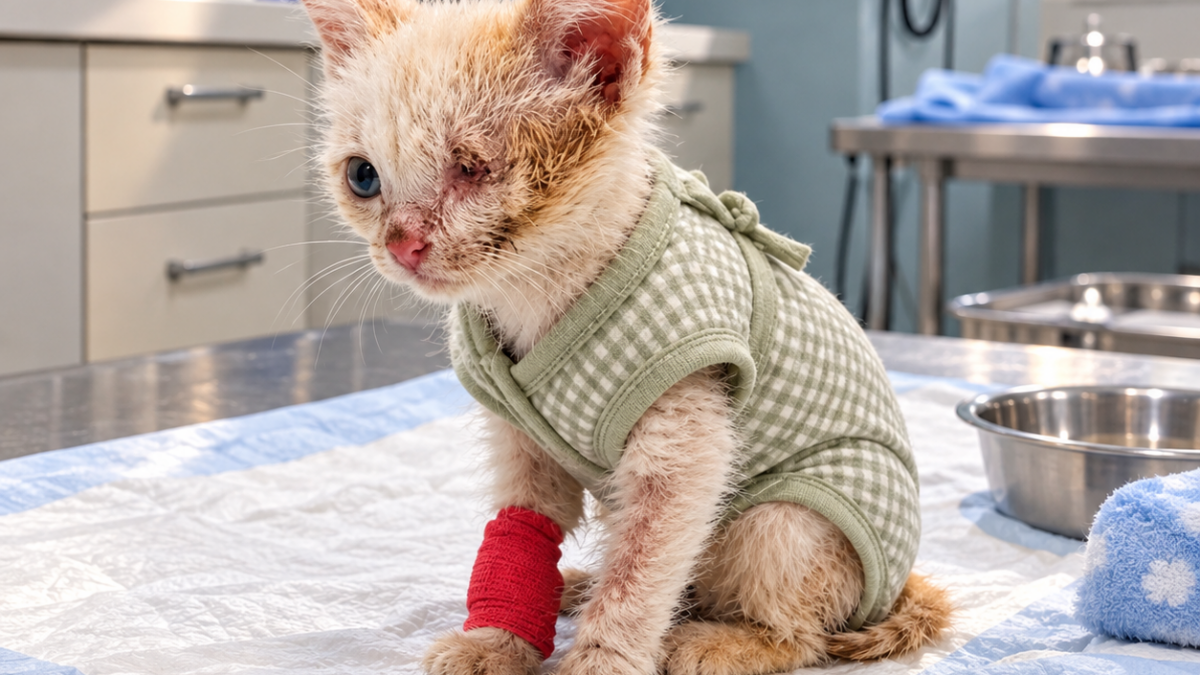
The kitten was only five weeks old, but when I stepped toward him on the side of the road, he didn’t run, cry, or even try to hide.
He weighed less than a pound and a half, and when I lifted him, his tiny body went completely limp in my hands as though he had already learned that fighting changed nothing.
I thought the hardest part would be keeping him alive, but weeks later, one discovery about how he ended up there changed everything.
My name is Laura Bennett, and I had been helping stray and abandoned animals around our county for almost seven years when I found Kefir.
It was late April, one of those gray mornings when the air still carried winter even though the trees had started turning green.
I was driving home after dropping supplies at a small rescue clinic when I noticed something beside the curb.
At first, I thought it was a dirty piece of fabric.
Then one tiny ear moved.
I stopped so quickly that the car behind me honked.
I pulled onto the shoulder and walked back.
The kitten was sitting beside a storm drain where the pavement met a patch of weeds.
He didn’t move.
That scared me immediately.
Healthy kittens that age usually run.
Or hiss.
Or flatten themselves beneath something.
They do something.
This little one simply watched me approach.
His coat was cream-colored with pale orange markings, although dirt had dulled most of it. His eyes looked far too large for his narrow face.
“Hey, baby.”
Nothing.
I crouched.
He blinked once.
When I slid my hands beneath him, he didn’t struggle.
He weighed almost nothing.
Later, the clinic scale would show 684 grams.
At roughly five weeks old, he should have been plump, warm, curious, and probably causing trouble beside his mother and littermates.
Instead, I could feel every ridge of his spine through my fingers.
I wrapped him inside my sweatshirt and carried him to the car.
For the entire drive, he stayed pressed against my chest.
No meow.
No squirming.
Just breathing.
I kept looking down at him at red lights to make sure he was still doing that.
“Stay with me.”
His eyes opened.
“That’s all I need from you right now.”
At the clinic, Dr. Melissa Hart placed him immediately on a warming pad.
“He’s cold.”
“How bad?”
“Too early to tell.”
She checked his gums, listened to his chest, examined his eyes and ears, then gently pressed along his abdomen.
Kefir barely reacted.
That frightened me more than if he had screamed.
Melissa noticed.
“He should be protesting.”
“I know.”
“He’s exhausted.”
She weighed him again.
684 grams.
Then she looked at me.
“That’s very small.”
“Can we fix it?”
“We can try.”
Those words stayed with me.
We can try.
Warmth replaced pavement.
A soft blanket replaced weeds.
Tiny measured meals replaced whatever scraps he might have found outside.
For most of that first day, Kefir slept.
Every few hours, we woke him gently and offered food.
At first, he only sniffed it.
Then, late that evening, he licked the edge of the spoon.
Once.
Twice.
A tiny bite.
I laughed.
Melissa looked over from the desk.
“What?”
“He ate.”
“How much?”
“Almost nothing.”
“Then celebrate almost nothing.”
So I did.
The next morning, he ate again.
And over the following days, the kitten who had seemed almost absent from his own body began returning little by little.
He started lifting his head when I entered.
Then leaning toward my hand.
Then sleeping without keeping every muscle tight.
One afternoon, I scratched gently beneath his chin.
Kefir closed his eyes and pushed his head into my fingers.
It was the first time he had asked for anything.
But while his body was getting stronger, I couldn’t stop thinking about one question.
How had a five-week-old kitten ended up alone beside that road?
Then a shop owner called me.
She had checked a security camera from the night before I found him.
And there, just after midnight, a car stopped beside the curb.
A door opened.
Someone stepped out carrying a small box.
And when they drove away, the box stayed behind.
PART 2
I watched the security footage six times before I realized I was gripping my phone hard enough to make my fingers ache.
The video wasn’t perfect.
The camera belonged to a twenty-four-hour convenience store about sixty yards from where I had found Kefir. It was designed to monitor the parking lot, not the road beyond it, so the image became grainier near the edge of the frame.
But it was clear enough.
At 12:17 a.m., a dark sedan slowed.
The passenger-side door opened.
A person stepped out.
They carried what looked like a small cardboard box.
They placed it beside the curb.
Then they returned to the car.
The sedan pulled away.
For nearly thirty seconds, nothing happened.
Then something tiny climbed over the side of the box.
Kefir.
He stumbled onto the pavement.
The car did not come back.
I stopped the video.
Started again.
Watched the box.
The person.
The car.
Kefir.
Again.
Behind me, Melissa said quietly, “Laura.”
I didn’t answer.
She reached over and lowered the phone.
“You don’t need to keep watching it.”
“I wanted him to have wandered there.”
“I know.”
“From a barn. A porch. Anywhere.”
“I know.”
“I wanted somebody to be looking for him.”
Melissa pulled a chair beside me.
“He still might have been found somewhere first. We don’t know everything.”
“They left him in a box.”
“Yes.”
“At midnight.”
“Yes.”
“He was five weeks old.”
Her face tightened.
“Yes.”
I looked through the glass door toward the small treatment room.
Kefir was asleep inside a fleece-lined crate with a heating pad beneath half of it so he could move away if he became too warm.
His stomach rose and fell.
Tiny.
Regular.
Alive.
“How long would he have lasted?”
Melissa did not answer immediately.
“In that condition?”
“Yes.”
“Maybe another day. Maybe less if the temperature dropped.”
That night had been forty-one degrees.
Cold enough that I had worn a jacket when I found him.
I looked back at the frozen image of the car.
“They knew.”
Melissa’s voice stayed careful.
“We know someone left a box.”
“They knew there was a kitten in it.”
“Probably.”
“Melissa.”
She sighed.
“Yes. It certainly appears that way.”
I wanted rage.
I expected it.
What came instead was something colder.
The person had not accidentally lost him.
They had not opened a front door and watched him escape.
They had not spent the night calling shelters.
They had put him in a box.
Driven somewhere else.
Stopped.
Left him.
And gone home.
I stood.
“What are you doing?”
“Calling animal control.”
I made the report that afternoon.
The officer assigned to it was named James Carter.
He had handled several abandonment cases with our rescue before and had the unfortunate gift of remaining calm when everyone else wanted to scream.
I sent him the video.
He called twenty minutes later.
“Do you have the original file?”
“The store owner does.”
“I’ll need it.”
“You can see the plate.”
“Partly.”
“So you can find them?”
“Maybe.”
“James.”
“Laura.”
“You know what I’m asking.”
“I know.”
“And?”
“And I’m not going to promise you something before we have it.”
I hated that answer.
He knew I hated it.
That was probably why he used it.
“The sedan looks dark blue or black,” he continued. “There may be enough of the plate to narrow things down, especially with the time and traffic cameras farther down the road.”
“So you can find them.”
“I said maybe.”
“You’re exhausting.”
“So I’m told.”
Before hanging up, his tone softened.
“How’s the kitten?”
I looked toward Kefir.
“He ate ten grams of wet food.”
“That good?”
“For him? Huge.”
“Then focus on that tonight.”
Easy for him to say.
I did try.
Kefir gave me something else to focus on anyway.
He had spent his first three days mostly sleeping.
On day four, he discovered my shoelace.
I was sitting beside his crate when one tiny paw reached through the opening and touched it.
I stopped moving.
The paw disappeared.
Then came back.
Tapped the lace again.
“You see that?”
Emily, one of the veterinary technicians, glanced over.
“What?”
“He attacked me.”
She stared at Kefir.
He was barely strong enough to stand for more than a minute.
“Terrifying.”
“He’s dangerous.”
Kefir reached out again.
This time his claws caught the lace.
I moved my foot slightly.
His eyes widened.
He pulled.
Weakly.
But deliberately.
Emily smiled.
“There he is.”
That phrase became something we said often.
There he is.
When Kefir ate a full teaspoon by himself.
There he is.
When he washed one paw after dinner.
There he is.
When he hissed at a thermometer.
I actually cheered at that one.
Melissa looked offended.
“He’s threatening a medical professional.”
“He finally has opinions.”
“Wonderful.”
Kefir hissed again.
“See?”
His strength returned slowly.
He was not simply underweight.
His body had been deprived of proper nutrition during a critical stage of development.
His coat was brittle.
He was mildly dehydrated.
His blood sugar had been dangerously low when I brought him in.
We tested him for common infections.
Treated parasites.
Monitored his digestion carefully.
Every feeding mattered.
Too much too quickly upset his stomach.
Too little and he lost ground.
I kept a notebook.
April 27: 684 grams.
April 28: 699.
April 29: 711.
May 1: 742.
I loved those numbers.
Each one felt like evidence.
Not of what happened to him.
Of what could happen when somebody cared.
His personality emerged with the weight.
By the second week, Kefir had decided people were useful.
He still startled easily.
But instead of remaining completely still when I approached, he began leaning toward me.
He learned the sound of the food container opening.
That changed everything.
One morning I walked into the clinic carrying breakfast.
A tiny sound came from his crate.
“Mrrp.”
I froze.
Emily froze.
Kefir stared at the bowl.
“Mrrp.”
I put one hand over my heart.
“Was that a meow?”
Emily laughed.
“That was a demand.”
Kefir opened his mouth again.
This time the sound was slightly louder.
I crouched.
“You found your voice?”
He stepped forward.
Then tried to climb directly into the food bowl.
Apparently the emotional significance of his first meow mattered only to me.
That same afternoon, James called.
“We have a possible vehicle.”
My entire body tightened.
“Who?”
“Don’t jump ahead.”
“You called me.”
“Yes, because I need information.”
“What information?”
“Did the kitten have anything with him besides the cardboard box?”
“No.”
“Blanket?”
“No.”
“Food?”
“No.”
“Any writing on the box?”
I thought back.
“It was an ordinary shipping box. Wait.”
“What?”
“There was a label.”
“Readable?”
“I don’t know. It was wet.”
“Do you still have the box?”
I closed my eyes.
“Yes.”
“Why?”
“Because I save everything until cases are closed.”
“That is both helpful and mildly concerning.”
“You’re welcome.”
The box was in our rescue storage room.
We found it behind several carriers.
The shipping label was damaged but not destroyed.
A name remained partly visible.
So did a street.
James photographed it.
His expression changed.
“You recognize it?” I asked.
“I’m not answering that yet.”
“James.”
“Laura.”
“You’re doing the voice.”
“What voice?”
“The bureaucratic voice.”
“It keeps me employed.”
He took the box.
Two days later, he called again.
“Come to the office.”
“Why?”
“I’d rather explain in person.”
That was never a good sentence.
When I arrived, James was sitting at a small conference table with a folder.
“Is Kefir okay?”
“Yes.”
“That’s not why I’m here.”
“No.”
He slid a photograph toward me.
A black sedan.
Same body shape as the vehicle in the footage.
A dent near the rear bumper.
“What am I looking at?”
“The car is registered to a woman named Natalie Foster.”
“Does the address match the box?”
“Her mother’s address does.”
My pulse increased.
“Did you speak to Natalie?”
“Yes.”
“And?”
“She says she has never owned a kitten.”
I stared at him.
“Of course she does.”
“She also says several people use that car.”
“Who?”
“Her adult son. Her boyfriend occasionally.”
“Someone was in the passenger seat.”
“Yes.”
“Who was driving?”
“Unknown.”
“Can’t you just ask?”
“We did.”
“And?”
“She says she doesn’t remember who used the car that night.”
I laughed once.
James didn’t.
“She doesn’t remember who took her car after midnight?”
“That’s her statement.”
“Do you believe it?”
“My belief—”
“Isn’t evidence. I know.”
“Good.”
“I’m learning.”
He turned another page.
“There’s more.”
The shipping label originally belonged to a package delivered to Natalie’s mother’s house three weeks earlier.
“That proves the box came from them.”
“It strongly links the box to that household.”
“And the car?”
“Links the vehicle.”
“And Kefir?”
“Not yet.”
My frustration returned.
“We have a kitten in their box beside a road after their car stopped there.”
“I know.”
“How much more do you need?”
“Enough that it doesn’t collapse the second somebody says another person used the box.”
I sat back.
“Fine.”
He closed the folder.
“We’re also checking whether any neighboring properties have cameras.”
“Okay.”
“Laura.”
“What?”
“Don’t contact them.”
“I wasn’t going to.”
He raised one eyebrow.
“I wasn’t.”
“Good.”
“I wanted to.”
“I know.”
Back at the clinic, Kefir was having a better day.
He had discovered a felt mouse.
Not properly.
He stared at it for nearly five minutes as though suspicious of its existence.
Then he touched it.
The mouse rolled.
Kefir jumped backward.
I laughed.
He looked at me.
Then attacked it.
For perhaps twenty seconds, he became the kitten he should have been all along.
Pouncing.
Missing.
Rolling sideways.
Trying again.
He tripped over his own back feet.
Then collapsed against the blanket.
Not from terror.
From exhaustion after play.
I sat beside him.
“You’re getting there.”
His eyes closed.
I touched one finger to his head.
“You don’t know this, but somebody is trying very hard to explain why you weren’t their problem.”
One eye opened.
“I know.”
He licked my finger.
Kefir moved from the clinic to my home at the end of the second week.
Technically, I was fostering him.
Nobody believed me.
Not Melissa.
Not Emily.
Not James.
Certainly not my sister, Megan.
“You named him Kefir.”
“That doesn’t mean anything.”
“You bought him a heated bed.”
“He was underweight.”
“You ordered a custom ceramic bowl.”
“It was on sale.”
“It has his name on it.”
I looked at her.
“Custom items can be discounted.”
Megan smiled.
“You’re keeping him.”
“I have two adult cats.”
“And?”
“They haven’t met him.”
“They will.”
“You’re annoying.”
“You love me.”
That was unfortunately true.
My cats were named Winston and Pearl.
Winston was eleven, orange, large, and deeply committed to routines that benefited Winston.
Pearl was seven, gray, elegant, and suspicious of all new developments.
We introduced Kefir slowly.
Scent first.
Separate rooms.
Blanket exchanges.
Meals on opposite sides of the door.
Winston reacted by eating his own food and then trying to steal Kefir’s.
Pearl sat outside the room glaring as though I had committed a constitutional violation.
Kefir, meanwhile, was fascinated.
Every time he smelled them beneath the door, his tail lifted.
His first face-to-face meeting was with Winston.
I held my breath.
Winston walked in.
Saw Kefir.
Stopped.
Kefir stood completely still.
Winston approached.
Sniffed his head.
Kefir leaned forward.
Winston hissed.
Kefir fell over.
Not metaphorically.
He simply tipped sideways.
I burst out laughing.
Winston looked offended by my disrespect.
Twenty minutes later, they were sitting three feet apart.
Within a week, Kefir began following Winston from room to room.
Winston pretended to hate this.
He also started sleeping outside Kefir’s bed.
Pearl took longer.
She hissed for eleven days.
On day twelve, I found Kefir asleep against her back.
Pearl opened one eye when I entered.
Her expression clearly said:
We will never discuss this.
We never did.
Kefir gained weight steadily.
At eight weeks, he passed one kilogram.
I photographed the scale.
At ten weeks, 1.3 kilograms.
His coat began shining.
His belly rounded.
His legs seemed too long for his body.
He developed a habit of sitting on my shoulder while I worked at the computer.
The tiny street kitten who had barely reacted when I picked him up now objected loudly if I closed a door between us.
He had opinions about everything.
Breakfast.
Dinner.
Pearl using “his” blanket.
Winston occupying my lap.
Vacuum cleaners.
Closed cabinets.
Empty food dishes that were, in fact, not empty.
Every meow delighted me.
That may sound ridiculous.
But silence had been the first thing I knew about him.
So his noise felt like proof of life.
The investigation continued in the background.
Then, three weeks after James identified Natalie’s car, another camera changed the case.
A neighbor two houses away from Natalie’s mother had a doorbell camera angled toward the street.
At 11:48 p.m. on the night Kefir was abandoned, the black sedan appeared.
Two people were visible.
Natalie’s twenty-two-year-old son, Evan.
And his girlfriend, Brooke.
The camera captured them carrying something from the house.
A box.
Same size.
Same tape placement.
They loaded it into the car.
At 12:24 a.m., they returned.
Without the box.
I sat in James’s office staring at the still images.
“That’s him.”
“We think so.”
“You think?”
“We need statements.”
“You have them carrying the box.”
“Yes.”
“Then returning without it.”
“Yes.”
“And the store video shows their car dropping a box.”
“Yes.”
“With Kefir inside.”
“Yes.”
“So why are you still saying ‘we think’?”
James folded his arms.
“Because precision is how we keep cases from becoming stories people can explain away.”
I looked at him.
“Fine.”
He almost smiled.
“You’re improving.”
“I hate you.”
“That’s fine.”
Evan initially denied knowing about any kitten.
Then investigators showed him the doorbell images.
His story changed.
He said Brooke found a kitten behind a shed.
They intended to take him to an animal shelter.
But shelters were closed at midnight.
“So you left him beside a road?” James asked during the interview.
According to the report, Evan claimed they believed someone would find him.
That sentence made me furious.
Someone will find him.
It is one of the cruelest excuses abandonment creates.
Someone else will fix what I refuse to handle.
Someone else will notice.
Someone else will stop.
Someone else will care.
And sometimes nobody does.
“What did Brooke say?” I asked James.
“She says Evan made the decision.”
“Of course.”
“She admits she was present.”
“Did they know how young he was?”
“She says she thought six or seven weeks.”
“He was five.”
“I know.”
“Did they feed him?”
“She says they tried.”
“Veterinarian?”
“No.”
“Rescue?”
“No.”
“Shelter the next morning?”
“No.”
“Nothing.”
“Nothing.”
There was one question I needed answered.
“Where was his mother?”
James looked at me.
“We’re working on that.”
That frightened me.
Because kittens rarely appear alone.
Kefir came from somewhere.
A mother.
Possibly siblings.
I went home and found him asleep on Winston’s stomach.
Winston looked trapped.
“You’re allowed to move.”
Winston blinked slowly.
Kefir stretched and wrapped one paw over him.
“No?”
Winston closed his eyes.
Apparently not.
I sat beside them.
“Kefir.”
His ears moved.
“Where did you come from?”
No answer.
Only a purr.
But within a week, we learned.
Natalie’s mother, Donna, had an unspayed outdoor cat living around her property.
A calico named Daisy.
Daisy had recently given birth beneath a storage shed.
Five kittens.
Kefir was one.
My heart dropped.
“Five?”
James nodded.
“Where are the others?”
“Three are still with the mother.”
“That’s four total.”
“One died.”
I closed my eyes.
“When?”
“Before officers got there.”
“Cause?”
“Unknown.”
“Can we get Daisy and the kittens?”
“We’re coordinating surrender.”
“Coordinating?”
“Donna says they’re not hers.”
I stared at him.
“Of course.”
“They’re ‘strays.’”
“And yet her grandson removed one.”
“That’s part of what we’re clarifying.”
The rescue organization offered immediately.
If Donna surrendered Daisy and the surviving kittens, we would take them.
Spay Daisy when medically appropriate.
Vaccinate.
Treat.
Foster.
Find homes.
No cost to her.
She agreed.
Not because she suddenly cared.
Because she wanted the “cat problem” gone.
I went with animal control when we collected them.
The shed sat behind a modest house with peeling paint.
Daisy appeared when we opened a can of food.
Thin.
Alert.
Calico.
Her nipples confirmed she was nursing.
She watched us carefully from beneath the shed.
One by one, we safely trapped the kittens.
Cream-and-orange.
Black.
Calico.
My chest tightened.
I imagined Kefir there.
Warm beside them.
Then lifted away.
Driven down a road.
Left alone.
The surviving kittens were healthier than Kefir had been when found.
Still underweight.
But with Daisy caring for them, they had survived.
When we brought them to the clinic, I sat beside Daisy’s enclosure for a long time.
“You lost two.”
Her green eyes watched me.
“One came back.”
Not physically.
We did not immediately reunite Kefir with Daisy.
He had been separated long enough, and his health and foster routine were stable. Melissa wanted controlled introductions rather than assuming biology would override stress.
But several days later, after examinations and quarantine precautions, we tried.
Daisy was resting inside a large foster room.
Kefir entered in a carrier.
He sniffed.
His whole body changed.
Ears forward.
Nose working.
I opened the carrier.
He stepped out.
Daisy lifted her head.
For several seconds, neither moved.
Then Kefir made a sound I had never heard before.
Small.
High.
Questioning.
Daisy stood.
She approached.
Sniffed his face.
Then began washing his head.
I sat on the floor and cried.
Kefir pushed beneath her chest as though he remembered a position his body had not forgotten.
Daisy licked his ears.
Then his neck.
He purred so loudly Melissa could hear from the hallway.
“Good?” she called.
I couldn’t answer.
She stepped inside.
“Oh.”
Daisy eventually lay down.
Kefir curled beside her.
Not nursing.
Simply pressed against her.
His three surviving siblings cautiously approached.
Kefir sniffed them.
The black kitten slapped him in the forehead.
He slapped back.
Within fifteen minutes they were wrestling.
“That family reunion went downhill fast,” Melissa said.
I laughed.
For several weeks, Kefir spent supervised time with Daisy and the other kittens while continuing to live with me.
He learned things from them I could not teach.
How to stalk.
How to wrestle properly.
When biting became too hard.
How to wash another kitten without immediately attacking its tail.
Daisy gained weight.
Her coat improved.
When the kittens were old enough, she was spayed.
The three siblings found excellent homes.
Daisy became the real surprise.
Donna did not want her back.
I expected Daisy to be difficult to place because she had lived outdoors and distrusted unfamiliar people.
Instead, one of our older volunteers, Margaret, fell in love with her.
Margaret was sixty-eight, widowed, quiet, and had recently lost a seventeen-year-old cat.
She visited Daisy for weeks.
Never forced contact.
Just sat.
Read books aloud.
Brought treats.
One afternoon Daisy walked into Margaret’s lap.
That was it.
Adoption approved.
Everybody went somewhere safe.
Except one kitten who had died before we arrived.
I could not erase that.
Neither could the legal case.
Evan and Brooke eventually faced citations and consequences associated with animal abandonment under local law.
The exact outcome was less dramatic than the internet would have wanted.
There was no cinematic courtroom scene.
No judge delivering a furious speech.
There were fines.
Community-service requirements.
Animal-welfare education.
And restrictions tied to future animal ownership depending on the final order.
The evidence established that they had removed a vulnerable kitten and intentionally left him beside a public road rather than contacting available animal-control or rescue resources.
Brooke accepted responsibility earlier.
Evan fought it longer.
He insisted he had believed Kefir would be found quickly.
During one hearing, I was asked to describe Kefir’s condition.
I explained his weight.
His low body temperature.
His blood sugar.
His inability to respond normally.
The attorney asked:
“But he did recover?”
“Yes.”
“So no permanent harm?”
I stared at him.
Melissa had warned me to answer only the question.
“Yes, he recovered physically.”
The attorney nodded.
Then I added:
“Because somebody stopped.”
There was an objection.
The judge allowed the answer.
The attorney continued.
“You cannot state with certainty that the kitten would have died if nobody found him that morning.”
“No.”
“Thank you.”
I leaned toward the microphone.
“I can state that his veterinarian believed he was medically vulnerable and required immediate supportive care.”
That answer stood.
Later, Evan spoke.
Not to me.
To the court.
He said he had panicked.
His grandmother wanted the cats gone.
He and Brooke thought taking one kitten might “help.”
When the kitten seemed weak, they did not want veterinary expenses.
They assumed a shelter would ask questions or charge fees.
So they drove.
Then abandoned him.
The explanation was not sophisticated cruelty.
Somehow, that made me angrier.
Kefir had almost died because helping him had become inconvenient.
There was no grand motive.
No dramatic hatred.
Just avoidance.
The judge said something simple:
“An animal’s vulnerability does not disappear because caring for it is inconvenient.”
I wrote those words down.
Outside the courthouse, Evan approached me.
James immediately stepped closer.
“It’s okay,” I said.
Evan stopped several feet away.
He looked younger than I expected.
Maybe because I had built him into something monstrous in my mind.
He wasn’t.
That did not make his decision less cruel.
“How is he?” he asked.
“Kefir?”
He nodded.
“Healthy.”
“Good.”
I waited.
He rubbed one hand over the back of his neck.
“I didn’t think he was going to die.”
I felt the old anger.
“You didn’t know enough to make that decision.”
“I know.”
“Do you?”
He looked down.
“I do now.”
For months, I had imagined what I would say if I got that moment.
I had speeches prepared in my head.
About responsibility.
About five-week-old kittens.
About hypothermia.
About cardboard boxes.
None came out.
Instead I asked:
“Why him?”
Evan looked confused.
“Why did you take Kefir instead of one of the others?”
He thought.
“He was the easiest to grab.”
My stomach twisted.
“Because he didn’t run?”
“I guess.”
There it was.
The detail that hurt most.
Kefir had been too weak to run even before he was abandoned.
Evan had picked him because weakness made him convenient.
I stepped closer.
“That’s exactly why you should have helped him.”
Evan’s eyes dropped.
“I know.”
James touched my elbow lightly.
Enough.
I nodded.
Then walked away.
That night, I went home expecting to feel victorious.
I didn’t.
Kefir was sitting on my kitchen counter.
He was absolutely not allowed on the kitchen counter.
“Kefir.”
He froze.
A piece of chicken was hanging from his mouth.
I stared at him.
He stared at me.
“Seriously?”
He ran.
Chicken still in mouth.
Winston chased him.
Pearl joined because apparently crime was contagious.
Within seconds, three cats were tearing through my living room.
I began laughing.
Then I understood.
That was the revenge.
Not Evan looking ashamed.
Not a fine.
Not the court order.
Not even the judge’s words.
Kefir had been chosen for abandonment because he was the kitten who could not run.
Now I could barely catch him.
I stood in the middle of the living room laughing while he launched himself onto the couch, across a cushion, onto a cat tree, and up to the top platform.
He looked down at me.
Chicken gone.
Expression innocent.
“You were dying beside a road.”
“Mrrp.”
“And now you steal dinner.”
Another “mrrp.”
Winston jumped up beside him.
Pearl remained below, perhaps preserving plausible deniability.
I sat on the couch.
“You win.”
Kefir came down.
Climbed onto my shoulder.
Purred against my neck.
That was enough.
By six months old, Kefir had become almost unrecognizable.
Not enormous.
He remained a relatively small cat.
But solid.
Healthy.
Cream-colored fur soft and thick.
Orange markings bright.
Eyes clear.
His weight was completely appropriate.
He had a narrow face that gave him a permanently curious expression.
He loved climbing.
He loved cardboard boxes, which surprised me.
The first time he crawled voluntarily into one, I almost stopped him.
Then Sophie, one of our behavior volunteers, said:
“Why?”
I looked at her.
“Because of how he was abandoned.”
“That box isn’t that box.”
I knew.
Still.
Kefir jumped into the box.
Turned around three times.
Fell asleep.
I sat nearby watching him.
A box had once been a container someone used to discard him.
Now it was something he chose because it was warm and ridiculous and cats love boxes.
Sophie smiled.
“He reclaimed cardboard.”
“Don’t make me cry.”
“You’re doing that yourself.”
She was right.
Kefir grew into an affectionate cat but not an indiscriminate one.
He chose people carefully.
With strangers, he often watched from a distance.
With me, he had no concept of personal space.
Bathroom door?
Unacceptable.
Laptop?
A heated bed.
Pillow?
Shared property.
My chest at three in the morning?
Perfect location for all ten pounds of adult Kefir.
He still liked sitting close rather than directly on people at first.
Then one night, months after rescue, I was reading on the couch.
Kefir climbed onto my lap.
No coaxing.
No food.
He turned twice.
Curled up.
Put his head against my stomach.
I stopped reading.
Winston was sleeping nearby.
Pearl occupied the chair.
The house was quiet.
Kefir began purring.
His entire body vibrated.
I thought of the street.
The still little kitten.
The limp body in my hands.
The way I had kept looking down during the drive to check whether he was breathing.
Now he was so comfortable that he fell asleep with all four paws loose.
Trust looks different in cats than people expect.
Sometimes it is not running to greet you.
Sometimes it is turning their back.
Exposing a stomach.
Closing their eyes.
Sleeping deeply enough to dream.
Kefir’s paws twitched.
I smiled.
“Go ahead.”
His ears moved.
“Dream about stealing chicken.”
He purred louder.
A year after his rescue, we held a reunion at the clinic.
Not officially.
Melissa simply scheduled Daisy’s annual appointment on the same afternoon as Kefir’s.
Margaret brought Daisy.
Two of Kefir’s sibling families came.
The third sent photographs because they lived farther away.
The black brother was now named Pepper.
The calico sister was Juniper.
The cream sister was Sunny.
All healthy.
All fixed.
All vaccinated.
All loved.
Daisy walked into the room first.
Kefir noticed her.
He stared.
Then approached.
They sniffed.
Daisy licked his forehead once.
Kefir immediately attempted to steal a treat from Margaret’s purse.
“Touching reunion,” Melissa said.
“I’m overwhelmed.”
Pepper arrived and hissed at everyone.
Juniper tried to climb into a sink.
Normal cats.
That was the miracle.
Not perfection.
Normality.
I took a photograph of Daisy with three of her kittens.
Later, I placed it beside a photograph from the week they were rescued.
The difference was almost absurd.
Daisy healthier.
Kittens grown.
Eyes bright.
Bodies filled out.
Then I found Kefir’s first photograph.
He was wrapped inside my sweatshirt.
Head smaller than my palm.
Eyes huge.
I almost didn’t post it.
Not because I wanted to hide what happened.
Because I didn’t want suffering to remain his most recognizable image.
So when the rescue organization eventually shared an anniversary update, I chose the healthy photograph first.
Kefir on the cat tree.
One paw hanging over the edge.
Eyes half closed.
The rescue photo came second.
That order mattered to me.
He was not “the dying kitten.”
He was Kefir.
The dying kitten was something that had happened to him.
Not what he was.
Donna, the woman whose property Daisy had lived on, eventually contacted the rescue.
I assumed she was angry.
Instead, she asked whether Daisy was alive.
“Yes.”
“And the kittens?”
“All living kittens are doing well.”
She paused.
“The little cream one?”
“Kefir?”
“Yes.”
“He lives with me.”
Another pause.
“Is he okay?”
“Very.”
Donna sighed.
“I told Evan to get rid of the cats.”
There it was.
Not the whole cause.
But part of it.
“What did you mean by ‘get rid of’?”
“I meant call somebody.”
“Did you?”
“No.”
“Did you give him a number?”
“No.”
“Did you offer to pay for surrender or care?”
“No.”
“Then what did you expect a twenty-two-year-old who didn’t want to spend money to do?”
Silence.
I immediately regretted how sharp I sounded.
Not because the question was wrong.
Because anger rarely produces useful answers.
Donna finally said:
“I don’t know.”
I sat at my kitchen table.
Kefir jumped beside me.
“Can I ask you something?” Donna said.
“What?”
“Could I see a picture?”
I almost said no.
Then I looked at Kefir.
He was licking one paw.
He did not care who saw his photograph.
I sent one.
Kefir stretched across the back of the couch, healthy and absurdly comfortable.
Donna did not reply for several minutes.
Then:
**He got big.**
I typed:
**He survived.**
Another pause.
**I’m sorry.**
I read those words.
Did they fix anything?
No.
Did they bring back the kitten who died beneath the shed before rescue?
No.
Did they undo Kefir’s night beside the road?
No.
But accountability does not become meaningless just because it arrives late.
I replied:
**Please get help sooner next time.**
She answered:
**I will.**
I hoped that was true.
Months later, Margaret told me Donna had begun allowing a local trap-neuter-return group onto the property to help with several community cats.
That mattered.
Not redemption in some dramatic sense.
But change.
Maybe one future litter would never suffer because someone finally made a phone call.
That was worth something.
By his second birthday, Kefir had developed a strange obsession with water.
Not bathing.
Absolutely not.
Running faucets.
He would sit beside the sink and scream until someone turned on a thin stream.
Then he would slap it.
Bite it.
Get his head wet.
Become offended.
Repeat.
Megan visited one afternoon.
“That’s the fragile dying kitten?”
Kefir launched himself into the sink.
“Yes.”
“He looks deeply traumatized.”
“He’s processing.”
Kefir sneezed water onto her.
Megan wiped her face.
“I see.”
He also developed a habit of carrying socks.
Not playing with them.
Transporting them.
I would find socks in his food area.
Near the cat tree.
Inside the bathtub.
Once inside a cooking pot.
No one understood.
Winston tolerated Kefir but maintained seniority.
Pearl became his actual companion.
They slept together frequently.
Groomed one another.
Chased each other at three in the morning.
When Pearl underwent dental surgery, Kefir sat outside her recovery room door for hours.
When she came home groggy, he slept beside her without touching.
I remember watching them and thinking about what five-week-old Kefir had lost.
His mother.
His siblings.
Warmth.
Security.
For one night, maybe only hours, he had been utterly alone.
Then, because one person stopped, his world filled again.
Not with replacements.
You cannot replace what was taken.
But with new relationships.
New safety.
New rituals.
Animals are extraordinary that way.
They do not need us to erase the past.
They need us to make the present reliable.
Food arrives.
Hands are gentle.
Doors open.
People return.
Pain receives treatment.
Fear is allowed.
Trust is never demanded.
That became the real story of Kefir’s recovery.
Not weight.
Not even survival.
Reliability.
At three years old, Kefir became accidentally famous within our small rescue network.
A litter of orphaned kittens arrived at the clinic.
Their mother had been killed by a car.
Four babies.
Around three weeks old.
They needed round-the-clock feeding.
I was helping with foster rotation.
One evening, I brought them home in a warm carrier.
Kefir heard them before I opened the door.
Tiny squeaks.
He came running.
His body froze.
I set the carrier down.
He sniffed.
One kitten cried.
Kefir sat beside the carrier for twenty minutes.
When I finally allowed a controlled introduction, he approached slowly.
He sniffed the smallest kitten.
Then began grooming it.
I almost fell over.
“Kefir.”
He ignored me.
Another kitten crawled toward him.
He groomed that one too.
Winston watched from the doorway looking disgusted by everyone’s life choices.
Pearl approached later and helped.
But Kefir became obsessed.
Whenever the kittens cried, he appeared.
He lay near their nest.
Cleaned them after feedings.
Allowed them to crawl over him when they became mobile.
He was not their mother.
He could not feed them.
But he became something.
An uncle.
A babysitter.
A warm body.
I sent Melissa a video.
She replied:
**OF COURSE HE DID.**
One evening, the smallest orphan curled under Kefir’s chin.
He rested one paw across it.
I sat on the floor staring.
The kitten abandoned at five weeks was protecting a kitten even younger.
Again, I resisted making suffering poetic.
Kefir did not become kind because suffering was good for him.
Nothing about what happened to him was good.
Maybe he would have been nurturing anyway.
Maybe his temperament simply leaned that way.
But the image still moved me.
Not because trauma had produced virtue.
Because trauma had failed to destroy tenderness.
All four orphans survived.
All found homes.
One adopter still sends me photographs.
She named her kitten Milo.
Kefir never saw him after adoption.
He didn’t need to.
His work was finished.
Years passed.
Kefir remained small compared with Winston.
He remained dramatic.
He remained convinced closed bathroom doors were personal betrayal.
The story of his abandonment became less central.
That was exactly what I wanted.
People would visit and meet him without knowing.
They saw a cream-and-orange cat sitting on the arm of the couch.
Sometimes he approached.
Sometimes not.
If I later told them where he came from, they often looked surprised.
“This cat?”
“Yes.”
“He seems so normal.”
I loved that sentence.
Normal.
The word people overlook until normal becomes impossible.
Kefir ate breakfast.
Chased insects.
Slept in laundry.
Went to veterinary appointments.
Hated his carrier.
Loved cardboard.
Normal.
The most dramatic revenge against abandonment was not a punishment.
It was ordinary life continuing for years.
Evan left the county eventually.
Brooke completed her community-service requirement with an animal-welfare program.
That outcome originally made me angry.
Why should someone involved in abandonment work near animals?
The program did not put her directly in charge of vulnerable animals.
She cleaned supplies.
Organized donated food.
Helped with laundry.
Attended education sessions.
Months later, the coordinator told me Brooke had asked to stay as a volunteer after her requirement ended.
I did not know how to feel.
“Do you trust her?” I asked.
“With supervision, yes.”
“Why would she stay?”
“You’d have to ask her.”
I never did.
But one afternoon I saw her across the rescue center.
She was stacking bags of cat food.
She recognized me.
Stopped.
For a second, neither of us moved.
Then she said:
“Laura.”
I nodded.
She looked toward the foster room.
“I heard Daisy got adopted.”
“She did.”
“And the kittens?”
“All safe.”
“Kefir?”
“Still stealing my food.”
A tiny smile appeared.
Then disappeared.
“I’m glad.”
I almost walked away.
Instead I asked:
“Why are you here?”
She swallowed.
“Because I should have known better.”
“You did know better.”
She flinched.
Good.
I was not trying to be kind.
But she nodded.
“Yes.”
“Then why?”
She thought for a long moment.
“Because knowing something is wrong and stopping it are different things.”
That answer surprised me.
She looked down at the bag in her hands.
“I kept telling myself Evan would figure something out. Then when he said we should leave the kitten where somebody would find him, I knew it was wrong.”
“But you went.”
“Yes.”
“You watched him put the box down.”
“Yes.”
“And drove away.”
“Yes.”
No excuses.
That mattered.
Not enough to erase it.
But enough that I stayed.
“What changed?”
She glanced around the room.
“The first week I had to volunteer here, I hated it.”
I almost laughed.
“Good start.”
“I thought everyone judged me.”
“They probably did.”
“They did.”
She smiled faintly.
“Then they gave me laundry.”
“Cruel.”
“Mountains of it.”
I waited.
“One day a litter came in. Four kittens. Maybe six weeks old.”
My chest tightened.
“I wasn’t allowed to handle them. I just brought clean blankets.”
She swallowed.
“One of them looked like Kefir.”
I said nothing.
“I finally understood how small he was.”
There it was.
Sometimes scale is abstract until you hold it.
Five weeks.
684 grams.
Those numbers meant everything to me.
Maybe nothing to her until she saw another body that size.
“I’m not asking you to forgive me,” she said.
“I’m glad.”
“I just wanted you to know I’m still here.”
I looked at the food bags.
“You want revenge advice?”
Her eyebrows rose.
“Excuse me?”
“Spend the rest of your time noticing what you ignored that night.”
She stared.
Then nodded.
“I can do that.”
“Good.”
I left.
For the first time, I understood revenge differently.
Not hurting Brooke.
Not keeping her forever trapped inside the worst decision she had made.
If she genuinely changed, then Kefir’s story had produced one more person who might stop for the next animal.
That was useful.
Useful mattered more than satisfying my anger.
Evan was different.
I heard little about him.
That was fine.
Kefir did not need both people transformed for his life to be complete.
He needed safety.
He had it.
When Kefir was five years old, Winston died.
He had kidney disease.
We managed it for a long time.
Eventually, his body could not continue.
Kefir had spent most of his life following that grumpy orange cat.
When Winston did not come home from the clinic, Kefir searched.
Room to room.
He cried.
That sound crushed me.
For two nights, he slept where Winston’s bed had been.
Pearl stayed close.
I sat with them.
Grief is part of a good life too.
That sounds cruel, but it is true.
You cannot love without eventually learning absence.
Kefir had survived abandonment.
Now he experienced a different loss.
One where someone had not chosen to leave him.
One where love had remained until the last possible moment.
It still hurt.
But it did not frighten him the same way.
He did not stop eating.
Did not hide.
He searched.
Then slowly stopped.
Several months later, Kefir began sleeping in Winston’s favorite sunny spot.
At first, that hurt me.
Then it comforted me.
Life fills spaces.
Not perfectly.
Never completely.
But enough.
Pearl died three years later at ten after an aggressive cancer.
That loss hit Kefir harder.
They had been close.
He became quieter for weeks.
I adopted no new cat immediately.
I thought Kefir deserved time.
Then, four months later, someone found a tiny black kitten in a parking garage.
I said no.
Absolutely not.
I was not ready.
The rescue asked only if I could foster overnight.
Everyone knows where this is going.
The kitten’s name became Olive.
She was seven weeks old.
Healthy.
Loud.
Fearless.
She arrived at my house in a carrier.
Kefir approached.
Olive hissed.
Kefir sat down.
Olive hissed again.
Kefir yawned.
I laughed.
Within three days, Olive was following him.
Within two weeks, she was sleeping on top of him.
I signed the adoption papers a month later.
Megan said nothing.
She simply texted:
**I TOLD YOU SO.**
I blocked her for six minutes.
Kefir raised Olive in the loosest possible sense.
He corrected her when she bit too hard.
Groomed her.
Allowed her to steal his food until I intervened.
Taught her the exact cabinet where treats were stored.
That betrayal remains unforgiven.
Watching them together reminded me how far Kefir had traveled.
Not in miles.
In roles.
Abandoned kitten.
Patient.
Foster.
Family.
Companion.
Caretaker.
Old friend.
By age ten, orange had faded slightly around his face.
His movements slowed.
He still played.
Just differently.
No more vertical launches onto high shelves.
More floor toys.
More naps.
Olive kept him moving.
He kept her civilized.
Mostly.
Every April, I remembered the road.
Not because I wanted to.
Because certain dates attach themselves to your body.
On one anniversary, I drove past the exact place where I had found him.
The storm drain was still there.
The convenience store had changed ownership.
The curb looked ordinary.
Cars passed.
Nobody knew.
I pulled over.
Kefir was not with me.
He hated unnecessary car rides.
I stood near the weeds.
For years, I had imagined that patch as a terrible place.
Then I realized something.
It was also where abandonment ended.
That mattered.
The box had been placed there as an ending.
It became a beginning.
Not because whoever abandoned him intended that.
Because somebody noticed.
There is power in noticing.
Not dramatic power.
No cape.
No applause.
I almost drove past.
That truth keeps me humble.
I was not searching for Kefir.
I was thinking about groceries.
Phone calls.
Laundry.
Then I saw one ear move.
That tiny motion changed both our lives.
I stood there for several minutes.
Then went home.
Kefir was asleep on my bed.
Olive beside him.
He opened one eye when I entered.
“You have no idea where I went.”
Slow blink.
“Probably better.”
I lay beside him.
He purred.
At twelve, Kefir developed arthritis.
We changed things.
Small steps beside furniture.
Lower cat beds.
Medication.
Warmer sleeping spots.
I bought another heated bed.
Megan laughed when she saw it.
“Full circle.”
“What?”
“You bought a heated bed when he was a kitten.”
I looked down.
She was right.
The first heated bed had helped a hypothermic baby regulate his temperature.
This one helped an old cat’s joints.
Beginning and aging held together by the same simple thing.
Warmth.
Kefir loved it.
He slept there every afternoon.
His appetite remained excellent.
Too excellent.
Melissa, who had known him since the first day, eventually told me he needed to lose half a pound.
I stared at her.
“You once celebrated every gram.”
“I regret creating a monster.”
Kefir screamed from the carrier.
Melissa pointed.
“See?”
“You made him like this.”
“You fed him.”
“Under medical supervision.”
“You continued for twelve years.”
“Details.”
We adjusted his portions.
He considered this a betrayal.
The kitten once too weak to eat became an old cat who filed formal complaints if breakfast was four minutes late.
I treasured every complaint.
When Melissa retired, her final week at the clinic included Kefir’s checkup.
She examined him slowly.
Listened to his heart.
Checked his teeth.
Flexed his hips.
Then sat down beside me.
“He looks good.”
“For twelve?”
“For twelve.”
Kefir walked from my lap to hers.
He did not usually choose other laps.
Melissa froze.
“Are you seeing this?”
“I am.”
“He likes me.”
“Don’t move.”
“He has never sat on me.”
“I know.”
Kefir curled up.
Melissa’s eyes filled.
“Oh, come on.”
I laughed.
“Professional detachment.”
“Be quiet.”
She stroked his head.
“I remember 684 grams.”
“So do I.”
“I thought we might lose him that first night.”
“I know.”
Kefir purred.
Melissa looked at him.
“You had other plans.”
That phrase stayed with me.
At thirteen, Kefir’s kidneys began showing early signs of age-related decline.
Nothing catastrophic.
We adjusted diet.
Added fluids later.
Monitored bloodwork.
I had learned enough from years of rescue work to understand what came next eventually.
Still, knowledge does not make love less frightening.
Olive stayed close to him.
Kefir spent more time in sunbeams.
More time beside me.
He still liked boxes.
At Christmas, I received a package large enough to contain a small appliance.
Kefir climbed into the box before I had removed all the packing paper.
I looked at him.
“You know, statistically, you should hate these.”
He kneaded the cardboard.
“Apparently not.”
Then he slept there for four hours.
That was Kefir.
He refused to let the object associated with his worst night belong forever to fear.
Or maybe he never made the association at all.
Maybe that interpretation was entirely mine.
Cats are good at exposing human need for meaning.
Kefir did not need everything to symbolize recovery.
Sometimes a box was warm.
Sometimes a sunbeam was warm.
Sometimes dinner was late and therefore a crisis.
Life could be simple.
I learned from that too.
One spring morning, almost fourteen years after I found him, Kefir did not come for breakfast.
That had never happened.
Not once.
My heart knew before my mind did.
I found him in his heated bed.
Awake.
Quiet.
I crouched.
“Hey.”
He lifted his head.
Mrrp.
Weak.
But him.
At the clinic, bloodwork confirmed what I feared.
His kidneys had declined sharply.
We treated.
He rallied.
For several months, we had more good days.
Then fewer.
I measured his life differently.
Did he eat?
Did he groom?
Did he seek contact?
Did he enjoy the window?
Did he still boss Olive?
Yes.
Yes.
Yes.
Yes.
Definitely yes.
So we continued.
One evening, Kefir climbed into my lap the way he had years earlier.
Turned twice.
Curled up.
His body was lighter now.
Not dangerously thin like the beginning.
Just old.
I touched his spine.
Memories arrived without permission.
684 grams.
The sweatshirt.
The warming pad.
The first tiny bite.
The first felt mouse.
Daisy washing his head.
Chicken theft.
Olive sleeping on him.
Years.
So many years.
I realized something then.
When I first found Kefir, I had begged him for one more hour.
Then one more day.
Eventually I stopped counting.
That was the gift.
He became so safe that survival stopped being the headline.
Life replaced it.
His final decline came gently.
When Melissa heard, she visited even though she had been retired for almost two years.
Kefir was resting at home.
She sat beside him.
He sniffed her fingers.
Then placed one paw on her hand.
“Still remember me?”
Slow blink.
“I’ll take that.”
Olive lay nearby.
Megan came.
James even sent a message after hearing through the rescue network.
**Tell the little criminal I said hello.**
He remembered the chicken story.
Everybody remembered something different.
That is how you know an animal has had a life.
Not one image.
Many.
The kitten by the road.
The clinic patient.
The food thief.
The brother.
The foster uncle.
The grumpy old cat.
All true.
None complete alone.
On Kefir’s final morning, sunlight fell across my bedroom floor.
He had stopped eating.
He no longer wanted to move far.
The veterinarian who came to my home gave us time.
No hurry.
I held Kefir exactly the way I had on the first day.
Against my chest.
Only now he trusted the position completely.
His head rested below my chin.
I could feel his breathing.
Olive remained nearby.
I whispered:
“You were so tiny.”
His ear moved.
“You scared me.”
A weak purr.
“You became extremely expensive.”
Another vibration.
“You stole a lot of chicken.”
Nothing.
Then:
“Mrrp.”
I laughed through tears.
“Exactly.”
I thought about all the things I could say.
Thank you.
I love you.
You saved me too.
All the phrases people use at endings because language feels inadequate.
In the end, I chose something simpler.
“You can rest.”
Kefir’s body softened.
The same way it had softened against the blanket weeks after rescue.
Only this time there was no fear in it.
No exhaustion from starvation.
No uncertainty.
Just trust.
He died warm.
Held.
At almost fourteen years old.
That is the detail I always tell people first.
Not that he died.
That he got fourteen years.
The five-week-old kitten left beside a road got almost fourteen years.
Thousands of breakfasts.
Thousands of naps.
Hundreds of boxes.
Two cat siblings.
Then Olive.
A mother found again.
A family.
A home.
That is a long answer to abandonment.
Afterward, the house became unbearably quiet.
Olive searched for him.
So did I, in ways that made no sense.
I would glance toward his heated bed.
Expect him on my pillow.
Open a food container and wait for his voice.
Grief turns routine into absence.
I stored his ceramic bowl in a cabinet.
The custom one Megan had mocked me for buying.
KEFIR.
The letters were slightly faded.
I could not put it away permanently.
So months later, I brought it to the rescue.
Not to give another cat his bowl.
That felt wrong.
Instead, we placed it in a small display beside a photograph of adult Kefir.
Not the rescue photograph.
The healthy one.
Cream-and-orange fur.
Bright eyes.
One paw hanging off his cat tree.
Below it, we added a simple line:
**684 grams when found. Nearly fourteen years loved.**
Nothing about Evan.
Nothing about the box.
Nothing about the court.
Because those things mattered only at the beginning.
Kefir deserved more space than the people who abandoned him.
Brooke still volunteered occasionally.
When she saw the photograph, she stood in front of it for a long time.
I happened to be there.
She turned.
“Fourteen?”
“Almost.”
Her eyes filled.
“I didn’t know.”
I understood what she meant.
She had known he survived.
She had not known how long he lived.
“Fourteen years,” she repeated.
“Yes.”
She looked back at the picture.
“I’m glad.”
I believed her.
There was a time that would have made me angry.
Why should she get comfort from the life she nearly prevented?
But grief had changed my priorities.
Kefir had enough joy.
It did not diminish if somebody else learned from it.
Brooke touched the edge of the display.
“I still think about that night.”
“So do I.”
“I wish—”
“I know.”
She stopped.
No need to finish.
Wishes cannot change roads.
Actions change what happens next.
Brooke had spent years volunteering.
She had reported suspected neglect twice during that time.
One report led to early intervention for a litter of sick kittens.
Maybe Kefir’s story had echoed forward after all.
That did not excuse her.
It meant she did something with shame besides hiding from it.
I could respect that.
Evan never returned to the rescue.
I never needed him to.
His absence did not diminish Kefir’s life.
A year after Kefir died, I was driving the same road.
Same route.
Different season.
I saw something near the curb.
My heart jumped.
I stopped.
Not a kitten.
A glove.
I laughed at myself.
Then cried.
I stood beside my car and looked toward the storm drain.
Once, a five-week-old kitten had been too weak to run from me there.
At the time, I thought his stillness meant surrender.
Maybe it did.
Maybe he had simply run out of strength.
But that was not the behavior that defined him.
Kefir ran later.
Across my living room with stolen chicken.
After felt mice.
After Olive.
Up cat trees.
Down hallways.
Into boxes.
Toward me when I opened food.
The kitten who did not run eventually spent a life choosing where to go.
That is the ending I keep.
Not the security footage.
Not the sedan.
Not the box beside the curb.
I remember the day Kefir was about six months old and escaped into my hallway with a chicken strip.
I remember chasing him.
Winston chasing him.
Pearl joining for reasons known only to Pearl.
Kefir reached the cat tree.
Climbed to the top.
Looked down at me.
Alive.
Fast.
Impossible to catch.
I laughed until I had tears in my eyes.
Back then, I thought those tears were about how far he had come.
Now I understand something more.
That moment was the revenge.
Someone had looked at a weak kitten and decided he was easy to leave.
Life answered by making him difficult to lose.
He became loved by too many people.
Remembered in too many stories.
Photographed in too many ridiculous positions.
Missed in too many rooms.
His name remained on a bowl.
In veterinary records.
In rescue files.
In my phone.
In my habits.
In me.
Someone tried to make Kefir disappear beside an empty road.
They failed completely.
Because nearly fourteen years later, I can still close my eyes and hear him.
“Mrrp.”
Demanding breakfast.
Complaining about a closed door.
Calling from another room simply because he wanted to know where I was.
The little kitten who once stayed so still, hoping somebody would notice, eventually learned something I wish every abandoned animal could learn.
He no longer had to wait silently to be noticed.
He could simply call.
And someone who loved him would always answer.


