PART 2: I Found a 5-Month-Old Puppy Crying Against a Wall—Months Later, I Barely Recognized the Dog Running Toward His New Family
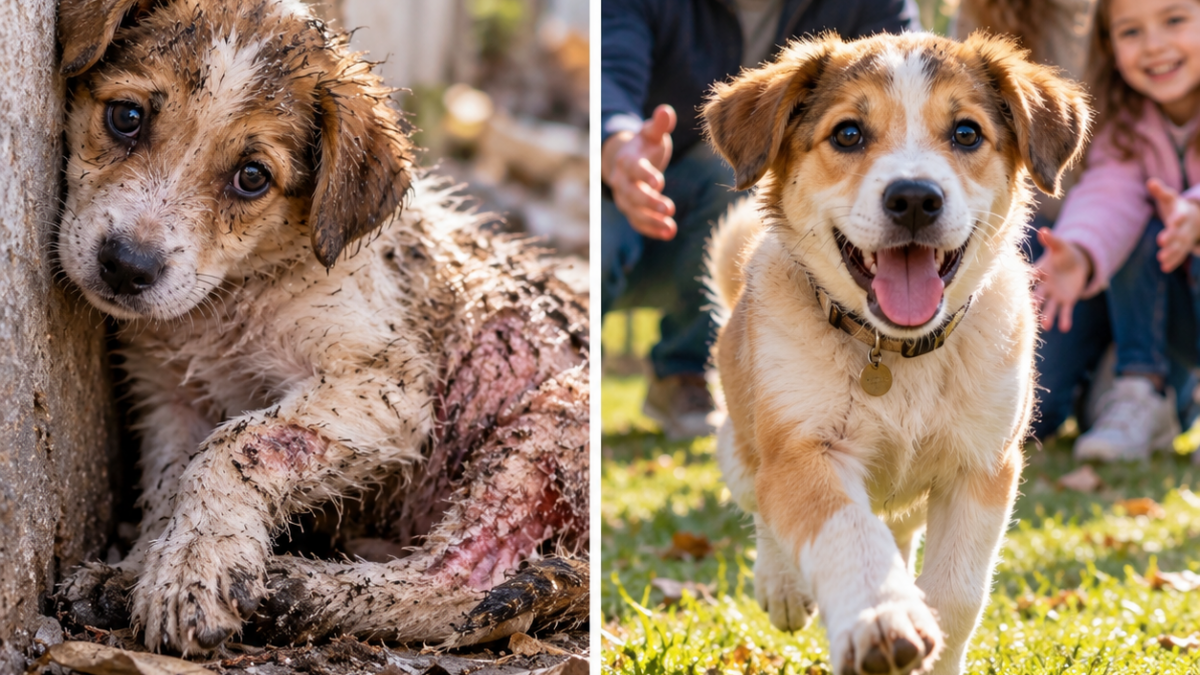
The puppy was pressed so tightly against the wall that when I slowly reached out to comfort him, he flattened himself even harder against the concrete, and in that instant I understood something that hurt more than the condition of his injured leg ever could—at only about five months old, Barney had already learned to be afraid of a raised human hand.
He was starving enough to swallow food so quickly that I had to slow him down between bites, exhausted enough to collapse after eating, and frightened enough to watch every movement I made as though kindness might suddenly turn into something else, yet somewhere beneath that fear was still a tiny part of him stubborn enough to stay alive until somebody finally heard him crying.
I thought rescuing Barney would mean cleaning his wounds, giving him medicine, filling his stomach, and finding him a home, but I would soon discover that healing his body was the easy part—and that the moment his past came closest to stealing his future would happen only after everyone believed he was finally safe.
I found Barney near the edge of an old service road behind several closed buildings, in a place people rarely had any reason to visit after dark, and if I had taken the main road home that evening instead of turning down that narrow stretch, I still don’t know how long he would have remained there.
I heard him before I saw him.
A thin cry.
Then silence.
Another cry.
It wasn’t a strong bark or the demanding sound of a healthy puppy calling for attention.
It sounded tired.
Almost uncertain.
As though even making noise had begun to feel pointless.
I followed it around a wall and stopped.
There he was.
A little puppy, maybe five months old, curled beside the concrete with one injured leg held awkwardly beneath him.
His coat was dirty.
His body looked too small.
The wound on his leg had been left untreated long enough that it desperately needed veterinary care, and even from several feet away I could tell he had been there far too long.
But what I remember most clearly was his face.
Barney didn’t rush toward me.
He didn’t wag his tail.
He didn’t cry louder because help had arrived.
He tried to disappear.
When I took one step forward, he pressed himself against the wall.
“It’s okay,” I whispered.
His eyes followed my hands.
I crouched.
“No one’s going to hurt you.”
I reached slowly toward him.
The second my hand rose, Barney flinched so sharply that I stopped.
He tucked his head down.
My heart dropped.
A puppy doesn’t react that way for no reason.
I didn’t need to know exactly what had happened before that evening.
His body language told me enough.
So I lowered my hand.
I sat on the ground several feet away.
And I waited.
For nearly ten minutes, neither of us moved much.
Then I opened a small container of food I kept in my rescue bag.
Barney smelled it immediately.
His nose lifted.
That was the first sign that he had not completely given up.
I placed the food in front of him and moved backward.
Barney stared at me.
Then at the bowl.
Then back at me.
Finally, hunger won.
He crawled forward.
The moment he started eating, he ate so fast that fear replaced relief.
“Slow down.”
He didn’t.
I moved the bowl away.
Barney looked up in panic.
“No, no. I’m not taking it.”
I gave him a smaller amount.
He swallowed it.
Then another.
We continued like that until he had eaten enough to settle.
For the first time, his body relaxed slightly.
I moved closer.
He didn’t retreat.
“That’s it,” I whispered. “We’re going somewhere warm.”
When I wrapped him in a blanket, he trembled.
But he didn’t resist.
I carried him toward the car, and the entire time his eyes remained fixed on my face.
That was how Barney’s old life ended.
Not with a dramatic rescue.
Not with applause.
Just a frightened puppy in my arms, still unsure whether the person carrying him was actually safe.
I had no idea how hard I was about to fight to prove that I was.
PART 2
The veterinarian took one look at Barney and moved faster than I expected.
“How long has he been like this?”
“I don’t know.”
“Do you know where he came from?”
“No.”
“Owner?”
“None that I know of.”
She nodded and carried him into the treatment area.
I stood in the hallway holding the blanket he’d been wrapped in.
It smelled like dirt, old rainwater, and dog.
I didn’t care.
I held it against my chest because it was the only part of Barney I had left while the medical team worked.
About forty minutes later, Dr. Collins came out.
“He’s stable.”
That word gave me enough air to breathe again.
“The wound on his leg is significant, but we believe we can manage it.”
“Can he keep the leg?”
“We don’t see any immediate reason he shouldn’t.”
I closed my eyes.
“Thank God.”
“He needs the affected area cleaned carefully, medication, fluids, nutrition, and monitoring.”
“What about the larvae?”
“We’re treating that.”
She chose her words professionally and without unnecessary detail.
I was grateful.
“Is he in pain?”
“He’s uncomfortable. We’re addressing that.”
I looked through the window.
Barney was lying beneath a clean blanket.
His eyes were still open.
“Will he recover?”
Dr. Collins hesitated just enough to make me nervous.
“Physically, I think his chances are good.”
“Physically?”
She looked at me.
“You saw the way he reacts when someone raises a hand?”
I nodded.
“That part may take longer.”
I already knew she was right.
## THE FIRST NIGHT
Barney stayed at the clinic.
I went home.
I lasted three hours.
At midnight, I called.
“He’s sleeping,” the technician told me.
“Did he eat?”
“A little.”
“How little?”
“Enough that we’re not worried.”
“Did he cry?”
“Not much.”
That answer somehow hurt.
I would rather have heard that he demanded attention.
That he barked.
That he fought sleep.
Anything except quiet.
The next morning, I was at the clinic before they officially opened.
Barney was awake.
When I entered the treatment room, he watched me.
No tail movement.
No excitement.
But he knew me.
I could see it.
I sat beside him.
“Hey.”
His ears moved.
“You remember me?”
Nothing.
“I brought chicken.”
That got a nose twitch.
I smiled.
“Exactly.”
We had a relationship now.
Mostly based on chicken.
It was a start.
## WHAT THE DOCTOR COULDN’T TREAT
Over the next week, Barney’s body improved quickly.
His temperature normalized.
His appetite became enormous.
His skin regained healthy color.
His wound began healing.
He tolerated his medication.
The medical team was encouraged.
I should have been relieved.
Instead, another problem became more obvious.
Barney was terrified of people.
Not aggressive.
Never aggressive.
That almost made it worse.
When frightened, he didn’t defend himself.
He froze.
If someone reached too quickly, he lowered his head.
If a door slammed, his entire body tightened.
If a man with a deep voice entered the room, Barney moved toward the farthest corner.
He watched feet.
Hands.
Doors.
Everything.
His body was recovering.
His mind was still living somewhere else.
One afternoon, Dr. Collins watched me sitting on the floor while Barney ate from my hand.
“You’re going to have to take him out of the clinic soon.”
“I know.”
“Do you have somewhere appropriate?”
“My house.”
“Other animals?”
“Three dogs.”
“Temperaments?”
“Stable.”
She nodded.
“That might help.”
“You think so?”
“Sometimes another dog teaches safety better than we can.”
That idea became the turning point.
## COMING HOME
The first day Barney came home, I prepared everything.
A quiet room.
Soft bed.
Water.
Food.
Baby gate.
No pressure.
My dogs—Milo, Daisy, and Rufus—were kept on the other side of the house initially.
I carried Barney inside.
The second I put him down, he moved toward the wall.
Again.
That wall.
I hated seeing it.
He positioned himself where he could watch the entire room.
I sat near the doorway.
“You don’t have to do anything.”
He stared at me.
“This is your room.”
Nothing.
“Temporarily.”
His ears moved.
“Unless you become impossible.”
Nothing.
“You might.”
Still nothing.
I laughed softly.
He watched me as if I were strange.
Maybe I was.
After twenty minutes, I opened the door slightly.
Milo appeared first.
Milo was a six-year-old mutt whose entire philosophy of life was that strangers existed to become friends.
He sniffed through the gate.
Barney stiffened.
Milo wagged.
Barney stared.
Daisy came next.
Then Rufus.
Three faces looking through the gate.
Barney looked from one to another.
Milo sneezed.
Rufus wagged.
Daisy lay down.
Something changed.
Barney’s body relaxed perhaps half an inch.
That was all.
But I saw it.
## THE FIRST SMILE
We introduced them slowly.
One dog at a time.
Neutral space.
Leashes loose.
Short interactions.
No pressure.
Milo went first.
He approached Barney in a curve rather than straight on.
Good manners.
Barney froze.
Milo sniffed.
Then walked away.
Barney looked confused.
Five minutes later, Milo returned carrying a rope toy.
He dropped it several feet from Barney.
Then backed away.
Barney looked at the rope.
Then Milo.
Milo lowered his front legs into a play bow.
For the first time, Barney’s tail moved.
I held my breath.
Milo bounced sideways.
Barney took one uncertain step.
Milo ran in a circle.
Barney took another.
Then suddenly, something extraordinary happened.
Barney jumped.
Not high.
Not gracefully.
Just a small puppy jump toward Milo.
Milo exploded into motion.
Barney followed.
Three seconds.
Maybe four.
Then Barney stopped because his recovering leg reminded him he wasn’t ready.
But his mouth opened.
His face changed.
His eyes changed.
I had seen hundreds of dogs pant.
I knew dogs didn’t literally smile in the human sense.
But if you had seen Barney at that moment, you would understand what I mean.
He looked happy.
Truly happy.
I sat down on the grass.
My eyes filled.
“I’ve been waiting for that.”
Barney glanced toward me.
Then back at Milo.
Milo grabbed the rope.
Barney grabbed the other end.
And for the first time since I found him, Barney looked like what he was.
A puppy.
## THE DOGS DID WHAT I COULDN’T
Humans had become complicated for Barney.
Dogs weren’t.
My dogs didn’t approach him with sympathy.
They didn’t ask about his past.
They didn’t care about the scar on his leg.
They didn’t care that he flinched when hands moved too quickly.
They had rules Barney understood.
Sniff.
Play.
Rest.
Eat.
Walk.
Sleep.
Repeat.
Within two weeks, Barney began following Milo around the house.
If Milo walked into the kitchen, Barney followed.
If Daisy slept near the couch, Barney chose a spot nearby.
If Rufus barked at the mail carrier, Barney stood behind him, trying to understand what emergency had occurred.
Usually none.
Rufus considered mail delivery a serious threat to national security.
Barney started learning.
The vacuum cleaner wasn’t dangerous.
The refrigerator opening usually meant something good.
The back door meant the yard.
Leashes meant walks.
My hand reaching toward his collar didn’t always mean fear.
Some nights, we regressed.
A dropped pan sent him running beneath the table.
Once, I raised a rolled newspaper to move it from the couch, and Barney disappeared into the hallway so quickly that I felt physically sick.
I put the newspaper down.
Sat on the floor.
Waited.
Ten minutes later, Milo came and sat beside me.
Then Daisy.
Then Rufus.
Barney watched from the hallway.
Milo yawned.
Daisy rested her head on my knee.
Rufus fell asleep.
Barney took one step.
Then another.
Eventually, he returned.
I didn’t touch him.
He lay down several feet away.
That was enough.
Healing was not a straight line.
## BECOMING A BIG BROTHER
Three months after Barney arrived, our rescue took in two very young puppies who needed temporary foster care.
I worried about introducing them.
Barney had become physically strong.
His coat shone.
His leg had healed.
He had grown taller and broader.
But emotionally, he was still sensitive.
The puppies were chaos.
One was named Peanut.
The other Oliver.
They entered my house like they owned it.
Barney stood in the hallway staring.
Peanut ran directly toward him.
I nearly intervened.
Barney stepped backward.
Peanut followed.
Barney looked at me.
“Sorry,” I said. “He’s rude.”
Peanut jumped toward Barney’s face.
Barney turned away gently.
No growl.
No snap.
Oliver arrived.
Now two puppies surrounded him.
Barney looked trapped.
Milo watched from the couch with obvious amusement.
Then Peanut grabbed Barney’s ear.
I gasped.
Barney slowly turned his head.
Peanut froze.
For one second, the room became silent.
Then Barney licked the puppy’s face.
I laughed.
Within days, Barney had become their protector.
He let them sleep against him.
He followed them into the yard.
If they played too far from the house, Barney herded them closer.
When Peanut cried during his first night, Barney left his own bed and lay beside the puppy crate.
The frightened puppy had become the dog making someone else feel safe.
That affected me more deeply than almost anything else.
## THE VIDEO THAT CHANGED EVERYTHING
Our rescue posted a short video online.
Nothing dramatic.
Barney lying on the floor while Peanut climbed across his back.
The caption explained that months earlier, Barney had been found frightened and injured, afraid even of a hand moving toward him.
Now he was helping foster puppies learn confidence.
The video spread.
Not millions.
But far beyond our usual audience.
Applications started arriving.
People wanted Barney.
I should have been excited.
Instead, I became terrified.
Because recovery had created a new challenge.
Letting him go.
## THE FIRST FAMILY
The first serious application came from a young couple.
Nice house.
Fenced yard.
Dog experience.
Excellent references.
On paper, perfect.
They visited.
Barney stayed behind me for ten minutes.
The woman crouched.
“It’s okay.”
Barney didn’t approach.
The man extended his hand.
Too quickly.
Barney backed away.
The man laughed.
“He’s really shy.”
“Yes.”
“How long does that last?”
I didn’t like the question.
“What do you mean?”
“How long until he’s normal?”
I looked at him.
“He is normal.”
“You know what I mean.”
I did.
And I hated it.
He wanted the beautiful version from the video.
Not the dog who sometimes still flinched.
The meeting ended politely.
I declined the application.
They were upset.
Maybe they would have been fine.
But Barney had already spent enough of his life being expected to become convenient for humans.
His home needed to accept who he was today.
Not only who he might become tomorrow.
## THE SECOND FAMILY
A woman named Lisa came next.
She lived alone.
Quiet home.
Older dog.
She spent an hour sitting on my patio without trying to touch Barney.
Barney eventually approached.
Sniffed her shoe.
She didn’t move.
Good.
He came closer.
She smiled.
I thought this might be it.
Then she told me she traveled for work almost every week.
Barney would spend long hours with a dog sitter.
Maybe he could adjust.
But his separation anxiety still surfaced sometimes.
I couldn’t do it.
I declined.
Lisa understood.
That made it harder.
## WAS I PROTECTING HIM OR KEEPING HIM?
One evening, my friend Rachel visited.
Not Mishka’s Rachel—another rescue volunteer named Rachel who had known me for years.
She watched Barney sleeping beside Peanut and Oliver.
“How many applications have you rejected?”
“Five.”
“How many were terrible?”
I hesitated.
“Two.”
“And the other three?”
“Not right.”
“For Barney?”
“Yes.”
“Or for you?”
I looked at her.
“Don’t.”
“I’m serious.”
“I’m protecting him.”
“I know.”
“Then what?”
“Sometimes protecting becomes another form of refusing to trust.”
That irritated me.
Barney lifted his head at our voices.
I lowered mine.
“He finally trusts this house.”
“Exactly.”
“What if he goes somewhere else and shuts down?”
“Then you choose carefully.”
“What if they return him?”
“Then you take him back.”
“What if—”
“Emma.”
I stopped.
“Barney learned to trust again.”
She looked directly at me.
“Maybe you’re the one who hasn’t.”
That hurt because it was true.
## THE FAMILY FROM DOWNTOWN
Their application arrived on a Thursday.
David and Melissa Carter.
Two children, ages eleven and fourteen.
A house near the center of town with a fenced backyard.
Both adults worked mostly from home.
Previous dog had died at age fifteen.
Veterinary reference excellent.
They had watched Barney’s video.
But their application included a sentence that caught my attention:
**We understand that Barney may never become fearless. We are not looking for a fearless dog. We are looking for Barney.**
I read it three times.
The first meeting was scheduled for Saturday.
I barely slept Friday.
## THE MEETING
My dogs knew something was happening because I cleaned the house.
This was suspicious behavior.
Barney followed me from room to room.
At eleven, the family arrived.
David came in first.
He was tall.
That worried me because Barney sometimes became nervous around unfamiliar men.
But David didn’t approach.
He sat on the floor.
Melissa sat beside him.
Their daughter Emily held a bag of treats but didn’t offer one immediately.
Their son Jake looked at Barney and smiled.
Nobody called him.
Nobody reached.
For almost fifteen minutes, they talked to me instead.
Barney watched.
Then Milo entered.
Milo went directly to David.
Traitor.
David scratched him.
Barney watched.
Daisy approached Melissa.
Barney watched.
Rufus demanded attention from everyone.
Barney watched.
Finally, Barney moved forward.
One step.
Then another.
He sniffed David’s shoe.
David kept talking to me.
Barney sniffed his knee.
Still nothing.
Then David slowly placed his hand palm-up on the floor.
Barney smelled it.
The room became very quiet.
Then Barney touched his nose to David’s fingers.
David didn’t move.
“Good boy,” he whispered.
Barney stepped away.
Then returned.
My eyes started burning.
Melissa noticed.
She smiled but said nothing.
Emily eventually offered a treat.
Barney took it.
Jake rolled a tennis ball across the floor.
Barney looked at it.
Then chased it.
Milo chased Barney.
Peanut chased everybody.
Within minutes, the room turned chaotic.
Barney ran back holding the ball.
Jake laughed.
“He’s fast.”
I watched Barney.
No wall.
No corner.
No trembling.
Just a dog carrying a tennis ball in a room full of strangers.
I knew.
## THE PROBLEM
The adoption should have been simple after that.
It wasn’t.
Two days later, David called.
His voice sounded different.
“We need to talk.”
My stomach dropped.
“What happened?”
“Our landlord.”
I froze.
“You rent?”
“We own the house. But the property association has breed restrictions in the neighborhood documents.”
“What breed is Barney?”
“That’s the problem. His paperwork says mixed breed, but someone from the association saw the video and thinks he looks like a restricted type.”
Anger flooded me.
“So they won’t allow him?”
“We’re checking.”
That night, I couldn’t sleep.
Barney had survived everything.
Now a sentence in a neighborhood rule might keep him from the family who had finally felt right.
The Carters didn’t quit.
They contacted their veterinarian.
Obtained Barney’s records.
Reviewed the association documents.
Requested clarification.
Days passed.
The adoption went on hold.
Barney knew nothing.
Every morning, he played with Peanut.
Every afternoon, he slept beside Milo.
I knew something he didn’t.
A door had almost opened.
Now it might close.
## THE WAIT
On the fifth day, Melissa came to visit alone.
She sat on the floor.
Barney immediately approached her.
That told me how much the first meeting had mattered.
“He remembers you.”
“I’ve been thinking about him constantly.”
“What did the association say?”
“Still reviewing.”
I sighed.
Melissa scratched Barney gently beneath the chin.
“We’re not walking away.”
“You might have no choice.”
“We’ll see.”
“What if they refuse?”
She looked at me.
“Then we challenge it through the proper process.”
I smiled faintly.
“You’re stubborn.”
“Ask my husband.”
Barney leaned against her leg.
Melissa looked down.
“See? He appreciates it.”
## THE DECISION
Three days later, David called.
“They approved him.”
I nearly shouted.
“What?”
“The restriction doesn’t apply to a documented mixed-breed dog based solely on appearance. Our vet provided the necessary records.”
I sat down.
“You’re serious?”
“Can we bring our boy home?”
Our boy.
That was it.
I started crying.
David laughed.
“Is that yes?”
“Saturday.”
“Why not today?”
“Because I need two days to emotionally collapse.”
“Fair.”
I hung up.
Barney was in the kitchen.
He looked at me.
“You’re leaving.”
Tail wag.
“You have no idea.”
He walked over.
I knelt.
“You’re getting your family.”
He licked my face.
It was deeply unfair.
## THE LAST NIGHT
I expected to feel happy.
I did.
But grief sat beside happiness.
Barney slept in my room.
He had begun doing that only recently.
I lay awake listening to him breathe.
I remembered the wall.
The food.
The clinic.
The first tail wag.
The first game with Milo.
Peanut sleeping against him.
The newspaper incident.
The first time Barney voluntarily put his head beneath my hand.
Now he was leaving.
“This was always the plan,” I whispered.
Barney slept.
“You’re not supposed to make this difficult.”
Nothing.
“I hope you know that.”
His ear moved.
I laughed quietly.
“Of course you don’t.”
## GOODBYE
Saturday morning arrived too fast.
The Carters were meeting us at a small park near the center of town before taking Barney home.
I loaded his bed.
Food.
Medical records.
Medication history.
Favorite toys.
Blanket.
Treats.
Then Barney’s friends somehow realized something was happening.
Milo followed him to the door.
Daisy stood near the car.
Rufus whined.
Peanut and Oliver ran in circles.
Barney looked from one dog to another.
My throat tightened.
“They know.”
Rachel stood beside me.
“Maybe.”
Barney touched noses with Milo.
Then Daisy.
Then Rufus.
Peanut tried to climb into the car with him.
I laughed through tears.
“No.”
Peanut disagreed.
Eventually, we drove away.
Barney sat in the back seat watching through the window.
At the park, the Carters were already waiting.
Emily saw the car.
“There he is!”
Barney heard her.
His ears lifted.
When I opened the door, he jumped down.
Then he saw them.
And ran.
Not away.
Toward them.
That was the moment I lost control.
Barney ran directly toward David.
David crouched.
Barney crashed into him.
Melissa hugged both of them.
The kids laughed.
I stood beside the car crying.
Months earlier, Barney had flattened himself against a wall when I lifted one hand.
Now he was running toward human arms.
There are moments in rescue you never forget.
That was mine.
## THE FIRST WEEK HOME
The Carters sent updates constantly.
Day one:
Barney sleeping beneath the dining table.
Day two:
Barney discovering the backyard.
Day three:
Barney sitting beside Emily during homework.
Day four:
Barney stealing one of Jake’s socks.
Caption:
**We have identified his first crime.**
I laughed.
Day five:
Barney riding in the car.
Day six:
Barney asleep between David and Melissa on the couch.
Day seven:
A family photograph.
Barney in the middle.
His mouth open.
Eyes bright.
Happy.
I stared at it for a long time.
Then I realized something.
I no longer looked at his scar first.
Months earlier, it was the first thing I noticed.
Now I saw Barney.
## THE FIRST SETBACK
Three weeks later, Melissa called.
I heard worry immediately.
“Barney had a bad night.”
“What happened?”
“A thunderstorm.”
My stomach tightened.
“He hid behind the couch. David tried to bring him out, and Barney panicked.”
“Did he bite?”
“No. Nothing like that. He just shut down.”
“Where is he now?”
“Under my desk.”
“Eating?”
“Yes.”
“Good.”
I explained what had helped before.
Don’t force.
Stay nearby.
Let another routine happen.
Food.
Calm voice.
Predictability.
“Are you thinking about returning him?”
The question came out before I could stop it.
Melissa went silent.
Then:
“Emma.”
“Yeah?”
“Absolutely not.”
I closed my eyes.
“Sorry.”
“We knew he came with history.”
I started crying again.
“Stop doing that,” she said.
“I can’t.”
“You really can’t.”
That evening, she sent a photo.
Barney asleep with his head on David’s foot.
Caption:
**Still ours.**
Those two words mattered more than any dramatic promise.
## SIX MONTHS
Six months after adoption, I visited.
I almost didn’t recognize him.
Not physically.
He still looked like Barney.
But his body language had changed.
He greeted me at the gate.
Tail high.
Relaxed.
Confident.
He remembered me instantly.
Barney jumped against my legs.
“Hey!”
He licked my face.
Behind him, Emily laughed.
“He doesn’t do that to everyone.”
“Good.”
I looked toward David.
“Please tell me he has manners.”
David considered.
“No.”
Barney ran toward the backyard.
Jake threw a ball.
Barney chased it.
He moved strongly.
His leg was fully healed.
The puppy who had once barely eaten without fear now ran across grass like the entire yard belonged to him.
Maybe it did.
## THE TRIPS BEGIN
The Carters traveled often.
Not far at first.
Weekend cabin.
Lake.
Hiking trails.
Beach.
Barney went everywhere.
Melissa sent photographs.
Barney beside a lake.
Barney sleeping in a hotel bed.
Barney wearing an absurd life jacket.
Barney sitting between the children in the back seat.
Barney looking at mountains.
Barney at the ocean.
His world kept expanding.
The place where I found him had been a few square feet of concrete and dirt.
Now his world contained highways.
Forests.
Water.
Cities.
Open fields.
Hotel rooms.
Family kitchens.
The back seat of a car full of snacks.
That felt like revenge.
## PEOPLE SOMETIMES ASKED WHAT HAPPENED TO HIM BEFORE
We never found out.
No former owner appeared.
No reliable witness came forward.
Nobody could tell us exactly why Barney was there.
Maybe he had been abandoned.
Maybe he wandered away from somewhere terrible.
Maybe he belonged to someone who never looked for him.
I stopped needing the answer.
For months, I had imagined finding whoever had frightened him.
I wanted someone to explain the way Barney flattened himself against walls.
Explain why he feared raised hands.
Explain why a five-month-old puppy ate as though every meal might be his last.
Then I realized something.
There was no explanation that would make me feel better.
And Barney did not need me to solve his past in order to protect his future.
That became our justice.
## BARNEY’S REVENGE
People sometimes use the word revenge as if it has to mean someone else losing.
Barney taught me a better version.
His revenge was the first time he fell asleep without watching the door.
His revenge was Milo teaching him to play.
His revenge was becoming a patient big brother to Peanut and Oliver.
His revenge was refusing to remain the frightened puppy someone had created.
His revenge was running toward David instead of away.
His revenge was a family fighting paperwork rather than deciding he was too complicated.
His revenge was hearing thunder and discovering that nobody sent him away afterward.
His revenge was growing strong.
Growing handsome.
Growing loved.
It wasn’t loud.
But it was complete.
## ONE YEAR
On the anniversary of the rescue, Melissa invited me to their house.
Barney was bigger.
Much bigger.
He had grown into his long legs and broad chest.
His coat shone.
His scar was still visible if you knew where to look.
Most people didn’t notice.
The children decorated a small dog-friendly cake.
The top said:
**BARNEY’S FIRST DAY**
Not birthday.
We didn’t know his birthday.
So they celebrated the day he had been found.
The day his life began again.
David lifted the cake.
“Speech.”
“No.”
“You’re the one who found him.”
“Absolutely not.”
Emily pointed.
“Speech.”
Everyone joined.
I surrendered.
Barney sat below me staring at the cake.
“I’m pretty sure nobody here cares what I say except the dog.”
Correct.
I looked at him.
“One year ago, this dog didn’t trust my hand.”
Barney’s attention remained on the cake.
“Today he trusts all of you.”
Melissa put one hand over her mouth.
I continued.
“I used to think rescue meant changing an animal’s fate.”
My voice tightened.
“But Barney changed mine too.”
David looked down.
Emily cried.
Jake pretended he wasn’t crying.
Barney barked.
Everyone laughed.
“Fine,” I said. “Give him the cake.”
## THE DOG IN THE MIRROR
There was a large mirror near the Carter family’s hallway.
Barney had apparently never noticed it.
During my visit, he suddenly saw himself.
He stopped.
Stared.
Then walked closer.
The other dog in the mirror approached.
Barney tilted his head.
I laughed.
“Who’s that?”
He sniffed the glass.
For some reason, the moment affected me.
Maybe because I remembered the tiny puppy pressed against concrete.
Now the reflection showed a strong young dog.
Muscular.
Healthy.
Confident.
If Barney could understand mirrors the way we do, I wondered whether he would recognize how much he had changed.
Probably not.
Dogs are fortunate that way.
They don’t spend their lives comparing themselves to old photographs.
## TWO YEARS
By the second anniversary, Barney had become inseparable from the family.
He slept near Emily’s room.
Waited for Jake to come home.
Sat beside David during morning coffee.
Followed Melissa around the kitchen.
He remained cautious with certain strangers.
That never disappeared completely.
And that was okay.
The family respected it.
They didn’t force greetings.
Didn’t let strangers crowd him.
Didn’t treat his boundaries as defects.
Barney didn’t need to become a dog who loved every human.
He needed humans who understood him.
There is a difference.
## PEANUT RETURNS
Peanut was adopted too.
Almost a year after Barney left, Peanut’s family contacted the Carters through our rescue.
We arranged a reunion.
I wondered whether the dogs would remember.
Barney arrived first.
Peanut jumped from the other car.
They froze.
Then Peanut ran.
Barney ran.
Whatever recognition dogs experience, something happened.
They collided in the middle of the field.
Play bow.
Chase.
Wrestle.
Run.
Barney was bigger.
Peanut didn’t care.
For nearly an hour, they played.
I watched from the fence.
Rachel stood beside me.
“You’re crying.”
“No.”
“You are.”
“Wind.”
“There is no wind.”
“Leave me alone.”
## THE OLD WALL
Three years after I found Barney, construction began near the place where he’d been rescued.
The old buildings were being renovated.
The wall was scheduled for demolition.
I drove past alone one afternoon.
I stopped.
For years, that wall had existed in my memory as the place Barney had tried to disappear.
I stood there.
No dog.
No bowl.
No fear.
Just concrete.
I thought I would feel anger.
Instead, I felt nothing toward the wall.
It was only a wall.
Barney had made it powerful because of what happened there.
Now Barney was hundreds of miles away on a family road trip.
Melissa had sent a photograph that morning.
Barney standing beside a lake.
I opened it.
Then looked at the wall.
“You’re irrelevant now,” I whispered.
Two weeks later, the wall came down.
I didn’t go watch.
## THE LIFE HE WASN’T SUPPOSED TO HAVE
Barney traveled farther than I ever expected.
The Carters took a summer trip through several states.
They planned every stop around dog-friendly locations.
Barney hiked short trails.
Visited beaches.
Slept in cabins.
Rode through mountains.
Watched rain from a porch.
Stole food from a picnic table once.
David sent me:
**Your son committed another crime.**
I replied:
**He’s your son now.**
David:
**Convenient.**
Barney became known among their friends.
The nervous rescue.
Except eventually, new people stopped knowing the first part.
To them, he was simply Barney.
That mattered.
His trauma stopped being his introduction.
## FIVE YEARS
Five years after rescue, Barney’s muzzle showed the first tiny flecks of gray.
I protested.
“Impossible.”
Melissa laughed.
“He’s an adult.”
“No.”
“He is.”
“He was five months old yesterday.”
Barney leaned against me.
He still remembered.
Every visit, he greeted me.
But when it was time for me to leave, he stayed with his family.
That used to hurt.
Then I realized it was exactly what I had wanted.
A rescue should not spend forever looking backward toward the person who saved him.
He should look forward toward the people who became home.
## THE BOY WHO WAS AFRAID OF DOGS
One summer, Barney did something nobody had planned.
A neighbor’s son named Caleb was terrified of dogs.
He had been frightened during an encounter years earlier.
When Barney was outside, Caleb crossed the street.
Melissa never pushed him.
One day, Barney was lying on the porch while Caleb’s mother spoke with Melissa.
Caleb stayed near the sidewalk.
Barney looked at him.
Didn’t move.
Eventually, Caleb asked:
“Does he bite?”
Melissa answered honestly.
“He has never bitten anyone here. But you don’t have to touch him.”
Caleb stayed.
Barney stayed.
The next week, same thing.
Then Caleb moved closer.
Eventually, he sat on the lowest porch step.
Barney remained several feet away.
Weeks later, Caleb offered a treat.
Barney took it gently.
The boy smiled.
Melissa later told me:
“They’re both learning.”
That sentence stayed with me.
A dog once afraid of humans helped a child become less afraid of dogs.
Life loves circles.
## WHEN BARNEY GOT SICK
At seven years old, Barney suddenly stopped eating.
Melissa called me.
Old fear returned instantly.
They rushed him to the veterinarian.
Tests.
Waiting.
More tests.
Eventually, the diagnosis was treatable gastrointestinal inflammation.
Nothing catastrophic.
But those twenty-four hours destroyed me.
I drove to the clinic.
Barney was lying beside Melissa.
When he saw me, his tail moved.
“You scared us.”
He looked tired.
“You are not allowed to do that.”
Melissa laughed weakly.
Barney recovered.
But the episode reminded us of something we didn’t like thinking about.
Time had been moving.
## HIS FIRST DAY, EVERY YEAR
The Carters never stopped celebrating Barney’s first day.
Every year.
A small cake.
Photographs.
Sometimes Peanut visited.
Sometimes Milo and Daisy did when they were still healthy enough.
Over time, the photos became a timeline.
Year one: young, strong, slightly uncertain.
Year two: confident.
Year three: broad-chested, bright-eyed.
Year four: sprawled across the family’s couch.
Year five: gray beginning around the chin.
Year six: children taller.
Year seven: David with more gray hair.
Year eight: Barney moving slightly slower.
The family grew around him.
## MILO
Milo eventually grew old.
When his health declined, I called Melissa.
“Can Barney visit?”
They came the next day.
Milo was lying on a blanket.
Barney walked inside.
He stopped.
Milo lifted his head.
Their noses touched.
I cried before anything happened.
Barney lay down beside him.
Remember, Milo had been the first dog to invite Barney to play.
The first one to show him that a home could be safe.
Now Barney stayed beside his old friend.
Milo died peacefully several days later.
Barney had already gone home.
I’m glad.
Their final memory of each other was quiet.
Two dogs resting together.
## GROWING OLD
Barney reached ten.
Then eleven.
His legs slowed.
The leg that had been injured as a puppy developed arthritis earlier than the others.
The veterinarian created a treatment plan.
Medication.
Weight control.
Gentle exercise.
Soft bedding.
Shorter hikes.
The endless road trips became easier trips.
Cabins instead of long trails.
Beaches with fewer stairs.
More time sitting in sunlight.
Barney didn’t care.
He wanted the family.
Location was secondary.
## EMILY LEAVES FOR COLLEGE
When Emily left for college, Barney waited near her room.
For days.
Melissa sent me a photo.
“He’s confused.”
Emily video-called him.
He recognized her voice.
His ears lifted.
He searched the room.
That broke everyone.
When Emily returned for Thanksgiving, Barney heard the car.
He moved faster than anyone had seen him move in months.
He met her at the door.
Tail everywhere.
Whole body wagging.
Emily dropped her bags and hugged him.
David recorded it.
I watched the video several times.
That frightened puppy had grown into someone’s childhood dog.
Think about that.
Someone’s childhood dog.
He was part of memories now.
## THE DAY DAVID RAISED HIS HAND
Years after Barney’s adoption, David told me about a moment that had terrified him.
He was repairing a shelf.
A hammer slipped.
He lifted his hand quickly.
Barney flinched.
Just once.
After all those years.
David froze.
Barney looked at him.
For a second, the past entered the room.
Then David lowered his hand.
“Sorry, buddy.”
Barney walked toward him.
David knelt.
Barney put his head beneath David’s hand.
That was healing.
Not forgetting.
Choosing the present over the memory.
## TWELVE YEARS OLD
At twelve, Barney slept more.
His hearing softened.
His eyes became slightly cloudy.
But he still recognized important sounds.
Food bag.
Car keys.
Emily’s voice.
Jake arriving.
David saying:
“Road trip.”
The last one still produced excitement.
Their journeys became short.
A nearby lake.
A cabin two hours away.
An overnight stay by the coast.
Barney moved slowly.
But he went.
Because the family understood something.
The point had never been distance.
It was togetherness.
## HIS FINAL TRIP
Barney’s last trip was to a quiet lake where the Carters had taken him years earlier.
Melissa invited me.
I almost refused.
I felt like I was entering something private.
She insisted.
“You were his first safe person.”
That sentence convinced me.
Barney walked slowly toward the water.
David supported him with a harness.
Emily and Jake—both adults now—walked beside him.
We reached the shore.
Barney stopped.
Wind moved across his face.
He sniffed.
Then sat.
We all sat with him.
Nobody spoke for a while.
I looked at his gray face.
His eyes.
Still those eyes.
But completely different.
No fear.
No desperation.
Just age.
Peace.
Belonging.
I touched his shoulder.
“Long way from that wall.”
Melissa cried.
I hadn’t meant to make her cry.
Then everyone cried.
Barney looked irritated by the emotional weakness of his humans.
## THE LAST MONTH
His health declined gradually.
There was no sudden tragedy.
His body simply became tired.
Eating took more encouragement.
Standing took more effort.
The veterinarian helped the family manage his comfort.
One morning, Melissa called.
“I think we’re close.”
I knew what she meant.
I drove there.
Barney was on his bed near the living-room window.
Family photographs surrounded the room.
Trips.
Birthdays.
Graduations.
Holidays.
And in almost every group photograph, somewhere, there was Barney.
Sometimes looking at the camera.
Sometimes looking away.
Sometimes asleep.
Always there.
I sat beside him.
His eyes opened.
“Hey, handsome.”
His tail moved.
Just once.
That was enough.
David sat opposite me.
“You remember the first time he ran toward us?”
I laughed through tears.
“I thought my heart was going to stop.”
Emily sat beside Barney.
“I was eleven.”
Jake said:
“I was fourteen.”
Melissa touched Barney’s paw.
“We got more time than we deserved.”
“No,” I said.
Barney looked toward us.
“You gave him exactly what he deserved.”
## THE LAST DAY
The family chose a peaceful goodbye at home.
No unfamiliar clinic.
No stressful final car ride.
His favorite bed.
His people.
Sunlight.
I had always thought Barney’s story began with me finding him.
I was wrong.
His story had begun before me.
I simply entered during the bad chapter.
The Carters wrote everything that came after.
Barney’s breathing slowed.
Melissa whispered:
“You’re safe.”
Those words.
I remembered saying them beside the wall.
You’re safe.
Back then, Barney didn’t believe me.
Now he did.
Completely.
David touched his head.
Emily held his paw.
Jake sat on the floor.
I stayed beside them.
Barney looked around once.
Then rested.
His final moments were quiet.
Loved.
Home.
Exactly what his first moments with us had not been.
## AFTER BARNEY
The Carters kept his collar.
I kept his original rescue photograph.
For months, I couldn’t look at it.
When I finally did, I barely recognized him.
Tiny.
Frightened.
Pressed against that wall.
Then I placed beside it a photograph from his final lake trip.
Same dog.
Same eyes.
Different life.
That is the photograph pairing I show new volunteers now.
Not to make them sad.
To make them understand.
You cannot always change what happened before you arrived.
But you may be able to change everything that comes after.
## THE FAMILY’S NEXT DOG
A year later, Melissa called.
“We’re thinking about adopting.”
I smiled.
“Good.”
“But there’s a problem.”
“What?”
“We found two.”
I laughed.
Of course.
A bonded pair.
Older dogs.
Nobody wanted to separate them.
David said:
“Apparently Barney trained us badly.”
They adopted both.
The first photograph showed the two new dogs asleep on Barney’s old rug.
Not replacing him.
Nothing could.
Just continuing what he had taught them.
## THE REAL REVENGE
Years ago, when I first carried Barney away from that wall, I wanted revenge on whoever had made him afraid.
I wanted answers.
Names.
Consequences.
I imagined that justice would mean finding the person responsible and making them understand what they had done.
Life never gave me that.
No confession.
No dramatic confrontation.
No person standing in front of me asking forgiveness.
For a long time, that bothered me.
Then Barney’s life gave me a better answer.
Whoever made him believe hands were dangerous did not get the final word.
David’s hands became safe.
Melissa’s hands became safe.
Emily’s.
Jake’s.
Mine.
Whoever left him hungry did not get the final word.
Barney became the dog who stood beside the kitchen waiting for snacks.
Whoever left him frightened did not get the final word.
He became the dog running toward his family.
Whoever reduced his world to one cold wall did not get the final word.
Barney saw lakes.
Mountains.
Beaches.
Cabins.
Forests.
Roads.
Backyards.
Bedrooms.
Holiday mornings.
Graduations.
Years.
Love.
That was his revenge.
He lived so fully that what happened before rescue became the smallest part of his story.
## WHY I STILL THINK ABOUT THAT FIRST NIGHT
Sometimes I wonder:
What if I hadn’t heard him?
What if the wind had been louder?
What if I had driven another road?
What if I’d decided the sound was nothing?
Those questions can become dangerous.
Because rescue depends on chance more often than we want to admit.
Barney was lucky.
But luck only mattered because someone acted when the opportunity appeared.
I don’t think I was chosen by fate.
I took a road.
I heard a sound.
I stopped.
That’s enough.
Sometimes changing a life begins with something very ordinary.
Stopping.
Looking.
Refusing to assume somebody else will handle it.
## THE PHOTO ON MY DESK
I still keep a photograph of Barney.
Not the rescue photograph.
Not the wound.
Not the wall.
The photograph I chose shows Barney standing between the Carters on a trail.
David on one side.
Melissa on the other.
Emily and Jake behind them.
Barney in front.
Mouth open.
Eyes bright.
His scar barely visible.
If someone who didn’t know the story looked at that picture, they would see a happy family dog.
Exactly.
That’s what I want them to see.
Because Barney should not be remembered only for what he survived.
He should be remembered for what he became.
## WHAT BARNEY TAUGHT ME
Barney taught me that physical wounds sometimes heal before fear does.
That patience is not waiting passively.
It’s repeating safety until someone believes you.
That a scared dog isn’t ungrateful.
That a setback doesn’t erase progress.
That another animal can sometimes reach a frightened heart faster than a human can.
That adoption doesn’t mean the rescue ends.
It means the next part begins.
That the right family doesn’t ask:
“How quickly will he become easier?”
They ask:
“What does he need?”
And most of all:
A terrible beginning does not demand a terrible ending.
## IF I COULD SPEAK TO THAT PUPPY
If I could return to the evening I found him, I would sit beside the wall again.
I wouldn’t rush.
I wouldn’t try to touch him.
I would place the food down exactly the same way.
Then I would tell him:
“Barney, I know you don’t believe me yet.
“You’re going to heal.
“Your leg is going to become strong.
“You’re going to meet a ridiculous dog named Milo who will teach you how to play.
“Two puppies are going to climb all over you, and instead of being afraid, you’re going to become their big brother.
“You’re going to discover tennis balls.
“You’re going to sleep on couches you’re technically not allowed to use.
“You’re going to meet four people who won’t care how long it takes you to trust them.
“One day, you’re going to see them across a park and run toward them so fast that the woman who rescued you is going to cry like an idiot.
“Thunder will still scare you sometimes.
“Hands might still surprise you.
“But nobody is going to send you away for being afraid.
“You’re going to ride in cars because you’re traveling somewhere fun.
“You’re going to see mountains.
“You’re going to stand beside lakes.
“You’re going to watch two children grow into adults.
“You’re going to become old enough for your face to turn gray.
“And when your legs become tired years from now, people are going to slow down for you instead of leaving you behind.
“You won’t spend your last day alone.
“You’ll spend it surrounded by the people who built their lives around loving you.
“So eat.
“Rest.
“Stay.
“You don’t have to trust me tonight.
“Just survive tonight.”
I think about that often.
Because when I found Barney, I wanted him to understand immediately that he was safe.
Now I know trust doesn’t work like that.
You don’t tell a frightened heart that the world has changed.
You show it.
Again.
Again.
Again.
Until one day, the frightened puppy doesn’t notice he’s stopped waiting for something bad to happen.
He’s too busy living.
## BARNEY’S FINAL VICTORY
The wall where I found him is gone now.
The buildings have changed.
People pass through the area without knowing a puppy once curled there.
That’s fine.
I don’t need a plaque.
I don’t need the place preserved.
Barney’s life is the monument.
A photograph at a lake.
A tennis ball under someone’s couch.
A family celebrating the day they met him.
Two older rescue dogs sleeping on his old rug.
A boy who learned not every dog should be feared.
A group of puppies who once slept against a gentle big brother.
And four people who still say his name whenever they talk about the best dog they ever knew.
Whoever hurt Barney disappeared from his story.
Barney didn’t.
That might be the most satisfying ending possible.
The frightened puppy outlived the fear.
The abandoned puppy became irreplaceable.
The dog waiting for someone to notice him became the dog a family rearranged its entire life around.
And the puppy who once backed away from a raised hand eventually spent years pushing his head beneath the hands of people he trusted because he wanted them to keep petting him.
That was the part that always broke me.
Not the wall.
Not the clinic.
Not the first night.
That.
Trust returning.
Love becoming normal.
Safety becoming boring.
A home becoming permanent.
Those are the victories people rarely photograph.
But they’re the ones that matter most.
## THE END
I used to say I changed Barney’s fate.
I don’t say that anymore.
Too many people changed it.
The veterinarian who treated him.
The volunteers who sat beside him.
Milo, Daisy, and Rufus.
Peanut and Oliver.
The Carters.
And Barney himself.
I only opened the first door.
Barney walked through the rest.
Sometimes slowly.
Sometimes nervously.
Sometimes with his tail tucked.
Eventually with confidence.
Then one day he ran.
I can still see that moment.
The park.
David crouching.
Melissa crying.
Emily calling his name.
Jake laughing.
Barney running straight toward them.
No wall behind him.
No fear holding him.
No hesitation.
Just home ahead.
If someone asked me to choose one image that explains Barney’s entire life, it would be that one.
Not where I found him.
Where he was going.
Because rescue should never be about trapping an animal forever inside the worst moment of its life.
Barney was more than an injured puppy.
More than a frightened puppy.
More than a sad photograph.
He became a friend.
A brother to smaller dogs.
A family dog.
A travel companion.
A child’s memory.
An old gray face sleeping safely near people who loved him.
He got the life every frightened animal deserves.
Not perfect.
Not without difficult days.
But full.
And when I think about that first evening now, I don’t ask anymore:
“What if I hadn’t found Barney?”
Instead, I think about what happened because I did.
A puppy lived.
Then he trusted.
Then he loved.
Then he was loved back.
Then he grew old.
And somewhere between that wall and his final peaceful morning, Barney proved something I wish every frightened animal could know:
The worst day of your life does not get to decide how your story ends.
Barney’s certainly didn’t.
His story ended exactly where it should have—
not against a wall,
not waiting to be saved,
but at home,
surrounded by his family,
after a lifetime of journeys,
with nothing left to fear.

