PART 2: I Came to Adopt the Shelter’s Favorite Golden Retriever—But He Refused to Leave Without the Pit Bull Hiding Behind Him
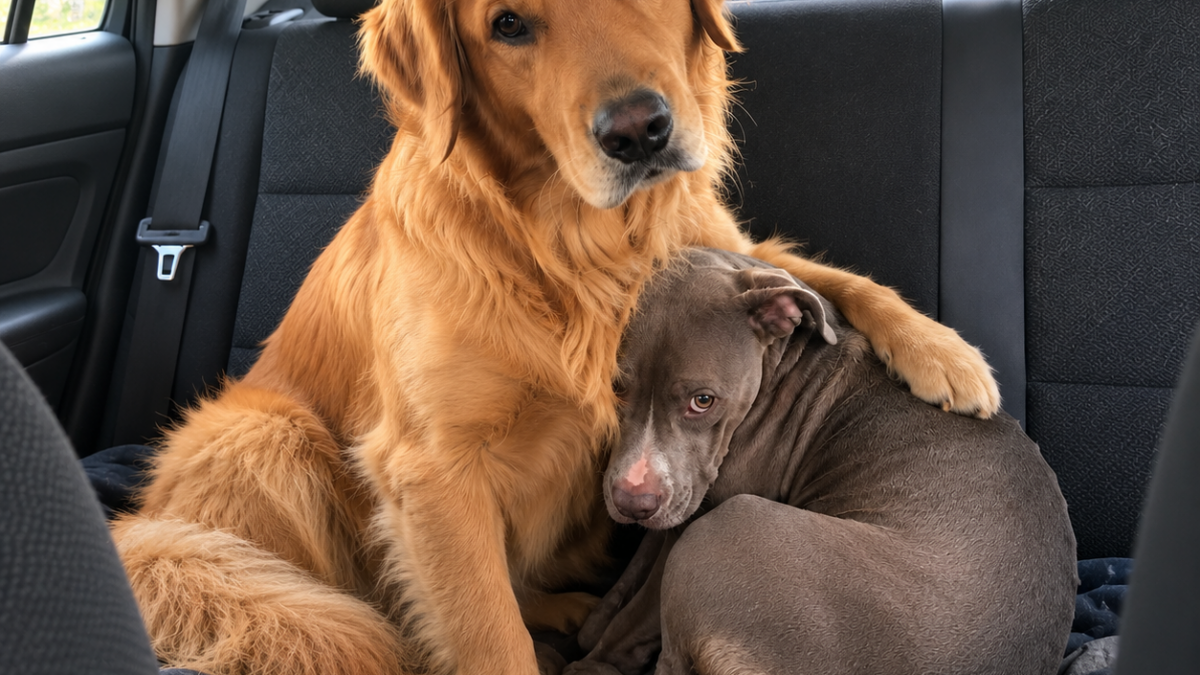
I walked into the shelter that morning absolutely certain I was going home with Charlie, the golden retriever everyone had told me was impossible not to love.
What I didn’t expect was the frightened Pit Bull pressed against the back wall of his kennel—or the way Charlie kept stepping between her and every person who came too close.
By the time a volunteer finally told me what had happened to those two dogs before they arrived there, the adoption I had planned was no longer the decision I was facing.
My name is Jacob. I was twenty-seven years old, living alone in a small second-floor apartment, and this was going to be my first dog adoption.
I had spent months thinking about it.
I wanted a dog who would walk with me in the mornings, wait near the door when I came home, and make my apartment feel less like a place where I slept between workdays and more like an actual home.
My friends kept telling me about Charlie.
“You’ll love him,” one said.
“He loves everybody.”
Another friend described him as “a walking ray of sunshine with fur.”
So on a Saturday morning, I drove to the county shelter expecting a fairly simple decision.
Then Charlie saw me.
His tail started swinging so hard his entire body moved with it.
He bounced toward the kennel door, planted his front paws against the gate, and pushed his nose between the bars.
“That’s Charlie,” a volunteer behind me said, laughing.
I turned.
Her name tag read **SARAH**.
“He seems subtle.”
“Very.”
Charlie licked my fingers.
He was everything I had imagined.
Beautiful cream-colored coat.
Warm brown eyes.
Big ridiculous smile.
The kind of dog who seemed convinced every stranger was simply a friend he hadn’t met yet.
“This might be easy,” I said.
Sarah didn’t answer.
That was when I noticed the other dog.
She was lying behind Charlie near the back wall.
Smaller.
Gray.
A Pit Bull with amber-colored eyes and one white patch on her chest.
While Charlie practically vibrated with excitement, she barely moved.
Her ears were low.
Her tail was tucked tightly against her body.
She watched me with the careful expression of an animal who had learned that new people were not automatically good news.
“Who’s that?”
Sarah’s voice softened immediately.
“Lili.”
Charlie heard her name and turned around.
He walked toward Lili, touched his nose to the side of her face, then looked back at me.
Almost like he was introducing us.
I crouched.
“Hi, Lili.”
She took one step forward.
Then immediately stepped back.
Charlie moved beside her.
Not in front of her aggressively.
Just close.
Lili leaned against him.
Something about that tiny movement stayed with me.
“Are they kennel mates?”
Sarah hesitated.
“They’re more than that.”
“What does that mean?”
She looked toward the front office.
“Come with me.”
Five minutes later, I was sitting across from her in a small room with two chairs, one table, and a window overlooking the shelter yard.
Sarah folded her hands.
“Charlie and Lili came here together almost two years ago.”
“Two years?”
She nodded.
“They were found in the basement of an abandoned house.”
I stopped smiling.
Sarah continued carefully.
“A utility worker went to inspect the property after neighbors complained about a broken pipe. He heard barking below the house.”
“Charlie?”
“Yes.”
“And Lili?”
“She was hiding.”
Sarah told me rescuers found Charlie near the basement stairs.
He was thin and frightened, but he kept moving between them and the darkest corner of the room.
They initially thought he was guarding something.
Then one rescuer looked behind an old furnace.
Lili was there.
Pressed against the wall.
Too afraid to come out.
Charlie wasn’t protecting food.
He was protecting her.
“They eventually got both dogs outside,” Sarah said. “But when we put them in separate kennels, Lili stopped eating.”
“What about Charlie?”
“Paced constantly. Barked. Wouldn’t settle.”
“So you put them back together.”
“Within an hour.”
“And?”
Sarah smiled sadly.
“Charlie ate. Then Lili ate from the bowl beside his.”
I looked through the window toward the kennel wing.
“Nobody adopted them?”
“People tried.”
“What happened?”
“Everyone wants Charlie.”
I knew where this was going before she finished.
Sarah looked down.
“But most of them don’t want Lili.”
I didn’t say anything.
She continued.
“Charlie gets applications constantly. Families see a golden retriever and fall in love before they even enter the building.”
“And Lili?”
“People see the breed first.”
The room became very quiet.
Then Sarah said the sentence that changed everything.
“We stopped trying to separate them a year ago.”
I stared at her.
“You mean Charlie can’t be adopted alone?”
She looked directly at me.
“Not from this shelter.”
I had driven there planning to adopt one dog.
My lease allowed one dog.
My budget was built around one dog.
My apartment was barely big enough for me and one dog.
And somewhere down the hall, Charlie was waiting beside the frightened Pit Bull he had protected for almost two years.
Sarah pushed the adoption folder toward me.
“You don’t have to decide today.”
Then she added quietly:
“But if you want Charlie, you need to understand something first.”
I looked at her.
“He has already chosen Lili.”
PART 2
I sat there staring at the folder.
It contained Charlie’s veterinary records, vaccination history, shelter assessments, and several photographs.
The first picture showed him the day rescuers found him.
He looked different.
His coat was dull and dirty. His ribs were visible beneath the fur.
Beside him, barely visible behind his shoulder, was Lili.
Even in the photograph, she was using him like a wall.
I picked up another picture.
“Is this the basement?”
Sarah nodded.
The image showed a concrete room with a tiny window near the ceiling.
An old furnace stood against one wall.
Two empty bowls sat near the stairs.
There was nothing else.
No bed.
No toys.
No blankets.
I put the photograph down.
“How long were they down there?”
“We don’t know exactly.”
“Days?”
“Probably longer.”
My stomach tightened.
“Nobody lived in the house?”
“It had been vacant for several weeks.”
“So someone left them there.”
Sarah chose her words carefully.
“That was the conclusion investigators reached.”
“Did they ever find the owner?”
“There were records associated with the property, but nobody came forward to claim the dogs.”
I looked toward the door.
“Did Charlie ever act aggressive when they rescued them?”
“No.”
“He was protecting Lili.”
“Yes.”
“How?”
Sarah thought about it.
“He stayed between her and people. He barked. He wouldn’t let anyone rush toward her. But once rescuers stopped advancing and sat down, he calmed.”
“And Lili?”
“It took almost three hours before she’d move.”
I imagined it.
A dark basement.
Strangers entering.
Charlie standing between them and the dog behind the furnace.
“Lili doesn’t trust people?”
“She trusts some.”
“You?”
“Eventually.”
“How long did that take?”
“Four months before she voluntarily touched me.”
I looked at her.
“Four months?”
“She followed Charlie from the first day. People took longer.”
I should have stood up.
Thanked Sarah.
Gone home.
I had come for Charlie, and Charlie wasn’t available by himself.
Simple.
Except it didn’t feel simple anymore.
“Can I spend time with them?”
Sarah smiled.
“I was hoping you’d ask.”
She brought me into a fenced yard behind the shelter.
Charlie came out first.
He exploded through the door as though someone had fired him from a cannon.
He ran directly toward me.
I barely had time to brace myself before he jumped up and put both front paws against my chest.
“Charlie!”
Sarah laughed.
“I warned you.”
“You absolutely did not.”
Charlie dropped down, grabbed a tennis ball, and ran in a giant circle.
Then he stopped.
Looked toward the door.
Lili had not come outside.
Charlie dropped the ball.
He walked back.
Sarah called into the kennel hallway.
“Lili?”
Nothing.
Charlie stood at the doorway.
Waited.
A few seconds later, Lili’s face appeared.
She saw me.
Stopped.
Charlie walked inside.
Then reappeared beside her.
He touched his nose to her shoulder.
Lili stepped out.
One foot.
Then another.
She kept her body pressed close to Charlie’s side.
I stayed seated on the bench.
For ten minutes, I ignored her.
Charlie made that almost impossible.
He brought me the ball.
I threw it.
He returned.
Again.
Again.
Each time, Lili moved a little farther into the yard.
Eventually she stood perhaps ten feet away.
I rolled the tennis ball instead of throwing it.
Charlie ran after it.
The ball passed near Lili.
She startled.
Then watched Charlie.
He picked it up.
Dropped it.
Lili sniffed the ball.
Charlie looked at her.
She tapped it once with her paw.
Sarah whispered:
“That’s new.”
I turned.
“What?”
“She usually doesn’t play when strangers are here.”
I looked back.
Lili immediately stopped and retreated behind Charlie.
“Sorry.”
“Don’t be.”
For nearly an hour, I watched them.
Charlie was everything people said.
Confident.
Joyful.
Affectionate.
But every few minutes, no matter what he was doing, he checked on Lili.
If she moved, he noticed.
If a sound frightened her, he returned to her.
If she froze, he waited.
And Lili watched him as though Charlie was translating the world.
When he relaxed, she relaxed.
When he approached me, she followed.
When he drank water, she drank.
When Charlie finally lay down beside my shoe, Lili approached to within three feet.
I didn’t move.
She sniffed.
Stopped.
Sniffed again.
Then quickly retreated.
I smiled.
“Progress?”
Sarah nodded.
“For Lili? Absolutely.”
When the hour ended, I stood.
Charlie immediately walked toward the gate.
Lili followed.
I felt ridiculous being disappointed.
Sarah saw it.
“You can come back.”
“I don’t know if I can take two dogs.”
“That’s okay.”
“My apartment’s small.”
“I understand.”
“My lease only allows one.”
“Then that probably answers the question.”
It should have.
But when Sarah opened the kennel door, Charlie went inside.
Lili followed.
Then both turned around.
Charlie stared at me through the gate.
Lili stood behind him.
I drove home alone.
My apartment had never felt so empty.
I made dinner.
Ate half of it.
Opened my laptop.
The shelter website was still in my browser history.
Charlie appeared first.
His picture was exactly what shelters use when they want a dog adopted quickly.
Golden coat.
Open mouth.
Happy expression.
Underneath:
**BONDED PAIR WITH LILI — MUST BE ADOPTED TOGETHER.**
I clicked Lili.
Her photograph was quieter.
She sat beside Charlie, leaning slightly toward him.
Her description said:
**Lili is a gentle, cautious dog who needs time, patience, and a predictable home. She is deeply bonded to Charlie and gains confidence from his presence.**
Then one line caught me.
**Lili has been overlooked many times because visitors often decide what they think about her before they meet her.**
I closed the laptop.
Then opened it again.
My lease.
One dog.
Maximum weight fifty pounds.
Charlie weighed sixty-eight.
So technically, even Charlie alone didn’t qualify.
I laughed.
“Great plan, Jacob.”
I called my landlord the next morning.
His name was Mr. Harlan.
He owned three small apartment buildings.
“Two dogs?” he repeated.
“Yes.”
“No.”
“I figured.”
“Your lease says one.”
“I know.”
“And fifty pounds.”
“I know.”
“How big are they?”
“One is about seventy.”
“And the other?”
“Forty-five.”
He laughed.
“Jacob, that’s more dog than apartment.”
“I know.”
“Then why are we having this conversation?”
Because Charlie wouldn’t leave Lili.
Because Lili had learned to walk through the world by following Charlie.
Because I hadn’t stopped thinking about either of them.
Instead I said:
“Just checking.”
“You’re a good tenant. Get yourself a smaller dog.”
I hung up.
That afternoon, I went back to the shelter.
Sarah saw me.
“No dog today?”
“No.”
“Then why are you here?”
“I don’t know.”
She smiled.
“Sure.”
I spent another hour with Charlie and Lili.
Then another two days later.
Then again on Saturday.
By my fifth visit, Charlie greeted me like we were old friends.
Lili no longer disappeared completely.
She stayed ten feet away.
Then seven.
Then five.
On the seventh visit, I sat on the ground.
Charlie lay across my legs.
Lili approached.
I stared straight ahead.
She sniffed my shoulder.
My heart started pounding so hard I was afraid she’d hear it.
Then something touched my arm.
Her nose.
One second.
Two.
She backed away.
Sarah was standing near the gate.
She had tears in her eyes.
“Don’t make this weird,” I whispered.
“I’m not.”
“You are absolutely making it weird.”
“She touched you.”
“I noticed.”
“She doesn’t do that.”
I looked at Lili.
She was beside Charlie again.
“Maybe she likes me.”
“Maybe.”
That evening, I started looking for a new apartment.
It was a terrible time to move.
Rent had increased everywhere.
Most buildings had weight limits.
Several had breed restrictions.
One property manager heard “Pit Bull” and ended the conversation before I finished describing her.
Another said:
“We don’t allow aggressive breeds.”
“She’s not aggressive.”
“It’s policy.”
“Based on what?”
“Insurance.”
I stopped arguing.
A week later, Sarah called.
“Jacob?”
“Yeah?”
“Someone applied for Charlie and Lili.”
My stomach dropped.
“Together?”
“Together.”
That should have made me happy.
Wasn’t that what mattered?
A home.
Both dogs.
Together.
“That’s good,” I said.
Sarah was quiet.
“What?”
“The family is coming tomorrow.”
“Okay.”
“They have a house. Yard. Two teenagers.”
“Sounds perfect.”
“They sound good on paper.”
I hated how disappointed I felt.
“Why are you telling me?”
“Because you’ve been coming here for almost a month.”
“They deserve a home.”
“I agree.”
“So let them go.”
Another pause.
“Okay.”
That night, I slept badly.
The next afternoon, I drove to the shelter even though I had no reason to.
I parked across the street.
Sat in my car.
Felt like an idiot.
Then Sarah called.
“They left.”
I gripped the phone.
“With the dogs?”
“No.”
I exhaled too quickly.
“Why?”
“They loved Charlie.”
Of course.
“And Lili?”
“The father said he wasn’t comfortable.”
“Because she’s a Pit Bull.”
“That was part of it.”
“What was the other part?”
“She wouldn’t approach them.”
I closed my eyes.
“How long did they give her?”
“About fifteen minutes.”
I stared through the windshield.
“I’ll be there in five.”
Sarah laughed.
“You’re across the street, aren’t you?”
“No.”
“Jacob.”
“Maybe.”
I entered the shelter.
Charlie barked happily.
Lili stood behind him.
And something inside me became very clear.
I didn’t want Charlie anymore.
Not by himself.
I wanted Charlie and Lili.
Not because I felt sorry for Lili.
That distinction mattered.
Pity is a terrible foundation for adoption.
I wanted the dog who hid behind Charlie.
The dog who needed seven visits to touch my arm.
The dog who watched before trusting.
The dog everybody kept deciding wasn’t worth the effort.
I wanted both.
The only problem was everything practical.
Apartment.
Lease.
Money.
Space.
I sat beside their kennel.
“Give me two weeks.”
Charlie licked my hand.
Lili watched.
“I’m serious.”
I looked at her.
“Don’t get adopted before then.”
She blinked.
Charlie sneezed in my face.
“Thank you.”
It took eleven days.
A woman from work named Denise heard me complaining about apartment listings.
“My brother owns a duplex.”
“Does he allow dogs?”
“Depends.”
“On?”
“The dogs.”
“One is a golden retriever.”
“Easy.”
“The other is a Pit Bull.”
Denise paused.
There it was.
Then she asked:
“Is she nice?”
“She’s terrified of everyone.”
“That wasn’t my question.”
I smiled.
“Yes.”
Her brother, Mark, met the dogs at the shelter.
He did something no landlord had done.
He sat on the ground.
He ignored Lili.
Charlie climbed into his lap.
Mark laughed.
“Is this the dangerous one?”
“No.”
Lili stayed near the fence.
After twenty minutes, she moved closer.
Mark never reached for her.
“Smart,” Sarah said.
“What?”
“Most people put their hand in her face.”
“Why?”
“They’re trying to be friendly.”
“Seems rude.”
I liked him immediately.
Mark’s duplex had a small fenced yard.
The apartment was actually cheaper than mine.
The neighborhood was quieter.
He required a pet deposit.
For two dogs, it hurt.
I paid it.
Then I called my landlord.
“I’m moving.”
“What?”
“At the end of the month.”
“Why?”
“Two dogs.”
He laughed.
“You’re seriously moving for dogs you don’t even own?”
“Apparently.”
“You’re crazy.”
Maybe.
Two weeks later, I signed the adoption papers.
Sarah cried.
I pretended not to notice.
Charlie walked out first.
Lili stopped at the shelter door.
Her body froze.
The outside world was too open.
Too loud.
A truck passed.
She backed up.
Charlie turned.
He walked to her.
Stood beside her.
Lili looked at him.
Then stepped forward.
I will remember that forever.
Charlie led her through the door.
But I held both leashes.
The drive home was forty minutes.
Charlie sat upright in the back seat, watching everything.
Lili curled on the floor behind the passenger seat.
Every time we stopped, she lifted her head.
Every time the car moved again, she lowered it.
When we arrived, Charlie jumped out.
Lili refused.
I waited.
Five minutes.
Ten.
Charlie stood beside the open car door.
Finally Lili stepped down.
She entered the duplex directly behind him.
Then disappeared beneath the kitchen table.
That was her home for the next six days.
I placed food nearby.
Water.
A bed she ignored.
Charlie slept next to the table.
I never pulled her out.
Never reached underneath.
Never forced anything.
On day three, I woke at two in the morning and heard something.
I walked into the kitchen.
Lili was standing beside the couch.
She saw me.
Froze.
Charlie was asleep.
For once, she had explored without him.
I looked away.
“Carry on.”
She disappeared beneath the table.
The next morning, one of my shoes was in the kitchen.
I had left it by the front door.
I picked it up.
No damage.
Just relocated.
“Was this you?”
Charlie wagged.
Lili watched from beneath the table.
“Interesting.”
The following morning, the other shoe had moved.
Then a sock.
Then my sweatshirt.
Lili wasn’t destroying anything.
She was collecting things that smelled like me.
When Sarah heard, she smiled.
“That’s huge.”
“It’s creepy.”
“It’s trust.”
“She stole my underwear yesterday.”
“Trust.”
“Please stop calling everything trust.”
By week three, Lili came out while I was sitting on the couch.
Charlie was beside me.
She approached.
Stopped.
Approached again.
Then lay down on the rug.
Six feet away.
I didn’t move for almost an hour.
My leg fell asleep.
Worth it.
By month two, she accepted treats from my hand.
Month three, she let me scratch beneath her chin.
Month four, she climbed onto the couch.
Not beside me.
At the opposite end.
Still.
Progress.
Charlie, meanwhile, adjusted to domestic life in approximately four minutes.
He believed the backyard existed specifically for him.
The refrigerator contained all food.
Every visitor was coming to see him.
And my bed was apparently too large for one human.
Lili learned by watching him.
Doorbell?
Charlie wagged.
Lili stopped hiding.
Vacuum cleaner?
Charlie didn’t care.
Eventually Lili didn’t either.
Neighbors?
Charlie approached.
Lili stayed behind him until she decided they were safe.
Then something changed.
Around month six, Lili started doing things first.
She went into the backyard before Charlie.
She approached Mark before Charlie.
She brought me a toy.
One evening, I came home late from work.
Charlie was asleep in the living room.
Lili was waiting behind the door.
When I entered, she jumped backward from surprise.
Then her tail moved.
I stopped.
“Lili?”
Her tail moved again.
I crouched.
She came toward me.
Slowly.
Then pressed her forehead against my chest.
I sat on the floor.
For the first time, Lili had chosen me without checking Charlie first.
“Hey, girl.”
She stayed there.
Charlie woke.
Saw us.
Walked over.
Then sat beside Lili.
If dogs can look satisfied with themselves, Charlie did.
“You planned this?”
Charlie wagged.
“I knew it.”
Our life became ordinary.
Which was exactly what I wanted.
Morning walks.
Work.
Dinner.
Weekend hikes.
Charlie loved water.
Lili hated it.
The first time Charlie jumped into a lake, Lili stood on shore looking horrified.
Charlie swam back.
Shook water everywhere.
Lili ran away.
I laughed so hard I nearly dropped the leash.
“Your hero is an idiot.”
Charlie jumped back into the lake.
Lili looked at me.
“See?”
She eventually learned to wade.
Never swim.
She had standards.
A year after the adoption, Sarah asked permission to post an update.
One photograph.
Charlie asleep on his back.
Lili beside him with her head resting across his chest.
I agreed.
The shelter wrote:
**Two years in a kennel. One year home. Charlie still protects Lili—but now she protects him too.**
The photo spread farther than anyone expected.
Thousands of shares.
Hundreds of comments.
Most were kind.
Then, three days later, Sarah called.
Her voice sounded wrong.
“Jacob.”
“What happened?”
“Someone contacted the shelter about Charlie.”
I stopped walking.
Charlie and Lili were in the yard.
“Who?”
“A man named Russell Dean.”
The name meant nothing.
“He says Charlie belongs to him.”
My hand tightened around the phone.
“What?”
“He claims Charlie disappeared from his property three years ago.”
“Three years?”
“Yes.”
“Charlie was found in an abandoned basement.”
“I know.”
“He was there with Lili.”
“I know.”
“And this guy waited three years?”
“He says he never knew Charlie was at our shelter until the photo went viral.”
“Does he have proof?”
“Apparently.”
My stomach turned.
“What kind?”
“Old photographs. Veterinary records. Possibly a microchip registration.”
I looked at Charlie.
He was rolling in grass.
Lili stood nearby.
“What happens?”
“Nothing today.”
“Sarah.”
“Jacob, breathe.”
“What happens?”
“The shelter’s attorney is reviewing everything.”
“What about Lili?”
Silence.
“What about Lili?”
Sarah answered carefully.
“He isn’t claiming her.”
That made something cold settle inside me.
“Why not?”
“He says she’s not his dog.”
I looked at Lili.
She was watching Charlie.
“Then how did they end up together?”
“We don’t know.”
“Did you ask?”
“Yes.”
“What did he say?”
“That Charlie must have met her after he disappeared.”
I didn’t believe that.
Not yet.
Maybe because I didn’t want to.
But something about it felt wrong.
Charlie and Lili hadn’t behaved like two dogs who met casually in a basement.
Their bond was too deep.
Too organized.
Charlie knew exactly how to calm her.
Lili trusted him more than she trusted food.
That kind of relationship can form quickly under stress.
But I wanted facts.
“What does Russell want?”
“He wants Charlie returned.”
“No.”
“I know.”
“No.”
“Jacob—”
“They’ve been together at least three years.”
“I know.”
“You can’t just take Charlie.”
“Nobody is taking anyone today.”
I called a lawyer.
Her name was Erica Sloan.
She handled animal ownership disputes and nonprofit cases.
I brought every document I had.
Adoption agreement.
Medical records.
Shelter history.
Microchip transfer.
Photographs.
Erica read everything.
“Your adoption appears valid.”
“Appears?”
“If the shelter had lawful possession and followed the mandatory hold period, then title transferred.”
“They had Charlie for two years.”
“That’s helpful.”
“So this guy can’t take him.”
“Probably not.”
I hated that word.
“Why would he even try?”
“People do strange things when they see something they believe was theirs.”
“Charlie isn’t a couch.”
“I know.”
“What about Lili?”
“Legally?”
“Any way.”
Erica looked at the photograph.
“The stronger issue may be welfare, not ownership.”
“Meaning?”
“If Charlie and Lili are demonstrably bonded, separating them could be harmful.”
I sent Erica every shelter behavior note.
Separate kennels.
Lili refusing food.
Charlie pacing.
Reunion.
Improvement.
Dr. Kim, our veterinarian, wrote a statement describing their current bond.
Sarah provided historical records.
Then she found something.
A veterinary receipt.
Old.
Nearly four years old.
The shelter had obtained it during the original investigation but apparently never connected the significance.
The owner name:
**Russell Dean.**
Animal one:
**Charlie — Golden Retriever.**
Animal two:
**Lilith — Pit Bull Mix.**
I stared at the page.
“Lilith?”
Sarah nodded.
“Lili.”
My hands went cold.
“He said she wasn’t his.”
“I know.”
“What else is there?”
She opened another file.
Vaccination records.
Both dogs.
Same address.
Russell’s address.
The abandoned house.
“He owned both.”
“Looks that way.”
“Then why lie?”
Sarah looked at me.
“I think we’re going to find out.”
Erica sent Russell’s attorney a formal request for clarification.
Within forty-eight hours, his story changed.
Lili had belonged to his former girlfriend.
Then:
He had only temporarily cared for her.
Then:
He didn’t remember registering her.
Then:
The veterinary office must have listed him for billing convenience.
Every explanation created another inconsistency.
Then a former neighbor contacted the shelter.
Her name was Mrs. Bell.
She had lived across from Russell’s old property.
She remembered both dogs.
“Charlie used to sit by the fence,” she told us.
“And Lili?”
“Never came near the fence.”
“Did they live together?”
“Oh yes.”
“For how long?”
“At least two years before Russell left.”
“Did you know he was leaving?”
She hesitated.
“I knew the bank had taken the house.”
“What happened to the dogs?”
“I assumed he took them.”
“Did you see him leave?”
“Yes.”
“With the dogs?”
“No.”
That silence mattered.
Mrs. Bell had something else.
A security camera.
The system was old, but she had archived recordings after police asked about another incident in the neighborhood.
One clip was from the day Russell left.
His truck pulled away.
Furniture in the bed.
Boxes.
No dogs.
Another clip from the next morning showed Charlie at a basement window.
Pawing at the glass.
I had to stop watching.
Lili wasn’t visible.
She had probably been behind the furnace.
Erica watched the entire clip.
Then looked at me.
“Don’t post this.”
“I wasn’t going to.”
“You’d be amazed.”
“What does this do?”
“It turns his claim into a very different problem.”
Russell’s attorney withdrew the demand for immediate return.
But Russell himself did not disappear.
He called me.
I don’t know how he got my number.
“Jacob?”
“Who’s this?”
“Russell.”
My entire body tightened.
“Do not contact me directly.”
“I just want to talk.”
“You have an attorney.”
“So do you.”
“Then use them.”
“Charlie was my dog.”
“And Lili?”
Silence.
I waited.
“That situation was complicated.”
“Her name was Lilith.”
Another silence.
“You found the vet records.”
“Yes.”
“Look, I made mistakes.”
“You left them.”
“I was losing my house.”
“That doesn’t answer me.”
“I couldn’t take two dogs.”
“But you could take Charlie now.”
He exhaled.
“Charlie was my son’s dog.”
That was new.
“Your son?”
“My son died four years ago.”
My anger stopped moving for a second.
I wasn’t prepared for that.
Russell continued.
“Charlie was his.”
“I’m sorry.”
“I saw the shelter photo. I saw Charlie. I thought…”
He stopped.
“What?”
“I thought getting him back might feel like getting something back.”
I closed my eyes.
Grief explains things.
It does not erase responsibility.
“And Lili?”
“My girlfriend brought her home.”
“She lived with you.”
“Yes.”
“She was registered to you.”
“Yes.”
“Charlie protected her.”
“I know.”
“Then why did you claim she wasn’t yours?”
Russell’s voice hardened.
“Because I wasn’t trying to get her back.”
There it was.
Not complicated.
Not misunderstood.
Simple.
“You wanted Charlie.”
“Yes.”
“Without Lili.”
“Yes.”
“Even though they’re bonded.”
“I don’t know what they are now.”
“You knew then.”
He said nothing.
I remembered the basement.
The furnace.
Charlie standing between rescuers and Lili.
“You left both of them in that house.”
“I thought someone would find them.”
My grip tightened around the phone.
“When?”
“Neighbors were around.”
“You locked the house.”
“I left food.”
“How much?”
Silence.
“Russell.”
“I don’t remember.”
“Then don’t tell me you planned for them to be safe.”
His voice rose.
“You don’t know what my life was like.”
“You’re right.”
I kept my voice calm.
“But I know what theirs was like after you drove away.”
He breathed heavily.
“I want to see Charlie.”
“No.”
“You can’t stop me forever.”
“Watch me.”
Then I hung up.
Erica was furious when I told her.
“Do not speak with him again.”
“I didn’t call him.”
“Doesn’t matter.”
“He admitted it.”
“To you.”
“Yes.”
“Was it recorded?”
“No.”
“Then it’s a conversation.”
I understood.
Evidence.
Not anger.
Evidence.
The formal dispute went to a civil hearing because Russell continued claiming an ownership interest in Charlie and challenged whether the shelter had authority to transfer him.
The hearing was held in a small county courtroom.
I sat beside Erica.
Sarah sat behind us.
Russell was across the aisle.
He looked older than I expected.
Not evil.
Not monstrous.
Just tired.
That made the whole thing harder.
People want villains to look like villains.
Real life rarely provides that courtesy.
Russell’s attorney argued that Charlie had been a beloved family dog and that Russell had suffered severe personal and financial hardship.
They presented photographs of Charlie with Russell’s son.
One showed a teenage boy lying on the floor while Charlie slept across his back.
I looked away.
Charlie had been loved.
That was true.
More than one truth can exist.
Russell loved his son.
His son loved Charlie.
Russell later abandoned Charlie.
All could be true at once.
Then Erica presented the timeline.
Property foreclosure.
Russell’s move.
Neighbor footage.
Shelter discovery.
Mandatory stray hold.
Public notices.
Two years of shelter care.
Adoption transfer.
Microchip update.
Veterinary records proving Russell had owned both Charlie and Lili.
The judge looked at Russell.
“You initially denied owning the Pit Bull?”
Russell shifted.
“She belonged primarily to my former partner.”
“But veterinary records list you as owner.”
“For billing.”
“Vaccination registration?”
“Same.”
“License?”
Russell didn’t answer immediately.
“Same address.”
The judge looked down.
“Yet you are seeking only Charlie.”
“Yes.”
“Why?”
Russell swallowed.
“He belonged to my son.”
“And the other dog?”
“She didn’t.”
Erica stood.
“Your Honor, the issue is not sentimental preference. Charlie and Lili were surrendered by abandonment through conduct, processed under lawful shelter procedures, housed together for approximately two years, and then adopted as a bonded pair.”
Russell’s attorney objected to the word surrendered.
The judge corrected the phrasing.
“Abandoned, according to the county’s finding.”
That was enough.
Then came the behavior records.
Lili stopped eating when separated.
Charlie paced.
Reunited.
Stabilized.
Dr. Kim’s statement.
Sarah’s testimony.
Finally, Mrs. Bell’s video.
Charlie at the basement window.
The courtroom went silent.
Russell stared at the screen.
I watched his face.
He had never seen it.
That surprised me.
Charlie pawed at the small window.
Again.
Again.
The clip ended.
Russell lowered his head.
The judge was quiet for several seconds.
Then he asked:
“Mr. Dean, after you left the property, did you return for either dog?”
Russell’s voice was barely audible.
“No.”
“Did you contact animal control?”
“No.”
“Neighbors?”
“No.”
“The shelter after notice was published?”
“I never saw it.”
“Did you search shelters?”
“No.”
“Why not?”
Russell closed his eyes.
“I couldn’t deal with anything.”
The judge looked at him for a long moment.
“I am sorry for the loss of your son.”
Russell nodded.
“But grief does not preserve property rights indefinitely after abandonment, nor does it obligate animals to remain available years later when someone is finally prepared to reclaim them.”
I will never forget that sentence.
The claim was dismissed.
My adoption stood.
Charlie remained mine.
Lili remained beside him.
The judge also ordered Russell to reimburse a portion of the shelter’s legal expenses associated with the unsupported ownership challenge.
It wasn’t a dramatic punishment.
No one shouted.
No one was led away.
But Russell had spent months trying to separate two dogs he had once left behind.
In the end, the records he created himself—the registrations, licenses, veterinary visits—proved Lili had always been part of the same home.
His own paperwork defeated his attempt to erase her.
Outside the courthouse, Russell approached me.
Erica immediately stepped between us.
“It’s okay,” I said.
She did not move far.
Russell looked exhausted.
“I won’t appeal.”
“Good.”
He looked toward the parking lot.
“How is Charlie?”
“Happy.”
“Does he still swim?”
That startled me.
“Constantly.”
Russell smiled.
“My son taught him.”
I didn’t know what to say.
Then he asked:
“And Lili?”
“She hates water.”
For the first time, he laughed.
Quietly.
“She always did.”
That sentence made me angrier than anything else.
Because it proved how well he had known her.
“You knew.”
His smile disappeared.
“Yes.”
“You knew her.”
“Yes.”
“And you still tried to pretend she wasn’t yours.”
He looked down.
“I wanted one piece of my old life back.”
“By taking away hers.”
He nodded.
No argument.
I continued.
“Charlie isn’t a photograph.”
“I know.”
“He isn’t your son.”
“I know.”
“And Lili isn’t the part of the memory you get to edit out because she’s inconvenient.”
Russell’s eyes filled.
“I know.”
I expected satisfaction.
Revenge.
Something.
Instead I felt tired.
“Why did you really leave them?”
He stared toward the courthouse steps.
“I was angry.”
“At them?”
“No.”
“Then who?”
“Everything.”
His wife had left years earlier.
His son died suddenly.
Then his job disappeared.
Then the bank took the house.
“I packed what I could.”
His voice shook.
“Charlie kept following me room to room.”
I listened.
“Lili wouldn’t come upstairs.”
“Because she was afraid.”
“Yes.”
“So you left them.”
“I told myself I’d come back.”
“Did you?”
“No.”
He looked at me.
“That’s the truth.”
We stood there in silence.
Then he said:
“Take care of them.”
“I already do.”
“I know.”
He walked away.
That was the last time I saw him for years.
People online called the court decision justice.
Some called it revenge.
I didn’t.
The satisfying part wasn’t Russell losing.
The satisfying part was that he couldn’t separate them again.
Charlie had protected Lili in that basement.
The shelter protected their bond.
Then I did.
That was enough.
Life returned to normal.
Lili became braver every year.
By her third year with me, strangers no longer terrified her automatically.
She still preferred introductions outside.
She still disliked sudden movements.
But she learned.
She trusted Mark.
Sarah visited regularly.
Lili eventually greeted her at the door.
The first time that happened, Sarah cried again.
“You’re impossible,” I told her.
“She used to hide behind a furnace.”
“I know.”
“Let me have this.”
Charlie turned eight.
Then nine.
His face became lighter around the muzzle.
He remained ridiculous.
He stole sandwiches.
He discovered sprinklers.
He once jumped into a muddy pond, then immediately climbed into my car before I could stop him.
Lili watched from the shore.
I swear she looked embarrassed.
At ten, Charlie slowed.
Not much.
Then more.
One morning, he stopped halfway up the stairs.
I noticed.
“Come on, buddy.”
He tried again.
His back legs shook.
I helped him.
Dr. Kim diagnosed arthritis.
Medication helped.
We added rugs.
A ramp.
Shorter walks.
Lili adjusted automatically.
When Charlie moved slowly, she moved slowly.
When he rested, she stayed nearby.
The protector had become the one being watched.
At eleven, Charlie developed a lump.
The biopsy results arrived on a Tuesday.
Cancer.
I sat in Dr. Kim’s office.
“What do we do?”
She explained options.
Surgery.
Specialist consultation.
Imaging.
Potential treatment.
I chose everything that offered a reasonable chance without turning Charlie’s remaining life into a series of frightening procedures.
For months, he did well.
Then he didn’t.
His appetite faded.
Walks shortened.
Swimming stopped.
Lili noticed before I accepted it.
She began sleeping with her body pressed tightly against him.
One night, I found her licking his face.
Charlie barely lifted his head.
I sat beside them on the floor.
“Not yet.”
Neither dog looked at me.
I said it again.
“Not yet.”
But time does not negotiate.
Dr. Kim came to the house when Charlie could no longer enjoy the things that made him Charlie.
Sarah came too.
Mark stood outside because he couldn’t handle watching.
Charlie lay on his favorite blanket.
Lili beside him.
I had worried Dr. Kim might suggest separating them.
She didn’t.
“Let Lili stay.”
“Are you sure?”
“She knows something is changing.”
I held Charlie’s head.
“You did good, buddy.”
His tail moved once.
“You really did.”
I looked at Lili.
She was pressed against his side.
Then back at Charlie.
“You found her.”
He blinked slowly.
“You stayed.”
My voice broke.
“You got her out.”
Sarah was crying openly.
I stopped making fun of her for it.
Charlie relaxed beneath my hands.
Lili remained beside him.
When his breathing stopped, she didn’t move.
For nearly ten minutes, she stayed there.
Then she stood.
Sniffed his face.
His ears.
His paws.
She nudged him.
Nothing.
Again.
Then she sat down.
I had never seen grief in a dog in a way I could name with certainty.
That day, I did.
Lili let out one quiet sound.
Then looked at me.
Not at Sarah.
Not at Dr. Kim.
Me.
I sat on the floor.
She walked over.
Pressed her body against my chest.
Charlie had been her safe place for almost her entire life.
Now he was gone.
And Lili came to me.
I wrapped both arms around her.
“I’ve got you.”
She stayed.
After Charlie was gone, I expected Lili to fall apart.
For two days, she barely ate.
She searched the bedroom.
The yard.
The hallway.
Every sound made her look toward the door.
I slept downstairs with her.
On the third morning, she stood beside Charlie’s empty bed.
Then looked at me.
I picked up her leash.
“Want to walk?”
She hesitated.
For years, Charlie always went through the door first.
That morning, nobody was there to lead.
I opened it.
Lili stared outside.
Then at me.
I waited.
She stepped through.
By herself.
I cried on the sidewalk.
Not because she had forgotten Charlie.
She never did.
Because seven years earlier, Lili couldn’t leave a shelter kennel unless Charlie moved first.
Now she walked beside me.
She had learned something Charlie had spent his entire life trying to teach her.
The world could be safe.
Not always.
Not everywhere.
But enough.
Months passed.
Lili became quieter.
Not withdrawn.
Older.
Thoughtful.
She slept in Charlie’s bed for a long time.
I never moved it.
One afternoon, Sarah called.
“I have a problem.”
“No.”
“You don’t even know what it is.”
“You’re calling from the shelter. No.”
She laughed.
“There’s a dog.”
“Absolutely not.”
“I didn’t say adopt.”
“You’re about to.”
“Foster.”
“No.”
“Jacob.”
“No.”
“Three weeks.”
“No.”
“She’s terrified.”
I stopped.
Sarah knew exactly what she was doing.
“What kind of dog?”
“Mixed breed. Maybe a year old.”
“What’s wrong?”
“Nothing physically. But she won’t come out of the back of the kennel.”
I looked at Lili.
She was asleep in a patch of sunlight.
“Why are you calling me?”
“Because she needs a calm dog.”
I closed my eyes.
“Sarah.”
“I know.”
“You are manipulative.”
“Correct.”
The young dog’s name was Daisy.
When she arrived, she refused to leave the transport crate.
I expected Lili to ignore her.
Instead, Lili approached.
Slowly.
She sat six feet away.
Daisy watched.
Lili lay down.
For an hour, nothing happened.
Then Daisy put one paw outside the crate.
Lili didn’t move.
Another paw.
Eventually Daisy stepped out.
She walked directly toward Lili.
Lili stood.
Touched her nose to Daisy’s face.
Then walked toward the water bowl.
Daisy followed.
I covered my mouth.
The pattern was unmistakable.
Charlie had done exactly the same thing for Lili.
Show the way.
Don’t force.
Move first.
Let the frightened dog decide.
That night Daisy slept beside Lili.
Sarah texted:
**How’s it going?**
I sent a photograph.
She replied with six crying emojis.
I wrote:
**Get help.**
Daisy stayed three weeks.
Then a family adopted her.
A good family.
Patient.
Quiet.
They already had an older dog.
When Daisy left, Lili watched the car drive away.
Then came inside.
No panic.
No collapse.
She had helped another dog move forward and then let her go.
I sat beside her.
“Charlie would’ve liked that.”
Lili rested her head on my knee.
Years passed.
Lili’s muzzle turned white.
People who met her later in life had difficulty believing she had once hidden behind a furnace.
She became gentle with frightened dogs.
The shelter occasionally asked whether she could help with shy fosters.
Not every dog.
Not often.
But sometimes.
She had rules.
Pushy puppies annoyed her.
Large energetic dogs exhausted her.
Quiet frightened dogs?
Those she understood.
One winter afternoon, Sarah brought over a young Pit Bull named Max who had spent most of his life isolated in a backyard.
He entered my house trembling.
Lili walked into the room.
Max froze.
Lili yawned.
Then lay down.
Twenty minutes later, Max lay down too.
Sarah whispered:
“Do you realize what she is now?”
“Old?”
“A helper dog.”
I smiled.
“No.”
“What?”
“She’s Lili.”
That mattered.
I had spent years watching people turn dogs into categories.
Pit Bull.
Golden Retriever.
Scared dog.
Bonded dog.
Rescue dog.
Therapy dog.
Good breed.
Bad breed.
But Lili was never a category.
Neither was Charlie.
They were themselves.
Charlie was brave and ridiculous.
Lili was cautious and observant.
Charlie loved everyone immediately.
Lili made people earn it.
Neither way was morally superior.
They were simply different ways of moving through the world.
When Lili was nearly thirteen, I received an envelope.
No return address.
Inside was a photograph.
Charlie.
Young.
Maybe two years old.
Beside him sat a teenage boy.
Russell’s son.
On the back:
**His name was Evan. Charlie was his best friend. I thought you should know his face. — Russell**
There was another photograph.
Lili.
Young.
Standing in a backyard.
Charlie beside her.
She looked healthy.
Confident.
Not frightened.
That one hurt more.
Because it proved there had been a before.
A Lili before the basement.
Before fear.
Before Charlie became the only thing she trusted.
On the back:
**She used to sleep under the kitchen table. She always hated rain. I was wrong to pretend she wasn’t mine.**
I sat for a long time.
Then I put both photographs in the album with Charlie’s shelter pictures.
I did not forgive Russell because of a photograph.
Forgiveness isn’t a receipt somebody earns with one good gesture.
But the picture gave Lili back a piece of her own history.
She had once been happy in that house.
That mattered.
The past didn’t need to be entirely terrible for Russell’s final choice to be wrong.
People can love animals and still fail them.
That’s one of the hardest truths in rescue.
Cruelty is easy to condemn when it comes from someone who never cared.
More difficult is the person who cared once and then chose fear, anger, pride, addiction, poverty, grief, convenience, or panic over responsibility.
Understanding why something happened does not make it acceptable.
But it can make the story honest.
I wrote Russell one letter.
Only one.
**Thank you for the photographs. Charlie had a good life. Lili still does. She learned to trust people again. I hope that matters to you.**
Three weeks later, he replied.
One sentence.
**It matters more than you know.**
That was enough.
At fourteen, Lili’s arthritis became worse.
At fifteen, her hearing faded.
She stopped climbing onto the couch.
I bought ramps.
She ignored them until I put carpet on top.
Then she used them.
Charlie would have run up the ramp simply because it existed.
Lili inspected every structural decision like a building engineer.
She still hated rain.
Some things never changed.
On wet mornings, I opened the door.
She looked outside.
Looked at me.
Then turned around.
“No.”
She walked away.
“Lili.”
Nothing.
“You need to go outside.”
She stared from the hallway.
I put on my coat.
She sighed dramatically.
“You’re not the victim here.”
Apparently she disagreed.
One evening, I realized she had started sleeping beside my bed instead of Charlie’s old bed in the living room.
I don’t know when it changed.
There was no dramatic moment.
No decision I witnessed.
She simply moved.
That was how most healing happened with Lili.
Not in breakthroughs.
In quiet rearrangements you noticed afterward.
The first time she approached my hand.
The first time she slept on the couch.
The first time she walked through the door without Charlie.
The first time she comforted Daisy.
The first night she chose my room.
Small things.
Until one day you looked back and realized the frightened dog behind Charlie had become an old dog who trusted the world enough to sleep deeply.
Her final year was gentle.
I am grateful for that.
No major emergency.
No dramatic crisis.
Just age.
Slower mornings.
Longer naps.
Medication.
Short walks.
Sunlight.
One October evening, she refused dinner.
I knew immediately.
Not that she was dying that night.
But that we had entered the final part.
Dr. Kim examined her the next morning.
Her kidneys were weakening.
Her heart was tired.
We could manage symptoms.
Not reverse time.
“How long?”
I asked even though I knew better.
Dr. Kim smiled sadly.
“You always ask.”
“I always hate your answer.”
“Then stop asking.”
I laughed.
Lili looked between us.
We had several good months.
I gave her whatever food she wanted within reason.
Then increasingly without reason.
Chicken.
Eggs.
Small pieces of steak.
She had spent enough years being careful.
I let her become demanding.
One January morning, snow covered the yard.
Lili stood at the open door.
She had always liked snow more than rain.
She stepped outside.
Walked slowly into the white yard.
Then stopped.
For several minutes, she simply stood there.
I joined her.
She leaned against my leg.
“You thinking about Charlie?”
I knew I was assigning human meaning.
I didn’t care.
I thought about him.
The first day.
Golden fur.
Tail swinging.
Lili behind him.
He had been the dog I wanted.
Lili had been the complication.
How wrong that felt now.
Charlie had been the door.
Lili became the room beyond it.
The life I didn’t know I was choosing.
The dog who taught me patience.
The dog who made me move apartments.
The dog strangers dismissed before meeting.
The dog Charlie refused to leave behind.
The dog who eventually stopped needing him to walk first.
That afternoon, Lili slept almost six hours.
A week later, she fell while getting up.
I helped her.
She tried again.
Her legs trembled.
I called Dr. Kim.
We scheduled a home visit for Friday.
Thursday night, Lili surprised me.
She ate an entire bowl of chicken.
Walked into the living room.
Then lay in Charlie’s old bed.
She hadn’t used it in almost two years.
I sat beside her.
“Really?”
Her eyes were cloudy with age.
But still amber.
Still Lili.
I brought out the album.
Ridiculous, maybe.
She couldn’t understand photographs.
But I could.
I opened to Charlie.
“There he is.”
Lili rested her chin on my leg.
“Big idiot.”
I showed another.
Charlie swimming.
“You hated that.”
Another.
Charlie and Lili asleep together.
Another.
The two of them in the shelter yard.
Lili standing behind Charlie.
I stopped there.
“Look at you.”
She breathed slowly.
“You thought he was everything.”
My throat tightened.
“Maybe he was.”
For a while.
Then I turned to the next picture.
Lili at home.
Alone on the couch.
Then another.
Lili beside Daisy.
Then another.
Lili standing confidently at the front door.
“You figured it out.”
She closed her eyes.
“You really did.”
Dr. Kim arrived Friday afternoon.
Sarah came too.
Of course she did.
She entered carrying the first tennis ball Charlie had played with during my shelter visits.
“I found it in an old storage bin.”
I laughed.
“That thing is disgusting.”
“I washed it.”
“That somehow makes it worse.”
Sarah sat beside Lili.
“You remember me?”
Lili opened her eyes.
Her tail tapped once.
Sarah immediately cried.
“Still weird,” I told her.
“I hate you.”
“No, you don’t.”
Dr. Kim examined Lili.
Then looked at me.
I knew.
We moved slowly.
No rush.
No clinic.
No bright lights.
Lili was on Charlie’s old bed.
I sat beside her.
Sarah on the other side.
Before we began, I thought about that first day.
The shelter.
The gate.
Charlie pressing his face through the bars.
Lili barely visible behind him.
I had walked in planning to save one dog.
That’s the arrogant language we use sometimes.
Save.
As though the exchange moves only one direction.
Charlie and Lili changed everything about my life.
Where I lived.
How I spent money.
Who my friends became.
What I understood about fear.
About loyalty.
About labels.
About second chances.
About the difference between pity and commitment.
I touched Lili’s head.
“You don’t have to follow anybody anymore.”
Her eyes opened.
I smiled through tears.
“You already know the way.”
Sarah looked down.
Dr. Kim gave me another minute.
“I think Charlie’s waiting somewhere ridiculous.”
My voice broke.
“Probably in a lake.”
Lili breathed out softly.
“If you see him, tell him I kept my promise.”
Then I corrected myself.
“No.”
I shook my head.
“Tell him you did.”
Because Charlie had chosen Lili before I ever knew either of them.
He stayed beside her when nobody else was there.
He taught her how to eat again.
Walk outside.
Approach people.
Trust.
Then, when his time ended, she carried what he taught her forward.
To me.
To Daisy.
To Max.
To frightened dogs she would never have approached years earlier.
Charlie saved Lili.
Then Lili became someone else’s Charlie.
That was the part of their story I loved most.
Lili left quietly.
Her head against my hand.
No fear.
No basement.
No locked door.
No one walking away.
Just home.
Afterward, Sarah and I sat on the floor.
For a long time, neither of us moved.
Finally she said:
“You know, you came in for Charlie.”
“I remember.”
“You almost left because of her.”
“I remember that too.”
She smiled.
“Imagine.”
I looked at the empty bed.
“I try not to.”
Months later, I returned to the shelter.
Not because I wanted another dog.
I wasn’t ready.
Sarah showed me a framed photograph near the adoption hallway.
Charlie and Lili.
Together.
Not the sad intake photograph.
One from my backyard.
Charlie sitting proudly.
Lili beside him.
Not behind him.
Beside him.
Underneath was a small card.
**BONDED DOES NOT MEAN BROKEN.**
**Sometimes the animal another dog depends on is not a problem to solve. It is part of the reason that animal survived.**
Below that:
**Charlie & Lili — adopted together.**
No dramatic story.
No mention of the basement.
No Russell.
No court case.
Just together.
A family stood nearby reading the card.
Their little girl pointed toward another kennel.
Two older dogs were sleeping side by side.
The mother said:
“Do they have to go together?”
Sarah answered:
“Yes.”
The father hesitated.
Then looked at the photograph of Charlie and Lili.
“Can we meet both?”
I walked away before they saw me crying.
That family adopted both dogs.
I learned later.
A bonded pair.
Eleven and nine years old.
Nobody had applied for them in months.
They went home together.
Sometimes people ask me whether I regret taking two dogs when I had planned for one.
The answer is complicated.
Financially?
There were moments.
Two sets of food.
Two veterinary bills.
Moving costs.
Deposits.
Medications.
Later, treatments.
Emotionally?
Losing Charlie hurt more because I watched Lili lose him too.
Losing Lili years later felt like saying goodbye to both of them again.
So yes.
Two dogs meant more responsibility.
More worry.
More grief.
But people sometimes make a mistake when they calculate whether love is worth the cost.
They count only the ending.
They look at grief and say:
That is what loving them did to you.
No.
Grief was the bill that arrived after years of joy.
Years of Charlie launching himself into lakes.
Years of Lili stealing my socks.
Years of two dogs taking up an unreasonable amount of my bed.
Years of watching fear turn into trust.
Years of watching Charlie grow old knowing he had never once abandoned the dog who depended on him.
Years of watching Lili become brave enough to stay after he was gone.
If you count the entire story, grief was expensive.
But the life before it was priceless.
I still have Charlie’s first tennis ball.
Sarah gave it to me the day Lili died.
I have Lili’s collar beside it.
And I still have the original shelter photograph.
Charlie in front.
Lili half-hidden behind his shoulder.
Every now and then, I look at it and think about the man I was that morning.
Twenty-seven.
Small apartment.
First adoption.
Very clear plan.
Golden retriever.
One dog.
Simple.
I had no idea what waited behind Charlie.
I thought Lili was the complication attached to the dog I wanted.
I couldn’t have been more wrong.
Charlie was never asking me to tolerate Lili in order to have him.
He was showing me who he was.
You do not get the joyful dog while discarding the frightened one he loves.
You do not celebrate his loyalty while asking him to betray it.
You do not call him wonderful for protecting her in a basement and then ask him to stop protecting her because a two-dog adoption is inconvenient.
Charlie came with a truth.
Lili mattered.
He understood that long before I did.
Years later, when Charlie was gone, Lili taught me the second half.
Charlie mattered too.
But his greatest gift wasn’t making her dependent on him forever.
It was giving her enough safety to eventually stand without him.
That is what real protection does.
It doesn’t make someone weaker so they need you.
It gives them enough security to become themselves.
I walked into that shelter wanting a companion.
I found two.
One taught me how loyalty looks.
The other taught me what loyalty can build.
And if I could go back to that first morning—to the moment Sarah looked across the table and told me Charlie had already chosen Lili—I wouldn’t hesitate this time.
I wouldn’t think about my apartment.
Or the inconvenience.
Or the second leash.
I would look through that kennel gate at the golden retriever wagging his whole body and the frightened gray Pit Bull hiding behind him.
And I would understand immediately what took me weeks to learn.
Charlie wasn’t asking me to rescue Lili for him.
He was asking one simple question.
**If you say you want me, are you willing to love what I love too?**
In the end, that question changed my entire life.
I came to the shelter for Charlie.
But Charlie made sure I saw Lili.
And years later, after both of them were gone, I finally understood why that mattered.
Because sometimes the animal hiding in the background of the story you thought you wanted becomes the one you were meant to find.

