PART 2: I Came Home After Six Months to Find an HOA Road Through My Vineyard—They Never Expected Me to Fight Back
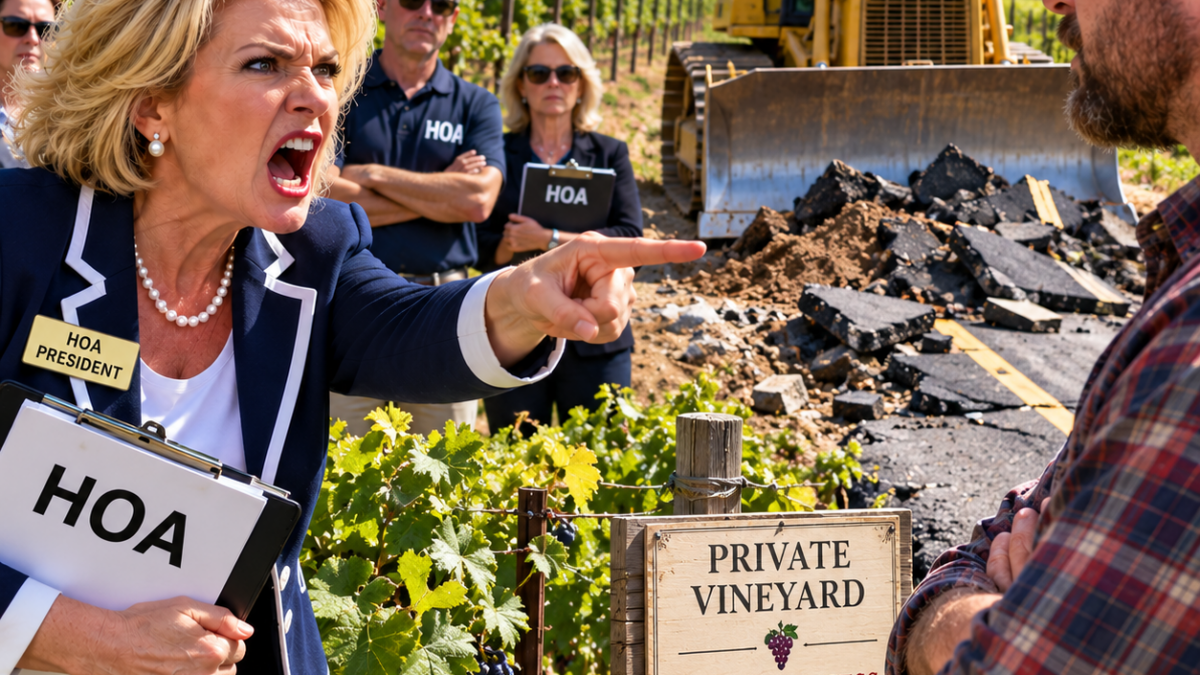
PART 2
The document was labeled:
Capital Improvements Committee — Special Session.
I opened it.
The meeting had occurred three months after I left to care for Dad.
Karen had introduced what she called the “Western Emergency Access and Recreation Corridor.”
My vineyard wasn’t named.
Instead, the minutes referred repeatedly to “underutilized transitional land adjacent to the western cul-de-sac.”
Transitional land.
Apparently ten acres could stop belonging to you if somebody found sufficiently bureaucratic words for it.
I kept reading.
The stated purposes shifted even within the document.
Fire access.
Pedestrian connectivity.
Emergency evacuation.
Future recreation.
Possible park connection.
No survey.
No easement number.
No county authorization.
No owner consent.
There was one line that caught my attention.
President Prescott stated that property access concerns had been addressed through prior owner notification and developer mapping.
I read it three times.
Addressed.
That word was doing a lot of work.
I opened the folder where I’d stored Karen’s letters over the years.
Complaint about the tractor.
Complaint about compost.
Complaint about grass.
Complaint about the appearance of vineyard netting.
Every response from me had gone certified mail.
Every response said essentially the same thing:
My property is not part of Oak Haven Estates.
You have no jurisdiction over it.
Attached are the deed and county parcel map.
I found the return receipts.
Signed.
They knew.
That changed things.
The construction might still have been somebody’s catastrophic mistake.
But the board couldn’t honestly claim nobody had warned them.
My phone was already in my hand.
I called Marcus Cole.
Marcus and I had served together for nearly a decade.
He had been the kind of officer who could read thirty pages of regulations, find the one sentence everybody else missed, and ruin a dishonest contractor’s entire week with it.
After leaving the Army, he had gone to law school.
Now he handled property disputes, land-use fights, and government-liability cases.
He answered on the third ring.
“Jack Thorne.”
“Marcus.”
“You sound terrible.”
“Dad died.”
The joking tone vanished.
“Damn. Jack, I’m sorry.”
“Funeral was two days ago.”
“You home?”
“Yeah.”
There was a pause.
“What happened?”
He knew me too well.
“The HOA built a road through my vineyard while I was gone.”
Silence.
Then:
“They did what?”
“Ten feet wide. Maybe two hundred yards. Asphalt.”
“Do they have an easement?”
“No.”
“You sure?”
“I have the deed and surveys in front of me.”
“Send them.”
“They destroyed almost two hundred vines.”
“Send photographs.”
“They paved over Grandpa’s marker.”
Another silence.
This one lasted longer.
“Send me everything.”
I scanned until midnight.
Deed.
Surveys.
My certified letters.
Their receipts.
Photographs.
Board minutes.
Resolution.
Damage.
Marcus called at 6:40 the next morning.
I was already awake.
“You want the short version?”
“Yes.”
“This looks very bad for them.”
“Good.”
“That wasn’t encouragement.”
“I’ll take it anyway.”
“Your recorded survey is clean. No road easement through the vineyard. The subdivision plat doesn’t show one either.”
“Exactly.”
“I want a new survey.”
“Why?”
“Because you don’t win boundary cases by telling judges that everyone has always known where the line is.”
“I already know where it is.”
“And I already know you’re stubborn. Hire a surveyor.”
I made the call.
Then I began documenting damage.
The road had removed approximately 190 vines.
Some were replaceable.
Some weren’t.
The heritage Zinfandel stock mattered because it had adapted over decades to our soil and climate.
Our vineyard was small, but local restaurants bought enough of our production to make it more than a hobby.
Those vines represented years of future yield.
The irrigation damage ran beyond the pavement.
Heavy construction equipment had compacted soil along both shoulders.
The grading altered drainage.
I photographed everything.
Measured everything.
Marked everything.
Then I reached the memorial stone.
I couldn’t dig it out without disturbing pavement, and Marcus had specifically told me not to touch the road yet.
So I knelt there.
For the first time since Dad’s funeral, I cried.
Not loudly.
Nothing cinematic.
I put one hand on the warm asphalt and imagined the gray granite under it.
Dad and I had installed that stone together after Grandpa died.
It read:
HAROLD THORNE
1919–1998
HE PLANTED FOR THOSE WHO CAME AFTER
Dad had chosen the words.
Now Dad was gone too.
And somebody had paved over the one sentence that seemed to describe both men.
I stayed there until my knees hurt.
Then I got up.
Grief had been a fog for six months.
Karen had given it a target.
That frightened me.
Because targets can feel good when you’re hurting.
They can also make you reckless.
So instead of driving to Karen’s house, I wrote a letter.
Property description.
No easement.
No HOA membership.
Trespass.
Destruction of producing agricultural assets.
Interference with irrigation.
Preliminary damages exceeding six figures.
Ten business days to provide a written removal-and-restoration plan.
I included photographs.
I included copies of recorded documents.
I mailed one to the HOA.
Then separate copies to every director.
I wanted nobody later claiming Karen had hidden the dispute from them.
Ten days passed.
No response.
On day eleven, something was taped to my front door.
At first, I thought it might finally be the board’s answer.
It was a violation notice.
Two hundred fifty dollars.
I read the reason twice.
Failure to maintain landscaping in compliance with community aesthetic standards.
The supporting photograph showed the torn earth beside the road.
Damage caused by their contractor.
I started laughing.
It wasn’t humor.
It was what happens when anger reaches a point your body doesn’t know how to process.
They had destroyed my vineyard.
Then fined me for the destruction.
I photographed the notice in place before removing it.
Sent it to Marcus.
He called almost immediately.
“Please tell me that’s fake.”
“No.”
“Were you secretly hoping I’d die from professional frustration?”
“Not particularly.”
“Jack, these people are either receiving catastrophically bad advice or ignoring good advice.”
“Which one helps us more?”
“Both.”
The next board meeting was four days later.
I went.
The Oak Haven clubhouse smelled like artificial vanilla and coffee that had been sitting on a burner too long.
Fifteen or twenty residents occupied folding chairs.
Karen sat behind a table with four directors.
Gerald Pike, the treasurer.
Brenda Lawson, secretary.
Two men I didn’t know.
Karen saw me.
Her mouth tightened.
She continued discussing sprinkler-head visibility for another twenty minutes.
Then homeowner comments opened.
I stood.
“Jack Thorne. Owner of the ten-acre vineyard bordering Chestnut Lane.”
Karen interrupted immediately.
“Mr. Thorne is not an association member.”
“Correct.”
A few heads turned.
“I’ve been saying that for five years.”
“You therefore do not have standing to participate in member comments.”
“I’m not here to comment on your landscaping rules.”
I held up the violation notice.
“I’m here because your association built a road through my land and then fined me for the damage.”
Murmurs moved through the room.
Gerald looked down.
Interesting.
Karen leaned toward the microphone.
“Your concerns have been referred to counsel.”
“Did counsel tell you where the recorded easement is?”
“We acted according to developer maps and information available to the board.”
“So there is no easement.”
“That is not what I said.”
“Then give me the recording number.”
Her cheeks reddened.
“This is not a courtroom.”
“No. In court, you’ll have to answer.”
That landed.
One of the men beside Brenda shifted in his chair.
I continued.
“You received a formal demand ten days ago.”
“The board does not respond to threats.”
“It wasn’t a threat.”
“You demanded hundreds of thousands of dollars.”
“I demanded you restore what you destroyed.”
“Your property had become unsightly and poorly maintained during your extended absence.”
There it was.
Dad had been dead less than two weeks.
Something in my jaw tightened.
“I was gone because my father was dying.”
The room went quiet.
Karen hesitated.
Only for a second.
“That does not change the association’s obligation to protect the community.”
A woman near the back spoke.
“Karen?”
Karen looked annoyed.
“Yes, Linda?”
“I thought the road was required by the fire department.”
“It is part of a comprehensive emergency-access plan.”
Linda frowned.
“But it ends at his tree.”
“Phase Two is pending.”
“Pending where?”
Karen gave her a hard look.
Linda lowered her hand.
I turned toward the residents.
“Has anyone here seen a fire-department requirement for that road?”
Nobody answered.
“How much did it cost?”
Gerald moved.
Karen cut him a glance.
I caught it.
“Financial matters are available in the annual report,” she said.
“Was there a special assessment?”
A man in the second row nodded.
“Eight hundred per house.”
More murmurs.
I looked at him.
“What were you told you were buying?”
“A fire-access route to the county preserve.”
“There is no county preserve behind my property.”
Silence.
“The Miller farm is behind me. Private land. Beyond that is County Route 12.”
Linda sat straighter.
“You told us the county park was going to connect.”
Karen struck the gavel.
“This is becoming disruptive.”
I faced the board.
“Every person at this table has now been personally informed that the road is on disputed private property and that I deny any easement exists. From today forward, continued occupation is not innocent.”
Gerald’s face had gone pale.
Karen struck the gavel again.
“Mr. Thorne, leave.”
I nodded.
“I will.”
At the door I stopped.
“One more thing.”
Karen stared.
“When I sue the association, association money pays lawyers.”
Several homeowners looked at each other.
“If insurance denies any part of it, association money pays damages.”
The room changed.
“Which means this isn’t just my problem anymore.”
Karen stood.
“Get out.”
I left.
The next morning, Marcus called.
“I heard you gave a speech.”
“Who told you?”
“Linda.”
“You know Linda?”
“She emailed my office at midnight.”
“Oh.”
“She attached the special-assessment notice.”
“What does it say?”
“Fire-access improvement.”
I sat up.
“Not walking path?”
“Nope.”
“Karen called it both.”
“I noticed.”
“Useful?”
“Potentially.”
Then his voice changed.
“Your surveyor starts today.”
Henderson arrived in a white truck covered with faded company lettering.
He was seventy if he was a day, with forearms like fence posts and a permanent squint from decades of looking into sunlight.
He shook my hand.
“Knew your dad.”
“Most people around here did.”
“Good man.”
“He was.”
Henderson studied the road.
His expression flattened.
“They put that in while you were gone?”
“Yes.”
“Any easement?”
“Not that I’ve found.”
“Well, we’ll find out.”
His crew spent six hours running measurements.
By late afternoon, he called me toward the cul-de-sac.
He drove a bright survey stake directly beside the asphalt.
“This is your western property line.”
I looked toward the road.
“How much of it is mine?”
“All the part everyone cares about.”
He walked down the pavement.
One hundred feet.
Two hundred.
Then farther.
“From here to the oak?”
“Your land.”
“All of it?”
“All.”
“So Oak Haven owns how much?”
He pointed at a short apron connecting the cul-de-sac to my boundary.
“About twelve feet from curb to line.”
I looked down the black ribbon.
“Then nearly the entire road is trespassing.”
“That’s what the survey says.”
He planted more stakes.
Bright pink flags appeared every twenty feet.
They transformed the road.
Yesterday it looked official.
Today it looked accused.
Karen arrived within an hour.
Her SUV stopped so abruptly that Linda, who had wandered over to watch, actually laughed.
Karen climbed out.
“What are those?”
“Survey markers,” I said.
“You cannot place those on HOA common property.”
Henderson didn’t look up from his notes.
Karen marched closer.
“I asked you a question.”
He raised his head.
“No, ma’am. You made a statement.”
“Who are you?”
“Licensed surveyor.”
“This is a community path.”
“Looks like asphalt.”
Karen pointed at the first stake.
“This line is incorrect.”
“Show me your survey.”
“Our developer provided maps.”
“Recorded survey?”
She hesitated.
“I don’t carry association records in my car.”
“Then I’d suggest you stop telling a licensed surveyor his line is wrong until you find one.”
Her face reddened.
I almost felt sorry for her.
Almost.
She turned toward me.
“This harassment will be documented.”
“Please document everything.”
“I intend to.”
“So do I.”
I lifted my phone.
Karen looked at the rows of flags.
Something new entered her expression.
Fear.
Small.
Quick.
But real.
She left without another threat.
Henderson waited until her SUV disappeared.
“She’s going to be fun.”
“You have no idea.”
His certified report arrived two days later.
No easement.
No public right-of-way.
No ambiguity.
The road lay almost entirely within my recorded parcel.
Marcus filed suit.
Trespass.
Property damage.
Nuisance.
Claims seeking removal and restoration.
Declaratory relief regarding any alleged easement.
And claims arising from the HOA’s continued assertion of rights over land outside its jurisdiction.
He named the association.
Karen.
And, based on their documented votes and actions, relevant directors subject to what evidence ultimately supported.
When copies were served, Gerald called me personally.
I almost didn’t answer.
“Jack?”
“Gerald.”
“I didn’t know you were naming us individually.”
“Talk to your lawyer.”
“I voted based on what Karen gave us.”
“Talk to your lawyer.”
“We thought there was access.”
“Gerald.”
“What?”
“Did you ever see an easement?”
Silence.
That told me more than an answer.
“Get your own attorney,” I said.
Then I hung up.
Marcus sent formal document requests.
Board minutes.
Emails.
Messages.
Contracts.
Bids.
Payments.
Maps.
Communications with the developer.
Communications with fire officials.
Anything related to the road.
The HOA resisted.
Their first production could have fit in a grocery bag.
Redacted minutes.
One contractor bid.
A handful of emails.
A preliminary development sketch.
No competing estimates.
No fire-department requirement.
No county approval.
Marcus called it “performative compliance.”
I called it garbage.
He filed a motion to compel.
Then I noticed the contractor name.
Prescott Paving & Site Solutions.
I called Linda.
“Karen’s husband own a paving company?”
“No.”
“Relative?”
There was a pause.
“Her sister married a Prescott from the other side of the county.”
Jessica—Linda’s neighbor, not my niece this time—helped us look through public business registrations.
The paving company belonged to Karen’s brother-in-law.
I sent the record to Marcus.
He didn’t celebrate.
“Interesting.”
“That’s all?”
“Did she disclose the relationship?”
“I don’t know.”
“Then we find out.”
Arthur Bell, a retired accountant in Oak Haven, contacted Marcus after hearing about the lawsuit.
He had been requesting detailed HOA financial statements for two years.
The board kept giving him summaries.
“Too neat,” he told me.
“What does that mean?”
“Real finances are ugly. Rounded summaries hide things.”
He began working with Marcus on the documents we already had.
Meanwhile, I spoke with residents.
Not to recruit a mob.
To understand what they had been told.
The stories didn’t match.
Fire lane.
Walking trail.
Jogging route.
Future park connection.
Emergency evacuation.
Property-value improvement.
Karen had apparently sold the same asphalt to different people using whatever explanation made each group most likely to support the assessment.
Linda apologized to me one afternoon.
“For what?”
“I voted yes.”
“You believed what you were told.”
“I should’ve asked.”
“Most of us don’t investigate every agenda item.”
She looked toward my vineyard.
“I paid eight hundred dollars to destroy somebody else’s property.”
“You paid for a project represented to you as legal.”
“Doesn’t feel different.”
“It is.”
She nodded but didn’t look convinced.
My own guilt worked the opposite direction.
I kept thinking about Leo.
The young man I’d hired to check the property while I was away.
I hadn’t called him yet.
Partly because everything had become legal.
Partly because I didn’t want to know whether he had seen construction starting and failed to stop it.
Finally I drove to his place.
He opened the door and looked sick the moment he saw me.
“Mr. Thorne.”
“Leo.”
“I’ve been meaning to call.”
“That usually means there’s something I won’t enjoy hearing.”
He looked down.
“They told me you approved it.”
“Who?”
“Mrs. Prescott.”
“When?”
“Maybe two months after you left.”
“Did you see paperwork?”
“She had a folder.”
“Leo.”
“No.”
His voice cracked.
“I didn’t.”
I stayed quiet.
“She said there was an easement and you had worked it out with the board because it would help emergency access. I told her I didn’t know anything about it.”
“Did you call me?”
He looked ashamed.
“No.”
“Why?”
“Your dad.”
I felt myself stiffen.
“You told me not to bother you unless the house was burning or somebody was hurt.”
I had said exactly that.
“Then the contractors showed up.”
“You let them in?”
“The vineyard gate was locked.”
My stomach dropped.
“How did they get through?”
“Karen had a locksmith.”
That was new.
“What?”
“She said HOA counsel authorized access.”
“You saw them open my gate?”
“Yes.”
“Did you keep anything?”
Leo hurried into another room.
He returned with his phone.
“I took pictures because it felt wrong.”
Photographs.
A paving truck.
Workers.
Karen.
And a locksmith kneeling at my gate.
Then one photograph made me freeze.
Karen stood beside a white pickup talking to a man wearing a Prescott Paving shirt.
In her hand was a map.
I zoomed in.
Not the final development plat.
A preliminary concept map.
I knew that map.
My father and I had seen it years earlier at county planning hearings.
It had shown a dotted “potential future access” through our land.
We objected.
The county rejected it.
The final approval specifically prohibited access through the Thorne parcel without a separately negotiated easement.
I remembered Dad standing beside me at that hearing.
“They’ll come back for it someday,” he’d said.
I had laughed.
Apparently Dad knew developers better than I did.
“Leo, send me every photo.”
He nodded.
“I’m sorry.”
I looked at him.
He was twenty-three.
I had left him with mowing and basic maintenance, not instructions for confronting a homeowners association and a construction crew.
“I should’ve told you nobody enters without calling me.”
“I should’ve called.”
“Both can be true.”
He swallowed.
“Are you firing me?”
“For something that happened while my phone lived beside a hospital bed?”
“I don’t know.”
“No.”
Relief washed across his face.
“But next time somebody arrives with a paving crew?”
“I call you.”
“Before they pave.”
“Before they unlock the gate.”
“Good.”
Marcus nearly shouted when I sent him the preliminary map photograph.
“Jack, get the final county resolution.”
“I know where it is.”
“Today.”
The county planning office had archived the original Oak Haven approval.
I found the clause.
Clear as daylight.
Any future western vehicular or pedestrian access across adjacent agricultural parcels required separately recorded rights and further county review.
No such rights had ever been recorded.
Then Karen filed an affidavit opposing our lawsuit.
Attached to it?
The same preliminary sketch.
She described the dotted line as evidence that access had always been contemplated.
Marcus called.
He was laughing.
“What’s funny?”
“She attached the map.”
“I saw.”
“She actually attached it.”
“Why is that good?”
“Because now I get to attach the final approval.”
The motion-to-compel hearing was the first time I saw Karen in court.
No gavel.
No microphone.
No homeowners she could eject.
She sat beside the HOA attorney wearing a gray suit and an expression of offended dignity.
Marcus gave the judge the preliminary map.
Then the final county resolution.
The judge compared them.
Her eyes narrowed.
“Counsel.”
The HOA attorney stood.
“Yes, Your Honor?”
“Your client’s affidavit characterizes this preliminary drawing as evidence supporting an access right.”
“Yes, Your Honor.”
“Where is the recorded access right?”
“We believe the overall development history—”
“Where?”
He stopped.
“There is no separately recorded easement we’ve located.”
The judge tapped the final resolution.
“This expressly conditions future access on obtaining such rights.”
“Yes.”
“And yet your client caused a road to be built anyway?”
“Our position is that there was a good-faith misunderstanding.”
Marcus stood.
“Your Honor, that is precisely why the communications matter. We have reason to believe directors were warned before construction.”
Karen turned toward her lawyer.
That reaction was tiny.
The judge saw it.
So did Marcus.
“Produce the communications,” the judge ordered. “Unredacted, except for legitimate privilege specifically identified on a privilege log. Forty-eight hours.”
She looked directly at the HOA lawyer.
“And counsel, review affidavits before allowing additional statements regarding legal access.”
Outside the courthouse, Marcus exhaled.
“She knows.”
“Karen?”
“Yes.”
“How much?”
“We’re about to find out.”
Forty-eight hours later, boxes arrived.
Emails.
Invoices.
Text-message printouts.
Notes.
Draft minutes.
Arthur joined us in Marcus’s conference room.
We ordered pizza and started reading.
At 9:20 that night, Arthur stopped.
“Found something.”
An email from Gerald to Karen.
Karen, we need to stop until counsel confirms the western access. I cannot locate a recorded easement. The county approval appears to require separate rights from Thorne.
Karen’s response:
Gerald, Jack is gone indefinitely. The old vineyard is deteriorating and the road benefits everyone. The developer map is sufficient for us to proceed. Better to get this finished before he returns than spend another year begging one stubborn landowner.
I read the final sentence again.
Before he returns.
She knew.
Marcus kept reading.
Another email.
Brenda:
Will the farmer sue?
Karen:
He would have to prove damages first. By the time he comes back, it will be established community infrastructure. Courts don’t like tearing up completed improvements.
My hands became very still.
She hadn’t misunderstood.
She had calculated.
Build first.
Create a fait accompli.
Bet that I wouldn’t have the money or will to undo it.
Dad dying wasn’t an unfortunate coincidence.
My absence was the opportunity.
I pushed back from the table.
Marcus saw my face.
“Jack.”
“I need air.”
“Go.”
I walked into the parking lot.
For months I’d pictured Karen as arrogant.
Now I understood something uglier.
She had waited until I was gone.
Not necessarily because she knew why I was gone at first.
But the emails showed she knew I wasn’t present to stop construction.
Later messages referenced my “family situation.”
She had known enough.
I called Sarah.
She answered sleepy.
“What happened?”
“She knew.”
“Who?”
“Karen.”
I told her.
Sarah was quiet.
Then I heard her inhale sharply.
“She did it while Dad was dying?”
“She did it because I wasn’t here.”
“That woman—”
“I know.”
“No. You don’t get to say I know.”
Her voice broke.
“You were changing Dad’s sheets and feeding him ice chips while she was figuring out how fast she could bulldoze Grandpa’s vines.”
I closed my eyes.
“She’ll answer for it.”
“How?”
“I don’t know yet.”
“Don’t do anything stupid.”
“Marcus is standing twenty feet away staring at me through the window.”
“Good. Put him on suicide watch for your common sense.”
Despite everything, I laughed.
That helped.
I went back inside.
Arthur had found the financial records.
Only one paving bid.
Prescott Paving.
Price nearly double comparable local work.
Then another line item.
Twenty thousand dollars.
Project coordination consulting.
Paid to K.P. Community Solutions LLC.
Arthur typed the company name into a database.
His eyebrows rose.
“Registered organizer: Karen Marie Prescott.”
The room became silent.
Marcus leaned back.
“Okay.”
I pointed at the screen.
“She paid herself?”
“Apparently the HOA paid an entity she controls.”
“For coordinating an illegal road?”
“That’s what the invoices appear to indicate.”
Arthur’s voice was flat.
“And her brother-in-law got the paving contract.”
Marcus held up a hand.
“Everybody slow down.”
“You’re kidding.”
“No. This is where we become boring.”
“Marcus.”
“Civil case first. We preserve the records. We inform the appropriate authorities through counsel. Nobody threatens criminal prosecution to gain a private settlement.”
That differed from the source story’s rougher version, and it made sense.
We weren’t going to turn possible crimes into bargaining chips.
We didn’t need to.
The evidence was already devastating.
The HOA’s insurance carrier became involved soon after.
So did independent counsel for Gerald.
Then Brenda hired her own lawyer.
The board began collapsing internally.
Gerald requested an emergency meeting.
Karen opposed it.
The remaining directors overruled her.
Residents packed the clubhouse.
I didn’t attend.
I was tired.
Instead, I sat alone in Dad’s old room.
His boots were still under the chair.
I had brought a box of his things home from the hospice apartment but hadn’t unpacked it.
I opened it.
Work shirts.
A pocketknife.
Reading glasses.
Then a small notebook.
Dad kept vineyard notes in cheap spiral pads.
Dates.
Weather.
Pruning.
Sugar readings.
I flipped through pages.
Three years earlier:
Jack thinks Row 4 can wait. He’s wrong. Don’t tell him until next spring.
I smiled.
Another entry.
Oak Haven woman came again asking about west access. Told her no. Jack already answered. These people think repetition changes ownership.
I sat up.
Date.
Four years earlier.
Karen had spoken directly to Dad.
I kept reading.
Told Prescott lady the old development proposal was rejected. She said plans change. Told her our answer doesn’t.
My hands tightened around the notebook.
She hadn’t only been warned by me.
Dad had personally told her.
Years before.
I photographed the page.
Sent it to Marcus.
He replied:
This is potentially useful corroboration. Preserve original.
Then I saw another line.
Different page.
If they ever get Jack mad enough, God help the pavement.
I laughed so suddenly I started crying.
Dad knew me.
Even at the end.
Maybe especially then.
The civil case moved quickly after document production.
The HOA’s new counsel requested settlement discussions.
Our demands were straightforward.
Remove the road.
Restore drainage and soil.
Replace irrigation.
Fund professional vineyard rehabilitation.
Compensate proven lost production.
Pay agreed legal and expert costs.
Formally acknowledge no easement existed.
Withdraw the bogus fine.
Prohibit future entry without permission.
The exact amount was negotiated.
Not the cartoonishly dramatic sum people later repeated online.
Enough to repair real damage.
Enough to compensate losses.
Enough that homeowners were furious about why their leadership had created the liability.
Karen’s resignation was no longer my settlement demand.
The homeowners were handling that themselves.
At a special meeting, they removed her from office.
Gerald resigned.
Brenda followed.
Arthur Bell joined an interim finance committee.
Linda helped organize governance reforms.
I thought that would satisfy me.
It didn’t.
Because the road was still there.
Every morning I saw it.
Every evening.
Black asphalt cutting through empty spaces where vines had stood.
Marcus understood.
“The settlement gives you removal rights.”
“I know.”
“You’ll hire somebody?”
“I’ve been thinking.”
“That tone concerns me.”
“I was a combat engineer for twenty-two years.”
“No.”
“You don’t even know what I’m going to say.”
“Yes, I do.”
“I’m qualified on heavy equipment.”
“Jack.”
“The road is mine to remove.”
“Under the settlement, yes.”
“I’ll obtain permits.”
“Yes.”
“I’ll use licensed trucking for disposal.”
“Jack.”
“I’ll follow environmental and county requirements.”
He sighed.
“You want to bulldoze it.”
“Yes.”
“Why?”
I could have said cost.
Efficiency.
Experience.
None of those were the real reason.
“Because they put it there while I was sitting beside my father’s bed.”
Marcus became quiet.
“Then do it legally.”
“That was the plan.”
“And safely.”
“Yes.”
“No midnight vigilante nonsense.”
That part of the viral title later became exaggerated.
I did not secretly steal a bulldozer and demolish an HOA road under darkness.
The truth was better.
I obtained the restoration permits.
Scheduled equipment.
Arranged trucks.
Verified utility locations.
Had Henderson mark the boundary again.
Had a soil specialist on standby.
Then I chose a Saturday.
The Caterpillar D6 arrived shortly after sunrise.
Its diesel engine echoed across Oak Haven.
Residents began coming outside before the lowboy driver finished unloading.
I wore jeans, boots, gloves, hearing protection.
Leo stood nearby.
Linda.
Arthur.
Even Marcus came, mostly because he distrusted my definition of “controlled aggression.”
“You brought a lawyer to a demolition.”
“You brought a bulldozer to a property dispute.”
“Fair.”
I climbed into the cab.
The controls felt familiar.
Not exactly like Army equipment.
Close enough.
The first survey stake stood at the legal property line.
I lowered the blade just inside it.
The steel edge touched asphalt.
For a second I stopped.
Dad would have loved this.
Grandpa even more.
Then I advanced.
The asphalt cracked.
A black slab lifted.
Aggregate snapped.
The blade pushed forward.
Dark earth appeared beneath it.
The smell hit me first.
Soil.
After months of hot tar and dust, the earth smelled alive.
I kept going.
Slowly.
Not reckless.
Slice.
Lift.
Push.
Loader removes debris.
Dump truck carries it away.
Repeat.
People gathered at the cul-de-sac.
Phones came out.
Somebody cheered.
I ignored them.
This wasn’t a performance.
At least I told myself that.
Then a familiar SUV stopped hard at the end of the street.
Marcus saw it before I did.
“Oh, wonderful.”
Karen climbed out.
She wasn’t president anymore.
But apparently nobody had informed her nervous system.
“What are you doing?”
I idled the machine.
She approached the boundary.
Henderson immediately stepped forward.
“Stay off the marked work area, ma’am.”
She pointed at me.
“He cannot destroy community property.”
Marcus walked over holding a copy of the settlement.
“This road is on Mr. Thorne’s land and is being removed under the executed agreement.”
Karen stared at him.
“This road belongs to Oak Haven.”
“No.”
“It was funded by residents.”
“That doesn’t transfer ownership of land.”
“I’ll call the police.”
“You’re free to.”
She looked at me in the cab.
“You think this makes you a hero?”
I removed my hearing protection.
“No.”
“You’ve bankrupted people because you couldn’t tolerate a path.”
That made me stop.
I shut down the engine.
The sudden silence felt enormous.
I climbed down.
“Say that again.”
“You heard me.”
“You told homeowners this was a fire lane.”
“It was.”
“You told others it was a park connection.”
“It would have been.”
“You knew there was no easement.”
Her face changed.
“I relied on professional information.”
“Gerald warned you.”
“He is a coward protecting himself.”
“My father warned you years ago.”
That hit.
Her eyes flickered.
“You spoke to him.”
“I spoke with many neighboring property owners.”
“He told you the access had been rejected.”
She crossed her arms.
“You don’t know what your father told me.”
I held up the photocopy of his notebook page.
“I know what he wrote down afterward.”
For the first time, Karen had no immediate answer.
I stepped closer but stayed on my side of the safety line.
“You waited until I was gone.”
“No.”
“Your email says, ‘Get it finished before he returns.’”
Her mouth tightened.
“That has been taken out of context.”
“What context makes it better?”
Silence.
Residents were listening.
Linda stood near the curb.
Arthur beside her.
Karen looked around and seemed to realize there was no audience left that belonged to her.
“You destroyed this community,” she said.
Linda answered before I could.
“No, Karen.”
Karen turned.
Linda’s voice shook slightly.
“You lied to us.”
“I protected your property values.”
“You charged me eight hundred dollars for a road that never went to a fire station or a park.”
“It was a multi-phase—”
“Stop.”
That word came from Arthur.
He was holding several printed financial statements.
“You paid twenty thousand dollars to your own company.”
Karen went pale.
“That was legitimate consulting.”
“And your brother-in-law got the only paving contract.”
“My family relationships were known.”
“Not to us.”
More residents began speaking.
Not shouting.
Worse.
Questions.
Specific ones.
Invoices.
Votes.
Disclosure.
Why no survey?
Why no easement?
Why the hurry while I was gone?
Karen looked at me again.
“This is what you wanted.”
“What?”
“To humiliate me.”
I thought about that.
Months earlier, maybe part of me had.
Now I was standing beside broken asphalt with Dad’s notebook in my pocket.
“No.”
I looked toward the vineyard.
“I wanted my land back.”
I climbed into the bulldozer.
Karen shouted something else.
The engine swallowed it.
By late afternoon, the road was gone.
Every piece of asphalt had been loaded out.
The ground looked terrible.
Scarred.
Compacted.
Raw.
But it was dirt.
Mine.
At the memorial stone, I stopped the machine.
We removed the last asphalt around it by hand.
Leo helped.
The top edge appeared first.
Then the engraved words.
When the whole stone was visible, I knelt.
Mud covered the lettering.
I wiped it with my glove.
HE PLANTED FOR THOSE WHO CAME AFTER.
Arthur stood behind me.
Nobody said anything.
I didn’t need them to.
The next phase was harder than demolition.
You can tear pavement out in a day.
You cannot rebuild a vineyard that way.
Soil testing showed heavy compaction.
We ripped the subsoil carefully.
Added organic material.
Repaired drainage.
Rebuilt irrigation.
A viticulturist helped source heritage Zinfandel material genetically close to our surviving stock.
The settlement covered much of the professional restoration.
Then something happened I hadn’t planned.
Neighbors showed up.
Not all at once.
Linda first.
Work gloves and a shovel.
Arthur brought a wheelbarrow.
Leo came with two friends.
A family from Oak Haven brought food.
Then more people.
I stood near the tractor watching them.
Linda noticed.
“You going to help or just supervise?”
“This is my vineyard.”
“Then act like it.”
I smiled.
We worked all Saturday.
Children carried small buckets of compost.
Adults repaired rows.
Someone played music.
Arthur complained about my spacing until I reminded him he was an accountant.
“You know what vineyards and accounting have in common?”
“No.”
“Rows.”
“That is the worst argument I’ve ever heard.”
“Still right.”
By evening, the scar looked less like a road.
More like land recovering.
My relationship with Oak Haven changed.
For years, I had considered the subdivision an invasion.
Identical houses creeping closer.
People complaining about tractors while buying wine produced ten feet from the thing they complained about.
Karen had personified all of that resentment.
But Karen wasn’t Oak Haven.
Linda was Oak Haven too.
Arthur.
Families who had believed a fire-safety story because they had children and wanted them safe.
Retirees who paid assessments without imagining the board would build on somebody else’s land.
They had been manipulated.
Some had also been too passive.
Both things were true.
The interim board changed procedures.
Major capital projects required legal review.
Related-party contracts had to be disclosed.
Competitive bids became mandatory above a threshold.
Detailed financial statements were published.
Nobody was allowed to describe a neighboring property as community land without documented ownership rights.
Arthur jokingly called that the Thorne Rule.
I told him never to name anything after me.
He put it in the minutes anyway.
Karen and her husband listed their house within weeks.
I learned about it from Linda.
“You going to buy it?” she asked.
“Why?”
“Turn it into vineyard worker housing.”
“Tempting.”
“You could paint the door purple.”
“Now you’re thinking like a criminal.”
Karen moved before winter.
I never saw the moving truck.
That surprised people.
They expected me to stand outside enjoying it.
I was pruning vines.
Real work had become more satisfying than watching her leave.
The financial evidence did not disappear with her resignation.
Independent auditors reviewed the project.
Authorities received records through proper channels.
I was interviewed.
Marcus was interviewed.
Board members cooperated.
The investigation took months.
Contrary to neighborhood rumors, nobody kicked down Karen’s door.
No federal agents descended from helicopters.
Real investigations are mostly fluorescent rooms, documents, bank records, interviews, and waiting.
Eventually the case produced charges related to fraudulent financial conduct surrounding the HOA project.
Karen ultimately entered a plea agreement on a fraud offense.
She paid restitution.
Received probation, financial penalties, and substantial community-service requirements.
The governance restrictions imposed through the resolution and settlement meant she would not be returning to the kind of board position she had abused.
When Marcus told me the final disposition, I was tying new vines.
“That’s it?” he asked after I went quiet.
“What do you want me to say?”
“You’ve been fighting this woman for almost a year.”
“And?”
“No celebration?”
I looked down the row.
Tiny green leaves were opening on the replacements.
“I’m busy.”
He laughed.
“You’ve become annoyingly healthy.”
“Don’t worry. I still hate paperwork.”
“That’s false.”
“Fine. I hate other people’s paperwork.”
There was one loose end.
The settlement included compensation beyond direct physical restoration.
I could have kept all of it.
Nobody would have questioned that.
The lawsuit had cost me months.
Stress.
Lost production.
Time.
Dad’s final season at the vineyard was gone forever.
But the more I thought about the money, the more it felt tied to something I didn’t want sitting in my bank account.
Dad had been an Army veteran too.
Grandpa had served.
So had I.
I established a local veterans assistance fund through an existing nonprofit partner, focused on short-term housing, transportation, and employment needs.
Not all the settlement money.
I wasn’t trying to become a saint.
The vineyard needed repairs.
Lawyers needed paying.
Future losses were real.
But enough went into the fund that something useful came from the ugliest year of my life.
Sarah—my sister, not a wife; people always confused that part when the story spread—came to visit the day the paperwork was finalized.
We walked the new rows together.
She stopped beside Grandpa’s marker.
“You moved it.”
“Six feet.”
“Why?”
“Better drainage. And nobody can drive over it unless they go through a fence.”
She smiled.
“Dad would’ve approved.”
“He’d complain about the lettering.”
“He complained about everything.”
“That too.”
We stood quietly.
Then Sarah said, “I was angry with you.”
“When?”
“When Dad was sick.”
I turned.
“You never said.”
“You were there physically, but part of you kept worrying about the vineyard.”
“That sounds terrible.”
“It wasn’t.”
She looked toward the new vines.
“He worried about it too. You two talked about this place because neither of you wanted to talk about him dying.”
I swallowed.
“That sounds more accurate.”
“He knew you were coming back here.”
“I told him I would.”
“He made me promise something.”
“What?”
“To make sure you didn’t turn into a hermit.”
I laughed.
“Apparently you failed.”
“Have you looked around lately?”
Linda was walking toward us carrying a basket.
Arthur’s truck sat near the barn.
Leo was repairing irrigation.
Children from Oak Haven were helping pick up old trellis wire.
Sarah raised an eyebrow.
“Doesn’t look very hermit-like.”
She was right.
That may have been Karen’s strangest legacy.
Before the road, I thought peace meant distance.
Fence lines.
Privacy.
Nobody interfering.
I still believed in boundaries.
After what happened, I’d be insane not to.
But boundaries and isolation were not the same thing.
A good neighbor respects the line and still shows up when you need help on your side of it.
Karen never understood the first part.
I had almost forgotten the second.
The following year, the replacement vines produced their first small clusters.
Not enough for serious production.
Enough to make me stop beside them every morning.
The old surviving rows recovered too.
We bottled a limited batch from what remained of the unaffected harvest.
I gave the first bottle to Marcus.
He looked at the label.
Thorne Vineyard — Boundary Row Zinfandel.
“You named wine after litigation.”
“Marketing.”
“I’m billing you royalties.”
“You’ve billed me enough.”
The second bottle went to Henderson.
The third to Linda.
The fourth sat unopened on the dining table for weeks.
It was Dad’s.
Or would have been.
One evening I finally carried it outside.
I sat beside the memorial stone.
Didn’t open it.
Just set it there.
The sunset turned the vineyard gold.
For months after Dad died, I had thought Karen stole my chance to grieve properly.
Maybe she did, temporarily.
The road gave me something to fight when sitting still hurt too much.
But anger can postpone grief.
It cannot finish it.
I touched the stone.
“Road’s gone.”
Wind moved through the vines.
“Thought you’d like that.”
Nothing answered.
Of course.
I smiled anyway.
“Heard you told Prescott no years ago.”
The notebook page was folded in my pocket.
“I should’ve listened when you said she’d come back.”
I sat until dark.
When I finally stood, I left the bottle beside the marker overnight.
Not for any mystical reason.
Dad wouldn’t have cared about symbolism.
He would’ve complained that sunlight could ruin good wine.
The next morning I brought it inside.
Three years later, the rebuilt rows produced enough fruit for their first proper vintage.
The vines were younger.
Different.
You could see the line where the old vineyard ended and the restoration began.
For a while that bothered me.
I wanted the damage erased.
Then the viticulturist told me something.
“You don’t want it invisible.”
“Why?”
“Because vineyards are records.”
He pointed toward thick trunks in the old section.
“Those vines tell one story.”
Then toward the younger rows.
“These tell another.”
I looked down the former road corridor.
The asphalt was gone.
But if you knew where to look, the rows were newer.
“So the scar stays.”
“No.”
He shook his head.
“The history stays.”
That distinction mattered.
Oak Haven changed too.
Residents still argued.
One board meeting nearly collapsed over mailbox replacements.
Arthur called me afterward.
“Human civilization has learned nothing.”
“What happened?”
“Four shades of black.”
“Tragic.”
“I may resign.”
“You’re not president.”
“Still considering it.”
The new road proposal never returned.
Fire access was eventually improved through an actual county-approved route using land whose owner voluntarily granted a negotiated easement.
Imagine that.
Permission.
Survey.
Compensation.
Recorded documents.
No bulldozers required afterward.
Linda invited me to the ribbon cutting.
“I don’t attend road celebrations.”
“You destroyed the last one.”
“Exactly.”
I went anyway.
The fire chief spoke.
A county engineer explained the route.
The landowner who granted the easement stood beside his family.
Everything had been done properly.
I found myself almost emotional.
Marcus noticed.
“You’re tearing up over civil engineering.”
“Shut up.”
“Combat engineers really are strange.”
“You’re drinking free coffee because of us.”
“Fair.”
Years after the fight, people still told the story wrong.
They said I came home, saw a road, lost my temper, rented a bulldozer that night, and tore it out before sunrise while Karen screamed from the curb.
That’s not what happened.
That version is satisfying because it’s simple.
Trespass.
Rage.
Bulldozer.
Justice.
Real life was slower.
I came home grieving.
I almost lost control.
Then I documented.
Asked.
Demanded.
Got ignored.
Surveyed.
Filed.
Waited.
Discovered lies.
Sat through hearings.
Read emails.
Negotiated restoration.
Obtained permits.
And only after the law recognized what had been true from the beginning did I climb onto that machine.
That made the moment better.
The bulldozer wasn’t revenge outside the rules.
It was the final enforcement of them.
Karen had spent years pretending rules meant whatever she wanted them to mean.
In the end, rules were precisely what stopped her.
A deed.
A recorded survey.
A county planning condition.
Disclosure laws.
Corporate governance.
Contracts.
Court procedure.
Evidence.
The boring machinery of lawful ownership.
I learned something else too.
Dad’s death and the vineyard became tangled in my memory for a long time.
Fresh asphalt.
Hospice disinfectant.
Grapevine sap.
Funeral flowers.
Diesel.
Sometimes grief attaches itself to whatever else is happening when loss arrives.
For months I couldn’t smell warm asphalt without seeing Dad’s hospital room.
Then years passed.
The association replaced a section of street near the cul-de-sac.
I smelled new pavement one morning.
And nothing happened.
Just asphalt.
That was when I realized some part of me had healed.
On the fifth anniversary of the road removal, Linda organized a harvest dinner.
I told her that anniversary celebrations for demolished HOA infrastructure were ridiculous.
She ignored me.
Tables were set between the rows.
Arthur brought folding chairs.
Leo, now running his own landscaping business, provided lights.
Marcus arrived late carrying a bottle of wine he had bought from my own tasting room at full retail price.
“You know I would’ve given you one.”
“I support small businesses.”
“You billed that sentence in six-minute increments.”
“Probably.”
After dinner, Linda raised her glass.
I groaned.
“No speeches.”
“Too late.”
She looked around.
“Five years ago, a lot of us believed what we were told because asking questions felt uncomfortable.”
People became quiet.
“We funded something that hurt our neighbor.”
“Linda—”
She held up a hand.
“You let me finish.”
I did.
“Jack fought for his property. But he also forced the rest of us to pay attention to ours—our money, our board, our decisions.”
She smiled at me.
“And he learned that sometimes suburban people are useful for vineyard labor.”
Laughter.
I raised my glass.
“That last part is true.”
Arthur shouted, “We’re underpaid.”
“You’re unpaid.”
“Exactly.”
The dinner continued.
Children ran between rows.
Nobody drove there.
Nobody needed a road.
Later, when most people had gone, I walked to the memorial stone.
Dad’s name wasn’t on it.
Only Grandpa’s.
I had considered adding Dad.
Eventually I decided against it.
Dad had never liked monuments.
His memorial was everywhere.
The irrigation system he redesigned.
Trellis posts he drove.
A tractor repair he’d improvised so badly nobody else understood it.
The old pruning knife hanging in my barn.
The notebook.
The vines.
I heard footsteps.
Sarah joined me.
“You’re doing the sentimental thing again.”
“Apparently.”
She touched the stone.
“He’d hate that party.”
“He’d leave after twenty minutes.”
“He’d take food first.”
“Absolutely.”
We stood there.
The younger Zinfandel rows stretched into darkness.
No black stripe.
No yellow line.
No shortcut.
Just vines.
“Remember when you told me you were going home because you needed something permanent?” Sarah asked.
“Yeah.”
“Turns out even permanent things get damaged.”
I looked at her.
“That cheerful wisdom run in the family?”
“Apparently.”
She nodded toward the rows.
“But damaged isn’t gone.”
That one stayed with me.
A year later, I opened Dad’s bottle.
Not the original bottle I’d left beside the marker—that was long consumed at a family dinner.
This was from the first full harvest of the replanted section.
I poured two glasses.
One for me.
One for Sarah.
We sat on the porch.
“How is it?” she asked.
I tasted it.
Young.
A little rough.
More acid than the old rows.
Different.
“Not Dad’s.”
“No.”
I took another sip.
“But good.”
The sunset disappeared behind the vines.
At the edge of Oak Haven, children rode bicycles around the cul-de-sac.
The street ended exactly where it was supposed to.
My vineyard began exactly where it always had.
And between the two sat no wall.
Only a boundary everybody finally understood.
I looked across the rows at the place where asphalt once covered my grandfather’s marker.
For a long time, I thought victory was watching the road disappear beneath my bulldozer blade.
It wasn’t.
Victory was what came afterward.
Soil breathing again.
Vines taking root.
Neighbors arriving with shovels instead of notices.
My father’s notebook back in its drawer.
Karen’s name slowly becoming irrelevant.
And a piece of land that had been violated, not restored to what it was before, but allowed to become alive again.
Sarah lifted her glass.
“To Dad?”
I touched mine to hers.
“To everyone who planted for those who came after.”
The glasses clicked softly.
Above the vineyard, evening settled.
Below us, the new vines moved in the wind where the road had once been.
[END OF STORY]

