PART 2: I Brought Home One Terrified Labrador—Then the Shelter Called at 1 A.M. About the Sister She’d Been Crying For
PART 2
I parked so quickly that one tire bumped the curb.
Bella was already standing in the back seat.
Her whole body had changed.
For six hours she had moved through my apartment like a dog carrying invisible weights.
Now she was alert.
Ears forward.
Nose working.
Before I even opened my door, she began whining.
Not the hopeless sound I’d heard beside my window.
This was sharper.
Urgent.
She smelled something.
Or someone.
“Easy,” I whispered.
I clipped the leash to her collar before opening the rear door.
Bella nearly pulled me across the parking lot.
Laura was standing beneath the yellow security light outside the shelter entrance.
Her hair was tied up messily, and she had thrown a winter coat over what looked like pajama pants.
Beside her stood a heavyset man in his late forties named Greg.
I had seen him once or twice when helping Laura with donations.
He worked overnight kennel duty.
Laura looked at Bella.
“Oh, thank God.”
“What happened?”
Greg unlocked the door.
“You need to see it.”
The shelter after midnight felt completely different from the noisy place I knew during the day.
Most of the overhead lights were off.
The front lobby was dark.
Only strips of fluorescent light illuminated the kennel corridor.
Dogs stirred as we passed.
A shepherd lifted its head.
A hound barked once.
Bella barely noticed.
She was pulling harder now.
Then we reached the last row.
Before I saw Molly, I heard her.
A low, trembling cry.
Bella froze.
For half a second, the entire Labrador went rigid.
Then she exploded forward.
“Bella!”
The leash tore through my hand.
Laura grabbed my elbow before I lost my balance.
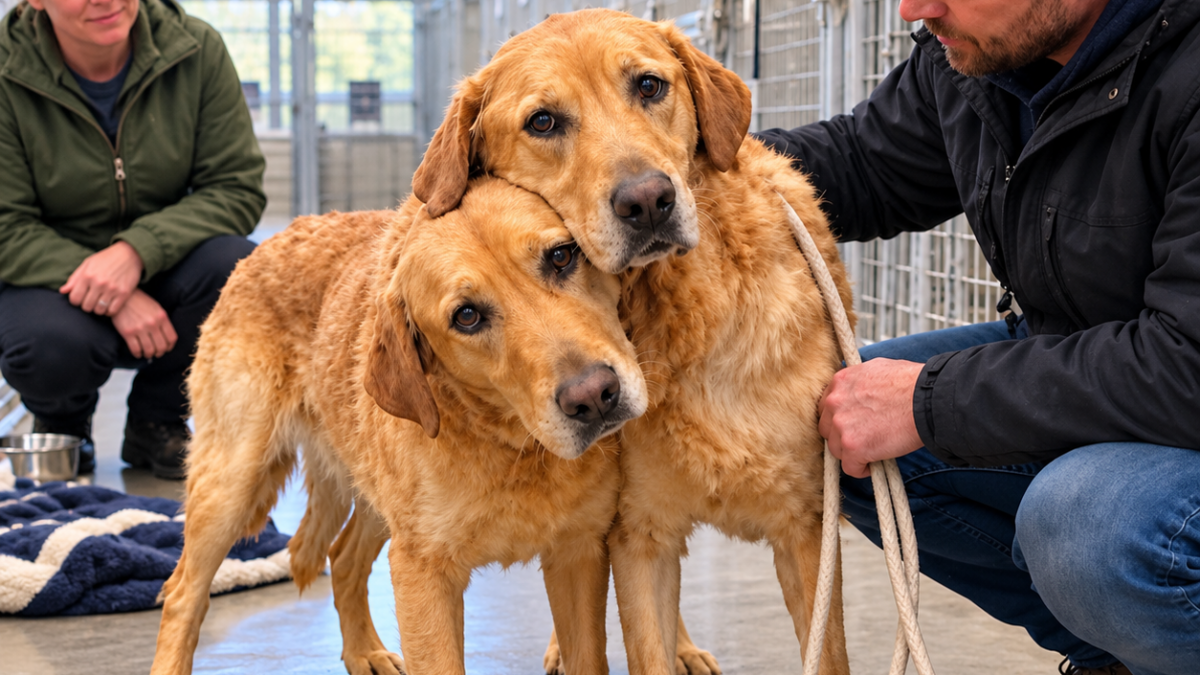
At the far end of the corridor, a second golden Labrador rose from beside a kennel gate.
She looked almost exactly like Bella.
Maybe slightly smaller.
A little darker around the ears.
Same brown eyes.
Same soft golden coat.
“Molly,” Laura whispered.
Molly saw Bella.
The sound that came out of her was so raw I still remember it.
She threw herself against the kennel gate.
Bella began crying too.
Not barking.
Crying.
Her whole rear end wagged so violently that her body curved sideways.
Greg hurried ahead and unlocked the kennel.
“Hold on. Let me—”
The gate opened.
Bella pulled free of me.
The sisters collided.
There is no better word for it.
They crashed into each other with such force that both nearly fell.
Then they became a tangle of paws, tails, noses, and frantic little sounds.
Molly buried her face against Bella’s neck.
Bella licked Molly’s ears.
Molly pressed herself under Bella’s chin.
Then Bella leaned her entire body against her sister like she was making absolutely certain no one could pull them apart again.
Laura covered her mouth.
Greg looked away.
I stood there holding an empty leash.
Nobody spoke.
For nearly a full minute, the two dogs ignored every human in the room.
Then Molly lay down.
Bella dropped beside her.
Their sides touched.
Their breathing slowed.
Molly closed her eyes.
That quickly.
She had apparently spent hours pacing and crying.
But the moment her sister returned, she slept.
Laura wiped her cheek.
“I’m sorry.”
“For what?”
“I should have told you.”
“You knew?”
“I knew they arrived together.”
“That isn’t what I asked.”
She looked ashamed.
“I didn’t understand how dependent they were on each other.”
I turned toward the two dogs.
“How could nobody understand that?”
Greg answered.
“Because the intake notes were thin. They were surrendered during a crazy weekend. We had twenty-three animals come in within forty-eight hours.”
“Who surrendered them?”
Laura hesitated.
“The nephew of their owner.”
“What happened to the owner?”
“She died.”
I looked down at Bella and Molly.
That explained more than I wanted it to.
They hadn’t simply lost a house.
They had lost a person.
Then strangers had taken them to a kennel.
Then we had separated them.
“How long ago?”
“Three weeks.”
Three weeks.
I imagined trying to explain death to a dog.
Then trying to explain why her home was gone.
Then why her sister was suddenly gone too.
I crouched beside them.
Bella opened one eye.
Molly didn’t move.
“What happens now?” I asked.
Laura looked at Greg.
Greg looked at the clipboard.
That was the first moment I remembered the man I had seen standing beside Laura outside.
“What is that?”
He sighed.
“Tomorrow’s placement sheet.”
Laura closed her eyes.
I looked from one to the other.
“What?”
“Molly has an adoption appointment at ten-thirty tomorrow morning,” Laura said.
I stared at her.
“No.”
“Ethan—”
“No.”
“It was arranged before tonight.”
“Then cancel it.”
“We can’t just cancel an approved appointment because—”
“Because the dog stopped eating when her sister disappeared?”
Greg raised both hands.
“I agree with you, man.”
“Then cancel it.”
“I don’t have that authority.”
“Who does?”
Laura answered.
“Marcy.”
I knew that name.
Marcy Whitmore had become shelter operations manager about eight months earlier.
I had met her once during a food donation drive.
She was efficient.
Professional.
The kind of person who could walk through a room full of barking dogs while answering three phone calls and never lose her place.
Laura respected her.
But Laura had also once described her as someone who thought spreadsheets could solve anything.
“Call her.”
Greg gave me a tired look.
“It’s one-forty in the morning.”
“You called me.”
“That was Laura.”
“Then Laura can call her.”
Laura shook her head.
“Ethan, slow down.”
I pointed at the dogs.
“Molly hasn’t eaten since Bella left.”
“I know.”
“Bella hasn’t eaten either.”
“I know.”
“They’re asleep now because they’re together.”
“I know.”
“Then what exactly are we discussing?”
“The adopter has already been approved.”
“That’s not my problem.”
“It becomes our problem if we ignore shelter procedure.”
I stood.
“What procedure says you split dogs that have been together their entire lives?”
Laura didn’t answer.
Greg studied the floor.
That silence bothered me more than an argument would have.
“You don’t have one.”
Laura rubbed her forehead.
“We have a bonded-pair designation.”
“Good.”
“They haven’t been designated bonded.”
I actually laughed.
Not because anything was funny.
“Look at them.”
“It requires an assessment.”
“When?”
“Usually during intake.”
“Was it done?”
Another silence.
“No,” she admitted.
“Why?”
“Because they were overwhelmed.”
“So because they were too traumatized to perform properly for an assessment, the shelter decided they weren’t bonded?”
“That isn’t what happened.”
“It looks exactly like what happened.”
Greg stepped in.
“Technically, nobody decided they weren’t bonded. They just never got marked as bonded.”
“That distinction may matter to a computer.”
I pointed toward the sleeping dogs.
“It doesn’t matter to them.”
Laura’s eyes hardened slightly.
“I’m on your side, Ethan.”
“I know.”
“Then stop talking like I did this on purpose.”
That stopped me.
She was right.
Laura was standing in a shelter at nearly two in the morning because she had cared enough to call.
I lowered my voice.
“You’re right.”
She nodded.
“I’m sorry.”
“So am I.”
Greg scratched his beard.
“Could you foster both?”
The question landed so simply that I almost laughed again.
“Yes.”
Laura turned.
“You said your apartment allows two pets?”
“Yes.”
“You can handle two Labradors?”
“I don’t know.”
Greg looked at me.
“Honest answer.”
“I thought one would sleep beside my couch.”
Laura glanced at Bella and Molly.
“You may need a larger couch.”
For the first time that night, I smiled.
“Can I take Molly now?”
Laura’s smile disappeared.
“I can’t authorize it.”
“What if she stays with Bella here until morning?”
“That we can do.”
I looked around the kennel.
Bella had finally escaped this place.
Bringing her back and leaving her overnight felt cruel.
But separating them again felt worse.
I sat down on the concrete floor outside the open kennel.
“Then I’m staying.”
Laura blinked.
“What?”
“I’m staying until Marcy gets here.”
“Ethan.”
“You have a vending machine?”
Greg pointed down the hall.
“Terrible coffee too.”
“Perfect.”
Laura stared at me for several seconds.
Then she laughed quietly.
“You’re ridiculous.”
“Probably.”
“Your back is going to hate you.”
“Definitely.”
I spent the next five hours at the shelter.
Greg found me an old folding chair.
Laura brought Bella’s blanket from my car.
We put it in Molly’s kennel.
Neither dog cared.
They slept pressed against each other on the concrete.
At three-thirty, Molly finally woke.
Greg offered her food.
She ate.
Bella ate from the same bowl.
Not because we planned it that way.
Molly simply started eating, and Bella joined her.
The two dogs consumed the entire meal in less than four minutes.
Greg stared at the empty bowl.
“Well.”
“What?”
“She refused chicken.”
“When?”
“About midnight.”
“You gave her chicken?”
“Warm chicken.”
Laura folded her arms.
“And Bella refused cheese at Ethan’s.”
I nodded.
“Good cheese.”
Greg looked at the sisters.
“So apparently the secret ingredient was another Labrador.”
At six-thirty, the first morning staff began arriving.
By seven, word had spread.
Kennel attendants came to look.
A veterinary technician named Serena knelt beside the sisters and watched them for several minutes.
“How long separated?”
“About nine hours,” Laura said.
“And both stopped eating?”
“Yes.”
“Pacing?”
“Yes.”
“Vocalizing?”
“Yes.”
“Any vomiting or diarrhea?”
“Not yet.”
Serena stood.
“That’s clinically significant separation distress.”
I looked at Laura.
“Is that enough for the designation?”
“It helps.”
At seven-forty-five, Marcy arrived.
I recognized her immediately.
Black slacks.
Gray coat.
Hair pulled into a neat bun.
Coffee in one hand.
Tablet in the other.
She walked into the kennel corridor, saw me sitting beside two Labradors, and stopped.
“Why is Mr. Carter here?”
Not hello.
Not good morning.
Why is Mr. Carter here?
Laura stepped forward.
“We had a problem overnight.”
“I gathered that from the messages.”
Marcy looked at Bella and Molly.
Then at me.
“Mr. Carter, Bella was released to you as a foster yesterday.”
“Yes.”
“You were supposed to contact the after-hours line if there was an emergency.”
“Laura called me.”
Marcy looked at Laura.
Laura didn’t flinch.
“I called him because Molly was showing severe distress.”
Marcy tapped her tablet.
“Molly has an adoption appointment at ten-thirty.”
I stood.
“She isn’t going.”
Marcy’s expression barely changed.
“I’m sorry?”
“She and Bella have been together their entire lives.”
“We know they entered together.”
“No. They lived together.”
“That is not the same as a documented bonded pair.”
Serena spoke from behind us.
“They both displayed separation distress overnight.”
Marcy looked at her.
“Have you performed the formal assessment?”
“Not yet.”
“Then we don’t have a conclusion.”
I could feel anger warming my face.
“You really need an assessment after what happened?”
“Yes.”
“Why?”
“Because shelter decisions cannot be made based on emotion alone.”
There was that word.
Emotion.
As though what the dogs had done was sentimental theater instead of behavior.
“What time can you assess them?”
Marcy looked toward Serena.
Serena said, “I can begin at eight-thirty.”
“Good,” I said.
Marcy closed the cover on her tablet.
“Molly’s adopter will still arrive at ten-thirty.”
“If they’re bonded?”
“Then we’ll discuss options.”
“What options?”
“That depends on the assessment.”
I didn’t like the answer.
At eight-thirty, Serena took Bella into a small consultation room.
Molly remained with Laura in the meet-and-greet area.
Within forty seconds, Molly began searching.
Door.
Window.
Door.
Exactly what Bella had done in my apartment.
After two minutes, she whined.
After four, she ignored Laura’s treats.
After six, she scratched at the door.
Serena returned Bella.
Molly’s body relaxed almost instantly.
Then they reversed it.
Molly left.
Bella lasted less than a minute before pacing.
I watched Marcy standing with folded arms.
“How much more do you need?”
She said nothing.
Serena continued the evaluation.
They observed resource sharing.
Toy behavior.
Feeding.
Handling.
Response to unfamiliar dogs.
Resting patterns.
The sisters weren’t inseparable every second.
Bella liked tennis balls.
Molly preferred carrying a rope toy.
They explored different corners of the yard.
But every thirty or forty seconds, one checked for the other.
If Molly disappeared behind Serena, Bella moved until she could see her.
When Bella paused at the water bowl, Molly circled back.
The connection was subtle when they were together.
It became obvious only when they were apart.
At nine-fifty, Serena finished writing.
“Well?” I asked.
She looked at Marcy.
“Strong bond. Significant separation distress. Recommend placement together.”
I exhaled.
Laura smiled.
Greg, who had stayed late to see what happened, whispered, “Thank God.”
Marcy read the form.
Then she said, “Recommendation noted.”
I frowned.
“What does that mean?”
“It means Serena has recommended they stay together.”
“So the appointment is canceled.”
“No.”
The whole room went quiet.
Laura stared at her.
“Marcy.”
“The applicant may be willing to adopt both.”
I blinked.
“What applicant?”
“The woman scheduled for Molly.”
“She applied for one Labrador.”
“She owns a home with a fenced yard and has prior breed experience.”
“I’m already fostering Bella.”
“That arrangement began yesterday.”
“And?”
“And Bella remains shelter property during the foster period.”
I felt something cold move through me.
“You’re saying you might give her to Molly’s adopter too?”
“I’m saying keeping them together is the priority.”
For one second, I almost respected the logic.
Then I remembered something.
“I offered to foster both.”
“That request hasn’t been approved.”
“Why?”
“Your residence needs to be reviewed for two large dogs.”
“You sent Bella home with me after a phone call.”
“One dog.”
“And now you suddenly need an inspection because there are two?”
“That is standard procedure.”
Laura looked uncomfortable.
I stared at Marcy.
“What if the other adopter only wants Molly?”
“We’ll make a placement determination.”
“Meaning?”
“Mr. Carter, you are asking me to predict a conversation that has not happened.”
“No. I’m asking whether you would separate them after your own staff just documented that they shouldn’t be separated.”
Marcy’s mouth tightened.
“We have to balance animal welfare against placement opportunities.”
“That sounds like yes.”
She turned away.
The adopter arrived at ten twenty-three.
Her name was Denise Harper.
She was fifty-seven, recently retired, and had lost her twelve-year-old yellow Labrador four months earlier.
The moment I met her, I knew something important.
She wasn’t the enemy.
She entered the room carrying a new leash and a bag of treats.
She looked excited.
Nervous.
Hopeful.
Then she saw two dogs.
“Oh.”
Marcy greeted her.
“Denise, there has been a development with Molly.”
I watched Denise’s face as Marcy explained.
To her credit, Marcy didn’t lie.
She told her about Bella.
The overnight distress.
The assessment.
Then she asked whether Denise might consider adopting both.
Denise looked stunned.
“I came prepared for one dog.”
“Of course.”
“Two Labradors is a lot.”
“It is.”
Denise looked at me.
“And you’re fostering Bella?”
“Yes.”
“How long?”
“Since yesterday.”
She smiled awkwardly.
“So about twelve hours?”
“Longest twelve hours of my life.”
That made her laugh.
Then Bella walked over to Molly.
Molly leaned against her.
Denise watched.
“What happens if I only take Molly?”
Marcy said carefully, “We would continue monitoring.”
Denise looked at Serena.
“What do you think?”
Serena hesitated.
Marcy gave her a look.
Denise noticed.
“So that means I should ask when your boss isn’t standing here.”
Nobody spoke.
I liked Denise immediately.
She crouched beside Molly.
Molly sniffed her hand.
Then Bella came over too.
Denise stroked both dogs.
“They really are sisters.”
Laura nodded.
“Same litter, according to intake.”
Denise stayed with them nearly twenty minutes.
Then she stood.
“I’m not taking Molly.”
My shoulders dropped with relief.
Marcy said, “You don’t need to decide immediately.”
“I already did.”
“You were approved.”
“For one dog.”
She looked down at Molly.
“And I came here because I wanted to give a dog a good life. Not because I wanted a Labrador badly enough to make one miserable.”
Her eyes shifted toward me.
“If he’s willing to keep both, why aren’t you letting him?”
Marcy’s expression tightened.
“We have procedures.”
Denise nodded.
“Then your procedures need work.”
She placed the new leash on a chair.
“Keep that for whoever needs it.”
Then she walked out.
I thought that ended the fight.
I was wrong.
Marcy looked at me.
“Your home inspection is tomorrow at eleven.”
“Tomorrow?”
“Yes.”
“And what happens until then?”
“Bella and Molly remain here.”
“No.”
“Mr. Carter—”
“They just spent a night proving this place is stressful.”
“They’ll remain together.”
“What about my foster agreement?”
“Bella can return with you.”
“And Molly?”
“Stays.”
“So separate them again?”
Marcy exhaled.
“We cannot release a second animal without approval.”
Serena looked down.
Laura’s jaw tightened.
I could see it now.
This had stopped being about the dogs.
It was about control.
Marcy had a rule.
I had challenged it.
Now she was going to follow every line of that rule even when the result contradicted the whole purpose of the shelter.
“What happens if I leave Bella here with Molly until tomorrow?”
“Bella’s foster placement would be paused.”
“Fine.”
Marcy looked surprised.
“Fine?”
“I’m not separating them again.”
“Then you’re choosing to leave Bella at the shelter.”
“No.”
I looked directly at her.
“I’m choosing not to make her suffer because your paperwork is one day behind reality.”
Laura whispered my name.
I knew I was pushing too far.
I didn’t care.
Marcy closed her tablet.
“We’ll see you tomorrow at eleven.”
She walked away.
I stayed another two hours.
Before leaving, I crouched inside the kennel.
Bella rested her head on my knee.
Molly leaned against my side.
“I know,” I whispered.
“I know.”
I hated driving home alone.
The apartment looked exactly as it had twenty-four hours earlier.
But now it felt emptier.
Bella’s untouched bed sat beside the couch.
Her water bowl remained in the kitchen.
One golden hair was stuck to my sweatshirt.
I had known her less than a day.
Yet I kept looking toward the door expecting her to be there.
That bothered me.
Not because I didn’t want to care.
Because I understood how quickly caring could become a weakness someone else controlled.
At three that afternoon, Laura called.
“You need to know something.”
My stomach tightened.
“What now?”
“I found their original intake packet.”
“And?”
“The electronic file is incomplete.”
I sat down.
“What’s missing?”
“Three pages.”
“Important pages?”
“Yes.”
I heard paper moving.
“The man who surrendered them wrote that they had never been separated.”
I closed my eyes.
Laura continued.
“He wrote that they slept together every night.”
I stood again.
“He wrote that?”
“Yes.”
“What else?”
Her voice changed.
“He specifically asked us to keep them together.”
I stopped moving.
“Say that again.”
“There’s a handwritten note attached to the surrender form.”
Laura read it.
“Bella and Molly have been together since eight weeks old. They become extremely anxious when separated. Please place them together if possible. They have already lost their owner and home.”
For several seconds, neither of us spoke.
“Why wasn’t that in the system?”
“I don’t know.”
“Who processed them?”
“A temporary intake worker.”
“Did Marcy see these papers?”
“I don’t know.”
“Can you send me a copy?”
“I’m not allowed to release surrender documents.”
“Can you tell Marcy?”
“I already did.”
“And?”
“She said the formal assessment matters more.”
I laughed once.
A hard, humorless sound.
“Of course she did.”
“Ethan.”
“What?”
“There’s more.”
I sat down again.
“Molly’s kennel notes show staff reported separation distress twice before Bella went into foster.”
My grip tightened on the phone.
“When?”
“Three days ago.”
“So people knew.”
“Some people noticed.”
“That isn’t the same thing.”
“No.”
“Did anyone tell Marcy?”
“I can’t prove it.”
I leaned back against the couch.
“What exactly are you telling me, Laura?”
She was quiet for a moment.
Then she said, “I think the shelter’s trying to move animals too quickly.”
That surprised me.
“What do you mean?”
“We’ve been over capacity for months.”
“I know.”
“Marcy started something called placement velocity tracking.”
I almost laughed.
“Of course she did.”
“Don’t.”
“I’m sorry.”
“She isn’t evil, Ethan.”
“I didn’t say she was.”
“She’s trying to keep animals from sitting here for months.”
“That sounds good.”
“It was. At first.”
I waited.
“But now every dog gets a clock.”
“What kind of clock?”
“Days in shelter. Days without applications. Days between approval and placement.”
“And?”
“The board reviews numbers every month.”
I understood before she finished.
“Keeping bonded animals together makes placement slower.”
“Yes.”
“So they stopped looking too hard for bonds.”
Laura didn’t answer.
That silence was an answer.
“Is that official?”
“No.”
“Then what is it?”
“A culture.”
That word stayed with me.
A culture.
Not a written policy.
Not something you could point to.
Just a thousand small decisions made because everyone understood what numbers mattered.
“How many bonded pairs have been separated?”
“I don’t know.”
“Can you find out?”
“I could lose my job.”
That brought me back to reality.
Laura had already done more than most people would.
“Don’t risk your job.”
“Ethan—”
“I mean it.”
I looked at Bella’s empty bed.
“Tomorrow I’ll pass the inspection.”
“And then?”
“I take both dogs home.”
“That’s the goal.”
“No.”
I stared at the wall.
“That’s what’s going to happen.”
The home inspection lasted forty-two minutes.
Marcy didn’t come.
A shelter field officer named Jonah Reed arrived instead.
He was tall, patient, and clearly had better things to do than inspect whether my trash can had a lid.
He checked the lease.
Pet limits.
Balcony railing.
Entry doors.
Nearest outdoor area.
My work schedule.
Emergency contact.
Then he looked at two new dog beds.
Two food bowls.
Two leashes.
Two crates.
“You went shopping.”
“I panicked.”
He smiled.
“Looks familiar.”
“You foster?”
“Failed three times.”
“Failed?”
“Foster fail. Means you adopt them.”
“Oh.”
He looked at me.
“You’re in danger.”
I laughed.
“Apparently.”
He signed the form.
“Approved for two.”
“That’s it?”
“That’s it from me.”
“When can I pick them up?”
He hesitated.
I stopped smiling.
“What?”
“Operations has placed a temporary hold.”
I stared at him.
“Why?”
“You’ll have to ask Marcy.”
“I thought the inspection was the only thing.”
“So did I.”
I drove straight to the shelter.
Marcy met me in the lobby.
“My home passed.”
“I saw.”
“So give me the dogs.”
“We’re reassessing placement.”
“Why?”
She folded her hands.
“Because an approved rescue partner has offered to take them together.”
I honestly thought I had misheard.
“What?”
“A Labrador rescue in Oregon has space for bonded pairs.”
“You’re going to send them to Oregon?”
“It is one option.”
“I’m standing right here.”
“They have an established program.”
“So do I.”
“You have less than forty-eight hours of foster experience.”
“I also have an approved home, no other pets, a flexible job, and both dogs already know me.”
“Knowing you for one day is not necessarily—”
“They ate with me present.”
“That is not—”
“They slept beside me at the shelter.”
“Ethan.”
“And Bella followed me into my apartment voluntarily. She didn’t fear me. She missed Molly.”
Marcy’s expression hardened.
“This is exactly why fostering decisions should not become personal.”
I stared at her.
“They are animals, Marcy.”
“I’m aware.”
“Then how could it not become personal?”
“We have to think beyond one emotional situation.”
I stepped closer.
“So do I.”
Her eyes narrowed.
“What does that mean?”
“It means I want to know why the intake note asking you to keep them together disappeared from the electronic file.”
For the first time since I met her, Marcy’s face changed.
Only slightly.
But enough.
“Where did you hear that?”
“Does it matter?”
“Yes.”
“No. What matters is whether it exists.”
She looked past me toward the kennel corridor.
Then back.
“That document was not part of their formal behavior record.”
“That wasn’t my question.”
“It was a surrender request.”
“From the person who knew them.”
“Family members often make requests we cannot guarantee.”
“Did you know about it?”
“I was aware they had lived together.”
“Did you know they had never been separated?”
Silence.
“Did you know the surrendering family warned they became anxious apart?”
Marcy’s jaw tightened.
“Mr. Carter, I am not going to debate internal records with you in the lobby.”
“Then let’s go to your office.”
“No.”
“Why not?”
“Because the placement hold remains.”
“When does the Oregon rescue take them?”
“Tomorrow morning.”
The room seemed to tilt.
“Tomorrow?”
“At nine.”
“You scheduled transport before telling me?”
“You are a foster applicant, not the owner.”
The sentence hit harder than it should have.
Maybe because technically she was right.
Bella and Molly weren’t mine.
Not yet.
But looking at a truth from the narrowest possible angle does not always make it honest.
“You knew I wanted both.”
“Yes.”
“You inspected my home.”
“Yes.”
“I passed.”
“Yes.”
“And while that inspection was happening, you arranged to send them to another state?”
“We maintained multiple options.”
“No.”
I shook my head.
“You kept me busy while you chose the option that made your spreadsheet cleaner.”
Her face flushed.
“That is unfair.”
“Is it?”
“Yes.”
“Then tell me why they can’t come home with me.”
“Because experienced rescue placement offers additional safeguards.”
“Such as?”
“Behavior support. Veterinary coordination. Adoption screening.”
“I have a veterinarian.”
“That isn’t the same.”
“I have an approved home.”
“You are not a rescue organization.”
“I’m the person Bella already trusts.”
“After one night.”
“And apparently one night was enough for her to cry at my window for Molly.”
Marcy stood.
“This conversation is over.”
“No, it isn’t.”
“It is.”
She stepped toward the office door.
“You can apply through the rescue once they are transferred.”
I stared at her.
“You’re making me compete for dogs I’ve already been approved to foster?”
“They are not possessions.”
“Then stop moving them like inventory.”
Marcy opened the door.
“Please leave.”
I did.
Not because I was finished.
Because I finally understood that arguing with her would accomplish nothing.
I called Laura from my car.
“They’re leaving tomorrow.”
“I know.”
“You knew?”
“I found out twenty minutes ago.”
“Can she do that?”
“Technically, yes.”
“Can anyone stop it?”
“Maybe the director.”
“I thought Marcy ran operations.”
“She does. But she reports to Dr. Evelyn Shaw.”
“Who is that?”
“Executive director.”
“Why haven’t I met her?”
“She’s been at a veterinary conference.”
“When does she return?”
“Tonight.”
“What time?”
“Ethan.”
“What time?”
“Her flight lands around six.”
I looked at the clock.
It was 1:17 p.m.
“Can you give me her email?”
“No.”
“Why?”
“Because I enjoy employment.”
“Fair.”
“But her email is on the shelter website.”
“I didn’t hear that from you.”
“Good.”
I went home and wrote the shortest email of my life.
Subject: Bella and Molly — Transfer Tomorrow Morning
Dr. Shaw,
I am the approved foster for Bella, an eighteen-month-old Labrador currently at your shelter.
Bella and her sister Molly have lived together their entire lives. Both showed significant separation distress when Bella was fostered alone. Your veterinary staff completed an assessment recommending joint placement.
I passed a home inspection for both dogs this morning.
I have now been told they will be transferred out of state tomorrow despite my approved placement.
Their original surrender paperwork reportedly asks that they remain together and notes previous separation anxiety.
I am requesting that tomorrow’s transfer be paused long enough for you to review the record.
Thank you,
Ethan Carter
I attached nothing.
I accused no one.
I used Richard—no, not Richard. That was the other story. I caught myself thinking of the kind of advice my own father used to give me.
My father was an accountant.
His version of wisdom was simple:
If someone’s story is confusing, stop listening to the story and look at the dates.
So I made a timeline.
Three weeks earlier: Bella and Molly surrendered together.
Two staff notes: distress when separated briefly.
Day one: Bella placed in foster.
Within hours: both stopped eating and paced.
1:00 a.m.: Laura called.
1:45 a.m.: reunion.
8:30 a.m.: formal assessment.
9:50 a.m.: joint-placement recommendation.
Next day: my home inspection approved for two.
Same day: out-of-state transfer scheduled.
When I saw it all in one place, the situation looked even stranger.
At 5:58 p.m., my phone rang.
Unknown number.
“Ethan Carter?”
“Yes.”
“This is Evelyn Shaw.”
I stood so fast I knocked over a glass.
“Dr. Shaw.”
“I’m at the airport. I’ve read your email.”
“Thank you.”
“I’ve also spoken with Serena and Laura.”
I waited.
“The transfer is paused.”
I closed my eyes.
“For how long?”
“Until I review the full file tomorrow morning.”
“Can Bella and Molly stay together?”
“They will.”
“Can they come home with me tonight?”
“Not tonight.”
I was disappointed, but at least the transport was stopped.
“Okay.”
“Mr. Carter?”
“Yes?”
“You said the surrender paperwork contains a request that they stay together.”
“That’s what I was told.”
“I cannot find that document remotely.”
“Laura found the paper copy.”
Another silence.
“Interesting.”
The way she said it made me sit down.
“What?”
“Nothing I’m prepared to discuss until I see it.”
That night I slept badly again.
At seven the next morning, Laura sent one text.
Both ate breakfast. Both slept. Transfer canceled for now.
I stared at the message until my eyes blurred.
At nine-twenty, Dr. Shaw called again.
“Can you come in?”
“I’m already dressed.”
She laughed softly.
“Ten?”
“I’ll be there.”
Dr. Evelyn Shaw was nothing like Marcy.
She was sixty-one, wore blue scrubs beneath a wool coat, and had the calm manner of someone who had spent decades dealing with frightened animals and frightened people.
Marcy was already in the office when I arrived.
So was Serena.
Laura stood near the wall.
A thick paper file sat in the middle of the desk.
Dr. Shaw gestured toward a chair.
“Mr. Carter, I’ve reviewed the intake record.”
I sat.
Marcy remained standing.
Dr. Shaw opened the folder.
“The dogs were surrendered by a man named Thomas Bell after the death of his aunt, Margaret Bell.”
I nodded.
“The original intake form states Bella and Molly were obtained from the same litter at eight weeks of age.”
She turned a page.
“They lived together continuously for approximately sixteen months.”
Another page.
“The surrendering family specifically reported that the dogs slept together, became distressed when separated, and should remain together if possible.”
I looked at Marcy.
She looked at the window.
Dr. Shaw continued.
“Those notes were not transcribed into the electronic behavior summary.”
“Why?”
“The intake employee involved no longer works here.”
“So it was a mistake?”
“At first, yes.”
At first.
I heard the words.
Marcy heard them too.
Dr. Shaw looked toward her.
“However, later kennel notes documented repeated separation distress.”
Marcy finally spoke.
“There was never a formal bonded designation.”
“No,” Dr. Shaw said. “Because the assessment was never scheduled.”
“We were overloaded.”
“I know.”
“And both dogs were young. Young dogs are often successfully separated.”
“Sometimes.”
“Placement speed matters.”
Dr. Shaw’s voice stayed calm.
“So does placement quality.”
Marcy’s face reddened.
“We had a qualified adopter for Molly and a foster for Bella.”
“And both dogs deteriorated within hours.”
“We corrected course.”
“No. Laura did.”
Nobody moved.
Dr. Shaw turned toward me.
“Your home is approved for both animals.”
My heart jumped.
“So I can take them?”
“If you still want to foster them together.”
“Yes.”
“You understand two eighteen-month-old Labradors are significantly more work than one?”
“Yes.”
“You may regret saying that.”
“I probably will.”
Serena laughed.
Dr. Shaw smiled.
“Then you may take them home today.”
I exhaled.
The fight should have ended there.
Instead, Marcy said, “I object.”
Everyone turned.
Dr. Shaw removed her glasses.
“On what basis?”
“The rescue transfer was appropriate.”
“It was an option.”
“It was safer.”
“For whom?”
“The dogs.”
Dr. Shaw studied her.
“Explain.”
Marcy straightened.
“An established rescue has resources Mr. Carter does not.”
“True.”
“Experienced foster networks.”
“True.”
“Adoption placement history.”
“True.”
“So why are we prioritizing an inexperienced individual foster?”
Dr. Shaw looked at me, then back at Marcy.
“Because the dogs know him. Because his residence passed inspection. Because he has agreed to keep them together. Because he lives twenty minutes from our clinic. Because this is a foster placement, which means we retain oversight. And because moving two stressed animals three hours to another organization for no necessary reason introduces additional disruption.”
Marcy said nothing.
Dr. Shaw leaned back.
“More importantly, why were you determined to complete that transfer after Serena recommended local joint placement?”
Marcy’s jaw flexed.
“I thought it was operationally cleaner.”
There it was.
Cleaner.
Not cruel.
Not malicious.
Cleaner.
A transfer closed both cases.
A foster kept them on the shelter’s books.
Dr. Shaw understood immediately.
“You were counting placements.”
Marcy said nothing.
Dr. Shaw’s expression changed.
“You were counting the Oregon transfer as two positive outcomes.”
“The animals would have gone to rescue.”
“Yes.”
“And that counts as live placement.”
“Yes.”
The room became very quiet.
I didn’t understand every administrative detail.
But I understood enough.
If Bella and Molly came home with me as fosters, they remained technically in shelter care.
Their days in custody continued.
Their veterinary costs remained on the shelter ledger.
Their case stayed open.
If they were transferred to rescue, the shelter could mark both cases as resolved.
Two fewer animals.
Two successful live outcomes.
Two cleaner numbers.
Marcy finally said, “Our length-of-stay metrics are terrible.”
Dr. Shaw stared at her.
“That is not a justification for overriding clinical recommendations.”
“I didn’t override anything.”
“You attempted to.”
“I used an authorized rescue.”
“After local foster approval.”
“I believed it was better.”
“For the dogs?”
Dr. Shaw paused.
“Or the report?”
Marcy looked away.
That was the moment she lost the argument.
Not because she admitted something terrible.
Because she couldn’t answer something simple.
Dr. Shaw closed the folder.
“Bella and Molly will go with Mr. Carter today.”
Marcy began to speak.
Dr. Shaw raised one hand.
“Placement decisions involving documented bonded animals will require clinical sign-off until we review procedures.”
“This is an overreaction.”
“No.”
Dr. Shaw’s voice remained quiet.
“This is supervision.”
Marcy’s face went pale.
I almost felt sorry for her.
Almost.
But then I remembered Bella at my window.
Molly alone in an empty kennel.
Two dogs grieving the same loss from two different places because someone had decided efficiency mattered more than watching what was happening in front of them.
I didn’t need Marcy humiliated.
I needed the dogs.
Twenty minutes later, Laura brought them into the lobby.
Bella saw me first.
Her tail started moving.
Molly followed.
Then both Labradors came running.
I dropped to my knees.
Bella crashed into my chest.
Molly climbed halfway over my shoulder.
“Okay,” I laughed. “Okay. I missed you too.”
Laura handed me two leashes.
“You sure?”
“No.”
“Good.”
“What?”
“If you were sure, I’d think you didn’t understand what you’re doing.”
Dr. Shaw came out of her office carrying a folder.
“Food schedule. Vet information. Behavior recommendations. Foster agreement for two.”
I signed.
Then she handed me a sealed envelope.
“What’s this?”
“A copy of the surrendering family’s nonconfidential notes.”
“Why?”
“Because sometimes history helps.”
I put it in my jacket pocket.
On the drive home, I kept looking in the mirror.
Bella sat behind the passenger seat.
Molly beside her.
Their shoulders touched.
No pacing.
No crying.
No noses pressed desperately against the glass.
Halfway home, Molly lay down.
Bella lowered her head across Molly’s back.
By the time we reached my apartment, both were asleep.
I parked and stayed in the driver’s seat.
For maybe five minutes.
I didn’t want to wake them.
That was the first moment I understood something I hadn’t admitted yet.
I didn’t want them for two weeks.
I didn’t know what I wanted.
But it wasn’t temporary.
The first night with both dogs was completely different.
Bella walked inside first.
She sniffed the couch.
Then the kitchen.
Then my shoes.
Molly followed.
Within ten minutes, they had inspected every room.
Within twenty, Molly stole a dish towel.
Within thirty, Bella discovered the tennis ball.
At seven, both ate.
At eight, they wrestled so violently in the living room that I moved a lamp for its own safety.
At nine, they collapsed on the rug.
At ten-thirty, Molly climbed onto the couch.
Bella tried to follow.
“There is absolutely not room for all three of us.”
They ignored me.
By eleven, I was wedged against one armrest with two Labradors occupying eighty percent of the furniture.
I sent Laura a photograph.
Her reply came immediately.
Looks like the foster is going well.
I wrote:
I have lost circulation in my left leg.
She responded:
Normal.
At midnight, I remembered the envelope.
Bella and Molly were asleep, so I opened it at the kitchen table.
The first page was a summary.
Margaret Bell.
Age seventy-two.
Deceased.
Owner of Bella and Molly.
Then a handwritten statement from Thomas, her nephew.
My aunt adopted Bella and Molly together after her husband died. They were the last two females in the litter and she couldn’t choose between them. They have always slept together. They eat separately but stay close. Bella is more cautious. Molly is more outgoing. If one is at the vet, the other waits by the front door. Please keep them together if possible.
I stopped reading.
After her husband died.
I looked toward the couch.
Bella was asleep with her nose against Molly’s neck.
Margaret had been lonely.
She had brought home two dogs.
Then she died.
I kept reading.
There was one final sentence.
They have already lost their person. Please don’t make them lose each other too.
I had to put the paper down.
For the first time, I understood why Laura had sounded shaken when she found the file.
The warning had been there from the beginning.
Not a diagnosis.
Not a behavior code.
Just a person saying plainly what mattered.
Please don’t make them lose each other too.
I folded the page carefully.
Then I walked to the couch.
Bella opened her eyes.
I sat on the floor.
“You already had someone who loved you.”
Her tail tapped once.
Molly remained asleep.
“I’m sorry nobody listened.”
Bella moved her head onto my knee.
And somehow that felt like forgiveness for something I hadn’t done.
The next three weeks were chaos.
Beautiful chaos.
Bella woke at six every morning.
Molly believed morning should begin at five-forty-five.
Bella loved tennis balls.
Molly loved stealing Bella’s tennis balls.
Bella was afraid of the vacuum cleaner.
Molly tried to attack it.
Bella refused to walk over metal sidewalk grates.
Molly crossed everything without noticing.
Bella followed me from room to room.
Molly followed Bella.
If I closed the bathroom door, both sat outside.
Privacy became a historical concept.
I worked from home three days a week.
On office days, Laura helped arrange a midday walker.
The first time I left them alone for two hours, I set up a camera.
For the first ten minutes, they waited by the door.
Then Molly climbed onto the couch.
Bella joined her.
They slept until I returned.
No crying.
No pacing.
No panic.
That was the proof I needed.
The problem had never been my home.
It had never been the shelter alone.
It was separation.
Together, they could handle change.
Apart, every loss became the first loss all over again.
At their first foster veterinary check, Dr. Shaw examined both.
Healthy.
Slightly underweight.
Mild stress-related stomach irritation.
Nothing permanent.
When she finished, she sat on the floor with them.
“How are you doing?”
I laughed.
“Define doing.”
“Regretting two Labradors yet?”
“Every morning before coffee.”
“After coffee?”
“Less.”
She smiled.
“Marcy is on administrative leave.”
I looked at her.
I hadn’t asked.
“For what?”
“Procedure review.”
“Because of Bella and Molly?”
“Not only.”
Something in her tone made me wait.
“We audited several months of placement decisions.”
“And?”
“There were other cases where bonded indicators were not followed up.”
My stomach tightened.
“How many?”
“Enough.”
“Were animals separated?”
“Yes.”
The answer hurt.
“Did they suffer?”
“Some adjusted fine.”
“And some?”
She looked down at Bella.
“Some were returned.”
I said nothing.
“Separating a bonded pair doesn’t always create disaster,” Dr. Shaw continued. “That’s why this is difficult. Dogs form different kinds of attachments. Sometimes what looks like dependence is simply familiarity. Sometimes separation actually helps an anxious dog develop confidence.”
“But not these two.”
“No.”
“How many people knew?”
“About the broader pattern?”
“Yes.”
She sighed.
“People saw pieces.”
That sounded familiar.
A culture.
Nobody standing in a room announcing, We are going to ignore animal welfare.
Just busy people.
Targets.
Numbers.
Shortcuts.
A missing note.
An assessment postponed.
A transfer scheduled.
A good system becoming worse one small compromise at a time.
“What happens now?”
“We fix it.”
“How?”
“We’re revising intake procedures. Surrendered animals from the same home will receive a relationship assessment before separate placement when possible.”
“When possible?”
“This is still a shelter, Ethan.”
“I know.”
“We sometimes receive ten animals from one household.”
“Fair.”
“We can’t promise every pair stays together.”
“I’m not asking that.”
“What are you asking?”
I looked at Bella and Molly.
“That somebody notices before deciding.”
Dr. Shaw nodded.
“That’s what we’re trying to build.”
A week later, I received a call from a number I didn’t recognize.
“Is this Ethan Carter?”
“Yes.”
“My name is Thomas Bell.”
The name took a second to register.
Then I stood.
“Bella and Molly?”
“Yes.”
His voice cracked slightly.
“I’m Margaret’s nephew.”
I looked toward the living room.
Both dogs were sleeping.
“How did you get my number?”
“The shelter asked permission to share yours after I contacted them.”
I remembered an email I had approved but barely read.
“Right.”
“I heard someone fostered both.”
“Yes.”
“Are they together?”
“Yes.”
“Right now?”
I smiled.
“About ten feet from me.”
Thomas exhaled so hard I could hear it.
“Thank God.”
For a moment, neither of us spoke.
Then he said, “I owe them an apology.”
“No.”
“Yes.”
“You lost your aunt.”
“I should have found somewhere else.”
“You were grieving.”
“That isn’t an excuse.”
“It might be context.”
He was quiet.
“My aunt raised me more than my mother did.”
I sat.
“She got the dogs after Uncle Ray died.”
“I read that.”
“She was never a dog person before that.”
I smiled.
“Really?”
“Terrified of big dogs.”
I looked at Molly, who was upside down with all four paws in the air.
“That’s hard to imagine.”
“She went to look at one Labrador puppy.”
I laughed.
“I know how that story ends.”
“Exactly.”
Thomas laughed too.
Then his voice softened.
“She said Bella looked scared and Molly kept standing over her.”
That caught my attention.
“Even then?”
“From the beginning.”
He paused.
“When Aunt Margaret went into the hospital, Molly paced the hallway every night. Bella stayed by the front door.”
Exactly the same behaviors.
“They knew something was wrong.”
“Yes.”
“Did they see her again?”
Thomas went quiet.
“No.”
That one word carried enormous weight.
“She died three days after admission. We thought she was coming home.”
“I’m sorry.”
“I brought the dogs to my house.”
“What happened?”
“I have two cats and a dog. My landlord found out. I had forty-eight hours.”
“You did what you could.”
“I called rescues. Everyone was full.”
“You did what you could.”
“I promised Aunt Margaret I’d keep them together.”
His voice broke.
I closed my eyes.
“You tried.”
“It doesn’t feel like enough.”
I looked at the sisters.
Bella had awakened.
She was watching me.
“Would you like to see them?”
Silence.
“What?”
“You can visit.”
“Are you sure?”
“They were your family too.”
Thomas arrived Saturday.
He was forty-two, tall, with tired eyes and hands that shook slightly when I opened the door.
Bella recognized him immediately.
I had wondered whether she would.
There was no hesitation.
She rushed forward.
Molly came behind her.
Thomas dropped to his knees.
Both dogs climbed onto him.
He began crying.
Not politely.
Not quietly.
He held their necks and sobbed into their fur.
“I’m sorry.”
Bella licked his face.
“I’m so sorry.”
Molly pushed beneath his arm.
I stepped away.
That reunion belonged to them.
Later, Thomas sat on my couch with a Labrador pressed against each leg.
He showed me photographs.
Margaret in a garden with two tiny puppies.
Margaret asleep in a recliner with Bella on one side and Molly on the other.
Bella and Molly wearing ridiculous Christmas antlers.
Margaret standing on a beach, laughing as both dogs pulled in opposite directions.
“She loved them,” I said.
“They saved her.”
I looked at him.
“After your uncle?”
“Yes.”
He stared at the photograph.
“She stopped eating after he died.”
That hit me.
“What?”
“She lost fifteen pounds. Wouldn’t see friends. Wouldn’t leave the house.”
“And then?”
“My cousin dragged her to a litter of puppies.”
He smiled.
“She came home with two.”
I looked at Bella.
Then Molly.
“They did this before.”
“What?”
“They pulled someone back into life.”
Thomas looked at me.
I hadn’t meant to say it so personally.
But it was true.
Before Bella arrived, I hadn’t thought of myself as lonely.
Not really.
I worked.
Saw friends.
Went to the gym.
Called my sister.
Had dinner with coworkers.
I wasn’t grieving a spouse.
I wasn’t recovering from tragedy.
I was simply living a life that had slowly become smaller.
Work.
Apartment.
Television.
Sleep.
Repeat.
I had become good at not needing anything.
Then one frightened Labrador stood at my window crying for her sister.
And suddenly my apartment had a reason to matter to someone besides me.
Thomas looked around.
“They like it here.”
“I think so.”
“Are you keeping them?”
I hesitated.
“They’re fosters.”
“That isn’t what I asked.”
I laughed.
“You sound like Laura.”
“Are you?”
I looked at the sisters.
“I don’t know.”
Thomas nodded.
Then he reached into his jacket.
“I brought something.”
It was a small wooden box.
Inside were two red collars.
Old.
Worn.
Metal tags attached.
BELLA.
MOLLY.
“These were theirs?”
“Aunt Margaret bought new collars a few months before she died. These were the puppy ones.”
He held them carefully.
“I thought you should have them.”
“I can’t take these.”
“Please.”
I looked at him.
“They belong with them.”
I accepted the box.
Thomas stayed three hours.
Before leaving, he stood on the sidewalk while Bella and Molly watched through the window.
“I thought surrendering them was the worst thing I’d ever done.”
“You didn’t abandon them on a road.”
“It felt like I did.”
“You brought them somewhere you believed would protect them.”
He nodded.
“Thank you for going back for Molly.”
“I almost didn’t know she existed.”
“But once you did, you went.”
He glanced at the dogs.
“That matters.”
Two months passed.
Then the foster coordinator emailed me.
Bella and Molly were officially cleared for adoption.
I stared at the message for five minutes.
The shelter had posted them as a bonded pair.
One adoption.
Two dogs.
The profile included a photograph I had taken at the park.
Bella sitting.
Molly leaning into her.
Applications opened Friday.
I called Laura.
“They’re listed.”
“I know.”
“Why didn’t you warn me?”
“You knew this was coming.”
“Knowing something is coming and seeing a button that says Apply to Adopt are different experiences.”
Laura laughed.
“Do you want me to remove them?”
My heart stopped.
“Can you?”
“If their foster applies.”
I said nothing.
“Ethan.”
“I heard you.”
“You’ve had them nine weeks.”
“I know.”
“They sleep on your bed.”
“Against my will.”
“You bought them raincoats.”
“It rains here.”
“You cooked chicken because Bella had an upset stomach.”
“That was medical.”
“You canceled a weekend trip because Molly had diarrhea.”
“Also medical.”
“You have framed photographs of them.”
“That was Thomas’s Christmas gift.”
“You moved your coffee table so they would have more wrestling space.”
I looked at the empty spot where my coffee table used to be.
“That table was too big.”
Laura laughed harder.
“You are exhausting.”
“Two dogs are expensive.”
“Yes.”
“My apartment is smaller.”
“Yes.”
“I’ve never owned a Labrador.”
“You currently live with two.”
“What if I mess them up?”
Laura stopped laughing.
There it was.
The real question.
Not money.
Not space.
Not dog hair.
Fear.
“What if they need more than I can give them?”
Laura’s voice softened.
“Then you ask for help.”
“What if somebody else has a yard?”
“Then they have a yard.”
“What if someone else has more experience?”
“Then they have more experience.”
“What if—”
“Ethan.”
I stopped.
“Do they trust you?”
I looked toward the bedroom.
Bella was asleep beside the doorway.
Molly on the rug.
“Yes.”
“Are they safe?”
“Yes.”
“Are they healthy?”
“Yes.”
“Are they happy?”
I watched Molly roll onto her back.
“Yes.”
“Do you love them?”
That question irritated me because it removed every excuse.
I whispered, “Yes.”
“Then what exactly are you waiting for?”
I applied that night.
The adoption was approved the next morning.
Laura called at 8:03.
“Congratulations.”
“That fast?”
“Your home was already inspected.”
“So that’s it?”
“Not quite.”
My stomach dropped.
“What?”
“Marcy appealed the bonded-pair designation.”
I stood.
“You’re kidding.”
“I wish.”
“She’s still working there?”
“She returned this week in a reduced administrative role.”
“Why does she care?”
“She says policy was changed during an active case and the adoption fee structure wasn’t correctly applied.”
I stared at the wall.
“You’re telling me after all this she’s arguing over fees?”
“Partly.”
“How much?”
“That’s not really the issue.”
“What is?”
“She says allowing a foster to adopt both through a single bonded-pair fee could create precedent.”
I laughed.
“Then charge me two fees.”
“I told Dr. Shaw you’d say that.”
“I’ll pay three.”
“Don’t encourage them.”
“When is the appeal?”
“Board review Thursday.”
I closed my eyes.
I had spent nine weeks assuming the fight was over.
Apparently bureaucracy has sequels.
“What can happen?”
“Worst case? They delay finalization.”
“Can someone else adopt them?”
“Not while your application is pending.”
“Can Marcy separate them?”
“No.”
That was all I needed.
“Fine.”
“You’re not angry?”
“Oh, I’m furious.”
“You sound calm.”
“I’ve learned anger works better after breakfast.”
Thursday’s board meeting was open to the public.
I didn’t intend to speak.
Dr. Shaw told me it should be procedural.
Then I arrived and saw Marcy sitting at the table.
A projector displayed shelter outcome statistics behind her.
Transfers.
Adoptions.
Returns.
Length of stay.
Live-release rate.
Numbers.
So many numbers.
Bella and Molly existed somewhere inside those bars and percentages.
Marcy presented first.
She argued that the shelter needed consistent standards.
That emotional cases could distort policy.
That treating every pair from the same household as bonded would reduce flexibility.
Some of what she said was reasonable.
That was what made the problem harder.
She wasn’t standing there saying dogs didn’t matter.
She believed systems mattered more.
Then Dr. Shaw presented.
She agreed that not every pair should remain together.
She agreed that formal assessment mattered.
Then she showed Bella and Molly’s timeline.
The first staff report.
The second.
The foster separation.
The overnight distress.
The reunion.
The clinical assessment.
The home approval.
The attempted transfer.
The board chair asked one question.
“Why was the transfer scheduled after the clinical recommendation?”
Marcy answered.
“Because the receiving rescue was qualified.”
“That wasn’t my question.”
Silence.
The chair repeated it.
“Why was transfer prioritized over an approved local joint foster?”
Marcy looked at the screen.
“Because transfer would have closed both cases.”
There it was.
Not evil.
Not cruelty.
A metric.
The board chair leaned back.
“So the shelter’s reporting incentives influenced the placement decision.”
“I wouldn’t characterize it that way.”
“How would you characterize it?”
“Operational efficiency.”
The room murmured.
Then Dr. Shaw put another slide on the screen.
Return rates.
Pairs separated after documented attachment concerns had a significantly higher disruption rate in their small internal sample.
Not enough data for scientific conclusions.
Enough to ask questions.
Marcy stared at it.
Dr. Shaw said, “Efficiency that produces failed placements isn’t efficiency.”
That line changed the room.
The board denied the appeal.
Then they voted to permanently adopt the revised bonded-animal procedure.
Not automatic co-adoption.
Not sentimental guesswork.
Assessment.
Documentation.
Clinical input.
And if a pair showed significant separation distress, no staff member could override a joint-placement recommendation for administrative metrics alone.
Marcy was removed from animal-placement authority.
She remained employed in grants and logistics.
Some people were disappointed she wasn’t fired.
I wasn’t.
The shelter had problems before Marcy.
It would have problems after her.
Firing one person would have made a satisfying villain story.
Changing the system mattered more.
After the meeting, Marcy approached me.
I expected an argument.
Instead she said, “You got what you wanted.”
“No.”
Her eyebrows lifted.
“I wanted the dogs not to suffer.”
She looked toward the closed meeting room.
“The outcome metrics exist for a reason.”
“I believe you.”
“Shelters that keep animals too long get criticized too.”
“I believe that too.”
“We were drowning.”
“I know.”
She looked tired for the first time.
Not polished.
Not controlled.
Just tired.
“I thought getting animals out was the answer.”
“Sometimes it is.”
“And you think I stopped seeing them.”
I didn’t answer.
She smiled without humor.
“Dr. Shaw said the same thing.”
I glanced toward the parking lot.
“You know what changed my mind?”
“What?”
“Bella at my window.”
She looked at me.
“She wasn’t dramatic. She wasn’t destroying anything. She just kept checking.”
Marcy listened.
“Door. Window. Door. Window. All night.”
I swallowed.
“And Molly was doing the same thing here.”
Marcy looked down.
“I saw the overnight footage.”
That surprised me.
“When?”
“During the review.”
“What did you think?”
She took a long breath.
“That we should have noticed sooner.”
It wasn’t an apology.
Not completely.
But it was close.
I nodded.
“Then notice the next ones.”
Her eyes lifted.
“That sounds like something Dr. Shaw would say.”
“I’m spending too much time at the shelter.”
She almost smiled.
The adoption became final the following morning.
Laura insisted I come in person.
“You could email the signatures,” I told her.
“No.”
“Why?”
“Because I deserve this.”
“For what?”
“For the last ten weeks.”
Fair.
I arrived at ten.
Laura had placed a ridiculous handwritten sign on the desk.
It said:
CARTER FAMILY — 2 DOGS, 1 ADOPTION, APPROXIMATELY 9 MILLION HAIRS
“Very professional,” I said.
“Thank you.”
Dr. Shaw signed first.
Then me.
Bella’s name.
Molly’s name.
Same form.
Bonded pair.
Owner: Ethan Carter.
Owner.
The word felt strange.
Then Laura handed me their leashes.
“You realize nothing actually changes today.”
“I know.”
“They already live with you.”
“I know.”
“They already destroyed your rug.”
“Molly destroyed the rug.”
Bella wagged.
“Bella witnessed it.”
“Accessory.”
Laura smiled.
“So why are you crying?”
I wiped my face.
“Allergies.”
“To paperwork?”
“Severe condition.”
Dr. Shaw opened the office door.
“Take your dogs home, Ethan.”
My dogs.
On the drive back, Bella sat upright behind me.
Molly slept.
At a red light, I looked in the mirror.
“You know,” I said, “this whole thing was supposed to last two weeks.”
Bella tilted her head.
Molly snored.
“Excellent response.”
Life settled after that.
Or at least as much as life can settle with two young Labradors.
I bought a larger couch.
That was a mistake.
They interpreted the additional space as belonging entirely to them.
I bought a robot vacuum.
Molly barked at it for four days.
Bella eventually learned to ignore it.
I joined a hiking group because both dogs needed more exercise than my neighborhood walks could provide.
I met people.
Real people.
Not coworkers on video calls.
Not neighbors I nodded to in the elevator.
People whose names I knew.
People who texted on Saturdays.
People who knew Bella hated metal grates and Molly stole gloves.
My life expanded.
That was the part I hadn’t expected.
I thought adopting dogs would add responsibility.
Instead, they added geography.
Parks.
Trails.
Beaches.
Pet stores.
Training classes.
Outdoor cafés.
Friends.
They pulled me into places I had no reason to visit before.
Six months after the adoption, Thomas called.
“Today would have been Aunt Margaret’s birthday.”
“I’m sorry.”
“Could we do something?”
“Of course.”
We drove Bella and Molly to the beach Margaret used to visit with them.
Thomas brought a small bouquet of daisies.
We walked until sunset.
At one point both dogs ran toward the water.
Bella stopped before the waves.
Molly ran straight in.
Thomas laughed.
“Aunt Margaret used to say Molly had no survival instinct.”
“I believe that.”
He watched them.
“She would be so relieved.”
I knew what he meant.
Not happy, exactly.
Relieved.
The kind of peace you feel when a promise almost broken somehow survives.
Thomas sat on a piece of driftwood.
“I blamed myself for months.”
“For the shelter?”
“For all of it.”
“You couldn’t control her dying.”
“I could have planned better for the dogs.”
“Maybe.”
He looked at me.
“That’s surprisingly unsympathetic.”
I smiled.
“I’m trying something new.”
He laughed.
I continued.
“Maybe you could have planned better. Maybe the shelter could have read the intake note. Maybe Laura could have asked more questions. Maybe I could have asked whether Bella came in with another dog before taking her home.”
Thomas nodded slowly.
“But none of us knew what the next mistake would cause.”
“No.”
“The important part is what happened after we knew.”
He looked toward the dogs.
Molly had found a piece of seaweed.
Bella was trying to take it.
Thomas smiled.
“You went back.”
“We all did, eventually.”
A year after Bella first stood at my window, the shelter invited me to speak at a foster orientation.
I refused.
Laura asked again.
I refused again.
Then Dr. Shaw said there would be pizza.
I have standards, but they are apparently negotiable.
There were fifteen new foster volunteers.
I didn’t tell them they were heroes.
I didn’t tell them fostering would save lives.
They had already heard that.
Instead, I told them the part nobody had told me.
“Pay attention to what the animal keeps looking for.”
A woman in the front row frowned.
“What do you mean?”
“When Bella came home, I thought she was scared of my apartment.”
I told them about the door.
The window.
The pacing.
Looking behind us during the walk.
“She wasn’t afraid of where she was.”
I said.
“She was afraid of who wasn’t there.”
I looked around the room.
“Animals can’t explain their history. Sometimes behavior is the history.”
Dr. Shaw nodded from the back.
After the orientation, a young couple approached me.
They were fostering two terrier mixes from the same household.
“We were thinking of separating them for training,” the woman said.
I felt myself tense.
Then I remembered what Dr. Shaw had taught me.
Not every attachment is Bella and Molly.
So instead of saying no, I said, “Ask the behavior team.”
They did.
The dogs weren’t bonded.
They trained separately and thrived.
That mattered too.
The lesson was never keep every animal together.
The lesson was look.
Listen.
Assess.
Don’t let convenience answer a question before the animal does.
The shelter improved.
Slowly.
Imperfectly.
Marcy stayed in grants.
She turned out to be extremely good at it.
Within a year, she helped secure funding for a new quiet intake room designed specifically for animals arriving from the same household.
Dr. Shaw told me before the opening.
“You’ll never guess who wrote the strongest section of the grant.”
“Marcy.”
“Marcy.”
I smiled.
People are complicated.
That is often less satisfying than villains.
But it is usually more true.
At the new intake room opening, Marcy saw me.
She walked over.
“Bella and Molly?”
“Outside with Laura.”
“Still together?”
“Try separating them.”
She laughed.
“I won’t.”
There was a pause.
Then she said, “The room has movable dividers.”
“What?”
“So staff can observe animals together and separately without moving them to completely different parts of the shelter.”
I understood.
“You designed that?”
“I suggested it.”
“Because of them?”
She glanced toward the doors.
“Because we missed things.”
That was the closest she ever came to apologizing.
It was enough.
I found Bella and Molly outside.
Both were sitting beside Laura.
Molly was noticeably heavier.
Bella had a few pale hairs beneath her chin, though they were only two and a half.
“You feed them too much,” Laura said.
“You give them treats.”
“Professional treats.”
“That isn’t a thing.”
“It is now.”
Bella leaned against my leg.
Molly immediately moved to my other side.
Laura looked down at them.
“Remember that first night?”
“I try not to.”
“You were sitting on a folding chair at three in the morning.”
“My back remembers.”
“And you said you didn’t know if you could handle two.”
“I still don’t.”
She smiled.
“They handle you.”
“That sounds accurate.”
That winter, I got the flu.
Not a cold.
Actual influenza.
Fever.
Chills.
The kind that makes walking to the kitchen feel like a wilderness expedition.
For three days, Bella and Molly barely left me.
Bella slept beside the couch.
Molly rested near my feet.
When the dog walker arrived, Molly went outside.
Bella refused until the walker brought the leash into the living room and let her see I was staying.
On the second night, I woke around two.
Bella’s chin was resting on the edge of the couch.
Molly lay directly behind her.
Two pairs of brown eyes watching me.
“You two are creepy.”
Molly’s tail thumped.
I reached down and touched Bella’s head.
Something about that moment brought me back to the first night.
Bella at the window.
Waiting for Molly.
I had thought she was helpless then.
She wasn’t.
She had been loyal.
There is a difference.
Fear had not made her weak.
Love had made absence unbearable.
That distinction changed the way I saw both dogs.
Bella became braver over time.
She learned to cross metal grates.
Slowly.
One paw at a time.
She stopped looking over her shoulder constantly on walks.
Molly learned that not every closed door meant somebody had disappeared forever.
We practiced short separations with trainers.
Thirty seconds.
One minute.
Five.
Not because we wanted to split them.
Because dependence can become fear, and we wanted their bond to feel safe rather than desperate.
Eventually, Bella could stay with me while Molly went to the veterinarian without pacing.
Molly could remain with Laura while Bella took a short training walk.
They still preferred each other.
Always.
But they learned something important.
Separation could end in reunion.
That lesson took months.
Maybe humans need the same lesson.
Two years after the adoption, Thomas called with news.
He had bought a house.
“You know what this means?” he asked.
“You’re drowning in mortgage paperwork?”
“That too.”
Then I heard barking behind him.
“You got a dog.”
“Not yet.”
“What are you doing?”
“I’m at the shelter.”
I laughed.
“Of course you are.”
“There’s an eight-year-old black Lab.”
“Old.”
“Yeah.”
“Expensive knees.”
“Probably.”
“Gray muzzle?”
“Very.”
“Perfect.”
Thomas adopted him that afternoon.
His name was Howard.
Bella and Molly met him a week later.
Molly stole his tennis ball.
Howard looked at her with the exhausted dignity of a middle-aged man watching teenagers at a shopping mall.
Thomas laughed so hard he had to sit down.
“Aunt Margaret would’ve loved this.”
“Yes.”
“She would’ve loved you too.”
That one caught me off guard.
“I never met her.”
“Doesn’t matter.”
I looked at Bella and Molly.
Maybe he was right.
Three years passed.
Bella and Molly grew from anxious young dogs into confident adults.
They still slept touching.
Not always.
Sometimes Bella chose the dog bed near the window while Molly took the couch.
Sometimes Molly slept in my bedroom and Bella remained in the hallway.
But most mornings, I found them together.
Shoulder to shoulder.
Back to back.
Two golden shapes taking up far more space than physics should have allowed.
The shelter placed a framed photograph of them in the new intake room.
I objected.
Laura ignored me.
Beneath the photograph was a small card.
It didn’t tell the whole story.
It simply said:
BELLA & MOLLY
ARRIVED TOGETHER
PLACED TOGETHER
LISTEN BEFORE YOU SEPARATE
Marcy wrote the last line.
I learned that later.
That mattered to me more than I expected.
Not because it proved I had won.
I had stopped thinking about winning.
It proved someone had changed.
And perhaps that was the only kind of revenge worth wanting.
The thing that hurt you becomes the reason the next person—or next dog—gets treated better.
On the third anniversary of that first phone call, Laura came over for dinner.
Thomas came too.
So did Dr. Shaw.
Howard came with Thomas.
Three Labradors occupied my living room.
My apartment had long since stopped looking like the home of a single man.
Dog beds.
Leashes.
Photographs.
A basket containing approximately eleven thousand tennis balls.
Laura walked to the window.
“This is where she stood?”
I nodded.
Bella was lying beneath it.
“The first night.”
“Until I called.”
“Yeah.”
Laura looked at me.
“I almost didn’t.”
“What?”
“Call you.”
I stared at her.
“Why?”
“I thought I was overreacting.”
I felt a chill despite the warm room.
“Molly was crying.”
“She was.”
“So why wouldn’t you call?”
“Because shelters are full of crying dogs.”
The sentence landed heavily.
Laura looked down.
“You get used to things you shouldn’t get used to.”
Dr. Shaw, standing behind us, said quietly, “That’s why systems need outsiders sometimes.”
I looked at her.
“Outsiders?”
“People who haven’t learned to normalize the problem.”
Laura nodded.
“You saw Bella pace for four hours and knew something was wrong.”
“I thought she hated my apartment.”
“But you kept watching.”
I looked down at Bella.
“What if you hadn’t called?”
Nobody answered.
We all knew.
Molly probably would have gone home with Denise.
Bella might have remained with me.
Maybe both eventually would have adjusted.
Maybe not.
Maybe one would have been returned.
Maybe they would have lived perfectly decent lives apart.
That uncertainty mattered.
Because the point wasn’t that catastrophe was guaranteed.
The point was that we had evidence telling us what they needed, and we almost ignored it.
That night, after everyone left, I opened the wooden box Thomas had given me years earlier.
The old red puppy collars were still inside.
The metal tags scratched.
Faded.
Bella.
Molly.
I sometimes wondered whether Margaret had ever imagined where those collars would end up.
Maybe she thought she would have the dogs for twelve years.
Maybe fifteen.
Maybe she never considered that death would interrupt the plan.
Most of us don’t.
We build routines as though routine itself is a promise.
Morning coffee.
Work.
Dinner.
Dog walks.
Bed.
Then one day the shape of a life changes.
Margaret died.
Thomas lost his aunt.
Bella and Molly lost their person.
The shelter lost track of a note.
I agreed to foster one dog.
Laura made one late-night phone call.
And all of our lives bent in a different direction.
The strangest part is how close it came to not happening.
If Bella had eaten.
If Molly had stayed quiet.
If Laura had decided midnight was too late.
If I had silenced my phone.
If Denise had insisted on adopting Molly.
If Serena had dismissed the distress.
If Dr. Shaw had ignored my email.
If the transfer van had left at nine.
Lives often change because of big decisions.
But sometimes they change because someone notices a dog staring at a door.
Bella is five now.
Molly too.
Their faces are beginning to look mature instead of puppy-soft.
Bella has become the calmer one.
Molly still believes rules are suggestions.
Every morning, Molly wakes first.
She stretches.
Walks to Bella.
Touches her nose to Bella’s face.
Then they come find me.
Together.
Always together.
A few months ago, I woke before them.
The apartment was quiet.
I made coffee and stood beside the same window where Bella had cried that first night.
Outside, rain covered the street.
Cars moved through the gray morning.
Behind me, I heard paws.
Bella appeared first.
Molly a second later.
Bella came to the window.
For one irrational moment, my chest tightened.
Then she looked outside.
Looked at Molly.
And walked away.
No crying.
No waiting.
No fear.
She wasn’t searching anymore.
Everyone she needed was already in the room.
I stood there holding my coffee and felt something I could barely explain.
Years earlier, I thought I was giving one frightened Labrador a quiet place to sleep for a few weeks.
I thought fostering meant opening my apartment.
Providing food.
Walking a dog.
Giving the shelter more kennel space.
I didn’t understand that Bella would arrive carrying an invisible thread tied to another dog across town.
I didn’t understand that Molly was pulling on the other end.
I didn’t understand that love could make two animals refuse food in separate rooms at the same hour.
I didn’t understand that one phone call after midnight could redirect an entire life.
I certainly didn’t understand that the quiet apartment I had once thought was perfectly fine would eventually feel incomplete without four Labrador paws racing across it before sunrise.
Bella taught me to notice absence.
Molly taught me that reunion can heal faster than explanations.
Laura taught me that making the difficult phone call matters.
Thomas taught me that surrendering an animal doesn’t always mean someone stopped loving it.
Dr. Shaw taught me that good systems still need people willing to question them.
Even Marcy taught me something.
Numbers can tell you how many animals leave a shelter.
They cannot always tell you whether they left in the right way.
As for me?
I learned that sometimes the life you think you’re helping is quietly rearranging yours.
I was supposed to foster one dog.
For two weeks.
Instead, I drove across town at one-thirty in the morning with Bella trembling in the back seat because somewhere across the city her sister was crying.
I thought I was taking Bella back to the shelter.
I was wrong.
I was going to get Molly.
And in the end, I brought both of them home.
The dogs who had already lost their first person never had to lose each other.
And I never had to come home to a quiet apartment again.

