PART 2: I BOUGHT HER OLD HOUSE—THEN AT 3 A.M., THE CAT WHO USED TO LIVE THERE CAME BACK TO ONE EXACT SPOT
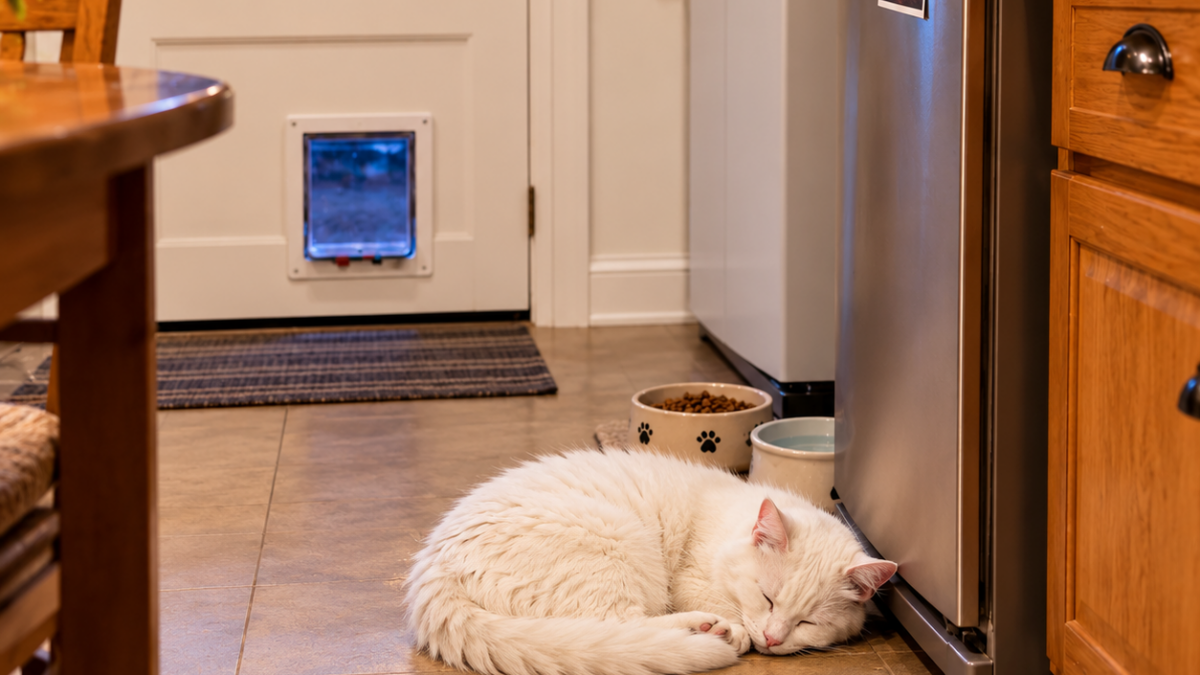
PART 2
I still had my real estate agent’s number.
At 8:15, I called her.
“I have a strange question.”
“That’s usually how homeowners start conversations that cost me money.”
“It’s not about the house.”
“That’s encouraging.”
“Do you still have the seller’s phone number?”
A pause.
“Probably. Why?”
“A cat came into my kitchen last night.”
Another pause.
“Okay.”
“Through the cat flap.”
“Right.”
“She seemed to know the house.”
My agent went quiet.
“What do you mean, know it?”
“She didn’t look around. She went straight to a spot beside the refrigerator.”
I glanced toward the faded mark.
“Then she slept under the cabinets.”
“What color?”
That question caught me.
“Orange and white.”
My agent exhaled.
“Oh.”
“What?”
“I think you should talk to the former owner.”
### The Phone Call
She contacted the seller first and asked permission to share the number.
Twenty minutes later, my phone rang.
I answered.
“Hello?”
A woman’s voice.
“Hi. I’m the woman who sold you the house.”
“Thank you for calling.”
“My agent said something about a cat.”
“Yes.”
There was something cautious in her voice now.
Almost hopeful.
“Can you describe her?”
“Orange and white. Older. Greenish eyes. A little white around the nose.”
Silence.
Then:
“Was she thin?”
“Not really.”
“Did she have a small nick near the top of her left ear?”
I thought about it.
“Yes.”
The woman inhaled sharply.
“That’s Clover.”
I looked toward the kitchen.
“Clover?”
“My cat.”
The words seemed impossible.
“Your cat?”
“Yes.”
“But you moved eight months ago.”
“I know.”
“And she lives with you now?”
“Yes.”
“Where?”
“About four miles away.”
I stood.
“Four miles?”
“Yes.”
“She walked four miles?”
Another pause.
“She’s done it before.”
That was the moment the story became something more than strange.
### Clover’s Old House
The woman told me Clover had lived in the house for most of her life.
She had arrived as a young adult after being taken in from a relative who could no longer keep her.
At first, Clover had hidden beneath furniture.
Then she claimed the kitchen.
The corner beside the refrigerator had held her food bowl.
The worn patch under the cabinets?
Her sleeping place.
Every day.
For years.
“That’s exactly where she went,” I said.
“I know.”
The woman’s voice softened.
“She always slept there.”
I looked at the tile.
Suddenly it didn’t look like worn flooring anymore.
It looked like evidence.
Evidence that a small life had repeated the same ordinary routine thousands of times.
“What about the cat flap?”
“We installed it maybe nine years ago.”
“So she used it constantly?”
“In summer, yes. She was always coming in and out.”
The woman laughed faintly.
“She’d sit outside for an hour, then come inside and act like she’d survived an expedition.”
I smiled.
That sounded like the cat I had met.
Confident.
Unhurried.
Certain that buildings should arrange themselves around her.
Then I asked:
“If she lives four miles away, how did she get here?”
“We don’t know exactly.”
The humor left her voice.
“But she keeps finding her way back.”
### They Had Tried Everything
The family moved because of work.
They hadn’t wanted to sell the house.
That surprised me.
I assumed most sellers were eager to leave by the time paperwork was signed.
This family hadn’t been.
Their children had grown up there.
They had planted trees in the backyard.
One of them had learned to ride a bicycle on the driveway.
Clover had spent years sleeping in windows and occupying the kitchen.
Then life changed.
They moved.
Clover moved with them.
“We did everything people tell you to do,” the woman explained. “Kept her inside for weeks. Put her blankets around the house. Used her old bowls. Made sure she had quiet rooms.”
“Did she settle?”
“We thought so.”
She paused.
“Then one day she got out.”
“And came here.”
“Yes.”
“How long did it take you to find her?”
“We didn’t.”
I frowned.
“What do you mean?”
“The first time, one of the neighbors from the old street called us.”
“Here?”
“Yes.”
“She was sitting on the back step.”
My back step.
I looked through the kitchen window.
“She crossed four miles?”
“Somehow.”
The woman sighed.
“We picked her up.”
“And then?”
“She did it again.”
### The Routine Nobody Could Break
The family became careful.
Doors closed quickly.
Screens checked.
Everyone warned visitors.
Clover still occasionally escaped.
And when she did, there was one place she went.
My house.
Her house.
Whatever you wanted to call it.
The former owner said:
“We already know where to look when she disappears.”
I sat down.
“How often?”
“Not constantly. She’s older now. Months can go by.”
“Does she always make it here?”
“As far as we know.”
I thought of the distance.
Four miles of roads, sidewalks, alleys, yards, fences, dogs, weather, traffic.
For a young cat, that would have worried me.
For an elderly one, it frightened me.
“Why?”
I asked the question even though I knew she couldn’t truly answer.
“Why does she keep coming?”
The woman was silent for a long time.
Then:
“She doesn’t understand that we moved.”
Her voice had changed.
I heard tears in it now.
“I think some part of her still believes that’s her home.”
I looked around my kitchen.
My refrigerator.
My mugs.
My coffee maker.
My grocery list pinned beside the pantry.
Eight months of my life layered over years of hers.
Suddenly ownership felt less simple.
### “Should I Block the Flap?”
It seemed like the responsible question.
Maybe the only responsible one.
“Do you want me to block the cat flap?”
The woman didn’t answer immediately.
I heard her breathe.
Finally:
“Probably.”
Then:
“No.”
I waited.
“I don’t know.”
“That’s okay.”
“She shouldn’t be making the trip.”
“I agree.”
“She’s getting old.”
“I noticed.”
“I worry every time she gets out.”
“I would too.”
Another long pause.
Then she asked quietly:
“Would you mind leaving it open a little longer?”
I glanced toward the scratched plastic flap.
“For Clover?”
“Yes.”
“Okay.”
The relief in her voice was immediate.
“Thank you.”
Then she said something I never forgot.
“She won’t be able to make these trips forever.”
I didn’t respond.
What could I say?
We both understood what she meant.
Not simply that one day Clover’s legs would become too stiff.
Not simply that the journey would become too far.
She was talking about age.
Time.
The slow closing of a life.
I looked again at the worn tile.
The place where Clover had slept from three until almost five.
For the first time, I understood that I hadn’t witnessed a trespassing cat.
I had witnessed an old animal returning to a room that contained her younger self.
### Two Nights Later
At 2:58 a.m., the flap tapped.
I was already awake.
I had been expecting her.
Clover stepped into the kitchen.
She saw me sitting at the table.
Stopped.
I whispered:
“Hi, Clover.”
Her ears lifted.
Maybe hearing her name surprised her.
Maybe not.
She walked past me.
Straight to the refrigerator.
Straight to the empty corner.
She sniffed.
Then walked to the faded tile.
Turned twice.
Lay down.
Exactly the same.
I didn’t move.
There was something sacred about the routine.
Not mystical.
Not magical.
Simply private.
A habit older than my claim to the house.
I made coffee.
Quietly.
The smell filled the kitchen.
Clover opened one eye.
“Sorry.”
She closed it again.
I sat at the table and watched an elderly cat sleep.
No drama.
No rescue.
No crisis.
And yet I felt more moved than I expected.
### The Bowl
The next afternoon, I went to a pet store.
Buying a cat bowl when you don’t own a cat feels oddly ceremonial.
I stood in front of an entire wall of options.
Ceramic.
Metal.
Plastic.
Raised.
Tilted.
Decorated with fish.
Decorated with paws.
One said:
**FUR BABY**
Absolutely not.
I chose a small, plain ceramic bowl.
Cream-colored.
I bought a second for water.
Before adding food, I called Clover’s owner.
“I want to leave something for her when she visits.”
“That’s very kind.”
“What does she eat?”
The woman told me.
Brand.
Portion.
A few dietary concerns.
“She doesn’t need much overnight.”
“Understood.”
“And please don’t give her milk.”
“I know.”
“I have to say it.”
“Fair.”
The woman laughed.
It was the first conversation we had where Clover felt less like a problem and more like a mutual acquaintance.
That evening, I placed the bowl beside the refrigerator.
Directly over the faded mark.
The old location.
I filled the water bowl.
Then I waited.
### 3:07
The flap opened.
Clover entered.
She saw me.
Then she saw the bowl.
She stopped.
Completely.
Her body became still.
I held my breath.
Clover approached.
Sniffed.
She looked toward me.
I had the strange feeling I was being evaluated.
“Your owner approved it.”
No response.
“I have authorization.”
She sniffed again.
Then ate.
Three bites.
Pause.
Two more.
Water.
She lifted her head.
Looked around the kitchen.
Then walked to the worn tile.
Turned twice.
Lay down.
I felt absurdly happy.
For the first time since she began returning to the house, something familiar had been waiting for her.
### I Started Leaving the Light On
Not the bright overhead light.
A small lamp on the counter.
Warm.
Low.
Enough to make the kitchen easy to navigate.
My electric bill did not collapse.
My life did not change.
But the room changed slightly.
It became ready.
That was how I began thinking of it.
Not waiting exactly.
Ready.
Some nights Clover came.
Most nights she didn’t.
There was no schedule.
Weeks passed occasionally.
Then I would hear:
Tap.
Scratch.
Soft feet.
And an elderly orange-and-white cat would appear.
### We Developed Rules
I didn’t approach her first.
She didn’t jump on counters.
I kept the food portion small.
She pretended the house was still hers.
I pretended to object.
It worked.
Once, I came downstairs and found her sitting on my kitchen chair.
“That’s new.”
Clover stared.
“You don’t live here.”
She closed her eyes.
“Right.”
I sat in another chair.
### The Former Owner Started Calling Me
Not constantly.
Just enough.
“Has she been there?”
“Not this week.”
Or:
“Yes. Tuesday morning.”
“What time?”
“About three.”
“Was she okay?”
“She ate. Slept. Left around five.”
The first few times, the woman sounded guilty.
“I’m sorry.”
“For what?”
“For this being your problem.”
“It isn’t a problem.”
“She’s breaking into your house.”
“She has a key.”
“What?”
“The cat flap.”
She laughed.
That became easier too.
### I Learned Clover’s History
The former owner told me pieces over time.
Clover used to sleep under the cabinets while breakfast was being made.
She learned the sound of the refrigerator opening and would appear instantly.
She hated thunderstorms.
Loved roasted chicken.
Ignored most toys.
Preferred cardboard.
In winter, she slept upstairs more.
In summer, the tile became her favorite place because it stayed cool.
That explained the worn patch.
Years of fur.
Paws.
Weight.
Turning twice.
Settling.
An ordinary act repeated so many times it physically changed the floor.
That fascinated me.
Human beings leave marks everywhere.
Furniture dents.
Nail holes.
Scuffed stairs.
But Clover had left her own.
### The House Became Double
There was the house I knew.
And the house Clover remembered.
Mine had a small table by the window.
Hers had once had a larger wooden table.
Mine had white curtains.
Hers had yellow ones.
My refrigerator was stainless steel.
The previous family’s had been white.
But the corner remained.
The tile remained.
The cat flap remained.
Certain anchors survived.
Clover didn’t seem bothered by the differences.
Maybe animals don’t need every detail.
Maybe a few important points are enough.
Smell.
Texture.
Shape.
Route.
### One Morning She Didn’t Leave
At 5:00, Clover was still sleeping.
5:30.
Still there.
I became nervous.
By six, I called her owner.
“She hasn’t left.”
“What?”
“She’s still sleeping.”
Silence.
“Is she breathing normally?”
“Yes.”
“Does she respond?”
I crouched several feet away.
“Clover?”
One ear moved.
“She’s responding.”
The woman exhaled.
“She might just be tired.”
The obvious explanation frightened me anyway.
Four miles.
Old age.
Cold night.
I sat on the kitchen floor.
“Clover.”
She opened her eyes.
Slowly.
Then stretched.
Got up.
Walked to the water bowl.
Drank.
I called the owner again.
“She’s up.”
“Oh, thank God.”
“Do you want to come get her?”
A pause.
“Yes.”
### They Came Back to the House
Twenty minutes later, a car pulled into my driveway.
It was the first time I saw Clover’s family since buying the house.
The woman stepped out carrying a cat carrier.
A man was with her.
Her husband, I assumed.
They both looked toward the kitchen window.
I opened the front door.
“She’s in the kitchen.”
The woman stopped in the hallway.
I watched her face.
She hadn’t been inside since moving.
For me, the hallway was just a hallway.
For her, it was eight months of absence compressed into ten feet.
“Oh.”
“You okay?”
“Yes.”
She wasn’t.
Not entirely.
She walked toward the kitchen.
Clover was sitting beside the refrigerator.
The moment she saw the woman, she meowed.
A loud, scratchy sound.
The woman dropped to her knees.
“There you are.”
Clover walked toward her.
Rubbed against her legs.
The woman began crying.
“I’m sorry.”
Clover rubbed harder.
The husband looked away.
I pretended to check the coffee maker.
Some moments don’t need witnesses staring directly at them.
### Two Homes in One Room
The former owner sat on my kitchen floor holding Clover.
She looked around.
“You changed the curtains.”
“I did.”
“They look better.”
“They were cheap.”
“No. I mean better than ours.”
I laughed.
Then she saw the bowl beside the refrigerator.
Her expression changed.
“You put it there.”
“That’s where she goes.”
“That’s exactly where her old bowl was.”
“I figured.”
Her hand covered her mouth.
The husband put one palm against her shoulder.
She whispered:
“I didn’t know how much I missed this room.”
I understood then.
Clover wasn’t the only one carrying memories.
### Clover Refused the Carrier
Naturally.
They tried.
She backed away.
They tried treats.
She ignored them.
The husband said:
“She’s eighty years old in cat years and still thinks we’re idiots.”
The woman wiped her face.
“She’s consistent.”
Eventually, Clover entered after some negotiation.
Before the door closed, she looked toward the worn tile.
Only for a second.
Then they carried her outside.
I stood at the back door.
The woman turned.
“Thank you.”
“For what?”
“For letting her come back.”
I shrugged.
“It’s her flap.”
The woman laughed.
Then cried again.
### I Started Understanding the Word “Home”
Before Clover, I thought home was mostly practical.
The place you pay for.
Maintain.
Insure.
Clean.
The place where your possessions are.
Then an elderly cat walked four miles to sleep on a faded tile.
That complicated things.
Clover had another house.
Another family.
Another bowl.
Another bed.
People who loved her.
And still, some part of her navigated back to this address.
Was that confusion?
Probably.
Habit?
Certainly.
Memory?
Obviously.
Love?
Maybe.
I stopped needing one explanation.
### Spring
When the weather warmed, Clover visited more often.
Not every week.
But enough that I could recognize the sound instantly.
Tap.
Pause.
Scratch.
I would look at the clock.
Usually between 2:40 and 3:20.
“Morning, Clover.”
She would enter.
Eat.
Sleep.
Leave.
Sometimes she explored the backyard first.
Sometimes she stayed until sunrise.
I informed her family every time.
We developed a shared system.
If she arrived, I texted.
If she hadn’t returned to them by morning, they came.
We never treated the journey as harmless.
Four miles remained four miles.
But Clover remained Clover.
### One Night I Tried to Close the Flap
Not permanently.
A storm was coming.
The forecast predicted heavy rain and wind.
I locked the flap around midnight.
At 3:16, something scratched outside.
My stomach dropped.
I rushed downstairs.
Clover.
Wet.
Standing on the step.
I opened the back door.
She walked inside without acknowledging me.
Water dripped from her coat.
“Okay. Point taken.”
I grabbed a towel.
She tolerated exactly three seconds of drying before glaring.
“Your owner is going to blame me.”
Clover walked to the food bowl.
I called.
“She’s here.”
The owner groaned.
“How?”
“I was hoping you knew.”
“She got out when my husband brought groceries in.”
“She made it through the storm.”
“Oh, Clover.”
“She’s okay.”
“I’m coming.”
“Wait until the rain slows.”
A pause.
“You’re sure?”
“She’s warm. Eating.”
“Thank you.”
I looked at Clover.
“You are causing problems in multiple households.”
She ate.
No remorse.
### That Storm Changed the Plan
The next day, Clover’s family and I talked seriously.
The trips were becoming too risky.
Traffic alone was enough.
Weather made it worse.
“She can’t keep doing this,” I said.
“I know.”
Her owner sounded exhausted.
“We can keep her inside.”
“You’ve tried.”
“We’ll try harder.”
“I don’t want her getting hurt.”
“Neither do I.”
Silence.
Then I suggested something that surprised both of us.
“What if you bring her?”
“What?”
“Not every day.”
I sat at the kitchen table.
“But once in a while. Put her in the carrier. Bring her here. Let her visit.”
The woman was quiet.
“You’d really be okay with that?”
“Yes.”
“You bought the house.”
“So?”
“It’s strange.”
I looked toward Clover’s tile.
“It stopped being strange months ago.”
### The First Planned Visit
A week later, they drove Clover over in daylight.
She hated the carrier.
She announced this loudly.
The moment they opened it in the kitchen, Clover stepped out.
Then stopped.
Daylight changed the room.
She looked around.
Slowly.
Walked to the bowl.
Then to the tile.
Turned twice.
Lay down.
Her owner sat at my table.
We drank coffee.
Clover slept.
For the first time, nobody had to worry about four miles of roads.
The woman looked at me.
“This feels ridiculous.”
“It is.”
“I’m visiting my old house so my cat can take a nap.”
“Yes.”
She smiled.
“Thank you for understanding.”
I looked at Clover.
“I’m not sure I do.”
That was also true.
### The Visits Became Safer
We couldn’t control every escape.
Clover still occasionally slipped out.
But the deliberate visits helped.
At least, we believed they did.
Once every couple of weeks, sometimes less, they brought her.
She spent an hour or two.
Ate.
Slept.
Walked around the kitchen.
Sometimes into the hallway.
Never much farther.
Then went home.
The old house became less of a forbidden destination and more of a place still available to her.
Maybe that mattered.
Maybe not.
But the dangerous nighttime journeys decreased.
### I Became Friends With the Former Owner
We had almost nothing else in common.
Different ages.
Different jobs.
Different lives.
Yet Clover created a strange bridge.
Sometimes she stayed after collecting Clover.
We talked.
She told me about raising her children there.
I told her about repairing the bathroom sink.
She told me which outlet had always been unreliable.
I told her I’d replaced it.
She laughed.
“So that was really broken?”
“Yes.”
“My husband insisted it was the lamp.”
“He owes you an apology.”
“I’m calling him.”
The house became less anonymous.
I learned the stories behind the marks.
### The Scratch on the Hallway Door
Clover.
Of course.
“She got trapped in the bedroom once.”
The former owner pointed at the scratches.
“She hated closed doors.”
“Still does.”
“The kids accidentally shut her in there.”
“For how long?”
“Maybe twenty minutes.”
“And she did that?”
“She believes in immediate escalation.”
That sounded right.
### The Dent in the Baseboard
Not Clover.
A bicycle.
Their son had tried to ride it inside.
“At eleven years old?”
“He wasn’t our smartest child that afternoon.”
I laughed.
The house became populated again.
Not physically.
Historically.
### I Had Bought More Than Walls
That realization kept returning.
Property law said the house was mine.
Memory didn’t care about property law.
The previous family had left.
Clover hadn’t, not entirely.
And through Clover, pieces of them kept walking back into the kitchen.
### The Corner Beside the Refrigerator
I never put anything there.
At first, accidentally.
Later, deliberately.
I considered moving a small cart into the space.
Then decided against it.
That spot belonged to the bowl now.
Not legally.
Emotionally.
I became surprisingly protective of it.
A friend visited and said:
“You don’t even own a cat.”
“No.”
“Then why do you have cat bowls?”
“It’s complicated.”
“Do you feed strays?”
“One specific non-stray.”
He stared.
I explained.
Halfway through, he said:
“You’re letting someone else’s cat break into your house?”
“She has visitation rights.”
He laughed.
Then Clover arrived while he was there.
3:11.
Walked through the flap.
Saw him.
Stopped.
My friend whispered:
“That’s her?”
“Yes.”
Clover stared at him with deep suspicion.
Then walked around him as though he were furniture.
My friend said:
“She definitely thinks this is her house.”
“Exactly.”
### Summer
Clover’s coat looked better in warm weather.
She moved more easily.
Her owner said she had been to the veterinarian and was doing well for her age.
That relieved me more than I expected.
I had become attached.
Not in the way her family was.
Different.
I didn’t own her.
I didn’t expect her.
But each visit felt like being trusted with something fragile.
An old routine.
A memory.
A small life passing through.
### She Began Acknowledging Me
At first, I had simply existed in the room.
Later, Clover occasionally approached.
One morning she rubbed her cheek against the leg of my chair.
I froze.
“Was that affection?”
She walked away.
“Clover?”
Nothing.
I texted her owner.
**She touched me voluntarily.**
The reply came:
**Don’t get excited. She probably wanted the chair.**
Fair.
### The Chair
Eventually, Clover started sleeping beneath my kitchen table instead of always on the tile.
That felt significant.
The first time, I worried.
“Are you okay?”
She was.
She simply chose another place.
I told her owner.
“She slept somewhere different.”
The woman became quiet.
“Really?”
“Yes.”
“That might be good.”
I understood.
The worn tile had been memory.
Choosing somewhere new might mean the room itself had become familiar again in a different way.
Not only past.
Present too.
### I Felt Guilty About Being Happy
Was I stealing part of Clover’s old home?
Was she replacing the former family with me?
Of course not.
That was human overthinking.
Clover wasn’t holding a philosophical debate about loyalty.
She was comfortable.
That was enough.
Her owner laughed when I admitted it.
“You realize she has enough love for multiple chairs, right?”
“I suppose.”
“You’re allowed to like her.”
“I do.”
“I know.”
### The Photo
One afternoon, the former owner brought me something.
A small framed photograph.
Clover as a younger cat.
Maybe six or seven.
Larger.
Brighter orange.
Sitting beside the refrigerator.
Same corner.
Same faded tile, though less faded then.
Her food bowl visible.
The exact place.
“I thought you might want this.”
I stared.
“Are you sure?”
“We have copies.”
I looked at the younger Clover.
“That’s strange.”
“What?”
“I know that cat.”
The woman smiled.
“Yes.”
“But I never met that version.”
“No.”
I placed the photo on a small shelf in the kitchen.
Not as decoration exactly.
As context.
### Clover Saw It
Did she recognize herself?
Probably not.
She sniffed the frame.
Then rubbed her face against the corner.
Good enough.
### The Visit That Scared Me
Autumn returned.
One night Clover came through the flap and seemed exhausted.
Not simply sleepy.
Slower.
She stood beside the bowl but didn’t eat.
I immediately called her owner.
“She’s here.”
“Okay.”
“But she seems off.”
The woman’s voice changed.
“What do you mean?”
“Slow. Tired. She hasn’t eaten.”
“I’m coming.”
I sat on the floor several feet from Clover.
She lowered herself onto the tile.
“Hey.”
Her eyes opened.
“Stay with me.”
I knew how ridiculous the phrase was.
Still, I said it.
Her family arrived quickly.
The owner knelt.
Clover lifted her head.
Meowed.
They took her to the emergency vet.
I stood in my kitchen after they left.
The bowl untouched.
The tile empty.
For the first time, the room felt wrong.
### Waiting
I understood Clover a little better that night.
Waiting changes time.
Ten minutes becomes an hour.
An hour becomes a night.
I kept my phone beside me.
At 1:40 a.m., the owner texted.
**She’s okay. Probably overexerted. Mild dehydration. They want us to keep her indoors and monitor her.**
I sat down.
Relief made my hands shake.
Then another message.
**No more walking back to the old house.**
I replied immediately.
**Agreed. Bring her anytime.**
### The End of the Cat Flap
The next morning, I locked it.
Not because I wanted to erase Clover.
Because loving the story did not mean encouraging the dangerous part.
That distinction mattered.
For months, I had romanticized the little flap.
A doorway between homes.
A path memory refused to close.
But four miles was four miles.
Old age was old age.
Clover’s safety mattered more than symbolism.
I called her owner.
“It’s locked.”
“Thank you.”
“I feel terrible.”
“Don’t.”
“What if she comes?”
“She won’t.”
“How do you know?”
“We’re being much more careful now.”
A pause.
“And if she ever does…”
“I’ll open the actual door.”
She laughed.
“Deal.”
### I Missed the Sound
That surprised me.
Tap.
Scratch.
Soft paws.
For months, I had heard it unexpectedly.
Now I knew I wouldn’t.
Three o’clock became ordinary again.
I slept through it.
Mostly.
Sometimes I woke.
Looked at the clock.
3:05.
Listened.
Nothing.
I hated how empty silence could feel once you knew what sound used to fill it.
### Clover Came Back by Car
Two weeks later.
Daylight.
Carrier.
Complaining loudly.
Her owner opened it in the kitchen.
Clover stepped out.
Walked to the bowl.
Ate.
Then went to the worn tile.
Turned twice.
Lay down.
I smiled.
“You still know the place.”
Her owner sat at the table.
“She probably knows it better than both of us.”
True.
### We Created a New Routine
No more dangerous overnight journeys.
Instead, occasional visits.
Sometimes every two weeks.
Sometimes a month passed.
It depended on Clover.
On weather.
On health.
On life.
The important part was choice without risk.
Her owner would call:
“Clover’s being restless. Do you mind if we stop by?”
“No.”
Or:
“She’s doing well today.”
“Bring her.”
I began calling them “office hours.”
Clover’s owner found this ridiculous.
### Christmas
They visited a few days before Christmas.
I had decorated the kitchen.
Small lights around the window.
Nothing elaborate.
Clover entered.
Stopped beneath them.
For a second, her orange fur caught the warm light.
Her owner whispered:
“She used to sleep under the Christmas tree.”
“Did she destroy ornaments?”
“Only expensive ones.”
“Of course.”
We laughed.
Clover slept beneath the table.
Not on the tile.
I noticed.
So did her owner.
Neither of us commented.
### A New Memory
That was what was happening.
Clover was not only revisiting old ones.
She was making new ones.
The house had stopped being frozen in the past.
She now knew my table.
My coffee smell.
The cream-colored bowl I had chosen.
The sound of my voice.
Her old home had changed.
And somehow, that did not destroy what it had been.
### I Painted the Kitchen
That became a moral crisis.
For me, not Clover.
The walls needed repainting.
Years of marks.
Faded patches.
I chose a warm off-white.
Then stared at the worn tile.
I couldn’t replace it.
Not yet.
A contractor said:
“You’ll want new flooring eventually.”
“Maybe.”
“That tile’s pretty worn.”
“I know.”
“You have water damage?”
“No.”
“Then why keep it?”
I looked at the faded patch.
“Long story.”
### I Left It
Some people keep growth marks on doorframes.
Others preserve old wallpaper behind cabinets.
I kept one worn patch of kitchen tile because a cat had slept there for years.
There are worse reasons.
### Clover Grew Older
The change was gradual.
Her jumps became smaller.
She took longer stepping from the carrier.
Her owner began lifting her more often.
Clover objected.
Strongly.
“Still dramatic,” I said.
“She has standards.”
Sometimes Clover rested before eating.
Sometimes she drank more.
The family stayed on top of veterinary care.
We all understood time was moving.
Nobody said it often.
### The Former Owner Asked Me Something
One afternoon, while Clover slept, she said:
“Do you ever wish I hadn’t asked you to leave the flap open?”
“No.”
“Really?”
“Really.”
“It was unfair.”
“How?”
“I made our history part of your house.”
I looked around.
“It was already here.”
She glanced at the tile.
I continued.
“You didn’t bring it back. Clover did.”
The woman smiled.
“She has a talent for getting her way.”
### She Apologized Again
“For selling the house?”
“No.”
“For Clover.”
“You don’t need to.”
“I know.”
She looked toward her cat.
“But moving her at this age…”
“You didn’t have a choice?”
“We had choices.”
That surprised me.
She looked down.
“We needed to move. But I still feel like we broke something for her.”
I thought carefully.
“Maybe.”
Her eyes lifted.
“But she still has you.”
Silence.
“And apparently she has me too.”
The woman laughed.
“That poor cat.”
### Clover Had Not Been Abandoned
That distinction mattered.
Unlike so many stories people tell about animals returning to old homes, Clover had a family.
A loving one.
Her return wasn’t proof that they failed her.
It was proof that attachment is complicated.
Her family could love her perfectly and still be unable to move the history inside her body.
### Animals Remember Differently
I started reading about cat behavior.
Not obsessively.
Enough to understand territory, scent, routines, homing ability.
But facts only explained part of what I witnessed.
Yes, cats can form strong attachments to territory.
Yes, familiar smells matter.
Yes, some cats return to old homes after moves.
Those explanations made sense.
Still, standing in a dark kitchen at three in the morning while Clover slept in the exact spot she had used for years felt different from reading about behavior.
Science explained the mechanism.
It didn’t lessen the emotion.
### The Last Unplanned Visit
It happened in early spring.
The flap was locked.
I woke to scratching at the back door.
Not the flap.
The actual door.
3:22.
I knew before I reached the kitchen.
Clover.
I opened the door immediately.
She stepped inside.
Dry.
Tired.
But alert.
“Clover.”
I knelt.
“How?”
She walked past me.
I called her family.
The owner answered on the second ring.
“She’s here.”
Silence.
“What?”
“At my back door.”
“Oh no.”
“She seems okay.”
“We didn’t know she was gone.”
“I’m bringing her inside.”
“I’m coming.”
Clover ate.
Then walked toward the tile.
Instead of curling immediately, she stood there.
Looked at the corner.
Then at me.
I sat down.
“What are you doing, old girl?”
She approached.
Slowly.
And rubbed her head against my knee.
It was the first time she had ever done that without food, furniture, or convenience involved.
I put one hand near her.
Waited.
She leaned into it.
I stroked her head.
Once.
Twice.
She purred.
Very softly.
### I Cried
Embarrassing.
True.
Not because anything sad had happened.
Because something had changed.
For months, Clover had treated me as the temporary person occupying a permanent place.
That morning, for one brief moment, I felt accepted.
Not as replacement.
Not as owner.
As part of the house.
### Her Family Arrived
The woman found me sitting on the kitchen floor beside Clover.
She stopped.
“Oh.”
Clover continued purring.
The woman smiled.
“She likes you.”
“I think she tolerated me before.”
“No.”
Her owner shook her head.
“She doesn’t do that unless she trusts someone.”
I looked down.
“That makes it worse.”
“What?”
“I’m attached.”
She laughed.
“Too late now.”
### They Found the Escape Point
A basement window.
Loose screen.
Clover had somehow pushed through.
The family repaired it immediately.
That really was the final unsupervised trip.
At least while she lived.
### I Never Unlocked the Cat Flap Again
That sounds sad.
It wasn’t.
The flap had done its job.
It had allowed Clover to return until the humans around her understood what she was asking for.
Then we found a safer way.
Sometimes love means leaving the door open.
Sometimes it means finally closing it because the journey through it has become too dangerous.
Knowing the difference matters.
### The Bowl Stayed
Locked flap.
Bowl still there.
Water fresh on visit days.
Clover’s photograph on the shelf.
The worn tile untouched.
I had no intention of changing those.
### Her Visits Became Shorter
An hour.
Sometimes forty minutes.
Clover often slept.
Her owner worried she was boring me.
“She literally comes here to nap.”
“I know.”
“You could watch paint dry.”
“I’d rather watch Clover.”
The woman smiled.
“Fair.”
### One Afternoon Clover Didn’t Go to the Tile
She came out of the carrier.
Ate.
Then walked directly to my feet.
Rubbed against my leg.
Walked into the living room.
She had never gone that far before.
Her owner and I followed at a distance.
Clover inspected the couch.
My bookshelf.
The rug.
Then jumped—carefully—onto the lower cushion.
She curled up.
I whispered:
“That’s new.”
Her owner smiled.
“She’s visiting you now.”
The words hit me harder than they should have.
At first, Clover returned only to her past.
Now perhaps there was something in the present worth visiting too.
### The House Was No Longer Only Hers or Mine
It had become layered.
The family before.
Me after.
Clover connecting both.
That felt more honest than ownership.
### The Final Summer
I didn’t know it would be final.
Nobody does.
Clover still visited occasionally.
She was slower but comfortable.
Her veterinarian managed the ordinary problems of age.
Joints.
Kidneys beginning to need monitoring.
Diet adjustments.
Nothing dramatic.
Time, mostly.
One July afternoon, they brought her over.
Sunlight came through the kitchen window.
Clover walked to the worn tile.
Then changed her mind.
She chose a rectangle of sunlight near the table.
Turned twice.
Lay down.
Her owner whispered:
“She never used to sleep there.”
I smiled.
“She does now.”
### Clover Slept Between Two Eras
The old tile behind her.
My table beside her.
Sunlight across her body.
If I had taken a photograph, it might have looked ordinary.
I didn’t.
Some moments feel better when they aren’t turned into evidence.
### The Call I Knew Would Come
It happened months later.
A cold morning.
Not three o’clock.
9:17.
My phone rang.
I saw Clover’s owner’s name.
Before answering, something inside me understood.
“Hi.”
The woman was crying.
Not loudly.
“I wanted you to know.”
I sat down.
“Okay.”
“Clover passed away this morning.”
There it was.
The sentence we had been approaching since our first phone call.
The sentence hidden inside:
She won’t be able to make these trips forever.
I closed my eyes.
“Was she comfortable?”
“Yes.”
“Were you with her?”
“All of us.”
I breathed out.
“Good.”
“She was in her bed.”
I nodded even though she couldn’t see me.
“She had breakfast yesterday.”
I laughed through tears.
“That sounds like Clover.”
“She complained about her medication.”
“Also Clover.”
The woman cried harder.
Then said:
“I think she had a good life.”
“She did.”
“I just wish…”
She stopped.
“What?”
“I wish she could’ve visited one more time.”
I looked toward the kitchen.
The bowl.
The tile.
The little locked flap.
“She did enough.”
### The Kitchen That Morning
After the call ended, I stood in the kitchen.
No sound.
The house had never actually expected Clover every morning.
But grief is irrational.
I looked at the clock.
9:31.
Then at the back door.
Part of me expected the flap to move.
Ridiculous.
Impossible.
Still.
I waited.
Nothing.
### The Bowl
I almost removed it that day.
Picked it up.
Washed it.
Dried it.
Held it over the cabinet.
Then stopped.
I put it back beside the refrigerator.
Empty.
Not because I thought Clover was coming.
Because I wasn’t ready for the corner to become ordinary again.
### Her Owner Visited Alone
A week later.
She carried the cat carrier out of habit.
Then realized what she had done.
We both stared at it.
She laughed once.
Painfully.
“I don’t know why I brought this.”
I opened the door wider.
“Come in.”
She walked to the kitchen.
Stopped beside the bowl.
Touched the edge.
“She always made a mess with water.”
“I know.”
“She’d drink and walk away with half of it on her chin.”
“I know.”
The woman smiled.
“You really did know her.”
That felt like a gift.
### We Sat at the Table
The same table where I had watched Clover sleep at three in the morning.
The woman brought photographs.
Clover as a young cat.
Clover in a cardboard box.
Clover sleeping beneath the Christmas tree.
Clover sitting in the backyard of this house.
Clover older.
Clover at their new house.
Two homes.
One life.
### “Do You Want Her Bowl?”
I asked.
The woman looked at it.
“No.”
“Are you sure?”
“You bought that.”
“Yes.”
“But it belongs here.”
I understood.
### The Faded Tile
She crouched.
Touched it.
“I always hated this floor.”
I laughed.
“So do I.”
“My husband wanted to replace it.”
“Mine too.”
We both stopped.
I didn’t have a husband.
She laughed.
“Sorry.”
“I knew what you meant.”
She wiped her eyes.
“Dad joke reflex.”
Then she looked at the tile again.
“Keep this spot if you can.”
“I will.”
“You don’t have to.”
“I know.”
That was why I would.
### The Cat Flap
Eventually, I replaced the back door.
Months later.
Winter drafts had become ridiculous.
The old door came off.
I held the cloudy flap before the contractor hauled everything away.
“Want me to toss it?”
“No.”
He looked at me.
“You keeping that?”
“Yes.”
He shrugged.
Homeowners keep strange things.
I cleaned the flap.
Put it in a small box with Clover’s photograph.
Not displayed.
Just kept.
Some objects don’t need to perform memory publicly.
It’s enough that they exist.
### The Bowl Stayed Longer
Almost a year.
Empty.
Then one afternoon I finally moved it.
Not because I forgot.
Because I didn’t need the object in the exact spot anymore.
That surprised me.
Maybe I had learned something from Clover.
Memory could survive movement.
I placed the bowl on a kitchen shelf beneath her photograph.
The corner beside the refrigerator became empty again.
Like the first day I moved in.
Except now I knew why the floor was faded.
That changed everything.
### I Never Replaced the Tile
People asked.
Contractors suggested it.
Friends said modern flooring would improve the room.
Maybe one day.
But not yet.
The worn patch remained.
A quiet physical record of years nobody could see.
### The Most Satisfying Ending
People sometimes want stories to end with someone winning.
Someone punished.
Something restored exactly as it was.
Clover’s story didn’t work that way.
Nobody had wronged her.
Her family loved her.
I loved having her visit.
The move had simply changed a world she understood.
There was no villain.
Only time.
Distance.
Memory.
And an old cat who refused to accept that one address had stopped being home.
If there was any revenge in the story, it was Clover’s victory over the idea that moving meant losing everything.
Her family gave her a new home.
I kept part of the old one open.
For a while, she had both.
That was more than most of us get.
### I Bought a House
That was how I used to tell the beginning.
I bought a house.
Eight months later, a strange cat walked through the back door.
Now I tell it differently.
I bought a house that already belonged to years I had never seen.
Clover was the one who explained that to me.
### Four Walls Are Not the Whole Thing
A home is repetition.
The bowl in the same corner.
The same patch of cool tile.
The sound of people making breakfast.
Sunlight moving across a familiar floor.
The back door opening.
Someone calling your name.
The places where you slept so many times your body left a mark.
You can move the furniture.
Paint the walls.
Change the refrigerator.
Replace the curtains.
Some maps remain inside us.
### Clover Carried Hers for Four Miles
Again and again.
Until her body no longer needed to.
Until we found safer ways.
Until the map became memory instead of a route.
### The Last Time I Dreamed About Her
Months after Clover died, I dreamed I heard the flap.
Old flap.
Old door.
3:03.
I walked into the kitchen.
Clover was there.
Not old.
Not young.
Just Clover.
She stood beside the refrigerator.
The bowl was full.
She looked at me.
Then walked to the tile.
Turned twice.
Lay down.
I sat at the table.
Nothing else happened.
When I woke, I wasn’t sad.
Not exactly.
The dream had been ordinary.
That felt right.
### Ordinary Was the Whole Point
Clover wasn’t returning because the house contained treasure.
Nothing dramatic had happened there.
She returned because ordinary life had happened there.
Thousands of breakfasts.
Naps.
Footsteps.
Doors.
Voices.
Years.
That was enough to make the place worth crossing four miles for.
### The Former Owner and I Stayed in Touch
Not constantly.
Holiday messages.
An occasional photograph from when Clover was younger.
Updates about the old neighborhood.
Once she wrote:
**Do you still have the worn tile?**
I replied with a photo.
**Still here.**
She answered:
**Good.**
Nothing else was needed.
### “Still Here”
That phrase became meaningful.
Clover wasn’t.
The mark was.
The memories were.
The house was.
I was.
But “still here” no longer meant refusing to move forward.
It simply meant some things survive in altered form.
### New Owners
Years later, I sometimes wondered what would happen if I sold the house.
Would I explain Clover?
Would the next person care?
Would they replace the floor immediately?
Would that matter?
At first, I thought yes.
Then I reconsidered.
Clover’s life did not depend on a tile surviving forever.
That would make memory another kind of cage.
If the floor disappeared, Clover would still have existed.
She had already taught me that.
### The Mark Was Not the Memory
It only pointed toward it.
Like the cat flap.
Like the bowl.
Like the photograph.
### Home Can Outlive Objects
That might be the final lesson.
Clover believed home was a place.
Then somehow, through her strange visits, I learned that home can also become something carried.
Her first family carried her into the new house.
Clover carried the old house inside herself.
I carried her story after she was gone.
Nobody owned the whole thing.
### One Cold Morning
Years after that first visit, I woke around three.
Wind against the windows.
The new back door silent.
I walked to the kitchen.
Not because I had heard anything.
Habit.
I turned on the small lamp.
The one I used to leave for Clover.
The room glowed softly.
I made coffee.
Then sat at the table.
The faded tile was visible beneath the cabinets.
I could almost picture her.
Orange and white.
Turn once.
Twice.
Curl.
Sleep.
### I Didn’t Feel Haunted
I felt grateful.
There is a difference.
### Clover Had Trusted Me With Her Past
Not intentionally.
She was a cat.
She came because she remembered.
But by allowing her to return, I became the keeper of a small part of a life I had not witnessed.
That is what old houses do to us sometimes.
They hand us stories through scratches, dents, faded floors, forgotten objects.
Most we never understand.
Clover was unusual because she came back to explain hers.
### Her Story Explained the House
The cat flap was not ugly hardware anymore.
It was a doorway she had used for years.
The faded semicircle was not random discoloration.
It was a bowl.
The dull tile was not bad flooring.
It was thousands of naps.
The corner was not empty.
It was full of repetition.
That changed how I saw everything.
### I Became More Careful With Old Marks
I stopped assuming every flaw needed repairing immediately.
Some did.
Water damage is water damage.
But others?
I started asking.
Why is this here?
Who made this?
What happened enough times to leave a trace?
Not every mark deserves preservation.
But every mark came from something.
### Clover’s Revenge Against Time
If I had to describe the “revenge” in her story, I’d call it this:
Time said the house had changed owners.
Clover came back anyway.
Distance said four miles separated her from her old kitchen.
She found the route.
The move said the old routine was finished.
For a while, she kept part of it alive.
Age said her journeys would eventually stop.
We found another way.
And even after Clover herself was gone, the life she lived here altered the way another human understood home.
Time won eventually.
It always does.
But it did not erase her.
### That Was Enough
More than enough.
### The First Night
Sometimes I go back to that first image.
Me.
Barefoot.
Confused.
3:03 a.m.
A strange cat beside my refrigerator.
I thought I was witnessing something bizarre.
I wasn’t.
I was watching memory perform a routine.
Clover walked into the room and did exactly what she had done countless times before.
The house had changed.
She had not.
Not yet.
### Later, She Did
She learned me.
Learned my table.
My coffee.
My voice.
She began sleeping somewhere new.
She began rubbing against my leg.
She allowed the old house to become slightly new without losing what it had been.
That may have been the most beautiful part.
### She Didn’t Have to Choose
Old home or new.
Old family or new friend.
Past or present.
For a little while, she was allowed all of it.
### Her Family Never Lost Her
And I never truly had her.
That made our relationship unusual.
Maybe purer in some way.
No ownership.
Only hospitality.
### I Was the Person Who Left the Light On
That was enough.
### The Kitchen Today
Different paint.
New back door.
Same cabinets, though refinished.
Same refrigerator corner.
Same worn tile.
Clover’s photo on the shelf.
Her little cream-colored bowl beside it.
A visitor might ask:
“Was that your cat?”
I usually answer:
“Not exactly.”
Then I tell them.
### Some People Laugh at the Beginning
“A cat broke into your house?”
“Yes.”
“Multiple times?”
“Yes.”
“You let her?”
“Eventually.”
Then they stop laughing when I reach the part about four miles.
About age.
About the old sleeping spot.
About the owner asking me to keep the flap open.
That’s usually the moment they understand.
### Clover Wasn’t Trying to Return to a Building
Not exactly.
She was returning to a life.
Of course, life wasn’t there anymore.
The people had moved.
Furniture changed.
Smells changed.
But the floor remained.
The corner remained.
For Clover, that may have been enough.
### We All Do Versions of This
Humans revisit childhood streets.
Drive past old schools.
Keep keys to doors that no longer exist.
Save clothing belonging to people who are gone.
Listen to songs because they contain a room we once lived in.
Clover walked four miles.
Maybe that was simply her version.
### I Never Called It Confusion Again
Her owner did once.
“She’s confused.”
Maybe.
But after knowing Clover, I preferred:
“She remembers.”
Both might have been true.
The second felt kinder.
### Remembering Isn’t Always Rational
It doesn’t need to be.
### The Quietest Legacy
Clover didn’t leave me money.
Furniture.
A legal note.
She left a worn floor.
A bowl.
A photo.
A habit of waking at three.
And an idea.
Home is not always where your address says you live.
Sometimes it is where your body remembers exactly where to lie down.
### The Final Morning
The morning after Clover’s owner told me she was gone, I woke at 3:01.
No sound had awakened me.
I simply opened my eyes.
I lay there.
Listened.
Nothing.
For eight months before Clover, that silence had meant nothing.
After Clover, it had shape.
I got up.
Walked downstairs.
The lamp was already on.
I had forgotten to switch it off.
The bowl sat beside the refrigerator.
Empty.
The tile beneath the cabinets was bare.
I poured water into my coffee maker.
Then stopped.
I looked at the cat flap.
Locked.
Still.
For one foolish second, I wanted it to move.
Not because I believed she could come back.
Because grief occasionally asks the impossible before accepting the ordinary.
It didn’t move.
I sat at the table.
### I Wasn’t Ready
I had known this morning would come.
The former owner had known.
We had talked around it from the first day.
“She won’t be able to make these trips forever.”
I had thought preparation would make the absence easier.
It didn’t.
Knowing a goodbye exists somewhere in the future does not rehearse your heart for the moment it arrives.
### Then I Looked at the Tile
And I remembered that Clover had already done the hard part.
She had made the journey.
Again and again.
She had found the old kitchen.
She had slept where she wanted.
She had eaten from a bowl placed exactly where the old one used to be.
She had been allowed to remember.
Later, she had learned safer visits.
She had learned me.
She had slept beneath my table.
She had explored my living room.
She had made new memories inside the old house.
Nothing was unfinished.
That mattered.
### I Didn’t Need One More Visit
I wanted one.
Different thing.
### So I Made Coffee
Sat down.
Waited for sunrise.
At 5:02, pale light entered the kitchen.
The same time Clover often used to leave.
I looked toward the back door.
Then whispered:
“Good morning, Clover.”
No answer.
That was okay.
### The House Was Mine
Legally.
Practically.
But after Clover, I never again thought that meant nobody else could belong to it in memory.
A house can hold multiple lives.
One after another.
Sometimes overlapping.
### Clover Taught Me That Without Trying
She simply came home.
### Her Old Owner Once Told Me
“You were kinder than you had to be.”
I disagreed.
Not because I’m especially good.
Because once you watch an elderly cat cross your kitchen at three in the morning, walk directly to one worn square of flooring, turn around twice, and sleep as if eight months had never passed, kindness becomes the obvious response.
Blocking her immediately would have been easier.
Understanding her was better.
### Eventually We Chose Safety
That mattered too.
Compassion is not always giving someone exactly what they demand.
Sometimes it is respecting what they want while protecting what they cannot fully understand.
Clover wanted the journey.
We gave her the destination without requiring the danger.
That was the best compromise humans could make.
### She Had Two Homes
One where her family lived.
One where memory lived.
And for her final years, both made room.
### That Is the Ending
Not tragedy.
Not a cat endlessly searching.
Not a family losing her.
Not a stranger taking her.
Clover was loved in the new house.
Remembered in the old one.
Protected by both.
When she could no longer safely cross the distance herself, the people around her carried her.
When she was gone, neither house erased the other.
### I Still Own the Property
Mortgage statements arrive.
Taxes get paid.
Things break.
Gutters need cleaning.
The ordinary bureaucracy of ownership continues.
But deep down, I know something paperwork doesn’t explain.
I wasn’t the first person—or creature—to call this place home.
I won’t be the last.
### The Worn Tile
One day it will probably be replaced.
Even I understand that.
When that happens, I won’t panic.
I’ll take a photograph.
Maybe keep a small piece if removal allows.
Maybe not.
Because Clover taught me that memory doesn’t live inside flooring.
The flooring only helps us find it.
### The Light
I no longer leave it on every night.
But sometimes, when I wake around three, I turn it on anyway.
Just for a few minutes.
The kitchen glows.
I drink water.
Stand beside the table.
Remember.
### The Bowl
Still on the shelf.
Cream-colored.
Ordinary.
Nothing sentimental about its design.
Yet I couldn’t replace it with another and feel the same.
Objects become important through use.
Clover used it.
That was enough.
### Her Photograph
Young Clover beside the old refrigerator.
Bright eyes.
White paws.
Years ahead of her.
I sometimes compare the photo with the cat I met.
Older.
Slower.
Same expression.
That mildly offended look.
As though humans were always several steps behind.
She was probably right.
### If Clover Could Explain Herself
I doubt she would give me a poetic answer.
Why did you walk four miles?
Because the kitchen is there.
Why did you sleep on that tile?
Because I always did.
Why did you keep coming back?
Because I could.
Cats rarely need the complicated meanings we assign them.
Still, the meanings are real for us.
### Maybe Home Is Simple to a Cat
A bowl.
A smell.
A floor.
A route.
A body remembering safety.
Perhaps humans make it complicated.
### But I’m Grateful She Complicated Mine
Before Clover, I saw the house as a purchase.
After Clover, I saw it as a continuation.
People before me.
Animals before me.
Stories before me.
I became one chapter.
Not the whole book.
### That Made Ownership Feel Smaller
And home feel larger.
### Clover Never Knew What She Changed
She never knew I called the former owner.
Never knew we worried about her routes.
Never knew the bowl was bought specifically for her.
Never knew I left a lamp on.
Never knew two households coordinated around her strange determination.
She simply lived.
That may be the purest legacy.
### Her Life Made People Kinder Without Her Understanding It
Her former family became more careful.
I became more patient.
We became friends.
An old house kept one corner open.
A dangerous habit became a safe ritual.
### Nothing Grand
Just enough.
### The Final Lesson
When I bought the house, I thought history meant old construction.
Previous renovations.
Property records.
Dates.
Clover taught me that history can also be soft.
Four paws.
Orange fur.
A bowl beside a refrigerator.
A worn square of tile.
A plastic flap moving at three in the morning.
### Sometimes History Comes Back Through the Door
Looks at you.
Decides you’re acceptable.
Then goes to sleep.
### I Was Lucky Enough Not to Push It Away
That is how I think of myself now.
Not Clover’s rescuer.
Not her owner.
Not even really her caretaker.
I was the person who happened to own the kitchen when she needed to remember it.
### That Was My Role
Leave the light on.
Keep the water clean.
Fill the bowl.
Don’t crowd her.
Call her family.
Protect the route when possible.
Then, when the journeys became unsafe, help build another way.
### Small Responsibilities
But important ones.
### The Old House
Sometimes late at night, the heating pipes click.
The refrigerator hums.
The floor settles.
I hear sounds that once would have made me wonder whether Clover had returned.
Now I know better.
Still, sometimes I smile.
### “Morning, Clover”
I say it occasionally.
Not because I believe she’s there.
Because names keep certain stories warm.
### Her Owner Does the Same
She once texted me:
**Sometimes I still look toward the door around 3.**
I replied:
**Me too.**
That was all.
Two homes.
Same silence.
Same cat missing from both.
### But Neither Home Was Empty Because of Her
That is the strange thing.
She was gone.
Yet she had left both places fuller.
### The Family Had Their Memories
I had mine.
Different chapters.
Same Clover.
### I Inherited a Memory
That is the sentence I would use now.
When I signed the closing papers, nobody listed it.
No disclosure form said:
**Property includes occasional elderly cat with strong opinions about territorial continuity.**
No agent mentioned:
**Previous resident may return around 3 a.m.**
No inspection report said:
**Faded tile beside cabinets caused by years of sleeping cat.**
Yet all of it came with the house.
### I Wouldn’t Change That
Not even the worry.
Not the interrupted sleep.
Not the storm.
Not the morning she scared me by staying too long.
Because all of those moments belonged to the privilege of knowing her.
### Clover’s Last Gift
Was not a dramatic act.
She didn’t save anyone.
Didn’t perform some impossible miracle.
She simply reminded me that attachment leaves marks.
Sometimes visible.
Sometimes not.
### Years Can Pass
People move.
Doors change.
Rooms get painted.
Yet the heart—human or animal—can keep a map no real estate document records.
### Clover Followed Hers
Until she didn’t need to anymore.
### And I Learned to Respect It
That is where the story should end.
Not with the sadness of the final silent morning.
With gratitude for all the mornings before it.
### 3:03 A.M.
A small flap moving.
A cat standing beside my refrigerator.
Me thinking:
What is happening?
Clover thinking, perhaps:
Why is this stranger in my kitchen?
I like her version better.
### Because in a Way, She Was Right
I was new.
She wasn’t.
### She Had Been There First
Years before my keys.
Years before my furniture.
Years before my name appeared on any document connected to the property.
She knew where the bowl belonged.
She knew where the coolest tile was.
She knew how the dawn light entered the window.
I was the one still learning.
### So I Learned
From her.
### Home Is Not Only Ownership
It is familiarity.
It is memory.
It is where the body relaxes without needing permission.
### Clover Had That Here
Long before me.
And eventually, in a smaller way, she had it with me too.
### That Is Why I Kept the Door Open
Until keeping it open became dangerous.
Then I kept the welcome open instead.
There is a difference.
### The Welcome Lasted Longer Than the Flap
Longer than the visits.
Longer than Clover herself.
### It Is Still Here
In the worn tile.
The photograph.
The bowl.
And in the way I now walk through my kitchen understanding that spaces remember people because people remember what happened inside them.
### Clover Remembered First
I simply listened.
### If Someone Else Owns This House One Day
Maybe I’ll tell them.
Maybe I’ll stand beside the refrigerator.
Point down.
“See that faded spot?”
They’ll say:
“Yes.”
“A cat used to sleep there.”
They may smile politely.
Then I’ll explain.
Four miles.
Three in the morning.
The bowl.
The visits.
The old family.
The safe final years.
Maybe they’ll understand why I never covered the mark.
Maybe they won’t.
That’s okay.
Not every story needs to stay attached to the place forever.
### Clover Already Carried It Far Enough
Four miles at a time.
Again and again.
### I Can Carry It From Here
That feels fair.
### And So, on Certain Nights
When the house is quiet,
when the kitchen clock glows blue,
when it happens to read 3:03,
I look toward the back door.
There is no cat flap now.
No scratching.
No soft orange-and-white figure stepping inside.
But I can remember her perfectly.
The first glance.
The deliberate walk.
The empty corner.
The worn tile.
Turn once.
Turn twice.
Sleep.
### She Never Asked Me for Anything
Not really.
Yet I gave her food.
Water.
Space.
A light.
Time.
And eventually, a safer way to return.
### In Exchange
She gave me a different definition of home.
A better one.
### Home Is Not Always Where We Live Now
Sometimes it is where we learned the shape of safety.
Where our bowl once sat.
Where the floor feels familiar beneath old paws.
Where the smallest ordinary routines became years without anyone noticing.
### Clover Had Another Home
A loving one.
A family waiting for her.
That was never in doubt.
But a small part of her belonged to this kitchen too.
And I finally stopped seeing that as confusion.
### It Was Memory
Messy.
Persistent.
Sometimes inconvenient.
Sometimes unsafe.
Always real.
### I Bought This House
But for a while, every few weeks around three in the morning, Clover came back and quietly reminded me:
Some things cannot be transferred at closing.
Some rooms belong partly to everyone who has loved inside them.
Some places remain home long after the keys change hands.
And sometimes the kindest thing a stranger can do is not insist that the past is over simply because the paperwork says it is.
### So I Left the Light On
I filled the bowl.
I kept the water fresh.
I sat quietly nearby.
And whenever Clover curled up on that worn patch of tile, I let the old house become hers again for a little while.
Not forever.
Just long enough.
Long enough to rest.
Long enough to remember.
Long enough to feel that nothing important had been taken from her simply because life had moved somewhere else.
### Eventually, She Moved On Too
Slowly.
Safely.
Loved.
The dangerous walks stopped.
The visits became carried visits.
The worn tile became only one sleeping place among several.
Then, one morning, Clover’s life ended where it should have—
with her family,
in the home where they were waiting for her,
surrounded by people who had never stopped loving her.
### And Here
Four miles away,
her other kitchen remained quiet.
The bowl empty.
The faded tile untouched.
The light still capable of being switched on.
### I Was Sad
Of course.
But not angry.
Not cheated.
I had never been promised Clover forever.
I had been given visits.
That was enough.
### More Than Enough
Because when I bought an ordinary little house eight months before she first appeared, I thought the previous family had taken everything that mattered with them.
I was wrong.
They had taken Clover.
But Clover had left part of herself here.
And every time she returned, she picked up that old part for a few hours and carried it back into her life.
### Maybe That Is What Memory Does
It lets us return without actually undoing time.
### Clover Couldn’t Stay Here Forever
Neither can any of us.
But for a while, she had the extraordinary privilege of having two places where someone would open the door.
Two places where food waited.
Two places where her name was known.
Two homes willing to make room for one old cat’s stubborn heart.
### That Is the Ending I Choose to Remember
Not the morning when she stopped coming.
The nights when she did.
The soft flap.
The slow footsteps.
The orange-and-white face.
The bowl.
The tile.
The little circle she made before sleeping.
### And Me
Sitting at the table,
trying not to disturb her,
slowly realizing that I had not simply bought a house.
For a brief and beautiful part of Clover’s final years,
I had inherited one of her homes.
And all I had to do was let her remember.

