PART 2: I Bought a Lake Cabin Outside the HOA—Then Locked the Only Road Their Entire Neighborhood Used
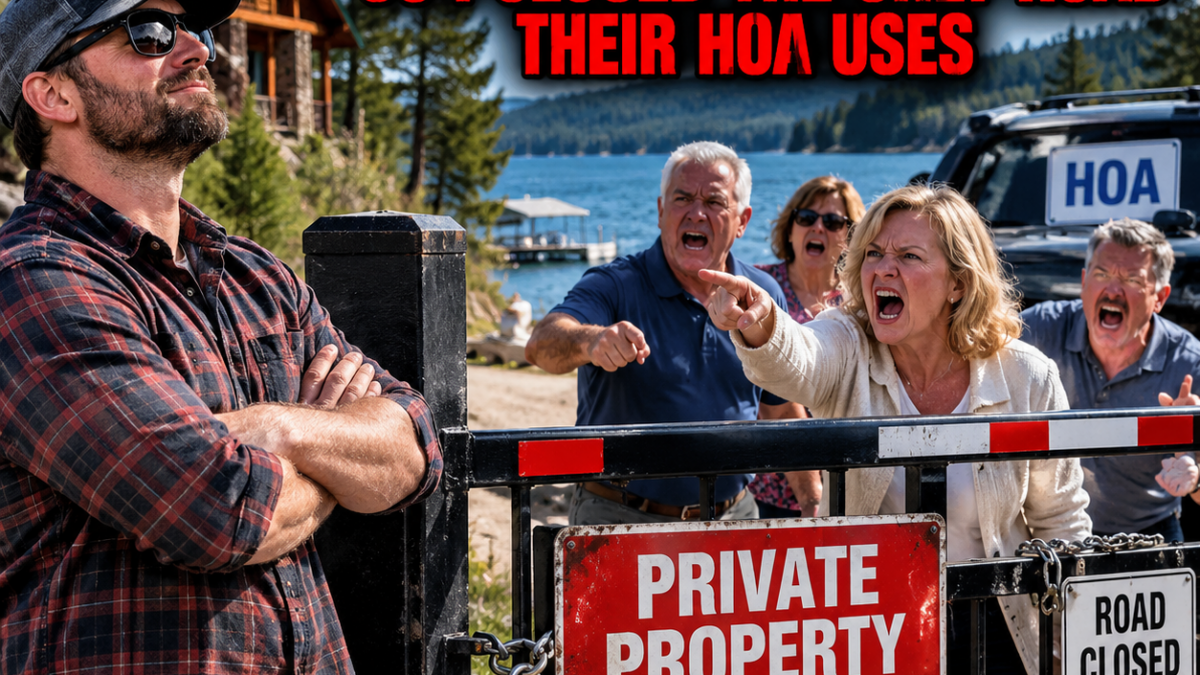
PART 2
Victoria stopped her Lexus six feet from the gate.
Behind her sat two maintenance trucks, three residents’ SUVs, a delivery van, and a golf cart whose driver looked like he had wandered into a meeting he hadn’t been told about.
The morning was cold enough that I could see exhaust hanging beneath the trees.
Victoria got out.
She had the same clipboard I had seen half a dozen times before.
I had come to dislike that clipboard.
Not because there was anything special about it, but because Victoria held it like a judge held a gavel. Every time she appeared with it, she seemed convinced that whatever paper rested beneath the metal clip automatically became law.
She marched toward me.
“Nathan.”
“Morning.”
Her eyes moved from me to the chain running through the gate.
Then to the new lock.
“You actually locked it.”
“I did.”
“You were instructed not to interfere with community access.”
“I was instructed by you.”
“I represent Pine Ridge Estates.”
“And I don’t live in Pine Ridge Estates.”
The driver of the maintenance truck behind her looked away.
Victoria lowered her clipboard.
“This isn’t funny.”
“I agree.”
“You can’t simply close a road that dozens of families depend on.”
I glanced behind her.
“That sounds like something your board should have investigated before depending on somebody else’s property.”
The muscles around her jaw tightened.
She stepped closer.
“This road has been used for years.”
“Used,” I said. “That’s not the same as owned.”
I reached into the folder beneath my arm and removed a copy of the survey.
I didn’t hand it to her yet.
I just held it.
Victoria looked at the page.
Then she looked back at me.
“What is that?”
“My survey.”
“We have our own records.”
“Great. Bring them.”
“We don’t need to prove this to you.”
That sentence told me more than she probably intended.
I folded the survey and slid it back into my folder.
“Then the gate stays closed.”
For several seconds neither of us spoke.
Behind Victoria, someone honked.
It was only a quick tap, probably accidental, but it shattered the stillness.
Victoria turned around, clearly embarrassed by the audience.
Then she faced me again.
“Nathan, open the gate.”
“No.”
“You are disrupting HOA operations.”
“This isn’t an HOA gate.”
“You know exactly what I mean.”
“Yes,” I said. “I do.”
And that was exactly why I wasn’t opening it.
Victoria had spent weeks changing the language.
First the road was something the HOA had always “used.”
Then it became a “community route.”
After that it became “HOA-managed access.”
Now, suddenly, closing my own gate was interfering with “HOA operations.”
Each phrase moved the boundary a little farther.
I had finally realized that if I kept allowing it, eventually everyone would forget there had ever been a boundary at all.
Victoria glanced down at my lock.
“You’re going to regret making this difficult.”
I didn’t raise my voice.
I didn’t insult her.
I didn’t threaten her.
I simply said, “Then put everything you believe I’m doing wrong in writing.”
Her eyes narrowed.
That was when I knew I had finally said something she didn’t like.
People who rely on pressure love conversations.
They are much less enthusiastic about records.
She turned back to her Lexus.
“This isn’t finished.”
“I know.”
She got in and reversed.
One by one, the vehicles behind her followed.
The delivery driver stayed longest.
He rolled down his window.
“Is there another way into Pine Ridge?”
I pointed toward the county road.
“Main entrance is about four miles east.”
His face fell.
“Four miles?”
“Yep.”
He sighed.
“Not your fault.”
Then he turned around too.
Within ten minutes, the road was quiet.
I stood behind the gate listening to the engines disappear through the trees.
Then something happened that surprised me.
My hands started shaking.
Not badly.
Just enough for me to notice.
All morning I had felt calm because I had been focused on the facts.
Now that everyone was gone, the weight of what I had done landed on me.
I had taken on an HOA with dozens of homeowners, a board, legal counsel, contractors, money, and years of institutional confidence.
I was one man living in an old cabin.
For the first time, I wondered whether I had underestimated what they could do.
I went inside and put the folder on my kitchen table.
The cabin smelled of coffee and cedar smoke.
The old wall clock clicked above the fireplace.
I sat down.
For almost twenty minutes, I did nothing.
Then my phone rang.
Victoria.
I watched it vibrate across the table.
I let it ring.
Thirty seconds later, a text appeared.
**OPEN THE ROAD IMMEDIATELY.**
I took a screenshot.
Then another message arrived.
**FAILURE TO RESTORE ACCESS MAY RESULT IN LEGAL ACTION.**
I took another screenshot.
Then I created a new folder on my laptop.
I named it:
**PINE RIDGE ROAD DISPUTE.**
Inside it, I saved both messages.
That became my routine.
Every letter.
Every photograph.
Every sign.
Every date.
Every vehicle.
Every conversation I could properly document.
I didn’t know yet how far Victoria intended to push things.
But I knew something she didn’t.
She thought I was trying to win an argument.
I wasn’t.
I was preparing to prove ownership.
### The Paper Trail
The next morning, I drove to the county records office.
It was an old brick building downtown that smelled like dust, printer toner, and coffee that had probably been sitting on the same warmer since sunrise.
A woman behind the counter asked how she could help me.
“I need everything connected to a parcel.”
She smiled.
“Everything?”
“Everything.”
I gave her the parcel number.
For the next hour, we went through surveys, deed references, recorded plats, transfer documents, and old maps.
I expected to find something I had missed.
Maybe an easement.
Maybe an agreement signed decades ago.
Maybe language buried somewhere in the chain of title that gave Pine Ridge Estates a permanent right to cross my land.
Part of me almost hoped I would find it.
At least then the argument would end.
Instead, the deeper I looked, the stranger the situation became.
The road appeared on old surveys as private access to the cabin parcel.
The property lines followed it exactly.
The entrance gate sat inside my boundary.
The strip of land beneath the gravel transferred with the cabin.
I found references to neighboring parcels.
Utility rights.
Drainage information.
Survey corrections.
But I could not find a recorded document giving Pine Ridge Estates ownership of my road.
I asked the clerk to check again.
She did.
Then she turned the monitor toward me.
“This is what we have.”
“What about an access agreement?”
“If it was properly recorded against the property, we should see it.”
“And you don’t?”
She shook her head.
“I’m not giving you legal advice, Mr. Cole. I’m only telling you what the records show.”
That sentence became important to me.
I didn’t need people to tell me what I wanted to hear.
I needed everyone to stay within the facts.
So I ordered certified copies of the key documents.
When I walked out carrying the folders, I felt different.
Not victorious.
More grounded.
Victoria had confidence.
I had paper.
There is a huge difference.
On my way home, I stopped at a hardware store and bought measuring flags, a notebook, weatherproof document sleeves, and another security camera for the entrance.
Then I spent the afternoon walking the quarter-mile road.
I photographed the old boundary posts.
I photographed the Pine Ridge signs.
I photographed fresh gravel that HOA crews had spread.
I photographed trimmed branches.
I photographed every place where somebody else had acted as if management of the road belonged to them.
When I reached the gate, I found something new taped to it.
Another notice.
This one was inside a clear plastic sleeve.
At the top were the words:
**TEMPORARY COMMUNITY ACCESS AGREEMENT.**
I read it twice.
Then a car door shut behind me.
Victoria had arrived without me hearing her.
“You’ve been busy,” she said.
“So have you.”
She walked toward the gate in polished shoes that looked completely wrong on a gravel road.
“That agreement solves the problem.”
I held up the document.
“It solves your problem.”
“Ours.”
“No. Yours.”
She folded her arms.
“The association is willing to take responsibility for maintaining the road.”
“You’ve already been maintaining parts of it without asking me.”
“Which benefits you.”
“That isn’t the point.”
“Then what is the point, Nathan?”
I looked at her.
“The point is consent.”
She seemed genuinely irritated by the word.
For Victoria, the practical argument was apparently enough.
People used the road.
The HOA wanted the road.
The HOA had maintained the road.
Therefore, in her mind, the HOA should continue controlling the road.
But that logic skipped the person who actually owned it.
Me.
I tapped the agreement with one finger.
“This gives your board continuing access.”
“Correct.”
“And authority over maintenance.”
“For everyone’s benefit.”
“And it limits my ability to close my own gate.”
“That’s necessary.”
“For whom?”
“For the community.”
“I’m not part of your community.”
That stopped her.
Not because she had forgotten.
Because I think she had stopped considering it relevant.
“You live beside Pine Ridge,” she said.
“Beside.”
“You benefit from our services.”
“I pay county taxes.”
“You use roads near our development.”
“County roads.”
“You enjoy the lake.”
“So does half the county.”
Her eyes hardened.
“You are determined to be difficult.”
I shook my head.
“No, Victoria. You’re used to people eventually saying yes.”
The wind pushed a strand of hair across her face.
She tucked it behind her ear and looked at me for several seconds.
Then she pointed at the agreement.
“You have seven days.”
“For what?”
“To reconsider.”
“And if I don’t?”
“The board will pursue its options.”
“What options?”
“You’ll find out.”
I folded the notice carefully.
Then I slipped it into my folder.
Victoria watched me.
“You keep everything, don’t you?”
“Now I do.”
Her face changed again.
Just slightly.
She turned and walked away.
I watched her Lexus disappear.
Then I went back to the cabin and placed the agreement beside my deed.
I stared at the two documents.
One had existed before I ever heard Victoria Ashford’s name.
The other had been printed because she wanted me to surrender rights the first document already gave me.
That night, I called a property attorney.
### The Lawyer Who Didn’t Promise Me Anything
His name was Daniel Mercer.
His office was above a pharmacy in town.
When I arrived two days later, I expected a dramatic reaction.
Maybe disbelief.
Maybe anger.
Maybe the kind of speech people give in stories right before announcing that somebody is about to be destroyed in court.
Daniel did none of that.
He read.
For almost forty minutes, he barely spoke.
He reviewed my deed.
Then the survey.
Then the county copies.
Then Victoria’s notices.
Then the proposed agreement.
Finally, he leaned back.
“You did the right thing by not signing this.”
I exhaled.
“So the road is definitely mine?”
“Your documents indicate that the land underlying the road is part of your parcel.”
“And they have no rights?”
He raised one hand.
“Slow down.”
That wasn’t the answer I wanted.
But it was probably the answer I needed.
Daniel continued.
“Property disputes are rarely improved by assuming the simplest possible conclusion. Ownership is one question. Access rights can be another. We need to determine whether Pine Ridge has a valid easement, whether any rights were created historically, whether there are claims based on prior use, and what state law says about the facts.”
I nodded.
“County records didn’t show anything.”
“That matters. It doesn’t mean we stop looking.”
He pointed toward my stack of photographs.
“This is good.”
“The signs?”
“The documentation. Dates. Notices. Photos. Keep doing that.”
“So I should keep the gate closed?”
He paused.
“I’m not going to give you a dramatic answer. I’m going to give you a careful one. Do not obstruct emergency services. Do not damage their property. Do not threaten anyone. Do not create a dangerous condition. And do not sign away rights because someone puts a deadline in a letter.”
That sounded reasonable.
“What about regular HOA traffic?”
“We’ll respond formally.”
He pulled Victoria’s seven-day letter toward him.
“Let them explain the legal basis for their claim.”
That sentence made me smile.
Daniel noticed.
“What?”
“That’s the question I’ve been asking from the beginning.”
“Good,” he said. “Now ask it through counsel.”
The letter Daniel sent was almost disappointingly polite.
It did not accuse Victoria of anything.
It did not insult the HOA.
It simply requested documentation supporting Pine Ridge Estates’ claimed right to control or use the road and instructed the association not to place additional signs or perform work on my parcel without authorization while the matter was disputed.
Three days later, Victoria showed up with a tow truck.
### The Tow Truck
I heard the diesel engine before I saw it.
When I walked down from the cabin, Victoria’s Lexus was parked outside the gate.
Behind her sat a heavy tow truck.
Its amber lights were turning slowly.
For one ridiculous second, I wondered whether she intended to tow the gate.
Victoria got out.
“Nathan, open it.”
“No.”
“We’ve received your attorney’s letter.”
“Then talk to my attorney.”
“I’m talking to you.”
“Why is there a tow truck?”
Her eyes flicked toward it.
“We have vehicles that require access.”
“That truck doesn’t look like a delivery vehicle.”
“It’s here in case access needs to be restored.”
I looked at the driver.
He looked at Victoria.
Then at me.
Then at the gate.
He seemed increasingly uncomfortable.
I walked closer but stayed on my side.
“This gate is on my property.”
Victoria lifted her clipboard.
“The HOA has maintained access here for years.”
“Then show me the easement.”
“We have historical use.”
“Show me the document.”
“You keep repeating yourself.”
“Because you keep avoiding the question.”
She stepped closer.
“Nathan, there are consequences when one property owner decides to inconvenience an entire neighborhood.”
“And there are consequences when an association treats private property like it belongs to them.”
The tow-truck driver got out.
“Ma’am?”
Victoria turned.
“Yes?”
He pointed toward the gate.
“Just so we’re clear, what exactly am I supposed to tow?”
She hesitated.
That hesitation said everything.
I looked at him.
“Nothing on this side of the gate belongs to the HOA.”
He immediately stepped backward.
“I’m not touching a private gate without proper authorization.”
Victoria’s face reddened.
“We discussed this.”
“We discussed vehicle access,” he said. “You didn’t tell me I’d be removing somebody’s property.”
“I didn’t say remove it.”
The driver looked at me again.
Then back at Victoria.
“I’m going to wait in my truck.”
He walked away.
I almost felt sorry for her.
Almost.
Instead, I said, “Victoria, this is getting unnecessary.”
Her stare snapped back to me.
“I agree.”
“Then send the documentation to Daniel.”
“You think hiring an attorney makes you untouchable?”
“No.”
That answer seemed to surprise her.
I continued.
“I think hiring an attorney means we stop pretending a clipboard settles property law.”
She said nothing.
Then she got into her Lexus.
The tow truck followed her out.
I photographed both vehicles leaving.
Later that afternoon, Daniel called.
“You handled that well.”
“How do you know?”
“The HOA attorney called me.”
“What did he say?”
Daniel chuckled softly.
“He asked whether your gate was physically preventing passage.”
“It is.”
“And I asked him to provide the legal instrument authorizing Pine Ridge to pass through it.”
“What did he say?”
“He said he’d get back to me.”
For the first time since the conflict began, I laughed.
Not because I thought I had won.
Because the question had finally reached someone who understood that it required an answer.
### Forty-Eight Hours
Victoria’s next notice arrived two days later.
This one gave me forty-eight hours to restore access.
I was standing on the porch when she taped it to the gate.
“You’re escalating this,” I said.
She turned.
“No. You are.”
“I sent you a request for proof.”
“You sent lawyers after your neighbors.”
“I hired one lawyer after you threatened legal action.”
She ignored that.
“Forty-eight hours.”
“And then?”
“The association will proceed formally.”
“Good.”
She blinked.
“Good?”
“Yes.”
“I don’t think you understand.”
“I understand exactly. Formal means documents. Formal means records. Formal means you have to explain your position to somebody who isn’t on your board.”
Her face tightened.
“You’ve turned this into a personal crusade.”
“No. I bought a cabin.”
I pointed down the road.
“You brought the crusade to me.”
She left without another word.
That evening, rain moved over the lake.
I sat at my kitchen table with every piece of evidence spread around me.
The fireplace crackled.
Water tapped softly against the windows.
Six months earlier, I had imagined evenings here would be spent reading, repairing the dock, maybe learning to fish properly.
Instead, I was sorting HOA notices into chronological order.
I felt tired.
More than angry, I felt disappointed.
I hadn’t bought the cabin to defeat anybody.
I hadn’t even known who Victoria was when I signed the closing papers.
Somewhere along the way, that became the thing I resented most.
People often imagine property disputes as battles between two people who both want the same thing.
But I already had what I wanted.
The cabin.
The trees.
The lake.
The road.
I wasn’t trying to take anything from Victoria.
I was trying to stop her from taking something from me.
There was a difference.
At 7:13 the next morning, three HOA vehicles arrived.
Victoria stepped out with another board member and a man I had never seen before.
He walked to the gate and passed a document through the bars.
“This is a formal demand,” he said.
I picked it up.
“Are you the HOA attorney?”
“Representative.”
“Daniel Mercer is my attorney. You can contact him.”
Victoria stepped forward.
“Last chance, Nathan. Open the road, and this can disappear.”
I looked behind her.
Residents were waiting again.
A landscaping van.
Two golf carts.
A delivery truck.
A maintenance pickup.
Every one of those vehicles demonstrated the same thing.
The HOA had built routines around using my property.
But dependence didn’t answer ownership.
“You’re offering me permission to use what I already own,” I said.
Victoria’s expression went flat.
“Then we move forward.”
She turned away.
I carried the letter inside.
Then I called Daniel.
“This might actually be helpful,” he said after reading a scan.
“How?”
“They’re stating their position clearly.”
“So?”
“So now we can ask the county to clarify the physical property boundaries while the legal issues are addressed.”
Two days later, a county inspector scheduled a site visit.
When Victoria found out, everything changed.
### The Morning the Inspector Arrived
The county truck appeared before sunrise.
I stood on my porch with coffee in one hand and watched a man in a reflective vest step out with a clipboard and measuring equipment.
His name was Marcus Reed.
Before we began, he made something clear.
“I’m not here to decide private legal claims.”
“I understand.”
“I’m documenting the parcel boundary, physical road location, markers, and existing improvements based on county records.”
“That’s all I’m asking.”
He nodded.
I liked him immediately.
Not because he was on my side.
Because he didn’t seem interested in having a side.
We started near the gate.
Marcus compared the survey to visible markers.
He photographed the fence.
He measured offsets.
He noted the HOA signs.
Twenty minutes later, Victoria arrived.
She got out before her Lexus had completely settled on the gravel.
“This is unnecessary.”
Marcus looked up.
“Good morning.”
“This road has served Pine Ridge Estates for years.”
“I’m documenting the site, ma’am.”
“I’m Victoria Ashford, HOA president.”
“Okay.”
I had to look away to keep from smiling.
Victoria seemed unused to introducing herself without the title producing an immediate reaction.
She pointed toward the gravel.
“The association manages this route.”
Marcus looked at one of the green signs.
“Who installed these?”
“Our maintenance team.”
“Authorized by whom?”
“The HOA.”
He wrote something.
“No,” he said. “I mean the property owner.”
Victoria stopped.
I stood ten feet away and said nothing.
That silence was one of the most satisfying moments of the entire dispute.
Not because Victoria was embarrassed.
Because somebody else had finally asked the same basic question.
She recovered quickly.
“The road has always functioned as community access.”
Marcus looked at me.
“Mr. Cole?”
“I purchased the parcel six months ago. I have not authorized the HOA to install signs, perform work, or claim management authority over the road.”
He nodded and wrote again.
Victoria interrupted.
“The previous owner allowed access.”
“That may be relevant to your separate dispute,” Marcus said. “I’m documenting what is physically here.”
We walked the entire road.
The quarter mile seemed longer with Victoria following us.
Every old post mattered.
Every bend.
Every ditch.
Every section of replaced gravel.
Near the cabin, Marcus stopped beside a weathered boundary marker.
He checked the map again.
Then he looked toward the lake.
“Your parcel continues through here?”
“Yes.”
Victoria stepped forward.
“The community has maintained portions of this road for years.”
Marcus looked at her.
“Do you have the owner’s authorization for the improvements?”
“Our position is that authorization wasn’t necessary.”
He wrote that down too.
For the first time, Victoria seemed to realize that everything she said might become part of an official record.
Her answers became shorter.
By noon, she had made six phone calls.
She stood near her Lexus speaking quietly while Marcus finished his inspection.
Before leaving, he handed me his card.
“You’ll receive the documentation through the normal process.”
Victoria walked toward him.
“When?”
“Once the review is completed.”
“We need access restored.”
“That’s not a decision I’m making today.”
“You saw the road.”
“Yes.”
“You saw that our community uses it.”
“Yes.”
“Then surely—”
Marcus interrupted politely.
“Use and ownership are not identical questions.”
I said nothing.
I didn’t need to.
Victoria watched his truck leave.
Then she looked at me.
For a few seconds, we were standing alone beside the gate.
Her expression had changed.
Not defeated.
Worried.
“We need to talk,” she said.
“We’ve been talking.”
“No. Really talk.”
“Okay.”
“There may be another way to handle this.”
“What way?”
Her phone rang.
She looked at the screen.
Answered.
Listened.
Then her entire posture changed.
She turned slightly away from me.
“Yes,” she said quietly. “I understand.”
Another pause.
“No. Don’t send anything yet.”
She ended the call.
“What happened?” I asked.
“Nothing.”
It obviously wasn’t nothing.
She opened her car door.
“Tomorrow morning. Here.”
“For what?”
“A meeting.”
“With who?”
“The board.”
She drove away.
The next morning, she returned with four board members.
### The Board Finally Came to My Gate
Until then, Pine Ridge Estates had mostly existed to me as Victoria.
Her letters.
Her notices.
Her voice.
Her interpretation of what the community needed.
Seeing the rest of the board changed that.
There were four of them.
An older man named Richard Hale.
A woman named Susan Bell.
A younger man named Eric Dalton.
And a retired teacher named Martha Greene.
They didn’t look like villains.
They looked like homeowners who had been dragged into a problem that had grown much larger than they expected.
Victoria opened the meeting.
“We’d like to resolve this without unnecessary expense.”
I almost smiled at the phrase.
A month earlier, I had been the unreasonable cabin owner.
Now we were avoiding “unnecessary expense.”
“That works for me,” I said.
Richard spoke first.
“We understand there’s a disagreement over the road.”
“There’s a disagreement over whether your association can claim authority over land I own.”
Victoria cut in.
“Our legal position has not changed.”
I looked at Richard.
“Has everyone on this board seen the deed?”
Silence.
Susan glanced at Victoria.
“No.”
“Survey?”
Another silence.
“County parcel map?”
Martha looked uncomfortable.
“No.”
I slowly turned toward Victoria.
“You’ve been sending notices on behalf of this board, and they haven’t even seen the documents?”
Victoria stiffened.
“They have been briefed.”
“That wasn’t my question.”
Richard held up one hand.
“Let’s not make this personal.”
“I don’t want it personal.”
I opened my folder.
“That’s why I brought copies.”
I handed the survey through the side opening.
Richard took it.
Then Susan.
Then Martha.
Eric leaned over.
For two minutes, nobody spoke.
Birds moved through the trees above us.
Finally Martha looked up.
“This road is inside his parcel.”
Victoria answered immediately.
“That does not settle access rights.”
“I know,” Martha said. “But why did our sign say ‘community access route’?”
“Because that’s how it has functioned.”
“Did Nathan approve the sign?”
Victoria hesitated.
“No.”
Martha looked at me.
“Did you?”
“No.”
Richard rubbed his forehead.
“What exactly are you asking for, Mr. Cole?”
It was the first time anyone from the HOA had asked.
Not told.
Not demanded.
Asked.
“I want the signs removed. I want unauthorized work on my property to stop. I want the board to stop sending me HOA assessments when I’m not an HOA member. And if Pine Ridge believes it has a legal right to use this road, I want that right demonstrated properly.”
Eric frowned.
“And if it doesn’t?”
“Then you ask.”
“For access?”
“Yes.”
Victoria gave a short laugh.
“You expect an entire neighborhood to ask your permission every time someone drives through?”
“No. I expect the association to negotiate an agreement if it wants permanent access.”
“That’s exactly what we offered.”
“No. You offered an agreement that took control of my gate.”
“For operational reasons.”
“There it is again.”
“What?”
“You don’t want access, Victoria. You want control.”
The board went silent.
She stared at me.
I continued.
“If you want reasonable access, we can discuss reasonable access. If you want to turn my private road into HOA property without buying it, owning it, or proving a legal right to control it, the answer is no.”
Martha slowly nodded.
Susan asked, “Would you allow access under an agreement?”
“If it protects my ownership and gives me control over my property.”
Victoria snapped her folder shut.
“Pine Ridge cannot operate on the whim of one cabin owner.”
I looked at the other board members.
“Then perhaps Pine Ridge shouldn’t have built its operations around land it didn’t own.”
Nobody answered.
The meeting ended twenty minutes later.
As they walked toward their vehicles, Martha stayed behind.
“I’m sorry,” she said quietly.
I was caught off guard.
“For what?”
“I didn’t know.”
“About the road?”
She nodded.
“We were told the cabin owner was trying to shut off a long-established community road.”
“I am shutting off access.”
“But that isn’t the whole story.”
“No.”
She looked toward Victoria.
“She should have shown us the documents.”
I chose my next words carefully.
“This doesn’t need to become a war between me and your neighborhood.”
“I know.”
“I don’t hate anyone who lives there.”
“I know.”
“I just want people to stop acting like ownership disappears because enough people find it inconvenient.”
Martha gave me a tired smile.
“That sentence is going to cause a very long board meeting.”
She left.
For the first time, I understood something important.
Victoria and Pine Ridge Estates were not the same thing.
That mattered.
Because if I turned the residents into enemies, I would become exactly what Victoria had been accusing me of being: a man more interested in power than resolution.
I didn’t want power over them.
I wanted authority over my own gate.
### The Proposal That Almost Worked
Three days later, Victoria returned with a new agreement.
This one looked different.
No aggressive heading.
No deadline.
No demand.
Just:
**PROPOSED ACCESS AGREEMENT.**
She arrived with Richard and the HOA attorney.
Daniel joined by phone.
We stood around the hood of my truck reviewing the document.
For the first time, it actually contained terms worth discussing.
Pine Ridge would maintain specified sections of gravel.
The HOA would remove unauthorized signs.
Maintenance crews would provide notice before nonemergency work.
The HOA would stop billing me assessments.
The agreement would acknowledge that my parcel remained outside Pine Ridge Estates.
I looked at Daniel’s face on my phone screen.
“This is better.”
“Keep reading,” he said.
I did.
Near the bottom was the problem.
The HOA wanted continuous operational control of the primary gate.
I read it twice.
Then I looked up.
“No.”
Victoria sighed.
“Nathan.”
“No.”
Richard asked, “What’s wrong?”
I handed him the page.
“This gives the association control of my gate.”
Victoria responded, “We can’t have residents trapped because you decide to close it.”
“Then we can create access rules.”
“That’s what this does.”
“No. It transfers practical control.”
The attorney spoke.
“It establishes predictable access.”
Daniel’s voice came through my phone.
“It also gives your client authority over the gate.”
The attorney paused.
“We can revise the wording.”
Victoria looked frustrated.
“We are talking about a metal gate, not sovereignty.”
I looked at her.
“That gate is the difference between permission and assumption.”
She shook her head.
“You’re obsessed with symbolism.”
“No. I’ve spent a month watching your association install signs on my fence, send maintenance crews onto my land, bill me for my own road, tell me I’m interfering with HOA operations, and bring a tow truck when I wouldn’t open my gate. So yes, I care who controls the gate.”
Richard turned toward Victoria.
“A tow truck?”
Her face changed.
“It was not there to remove his gate.”
“Then why was it there?”
“It’s irrelevant.”
“It doesn’t sound irrelevant.”
For the first time, the pressure was moving in the opposite direction.
Not from me.
From her own board.
Victoria looked down at the agreement.
“Fine. We revise the gate provision.”
I shook my head.
“Not today.”
She looked up sharply.
“Excuse me?”
“We wait for the county review.”
“We’re offering you what you wanted.”
“Almost.”
“Do you enjoy this?”
The question surprised everyone.
“Enjoy what?”
“Dragging this out.”
I looked at her for a long moment.
Then I answered more quietly.
“I moved here because I wanted peace.”
Victoria said nothing.
“I didn’t know your name when I bought this cabin. I didn’t know who sat on your board. I didn’t care what color mailboxes Pine Ridge allowed or what rules you had. I wanted a dock, some trees, and a place where I could drink coffee without hearing traffic.”
I pointed toward the road.
“You brought this to my gate.”
Her eyes shifted away.
“So no, Victoria. I don’t enjoy it.”
That was the first time the anger went out of the conversation.
The attorney gathered the papers.
Richard nodded to me.
“We’ll wait for the county.”
Victoria walked back to her car without speaking.
### The Day Pine Ridge Brought Everyone
I thought the next step would be quiet.
I was wrong.
The following Saturday, I heard engines rolling through the trees.
A lot of engines.
I walked onto my porch.
SUVs.
Pickup trucks.
Golf carts.
Maybe twenty vehicles.
Victoria was in front.
Behind her were board members and residents.
For one second, my stomach dropped.
Then I reminded myself of Daniel’s advice.
Stay calm.
Document.
Don’t threaten.
Don’t escalate.
I turned on the camera near the entrance and walked down.
By the time I reached the gate, perhaps thirty people were standing outside.
Victoria stepped forward.
“We’re here to resolve this once and for all.”
I looked at the crowd.
“By bringing half the neighborhood?”
“Affected residents deserve to understand what you’re doing.”
Murmurs rose behind her.
A man called out, “We’ve used this road for ten years!”
A woman said, “My deliveries come through here!”
Another resident asked, “Why are you doing this to us?”
That one hurt.
Because I wasn’t.
At least I didn’t feel like I was.
But from their perspective, they had used a road for years, then a stranger bought a cabin and locked a gate.
If Victoria had told them only that part, I probably would have been angry too.
So I did something she wasn’t expecting.
I unlocked the small pedestrian gate.
I stepped outside.
Then I closed it behind me.
Victoria looked suspicious.
“What are you doing?”
“Talking to them.”
“You can talk from inside.”
“I’m not hiding.”
I turned toward the residents.
“My name is Nathan Cole.”
The crowd quieted.
“I bought the cabin six months ago. My property is not part of Pine Ridge Estates.”
A few people nodded.
Most said nothing.
“This road crosses my parcel. Since I bought the property, HOA signs have been installed on my fence without my permission. HOA crews have performed work here without asking. I’ve been sent assessments for this road even though I’m not an HOA member. I’ve been asked to sign an agreement giving the HOA control of my gate.”
Several people looked at Victoria.
She interrupted.
“That is a very selective version of events.”
“Then you can speak when I’m finished.”
Her eyes widened.
I kept going.
“I am not trying to strand anyone. I am not trying to punish residents. I am asking the association to demonstrate whatever legal right it believes it has to use and control this road.”
The same man who had shouted earlier raised his hand awkwardly.
“Did the HOA show you an easement?”
“No.”
He looked at Victoria.
“Do we have one?”
Victoria responded immediately.
“Our attorney is reviewing historical access rights.”
“That wasn’t his question,” another resident said.
The atmosphere shifted.
I pulled copies of the survey from my folder.
“I brought these because I don’t expect anyone to take my word for it.”
I handed one to the nearest resident.
People gathered around.
Someone whispered, “The road’s on his lot.”
Another voice answered, “That doesn’t necessarily mean we can’t use it.”
“Correct,” I said.
People looked at me.
“I’m not pretending one map answers every legal issue. That’s why we’re getting a formal review. But the HOA has been acting as if there’s no question at all.”
A woman near the back stepped forward.
“My name’s Jennifer. I live on Lakeview Court.”
“Nice to meet you.”
“Are you willing to negotiate access?”
“Yes.”
Victoria cut in.
“We already offered him an agreement.”
I looked at Jennifer.
“The proposed agreement gave the HOA control of my gate.”
Jennifer turned toward Victoria.
“Why?”
“For reliable access.”
“Couldn’t you just make an agreement that lets people use the road without taking his gate?”
Victoria started to answer.
Martha Greene beat her to it.
“Yes.”
The entire group went quiet.
Martha stepped forward.
“Yes, we could.”
Victoria looked furious.
“Martha—”
“No,” Martha said. “Residents deserve the complete picture.”
I didn’t enjoy seeing Victoria isolated.
That might sound strange after everything she had done.
But humiliation was never the goal.
Still, consequences sometimes arrive looking a lot like embarrassment.
Richard addressed the crowd.
“The board is waiting for the county review. No final agreement has been reached.”
A resident asked, “Then why are we all here?”
No one answered.
Finally Eric Dalton said, “We were told showing community impact might help resolve the matter.”
The resident laughed.
“So this was pressure?”
Victoria closed her folder.
“This meeting is over.”
But it wasn’t.
Not really.
Because for the first time, Pine Ridge residents understood that the problem wasn’t simply a stubborn man at a locked gate.
It was also a board that had spent years relying on an arrangement nobody had properly documented.
As people returned to their vehicles, Jennifer stopped beside me.
“I’m sorry I yelled.”
“You had incomplete information.”
“So did we all.”
She looked toward the road.
“You really don’t mind people using it?”
“I mind people claiming it.”
She nodded.
“That makes sense.”
The vehicles left.
Victoria remained.
She stood beside her Lexus staring at the gate.
Then she looked at me.
“You embarrassed me.”
“I told the truth.”
“You could have handled this privately.”
“I tried.”
She stared at me.
Then her voice softened.
“You have no idea how many things in Pine Ridge depend on that route.”
“Then why didn’t anyone secure access properly?”
Her expression told me she didn’t have an answer.
That was when my phone buzzed.
An email from the county.
The official access review had been scheduled for the following week.
I showed Victoria the screen.
She read it.
Then she looked at the gate.
“I guess we’ll have our answer.”
“No,” I said.
She frowned.
“We’ll have part of it.”
### The County Review
The morning of the review was clear and cold.
I barely slept.
Not because I expected some dramatic judgment.
Because after weeks of conflict, I was finally afraid of learning that I had misunderstood something.
What if there was an old recorded right everybody had missed?
What if historical use changed the situation?
What if I had spent a month defending control that wasn’t as simple as I believed?
Daniel had warned me from the beginning not to confuse confidence with certainty.
So I prepared myself for any result.
A county official named Laura Bennett arrived with another survey technician.
Victoria came with the HOA attorney.
Richard and Martha came too.
No crowd.
No tow truck.
No line of vehicles.
Just documents.
That alone felt like progress.
Laura stood near the entrance.
“We’re documenting the existing property and access configuration based on available county records. This is not a substitute for a court ruling on every possible private legal claim.”
Everyone agreed.
She reviewed the map.
Then the survey.
Then the road.
Then the fence.
She photographed the boundary markers.
She compared them to county information.
The HOA attorney handed her a packet.
“This includes historical association records documenting use.”
Laura reviewed them.
I couldn’t see what they were.
For nearly an hour, everyone moved up and down the entrance without much conversation.
Then Laura asked us to gather near her truck.
She held the county map.
“Based on the parcel records we reviewed, the road surface at this location lies within Mr. Cole’s parcel.”
Victoria’s attorney nodded.
“We understand the underlying fee ownership may be his. Our position concerns access.”
Laura continued.
“I understand. I am addressing the county property record.”
She pointed toward the gate.
“The gate also appears to be located within the Cole parcel.”
I exhaled slowly.
Victoria’s face remained unreadable.
Laura looked at the Pine Ridge signs.
“County records reviewed for this inspection do not identify the HOA as owner of this road.”
The sentence was simple.
It felt enormous.
The HOA attorney immediately clarified.
“Again, ownership and potential access rights are distinct.”
Laura nodded.
“Correct.”
I appreciated that.
I didn’t need exaggeration.
The facts were enough.
Victoria looked at me.
For weeks she had spoken as if the road were unquestionably part of Pine Ridge operations.
Now a county official had stated, in front of her board members and attorney, that Pine Ridge was not identified as the owner.
That didn’t automatically answer every easement question.
But it destroyed the premise behind nearly every notice Victoria had sent me.
She could no longer speak as if my ownership were imaginary.
When the county team left, Richard turned toward the HOA attorney.
“So what now?”
“We evaluate the association’s access claims and negotiate if appropriate.”
Martha looked at Victoria.
“Meaning?”
The attorney answered carefully.
“Meaning the association should not represent itself as the owner of the road.”
Victoria stared down at the gravel.
Nobody said anything.
Finally I spoke.
“I’ll negotiate.”
Everyone looked at me.
I continued.
“I’m not interested in cutting Pine Ridge off forever. But the next agreement starts with the truth.”
Richard nodded.
“That seems fair.”
Victoria looked at me.
“And what exactly is the truth, Nathan?”
“That you don’t own my road.”
She held my gaze.
Then, slowly, she nodded.
It was the first time she had done that.
### The Gate Closed for Real
Until the county review, I had occasionally opened the gate for specific necessary access while the dispute was being documented.
Afterward, Daniel advised that any continuing permissions should be explicit and documented while negotiations proceeded.
So the automatic assumption ended.
The gate stayed locked.
Pine Ridge residents used their main entrance four miles away.
Delivery vehicles rerouted.
Maintenance crews rerouted.
People complained.
I understood why.
Four extra miles mattered when you had spent years taking a shortcut.
But something surprising happened.
The world did not end.
Nobody became trapped.
Nobody lost access to their homes.
Pine Ridge still connected to the public road system.
My road had simply been the convenient route.
That distinction became central to negotiations.
At the next board meeting, Pine Ridge proposed paying for road maintenance in exchange for access.
I said no.
Not because payment was unacceptable.
Because the draft still assumed broad HOA control.
They revised it.
I rejected the next version too.
That one gave the HOA authority to install signage.
“No association branding on my property.”
Victoria rolled her eyes.
“It would simply identify the route.”
“It identified the route just fine when your signs were there without permission. That’s part of how we got here.”
The provision disappeared.
The third draft allowed unrestricted use by “residents, guests, contractors, invitees, vendors, agents, service providers, and other persons conducting business with Pine Ridge Estates.”
Daniel read that paragraph and laughed.
“What’s funny?” I asked.
“They found a very long way to write ‘everybody.’”
We revised it.
The fourth draft addressed road maintenance but allowed crews to enter without notice.
I changed that.
The fifth draft was closer.
Then came the question of the gate.
Victoria would not let it go.
“If residents need access,” she said, “they cannot depend on you physically being present.”
“I agree.”
“Then Pine Ridge needs control.”
“No. Pine Ridge needs a mechanism.”
“What’s the difference?”
“A lot.”
I proposed electronic access credentials.
Residents authorized under the agreement could receive codes or registered remotes.
The HOA could request temporary contractor access.
Emergency provisions would remain available.
But the hardware, master control, and right to modify the gate stayed with me.
Victoria hated it.
Richard liked it.
Martha called it obvious.
Eric wanted to know why they hadn’t proposed it a month earlier.
Nobody answered.
Eventually the attorney said, “This could work.”
Victoria stared at him as if he had betrayed her personally.
I almost smiled.
Almost.
### What the Fight Was Really About
One evening after another negotiation session, I walked back to my cabin alone.
The sun was dropping behind the trees.
The lake was completely still.
When I reached the dock, I sat on the edge and looked across the water.
I thought about the previous owner.
Victoria had mentioned him repeatedly.
He never complained.
He allowed access.
He didn’t create problems.
For weeks, those phrases had irritated me.
That evening, they made me sad.
Maybe he had been generous.
Maybe he didn’t care.
Maybe he had told Pine Ridge they could use the road whenever they wanted.
If so, I respected that.
But generosity given by one owner does not become an obligation for the next simply because people become accustomed to it.
That was the part Victoria never seemed to understand.
Or maybe she understood it perfectly and feared what it meant.
If she admitted the HOA needed permission, then the entire power dynamic changed.
The neighborhood stopped being entitled to the road.
It became dependent on an agreement.
And agreements required two sides to say yes.
That was all I had ever wanted.
The ability to say yes.
Because if you cannot say no, then your yes means nothing.
I heard footsteps behind me.
It was Martha.
She stopped near the dock.
“I hope I’m not trespassing.”
I smiled.
“You asked.”
She laughed softly.
“Fair point.”
I motioned toward an old chair.
She sat.
For a minute, we watched the lake.
Then she said, “Victoria may resign.”
I looked at her.
“Because of me?”
“Because of a lot of things.”
“I don’t want that.”
“I know.”
“She was wrong about the road.”
“Yes.”
“That doesn’t mean she’s bad at everything.”
Martha looked surprised.
“You’re more generous than some of our residents right now.”
“I’m not trying to ruin her.”
Martha studied me.
“Do you know what people in Pine Ridge thought when this started?”
“That I was a jerk?”
She laughed.
“Basically.”
“Fair.”
“We were told you bought the cabin and immediately decided to close a community road.”
“I didn’t lock it immediately.”
“I know that now.”
She looked toward the gravel path.
“Victoria’s biggest mistake wasn’t misunderstanding the deed.”
“What was it?”
“She decided she knew what you would do before she ever asked you.”
That stayed with me.
Because she was right.
Victoria had seen a new cabin owner and apparently assumed pressure would work.
I had seen an HOA president and eventually started assuming every action was a power grab.
At some point, both sides had stopped seeing the person standing on the other side of the gate.
I didn’t suddenly forgive everything.
But I understood something I hadn’t before.
A satisfying ending didn’t require destroying Victoria.
It required fixing the problem she had created.
### The Residents Turned on the Wrong Problem
The next Pine Ridge board meeting became the most uncomfortable night of the entire conflict.
I attended with Daniel.
Not because I had joined their HOA.
Because negotiations were on the agenda and I had been invited.
The clubhouse was packed.
Some residents wanted the road reopened immediately.
Others were furious about the legal expenses.
A few wanted Victoria removed.
One man wanted the HOA to sue me no matter what it cost.
Jennifer, the resident who had apologized at the gate, stood up.
“For what?”
The man turned toward her.
“For blocking our access.”
“We have another entrance.”
“That adds eight minutes to my drive.”
Jennifer stared at him.
“You want to spend tens of thousands of dollars because your drive is eight minutes longer?”
“It’s the principle.”
I nearly laughed.
I had been hearing about principle for weeks.
Now everyone had one.
Richard called the meeting to order.
The HOA attorney summarized the county findings carefully.
He explained that county records reflected the road within my parcel and did not identify Pine Ridge Estates as its owner.
Then he explained that questions of any historical access rights were more complicated and that litigation carried uncertainty and expense.
A woman near the front asked, “Did we ever have a written agreement with the old owner?”
The attorney answered.
“We have not located a recorded agreement granting the association the kind of control previously asserted in the notices.”
The room erupted.
Not violently.
Just voices.
Questions.
Complaints.
Confusion.
Richard banged the small wooden gavel.
“Order.”
Martha spoke next.
“We need to acknowledge something.”
The room quieted.
“Our communications to Mr. Cole were too aggressive.”
Victoria sat completely still.
Martha continued.
“We acted as though our preferred interpretation was settled before it was properly reviewed.”
Victoria leaned toward her microphone.
“I disagree with that characterization.”
Richard sighed.
“Victoria.”
“No. I’m going to respond. The association had relied on this road for years. I acted to protect that reliance.”
Jennifer raised her hand.
“By billing someone who wasn’t even in our HOA?”
Victoria didn’t answer.
Another resident asked, “Did the board approve putting our signs on his property?”
Martha said, “Not through a specific recorded vote that I have located.”
The murmuring grew louder.
Then someone asked the question I had wondered about from the beginning.
“Why didn’t we just ask him?”
Silence.
Victoria looked down.
I could have made a speech.
I could have stood there and listed every notice, every threat, every moment she had tried to pressure me.
I didn’t.
Instead, I said, “You still can.”
Everyone turned toward me.
I stood.
“I’m willing to sign a reasonable access agreement.”
The angry man from earlier spoke.
“Then why has this taken so long?”
“Because access and ownership are different things.”
I looked around the room.
“If your association had come to me six months ago and said, ‘Nathan, our residents have historically used this road. Can we work out an agreement?’ I probably would have said yes.”
The room became very quiet.
“But that isn’t what happened. I received fees. Signs appeared. Crews entered. Then I was told I had deadlines to comply with rules from an HOA I never joined.”
Jennifer nodded.
I continued.
“I’m not asking Pine Ridge to surrender anything it owns. I’m asking it to stop claiming something it doesn’t.”
A man near the back asked, “What do you want from us?”
“Respect the boundary. Pay a fair share of actual maintenance tied to your use. Follow reasonable access rules. No unauthorized signs. No claiming the road as HOA property. No control of my gate.”
“That’s it?”
“That’s it.”
A woman laughed.
“We spent how much money getting to ‘ask permission and help with gravel’?”
The room erupted again.
This time even I laughed.
Victoria didn’t.
But something in her expression had changed.
She wasn’t angry anymore.
She looked exhausted.
### Victoria Came Alone
Two mornings later, I found her outside the gate.
No clipboard.
No attorney.
No board.
No Lexus parked aggressively across the entrance.
She had stopped off to the side.
I walked down.
“Morning.”
“Morning.”
She held a small envelope.
“What’s that?”
“Nothing official.”
That might have been the first time I had ever heard her use those words.
I unlocked the pedestrian gate.
She stayed outside.
“You can come in.”
She hesitated.
Then stepped through.
We walked toward the cabin.
For several minutes she didn’t speak.
At the porch, I poured two coffees.
She accepted one.
We sat facing the lake.
Finally she said, “I should have talked to you first.”
I looked at her.
She stared into the cup.
“I assumed the arrangement would continue.”
“I know.”
“The previous owner never objected.”
“I know.”
“We had been using the road for years.”
“I know.”
She looked at me.
“Then why does hearing me say it still sound so ridiculous?”
“Because none of those things are the same as asking.”
She nodded.
“I thought you were trying to make a point.”
“I was.”
“That’s not what I mean.”
“I know.”
She took a sip.
“I thought you bought the cabin and decided to show everyone you were in charge.”
I almost smiled.
“And I thought you saw a new owner and decided he’d eventually surrender if you sent enough letters.”
She looked at me.
“I did.”
That answer surprised me.
She continued.
“Not surrender exactly.”
“Comply?”
She gave a reluctant smile.
“Yes.”
“That’s not much better.”
“No.”
For the first time, neither of us was performing for anybody.
No residents.
No board.
No lawyers.
Just two tired people sitting above a lake.
“Why did the road matter so much to you?” I asked.
“Convenience.”
“That’s all?”
“At first.”
“And later?”
She looked toward the gate.
“Later it became about authority.”
I waited.
“I had already told everyone you were wrong,” she said. “Every time you pushed back, changing direction became harder.”
That was more honest than anything she had said during the entire conflict.
“You could have changed direction.”
“I know that now.”
“You knew it then too.”
She smiled sadly.
“Yes.”
I understood.
Pride has a strange way of making simple exits look impossible.
She handed me the envelope.
Inside was a revised agreement.
I read the first page.
Then the second.
Then the third.
The gate provision was gone.
In its place was a carefully written access license.
The document acknowledged my ownership.
Pine Ridge received defined use subject to agreed terms.
Maintenance obligations were shared.
Unauthorized signage was prohibited.
The HOA could not represent the road as association-owned property.
My cabin remained outside HOA jurisdiction.
Gate access would be provided through a controlled system.
The association could not change hardware, duplicate master credentials, or alter the access system without written approval.
I looked at her.
“Who drafted this?”
“Our attorney.”
“It’s much better.”
“I told him to stop trying to win.”
That made me laugh.
“What?”
“Daniel told me the same thing about myself.”
Victoria smiled.
“Maybe lawyers occasionally earn their money.”
I kept reading.
Then I reached the last page.
There was a line requiring the HOA to remove all remaining signs and formally withdraw previous road assessments sent to me.
I looked up.
“That was your addition, wasn’t it?”
“Yes.”
“Why?”
“Because those notices should never have been sent.”
For several seconds I didn’t know what to say.
Finally I nodded.
“Thank you.”
She stared across the lake.
“I’m sorry, Nathan.”
I believed her.
That didn’t erase what happened.
It didn’t need to.
Apologies aren’t time machines.
They’re choices about what happens next.
### The Final Negotiation
The formal signing happened the following week.
Daniel came to the cabin.
The HOA attorney arrived with Richard, Martha, and Victoria.
We used my kitchen table.
The same table where I had once spread out angry notices and county maps was now covered with the final agreement.
Before anyone signed, Daniel reviewed every page.
“No surprises,” he said.
The HOA attorney smiled.
“I certainly hope not.”
We went line by line.
Ownership acknowledged.
Check.
Defined access.
Check.
Maintenance schedule.
Check.
No HOA assessment authority over my parcel.
Check.
No HOA signs without my written approval.
Check.
Gate remains my property.
Check.
Access technology established for approved users.
Check.
Emergency procedures.
Check.
Insurance provisions.
Check.
No language implying that the agreement transferred ownership.
Check.
Then we reached one clause Daniel had insisted on.
Nothing in the agreement could be represented to future owners as proof that Pine Ridge owned the road.
Victoria read it quietly.
Then signed beside it.
When every signature was complete, Richard pushed the document toward me.
“Congratulations.”
I looked at him.
“For what?”
He laughed.
“For surviving us.”
Martha smiled.
Victoria shook her head.
I signed last.
Then I closed the folder.
No cheering.
No dramatic music.
No judge slamming a gavel.
Just ink.
But it felt more satisfying than any dramatic victory I could have imagined.
Because the road was still mine.
The neighborhood still had a practical route.
And nobody had to pretend one side had been destroyed for the other to be respected.
### The Signs Came Down
Two days later, a Pine Ridge maintenance crew arrived.
This time, they called first.
That alone felt strange.
“Mr. Cole?”
“Yeah.”
“This is Ben with Pine Ridge maintenance. We’re scheduled to remove the old association signs.”
“Come through.”
I opened the gate remotely.
The truck rolled toward the cabin.
I watched Ben and another worker unbolt the green COMMUNITY ACCESS ROUTE sign from my fence.
The same sign that had started everything.
Ben carried it toward the truck.
Then he stopped.
“You want this?”
I laughed.
“Why would I want it?”
“Souvenir?”
I thought about it.
“Actually, yeah.”
He handed it to me.
I carried it into the cabin and placed it in the storage room.
Not as a trophy.
As a reminder.
The next week, the maintenance crew returned to repair potholes.
Again, they called first.
A month later, Pine Ridge residents received gate credentials.
For the first few days, I stood near the porch listening to the electronic latch click whenever a vehicle entered.
Click.
A resident.
Click.
Delivery van.
Click.
Maintenance vehicle.
The sound didn’t bother me.
Because now every click meant something different.
Permission.
Agreement.
Respect.
The physical road had not changed.
The legal relationship had.
### The Eight-Minute Revolution
There was one unexpected consequence.
Some Pine Ridge residents had gotten used to the other entrance during the dispute.
They kept using it.
Jennifer stopped by one Saturday while I was repairing a loose dock board.
“I have a confession.”
“What?”
“I don’t even use your road anymore.”
“Why not?”
“The main entrance passes the grocery store.”
I stared at her.
“You spent a month angry about my gate and discovered you prefer the other road?”
She laughed.
“Pretty much.”
“How does it feel?”
“Embarrassing.”
She helped me hold the replacement board while I screwed it down.
A few minutes later she said, “You know what the funniest part is?”
“What?”
“The HOA is discussing whether to improve signage at the main entrance because so many people started using it.”
I shook my head.
“Of course they are.”
The so-called essential road had turned out to be convenient rather than indispensable.
That fact didn’t make the fight meaningless.
If anything, it made the original pressure seem even more unnecessary.
But I stopped dwelling on that.
Peace had returned to the cabin.
I intended to enjoy it.
### Victoria’s Last Board Meeting
Three months after we signed the agreement, Pine Ridge held elections.
Victoria didn’t run again.
I heard about it from Martha.
“She’s stepping down?”
“Yes.”
“Because of the road?”
“Partly.”
I felt an unexpected heaviness.
Martha noticed.
“You feel bad.”
“I don’t know.”
“She made her own decisions.”
“I know.”
“And nobody forced her to leave.”
“I know.”
Martha smiled.
“Then stop trying to take responsibility for every consequence.”
That weekend, Victoria drove to the cabin.
The gate opened when she entered her code.
She parked near the porch.
I walked out.
“Everything okay?”
“Yes.”
She handed me a small box.
“What’s this?”
“Open it.”
Inside was a brass plaque.
It read:
**COLE PRIVATE ROAD
ACCESS BY AGREEMENT**
I looked at her.
“You had this made?”
“I thought your current sign was ugly.”
I laughed harder than I had in months.
“You started this entire fight by putting signs on my property.”
“Yes.”
“And your goodbye gift is another sign?”
She was laughing too.
“The irony occurred to me.”
“I hope so.”
She became more serious.
“I’m not running for president again.”
“I heard.”
“Martha?”
“Martha.”
“I’m not surprised.”
“You okay with it?”
“I think it’s time.”
I nodded.
“You did a lot for Pine Ridge before this.”
She looked surprised.
“How would you know?”
“Residents talk.”
“Mostly complaints, I imagine.”
“Not all.”
She looked toward the road.
“I let the position become too important.”
“Maybe.”
“I thought protecting the association meant never backing down.”
“That sounds exhausting.”
“It was.”
We stood quietly.
Then she said, “You could have made this much worse for me.”
“I wanted my road, not your life.”
Her eyes softened.
“Thank you.”
I held up the plaque.
“I’ll put this somewhere.”
“Please don’t hide it in the storage room with the old HOA sign.”
I stared at her.
“How do you know about that?”
“Ben told me.”
I laughed.
“Fine.”
I installed it the next morning beside the gate.
Not because Victoria had chosen the wording.
Because the wording was perfect.
**Access by agreement.**
Four words.
That was what the entire fight had been about.
### The First Winter
Winter came early that year.
Snow settled on the pines and covered the cabin roof in a clean white layer.
One December morning, I woke before sunrise and saw headlights near the gate.
A Pine Ridge maintenance truck had stopped outside.
My phone rang.
It was Ben.
“Sorry to call this early.”
“What happened?”
“Tree came down near your north bend. Blocking the road.”
“I’ll meet you.”
I pulled on boots and a coat.
By the time I arrived, Ben had two workers with him.
Nobody crossed the gate until I opened it.
Six months earlier, an HOA crew would probably have driven in and started cutting.
Now Ben stood outside waiting.
It was a small thing.
It mattered more than he probably realized.
We cleared the tree together.
Afterward, he looked down the snow-covered road.
“You know, this is a pretty nice place.”
“That’s why I bought it.”
He laughed.
“Ever regret it?”
I thought about the question.
The notices.
The tow truck.
The lawyers.
The crowded gate.
The sleepless nights.
Then I looked through the trees at the frozen lake.
“No.”
Not even close.
### Why I Never Sold the Cabin
People asked me later why I didn’t sell.
A few neighbors assumed the entire experience had ruined the place for me.
It hadn’t.
If anything, the fight made me understand why the cabin mattered.
The first time I saw it, the porch sagged slightly on one side.
The dock needed repairs.
The fireplace smoked if the wind came from the north.
The kitchen cabinets were older than I was.
There was nothing impressive about it.
But when I stepped outside, I could hear water moving against the shore.
I could smell pine.
At night, I could see stars that disappeared over town.
It felt like a place where a person could finally hear his own thoughts.
That was what I was protecting.
Not a gravel road.
Not a metal gate.
The road was simply the boundary between my quiet life and someone else’s assumption that their convenience mattered more than my consent.
Once that boundary was respected, I didn’t need the gate closed all the time.
That was the irony Victoria had never understood at the beginning.
If she had asked me politely in the first week, I probably would have opened it.
Instead, she tried to establish that I had no right to close it.
Those are very different things.
### The Letter I Never Expected
Almost a year after I bought the cabin, I received an envelope from Pine Ridge Estates.
For half a second, seeing the logo made my stomach tighten.
Old reflex.
I opened it at the kitchen table.
It was a letter from the new HOA president.
Martha.
**Dear Mr. Cole,**
I laughed at the formality.
The letter summarized the first annual review of the access agreement.
Maintenance costs had been documented.
No unauthorized signs had been installed.
No disputes had been reported.
The gate system was functioning.
Then came a paragraph I didn’t expect.
**The board appreciates your cooperation in creating a clear and respectful access arrangement between Pine Ridge Estates and your property. The agreement has also prompted the association to review several other informal practices to ensure that neighboring property rights are properly documented and respected.**
I read that line twice.
Then I carried the letter to the porch.
That might have been the most satisfying part of the entire story.
Not that I kept my road.
Not that Victoria admitted she had been wrong.
Not even that the HOA had to remove its signs.
The conflict changed how the association behaved beyond my property.
They started checking boundaries before making assumptions.
They reviewed old maintenance arrangements.
They documented permissions.
They asked.
One locked gate had forced an entire organization to remember a simple principle.
Being accustomed to something does not automatically make it yours.
### A Year Later
Exactly one year after the morning Victoria first stood outside my locked gate, I woke before sunrise.
I made coffee.
Then I walked the road.
The gravel crunched beneath my boots.
The trees were just beginning to catch the first orange light.
Near the entrance, I stopped beside the gate.
Victoria’s brass plaque was still there.
**COLE PRIVATE ROAD
ACCESS BY AGREEMENT**
A vehicle approached from the Pine Ridge side.
The gate recognized the credential.
The lock clicked.
It opened.
Jennifer drove through.
She rolled down her window.
“Morning, road king.”
I groaned.
“Please never call me that again.”
She laughed.
“Can’t promise anything.”
The gate closed behind her.
I continued walking.
Near the old boundary marker, I stopped.
The faded paint was almost gone.
I remembered touching that same post months earlier while trying to figure out whether I was losing my mind.
Victoria had spoken with such certainty that I had genuinely wondered whether the documents in my own hands somehow meant less than her confidence.
That was another lesson the cabin taught me.
Certainty is not evidence.
Authority is not ownership.
Repetition is not permission.
And pressure does not turn a weak claim into a strong one.
I walked back toward the cabin.
The lake appeared between the trees.
Morning mist floated above the water.
My porch came into view.
Nothing about the scene was dramatic.
That was exactly how I wanted it.
### The Conversation That Finally Ended It
Later that fall, I ran into Victoria at a small café in town.
She was sitting alone near the window.
For a second, we both hesitated.
Then she waved.
I walked over.
“How’s civilian life?”
She laughed.
“Much quieter.”
“Highly recommended.”
“How’s the road?”
“Still a road.”
“That good?”
“Best kind.”
She motioned toward the chair opposite her.
I sat.
We talked for twenty minutes.
Not about property.
Not about lawyers.
Not about the board.
She told me she had started consulting for a local nonprofit.
I told her I was finally rebuilding the far end of my dock.
Eventually she said, “Do you know when I realized I had lost?”
I raised an eyebrow.
“The county review?”
“No.”
“The board meeting?”
“No.”
“The agreement?”
She shook her head.
“The first morning you asked me to show you where we owned the road.”
I stared at her.
“That early?”
“Yes.”
“Then why did you keep going?”
She smiled without humor.
“Because I didn’t know how to admit I didn’t have the answer.”
That might have been the most honest sentence she ever gave me.
She continued.
“I thought if I kept acting certain, the paperwork would eventually support me.”
“It usually works the other way around.”
“I know.”
We both laughed.
Then she looked serious.
“You taught me something.”
“That sounds dangerous.”
“I mean it.”
“What?”
“That protecting an organization doesn’t mean winning every disagreement.”
I nodded.
“And you taught me something too.”
She looked surprised.
“What?”
“Not everyone on the other side of a gate is my enemy.”
She smiled.
We shook hands when I left.
That was the last time we ever discussed the dispute.
And I was glad.
Some victories are better when you don’t have to keep reliving them.
### The Gate
People sometimes hear this story and assume the satisfying part was the day I locked Pine Ridge out.
It wasn’t.
Closing a gate is easy.
Anyone can buy a lock.
The satisfying part was what happened afterward.
I refused to let anger make decisions for me.
I documented instead of shouting.
I asked for records instead of trading accusations.
I hired someone who understood the law instead of pretending I did.
I allowed officials to do their jobs.
I listened when the county made distinctions that were less dramatic than I wanted.
I negotiated when negotiation became possible.
And when Pine Ridge finally approached me respectfully, I opened the road again.
Not because they defeated me.
Not because I surrendered.
Because opening something by choice is completely different from being told you have no right to close it.
The gate still stands today.
Most days, authorized vehicles pass through without me thinking about it.
Residents wave.
Delivery drivers know the route.
Maintenance crews call before scheduled work.
Nobody tapes HOA notices to my fence.
Nobody sends me assessments.
Nobody calls my road community property.
And nobody touches the lock except me.
Some evenings, I walk down there just before sunset.
The metal feels cold beneath my hand.
Beyond it, Pine Ridge Estates sits among manicured lawns and neat houses.
Behind me, my gravel road curves through twenty acres of trees toward an old cabin and a weathered dock.
There is no hostility between the two places anymore.
There doesn’t need to be.
A boundary isn’t an insult.
A gate isn’t an act of aggression.
And asking permission isn’t humiliation.
Those things only become battles when someone decides respect is optional.
### The Ending I Actually Wanted
On the second anniversary of buying the cabin, I invited a few Pine Ridge residents over for a cookout.
Jennifer came.
Martha came with her husband.
Richard stopped by.
Ben from maintenance brought too much food.
Even Victoria came.
That probably would have shocked both of us two years earlier.
We set up tables near the lake.
Children ran along the shore.
Someone brought fishing poles.
I grilled burgers while people argued harmlessly about whether the lake had better bass near the north reeds or the old dock.
At one point, I looked toward the road.
The gate was open.
Wide open.
For a moment I remembered Victoria standing outside it with her clipboard.
I remembered the tow truck.
The notices.
The residents gathered in anger.
The county truck.
The lawyers.
The maps covering my kitchen table.
Then I looked around.
People were laughing.
Nobody was discussing property lines.
Nobody cared who had won.
Martha walked over carrying two glasses of lemonade.
She handed me one.
“You’re staring at the gate.”
“I know.”
“Thinking about closing it?”
I laughed.
“No.”
“Good.”
We stood together watching the sunset.
Then she said, “Funny, isn’t it?”
“What?”
“All that fighting over whether the gate could close.”
I looked at the people gathered around my cabin.
“Yeah.”
“And now you leave it open.”
I shook my head.
“Not quite.”
She looked confused.
I smiled.
“Now I choose to leave it open.”
She understood immediately.
“That was always the point, wasn’t it?”
“Every single day.”
Later, after everyone left, I walked down and closed the gate for the night.
The latch clicked.
I locked it.
Then I turned toward home.
The road stretched behind me, pale beneath the moonlight.
My road.
Not because a sign said so.
Not because I had yelled louder.
Not because I had managed to embarrass an HOA president.
Because the deed said so.
The survey said so.
The county records said so.
And eventually, even Pine Ridge Estates said so.
But by then, something more important had changed.
I no longer looked at the gate and saw a fight.
I saw a choice.
That distinction was worth every letter, every uncomfortable conversation, and every morning I had stood there wondering whether I should simply give in because giving in would be easier.
It would have been easier.
For a while.
Then the HOA sign would have remained.
The crews would have kept arriving.
The assessments might have continued.
The language would have grown stronger.
Community access might have become community control.
And someday, perhaps another owner would have looked at the same road and wondered when it stopped being part of the cabin.
I made sure that question would never need to be asked.
Before selling someday—whether that happens five years from now or thirty—I will hand the next owner a folder.
Inside will be the deed.
The survey.
The county documentation.
The access agreement.
The gate records.
And probably, because I still find it funny, a photograph of Victoria standing outside the gate with that clipboard.
The new owner will know exactly what belongs to the cabin.
Pine Ridge will know exactly what rights it has.
Nobody will need to guess.
Nobody will need to threaten.
Nobody will need to fight.
That is what a good ending looks like to me.
Not revenge that leaves everyone damaged.
Not a neighborhood destroyed.
Not somebody humiliated forever.
A mistake corrected.
A boundary respected.
A relationship rebuilt.
And a road that can be shared because the person who owns it was finally asked.
That night, I returned to my porch with a cup of coffee.
The lake was almost black beneath the stars.
Wind moved softly through the pines.
Far down the gravel road, the gate stood closed.
Beyond it was Pine Ridge Estates.
Behind me was the little cabin I had bought because I wanted peace.
It had taken months of conflict to get there.
But finally, I had exactly what I came for.
Quiet.
And this time, everybody understood that quiet did not come from letting people walk over your boundaries.
Sometimes it came from protecting them carefully enough that one day you could open the gate again—not because someone forced you to, but because respect had finally made it safe to do so.

