PART 2: I Aged Out of Foster Care With $28 and Slept in My Car—Then a Dead Stranger Left Me a Cabin, 23 Letters, and One Secret Someone Wanted Buried
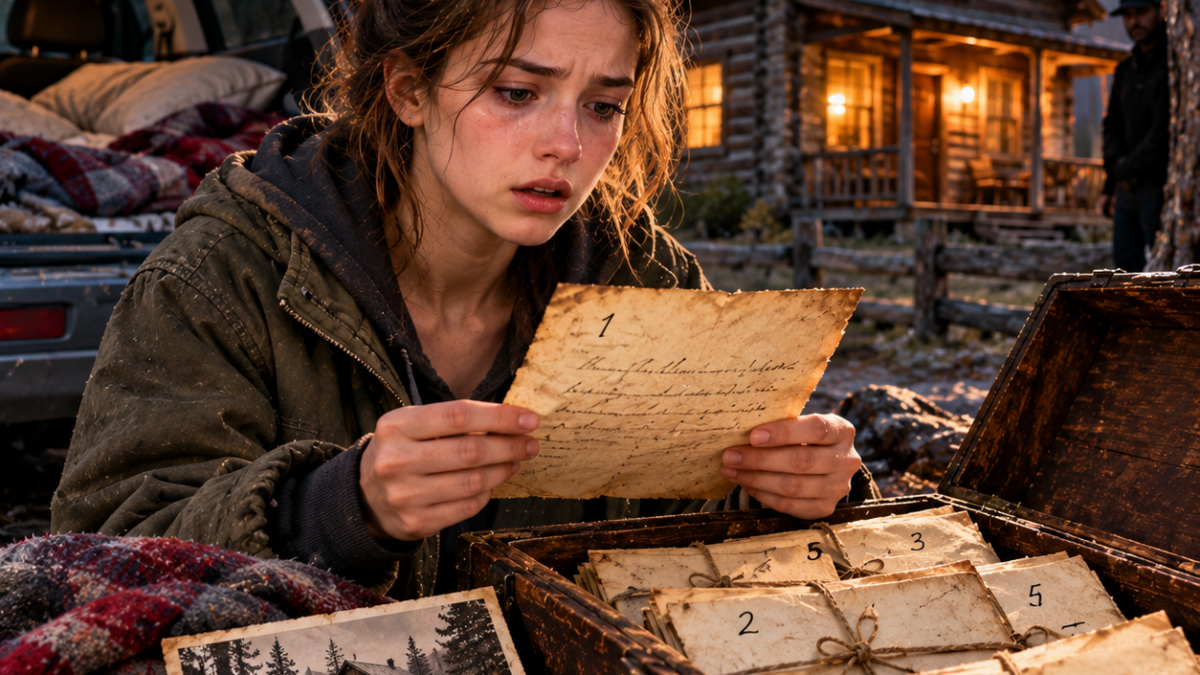
PART 2
For a long time, I just sat on the floor holding that envelope.
I was afraid to open it.
That probably sounds strange.
A developer had given me nine days before trying to take the only home I’d ever owned.
The answer might have been inside the paper in my hands.
I should have ripped it open immediately.
Instead I stared at Orson’s handwriting.
**If you come home.**
Not if you inherit the property.
Not if the attorney finds you.
Not if I’m gone.
If you come home.
I had spent fourteen years learning not to call anywhere that.
Homes disappeared.
Families changed their minds.
People made promises when they were feeling generous and explained why they couldn’t keep them when life became inconvenient.
I had learned to leave before anyone saw how badly leaving hurt.
And now a dead man I barely remembered had written those words as though he believed I might someday walk through his door again.
I opened the envelope.
Inside were six pages.
The first began simply.
*Willa,*
*If you’re reading this, then either I finally found the courage to explain everything to you, or time ran out before I got the chance.*
I had to stop.
My eyes blurred.
I wiped them with my sleeve and continued.
*First, I need you to know something I should have found a way to tell you years ago.*
*You were never forgotten.*
My throat closed.
I read that sentence again.
Then again.
*Your mother, Alice, was the closest thing I ever had to a daughter.*
I froze.
My mother’s name.
Orson explained that he had known her since she was sixteen.
She had grown up two properties away.
Her father had been unreliable, and her mother worked nights.
Orson had taught her to repair fence posts, change oil, split wood, and drive the old truck that apparently terrified everyone else in the county.
When she married my father, Daniel, Orson had stood beside them at the courthouse.
I found a photograph among the ones behind the wall.
There he was.
A younger Orson.
Tall.
Gray-eyed.
One hand on my father’s shoulder.
My mother beside him wearing a simple white dress.
I had looked at that picture twice without recognizing him.
The letter continued.
*Your parents named me as the person they wanted contacted if anything happened to them. But their paperwork was never properly completed.*
That sentence carried the first answer.
Not the whole answer.
But enough to hurt.
After my parents died, Orson had filed for guardianship.
His cabin failed an initial inspection because one bedroom wasn’t properly finished, the water system needed repairs, and the access road had winter safety concerns.
The state suggested temporary foster placement while he corrected everything.
Temporary.
He underlined the word.
*I believed temporary meant a month or two.*
*I was wrong.*
I sat there until darkness filled the bedroom around me.
He had repaired the house.
Submitted new paperwork.
Completed training.
Applied again.
By then, I had been moved.
Then moved again.
Records went between counties.
His letters were returned.
Phone calls led nowhere.
At one point he located the foster agency handling my case, but because his legal relationship to me had never been established, privacy rules prevented them from giving him information.
He hired an attorney.
He appealed.
He kept trying.
And then something else happened.
He got sick.
Not terminally.
Not then.
But badly enough to spend months recovering.
By the time he could try again, I had already been moved through several homes.
*That is the explanation,* he wrote.
*It is not an excuse.*
I pressed my palm over my mouth.
Nobody had ever apologized to me for disappearing.
Usually adults explained why leaving had been necessary.
Why circumstances were complicated.
Why I should understand.
Orson wasn’t asking me to understand.
He was telling me he’d failed.
That somehow hurt more.
Then I reached the third page.
The sale agreement.
*You may find paperwork showing that I agreed to sell this land to Northcrest Development.*
I sat straighter.
*That agreement did exist.*
My heart sank.
*It does not exist anymore.*
I stopped breathing.
*I canceled it.*
I read faster.
Orson had originally agreed to sell eighteen months earlier.
Medical bills had accumulated.
The cabin needed repairs.
Northcrest had been buying properties throughout the foothills for a planned gated development called Summit Ridge.
His forty-one acres mattered because the most practical road to their larger parcel crossed the southern edge of his land.
They offered him more than the property was worth.
For several weeks, he intended to take it.
Then something changed.
A private investigator he had hired years before finally found my name in a public record.
He learned I would age out of foster care the following year.
*I realized I had spent fourteen years telling myself I had lost the chance to give you a home.*
*Then I understood I might still be able to leave you one.*
I couldn’t see the words anymore.
I lowered the pages and cried.
Not quietly.
Not gracefully.
I cried like the five-year-old girl who had waited for somebody who never came.
I cried like the ten-year-old who stopped putting drawings on foster refrigerators because they disappeared whenever she moved.
Like the fifteen-year-old who quit asking whether placements were permanent.
Like the nineteen-year-old who slept in a Honda because adulthood had arrived before belonging ever did.
Orson had remembered.
It didn’t give me those years back.
But suddenly the story I’d told myself about them was different.
I had not been completely unwanted.
Somebody had tried.
Somebody had kept trying.
Eventually I returned to the letter.
Orson said he had exercised the termination clause in Northcrest’s purchase agreement before closing.
The contract allowed either party to withdraw during the inspection period if certain access and environmental conditions remained unresolved.
He had sent Northcrest written notice.
Certified mail.
Their attorney had acknowledged receipt.
Then came the sentence that made me sit completely still.
*Grant Holloway will tell you that document doesn’t matter.*
Grant.
The same man who had stood on my porch.
*He told me once that nobody would believe an old man who couldn’t keep his paperwork straight.*
My skin prickled.
*So I stopped keeping only one copy.*
I almost shouted.
Instead I kept reading.
*Helen has one portion of what you need, although she doesn’t know what it means.*
*The rest is where your mother used to hide things she didn’t want me to find.*
I stared at the page.
That was it.
No address.
No drawer.
No box number.
Just:
*Where your mother used to hide things.*
“You’ve got to be kidding me,” I whispered.
There was another line.
*Ask Ada about the blackberry pie.*
I stared at the words.
Then laughed through tears.
Of course.
A dead man had left me a property dispute disguised as a family riddle.
I grabbed my coat.
Ada Vaughn lived half a mile down the road.
Her porch light was still on.
She answered wearing slippers and holding a mug.
“Willa?”
“What’s the blackberry pie?”
She blinked.
“What?”
“Orson said to ask you about the blackberry pie.”
Ada’s expression changed immediately.
She stepped aside.
“Come in.”
I did.
She shut the door.
“How much did he tell you?”
“Not enough.”
Ada smiled faintly.
“That sounds like Orson.”
She sat at her kitchen table.
“Your mother used to spend summers here.”
“With Orson?”
“With all of us. This road used to have more families.”
I sat across from her.
“Alice was sixteen when she decided she’d become an expert baker.”
I almost smiled.
“My mother?”
“Terrible baker.”
That surprised a laugh out of me.
Ada continued.
“She made a blackberry pie for the county fair. Orson teased her because she burned the crust. She got furious and hid the whole thing.”
“Where?”
“That was the joke. Orson looked everywhere.”
Ada’s eyes softened.
“She hid it in the old root cellar because he hated going down there.”
I was already standing.
Ada pointed at me.
“Not alone.”
“I’ve been in the cabin for a week. I didn’t see a cellar.”
“That’s because the entrance isn’t inside.”
We walked back with flashlights.
Behind the workshop, blackberry vines had swallowed part of a low stone wall.
Ada pushed branches aside.
There was a wooden door almost level with the ground.
“Orson stopped using this years ago.”
The lock had rusted through.
Jonah’s truck happened to be outside my cabin.
He had spent the day repairing porch supports and was cleaning tools.
When he saw two women disappearing behind the workshop at ten o’clock at night, he followed.
“What are you doing?”
“Looking for a pie,” Ada said.
Jonah stared at her.
“Should I even ask?”
“No.”
We forced the door open.
Cold, damp air rolled out.
Stone steps led underground.
The cellar was nearly empty.
Old shelves.
Canning jars.
A wooden crate.
Two rusted lanterns.
I searched everything.
Nothing.
Jonah shined his flashlight along the wall.
“What exactly are we looking for?”
“I don’t know.”
“Useful.”
“Orson said my mother hid things here.”
Jonah crouched beside a lower shelf.
“There are scratches.”
He moved it.
Behind the shelf was a narrow cavity.
Inside sat a green metal box.
My hands shook as I pulled it out.
There was no lock.
Inside were papers sealed in plastic.
The first was Orson’s written termination of the Northcrest agreement.
Dated.
Signed.
Notarized.
The second was a certified-mail receipt.
The third was a letter from Northcrest’s legal department.
I read the first line aloud.
*Mr. Bellamy, we acknowledge receipt of your notice electing termination under Section 8.4 of the Purchase and Sale Agreement…*
Jonah slowly looked at me.
Ada sat down on an overturned crate.
I continued.
The letter disputed Orson’s reasoning.
It threatened potential future litigation.
But it acknowledged the termination.
Northcrest knew.
Grant Holloway knew.
And three days earlier, he had stood on my porch holding the original purchase agreement as though none of this existed.
I started laughing.
Not because it was funny.
Because for the first time since the SUV arrived, I wasn’t helpless.
Ada looked at me.
“You all right?”
I held up the letter.
“He lied to me.”
Jonah read it.
“Looks that way.”
“He gave me nine days.”
Jonah’s expression hardened.
“Then maybe day nine shouldn’t go the way he expects.”
The next morning, I drove straight to Helen Mercer’s office.
She read the documents without speaking.
Then she read them again.
“Where did you get these?”
“Root cellar.”
She looked over her glasses.
“Of course.”
“You said Orson left you something.”
Helen leaned back.
“He left me a sealed envelope with instructions that it was to be opened if anyone challenged the transfer of the property.”
My heart began pounding.
“You never opened it?”
“Nobody had challenged the transfer when we met.”
“They have now.”
Helen retrieved a large envelope from a fireproof cabinet.
Orson had written across it:
**ONLY IF THEY TRY TO TAKE HER HOME AGAIN.**
Helen looked at me.
I couldn’t speak.
Neither could she for a moment.
Then she opened it.
Inside was another copy of the termination notice.
A title report.
Several letters.
And a handwritten affidavit from Orson.
The final paragraph read:
*I am leaving Bellamy Ridge to Willa Corbin because I failed to give her a home when she needed one most.*
*I will not knowingly allow another person to take one from her.*
Helen lowered the paper.
“Well,” she said softly. “Mr. Bellamy apparently anticipated a fight.”
“Do we win?”
She didn’t answer immediately.
That scared me.
“Do we?”
“You have strong evidence.”
“That’s not what I asked.”
“Law isn’t a locked door where one paper always opens it.”
My stomach sank.
Helen pointed at the Northcrest letter.
“But this changes the situation considerably.”
“What happens now?”
“First, you stop packing.”
I looked at her.
She repeated it.
“Willa. Stop packing.”
Something in me resisted those words.
Because packing was what I knew.
When adults disagreed, I packed.
When circumstances changed, I packed.
When somebody said the arrangement wasn’t working, I packed.
Helen seemed to understand.
She pushed an empty legal pad toward me.
“Write this down.”
“What?”
“Your address.”
I frowned.
She waited.
Slowly, I wrote:
**172 Bellamy Ridge Road.**
“Again.”
I looked at her.
“Helen—”
“Again.”
I wrote it.
Then again.
She tapped the paper.
“That’s your address until a court says otherwise. Northcrest doesn’t get to change that by sending a man in a nice coat to scare a nineteen-year-old.”
For the first time, I smiled.
“What do we do to them?”
Helen’s expression became very lawyer-like.
“We respond.”
I learned that lawyers can make revenge sound extremely boring.
Helen sent Northcrest a formal notice rejecting their claim.
She enclosed the termination.
The certified-mail record.
Their own acknowledgment.
Orson’s affidavit.
She demanded that Northcrest withdraw its assertion of ownership immediately.
Grant Holloway responded within four hours.
Not to Helen.
To me.
He drove back to the cabin.
This time I didn’t invite him onto the porch.
I stayed behind the railing.
Jonah was working near the workshop.
Ada was in my kitchen pretending she had come over only because I needed extra jars.
Grant stepped out of the SUV.
“I received your attorney’s letter.”
“So did I.”
“I think there’s some confusion.”
“You told me Orson sold you this property.”
“He signed an agreement.”
“Then canceled it.”
“That remains disputed.”
“Your company acknowledged the cancellation.”
“An acknowledgment of receipt is not necessarily an acknowledgment of legal effectiveness.”
That sounded rehearsed.
I folded my arms.
“Then why didn’t you show me that letter?”
Grant’s expression changed slightly.
“We weren’t required to.”
“You stood on my porch and told me I had nine days.”
“I told you we intended to enforce our contractual rights.”
“You knew I was nineteen.”
“I was aware.”
“You knew I’d inherited the cabin recently.”
“Yes.”
“Did you know I had just aged out of foster care?”
That finally unsettled him.
“I don’t see how that’s relevant.”
“I think you saw exactly why it was relevant.”
He glanced toward Jonah.
Then back at me.
“Ms. Corbin, Northcrest has invested substantial money based on access through this property.”
There it was.
Not the cabin.
Access.
“What happens if you don’t get my land?”
“That’s complicated.”
“Your project stops?”
He didn’t answer.
I smiled.
Grant’s voice lowered.
“We are willing to make you an offer.”
“You said you owned it.”
“We are willing to resolve the dispute.”
“How much?”
He named a number.
It was more money than I’d ever imagined having.
For one second, I couldn’t breathe.
Enough to buy an apartment.
Enough for college.
Enough to replace my car.
Enough to never sleep in it again.
Grant saw hesitation and moved closer.
“You’re nineteen. You don’t need forty-one acres.”
I looked behind me.
The cabin.
The repaired porch.
My bedroom window.
The dresser Jonah built.
My clothes inside it.
Grant continued.
“You could leave here with financial security.”
Leave.
There it was again.
Always leave.
I turned back to him.
“No.”
His eyebrows rose.
“You haven’t thought about it.”
“I’ve spent fourteen years thinking about what it costs to lose a home.”
His jaw tightened.
“This isn’t personal.”
“It became personal when you gave me nine days.”
“We will litigate.”
“Then talk to Helen.”
“I’m talking to you because you’re the owner.”
“No. You’re talking to me because you thought I was easier than my lawyer.”
Grant looked at me for several seconds.
Then he said quietly, “You don’t understand what you’re getting into.”
That sentence should have scared me.
Instead, it made something settle inside my chest.
“You’re right.”
I looked at the cabin.
“I’ve never owned enough before to know what somebody taking it feels like.”
Then I looked back at him.
“But I’ve lost enough to recognize the feeling.”
He left.
Three days later, Northcrest filed suit.
Their claim was simple.
They argued Orson’s termination had been invalid.
They asked the court to enforce the original sale agreement.
Their filing also placed what Helen called a cloud on my title.
I couldn’t sell.
Couldn’t borrow against the land.
Couldn’t make certain improvements without risk.
“They want to exhaust you,” Helen explained.
“With what money?”
“Exactly.”
Northcrest had lawyers on staff.
I had a cabin with a leaky chimney and four hundred twelve dollars left from the estate checking account after immediate repairs.
I started panicking again.
“What if I can’t afford this?”
Helen removed her glasses.
“Orson paid my firm a retainer specifically for estate-related title disputes.”
“How much?”
“Enough.”
“For everything?”
“For a serious fight.”
I stared at her.
“He planned for this too?”
“He planned for many things.”
“He could plan for lawyers but couldn’t find a foster kid?”
The words came out sharper than I intended.
Helen didn’t defend him.
“No.”
That surprised me.
“He failed you, Willa.”
I looked away.
“Then why does everybody talk like he was some kind of hero?”
“I don’t.”
She waited until I looked back.
“I think he loved you. I think he tried. I also think a child needed him and he didn’t manage to reach her.”
Both things could be true.
I hated that.
I wanted Orson to be innocent or guilty.
Good or bad.
The man who tried or the man who gave up.
But real people rarely stay inside one category.
Helen said, “You don’t owe him sainthood because he left you land.”
“I know.”
“You also don’t have to reject the good he tried to do because it came too late.”
That stayed with me.
That night, I began reading the other twenty-two letters.
I had avoided them.
I think I was afraid they would create a version of Orson I couldn’t be angry at.
The letter for my sixth birthday contained a pressed maple leaf.
*Your mother used to collect these and insist every red leaf was the prettiest one she’d ever seen.*
The letter for seven contained a terrible drawing of a horse.
*I hope somebody is teaching you something impractical and wonderful.*
At eight:
*I tried again this year. I didn’t get farther than last year. I’m sorry.*
At nine:
*I wonder whether you still hate peas.*
At ten:
*Your mother once threatened to run away because I made her finish algebra before fishing.*
At eleven:
*If nobody has told you lately, being difficult to place is not the same thing as being difficult to love.*
I had to stop there.
I pressed the letter against my chest.
How had he known?
Maybe he didn’t.
Maybe he simply understood enough about the system to guess.
At twelve:
*You are not a guest in the world.*
At thirteen:
*Adults sometimes confuse what they are able to give with what a child deserves. Those are not the same thing.*
At fourteen:
*I still have your mother’s blue bicycle. It is far too small for you now.*
I found it hanging in the workshop.
At fifteen:
*You may be angry with me someday. You have every right.*
At sixteen:
*I learned you were still in Washington. It is the closest I’ve come to finding you in years.*
At seventeen:
*I finally have a lead.*
At eighteen:
*I know where you are, but my attorney says appearing suddenly may cause more harm than good. I am trying to contact the correct people first.*
That letter made me stand up.
Age eighteen.
He knew.
Why didn’t he come?
The next letter answered.
It had been written three months later.
*I went to the agency.*
My heart pounded.
*They told me you had asked that no previously unknown adults be introduced into your case without notice because you were preparing to transition out.*
I remembered that.
My social worker had asked if I wanted distant relatives or former contacts searched before I aged out.
I said no.
I had already been disappointed enough.
I didn’t know Orson existed.
He wrote:
*I respected the request because I was told it came from you.*
*I don’t know whether that was the right decision.*
*I was afraid showing up would feel like another adult making your life about what he wanted.*
I started crying again.
He had been that close.
A building away perhaps.
A name in a folder.
And both of us had made choices based on fear.
He feared becoming another stranger forcing his way into my life.
I feared hoping another stranger would stay.
Two people waiting on opposite sides of a door neither knew how to open.
The lawsuit moved quickly.
Northcrest’s project had investors.
Deadlines.
Road permits.
They needed the dispute resolved.
So did I.
Helen began discovery.
That meant Northcrest had to produce internal records related to Orson’s sale.
At first they produced almost nothing useful.
Then Helen found something in an email chain.
She called me at seven in the morning.
“Can you come in?”
“Is that a lawyer way of saying something bad happened?”
“Not today.”
I drove to town.
Helen had three printed emails on her desk.
The first was from Grant Holloway to Northcrest’s acquisitions director nine months before Orson passed away.
**Bellamy has withdrawn. We should evaluate alternate access.**
I read it twice.
“So he knew.”
“Yes.”
The second was sent two months later.
**Alternate route increases infrastructure costs by approximately $1.8M. Recommend reopening Bellamy discussions.**
The third was written after Orson’s death.
Grant again.
**Estate beneficiary appears young and unrepresented outside probate counsel. Existing signed agreement may provide leverage toward negotiated acquisition.**
I looked at Helen.
“What does leverage mean?”
“In this context?”
“Yes.”
“It means they knew the original agreement had been terminated, but they believed showing it to you might pressure you into selling.”
Heat rose through me.
“He knew.”
“Yes.”
“He came to my house knowing he didn’t own it.”
“He knew Northcrest’s legal position was disputed at best.”
“He told me to leave.”
Helen’s voice hardened.
“I know.”
I read the email again.
Young and unrepresented.
That was how he saw me.
Not as Willa.
Not as Orson’s beneficiary.
Not as the owner.
Young.
Alone.
Easy.
Something inside me changed that morning.
Until then, I had been defending my home.
After those emails, I stopped feeling defensive.
I wanted the truth on record.
“Can they get in trouble for this?”
Helen was careful.
“Potentially. But don’t build your expectations around punishment.”
“What can we do?”
“We can amend our response.”
“To say what?”
“Slander of title. Bad-faith litigation may also become relevant depending on what additional records show.”
“Can we make them pay?”
Helen almost smiled.
“We can ask.”
That became our answer whenever I got angry.
We can ask.
I wanted Grant humiliated.
Helen asked for documents.
I wanted Northcrest’s project stopped forever.
Helen asked for depositions.
I wanted to stand in front of their investors and read his email.
Helen told me to let the evidence speak.
It was not emotionally satisfying.
At first.
Then Grant Holloway sat for deposition.
I attended.
Helen questioned him.
He wore a dark suit and the same calm expression he’d had on my porch.
“Mr. Holloway, when did you first learn Mr. Bellamy intended to terminate the purchase agreement?”
“I don’t recall the exact date.”
Helen placed his email in front of him.
“Would this refresh your memory?”
He read it.
“Yes.”
“You wrote, ‘Bellamy has withdrawn.’ Correct?”
“Yes.”
“So as of this date, you understood Mr. Bellamy had withdrawn from the transaction.”
“I understood he was attempting to.”
“Your email does not say attempting.”
Grant’s attorney objected.
Helen continued.
“After Mr. Bellamy passed away, did you learn the property had been devised to Willa Corbin?”
“Yes.”
“How old was Ms. Corbin?”
“I believe nineteen.”
“Did you know she had recently exited foster care?”
Grant looked toward his attorney.
“Yes.”
“How?”
“I was informed.”
“By whom?”
“Our estate research contractor.”
Helen placed another document down.
“Is this the report?”
“Yes.”
I had never seen it.
The report contained a short profile.
No private medical information.
No dramatic secrets.
Just enough.
Age nineteen.
Former dependent of the state.
No real property ownership history.
Limited credit file.
Helen asked:
“Why did Northcrest require information about Ms. Corbin’s credit profile if you believed you already owned her property?”
Grant paused.
His attorney shifted.
“I don’t know.”
“You requested the report.”
“I request many reports.”
Helen handed him the email.
**Need to know whether heir has resources to fight.**
I stopped breathing.
Grant had written it.
Helen didn’t raise her voice.
“Is this your email?”
“Yes.”
“Who is ‘heir’?”
“Ms. Corbin.”
“What did you mean by resources to fight?”
“Our potential legal dispute.”
“So before you visited Ms. Corbin, you knew a legal dispute existed?”
“Yes.”
“Yet you told her Northcrest had a completed right to purchase the property?”
“I explained our position.”
“Did you tell her Mr. Bellamy had sent a termination notice?”
“No.”
“Did you tell her your own legal department had acknowledged it?”
“No.”
“Did you tell her you had previously written that Mr. Bellamy had withdrawn?”
“No.”
“Did you tell her Northcrest’s alternative road would cost approximately $1.8 million?”
“No.”
“Did you give her nine days?”
Grant looked at me.
“Yes.”
That single word felt different from Ward McCrae’s confession in some other story I had never lived.
It belonged to me.
Yes.
He knew.
Yes.
He calculated.
Yes.
He came anyway.
I expected triumph.
Instead, I felt tired.
Maybe because proof doesn’t erase the moment someone made you feel powerless.
It only changes what happens afterward.
Jonah drove me home.
We had become friends over the weeks.
Real friends.
The kind who stopped knocking before entering the workshop but still knocked on the cabin door.
He didn’t ask about the deposition until we were halfway up Bellamy Ridge.
Then he said, “How bad?”
“For him or me?”
“Him.”
“Pretty bad.”
“Good.”
I looked out the window.
“Why doesn’t it feel better?”
Jonah kept his eyes on the road.
“Because winning an argument doesn’t make the thing they did unhappen.”
I looked at him.
“You secretly eighty years old?”
“My grandmother raised me.”
“That explains a lot.”
He smiled.
Then he said, “You know what Orson used to say?”
“You knew him?”
“Everybody up here knew Orson.”
“Nobody thought to mention he spent fourteen years looking for me?”
Jonah’s smile disappeared.
“We didn’t know that.”
“What did you know?”
“That there was a girl.”
I turned toward him.
“What?”
“He never told us your name. Not until near the end.”
Jonah slowed for a curve.
“He used to say the cabin wasn’t really his to sell because he was keeping it for somebody who might never come.”
My chest tightened.
“You believed him?”
“We thought maybe he had a daughter nobody knew about.”
I stared through the windshield.
“Why did you build the dresser?”
Jonah looked confused.
“What?”
“When you first came. Why?”
“You had no furniture.”
“I had shelves.”
“You had your clothes in trash bags.”
“So?”
He shrugged.
“People shouldn’t have to live out of bags in their own house.”
I looked away before he could see my face.
That sentence almost broke me more than Orson’s letters had.
A month after Northcrest filed suit, the county planning commission scheduled a public hearing on Summit Ridge.
Northcrest needed approval for road modifications.
Their original plans assumed access across my property.
Without it, they needed a steep alternate route requiring major grading.
Neighbors began asking questions.
Not because they knew everything about my lawsuit.
Because construction traffic would affect them.
Ada organized people.
I tried to stop her.
“I don’t want this turning into a mob.”
“It’s a planning meeting, Willa.”
“You know what I mean.”
Ada handed me a casserole.
“No, I don’t. But eat.”
At the hearing, Northcrest presented beautiful drawings.
Large homes.
Mountain views.
Walking trails.
Native landscaping.
Words like sustainable and community appeared on every slide.
Then an engineer showed the road.
It crossed my land.
I raised my hand.
The commission chair looked at me.
“Ms. Corbin?”
“Northcrest doesn’t have permission to use that route.”
Grant sat at the applicant table.
One commissioner frowned.
“Mr. Holloway?”
Grant’s attorney spoke.
“The access parcel is currently subject to pending litigation.”
I said, “Because they’re suing me for land they already knew the seller withdrew from selling.”
The room went silent.
Helen touched my arm.
A warning.
Keep it factual.
The chair asked, “Is that matter before a court?”
“Yes.”
“Then this commission won’t determine ownership.”
“I understand.”
I sat down.
That should have been it.
Then Ada stood.
She was seventy-two and five-foot-two.
Grant looked more nervous around her than around Helen.
“My concern isn’t who wins the lawsuit,” Ada said. “My concern is why the applicant submitted a transportation plan relying on land they did not currently control.”
The engineer began answering.
Then Jonah’s father stood.
Then the Harrison brothers.
Then a firefighter who lived down the road.
Nobody shouted.
Nobody threatened.
They simply asked questions.
Road grade.
Drainage.
Emergency vehicle access.
Water runoff.
Winter maintenance.
Northcrest’s alternate route had problems.
Serious ones.
The commission postponed approval.
Grant cornered me in the hallway afterward.
Helen stepped between us.
Grant stopped.
He spoke to me anyway.
“You’re enjoying this.”
“No.”
“Your neighbors are trying to kill a development that could bring millions into the area.”
“My neighbors are asking whether fire trucks can get up your alternate road.”
“You know why we’re using the alternate road.”
“Yes.”
“Because you’re refusing a reasonable sale.”
I stared at him.
“You’re still doing it.”
“Doing what?”
“Talking like my property already belongs to the person willing to pay more for it.”
His face tightened.
“You could settle today.”
“So could you.”
His lawyer interrupted.
“Grant.”
He walked away.
Helen looked at me.
“That was good.”
“What?”
“You didn’t threaten him.”
“I wanted to.”
“I know.”
“I had a whole speech.”
“Keep speeches out of hallways.”
I smiled.
“Lawyers hate fun.”
“We hate discoverable fun.”
Two weeks later, Northcrest offered me three times the original purchase price.
I said no.
Then four times.
No.
Helen asked me to think carefully before refusing the next offer.
“This could change your life.”
“So can keeping the land.”
“I’m your attorney. I need to make sure you’re not rejecting money only because you’re angry.”
I thought about that.
Then I drove back to the cabin.
I walked the entire forty-one acres.
The creek.
The cedar grove.
The clearing where Orson’s workshop leaned.
The hill where you could see the snow line on the mountains.
Near the northern boundary, I found an old rope swing.
One of the letters mentioned it.
My mother had fallen from it at seventeen and refused to admit she was hurt because Orson had told her not to climb that high.
I sat beneath the tree.
Would I sell?
The question wasn’t really about Northcrest.
Would I sell if someone else offered the same amount?
Maybe someday.
I didn’t know.
Property wasn’t sacred merely because Orson gave it to me.
But I knew one thing.
I didn’t want my first decision as an owner to be made because somebody stronger had frightened me.
So I returned to Helen.
“I’m not selling.”
She studied me.
“Because?”
“Because I choose not to.”
She nodded.
“That’s a better answer.”
Discovery uncovered the document that ended Northcrest’s confidence.
Their legal department had prepared an internal memo after Orson’s termination.
The conclusion was clear:
**Seller’s termination likely effective. Recommend abandoning acquisition unless seller voluntarily re-enters negotiations.**
Grant had received it.
So had the acquisitions director.
Months later, after Orson died, they filed suit anyway.
Helen called me.
“I think they’re going to settle.”
“Why?”
“Because this stopped being a contract dispute.”
“What is it now?”
“A very uncomfortable record.”
Northcrest’s investors apparently agreed.
The company had borrowed money against the Summit Ridge project.
Its lender demanded an explanation.
The county commission wanted revised plans.
Local newspapers started asking why a developer had sued a nineteen-year-old beneficiary using an agreement its own lawyers considered terminated.
I never contacted reporters.
I didn’t need to.
Court documents were public.
Grant’s deposition was not yet public, but enough filings existed to raise questions.
Then Northcrest made a new offer.
They would dismiss their claim.
Clear my title.
Pay Helen’s fees.
Pay additional compensation.
And sign a confidentiality agreement.
I stared at the last page.
“They want me quiet.”
Helen nodded.
“How much are they offering for quiet?”
She told me.
Again, the number was enormous to me.
I thought about twenty-eight dollars.
Sleeping behind a grocery store.
Watching the gas gauge.
Counting quarters.
Nobody who has had almost nothing can pretend money doesn’t matter.
It mattered.
A lot.
“What happens if I don’t sign?”
“We continue.”
“Could we lose?”
“There is always risk.”
“How much?”
Helen considered.
“I think their ownership claim is weak. Your counterclaims are less predictable.”
“What would you do?”
“I can’t make that decision.”
“I know.”
She waited.
I looked at the confidentiality clause.
If I signed, I could keep the cabin.
Get money.
Move on.
Nobody could ask more.
Nobody could drag my childhood into public discussion.
It was tempting.
Then I remembered Grant’s email.
**Need to know whether heir has resources to fight.**
He had counted on silence before he ever offered to pay for it.
“No confidentiality.”
Helen nodded as though she’d expected that.
“They may reduce the money.”
“Fine.”
“Potentially substantially.”
“I want my legal fees.”
“Reasonable.”
“I want the title cleared.”
“Essential.”
“I want a written statement that Orson validly terminated the sale.”
Helen raised an eyebrow.
“They will resist that.”
“Then they can resist in court.”
“Anything else?”
“Yes.”
I thought of something that made me smile.
“I want them to withdraw the road plan across my land from every county application.”
“That would follow from no ownership.”
“I want it written.”
“All right.”
“And I don’t want Grant Holloway coming onto the property again.”
Helen actually smiled.
“That one I can probably arrange.”
Negotiations lasted six days.
On the seventh, Northcrest accepted nearly everything.
No confidentiality.
They did not admit intentional wrongdoing.
Companies rarely do.
But the settlement stated that Northcrest recognized Orson Bellamy had terminated the purchase agreement before his death.
They dismissed their suit with prejudice.
They released every claim against my land.
They paid my legal costs.
They compensated me for the title dispute.
Not the huge amount offered in exchange for silence.
Enough.
More than enough for someone who had once had twenty-eight dollars.
Grant Holloway was removed from the Summit Ridge acquisition.
I didn’t demand that.
Northcrest’s board did it.
Helen told me not to celebrate somebody losing a job.
“I’m not.”
“You’re smiling.”
“I smile when nervous.”
“You’ve been nervous for ten minutes?”
“Extremely.”
But the best part came nine days after the settlement.
Exactly nine days.
That number mattered to me.
I drove to Northcrest’s regional office.
Not because I needed to.
Because they had asked me to sign one final release in person.
Grant wasn’t there.
Their new representative was a woman named Vanessa Chen.
Professional.
Polite.
She handed me the release.
Helen reviewed it.
I signed.
Vanessa handed me a copy of the recorded title release.
“It’s complete.”
I looked at the stamp.
My land.
Clear.
I stood.
Vanessa said, “Ms. Corbin?”
“Yes?”
“For what it’s worth, what happened at the beginning of this matter should have been handled differently.”
It wasn’t an admission.
But it was something.
“Thank you.”
Outside, Helen stopped beside my car.
“You realize what day this is?”
“Yes.”
Nine days.
Grant had given me nine days before their lawyers moved forward.
Nine days after their case ended, I was driving home with proof they had no claim left.
It was childish.
Petty, maybe.
But I let myself enjoy it.
When I returned, Jonah was rebuilding the porch railing.
I held up the title release.
He climbed down.
“Done?”
“Done.”
“Really done?”
“Really.”
He stared at me.
Then opened his arms awkwardly.
I laughed.
“What is that?”
“I don’t know. Seemed appropriate.”
I hugged him.
It was the first hug I’d initiated in years.
Ada saw from across the road.
By dinner, somehow fifteen people knew.
By sunset, there were twenty-seven people in my yard.
Nobody called it a celebration.
They just happened to bring food.
Mountain people apparently lie badly about parties.
Someone brought a folding table.
Someone brought lanterns.
The Harrison brothers brought smoked chicken.
Ada brought blackberry pie.
I looked at it.
She smiled.
“This one’s not burned.”
People laughed.
I didn’t know what to do with so many people standing on property that belonged to me.
Then I realized something.
Nobody was asking me to leave.
So I stayed.
Later, after everyone was gone, I sat alone on the porch.
The twenty-three letters were beside me.
I opened the last one again.
There were two paragraphs I had not fully understood the first time.
*If the land becomes yours, don’t keep it merely because you think keeping it proves something.*
*Homes are not prisons. If someday leaving is your choice, leave.*
I smiled.
Even dead, Orson was arguing with me.
Then:
*But if you stay, fill the place with people who understand that being invited in should mean something.*
I looked through the window.
The cabin was warm.
My dresser stood in the bedroom.
Clothes inside.
Books on the shelf.
A toothbrush in the bathroom.
Food I had bought in the kitchen.
These were tiny things.
They felt enormous.
Months passed.
Northcrest redesigned Summit Ridge.
Without my road, they reduced the development considerably.
The alternate access cost more than expected.
Some investors pulled out.
Eventually the project became less than half its original size.
People called that my revenge.
It wasn’t.
I didn’t own Northcrest’s decisions.
I didn’t sabotage their project.
I simply refused to surrender the one piece they had assumed they could take cheaply.
Their own math did the rest.
Grant Holloway left Northcrest before the year ended.
I heard he moved to another firm in Oregon.
I never saw him again.
For a while, I imagined what I’d say if I did.
Then I stopped caring.
That surprised me.
I had thought justice would feel like watching the person who frightened me suffer.
It didn’t.
Justice felt like waking up and realizing I hadn’t thought about him in three weeks.
It felt like not checking the driveway every time I heard an engine.
It felt like leaving my shoes by the door instead of beside the bed in case I had to leave quickly.
It felt like buying a second set of sheets.
People who have always had homes won’t understand why that mattered.
In foster care, I rarely owned two sets of anything.
Extra things meant extra things to pack.
One afternoon I bought dishes.
Actual ceramic dishes.
Not disposable ones.
Jonah came in while I was putting them away.
He stared.
“What?”
“You bought eight plates.”
“Yes.”
“You live alone.”
“I know.”
“Planning something?”
I looked at the cabinet.
Eight plates.
Maybe I was.
The settlement money gave me choices.
That was unfamiliar.
Helen suggested school.
I enrolled part-time at a community college.
Construction management.
Jonah laughed when I told him.
“Going to compete with me?”
“I’ve watched you measure the same board four times.”
“That’s called craftsmanship.”
“That’s called anxiety.”
He pretended to be offended.
I also repaired the cabin.
Not all at once.
I wanted to preserve what was Orson’s.
The doorframe stayed.
Especially the mark.
**W.C. — AGE 5**
One evening I found myself standing beside it again.
For years I had almost no physical evidence of being five.
Foster moves had swallowed most childhood objects.
No old bedroom.
No toy box.
No height chart.
Yet Orson had kept this.
I traced the pencil.
Then Jonah appeared in the doorway.
“Want me to sand that when I refinish the frame?”
“No.”
He followed my eyes.
“Oh.”
“Can you seal over it?”
“Sure.”
“So it doesn’t fade.”
“Yeah.”
He paused.
“You want another mark?”
I looked at him.
“What?”
He picked up a pencil.
“You’re nineteen.”
I laughed.
“That’s stupid.”
“Probably.”
I stood against the frame anyway.
He placed a book on my head.
“Quit slouching.”
“I’m not.”
“You are.”
He marked the wood.
Beside it he wrote:
**W.C. — AGE 19 — HOME**
I stared at the last word.
“You added that.”
“Yeah.”
“You’re supposed to write height.”
He shrugged.
“I’m a carpenter. We take creative liberties.”
I didn’t erase it.
The next spring, Helen called.
“There’s something else.”
I had learned to fear those words.
“What?”
“Orson created a small trust.”
“For what?”
“He funded it years ago. It wasn’t part of the probate assets because it already existed.”
“How much?”
“Not enough to make you rich.”
“Good. Rich sounds stressful.”
Helen ignored that.
“The stated purpose is unusual.”
I waited.
“Assistance for young adults transitioning out of foster care.”
I sat down.
“He did what?”
“There’s approximately seventy-three thousand dollars remaining.”
My eyes filled.
“Why didn’t anybody tell me?”
“The trustee didn’t know you were connected. Your inheritance triggered a review.”
“What was Orson doing with it?”
“Paying deposits. Work boots. Community college fees. Car repairs. Small emergency grants.”
I covered my eyes.
Of course he had.
Fourteen years unable to reach one child.
So he helped others.
Helen continued.
“There’s one problem.”
“What?”
“The trust expires next year unless another qualified trustee takes responsibility.”
I knew what she was about to ask.
“No.”
“You haven’t heard the question.”
“I know the question.”
“Think about it.”
“I don’t know how to run a trust.”
“You can learn.”
“I barely know how to run myself.”
“Also learnable.”
I laughed despite myself.
Then Helen said quietly:
“You would not be helping children because you owe Orson.”
“I know.”
“You would not be required to make this property into some monument to your past.”
“I know.”
“Good.”
I went home.
For three weeks I ignored the trust paperwork.
Then my old caseworker called.
Her name was Maribel.
She had handled the final eighteen months before I aged out.
She had been one of the good ones.
“I heard about the property.”
“How?”
“County article.”
I groaned.
“Am I famous?”
“Only to seven people.”
“Good.”
She asked whether she could visit.
I said yes.
When she arrived, she brought a girl named Keisha.
Eighteen.
About to age out in five months.
Maribel apologized.
“Her transportation fell through. I didn’t want to cancel our meeting.”
Keisha looked uncomfortable.
I recognized that expression instantly.
The expression of a kid who knows every adult conversation may decide where she sleeps.
“You hungry?” I asked.
She shrugged.
Which meant yes.
I made sandwiches.
After a while, she asked about the cabin.
“It’s yours?”
“Yeah.”
“How?”
“Long story.”
“You rich?”
“No.”
She looked outside at forty-one acres.
“You look rich.”
I laughed.
Later, Maribel and I discussed Orson’s trust.
I asked what young adults needed most.
“Everything.”
“That’s not helpful.”
“Deposits. Transportation. Documents. Job clothes. Someone who answers the phone after five.”
That last part stayed with me.
Someone who answers the phone.
Keisha was on my porch when they prepared to leave.
She pointed toward the old workshop.
“What’s that?”
“Workshop.”
“Empty?”
“Mostly.”
“You could turn it into a house.”
I looked at her.
“Why?”
She shrugged.
“Looks big enough.”
After they left, I walked into the workshop.
Old benches.
Dust.
Tools.
Windows facing the creek.
I imagined a small apartment.
Then I imagined someone sleeping there after aging out.
Not because they had nowhere else to go permanently.
Just because they needed somewhere safe while figuring things out.
I sat on Orson’s old workbench.
“Is this what you wanted?” I asked the empty room.
No answer.
Good.
I didn’t want him deciding.
The choice had to be mine.
I called Helen the next day.
“I’ll take the trust.”
She sounded pleased.
“Under one condition.”
“What?”
“We change the name.”
“It currently has a generic legal name. What do you want?”
I thought about it.
“Twenty-Eight.”
Silence.
“Twenty-Eight?”
“Twenty-eight dollars was what I had when I aged out.”
Helen understood immediately.
“The Twenty-Eight Fund.”
“Yes.”
We renamed it.
Then I did something Orson had not asked for.
Using part of my settlement money, I converted the old workshop into two small transitional apartments.
Nothing luxurious.
Bedroom.
Bathroom.
Kitchenette.
A porch between them.
Jonah handled most of the construction.
I helped badly.
“You installed this backward,” he told me one afternoon.
“It opens.”
“Backward.”
“Subjective.”
“No. Doors are one of the least subjective things in construction.”
We laughed.
Keisha became the first resident.
She stayed five months.
Got a job at a veterinary clinic.
Saved money.
Moved into an apartment with a friend.
On the day she left, I noticed she had packed everything the night before.
Every bag sat by the door.
I knew why.
People like us learned to prepare for the goodbye before anyone said it.
I helped carry boxes to her car.
Then I said, “You know you can visit.”
She gave me the look I used to give adults.
The one that meant: Don’t promise things you won’t mean tomorrow.
So I didn’t make a speech.
I handed her a key.
She stared.
“What is this?”
“Cabin key.”
“Why?”
“Because people who live here get one.”
“I don’t live here anymore.”
“Then return it whenever you stop considering this somewhere you can come back to.”
Her eyes filled.
“That’s weird.”
“Probably.”
She put it on her key ring.
She still has it.
Over the next several years, fifteen young people stayed in those two apartments.
Some for two weeks.
Some almost a year.
Not all stories ended perfectly.
One young man disappeared after three months and stopped answering messages.
Another returned twice before she stabilized.
A boy named Darren broke one of Jonah’s windows trying to move a couch.
Jonah still complains about it.
But nobody was removed because somebody “needed the room.”
That rule became important to me.
Before anyone moved in, we agreed on an exit plan.
No surprises.
No garbage bags on Friday night.
No adult standing in a doorway saying circumstances had changed.
The Twenty-Eight Fund helped dozens more.
Car repairs.
Work clothes.
Security deposits.
Dental appointments.
Textbooks.
Once, we paid for a replacement birth certificate and state identification for a young woman whose entire future was being blocked by documents worth less than fifty dollars.
Every time Helen approved a grant, I thought about Orson.
I eventually stopped being angry at him every day.
Not because he had earned complete forgiveness.
Because carrying anger forever would have made his failure the center of my life.
I didn’t want that.
Six years after I inherited the cabin, I received a package.
No return name I recognized.
Inside was an old file folder.
The cover read:
**CORBIN, WILLA — GUARDIANSHIP CONTACT**
My hands shook.
A retired social-services employee had found it among archived personal records she was legally permitted to return through the agency.
Inside were copies of Orson’s requests.
Dates.
Letters.
Telephone notes.
Attempts.
One entry stopped me.
**Mr. Bellamy appeared in person. Advised minor recently moved. States he will continue pursuing guardianship.**
Another:
**Petitioner completed requested home modifications.**
Another:
**Unable to disclose placement location.**
Another:
**Mr. Bellamy requests letter be placed in child’s file.**
I sat at my kitchen table crying.
Not because the information was new.
The twenty-three letters had already told me.
But records were different.
They were proof that existed outside Orson’s own version of events.
He had come.
Again.
Again.
Again.
Then one final note.
Written when I was eleven.
**Mr. Bellamy expressed concern continued attempts may destabilize placement. Requests guidance.**
The response:
**Advised current permanency plan should not be disrupted absent court order.**
I stared at it.
That was where he had begun stepping back.
Not because he forgot.
Because someone told him that trying to reach me might make my life worse.
Maybe they were right.
Maybe not.
There was no way to know now.
I carried the folder into the bedroom.
I sat beneath the doorframe.
Age five.
Age nineteen.
Home.
I opened Orson’s eleventh-birthday letter.
*If nobody has told you lately, being difficult to place is not the same thing as being difficult to love.*
I finally understood that he might have been writing that to himself too.
Jonah and I married when I was twenty-seven.
Not because he rescued me.
I hated when newspaper profiles later framed it that way.
He didn’t.
He built a dresser.
Then he stayed long enough for everything after that.
There’s a difference.
We married beneath the cedar trees.
Ada cried before the ceremony even started.
Helen claimed something had gotten into her eye.
Keisha came.
Maribel came.
Several former residents came.
Even Denise, my final foster mother, came after I invited her.
That surprised people.
But Denise had not abandoned me.
She had participated in a system where beds, placements, money, regulations and good intentions collided.
I had spent enough years understanding that blame rarely fits neatly inside one person.
After the ceremony, Denise found me near the porch.
“I’ve wanted to apologize.”
“For what?”
“The way you left.”
“You didn’t do anything illegal.”
“That’s not what I said.”
I waited.
She looked toward the workshop apartments.
“I should have helped you plan better.”
“You had another placement coming.”
“I still should have.”
For years, I had imagined what I’d say if adults from my past apologized.
Something sharp.
Something unforgettable.
Instead I said:
“Thank you.”
She hugged me.
I let her.
Northcrest eventually completed a much smaller development several miles away.
Summit Ridge never became what their original brochures promised.
The access costs were too high.
The market changed.
Their investors chose fewer homes.
My forty-one acres remained untouched.
Years later, Northcrest approached me once more.
Different executives.
Different lawyer.
No Grant Holloway.
They wanted to purchase a small utility easement along the far southern boundary.
Helen called.
“You can say no.”
“I know.”
“The history doesn’t obligate you to negotiate.”
“I know.”
I asked what the easement was for.
A water line.
It would serve homes that had already been built.
Not some giant project.
Just families.
I agreed under conditions.
Minimal clearing.
Restoration.
Fair payment.
No road access.
And a contribution to the Twenty-Eight Fund.
Helen laughed when I suggested the last term.
“You’ve become dangerous.”
“How much?”
“Ask higher.”
We did.
They accepted.
That money funded six security deposits and two used cars.
When I told Ada, she said, “Now that’s revenge.”
I shook my head.
“No.”
“What would you call it?”
I thought about Grant standing on my porch.
Nine days.
His lawyers.
His confidence that fear would make my decision for me.
“Choice.”
That was the word.
Choice was the thing I hadn’t had when I was five.
Or nine.
Or fifteen.
Or nineteen with twenty-eight dollars.
The real victory wasn’t stopping Northcrest.
It wasn’t keeping forty-one acres.
It wasn’t watching their original project shrink.
The victory was that nobody else decided what happened to my home.
Eventually I read every one of Orson’s letters so many times I knew whole paragraphs by memory.
The twenty-third remained my favorite.
Not because it saved the property.
The papers in the root cellar did that.
Not because it exposed Northcrest.
Their own emails did that.
It was my favorite because of the final page.
I had barely noticed it the night I first opened the envelope.
I had been too frightened.
At the bottom, Orson wrote:
*I spent too many years believing I had missed my chance to do right by you.*
*Maybe I did.*
*Land cannot replace time.*
*A cabin cannot replace parents.*
*Twenty-three letters cannot repair fourteen birthdays.*
*Please don’t make them carry that responsibility.*
Then:
*The only thing I can leave you that might matter is a door nobody gets to close simply because you’ve become inconvenient.*
I keep that sentence framed above my desk.
Not the deed.
Not the settlement.
Not the newspaper article about Northcrest.
That sentence.
Because Orson understood something at the end that I had needed adults to understand all my life.
A home is not merely shelter.
It is the absence of an expiration date.
It is knowing the person in the next room isn’t quietly calculating whether somebody else needs your space more.
It is buying eight plates even when you live alone.
It is leaving books on shelves because you expect to be there next month.
It is putting clothes into a dresser.
It is not sleeping in shoes.
One autumn evening, a girl named Maya arrived at Bellamy Ridge.
She was nineteen.
Everything she owned fit into two bags.
She had aged out four days earlier.
The resemblance to my own story was so sharp that for a moment I couldn’t speak.
She stood on the porch of one of the apartments.
“What’s the maximum stay?”
“Depends.”
“Six months?”
“Maybe.”
“A year?”
“If that’s what the plan requires.”
She frowned.
“When do I have to know?”
“You don’t.”
That made her suspicious.
There are questions only kids from the system ask.
“Can somebody suddenly make me leave?”
“No.”
“What if you need the room for somebody else?”
There it was.
The sentence.
The exact sentence hidden underneath nearly every placement I’d ever had.
I looked at her.
“We don’t do that here.”
She stared at me.
“Why?”
I could have told her the whole story.
My parents.
Nine foster homes.
Twenty-eight dollars.
Orson.
The letters.
Northcrest.
The lawsuit.
The root cellar.
Everything.
Instead I said:
“Because somebody needing help doesn’t make you disposable.”
Maya looked down quickly.
I recognized what she was doing.
Trying not to cry in front of an adult.
I did what I wished adults had done for me.
Pretended not to notice.
I handed her the key.
“Kitchen’s stocked. Jonah still hasn’t fixed the dryer noise, so don’t panic when it sounds like an airplane.”
From across the yard Jonah shouted, “It works!”
Maya almost smiled.
Then she entered the apartment.
I watched her set both bags beside the bed.
She didn’t unpack.
Not that night.
I understood.
It took twelve days.
I know because on the thirteenth, I came over to repair a loose cabinet handle.
Her clothes were hanging in the closet.
Her books were on a shelf.
A photograph was beside the bed.
The bags were empty.
I went back outside before she saw me crying.
Jonah was waiting.
“You okay?”
“Yeah.”
He looked through the window.
He understood.
“She unpacked?”
I nodded.
He put his arm around me.
Across the property, the cabin glowed beneath the cedar trees.
Orson had called it Bellamy Ridge.
For a while, I considered changing the name.
Part of me wanted everything to be mine, free from a dead man’s history.
Eventually I kept it.
Not as a monument.
As continuity.
Orson failed to bring one child home.
Then he left behind something that helped many others find one.
That doesn’t erase his failure.
It gives it somewhere useful to go.
On my thirtieth birthday, I opened the wall panel in the bedroom again.
The photographs remained there in archival sleeves.
My mother.
My father.
Me at five.
Orson.
The twenty-three original letters now stayed in a fireproof case.
I took out the final one.
**IF YOU COME HOME.**
I smiled.
Then I added another envelope.
On the front I wrote:
**IF SOMEONE COMES AFTER ME**
Inside was a letter explaining the property.
The Twenty-Eight Fund.
The apartments.
Why the doorframe markings mattered.
Why the southern road could never be transferred without reviewing Northcrest’s old claims.
And why nobody living in the transition apartments should ever be given sudden notice merely because another person needed the room.
Jonah watched from the doorway.
“What are you doing?”
“Planning.”
“You’re thirty.”
“So?”
“You planning to disappear?”
“No.”
“Good.”
I placed the envelope beside Orson’s.
“Then what’s that?”
“Insurance against people forgetting why we built this place.”
Jonah walked over.
He read the front.
Then looked at me.
“You became Orson.”
I immediately glared at him.
“Take that back.”
He laughed.
“Parts of him.”
“Better.”
He pointed toward the doorframe.
“You want your thirty-year mark?”
I groaned.
“You’re still doing that?”
“Tradition.”
I stood against the wood.
He marked my height.
Beneath the nineteen-year mark, he wrote:
**W.C. — AGE 30 — STILL HOME**
I laughed so hard Ada heard us from her porch.
She was eighty-three by then and claimed her hearing was terrible except when something interesting happened.
That night, after everyone left, I stood alone in the bedroom.
Two marks.
Twenty-five years apart.
Age five.
Age thirty.
Between them was almost an entire life.
Nine foster homes.
Birthday letters I never received.
A man who tried and failed.
Twenty-eight dollars.
A Honda under grocery-store lights.
A lawyer’s phone call.
Forty-one acres.
A hidden wall panel.
A developer on my porch.
Nine days.
A root cellar.
A legal fight.
A dresser.
An unlocked future.
People sometimes ask what was inside Orson Bellamy’s twenty-third letter that “changed everything.”
They expect a deed.
A secret fortune.
Some impossible legal clause.
That wasn’t what changed everything.
The documents protected my land.
The evidence stopped Northcrest.
The settlement gave me financial stability.
But those things solved problems.
The letter solved something different.
For fourteen years, I had carried one belief so deeply that I didn’t even recognize it as a belief.
Nobody came.
Nobody tried.
Nobody remembered.
That belief followed me from house to house.
It made every goodbye feel inevitable.
Every promise temporary.
Every relationship something I should prepare to survive without.
Then a wall panel opened.
Twenty-three envelopes fell into my hands.
And I learned the truth.
Somebody had remembered my sixth birthday.
And my seventh.
And my eighth.
Somebody wondered whether I still hated peas.
Somebody kept my mother’s bicycle.
Somebody repaired a bedroom because he thought I might need it.
Somebody failed to reach me.
But he did not forget me.
There is a difference.
Not always enough of a difference.
But a real one.
Grant Holloway once thought the most important fact about me was that I had few resources to fight.
He was right.
I didn’t have much money.
I didn’t have powerful relatives.
I didn’t understand property law.
I had never owned land.
I had never hired a lawyer.
I had twenty-eight dollars only weeks before he first came up my driveway.
What he failed to understand was that people who have lost almost everything sometimes become very clear about what they refuse to lose again.
He gave me nine days.
I gave him an answer.
No.
Then evidence gave him another.
No.
Then the court record gave Northcrest the final one.
No.
But years later, the word I remembered most wasn’t no.
It was the word Orson had written on that envelope.
**Home.**
Because one developer’s mistake was thinking the cabin’s value came from acreage.
Timber.
Road access.
Future construction.
He saw forty-one acres on a map.
I saw something else.
I saw the first place where my clothes stayed in drawers.
The first address nobody could casually change.
The place where a carpenter wrote “HOME” beside my height.
The place where a girl named Keisha kept a key after moving out.
The place where Maya eventually unpacked both bags.
The place where eight plates sat inside a cabinet because I had finally learned that preparing for people to stay was just as possible as preparing for them to leave.
Orson Bellamy never got to see any of that.
Sometimes that still makes me angry.
Sometimes it makes me sad.
Most days, I think he’d understand.
He once wrote that the cabin couldn’t repair fourteen birthdays.
He was right.
Nothing could.
But it gave all the birthdays after them somewhere to happen.
And every year, on mine, I bake blackberry pie.
I’m terrible at it.
The crust usually burns.
Ada taught me that apparently this is genetic.
Jonah eats it anyway.
So do whichever former residents happen to come back.
Sometimes eight plates aren’t enough anymore.
I keep twelve now.
And when somebody asks why, I tell them the truth.
Because once, when I was nineteen, everything I owned fit into a car and I thought being ready to leave was the safest way to live.
Then a dead stranger left me forty-one acres, twenty-three letters, and a front door.
It took me years to understand which inheritance mattered most.
The land gave me somewhere to stay.
The letters gave me back a piece of my past.
But the door taught me something I had never learned in foster care.
A real home isn’t a place nobody can ever leave.
It’s a place where leaving is finally your choice.

