PART 2: HOA Turned My Private Ranch Road Into a Toll Highway—Then 11 Fire Engines Hit Their Locked Gate
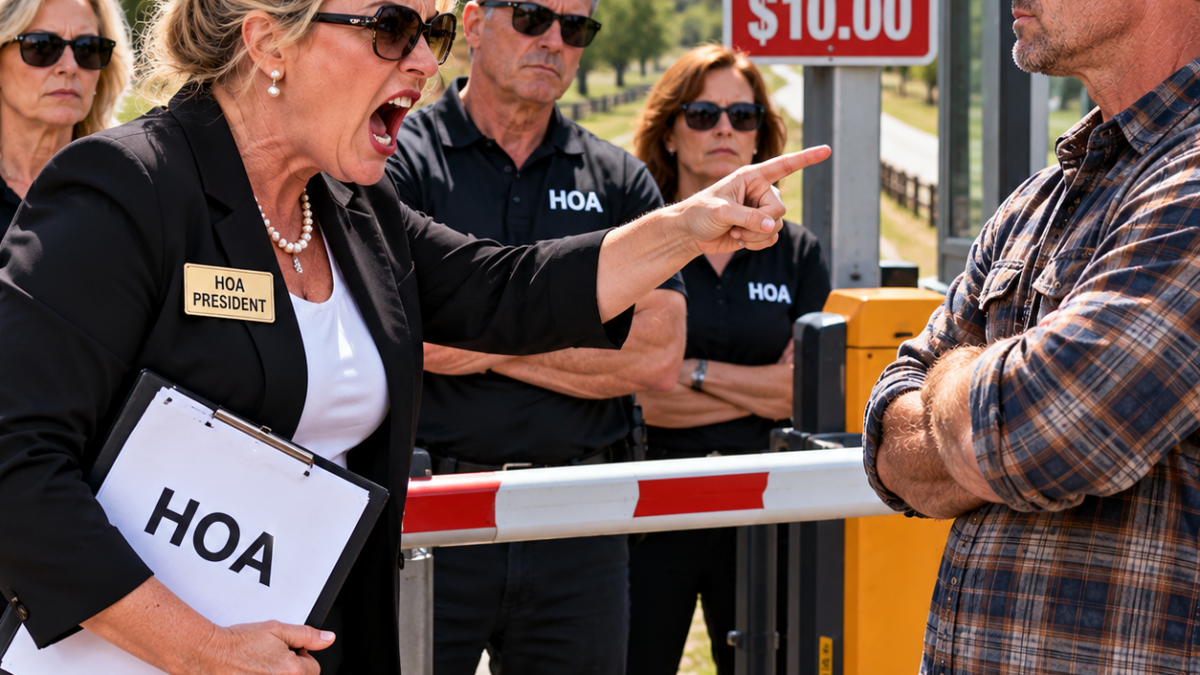
PART 2
The first vehicle came through at 6:43 the next morning.
I remember the exact time because I wrote it down.
White landscaping van.
Silver Creek resident pass.
Eight dollars.
The arm lifted.
The van rolled across my ranch.
At 6:51, a pickup followed.
At 7:04, a woman in a silver SUV scanned a code from her phone.
At 7:09, another truck.
By seven thirty, brake lights glowed beneath my father’s cottonwoods.
That bothered me more than the toll sign.
I had grown up looking at that bend in the road as a quiet place.
My father used to stop there on summer afternoons and sit beneath those trees when the heat became too much.
He planted them when I was thirteen.
I still remembered him handing me a shovel.
“Dig wider,” he told me.
“I already dug it.”
“Wide isn’t deep.”
“You said wider.”
He stared at me.
I stared back.
Then he smiled.
“That too.”
My father had been gone six years by the time Vanessa installed her toll gate.
Watching commuters line up beneath those trees made it feel as though she had changed something that belonged to him.
I kept telling myself not to make the dispute emotional.
Property law does not care who planted a tree.
Recorded rights matter.
Documents matter.
Boundaries matter.
So I started with documents.
I drove to the county records office that afternoon.
Rachel Moore worked behind the planning counter.
She had helped me before with grazing permits and a drainage boundary question.
When I explained what Silver Creek was doing, she raised an eyebrow.
“They installed a toll gate?”
“Yesterday.”
“On the emergency road?”
“That’s what I’m trying to understand.”
She pulled up the digitized subdivision plat.
There it was.
A narrow strip running across the eastern side of my ranch.
**SECONDARY ACCESS EASEMENT.**
Silver Creek was listed alongside it.
I leaned toward the screen.
“Vanessa says that gives them authority.”
Rachel didn’t answer immediately.
She zoomed in.
“There’s a reference number here.”
“What does it mean?”
“This plat isn’t the whole approval.”
“So the easement could be broader?”
“Or narrower.”
She pointed toward a note.
“The actual conditions were filed separately when the subdivision was approved.”
“Can we pull them up?”
She tried.
Nothing.
The county had digitized most recent records, but Silver Creek was old enough that several original planning documents remained in physical archive boxes.
Rachel leaned back.
“I’m not going to guess from this label.”
“Neither am I.”
“We need the controlling page.”
That answer was frustrating.
But it was fair.
I went home with a copy of the plat and one certainty.
Silver Creek did have some recorded connection to the road.
The question was how much.
Vanessa called before dinner.
“I understand you went to the county.”
“I did.”
“So you saw the easement.”
“I saw a plat reference.”
“You saw Silver Creek named on it.”
“Yes.”
“Then I assume we can stop pretending the association has no authority.”
“No.”
A pause.
“No?”
“The plat refers to another document defining the easement.”
“We already know what the easement is.”
“You know what you want it to be.”
Her voice hardened.
“The association has maintained access planning for this corridor for years.”
“Then send me the document saying you can charge people to drive across it.”
“The board is not obligated to debate every operational decision with an adjacent landowner.”
“Adjacent?”
I almost laughed.
“You installed the gate on my parcel.”
“It serves our community.”
“Still my parcel.”
She sighed.
“Grant, residents are already using it. They like it.”
That sentence told me more about Vanessa than anything else she had said.
People liked it.
Therefore it must be right.
“That doesn’t create a property right.”
“You’re making this unnecessarily adversarial.”
“No. I’m asking a simple question.”
“What question?”
“What exactly are you selling when somebody pays eight dollars to cross my land?”
Silence.
I continued.
“Your receipt says access authorization.”
“The terminology comes from the vendor software.”
“So change the terminology.”
“It’s administrative.”
“No. It matters.”
She laughed once.
“You’re trying to turn a software label into a legal argument.”
“And you’re trying to turn an emergency easement into a toll road.”
Neither of us spoke for several seconds.
Finally she said, “The board will continue operating the corridor.”
I looked out my kitchen window toward the ridge.
“Then I’ll continue documenting it.”
She hung up.
That became my routine.
Document.
Not argue.
Every morning I photographed the gate.
Every few days I bought a toll pass myself so I could preserve the receipt.
I recorded the posted fee schedule.
I wrote down vehicle counts.
Commercial trucks.
Landscapers.
Residents.
Delivery vans.
Guests.
By the end of the first week, I had documented thirty-seven paid commercial or contractor crossings from people who had never previously used the ranch road.
Resident traffic was far higher.
Silver Creek promoted the shortcut aggressively.
The residents’ portal called it:
**FIRE ROAD EXPRESS — A FASTER SECONDARY ACCESS OPTION**
Monthly passes appeared.
Vanessa announced that the revenue would help stabilize dues.
I began hearing comments from neighbors.
Not hostile at first.
Mostly curious.
A man named Tom Avery stopped beside my fence one afternoon.
Tom lived in Silver Creek and served on one of the HOA’s finance committees.
“You really fighting the road?”
“I’m trying to figure out what right they’re using.”
“Everybody loves it.”
“I know.”
“Cuts twelve minutes when school backs up.”
“I know.”
“People think you’re just angry because more cars are passing.”
“I’m not angry that people like convenience.”
“Then what’s the problem?”
I pointed toward the toll arm.
“If Silver Creek owns a right to sell access, they should be able to show me the document.”
“And if they can?”
“Then I read it and deal with reality.”
“And if they can’t?”
“Then they stop.”
Tom looked at the gate.
“Vanessa says the HOA maintains the road.”
“That may be true.”
“So?”
“Maintaining an emergency corridor is not automatically the same as turning it into a paid commuter road.”
Tom rubbed his jaw.
“Most residents don’t see the distinction.”
“I know.”
“That could make you look like the bad guy.”
I smiled.
“I’m not running for office.”
He laughed.
“Fair enough.”
The first real cost hit me the following Tuesday.
I had scheduled a cattle shipment.
The buyer’s truck was supposed to arrive at nine.
We needed the eastern lane clear so I could move the herd from the holding pasture.
Instead, Silver Creek’s new shortcut was packed.
Landscaping trucks.
Two delivery vans.
A moving truck.
Residents.
Every time I started moving cattle toward the road, another vehicle appeared.
The driver called me.
“We’re on schedule, Grant.”
“I know.”
“Can’t hold the truck all day.”
“Give me thirty minutes.”
I called Vanessa.
“We have livestock moving.”
“You’ll need to coordinate with the gate contractor.”
“No. I need the traffic stopped.”
“The corridor is open during normal operating hours.”
“This is a ranch road.”
“It is also community access.”
“I have cattle crossing.”
“We can send an alert asking drivers to slow down.”
“I don’t want them to slow down. I want them off my lane for forty-five minutes.”
She exhaled impatiently.
“One private inconvenience cannot override the needs of three hundred households.”
I looked at the herd pressing against the holding fence.
“This ‘private inconvenience’ is how I make my living.”
“And residents also have schedules.”
The buyer left.
I lost the deposit and most of the day.
That changed something in me.
Until then, the dispute had been abstract.
Lines on a plat.
Words in an old easement.
A toll receipt.
Now the HOA’s unauthorized traffic had cost me money.
I sent Vanessa a second formal notice.
I included the canceled shipment.
My loss.
The traffic log.
The photographs.
And one sentence in bold:
**You have now been notified that routine paid traffic is interfering with active agricultural use of the servient property.**
Her response came that evening.
The board had voted again.
They renamed the road the **Community Emergency Corridor**.
Then ratified continued gate operations.
I read the letter twice.
The name had changed.
The conduct hadn’t.
The next morning I took the file to Fire Marshal Laura Chen.
Laura was practical.
She didn’t care about HOA politics.
She didn’t care who was offended.
She cared whether emergency equipment could reach a road when someone needed help.
I laid the plat on her desk.
“This is the route.”
She traced it with one finger.
“Secondary emergency access.”
“Yes.”
“And you’re telling me there’s a toll gate across it?”
“Yes.”
She looked up.
“Approved by whom?”
“That’s what I’m asking.”
I showed her photographs.
Payment terminal.
Plate camera.
Barrier arm.
Locked cabinet.
Laura frowned.
“Emergency override?”
“Vanessa says the vendor has procedures.”
“What procedures?”
“She hasn’t explained.”
“Fire department receiver?”
“I don’t know.”
“Knox box?”
“I don’t know.”
“Manual release?”
“Vendor says there’s one.”
“Tested by us?”
“I have no record.”
She picked up the phone.
Within an hour, she had requested inspection documents from the HOA and the installation contractor.
The contractor was a man named Mark Cruz.
Mark called me later.
“I’m getting pulled into something I didn’t expect.”
“You installed the gate.”
“I installed what they ordered.”
“What did they order?”
“Commercial access-control system.”
“For a fire road?”
“That description came later.”
He sounded uncomfortable.
“What does your invoice call it?”
“Controlled-entry gate system.”
“Emergency hardware?”
“It was supposed to have manual release.”
“Supposed to?”
Pause.
“The HOA requested changes after installation.”
“What changes?”
“I’d rather give that to the fire marshal.”
That was fair.
I thanked him.
The county archive search continued.
Rachel finally called me two days later.
“We found the missing page.”
I drove into town.
She had an old planning box open on a table.
The paper inside smelled like dust and cardboard.
Silver Creek’s original approval year was stamped across the top.
Rachel pointed.
“Read this.”
I did.
Then read it again.
The language was remarkably simple.
The easement existed for emergency ingress and egress serving Silver Creek.
Fire.
Medical.
Law enforcement.
Evacuation.
The HOA could coordinate limited maintenance necessary to preserve emergency usability.
Nothing granted ownership.
Nothing authorized commuter traffic.
Nothing permitted tolls.
Nothing allowed commercial access.
I looked at Rachel.
“So that’s it?”
“That’s the controlling condition.”
“They can maintain it.”
“Yes.”
“But not sell access.”
“No.”
“Not residents cutting around traffic.”
“No.”
“Not contractors paying twenty-five dollars.”
“No.”
I felt something loosen in my chest.
For weeks Vanessa had buried every conversation beneath broader language.
Community corridor.
Maintenance authority.
Operational role.
Secondary access.
The old approval was six sentences.
It destroyed the entire argument.
Then Rachel pointed toward another sentence.
“This matters too.”
I read it.
The emergency route had to remain continuously available to emergency apparatus without payment or delay.
I looked at her.
“The toll gate.”
“Exactly.”
I called Laura from the parking lot.
She had the document within minutes.
Her inspection happened that afternoon.
Vanessa arrived with the binder.
Mark arrived with wiring diagrams.
I stood back.
This part wasn’t mine to control.
Laura opened the gate cabinet.
“No approved fire department receiver.”
Mark nodded.
“No.”
“Lock box?”
“No.”
“Certified override?”
“No.”
Vanessa interrupted.
“There is a manual process.”
Laura looked at her.
“What process?”
“Our security contractor can remotely release the gate.”
“What if there’s no network?”
Mark shifted his weight.
Laura noticed.
“What happens if power or network service fails?”
Mark answered quietly.
“Fail secure.”
Laura stared at him.
“Meaning?”
“The arm remains locked.”
Vanessa jumped in.
“That setting prevents unpaid vehicles from forcing the system.”
Laura turned toward her.
“This is an emergency road.”
“It is also being abused by routine drivers.”
“You invited routine drivers.”
“We regulate them.”
“With a payment controller.”
“Yes.”
“Across a road required to stay open to emergency apparatus.”
Vanessa opened the binder.
“Our counsel believes—”
Laura cut her off.
“I’m not asking what your attorney believes about property rights. I’m asking whether an engine can pass immediately if this system loses network service.”
Mark answered.
“No.”
That was the moment Vanessa’s legal argument collided with physical reality.
Laura issued a correction notice.
The obstruction had to be disabled during compliance review.
The gate arm was to remain raised.
No payment-dependent emergency access.
No reliance on an untested contractor release procedure.
Vanessa had an easy exit.
She could stop.
She could say the board had misunderstood the old easement.
Refund the tolls.
Lift the arm.
Remove the commuter program.
The story would have ended there.
Instead, she appealed.
“The notice is under review,” she told me the next morning.
“So?”
“So operations continue pending counsel’s challenge.”
“The fire marshal told you to keep the arm raised.”
“We complied during inspection.”
“It’s down now.”
“The system remains usable.”
“By people who pay.”
“By authorized users.”
I stared at her.
“Emergency responders don’t buy passes.”
“There is an emergency-release process.”
“The fire marshal just told you that process isn’t approved.”
“Our attorney disagrees with portions of her interpretation.”
I looked at the camera above us.
“You understand everything we say out here can be documented.”
“I have nothing to hide.”
“Good.”
I walked away.
That afternoon, the arm was still collecting tolls.
The conflict would probably have stayed procedural until Vanessa made it personal in a way I hadn’t expected.
A crew arrived to widen the inside turn.
I saw orange cones around one of my father’s cottonwoods.
A man with a chainsaw stood beside the trunk.
I ran across the pasture.
“Stop!”
The saw hadn’t started yet.
The foreman turned.
“We have vegetation clearance.”
“From whom?”
“Silver Creek.”
“That tree is on my property.”
“We were told it interferes with the turning radius.”
“Leave it.”
He hesitated.
Vanessa arrived twenty minutes later.
“The inside turn needs clearance for larger vehicles.”
“Larger vehicles shouldn’t be here.”
“Commercial service trucks use this route now.”
“That is your problem, not mine.”
“It creates a safety problem.”
“You created the traffic.”
She pointed toward the cottonwood.
“This falls within corridor maintenance.”
“No.”
“It affects visibility.”
“That tree has stood here thirty years.”
“Trees grow.”
“My father planted it.”
Something in my voice made the crew step farther away.
Vanessa lowered hers.
“I understand sentimental attachment.”
“Don’t.”
“Grant—”
“Don’t turn my father into a landscaping issue.”
Her expression changed.
“This isn’t personal.”
“It became personal when you sent a crew to cut down his tree.”
“We’re discussing one tree.”
“No.”
I stepped between her and the trunk.
“We’re discussing a boundary.”
I drove into town later that day to pick up documents for the upcoming hearing.
When I returned, the tree was gone.
At first, my brain refused to understand what I was seeing.
The second cottonwood stood where it always had.
Beside it was open sky.
Then I saw the stump.
Fresh sawdust covered the gravel shoulder.
A section of trunk lay in the ditch.
I stopped the truck in the middle of the road.
Didn’t turn off the engine.
Didn’t move.
For years I had believed I knew what anger felt like.
I was wrong.
Real anger can be silent.
It can make the entire world strangely clear.
I got out.
Walked to the stump.
Put my hand on the fresh cut.
The rings were visible.
Year after year.
Decades of summer heat.
Winter storms.
Dry seasons.
Snow.
All reduced to a flat circle because Vanessa wanted trucks to turn more easily through a road she had no right to commercialize.
She called that evening.
“I understand you’re upset.”
“You cut it down.”
“The contractor performed authorized vegetation maintenance.”
“I told you not to.”
“It was necessary.”
“You had the county document.”
“Our counsel is still reviewing the scope.”
“The easement gives you emergency maintenance authority.”
“Correct.”
“Not commuter-road construction.”
“The turn must safely accommodate larger vehicles.”
“Emergency engines already fit.”
“The corridor serves broader needs now.”
“Because you decided it did.”
“We can provide landscaping compensation.”
For the first time since the dispute began, I nearly lost control.
“Landscaping compensation?”
“We’ll cover replacement cost.”
“You can buy a sapling.”
“Yes.”
“You cannot buy thirty years.”
Silence.
Then she said something that ended whatever patience I still had for her leadership.
“The board cannot preserve every private preference beside a community corridor.”
I hung up.
The stump became evidence.
Photographed.
Measured.
Added to the file.
But it was more than evidence to me.
That night I sat at my father’s old kitchen table.
The same table where he had signed ranch paperwork for decades.
I remembered him planting those trees.
He had been forty-seven.
Strong enough to carry both saplings from the truck without help.
I had complained about digging.
He told me someday I would appreciate the shade.
He was right.
I had appreciated it for years without telling him.
Now one tree was gone, and the person responsible thought a nursery credit could replace it.
That was the night I stopped hoping Vanessa would voluntarily understand.
Some people only respect a boundary after someone else enforces it.
The reason she kept pushing finally became clear through Tom Avery.
He drove to the ranch the next morning holding a printed HOA budget packet.
“You should see this.”
“What is it?”
“Drainage project.”
Silver Creek had major storm-drain repairs scheduled.
Contractor bids had come in higher than expected.
The HOA faced a budget shortfall.
Residents were already angry about rising dues.
Vanessa had promised there would be no special assessment.
Tom pointed toward a revenue projection.
**FIRE ROAD EXPRESS ACCESS REVENUE**
The toll gate wasn’t just convenience.
It was financing.
Another page showed vendor savings based on service trucks using my ranch shortcut instead of the longer county approach.
I read the packet.
For the first time, Vanessa’s motive made human sense.
She wasn’t trying to become a toll-road tycoon.
She had a budget problem.
Residents wanted lower costs.
Contractors wanted faster access.
The road across my ranch appeared to solve everything.
Convenience.
Revenue.
Lower service bids.
No special assessment.
One solution.
Except the road wasn’t hers.
I called her.
“I saw the budget.”
Silence.
“So Tom gave you internal documents.”
“They’re not classified.”
“What exactly are you accusing me of?”
“Nothing new.”
“You said this was about control.”
“It is.”
“The money goes to community infrastructure.”
“I understand.”
That surprised her.
“You do?”
“Yes.”
“We’re trying to keep costs manageable for families.”
“I understand that too.”
“Then maybe we can finally stop fighting.”
“No.”
Another silence.
“You just said you understand.”
“I understand why you did it. That doesn’t mean you had the right.”
“We’re not stealing money.”
“You’re collecting it from people for passage over land you don’t control.”
“For maintenance.”
“Your receipts say access.”
“Semantics.”
“Your budget calls it revenue.”
“Community revenue.”
“From my road.”
She became frustrated.
“So what would you have us do? Raise dues again? Hit retired residents with another assessment? Tell families their costs are going up because you refuse to cooperate?”
There it was.
The moral pressure.
Not law.
Not property.
Guilt.
“Vanessa, if Silver Creek needs money, Silver Creek has to solve that problem with Silver Creek assets.”
“This road exists partly for Silver Creek.”
“For emergencies.”
“You benefit when firefighters can reach the ridge.”
“Of course.”
“So maintenance isn’t unreasonable.”
“I never objected to emergency maintenance.”
“Then we agree.”
“No. You’re taking a narrow right and stretching it until it becomes ownership.”
“That’s your interpretation.”
“The county found the original condition.”
“Our attorney is reviewing it.”
“Laura issued a correction notice.”
“Under appeal.”
“You cut down my tree.”
“It interfered with the corridor.”
“No.”
My voice lowered.
“It interfered with the road you wanted to invent.”
She hung up.
A week passed.
No decision from the county hearing yet.
No removal.
The tolls continued.
Then the weather changed.
Colorado had been dry.
Not dramatically dry.
Just enough that grass along the drainage cuts turned brittle and pale.
The wind arrived Friday afternoon.
Hard gusts from the southwest.
Around three, I smelled smoke.
By three ten, a gray column rose beyond the drainage corridor.
I was in the barn when my phone sounded with an emergency alert.
Brush fire.
Ridge area.
Multiple units responding.
The main Silver Creek entrance sat farther east.
For a fire moving toward the western side of the subdivision, the fastest approach was obvious.
My road.
I ran outside.
Sirens echoed over the hills.
Then something inside me went cold.
The gate.
I got into my truck and drove.
Engine 6 arrived first.
It came hard around the bend.
Red lights flashing.
Dust rolling behind it.
Then it stopped.
Fifty yards from where I stood.
The toll arm was down.
For a second, the scene looked unreal.
A fire engine.
A payment terminal.
A locked barrier.
Black smoke rising behind the ridge.
The driver tried the receiver.
Nothing.
A firefighter climbed down.
Checked the cabinet.
Another engine arrived behind them.
Then another.
Sirens stacked across the gravel.
Dispatch was routing mutual aid into the secondary access.
The road designed specifically for emergency response was becoming a parking lot.
I reached the gate.
“What’s happening?”
The captain looked at me.
“Receiver won’t open it.”
“Manual release?”
“Cabinet’s locked.”
Vanessa arrived in her SUV.
I still don’t know who called her.
Maybe the security system sent an alert.
Maybe a resident did.
She stepped out.
“Our contractor can release it.”
The fire captain stared at her.
“When?”
“He’s on the way.”
“How long?”
“A few minutes.”
Another engine arrived.
Then another.
Smoke thickened above the ridge.
The wind was pushing it uphill.
A battalion chief named Reeves came toward us.
He looked at the barrier.
Then Vanessa.
“Who owns this gate?”
“Silver Creek HOA.”
I spoke.
“The road is on my ranch.”
Vanessa shot me a look.
“The association administers the emergency corridor.”
Chief Reeves ignored the argument.
“Emergency override?”
“Our contractor has secure access.”
“Where’s the fire department override?”
“The system has procedures.”
“What procedures?”
“He can release it remotely or on site.”
“How long?”
“He’s already been called.”
Reeves looked toward the smoke.
“We don’t have time.”
Vanessa stepped between him and the cabinet.
“Chief, please don’t damage association equipment. The contractor can properly—”
His voice changed.
“Ma’am.”
She stopped.
“I have engines backed up on a designated emergency road while a brush fire is moving toward structures.”
“The gate can be opened safely.”
“When?”
“Within minutes.”
He looked behind him.
By then eleven engines had converged on the route.
Eleven.
A road created so firefighters could reach Silver Creek was blocked by the system installed supposedly to improve Silver Creek access.
Reeves looked at his crew.
“Force the cabinet.”
Vanessa protested.
“You do not have authorization to damage—”
“Cut the obstruction. Clear the lane.”
Nobody argued after that.
The cabinet was forced open.
The drop mechanism released.
Firefighters pushed the striped arm clear.
I opened the ranch turnout wider.
Then I stood beside the road.
Engine 6 passed.
Then the second.
Third.
Fourth.
One after another.
Eleven engines rolling under the surviving cottonwood.
Dust.
Sirens.
Men and women headed toward smoke.
I didn’t feel victorious.
I felt sick.
Because for weeks I had been warning everyone about exactly this possibility.
And I would have given anything to have been wrong.
Crews contained the brush fire before it reached the homes.
No evacuation was ultimately required.
No families lost their houses.
That mattered more than everything else.
By evening the ridge was dark except for scattered emergency lights.
I went back to the gate.
The toll arm lay crooked beside the road.
The cabinet door hung open.
Vanessa stood near her SUV.
Neither of us spoke for a while.
Finally she said, “The county is going to hear that crews passed.”
I stared at her.
“That’s what you took from today?”
“The system was eventually opened.”
“By firefighters forcing it.”
“Because they chose not to wait for the contractor.”
I almost couldn’t believe her.
“There were eleven engines.”
“I saw them.”
“Behind a payment gate.”
“It was a security malfunction.”
“No.”
I pointed toward the controller.
“It functioned exactly the way you ordered it to.”
She looked away.
I continued.
“Fail secure.”
Her head turned back.
“You don’t know the technical—”
“Mark told Laura.”
“It prevents unauthorized access.”
“Today it prevented fire engines.”
“For minutes.”
“Minutes are what emergency roads exist to save.”
Her face tightened.
“I am not taking responsibility for a fire I didn’t start.”
“I didn’t say you started the fire.”
“Then stop talking like I endangered the neighborhood.”
I looked toward the ridge.
“You put a locked toll system across their emergency route after the fire marshal warned you.”
“That is not a fair characterization.”
“It’s exactly what happened.”
She left.
The next morning she emailed me.
Silver Creek wanted an accounting of damage to association property.
I sat at the kitchen table reading the message.
Then I laughed.
Not because it was funny.
Because sometimes a demand is so disconnected from reality that laughter is the only response your body can find.
They wanted me to pay for the toll gate firefighters had opened during a brush fire.
I forwarded the email to Laura Chen.
Then I attached:
The correction notice.
The recovered easement language.
Mark’s installation records.
The toll receipts.
My cattle-loss documentation.
Photographs of the stump.
And the fire department dash-camera reference.
The county hearing opened four days later.
I arrived early.
Vanessa sat across the room beside HOA counsel.
Tom was behind them.
Laura sat with county staff.
Mark sat near the aisle.
A large monitor stood at the front.
The first document displayed was the original subdivision plat.
Then the controlling approval page.
The hearing officer read the relevant language aloud.
Emergency ingress and egress.
Fire.
Medical.
Law enforcement.
Evacuation.
Limited maintenance coordination.
Then came the sentence requiring continuous emergency availability without payment or delay.
Silver Creek’s attorney tried to distinguish maintenance authority from access administration.
The hearing officer asked:
“Where in this instrument is ordinary commuter access authorized?”
The attorney answered carefully.
“The association believed its maintenance responsibility carried an implied ability to manage reasonable use.”
“Manage emergency use?”
“Manage the corridor.”
“That was not my question.”
Silence.
The officer continued.
“Where does the document permit the association to charge a resident eight dollars to cross Mr. Mercer’s ranch because the main road has school traffic?”
No answer.
“Where does it authorize a twenty-five-dollar commercial toll?”
Again, nothing.
The toll receipts appeared on screen.
**ACCESS AUTHORIZATION.**
The monthly passes.
The Fire Road Express advertisement.
Then my traffic log.
The canceled cattle shipment.
The contractor invoice.
The hearing officer turned toward Vanessa.
“You were notified in writing that Mr. Mercer disputed routine paid traffic.”
“Yes.”
“And you continued?”
“Based on counsel’s understanding of our authority.”
“You later received the recovered approval page.”
“Yes.”
“And the toll system remained in operation?”
“Pending legal review.”
“Then the fire marshal issued a correction notice.”
“We appealed.”
“And after the notice, the gate returned to fail-secure operation?”
Vanessa shifted.
“Temporarily.”
Laura spoke.
“It was operational when Engine 6 arrived.”
The screen changed.
Dash-camera video.
I had seen it once before.
Watching it in that room felt different.
The engine approached my road.
Smoke visible over the ridge.
The red-and-white barrier filled the windshield.
Brake.
Stop.
The driver attempted the receiver.
Nothing.
Another engine appeared in the mirror.
Then another.
The video froze.
Eleven fire engines.
One locked gate.
Nobody in the hearing room moved.
Laura spoke.
“This route was recorded because emergency response time mattered. The installed device created a delay after formal notice that its emergency release was not approved.”
Silver Creek’s attorney began to respond.
The hearing officer raised a hand.
Then Mark’s email appeared.
It documented the HOA request that the system operate in fail-secure mode.
The reason:
Reduce unpaid tailgating and unauthorized passage.
The officer looked directly at Vanessa.
“Is this your request?”
She took several seconds.
“Yes.”
“You asked the installer to prioritize payment-control security on an emergency access road?”
“I asked him to prevent people from bypassing the gate.”
“By keeping it locked if the system failed.”
“We believed emergency procedures were available.”
“Were those procedures tested by the fire authority?”
“No.”
“Approved?”
“No.”
“Then what were you relying on?”
“The vendor.”
Mark spoke from behind me.
“I told the HOA it was commercial access equipment.”
Vanessa turned.
“You also said there was manual release.”
“There is.”
“Exactly.”
Mark shook his head.
“Inside a locked cabinet.”
That sentence finished the argument.
The hearing officer ruled Silver Creek had no right to use the emergency easement as a paid commuter road.
No toll authority.
No guest-pass authority.
No routine commercial-truck access.
No right to convert maintenance coordination into control of my ranch.
Any future device had to be specifically approved for emergency use.
The existing gate had to be removed.
The county also confirmed something I had been saying from the beginning.
I could exclude ordinary traffic.
The emergency easement remained.
Fire engines?
Always welcome.
Ambulances?
Always.
Law enforcement?
Yes.
Evacuation?
Yes.
Someone trying to save twelve minutes on the way home because the highway was crowded?
No.
That was never part of the deal.
The hearing officer looked at me.
“Mr. Mercer, are you requesting closure of emergency access?”
“No.”
“What are you requesting?”
I looked toward Vanessa.
Then toward the screen showing my father’s road.
“Exactly what the record says.”
“Which is?”
“Keep emergency access real. Stop selling everything else.”
For the first time in weeks, the room was completely quiet.
The county ordered the obstruction removed.
But that did not resolve the money.
Silver Creek had charged residents, visitors, contractors, and service providers for something it had no right to sell.
HOA counsel saw the problem immediately.
Defending every toll would require arguing that Silver Creek had possessed some commercial access right the county had just ruled did not exist.
The board entered settlement discussions.
At the next Silver Creek meeting, the clubhouse was full.
I attended reluctantly.
Tom asked me to come.
“You should hear this yourself.”
Residents packed the room.
Some angry at Vanessa.
Some angry at the board.
A few still angry at me.
People had paid tolls because they believed the HOA had authority.
Contractors had incorporated them into invoices.
Monthly passes had been sold.
Guests had scanned QR codes.
And now everyone wanted to know where the money was.
Tom stood holding the toll ledger.
He didn’t shout.
That made his question stronger.
“Why did we collect money for access across property the association did not own after Grant warned the board in writing?”
Vanessa sat at the center table.
“The board believed the easement was broader.”
Tom shook his head.
“You had the original conditions before the fire.”
“Our attorney was reviewing—”
“The fire marshal also warned us.”
“We appealed.”
“And we kept collecting.”
Vanessa looked around the room.
“We were trying to avoid a special assessment.”
A woman near the front said, “By charging us for someone else’s road?”
“The funds supported community expenses.”
“That isn’t the question.”
Vanessa’s voice cracked slightly.
Not much.
Just enough that I realized how exhausted she was.
“We had a drainage deficit.”
Nobody interrupted.
“Repair bids were higher than projected. Residents had already complained about dues. Service contractors charged more to use the longer route. We had an existing corridor. We believed we could manage it and recover costs.”
For the first time, I felt something other than anger toward her.
Not forgiveness.
Understanding.
There is a dangerous kind of mistake people make when they are under pressure to solve problems.
They stop asking whether they are allowed to use a solution.
They ask only whether the solution works.
The toll gate had worked financially.
Residents saved time.
Vendors saved miles.
The HOA raised revenue.
Vanessa kept dues flatter.
Everyone benefited.
Except the person whose property made the plan possible.
Me.
I stood.
The room quieted.
Vanessa looked at me.
“I understand why you wanted to avoid an assessment.”
She seemed surprised.
“I understand why people liked the shortcut.”
Someone behind me murmured.
I continued.
“I understand why a board president wants to solve problems instead of telling residents she failed.”
Vanessa’s eyes stayed on mine.
“But a good reason does not create a right over somebody else’s land.”
Nobody spoke.
“You were allowed to maintain emergency access. You turned that narrow responsibility into a business.”
Vanessa looked down.
I thought about my father’s tree.
My canceled cattle shipment.
The engines behind the gate.
“And every time someone asked you to stop, you convinced yourself the next justification was enough.”
Her expression changed.
“That isn’t fair.”
“Maybe not.”
I looked around the room.
“But fairness is why records exist. So none of us get to define our rights based only on what feels useful.”
The board went into closed session.
An hour later, they returned.
Vanessa was removed as president.
She was allowed to remain on the board until the next election, but no longer controlled operations.
She accepted the decision without drama.
“I disagree with the assignment of responsibility,” she said, “but I will cooperate with corrective work and refunds.”
That was as close to an admission as I ever received.
The refund process took weeks.
Silver Creek pulled electronic-payment histories.
Monthly passes.
QR transactions.
Guest tolls.
Commercial charges.
Where records clearly documented a toll, money was returned.
Contractors were notified.
Residents received credits or refunds.
The HOA removed the Fire Road Express portal page.
They paid restoration expenses tied to the road shoulder and gate removal.
Mark Cruz returned with his crew.
I met him beside the barrier.
“What do you want installed instead?” he asked.
“Nothing.”
“The county marker?”
“Yes.”
“No access gate?”
“No.”
“Fence?”
“No.”
He looked surprised.
“Just take it out?”
“Every bit of it.”
He pointed toward the concrete footing.
“We can make that look clean.”
“Remove it.”
“The camera pole too?”
“Yes.”
“Terminal?”
“Yes.”
“Want us to build a nicer emergency gate?”
I shook my head.
“Don’t build me a prettier gate.”
He smiled.
“Fair enough.”
“Repair the gravel. Mark the emergency route. Leave the rest of my road alone.”
That took a week.
One morning the toll arm was there.
The next it was gone.
Camera pole disappeared.
Terminal disappeared.
Concrete removed.
Shoulder repaired.
County crews installed one reflective sign.
**EMERGENCY ACCESS — KEEP CLEAR**
That sign belonged there.
No prices.
No QR code.
No HOA logo.
No monthly pass.
Just the original purpose.
The road became boring again.
Almost.
There was still the stump.
I passed it every morning.
Winning gave me the road back.
It did not give me the tree.
That difference became more important to me as time passed.
Money can correct a ledger.
It can refund a toll.
It can repair gravel.
Replace a fence.
Pay for lost business.
It cannot restore time.
Thirty years of growth does not fit on an invoice.
One Saturday I drove to a nursery.
A young employee walked through rows of trees with me.
“What size cottonwood?”
“Healthy.”
“That’s not really a size.”
“I know.”
He showed me several.
I chose one taller than I probably should have.
It cost more.
Needed a trailer.
Needed help unloading.
When I planted it beside the old stump, I used the same shovel my father had owned.
The handle had been replaced twice.
The blade was worn.
I dug the hole wide.
Then deeper.
I laughed when I realized what I was doing.
“Wide isn’t deep.”
My father’s voice was so clear in my memory that for a second I stopped working.
I could see him standing there again.
Forty-seven years old.
Dust on his jeans.
Annoyed because his thirteen-year-old son wanted to be anywhere except planting trees.
I put the shovel down.
Sat beside the stump.
For months I had treated the tree as evidence.
A photograph.
A damages item.
An example of overreach.
Sitting there, I let it become my father’s tree again.
That hurt.
But it also helped.
Tom came by while I was staking the sapling.
“You planted another one.”
“Looks that way.”
“How long until it gives shade?”
“Long time.”
“Thirty years?”
“Probably.”
He smiled.
“You’ll be old.”
“I’m already getting there.”
He looked toward Silver Creek.
“People are still arguing about the refunds.”
“They’ll stop.”
“You sure?”
“No.”
We both laughed.
Then Tom became serious.
“I voted for the access plan.”
I looked at him.
“I know.”
“I believed Vanessa.”
“I know.”
“I liked the shortcut too.”
“Most people did.”
“That make you angry?”
“No.”
“Why not?”
“Because you used a road your HOA told you it had authority to operate.”
He seemed relieved.
“I should’ve asked more questions.”
“Maybe.”
“I keep thinking about those engines.”
“So do I.”
Tom looked down the road.
“My granddaughter was at our house that afternoon.”
I didn’t answer.
He swallowed.
“If that fire had reached the subdivision…”
“It didn’t.”
“But it could have.”
“Yes.”
He stared at the emergency marker.
“You warned us.”
“I warned Vanessa.”
“We all wanted the easy answer.”
That was probably the most honest statement anyone from Silver Creek ever made about the whole mess.
The easy answer.
That was exactly what Fire Road Express had been.
Traffic problem?
Use Grant’s road.
Budget problem?
Charge tolls.
Vendor costs?
Use Grant’s road.
Dues complaints?
Charge tolls.
Service access?
Use Grant’s road.
Every problem had the same convenient solution because the true cost was being pushed onto someone who had never agreed to carry it.
My ranch.
My business.
My privacy.
My tree.
Eventually even emergency safety.
The new board changed Silver Creek’s rules.
Any future property-right claim had to be reviewed against the underlying recorded document.
No board resolution could expand an easement beyond its written purpose.
Emergency infrastructure required fire-authority approval before installation.
Revenue programs had to be tied to assets the HOA actually owned or had a contractual right to use.
That last rule should never have been necessary.
Apparently it was.
Vanessa did not run for another term.
I saw her only twice after that.
The first time was at the county office.
She nodded.
I nodded.
Nothing more.
The second was nearly a year later.
I was checking the emergency marker when a car stopped on the county shoulder.
Vanessa stepped out.
She looked different.
Not physically.
Smaller somehow.
Or maybe she simply no longer had an HOA SUV, binder, board title, and three hundred households behind her.
She looked toward the sapling.
“You replaced it.”
“Yes.”
“How’s it doing?”
“Fine.”
She walked closer but stopped well before the ranch boundary.
That detail didn’t escape me.
“I heard the county closed the fire review.”
“They did.”
“The new board sent me the report.”
I nodded.
For several seconds, the only sound was wind moving through the surviving cottonwood.
Finally she said, “I did believe I was helping them.”
“I know.”
That surprised her.
“You know?”
“I figured it out.”
“The drainage repairs would have meant a large assessment.”
“I saw the budget.”
“Some people in Silver Creek are on fixed incomes.”
“I know.”
“Families were furious about costs.”
“I know.”
She looked frustrated.
“Then you understand why I made the decision.”
“I understand why you wanted a solution.”
“That’s different?”
“Yes.”
She looked toward the road.
“I still think emergency corridors need management.”
“So do I.”
“And maintenance.”
“Yes.”
“And controlled access.”
“Emergency access should be protected.”
She looked at me.
“We agree on more than you think.”
“We probably always did.”
“Then why did everything become a war?”
I pointed toward the stump.
“Because you stopped asking.”
She followed my hand.
Her face tightened.
“That tree…”
“Yes.”
“I shouldn’t have approved that.”
It was the first direct admission I had ever heard from her.
I said nothing.
She continued.
“I believed once the board had decided the corridor was ours to administer, every smaller decision fit underneath that authority.”
“That was the problem.”
“I know.”
She looked at the young tree.
“I’m sorry about it.”
I thought I had imagined wanting those words.
For months.
Maybe longer.
Now that they had arrived, they felt smaller than expected.
Not meaningless.
Just unable to carry the weight I once hoped they would.
“Thank you.”
She looked surprised again.
“That’s it?”
“What else should I say?”
“I don’t know.”
“Neither do I.”
She turned toward her car.
Before leaving she stopped.
“For what it’s worth, I never intended to block the fire department.”
“I know.”
She faced me.
“Do you?”
“Yes.”
I looked toward the road.
“That’s why intent isn’t enough.”
She stood still.
Then nodded.
That was the last time we spoke.
People later asked whether I considered the outcome revenge.
I understand why.
Vanessa lost the presidency.
The toll program disappeared.
The HOA refunded the money it had collected.
Silver Creek paid restoration expenses.
The road returned entirely to emergency-only status.
The board had to explain to residents why its supposedly clever revenue program had collapsed.
The system meant to reduce community costs ended up costing the HOA money.
On paper, that looks like revenge.
It never felt that way.
Revenge would have meant wanting Silver Creek residents punished for Vanessa’s decision.
I didn’t.
Revenge would have meant trying to close the emergency easement entirely.
I never considered it.
That road existed for a reason.
The brush fire proved the reason better than any document ever could.
When Engine 6 needed the lane, it belonged there.
When eleven engines followed, every one of them belonged there.
That was the difference Vanessa refused to understand until the end.
I did not want control of the emergency road.
I already owned the land.
I wanted the recorded purpose respected.
There’s a distinction between ownership and responsibility.
My ranch carries the easement.
That means I accept certain limitations.
If an ambulance needs to cross at two in the morning, I do not get to object because the gravel is mine.
If firefighters need to move across the pasture, I do not demand a toll.
If residents need to evacuate, I do not close the gate because cattle are moving.
Those responsibilities are real.
But so are limits.
Silver Creek did not get to transform emergency access into daily commuter convenience merely because residents preferred it.
It did not get to create a commercial program because the HOA budget was uncomfortable.
It did not get to cut a tree because delivery trucks needed a wider turn on a road those trucks were never supposed to use.
And it certainly did not get to place payment enforcement ahead of emergency response.
That is what the case ultimately became about.
Not eight dollars.
Not fifteen.
Not twenty-five.
Boundaries.
Years later, the road still runs across the eastern side of my ranch.
The reflective emergency marker is beginning to fade.
The new cottonwood has grown taller.
Not tall enough to replace the shade.
Not yet.
But every spring the leaves come back.
That matters to me.
Sometimes Silver Creek residents walk along the county shoulder and wave.
Most of them were never my enemies.
I never wanted them to be.
A few have even stopped to ask about the tree.
I tell them the truth.
“My father planted the old one.”
They usually look at the stump.
Then the sapling.
One woman said, “So that’s why you cared so much.”
I smiled.
“No.”
She seemed confused.
“The tree was why it hurt so much.”
“What did you care about?”
“That someone thought wanting something badly enough gave them the right to take it.”
She nodded.
That was the lesson.
The road looked simple.
Gravel.
Two wheel tracks.
Cottonwoods.
A ranch fence.
But underneath it was a question that comes up in far more places than people realize.
When does convenience become entitlement?
Silver Creek crossed that line slowly.
First a board resolution.
Then construction.
Then a toll.
Then daily traffic.
Then commercial vehicles.
Then vegetation clearance.
Then a tree.
Then a fail-secure gate.
No single decision felt enormous to the people making it.
That is how overreach often works.
One reasonable-sounding step at a time.
By the time eleven fire engines stopped behind the toll arm, the absurdity was visible to everyone.
But it had been visible to me from the beginning.
Not because I was smarter.
Because I was the person losing something every step of the way.
Privacy.
Use of my lane.
A cattle shipment.
Control over traffic.
My father’s cottonwood.
Then potentially the very emergency reliability the easement existed to protect.
That is why I documented instead of tearing the gate out myself.
I could have destroyed the toll arm on day one.
People sometimes ask why I didn’t.
Because then the story would have become:
Angry rancher destroys HOA property.
Vanessa would have loved that.
It would have shifted every conversation away from the document she could not produce.
Instead, I left the gate standing.
Took pictures.
Saved receipts.
Logged cars.
Requested records.
Let the county archive speak.
Let the fire marshal inspect.
Let Mark explain the hardware.
Let the dash camera show the engines.
Let Vanessa’s own decisions build the case.
That is the kind of revenge I can live with, if people insist on using that word.
Not hurting someone.
Not humiliating them.
Not destroying what belongs to them.
Just refusing to rescue them from the consequences of their own choices.
The toll arm came down because Vanessa installed it.
The refund happened because Silver Creek collected money it had no right to collect.
The presidency ended because the board lost confidence in her judgment.
The emergency restrictions were imposed because firefighters were delayed.
I didn’t manufacture any of that.
I simply stopped letting them manufacture authority over me.
On the anniversary of my father’s death, I usually walk the eastern fence alone.
I did it that year too.
The sun was low.
The surviving cottonwood stretched its shadow across the road.
The new tree barely reached my shoulder.
I carried a small bucket.
Watered it slowly.
Then sat on the old stump.
My father never cared much for property arguments.
He believed most disputes could be solved by showing people a fence and asking whether they needed help seeing it.
I smiled thinking about what he would have said about the toll booth.
Probably something short.
Probably something I shouldn’t repeat at a board meeting.
But I also knew what he would have cared about.
The fire engines.
That was why he built the road.
Long before Silver Creek had sidewalks.
Long before an HOA existed.
Long before QR codes and plate cameras and online passes.
A fire had scared him badly enough that he wanted responders to have another way over the ridge.
Thirty years later, responders needed that road.
And people had put a payment gate across it.
That would have broken his heart.
The fact that the road is open today would have mattered more than any refund.
I looked at the sapling.
“Still not much shade,” I said.
Wind moved through the leaves.
I could almost hear him.
Give it time.
So I did.
The ranch got quiet again.
Really quiet.
No daily stream of Silver Creek commuters.
No vans beneath the trees.
No toll terminal chirping every time a QR code scanned.
No camera photographing plates.
No barrier arm dropping after each vehicle.
The only traffic on most days was mine.
Occasionally a county worker.
Sometimes wildlife.
Then, every once in a while, something important.
An ambulance.
A sheriff’s vehicle.
A fire engine during training.
They never stopped.
They never scanned anything.
They never paid.
They simply passed.
Exactly as my father intended.
One afternoon Engine 6 came through on a familiarization run.
The same company that had been first at the blocked gate during the brush fire.
The driver slowed near me.
Rolled down the window.
“Looks better.”
I looked at the empty roadside.
“No gate.”
“That’s why.”
We both laughed.
Then he pointed at the cottonwood.
“New?”
“Yes.”
“Good spot.”
“My father thought so.”
He nodded.
Then drove on.
No drama.
No sirens.
No smoke.
Just a fire engine traveling freely across a road built for fire engines.
I stood there longer than necessary.
That moment was worth more to me than seeing Vanessa removed.
More than refunds.
More than winning arguments at the county.
Because sometimes justice is not a courtroom moment.
It is ordinary life working correctly again.
A road open when it should be open.
Closed to traffic that has no right to be there.
A rancher moving cattle without asking an HOA for permission.
A tree growing beside an old stump.
A fire truck not having to stop.
The whole dispute started because Vanessa believed a recorded maintenance role gave her control.
By the end, everyone understood the difference.
Maintenance is responsibility.
Ownership is ownership.
An easement grants the rights written into it.
Not every right someone later finds convenient.
And a board vote cannot create power over property the board never possessed.
That lesson cost Silver Creek money.
It cost Vanessa her position.
It cost me business.
Time.
Peace.
And one irreplaceable tree.
If I could go back, I would still have fought it.
Not because I enjoyed winning.
Because there are some things you cannot surrender simply to keep the peace.
If I had accepted the toll booth because residents liked it, the next board would have assumed the access right was permanent.
If I had accepted the commercial trucks, the ranch road would eventually have looked like a service street.
If I had accepted the vegetation order, more trees would have disappeared.
If I had accepted fail-secure hardware, the next emergency might have ended differently.
Peace purchased by abandoning a boundary is rarely peace.
It is permission.
That was what Vanessa wanted from me.
Permission after the fact.
She wanted me to look at something already built, already operating, already popular, already producing revenue, and decide it was too difficult to undo.
She underestimated how much that road meant to me.
Not because it was profitable.
It wasn’t.
Not because it was beautiful.
It was gravel.
It mattered because my father had built it for one narrow purpose.
Keep people safe when the main road was not enough.
The HOA almost destroyed that purpose while claiming to improve it.
Today there is no Fire Road Express.
No resident monthly pass.
No visitor rate.
No truck toll.
No HOA camera.
No secure-mode cabinet.
The road has one sign.
**EMERGENCY ACCESS — KEEP CLEAR**
That is all it needs.
Sometimes the simplest words are the hardest ones for powerful people to accept.
Emergency means emergency.
Private means private.
Permission means permission.
And no amount of board resolutions, budget pressure, popularity, or good intentions can change those definitions merely because changing them would be convenient.
When I pass the new cottonwood now, I still see the old stump beside it.
I could have had the stump ground out.
I chose not to.
People ask why.
Because I want both there.
The stump reminds me of what cannot be replaced.
The new tree reminds me that losing something does not mean you stop planting.
One is memory.
The other is responsibility.
Maybe that is the real ending.
Not the refund.
Not the gate removal.
Not Vanessa losing the presidency.
Not the county ruling.
A young cottonwood growing beside the remains of an older one, on a quiet ranch road where fire engines will never again have to wait for somebody’s payment system to decide whether they are allowed through.
My father would have liked that.
And after everything that happened, so do I.

