PART 2: HOA Tore Down My Lakefront Fence for a Better View—Then Their $150K Mistake Showed Up at the Pool
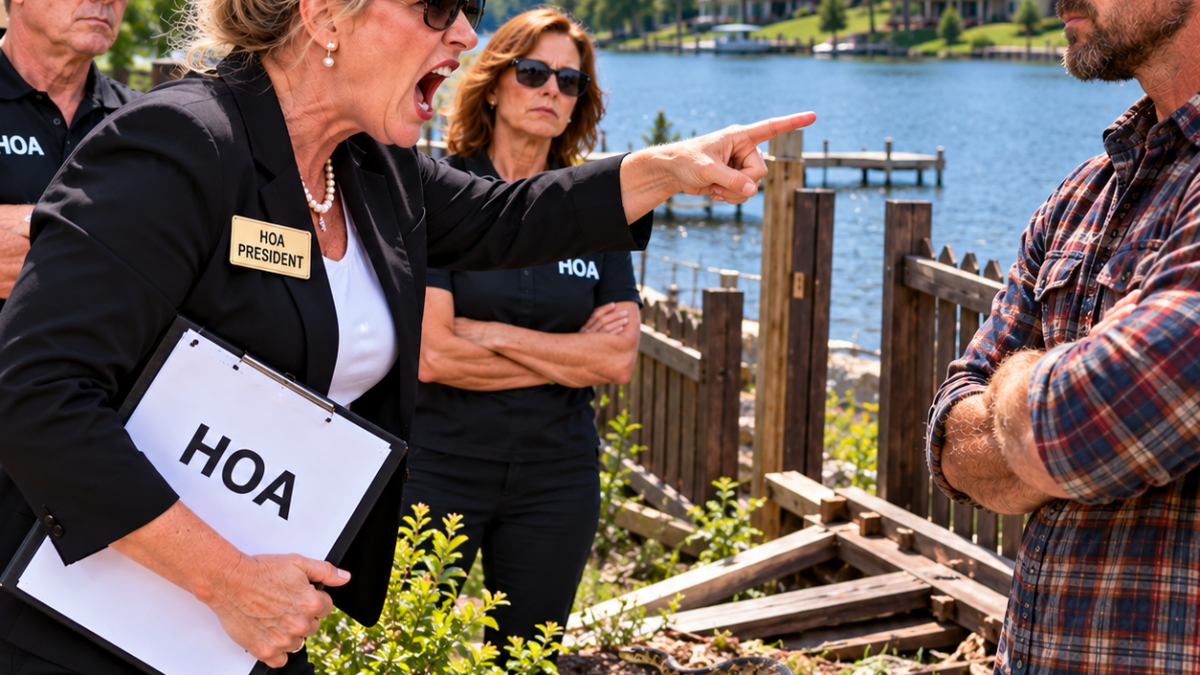
PART 2
My property had never belonged to Silver Creek.
That point was not complicated.
My family’s Lake Norman parcel existed before the neighboring development was built.
When Silver Creek came in, the developer created covenants, common areas, drainage systems, landscaping plans, and the usual HOA machinery.
My home was never annexed into it.
I paid no dues.
Signed no covenant.
Agreed to no architectural controls.
Vanessa knew all of that.
But Silver Creek’s clubhouse sat close enough to my boundary that my fence became impossible for her to ignore once the renovation began.
The old clubhouse had been modest.
Pool.
Small patio.
A few picnic tables.
The new project was designed to sell an image.
Lakefront living.
Luxury.
Community.
Blue water visible from the pool.
Stone terraces.
Outdoor entertaining.
The developer still owned several premium lots, and the renovated clubhouse was supposed to help move them.
That mattered more than I understood at first.
When Vanessa showed me the view-corridor plan, I went home and opened the steel cabinet where I kept property records.
Deed.
Plat.
Old survey.
Flood documents.
My father’s fence plan.
I spread everything across the dining-room table.
There was no view easement.
No HOA design right.
No landscaping authority crossing my fence.
Nothing.
I found one handwritten note from my father on the fence plan.
**Keep brush edge intact.**
I ran my thumb over the words.
That sounded like him.
Short.
Practical.
No explanation.
The flood had changed a lot of the shoreline back then.
After rebuilding, he had been obsessive about drainage, roots, and erosion.
He would walk the fence after storms and check whether water had cut underneath it.
At the time, I thought he was being overly cautious.
Years later, I understood.
Lakefront land is constantly negotiating with water.
So are the animals living beside it.
The next morning, I photographed everything.
Every post.
Every hinge.
Every survey pin.
The brush line.
The retaining stones.
The narrow spaces between roots.
The old corner post my father had shaped by hand.
I took more than two hundred pictures.
Then I called Daniel Reeves.
Daniel was a land-use attorney.
He had represented property owners around lake-access disputes, easements, and shoreline development.
I handed him Vanessa’s map.
He studied it.
“This document may matter for HOA planning.”
“But?”
“It does not create property rights.”
“Exactly.”
“Don’t get excited.”
“I’m not excited.”
“You’re smiling.”
“Because that’s exactly what I told her.”
Daniel tapped the paper.
“Being right about this map doesn’t mean we know everything yet.”
“What else?”
“Recorded easements.”
“I checked the plat.”
“I want a title report.”
“Why?”
“Because an old drainage right can sit quietly for decades until somebody suddenly decides it means something else.”
That turned out to be exactly what had happened.
Before ordering the title work, Daniel helped me write a certified letter.
The language was direct.
My parcel was not subject to Silver Creek covenants.
The fence was entirely within my surveyed property.
No contractor had permission to enter.
No fence removal was authorized.
No vegetation clearing was authorized.
No survey marker could be disturbed.
Then I added something Daniel initially thought was unusual.
Removing the fence or the associated brush edge could alter wildlife movement along the shoreline.
“You sure you want that in here?”
“Yes.”
“You have evidence?”
“Years of watching the property.”
“What kind of wildlife?”
“Snakes sometimes follow the rocky edge. Turtles. Small animals. The fence doesn’t stop everything. But it influences where things move.”
“Then phrase it carefully.”
We did.
I did not claim the fence was snake-proof.
That would have been ridiculous.
I said disturbance could change movement patterns and should be evaluated before removal.
Daniel sent the letter.
Vanessa responded with three attachments.
Board resolution.
Revised view-corridor map.
Legal memo.
I read the memo twice.
Then called Daniel.
“This doesn’t say they can touch my property.”
“No.”
“It assumes the corridor applies.”
“Yes.”
“But doesn’t establish it.”
“Correct.”
“So what exactly did their lawyer approve?”
“Hard to say.”
Vanessa called the next day.
“You received the board materials?”
“Yes.”
“So we’re clear.”
“No.”
She paused.
“What is unclear?”
“Your lawyer never says my parcel belongs to the HOA.”
“That is not the legal issue.”
“It’s the only issue that matters if you want to remove my fence.”
“The association has maintenance responsibilities around common-area sight lines and shoreline access.”
“On your property.”
“We have a planning corridor.”
“You have a colored stripe.”
“Ethan.”
“Send the recorded instrument.”
“You’re reducing a complex land-use question to one document.”
“Yes.”
“Why?”
“Because if you have a property right across my land, somebody recorded it.”
She hung up frustrated.
Two days later, Mark Dalton emailed me.
Mark was Silver Creek’s property manager.
Unlike Vanessa, he usually spoke carefully.
**We need access to photograph the fence base and brush edge so the contractor can price proposed work.**
I called him.
“Mark, proposed work meaning removal?”
Silence.
“Mark?”
“Yes.”
“No.”
“Ethan, we’re trying to get accurate numbers.”
“No contractor has permission to enter my property to price removal of my fence.”
“Can we inspect from the HOA side?”
“Yes.”
“That’s reasonable.”
“Then why did Vanessa tell me you had authority?”
Another silence.
“I manage the property, Ethan. I’m not the association’s attorney.”
That answer stayed with me.
Mark was already uncomfortable.
The HOA requested removal pricing before proving it had removal authority.
Daniel requested board records.
Silver Creek delayed.
But a resident I knew forwarded me the public meeting packet.
Buried inside was the sentence that explained almost everything.
**Remove visual barriers before lakefront sales weekend.**
Below it:
Photographer.
Broker tour.
Catered event.
Marketing launch.
Six weeks.
I called Daniel.
“This isn’t maintenance.”
“No.”
“This isn’t drainage.”
“No.”
“They want brochure photographs.”
“Looks that way.”
“That matters.”
“It matters to motive.”
“What about authority?”
“Authority still depends on the deed and easements.”
The distinction annoyed me at first.
I wanted motive to decide everything.
It didn’t.
Someone can have a terrible motive and a valid right.
Or a sympathetic motive and no right at all.
The law cared about the second question.
Vanessa’s financial pressure came later.
At the time, all I knew was that she wanted my fence out of her photographs.
The conflict cost me work before anyone touched a post.
I’m a dock and grading contractor.
I don’t sit behind a desk all day.
If I’m not at a job, I’m not billing.
After Mark’s email, I became afraid the HOA would act while I was gone.
So I canceled one dock-repair day.
Then another.
That cost me a paying client.
When I told Vanessa, she barely reacted.
“No one asked you to cancel jobs.”
“You’re pricing demolition of my fence.”
“We’re working toward a professional resolution.”
“You’ve never shown authority.”
“Our attorney has reviewed the matter.”
“Then why not wait for the title report?”
“Because contractors have schedules too.”
There it was again.
Schedule.
Deadline.
Momentum.
That was what drove her.
Not hatred.
Not personal revenge against me.
A project moving quickly enough that asking one more legal question felt expensive.
I contacted Rachel Monroe.
Rachel worked in nuisance-wildlife management and shoreline habitat assessment.
I described the fence.
Brush.
Pool.
Retaining wall.
She did not make dramatic claims.
That was exactly why I trusted her.
“If the fence and brush influence movement,” she told me, “removing both could redirect animals.”
“Snakes?”
“Possibly.”
“Can you guarantee it?”
“No.”
“Can anyone?”
“No.”
“What would you recommend?”
“Inspect before removal. Especially around utility cavities, landscaping voids, retaining walls, pumps, irrigation boxes.”
I asked her to put that recommendation in writing.
She did.
I sent it to Vanessa.
Vanessa replied:
**We are not funding wildlife studies for an aging private fence that obstructs the approved lakefront plan.**
Daniel read the email.
“Save that.”
“I’m developing quite a collection.”
“Keep collecting.”
The following Tuesday, I left the property for ninety minutes.
Ninety.
I needed dock hardware for another job.
Before leaving, I walked the fence.
Everything was intact.
When I returned, I heard machinery before I turned into the driveway.
A compact track loader sat on my grass.
Tire marks crossed the property line.
Fence panels were stacked beside a trailer.
Posts lay on the ground.
For several seconds, I couldn’t process it.
Then I counted.
One hundred forty feet.
Gone.
I parked sideways.
Got out.
Started recording.
“Stop the machine!”
The operator looked toward Vanessa.
She stood near the clubhouse in a sun hat holding the same clipboard.
“Nobody on this crew has permission to remove another inch.”
Vanessa walked toward me.
“The board approved the improvement.”
“You received my certified letter.”
“We disagree with your interpretation.”
“You entered my property.”
“Our contractor is completing approved work within the planning corridor.”
“Show me the deed.”
“Ethan, we’re past this.”
“No.”
I turned the camera toward the missing fence.
“You are standing on my parcel after written notice.”
Mark approached.
“Vanessa.”
She looked at him.
“The sight line is open. Maybe we stop here.”
“Finish the approved section.”
“Why?”
“Because leaving partial work creates another visual problem.”
I almost laughed.
A visual problem.
That was her reason.
Not safety.
Not drainage.
Not access.
A view.
The loader lifted another post.
I raised the phone.
“You approved this personally?”
“The board approved it.”
“That wasn’t my question.”
She didn’t answer.
“You are directing them to continue?”
“Finish the work.”
The video captured every word.
I did not stand in front of the machine.
Did not touch equipment.
Did not threaten anyone.
That restraint was hard.
My hands were shaking.
But Daniel’s advice stayed in my head.
**Document. Act afterward. Don’t give them another issue to hide behind.**
So I filmed.
The photographer arrived the next morning.
That may have been the moment I became angriest.
Not when the loader tore out the posts.
Not when Vanessa dismissed my letter.
When I stood on my own property and watched a professional photographer frame the beautiful lake view through the hole created by removing my fence.
A broker stood beside him.
“Perfect.”
Perfect.
I said nothing.
Took another photograph.
Daniel called that afternoon.
“The title report is in.”
I drove straight to his office.
He pushed the report across the desk.
“They do have an easement.”
My stomach tightened.
“What kind?”
“Storm-water maintenance.”
“Where?”
He showed me.
A narrow right allowing Silver Creek to reach a drainage outfall near the boundary.
“That’s it?”
“That’s it.”
“Does it reach the fence?”
“No.”
“View corridor?”
“No.”
“Landscaping?”
“No.”
“Fence alteration?”
“No.”
“Wildlife clearing?”
“No.”
I leaned back.
“So they had a right to maintain a drain.”
“Yes.”
“And they turned that into permission to remove one hundred forty feet of fence.”
“Yes.”
Daniel looked at me.
“That is the clean issue.”
We sent the title report.
Survey.
Formal demand.
Restore the line.
Stop entry.
Preserve all records.
Vanessa’s response was almost casual.
The fence was already down.
Counsel would review our interpretation.
Meanwhile, the clubhouse continued using the open view.
Brochure photographs were completed.
The broker tour continued.
For several days, Vanessa seemed to have won through simple momentum.
Then I found the corner post.
Or what remained of it.
My father had shaped that post himself.
Cedar.
Thicker than the others.
He used a drawknife because he said the factory edge was wrong.
I had forgotten that detail until I saw the split wood.
The machinery had cracked it lengthwise.
One part had been tossed with debris.
I stood there holding it.
I remembered my father bent over that post.
Older hands.
A pencil behind one ear.
Me complaining that nobody would ever notice whether one post was shaped differently.
He had said:
“You’ll notice.”
Decades later, I did.
I brought the piece into my workshop.
That night, anger hardened into something more useful.
I stopped hoping Vanessa would admit anything.
I wanted the boundary restored.
I wanted costs covered.
I wanted the record corrected.
Nothing more.
Nothing less.
The first snake sign appeared the next morning.
A shed skin near an irrigation box.
I photographed it.
Sent it to Rachel.
Sent it to Vanessa.
Her reply:
**One shoreline observation does not establish a hazard.**
Technically, she was right.
So I didn’t claim more.
Two days later, a water snake crossed the open strip toward the retaining wall.
Time-stamped photo.
Another report.
Vanessa called.
“You are trying to manufacture panic.”
“No.”
“You’re sending pictures of snakes at a lake.”
“I’m documenting changed activity near the gap.”
“Do you know how ridiculous that sounds?”
“Yes.”
“Then stop.”
“No.”
“Why?”
“Because if the pattern continues, I want a record showing when it started.”
Rachel inspected the property that afternoon.
She walked slowly.
Shoreline rocks.
Former fence line.
Brush cut.
Retaining lip.
Utility boxes.
Pool deck.
Pump housing.
She crouched beside the disturbed roots.
“This is the issue.”
“What?”
“You removed multiple guidance layers at once.”
“Explain.”
“The fence wasn’t an impenetrable barrier.”
“I know.”
“But fence, brush, roots, retaining features—together they influenced movement.”
“And now?”
“Now there’s a straighter route uphill.”
“To the pool?”
“To multiple cover areas. The pool has water. Utility spaces have shade and warmth. Pumps create cavities.”
“Can you say the HOA caused every snake?”
“No.”
“Can you say the disturbance increased the likely route?”
“Yes.”
That answer was careful.
And because it was careful, it was useful.
Mark listened.
He looked toward Vanessa.
“We should temporarily close the pool edge and inspect.”
“No.”
“Vanessa—”
“We are not closing a six-figure amenity because two snakes appeared beside a lake.”
“Rachel is recommending inspection.”
“She is not saying we have an infestation.”
Rachel shook her head.
“I am specifically not saying that.”
“Then we keep temporary warning signs and monitor.”
Rachel replied:
“If activity increases, close the area quickly.”
Vanessa nodded.
“Fine.”
That should have been enough.
Again, she had an off-ramp.
Again, deadline pressure won.
Another snake appeared near the pump enclosure after staff left.
Then came the morning everything changed.
The pool attendant found one inside the skimmer basket.
Staff cleared the deck.
Wildlife control arrived.
Another snake appeared near the pump housing.
The pool was closed.
Not because anyone panicked.
Because now professional inspection was unavoidable.
Rachel’s team checked the entire area.
No nest.
That mattered.
No dramatic “snake den.”
No impossible story about hundreds of animals.
It was a movement problem.
Disturbance.
Open route.
Cover.
Water.
Equipment cavities.
The response still cost money.
A lot of money.
The filter room had to be inspected.
Pump cavities.
Drainage channel.
Deck voids.
Irrigation boxes.
Landscaping.
Sanitation.
The broker event was canceled.
Guests were turned away.
Marketing was paused.
Vanessa stood near the locked gate looking at the pool.
I walked beside her.
“I didn’t want this.”
She didn’t look at me.
“I know what you’re going to say.”
“What?”
“That you warned us.”
“I did.”
She finally turned.
“You think I wanted snakes in a swimming pool?”
“No.”
“You think I wanted to cancel a sales weekend?”
“No.”
“Then stop looking satisfied.”
That stung.
Because I wasn’t satisfied.
“I am not happy.”
“You’ve been documenting every problem like you’re building toward this moment.”
“I was building toward a record.”
“For court?”
“For whoever eventually had to decide whether you had the right to remove my fence.”
She looked toward the water.
“I was trying to prevent another assessment.”
That was new.
“What?”
She seemed to regret saying it.
“The clubhouse ran over budget.”
“How badly?”
“Enough.”
“And the sales weekend mattered financially?”
She said nothing.
I called Daniel.
“Find the clubhouse contracts.”
The financial records changed the story again.
The developer still owned premium lots.
It had contributed money toward the clubhouse improvements.
An agreement provided a substantial payment if lake-view marketing was ready by the scheduled weekend.
Sixty thousand dollars.
If the HOA missed the deadline, the payment was at risk.
The reserve account was already under pressure.
That was why Vanessa kept pushing.
The fence was not just ugly to her.
It was the last obstacle in front of a financial deadline.
An internal email confirmed it.
**Cole fence remains final visual obstacle to reimbursement package.**
I read that sentence three times.
Then I felt something unexpected.
Sympathy.
Not forgiveness.
But understanding.
Vanessa had not woken up one morning and decided to ruin my property.
She had homeowners worried about reserves.
A project over budget.
A developer agreement.
A sales deadline.
A promise that the clubhouse would improve property values.
She found an old maintenance corridor on a map and convinced herself it gave enough authority to solve the problem.
The trouble was that she kept receiving reasons to stop.
My certified letter.
The old plat.
Daniel’s warning.
Rachel’s warning.
Mark’s request for boundary review.
Then the title report.
At every stage, she could have paused.
She didn’t.
Daniel found Mark’s archived email.
Before removal, Mark had written:
**Please confirm whether the fence itself lies within HOA property or easement rights before contractor authorization.**
No one had completed that review.
Vanessa approved removal anyway.
When confronted, she said:
“We had counsel’s memo, a board vote, and a financial deadline affecting every household.”
Daniel replied:
“None of those is a deed.”
The cost ledger began climbing.
Wildlife response and inspections.
Approximately eighteen thousand.
Filter, pump, and sanitation work after opening equipment spaces.
Approximately thirty-four thousand.
Drainage and landscaping reconstruction.
Twenty-seven thousand.
Fence and shoreline rebuilding.
Twenty-one thousand.
Canceled events and closure losses.
Around sixteen thousand.
Legal, engineering, and insurance expenses.
Another nineteen thousand.
Reserves for my direct claim.
About fifteen thousand.
The numbers were not all paid to me.
That distinction mattered.
I never received a $150,000 windfall because a snake crossed a patio.
The total represented the chain of consequences created by one unauthorized decision and the response that followed.
Projected exposure approached $150,000.
The fence itself would have cost less than $10,000 to deal with properly in the beginning.
That irony spread through Silver Creek faster than any wildlife rumor.
Residents started asking questions.
Why was the fence removed before the title review?
Why did the HOA ignore written notice?
Why did the pool stay open after wildlife specialists recommended inspection?
Why was one private owner’s property being used to protect a developer payment?
The insurer began asking the same questions.
Warnings.
Minutes.
Invoices.
Emails.
Photos.
Contractor authorization.
Every document I had preserved now mattered differently.
My photographs showed condition.
Rachel’s report showed foreseeable risk.
Mark’s email showed internal uncertainty.
Vanessa’s authorization showed who made the decision.
The certified letter established prior notice.
The financial records established pressure.
The title report established the legal limit.
No single item decided everything.
Together, they became almost impossible to explain away.
The insurer required shoreline restoration planning.
Silver Creek suspended additional work.
Daniel filed for narrow relief.
Just like I wanted.
No order running the HOA.
No demand shutting down the clubhouse forever.
No exaggerated wildlife claims.
Keep crews off my land except for the legitimate drainage easement.
Preserve records.
Restore the boundary.
Judge Caroline Webb handled the hearing.
She had a reputation for reading documents before anyone entered her courtroom.
I liked her immediately.
The view-corridor map sat on one side.
Old plat.
Survey.
Title report.
Drainage easement.
Board memo.
On the other.
Silver Creek’s attorney began.
“The association acted based on counsel guidance, board approval, and a long-standing maintenance corridor serving common property.”
Judge Webb looked at the easement.
“This is the recorded instrument?”
“Yes, Your Honor.”
She read silently.
Then looked toward me.
“Mr. Cole does not dispute this drainage right?”
Daniel answered.
“No, Your Honor.”
“Then what is disputed?”
“The HOA expanded a right to maintain a storm-water outfall into a claimed right to remove private shoreline fencing for scenic purposes.”
The judge looked toward Silver Creek.
“Is there another recorded instrument?”
Counsel presented the planning map.
She looked at it.
“This is not recorded title.”
“No, Your Honor, but it reflects the community corridor—”
“I asked whether there is another property instrument.”
“No.”
She turned to the survey.
“The removed fence stood where?”
Daniel pointed.
“Entirely within Mr. Cole’s parcel.”
“Does the drainage easement reach it?”
“No.”
Judge Webb looked at Vanessa.
“Why was the fence removed?”
Vanessa answered directly.
“To improve the clubhouse lakefront and preserve the planned community benefit.”
“Under what recorded authority?”
“We believed the planning corridor and maintenance easement together supported reasonable work.”
Judge Webb looked again at the easement.
“This document authorizes drainage maintenance.”
“Yes.”
“It does not mention views.”
“No.”
“Fences?”
“No.”
“Landscaping?”
“No.”
“Marketing?”
“No.”
Then came the sentence I never forgot.
“Community benefit does not enlarge a property right beyond its written legal terms.”
Vanessa looked down.
The court barred Silver Creek from entering beyond the actual drainage easement without my permission.
Records had to be preserved.
Restoration and damages would proceed separately.
The ruling did not decide every dollar.
It decided something more important first.
The HOA never had the authority it claimed.
Outside the courthouse, reporters weren’t waiting.
This wasn’t that kind of case.
Just lawyers.
Residents.
Board members.
Daniel.
Me.
Vanessa walked down the courthouse steps alone.
For a moment, I considered saying something.
I didn’t.
Victory does not always need dialogue.
Sometimes the cleanest ending is letting the order speak.
Except the story wasn’t over.
The insurer separated covered restoration costs from deductibles and possible exclusions.
The board discovered that even when insurance paid part of the loss, owners could still feel the consequences through deductibles and depleted reserves.
Exactly what Vanessa had tried to prevent.
That was the harshest part.
Her goal had been understandable.
Avoid a reserve shortfall.
Avoid an assessment.
Protect property values.
Finish the clubhouse.
Secure the developer payment.
Instead, the shortcut created the larger financial problem.
At the next Silver Creek meeting, the clubhouse room was packed.
I attended because restoration plans affected my property.
Vanessa sat at the board table.
Residents were angry.
One man stood.
“Was Ethan’s fence inside the HOA?”
“No,” Vanessa said.
“Did we know he disputed it?”
“Yes.”
“Did we have a survey?”
“We received one during the dispute.”
“Before removal?”
She hesitated.
“We received boundary information and warnings.”
A woman near the front asked:
“Why didn’t you wait?”
Vanessa looked around the room.
“Because the clubhouse deadline carried significant financial consequences.”
“So you gambled?”
“That is not how I would describe it.”
“How would you describe it?”
Vanessa took a breath.
“I believed the association had enough authority to proceed.”
Another resident said:
“But the judge said we didn’t.”
“Yes.”
No argument.
No speech.
Just yes.
The board changed its contracting policy that night.
No project near private parcels could begin without survey confirmation.
No operational map could substitute for recorded authority.
No individual president could authorize boundary-sensitive contract changes alone.
Written legal basis required.
Documented survey review required.
Vanessa’s solo authority over such contracts was gone.
She remained long enough for transition.
But she no longer controlled project approval.
Someone later asked whether I had demanded her resignation.
I hadn’t.
I didn’t want her life destroyed.
I wanted a system where the next landowner did not need photographs, lawyers, and a courtroom to stop somebody from treating a planning map like a deed.
The restoration process began slowly.
Rachel supervised the wildlife side.
Her instructions were simple.
Rebuild the fence line.
Restore the brush edge.
Leave legitimate drainage access clear.
Create no false promise that wildlife could be completely excluded.
“People hear ‘wildlife barrier’ and imagine a wall,” she told me.
“It was never that.”
“I know.”
“The goal is guidance.”
“Exactly.”
“We restore layers.”
New fence.
Native brush.
Low exclusion features near the retaining edge.
Reduced cavities around equipment.
Better screening.
It would take time.
Plants do not read settlement agreements.
They grow when they grow.
Contractors installed new posts along my surveyed boundary.
This time, Owen checked the line before anyone dug.
I stood there when they reached the corner.
The place where my father’s cedar post had been.
A contractor held a new post.
“Same size?”
“Yes.”
“We can shape the top similar to your old photos.”
I thought about it.
“No.”
He looked surprised.
“You sure?”
“Yes.”
“Why?”
“Because pretending it’s the same doesn’t make it the same.”
He nodded.
We installed the new one.
Straight.
Strong.
Correct.
But new.
The original cedar fragment stayed in my workshop.
One evening my daughter Emma found it.
“What’s this?”
“Your grandfather’s corner post.”
“What happened?”
“The HOA crew broke it.”
She turned the cedar over.
Old tool marks were still visible on one side.
“He made these?”
“Yes.”
“With what?”
“Drawknife, I think.”
“Why keep it?”
I considered the answer.
“Because repair shouldn’t require pretending nothing was lost.”
She stared at me.
“That’s sad.”
“Maybe.”
“Are you still angry?”
“Some days.”
“At Vanessa?”
“Not always.”
“Who then?”
I smiled.
“Sometimes myself.”
“Why?”
“For assuming I had more time to ask Dad about things.”
Emma sat on the workbench.
“He would’ve hated the fence getting removed.”
“Yes.”
“Would he have sued?”
I laughed.
“Your grandfather would have stood beside the first contractor until everyone got tired.”
“That sounds cheaper.”
“Probably.”
The clubhouse pool reopened after inspectors cleared the equipment spaces.
No grand reopening.
No broker spectacle.
Just gates unlocked one morning.
Residents came back.
Children swam.
People sat beside the water.
The world did not end.
Snakes still existed around Lake Norman.
Of course they did.
The restoration never promised otherwise.
What changed was the route.
As native brush returned and the fence layer was restored, Rachel documented less movement toward the pool structures.
Most wildlife followed shoreline cover again.
One afternoon, I saw a snake moving along the rocks well below the fence.
I watched it disappear into vegetation.
That was where it belonged.
Not because I hated snakes.
They were part of the lake.
The issue had never been exterminating them.
The issue was respecting the landscape enough not to tear apart its patterns for a marketing photograph.
Vanessa and I did not speak for several weeks.
Then one afternoon, I saw her standing on the clubhouse terrace.
She looked through the new fence toward the water.
The lake view was narrower again.
Still beautiful.
Lake Norman does not stop being beautiful because a private fence exists.
I walked along my side.
She saw me.
“Ethan.”
“Vanessa.”
“The restoration looks good.”
“It does.”
She looked toward the lake.
“I used to think that fence ruined the view.”
“And now?”
“I still think the open view looked better.”
I laughed.
“At least you’re consistent.”
She smiled slightly.
“But it wasn’t ours to open.”
That mattered more than an apology.
We stood quietly.
Then she said:
“I keep seeing the cost number online.”
“One-fifty?”
“Yes.”
“People make it sound like the snakes sent you a $150,000 bill.”
She laughed.
“Exactly.”
“They didn’t.”
“I know.”
“It was everything.”
“Wildlife response. Pool. Landscaping. Closure. Legal.”
“Insurance.”
“Your settlement.”
“My settlement was only part.”
She nodded.
“I wish residents understood that.”
“Then explain it.”
She looked toward the clubhouse.
“They’re angry.”
“They have a right to be.”
“I was trying to protect them from the reserve hit.”
“I know.”
“You really believe that?”
“Yes.”
She seemed surprised.
“I never thought you were trying to hurt the neighborhood.”
“Then why did you fight me so hard?”
“Because good intentions don’t move property lines.”
She looked away.
After a moment:
“I should’ve waited for the title report.”
“Yes.”
“I should’ve listened to Mark.”
“Yes.”
“And Rachel.”
“Yes.”
“And you.”
I smiled.
“That one probably hurts.”
She laughed softly.
“Yes.”
Then her face became serious.
“I’m sorry about your father’s post.”
I didn’t answer immediately.
“Thank you.”
“I know money doesn’t fix that.”
“No.”
“Nothing does.”
“No.”
She looked through the fence.
“Maybe that’s the part I understand now.”
“What?”
“I kept looking at everything as replaceable.”
I waited.
“Fence panels. Plants. Posts. Contracts. Landscaping.”
“That’s how project management works.”
“It’s also how you stop seeing what belongs to somebody else.”
That was the closest Vanessa ever came to explaining the entire dispute better than I could.
The insurance settlement and HOA accounting took months.
My portion covered direct damage.
Fence.
Site restoration.
Lost work.
Survey costs.
Legal expenses allocated under settlement.
I did not become rich.
Anyone imagining I walked away with $150,000 in my pocket would be disappointed.
The association absorbed the larger chain of pool and clubhouse costs through a combination of reserves, insurance, deductibles, and project expenses.
Residents felt some of it.
Vanessa hated that.
At the final financial meeting she said:
“This is the exact kind of reserve pressure I was trying to prevent.”
I happened to be there.
I answered quietly.
“I understood that from the beginning.”
She looked at me.
“But protecting reserves never made my land yours.”
She nodded.
No argument.
That was progress.
Months later, Silver Creek adopted a formal boundary-review policy.
I received a copy because part of the settlement required procedures for future work near my property.
It was four pages long.
Survey verification.
Title review.
Recorded authority.
Contractor limits.
Owner consent.
Wildlife review where shoreline disturbance was involved.
I read it twice.
Then called Daniel.
“You know what annoys me?”
“What?”
“This is excellent.”
He laughed.
“That’s the point.”
“If they had this before the clubhouse project, you would’ve made less money.”
“Tragic.”
I folded the policy.
“Do you think Vanessa learned anything?”
“Does it matter?”
I thought about that.
“At first I would’ve said yes.”
“And now?”
“The board learned.”
“Better answer.”
That became the real revenge, if I had to use that word.
Not humiliation.
Not watching Vanessa suffer.
Not snakes.
Not money.
A permanent change in procedure.
The next board would have to verify authority before touching private land.
A contractor would get a real survey.
A site plan would not magically become a deed.
A president’s deadline would not become property law.
That would outlast my anger.
One year after the fence came down, I walked the entire shoreline with Rachel.
Native brush had begun filling back in.
The new fence weathered slightly.
The lake looked exactly as beautiful as it always had.
Rachel pointed toward the pool.
“Activity reports are down.”
“Snake activity?”
“Reported encounters around the equipment spaces, yes.”
“Good.”
“Remember, you’ll never make this wildlife-free.”
“I don’t want to.”
She smiled.
“You’d be surprised how many people do.”
“I live beside a lake.”
“Exactly.”
We reached the old corner.
New post.
Old line.
Rachel touched one of the young shrubs.
“Another few seasons and this will look much more natural.”
“I’ll take it.”
“You still have the cedar piece?”
“Yes.”
“Why?”
“Everyone keeps asking me that.”
“Then you probably don’t have a good answer.”
I looked toward my workshop.
“I think I do.”
“What is it?”
“It reminds me restoration and replacement aren’t the same.”
Rachel nodded.
“That’s actually a very wildlife-biologist answer.”
“I’m honored.”
Another year passed.
Silver Creek finally sold the remaining premium lots.
The sales terrace remained.
The lake view was narrower.
The properties still sold.
That amused me more than I should admit.
Apparently buyers could survive seeing part of a fence.
One of the new owners, a man named Chris, introduced himself while I was fixing a gate hinge.
“You’re Ethan?”
“Depends who’s asking.”
He laughed.
“I bought Lot 47.”
“Congratulations.”
“Our agent told us there was some old dispute about the view.”
“Old dispute?”
“She said the HOA had to rebuild a fence.”
“That’s one way to tell it.”
He looked toward the clubhouse.
“I don’t get it.”
“What?”
“The view is still great.”
I smiled.
“Don’t tell Vanessa.”
“Who?”
“Never mind.”
That conversation gave me a strange sense of peace.
The entire conflict had been built around urgency.
The view had to be perfect.
The weekend had to happen.
The brochures had to show uninterrupted blue water.
The developer payment had to arrive.
The fence had to disappear.
Otherwise something terrible would happen.
Years later, residents were perfectly happy.
The lake was still blue.
The clubhouse still attractive.
Homes still valuable.
The crisis had mostly existed inside the deadline.
I began noticing that pattern elsewhere.
Whenever someone says there is no time to verify authority, that is often when authority needs verification most.
Urgency narrows people’s thinking.
It turns questions into obstacles.
It makes consent look inefficient.
Vanessa’s greatest mistake was not caring about Silver Creek too much.
It was convincing herself that caring gave her permission to skip uncertainty.
My father would have hated that.
He was slow about everything involving land.
Measure twice.
Dig once.
Watch water before moving dirt.
Never cut a tree until you know what its roots are holding.
He annoyed me constantly.
He was also usually right.
One summer evening, Emma and I walked down to the fence.
She had graduated by then.
Older.
Busy.
Thinking about moving to Raleigh.
She leaned against the new corner post.
“This is where Grandpa’s post was?”
“Yeah.”
“Do you miss the old fence?”
“I miss parts of it.”
“The new one is nicer.”
“I know.”
“You hate when I say that.”
“No.”
“You make a face.”
“That’s just my face.”
She laughed.
Then she looked through the slats.
“The clubhouse really does have a nice view.”
“Traitor.”
“I’m serious.”
“So was Vanessa.”
“Maybe she had taste.”
“She had timing problems.”
Emma smiled.
Then:
“If you had known everything that would happen, would you have just sold them the strip?”
“No.”
“Why?”
“Because they never asked to buy it.”
“They could’ve.”
“Yes.”
“Would you have considered it?”
“Maybe.”
That surprised her.
“All that fighting and you might’ve said yes?”
“Under the right terms.”
“Then this was really stupid.”
“That is the legal conclusion, yes.”
She laughed.
But that was another truth.
The HOA could have approached me before construction.
Could have said:
We want a wider sight line.
Would you sell or modify part of the fence?
Maybe I would have said no.
Maybe yes.
Maybe a different fence.
Maybe strategic openings.
Maybe additional landscaping.
Maybe compensation.
Maybe nothing.
Negotiation has many outcomes.
Unauthorized removal has very few.
The irony was that Vanessa wanted certainty.
Her shortcut created years of uncertainty.
That lesson followed me into my own business.
When customers asked for last-minute changes, I started writing everything down.
Not because I distrusted everyone.
Because clear permission protects relationships.
A homeowner once asked me to widen a dock.
The neighboring owner said part of the proposed work crossed a shared setback.
Years earlier, I might have trusted the customer and started.
After Silver Creek, I stopped.
Survey first.
Written agreement.
The customer complained.
“This will delay us.”
I heard Vanessa’s voice in my head.
Deadline.
Progress.
Community benefit.
I told him:
“A delay is cheaper than building twice.”
He didn’t like it.
Three weeks later, the survey showed the neighbor was right.
We moved the design.
I saved everyone a fight.
That may have been one of the best things Vanessa accidentally taught me.
Years after the case, Mark Dalton retired.
He stopped by my workshop before leaving town.
“I brought something.”
He handed me a folder.
“What?”
“Old project photographs.”
“Why?”
“You may want them.”
Inside were pictures taken before the fence removal.
One showed the corner post.
My father’s post.
Before the machinery split it.
I stared at the image.
Mark became uncomfortable.
“I should’ve pushed harder.”
“You tried.”
“Not hard enough.”
“You asked for the boundary review.”
“I let the work proceed.”
“You weren’t president.”
“I was property manager.”
I closed the folder.
“Mark.”
He looked at me.
“If we start rewriting every decision with what we know afterward, none of us survive.”
“That sounds forgiving.”
“Don’t get used to it.”
He laughed.
Then looked at the photograph.
“I kept thinking Vanessa knew something I didn’t.”
“That was the problem.”
“Authority by confidence.”
“Exactly.”
He nodded.
“Sorry, Ethan.”
“Thank you.”
After he left, I printed the photo larger.
I put it near the cedar fragment.
For the first time, I could see the old tool marks clearly.
My father’s hands had left those marks decades earlier.
The post was gone.
But not everything was.
Memory is strange that way.
Sometimes losing an object makes you see it more clearly than when it was standing in front of you every day.
Vanessa eventually moved off the board entirely.
No scandal.
No dramatic resignation.
Her term ended.
She chose not to run again.
I saw her occasionally around Silver Creek.
We became civil.
Maybe even friendly in a limited way.
One morning I found her standing outside the clubhouse looking at a contractor’s survey stakes.
“What are you doing?” I asked.
She looked at me.
“Checking where their work ends.”
I laughed.
“What?”
“Nothing.”
“Say it.”
“You’ve changed.”
“Unfortunately, you were expensive education.”
“Same.”
We stood beside the patio.
A new board member walked over carrying a plan.
Vanessa pointed at a line.
“Is that recorded or conceptual?”
I almost choked.
The board member said:
“Conceptual.”
“Then don’t send crews until you have the property document.”
She glanced at me.
I raised both hands.
“I didn’t say anything.”
“You didn’t need to.”
That was my favorite moment with her.
Not the court ruling.
Not the settlement.
Watching her teach someone else the lesson she had learned the hard way.
That is how you know accountability worked.
Not when someone is punished.
When their next decision changes.
The $150,000 number followed the story longer than anything else.
People loved it.
**HOA Removes Fence—Snakes Cost Them $150K.**
Dramatic.
Simple.
Not entirely accurate.
Whenever someone asked, I explained.
“The snakes didn’t cost them $150,000.”
“What did?”
“The decision.”
Wildlife response was part of it.
Pool systems.
Inspections.
Sanitation.
Drainage.
Landscaping.
Closure.
Canceled events.
Engineering.
Legal work.
Insurance.
Restoration.
My direct damages.
All connected.
That distinction mattered.
Because otherwise the story becomes superstition.
Remove fence.
Snakes appear.
Magic punishment.
That isn’t what happened.
The real lesson was much less magical.
Warnings were ignored.
Authority wasn’t verified.
Work continued.
The environment changed.
Professionals had to respond.
Facilities closed.
Contracts failed.
Lawyers became involved.
Damage had to be repaired.
Each cost came from a decision someone could have stopped earlier.
That is more useful than a revenge fantasy.
Consequences are usually cumulative.
My father understood that about water.
One small drainage mistake rarely destroys a property immediately.
Water follows the bad grade.
Again.
Again.
Again.
Eventually something washes out.
Vanessa’s decision worked the same way.
One assumption.
Then another.
Then another.
Until the bill arrived.
I still have the certified-mail receipt from my first warning.
Small paper slip.
Few dollars.
I keep it inside the case folder.
Sometimes I think it may be the most valuable document in there.
Not because of money.
Because it proves how inexpensive prevention was.
An envelope.
A pause.
A title review.
That was all.
Instead, they got one hundred forty feet of open lake view for a few weeks.
Then months of consequences.
The new fence is older now.
Weathered.
Closer in appearance to the one my father built.
Native brush has filled much of the gap.
The pool remains open.
People laugh there in summer.
Children splash.
Residents cook at the outdoor kitchen.
Nobody looks frightened.
Nobody should.
The shoreline is not dangerous.
It is alive.
There is a difference.
The fence guides the boundary.
The brush guides movement.
The drainage easement remains accessible.
Silver Creek crews inspect the outfall when needed.
They call first if access beyond the easement is required.
Usually I say yes.
Once a new board member asked:
“After everything that happened, why are you so willing to let us in?”
I answered:
“Because asking was never the problem.”
He looked embarrassed.
“I guess that’s obvious.”
“It wasn’t for a while.”
My relationship with Silver Creek became surprisingly good.
Not because I forgot.
Because the rules became clear.
Clarity removes a lot of resentment.
They maintain their property.
I maintain mine.
We cooperate on drainage.
We communicate around shoreline work.
Nobody pretends common benefit equals common ownership.
That is enough.
On the fifth anniversary of my father’s death, I took the cedar fragment out of the workshop.
I carried it to the fence.
Sat beside the new corner post.
Lake Norman was almost perfectly still.
The clubhouse terrace was empty.
For a while, I thought about putting the cedar into the ground beside the new post.
A memorial.
Then decided against it.
Wood exposed to weather would eventually rot.
So I took it back inside.
Some things survive better where they are protected.
That applies to memories too.
Emma visited that weekend.
She found me organizing old photographs.
“You’re doing the Dad thing.”
“What Dad thing?”
“Pretending you’re cleaning when you’re actually getting emotional over old junk.”
“I have no idea what you’re talking about.”
She picked up the pre-removal photograph.
“Grandpa’s post?”
“Yes.”
“You know what’s weird?”
“What?”
“If Vanessa hadn’t torn it down, you probably wouldn’t have this photo framed.”
I looked at her.
“Probably not.”
“You would’ve walked past it every day.”
“Yes.”
“And not thought about it.”
“Probably.”
“So something good came out of something bad.”
“I hate when you’re reasonable.”
She smiled.
“I learned it from Mom.”
“Definitely not me.”
Then she looked toward the lake.
“You won, right?”
I knew what she meant.
Not legally.
Emotionally.
I thought for a while.
“Yes.”
“Because you got the fence back?”
“Partly.”
“Money?”
“No.”
“Vanessa lost authority?”
“No.”
“Then why?”
“Because I don’t think about the HOA every time I look at the lake anymore.”
Emma smiled.
“That’s probably the right answer.”
It was.
For a long time, the fence dispute colonized my view.
I would look at the water and see Vanessa.
The loader.
The photographer.
The broken post.
Court.
Invoices.
Snakes.
Eventually, Lake Norman became a lake again.
That was real closure.
Not forgetting.
Separating memory from place.
The final change came when Silver Creek planned another clubhouse improvement.
Shade structures.
Small patio expansion.
Nothing dramatic.
The proposed work sat near the boundary.
The board president called me three months before construction.
Three months.
Not three days.
“We have a preliminary concept.”
“Preliminary?”
“Yes.”
“No contractors scheduled?”
“No.”
“No sales weekend?”
She laughed.
“Definitely no sales weekend.”
“Then you’re already doing better.”
They sent the plan.
Survey.
Recorded easement.
Proposed work limit.
I noticed one drainage element might affect my side.
We met.
Adjusted it.
Signed a temporary access agreement.
Construction happened.
Finished on time.
No conflict.
At the opening, the president invited me.
I almost declined.
Then went.
I stood on the terrace.
Same lake.
Same clubhouse.
Same fence.
Someone handed me iced tea.
A resident I didn’t know said:
“Beautiful view.”
I looked toward the water.
“Yes.”
He gestured toward my fence.
“Would probably be even better without that.”
I nearly laughed.
“You have no idea.”
“What?”
“Nothing.”
I drank my tea.
Let him enjoy the view.
Because that was another sign the fight was finally history.
Someone could dislike my fence without it becoming a property dispute.
People are allowed opinions.
They are not automatically entitled to act on them.
That difference took Silver Creek years and a great deal of money to learn.
But they learned it.
When I tell the story now, I don’t start with the snakes.
People expect me to.
They’re dramatic.
I start with Vanessa standing beside my fence and saying:
“Imagine this view without six feet of weathered wood.”
Because that was the moment everything turned.
She saw a visual obstruction.
I saw property.
My father’s work.
A shoreline system.
A boundary.
Both views could exist.
The mistake was deciding hers allowed her to erase mine.
That is what the judge corrected.
That is what the settlement repaired.
That is what the new board policy prevented from happening again.
And that is what the rebuilt fence means to me.
Not victory.
Consent.
Every post stands where the survey says it should.
Every section exists because the landowner approved it.
The drainage easement stays open because Silver Creek has a legitimate right there.
The brush remains because restoration professionals understood its function.
The lake remains visible because a fence does not own the horizon.
Everybody has something.
Nobody gets everything.
That is how shared landscapes work.
The last time Vanessa and I spoke about the original case, she said something I never expected.
“We should’ve offered to replace the fence with something better.”
“What do you mean?”
“Before removal.”
She pointed toward the lake.
“We could’ve asked whether you’d consider a different design. Maybe lower sections in certain places. Maybe natural screening.”
“I might’ve listened.”
“I know.”
“That bother you?”
“A lot.”
“Why?”
“Because I spent months convinced you were impossible.”
“And?”
“You weren’t.”
“Don’t spread that rumor.”
She smiled.
“I was.”
“What?”
“Impossible.”
I shook my head.
“No.”
She looked surprised.
“You were under pressure.”
“That’s generous.”
“You still made the wrong decision.”
“There it is.”
“But you weren’t impossible.”
“What was I?”
“Too certain.”
She considered that.
“Fair.”
Then she looked at the fence.
“All that money.”
“Yep.”
“For something we could’ve discussed.”
“Yep.”
She laughed bitterly.
“That’s the worst part.”
“No.”
“What’s worse?”
I thought about my father’s cedar.
“The things money couldn’t replace.”
Her face softened.
“I know.”
That was enough.
Today, the old cedar fragment still sits on my workshop shelf.
Beside it are three things.
A photograph of my father setting the original post.
The certified receipt proving Vanessa received my warning.
And a copy of Judge Webb’s order.
Three different kinds of evidence.
Memory.
Notice.
Boundary.
I keep them together because the whole story lives between them.
My father built something.
I warned someone not to remove it.
The law eventually confirmed she had no right to do so.
Everything in between was avoidable.
That is why I no longer think of the $150,000 as the most important number.
One hundred forty feet matters more.
That was the fence length.
Six weeks matters more.
That was how much time Vanessa had to stop.
Three warnings matter more.
That was how many chances she had to slow down.
One recorded easement matters more.
Because reading it correctly would have prevented the entire thing.
And one broken cedar post matters more to me than every invoice.
That is the funny thing about property fights.
The dollars make the headline.
The smallest object often carries the real story.
The pool reopened.
The reserves recovered.
Insurance claims closed.
Legal files were archived.
Vanessa moved on.
Silver Creek kept growing.
But my father’s post stayed broken.
There was no dramatic way to fix that.
So I stopped trying.
Instead, I kept the piece.
Built the new fence correctly.
Restored the shoreline.
Allowed the brush to return.
Protected the drainage.
And made sure the next person who looked at an HOA planning map understood exactly what it was.
A plan.
Not a deed.
The snakes were never my revenge.
The court wasn’t revenge either.
The $150,000 wasn’t revenge.
My real satisfaction came years later, when a Silver Creek contractor arrived near the shoreline carrying a folder.
Before stepping across my line, he stopped.
“Mr. Cole?”
“Yes?”
“We need about ten feet of access to inspect the drainage outfall.”
“You have the easement map?”
He held it up.
“Right here.”
“Does your work stay inside it?”
“Mostly. If we need to step beyond it, I was told to ask you first.”
I smiled.
“Then we’re going to get along fine.”
He looked confused.
“Okay.”
He had no idea why that sentence meant so much.
He didn’t need to.
The lesson had survived even after the story behind it had faded.
That was enough.
I opened the gate.
Let the crew through.
Then closed it behind them.
My fence.
Their legitimate drainage access.
One lake.
Two sets of rights.
No argument.
No wildlife truck.
No emergency meeting.
No lawyer.
No one standing on the wrong side of a boundary pretending a deadline changed where the line had always been.
Just people doing the job correctly.
As they should have from the beginning.

